Chapter VIII · 1878—1881 FOREIGN TRAVELS—MANAGEMENT OF HER WORK AT HOME
Reading edition
I mentioned, in an earlier chapter, the way in which Octavia’s difficulties had, on more than one occasion, called out the help and sympathy of new friends. This good fortune was remarkably exemplified when she broke down in 1877. Miss Yorke, who now came forward to give her sympathy and help, became one of the most important figures in the remaining years of Octavia’s life; and, by her persistent devotion to her comfort and active help in her work, did much to encourage her to new efforts. But, for the moment, her help took the form of accompanying her in a foreign tour, which turned Octavia’s attention away from the troubles which were weighing on her mind, and gave her new sources of interest.
In the letters chosen to illustrate the tour, I have, as a rule, preferred those which show her sympathy with the people and modes of life with which she came in contact, rather than those descriptions of scenery, which often strike readers as familiar. But her strong artistic sense gave her so great a power of realizing and describing natural beauty, that I have occasionally made exceptions to this rule.
As the final decision to go abroad was only accepted after considerable hesitation and delay, Octavia had to make all her provision for her time of absence in the course of a week. Under these circumstances, her sister, Mrs. Lewes, consented to undertake the guidance of the fellow workers in this emergency. As, however, Mrs. Lewes could not assume all the responsibility 355which had fallen on her sister, a certain amount of decentralisation was effected, and greater power entrusted to the fellow workers.
HER FELLOW-WORKERS
The capacity and disposition possessed by each thus became more manifest; and, while some showed administrative power, but with little real sympathy, others, who had felt more of Octavia’s personal influence, threw themselves, with hearty delight, into the life of the poor people. I have chosen letters from two of these sympathetic workers, as best illustrating Octavia’s purpose. One was a lady whose name I do not venture to quote, because I have not been able to find out where she is now, or obtain her consent to the use of her name; but I am sure that she cannot be offended that her cheery, and rather unique influence should be remembered. The other is Miss Emily Harrison, to whom I have already alluded in an earlier chapter; whose little painting room near the playground was the scene of much friendly intercourse, and much more useful guidance than a more conventional teacher could give. At the same time Octavia’s personal influence on the tenants was shown by such experiences as Mrs. Lewes relates. One tenant said to her, “We shall be all right now you’ve come. We do understand Miss Hill and Miss Cons.” And again Mrs. Lewes writes, “At the D.’s I began with a locked door, a barking dog, and a notice to quit, and ended with a gentle interview, a promise to pay up largely, as soon as ever he is in work, and a withdrawn notice.”
It will be seen that one victory, though of a temporary kind, marked this period. The public-house, which had been so bitter a bone of contention at an earlier stage of its existence, was turned into a coffee-house; and, under Miss Cons’ energetic guidance, succeeded in holding its own for some time.
Still more cheering news came to Octavia during her absence. Her example had been producing effect in other towns; movements for housing reform had begun in Liverpool, Manchester, and Dublin; and a very efficient worker, who had come to Octavia for advice and training, was carrying on a satisfactory scheme in Leeds.
356January 10th, 1878.
Miranda to Mary Harris.
As to Octavia’s work, she means to get Gertrude to be the centre, as far as she can, but each of the volunteers to be put in direct communication with the owners, and to be answerable immediately to them; and she will ask the owners to understand that she expects them to look into the balance sheets, each quarter, and to see how things are going for themselves; not to hold her responsible any more just now. Meanwhile she leaves all the work in train; and Gertrude will advise and help the volunteers, and direct the assistants as far as she can, but will not take Octavia’s responsibility to the owners. Of course she could not, as the work cannot be her first duty; and she might have to break off any time. O. thinks the plan will make the volunteers splendidly independent, and will answer very well wherever there is a good worker; also that the worst can do little else than not make any great improvements in their properties. The management of the Donation Fund she leaves with Minnie, whose judgment she trusts very much.
Hôtel D’Holland, Cannes,
January 24th, 1878.
Octavia to her Mother.
We reached here last night. Miss Yorke is kinder, brighter, and with subtler sympathy than I had imagined. She is an excellent manager, and prevents one’s feeling forlorn in travelling. It is an immense comfort that all my work is so well started, and that I am anxious about nothing.... I hope dear Gertrude found all as easy as could be; but one feels how puzzling things might be, from there being omissions of form, when once the living voice was gone.
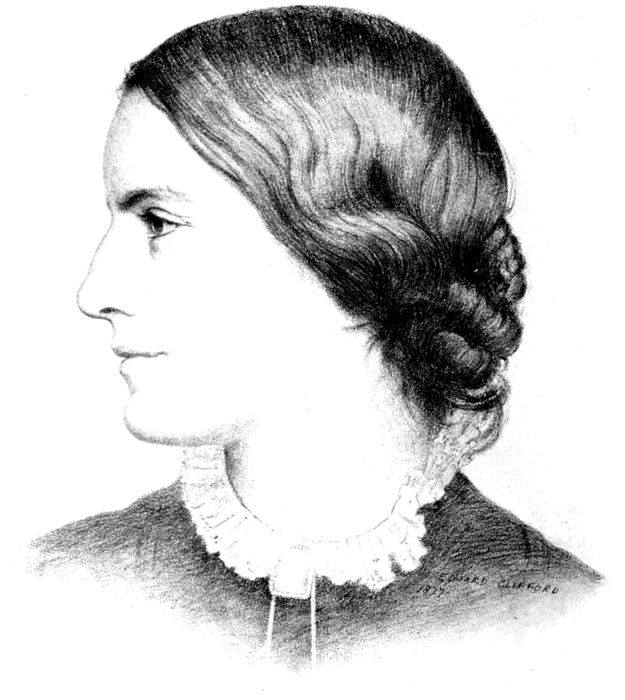
Octavia Hill. From a Drawing by Edward Clifford. 1877.
357Villa Cattaneo, Nervi Riviera de Levante,
February 4th, 1878.
The MacDonalds are very kind, but I rest much more on Miss Yorke’s quiet, strong, wise help. There is something so sterling in her. She says little, and does so much. I am deeply interested about the war, and long for news. We get no newspapers here! And, for the first time in my life, I do miss them sadly.
AN ARTIST’S WISH FOR HIS FRIEND
52, Wigmore Street,
January 24th, 1878.
Edward Clifford[87] to Octavia.
Dear Miss Hill,
I write just a little greeting to you, as one of the many friends who are thinking pretty often of you, and longing for the time when you may come back, revived, to all the folks who need you here.
I wished so much for you to go, that I can’t be sorry, for a moment, that you are gone. What I hope now is, that you may have a delicious sky above you, and hills and green plains on each side, and a few unexpected roses, and the promise of anemones and violets before long; and that you are already feeling, as it were, in a new planet, and as if everything had happened about forty years ago. Distance and time are more like each other than might be supposed.
Don’t, of course, think of answering any note of mine. I shall hear of you, I hope, from Miss Miranda.
Yours sincerely,
Edward Clifford.
35814, Nottingham Place,
January 27th, 1878.
Mrs. Hill to Octavia.
My own dearest child,
I feel it a great blessing that you have no anxiety about your work. I am glad, both for its sake, and for yours; for I am sure you could not recover, as we wish you to do, if you felt things were likely to go ill. I hope this change will prove an improvement in its organisation, and the beginning of an easier life for you. You have climbed the hill far enough to look back, and survey the road passed over; and reflection will suggest to you by what future paths the goal you set before yourself is most likely to be reached. Accept this interval, as a precious time lent you for retrospect and prospect, and for renewing the bodily health that you have expended so unsparingly.
Your loving Mother.
c/o George MacDonald, Esq.,
Villa Cattaneo,
February 9th, 1878.
Octavia to Emily.
I should greatly prefer, if you have time, that you should train a lady on each Committee[88] to wise relief with the fund,[89] rather than spend it on entertainments. You see I want to distribute power, not to accumulate it, and to bring it near the workers, who are face to face with the poor.
We know no news except what we learn in private letters; not a creature here sees a paper. I don’t know, if the six million is voted, nor whether the Pope is dead.
MEMORIES OF MAZZINI IN GENOA
359Villa Cattaneo, Nervi,
February 12th, 1878.
To Emily and Edmund Maurice.
... We found Vaccari, a young shopman in a jeweller’s shop, in a little back street in Genoa. He was greatly delighted, and told us it was the first donation they had had from England, he thought. He was so sorry not to show us the house himself, (he could not leave his master’s shop on a week day) so that we fixed to go in to Genoa, on purpose, on Sunday, and to see the house and the tomb.
We drove first to the cemetery. On a little plateau there were four tombs. One of Mazzini’s mother, buried in 1852. It seems he chose the spot himself. He came unknown to Genoa, made his way into the cemetery, mingled with the crowd, wandered over the place, and chose this spot for her burial. He then returned to Geneva, and wrote to a friend of his in Genoa, asking him to arrange the burial. He planned the stone himself. There is a profile bas-relief of her; and the stone simply records that it is that of Maria Mazzini, the mother of the exile, Joseph Mazzini (escile is, I suppose, exile). Six very beautiful cypresses stand round the tomb, three on each side. The feeling is one of space, air, freedom, simplicity, and tenderness. Next to her tomb is that of Savi, much less simple, but beautiful. The third grave is that of a stranger. Behind the three is a kind of cavern, in the side of the steep rocky slope which rises high above. This cavern has a very simple massive Egyptian-looking entrance over which alone stand the words “Giuseppe Mazzini.” Within is the tomb. The whole was designed by a young workman not twenty years old, but a disciple of Mazzini’s.
360We went then to the house. High but very humble; a dark staircase leads to a dark back room looking out upon one of the narrow viciola with which Genoa is traversed; here an old man, looking very poor, but (V. told us) who had known M. well, was carving little wooden frames by the faint light which came in just by the window. V. led us very solemnly into a small room leading out of this, where he told us Mazzini was born. This contained a book-case with their club-library—not in all more than double the size of mine—and several more portraits and relics of their heroes. It was evident the club used this as a little reading or committee room. There were besides numerous casts, engravings, photographs, and little busts of Mazzini, Mamelli, M.’s mother, and others; a little glass case with the quill pen with which M. wrote one of his books, the cockade he wore at Rome, two pairs of his spectacles, a tiny little letter from him, and a lock of his hair; another autograph framed, nearly undecipherable, had been written the day before his death.
The whole morning was to me very interesting and instructive; of course I judge from very slight data, but it appeared to me that we had come upon a man of deep and strong conviction, of much education, much thought, one of a company of poor men, bound together in closest fellowship by a common reverence, a common hope, and memory of a time of real danger and adversity. Their efforts were very touching. We asked what hope there was of collecting the remainder of the money. V. answered that they meant to do it. “Mais, madame, pour les ouvriers ça demande du temps.” We asked about the chance of securing the books. “Some of us,” he replied, “have the works of Signor Mazzini; it is our intention to present them to the 361library. We have ourselves read them, and made notes, that we may be able to spare them the better.” Something like a library that, written first indelibly in men’s minds. Their small contributions, too, for purchasing the house were touching.
REVERENCE FOR RELICS OF MAZZINI
I could not help thinking it strange that a man of such thought, dwelling on the far future with quiet hope, speaking of education as the thing to desire, and having come face to face with great men, at great epochs, should tell us, with such impressiveness, that one man in Genoa had Mazzini’s purse, his sword and other things. No body of workmen in England would speak so of any dead man’s possessions. Has the worship of saints’ relics thus coloured the forms of reverence? Was it that the times in England have needed and produced no such heroism, as that of the man who held his life in his hands for years, and chose exile for his fellow citizens? Was it that definite creeds of Catholicism had been cast aside by these men? no other profession of faith except reverence for country and heroes adopted? Is it southern adoration? Or what made the difference? I ask myself and know too little to reply. But of one thing I am sure; it is not that the spirit is less important than the accident of form. Except in that question of the autograph, I was struck again and again at the way in which Vaccari went right thro’ the non-essential to the essential.
All thro’ the interview I felt painfully that I knew too little to learn a tenth part from him of what I might. He gave me credit again and again for knowledge, and was disappointed by my ignorance. I stopped him to tell me about an inscription on a house I had noticed. It was to Mamelli saying that he gave his blood to his country, and his poems to posterity, 362and that in that house he had his cradle and his dwelling. He thought I knew that Mamelli had died young, wounded at the siege of Rome in 1849; and his face lighted with joy and he broke from French into his native Italian as he said it was he who sent Mazzini the message, “Rome is a republic! Come!” He told me that the mother of Mamelli still lived in a garret there, and his sister. I admired the stone and inscription, and he said with pleased smile, “It is we” (that was I think his circolo or club) “which drew out and planned it there.”
I suppose it will live rent free, if these three little rooms, of to them holy memory, are purchased.
I wish Edmund would write to him, if ever occasion offers. He seemed so delighted with sympathy, and must have felt me very stupid—of course I am ignorant, and the difficulty of language was great. I could understand, but not talk. I could have done nothing but for Miss Yorke, who was so kind; she knew less than I did, much! But she took such pains, and asked everything I asked her. They look upon England as very rich, and cared for sympathy. He did not want us to think they were not really in earnest because the matter took time here, said it was so different in England; and, when Miss Yorke said there were rich men in Genoa, he said, “Oh, yes, but not so many, and it is not they who listened to Mazzini.”
Octavia.
Rome,
March 14th, 1878.
Octavia to her Mother.
I write to-day, to be sure to send a letter in time for your birthday; time and strength are so uncertain 363now, one has to be beforehand with things. I think of you so, and shall think of you on the day. My thoughts of you all make me realise how you are all doing, and have done so much, and how little I am doing to combat the difficulties that every day brings. I do hope you all know that I am better; that will make one anxiety less. How I think of you all, of dear Andy bearing the burden of all management; of dear Florence keeping to work with her frail health; of dear Gertrude so marvellously carrying on my work; and of dear Minnie doing all so perfectly, and thinking of everyone. Among them all, however, you seem to me to have the heaviest weight, who have to care for us all and think for and of us, and be our centre and head.
EXPEDITIONS FROM ROME
Hotel Vittoria, Rome,
April 3rd, 1878.
To her Mother.
I have been thinking that it would be a very good thing if, at the end of May, you were to come out to me for a month. By that time I shall be in Switzerland. I am not a very bright companion, and we should not be able to travel about; still, I think you might enjoy the beauty and the quiet; and, if you were to bring a few books, we might sit out of doors and read together.... We went to Albano and La Riccia, which Ruskin knew; and I began to look a little more; the flowers were lovely, and I liked seeing the site of Long Alba, and Monte Cavo, sacred to Jupiter Latiaris. I drew a great tomb there. Yesterday we went to Ostia. I drew the castle, and also drew, in a great fir wood near the sea at Castel Fusano. We have been sixteen long drives to places since we 364came here—many of them full of beauty and interest. Ruskin and Virgil made me feel more at home at Albano and Ostia. I fancy, too, I am really better the last two days.
Hotel Vittoria, Rome,
April 4th (1878).
To her Mother.
... We drive to-day to Tivoli, to-morrow to Subiaco (St. Bernard’s Monastery); on Saturday to Olevano; on Sunday we drive thro’ Palestrina to Frascati. On Monday we shall see Tusculum, and then drive to Albano, where we shall probably stay some days. Miss Y. has gone to tell the carriage not to come before post time, because I want news of you all before starting.... We drove yesterday to Veci; it was a lovely drive. I am certainly better. I am much stronger, but I must not try yet even a little walking: it hurts my head. How interested you would have been with all these beautiful places and historical associations! It is a splendid way of seeing them to drive out, as we have been doing for the last three weeks. Of course one loses much by not being able to walk, even a little, when one gets there; especially in a country where the existence of a road to a place seems an exception to be noted.
Perugia,
April 14th, 1878.
To Miranda.
You would have been interested in Assisi. It is quite unspoiled. There is not a new or unsightly building there. It is marvellous to see how one man has stamped his mark upon it for 550 years. Where 365he has marked it, and where he could not make his mark, is equally notable. It was interesting too to see the place now, when the institutions he founded, and which necessarily have preserved many outward rules of his, are on the eve of passing away: and to pause and wonder what effect their disappearance will have on the influence he exercises. The little town stands on the sunny side of a very bare hill. It is full of towers, and balconies and loggie, and old arches; it seems well-to-do, but old-world, living only by its memory—St. Francis a kind of living soul preserving and pervading its body.
IMPRESSIONS OF ASSISI
Inside the town stands the tiny little church of San Damiano, the one he wanted to rebuild at first, and for which he took the money. Sta. Chiara and her nuns were first there. All has been preserved as it was then. The tiny church, the rough choir seats, the simple nameless burial place, the vaulted refectory with its rugged seats, the small rude infirmary, Sta. Chiara’s little room, are all there, and have received, as herself did, his own stamp of humility, simplicity, and poverty, more truly, more abidingly than any others. They say she kept the Saracen from touching them by looking from a window; but, when she died, the nuns were frightened; and the citizens built for them a church and nunnery in the town. This, a large church, has now no marks of either simplicity or special beauty that I cared for, except four frescoes by Giotto, on the vaults of so high a roof that I could see little except the exquisite glow of resplendent colour, and enough of angel form to fall in with the general impression Assisi gives, that these glad and bright visitants were by the holy and humble men of heart, who dwelt and painted there, felt to be all around them, whether they kneel on earth 366during a crucifixion, or support the head of a dying saint, or guide a mortal on his dark path, or in bright companies fill the visible heaven, or, with stately splendour, stand in myriads before the rapt eyes of the man who conquers temptation. One feels no surprise; the sight of their high holy and cloudless faces seems quite familiar; it is as if earth and heaven must be filled with them; one feels one might hear the rush of their great wings any moment, or hear their swift strong tread either; and they are companionable too, not far from men, “not too bright and good for human nature’s daily food”; or, at least, the barrier is so slight a one, that it gives us no surprise when they step down among men, or when a weary man is lifted suddenly by and among them.
The monk who showed us over the church gave us a very graphic account of the discovery and opening of St. F.’s coffin fifty years ago. It reminded one of “Past and Present.” No one knew exactly where the coffin would be; they only knew the church had been built for the body to be brought there, just after his death. The Pope declared the coffin would be certainly under the altar. They would not disturb this, and so tunnelled sideways. They worked at night only, not to disturb the minds of the townspeople. They worked fifty-two nights; then they found the coffin. The head lay pillowed on a stone, the arms crossed; the figure was perfect for a moment, but crumbled as the air reached it. Medals proved its authenticity. It was sent to Rome to be certified by the Pope; then carried in procession through the town which was “full! full!” the monk said, “for everyone came, for he was not only a saint, but he did much good to all people; so everyone came to it.” Then they replaced the coffin on the solid 367rock, where for 500 years it had been, hollowed a chapel round it, and there it is. And he so humble a man, who wanted to be out of sight! Strangely sweet did the tiny little church of Portiuncula seem; and the little hut by it where he died, which now are enclosed by the great dome of St. Maria degli Angeli in the plain just below Assisi. They seemed to bring back the simple, child-like heart of the man; they and the home of Sta. Chiara seemed to me almost more to recall him than even the solemn glory of the frescoes on the twilight richness of San Francesco. And now the order he established will pass away.
REPORTS OF HOME WORK
May 11th, 1878 or 9?
Miranda to Octavia.
Miss Cons has spent Mr. Crewdson’s £10 on the Walmer Castle library, which has now 300 volumes and sixty members, many of them lads from sixteen to twenty. Miss Cons goes to the Walmer Castle herself from three to eleven every alternate Sunday afternoon; to set the managers free to go out. She said half-apologetically, “I don’t serve unless there is a great press; but I see that things go right.”
July 21st, 1878.
Gertrude to Octavia.
When I was in B. Court I took round some of the notices about the Club, as Mr. Brock had spoken so warmly of its efforts to right itself; and I had a very nice talk with Hobbs. He promised to go and talk to Mr. Brock that evening, and spoke with pleasure of the old days, when those who were teetotalers and those who were not worked side by side, and its own funds made it self-supporting. Bristow, too, spoke to Miss 368Garton most heartily. He brought out a chair that they might talk more comfortably; and he said he would sacrifice “I don’t know what time and money” rather than see the Club broken up. This week, too, Miss Kennedy sends good news from Dublin. She says she has been afloat three weeks with her father’s property in Dublin, which was neglected. She has adopted all your plans and books, and writes up for printed forms; and she seemed so interested. But just as keen as ever about B. Court. She says, “I had a delightful interview with Mrs. Fitch, just before leaving London, and we talked out all or most of our new ideas and wishes. So I hope the ‘alliance’ will be most satisfactory. I will do all I know to make it so.”
Hôtel Bellevue, Thun,
August 5th, 1878.
To Miranda.
We go on so freely just from place to place as each day seems best, quite out of the beat of tourists, and off the regular tracks, really near the lives and heart of the people. We see them in their chalets and gardens, and in the upland fields bringing back their harvests. To-day we have crossed sunny plains and uplands, and come along the ravines beside lovely rivers, and stopped to lunch at queer old-fashioned inns. I don’t expect to like it so much when we get to the grander scenery. I expect the roads are fewer, and the tracks more beaten; we shall meet more tourists and tourists’ inns. But still, as we take carriages and stop where we like, we can avoid the worst places. We have all our luggage with us; and, when the horses are fed, we take out our books and cloaks, and sit in fields and woods. At the inns and hotels Miss Y. is perfectly at 369her ease, and makes every place at once like home. She is, too, up to all emergencies, like Mr. Barnett or Miss Cons; so, if we have an adventure on the way, she knows what to do and all that is safe and right. She knows at a glance which carriages are large enough, what hotels are suitable, which drags are strong enough, at which places we may leave luggage unwatched, what men would fulfil engagements without supervision, etc., etc.
MISS YORKE’S RESOURCEFULNESS
How you would rejoice to see the simple happy homes of the people, and all the wild woods, streams, and rocks, and pretty fields!
Bernina Hospice,
September 14th, 1878.
Octavia to her Mother.
We are here at the queerest, nicest, out of the way place. It is a capital hotel, the people kindly, simple, and capable. We are the only people staying here, tho’ travellers call continually. To our great delight last night heavy snow began to fall, and has continued all day. The sky is evidently full of snow, and we cannot see far, but, between the swiftly falling flakes, we dimly see the great slopes of the near mountains, and a white ghost-like lake fed by the glacier opposite. Beyond it we see a narrow little barrier of rocks (which was black when we arrived, but now is quite white) which separates us from another little lake called Lago Nero, fed not by glaciers but by springs, and which therefore is dark and clear, not thick and white like Lago Bianco. The narrow little barrier marks the watershed, from which streams descend on one side to the Black Sea, and on the other to the Adriatic.
370Zernetz,
October 1st, 1878.
To her Mother.
The drive to-day was magnificent, the weather beautiful (this was our fifteenth pass, this is the only one we have been over twice). It is much more beautiful, now the snow is so much more abundant. The larches are the brightest pale gold. The cloud shadows were lovely to-day. We get the warmest welcome from all the people we have seen before. Miss Y. sees, recognises, and remembers all about them all. It is quite funny when we drive thro’ a town or village; she sees the driver who took us to one place, or the girl from whom we bought something; it is marvellous how she remembers them after such slight acquaintance, or under such different appearances. It makes all the people so pleased. It is very strange; the season is over, and the hotels are closed, or not expecting visitors; and the masters of some of them are hard at work, in rough clothes, doing field labour—some of course have other hotels at Cannes or Nice—but others, who looked so spick and span in the summer, you meet now with a long whip in the lanes, following an ox-cart with hay.
We had such a pathetic, interesting driver to-day, a brown, weather-beaten, much-enduring man. He drove us in the summer, and won Miss Y.’s heart by taking so much care of his horse, and so little of himself. He looked worn and shabby then, when everyone looked spruce. His little flaxen-haired girl of three years old ran out to see him, and he took her up on the box for a few yards. To-day we engaged him again, and he was so pleased; he’s so hard-working looking. I think he is rarely employed as a driver. The 40 francs seemed a very large sum to him; and he put on such a gigantic, 371very clean collar in honour of the day. He walked a large part of the forty miles to save his horse; and Miss Y. noticed what a small dinner he ordered, and that he never lighted a cigar all day (so different from most of the drivers) till just as we were coming here, when, with a solemn and pleased air, as if it were the right thing, he lighted one to drive up smoking. He doesn’t look wretched, only long-suffering, as to weather and work, and very careful. We have engaged him to take us on thirty-eight miles to-morrow; and I daresay he will carry home his 80 francs and spend or save it very providently.
Tyrol,
October 4th, 1878.
To Miranda.
Will Minnie look into the question of the Commons Preservation appeal, with a view to considering whether or not to give £20 of the Ruskin donation money? On the one hand they must be very careful about litigation; on the other, their hands ought to be strengthened to carry on that which is wise.
EXPERIENCES IN TYROL
Bruneck,
October 13th, 1878.
To her Mother.
I think you would be much interested by the old-world life here, and the customs handed down for generations. Maggie is very kind in explaining the things we see. Yesterday troops of cattle were returning from the mountain pastures to their winter homes near the farms. Each troop had its best cow decorated with a cow-crown, a high and bright erection of which the creature was very proud. She wore also a bright, 372broad, embroidered collar, and a gigantic sweet-toned bell, much larger than I ever saw in Switzerland. Cows, goats, oxen, sheep, and men all came together, most of them more or less adorned with flowers, ribbons, bells, and embroidery. But the principal cow, quite conscious of her honour, walked in a stately way in front. The people came out in force, in every village, to see them pass; and the greatest excitement prevailed to see in what condition they returned. To-day, after mass, they are all turned into the largest field on each farm, and the neighbours go round to pay visits to see how each herd has prospered. The senner or dairyman, who has been in charge, brings down in triumph all his butter and cheeses; and they go quite far out of their way, to pass in triumphal procession with the flocks through Bruneck itself. I suppose as a kind of type of the plenty he brings, it is the custom for him to store his pockets with cakes which he gives to the villagers on his way down. Maggie told us last year their queen cow broke her horn just before they should return; and she had to be deposed, and was very depressed; another cow had to be trained to wear a crown; they practised with a milking stool, and had to teach her to walk first. I thought Blanche would like to hear all this. We drove yesterday to Tauffers, a village twelve miles from here. It lies at the head of a valley, and six weeks ago was a lovely village full of gardens and surrounded by meadows. But, one Saturday, the river ceased to flow; and they were alarmed. It seemed a mass from an avalanche had fallen into it and blocked it; and, after the body of water had accumulated behind it, it suddenly broke thro’ the dam and tore in headlong force along, carrying great rocky sand and trees in its course. For six hours it tore along; and then the men could get out to see to 373the cattle. Every bridge between them and Bruneck and the outer world was torn away. There were some Austrian tourists there; and two of them volunteered to scramble over the waste of ruin, and climb along the edge of the mountain down to Bruneck with some of the villagers; and they came to the burgomaster here, and bore witness to the desolation. The burgomaster sent a great drum thro’ the town announcing the catastrophe; and all the peasants round brought food and carts and horses, and worked with a will.
LIFE OF A TYROLESE PEASANT
The Tyrol,
October 27th, 1878.
To Miranda.
Did I tell you how here the elder brother has all and the younger has nothing but the right to support, and labourers’ wages in return for labourers’ work, on the ancestral estate? Some go away to make a place for themselves elsewhere; but many don’t. They can never marry, and they grow old in a life of humble service on their brother’s land.
Mr. Howitt has been much touched by the life and character of the brother of the old man who owns this farm, and wrote these lines which he would like you to see. He told us of the old man’s silent life, strict attention to the cattle, reverent raising of his hat, and letting his grey hair be caught by the wind, as he prayed in the field when the vesper bell rang in the distant town, and of his unnoticed place among the other labourers; and how when his nephew was married, he thought he must make him a present; so he asked leave to go into the bedroom let to the Howitts, where the chest of drawers containing his own earthly possessions stood; how he took out a 374green little old jug made in the form of an animal, of no value, but all that he could find to give. Take care of the lines, for I like them.
Lienz,
November 2nd, 1878.
To Miranda.
I should be frantic if you didn’t so beautifully report all you send, so that I know what there ought to be.
I was so delighted with Miss Martineau’s letters; it seems to me to show how much things have taken root, and how much heart there is in things, and how people are helping one another. I wonder if Mrs. Wilson is sure to be fully occupied. It is delightful when the volunteers themselves do so much; but I hope they will use the assistants in other fields.
It is no use frittering time and strength in many places.
St. Michael, November 9th, 1878.
To her Mother.
TYROLESE SCENERY
I really ought to tell you of our travels, they are so full of interesting things. At Heiligenblut, on Wednesday, we hadn’t very fine weather; the sky was dark as when snow is coming; but we went a scramble up to a high point (where there was a ruined chapel with a fine view of the Gross Glockner) and all the snowy valley and peaks, and all up, by an icy stream, which reminded me very much of Lowell’s Sir Launfal. On Thursday the weather was really magnificent, clear, bright, and so sunny. We saw the Gross Glockner to perfection, and then drove three hours to Winklern. We had a dreadful char-a-banc with such gaps in the 375boards of the floor; it was very draughty for our feet, but we had such views! At Winklern we changed carriages, and started for another four hour drive to Ober Vellach; but the fates seemed against us; first the axle of the carriage broke and quietly deposited us on the ground to our infinite amusement. The driver went off with the horse to try to borrow another; and I sat in the sun trying to draw a chalet, with such Indian corn outside it, and above, the golden larches, and beyond them the slope of snow; but I hadn’t time to do anything. The man returned with a kind of cart, but very comfortable. We drove some way in it, when the man looked and saw the cord, which had tied our luggage, loose, and all the luggage gone. We made him drive back some miles; and there quite quietly in the middle of the road stood the luggage, neither walker nor driver having passed. It began to get late; the sun set, in wonderful splendour; and then the moon rose. We were driving thro’ a long defile in which a torrent joins the Möll. It is a wildly destructive one, and has strewn the whole valley with stupendous stones, and dug channels among them, and tossed them here and there over all the waste. The road threads its way, now down into channels of half frozen water, now up great banks of stones; here and there the Möll expands into small lakes, in which the opposite slopes of snow-covered fir trees and the moon and snow peaks were exquisitely reflected; and for miles we went without seeing a house. It was very lovely. On Friday we drove only 20 miles to Spital; the weather was quite lovely, every blade of grass sparkled in the sunlight, and the frosty air made everything bright. We had two fine grey horses, which greatly delighted Miss Y. They trotted along the frozen snow 376at a fine pace. To-day we have driven 29 miles, from Spital, by Gmund and Rennwig, here. It was not clear when we started; a snow cloud seemed to darken the sky. We climbed a long steep bleak hill, and then saw the folds of the hills north, south, east, and west, and the river, by which we were to travel so long, deep in its channel, far below us; still the light was not beautiful. Gmund is a funny old-world place, with an arched gateway to enter by, and another under a château to go out by, and a fine old statue on a bridge,—nothing pretty in it, only it looks so asleep. The road led on for nine miles more by the river, till we came to Rennwig. There we were to change our carriage for one with two horses, as the Katschburg over which we had to pass is steep. We went into the inn to have some coffee. There were the maids spinning and the mistress working, and our driver came in for his food; all in the same large warm sitting-room where we were. To our intense delight, when we came out, we found we were to have a sledge and two large horses, strong as cart-horses, to draw it. It was very comfortable; we had no end of wraps; and Miss Y. bought us each some great warm over-boots this morning. There we sat, as warm as could be, with our luggage packed round us. We saw at once that the day, the middle of which had cleared and been splendid, had changed its mind, and more snow was coming, as a heavy cloud hung over the mountain in front. Slowly, lightly, thickly it began to fall; the great fir-covered slopes were seen through the mist of it; the landscape was little changed by it, for there was much before; the road was thick with it, the drifts white and deep; the mountains loomed large and white; then the moon rose, and the snow 377ceased. Such a silence, such a scene I never saw; for nine miles we drove without passing a house or a person. |A TYROLESE INN| Our driver had a great horn, which he blew before a bend in the road, to warn any sledge that might be coming; and the unfamiliar sound seemed to make the silence more marked. We are on a post road, and employing postal vehicles, and all is safe and familiar, and easy to the people evidently, but very impressive to us. We are, as you say, seeing the country as it is, and not in gala dress for tourists. We like the people much. We seem a great marvel to them; they see few tourists here, and few English anywhere. We are in a very comfortable inn, but surrounded by deep snow. We are much amused with the people in the room where we had supper. A perfectly sober, orderly, well-behaved set of men and women came in to supper. One great dish was placed in the middle of the table; they all helped themselves to it with spoons, which they took out of their pockets. When they had finished, they sucked their spoons and pocketed them. The master and mistress of the hotel, their servants and children, came next. They had a plate each allowed them, but only one glass amongst them. They give us many things which they think the right thing; but they evidently regard them as great luxuries, and to be taken great care of. The little bits of carpet beside our beds they carefully fold up every morning and put away all day, and get them out for us each night. Their little charges are somewhat touching. They ask us how much bread we have eaten, and charge accordingly. We go on to Radstadt to-morrow. Don’t be anxious about us, we are very cautious; and I never saw anything like Miss Y.’s knowledge and observation. She knows the strength and power and time and chances of all things.
378St. Johann in Pongau,
November 11th.
We had such a day yesterday! We came sleighing fifty miles. We came by Unter Tauern down to Radstadt, and then it being only 3.30 o’clock, and as we had only driven forty miles, we thought, after dining and asking for a chance post card, we would go nine and a half miles to Wagram, as we wanted to see the winter sunset over the snow, and it would give us more time at Gastein. We drove off, still all in sledges; and a splendid sunset it was. It was quite dark when we drove into Wagram, which appears in large letters on the map; but, as Baedeker mentions no inn, we had enquired at Radstadt which was the best. It was a rough place indeed, but the woman took us upstairs, promising a room, when suddenly, whether it was that in the light she saw we were quite unlike the country people, or what, I can’t say, but she turned resolutely downstairs, took us into a kind of top room to parley; and nothing could induce her to give us a room. Moreover, she declared that there was no horse in the village which would take us on. The master, our coachman, and all the men in the room supported her. Miss Y. really believed them, she is so very disinclined to suspicion; they seemed to send and see, but became more positive. “Oh,” I said, “get a room; they’ll send us on to-morrow.” “There was no room,” they said. I thought they looked simple people frightened at us, so I said, “Ask her what she advises us to do.” Go back to Radstadt, two hours’ drive in the utter dark. However, there was nothing for it, and laughing we agreed. We still stood talking. “Tell her we’re English,” I suggested, “and have many railways in England, and no sledges”; for I saw one of the great 379causes of suspicion was that we hadn’t gone round by railway. |MISS YORKE’S DIPLOMACY| Miss Y. told them; and they became interested. She was very gentle, and, I think, touched them; for suddenly the men made a sign to her to accompany them. I followed their flaring tallow candle thro’ great barns, out into the stable yard, where in solemn circle they showed her a sledge, such as peasants use, just a platform of boards on runners. “Would that do?” “Certainly, perfectly.” So persistently truthful was she that she thought they meant a man would drag it, and said pleasantly, “Oh, it didn’t matter about a horse at all.” Horse! they’d a beautiful horse, she must really see it; so she was conducted thro’ great barns to the stable. She admired duly the great animals, but still clinging to her belief in their truth, said, “But they can’t go in the snow.” “Oh, beautifully!” they exclaimed. So all was settled. The good woman, touched by her gentleness, couldn’t do enough for her, and fetched her own great slippers lest her feet should be wet, and they all took us under their wings. They would make us go into the hot tap-room, and there kept us for two hours, while they prepared our room. We were made to draw up to the common table, and saw the moderate drink and food, the strong young women walkers who came in for their dry bread and beer, laid down their bundles, and set off again to walk all night. We saw the men drinking, and they looked with much interest at our maps. Meantime we saw them wash our sheets and bring them in to dry; and we felt the preparations the women were making above, while the men did the honours below. We hinted our fatigue; but it was all of no use. At last we got the man to take us up to our room. The woman was giving it a final sweeping, and wasn’t very 380pleased; but we admired the room and won her heart. A long low room with beams showing fine tiny latticed windows, a great massive wooden door with such a carved pediment, a long shelf running all round the room under the ceiling, set all round with shining pewter plates, two feet in diameter, against which hung numerous glass tankards. The beds were very small, but quite comfortable. The man asked the woman if she had given us water, “Oh yes, sehr viel”—very much—she replied. We found it a decanter full, and we had one towel between us; but evidently her very best, all embroidered at the end. They did their utmost for us. They seemed a little relieved, and very much pleased when Miss Y. paid them this morning. The man showed it to the woman, as much as to say, “I told you they would pay all right”; and she nodded a self-controlled, satisfied little nod. We all shook hands; and we drove off, sitting back to back on the sledge, our feet down at each side; they could be put into a ring like a stirrup when we chose; our luggage tied on near us, and we came merrily on here thro’ the snow. Now we are going on to Lind.
November 26th, 1878.
Octavia to her Mother.
I hope you will receive safely a letter I posted from Innsbruck to tell you that I am coming home for a very short time, and that I expect to arrive on Saturday evening, November 30th, but may be as late as Monday 2nd (evening).
We drove here from Imst to-day, forty-one miles thro’ the Ober-Inn-Thal, and passed all along the defile of the Finstermunster. It has been the worst day we have had for seeing the scenery; still I thought it very 381grand, and was glad to see what threatening snow looks like. The great swirls of wild white cloud, breaking and clinging against the mountain sides, and lying level in narrow ravines, were very grand. The Finstermunster is very impressive, the Inn threads its way 500 feet below the road; and the craggy cliffs above the road were stupendous. We hope the snow may fall heavily to-night, and leave it clear for the Engadine to-morrow. Yesterday, when we drove thirty-seven miles from Innsbruck to Imst, it was quite fine nearly all day. Here we are in our old quarters at Nauders, at the old-fashioned inn we liked; but we have had to come to the other side of the house to secure a room with a stove, very necessary with snow deep round everywhere.
I shall turn up in a very forlorn condition, as to dress fit for London.... I try not to think of coming back; I daren’t.
LETTER TO A NIECE
Salzburg,
November 17th, 1878.
To her Niece, Blanche Lewes (aged 6).
I was so pleased by your sending me the little bunch of roses in Mama’s letter. I was glad to hear of your moving to Elm Cottage. I fancy it is very pretty. I hope you and Maud like being there.
I suppose you very often go to see Aunt Margaret. You would be interested to see the way we travel here. There is thick snow on the ground; and we go on sledges,—that is carriages that have no wheels, but go easily in the snow. They go very fast.
The other day we started before it was light. The moon was shining brightly; there was a little light in the sky where the sun would rise. Miss Yorke and I 382sat in a sledge, which is so low that one feels almost on the ground.
The driver had on a great fur coat, a fur cap, and great fur gloves. He looked like a picture of a Laplander; but we had a horse, not a reindeer, to draw us. There was another sledge behind us with our luggage. I couldn’t think why the white horse that was drawing it kept coming and rubbing his nose against my shoulder; and I thought, too, that it was a little frisky sometimes. When it got excited, it seemed to prance about a good deal; and I wondered why the driver let it.
But soon we saw that the good little creature was being trusted to follow without any driver at all.
He followed for twelve miles, till we changed horses, over the mountain and over the wide tracts of snow, where the road was only marked by posts which stood up from the snow; and through the quiet little mountain villages, where the people were just waking and coming out to cut a way through the snow to their cow-houses or wood-sheds.
Every now and then the driver of our sledge turned back and called, “Cieco, Cieco” to the horse; and he trotted up, and rubbed his nose against my shoulder. We met the peasants walking. It was hard work in the snow; even where our horse had been, it was over their knees. One boy had a little dog with him; he wanted to keep it out of the snow, and had buttoned it into his coat in front; its little head looked so funny, wagging in front of his chest. We went up over the mountains where there were no more houses, and hardly any peasants to be seen, only just snow-covered mountains, and fir trees loaded with snow, and all the streams were covered or edged with icicles, some of them as tall as a cottage.
383There used to be wolves there; but I suppose there are none now. It was strangely solitary; so much so that we saw two pretty chamois going over the snow together into a fir wood. They left pretty footprints in the snow. There wasn’t another road going in the same direction for a hundred miles; so, though it was so high and cold and snowy, the people have to go over it all the winter. It was very beautiful to see the sun rise, and the snow on them looked quite rose-coloured in the light. We drove fifty miles in sledges that day. The people here all have a little ground, and they plant what they want to eat and to wear too: and they hardly ever buy anything in shops. Their cows and goats and fowls give them milk and eggs and cheese and milk; and their sheep provide them with wool; and they have flax and hemp, and the women spin and weave it; and they make it in the winter; and they make even the leather for their shoes at home from the skins of animals. Very little corn ripens here; it is not warm enough; but they make great racks, like gigantic towel rails, with numbers of rails twice as high as the houses; and there the little corn that they have and their hay are placed, that they may get sun and wind and ripen and dry.
They are very fond of their country, and have fought for it several times.
I mustn’t write you more of a letter to-day. With love and kisses to Maud and baby and Papa and Mama.
About 1878.
To Mr. Ruskin.
Thank you very much for your letter.
Please don’t think about me. If in anything you 384ever did or thought there is anything you would wish otherwise, forget it, as if it had never been. Never mind telling me, or even telling yourself, whether there was anything, or nothing, or if anything how much, or what it was; just, if it occurs to you, put it from you like an unreal thing; never let it trouble you. You know this is what I wish always.
Be sure not to trouble, so far as I am concerned, about any painful thoughts of me, which remain to you, if such there be. They are either true and will abide, or false and will vanish—it can but be for a little time.
Bagnieres de Bigorre,
February 5th, 1879.
To Mrs. Edmund Maurice.
There’s a thing I am anxious about; and that is I fear I’ve led you into what may be troublesome, as it turns out, and that is the Kyrle Open Spaces Committee.... You never said or felt or implied that you’d time for a great new work, which this kindling would be; and I write to say to you that I quite realise this, and shall not be surprised or disappointed that the K. S. C. becomes a very different thing from what we three talked of that morning, or even what I wrote of from Paris. I daresay you and E. will manage to make it a most useful opening up of the Open Space Kyrle work in London; and this will indirectly help the wilder commons slowly; in fact there need be no difference in programme; but I think you ought at once to know that I see a wide difference in expectation. It is clear there is no large or zealous body to gather together; you can’t even get an Hon. Sec., but the effort will be good as far as it goes.... It is the want of general interest, without a fire in the midst, 385that is telling. But never mind; only don’t think I expect much, nor strain yourself to do anything you don’t see your way to. Take it very quietly; go on till it grows into more life, if it may be, before all the commons are gone....
CONTRAST BETWEEN FRANCE AND TYROL
Hôtel de France, Bagnieres de Luchon,
Haute Garonne,
February 8th, 1879.
To Blanche Lewes.
I hear you were interested by my other letter. Now I am in quite another country. I am in France, and very near Spain. We meant to have ridden to-day a little way up the mountain and looked down into Spain; but there is still a little too much snow. They have no sledges here, as they had in Tyrol. The snow soon melts here. All the carts are drawn by great oxen. They draw them with their heads, not with collars as horses do. They have their heads harnessed, because their necks are so very strong. They have great sheepskins fastened on their horns, partly to look pretty, and partly, I think, to prevent the harness rubbing them. On Wednesday, we were driving in a carriage with two fine horses. We began to go up a hill, and we passed a cart with a heavy block of granite, and twelve strong oxen to draw it. We went on a very little way, and then our naughty horses didn’t like going up-hill; and, instead of going on, they went back; and they wouldn’t press against the collar; and, the more the coachman tried to drive them on, the more they went back. This is called “jibbing”; and it is very dangerous, because they can’t see where they are pushing the carriage; and they might send it off the road, down a precipice. Miss Yorke and I got out, as 386well as we could. The coachman, who had been very proud of his horses, and who had driven past the twelve oxen very dashingly (the oxen go very slowly), now said very meekly, “I must get two cows.” So he called the driver of the oxen to lend him two; and they fastened these in front of the horses. It looked so funny to see how the patient things pulled slowly and steadily up the hill; and the naughty horses couldn’t help coming, though once, when the rope broke which fastened the oxen, the horses again tried to go backwards. The man talked to the oxen all the way; they seemed to know all he meant them to do when he shouted. We couldn’t tell what he said, for the people here don’t talk French among themselves, but an old language that their neighbours can understand. They wear bright handkerchiefs tied round their heads, instead of hats or bonnets, and their boots are not made of leather, but all of wood; they are turned up at the toes, and oh! they make such a noise on the floor! Besides the oxen they use a great many mules; and they carry the milk to market in bottles slung on each side of the mules. It is much warmer here than in England, and many flowers are out already. The snowdrops grow wild in the woods.
March, 1879.
Mrs. Hill to Octavia.
Miranda gave your message to Mrs. Hollyer[90] whilst she was doing my grate. When she had left Mrs. Hollyer said, “Paradise Place is so quiet now; there are such nice respectable people. We are all so comfortable there”; then she looked up in my face 387with such a nice expression, and added, “Will you tell Miss Octavia so?” I did think it such a delicate way of returning your sympathy in her illness.
WILLIAM HOWITT’S DEATH
Rome,
March 27th, 1879.
To Mrs. Shaen.
Did you see dear Mr. Howitt’s death? We found him dying, when we came here. He was one of my oldest friends. I remember their house as one of the happiest and best I knew as a child. He used to take me for walks, when I was six years old. Mrs. Howitt looks so clearly thro’ to the meeting in the future, and has none but holy and happy recollections and the human grief is so natural, and yet the peace of trust so great. It is beautiful and helpful to me. I was almost a daughter to her, and her son who died in Australia one of my earliest companions; so she lets me slip in there, and there seems more life in the house of death than in all the sunlighted hills, for God seems so near her, and she feels that so.
Verona,
May 9th, 1879.
To Mrs. Edmund Maurice.
I am very sorry you are having so much trouble about the name; perhaps now that the real work is so abundant, and must be so engrossing, this question may die down. I do feel that the name, be it what it may, ought to mark the much larger work you propose to yourselves than the C.P.S. does; else you may hereafter have difficulty in getting all the work recognised as yours; and also people will be puzzled continuously 388and practically by your not being a branch of the C.P.S. Remind Mr. Haweis that you have to encourage gift and purchase and beautifying as well as “preservation”; that you have to do with private land as well as commons, and that you have to do with Metropolitan as well as rural open spaces. A name never includes all objects; but a narrower one belonging to a somewhat analogous society would be very confusing. So I feel.... Mr. Barnett you have probably seen.[91] His letter strikes me as depressed, and I am sorry. I realise what he says about throwing stones, but such practices often die down, after a little; and tar paving is such uninteresting London stuff; you can’t plant, or even have a may-pole in it; nor feel as if it were the earth. I hope they won’t put it, and certainly wouldn’t give a farthing to help; but I’m so sorry the burden of that and the Pensions is on him.... How splendid all the life of the movement you describe is. I have no fear if the people now interested can only be kept working with some result, enough to keep up their hope; if so, the things must grow.
Freshwater Place,
1879 or ’80.
Miss Emily Harrison to Octavia.
I got two nice little letters from children, when I was away. I heard they took my answers, and read them to the other children in the Playground. Wasn’t it nice of them? I send you my little neighbour’s artistic efforts; he is only a little chap. They had trained my scarlet runners, and left everything just as it was in my room, and welcomed me back so tenderly, 389saying the place had felt empty and dull without me. A girl, who has a lot of sisters to mother, came to tell me she had found the motto she liked best, “Love is the greatest force,” evidently learnt from experience; for they are all so fond of her. She and four sisters, and other little and big neighbours, came yesterday to work for an industrial exhibition we are going to have; and whilst they did needlework and pasting, etc., we read the “Fairy Spinner.”[92] I think M. H. was really the only one who could listen to it, as she has been ill and didn’t feel the excitement of the novelty so much as the others. Some of the dear little tots kept running past crying to the swallows and butterflies painted on the wall, “I’ll catch you bird,” “I’ll catch you butterfly,” almost as happy, dear, as if they were real ones, I think.... We came home to that dear Haven named Miranda, looking so sweet and rested and full of delightful sayings and doings of other people. Can’t you see her upturned face telling them, and a twinkle in her eyes at something funny?
ART IN FRESHWATER PLACE
No date. (Probably 1879.)
From Miss Emily Harrison.
Dearest Octavia,
Oh if one could but have a penny botanical garden in the Marylebone Road for the hot little children and weakly old people!
“Now I hope you’ll enjoy yourself,” with a hearty grasp of the hand, as much as to say, “You must now,” was the last word I heard at Freshwater Place.
I didn’t at all like leaving it. The children enjoyed 390their field day very much, I think, and kept asking, “Wasn’t it nice on Saturday?” with such a little hug of your hand! I was so pleased with one child, who, I knew, in the midst of amusing herself, simply to give me pleasure, came away to me with, “Won’t Miss like to have a game of six acres of land?” and the girl with the dreadful face behaved splendidly, and carried poor little Shannon all the way home to Swiss Cottage; for we nearly killed the poor little fellow. The cab-door burst open, and he was shot out, and I expected him to be killed on the spot. But on Sunday he was on his legs again—quite a hero; and instead of pitching into me, his parents were so kind; only too anxious to reassure me, and show how well he could walk. In fact, Johnny has come into notice ever since. I had a nice talk with grave Mrs. Wilson, who is going to lend books, and to honour me by getting me a cup of tea there; and I went to say, “How d’ye do?” and “Good-bye!” to B. Court Club, and found Mrs. Lewes there.
She was so pleased to get her rents all right; but also disappointed at many things. It seems that it is when everything looks like failure that courage comes from some bright spot, or something to start you afresh.
From a Lady helping in B. Court.
The cobbling class that I have superintended since the 2nd of December has kept up, as well as I could expect, in some respects, and very much better in others; for, though it has not increased in numbers, some boys have never missed coming. They have really learnt to mend well, and have improved so 391wonderfully in their manners to each other and to me, that, in three or four cases, we have got really fond of each other, and that is my hope for the future. Good, I like to think, may result. Nine boys attended the last evening, and seemed very sorry that it was the last, asking if, next winter, the class would be again; and, as they have once or twice hinted their hope of my taking them for something else in an evening, I am going to try; and we shall read English History to begin with, and talk, and so on; for we are really so comfortable with each other that just to be together is a pleasure to us now. They are only young. But I found that they and older boys did not do well together.... The boy beyond all the others whom I care for is James ——; and as I fear you may have heard anything but good of him—for I am the only one of your ladies who has any liking for him, except, I think, Miss Leighton,—perhaps it may be a mistake to like James as much as I do, and to hope that he will do so well. But I am quite sure that if you, dear Miss Hill, had the same cause as I have to admire all his ways and work that I can see, you would also care little for what is said about his mother and father. The first evening that he came he did nothing but watch me, and stand, rather rudely, with his cap on all the time. Also he had brought no halfpenny; and I told him that just for that evening he might stay, but that another time he could not without paying.
THE BOYS OF B. COURT
His large head and the powerful expression of his face made me think how bad, or how good, he might be, according to the way he turns. I heard that evening that he was one of the worst (English “troublesome”) boys in the Court. To my surprise 392he came the next time with his halfpenny; and, when I said that Lush the cobbler was late, he offered very civilly to go for him. I thanked him, and made much of him. During the evening he worked more steadily than any of them; and ever since he has been my best boy, both as regards working, and coming even when he has nothing to mend, just because he seems so happy to be there and to do any little thing that he possibly can for me. Mrs. Jales says that he is now much better in the Court too. To say I like him says little, for I do a great deal more than that. A woman would be strangely made who did not get to feel him as somewhat her own property, and, even if he goes wrong afterwards, not to lose her affection for him easily.
Braemar,
September 16th, 1879.
To Mrs. Shaen.
In an age when doubt assails so many young spirits with its light destruction of belief in the eternal and intangible, will not the possession of such a brother be perhaps to the elder ones something no other possession could be? Those who have never loved and lost may think of the dead as buried and done with; those whose lost ones had nothing noble or specially characteristic which was good about them, may think of them as having lived; but whoever has seen and loved a being with peculiar beauty and nobleness, will have moments, and those the best and deepest in life, when the certainty that that being still lives, will be quite quietly triumphant over all clever talk or brilliant flippancy. I think to you all Frank will be always a blessing—in spite of pain.
OPEN SPACES PRESERVATION
393On the attempt to save the site of Horsemonger Lane Gaol as an Open Space.
Braemar,
September 24th, 1879.
To Mrs. Edmund Maurice.
I think we could get the Archbishop to hold a meeting. In fact I have no fear about getting money, if dear E. can only get it into a working shape where that only is needed. After all, even if Government did give it, that only means all being taxed; and surely, so long as riches exist, there is need to call upon those who have them to give of their abundance freely and heartily to such places as Southwark; even without asking them, to make it possible for those of them who want to give to give helpfully, and, so long as there are even quite poor people with any surplus, it is a pity they should not have the joy of giving freely. Is it to be all compulsory taxes, and no free-will offering?
B. Court Club,
October 18th, 1878 or 1879 (?).
Gertrude to Octavia.
Mr. Blyth asked to come to see me on purpose to know what I thought about things. He is very hopeful, much pleased at the quiet dignified way in which the (Temperance) Lodges men behaved. They asked the old men (who are chiefly boys) what they meant to do about the debt, and their reply was that, if they could not meet it otherwise, they must sell the furniture, billiard tables, etc.! So, finally, the teetotalers have formally taken the debts (now said to be £5) upon themselves, and have also taken the tables, etc., as part of the club belongings.
There were, last week, forty-five new teetotal members, 394and there are twenty-four non-total abstainers—sixty-nine in all. Seventeen and threepence was paid in entrance fees, the whole room cleaned and put in order; and Grimmins’s first act was to fasten up with his own hands, in the renewed room, the tablet to Mr. Cockerell’s memory. They want it to be just as it all was at first, and to have a penny subscription and no ballot at election.
Eland House,
November 3rd, 1879 or ’80.
From Mrs. Edmund Maurice to Octavia.
We went to the opening of Walmer Castle, which was a great success. There were large crowds both of rich and poor. Among others Mr. Hughes, Mr. Hart, Mr. Davies, Mr. Diggle, General Gardiner, Charles and Gertrude. After the “public” had been admitted to the tap-room, and before they began making their purchases, speeches were made by one or two people. Mr. Hughes made a very nice speech, and so did Mr. Diggle, who was much applauded. He came up and asked very warmly after you, and said you would be glad to hear that all the work in St. Mary’s was going on well, and some of it was being carried on with more vigour than ever. Miss Cons looked very happy, and was busy talking to everybody. The whole place looked very clean and comfortable, and all the food very nice; there were decorations of flowers, and bright flags flying outside. We went over the house, and saw the beautiful dining-room upstairs and the smoking-room, and some very comfortable furnished little bedrooms for respectable men. General Gardiner turned to a friend and said, “We should some of us have been very glad of as good a bedroom as this at the University.” 395My fear about the bedrooms is that they are too dear. A shilling a night is not much to pay for so nice a little furnished room; but, if a working man has to pay seven shillings a week for his room, I fear he will think it too much. Downstairs there is a nice large room to be used for the Boys’ Club. It is to be decorated by the Kyrle Society.
WORK OF THE KYRLE SOCIETY
14, Nottingham Place,
October 17th, 1879.
From Miranda.
I don’t know whether Minnie will write and give you any account of the Kyrle Committee Meeting yesterday; but, in case she does not, I think you will be glad to know that all went, I think, very satisfactorily. Your letter was received with pleasure, and your offer of transferring the St. Christopher work to the Kyrle was received with warm thanks. Somebody is to be found to undertake the drawing.... Can you tell me where your large St. Christopher is? I was asked to show it yesterday, that the Committee might see how much needed completing.
The money was voted for the choir without any difficulty. We have two applications to decorate rooms for working girls.
Minnie asked, on behalf of the O.S. Committee, whether they were at liberty to appeal to the public for funds without consulting the General Committee on the subject. It was decided that they could not. Mr. N. said that he thought they never ought to take any public action without consulting the General Committee. We explained how impossible it would be to work at all, if no public action could be taken without reference to the General Committee; for all the work is 396dealing with public bodies, vestries, etc., and, when Minnie pointed out that in any doubtful case like Burnham Beeches, the O.S. Committee always had, and always would, consult the General Committee, Mr. N. was satisfied.
14, Nottingham Place, W.,
December 15th, 1879.
Octavia to a Volunteer Worker.
In order to bind the work in the Court (not the collecting, to which this letter does not refer at all) and to make the arrangements simpler and more organised, it is proposed to unite the teachers of the evening classes into a little Committee.
I hope you will be able to join this Committee. I do not think that it will involve you in any labour which will not be very easy, even to so busy a person as you; while it would, in many ways, save you trouble in making arrangements a little more organised and easy to deal with. I think you would all enjoy the little reason for meeting from time to time.
Unless any unforeseen business presents itself, I should think two meetings in the year would be ample; one to settle summer and one winter arrangements, for it is proposed to leave everyone utterly free to do on their evening precisely what seems good to them, so that the only questions that the Committee would have to deal with would be those which might clash with or influence other workers, or in which they would wish to have a voice. My sister, Mrs. Edmund Maurice, will be Secretary of the little Committee. There would be five members, including yourself; but if large questions of general interest were coming before the Committee, it would be well to invite the other workers in the Court 397to attend and vote, as the landlord is anxious for the room to be as generally useful as possible, especially as Lady Ducie has given up hers to the general use of the Court so entirely by giving the use of it to the Club. I am not without hope that I may have the great pleasure of seeing the Committee meet just once here, after Xmas, before I go. I hope rather great things from it, do you know? I feel how much the life of the Court has developed since I left. All of you seem to me stronger and quite knowing your own strength, which is an immense help. The work is more individual, more living, more firmly rooted; but I don’t like to think that you should lose anything by my absence; and I sometimes dare to hope that this little Committee might, while leaving to each of you full, free scope, give you each the little connecting link you seem as if you might lose in losing me. I mean the power of all meeting for common work, of gathering strength each from the other, of adding power and life each to the other’s work, of knowing and meeting one another, of understanding each what the other means, of pausing for a moment to see if there is anything to learn, to accept, to use in the other’s work, the sense of a common cause and of being one body to interpret that common cause in the noblest way in which it can be conceived, and to sink all little narrow views in the broadest and deepest ones.
GROWTH OF WORK IN OCTAVIA’S ABSENCE
Rome,
February 18th, 1880.
To Miranda.
What an interesting account you give of Mr. Clifford’s discussions! I believe few people will grasp what he meant the main point of the discussion to be; but I do believe they will be very useful, if they show 398people who are doing tangible good, or good less spiritual, that distinct teaching about God Himself may be needed. I think the reaction from doing that only has been too great, and that I and many people need to be reminded of that deepest way of work; tho’ I think we always take it up when we have the power, but we hardly look out for, or abundantly use, the people who have the power, nor cultivate it in ourselves. I think it is the next thing we have to aim at. In fear of undue pressure, we hardly appeal bravely enough to the indwelling power of response there must be in every one.
Brindisi,
February 20th, 1880.
To her Mother.
... I am glad you like the Diary of an Old Soul. I think MacDonald singularly excels in that quaint, simple, deeply religious poetry. Somehow he has naturally the habit of making those queer comparisons, and sudden leaps from great to small things which one finds in the old poets; and, in the same way, his deep faith atones for the strangeness. There is even something captivating in it. I think the book very beautiful. I went to see Mrs. Grey in Rome. She was so very kind and nice, and so interesting too. We talked of old times, and of the Public Day Schools, and the Kindergarten work. We also saw the Marshes.... Yesterday we came from Beneventum here. The day was wild, and there was even rain; but it was very interesting, first to cross the watershed between the Adriatic and Tyrrhenian Seas, then to traverse the great plain lying round Foggia, where four and a half million sheep used to graze, returning in winter by three great roads called the Strade dei Pecore. The merino sheep 399used to be there, now the plain is gradually being cultivated; but there are still half a million sheep, and one sees herds of great grey cattle, and droves of 40 or 60 horses, looking almost wild, grazing among the glades of oak trees, or on the open ground.
CO-OPERATION WITH CLERGY
February 21st, 1880.
Miranda to Octavia.
One of the lady workers was talking of giving food to one of the B. Crt. men, who has been ill; but I found he had just got into work, so I suggested he could get on for himself now. I then explained to her that your plan was to let St. Thomas’s Relief Committee do any absolute relief, and then to strengthen them with gifts, if you can make any. She was so much interested, and very glad to know it. She said that she had no idea you worked with the Church authorities to that extent. She knew you were a member of the Church, but had no idea you co-operated with the clergy to that extent. So many people thought you chose to be independent. I explained how anxious you were that the clergy should be willing to be co-operated with, and told her that your desire was to work with them and so was that of the C.O.S. if they would but be worked with.... Mr. E. writes: “Will Mr. M. contribute to the Thirlmere Defence Fund? He may be induced to do so when he remembers Miss Octavia Hill’s words” (evidently some words you spoke some time ago).
Hotel St. George, Corfu,
Tuesday, February 24th, 1880.
To her Mother.
We reached here on Saturday. We found no post left here for England till to-day; I hope you will 400not have thought it very long before you heard. We had a splendid passage here.... I lay on the deck nearly all day, and saw the wild, blue, beautiful Albanian shore, such a land of bare wild mountain-land. The name of the people means “Highlander.” Then we floated past the islands and into the narrow sea between Corfu and Albania, where the Venetians and Turks had their last sea fight, and the Turks tried no more to advance into Europe. It was a glorious light as we floated into Corfu about half past. When we had passed thro’ 13 miles of this forest country with the mountains in view, and here and there, but very far between, a village or two, we came out on a cliff over the sea, along which we drove three miles. The road had been made by the English soldiers, but it is now all going gradually to pieces; the arches which support the bridges over the little streams (which, by the way, are now quite dry) are all cracking, their keystones protruding; the well-built walls supporting the road on the slope of the hills are crumbling gradually down, taking the road with them. Great hollows are appearing in the road, and large stones in thousands rolling down upon it. The driver said, “Il governo non fa niente per la strada.” And there it is crumbling to decay. It does seem a pity.
We are going on board the Greek boat to-day en route for Athens. We hear the “roughness” only consists in the want of good food; that the boat and arrangements are good. There is at any rate much less open sea, and the scenery is finer. An English lady who sat by me last night said she had been both ways and much preferred ours, but the gentlemen here make a great talking about the food. I daresay it will do for us. I am doing very little drawing and no good with 401it; but it is possible I may later, and this sea could not be attempted without emerald green.
CONDITION OF PATRAS
Athens,
February 28th, 1880.
To Miranda.
Patras, their new commercial city, is nearly as pathetic and nearly as interesting as modern Athens; and one feels that from there actual safety, as well as education, and even the possibility of seeing the beauty, must spread gradually. The difficulties of travel are quite extraordinary, quite independently of the question of safety. There are no hotels, no lodgings, no beds, hardly any food, no relays of horses, no posts, no accurate guide-books, no trustworthy people to give information. And somehow one feels it will all come gradually from this little town, springing up, as it were, yesterday, with its little throb of life, which must permeate the whole before it can be healthy or alive. Even from a tourist’s point of view, mountains and woods and defiles and rivers are no use because you can’t get at them; and what of the life of the people, their education, their power of using the good things that the earth brings forth?
Hôtel des Étrangers, Athens,
March 3rd, 1880.
To her Mother.
Mrs. Coupland’s introductions have been most useful.... Dr. Milschaefer came himself to give us a lesson in modern Greek, and brought such an interesting young Greek to teach us the pronunciation. It is very interesting to see how the young national life is flowing instinctively in the old grooves. The great 402thing they have progressed in, since their independence, has been education. Their University is evidently becoming remarkable, and people are coming from Asia Minor and Turkey to study. Their girls’ schools and boys’ schools are evidently what they feel they are succeeding in. They regret, however, that everyone tries to be a lawyer or something of that kind; and that agriculture and manufacture are neglected. Evidently agriculture has a great future here. The country is much less fertile than in olden times, partly from the bad systems of cultivation, partly, I should guess, from the neglect of trees. They excuse themselves by saying that the ancient Greeks had slaves; but one feels free men ought to work as well as slaves! and one can see they know they ought to do better. One great want is population. They can and do live by the rudest systems of culture. I daresay the utter insecurity of country life, which for years (I suppose ages) has prevailed, will have prevented anyone seeing to, or caring for, farming. The Greeks look as if they had much more stamina than the Italians. I fancy their sea life has kept it up; and perhaps their mountain fastnesses, and the fiercer oppression have really been better for them than the enervated life of Italian cities under Austrian, or despotic, cultivated home rule, where the richer and nobler classes must have had the ease of civilisation without the responsibility or duty of self-government. But this is all theory to account for the greater energy one sees. Certainly the Greeks seem to me to have dealt really well with brigandage, in contrast with the Italians. After that dreadful affair in 1870,[93] the House of Deputies enacted a law for four years, punishing the 403relations of those who were with the brigands, and the villages near which it occurred, which law the English minister here tells us, really extirpated it in a few months, so that the English consuls were able officially to report that, except on the borders and in Thessaly, it no longer existed. Brigandage broke out some time ago in Acarnania, and they instantly re-enacted the law, and it disappeared. It seems to me wise and right in cases where, as here, the crime could only exist by reason of the collusion of the surrounding people. And it must be much kinder than dallying on, as the Italians keep doing in Sicily, first sending and then withdrawing troops. Mr. Corbett was so kind. Gen. Gardiner got me a letter of introduction thro’ Mr. Eric Barrington, who is Secretary to Lord Salisbury; the letter was evidently a very kind one. Mr. Corbett called at once, and gave us full and kind assurances and directions as to our movements. The border land is evidently, as every one has said thro’out, quite unsafe; but everywhere else confidence has been quite restored for some years. We have the very best advice, and shall strictly follow it, so you need not have any fear. By the way, do you know those four poor gentlemen were given a large escort, and they insisted on galloping on, and leaving them two miles behind!! So Mr. Corbett told us. It really makes a great difference as to the blame attached to the Greek authorities.
BRIGANDAGE IN GREECE
We went up Mt. Pentelicus on Monday. The day was not fine, it was wet and cold, and we had no view from the top; but I did enjoy it so very much. The colours of all the wild landscape near were so exquisite ... I never saw such lights, even in Italy. (Here follows an account of flowers found, and the difficulty of identifying them without botany books.) 404I never shall forget the sunset light coming back last night, as we saw it on Pentelicus, Parnes and Hymettus, and on the Acropolis of Athens. There was the grey-green foreground of stone and dead thyme; the red ground here and there ploughed up, the grey-green olive, or full dark pine, set far and far between; then there were the blue shadowed sides and bases of the mountains and their snow-covered tops, now in blue shadow, now in rose-coloured light, and then all the sun-lighted sides of the mountains were rose and gold; and the blue-green sea, turned in places into one silver sheet of ripple, broke on the shores with sweet musical voice. It was like a dream of perfect beauty.... Mrs. Corbett turns out to be a cousin of Lady Ducie’s, and writes most warmly about seeing me.
About difficulties in the school.
Athens,
March, 1880.
Octavia to Miranda.
Something has set the girls out of tune. I know how trying it is, and how the sense of it shuts one up, and makes it impossible to be oneself, or to trust to them. But I believe, if one could remember at such times what depths of better things there are in every human heart, and how they only need to be believed in and appealed to (especially in these young things), to spring up and grow and thrive, one would more quickly get past these trying times. There is usually either some stupid misconception, or false standard of what is desirable, confusing the young mind, some phantom, which seems good to it, and is not good; or else some real evil, which the child herself knows to 405be evil, and against which she—the better self—will side with you the teacher, if you can but assume that she is ready to do so. One may beat about the bush for any length of time, by dealing with manifestations of wrong; but if one can get near people, and get their spirits into harmony with God’s will and purpose, and make them feel that one only wants that done, one strikes at the root of the evil, and loses at once the sense of jar, because it is lost in the sense of harmony with the good in people.
GREEK SCENERY
Hôtel des Étrangers, Athens,
March 10th, 1880
To her Mother.
... I suppose this will reach you a little before your birthday (tho’ that seems hardly credible); let it bring you my loving wishes for all that is brightest and best. We went on Saturday to Tatoë, which is a little place on Mt. Parnes, where the king has built a little place for summer. It is close to the old pass of Dekelea, which the Spartans fortified, and held during the Peloponnesian War. It was a glorious day, and we thoroughly enjoyed it; Mt. Pentelicus looked quite beautiful. There is a great quantity of fir wood near the king’s place. They have cleared away trees here and there; I fancy, to let one see the giants of the native forest, which stand magnificently, throwing their arms up in the sunshine, a foreground to the blue mountains. The ground was covered with wild golden crocuses, blue anemones; and, here and there, if a little bit of land was sown with corn, there were great crimson anemones growing among it. The utter solitude of the country is so strange here. One drives for miles, and hardly sees a creature. We drove on Monday to 406the Bay of Phalerum, and spent the afternoon at the Acropolis, and saw the sunset from there. Yesterday a wild, tearing wind arose. We were to to have gone to Phyle, and the mules had been sent on; but the storm of wind raged, so we did not attempt it; in fact we could hardly stand on the hill of Areopagus, or beat our way back along the streets, when we returned from seeing the theatre of Dionysius, and the Stadium. We spent Sunday evening at Mrs. Corbett’s, and last evening at Mrs. Finlay’s, and met Mr. and Mrs. F. Noel. They go to Eubœa soon, and we shall follow soon.... As I sit, I see the snow heavily falling between me and the cypress trees. It does look so out of place.... Every one agrees in one united testimony as to the extinction of brigandage.... Here it is pretty to watch the restored confidence, and the life that is able to grow up under it. They seem to be very cautious still, and send mounted gendarmes out over all these solitary roads; but it is nice to hear the pride with which the gendarme tells you you can go anywhere.... People are beginning to build little houses in the country, and there are other marks of confidence. How interesting it is to hear, on all sides, of the love of education! It seems quite innate; the children clamour to be taught, and especially do they delight in politics. They had no toys till lately. Old Mrs. Hill, who first established schools here for girls, forty years ago, says she never sees the toy-shops without remembering how she brought the first dolls to Athens, and tried to teach the children to play. She says they all sit down to read; boys and girls stand at the corners to discuss politics. Children used to walk from Eleusis and back to attend school here.
GREEK POLITICS
407Athens,
March 18th, 1880.
To her Mother.
We saw, some few hundred yards from the hamlet, an old, broken marble pillar placed there to mark from the surrounding hilly open common a tiny space separated by a rough ridge of earth from the common; but even the ridges had gaps in them, one of which led to a stony path. We followed it, and found ourselves in the churchyard. A few graves, marked with little crosses, and planted with sweet rosemary, gathered round one which alone had a stone, a little railing, and a young date-tree planted at each corner. To our astonishment, we found the inscription in French. It was: “Oh you who pass by, pause and know that here lies an angel who waits for thee beyond there, Beatrice B.... who died in her 15th year, 1877.” It was so simple, and, having no surname, seemed to mark this more. We wondered whether French people were the cultivators, and what was the history. The people were all Greeks at the house doors in the hamlet, and we don’t know enough Greek to ask who has begun the cultivation. Still, we are getting on fast with our Greek. We often wish we knew more. There is an exciting ministerial crisis here—M. Tricoupis, the Liberal candidate, trying to overthrow, on financial questions, M. Koumondouros, the Conservative. People say M. Tricoupis is the man of most principle, but that he has not a strong party. Some of the deputies stay at this hotel, and every night at dinner they have a hot argument; but we cannot even follow the main drift—we only catch a few words here and there. If we knew more, we should learn much more. We have had a 408Greek master every night, and have been learning the grammar, when Miss Y. would let me; but it is slow work till one gets to the point of hearing.