LORD BYRON: (continued 5)
Reading edition
"I have not answered W. Scott's last letter,—but I will. I regret to hear from others that he has lately been unfortunate in pecuniary involvements. He is undoubtedly the Monarch of Parnassus, and the most English of bards. I should place Rogers next in the living list (I value him more as the last of the best school)—Moore and Campbell both third—Southey and Wordsworth and Coleridge—the rest, ὁι πολλοι—thus:—
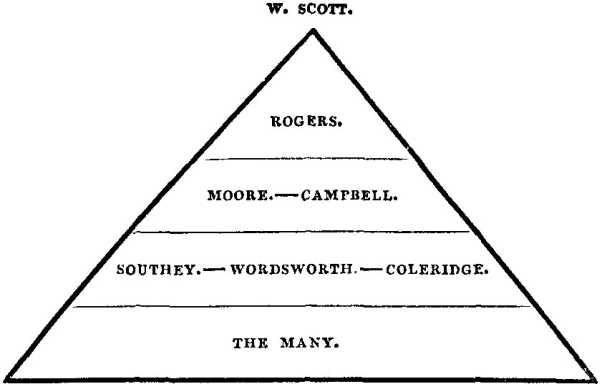
There is a triangular 'Gradus ad Parnassum!'—the names are too numerous for the base of the triangle. Poor Thurlow has gone wild about the poetry of Queen Bess's reign—c'est dommage. I have ranked the names upon my triangle more upon what I believe popular opinion, than any decided opinion of my own. For, to me, some of M * * e's last Erin sparks—'As a beam o'er the face of the waters'—'When he who adores thee'—'Oh blame not'—and 'Oh breathe not his name'—are worth all the Epics that ever were composed.
"* * thinks the Quarterly will attack me next. Let them. I have been 'peppered so highly' in my time, both ways, that it must be cayenne or aloes to make me taste. I can sincerely say that I am not very much alive now to criticism. But—in tracing this—I rather believe, that it proceeds from my not attaching that importance to authorship which many do, and which, when young, I did also. 'One gets tired of every thing, my angel,' says Valmont. The 'angels' are the only things of which I am not a little sick—but I do think the preference of writers to agents—the mighty stir made about scribbling and scribes, by themselves and others—a sign of effeminacy, degeneracy, and weakness. Who would write, who had any thing better to do? 'Action—action—action'—said Demosthenes: 'Actions—actions,' I say, and not writing,—least of all, rhyme. Look at the querulous and monotonous lives of the 'genus;'—except Cervantes, Tasso, Dante, Ariosto, Kleist (who were brave and active citizens), Aeschylus, Sophocles, and some other of the antiques also—what a worthless, idle brood it is!
"12, Mezza notte.
"Just returned from dinner with Jackson (the Emperor of Pugilism) and another of the select, at Crib's the champion's. I drank more than I like, and have brought away some three bottles of very fair claret—for I have no headach. We had Tom * * up after dinner;—very facetious, though somewhat prolix. He don't like his situation—wants to fight again—pray Pollux (or Castor, if he was the miller) he may! Tom has been a sailor—a coal heaver—and some other genteel profession, before he took to the cestus. Tom has been in action at sea, and is now only three-and-thirty. A great man! has a wife and a mistress, and conversations well—bating some sad omissions and misapplications of the aspirate. Tom is an old friend of mine; I have seen some of his best battles in my nonage. He is now a publican, and, I fear, a sinner;—for Mrs. * * is on alimony, and * *'s daughter lives with the champion. This * * told me,—Tom, having an opinion of my morals, passed her off as a legal spouse. Talking of her, he said, 'she was the truest of women'—from which I immediately inferred she could not be his wife, and so it turned out.
"These panegyrics don't belong to matrimony;—for, if 'true,' a man don't think it necessary to say so; and if not, the less he says the better. * * * * is the only man, except * * * *, I ever heard harangue upon his wife's virtue; and I listened to both with great credence and patience, and stuffed my handkerchief into my mouth, when I found yawning irresistible.—By the by, I am yawning now—so, good night to thee.—Νωἁιρων.
"Thursday, November 26.
"Awoke a little feverish, but no headach—no dreams neither, thanks to stupor! Two letters; one from * * * *'s, the other from Lady Melbourne—both excellent in their respective styles. * * * *'s contained also a very pretty lyric on 'concealed griefs;' if not her own, yet very like her. Why did she not say that the stanzas were, or were not, of her composition? I do not know whether to wish them hers or not. I have no great esteem for poetical persons, particularly women; they have so much of the 'ideal' in practics, as well as ethics.
"I have been thinking lately a good deal of Mary Duff, &c. &c. &c. &c.[96]
"Lord Holland invited me to dinner to-day; but three days' dining would destroy me. So, without eating at all since yesterday, I went to my box at Covent Garden.
"Saw * * * * looking very pretty, though quite a different style of beauty from the other two. She has the finest eyes in the world, out of which she pretends not to see, and the longest eyelashes I ever saw, since Leila's and Phannio's Moslem curtains of the light. She has much beauty,—just enough,—but is, I think, méchante.
"I have been pondering on the miseries of separation, that—oh how seldom we see those we love! yet we live ages in moments, when met. The only thing that consoles me during absence is the reflection that no mental or personal estrangement, from ennui or disagreement, can take place; and when people meet hereafter, even though many changes may have taken place in the mean time, still, unless they are tired of each other, they are ready to reunite, and do not blame each other for the circumstances that severed them.
"Saturday 27. (I believe—or rather am in doubt, which is the ne plus ultra of mortal faith.)
"I have missed a day; and, as the Irishman said, or Joe Miller says for him, 'have gained a loss,' or by the loss. Every thing is settled for Holland, and nothing but a cough, or a caprice of my fellow-traveller's, can stop us. Carriage ordered, funds prepared, and, probably, a gale of wind into the bargain. N'importe—I believe, with Clym o' the Clow, or Robin Hood, 'By our Mary, (dear name!) that art both Mother and May, I think it never was a man's lot to die before this day.' Heigh for Helvoetsluys, and so forth!
"To-night I went with young Henry Fox to see 'Nourjahad,' a drama, which the Morning Post hath laid to my charge, but of which I cannot even guess the author. I wonder what they will next inflict upon me. They cannot well sink below a melodrama; but that is better than a Satire, (at least, a personal one,) with which I stand truly arraigned, and in atonement of which I am resolved to bear silently all criticisms, abuses, and even praises, for bad pantomimes never composed by me, without even a contradictory aspect. I suppose the root of this report is my loan to the manager of my Turkish drawings for his dresses, to which he was more welcome than to my name. I suppose the real author will soon own it, as it has succeeded; if not, Job be my model, and Lethe my beverage!
"* * * * has received the portrait safe; and, in answer, the only remark she makes upon it is, 'indeed it is like'—and again, 'indeed it is like.' With her the likeness 'covered a multitude of sins;' for I happen to know that this portrait was not a flatterer, but dark and stern,—even black as the mood in which my mind was scorching last July, when I sat for it. All the others of me, like most portraits whatsoever, are, of course, more agreeable than nature.
"Redde the Ed. Review of Rogers. He is ranked highly; but where he should be. There is a summary view of us all—Moore and me among the rest; and both (the first justly) praised—though, by implication (justly again) placed beneath our memorable friend. Mackintosh is the writer, and also of the critique on the Staël. His grand essay on Burke, I hear, is for the next number. But I know nothing of the Edinburgh, or of any other Review, but from rumour; and I have long ceased—indeed, I could not, in justice, complain of any, even though I were to rate poetry, in general, and my rhymes in particular, more highly than I really do. To withdraw myself from myself (oh that cursed selfishness!) has ever been my sole, my entire, my sincere motive in scribbling at all; and publishing is also the continuance of the same object, by the action it affords to the mind, which else recoils upon itself. If I valued fame, I should flatter received opinions, which have gathered strength by time, and will yet wear longer than any living works to the contrary. But, for the soul of me, I cannot and will not give the lie to my own thoughts and doubts, come what may. If I am a fool, it is, at least, a doubting one; and I envy no one the certainty of his self-approved wisdom.
"All are inclined to believe what they covet, from a lottery-ticket up to a passport to Paradise,—in which, from the description, I see nothing very tempting. My restlessness tells me I have something within that 'passeth show.' It is for Him, who made it, to prolong that spark of celestial fire which illuminates, yet burns, this frail tenement; but I see no such horror in a 'dreamless sleep,' and I have no conception of any existence which duration would not render tiresome. How else 'fell the angels,' even according to your creed? They were immortal, heavenly, and happy as their apostate Abdiel is now by his treachery. Time must decide; and eternity won't be the less agreeable or more horrible because one did not expect it. In the mean time, I am grateful for some good, and tolerably patient under certain evils—grace à Dieu et mon bon tempérament.
"Sunday, 28th.
----
"Monday, 29th.
----
"Tuesday, 30th.
"Two days missed in my log-book;—hiatus haud deflendus. They were as little worth recollection as the rest; and, luckily, laziness or society prevented me from notching them.
"Sunday, I dined with the Lord Holland in St. James's Square. Large party—among them Sir S. Romilly and Lady Ry.—General Sir Somebody Bentham, a man of science and talent, I am told—Horner—the Horner, an Edinburgh Reviewer, an excellent speaker in the 'Honourable House,' very pleasing, too, and gentlemanly in company, as far as I have seen—Sharpe—Phillips of Lancashire—Lord John Russell, and others, 'good men and true.' Holland's society is very good; you always see some one or other in it worth knowing. Stuffed myself with sturgeon, and exceeded in champagne and wine in general, but not to confusion of head. When I do dine, I gorge like an Arab or a Boa snake, on fish and vegetables, but no meat. I am always better, however, on my tea and biscuit than any other regimen, and even that sparingly.
"Why does Lady H. always have that damned screen between the whole room and the fire? I, who bear cold no better than an antelope, and never yet found a sun quite done to my taste, was absolutely petrified, and could not even shiver. All the rest, too, looked as if they were just unpacked, like salmon from an ice-basket, and set down to table for that day only. When she retired, I watched their looks as I dismissed the screen, and every cheek thawed, and every nose reddened with the anticipated glow.
"Saturday, I went with Harry Fox to Nourjahad; and, I believe, convinced him, by incessant yawning, that it was not mine. I wish the precious author would own it, and release me from his fame. The dresses are pretty, but not in costume;—Mrs. Horn's, all but the turban, and the want of a small dagger (if she is a sultana), perfect. I never saw a Turkish woman with a turban in my life—nor did any one else. The sultanas have a small poniard at the waist. The dialogue is drowsy—the action heavy—the scenery fine—the actors tolerable. I can't say much for their seraglio—Teresa, Phannio, or * * * *, were worth them all.
"Sunday, a very handsome note from Mackintosh, who is a rare instance of the union of very transcendent talent and great good nature. To-day (Tuesday) a very pretty billet from M. la Baronne de Staël Holstein. She is pleased to be much pleased with my mention of her and her last work in my notes. I spoke as I thought. Her works are my delight, and so is she herself, for—half an hour. I don't like her politics—at least, her having changed them; had she been qualis ab incepto, it were nothing. But she is a woman by herself, and has done more than all the rest of them together, intellectually;—she ought to have been a man. She flatters me very prettily in her note;—but I know it. The reason that adulation is not displeasing is, that, though untrue, it shows one to be of consequence enough, in one way or other, to induce people to lie, to make us their friend:—that is their concern.
"* * is, I hear, thriving on the repute of a pun which was mine (at Mackintosh's dinner some time back), on Ward, who was asking 'how much it would take to re-whig him?' I answered that, probably, 'he must first, before he was re-whigged, be re-warded.' This foolish quibble, before the Staël and Mackintosh, and a number of conversationers, has been mouthed about, and at last settled on the head of * *, where long may it remain!
"George[97] is returned from afloat to get a new ship. He looks thin, but better than I expected. I like George much more than most people like their heirs. He is a fine fellow, and every inch a sailor. I would do any thing, but apostatise, to get him on in his profession.
"Lewis called. It is a good and good-humoured man, but pestilently prolix and paradoxical and personal. If he would but talk half, and reduce his visits to an hour, he would add to his popularity. As an author he is very good, and his vanity is ouverte, like Erskine's, and yet not offending.
"Yesterday, a very pretty letter from Annabella[98], which I answered. What an odd situation and friendship is ours!—without one spark of love on either side, and produced by circumstances which in general lead to coldness on one side, and aversion on the other. She is a very superior woman, and very little spoiled, which is strange in an heiress—girl of twenty—a peeress that is to be, in her own right—an only child, and a savante, who has always had her own way. She is a poetess—a mathematician—a metaphysician, and yet, withal, very kind, generous, and gentle, with very little pretension. Any other head would be turned with half her acquisitions, and a tenth of her advantages.
"Wednesday, December 1. 1813.
"To-day responded to La Baronne de Staël Holstein, and sent to Leigh Hunt (an acquisition to my acquaintance—through Moore—of last summer) a copy of the two Turkish tales. Hunt is an extraordinary character, and not exactly of the present age. He reminds me more of the Pym and Hampden times—much talent, great independence of spirit, and an austere, yet not repulsive, aspect. If he goes on qualis ab incepto, I know few men who will deserve more praise or obtain it. I must go and see him again;—the rapid succession of adventure, since last summer, added to some serious uneasiness and business, have interrupted our acquaintance; but he is a man worth knowing; and though, for his own sake, I wish him out of prison, I like to study character in such situations. He has been unshaken, and will continue so. I don't think him deeply versed in life;—he is the bigot of virtue (not religion), and enamoured of the beauty of that 'empty name,' as the last breath of Brutus pronounced, and every day proves it. He is, perhaps, a little opiniated, as all men who are the centre of circles, wide or narrow—the Sir Oracles, in whose name two or three are gathered together—must be, and as even Johnson was; but, withal, a valuable man, and less vain than success and even the consciousness of preferring 'the right to the expedient' might excuse.
"To-morrow there is a party of purple at the 'blue' Miss * * *'s. Shall I go? um!—I don't much affect your blue-bottles;—but one ought to be civil. There will be, 'I guess now' (as the Americans say), the Staëls and Mackintoshes—good—the * * * s and * * * s—not so good—the * * * s, &c. &c.—good for nothing. Perhaps that blue-winged Kashmirian butterfly of book-learning, Lady * * * *, will be there. I hope so; it is a pleasure to look upon that most beautiful of faces.
"Wrote to H.:—he has been telling that I ——[99]. I am sure, at least, I did not mention it, and I wish he had not. He is a good fellow, and I obliged myself ten times more by being of use than I did him,—and there's an end on 't.
"Baldwin is boring me to present their King's Bench petition. I presented Cartwright's last year; and Stanhope and I stood against the whole House, and mouthed it valiantly—and had some fun and a little abuse for our opposition. But 'I am not i' th' vein' for this business. Now, had * * been here, she would have made me do it. There is a woman, who, amid all her fascination, always urged a man to usefulness or glory. Had she remained, she had been my tutelar genius.
"Baldwin is very importunate—but, poor fellow, 'I can't get out, I can't get out—said the starling.' Ah, I am as bad as that dog Sterne, who preferred whining over 'a dead ass to relieving a living mother'—villain—hypocrite—slave—sycophant! but I am no better. Here I cannot stimulate myself to a speech for the sake of these unfortunates, and three words and half a smile of * * had she been here to urge it, (and urge it she infallibly would—at least she always pressed me on senatorial duties, and particularly in the cause of weakness,) would have made me an advocate, if not an orator. Curse on Rochefoucault for being always right! In him a lie were virtue,—or, at least, a comfort to his readers.
"George Byron has not called to-day; I hope he will be an admiral, and, perhaps, Lord Byron into the bargain. If he would but marry, I would engage never to marry myself, or cut him out of the heirship. He would be happier, and I should like nephews better than sons.
"I shall soon be six-and-twenty (January 22d, 1814). Is there any thing in the future that can possibly console us for not being always twenty-five?
"Oh Gioventu! Oh Primavera! gioventu dell' anno. Oh Gioventu! primavera della vita.
"Sunday, December 5.
"Dallas's nephew (son to the American Attorney-general) is arrived in this country, and tells Dallas that my rhymes are very popular in the United States. These are the first tidings that have ever sounded like Fame to my ears—to be redde on the banks of the Ohio! The greatest pleasure I ever derived, of this kind, was from an extract, in Cooke the actor's life, from his Journal, stating that in the reading-room at Albany, near Washington, he perused English Bards and Scotch Reviewers. To be popular in a rising and far country has a kind of posthumous feel, very different from the ephemeral éclat and fête-ing, buzzing and party-ing compliments of the well-dressed multitude. I can safely say that, during my reign in the spring of 1812, I regretted nothing but its duration of six weeks instead of a fortnight, and was heartily glad to resign.
"Last night I supped with Lewis;—and, as usual, though I neither exceeded in solids nor fluids, have been half dead ever since. My stomach is entirely destroyed by long abstinence, and the rest will probably follow. Let it—I only wish the pain over. The 'leap in the dark' is the least to be dreaded.
"The Duke of * * called. I have told them forty times that, except to half-a-dozen old and specified acquaintances, I am invisible. His Grace is a good, noble, ducal person; but I am content to think so at a distance, and so—I was not at home.
"Galt called.—Mem.—to ask some one to speak to Raymond in favour of his play. We are old fellow-travellers, and, with all his eccentricities, he has much strong sense, experience of the world, and is, as far as I have seen, a good-natured philosophical fellow. I showed him Sligo's letter on the reports of the Turkish girl's aventure at Athens soon after it happened. He and Lord Holland, Lewis, and Moore, and Rogers, and Lady Melbourne have seen it. Murray has a copy. I thought it had been unknown, and wish it were; but Sligo arrived only some days after, and the rumours are the subject of his letter. That I shall preserve,—it is as well. Lewis and Galt were both horrified; and L. wondered I did not introduce the situation into 'The Giaour.' He may wonder;—he might wonder more at that production's being written at all. But to describe the feelings of that situation were impossible—it is icy even to recollect them.
"The Bride of Abydos was published on Thursday the second of December; but how it is liked or disliked, I know not. Whether it succeeds or not is no fault of the public, against whom I can have no complaint. But I am much more indebted to the tale than I can ever be to the most partial reader; as it wrung my thoughts from reality to imagination—from selfish regrets to vivid recollections—and recalled me to a country replete with the brightest and darkest, but always most lively colours of my memory. Sharpe called, but was not let in—which I regret.
"Saw * * yesterday. I have not kept my appointment at Middleton, which has not pleased him, perhaps; and my projected voyage with * * will, perhaps, please him less. But I wish to keep well with both. They are instruments that don't do, in concert; but, surely, their separate tones are very musical, and I won't give up either.
"It is well if I don't jar between these great discords. At present I stand tolerably well with all, but I cannot adopt their dislikes;—so many sets. Holland's is the first;—every thing distingué is welcome there, and certainly the ton of his society is the best. Then there is Mde. de Staël's—there I never go, though I might, had I courted it. It is composed of the * *'s and the * * family, with a strange sprinkling,—orators, dandies, and all kinds of Blue, from the regular Grub Street uniform, down to the azure jacket of the Littérateur. To see * * and * * sitting together, at dinner, always reminds me of the grave, where all distinctions of friend and foe are levelled; and they—the Reviewer and Reviewée—the Rhinoceros and Elephant—the Mammoth and Megalonyx—all will lie quietly together. They now sit together, as silent, but not so quiet, as if they were already immured.
"I did not go to the Berrys' the other night. The elder is a woman of much talent, and both are handsome, and must have been beautiful. To-night asked to Lord H.'s—shall I go? um!—perhaps.
"Morning, two o'clock.
"Went to Lord H.'s—party numerous—milady in perfect good humour, and consequently perfect. No one more agreeable, or perhaps so much so, when she will. Asked for Wednesday to dine and meet the Staël—asked particularly, I believe, out of mischief, to see the first interview after the note, with which Corinne professes herself to be so much taken. I don't much like it; she always talks of myself or herself, and I am not (except in soliloquy, as now,) much enamoured of either subject—especially one's works. What the devil shall I say about 'De l'Allemagne?' I like it prodigiously; but unless I can twist my admiration into some fantastical expression, she won't believe me; and I know, by experience, I shall be overwhelmed with fine things about rhyme, &c. &c. The lover, Mr. * *, was there to-night, and C * * said 'it was the only proof he had seen of her good taste.' Monsieur L'Amant is remarkably handsome; but I don't think more so than her book.
"C * * looks well,—seems pleased, and dressed to sprucery. A blue coat becomes him,—so does his new wig. He really looked as if Apollo had sent him a birthday suit, or a wedding-garment, and was witty and lively. He abused Corinne's book, which I regret; because, firstly, he understands German, and is consequently a fair judge; and, secondly, he is first-rate, and, consequently, the best of judges. I reverence and admire him; but I won't give up my opinion—why should I? I read her again and again, and there can be no affectation in this. I cannot be mistaken (except in taste) in a book I read and lay down, and take up again; and no book can be totally bad which finds one, even one reader, who can say as much sincerely.
"C. talks of lecturing next spring; his last lectures were eminently successful. Moore thought of it, but gave it up,—I don't know why. * * had been prating dignity to him, and such stuff; as if a man disgraced himself by instructing and pleasing at the same time.
"Introduced to Marquis Buckingham—saw Lord Gower—he is going to Holland; Sir J. and Lady Mackintosh and Homer, G. Lamb, with I know not how many (R. Wellesley, one—a clever man) grouped about the room. Little Henry Fox, a very fine boy, and very promising in mind and manner,—he went away to bed, before I had time to talk to him. I am sure I had rather hear him than all the savans.
"Monday, Dec. 6.
"Murray tells me that C——r asked him why the thing was called the Bride of Abydos? It is a cursed awkward question, being unanswerable. She is not a bride, only about to be one; but for, &c. &c. &c.
"I don't wonder at his finding out the Bull; but the detection * * * is too late to do any good. I was a great fool to make it, and am ashamed of not being an Irishman.
"C——l last night seemed a little nettled at something or other—I know not what. We were standing in the ante-saloon, when Lord H. brought out of the other room a vessel of some composition similar to that which is used in Catholic churches, and, seeing us, he exclaimed, 'Here is some incense for you.' C——l answered—'Carry it to Lord Byron, he is used to it.'
"Now, this comes of 'bearing no brother near the throne.' I, who have no throne, nor wish to have one now, whatever I may have done, am at perfect peace with all the poetical fraternity: or, at least, if I dislike any, it is not poetically, but personally. Surely the field of thought is infinite; what does it signify who is before or behind in a race where there is no goal? The temple of fame is like that of the Persians, the universe; our altar, the tops of mountains. I should be equally content with Mount Caucasus, or Mount Anything; and those who like it, may have Mount Blanc or Chimborazo, without my envy of their elevation.
"I think I may now speak thus; for I have just published a poem, and am quite ignorant whether it is likely to be liked or not. I have hitherto heard little in its commendation, and no one can downright abuse it to one's face, except in print. It can't be good, or I should not have stumbled over the threshold, and blundered in my very title. But I began it with my heart full of * * *, and my head of orientalities (I can't call them isms), and wrote on rapidly.
"This journal is a relief. When I am tired—as I generally am—out comes this, and down goes every thing. But I can't read it over; and God knows what contradictions it may contain. If I am sincere with myself (but I fear one lies more to one's self than to any one else), every page should confute, refute, and utterly abjure its predecessor.
"Another scribble from Martin Baldwin the petitioner; I have neither head nor nerves to present it. That confounded supper at Lewis's has spoiled my digestion and my philanthropy. I have no more charity than a cruet of vinegar. Would I were an ostrich, and dieted on fire-irons,—or any thing that my gizzard could get the better of.
"To-day saw W. His uncle is dying, and W. don't much affect our Dutch determinations. I dine with him on Thursday, provided l'oncle is not dined upon, or peremptorily bespoke by the posthumous epicures before that day. I wish he may recover—not for our dinner's sake, but to disappoint the undertaker, and the rascally reptiles that may well wait, since they will dine at last.
"Gell called—he of Troy—after I was out. Mem.—to return his visit. But my Mems. are the very land-marks of forgetfulness;—something like a light-house, with a ship wrecked under the nose of its lantern. I never look at a Mem. without seeing that I have remembered to forget. Mem.—I have forgotten to pay Pitt's taxes, and suppose I shall be surcharged. 'An I do not turn rebel when thou art king'—oons! I believe my very biscuit is leavened with that impostor's imposts.
"Ly. Me. returns from Jersey's to-morrow;—I must call. A Mr. Thomson has sent a song, which I must applaud. I hate annoying them with censure or silence;—and yet I hate lettering.
"Saw Lord Glenbervie and his Prospectus, at Murray's, of a new Treatise on Timber. Now here is a man more useful than all the historians and rhymers ever planted. For, by preserving our woods and forests, he furnishes materials for all the history of Britain worth reading, and all the odes worth nothing.
"Redde a good deal, but desultorily. My head is crammed with the most useless lumber. It is odd that when I do read, I can only bear the chicken broth of—any thing but Novels. It is many a year since I looked into one, (though they are sometimes ordered, by way of experiment, but never taken,) till I looked yesterday at the worst parts of the Monk. These descriptions ought to have been written by Tiberius at Caprea—they are forced—the philtred ideas of a jaded voluptuary. It is to me inconceivable how they could have been composed by a man of only twenty—his age when he wrote them. They have no nature—all the sour cream of cantharides. I should have suspected Buffon of writing them on the death-bed of his detestable dotage. I had never redde this edition, and merely looked at them from curiosity and recollection of the noise they made, and the name they have left to Lewis. But they could do no harm, except * * * *.
"Called this evening on my agent—my business as usual. Our strange adventures are the only inheritances of our family that have not diminished.
"I shall now smoke two cigars, and get me to bed. The cigars don't keep well here. They get as old as a donna di quaranti anni in the sun of Africa. The Havannah are the best;—but neither are so pleasant as a hooka or chibouque. The Turkish tobacco is mild, and their horses entire—two things as they should be. I am so far obliged to this Journal, that it preserves me from verse,—at least from keeping it. I have just thrown a poem into the fire (which it has relighted to my great comfort), and have smoked out of my head the plan of another. I wish I could as easily get rid of thinking, or, at least, the confusion of thought.
"Tuesday, December 7.
"Went to bed, and slept dreamlessly, but not refreshingly. Awoke, and up an hour before being called; but dawdled three hours in dressing. When one subtracts from life infancy (which is vegetation),—sleep, eating, and swilling—buttoning and unbuttoning—how much remains of downright existence? The summer of a dormouse.
"Redde the papers and tea-ed and soda-watered, and found out that the fire was badly lighted. Ld. Glenbervie wants me to go to Brighton—um!
"This morning, a very pretty billet from the Staël about meeting her at Ld. H.'s to-morrow. She has written, I dare say, twenty such this morning to different people, all equally flattering to each. So much the better for her and those who believe all she wishes them, or they wish to believe. She has been pleased to be pleased with my slight eulogy in the note annexed to 'The Bride.' This is to be accounted for in several ways,—firstly, all women like all, or any, praise; secondly, this was unexpected, because I have never courted her; and, thirdly, as Scrub says, those who have been all their lives regularly praised, by regular critics, like a little variety, and are glad when any one goes out of his way to say a civil thing; and, fourthly, she is a very good-natured creature, which is the best reason, after all, and, perhaps, the only one.
"A knock—knocks single and double. Bland called. He says Dutch society (he has been in Holland) is second-hand French; but the women are like women every where else. This is a bore; I should like to see them a little unlike; but that can't be expected.
"Went out—came home—this, that, and the other—and 'all is vanity, saith the preacher,' and so say I, as part of his congregation. Talking of vanity, whose praise do I prefer? Why, Mrs. Inchbald's, and that of the Americans. The first, because her 'Simple Story' and 'Nature and Art' are, to me, true to their titles; and, consequently, her short note to Rogers about 'The Giaour' delighted me more than any thing, except the Edinburgh Review. I like the Americans, because I happened to be in Asia, while the English Bards and Scotch Reviewers were redde in America. If I could have had a speech against the Slave Trade, in Africa, and an epitaph on a dog in Europe (i.e. in the Morning Post), my vertex sublimis would certainly have displaced stars enough to overthrow the Newtonian system.
"Friday, December 10. 1813.
"I am ennuyè beyond my usual tense of that yawning verb, which I am always conjugating; and I don't find that society much mends the matter. I am too lazy to shoot myself—and it would annoy Augusta, and perhaps * *; but it would be a good thing for George, on the other side, and no bad one for me; but I won't be tempted.
"I have had the kindest letter from M * * e. I do think that man is the best-hearted, the only hearted being I ever encountered; and, then, his talents are equal to his feelings.
"Dined on Wednesday at Lord H.'s—the Staffords, Staëls, Cowpers, Ossulstones, Melbournes, Mackintoshes, &c. &c.—and was introduced to the Marquis and Marchioness of Stafford,—an unexpected event. My quarrel with Lord Carlisle (their or his brother-in-law) having rendered it improper, I suppose, brought it about. But, if it was to happen at all, I wonder it did not occur before. She is handsome, and must have been beautiful—and her manners are princessly.
"The Staël was at the other end of the table, and less loquacious than heretofore. We are now very good friends; though she asked Lady Melbourne whether I had really any bonhommie. She might as well have asked that question before she told C.L. 'c'est un démon." True enough, but rather premature, for she could not have found it out, and so—she wants me to dine there next Sunday.
"Murray prospers, as far as circulation. For my part, I adhere (in liking) to my Fragment. It is no wonder that I wrote one—my mind is a fragment.
"Saw Lord Gower, Tierney, &c. in the square. Took leave of Lord Gr. who is going to Holland and Germany. He tells me that he carries with him a parcel of 'Harolds' and 'Giaours,' &c. for the readers of Berlin, who, it seems, read English, and have taken a caprice for mine. Um!—have I been German all this time, when I thought myself Oriental?
"Lent Tierney my box for to-morrow; and received a new comedy sent by Lady C.A.—but not hers. I must read it, and endeavour not to displease the author. I hate annoying them with cavil; but a comedy I take to be the most difficult of compositions, more so than tragedy.
"G——t says there is a coincidence between the first part of 'The Bride' and some story of his—whether published or not, I know not, never having seen it. He is almost the last person on whom any one would commit literary larceny, and I am not conscious of any witting thefts on any of the genus. As to originality, all pretensions are ludicrous,—'there is nothing new under the sun.'
"Went last night to the play. Invited out to a party, but did not go;—right. Refused to go to Lady * *'s on Monday;—right again. If I must fritter away my life, I would rather do it alone. I was much tempted;—C * * looked so Turkish with her red Turban, and her regular, dark, and clear features. Not that she and I ever were, or could be, any thing; but I love any aspect that reminds me of the 'children of the sun.'
"To dine to-day with Rogers and Sharpe, for which I have some appetite, not having tasted food for the preceding forty-eight hours. I wish I could leave off eating altogether.
"Saturday, December 11. "Sunday, December 12.
"By G——t's answer, I find it is some story in real life, and not any work with which my late composition coincides. It is still more singular, for mine is drawn from existence also.
"I have sent an excuse to M. de Staël. I do not feel sociable enough for dinner to-day;—and I will not go to Sheridan's on Wednesday. Not that I do not admire and prefer his unequalled conversation; but—that 'but' must only be intelligible to thoughts I cannot write. Sheridan was in good talk at Rogers's the other night, but I only stayed till nine. All the world are to be at the Staël's to-night, and I am not sorry to escape any part of it. I only go out to get me a fresh appetite for being alone. Went out—did not go to the Staël's but to Ld. Holland's. Party numerous—conversation general. Stayed late—made a blunder—got over it—came home and went to bed, not having eaten. Rather empty, but fresco, which is the great point with me.
"Monday, December 13. 1813.
"Called at three places—read, and got ready to leave town to-morrow. Murray has had a letter from his brother bibliopole of Edinburgh, who says, 'he is lucky in having such a poet'—something as if one was a pack-horse, or 'ass, or any thing that is his:' or, like Mrs. Packwood, who replied to some enquiry after the Odes on Razors,—'Laws, sir, we keeps a poet.' The same illustrious Edinburgh bookseller once sent an order for books, poesy, and cookery, with this agreeable postscript—'The Harold and Cookery are much wanted.' Such is fame, and, after all, quite as good as any other 'life in other's breath.' 'Tis much the same to divide purchasers with Hannah Glasse or Hannah More.
"Some editor of some magazine has announced to Murray his intention of abusing the thing 'without reading it.' So much the better; if he redde it first, he would abuse it more.
"Allen (Lord Holland's Allen—the best informed and one of the ablest men I know—a perfect Magliabecchi—a devourer, a Helluo of books, and an observer of men,) has lent me a quantity of Burns's unpublished, and never-to-be published, Letters. They are full of oaths and obscene songs. What an antithetical mind!—tenderness, roughness—delicacy, coarseness—sentiment, sensuality—soaring and grovelling, dirt and deity—all mixed up in that one compound of inspired clay!
"It seems strange; a true voluptuary will never abandon his mind to the grossness of reality. It is by exalting the earthly, the material, the physique of our pleasures, by veiling these ideas, by forgetting them altogether, or, at least, never naming them hardly to one's self, that we alone can prevent them from disgusting.
"December 14, 15, 16.
"Much done, but nothing to record. It is quite enough to set down my thoughts,—my actions will rarely bear retrospection.
"December 17, 18.
"Lord Holland told me a curious piece of sentimentality in Sheridan.[100] The other night we were all delivering our respective and various opinions on him and other hommes marquans, and mine was this:—'Whatever Sheridan has done or chosen to do has been, par excellence, always the best of its kind. He has written the best comedy (School for Scandal), the best drama, (in my mind, far before that St. Giles's lampoon, the Beggar's Opera,) the best farce (the Critic—it is only too good for a farce), and the best Address (Monologue on Garrick), and, to crown all, delivered the very best Oration (the famous Begum Speech) ever conceived or heard in this country.' Somebody told S. this the next day, and on hearing it, he burst into tears!
"Poor Brinsley! if they were tears of pleasure, I would rather have said these few, but most sincere, words than have written the Iliad or made his own celebrated Philippic. Nay, his own comedy never gratified me more than to hear that he had derived a moment's gratification from any praise of mine, humble as it must appear to 'my elders and my betters.'
"Went to my box at Covent Garden to night; and my delicacy felt a little shocked at seeing S * * *'s mistress (who, to my certain knowledge, was actually educated, from her birth, for her profession) sitting with her mother, 'a three-piled b——d, b——d-Major to the army,' in a private box opposite. I felt rather indignant; but, casting my eyes round the house, in the next box to me, and the next, and the next, were the most distinguished old and young Babylonians of quality;—so I burst out a laughing. It was really odd; Lady * * divorced—Lady * * and her daughter, Lady * *, both divorceable—Mrs. * *[101], in the next, the like, and still nearer * * * * * *! What an assemblage to me, who know all their histories. It was as if the house had been divided between your public and your understood courtesans;—but the intriguantes much outnumbered the regular mercenaries. On the other side were only Pauline and her mother, and, next box to her, three of inferior note. Now, where lay the difference between her and mamma, and Lady * * and daughter? except that the two last may enter Carleton and any other house, and the two first are limited to the opera and b——house. How I do delight in observing life as it really is!—and myself, after all, the worst of any. But no matter—I must avoid egotism, which, just now, would be no vanity.
"I have lately written a wild, rambling, unfinished rhapsody, called 'The Devil's Drive[102],' the notion of which I took from Porson's 'Devil's Walk.'
"Redde some Italian, and wrote two Sonnets on * * *. I never wrote but one sonnet before, and that was not in earnest, and many years ago, as an exercise—and I will never write another. They are the most puling, petrifying, stupidly platonic compositions. I detest the Petrarch so much[104], that I would not be the man even to have obtained his Laura, which the metaphysical, whining dotard never could.
"January 16. 1814.
"To-morrow I leave town for a few days. I saw Lewis to-day, who is just returned from Oatlands, where he has been squabbling with Mad. de Staël about himself, Clarissa Harlowe, Mackintosh, and me. My homage has never been paid in that quarter, or we would have agreed still worse. I don't talk—I can't flatter, and won't listen, except to a pretty or a foolish woman. She bored Lewis with praises of himself till he sickened—found out that Clarissa was perfection, and Mackintosh the first man in England. There I agree, at least one of the first—but Lewis did not. As to Clarissa, I leave to those who can read it to judge and dispute. I could not do the one, and am, consequently, not qualified for the other. She told Lewis wisely, he being my friend, that I was affected, in the first place; and that, in the next place, I committed the heinous offence of sitting at dinner with my eyes shut, or half shut. I wonder if I really have this trick. I must cure myself of it, if true. One insensibly acquires awkward habits, which should be broken in time. If this is one, I wish I had been told of it before. It would not so much signify if one was always to be checkmated by a plain woman, but one may as well see some of one's neighbours, as well as the plate upon the table.
"I should like, of all things, to have heard the Amabæan eclogue between her and Lewis—both obstinate, clever, odd, garrulous, and shrill. In fact, one could have heard nothing else. But they fell out, alas!—and now they will never quarrel again. Could not one reconcile them for the 'nonce?' Poor Corinne—she will find that some of her fine sayings won't suit our fine ladies and gentlemen.
"I am getting rather into admiration of * *, the youngest sister of * *. A wife would be my salvation. I am sure the wives of my acquaintances have hitherto done me little good. * * is beautiful, but very young, and, I think, a fool. But I have not seen enough to judge; besides, I hate an esprit in petticoats. That she won't love me is very probable, nor shall I love her. But, on my system, and the modern system in general, that don't signify. The business (if it came to business) would probably be arranged between papa and me. She would have her own way; I am good-humoured to women, and docile; and, if I did not fall in love with her, which I should try to prevent, we should be a very comfortable couple. As to conduct, that she must look to. But if I love, I shall be jealous;—and for that reason I will not be in love. Though, after all, I doubt my temper, and fear I should not be so patient as becomes the bienséance of a married man in my station. Divorce ruins the poor femme, and damages are a paltry compensation. I do fear my temper would lead me into some of our oriental tricks of vengeance, or, at any rate, into a summary appeal to the court of twelve paces. So 'I'll none on 't,' but e'en remain single and solitary;—though I should like to have somebody now and then to yawn with one.
"W. and, after him, * *, has stolen one of my buffooneries about Mde. de Staël's Metaphysics and the Fog, and passed it, by speech and letter, as their own. As Gibbet says, 'they are the most of a gentleman of any on the road.' W. is in sad enmity with the Whigs about this Review of Fox (if he did review him);—all the epigrammatists and essayists are at him. I hate odds, and wish he may beat them. As for me, by the blessing of indifference, I have simplified my politics into an utter detestation of all existing governments; and, as it is the shortest and most agreeable and summary feeling imaginable, the first moment of an universal republic would convert me into an advocate for single and uncontradicted despotism. The fact is, riches are power, and poverty is slavery all over the earth, and one sort of establishment is no better nor worse for a people than another. I shall adhere to my party, because it would not be honourable to act otherwise; but, as to opinions, I don't think politics worth an opinion. Conduct is another thing:—if you begin with a party, go on with them. I have no consistency, except in politics; and that probably arises from my indifference on the subject altogether."
I must here be permitted to interrupt, for a while, the progress of this Journal,—which extends through some months of the succeeding year,—for the purpose of noticing, without infringement of chronological order, such parts of the poet's literary history and correspondence as belong properly to the date of the year 1813.
At the beginning, as we have seen, of the month of December, The Bride of Abydos was published,—having been struck off, like its predecessor, The Giaour, in one of those paroxysms of passion and imagination, which adventures such as the poet was now engaged in were, in a temperament like his, calculated to excite. As the mathematician of old required but a spot to stand upon, to be able, as he boasted, to move the world, so a certain degree of foundation in fact seemed necessary to Byron, before that lever which he knew how to apply to the world of the passions could be wielded by him. So small, however, was, in many instances, the connection with reality which satisfied him, that to aim at tracing through his stories these links with his own fate and fortunes, which were, after all, perhaps, visible but to his own fancy, would be a task as uncertain as unsafe;—and this remark applies not only to The Bride of Abydos, but to The Corsair, Lara, and all the other beautiful fictions that followed, in which, though the emotions expressed by the poet may be, in general, regarded as vivid recollections of what had at different times agitated his own bosom, there are but little grounds,—however he might himself, occasionally, encourage such a supposition,—for connecting him personally with the groundwork or incidents of the stories.
While yet uncertain about the fate of his own new poem, the following observations on the work of an ingenious follower in the same track were written.
LETTER 143. TO MR. MURRAY.
"Dec. 4. 1813.
"I have redde through your Persian Tales[105], and have taken the liberty of making some remarks on the blank pages. There are many beautiful passages, and an interesting story; and I cannot give you a stronger proof that such is my opinion, than by the date of the hour—two o'clock, till which it has kept me awake without a yawn. The conclusion is not quite correct in costume; there is no Mussulman suicide on record—at least for love. But this matters not. The tale must have been written by some one who has been on the spot, and I wish him, and he deserves, success. Will you apologise to the author for the liberties I have taken with his MS.? Had I been less awake to, and interested in, his theme, I had been less obtrusive; but you know I always take this in good part, and I hope he will. It is difficult to say what will succeed, and still more to pronounce what will not. I am at this moment in that uncertainty (on our own score); and it is no small proof of the author's powers to be able to charm and fix a mind's attention on similar subjects and climates in such a predicament. That he may have the same effect upon all his readers is very sincerely the wish, and hardly the doubt, of yours truly, B."
To The Bride of Abydos he made additions, in the course of printing, amounting, altogether, to near two hundred lines; and, as usual, among the passages thus added, were some of the happiest and most brilliant in the whole poem. The opening lines,—"Know ye the land,' &c.—supposed to have been suggested to him by a song of Goëthe's[106]—were among the number of these new insertions, as were also those fine verses,—"Who hath not proved how feebly words essay," &c. Of one of the most popular lines in this latter passage, it is not only curious, but instructive, to trace the progress to its present state of finish. Having at first written—
"Mind on her lip and music in her face,"
he afterwards altered it to—
"The mind of music breathing in her face."
But, this not satisfying him, the next step of correction brought the line to what it is at present—
"The mind, the music breathing from her face."[107]
But the longest, as well as most splendid, of those passages, with which the perusal of his own strains, during revision, inspired him, was that rich flow of eloquent feeling which follows the couplet,—"Thou, my Zuleika, share and bless my bark," &c.—a strain of poetry, which, for energy and tenderness of thought, for music of versification, and selectness of diction, has, throughout the greater portion of it, but few rivals in either ancient or modern song. All this passage was sent, in successive scraps, to the printer,—correction following correction, and thought reinforced by thought. We have here, too, another example of that retouching process by which some of his most exquisite effects were attained. Every reader remembers the four beautiful lines—
"Or, since that hope denied in worlds of strife, Be thou the rainbow to the storms of life! The evening beam that smiles the clouds away, And tints to-morrow with prophetic ray!"
In the first copy of this passage sent to the publisher, the last line was written thus—
{an airy} "And tints to-morrow with a {fancied} ray"—
the following note being annexed:—"Mr. Murray,—Choose which of the two epithets, 'fancied,' or 'airy,' may be the best; or, if neither will do, tell me, and I will dream another." The poet's dream was, it must be owned, lucky,—"prophetic" being the word, of all others, for his purpose.[108]
I shall select but one more example, from the additions to this poem, as a proof that his eagerness and facility in producing, was sometimes almost equalled by his anxious care in correcting. In the long passage just referred to, the six lines beginning "Blest as the Muezzin's strain," &c., having been despatched to the printer too late for insertion, were, by his desire, added in an errata page; the first couplet, in its original form, being as follows:—
"Soft as the Mecca-Muezzin's strains invite Him who hath journey'd far to join the rite."
In a few hours after, another scrap was sent off, containing the lines thus—
"Blest as the Muezzin's strain from Mecca's dome, Which welcomes Faith to view her Prophet's tomb"—
with the following note to Mr. Murray:—
"December 3. 1813.
"Look out in the Encyclopedia, article Mecca, whether it is there or at Medina the Prophet is entombed. If at Medina, the first lines of my alterration must run—
"Blest as the call which from Medina's dome Invites Devotion to her Prophet's tomb," &c.
If at Mecca, the lines may stand as before. Page 45. canto 2d, Bride of Abydos. Yours, B.
"You will find this out either by article Mecca, Medina, or Mohammed. I have no book of reference by me."
Immediately after succeeded another note:—
"Did you look out? Is it Medina or Mecca that contains the Holy Sepulchre? Don't make me blaspheme by your negligence. I have no book of reference, or I would save you the trouble. I blush, as a good Mussulman, to have confused the point.
"Yours, B."
Notwithstanding all these various changes, the couplet in question stands at present thus:—
"Blest as the Muezzin's strain from Mecca's wall To pilgrims pure and prostrate at his call."
In addition to his own watchfulness over the birth of his new poem, he also, as will be seen from the following letter, invoked the veteran taste of Mr. Gifford on the occasion:—
LETTER 144. TO MR. GIFFORD.
"November 12. 1813.
"My dear Sir,
"I hope you will consider, when I venture on any request, that it is the reverse of a certain Dedication, and is addressed, not to 'The Editor of the Quarterly Review,' but to Mr. Gifford. You will understand this, and on that point I need trouble you no farther.
"You have been good enough to look at a thing of mine in MS.—a Turkish story, and I should feel gratified if you would do it the same favour in its probationary state of printing. It was written, I cannot say for amusement, nor 'obliged by hunger and request of friends,' but in a state of mind from circumstances which occasionally occur to 'us youth,' that rendered it necessary for me to apply my mind to something, any thing but reality; and under this not very brilliant inspiration it was composed. Being done, and having at least diverted me from myself, I thought you would not perhaps be offended if Mr. Murray forwarded it to you. He has done so, and to apologise for his doing so a second time is the object of my present letter.
"I beg you will not send me any answer. I assure you very sincerely I know your time to be occupied, and it is enough, more than enough, if you read; you are not to be bored with the fatigue of answers.
"A word to Mr. Murray will be sufficient, and send it either to the flames or
"A hundred hawkers' load, On wings of wind to fly or fall abroad.
It deserves no better than the first, as the work of a week, and scribbled 'stans pede in uno' (by the by, the only foot I have to stand on); and I promise never to trouble you again under forty Cantos, and a voyage between each. Believe me ever
"Your obliged and affectionate servant,
"BYRON."
The following letters and notes, addressed to Mr. Murray at this time, cannot fail, I think, to gratify all those to whom the history of the labours of genius is interesting:—
LETTER 145. TO MR. MURRAY.
"Nov. 12. 1813.
"Two friends of mine (Mr. Rogers and Mr. Sharpe) have advised me not to risk at present any single publication separately, for various reasons. As they have not seen the one in question, they can have no bias for or against the merits (if it has any) or the faults of the present subject of our conversation. You say all the last of 'The Giaour' are gone—at least out of your hands. Now, if you think of publishing any new edition with the last additions which have not yet been before the reader (I mean distinct from the two-volume publication), we can add 'The Bride of Abydos,' which will thus steal quietly into the world: if liked, we can then throw off some copies for the purchasers of former 'Giaours;' and, if not, I can omit it in any future publication. What think you? I really am no judge of those things, and with all my natural partiality for one's own productions, I would rather follow any one's judgment than my own.
"P.S. Pray let me have the proofs I sent all to-night. I have some alterations that I have thought of that I wish to make speedily. I hope the proof will be on separate pages, and not all huddled together on a mile-long ballad-singing sheet, as those of The Giaour sometimes are; for then I can't read them distinctly."
TO MR. MURRAY.
"Nov. 13. 1813.
"Will you forward the letter to Mr. Gilford with the proof? There is an alteration I may make in Zuleika's speech, in second Canto (the only one of hers in that Canto). It is now thus:
"And curse, if I could curse, the day.
It must be—
"And mourn—I dare not curse—the day That saw my solitary birth, &c. &c.
"Ever yours, B.
"In the last MS. lines sent, instead of 'living heart,' convert to 'quivering heart.' It is in line ninth of the MS. passage.
"Ever yours again, B."
TO MR. MURRAY.
"Alteration of a line in Canto second.
"Instead of—
"And tints to-morrow with a fancied ray,
Print—
"And tints to-morrow with prophetic ray. "The evening beam that smiles the clouds away And tints to-morrow with prophetic ray;
Or,
{gilds} "And {tints} the hope of morning with its ray;
Or,
"And gilds to-morrow's hope with heavenly ray.
"I wish you would ask Mr. Gifford which of them is best, or rather not worst. Ever, &c.
"You can send the request contained in this at the same time with the revise, after I have seen the said revise."
TO MR. MURRAY.
"Nov. 13. 1813.
"Certainly. Do you suppose that no one but the Galileans are acquainted with Adam, and Eve, and Cain[109], and Noah?—Surely, I might have had Solomon, and Abraham, and David, and even Moses. When you know that Zuleika is the Persian poetical name for Potiphar's wife, on whom and Joseph there is a long poem, in the Persian, this will not surprise you. If you want authority, look at Jones, D'Herbelot, Vathek, or the notes to the Arabian Nights; and, if you think it necessary, model this into a note.
"Alter, in the inscription, 'the most affectionate respect,' to 'with every sentiment of regard and respect.'"
TO MR. MURRAY.
"Nov. 14. 1813.
"I send you a note for the ignorant, but I really wonder at finding you among them. I don't care one lump of sugar for my poetry; but for my costume and my correctness on those points (of which I think the funeral was a proof), I will combat lustily.
"Yours," &c.
"Nov. 14. 1813.
"Let the revise which I sent just now (and not the proof in Mr. Gifford's possession) be returned to the printer, as there are several additional corrections, and two new lines in it. Yours," &c.
LETTER 146. TO MR. MURRAY.
"November 15. 1813.
"Mr. Hodgson has looked over and stopped, or rather pointed, this revise, which must be the one to print from. He has also made some suggestions, with most of which I have complied, as he has always, for these ten years, been a very sincere, and by no means (at times) flattering intimate of mine. He likes it (you will think fatteringly, in this instance) better than The Giaour, but doubts (and so do I) its being so popular; but, contrary to some others, advises a separate publication. On this we can easily decide. I confess I like the double form better. Hodgson says, it is better versified than any of the others; which is odd, if true, as it has cost me less time (though more hours at a time) than any attempt I ever made.
"P.S. Do attend to the punctuation: I can't, for I don't know a comma—at least where to place one.
"That Tory of a printer has omitted two lines of the opening, and perhaps more, which were in the MS. Will you, pray, give him a hint of accuracy? I have reinserted the two, but they were in the manuscript, I can swear."
LETTER 147. TO MR. MURRAY.
"November 17. 1813.
"That you and I may distinctly understand each other on a subject, which, like 'the dreadful reckoning when men smile no more,' makes conversation not very pleasant, I think it as well to write a few lines on the topic.—Before I left town for Yorkshire, you said that you were ready and willing to give five hundred guineas for the copyright of 'The Giaour;' and my answer was—from which I do not mean to recede—that we would discuss the point at Christmas. The new story may or may not succeed; the probability, under present circumstances, seems to be, that it may at least pay its expenses—but even that remains to be proved, and till it is proved one way or another, we will say nothing about it. Thus then be it: I will postpone all arrangement about it, and The Giaour also, till Easter, 1814; and you shall then, according to your own notions of fairness, make your own offer for the two. At the same time, I do not rate the last in my own estimation at half The Giaour; and according to your own notions of its worth and its success within the time mentioned, be the addition or deduction to or from whatever sum may be your proposal for the first, which has already had its success.
"The pictures of Phillips I consider as mine, all three; and the one (not the Arnaout) of the two best is much at your service, if you will accept it as a present.
"P.S. The expense of engraving from the miniature send me in my account, as it was destroyed by my desire; and have the goodness to burn that detestable print from it immediately.
"To make you some amends for eternally pestering you with alterations, I send you Cobbett to confirm your orthodoxy.
"One more alteration of a into the in the MS.; it must be—'The heart whose softness,' &c.
"Remember—and in the inscription, 'To the Right Honourable Lord Holland,' without the previous names, Henry," &c.
TO MR. MURRAY.
"November 20. 1813.
"More work for the Row. I am doing my best to beat 'The Giaour'—no difficult task for any one but the author."
TO MR. MURRAY.
"November 22. 1813.
"I have no time to cross-investigate, but I believe and hope all is right. I care less than you will believe about its success, but I can't survive a single misprint: it chokes me to see words misused by the printers. Pray look over, in case of some eyesore escaping me.
"P.S. Send the earliest copies to Mr. Frere, Mr. Canning, Mr. Heber, Mr. Gifford, Lord Holland, Lord Melbourne (Whitehall), Lady Caroline Lamb, (Brocket), Mr. Hodgson (Cambridge), Mr. Merivale, Mr. Ward, from the author."
TO MR. MURRAY.
"November 23. 1813.
"You wanted some reflections, and I send you per Selim (see his speech in Canto 2d, page 46.), eighteen lines in decent couplets, of a pensive, if not an ethical tendency. One more revise—positively the last, if decently done—at any rate the penultimate. Mr. Canning's approbation (if he did approve) I need not say makes me proud.[110] As to printing, print as you will and how you will—by itself, if you like; but let me have a few copies in sheets.
"November 24. 1813.
"You must pardon me once more, as it is all for your good: it must be thus—
"He makes a solitude, and calls it peace.
'Makes' is closer to the passage of Tacitus, from which the line is taken, and is, besides, a stronger word than 'leaves'
"Mark where his carnage and his conquests cease— He makes a solitude, and calls it—peace."
LETTER 148. TO MR. MURRAY.
"November 27. 1813.
"If you look over this carefully by the last proof with my corrections, it is probably right; this you can do as well or better;—I have not now time. The copies I mentioned to be sent to different friends last night, I should wish to be made up with the new Giaours, if it also is ready. If not, send The Giaour afterwards.
"The Morning Post says I am the author of Nourjahad!! This comes of lending the drawings for their dresses; but it is not worth a formal contradiction. Besides, the criticisms on the supposition will, some of them, be quite amusing and furious. The Orientalism—which I hear is very splendid—of the melodrame (whosever it is, and I am sure I don't know) is as good as an advertisement for your Eastern Stories, by filling their heads with glitter.
"P.S. You will of course say the truth, that I am not the melodramist—if any one charges me in your presence with the performance."
LETTER 149. TO MR. MURRAY.
"November 28. 1813.
"Send another copy (if not too much of a request) to Lady Holland of the Journal[111], in my name, when you receive this; it is for Earl Grey—and I will relinquish my own. Also to Mr. Sharpe, and Lady Holland, and Lady Caroline Lamb, copies of 'The Bride' as soon as convenient.
"P.S. Mr. Ward and myself still continue our purpose; but I shall not trouble you on any arrangement on the score of The Giaour and The Bride till our return,—or, at any rate, before May, 1814,—that is, six months from hence: and before that time you will be able to ascertain how far your offer may be a losing one; if so, you can deduct proportionably; and if not, I shall not at any rate allow you to go higher than your present proposal, which is very handsome, and more than fair.[112]
"I have had—but this must be entre nous—a very kind note, on the subject of 'The Bride,' from Sir James Mackintosh, and an invitation to go there this evening, which it is now too late to accept."
TO MR. MURRAY.
"November 29. 1813. Sunday—Monday morning—three o'clock—in my doublet and hose,—swearing.
"I send you in time an errata page, containing an omission of mine, which must be thus added, as it is too late for insertion in the text. The passage is an imitation altogether from Medea in Ovid, and is incomplete without these two lines. Pray let this be done, and directly; it is necessary, will add one page to your book (making), and can do no harm, and is yet in time for the public. Answer me, thou oracle, in the affirmative. You can send the loose pages to those who have copies already, if they like; but certainly to all the critical copyholders.
"P.S. I have got out of my bed, (in which, however, I could not sleep, whether I had amended this or not,) and so good morning. I am trying whether De l'Allemagne will act as an opiate, but I doubt it."
TO MR. MURRAY.
"November 29. 1813.
"You have looked at it!' to much purpose, to allow so stupid a blunder to stand; it is not 'courage' but 'carnage;' and if you don't want me to cut my own throat, see it altered.
"I am very sorry to hear of the fall of Dresden."
LETTER 150. TO MR. MURRAY.
"Nov. 29. 1813. Monday.
"You will act as you please upon that point; but whether I go or stay, I shall not say another word on the subject till May—nor then, unless quite convenient to yourself. I have many things I wish to leave to your care, principally papers. The vases need not be now sent, as Mr. Ward is gone to Scotland. You are right about the errata page; place it at the beginning. Mr. Perry is a little premature in his compliments: these may do harm by exciting expectation, and I think we ought to be above it—though I see the next paragraph is on the Journal[113], which makes me suspect you as the author of both.
"Would it not have been as well to have said 'in two Cantos' in the advertisement? they will else think of fragments, a species of composition very well for once, like one ruin in a view; but one would not build a town of them. The Bride, such as it is, is my first entire composition of any length (except the Satire, and be d——d to it), for The Giaour is but a string of passages, and Childe Harold is, and I rather think always will be, unconcluded. I return Mr. Hay's note, with thanks to him and you.
"There have been some epigrams on Mr. Ward: one I see to-day. The first I did not see, but heard yesterday. The second seems very bad. I only hope that Mr. Ward does not believe that I had any connection with either. I like and value him too well to allow my politics to contract into spleen, or to admire any thing intended to annoy him or his. You need not take the trouble to answer this, as I shall see you in the course of the afternoon.
"P.S. I have said this much about the epigrams, because I lived so much in the opposite camp, and, from my post as an engineer, might be suspected as the flinger of these hand-grenadoes; but with a worthy foe, I am all for open war, and not this bushfighting, and have not had, nor will have, any thing to do with it. I do not know the author."
TO MR. MURRAY.
"Nov. 30. 1813.
"Print this at the end of all that is of 'The Bride of Abydos,' as an errata page. BN.
"Omitted, Canto 2d, page 47., after line 449.,
"So that those arms cling closer round my neck.
Read,
"Then if my lip once murmur, it must be No sigh for safety, but a prayer for thee."
TO MR. MURRAY.
"Tuesday evening, Nov. 30. 1813.
"For the sake of correctness, particularly in an errata page, the alteration of the couplet I have just sent (half an hour ago) must take place, in spite of delay or cancel; let me see the proof early to-morrow. I found out murmur to be a neuter verb, and have been obliged to alter the line so as to make it a substantive, thus—
"The deepest murmur of this lip shall be No sigh for safety, but a prayer for thee!
Don't send the copies to the country till this is all right."
TO MR. MURRAY.
"Dec. 2. 1813.
"When you can, let the couplet enclosed be inserted either in the page, or in the errata page. I trust it is in time for some of the copies. This alteration is in the same part—the page but one before the last correction sent.
"P.S. I am afraid, from all I hear, that people are rather inordinate in their expectations, which is very unlucky, but cannot now be helped. This comes of Mr. Perry and one's wise friends; but do not you wind your hopes of success to the same pitch, for fear of accidents, and I can assure you that my philosophy will stand the test very fairly; and I have done every thing to ensure you, at all events, from positive loss, which will be some satisfaction to both."
TO MR. MURRAY.
"Dec. 3. 1813.
"I send you a scratch or two, the which heal. The Christian Observer is very savage, but certainly well written—and quite uncomfortable at the naughtiness of book and author. I rather suspect you won't much like the present to be more moral, if it is to share also the usual fate of your virtuous volumes.
"Let me see a proof of the six before incorporation."
TO MR. MURRAY.
"Monday evening, Dec. 6. 1813.
"It is all very well, except that the lines are not numbered properly, and a diabolical mistake, page 67., which must be corrected with the pen, if no other way remains; it is the omission of 'not' before 'disagreeable,' in the note on the amber rosary. This is really horrible, and nearly as bad as the stumble of mine at the threshold—I mean the misnomer of Bride. Pray do not let a copy go without the 'not;' it is nonsense, and worse than nonsense as it now stands. I wish the printer was saddled with a vampire.
"P.S. It is still hath instead of have in page 20.; never was any one so misused as I am by your devils of printers.
"P.S. I hope and trust the 'not' was inserted in the first edition. We must have something—any thing—to set it right. It is enough to answer for one's own bulls, without other people's."
LETTER 151. TO MR. MURRAY.
"December 27. 1813.
"Lord Holland is laid up with the gout, and would feel very much obliged if you could obtain, and send as soon as possible, Madame d'Arblay's (or even Miss Edgeworth's) new work. I know they are not out; but it is perhaps possible for your Majesty to command what we cannot with much suing purchase, as yet. I need not say that when you are able or willing to confer the same favour on me, I shall be obliged. I would almost fall sick myself to get at Madame d'Arblay's writings.
"P.S. You were talking to-day of the American edition of a certain unquenchable memorial of my younger days. As it can't be helped now, I own I have some curiosity to see a copy of trans-Atlantic typography. This you will perhaps obtain, and one for yourself; but I must beg that you will not import more, because, seriously, I do wish to have that thing forgotten as much as it has been forgiven.
"If you send to the Globe editor, say that I want neither excuse nor contradiction, but merely a discontinuance of a most ill-grounded charge. I never was consistent in any thing but my politics; and as my redemption depends on that solitary virtue, it is murder to carry away my last anchor."
Of these hasty and characteristic missives with which he despatched off his "still-breeding thoughts," there yet remain a few more that might be presented to the reader; but enough has here been given to show the fastidiousness of his self-criticism, as well as the restless and unsatisfied ardour with which he pressed on in pursuit of perfection,—still seeing, according to the usual doom of genius, much farther than he could reach.
An appeal was, about this time, made to his generosity, which the reputation of the person from whom it proceeded would, in the minds of most people, have justified him in treating with disregard, but which a more enlarged feeling of humanity led him to view in a very different light; for, when expostulated with by Mr. Murray on his generous intentions towards one "whom nobody else would give a single farthing to," he answered, "it is for that very reason I give it, because nobody else will." The person in question was Mr. Thomas Ashe, author of a certain notorious publication called "The Book," which, from the delicate mysteries discussed in its pages, attracted far more notice than its talent, or even mischief, deserved. In a fit, it is to be hoped, of sincere penitence, this man wrote to Lord Byron, alleging poverty as his excuse for the vile uses to which he had hitherto prostituted his pen, and soliciting his Lordship's aid towards enabling him to exist, in future, more reputably. To this application the following answer, marked, in the highest degree, by good sense, humanity, and honourable sentiment, was returned by Lord Byron:—
LETTER 152. TO MR. ASHE.
"4. Bennet Street, St. James's, Dec. 14. 1813.
"Sir,
"I leave town for a few days to-morrow; on my return, I will answer your letter more at length. Whatever may be your situation, I cannot but commend your resolution to abjure and abandon the publication and composition of works such as those to which you have alluded. Depend upon it they amuse few, disgrace both reader and writer, and benefit none. It will be my wish to assist you, as far as my limited means will admit, to break such a bondage. In your answer, inform me what sum you think would enable you to extricate yourself from the hands of your employers, and to regain, at least, temporary independence, and I shall be glad to contribute my mite towards it. At present, I must conclude. Your name is not unknown to me, and I regret, for your own sake, that you have ever lent it to the works you mention. In saying this, I merely repeat your own words in your letter to me, and have no wish whatever to say a single syllable that may appear to insult your misfortunes. If I have, excuse me; it is unintentional. Yours, &c.
"BYRON."
In answer to this letter, Ashe mentioned, as the sum necessary to extricate him from his difficulties, 150l.—to be advanced at the rate of ten pounds per month; and, some short delay having occurred in the reply to this demand, the modest applicant, in renewing his suit, complained, it appears, of neglect: on which Lord Byron, with a good temper which few, in a similar case, could imitate, answered him as follows:—
LETTER 153. TO MR. ASHE.
"January 5. 1814.
"Sir,
"When you accuse a stranger of neglect, you forget that it is possible business or absence from London may have interfered to delay his answer, as has actually occurred in the present instance. But to the point. I am willing to do what I can to extricate you from your situation. Your first scheme[114] I was considering; but your own impatience appears to have rendered it abortive, if not irretrievable. I will deposit in Mr. Murray's hands (with his consent) the sum you mentioned, to be advanced for the time at ten pounds per month.
"P.S.—I write in the greatest hurry, which may make my letter a little abrupt; but, as I said before, I have no wish to distress your feelings."
The service thus humanely proffered was no less punctually performed; and the following is one of the many acknowledgments of payment which I find in Ashe's letters to Mr. Murray:—"I have the honour to enclose you another memorandum for the sum of ten pounds, in compliance with the munificent instructions of Lord Byron."[115]
His friend, Mr. Merivale, one of the translators of those Selections from the Anthology which we have seen he regretted so much not having taken with him on his travels, published a poem about this time, which he thus honours with his praise.
LETTER 154. TO MR. MERIVALE.
"January, 1814.
"My dear Merivale,
"I have redde Roncesvaux with very great pleasure, and (if I were so disposed) see very little room for criticism. There is a choice of two lines in one of the last Cantos,—I think 'Live and protect' better, because 'Oh who?' implies a doubt of Roland's power or inclination. I would allow the—but that point you yourself must determine on—I mean the doubt as to where to place a part of the Poem, whether between the actions or no. Only if you wish to have all the success you deserve, never listen to friends, and—as I am not the least troublesome of the number, least of all to me.
"I hope you will be out soon. March, sir, March is the month for the trade, and they must be considered. You have written a very noble Poem, and nothing but the detestable taste of the day can do you harm,—but I think you will beat it. Your measure is uncommonly well chosen and wielded."[116]
In the extracts from his Journal, just given, there is a passage that cannot fail to have been remarked, where, in speaking of his admiration of some lady, whose name he has himself left blank, the noble writer says—"a wife would be the salvation of me." It was under this conviction, which not only himself but some of his friends entertained, of the prudence of his taking timely refuge in matrimony from those perplexities which form the sequel of all less regular ties, that he had been induced, about a year before, to turn his thoughts seriously to marriage,—at least, as seriously as his thoughts were ever capable of being so turned,—and chiefly, I believe, by the advice and intervention of his friend Lady Melbourne, to become a suitor for the hand of a relative of that lady, Miss Milbanke. Though his proposal was not then accepted, every assurance of friendship and regard accompanied the refusal; a wish was even expressed that they should continue to write to each other, and a correspondence, in consequence,—somewhat singular between two young persons of different sexes, inasmuch as love was not the subject of it,—ensued between them. We have seen how highly Lord Byron estimated as well the virtues as the accomplishments of the young lady; but it is evident that on neither side, at this period, was love either felt or professed.[117]
In the mean time, new entanglements, in which his heart was the willing dupe of his fancy and vanity, came to engross the young poet: and still, as the usual penalties of such pursuits followed, he again found himself sighing for the sober yoke of wedlock, as some security against their recurrence. There were, indeed, in the interval between Miss Milbanke's refusal and acceptance of him, two or three other young women of rank who, at different times, formed the subject of his matrimonial dreams. In the society of one of these, whose family had long honoured me with their friendship, he and I passed much of our time, during this and the preceding spring; and it will be found that, in a subsequent part of his correspondence, he represents me as having entertained an anxious wish that he should so far cultivate my fair friend's favour as to give a chance, at least, of matrimony being the result.
That I, more than once, expressed some such feeling is undoubtedly true. Fully concurring with the opinion, not only of himself, but of others of his friends, that in marriage lay his only chance of salvation from the sort of perplexing attachments into which he was now constantly tempted, I saw in none of those whom he admired with more legitimate views so many requisites for the difficult task of winning him into fidelity and happiness as in the lady in question. Combining beauty of the highest order with a mind intelligent and ingenuous,—having just learning enough to give refinement to her taste, and far too much taste to make pretensions to learning,—with a patrician spirit proud as his own, but showing it only in a delicate generosity of spirit, a feminine high-mindedness, which would have led her to tolerate his defects in consideration of his noble qualities and his glory, and even to sacrifice silently some of her own happiness rather than violate the responsibility in which she stood pledged to the world for his;—such was, from long experience, my impression of the character of this lady; and perceiving Lord Byron to be attracted by her more obvious claims to admiration, I felt a pleasure no less in rendering justice to the still rarer qualities which she possessed, than in endeavouring to raise my noble friend's mind to the contemplation of a higher model of female character than he had, unluckily for himself, been much in the habit of studying.
To this extent do I confess myself to have been influenced by the sort of feeling which he attributes to me. But in taking for granted (as it will appear he did from one of his letters) that I entertained any very decided or definite wishes on the subject, he gave me more credit for seriousness in my suggestions than I deserved. If even the lady herself, the unconscious object of these speculations, by whom he was regarded in no other light than that of a distinguished acquaintance, could have consented to undertake the perilous,—but still possible and glorious,—achievement of attaching Byron to virtue, I own that, sanguinely as, in theory, I might have looked to the result, I should have seen, not without trembling, the happiness of one whom I had known and valued from her childhood risked in the experiment.
I shall now proceed to resume the thread of the Journal, which I had broken off, and of which, it will be perceived, the noble author himself had, for some weeks, at this time, interrupted the progress.