Chapter XVI · (continued 3)
Reading edition
However, at the time my nephew Teyoninhokáráwen desired to go to Europe to serve in the war, we hoped, should an opportunity occur for him to make representation of our situation, it might expedite the conclusion of the business to our satisfaction. This he was well enabled to do from his knowledge of the subject, and authorized as being an adopted Chief; as such, I gave him letters of introduction to my friends there; and from the generosity and love of justice, which ever distinguishes his Majesty's Government, and is peculiarly prevalent in the British nation, it appears he was attended to, and in consequence of his representation, letters in our favor were wrote to the Government here.
Brother,—You then, as Agent for Indian Affairs, sent notice to the Grand River, as we have evident proof, through the medium of a Cayuga Chief named Tsinonwanhonte, who acquainted the other Chief of that tribe, Okoghsaniyonte, that Teyoninhokáráwen had been making use of their names to their detriment, and that I had got to my highest, and would soon fall; that the method they were to take to prevent evil arriving to them, was to come to Niagara, protest against and disavow all the proceedings of Teyoninhokáráwen, depose me from being chief, and disannul all that we had done from the time we formed the settlement.
The Chiefs of the Grand River would not listen to this, but many of the common people were thereby prevailed on to go to Buffalo Creek on the American side. There they held a Council with the Senecas and others of the Five Nations living within that territory, made new chiefs contrary to our established customs, came to Niagara, complied in every respect with your desires; so as to contradict the application of Teyoninhokáráwen on our behalf, and prevent him obtaining that confirmation to our grant which he hoped for from the justice of his Majesty's Government, and which apparently was on the point of being accomplished to our satisfaction.
Brother,—We protest against this your proceeding for these reasons, that you knew the Five Nations living within the American territories, and who composed the principal part of that council, were not the real proprietors of the Grand River, according to Sir. Frederick Haldimand's Grant; neither did they deserve to be so from their subsequent conduct since we settled there; that several of these Chiefs were pensioners to the United States; that the names of many who were not Chiefs were sent to England, and that none of the principal men from the Grand River were there. Those who were made chiefs at Buffalo, we cannot allow of, as being contrary to all authority and custom, as well as their ignorance of public affairs rendering them absolutely unfit for such a situation.
The Farmer's Brother and Red Jacket, two of these Chiefs, pensioners to the United States, a few years ago at Hartford, in the Assembly of the Connecticut State, declared "that they were subjects to the United States, and would never cross the river, kissing the medal of General Washington in token of their steady attachment to the United States, vowing that they would ever remain united."
Is it such men as these you should represent as being the proprietors of the Grand River? No; they were granted to us as loyalists, that had fought and lost our lands in support of his Majesty's interests; and the love we bear our Great Father the King, and the desire we have of living under his protection, is the reason we set so great a value on these lands, and persevere to obtain a confirmation of them. Neither is there any reason why you should prefer the title or claims of the opposite party of our own dialect, inhabiting at present the same village with us; but who have joined those people in opposition, to promote anarchy among us. Before the war, they lived at Fort Hunter, and had sold the most of their lands before hostilities commenced; what they lost, therefore, is more to be imputed to their imprudence than to their loyalty. This was not the case with us of Canajoharie or Oghkwaga. When we took up the hatchet, our lands remained almost entire and unbroken, like those of the tribes to the westward.
Brother,—We, the principal Chiefs of that part of the Five Nations inhabiting the Grand River, who obtained the grant from General Haldimand in consequence of our services and losses, now affirm that we approve in every respect of the representation of our affairs made by Teyoninhokáráwen in England; and also of his request in our behalf; but so much having been said on the subject for these many years past renders so necessary a discussion, that we entreat the Government to direct an inquiry to be made into the conduct of those concerned.
Brother,—Since we appointed Trustees by the direction of the Executive in this province, we have found the appointment very insufficient, both as to the speedy execution of our business, as also to the giving us the proper security for the property which may pass through their hands. The confidence we ever entertained of being protected in all our rights by our Great Father, caused us to remove to the place we now occupy within his dominions. We therefore petition that his Majesty's Government appoint such other medium for the transaction of our business as to their wisdom may appear proper, and which to us may be more satisfactory and secure.
Brother,—You know, that some years ago our Council-fire was taken from Buffalo Creek and kindled at the Onondaga Village on the Grand River; it is there that in a general Council we determined on what we now communicate at the Council fire-place of our Great Father, in consequence of our being made acquainted with the effect the Council held here last spring twelvemonth had in England.
We have delayed some time, in hopes to have had previously a fair discussion of the affair at our General Council, and to have convinced the people of Buffalo Creek of the mistake they had fallen into, in thinking that they had any right to hold councils at their village to interfere in our land affairs; especially as our Council-fire, which had been extinguished by the Americans, was now rekindled under the protection of our Great Father, at the Grand River; from whose benevolence we now hold that land, of which the Onondagas, the keepers of our Council-fire, are joint proprietors; which is not the case at Buffalo Creek on the American side; for which reason it certainly deserves the preference, as most likely of duration through the blessing of God and the support of our Great Father the King. From the time that our forefathers formed the confederacy, it has been with these that the General Council Fire-place has been kept, and there that every thing relating to the welfare of the whole has been deliberated on; and, as such, it was regarded by all the neighboring nations.
Brother:—It is with pain and regret we have to observe that you received, as Trustee, thirty-eight thousand dollars of our money near two years ago, and that you have not since accounted to us for principal or interest, or given us any satisfactory account of the application of the same; and we therefore are so convinced that you have forfeited our esteem and confidence, that we desire our Great Father will appoint some other person to superintend our affairs, and render us that justice, which, as strict adherents in loyalty and attachment to our Great Father, we have so long and faithfully deserved.
[Additional Memoranda, by Captain Brant.]
The Agent had deferred meeting us the three preceding days, giving for the reason, that he waited for a Mr. Selby from Detroit; but the Chiefs gaining information that this gentleman's arrival was uncertain, insisted on meeting him that day between twelve and one o'clock, he came with the commanding officer. Col. Proctor said, as he had before said, he would not meet them in Council; so he remained in resolution, and would not hear them, giving the same excuse for it; but as this had never been the case before, nor the attendance of Mr. Selby required at any former council, the chiefs resolved to deliver their sentiments in the house built by his Majesty for that purpose, where they were assembled in the presence of several officers of the garrison, of Judge Thorpe, Mr. Weeks, Mr. Addison, Mr. Edwards, and several other gentlemen of the place.
Okoghsenniyonte, a Chief of the Cayugas, then rose, and expressed the general approbation of what was said, alleging it was the sentiment of the whole; that the satisfaction they had felt on having the lands granted them according to the promise of his Majesty's representatives, was greatly weakened and disappointed by the disputes raised against their title, and the right to make the use of it they desire.
No. XVI.
[Reference from Page 453.]
"New-York, 1st Dec. 1837.
"Dear Sir,
"In the year 1797, I visited Col. Brant on his return from Philadelphia to his home on Grand River, seventy miles north of Niagara, in company with Doctor Dingly and Doctor Priestley, at the Hotel kept by Mr. James Batten, corner of John and Nassau streets. He appeared to be in good health and spirits, rather inclined to corpulency, of the middling stature, his dress that of a private citizen; was very communicative. In the course of our interview he told us of his reception at the Court of St. James, spoke of our revolutionary war, and the active part he took, assisted by the English, which he now had reason to regret; would never again take up the tomahawk against these United States; gave us a pressing invitation to call and see him at his residence on Grand River; stated that he had large possessions, and could make his friends very comfortable; that he had many black slaves, which he had taken prisoners in the revolutionary war, who appeared to be happy, and entirely willing to live with him; pleased with the Indian habits and customs, and never expressed a wish to return into civil society, where they were sure to be slaves to the white people, as they had been before the war. He seemed to be pleased with the attention he had received from the citizens of New-York. We took leave of him, and promised if either of us ever visited that part of Canada, we would call and see him. I think Doctor Priestley, in his tour of the United States, did call and see him.
"Respectfully, your ob't serv't, Jeromus Johnson.
"William L. Stone, Esq."
No. XVII.
[Reference from Page 480.]
"London, April 2d, 1803.
"My dear Col. Joseph Brant,
"Years may have banished me out of the temple of your memory, but I have not yet forgot you, Sir William Johnson, his Lady and children. You will graciously receive this letter, which is to inform you that I esteem and reverence the virtues of Great Hendrick, yourself, and those of the Mohawk nation and their Allies; while I do not admire the policy, humanity, and justice of the English nation towards the Mohawks and their Allies, in aiding and assisting their enemies to rob them of their territory and country, and compelling them to seek shelter and lands amongst the Ottawawas and Mississagas, formerly their enemies, by the arts and intrigues of the French. The Christian rules are good and excellent; yet few Christians of the Roman and Protestant kind love or practise those rules. What is remarkable to me is, that Popes, Bishops. Nobles and Kings, who ought to be wise in doctrine and example, are the greatest strangers and enemies to Christianity.
"The reason of such conduct, no doubt, is pride; yet Solomon, in wisdom great, says, 'Pride was not made for man.' I conclude, therefore, that great men in state and church, having robbed Lucifer of his pride, they stole all his cruelty, and so became legislators; made laws to deprive the multitude of rational freedom, and plunder Gentiles without sin, because they are honest and good; and not Christians.
"The Pope, in 1492, gave, by his Bull to the King of Spain, all America, only because America was owned by the Gentiles, and because the Pope was, by his claim, successor of Christ, 'to whom God had given the heathen for his inheritance, and the western parts of the earth for his possession.' Had the Apostles and Christian Bishops, for the first six hundred years, understood Christ's words, 'I have other sheep which are not of this fold, them I will gather in,' the Pope would have not been content with his triple crown, which represents Asia, Africa, and Europe, but would have put on a quadruple crown to include America.
"It is evident that Christ commissioned his twelve Apostles to teach and baptize the people in Asia, Africa, and Europe, but not in America; for Christ said to them, 'I have other sheep which are not of this fold, them I will gather in,' and not depend on the twelve Apostles to do that benevolent work.
"What right then could the Pope, in 1492, have over America, when his predecessor, St. Peter, and the other eleven Apostles, held no commission in America or over America. Hence, as the King of Spain had no valid title to America from the Pope, what right has the King of England in and over America, who is an excommunicated heretic from the church of Rome. I conclude that the people of America belong to 'the fold of Christ,' not to the fold of the twelve Apostles, because God gave America to Christ, Psalm 2, v. 8, the Pope, Kings, and Bishops in the old world, have not, and never had, any divine authority in America, over Christ's sheep, the Gentiles; of course they are usurpers, robbers and deceivers.
"I consider you, Sir, as the Chief of the Mohawks, and the other five nations of Indians, the legal and just owners of the country lying between the waters St. Lawrence, Ontario, Lake Erie, Lake Champlain, and Hudson's River to the forks of Susquehanna, which you have lost for fighting your Gentile brethren in behalf of English Christians; and the good and honest Mississagas have in part lost their country, for fighting you, their Gentile brethren, in behalf of French Christians. Thus, I see you and the Mississagas have been crucified like Christ between two thieves, (i. e.) Jews and Romans. I have seen so much of Christian knavery and policy, that I am sick of Europe, which loves war and hates peace; therefore I want and long to have a wigwam near Great Pontiack, King by divine right of the Mississaga Nation and Tribes near Detroit and Lake Michigan. Great Pontiack has adopted my grandson, Nikik, Samuel Peters Jarvis. Should you judge it proper to explain my obligations to Great Pontiack, [FN] and thereby induce the Great Chief to patronize me also, I will go with Nikik to Michigan, and teach Nikik the rules and laws, how he shall defend in all shapes his brothers and sisters of the Mississaga Nation."
[FN] It would seem from these references to Pontiac, that the eccentric writer of this letter was ignorant of his death years before.—Author.
"I beg you to accept a portrait of Nikik my grandson, a captain and prince of the Mississagas, by creation of Great Pontiack; as I suppose he is successor of the wise and great Pontiack, King and Lord of that country, A. D. 1760.
"I know you and your generosity and benevolence, and therefore ask you to accept my gratitude, and to give me, (via.) Mr. Jarvis, such an answer as your goodness shall dictate to be due to, Sir,
"Your friend and servant, Samuel Peters."
No. XVIII.
[Reference from Page 487.]
The following brief but very interesting account of a French Colony, located in the town of Pompey, in the year 1666, is taken from "A Memoir on the Antiquities of the western parts of the State of New-York," by De Witt Clinton.
After informing us that the statement is collected partially from the Sachems of the Six Nations, and partly from a manuscript journal of one of the French Jesuits, he proceeds to remark:—
"From the Jesuits' journal it appears, that in the year 1666, at the request of Karakontie, an Onondaga chieftain, a French Colony was directed to repair to his village, for the purpose of teaching the Indians arts and sciences, and to endeavor, if practicable, to civilize and christianise them.
"We learn from the Sachems, that at this time the Indians had a fort, a short distance above the village of Jamesville, on the banks of a small stream near; a little above which, it seems, the chieftain, Karakontie, would have his new friends sit down. Accordingly they repaired thither and commenced their labors, which being greatly aided by the savages, a few months only were necessary to the building of a small village.
"This little colony remained for three years in a very peaceable and flourishing situation, during which time much addition was made to the establishment, and, among others, a small chapel, in which the Jesuit used to collect the barbarians, and perform the rites and ceremonies of his church.
"But the dire circumstance which was to bury this colony in oblivion, and keep their history in secret, was yet to come. About this time, (1669,) a party of Spaniards, consisting of twenty-three persons, arrived at the village, having for guides some of the Iroquois, who had been taken captive by the southern tribes. It appears evident that this party came up the Mississippi, as it has been ascertained that they passed Pittsburg, and on to Olean Point; where, leaving their canoes, they traveled by land. They had been informed by some of the southern tribes that there was a lake at the north of them, whose bottom was covered with a substance shining and white, [FN] and which they took, from the Indians' description, to be silver; and it is supposed that the idea of enriching themselves upon this treasure, induced them to take this long and desperate journey; for silver was the first thing inquired for on their arrival, and on being told that none was ever seen in or about the Onondaga lake, they became almost frantic, and seemed bent upon a quarrel with the French, and charged them with having bribed the Indians, and even those who had been their guides, that they would not tell where the mines might be found. Nor dare they, finding the French influence to prevail, venture out on a search, lest the Indians might destroy them. A compromise was however made, and both parties agreed that an equal number of each should be sent on an exploring expedition, which was accordingly done. But the effect of this upon the minds of the Indians was fatal. Upon seeing these strangers prowling the woods with various kinds of instruments, they immediately suspected some plan to be in operation to deprive them of their country."
[FN] The salt crystallizes at the present time on the grass and upon the naked earth in the immediate vicinity of the springs, though the water of the lake is fresh.
"Nor was this jealousy by any means hushed by the Europeans. The Spaniards averred to the Indians that the only object of the French was to tyrannize over them; and the French, on the other hand, that the Spaniards were plotting a scheme to rob them of their lands.
"The Indians by this time becoming equally jealous of both, determined, in private council, to rid themselves of so troublesome neighbors. For aid in this, they sent private instructions to the Oneidas and Cayugas, who only wanted a watchword to be found immediately on the ground. The matter was soon digested, and the time and manner of attack agreed upon A little before day-break, on All-Saints day, 1669, the little colony, together with the Spaniards, were aroused from their slumbers by the roaring of fire-arms and the dismal war-whoop of the savages. Every house was immediately fired or broken open, and such as attempted to escape from the flames met a more untimely death in the tomahawk. Merciless multitudes overpowered the little band, and the Europeans were soon either lost in death or writhing in their blood; and such was the furious prejudice of the savages, that not one escaped, or was left alive to relate the sad disaster. Thus perished the little colony, whose labors have excited so much wonder and curiosity.
"The French in Canada, on making inquiries respecting the fate of their friends, were informed by the Indians that they had gone towards the south, with a company of people who came from thence, and at the same time showing a Spanish coat of arms and other national trinkets, confirmed the Canadian French in the opinion that their unfortunate countrymen had indeed gone thither, and in all probability perished in the immense forests. This opinion was also measurably confirmed by a Frenchman who had long lived with the Senecas, and who visited the Onondagas at the time the Spaniards were at the village, but left before the disaster, and could only say that he had seen them there."
This history accounts, in the opinion of its learned author, for the appearance at this place of a small village, with evident remains of a blacksmith's shop, &c. to be seen at the first settlement of the country by the English. The account appears every way credible, and the explanation satisfactory. But in several other places in the country, the remains of blacksmiths' shops have been discovered, and in some instances the tools used by the trade. A blacksmith's vise was found, buried deep in the ground, on a farm in Onondaga Hollow, about three-fourths of a mile south of the turnpike. But the existence of a fort near this spot, every vestige of which is now nearly obliterated, readily accounts for the existence of these relics of civilization. In the cultivation of the lands lying upon the Onondaga Creek, innumerable implements of war and of husbandry have been found, scattered over a territory of four or five miles in length. Swords, gun-barrels, gun-locks, bayonets, balls, axes, hoes, and various other articles made of iron, have been found, and many of them are still preserved. I have now in my possession a sword that was dug up on the farm at present owned by Mr. Wyman, where have been found all the different kinds of articles mentioned above. On this farm, also, was found a stone of considerable dimensions, on which were rudely carved some European characters. But the stone has been lost, and the import of the characters is not remembered. It is proper also to remark here, that a stone, which has been preserved, and is now in the Albany museum, was found some years ago in the town of Pompey, containing inscriptions. The stone was of an oblong figure, being fourteen inches long by twelve broad, and is eight inches in thickness. It had in the centre of the surface the figure of a tree, with a serpent climbing it, and the following is a fac simile of the characters that were inscribed upon each side of the tree.
Leo X De Vix 1520 The tree, &c. Ls {TN: Cross icon—inverted U}
"We have here the true chronology of the pontificate of Leo X., and, without doubt, the year in which the inscriptions were made. This pontiff came to the papal chair in the year 1518 or 1514, and consequently the sixth year of his pontificate would be as stated above. The inscription may be thus translated:—'Leo X. by the grace of God; sixth year of his pontificate—1520.' The stone was doubtless designed as a sepulchral monument, and the letters Ls were probably the initials of the name of the person whose grave it designated. The Cross informs us that the deceased was a Catholic, and the inverted U, was probably some other emblem, which the hand of time had in a great measure effaced. The supposition is not incredible that this stone was carved by a Spanish hand on or near the spot where it was found, and there deposited by him. Mexico was settled by the Spaniards in 1521. But previously to this period, Spanish adventurers frequently arrived upon the American coast. Florida was discovered by them in 1502. The French voyager Verrazano explored nearly the whole coast of the present United States in 1524, but a little subsequent to the date which forms the subject of our inquiry. And De Soto, who had been constituted Governor of Cuba and President of Florida, performed his celebrated expedition into the interior of America, having with him six hundred men, as early as 1538. He spent four years in the country, and as Florida then extended to an indefinite point in the north, embracing all that tract of country which has since been called Virginia, and as mention is made by his historian of 'extreme cold,' and of a place called Saquechama, it is reasonable to conjecture that they penetrated to the north as far as the Susquehanna. [FN] But in the course of his travels, he fell in with a body of natives, who had with them a Spaniard by the name of John Ortez, of Seville. He had then been a captive for nearly ten years. It is not incredible, when all these facts are taken into consideration, that eight years anterior to the time of Ortez being taken prisoner, two or three, or half a dozen Spaniards, should have been taken by misfortune or the spirit of adventure to Pompey Hill, where one of them dying, the survivor or survivors prepared and placed this monument over his remains. It is also quite possible, that the visit of the Spanish adventurers, to which the narrative furnished by De Witt Clinton and recited above, relates, was at a period much earlier than that which he assigns for it. De Soto himself was amused by similar stories told him by the savages of the existence of gold and silver in regions that were always beyond him. In this way he was taken many hundred leagues into the bosom of a country filled only with savages, and never before trodden by the foot of an European. But he returned vexed to find that he had been amused only with golden dreams. The story of a lake at the north, whose bottom was lined with silver, was sufficient to fire the bosom of a Spaniard with an ungovernable spirit of daring in pursuit of that object; and as the date of this enterprise was left to be established by tradition, that erring chronicler of events, it is altogether probable that a mistake in time, sufficient to explain the subject of our inquiry, was committed. However this may be, there can be little doubt but Spaniards, carried there as captives or allured by the love of gold, were at Pompey Hill as early as 1520.—Lectures of Rev. Mr. Adams, of Syracuse, (N. Y.)"
[FN] See Sandford's Aborigines, p. cxiv. note. Also, "Yates and Moulton's Hist."
No. XIX.
[Reference from Page 487.]
Since the text of the present volume was written, the Antiquarian world has been gratified by a publication issued by the Society of Northern Antiquities of Copenhagen, which is creating a great sensation among men of letters. It is entitled
"Antiquitates Americanae sive Scriptores Septentrionales rerum Ante-Columbianarum in America. (Antiquities of America, or Northern writers of things in America before Columbus.) Hafniæ, 1837, 4to. pp. 486."
The following summary notice of this most important work is copied from the New Haven Chronicle of the Church, of December 15, 1837:—
This interesting and erudite volume is composed of ancient Icelandic histories relative to America, being mostly accounts of voyages of discovery to this country, made by the Northmen in the 10th, 11th, 12th, and 13th centuries, that is, anterior to the time of Columbus. To these are added critical and explanatory notes, chronological and genealogical tables, archaelogical and geographical disquisitions, concerning the migration of the Northmen to this country, their first landing-places, and earliest settlements, with the vestiges of the same now remaining. We give the following summary of the conclusions drawn by the author of this work in reference to the discovery and settlement of this country by the Norwegians.
In the spring of 986, Eric the Red emigrated from Iceland to Greenland, and formed a settlement there. In 994, Biarne, the son of Heriulf Bardson, one of the settlers who accompanied Eric, returned to Norway, and gave an account of discoveries he had made to the south of Greenland. On his return to Greenland, Leif, the son of Eric, bought Biarne's ship, and with a crew of thirty-five men, embarked on a voyage of discovery, A. D. 1000. After sailing some time to the south-west, they fell in with a country covered with a slatey rock, and destitute of good qualities; and which, therefore, they called Helluland, (Slate-land.) They then continued southerly, until they found a low, flat coast, with white sand cliffs, and immediately back, covered with wood, whence they called the country Markland, (Woodland.) From here they sailed south and west, until they arrived at a promontory which stretched to the east and north, and sailing round it, turned to the west; and sailing westward, passed between an island and the mainland, and entering a bay through which flowed a river, they concluded to winter there.
Having landed, they built houses to winter in, and called the place Lefsbuthir, (Leifs-booths.) Soon after this they discovered an abundance of vines, whence they named the country Vinland or Wineland. Antiquarians have been much puzzled to know where Vinland was located; but the Antiquarian Society, to whose exertions we owe the above work, after the most careful examination of all the evidence on the subject, do not hesitate to place it at the head of Narragansett Bay, in Rhode Island. Every thing in the description of the voyage and country agrees most exactly with this. The promontory extending east and north, corresponds closely with that of Barnstable and Cape Cod, and the islands they would encounter immediately upon turning west, would be Nantucket and Martha's Vineyard.
Two years after, 1002, Thorwold, the brother of Leif, visited Vinland, where he spent two years, and was finally murdered by the natives. Before his death, he coasted around the promontory, and called the north end, now Cape Cod, Kjalarnes, (Keel-Cape.) He was killed and buried on a small promontory, reaching south from the mainland, on the west side of the Bay, inclosed by the promontory of Kjalarnes, and which answers most accurately to the strip of land on the east side of Plymouth Harbour, now called Gurnet's Point. The Norwegians called it Krassanes, (Crossness or Crossland,) because the grave of Thorwold had a cross erected at both ends.
In 1007, three ships sailed from Greenland for Vinland, one under the command of Thorfinn Karlsefne, a Norwegian of royal descent, and Snorre Thorbrandson, of distinguished lineage; one other commanded by Biarne Grimalfson and Thorhall Gamlason; and the third by Thorward and Thorhall. The three ships had 100 men, and carried all sorts of domestic animals necessary for the comfort and convenience of a colony. An account of this voyage, and a history of the country, by Thorfinn Karlsefne, is still extant, and forms one of the documents in the Antiquities Americana. They sailed from Greenland to Helluland, and passing Markland, arrived at Kjalarnes, whence sailing south by the shore of the promontory, which they found to consist of trackless beaches and long wastes of sand, they called it Furthutrstrandir, (Wonder-Strand, or Beach;) whether on account of the extensive sandy shore, or from the mirage and optical illusion so common at Cape Cod, it is impossible to determine. Passing south, they sailed by the island discovered by Leif, which they called Straumey, (Stream-Isle,) probably Martha's Vineyard, and the straits between Straumfjothr, (Stream-Firth,) and arrived at Vinland, where they spent the winter. The Bay into which they sailed, they called Hopsvatn, and their residence received the name of Hop, (English Hope, Indian Haup,) the identical Mount Hope, so much celebrated as the residence of King Philip. After various successes, Thorfinn returned to Greenland, and finally went to Iceland and settled.
From a comparison of all the remaining accounts of these voyages, the geographical, nautical and astronomical facts contained in them, with the natural history and geography of this country when first settled by the whites, there can be little doubt that Vinland has been correctly located by the learned Society. By similar evidence it also appears, that Markland was what is now called Nova Scotia; that Litla Helluland (Little Helluland) was Newfoundland; and that Helluland it Mikla, (Greater Helluland,) was the coast of Labrador. We ought also to have observed above, that Straumfjothr (Stream-Firth) probably included the whole of Buzzard's Bay.
Of the climate of Vinland, the Northmen say, it was, when they were there, so mild, that cattle would live out-doors during the year; that the snow fell but lightly, and that the grass continued to be green in some places nearly all winter. Among the productions of Vinland, were abundance of vines, a kind of wild wheat, (maize,) a beautiful wood which they called mazer (Birdseye-maple, Acer Saccharinum,) a great variety of forest animals, Eider Ducks in great plenty; and the rivers and bays they describe as filled with fish, among which they reckon salmon, halibut, whales, &c. It is also said by the same historians, that the sun rose at half past seven o'clock in the shortest days, which is the exact time it rises at Mount Hope.
Subsequent to this time, explorations were made to the south of Vinland along the eastern shore, and judging from the fragments of voyages, it would seem that some penetrated as far south as Florida. The whole country south of Chesapeake Bay is called by them Hvitamannaland, (white-man's-land,) or Ireland it Mikla, (Ireland the Great.) In 1121 Vinland was visited by Bishop Eric, and as there is no account of his return, it seems probable that he spent his days there. Other explorations were made by the Norwegians and Greenlanders to the north, who penetrated as far as Barrow's Straits, which they called Kroksfjorthr, (Kroks-Firth or Strait,)and the land on the northern side, now known as the Cumberland Mountains, they denominated Kroksfjarltharheithi, (Barren-highlands-of-Kroks-Strait.) There are several other particulars we should be glad to notice, but the length of this article will not allow.
Among other matters, curious and important, contained in this valuable publication from Copenhagen, not noted by the New-Haven Chronicle, are one or more readings of the celebrated hieroglyphic inscription upon "Dighton Rock," in Fall River, Massachusetts, and of which no satisfactory explanation has previously been given. These Northern Antiquaries profess at length to have mastered that inscription. They pronounce the characters to be Runic, and read therein a confirmation of their theory, that a settlement was formed by the Northmen at Fall River as early as the tenth century. But this is not all. Since the work of the Copenhagen Antiquaries has been published, another discovery has been made in the immediate neighborhood of Dighton Rock, which is equally curious and important as connected with this investigation. The discovery referred to may be considered the most interesting relic of antiquity ever discovered in North America, viz:—the remains of a human body, armed with a breast plate, a species of mail, and arrows of brass; which remains we suppose to have belonged either to one of the race who inhabited this country for a time anterior to the so-called Aborigines, and afterwards settled in Mexico or Guatemala, or to one of the crew of some Phoenician vessel, that, blown out of her course, thus discovered the western world long before the Christian era.
These remains were found in the town of Fall River, in Bristol county, Massachusetts, about eighteen months since.
In digging down a hill near the village, a large mass of earth slid off, leaving in the bank, and partially uncovered, a human skull, which on examination was found to belong to a body buried in a sitting posture; the head being about one foot below what had been for many years the surface of the ground. The surrounding earth was carefully removed, and the body found to be enveloped in a covering of coarse bark of a dark color. Within this envelope were found the remains of another of coarse cloth, made of fine bark, and about the texture of a Manila coffee bag. On the breast was a plate of brass, thirteen inches long, six broad at the upper end and five at the lower. This plate appears to have been cast, and is from one eighth to three thirty-seconds of an inch in thickness. It is so much corroded, that whether or not any thing was engraved upon it has not yet been ascertained. It is oval in form—the edges being irregular, apparently made so by corrosion.
Below the breast-plate, and entirely encircling the body, was a belt composed of brass tubes, each four and a half inches in length, and three sixteenths of an inch in diameter, arranged longitudinally and close together; the length of a tube being the width of the belt. The tubes are of thin brass, cast upon hollow reeds, and were fastened together by pieces of sinew. This belt was so placed as to protect the lower parts of the body below the breast-plate. The arrows are of brass, thin, flat, and triangular in shape, with a round hole cut through near the base. The shaft was fastened to the head by inserting the latter in an opening at the end of the wood, and then tying it with a sinew through the round hole—a mode of constructing the weapon never practised by the Indians, not even with their arrows of thin shell. Parts of the shaft still remain on some of them. When first discovered the arrows were in a sort of quiver of bark, which fell in pieces when exposed to the air.
The skull is much decayed, but the teeth are sound, and apparently those of a young man. The pelvis is much decayed, and the smaller bones of the lower extremities are gone.
The integuments of the right knee, for four or five inches above and below, are in good preservation, apparently the size and shape of life, although quite black.
Considerable flesh is still preserved on the hands and arms, but none on the shoulders and elbows. On the back, under the belt, and for two inches above and below, the skin and flesh are in good preservation, and have the appearance of being tanned. The chest is much compressed, but the upper viscera are probably entire. The arms are bent up, not crossed; so that the hands turned inwards touch the shoulders. The stature is about five and a half feet. Much of the exterior envelope was decayed, and the inner one appeared to be preserved only where it had been in contact with the brass.
The following sketch will give our readers an idea of the posture of the figure and the position of the armor. When the remains were discovered, the arms were brought rather closer to the body than in the engraving. The arrows were near the right knee.
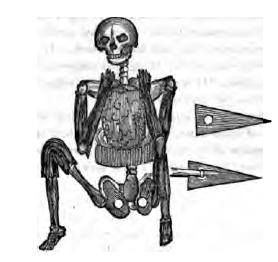
The preservation of this body may be the result of some embalming process; and this hypothesis is strengthened by the fact, that the skin has the appearance of having been tanned; or it may be the accidental result of the action of the salts of the brass during oxydation; and this latter hypothesis is supported by the fact, that the skin and flesh have been preserved only where they have been in contact with, or quite near, the brass; or we may account for the preservation of the whole by supposing the presence of saltpetre in the soil at the time of the deposit. In either way, the preservation of the remains is fully accounted for, and upon known chemical principles.
That the body was not one of the Indians, we think needs no argument. We have seen some of the drawings taken from the sculptures found at Palenqué, and in those the figures are represented with breast-plates, although smaller than the plate found at Fall River. On the figures at Palenqué the bracelets and anklets appear to be of a manufacture precisely similar to the belt of tubes just described. These figures also have helmets precisely answering the description of the helmet of Homer's μδγας κορνθαζολος Εκτωρ {quote in Greek script.}
No. XX.
[Reference from Page 499.]
We the subscribers, having been requested to give our opinion with regard to the religious and moral character of the late Capt. Joseph Brant, and the state of his mind as it appeared to us at its dissolution—hereby declare, that having lived a number of years a near neighbor of his, (our farms adjoining the place of his residence,) we were intimately acquainted with him; in conversation he would often begin the subject, and dwell upon the duties that we owed one to another. He was a believer in the Christian religion, and was brought up in the doctrine of the Episcopal Church of England, of which he was a member when he died. During his illness we were often with him, and were present at his dissolution. During his sickness, (which was painful,) he was patient and resigned, and appeared always thankful to his friends for the attention paid to him. It is our opinion that during his sickness, and at the close of it, he was possessed of his rational faculties, and that he lived and died in the faith of the Christian religion.
Augustus Bates, Asahel Davis.
Wellington Square, U. C. } August 15th, 1837. }
No. XXI.
[Reference from Page 526.]
Letter to the Mohawk Chief Ahyonwaeghs, commonly called John Brandt Esq. of the Grand River, Upper Canada.
London, January 20, 1822.
Sir,
Ten days ago I was not aware that such a person existed as the son of the Indian leader Brant, [FN] who is mentioned in my poem "Gertrude of Wyoming." Last week, however, Mr. S. Bannister of Lincoln's Inn, called to inform me of your being in London, and of your having documents in your possession which he believed would change my opinion of your father's memory, and induce me to do it justice. Mr. Bannister distinctly assured me that no declaration of my sentiments on the subject was desired but such as should spontaneously flow from my own judgment of the papers that were to be submitted to me.
[FN] The name has been almost always inaccurately spelt Brandt in English books.
I could not be deaf to such an appeal. It was my duty to inspect the justification of a man whose memory I had reprobated, and I felt a satisfaction at the prospect of his character being redressed, which was not likely to have been felt by one who had willfully wronged it. As for as any intention to wound the feelings of the living was concerned, I really knew not, when I wrote my poem, that the son and daughter of an Indian chief were ever likely to peruse it, or be affected by its contents. And I have observed most persons to whom I have mentioned the circumstance of your appeal to me, smile with the same surprise which I experienced on first receiving it. With regard to your father's character, I took it as I found it in popular history. Among the documents in his favor I own that you have shown me one which I regret that I never saw before, though I might have seen it, viz. the Duke of Rochefoucault's honorable mention of the chief in his travels. [FN] Without meaning, however, in the least to invalidate that nobleman's respectable authority, I must say, that even if I had met with it, it would have still offered only a general and presumptive vindication of your father, and not such a specific one as I now recognize. On the other hand, judge how naturally I adopted accusations against him which had stood in the Annual Register of 1779, as far as I knew, uncontradicted for thirty years. A number of authors had repeated them with a confidence which beguiled at last my suspicion, and I believe that of the public at large. Among those authors were Gordon, Ramsay, Marshall, Belsham, and Weld. The most of them, you may tell me, perhaps, wrote with zeal against the American war. Well, but Mr. John Adolphus was never suspected of any such zeal, and yet he has said in his History of England, &c. (vol. iii. p. 110) "that a force of sixteen hundred savages and Americans in disguise, headed by an Indian Col. Butler, and a half Indian of extraordinary ferocity named Brant, lulling the fears of the inhabitants (of Wyoming) by treachery, suddenly possessed themselves of two forts, and massacred the garrisons." He says farther, "that all were involved in unsparing slaughter, and that even the devices of torment were exhausted." He possessed, if I possessed them, the means of consulting better authorities; yet he has never to my knowledge made any atonement to your father's memory. When your Canadian friends, therefore, call me to trial for having defamed the warrior Brant, I beg that Mr. John Adolphus may be also included in the summons. And after his own defence and acquittal, I think he is bound, having been one of my historical misleaders, to stand up as my gratuitous counsel, and say, "Gentlemen, you must acquit my client, for he has only fallen into an error, which even my judgment could not escape."
[FN] The following testimony is borne to his fair name by Rochefoucault, whose ability and means of forming a correct judgment will not be denied. "Col. Brant is an Indian by birth. In the American war he fought under the English banner, and he has since been in England, where he was most graciously received by the King, and met with a kind reception from all classes of people. His manners are semi-European. He is attended by two Negroes; has established himself in the English way; has a garden and a farm; dresses after the European fashion; and nevertheless possesses much influence over the Indians. He assists at present (1795) at the Miami Treaty, which the United States are concluding with the western Indians. He is also much respected by the Americans; and in general bears so excellent a name, that I regret I could not see and become acquainted with him."—Rochefoucault's Travels in North America.
In short, I imbibed my conception of your father from accounts of him that were, published when I was scarcely out of my cradle. And if there were any public, direct, and specific challenges to those accounts in England ten years ago, I am yet to learn where they existed.
I rose from perusing the papers you submitted to me certainly with an altered impression of his character. I find that the unfavorable accounts of him were erroneous, even on points not immediately connected with his reputation. It turns out, for instance, that he was a Mohawk Indian of unmixed parentage. This circumstance, however, ought not to be overlooked in estimating the merits of his attainments. He spoke and wrote our language with force and facility, and had enlarged views of the union and policy of the Indian tribes. A gentleman who had been in America, and from whom I sought information respecting him in consequence of your interesting message, told me that though he could not pretend to appreciate his character entirely, he had been struck by the naiveté and eloquence of his conversation. They had talked of music, and Brant said, "I like the harpsichord well, and the organ still better; but I like the drum and trumpet best of all, for they make my heart beat quick." This gentleman also described to me the enthusiasm with which he spoke of written records. Brant projected at that time to have written a History of the Six Nations. The genius of history should be rather partial to such a man.
I find that when he came to England, after the peace of 1763, the most distinguished individuals of all parties and professions treated him with the utmost kindness. Among these were the late Bishop of London, the late Duke of Northumberland, and Charles Fox. Lord Rawdon, now Marquis of Hastings, gave him his picture. This circumstance argues recommendations from America founded in personal friendship. In Canada the memorials of his moral character represent it as naturally ingenuous and generous. The evidence afforded, induces me to believe that he often strove to mitigate the cruelty of Indian warfare. Lastly, you affirm that he was not within many miles of the spot when the battle which decided the fate of Wyoming took place, and from your offer of reference to living witnesses, I cannot but admit the assertion. Had I learnt all this of your father when I was writing my poem, he should not have figured in it as the hero of mischief. I cannot, indeed, answer by anticipation what the writers who have either to retract or defend what they may have said about him, may have to allege; I can only say that my own opinion about him is changed. I am now inclined exceedingly to doubt Mr. Weld's anecdote, and for this reason: Brant was not only trusted, consulted, and distinguished by several eminent British officers in America, but personally beloved by them. Now I could conceive men in power, for defensible reasons of state politics, to have officially trusted, and even publicly distinguished at courts or levees, an active and sagacious Indian chief, of whose private character they might nevertheless still entertain a very indifferent opinion. But I cannot imagine high-minded and high-bred British officers forming individual and fond friendships for a man of ferocious character. It comes within my express knowledge that the late General Sir Charles Stuart, fourth son of the Earl of Bute, the father of our present Ambassador at Paris, the officer who took Minorca and Calvi, and who commanded our army in Portugal, knew your father in America, often slept under the same tent with him, and had the warmest regard for him. It seems but charity to suppose the man who attracted the esteem of Lord Rawdon and General Stuart to have possessed amiable qualities, so that I believe you when you affirm that he was merciful as brave. And now I leave the world to judge whether the change of opinion, with which I am touched, arises from false delicacy and flexibility of mind, or from a sense of honor and justice.
Here, properly speaking, ends my reckoning with you about your father's memory; but as the Canadian newspapers have made some remarks on the subject of Wyoming, with which I cannot fully coincide, and as this letter will probably be read in Canada, I cannot conclude it without a few more words, in case my silence should seem to admit of propositions which are rather beyond the stretch of my creed. I will not, however, give any plain truths which I have to offer to the Canadian writers the slightest seasoning of bitterness, for they have alluded to me, on the whole, in a friendly and liberal tone. But when they regret my departure from historical truth, I join in their regret only in as far as I have unconsciously misunderstood the character of Brant, and the share of the Indians in the transaction, which I have now reason to suspect was much less than that of the white men. In other circumstances I took the liberty of a versifier to run away from fact into fancy, like a school-boy who never dreams that he is a truant when he rambles on a holiday from school. It seems, however, that I falsely represented Wyoming to have been a terrestrial paradise. It was not so, say the Canadian papers, because it contained a great number of Tories; and undoubtedly that cause goes far to account for the fact. Earthly paradises, however, are not earthly things, and Tempe and Arcadia may have had their drawbacks on happiness as well as Wyoming. I must nevertheless still believe that it was a flourishing colony, and that its destruction furnished a just warning to human beings against war and revenge. But the whole catastrophe is affirmed in a Canadian newspaper to have been nothing more than a fair battle, if this be the fact, let accredited signatures come forward to attest it, and vindicate the innocence and honorableness of the whole transaction, as your father's character has been vindicated. An error about him by no means proves the whole account of the business to be a fiction. Who would not wish its atrocity to be disproved? But who can think it disproved by a single defender, who writes anonymously, and without definable weight or authority?
In another part of the Canadian newspapers, my theme has been regretted as dishonorable to England. Then it was, at all events, no fable. But how far was the truth dishonorable to England? American settlers, and not Englishmen, were chiefly the white men calling themselves Christians, who were engaged in this affair. I shall be reminded, perhaps, that they also called themselves Loyalists. But for Heaven's sake let not English loyalty be dragged down to palliate atrocities, or English delicacy be invoked to conceal them. I may be told that England permitted the war, and was therefore responsible for its occurrences. Not surely universally, nor directly. I should be unwilling to make even Lord North's administration answerable for all the actions of Butler's rangers; and I should be still more sorry to make all England amenable either for Lord North's administration, or for Butler's rangers. Was the American war an unanimous and heartfelt war of the people? Were the best patriots and the brightest luminaries of our Senate for, or against it? Chatham declared that if America fell she would fall like the strong man—that she would embrace the pillars of our constitution and perish beneath its ruins. Burke, Fox, and Barre kindled even the breasts of St. Stephen's chapel against it; and William Pitt pronounced it a war against the sacred cause of Liberty. If so, the loss of our colonies was a blessing, compared with the triumph of those principles that would have brought Washington home in chains. If Chatham and Pitt were our friends in denouncing the injustice of this war, then Washington was only nominally our foe in resisting it; and he was as much the enemy of the worst enemies of our constitution, as if he had fought against the return of the Stuarts on the banks of the Spey or the Thames. I say, therefore, with full and free charity to those who think differently, that the American war was disgraceful only to those who were its abettors, and that the honor of Englishmen is redeemed in proportion as they deprecate its principles and deplore its details. Had my theme even involved English character more than it does, I could still defend it. If my Canadian critic alleges that a poet may not blame the actions of his country, I meet his allegation, and deny it. No doubt a poet ought not forever to harp and carp upon the faults of his country; but he may be her moral censor, and he must not be her parasite. If an English poet under Edward III. had only dared to leave one generous line of commiseration to the memory of Sir William Wallace, how much he would have raised our estimation of the moral character of the age! There is a present and a future in national character, as well as a past, and the character of the present age is best provided for by impartial and generous sentiments respecting the past. The twentieth century will not think the worse of the nineteenth for regretting the American war. I know the slender importance of my own works. I am contending, however, against a false principle of delicacy that would degrade poetry itself if it were adopted;—but it never will be adopted.
I therefore regret nothing in the historical allusions of my poem, except the mistake about your father. Nor, though I have spoken freely of American affairs, do I mean to deny that your native tribes may have had a just cause of quarrel with the American colonists. And I regard it as a mark of their gratitude that they adhered to the royal cause, because the governors, acting in the king's name, had been their most constant friends; and the colonial subjects, possibly at times their treacherous invaders. I could say much of European injustice towards your tribes, but in spite of all that I could say, I must still deplore the event of Christians having adopted their mode of warfare, and, as circumstances then stood, of their having invoked their alliance. If the Indians thirsted for vengeance on the colonists, that should have been the very circumstance to deter us from blending their arms with ours. I trust you will understand this declaration to be made in the spirit of frankness, and not of mean and inhospitable arrogance. If I were to speak to you in that spirit, how easily and how truly could you tell me that the American Indians have departed faster from their old practices of warfare, than Christians have departed from their habits of religious persecution. If I were to preach to you about European humanity you might ask me how long the ashes of the Inquisition have been cold, and whether the slave-trade be yet abolished? You might demand, how many—no, how few generations have elapsed since our old women were burnt for imaginary commerce with the devil, and whether the houses be not yet standing from which our great grand-mothers may have looked on the hurdles passing to the place of execution, whilst they blessed themselves that they were not witches! A horrible occurrence of this nature took place in Scotland during my own grandfather's life-time. As to warlike customs, I should be exceedingly sorry if you were to press me even on those of my brave old ancestors, the Scottish Highlanders. I can, nevertheless, recollect the energy, faith, and hospitality of those ancestors, and at the same time I am not forgetful of the simple virtues of yours. [FN]
[FN] Considering the filial motives of the young chief's appeal to me, I am not afraid that any part of this letter, immediately relating to him, will be thought ostentatious or prolix. And if charitably judged, I hope that what I have said of myself and of my poem will not be felt as offensive egotism. The public has never been troubled with any defences of mine against any attacks on my poetry that were mere literary; although I may have been as far as authors generally are from bowing to the justice of hostile criticism. To show that I have not been over-anxious about publicity, I must mention a misrepresentation respecting my poem on Wyoming which I have suffered to remain uncontradicted for ten years. Mr. Washington Irving, in a biographical sketch prefixed to it in an American edition, described me as having injured the composition of the poem by shewing it to friends who struck out its best passages. Now I read it to very few friends, and to none at whose suggestion I ever struck out a single line. Nor did I ever lean on the taste of others with that miserable distrust of my own judgment which the anecdote conveys. I knew that Mr. Irving was the last man in the world to make such a misrepresentation intentionally, and that I could easily contradict it; but from aversion to bring a petty anecdote about myself before the world, I forbore to say any thing about it. The case was different when a Canadian writer hinted at the patriotism of my subject. There he touched on my principles, and I have defended them, contending that on the supposition of the story of Wyoming being true, it is a higher compliment to British feeling to reveal than to palliate or hide it.
I have been thus special in addressing you from a wish to vindicate my own consistency, as well as to do justice to you in your present circumstances, which are peculiarly and publicly interesting. The chief of an aboriginal tribe, now settled under the protection of our sovereign in Canada, you are anxious to lead on your people in a train of civilization that is already begun. It is impossible that the British community should not be touched with regard for an Indian stranger of respectable private character, possessing such useful and honorable views. Trusting that you will amply succeed in them, and long live to promote improvement and happiness amidst the residue of your ancient race,
I remain, your sincere well-wisher, Thomas Campbell.