Volume 2 — APPENDIX, CONSISTING OF LETTERS WRITTEN BY KNOX, AND OTHER PAPERS, HITHERTO UNPUBLISHED.
Reading edition
356No I. [From MS. Letters, p. 243.]
The firste letter to his mothir in law, mestres Bowis.
Rycht deirlibelovit mother in oure saviour Jesus Chryst, when I call to mynd and revolve with myself the trubillis and afflictionis of Godis elect frome the begyning (in whiche I do not forget yow) thair is within my hart tuo extreme contraries; a dolour almaist unspeakabill, and a joy and comfort whilk, be mannis sences, can not be comprehendit nor understand. The cheif caussis of dolour be two; the ane is the rememberance of syn, whilk I daylie feill remanyng in this corrupt nature, whilk was and is sa odius and detestabill in the presence of oure hevinlie father, that by na uther sacrifice culd or myght the same be purgeit, except by the blude and deth of the onlie innocent sone of God. When I deiplie do considder the caus of Chrystis deth to haif bene syn, and syn yit to dwell in all flesche, with paule I am compellit to sob and grone as ane man under ane heavie burdene, ye, and sumtymes to cry, O wreachit and miserabill man that I am, wha sall delyver me fra this bodie of syn! The uther caus of my dolour is that sic as maist gladlie wald remane togidder, for mutuall comfort ane of another, can not be sufferit sa to do. Since the first day that it pleasit the providence of God to bring yow and me in familiaritie, I have alwayis delytit in your company; and when labours wald permit, ye knaw I have not spairit houris to talk and commoun with yow, the frute whairof I did not than fullie understand nor perceave. But now absent, and so absent that by corporal presence nather of ws can resave comfort of uther, I call to mynd how that oftymes when, with dolorous hartis, we haif begun our talking, God hath send greit comfort unto baithe, whilk now for my awn part I commounlie want. The exposicioun of your trubillis, and acknawledging of your infirmitie, war first unto me a verie mirrour and glass whairin I beheld my self sa rychtlie payntit furth, that nathing culd be mair evident to my awn eis. And than the searching of the scriptures for Godis sueit promissis, and for his mercies frelie givin unto miserable offenderis, (for his nature delyteth to schew mercie whair maist miserie ringeth), the collectioun and applying of Godis mercies, I say, wer unto me as the breaking and handilling with my awn handis of the maist sweit and delectabill ungumentis, whairof I culd not but receave sum comfort be thair naturall sweit odouris. But now, albeit I never lack the presence and plane image of my awn wreachit infirmitie; yet seing syn sa manifestlie abound in al estaitis, I am compellit to thounder out the threattnyngis of God aganis the obstinat rebellaris, in doing whairof (albeit as God knaweth I am no malicious nor obstinat synner) I sumtymes am woundit, knawing myself criminall and giltie in many, ye in all (malicious obstinacie laid asyd) thingis that in utheris I reprehend. Judge not, mother, that I wrait theis thingis debassing my self otheris wayis than I am: na; I am wors than my pen can expres. In bodie ye think I am no adulterer: lat sa be; but the hart is infectit with foull lustis, and will lust albeit I lament never samekill. Externallie I commit na idolatrie; but my wicked hart luffeth the self, and cannot be refranit fra vane imaginationis, ye, not fra sic as wer the fountane of all idolatrie. I am na mankiller with my handis; but I help not my nedie brother sa liberallie as I may and aucht. I steill not hors, money, nor claithis fra my nychbour; but that small portioun of warldlie substance I bestow not sa rychtlie as his halie law requyreth. I bear na fals witnes aganis my nychbour in judgement or utherwayis befor men; but I speik not the treuth of God sa boldlie as it becumeth his true messinger to do. And thus in conclusioun thair is na vyce repugnyng to Godis halie will, expressit in his law, whairwith my hart is not infectit.
This mekill writtin and dytit befoir the resait of your letteris, whilk I resavit the 21st of June. They war unto my hart sum comfort for dyvers caussis not necessar to be rehersit, but maist (as knaweth God) for that I find ane congruence betwix ws in spreit, being sa fer distant in bodie. ffor when that digestlie I did avys with your letter, I did considder that I myself was complenyng evin the self sam thingis at that verie instant moment that I ressavit your letter. Be my pen ffrome a sorrowfull hart I culd not but brust forth and say, “O Lord, how wonderfull ar thi workis! how dois thou try and prufe thi chosin children as gold by the fyre! how canest thou in maner hyd thi face fra thy awn spous, that thi presence efter may be mair delectabill! how canest thou bring thi sainctis lowe, that thou may carie thame to glorie everlasting! how canest thou suffer thi strang faithful messingeris in many thingis yit to wressill with wreachit infirmitie and febill weaknes, ye and sumtymes permittis thou thame horribillie to fall, partlie that na flesche sall have whairof it may glorie befoir the, and partlie that utheris of smaller estait and meaner giftis in thi kyrk myght resave sum consolatioun, albeit thay find in thame selves wickit motions whilk they are not abill to expell!” My purpois was, befoir I ressavit your letter, to have exhortit you to pacience and to fast, adhering to Godis promisis, albeit that your flesche, the divill, and uther your enemyis, wald persuad you to the contrare; for, by the artis and subteliteis that the adversarie useth aganis me, I not only do conjecture, but also planelie dois sie your assaltis and trubill. And sa lykwys, in the bowellis of Chrystis mercie, maist ernistlie I beseik you, by that infirmitie that ye knaw remaineth in me, (wars I am than I can wryt,) pacientlie to beir, albeit that ye haif not sic perfection as ye wald, and albeit also your motionis be sic as be maist vyle and abominabill, yet not to sorrow abuf measure. Gif I to whom God hes gevin greatter giftis (I wryt to his prais) be yit sa wrappit into miserie, that what I wald I can not do, and what I wald not, that with sainct paule, I say, I daylie ye everie hour and moment I devys to do, and in my hart, ficht I never sa fast in the contrarie I perform and do,—gif sic wreachit wickitnes remane in Godis cheif ministeris, what wonder albeit the same remane in yow? Gif Godis strangest men of war be beattin bak in thair face, that what thay wald they can not destroy nor kill, is it any sic offence to yow to be tossit as ye compleane, that thairfoir ye suld distrust Goddis frie promissis? God forbid, deir mother! the power of God is knawin be oure weaknes, and theis dolouris and infirmiteis be maist profitabill to ws; for by the same is our pryde beattin doun, whilk is not easie utherwayis to be done. By thame ar oure misereis knawn, sa that we, acknawledging oure selves misterfull, seikis the phesitioun. By thame cum we, be the operatioun of the halie spreit, to the hatred of syn, and be thame cum we to the hunger and thrist of justice, and to desyre to be desolued, and sa to ring with oure Chryst Jesus, whilk without this battell and sorrow this flesche culd never do. And sa fra the doloris I proceid to the comfort.
As the caussis of dolour be tuo, whilk ar present syn, and the lack of sic company as in whome we maist culd delyt, sa is the caussis of my comfort not ymaginit of my brane, but pronuncit first be God, and efter graftit in the hartis of Godis children by his halie spreit. Thay ar lykwys tuo; whilk is a justice inviolable offerit be our flesche befoir the trone of our heavinlie father, and ane assureit hoip of that generall assemblie and gathering togither of Godis dispersit flok, in that day when all teairs salbe wipit fra oure eis, when deth salbe vincuisit, and may na mair dissever sic as feiring God this day in the flesche murnis under the burdene of syn. Off oure present justice, notwithstanding syn remane in our mortall bodeis, ar we assureit by the faithfull witnes of Jesus Chryst, Johne the apostill, saying, “gif we confes oure synnis, faithfull and just is God to remit and forgive our synnis.” Mark the wordis of the apostill, gif we confes oure synnis God man forgive thame, becaus hie is faithfull and just. To confessioun of synnis ar theis thingis requisit; ffirst we man acknawledge the syn, and it is to be notit that sumtymes Godis verie elect, albeit they have synnit maist haynouslie, does not acknawledge syn and thairfoir can not at all tymes confes the same; for syn is not knawin unto sictyme as the vale be takin fra the conscience of the offender, that he may sie and behald the filthines of syn, what punishment be Godis just jugenentis is dew for the sam, and then (whilk is the 2 thing requisit to confessioun) begynnis the haitred of syn and of oure selves for contempnying of God and of his halie law; whairof last springis that whilk we call hoip of mercie, whilk is nathing els but a sob fra a trubillit hart, confoundit and aschamit for syn, thristing remissioun and Gods frie mercie, whairupon of necessitie man follow this conclusioun, God hes remittit and frelie forgevin the syn; and why? for “hie is faithfull and just” sayeth the apostill. Comfortabill and mervelous caussis! first, God is faithfull, ergo, hie man forgive syn. A comfortable consequent upon a maist sure ground! for Godis fidelitie can na mair faill nor can him self. Then lat this argument be gatherit for oure comfort; the office of the faithfull is to keip promeis; but God is faithfull, ergo, he man keip promeis. That God hes promissit remissioun of synis to sic as be repentant, I neid not now to recit the places. But let this collectioun of the promissis be maid, God promissis remissioun of synis to all that confessis the same; but I confes my synnis, for I sie the filthines thairof, and how justlie God may condemp me for my iniquities. I sob and I lament for that I can not be quyt and red of syn, I desyre to leif a mair perfyt lyfe. Thir ar infallible signis, seillis, and takinis, that God hes remittit the syn; for God is faithfull that sa hes promissit, and can na mair deceave nor hie can ceis to be God. But what reasone is this, God is just, thairfoir hie man forgive syn? A wonderous caus and reasone in deid! ffor the flesche and naturall man can understand nathing but the contrar, for thus man it reasone: the justice of God is offendit be my synnis, sa God man neidis have a satisfactioun, and requyre ane punissment. Gif we understand of whome God requyris satisfactioun, whether of ws, or of the handis of his onlie sone, and whais punisment is abill to recompens oure synnis, than sall we haif greit cause to rejose, remembering that God is a just God; for the office of the just man is to stand content when hie hes ressavit his dewtie. But God hes ressavit alredie at the handis of his onlie sone all that is dew for our synnis, and sa can not his justice requyre nor craif any mair of ws ather satisfactioun or recompensatioun for our synnis. Advert, mother, the sure pilleris and fundation of oure salvation to be Godis faithfulnes and justice. Hie that is faithful has promissit frie remissioun to all penitent synneris, and hie that is just, hes ressavit alredie a full satisfactioun for the synis of all thais that imbrace Chryst Jesus to be the only saviour of the warld. What restis than to us to be done? nathing but to acknawledge oure miserie and wrechednes, whilk na flesche can do sa unfenidlie as they that daylie feillis the wecht of syn. And uther, mother, caus haif we nane of desperatioun, albeit the divill rage never sa cruellie, and albeit the flesche be never sa fraill, daylie and hourlie lusting aganis Godis halie commandementis, ye, stryving aganis the same. This is not the tyme of justice befoir oure awn eis; we luke for that whilk is promissit, the kingdome everlasting, preparit to ws fra the begynning, whairof we ar maid airis be Godis apoyntment, reabillit [i.e. legitimated or restored] thairto be Chrystis death, to whom we sall be gatherit, when efter we sall never depart, whilk to remember is my singular comfort, but thairof now I can not wryte. My commendationis to all whom effeiris. I commit you to the protectioun of the omnipotent.
At Londoun the 23d of June, 1553, your sone unfeaned,
Johne Knox.
No II. [MS. Letters, p. 333.]
To mariorie bowis wha was his first wyfe.
Deirlibelovit sister in the commoun faith of Jesus our saviour, the place of Johne forbidding ws to salut sic as bringeth not the hailsome doctrine, admonisseth ws what danger cumeth be fals teacheris, evin the destructioun of bodie and saule; whairfoir the spreit of God willeth ws to be sa cairfull to avoyd the company of all that teachis doctrine contrarie to the treuth of Chryst, that we communicat with thame in nathing that may appeir to manteane or defend thame in thair corrupt opinioun, for hie that bidis thame godspeid, communicatis with thair syn, that is, hie that apeiris, be keiping thame company, or assisting unto thame in thair proceidingis, to favour thair doctrine, is giltie befoir God of thair iniquitie, baith becaus hie doith confirme thame in thair error be his silence, and also confirmes utheris to credit thair doctrine, becaus hie opponis not himself thairto: and sa to bid thame godspeid is not to speik unto thame commounlie as we for civill honestie to men unknawn, but it is efter we have hard of heir als doctrine to be conversant with thame, and sa intreat thame as they had not offendit in thair doctrine. The place of Jamis teachis ws, belovit sister, that in Jesus Chryst all that unfeandlie profes him are equall befoir him, and that ryches nor warldlie honouris ar nathing regairdit in his syght; and thairfoir wald the spreit of God, speiking in the apostill, that sic as ar trew christianis suld have mair respect to the spirituall giftis whairwith God had doteth his messingeris, nor to externall ryches, whilk oftymes the wicket possessis, the having whairof makis man nether nobill nor godlie, albeit sa judge the blind affectionis of men. The apostill dampneth sic as preferis a man with a golden chayne to the pure; but heirof will I speik no more. The spreit of God sall instruct your hart what is maist comfortable to the trubillit conscience of your mother, and pray ernistlie that sa may be. Whair the adversarie objectis, sche aucht not think wicket thoughts, answer thairto, that is trew, but seing this oure nature is corruptit with syn whilk entirrit be his suggestioun, it must think and wirk wickitlie be his assaltis, but hie sal beir the condigne punisment thairof, becaus be him syn first entirit, and also be him it doith continew whillis this karkais be resolved. And whair hie inquyris what Chryst is, answer hie is the seid of the woman promissit be God to break down the serpentis heid, whilk hie hath done alreadie in him self appeiring in this oure flesche, subject to all passionis that may fall in this oure nature, onlie syn exceptit; and efter the death sufferit, hie heth, be power of his godheid, rissin agane triumphant victour over deth, hell and syn, not to him self, for thairto was hie na dettour, but for sic as thristis salvatioun be him onlie, whom he may na mair los, nor he may ceas to be the sone of God and the saviour of the warld. And whair hie wald perswade that sche is contrarie the word thairinto, hie leis according to his nature, whairin thair is na treuth; for gif sche wer contrarie the word, or denyit it, to what effect sa ernistlie suld sche desyre the company of sic as teacheth and professeth it? Thair is na dout but hie, as he is the accusatour of all Godis elect, studieth to trubill her conscience, that according to hir desyre, sche may not rest in Jesus oure Lord. Be vigilant in prayer. I think this be the first letter that ever I wrait to you.
In great haist your brother,
Johne Knox.
No III. [MS. Letters, p. 283.]
To his Mother‑in‑law, and his Wife.
ffrome the eis of his Sanctis sal the Lord wype away all teiris and murnyng.
Deir mother and spous unfeanidlie belovit in the bowells of oure Saviour Chryst Jesus, with my verie hartlie commendationis. I perusit baith your letteris, not only directit to me, but also it that sorrowfullie compleanis upon the unthankfulnes of your brother as also of myne, that ye suld not have bene equallie maid privie to my coming in the countrie with utheris, whairof the enemy wald persuad yow (ane argument maist fals and untrew) that we judge you not to be of our noumber. Deir mother, be not sa suddanlie moveit, hie is your enemy that sa wald persuad you. God I tak to recorde in my conscience that nane is this day within the realme of Ingland, with whome I wald mair gladlie speik (onlie sche whome God hath offirit unto me, and commandit me to lufe as my awn flesche, exceptit) than with you. For your causis principallie enterprysit I this jurney; for hering my servand to be stayit, and his letteris to be takin, I culd na wys be pacifeit (for the maist part of my letteris was for your instructioun and comfort) till farther knawledge of your estait, and that ye wer na soner advertisit, only want of a faithfull messinger was the caus; for my coming to the countrey was sa sone noysit abrod, that with greit difficultie culd I be convoyit fra a place to another. I knew na sic danger as was suspectit be my brethrene; ffor as for my letteris in them is nathing conteanid, except exhortation to constancie in that treuth whilk God hes opinlie laid befoir our eis, whilk I am not myndit to deny whenever sic questions sal be demandit of me. But the cause moveing me that ffor a tyme I wald have bene clos, was, that I purposit (gif sa had bene possible) to have spokin with my wyfe, whilk now I persave is nathing apeirand, whill God offer sum better occasioun. My brethren, partlie be admonitioun, and partlie by teiris, compellis me to obey sumwhat contrair to my awn mynd; for never can I die in a mair honest quarrell nor to suffer as a witnes of that treuth whairof God hes maid me a messinger, whilk with hart I belive maist assuredlie, (the halie Gaist beiring witnes to my conscience,) and with mouth I trust to God to confes, in presence of the warld, the onlie doctrine of lyfe. Notwithstanding this my mynd, gif God sall prepair the way, I will obey the voces of my brethrene, and will gif place to the furie and rage of Sathan for a tyme. And sa can I not espy how that ether of yow baith I can speik at this tyme. But, gif God pleis preserve me at this tyme, whairof I am not yit resolved, then sal thair lak in me na gud will, that ye may knaw the place of my residence, and farthir of my mynd. But now, deir mother, haif we cause to rejois, for our heavinlie Father, wha callit us be grace to wryt in our hartis the signis and seallis of our election in Chryst Jesus his sone, begynnis now to correct our crukedness, and to mak us lyke in suffering afflictionis, schame and rebuke of the warld, to the greit bischope of our saullis, wha by mekill tribulation did enter in his glorie, as of necessitie man everie ane to whome that kingdome is apoyntit. And thairfor, mother, be nathing abasched of theis maist dolorous dayis, whilk schortlie sal have end to oure everlasting comfort. Thay ar not cropin upon ws without knawledge and foirsight; how oft have ye heard theis dayis foirspokin? thairfoir now grudge not, but pacientlie abyd the Lords delyverance. Hie that foirspak the trubill, promissis everlasting pleasure by the same word; albeit the flesche complene, dispair nathing, for it must follow the awn nature, and it is not dampnabill in the syght of oure Father; albeit the corrupt fraill flesche draw bak and refuse the croce, ffor that is as naturall to the flesche, as in hunger and thirst to covet reasonable sustenance. Onlie follow not the affectionis of the flesche to cōmit iniquytie; neither for feir of deth, nor for love of lyf, cōmit ye idolatrie; neither yit gif your presence whair the same is committit, but hait it, avoid it, and flee frome it. But your leter makis mention that ye haif pleasure and delyt in it: na, mother, I espy the contrarie, for ye compleane and lament that sic motionis ar within you; this is na sign that ye delyt in thame, for na man compleanis of that whairin hie delytis. Ye ar in na wors cas, tuiching that poynt, nor yet tuiching any uther whairof ye desyre to be red, than was the apostil, when with gronyng and angusche of hart he did cry, “O unhappie man that I am, wha sal delyver me fra this bodie of syn:” reid the haill chapter, and gif glorie to God that lattis you knaw your awn infirmitie, that from Chryst allone ye may be content to resave that whilk never remanit in corruptibill flesche, that is, the justice whilk is acceptabill befoir God, the justice by faith and not by workis, that ye may glorie in him wha frelie gives that whilk we deserve not. And thus nether feir that, nor uther assaltis of the divill, sa lang as in bodie ye obey not his persuasionis. Schortnes of tyme, and multitude of cairis, will not lat me wryt at this present sa plentifullie as I wald. Ye will me to charge you in suche thingis as I mister, God grant that ye may be abill to relief the nedie. Ye may be sure that I wald be bold upon you, for of your gude hart I am persuadit, but of your power and abilitie I greitlie dout. I will not mak you privie how ryche I am, but off Loundoun I departit with les money then ten grottis, but God hes sence provydit, and will provyd I dout not, heirefter abundantlie for this lyfe. Ather the quenis majestie, or sum thesaurer will be XL pounds rycher by me for samekill lack I of dewtie of my patentis. But that litill trubillis me. Rest in Chryst Jesus, your sone,
1553. Johne Knox.
No IV. [MS. Letters, p. 303.]
To his mother‑in‑law, Mrs Bowis.
Blissit be thais that mourne for ryghteousnes sake, &c.
Belovit mother with my hartlie commendatioun in the Lord. Let not your present dulnes discorage yow above measure: the wisdome of our God knawis what is maist expedient for our fraill nature, gif the bodie suld alwayis be in travell, it suld faynt and be unabill to continew in labour, the spreit hes his travell, whilk is a sobbing and murnyng for syn, fra whilk unles it sumtymes suld rest, it suddanlie suld be consumit. It doith na mair offend Godis maiestie that the spreit sumtyme lye as it were asleip, nether hauing sence of greit dolour nor greit comfort, mair than it doith offend him that the bodie use the natural rest, ceassing fra all externall exercis. Ye sall consider, mother, that the eis of God dois pers mair deiplie than we be war of; we, according to the blind ignorance whilk lurketh within ws, do judge but as we do feil for the present, but hie, according to his eternall wisdome, dois judge thingis lang befoir thay cum to pas. We judge that caldnes and angusche of spreit ar hurtfull, becaus we sie not the end whairfoir God dois suffer ws to be trubillit with sic temptationis; but his maiestie, wha onlie knawis the mass whairof man is maid, and causeth all thingis to work to the profit of his elect, knawis also how necessarie sic trubillis ar to dantoun the pryd of oure corrupt nature. Thair is a spirituall pryd whilk is not haistelie suppressit in Godis verie elect children, as witnesses sanct paule. God hath wroth greit thingis be yow in the syght of uthir men, with whilk (unless the mell of inward angusche did beat them doun) ye myght be steirit up to sum vane glorie, whilk is a vennoume mair subtil than ony man do espy. I can wryt to you be my awn experience. I have sumtymes bene in that securitie that I felt not dolour for syn, nether yit displeasure aganis myself for any iniquitie in whilk I did offend; but rather my vane hart did this flatter myself, (I wryt the treuth to my awn confusioun, and to the glorie of my heavenlie father through Jesus Christ,) ‘Thou hes sufferit great troubill for professing of Chrystis treuth, God hes done great thingis for the, delyvering the fra that maist cruell bondage, [galleis: on the margin], hie has placeit the in a maist honourabill vocatioun, and thy labours ar not without frute; thairfoir thou aucht rejos and gif prais unto God.’ O mother this was a suptill serpent wha this culd pour in vennoume, I not perceaving it; but blissit be my God wha permittit me not to sleip lang in that estait. I drank schortlie efter this flatterie of myself a cupe of contra poysone, the bitternes whairof doith yit sa remane in my breist, that whatever I have sufferit, or presentlie dois I reput as doung, yea, and my self worthie of dampnation for my ingratitude towardis my God. The lyke, mother, myt have cumin to yow, gif the secreit brydall of afflictioun did not refrane vane cogitationis; but of this I have written to yow mair planelie in my other letteris. And this I commit you to the protectioun of the omnipotent for ever.
Yours at his power,
Johnne Knox.
No V. [MS. Letters, p. 335‒6.]
To his Sister.
The spreit of God the father, be Jesus Chryst, comfort and assist yow to the end. Amen.
Touching the sonis of Jacob, who cruellie, contrar to thair solempned promeis and othe, did murther and slay the citisens of Sichem; whasa ryghtlie marketh the scriptures of God sall easelie espy thame maist grevouslie to have offendit. ffor albeit the transgression of the young man was haynous befoir God, yit wer thay na civill maiestratis, and thairfoir had na autoritie to punis. And farther, thay committit treasone, and in sa fer as in thame was blasphemit God and his halie name, making it odious to the nationis about, seing thay under pretence of religioun, and of ressaving them in leage with God and with the pepill, did disceatfullie as also cruellie destroy the haill citie suspecting na danger. Albeit sum laboureth to excus thair syn be the zeall thay had that thay myght not suffer thair sister to be abusit lyke ane harlot, yit the spreit of God speiking in thair awn father, efter lang advysement, in the extreamitie of his deth, utterlie dampneth thair wickit act, saying, “Semioun and Levi, brethren, &c., lat not my saule entir in thair consall, nor yit my glorie into thair company, for in thair furie thay killit a man, and for thair lust destroyit the citie, cursit is thair heit or rage, for it is vehement, and thair indignatioun, for it is intractable, I sall dispers thame in Jacob, and scatter thame abrod in Israell.” Heir may ye espy, sister, that God dampneth thair het displeasure and cruell act, as maist wickit and worthie of punisment. But perchance it may be inquyrit, why did God suffer the men that had professit his name be ressaving the sign of circumsitioun sa unmercifullie to be entreatit? I myght answer, God sufferis his awn in all ageis be the ungodlie to be cruellie tormentit. But sic was not the case of thir men, whom na doubt the justice of God faund cryminall and worthie the deth. ffor thay did abus his sacramentall signe, receaving it nether at God’s commandement, nor having any respect to his honour, nor to the advancement of his name, nor yit trusting in his promissis, nor desyreing the incres or multiplicatioun of Godis pepill, but onlie for a warldie purpois, thinking thairby to have attaynit ryches and ease, be joynyng thameselves to Godis pepill. And sa the justice of God faund thame worthie of punisment, and sa permittit thame justlie on his part to be afflictit and destroyit be the ungodlie, whilk is a terribill exempill to sic as in caus of religioun mair seikis the profit of the warld nor eternall salvatioun. But hereof na mair. Thus brieflie and rudlie have I writtin unto yow, becaus I remember myself anis to have maid yow a promeis sa to do, and everie word of the mouth of the faithfull (yf sa impeid not God) aught to be keipit. And now rest in Chryst. After this I think ye sall rasave na mair of my handis. In haist with sair trubillit hart.
Yours as ever in godlines,
[Anno 1553.] Johne Knox.
No VI. Letter of John Knox to John Fox.
(See vol. i. p. 219.)
[British Museum. Harl. MSS. 416, 34. § 70.]
An Original.
Indorsed “To his louinge brother master fox be these delyuered at Basill.”
The mightie comforth of the holie ghost for salutation.
Dearlie beloued brother, albeit at the deꝓture of this our brother from whom I receaved yor loving and frendlie lr̄e, my selue could writ nothing be reason of the euill disposition of my bodie, yit becaus I could not suffer him to depert without som remembrance of my deutie to you, I vsed the help of my left hand, that is of my wief, in scribbling these fewe lynes vnto you, as touching my purpose and mynd in the publishing the first blast of the trompet.
When the secreates of all hartes shalbe disclosed, that shalbe knowē wch now by manye can not be perswaded, to wit, that therin I nether haue sought my selue, nether yit the vain prase of men. my rude veheraencie and inconsidered affirmations wch may appear rather to procead from coler then of zeal and reason, I do not excuse, but to haue vsed anye other tytle more plausible, therby to haue allured the world by any art as I never purposed so do I not yit purpose. to me it is ynewgh to say that black is not whit, and mans tyrannye and foolishnes is not goddes perfite ordinance, wch thinge I do not so much to correct comon welthes as to delyuer my own conscience, and to instruct the consciences of som semple who yit I fear be ignorant in that matter, but ferther of this I delay to better opportunytie. Salut yor wief and dowghter hartlie in my nam. the grace of our lord Jesus Christ rest wt you now and euer. from geneva the 18 of May, 1558.
Your brother to power,
Johne Knox.
I yor sister the writer herof saluteth you and yor wief most hartlie thanking hir of hir loving tokens wch my mother and I receaued from Mrs Kent.
No VII. [Cald. MS. Vol. I. p. 427.]357
Extract of a letter from John Knox to Mrs Anne Locke. (See vol. i. p. 268.)
―― The queen and her counsell made promise that no person within Sanct Johnston, neither yet of these that assisted them, should be troubled for any thing done either in religion, either yet in down casting of places, till the sentence of the estates in Parliament had decided the controversie, and that no bands of French souldiers should be left behind the queen and counsell in the town, and that no idolatrie should be erected, nor alteration made within the town. But after she had obtained her desire, all godlie promises were forgotten; for the Sunday next after her entering, mess was said upon a dyeing table (for ye shall understand all the alters were prophaned); the poor professors were oppressed; when children were slain, she did but smile, excusing the fact be the chance of fortune; and at her departure, she left 400 souldiers, Scottismen, but paid by France, to dantoun the town. She changed the provist, and exiled all godlie men. This crueltie and deceit displeased many that before assisted her with their presence and counsell; and among others, the earl of Argyle and the prior of Sanct Andrews left [her], and joined themselves to the congregation openly, whilk as it was displeasing to her and to the shavellings, so it was most comfortable and joyfull to us, for by their presence were the hearts of many erected from desperation. At their commandment I repaired to them at St Andrewis, wher consultation being had, it was concluded that Christ Jesus should there be openlie preached, that the places and monuments of idolatrie should be removed, and superstitious habits changed. This reformation was begun the 14th of June. In the meantime came the bishop of St Andrewis to the towne, accompanied with a great band of warriours, and gave a strate commandement, that no preaching should be made by me, who was both brunt in figure and horned, assuring the lords that if they suffered me to preach that twelve haquebuts should lyght upon my nose at once. O burning charitie of a bloodie bishop! But as that boast did litle affray me, so did it more incense and inflamme with courage the harts of the godlie, who with one voyce proclaimed that Christ Jesus should be preached in despite of Sathan, and so that Sabbath and three dayes after I did occupy the publike place in the midst of the doctors who this day are even as dumbe as their idols which wer brunt in their presence. The bishop departed to the Queene, frustrat of his intent, for he had promised to bring me to her either alyve or dead: and incontinent was a new army assembled, and forward they marched against St Andrews. It was not thought expedient that we should abide them lurking in a town, and so we past to the fields and met them at Couper, where lodging was appointed for the camp, but we prevented them: where we remained upon their coming till the nixt day, when both armies were in sight of other within shot of cannon, and we looked for nothing but the extremitie of batle: not that we intended to pursue, but only to stand in camp where our field was pitched for defence of ourselves. There came from our adversaries ane ambassador desiring speech and communing of the lords, which gladlie of us being granted, after long reasoning the queene offered a free remission of all crimes bypast, sua that they would no furder proceed against friars and abbayes, and that no more preaching should be used publicklie. But the lords and the brethren refused such appointment, declaring that the fear of no mortal creature should cause them betray the veritie known and professed, neither yet to suffer idolatrie to be maintained in the bounds committed to their charge. The adversaries perceiving that neither threatening, flatterie, nor deceit, could break the bold constancie and godlie purpose of the lords, barons, gentlemen, and commons, who were there assembled to the number of 3000 in on days warning, they were content to tak assurance for 8 days, permitting unto us freedom of religion in the meantime. In the whilk the abbay of Lindores, a place of black monkes, distant from St Andrewis twelve myles, we reformed, their altars overthrew we, their idols, vestments of idolatrie, and mass books, we burnt in their presence, and commanded them to cast away their monkish habits. Divers chanons of St Andrewis have given notable confessions, and have declared themselves manifest enemies to the pope, to the mass, and to all superstition. [Then follows what is inserted, vol. i. p. 280‒1.]—We fear that the tyrannie of France shall, under the cloak of religion, seek a plain conquest of us; but potent is God to confound their counsell and to break their force. God move the hearts of such as profes Christ Jesus with us, to have respect to our infancie, and open their eyes to see that our ruin shall be their destruction. Communicat the contents herof (which I write to you, least by divers rumours ye should be troubled and wee slandered) with all faithfull, but especiallie with the afflicted of that little flock, now dispersed and destitute of these pleasant pastures in which some tyme they fed abundantlie. If any remain at Geneva, let either this same or the double of it be sent unto them, and likeways unto my dear brother Mr Goodman, whose presence I more thirst for than she that is my own flesh. Will him therefor in the name of the Lord Jesus (all delay and excuse set apart) to visit me; for the necessity is great here. If he come be sea, let him be addressed unto Dundie, and let him ask for George Levell, for George Rollock, or Wm. Carmichael. If he come to Leith, let him repair to Edinburgh, and enquire for James Baron, Edward Hope, Adam Fullertoun, or for John Johnston writer, be whom he will get knowledge of me. If my mother and my wife come be you, will them to make the expedition that goodly they can to visit me, or at least to come to the north parts, where they shall know my mind, which now I can not write, being oppressed with hourly cares. This bearer is a poor man unknown in the country, to whom I beseech you shew reasonable favour and tenderness, touching his merchandize and the just selling thereof. Thus, with hearty commendations to all faithfull, I heartily commit you to the protection of the Omnipotent. From Sanct Andrewes the 23d of June 1559.
No VIII. [Cald. I. 522.]
To the same. (See vol. i. 312.)
Lest that the rumours of our troubles trouble you above measure, dear sister, I thought good in these few words to signifie unto you that our esperance is yet good in our God, that he for his great names sake will give such success to this enterprise as nether shall these whom he hath appointed to sigh in this be utterlie confounded, neither yet that our enemies shall have occasion to blaspheme the verity, nor yet triumph over us in the end. We trusted too much, dear sister, in our owne strenth, and speciallie since the erle of Arran and his friends were joyned to our number. Amongst us also were such as more sought the purse than Christ’s glory. Wee by this overthrow are brought to acknowledge, what is a multitude without the present help of God! and the hollow hearts of many are now revealled. God make us humble in his eyes, and then I fear not the furie of the adversaries, who, be ye assured, doe sore rage, so as yet their crueltie must neids crave vengeance from him whose members they persecute. Our dear brethren and sisters in Edinburgh and Lothian who lay nearest these bloode thirsty tyrants, are so troubled and vexed that it is a pity to remember their estate. Our God comfort them. We stand universally in great fear, and yet we hope deliverance. I wrote to you before to be suitor to some faithfull, that they would move such as have abundance to consider our estate, and to make for us some provision of money to keep soldiers and our company together. And herein yet again I cannot cease to move you. I can not well write to any other, because the action may seem to appertaine to my own country onlie. But because I trust ye suspect me not of avarice, I am bold to say to you that if we perish in this our enterprise, the limits of London will be straiter than they are now within few years. Many things I have which I would have required for myself, namely Calvin on Isaiah, and his Institutions revised. But common troubles cause me to neglect all private business. If ye can find the means to send me the books before written, or any other that be new and profitable, I will provide that ye shall receive the prices upon your advertisement. My wife saluteth you. Salute all faithfull heartilie in my name, especiallie those of familiar acquaintance, of whom I crave pardon that I write not, being not so quiet as ye would wish. My onlie comfort is that our troubles shall pass sooner, peradventure, than our enemies look. Grace be with you. From St Andrews, in haste, the 18th November, 1559. Yours known,
John Knox.
Mr Gudeman is in the west country in Ayr, who willed me to salute you in his name as oft as I wrote you.
No IX. [Cald. I. 524.]
To the same. (See vol. i. 315.)
We shall meet when death shall not dissever.
Two letters I have received from you, dear sister, both almost at one time, the one is dated at London the 28th of November, the other of the same place the 2d of December. The letter of the last date I first read, which made mention of your trouble be reason of a suddan fire in a lodging near to you; that you had sought all means for our support, as well of those of high as of low degree; but that it was not needfull that any thing should be sent unto us, because it was supposed that the highest would support us; and last, that ye had not received the answer of your doubts. In your other letters, after your most comfortable discourse of God’s providence for his people in their greatest necessitie, ye godlie and trulie conclude that neither could their unworthiness, neither yet their want of things judged necessarie for their preservation, stop his majestie’s mercie from them. Thereafter ye will me to avoid danger, and rather to fight by prayer in some place removed from danger than expose my self to the hazard of battell, and so ye conclude by praising God’s mercie as did Jeremy in his greatest anguish, &c.
What support should come to us be consent of counsell and authoritie I am uncertain. But suppose it shall be greater than yet is bruted, that ought not to stay the liberall hands of the godlie to support us privatelie. For the public support of an army shall not make such as now be superexpended able to serve without private support. I will make the matter more plain be one example. I know one man that since the 10th of May hath spent in this action thirteen thousand crowns of the summe [sonne], besydes his victuals and other fruits of the ground. His treasure being now consumed, he cannot, without support, susteane the number which before he brought to the field. If he and such others that are in lyke condition with him shall be absent, or yet if numbers shall decay, our enemies shall seem to prevail in the field, and therfor desired I some collection to be made, to the end that the present necessitie of some might have been relieved. If the matter pertained not to my native country, I would be more vehement in persuasion, but God shall support even how, when, and by whom it shall please his blessed majestie. Sorry I am that ye have not received my answer unto your doubts, not so much that I think that ye greatlie need them, as that I would not put you in suspicion that I contemned your requests. The rest of my wife hath been so unrestful since her arrival here, that scarcelie could she tell upon the morrow what she wrote at night. She cannot find my first extract. And therfor, if any scruple remaine in your conscience, put pen again to paper, and look for ane answer, as God shall give opportunitie. God make yourself participant of the same comfort which you wrote unto me: and in very deed, dear sister, I have no less need of comfort, notwithstanding that I am not altogether ignorant, than hath the bound man to be fed, albeit in store he hath great substance. I have read the cares and tentations of Moses, and sometymes I have supposed myself to be well practised in such dangerous battells. But, alace! I now perceive that all my practice before was but mere speculation, for one day of troubles since my last arrival in Scotland hath more pierced my heart than all the torments of the galleys did the space of 19 months. For that torment, for the most part, did touch the bodie, but this pierceth the soul and inward affections. Then was I assuredlie persuaded that I should not die untill I had preached Christ Jesus even where I now am, and yet having now my heart’s desyre, I am nothing satisfied, neither yet rejoice. My God remove my unthankfulness. From Sanct Andrews, the last of December 1559.
Yours known in Christ,
John Knox.
No X. [Cald. I. 533.]
To the same. (See vol. i. 317.)
The eternal our God shall shortly put an end to all our troubles.
Lest that sinister rumours should trouble you above measure, dear sister, I can not but certify you of our estate as often as convenient messengers occur. The French, as before I wrote unto you, have pursued us with great furie, but God hath so bridled them, that since the 5th day when they put to flight the men of Kinghorn, Kircaldy, and Dysart, they have had of us (all praise be to our God) no advantage. They lost in a morning a lieutenant, the boldest of their company, and fourty of their bravest soldiers, diverse of them having been taken and diverse slain in skirmishing. They have done greatest harm to such as did best entertain them; for from them they have taken sheep, horse, and plenishing. Our friends, and foes to them, did continually remove from their way all moveables that to them appertained. They have casten to the ground the laird of Grange’s principal house, called the Grange, and have spoiled his other places. God will recompense him, I doubt not, for in this cause, and since the beginning of this last trouble especially, he hath behaved himself so boldly as never man of our realm hath deserved more praise. He hath been in many dangers, and yet God hath delivered him above mens expectations. He was shot at Lundie, right under the left pape, thorrow the jacket, doublet, and shirt, and the bullet did stick in one of his ribs. Mr Whitelaw hath gotten a fall, by which he is unable to bear arms. But God be praised both their lives be saved. I remained all this time in St Andrews with sorrowful heart, and yet as God did minister his spirit comforting the afflicted, who, albeit they quaked for a time, yet do now praise God who suddenly averted from them that terrible plague devised for them by the ungodly. The French men approached, within 6 miles, yet at the sight of certain of your ships, they retired more in one day than they advanced in ten. We have had wonderful experience of God’s merciful providence, and for my own part I were more than unthankful if I should not confess that God hath heard the sobs of my wretched heart, and hath not deceived me of that little spark of hope which his holy spirit did kindle and foster in my heart. God give me grace to acknowledge his benefit received, and to make such fruit of it as becometh his servant. If ye can find a messenger, I heartily pray you to send me the books for which I wrote before. I must be bold over your liberality not only in that, but in greater things as I shall need. Please you cause this other letter inclosed be surely conveyed to Miles Coverdale. Salute all faithful acquaintance, Mr Hickman and his bedfellow, your husband, Mr Michael and his spouse as unacquainted, especially remembered. I know not what of our brethren at Geneva be with you. But to such as be there, I beseech you to say, that I think that I myself do now find the truth of that which oft I have said in their audience, to wit, that after our departure from Geneva should our dolour beginne. But my good hope is in God that it shall end to his glory and our comfort. Rest in Christ Jesus. From Sanct Andrews, the 4th of February 1559.
Your brother.
John Knox.
No XI. [Cald. II. 89.]
John Knox to Mr John Wood, Secretary to the Regent. 14th Feb. 1568.
My purpose, beloved in the Lord, concerning that which oft and now last ye crave, I wrote to you before, from which I can not be moved, and, therefore, of my friends I will ask pardon, howbeit on that one head I play the churle, retaining to myself that which will rather hurt me than profit them, during my days, which I hope in God shall not be long, and then it shall be in the opinion of others whether it shall be suppressed, or come to light.358 God for his great mercies sake put such end to the troubles of France, as the purity of his evangell may have free passage within that realme; and idolatry, with the maintainers of the same, may once be overthrown by order of justice, or other ways as his godly wisdom hath appointed. In my opinion England and Scotland have both no less cause to fear than the faithful in France, for what they suffer in present action is laid up in store, let us be assured, for both countries. The ground of my assurance is not the determination of the council of Trent, for that decree is but the utterance of their own malice; but the justice of God is my assurance, for it cannot spare to punish all realmes and nations that is or shall be like to Jerusalem, against whose iniquity God long cried be his servants the prophets, but found no repentance. The truth of God hath been now of some years manifested to both, but what obedience, the words, works, and behaviour of men give sufficient testimony. God grant Mr Gudman a prosperous and happy success in the acceptation of his charge, and in all his other enterprises to God’s glory and the comfort of his kirk; and so will I the more patiently bear his absence, weaning myself from all comfort that I looked to have received be his presence and familiarity. Because I have the testimony of a good conscience, that in writing of that treatise, against which so many worldly men have stormed, and yet storm, I neither sought myself nor worldly promotion, and because as yet I have neither heard nor seen law nor scripture to overthrow my ground,359 I may appeal to a more indifferent judge than Dr Jewell. I would most gladly pass through the course that God hath appointed to my labours, in meditation with my God, and giving thanks to his holy name, for that it hath pleased his mercy to make me not a lord bishop, but a painful preacher of his blessed evangell, in the function whereof it hath pleased his majesty for Christ his son’s sake to deliver me from the contradiction of moe enemies than one or two, which maketh me the more slow and less careful to revenge be word or writ whatever injury hath been done against me in my own particular. But if that men will not cease to impugne the truth, the faithfull will pardon me if I offend such as for pleasure of flesh fear not to offend God. The defence and maintenance of superstitious trifles produced never better fruit in the end than I perceive is budding amongst you, schisme, which no doubt is a forerunner of greater desolation, unless there be speedy repentance.—[Then follows what has been already quoted in vol. ii. p. 162.]—The faithfull of your acquaintance here salute you. The grace of the Lord rest with you.
No XII. [Cald. II. 107.]
The same to the same. (See above, p. 165.)
I thank you heartily, dearly beloved in the Lord Jesus, that ye had such remembrance of me as to certify of that part which not a little troubled and yet troubleth me. What I have done or am able to do in that behalf I will not trouble you at this present, this only excepted, that it will please you to travel as in the end of your letter ye write ye would do, to wit, that my sons might be Denezans there. I am informed both be letter and be tongue, besides conjectures that probably may be gathered, that the Duke and his friends are inflamed against me. Ofter than once I have called to mind your words to me that day that I had been more than vehement, as some men thought, in the end of the ―― chapter of John’s Evangell, concerning the treasonable departure of Judas from Christ, and of the causes thereof. Before that I came forth of the preaching place, ye said, Before my God I think your eyes shal see performed that which your mouth hath pronounced. My words were these, I fear that such as have entered with us in professing of the Evangell, as Judas did with Christ, shall depart and follow Judas, how soon the expectation of gain and worldly promotion faileth them. Time will try farther, and we shall see overmuch. We look daily for the arrival of the duke and his Frenchmen, sent to restore Satan to his kingdome, in the person of his dearest lieutenant, sent, I say, to repress religion, not from the king of France, but from the Cardinall of Lorrane in favour of his dearest nice. Lett England take heed, for surely their neighbours houses are on fire. I would, dear brother, that ye should travell with zealous men, that they may consider our estate. What I would say, ye may easily conjecture. Without support we are not able to resist the force of the domesticall enemies, (unless God work miraculously,) much less are we able to stand against the puissance of France, the substance of the Pope, and the malice of the house of Guise, unless we be comforted be others than by ourselves. Ye know our estate, and therefore I will not insist to deplore our poverty. The whole comfort of the enemies is this, that be treason or other means they may cutt off the Regent, and then cutt the throat of the innocent king. How narrowly hath the regent escaped once, I suppose ye have heard. As their malice is not quenched, so ceaseth not the practice of the wicked, to put in execution the cruelty devised. I live as a man already dead from all affairs civil, and therefore I praise my God; for so I have some quietness in spirit, and time to meditate on death, and upon the troubles I have long feared and foreseeth. The Lord assist you with his holy spirit, and put an end to my travells, to his own glory, and to the comfort of his kirk; for assuredly, brother, this miserable life is bitter unto me. Salute your bedfellow in my name, and the rest in Christ Jesus. The faithfull here salute you. The grace of the Lord Jesus Christ rest with you for ever.
Of Edinburgh the 10 of September 1568.
No XIII. [Cald. MS. I. 380.]
Extract of a Letter from John Knox to Mrs Anne Locke, dated 6th April, 1559. (See above, p. 253.)
―― Your letters, dear sister, dated at Geneva the 17th of February, received I in Deepe the 17th of March. Touching my negligence in writing to you, at other times I fear it shall be little amended, except that better occasions than yet I know be offered. For oft to write when few messingers can be found is but foolishness. My remembrance of you is not yet so dead, but I trust it shall be fresh enough, albeit it be renewed be no outward tokin for one year. Of nature I am churlish, and in conditions different from many. Yet one thing I ashame not to affirme that familiarity once thoroughly contracted was never yet broken be my default. The cause may be that I have rather need of all than that any have need of me.—
Extract of a Letter from John Knox “To a friend in England.” [Cald. II. 144.]
Of Edinburgh, 19th August, 1569.
―― If from day to day thir seven years bypast, I had not looked for an end of my travells, I could have no excuse of my obstinate fault toward you, beloved in the Lord, be whom I have received, besides commendations and letters, divers tokens of your unfained friendship, yet have negligently pretermitted all office of humanity toward you, whereinto I acknowledge my offence, for albeit I have been tossed with many storms all the time before expressed, yet might I have gratified you and others faithfull with some remembrance of my estate, if that this my churlish nature, for the most part oppressed with melancholy, had not stayed tongue and pen from doing of their duty. Yea, even now, when that I could somewhat satisfy your desire, I find within myself no small repugnance, for this I find objected to my wretched heart, ‘Foolish man! what seeks thou in writing of missives in this corruptible age? Hath thou not a full satiety of all the vanities under the sun? Hath not thy eldest and stoutest acquaintance buried thee in oblivion, and art not thou in that estate be age, that nature itself calleth thee from the pleasures of things temporall? Is it not then more than foolishness unto thee to hunt for acquaintance on the earth, of what estate or condition whatsomever the person be?’ To these objections I could answer nothing, (much more I think than is written,) but that I would write with what imperfections I little regard.――
No XIV. Letter to Sir William Douglas of Lochleven, 31 Mar. 1570.
[The original is among the papers of the family, at Dalmahoy.]
After harty commendatioun of my service unto you, rycht wyrshippfull, I receaved your missive this last of March, perceaving tharby the bruite that ye hear of the purpose of some to tak the castell of Sanctandrois, quhilk bruite I easely beleve be not all togidder vane, for men will not faill to hurt what thei can the quietnes of this realme, and to reenter in thare usurped possessioun and injust uplifting of the fruitis that never did justlie apperteane to sick idill bellies. How sick trublaris may be stayed of thare interpryses I remitt to God, to whose counsall I committ you in that and all other cases worldly; for I have tacken my gude nycht of it, and therfor bear with me gude Sr, albeit I write not to the superintendent of Fyff in the actioun that ye desyr as concernyng the excuse of the tua ministeris, to our superintendent I shall do the best that I can when I meitt with him; and thus with my harty commendatioun I committ you to the protectioun of the omnipotent. Of Edinburghe the sam hour I receaved yours this Friday att 5 afternone 1570.
Yours to power in God trubled in body,
Johne Knox.
(In dorso) To the Rycht Worshepful the Lard of Lochlevin.
No XV. [Cald. II. 269.]
John Knox to Sir John Wishart of Pittarrow. (See above, p. 201.)
The end of all worldly trouble and pleasure both approacheth. Blessed are they that patiently abide in the truth, not joining hands nor heart with impiety, how that ever it triumph.
Right worshipfull, after hearty commendations, your letter, dated at Pittarrow the 14th of July, received I in Sanct Andrews, the 15th of the same. The brute and armour of Adam Gordon and his doings, and preparations made to resist him was diverse, but nothing that I heard moved me, for I perceive the cup of iniquity is not yet full. Of one thing I am assured, that God of his mercy will not suffer his own to be tempted above measure, neither will he suffer iniquity to be ever unpunished. From me can come no other counsel than ye have heard from the beginning of our acquaintance, to wit, that not only action defileth and maketh guilty before God, but also consent of heart, and all paction with the wicked. Out of bed, and from my book, I come not but once in the week, and so few tidings come to me. What order God shall put into the mind of the authority to take for staying of their present troubles, I know not, but ever still my dull heart feareth the worst, and that because no appearance of right conversion unto God, but both the parties stands as it were fighting against God himself in justification of their wickedness. The murderers assembled in the castle of Edinburgh, and their assisters, justify all that they have done to be well and rightly done; and the contrar party as little repenteth the troubling and oppressing of the poor kirk of God as ever they did; for if they can have the kirk‑lands to be annexed to their houses, they appear to take no more care of the instruction of the ignorant, and of the feeding of the flock of Jesus Christ, than ever did the Papists, whom we have condemned, and yet are worse ourselves in that behalf: for they according to their blind zeal spared nothing that either might have maintained or holden up that which they took for God’s service; but we, alace! in the midds of the light forgett the heaven and draw to the earth. Dayly looking for an end of my battel, I have set forth ane answer to a Jesuit who long hath railed against our religion, as the reading of this tractat will more plainly let you understand. The letter in the end of it, if it serve not for the estate of Scotland, yet it will serve a troubled conscience, so long as the kirk of God remaineth in either realme. With my hearty commendations to your bedfellow, and to my Lord Marshall, the Master, and to the faithfull in your company. Deliver to them the book according to their directions, and pray the faithfull in my name to recommend me to God in their prayers, for my battel is strong, and yet without great corporal pain. The Lord Jesus, who hath once redeemed us, who hath also of his mercy given unto us the light of his blessed countenance, continue us in that light that once we have received externally, and at his good pleasure put an end to all the troubles of his own spouse, the kirk, which now sobbeth and crieth, Come Lord Jesus, come Lord Jesus; whose omnipotent Spirit conduct you to the end. Amen.
At Sanct Andrews, 19th of July. [1572.]
No XVI. [Cald. II. 270.]
John Knox to Mr Goodman.
Written about the same time with the preceding.
Beloved brother, I can not praise God of your trouble; but that of his mercie he hath made you one against whom Satan bendeth all his engines, therof unfainedlie I praise my God, beseeching him to strengthen you to fight your battell lawfully to the end. That we shall meet in this life there is no hope; for to my bodie it is impossible to be carried from countrie to countrie, and of your comfortable presence where I am I have small, yea no esperance. The name of God be praised, who of his mercie hath left me so great comfort of you in this life. That ye may understand that my heart is pierced with the present troubles, from the castle of Edinburgh hath sprung all the murthers first and last committed in this realme, yea, and all the troubles and treasons conspired in England, God confound the wicked devisers with their wicked devises. So long as it pleased God to continue unto me any strength, I ceased not to forwarn these dayes publickly, as Edinburgh can witness, and secretlie, as Mr Randolph and others of that nation with whom I secretlie conferred, can testifie. Remedy now on earth resteth none, but onlie that both England and Scotland humbly submit themselves to the correcting hand of God, with humble confession of their former inobedience, that blood was not punished, when he be his servants publicly craved justice according to his law; in which head your realme is no less guilty than we, who now drink the bitter part of the cup, which God of his mercie avert from you. And thus weary of the world, with my hearty commendations to all faithful acquaintance, Mr Bodlih and his bedfellow especially remembered, I commit you to the protection of the omnipotent. Off Sanct Andrews.
No XVII. [Calderwood’s MS. ad an. 1570. Advocates’ Library.]
Prayer used by John Knox after the Regent’s death.
O Lord, what shall we add to the former petitions we know not; yea, alace, O Lord, our owne consciences bear us record that we are unworthie that thou should either encreass or yet continue thy graces with us, be reason of our horrible ingratitude. In our extreme miseries we called, and thou in the multitude of thy mercies heard us; and first thou delivered us from the tyrannie of mercieless strangers, next from the bondage of idolatry, and last from the yoak of that wretched woman, the mother of all mischief, and in her place thou didst erect her sonne, and to supply his infancie thou didst appoynt a regent endued with such graces as the divell himself cannot accuse or justly convict him, this only excepted that foolish pity did so farre prevaill in him, concerning execution and punishment which thou commanded to have been executed upon her, and upon her complices, the murtherers of her husband. O Lord, in what miserie and confusion found he this realme! To what rest and quietnesse now be his labours suddanlie he brought the same, all estates, but speciallie the poor commons, can witness. Thy image, Lord, did so clearlie shyne in that personage, that the divell, and the wicked to whom he is prince, could not abyde it. And so to punish our sinnes and ingratitude, who did not ryghtlie esteem so pretious a gift, thou hes permitted him to fall, to our great griefe, in the hands of cruell and traterous murtherers. He is at rest, O Lord, and we are left in extreme miserie! Be mercifull to us, and suffer not Satan to prevaill against thy little flocke within this realme, neither yet, O Lord, let bloode thirsty men come to the end of their wicked enterprises. Preserve, O Lord, our young king, although he be ane infant; give unto him the spirit of sanctification, with encreasse of the same as he groweth in yeares. Let his raigne, O Lord, be such as thou may be glorified, and thy little flock comforted by it. Seeing that we are now left as a flock without a pastor in civill policie, and as a shippe without a rudder in the midst of the storm, let thy providence watch, Lord, and defend us in these dangerous dayes, that the wicked of the world may see that as weill without the help of man, as with it, thou art able to rule, maintain, and defend the little flock that dependeth upon thee. And because, O Lord, the shedding of innocent bloode hes ever been, and yet is odious in thy presence, yea, that it defyleth the whole land where it is shed and not punished, we crave of thee, for Christ thy sonnes sake, that thou wilt so try and punish the two treasonable and cruell murthers latelie committed, that the inventars, devysers, authors, and maintainers of treasonable crueltie, may be either thoroughlie converted or confounded. O Lord, if thy mercie prevent us not, we cannot escape just condemnation, for that Scotland hath spared, and England hath maintained, the lyfe of that most wicked woman. Oppose thy power, O Lord, to the pryde of that cruell murtherer of her owne husband; confound her faction and their subtile enterprises of what estate and condition soever they be; and let them and the world know, that thou art a God that can deprehend the wise in their own wisdome, and the proud in the imagination of their wicked hearts, to their everlasting confusioun. Lord, retain us that call upon thee in thy true fear. Let us grow in the same. Give thou strength to us to fight our battell, yea, Lord, to fight it lawfullie, and to end our lives in the sanctification of thy holy name.
No XVIII. [Buik of the Universall Kirk, p. 45. Advocates’ Library.]
My Lord Regent’s letter to the Assembly.
After our maist heartie commendationes, seing we are not able to [be] present [at] the assembly now approachand, as our intentioun was, we thoght it convenient brieflie to give you significatioun of our meaning in wryte, of the qlk we pray you take good consideration, and accordinglie to give you advertisement. Ye are not ignorant, as we suppose, what hes bene the estate of the kirk of God within this realme, baith before we accepted the burdein of regment, and sensyne. How first the thrids of benefices were grantit and the ministrie thereby partly releivit and sustainit in sick sort, that nothing inlaikit that our travells could procure. The first ordour indeed was diverse ways interruptit and broken, bot chieflie in that yeir when we were exylit in Ingland, quherthrough the haill ministers that year were frustrate of their living; shortlie the estate of government altering at Gods pleasure, and the king our soveraine being inaugurate with the crowne of this kingdom, the first thing yt we were carefull of was, that the trew religioun might be established, and the ministers of the evangell made certaine of their livings and sustentation in tyme comeing. Ye knaw, at the parliament we war maist willing that the kirk should have been put in full possession of the proper patrimonie. And toward the thrids, we exped in our travels, and inlaikit only a consent to the dissolution of the prelacies, whereunto althogh we were earnestly bent, yet the estates delayit, and wald not agrie therunto. And sen that tyme to this houre, we trust ye will affirme, that we have pretermittit nothing that may advance the religione, and put the professors thereof in suretie, whereanent the haill and only inlaik hes been in the civill troubles that God hes suffered the countrey to be plaguet with: now the matter being after so great rage brocht to some stay and quyetnes, it was convenient that we return where matters left, and prease to reduce them to the estate they stood in. Ane thing we man call to remembrance, that at sick time as we travellit in the parliament to cause the estates to grie that the thrids should be discernit to pertaine to the ministrie, they plainly opponit them to us in respect of the first act, alledgand that with the sustentation of the ministrie, there was also regard to be had to the support of the prince, in sustaining of the publick chairges, quhilks if they had not some reliefe be that meines, the revenue of the crown being so diminischit, and the ordinar chairges cume to sic grytnes, on force they wold be burdenit with exactionis, and so this dangerous argument compellit us to promitt to the estates, That we wald take upon us, the act being grantit to the kirk, they should satisfy and agrie to any thing suld be thocht reasonable for supporting of the publick chairges of the prince, and according to this the commissioner deput for the affairs of the kirk agreit to certaine assignations of the thrids for supporting of the king and us bearing authoritie. Quhilk order had been sufficient for the haill, if the civill trouble had not occurit, yet the disobedience growand so universallie, we ar content to sustain our part of the inlaik and loss for the tyme bypast, but because there hes been murmure and grudge for that thing assignit to the kings houss and ours, and some other needful things in the state, as that thereby the ministers were frustrate of their appointit stipendis, some communicatione was had at St Androes, and nothing yet concludit, quhill the general assembly of the kirk; quhilk now moves us to wreit to you in this forme, prayand you rychtly to consider the necessitie of the cause, and how the same hes proceeded fra the beginning, haveing respect that the kirk will [not] be very well obeyit without the king’s authoritie and power, and that now the propertie of the crowne is not able to sustaine the ordinarie chairges. how in the beginning the thrids had not been grantit, if the necessitie of the prince had not been ane of the chiefe caussis, and at the parliament the estates, as we before have written, stack to consent that the haill thrids sould be declareit to pertaine to the ministrie, whill first we tooke in hand, that they being made without conditione in favours of the kirk, the same wald againe condescend to sa meikle as wold be sufficient to the support of the public affaires, in foorth setting of the kings authoritie, and that therefore ye will now aggrie, and condescend to ane certaine and speciall assignatione of it that sal be imployit in this use. The quantity whereof diverse of yourselves, and the beirer Mr John Wood our servant, can informe you, that after ye may distribute to everie man having chairge in the kirk of God, his stipend, according to the conditione of the place he serves in, according to your w. discretione. Hereby all confusione that lang has troublit the estate of the kirk toward the stipend sal be avoydit, and some special provisione being made for sustaining of their publick chairges, we may the better hald hand to sie the kirk obeyit of that whereon the ministers sould live, as we [sic] sall report, that dureing our travells in the north countrey, have found our effectuous good will, and travellis in their furtherance. farther, we man put you in mind brieflie, of ane matter that occurit at our late being in Elgin. Ane Nicoll Sudderland in ffores, was put to the knawledge of ane assyse for incest, and with him the woman; the assyse hes convict him of the fault, but the question is, whether the same be incest or not, so that we behoovit to delay the executione whill we behoovit to have your resolution at this assemblie. The case is, that the woman was harlot of before to the said Nicholl’s mother’s brother, herein Mr Rot Pont can informe you more amplie, to whais sufficiencie we remitt the rest. Moreover, at our coming at Abd yr came ane nameit Portfeild, minister provydit of before to the viccarage of Ardrossane, and requyrit also of vs, that he might have the viccarage of Stevinsone, seing both was ane matter meane enough to sustaine him, and because the kirks were neir, he might discharge the cure of both. We haveing him comendit be diverse great men to the same, but thocht gude to advertyse you, yt this preparative induce not evill example and corruption: alwayes in cace sick things occurre heireafter, let vs vnderstand what ye wald have vs to doe, as in lyke maner towards the chaplenries yt sall happin to vaike, qr anent because there is no certaine ordour, and prescryvit [sic] some confusion stands, some desyreand them for lyfetime, some for infants that are of the schooles, and some for vii zeirs, we are sometyme preasit to receive or confirme assignatiouns or demissioun of benefices, the preparative whereof apperis to bring with it corruptioun, and so we wold be resolvit how to proceid, befor our coming fra fyfe. and sensyne we have been very willing to doe justice on all suspectit persons of witchcraft, as also vpon adulterers, incestuous persons, and abusers of ye sacrament, qrin we could not have sick expeditioun as we wold have wischet, because we have no uther probabilitie whereby to try and convict ym, but ane generall delation of names, ye persons suspect not being for the most part tryit and convict be ordour of the kirk of befoir. This hindrit many things qlk utherwayes might have bein done, and yrfore we pray you appoint and prescryve how the judgement of the kirk may proceid and be execute against all sick trespassors, befor complaint be made to vs, that when we come to the cuntrey, we may cause execute ye law, and be releivit of the triall of inquisition heiranent. We thoght expedient to give you this to advertisement, and so remitts the haill to your care and diligence, committis you in the protection of eternall God. aberd. ye last day of Junii 1569.
Your assurit friend,
James Regent.
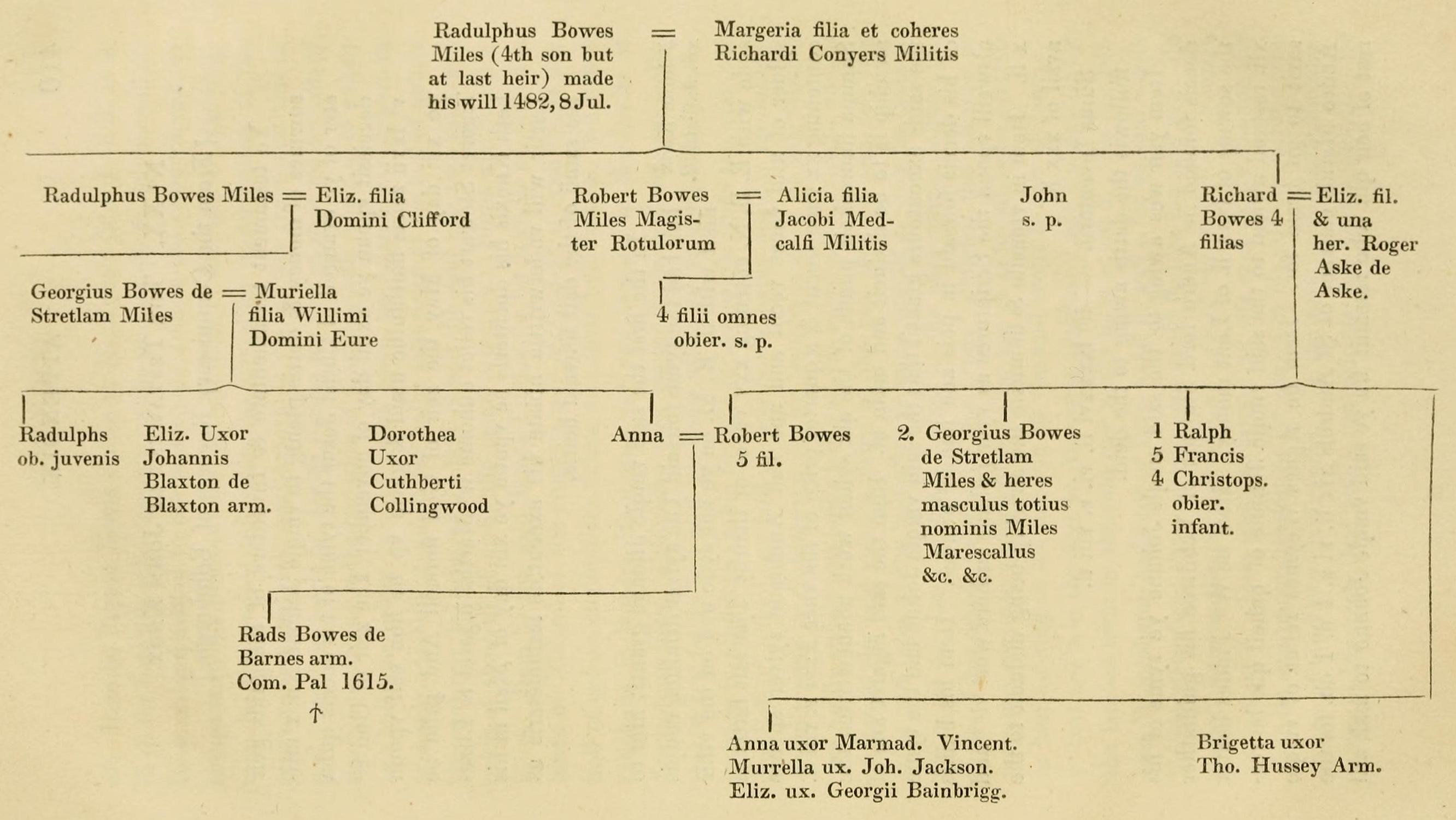
No XIX. PEDIGREE
OF
BOWES OF STREATLAM.
(See Vol. I. p. 89.)
[For the information contained in this article, I am indebted to Robert Surtees of Mainsforth, Esq.]
“Richard Bowes (of Aske in Yorkshire) youngest sonne of Sr Raph Bowes of Streatlam Knight (& of his wife Marjory daughter & one of ye heirs of Sr Richard Conyers of South Cowton Knt). He married Elizabeth ye daughter & one of ye co‑heirs of Sr Roger Aske of Aske Kt & by hir had issue Sr George Bowes ye Knight Marshall & at length heire maile of the whole family of Bowes: Robert Bowes 2d sonne: and ten daughters: viz. 1. Bridgit married to Thomas Hussey Esqr. ye next heire maile to ye Lord Hussey. 2. Eliz. mard John Bainbrigge of Snotterton Esq. 3. Anne mard Marmaduke Vincent Esq. Muriall mar. to — Jackson of Bedale Esq. Marjory† to Mr Knoxes§ a Devine in Scotland. Margaret to Thomas Middleton Esq. & after to Ambrose Burbeck. Margery Lucy Agnes & Jane all died unmarried.”
[On the margin, in a different hand,] “† sometime called Joane to distinguish her from her sister of the same name. § Knox the famouse Reformer.”
The above is extracted verbatim from a narrative Pedigree compiled about 1640 by Thomas Bowes, whose autograph is on the last page, and which is now in the possession of Mr Surtees, having been purchased by him at the sale of Counsellor Gill’s Library several years ago.
The Pedigree in the Herald’s office stands on the opposite page. It notices only four of the daughters, entirely omitting Mrs Knox and the four unmarried maidens mentioned above. This is from the Visitation of Durham, by Flower, Norroy, 1575.
The Visitation by St George, 1615, is still less full; it names only Ralph, Robert, and Richard, omitting all the daughters.—A modern Pedigree of less authority amongst Mr Allan’s collections at Grange, states Knox’s wife to be Joan—but is answered by the old narrative statement, which is far the fullest, and by the marginal note affixed to it. It was very common at that time to have two children of the same Christian name.
The Knight Marshall had two wives. From the first, a Mallory of Studley, descends Thomas Bowes, now of Bradley, Esq. Co. Pal. who is the male heir of the whole family; but the issue of the second match, a Talbot of Grafton, got the chief estate, now in the Earl of Strathmore by heirs general.
No XX. The Testament of John Knox.
[From the Commissary Records of Edinburgh.]
Ye testament testamentare & Inventare of the guids geir sowmes of money & dettis ꝓtenīg to vmqle Johnne Knox mīister of ye evangell of Christ Jesus the tyme of his deceis quha deceissit vpoun ye xxiiii day of november The zeir of God im vc lxxii zeiris ffaithfullie maid & gevin vp be him self vpoun ye xiii day of May the zeir of God foirsaid And ꝓtlie be m̅garet Stewart his relict quhome wt Martha m̅garet & Elizabeth Knoxis his dochteris he vpoun ye xiii day of Maii in his Lattir will vnderwrittin nōīate his executors testamētaris as the samē of the dait foirsaid beiris.
Johnne Knox xiii Jarii 1572.
In the first the said vmqle Jhonne grantit him to haif had the tyme foirsaid Tua sylver drinking coupis m̅kit with J. K. M. on ye ane syde and on the vthir syde with E. B. N. cōtening xxv vnces or thairby Tua salt fattis of syluer of xiiii vnces vecht and ane half Auchtene sylver spvnes contening xx vnce wecht & a quarter price of the vnce xxvi s. viii d. Summa ffoureskoir punds of the qlk syluer work abonewritten the airschip is to be deducit and takin of. Item the said m̅garet ane of the saids executours grantit that the said vmqle Johne had the tyme of his deceis foirsaid in pois ane hundēt pundes. Item his buikis alsweill vpoun the Scriptures as vyer ꝓphane authors wort vixx and x li. Item in vtensile & domicile the airschip being deducit to the avail of xxx li.
Sūma Inventarii.――iic lxxxxvi li. vi. s. viii d.
ffollowis the dettis awing to the deid.
Item yair wes awing to the said umqle Johnne ye tyme of his deceis foirsaid be Andro lord Stewart of Vchiltree his guidfather the sowme of lxxx li. of Lent money. Item be Wm Fiddes baxter xli. restand awand to the said vmqle Johnne of quheit qlk he ressavit to gif breid for. Item be Agnes Weymes relict of vmqle Andro Mernis cietener of St Androis xix li. xi s. 1 d. 1 ob. for the rest of beir qlk scho ressauit fra ye said vmqle Johnne to mak aill of. Item be m̅garet Spens Spous to Mr Robert Glen xviii li. xv s. iii d. for beir qlk scho ressauit fra the said vmqle to delyuer aill of. Item restand awand to the said vmqle Johnne the tyme foirsaid for ane pairt of his pensioun qlk he had furth of the kirk of Haddingtoun be the ꝓsones following the victualles underwritten of the zeiris and cropes resive underspecifeit viz. of the crope and zeir of god im vc lxxi zeiris be James Fiddes for ane pairt of his teyndis of the Nūland liand in the parochin of Haddingtoun Ane boll of quheit ane boll ane firlote beir vii bollis aitts. be Adame Ethingtoun in Quhitrig ane boll of quheit sex bollis aitts price of the boll of quheit the said zeir 1 s. price of the boll of beir the said zeir twa m̅kis and price of the boll of aittis the same zeir xx s. Sūma xix li. xiii s. iiii d. Item be the said James Fiddes for his teyndis of the saids lands of Nūland of the crope & zeir of God im vc lxxii zeiris ane boll of quheit ane boll ane firlote beir sevin bollis aittis. Be James Oliphant & Robert Hepburne for yair teyndis of the landis of Stenestoun liand within the said parochin ye said zeir sex bollis quheit sex bollis beir and xx bollis aittis. be ye said Adame Ethingtoun in Quhitrig for his teyndis of the saidis lands the said zeir ane boll of quheit ane boll of beir & sex bollis aittis. Be Johnne gulanis wyfe in Auldersoun for hir teyndis yrof of ye zeir foirsaid twa bollis quheit twa bollis beir and viii bollis aittis Price of ye boll of quheit the said zeir 1 s. price of the boll beir ye said zeir twa m̅kis and price of the boll aittis ye same zeir xx s. Summa lxxix li. xiii s. iiii d. Item restand awand to the said umqle Johnne the tyme of his deceis foirsaid be the ꝓsons following the sowmes of money & victuale underwrittin as for ane ꝓt of his stipende assignit to him for s̃uīg in the mīistrie of the said crope & zeir of God, im vc lxxi zeiris in the first be Margaret Haldane Lady Colingtoun for the lambes term in the said zeir xxxiii li. vi s. viii d. Be Mr Robert Wynrahame collector of Fyfe xxxii li. xvii s. for ye said vmqle John̄is victuale of the said pensioun sauld be him the said zeir. Be Robert Bennet thre firlottis quheit ꝓce of the boll 1 s. Summa xxxii s. vi d. Item restand awand to the said vmqle Jhonne the victuale and underspecifeit as for ane ꝓt of his said stipend the crop & zeir of God im vc lxxii zeiris. In the first be Williame m̅chingstoun in Inneresk thre bollis tua firlottis tua peckis quheit. Be Williame Vernor yair tua bollis tua firlottis thre peckis quheit. Be George Formā yair thre bollis tua firlottis tua pectis quheit. Be Robert Dowglas thre bollis tua firlotis tua pectis quheit. Be Johnne Cranistoun in Monktounhall thre bollis thre firlottis quheit. Be Johne Kerss yair thre bollis ane firlot tua pectis quheit. Be Thomas Thomsoun yair tua bollis tua firlottis tua pectis quheit. Be Adame wricht tua bollis ane firlit quheit. Be Williame Johnestoun foure bollis ane firlot quheit. Be Dauid Hill in Inneresk ane boll thre firlotts thre pectis quheit. extenden̄ to tua chalder quheit price of ye boll of quheit the said zeir 1 s. Sūma lxxx li. Be helene Cowtis relict of umqle Richard Prestoun of quhithill ane chalder beir. Be Jonet Betoun in Litill Monktoun ellevin bollis beir. Be Williame Wauchop of Nudry m̅schell for the teyndis of the lands of Calcoittis thre bollis beir. Be Johnne Hill of that ilk tua bollis beir. Be the tennentis of the parochin of Kynglassie for chalderis beir as followis. Be Johnne Boswall in Gaitmylk ane chalder beir. Williame Swyne yair viii bollis beir. George Tod in Kyninmonth ane chalder beir. Helene Mertyne in Kynglassie and Wm Boswall hir sone tuelf bollis beir. Wm Boswall in Stintoun xii bollis beir extenden̄ in ye haill to sex chalderis beir price of the boll ōrheid tua m̅kis. Sūa ane hundret twentie aucht pundis. Be the tennētis of the parochin of Newbirnshyre in Fyffe foure chalderis aittis as follows vizt Williame Dishingtoun in Ranelery fourtene bollis aittis. Thome Alcheur yair xiiii bollis beir. Johnne Zoung in the Coittis sex bollis aittis. Be David Sympsoun yair sex bollis aittis and be Andro . . . . . . . . yair sex bollis aittis. Be David Johnesoun in Moncturpie aucht bollis aittis. Be . . . . . . . . Sympsoun foure bollis aittis price of the boll ouerheid xx s. Summa lxiiii li. Item restand awand to ye said umqle Johnne, the sowmes underspecifeit as for ane ꝓt of ye sylver of his said stipend of the said zeir of God im vc lxxii zeiris. In the first be James Rig of Carberry for the half teynd of Cowsland xxxiii li. vi s. viii d. Be . . . . . . lady Edmestoun Spous to Andro Ker of hirsell knyt, for the vyr half of the teyndis of the lands foirsaids xxxiii li. vi s. viii d. Be the said m̅garet Haldane lady Colyngtoun for the teynd of Hailis lxvi li. xiii s. viii d. Be Robert Bennet xxxiii li. vi s. viii d. Be Mr James Macgill of Rankelor, neyer for his males of the lands of Pinkie for the t̃mes of Witsonday and m̅tymes In the said zeir of god im vc lxxii zeiris li lib. vi s. viii d. And als resting be him of the males of the landis foirsaids of the zeir of God im vc lxx zeiris xlv s. viii d. Be the executirs of vmqle Gilbert Edmestoun for the males of the lands of Wowmet of the t̃me of m̅tymes the said zeir of God im vc lxxii zeiris xxii li. viii s. Be Jonet betoun for the males of Litill Monktoun Nyne pundis. Be the said . . . . . . . . Lady Edmestone and Archibald Prestoun of Wallefeild for the males of Netoun xiiii li. xi s. vi d. Be James Rig of Carberry for the Maill yrof xx li. Item be . . . . . . . . of Nudry for the Males of Calcottes thre pundes. Be Robert Douglas in Inneresk for his males iii lib. xix s. iiii d. Be Wm m̅chinston thair for his few maill xxvii s. x d.
Summa of the detis abone writtin awing to ye deid viiic xxx li. xix s. vi d.

Na detis awing be the deid
Summa of ye Inventare wt ye detis awing to the deid im vc xxvi li. xix s. vi d.
To be Diuidit in thre ꝓtis ye deidis pairt yrof extends to iiic lxxv li. xiii s. ii d.
ffollowis the latter will and legacie.
Lord Jesus I ǫmend my trublit spreit in thy ꝓtectioun and defence and thy troublit kirk to thy m̅cie. Becaus I haif had to do wt dyuers ꝓsonages of the mīistrie qrunto god of his m̅cie erectit me wt in this realme my dewetie cravis that I sall leve unto thaim now ane testimony of my mynd. And first unto the papistis and to the vnthankfull warld I say that althocht my lyfe hes bene vnto thaim odious and that oftintimes yai haif socht my destruction & ye destructioun of ye kirk qlk god of his mercie hes plantit within this realme & hes alwayis preservit & kepit the samin fra thair crewale Int̃prysis zet to yaim I am ǫpellit to say that onles thai spedele repent my departing of this lyfe salbe to yaim the greatest calamitie that evir zet hes apprehendit yaim. sum small apperance yai may zit haife in my lyfe gif thai haif grace to se ane deid man haif I bene almaist yir tua zeiris last bypast And zet I wald that yai suld rypelie considder in quhat bettir estait yai and yair materis stands in yan it hes done befoir and thai haif hard of lang tyme befoir threatnit. bot becaus yai will nocht admit me for ane adminiser, I gif yaī ouir to the Judgement of him quha knawis ye hartis of all and will disclose the secretis yairof in dew tyme. And yis far to the papistis. To the faithfull God befoir his sone Jesus christ and befoir his halie Angellis I ꝓtest yat God be my mouth, be I nevir sa abiect, hes schawin to zow his trewth in all simplicitie. Nane I haif corrupted, nane haif I defraudit, m̅chandise haif I nocht maide (to godis glorie I write) of the glorious evangell of Jesus Christ, bot according to the measr of the grace graunted unto me, I haif dividit the sermont of trewth in just ꝓtis, beatin doun the pryde of the proude In all that did declare yr rebellioun aganis God, according as God in his law gevis to me zit testimonie, & raising vp the ǫsciences trublit with the knawledge of yr awin synnis be the declaring of Jesus Christ the strength of his death & the michtie operatioun of his resurrectioun. In the hartis of the faithfull off yis I say I haif ane testimony yis day in my conscience befoir God, how yat evir ye warld rage. Be cōstant yr foir in doctrine that anis publictlie ze have professit, lat nocht sclandrous dayis draw zow away fra Jesus Christ, nayir lat the prosperitie of the wickit move zow to follow it nor yame. ffor howsoeuer it be yat God appeiris to neglect his awin for ane seasoun, zit he remanis ane Just Juge quha nathir can nor will justifie the wickit. I am nocht ignorant yat mony wald that I suld enter in particulare determinatioun of thir ꝓn̄t trubles, to quhome I planelie and simplie āswer yat as I neuir excedit ye boundis of Goddis scriptures, sua will I nocht do in yis pairt by Godis grace. Bot heirof I am assurit be him quha nathair can dissave nor be dissavit yat the castell of Edinburt, in the qlk all the murthour all the truble & the haill destructioun of yis puir commounweill was Inventit, as our awin eis may witness, by yaim & by yair mātenaris was put in executioun, sall cum to destructioun mantene it quhasa list, The destructioun I say of body & saull, except yai repent. I luik not to the momētary prosperitie of ye wicked, ze not althot yai suld remane conquerors to the cūing of or lord Jesus, bot I luik to this sentence, that quhasaeuir scheddis Innocent bluid defyles the land and provoikis Godis wrath aganis himself & the land, vntill his bluid be sched agane be ordor of law to satisfie gods anger. This is nocht the first tyme that ze haif hard this sentence. althot yat mony at all tymes sturrit at sik severitie I zit afferme the same being reddy to entir to gif compt befoir his Maiestie of the stewartship he committit vnto me. I knaw in my death the rumours salbe strange, bot be ze nocht trublit abone measor, belouit in the Lord Jesus. Bot zit agane I say, remane cōstāt in ye trewt, & he quha of his m̅cie send me, conductit me, and prosperet ye work in my hand aganis Sathan will provide for zow abundantlie, quhen yat athir my bluid sall wattir the doctrine taucht be me, or he of his mercie vtherwayis provide to put ane end to yis my battell. My executors I mak constitute & ordane m̅garet Stewart my spous, Martha Margaret & Elizabeth knoxis my dochteris, and the faithfull to be ōrsmen. To my tua sones Nathaneell & Eleazare Knoxis I unfeignedlie leif ye same benedictioun yat yair dairest mider Mariorie Bowss left vnto yaim To wit that God for his sone christ Jesus saik wald of his mercie mak yaim his trew fereris and als vpricht worschippers of him as ony yat euer sprang out of Abrahames loynes, quhairto now as than I fra my trublit hart say amen. ffurther I have delyuerit be Maister Randulphe to Mr Robert Bowss schereff of the bischoprik & bruder to ye said Mariorie my vmqle dairest spous ye sowme of fyve hundreth punds of scottis money to ye vtilitie and proffett of my saidis tua sonis, The qlk money is yat pairt of substāce yat fell or pertenit to yaim be the deces of Mariorie Bowss yair moder of blissit memory, And augmētit be me as I myt or may spair to mak out the said sowme, for I ressavit of yris bot ane hundret merkis sterling, qlk I of my povirtie extendit to fyve hundret punds scottis, and yat in contentatioun of yair bairns pairt of geir qlkis may fall to yaī by my deces. Item I leif to my saids tua sones Tua sylver drinking cowpis the ane of thaī is m̅ket J. K. M. on ye ane syde, and on ye vther syde wt E. B. N. And in like mnner ye toyir wt ye same m̅k and lēres, The wecht of ye saidis tua cuipis contenand xxii vnce, or yrby, Tua salt fattis of sylver and xviii sylver spvnes, weyand xxxiiii z. and ane qr vnces, price of ye vnce ōrheid xxvi s. viii d. The qlks cuipis salt fattis & spvnes I leif in keping to ye said Margaret my spous qll my saidis sones be of the aige of xxi zeiris At ye qlk tyme I ordane & commandis hir to delyver the samī to my saidis sones, or to ony ane of yaim, gif be deces ye vthir faillis. Item I leif also to my saids sones ane pairt of my saidis buikis of ye availl of xxx li And failzeing of my saids sones & thair airis I ordane the foirsaidis fyve hundret punds wt ye syluer cuips spvnes saltfattis and buikis to return agane as eftir followis, That is to say, ye ane equale half yrof to ye said Margaret my spous & my saids thrie dochteris, And ye vyir half of ye samī to my bruder Williame Knox & his airis quhatsumevir. Item I leif to my said spous Margaret Stewart ye Aucht hundret merkis qlkis ar laid vpoun the landis of pennymoir quhairin scho is infeft be Andro lord Stewart of vchiltree my fader of law, and failzeing of ye said Margaret I leif ye samē to my saids thre dochters & failzeing of thaim I leif the samin to ye said Andro lord Stewart of vchiltrie & his airis quhatsūeuir, chairgeing & requyring my said fader of law & his airis, as yai will āsuer befoir yat incorruptible Judge ye lord Jesus, yat yai suffer not my said spous & children to be defraudit or evill payit of the males & ānual rent of the saids lands during the nonredemptioun of ye samī. Item I leif to paule knox my bruder sonne ane hundreth pundis qlk lyis in wodset upoun Robert Campbellis landis in Kinzeanclewt & quhairin the said paule is ellis infeft, and yat to be ane help to hald him at ye scuilis. And as concerning ye rest of my haill guids quhatsumeuir I leif to be dividit betuix my said spous & my saids thre dochteris, and becaus my said spous man tak the cair of my saidis dochteris & faithfullie travell for thair guid nurischment & upbringing, Thairfoir I leif my said spous ye use of yr geir qll yaibe mareit or cum to perfite aige, at qlk tyme I ordane thaim every ane as the tyme approches to haif yair awin yat to yaim appertenis