Chapter XXII · FORREST IN SEVEN OF HIS CHIEF ROLES.—CHARACTERS OF IMAGINATIVE PORTRAITURE.—RICHELIEU.—MACBETH.—RICHARD.—HAMLET.—CORIOLANUS.—OTHELLO.—LEAR.
Reading edition
At the date of this writing, although there are many good actors in America, there are none who are generally recognized as great. There also appears for the time to be a decline in the popular taste for the serious and lofty drama, and a general preference for sensational, comic, and spectacular plays. In vain does the call-boy summon the sublime characters and parts that entranced the audiences of a bygone generation. They seem to have died with the strong and stately actors who gave them such noble life and motion. The sceptred pall of gorgeous tragedy has vanished from the stage, it may almost be said, and for the poet and the thinker have been substituted the carpenter, the scene-painter, the upholsterer, and the milliner. Nudity, prurience, broad appeals to sensual passion, extravagant glare and movement and noise, have largely thrust aside tragic action, romantic sentiment, and moral grandeur. Even though the depravation be but temporary, marking a transitional crisis, it is a feature unpleasant to contemplate. And it may be of some service, not only in completing the picture of the life of Forrest, but likewise in revealing the higher social uses and lessons of his art, to give a description of the chief of those massive and heroic rôles he loved best to fill in the ripest period of his professional career. The accounts must be brief and fragmentary, and very inadequate at the best. To preserve or re-create the full impression of a great actor in a great part, he should be sculptured in every attitude and movement, with every gesture and look, and painted in every tone, emphasis, and inflection of his voice. Yet, without attempting this impossible feat in the case of Forrest, enough may be rapidly indicated in general sketches to enable intelligent readers to form some approximate 721conception of his leading impersonations and of the influences they were calculated to exert.
The pictures of the acting of Forrest now to be essayed must be tantalizingly faint and imperfect, in the absence of an art to translate and reproduce all the other eight dramatic languages of human nature in the one language of words. But to appreciate even these poor attempts at their worth one preliminary condition on the part of those who read is pre-eminently necessary. They must remember that Forrest was one of those rare men profusely endowed with that mysterious power to interest and impress which is popularly called personal magnetism. He was signally charged with that secret spell, that loaded and swaying fascination, which all feel though no one understands, which contagiously works on those who come within its reach, seizing curiosity, enlisting sympathy, or evoking repulsion. The distinguishing differences of men in this respect are indescribable and fatal. No art can efface them or neutralize them. For an artist who makes direct personal appeal to an audience the having or the not having this magnetic gift is as the hidden core of destiny. With it obstacles are removed as by magic, friends won, enemies overthrown, and wherever the possessor sails through the community he leaves a wide phosphorescent wake of social interest and gossip. Without it, though flags are waved and trumpets are blown and all pains taken to make an impression and secure a victorious career, yet the efforts prove futile and public attention wanders listlessly away. One seems created to be the victim of perpetual slights, dry, trivial, destitute of charm, nobody caring anything about him; while another, freighted with occult talismans, strangely interests everybody. The recognition of such contrasts is one of the most familiar facts of experience. These phenomena are suggested by the word sphere as applied to the characteristic influence of personality. The spiritual sphere or signalling power of an individual is described as attractive or repulsive, strong or weak, vast or little, harmonious or discordant. The mystery is not so blankly baffling as it has been supposed, but is in a large degree susceptible of rational explication.
Out of a hundred accomplished singers, beautiful in person and marvellous in voice, one prima donna shall surpass all the 722rest in fascinating the public. There is a nameless distinction in her bearing, there is an indescribable charm in her song, which bewitch and enthrall, are her irresistible passports to public enthusiasm, and make her sure of a long and dazzling career; while one after another of the rest with desperate exertions and fitful plaudits disappear. Here is a tragedian who exercises the same spell and quickly obscures his distanced rivals. He advances on the stage with a quiet step, his mantle negligently crossing his breast, his countenance calm. Without a start, without a gesture, without a word, he simply is and looks. Yet, as he approaches, awe spreads around him. Why this breathless silence all over the theatre, this rooted attention from every one? He seats himself, he leans on the arm of the chair; his voice, quick and deep, seems not to utter common words, but to pronounce supernatural oracles. By what transcendent faculty does he render hate so terrible, irony so frightful, disdain so superhuman, devotion so entrancing, love so inexpressibly sweet, that the whole assembly rivet their eyes and hold their breath while their hearts throb under the mystic influence of his action? The secret is purely a matter of law without anything of chance or whim or caprice in it. It is the profound and universal law which regulates the exercise of sympathetic influence by one person on another. It has two elements, namely, beauty and power. Beauty and power both can be expressed in shapes, features, motions, and tones. Shapes, features, and tones are results and revelations of modes of motion. The face is shaped and modulated by the ideal forces within, the rhythmical vibrations which preside over the processes of nutrition. All those shapes or movements in a person which in their completeness constitute, or in their segments imply, returning curves or undulations, such as circles, ellipses, and spirals, are beautiful. They suggest economy of force, ease of function, sustained vitality, and potency. But abrupt changes of direction, sudden snatches and breaks of movement, sharp angles, are ugly and repellent, because they suggest waste of force, difficulty of function, discord of the individual with the universal, and therefore hint evil and death. The serpent was anciently considered a symbol of immortality on account, no doubt, of all its motions being endless lines or undulations circling in themselves. This is the law of beauty which 723just in proportion to its pervasive prevalence and exhibition in any one gives its possessor charm. The subtile indication of this in the incessant and innumerable play of the person fascinates and delights all who see it; and those who do not consciously perceive it are still influenced by it in the unconscious depths of their nature.
The element of power is closely allied in its mode of revelation and influence with that of beauty. Every attitude, gesture, or facial expression is composed of contours and lines, static and dynamic, latent and explicit, fragmentary and complete, straight, curved, or angularly crooked. Now, the nature of these lines, the degree in which their curves return or do not return into themselves, the nature and sizes of the figures they describe, or would describe if completed according to their indicative commencements, determine their beauty or ugliness and decide what effect they shall produce on the spectator. The beauty and the pleasure it yields are proportioned to the preponderance of endless lines suggestive of circulation of force without waste, and therefore of perfect grace and immortal life. But that sense of power which breeds awe in the beholder is measured by the proportion of exertion made to effect produced. All force expended passes off on angular lines. The angles of movement may be obtuse or sharp in varying degrees, and consequently subtend lines of different lengths. All attitudes and gestures compose curves and figures, or cast lines and form angles, which constitute their æsthetic and dynamic values, those measuring beauty, these measuring power. For, on the principle of the lever and momentum, the power expended at the end of a line is equal to that exerted at the beginning of the line multiplied by its length. The amounts of exertion and the lengths of lines are unconsciously estimated by the intuitions of the observer, and the unconscious interpretations to which he is led are what yield the impressions he experiences on seeing any given actor. The greatest sense of power is received when the minimum of initial effort is seen with the maximum of terminal result; when the smallest weight at the central extremity balances the largest one at the distal extremity. The law of combined beauty and power of action, then, is contained in the relations of returning lines and lengths of straight lines. The measure of dramatic expression is 724this: impression of grace is according to the preponderance of perpetuating curves, and impression of strength according to the degrees of the angles formed by the straight lines. That actress or actor in whose organism there is the greatest freedom of the parts and the greatest unity of the whole, the most perfect co-operation of all the nerve-centres in a free dynamic solidarity and the most complete surrender of the individual will to universal principles, will make the deepest sensation,—in other words, will have the largest amount of what has been vaguely called personal magnetism. The divinest character expresses itself in softly-flowing forms and inexpensive movements. The most royal and august majesty of function indicates its rank of power by the slightest exertions implying the vastest effects. Frivolous, false, and vulgar characters are ever full of short lines, incongruous, fussy, and broken motions, curves everywhere subordinated and angles obtrusive. Such persons are, as it is said, destitute of magnetism. They do not interest. They cannot possibly charm or awe. It is a law of inexpressible importance that the quality, grade, and measure of a personality are revealed primarily in the proportions, secondarily in the movements, of the physical organism. These proportions and movements betray alike the permanent features of the indwelling character and all its passing thoughts and emotions. The truth is all there, though the spectator may be incompetent to interpret its signals. The most harmonious and perfect character will show the most exquisite symmetry and grace of repose and action. The irregulated, raw, and reckless type of character expresses itself in awkward, violent, or incongruous movements, wasteful of energy yet not impressive in result. Beauty of motion, the implication of endless lines, is the normal sign of loveliness of soul. Grandeur of soul or dynamic greatness of mind is indicated by implicit extent and ponderous slowness of motion. When the smallest displays of motion at the centres suggest the most sustained and extended lines, the impression given of power is the most mysterious and overwhelming. The most tremendous exertions, in lines and angles whose invisible complements are small, produce a weak impression, because they make no appeal to the imagination. The beauty of the figures implied in the forms of the movements of a man is the analogue of his goodness; the dimensions of the 725figures, the analogue of his strength. And in the case of every one the spectators are constantly apprehending the forms of these figures and how far they reach, and emotionally reacting in accordance with the results thus attained. It is not a conscious and critical process of the understanding or the senses, but a swift procedure of the intuitions or organic habits, including the sum of ancestral experiences deposited in instinctive faculty. Many who are ignorant of this law of the revelation of human nature, and of the sympathetic influence of man on man involved in it, may feel that the whole conception is merely a fine-spun fancy, with no solid basis in fact. But a perfect parallel to the process here described as taking place through the eye has been both mathematically and visibly demonstrated in the case of the ear. The beauty of form as perceived by the eye depends on implicit perception of geometric law, and is proportioned to the simplicity of the law and the variety of the outline embodying it, just as the harmony of colors or the harmony of sounds depends on the implicit perception of arithmetical ratios, and is proportioned to the harmony of times in which the vibrations of the visible or audible medium occur. We distinguish the beauty and the quality of a tone of the same pitch produced by different instruments or voices, and our feelings are differently affected with pleasure or pain as we listen to them. But the beauty of a tone consists in the equidistance of the pulsations of air composing it, and the quality of a tone consists in the forms of the pulsations. The auditory apparatus reports the symmetry or asymmetry of the pulsations in form and rate, and the soul, intuitively grasping the secret significance, is delighted or disturbed accordingly. The charm of a delicious, musical, powerful voice has these four elements, beautiful forms in its vibrations, perfect rhythm or equidistance in its vibrations, varying breadth in its vibrations, and varying extent of vibratory surface in the sounding mechanism. Without knowing anything about any of these conditions, the sensitive hearer, played on by them through his ear, accurately responds in feeling. It is exactly the same, in the case of the eye, with the geometrical lines and figures involved in the bearing of a person. If these are beautiful in forms, graceful in motions, sublime in implicit dimensions, the impression is delightful and profound; while if they are petty and incoherent, or 726clumsy and unbalanced, their appeal is superficial and disagreeable. This is the law of personal magnetism, which always exerts the vastest swing of power from the most exactly centred equilibrium. The mysteries of God are revealed in space and time through form and motion. They are concentrated in rhythm, which, as defined by Delsarte, is the simultaneous vibration of number, weight, and measure. We are creatures of space and time; all our experience has been written and is organized in that language. Our whole nature therefore in its inmost depths corresponds and thrills to the mystic symbols of harmony or discord with love and pleasure or with fear and pain. The secret of the delight that waits on the perception or feeling of beauty and power is the recognition of sequent ratios which express symmetry in time or algebraic law, and coexistent ratios which express symmetry in space or geometric law. Spatial symmetry is the law of equilibrium, the adjustment of the individual with the universal, and measures power. Temporal symmetry is the law of health, the pulsating adjustment of function with its norm, and measures the melodious flow of life. Rhythm is the constant dynamic reproduction of symmetry in space and time combined. It is the secret of personal magnetism. Its charm and its power are at their height when the symmetries are most varied in detail and most perfect in unity.
Now, Forrest ever possessed this magnetic temperament, this firmly poised and ingravidated personality, and ever wielded its signals with startling effect. The tones and inflections of his sweet and majestic voice in its wide diapason were felt by his hearers palpitating among the pulses of their hearts. His attitude, look, and gesture in great situations often produced on a whole assembly the electric creep of the flesh and the cold shudder of the marrow. His fearlessness and deliberation were conspicuous and proverbial. A censorious critic said, “Mr. Forrest is the most painfully elaborate actor on the stage. He swings in a great slow orbit, and, though he revolves with dignity and sublimity, the sublimity is often stupid and the dignity a little pompous. He dwells so long on unimportant passages that one might imagine he intended to take up an everlasting rest on a period, to go to sleep over a semicolon, or spend the evening with a comma. His pauses are like the distances from 727star to star, and if he continues in his course people will have time to stroll in the lobbies between his sentences. His performances might be defined by his enemies as infinite extensions of silence with incidental intervals of speech.” Through this enveloping burlesque one discerns the poise, sang-froid, and grandeur of the man.
Senator Stockton, passing the Broadway Theatre one evening, met a friend coming out, and asked him, “What is going on in there?” The reply was, “Oh, nothing: Forrest is in one of his pauses!” An admiring critic said of him, and if the diction be exaggerated it yet invests the truth, “There is no actor living who takes a stronger hold of the feelings of his audience or grasps the passions of the human heart with such a giant-like clutch. He is as imposing and daring in his action as the mountain condor when he darts on the flock, or the bird of Jove when he wheels from the peaks and burnishes his plumage in the blaze of the sun. It is not one here and there that submits to his sovereignty. The entire audience are swayed and fashioned after the workings of his soul. He permits none to escape the potency of his sceptre, but makes all bow to his terrible and overwhelming mastery.” Of course different persons had different degrees of susceptibility to this elemental power and earnestness of nature and to this trained and skilled display of art, though all must feel it more or less either as attraction or as repulsion. The varying effects of the playing of character through its signs is the genuine drama of life itself. The idiot holds his bauble for a god, as Shakspeare says. The ruffian is hardened against all delicate and noble manifestations of mind. The dilettante, in his dryness, veneer, and varnish, is incapable of any enthusiasm for persons. And there are multitudes so harassed and exhausted in the selfish contests of the day, their hearts and imaginations so perverted or shrivelled, that the brightest signals of heroism, genius, and saintliness shine before them in vain. The play of personal qualities, the study and appreciation of them, are more neglected now than they ever were before. It is one of the greatest of social calamities; for it takes the social stimulus away from spiritual ambition or the passion for excellence. And it is one of the supreme benefactions conferred on society by a great actor that he intensifies and illuminates the revelatory language of character and fixes attention 728on its import by lifting all its modes of expression to their highest pitch.
RICHELIEU.
In a previous chapter an attempt was made to describe Forrest in those characters of physical and mental realism with which his fame was chiefly identified during the earlier and middle portions of his popular career. It remains now to essay a similar sketch of those characters of imaginative portraiture which he best loved to impersonate in the culminating glory and at the close of his artistic career. In the Rolla, Damon, Spartacus, Metamora of his young manhood he was, rather than played, the men whose parts he assumed, so intensely did he feel them and so completely did he reproduce nature. He wrestled with the genius of his art as Hercules with Antæus, throwing it to the ground continually, but making its vitality more vigorous with every fall. As years passed, and brought the philosophic mind, they tempered and refined the animal fierceness, strained out the crudity and excess, and secured a result marked by greater symmetry in details, fuller harmony of accessories, a purer unity in the whole, and a loftier climax of interest and impression. Then studious intellect and impassioned sentiment, guided by truth and taste, preponderated over mere instinct and observation, and imaginative portraiture took the place which had been held by sensational realism. This is what in dramatic art gives the violence of passion moderating restraint, puts the calm girdle of beauty about the throbbing loins of power. Imagination, it is true, cannot create, but it can idealize, order, and unify, unravel the tangled snarl of details, and wind the intricacies in one unbroken thread, making nature more natural by abstraction of the accidental and arrangement of the essential. This was what the acting of Forrest, always sincere and natural, for a long time needed, but at last, in a great degree, attained, and, in attaining, became genuinely artistic.
The Richelieu of Forrest was a grand conception consummately elaborated and grandly represented. It was a part suited to his nature, and which he always loved to portray. The glorious patriotism which knit his soul to France, the tender affection which bound his heart to his niece, the leonine banter with which he mocked his rivals, the indomitable courage with which he defied his foes, the sublime self-sufficingness with which he trusted 729in fate and in the deepest emergencies prophesied the dawn while his followers were trembling in the gloom, his immense personal superiority of mind and force swaying all others, as the sun sways its orbs,—these were traits to which Forrest brought congenial qualities and moods, making their representation a delight to his soul.
He dressed for the part in long robes, an iron-gray wig, and the scarlet cap of a cardinal. He stooped a little, coughed, but gave no signs of superannuation. As the conspiracies thickened about him and the end drew on, he seemed visibly to grow older and more excitable. His age and feebleness, though simulated with an exquisite skill, were not obtruded. Though the picture of an old man, it was the picture of a very grand old man, like the ruin of a mighty castle, worn by time and broken by storms, yet towering proudly in its strength, with foundations the earthquake could not uproot and battlements over which the thunder crashed in vain. Forrest made the character not only intensely interesting and exciting by the great variety of sharp contrasts he brought into reconciliation in it, but also admirable and lovable from the honest virtues and august traits it embodied. He represented Richelieu as a patriotic statesman of the loftiest order, and also as a sage deeply read in the lore of the human heart, tenaciously just, a careful weigher of motives, his sometimes rough and repellent manner always covering a deep well of love and a rich vein of satire.
In the opening scene, the cunning slyness of the veteran plotter and detective, the dignity of the great statesman, and the magnetic command of the powerful minister were revealed in rapid alternation in a manner which was a masterpiece of art.
“And so you think this new conspiracy
The craftiest trap yet laid for the old fox?
Fox? Well, I like the nickname. What did Plutarch
Say of the Greek Lysander?
That where the lion’s skin fell short, he eked it
Out with the fox’s! A great statesman, Joseph,
That same Lysander!”
There was in the delivery of these words a mixture of sportiveness and sobriety, complacency and irony, which spoke volumes. Then, speaking of Baradas, the conceited upstart who 730expected to outwit and overthrow him, the expression of self-conscious greatness in his manner, combined with contempt for the mushroom success of littleness, made the verbal passage and the picture he painted in uttering it equally memorable as he said,—
“It cost me six long winters
To mount as high as in six little moons
This painted lizard. But I hold the ladder,
And when I shake—he falls!”
As his hand imaginatively shook the ladder, his eye blazed, his voice grew solid, and the audience saw everything indicated by the words as distinctly as if it had been presented in material reality. Nothing could be more finely drawn and colored than the variety of moods, the changing qualities of character and temper, called out in Richelieu by the reactions of his soul on the contrasted persons of the play and exigencies of the plot as he came in contact with them. When, alluding to the attachment of the king for his ward as an ivy, he said—
“Insidious ivy,
And shall it creep around my blossoming tree,
Where innocent thoughts, like happy birds, make music
That spirits in heaven might hear?”—
there was a fond caressing sweetness in his tones that fell on the heart like a celestial dew. Into what a wholly different world of human nature we were taken in the absolute transformation of his demeanor with Joseph, the Capuchin monk, his confidant! Here there was a grim humor, an amusing yet sinister banter:
“In my closet
You’ll find a rosary, Joseph: ere you tell
Three hundred beads I’ll summon you. Stay, Joseph.
I did omit an Ave in my matins,—
A grievous fault. Atone it for me, Joseph.
There is a scourge within; I am weak, you strong.
It were but charity to take my sin
On such broad shoulders. Exercise is healthful.”
His interview with De Mauprat reminded one of a cat playing with a mouse, or of a royal tiger which had laid its paw on one of the sacred cattle and was watching its quiverings under the velvet-sheathed claws. When De Mauprat expects to be ordered to the block, Richelieu sends him to his darling Julie:
731“To the tapestry chamber. You will there behold
The executioner: your doom be private,
And heaven have mercy on you!”
The delightful humor here follows the desperate terror like sunlight streaming on a thunder-cloud. What a contrast was furnished in the allusion to the detested Baradas and his confederates when the aroused cardinal, after the failure of every method to conciliate, towers into his kingliest port, and exclaims, with concentrated and vindictive resolution,—
“All means to crush. As with the opening and
The clenching of this little hand, I will
Crush the small vermin of the stinging courtiers!”
The central and all-conspicuous merit of Forrest’s rendering of Richelieu was the unfailing felicity of skill with which he kept the unity of the character clear through all the variety of its manifestations. It was a character fixed in its centre but mobile in its exterior, dominated by a magnificent patriotic ambition, open to everything great, tinged with cynicism by bitter experience, if irascible and revengeful yet full of honest human sympathy. He enjoyed circumventing traitors with a finesse keener than their own, and defying enemies with a haughtiness that blasted, while ever and anon gleams of gentle and generous affection lighted up and softened the sombre prominences of a nature formed to mould rugged wills and to rule stormy times.
It is only great actors who are able to make the individuality of a character imperially prominent and absorbing yet at the same time to do equal justice to every universal thought or sentiment occurring in the part. Forrest was remarkable for this supreme excellence. Whenever the author had introduced any idea or passion of especial dignity from the depth of its meaning or the largeness of its scope, he was sure to express it with corresponding emphasis and finish. This makes a dramatic entertainment educational and ennobling no less than pleasurable. When François, starting on an important errand, says, “If I fail?” Richelieu gazes on the boy, while recollections of the marvellous triumphs of his own career flit over his face, and exclaims, with an electric accentuation of surprise and unconquerable assurance,—
732“Fail?
In the lexicon of youth, which fate reserves
For a bright manhood, there is no such word
As fail!”
When the huge sword of his martial period at Rochelle drops from his grasp, and he is reminded that he has other weapons now, he goes slowly to his desk, the old hand from which the heavy falchion had dropped takes up the light feather, his eyes look into vacancy, the soldier passes into the seer, an indefinable presence of prophecy broods over him, and the meditative exultation of his air and the solemn warmth of his voice make the whole audience thrill as his sculptured syllables fall on their ears:
“True,—this!
Beneath the rule of men entirely great
The pen is mightier than the sword. Behold
The arch-enchanted wand! Itself a nothing,
But taking sorcery from the master hand
To paralyze the Cæsars and to strike
The loud earth breathless. Take away the sword:
States can be saved without it.”
When Julie, appealing to him for aid which he cannot promise, expostulatingly asks,—
“Art thou not Richelieu?”—
he answers in a manner whose attitude, look, and tone instantly carry the imagination and sympathy of the soul-stricken auditors from the individual instance before them to the solemn pathos and mystery of the destiny of all mankind in this world:
“Yesterday I was:
To-day, a very weak old man: to-morrow,
I know not what!”
So, when, amidst unveiled treason, hate and fear and sickening ingratitude, left alone in his desolation, his spirit for a moment wavered under the load of suspicion and melancholy, but quickly rallied into its own invincible heroism, he so painted and voiced the successive moods that every bosom palpitated in living response:
733“My leeches bribed to poisoners; pages
To strangle me in sleep; my very king—
This brain the unresting loom from which was woven
The purple of his greatness—leagued against me!
Old, childless, friendless, broken—all forsake,
All, all, but the indomitable heart
Of Armand Richelieu!”
Never was transition more powerful than from the minor wail of lamentation with which Forrest here began to the glorious eloquence of the climax, where his vocal thunderbolts drove home to every heart the lesson of conscious greatness and courage. The treachery was depicted with a look and voice expressive of a weary and mournful indignation and scorn touched with loathing; the desertion, with bowed head and drooping arms, in low, lingering, tearful tones; the self-assertion was launched from a mien that swelled with sudden access of inspiration, as if heaving off its weakness and stiffened in its utmost erection.
Another imposing instance in which Forrest so rendered a towering sense of genius and personal superiority as to change it from egotism to revelation, merging the individual peculiarity in a universal attribute, was where the armed De Mauprat comes upon the solitary cardinal and tells him the next step will be his grave. The defiant retort to this threat was so given as to impress the audience with a sense of prophetic power, a feeling that the destiny of man is mysteriously linked with unseen and supernatural ranks of being:
“Thou liest, knave!
I am old, infirm, most feeble—but thou liest.
Armand de Richelieu dies not by the hand
Of man. The stars have said it, and the voice
Of my own prophetic and oracular soul
Confirms the shining sibyls!”
A crowning glory of the impersonation of this great rôle by Forrest was the august grandeur of the method by which he set the intrinsic royalty of Richelieu over against the titular royalty of Louis. In many nameless ways besides by his subtile irony, his air of inherent command masked in studied courtesy of subordination, and the continual contrast of the comprehensive measures and sublime visions of the one with the petty personal 734spites and schemes of the other, he made it ever clear that the crowned monarch was a sham, the statesman the real one anointed and sealed by heaven itself. This true and democratic idea of superiority, that he is the genuine king, not who chances to hold the throne, but who knows how to govern, received a splendid setting in all the interviews of the king and the cardinal. When the conspirators had won Louis to turn his back on his minister with the words,—
“Remember, he who made can unmake,”—
who that saw it could ever forget the dilating mien and burning oratoric burst which instantly made the sovereign seem a menial subject, and the subject a vindicated sovereign?
“Never! Your anger can recall your trust,
Annul my office, spoil me of my lands,
Rifle my coffers: but my name, my deeds,
Are royal in a land beyond your sceptre.
Pass sentence on me if you will. From kings,
Lo, I appeal to Time!”
Again, when Louis, with mere personal passion, had harshly rebuffed him with the words,—
“For our conference
This is no place nor season,”—
the narrow selfishness of the king makes him seem a pygmy and a plebeian in the light of the universal sentiment and expansive thought with which Richelieu overwhelmingly responds,—
“Good my liege, for justice
All place is a temple and all season summer.
Do you deny me justice?”
But the grandest exhibition of the superiority of democratic personal royalty of character and inspiration to the conventional royalty of title and place, the supreme dramatic moment of the play, was the protection of Julie from the polluting pursuit of the king. Folding the affrighted girl to his breast with his left arm, he lifted his loaded right hand, and, with visage of smouldering fire and clarion tone, cried,—
735“To those who sent you!
And say you found the virtue they would slay,
Here, couched upon this heart, as at an altar,
And sheltered by the wings of sacred Rome.
Begone!”
Baradas asserts that the king claims her. Then came such a climax of physical, moral, and artistic power as no man could witness without being electrified through and through. Forrest prepared and executed this climax with an exquisite skill that made it seem an unstudied inspiration. His intellect appeared to have the eager fire that burns and flashes along a train of thought, gathering speed and glory as it moves, till at last it strikes with irresistible momentum. At first with noble repression the low deep voice uttered the portentous words,—
“Ay, is it so?
Then wakes the power which in the age of iron
Burst forth to curb the great and raise the low.”
Here the surge of passion began to sweep cumulatively on. The eyes grew wild, the outstretched hands quivered, the tones swelled and rang, the expanded and erected figure looked like a transparent mass of fire, and the climax fell as though the sky had burst with a broadside of thunders.
“Mark where she stands! Around her form I draw
The awful circle of our solemn Church.
Set but a foot within that holy ground,
And on thy head, yea, though it wore a crown,
I launch the curse of Rome!”
The sudden passage of Richelieu from the extreme of tottering feebleness to the extreme of towering strength, under the stimulus of some impersonal passion, illustrated a deep and marvellous principle of human nature. Forrest never forgot how startlingly he had once seen this exemplified by Andrew Jackson when discussing the expediency of the annexation of Texas to the United States. A disinterested and universal sentiment suddenly admitted to the mind, lifting the man out of egotism, sometimes seems to open the valves of the brain, flood the organism with supernatural power, and transform a shrivelled skeleton into a 736glowing athlete. Richelieu had fainted, and was thought to be dying. The king repents, and restores his office, saying,—
“Live, Richelieu, if not for me, for France!”
In one instant the might of his whole idolized country passes into his withered frame.
“My own dear France, I have thee yet, I have saved thee.
All earth shall never pluck thee from my heart,
My mistress France, my wedded wife, sweet France!”
It was the colossal scale of intellect, imagination, passion, and energy exposed by Forrest in his representation of Richelieu that made the rôle to ordinary minds a new revelation of the capacities of human nature. When, with a tone and inflection whose sweet and long-drawn cadence almost made the audience hear the melody of the spheres clanging in endless space, he said,—
“No, let us own it, there is One above
Sways the harmonious mystery of the world
Even better than prime ministers,”—
he produced on the stage a religious impression of which Bossuet might have been proud in the pulpit. And to hear him declaim, with a modest pomp and solemn glow of elocution befitting the thoughts and imagery, the following passage, was to receive an influence most ennobling while most pleasurable:
“I found France rent asunder;
The rich men despots, and the poor, banditti;
Sloth in the mart, and schism in the temple;
Brawls festering to rebellion, and weak laws
Rotting away with rust in antique sheaths.
I have re-created France, and from the ashes
Of the old feudal and decrepit carcass
Civilization, on her luminous wings,
Soars, phœnix-like, to Jove. What was my art?
Genius, some say; some, fortune; witchcraft, some.
Not so: my art was Justice!”
It was no wonder that Charles Kean, after beholding this interpretation of Richelieu by Forrest, said to his wife, “Ellen, this is the greatest acting we have ever seen or ever shall see.” It was but just that Henry Sedley, himself an accomplished actor and 737owned to be one of the best dramatic critics in the country, should write, “We can imagine a Richelieu more French than that of Mr. Forrest, but we cannot well conceive one more full of dramatic passion, of sustained power, or of the mysterious magnetism that takes captive and sways at will the average human imagination.”
SHAKSPEAREAN CHARACTERS.
In all the last forty years of his life Forrest was an enthusiastic reader and student of Shakspeare. As his experience deepened and his observation enlarged and his familiarity with the works of this unrivalled genius became more thorough, his love and admiration rose into wondering reverence, and ended in boundless idolatry. His library teemed with books illustrative of the plays and poems of the immortal dramatist. He delighted to pore even over the commentators, and the original pages were his solace, his joy, and his worship. He relished the Comedies as much as he did the Tragedies, and in the Sonnets found inexhaustible beauties entwined with exquisite autobiographic revelations. Thus he came within the esoteric circle of readers. One of the latest schemes with which his heart pleased his fancy was a design to erect in some suitable place in his native city a group of statuary representing Shakspeare with Heminge and Condell, the two editors whose pious care collected and gave to posterity the matchless writings which otherwise might have been lost.
The personal feelings and the professional pride of Forrest were more bound up with his representations of Shakspearean characters than with any others. Of the eight Shakspearean rôles which he played, those of Shylock and Iago were early dropped, on account of his extreme distaste for the parts, and his unwillingness to bear the ideal hate and loathing they awakened in the spectators. But to the remaining six parts—Macbeth, Richard, Hamlet, Coriolanus, Othello, and Lear—he gave the most unwearied study, and in their representation showed the extremest elaboration of his art. He spent an incredible amount of time and pains in striving to grasp the true types and attributes of these characters, and in perfecting his portrayals of them according to the intentions of the author and the realities of nature. And he actually attained conceptions of them far more comprehensive, 738accurate, and distinct than he received credit for. His playing of them, too, was marked not only by a bold sweep of power and truth, but also by a keenness of insight, a delicate perception of fitness, a just distribution of light and shade, a felicity of transition and contrast, which were lost on the average of an audience. The knowledge that his finest points were not appreciated by many was one of his trials. In spite of this, however, his own conviction of the minute truthfulness and merit of his acting of Shakspearean characters, based on indefatigable study of nature and honest reproduction of what he saw, was the sweetest satisfaction of his professional life. He always wished his fame to stand or fall with a fair estimate of his renderings of these rôles. And one thing is to be affirmed of him, which the carelessness of miscellaneous assemblies superficially seeking amusement generally failed to appreciate, namely, that he felt profoundly the solemn lessons with which those characters were charged, and conscientiously endeavored to emphasize and enforce them, making his performance a panorama of living instruction, an illuminated revelation of human nature and human destiny, and not a mere series of piques of curiosity or traps for sensation.
In the ordinary dramatist or novelist a character is manufactured out of a formula, but in Shakspeare every great character is so deeply true that it suggests many formulas. In the highest ancient art situations vary with characters; in average modern art characters vary with situations; in Shakspeare both these results are shown as they are in real life, where sometimes characters are moulds for shaping situations, and sometimes situations are furnaces for testing characters. Of old, when life was deeper because less complex, the dramatized legend was the channel of a force or fate; there its interest lay. In Shakspeare the interest is not to see the supernatural force reflected blazing on a character, but rather to see it broken up by the faculties of the character, to see it refracted on his idiosyncrasies. This makes the task of the player more difficult, because he must seize the unity of the character in its relations with the plot, and keep it clear, however modulated in variety of manifestations. This Forrest did in all his Shakspearean impersonations. Though few who saw him act appreciated it, the distinctness with which he kept this in view was his crowning merit as an artist.
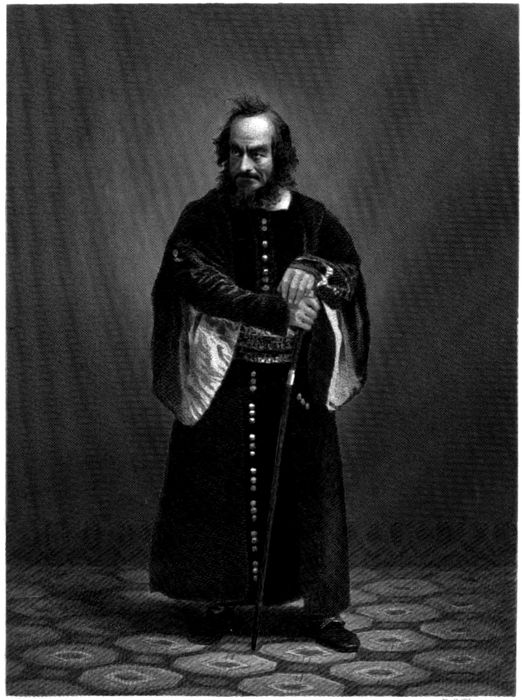
D G Thompson EDWIN FORREST AS SHYLOCK.
739
MACBETH.
Many actors have represented Macbeth as a coward moulded and directed at will by his stronger wife,—a weakling caught like a leaf in an irresistible current and hurried helplessly on to his doom. Such is not the picture painted by Shakspeare. Such was not the interpretation given by Forrest. Macbeth is a broad, rich, powerful nature, with a poetic mind, a loving heart, a courageous will. He is also strongly ambitious, and prone to superstition. To gratify his ambition he is tempted to commit a dreadful crime, and the temptation is urged on him by what he holds to be supernatural agencies. After misgivings and struggles with himself, he yields. The horrid deed being perpetrated, the results disappoint him. The supernatural prophecies that led him on change to supernatural terrors, his soul is filled with remorse, his brain reels, and as the sequel of his guilt thickens darkly around him he rallies his desperate energies and meets his fate with superb defiance. The struggle of temptation in a soul richly furnished with good yet fatally susceptible to evil, the violation of conscience, the overwhelming retribution,—these points, softened with sunny touches of domestic love and poetic moral sentiment, compose the lurid substance and movement of the drama. And these points Forrest embodied in his portraiture with an emotional intensity and an intellectual clearness which enthralled his audience.
As he came over the hills at the back of the stage, accompanied by Banquo, in his Highland tartan, his plumed Scotch cap, his legs bare from the knee to the ankle, his pointed targe on his arm, with his free and commanding air, and his appearance of elastic strength and freshness, he was a picture of vigorous, breezy manhood. His first words were addressed to Banquo in an easy tone, such as one would naturally use in describing the weather:
“So foul and fair a day I have not seen.”
The witches hailing him with new titles and a royal prophecy, he starts,—
“And seems to fear
Things that do sound so fair.”
As they concluded, the manner in which, with subdued breathing eagerness, he said,—
740“Stay, you imperfect speakers; tell me more,”—
showed what a deep and prepared chord in his soul their greeting had struck. And when they made themselves vapor and disappeared, he stood rapt in the wonder of it, and replied to the question of Banquo, “Whither have they vanished?” with a dissolving whispering voice, in an attitude of musing suspense and astonishment,—
“Into the air; and what seemed corporal melted
As breath into the wind. Would they had stayed!”
When the missives from the king saluted him Glamis and Cawdor, he attributed more than mortal knowledge to the weird sisters; and at once the terrible temptation to gratify his ambition by murder seized his soul, and conscience began to struggle with it. This struggle, in all its dread import, he pictured forth as he delivered the ensuing soliloquy with speaking features and in quick low tones of suppressed questioning eagerness:
“This supernatural soliciting
Cannot be ill; cannot be good. If ill,
Why hath it given me earnest of success,
Commencing in a truth? I am thane of Cawdor.
If good, why do I yield to that suggestion
Whose horrid image doth unfix my hair,
And make my seated heart knock at my ribs,
Against the use of nature?
My thought, whose murder yet is but fantastical,
Shakes so my single state of man that function
Is smothered in surmise, and nothing is,
But what is not.”
In uttering these words he painted to eye and ear how temptation divides the soul into the desiring passion and the forbidding principle and sets them in deadly contention. Then the apologetic sympathy of his reply to the expostulation of Banquo,—
“Worthy Macbeth, we stay upon your leisure,”—
showed the gentle quality of his nature:
“Give me your favor: my dull brain was wrought
With things forgotten. Kind gentlemen, your pains
Are registered where every day I turn
The leaf to read them. Let us toward the king.”
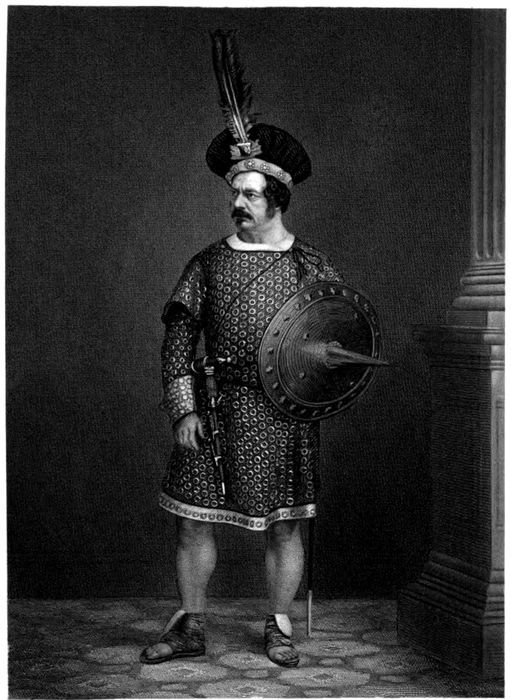
A. Robin. EDWIN FORREST AS MACBETH.
741Macbeth was one originally full of the milk of human kindness, who would not play false, but would win holily what he wished highly: yet his ambition was so sharp that the sight of the coveted prize made him wild to snatch it the nearest way. This conflict Forrest continually indicated by alternations of geniality towards his comrades and of lowering gloom in himself, while his brain seemed heaving in the throes of a moral earthquake. Thus, when Duncan had indicated Malcolm as successor to the throne, Macbeth betrayed the depths of his soul by saying, with sinister mien, aside,—
“The Prince of Cumberland! That is a step
On which I must fall down, or else o’erleap,
For in my way it lies. Stars, hide your fires!
Let not light see my black and deep desires.”
The earnest and tender warmth which Forrest made Macbeth put into his greeting of his wife after his absence, his dangers in battle, and his mysterious adventure with the witches, proved how deeply he loved her. And his first words,—
“My dearest love,
Duncan comes here to-night,”—
were spoken with an abstracted and concentrated air that fully revealed the awful scheme that loomed darkly far back in his mind. Left alone with himself, the temptation renewed the struggle between his better and his worse self. In the long and wonderful soliloquy, beginning—
“If it were done when ’tis done, then ’twere well,”—
he painted the gradual victory of reason, honor, conscience, and affection over the fell ambition that was spurring him to murder, and, as Lady Macbeth entered, he exclaimed, with a clearing and relieved look,—
“We will proceed no further in this business.”
But the stinging taunts with which she upbraided him, and the frightful energy of her own resolution with which she eloquently infected him, worked so strongly on his susceptible nature that he reinstalled his discarded purpose, and went out saying firmly,—
“I am settled, and bend up
Each corporal agent to this terrible feat.”
742In this scene he so distinctly exhibited the operation of her influence on him, the slow change of his innocent determination into uncertain wavering, and then the change of the irresolute state into guilty determination, that the spectators could almost see the inspiring temptress pour her spirits into him, as with the valor of her tongue she chastised his hesitation away.
When he next appeared he looked oppressed, bowed, haggard, and pale, as if the fearful crisis had exerted on him the effect of years of misery. In half-undress, with semi-distraught air, his hushed and gliding manner of sinewy stealth, in conjunction with the silence and darkness of the hour, conveyed a mysterious impression of awe and terror to every soul. He said to the servant, with an absent look and tone, as if the words uttered themselves without his heed,—
“Go; bid thy mistress, when my drink is ready,
She strike upon the bell. Get thee to bed.”
Then slowly came the appalling climax in the temptation whose influences had been progressively operating in the automatic strata of his being deeper than his free consciousness could reach. Those influences were now ready to produce an illusion, by a reversal of the normal action of the faculties unconscious ideas reporting themselves outwardly as objects. Buried in thought, he stands gazing on the floor. Lifting his head, at last, as if to speak, he sees a dagger floating in the air. He winks rapidly, then rubs his eyes, to clear his sight and dispel his doubt. The fatal vision stays. He reasons with himself, and acts the reasoning out, to decide whether it is a deception of fancy or a supernatural reality. First he thinks it real, but, failing in his attempt to clutch it, he holds it to be a false creation of the brain. Then its persistence drives him insane, and as he sees the blade and dudgeon covered with gouts of blood he shrieks in a frenzy of horror. Passing this crisis, he re-seizes possession of his mind, and, with an air of profound relief, sighs,—
“There’s no such thing:
It is the bloody business which informs
Thus to mine eyes.”
Then, changing his voice from a giant whisper to a full sombre vocality, the next words fell on the ear in their solemn 743music like thunder rolling mellowed and softened in the distance:
“Now o’er the one half world
Nature seems dead, and wicked dreams abuse
The curtained sleep.”
Gathering his faculties and girding up his resolution for the final deed, as the bell rang he grasped his dagger and made his exit, saying,—
“Hear it not, Duncan; for it is a knell
That summons thee to heaven or to hell.”
These words he spoke, not with the bellowing declamation many players had given them, but in a low, firm tone tinged with sadness, a tone expressive of melancholy mixed with determination. As he came out of the fatal chamber backwards, with his hands recking, he did not see Lady Macbeth standing there in an attitude of intense listening, until he struck against her. They both started and gazed at each other in terror,—an action so true to nature that it always electrified the house.
Then at once began the dread reaction of sorrow, fear, and remorse. Forrest made the regret and lamentation of Macbeth over the crime and its irreparable consequences exquisitely piteous and mournful. The marvellous wail of his description of innocent sleep forfeited thenceforth, the panic surprise of his
“How is it with me when every noise appals me?”
the lacerating distress of his
“Wake Duncan with thy knocking: I would thou couldst!”
penetrated the heart of every hearer with commiseration.
Forrest gave Macbeth, in the first scene of the play, a cheerful and observant air; after the interview with the witches he was absorbed and abstracted; pending his direful crime he was agitated, moody, troubled,—
“Dark thoughts rolling to and fro in his mind
Like thunder-clouds darkening the lucid sky;”
after the murder he was restless, suspicious, terrified, at times insane. These alterations of mood and manner were distinctly marked with the evolution of the plot through its salient stages. 744Of the pervasive remorse with which the moral nature of Macbeth afflicted and shook him, Forrest presented a picture fascinating in its fearful beauty and truth. When he spoke the following passage, the mournfulness of his voice was like the sighing of the November wind as it throws its low moan over the withered leaves:
“Better be with the dead,
Whom we to gain our peace have sent to peace,
Than on the torture of the mind to lie
In restless ecstasy. Duncan is in his grave:
After life’s fitful fever he sleeps well:
Treason has done his worst; nor steel, nor poison,
Malice domestic, foreign levy, nothing
Can touch him farther.”
Then, seeking sympathy and consolation, he turned to the partner of his bosom and his greatness with the agonizing outburst,—
“O, full of scorpions is my mind, dear wife.”
Close on the awful remorse and on the pathetic tenderness, with consummate truth to nature the selfish instincts were shown hardening the man in his crime, making him resolve to strengthen with further ill things bad begun:
“I am in blood
Stept in so far, that, should I wade no more,
Returning were as tedious as go o’er.”
So unstably poised was his disposition between his good affections and his wicked desires that the conflict was still repeated, and with each defeat of conscience the dominion of evil grew completer. As his remorseful fears translated themselves into outward spectres, Forrest vividly illustrated the curdling horror human nature experiences when guilt opens the supernatural world to its apprehension. He made Macbeth show a proud and lion-mettled courage in human relations, but seem cowed with abject terror by ghostly visitations. His criminal course collects momentum till it hurries him headlong to wholesale slaughters and to his own inevitable ruin. In his mad infatuation of self-entangling crime he says of his own proposed massacre of the family of Macduff,—
“No boasting like a fool:
This deed I’ll do before this purpose cool.”
745Relying on the promise of the witches that none of woman born should harm him, and that he should never be vanquished till Birnam wood came to Dunsinane, he added crime to crime till the whole land was in arms for his overthrow. Then, despite his forced faith and bravery, a profound melancholy sank on him. His vital spirits failed. He grew sick of life and weary of the sun. To this phase of the character and career Forrest did conspicuous justice. Nothing of the kind could exceed the exquisite beauty of his readings of the three famous passages,—
“I have lived long enough; my way of life
Has fallen into the sere, the yellow leaf:”
“Canst thou not minister to a mind diseased,
Pluck from the memory a rooted sorrow?”
She should have died hereafter:
“There would have been a time for such a word.”
His voice lingered on the melodious melancholy of the words and every line of his face responded to their mournful and despairing significance.
When told that Birnam wood was moving, the sense of supernatural power turned against him. For a moment he stood, a solid dismay. Then he staggered as if his brain had received a blow from the words which smote to its reeling centre. So, when Macduff exposed to him the paltering of the fiends in a double sense, his boasted charm seemed visibly to melt from him, and he shrank back as though struck by a withering spell. His towering form contracted into itself, his knees shook, and his sword half dropped from his grasp. But the next instant, goaded by the taunts of his adversary, he rallied on his native heroism, braced himself for the struggle as if he resolved to rise superior to fate whether natural or demoniac, and fell at last like a ruined king, with all his blazing regalia on. The performance left on the mind of the appreciative beholder, stamped in terrible impress, the eternal moral of temptation and crime culminating in fatal success and followed by the inevitable swoop of retribution:
“Naught’s had, all’s spent,
Where our desire is got without content.”
746
RICHARD.
Quite early in his histrionic career Forrest wrote to his friend Leggett, “My notions of the character of Richard the Third do not accord with those of the players I have seen personate it. They have not made him gay enough in the earlier scenes, but too sullen, frowning, and obvious a villain. He was an exulting and dashing, not a moody, villain. Success followed his schemes too rapidly and gave him too much elation to make appropriate the haggard and penthouse aspect he is usually made to wear. Contempt for mankind forms a stronger feature of his character than hatred; and he has a sort of reckless jollity, a joyous audacity, which has not been made conspicuous enough.” In general accord with this conception he afterwards elaborated his portraiture of the deformed tyrant, the savage humorist, the murderous and brilliant villain. He set aside the stereotyped idea of Richard as a strutting, ranting, gloomy plotter, forever cynical and sarcastic and parading his crimes. Not excluding these traits, Forrest subordinated them to his cunning hypocrisy, his gleaming intellectuality, his jocose irony, his exulting self-complacence and fiendish sportiveness. He represented him not only as ravenously ambitious, but also full of a subtle pride and vanity which delighted him with the constant display of his mental superiority to those about him. Above all he was shown to be possessed of a laughing devil, a witty and sardonic genius, which amused itself with playing on the faculties of the weaklings he wheedled, scoffing at what they thought holy, and bluntly utilizing the most sacred things for the most selfish ends. There can be no doubt that in removing the conventional stage Richard with this more dashing and versatile one Forrest restored the genuine conception of Shakspeare, who has painted him as rattling not brooding, exuberantly complacent even under his own dispraises, an endlessly inventive and triumphant hypocrite, master of a gorgeous eloquence whose splendid phrases adorn the ugliness of his schemes almost out of sight. His mental nature devours his moral nature, and, swallowing remorse, leaves him free to be gay. The character thus portrayed was hard, cruel, deceitful, mocking,—less melodramatically fiendish and electrical than the Richard of Kean, but more true to nature. The picture was a consistent one. The deformity of the man, reacting on his matchless intellect and courage and sensual passion, had made him a bitter cynic. But his genius was too rich to stagnate into an envenomed gloom of misanthropy. Its exuberance broke out in aspiring schemes and crimes gilded with philosophy, hypocrisy, laughter, and irony. Moving alone in a murky atmosphere of sin and sensuality, he knew himself to the bottom of his soul, and read everybody else through and through. He believed in no one, and scoffed at truth, because he was himself without conscience. But his insight and his solid understanding and glittering wit, making of everything a foil to display his self-satisfied powers, hid the degradation of his wickedness from his own eyes, and sometimes almost excused it in the eyes of others. Yet, so wondrous was the moral genius of Shakspeare, the devilish chuckling with which he hugged the notion of his own superiority in his exemption from the standards that rule other men, instead of infecting, shocked and warned and repelled the auditor:
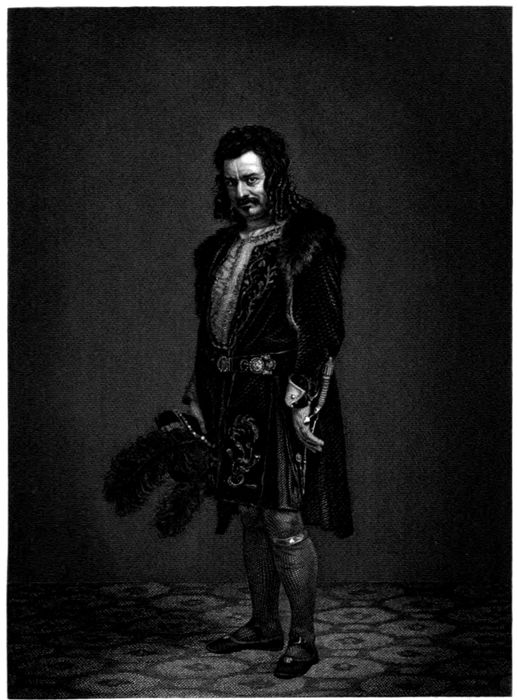
H B Hall & Sons EDWIN FORREST AS RICHARD III.
747“Come, this conscience is a convenient scarecrow;
It guards the fruit which priests and wise men taste,
Who never set it up to fright themselves.”
Thus in the impersonation of him by Forrest Richard lost his perpetual scowl, and took on here and there touches of humor and grim comedy. He burst upon the stage, cloaked and capped, waving his glove in triumph over the downfall of the house of Lancaster. Not in frowning gutturals or with snarling complaint but merrily came the opening words,—
“Now is the winter of our discontent
Made glorious summer by this sun of York.”
Gradually as he came to descant upon his own defects and unsuitedness for peace and love, the tone passed from glee to sarcasm, and ended with dissembling and vindictive earnestness in the apostrophe,—
“Dive, thoughts, down to my soul. Here Clarence comes.”
The scene with Lady Anne, where he overcomes every conceivable kind and degree of obstacles to her favor by the sheer fascination of his gifted tongue, was a masterpiece of nature and art. He gave his pleading just enough semblance of sincerity to 748make a plausible pathway to the feminine heart, but not enough to hide the sinister charm of a consummate hypocrisy availing itself of every secret of persuasion. It was a fearful unmasking of the weakness of ordinary woman under the siege of passion. No sermon was ever preached in any pulpit one-half so terrible in power for those prepared to appreciate all that it meant. When Lady Anne withdrew, the delighted vanity of Richard, the self-pampering exultation of the artist in dissimulation, shone out in the soliloquy wherewith he applauded and caressed himself:
“Was ever woman in this humor wooed?
Was ever woman in this humor won?
I’ll have her,—but I will not keep her long
To take her in her heart’s extremest hate,
With curses in her mouth, tears in her eyes,
The bleeding witness of my hatred by;
Having heaven, her conscience, and these bars against me!
And I no friends to back my suit withal,
But the plain devil, and dissembling looks!
And yet to win her,—all the world to nothing!”
In many places in the play his air of searching and sarcastic incredulity, and his rich vindictive chuckle of self-applause, were as artistically fine as they were morally repulsive. As Kean had done before him, he made an effective point in speaking the line,
“To shrink my arm up like a withered shrub:”
he looked at the limb for some time with a sort of bitter discontent, and struck it back with angry disgust. When the queenly women widowed by his murderous intervention began to upbraid him with his monstrous deeds, the cool audacity, the immense aplomb, the half-hidden enjoyment of the joke, with which he relieved himself from the situation by calling out,—
“A flourish, trumpets! strike alarums, drums!
Let not the heavens hear these tell-tale women
Rail on the Lord’s Anointed!”—
were a bit of grotesque satire, a gigantic and serviceable absurdity, worthy of Rabelais.
The acting of Forrest in the tent-scene, where Richard in his broken sleep dreams he sees the successive victims of his murderous 749hand approach and threaten him, was original and effective in the highest degree. He struggled on his couch with horrible phantoms. Ghosts pursued him. Visions of battle, overthrow, despair, and death convulsed him. Acting his dreams out he dealt his blows around with frightful and aimless energy, and with an intense expression of remorse and vengeance on his face fell apparently cloven to the earth. He then arose like a man coming out of hell, dragging his dream with him, and, struggling fiercely to awake, rushed to the footlights, sank on his knee, and spoke these words, beginning with a shriek and softening down to a shuddering whisper:
“Give me another horse! Bind up my wounds!
Have mercy, Jesu! Soft; I did but dream.
O coward conscience, how dost thou afflict me!
The lights burn blue. It is now dead midnight.
Cold fearful drops stand on my trembling flesh.”
The merely selfish individual instincts and passions of unregenerate human nature are kept from breaking out into the crimes which they would spontaneously commit, by an ethical regulation which consists of a set of ideal sympathies representing the rights and feelings of other men, representing the word of God or the collective principles of universal order. The criminal type of character embodied in Richard throws off or suppresses this restraining and retributive apparatus, and enthrones a lawless egotism masked in hypocrisy. Thus, Richard had so obscured, clogged, and deadened the moral action of conscience, that his egotistic passions held rampant supremacy, and success made him gay and exultant, unchecked by any touch of remorse or shame. In his own eyes he clothed himself in the glimmering mail of his triumphant deeds of wickedness, and dilated with pride like Lucifer in hell. He could not weep nor tremble, but he could shake with horrid laughter. In drawing this terrible outline Shakspeare showed that he knew what was in man. In painting the audacious picture Forrest proved himself a profound artist. And the moral for the spectators was complete when the hardened intellectual monster of depravity, in the culmination of the secret forces of destiny and his own organism, was stripped of his self-sufficiency, and, as the supernatural world broke on his vision, 750he stood aghast, with curdled blood and stiffened hair, shrieking with terror and despair.
Forrest was too large, with too much ingrained justice and heavy grandeur, to be really suited for this part. He needed, especially in its scolding contests of wit and spiteful invective, to be smaller, lighter, swifter, more vixenish. It was just the character for Kean and Booth, who in their way were unapproachable in it. Yet the conception of Forrest was far truer on the whole; and his performance was full of sterling merit.
HAMLET.
The clear good sense, the trained professional skill, and the deep personal experience of Forrest gave him an accurate perception of the general character of Hamlet. There will always be room for critical differences of judgment on the details. But he could not commit the gross blunders illustrated by so many noted actors who have exhibited the enigmatical prince either as a petulant, querulous egotist morbidly brooding over himself and irritable with everybody else, or as a robustious, periwig-pated fellow always in a roaring passion or on the verge of it. Forrest saw in the mind and heart of Hamlet sweet and noble elements of the courtier, the scholar, the philosopher, the poet, and the lover, but joined with a sensitive organization whose nerves were too exquisitely strung not to be a little jangled by the harsh contact of the circumstances into which he was flung. He regarded him as naturally wise, just, modest, and affectionate, but by his experience of wrong and fickleness in others, and of disturbed health in himself, led to an exaggerated self-consciousness profoundly tinged with mournfulness and easily provoked to sarcasm. In the melancholy young Dane was embodied the sad malady of the highest natures, the great spiritual disease of modern life,—an over-excited intellectuality dwelling with too much eagerness and persistence on the mysteries of things; allured, perplexed, baffled, vainly trying to solve the problems of existence, injustice, misery, death, and wearying itself out with the restless effort. Thus there is produced a tendency of blood to the head, which leaves the extremities cold, the centres congested, and the surface anæmic. The fevered and hungry brain devours the juices of the body, the exhausted organic and animal functions complainingly react on the spiritual nature or conscious essence with a wretched depression, everything within is sicklied over with a pale cast of thought, and everything without becomes a sterile and pestilent burden. The strong and gentle nature, finely touched for fine issues, but too delicately poised, is stricken with the disease of introspective inquiry, and, not content to accept things as they are and wholesomely make the best of them, keeps forever probing too curiously into the mysterious cause and import of events, until mental gloom sets in on the lowered physical tone. Then the opening of the supernatural world upon him, revealing the murder of his father and imposing the duty of vengeance, hurries him in his weakened and anxious condition to the edge of lunacy, over which he sometimes purposely affects to pass, and sometimes, in his sleepless care or sudden excitement, is really precipitated. Such was the conception which Forrest strove to represent in his portraiture of Hamlet. And in rendering it he did all he could to neutralize the ill-adaptedness of his stalwart person and abounding vigor for the philosophical and romantic sentimentality of the part by a subdued and pensive manner and a costume which made his figure appear more tall and slender. He laid aside the massive hauteur of his port, and walked the stage and conversed with the interlocutors as a thoughtful scholar would walk the floor of his library and talk with his friends. Even when he broke into passionate indignation or scorn a restraining power of culture and refinement curbed the violence. Still, the incongruity between his form and that of the ideal Hamlet was felt by the audience; and it abated from the admiration and enjoyment due to the sound intelligence, sincere feeling, beautiful elocution, and just acting which he displayed in the performance.
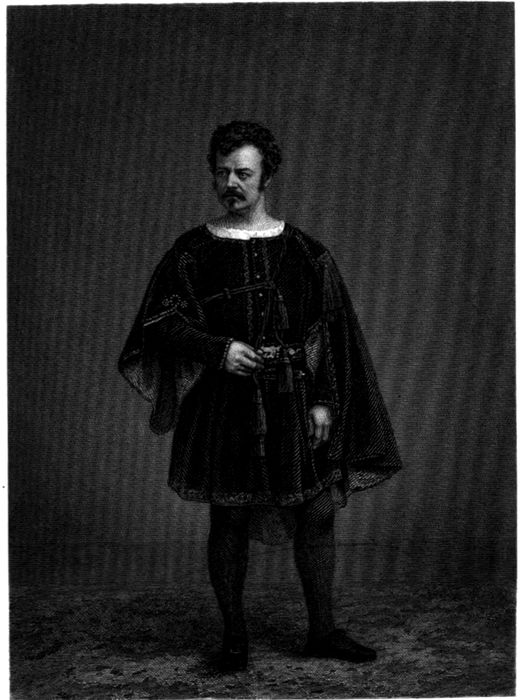
G H Cushman EDWIN FORREST AS HAMLET.
751Most players of Hamlet, in the scene where he first appears among the courtiers before the king and queen, have taken a conspicuous position, drawing all eyes. Forrest, with a delicate perception that the deep melancholy and suspicion in which he was plunged would make him averse to ostentation, was seen in the rear, as if avoiding notice, and only came forward when the king called him by name with the title of son. He then betrayed his prophetic mislike of his uncle by the dark look and satirical inflection with which he said, aside,—
“A little more than kin and less than kind.”
752His reply to the expostulation of his mother against his grief seeming so particular and persistent,—
“Seems, madam: nay, it is: I know not seems.
’Tis not alone my inky cloak, good mother,
Nor customary suits of solemn black,”—
was given with a sincerity, naturalness, and beauty irresistible in effect. His grief and gloom appeared to embody themselves in a voice that wailed and quivered the weeping syllables like the tones of a bell swinging above a city stricken with the plague. The impression thus produced was continued, modified with new elements of emotion, and carried to a still higher pitch, when, left alone, he began to commune with himself and to utter his thoughts and feelings aloud. What an all-pervasive disheartenment possessed him, how sick he was of life, how tenderly he loved and mourned his father, how loathingly he shrank from the shameless speed and facility wherewith his widowed mother had transferred herself to a second husband,—these phases of his unhappiness were painted with an earnest truthfulness which seized and held the sympathies as with a spell.
“O that this too, too solid flesh would melt,
Thaw, and resolve itself into a dew:
Or that the Everlasting had not fixed
His canon ’gainst self-slaughter. O God! O God!
How weary, stale, flat, and unprofitable
Seem to me all the uses of this world!”
Hamlet had been a deep solitary self-communer, had penetrated the hollow forms and shows of the conventional world, and with his questioning spirit touched the very quick of the mystery of the universe. His soul must have vibrated at least with obscure presentiments of the invisible state and supernal ranges of being in hidden connection with the scenes in which he was playing his part. Forrest revealed this by his manner of listening to Horatio while he described how he and Marcellus and Bernardo had seen the ghost of the buried majesty of Denmark walking by them at midnight. This sense of a providential, retributive, supernatural scheme mysteriously interwoven with our human life was breathed yet more forcibly in his soliloquizing moods after agreeing to watch with them that night in hope that the ghost would walk again:
753“My father’s spirit in arms! All is not well;
I doubt some foul play: would the night were come!
Till then sit still, my soul. Foul deeds will rise,
Though all the earth o’erwhelm them, to men’s eyes.”
When Hamlet, with Horatio and Marcellus, came upon the platform at twelve to watch for the ghost, and said,—
“The air bites shrewdly: it is very cold,”—
he finely indicated by his absent and preoccupied manner that he was not thinking about the cold, but was full of the solemn expectation of something else. He took a position nigh to the entrance of the ghost, and continued his desultory talk about the custom of carousing in Denmark, till the spectral figure stalked in, almost touching him. Then Hamlet turned, with a violent start of amazement and a short cry, and, while the white face looked down into his own, uttered the most affecting invocation ever spoken by man, in a subdued and beseeching tone that seemed freighted with the very soul of bewildered awe and piteous pleading. His voice was in a high key but husky, the vocality half dissolved in mysterious breath. His look was that of startled amazement touched with love and eagerness. The remorseful Macbeth confronted the ghost of Banquo with petrifying terror. The thunder-struck Richard saw the ghosts of his victims with wild horror. But Hamlet was innocent; his spirit was that of truth and filial piety; and when the marble tomb yawned forth its messenger from the invisible world to revisit the glimpses of the moon, although his fleshly nature might tremble at recognizing the manifest supernatural, his soul would indeed be wonder-thrilled but not unhinged, feeling itself as immortal as that on which it looked. His figure perfectly still, leaning forward with intent face, his whole soul concentrated in eye and ear, breathed mute supplication. And when in reply to the pathetic words of the ghost,—
“My hour is almost come
When I to sulphurous and tormenting flames
Must render up myself,”—
he said,—
“Alas, poor ghost!”—
his voice was so heart-brokenly expressive of commiseration that the hearers almost anticipated the response,—
754“Pity me not: but lend thy serious hearing
To what I shall unfold.”
The harrowing tale finished, the task of revenge enjoined, the ghost disappears, saying,—
“Adieu! adieu! Hamlet, remember me.”
Nothing in dramatic art has ever been conceived more overwhelmingly affecting and appalling than this scene and speech. A withering spell seemed to have fallen on Hamlet and instantly aged him. He looked as pale and shrivelled as the frozen moonlight and the wintry landscape around him. He spoke the soliloquy that followed with a feeble and slow laboriousness expressive of terrible pain and anxiety:
“Hold, hold, my heart;
And you, my sinews, grow not instant old,
But bear me stiffly up! Remember thee?
Ay, thou poor ghost, while memory holds a seat
In this distracted globe. Remember thee?
Yea, from the table of my memory
I’ll wipe away all trivial fond records,
All saws of books, all forms, all pressures past,
That youth and observation copied there,
And thy commandment all alone shall live
Within the book and volume of my brain.”
To these words Forrest imparted an expression loaded with the whole darkening and dislocating effect which the vision and injunction of his father had exerted on him and was thenceforth to exert. For he was changed beyond the power of recovery. He now moves through the mysteries of the play, himself the densest mystery of all, at once shedding and absorbing night, his steady purpose drifting through his unstable plans, and his methodical madness hurrying king, queen, Polonius, Ophelia, Laertes, and himself to their tragic doom. The load of his supernatural mission darkens every prospect; yet his royal reason rifts the darkness with its flashes, the splendor of his imagination flings rainbows around him, and the native tenderness of his heart contrasts with his hard and lonely fate like an Alpine rose springing from the crags and pressing its fragrant petals against the very glacier. He was unhappy before, because his faculties transcended his conditions, 755his boundless soul chafed under the trifles of every-day experience, and his nobleness revolted from the hollow shams and frivolous routine which he saw so clearly. But now that the realm of the dead has opened on him, filling him with distressful doubts and burdening him with distasteful duty, revealing murder on the throne and making love and joy impossible, his miserable dejection becomes supreme. He seeks to escape from the pressure of his doom in thought, conversation, friendship, sportive wit. Embittered by his knowledge, he turns on the shallow and treacherous praters about him with a sarcastic humor which seems not part of his character but elicited from him by accidents and glittering out of his gloom like lamplight reflected on an ebony caryatid, or like a scattered rosary of stars burning in a night of solid black.
Forrest endeavored to represent in their truth the rapid succession of transitory and contradictory moods of Hamlet and yet never to lose the central thread of unity on which they were strung. That unity was imaginative intellectuality, introspective skepticism, profound unhappiness, and a shrinking yet persistent determination to avenge the murder of his father. The great intelligence and skill of the actor were proved by his presenting both the variety and the unity, and never forgetting that his portraiture was of a refined and scholarly prince and a satirical humorist who loved solitude and secrecy and would rather be misunderstood than reveal himself to the crowd. Among the many delicate shadings of character exemplified in the impersonation one of the quietest and best was the contrast of his sharp lawyer-like manner of cross-examining Rosencrantz and Guildenstern and detecting that in the disguise of friends they were really spies, with the thoughtful and gracious kindness of his dealing with the players. Seated part of the time, he spoke to the poor actor like an old friend, and called him back, when he was retiring, to add another thought, and finally dismissed him with a sympathetic touch on his shoulder and a smile.
The closet scene with the queen-mother, as Forrest played it, was a model of justness. He began in a respectful and sorrowing tone. Gradually, as he dwelt on her faithlessness to his father, and her loathsome sensuality, his glowing memory and burning words wrought him up to vehement indignation, and he appeared 756on the point of offering violence, when the ghost reappeared with warning signal and message. The suddenness of change in his manner—pallor of face, shrunken shoulders, fixed dilatation of eyes—was electrifying. And when in response to the queen’s
“O Hamlet, thou hast rent my heart in twain!”
he said,—
“O throw away the worser part of it,
And live the purer with the other half.
Good-night: but go not to my uncle’s bed:
Assume a virtue if you have it not,”—
he compressed into his utterance, in one indescribable mixture, a world of entreaty, command, disgust, grief, deference, love, and mournfulness.
The scene in the church-yard was one full of felicitous design and execution. Entering slowly with Horatio, he seemed, as he looked about, invested with a religious reverence. Then he sat down on a tombstone, and entered easily into conversation in a humorous vein with the clown who was digging a grave. At the same time he kept up an even flow of understanding with Horatio. He so bore himself that the audience could reach no foregone conclusion to withdraw their absorbed attention from the strange funereal phantasmagoria on which the curtain was soon to sink like a pall. Over the skull of Yorick, in quick transition from the bantering with the clown, his reminiscences, not far from mirth, his profound yet simple moralizing, so heartfelt and natural, were naïve and solemn and pathetic to the verge of smiles and awe and tears. When he learned that Ophelia was dead, and that this grave was for her, he staggered, and bent his head for a moment on the shoulder of his friend Horatio. Though so quickly done, it told the whole story of his love for her and his enforced renunciation.
Of all who have acted the part no one perhaps has ever done such complete justice to the genius of Hamlet as Forrest did in his noble delivery of the great speeches and soliloquies, with full observance of every requirement of measure, accent, inflection, and relative importance of thought. Some admired actors rattle the words off with no sense whatever of the fathomless depths of meaning in them. In the famous description by Hamlet of the 757disenchanting effect of his heavy-heartedness the voice of Forrest brought the very objects spoken of before the hearer,—the goodly frame, the earth; the most excellent canopy, the air; the brave overhanging firmament; the majestical roof fretted with golden fire. And when, turning from the beauty of the material universe to the greater glory and mystery of the divine foster-child and sovereign of the earth, man, he altered the tone of admiration to a tone of awe, his speech stirred the soul like the grandest chords in the Requiem of Mozart, thrilling it with sublime premonitions of its own infinity.
Forrest thoroughly understood from the combined lessons of experience and study the irremediable unhappiness and skepticism of the great, dark, tender, melancholy soul of Hamlet,—how sick he was at heart, how nauseated with the faithless shallowness of the hangers-on at court, how weary of life. He comprehended the misery of the affectionate nature that had lost all its illusions and was unable to reconcile itself to the loss,—the unrest of the ardent imagination that could not forego the search for happiness though constantly finding but emptiness and desolation. And he made all this so clear that he actually startled and spell-bound the audience by his interpretation of the wonderful soliloquy wherein Hamlet debates whether he had not better with his own hand seize that consummation of death so devoutly to be wished, and escape
“The whips and scorns of time,
The oppressor’s wrong, the proud man’s contumely,
The pangs of despised love, the law’s delay,
The insolence of office, and the spurns
That patient merit of the unworthy takes.”
The deep intuition that felt there were more things in heaven and earth than philosophy had ever dreamed, the sore resentment at the unjust discriminations of the world, the over-inquisitive intellect of the fool of nature, horridly shaking his disposition with thoughts beyond the reaches of his soul, the instinctive shrinking from the undiscovered country after death, the broken will forever hankering after action but forever baffled from it, the unfathomable desire for rest, the intense ennui raising sighs so piteous and profound that they seemed to shatter all the bulk,—all these were so brought out as to constitute a revelation of the history of genius 758diseased by excessive exercise within itself with no external outlets of wholesome activity. This lesson has the greatest significance for the present time, when so many gifted men allow their faculties to spin barrenly in their sockets, incessantly struggling with abstract desires and doubts, wasting the health and strength all away because the spiritual mechanism is not lubricated by outward fruition of its functions, till normal religious faith is made impossible, and at last, in their sterilized and irritable exhaustion, they apotheosize despair, like Schopenhauer, and perpetually toss between the two poles of pessimism and nihilism,—Everything is bad, Everything is nothing! The true moral of the revelation is, Shut off the wastes of an ambitious intellect and a rebellious will by humility and resignation, do the clear duties next your hand, enjoy the simple pleasures of the day with an innocent heart, trusting in the benignant order of the universe, and you shall at last find peace in such an optimistic faith as that illustrated by Leibnitz,—Everything is good, Everything in the infinite degrees of being from vacuity to plenum is centred in God!
It has always been felt that in Hamlet Shakspeare has embodied more of his own inner life than in any other of his characters. Certainly Hamlet is the literary father of the prolific modern brood of men of genius who fail of all satisfactory outward activity because wasting their spiritual peace and force in the friction of an inane cerebral strife and worry. Few appreciate the true teaching or importance of this portrayal. Hamlet said he lacked advancement, and that there was nothing good or bad but thinking made it so, and that were it not that he had bad dreams he could be bounded in a nutshell and count himself king of infinite space. His comments on others were usually contemptuous and satirical. He despised and mocked Polonius, and treated Osric, Rosencrantz, and Guildenstern with scorn and sarcasm. And yet, although he vilifies the general crowd and the drossy age, he is clearly sensitive to public opinion and really most anxious to appear well, and unwilling to bear a wounded name. In a word, he represents that class of select and unhappy spirits whose great imaginative sympathy is constantly showing to them themselves reflected in others and others reflected in themselves, the result of the comparisons being personal 759complacence and social irritability. For they form an estimate of their own superiority which they cannot by action justify to others and get them to ratify. The disparity of their inward power and their outward production annoys them, fixes itself in chronic consciousness, and in the consequent spiritual resistance and fret expends all the energy which if economized and fruitfully directed would remove the evil they resent and bless them with the good they desire. Then they react from the world into cynical bitterness and painful solitude. The empty struggle and misanthropic buzz within exhaust brain and nerves, and initiate a resentful, desponding, suicidal state made up of discordant aspiration and despair. Unable to fulfil themselves happily they madly seek to destroy themselves in order to end their misery. The remedy lies in a secret at once so deep and so transparent that hardly any of the victims ever see it. It is simply to think less pamperingly of themselves and more lovingly of others; cease from resistance, purify their ambition with humble faith, and in a quiet surrender to the Universal allow their drained and exasperated individuality leisure to be replenished and harmonized. Corresponding with a religious attunement of the soul, nervous tissues divinely filled with equalizing vitality and power are the physical ground of contentment with self, nature, mankind, destiny, and God. And the man of genius who has once lost it can gain this combined moral and physical condition only by a modest self-conquest, lowering his excessive exactions, and giving him a fair outlet for his inward desires in productive activity.
Forrest distinguished the wavering of his Hamlet from the indecision of his Macbeth and the promptitude of his Richard, and contrasted their deaths with a luminous marking both fine and bold. Richard, whose selfish intellect and stony heart had no conscience mediating between them, with solid equilibrium and ruthless decision swept directly to his object without pause or question. His death was characterized by convulsions of impotent rage that closed in paralyzing horror. The conscience of Macbeth made him hesitate, weigh, and vacillate until rising passion or foreign influence turned the scale. His death was one of climacteric bravery and frenzied exertion embraced in reckless despair. The intellect of Hamlet set his heart and his conscience 760at odds, and kept him ever balancing between opposed thoughts and solicitations. He had lost his stable poise, and was continually tipping from central sanity now towards dramatic madness, now towards substantial madness. He died with philosophic resignation and undemonstrative quietude. While all the mutes and audience to the act looked pale and trembled at the tragic chance, he bequeathed the justification of his memory to his dear Horatio, gave his dying voice for the election of Fortinbras, and slowly, as the potent poison quite o’ercrowed his spirit, let his head sink on the bosom of his one friend, and with a long breath faintly whispered,—
“The rest is silence;”—
and then all was done.
“Now cracks a noble heart. Good-night, sweet prince,
And flights of angels sing thee to thy rest.”
In the few pages of this tragedy Shakspeare gives perhaps the supremest existing example of the richness and power of the dramatic art. It sums up the story of life,—the joy of lovers, the anguish of bereavement, the trial of friendship, hope and fear, plot and counterplot, lust, hatred, crime and the remorse that follows, hearty mirth contrasted with sublime despair, death, and the dark ignorance of what it all means which shuts around the horizon with impenetrable clouds. Here are expressed an intensity of passion, a bitter irony, a helpless doubt, a vain struggle, a saturating melancholy and a bewildered end which would be too repulsive for endurance were it not for the celestial poetry which plays over it and permeates it all and makes it appear like a strange and beautiful dream.
As to the interpretation by Forrest of the part of Hamlet in the play it is but fair to quote in close what was said by a severe and unfriendly anonymous critic who admitted that the intelligence shown was uncommon, the elocution perfect, the manner discreet, the light and shade impressive. “Mr. Forrest struggles continually with Mr. Forrest. Mind wrestles with muscle; and although intellect is manifest, it is plain that the body with great obstinacy refuses to fulfil the demands of thought. To conceive bright 761images is a different thing from portraying them on the canvas. And when Mr. Forrest, attempting with high ambition to do that which nature forbids him to do, makes of philosophy a physical exhibition and reduces mental supremacy to the dominion of corporeal authority, he must blame that fate which cast him in no common mould and gave to the body a preponderance which neither study nor inspiration can overcome.” The critic here indicates the defect of the actor, unquestionably, but so exaggerated as to dwarf and obscure his greater merits.
CORIOLANUS.
Not many dramatic contrasts are wider than that between the complex imaginative character of the melancholy Hamlet, spontaneously betaking himself to speculation, and the simple passionate character of the proud Coriolanus, instinctively rushing to action. There was much in the build and soul of Forrest that closely resembled the haughty patrician, and he was drawn to the part by a liking for it accordant with his inherent fitness for it. For several years he played it a great deal and produced a strong sensation in it. So thoroughly suited were he and the part for each other, so pervasive and genuine was the identification of his personal quality with the ideal picture, that his most intimate friend, and the gifted artist chosen for the work, selected this as the most appropriate representative character for his portrait-statue in marble.
The features and contour of the honest, imperious, fiery, scornful, and heroic Coriolanus, as impersonated by Forrest with immense solidity and distinctness, were simple but grand in their colossal and unwavering relief. Kemble had been celebrated in this rôle. He played it as if he were a symmetrical statue cut out of cold steel and set in motion by some precise mechanical action. Forrest added to this a blood that seemed to flame through him and a voice whose ponderous syllables pulsated with fire. Stern virtue, ambition, deep tenderness, magnanimity, transcendent daring and pride and scorn,—the man as soldier and hero in uncorrupt sincerity and haughty defiance of everything wrong or mean,—these were the favorite attributes which Forrest met in Coriolanus, and absorbed as by an electric affinity, 762and made the people recognize with applauding enthusiasm. He might well utter as his own the words of his part to Volumnia,—
“Would you have me
False to my nature? Rather say, I play
The man I am.”
What unconsciously delighted Forrest in Coriolanus, and what he represented with consummate felicity and force of nature, was that his aristocracy was of the true democratic type; that is, it rested on a consciousness of intrinsic personal worth and superiority, not on conventional privilege and prescription. He loathed and launched his scorching invectives against the commonalty not because they were plebeians and he was a patrician, but because of the revolting opposition of their baseness to his loftiness, of their sycophancy to his pride, of their treacherous fickleness to his adamantine steadfastness. As an antique Roman, he had the resentful haughtiness of his social caste, but morally as an individual his disdain and sarcasm were based on the contrast of intrinsically noble qualities in himself to the contemptible qualities he saw predominating in those beneath him. And although this is far removed from the beautiful bearing of a spiritually purified and perfected manhood, yet there is in it a certain relative historical justification, utility, and even glory, entirely congenial to the honest vernacular fervor of Forrest.
Coriolanus, in his utter loathing for the arts of the demagogue, goes to the other extreme, and makes the people hate him because, as they say, “For the services he has done he pays himself with being proud.” At his first appearance in the play he cries to the citizens, with scathing contempt,—
“What’s the matter, you dissentient rogues,
That, rubbing the poor itch of your opinion,
Make yourselves scabs?
He that trusts to you,
Where he should find you lions, finds you hares;
Where foxes, geese. You are no surer, no,
Than is the coal of fire upon the ice,
Or hailstone in the sun. Hang ye! Trust ye?
With every minute you do change a mind;
And call him noble that was now your hate;
Him vile, that was your garland.”
763As his constancy despises their unstableness, so his audacious courage detests their cowardice:
“Now put your shields before your hearts, and fight
With hearts more proof than shields.”
Seeing them driven back by the Volsces, he exclaims,—
“You souls of geese
That bear the shapes of men, how have you run
From slaves that apes would beat? Pluto and hell!
All hurt behind; backs red, and faces pale
With flight and agued fear! Mend, and charge home,
Or, by the fires of heaven, I’ll leave the foe
And make my wars on you.”
In all these speeches the measureless contempt, the blasting irony, the huge moral chasm separating the haughty speaker from the cowering rabble, were deeply relished by Forrest, and received an expression in his bearing, look, and tone, everyway befitting their intensity and their dimensions. Particularly in the reply to Sicinius,—
“Shall remain!
Hear you this Triton of the minnows? Mark you
His absolute ‘shall’?”—
the width of the gamut of the ironical circumflexes gave one an enlarged idea of the capacity of the human voice to express contempt. And when his disdain to beg the votes of the people and his mocking gibes at them had aggravated them to pronounce his banishment, his superhuman expression of scornful wrath no witness could ever forget:
“You common cry of curs! whose breath I hate
As reek o’ the rotten fens, whose loves I prize
As the dead carcasses of unburied men
That do corrupt my air, I banish you.”
His eyes flashed, his form lifted to its loftiest altitude, and the words were driven home concentrated into hissing bolts. As the enraged mob pressed yelping at his heels, he turned, and with marvellous simplicity of purpose calmly looked them reeling backwards, his single sphere swallowing all theirs and swaying them helplessly at his magnetic will.
764His farewell, when “the beast with many heads had butted him away,” was a noble example of manly tenderness and dignity, all the more pathetic from the self-control which masked his pain in a smiling aspect:
“Thou old and true Menenius,
Thy tears are salter than a younger man’s,
And venomous to thine eyes. I’ll do well yet.