LIFE AND CAREER OF JAMES COPELAND, THE SOUTHERN LAND PIRATE, AND HIS INTIMATE ASSOCIATES, (continued 2)
Reading edition
The negro camp meeting had been already appointed, about ten or twelve miles above Shreveport and about two miles from the river. Wages and McGrath having fully understood how to act, Wages told him where the boat could be found, ten days before Christmas, and they parted, and Wages returned.
Accordingly, at the time appointed, McGrath was at the boat. We had him and his horse provided for; he was made acquainted with our two free darkies, and all things were arranged and understood well that night. McGrath left next morning to prepare for the camp meeting, which was to commence in eight days. We loitered away our time; and two days before the commencement of the camp meeting, we dropped our skiff to a landing opposite the camp ground, where we lay trading. We had sold almost everything we had.
On the morning of the commencement of the meeting, we set our two free darkies over the river, and they went to the place early in the day. Wages and I cleared out our skiff of all barrels, boxes and dunnage of every description, and had everything in complete trim, row locks, oars and all ready. The meeting commenced. We had instructed our free darkies to what landing place to conduct these seven negroes we were stealing; and on the first night of the meeting, sure enough they all came to us. Their master had furnished them with two mules and a wagon, to haul their bedding, etc., to the camp ground, and they had brought all their clothing, bedding, and everything they had. They informed us that they had sold all their poultry and crop, and had got money to support them for the year. They had procured another negro to drive the mules and wagon back to the camp ground; and by nine o’clock that night we were under way down stream.
WELTER AND HARDEN’S DECEPTION—WELTER ACTING AS UNITED STATES MARSHAL.
We rigged all six of the oars; one of the women pulled one oar and I pulled one; Wages sometimes spelled me, and I would steer the boat, and the women would sometimes spell each other, and we run at the rate of about ten miles an hour. About eleven o’clock that night we passed Shreveport, and before day sometime, we passed Natchitoches, the point we were striving to make, for we knew there was a bayou about five miles below, where we could hide ourselves and skiff through the day. We put into the bayou a little before day, and at daylight we landed our skiff in some bushes and high grass, and we all went on shore in a thick palmetto swamp, built a good fire, cooked and eat, and drank good whiskey and every one slept what they wanted; and about sunset we left and rowed into the river again. By this time they all had got themselves more accustomed to rowing, and made better headway and with more ease. We run on in the night and lay-by in the day; and the third night we reached the mouth of Red River and lay in the swamp that day; and the fourth night, about midnight, we reached Tunica, and run our skiff in a creek just above; made a fire in the swamp and remained till daylight. After daylight sometime, we eat breakfast and Wages and I made an excuse to go to the village of Tunica to buy some cigars, and to get some eggs, etc. The negroes set us over with the skiff; we went down to the village and went to the tavern. There we found our old friend, Welter, and Harden, and three other men whom Welter introduced us to as his friends and acquaintances, but they were in fact his “strikers.” Harden immediately after we left him at Shreveport had gone down the river to Welter’s and informed him where to meet us.
We held a consultation as to the best plan to pursue, and we all finally agreed that the safest and best plan was to let Welter take all the negroes and pay us for them. He was to pay Harden for the two free fellows one thousand dollars in cash and his note for one thousand payable in six months. He was to pay Wages and I for our seven negroes and the skiff with all the apparatus, eight hundred dollars in cash and his note for four thousand dollars, payable in six months. After this arrangement was concluded Wages and I went to the skiff, took our guns to go a hunting, and then returned to the village. About two hours before sunset Welter took Harden and his three men, got a small boat and went up to the creek where all the negroes were. But before they got to the place they tied Harden’s hands behind him to make the negroes believe that he was a prisoner for negro stealing. Welter and his men surrounded the camp and took all the negroes prisoners, and then brought up Harden tied. Welter then informed the two free negroes that he was the United States Marshal, and that it was his duty to take them and Harden back to Shreveport, where they would be tried for the crime of negro stealing, and that the punishment would be death or the penitentiary for life; but that he did not know that he could prove Harden guilty, and then asked them if Harden had been with them. They declared he had not. Welter then told the negroes that he knew them; that they had been stolen once before and sold in Louisiana, and that he knew all about them, and made them confess the truth. He then told the free negroes that their case was a desperate one; that it would be impossible for them to escape; and then asked them which they would prefer, to stand their trial or be sold as slaves for life. They said they had rather be sold as slaves; so he tied their feet, after putting them in the boat, and took in all their dunnage, and the other seven negroes. Upon their positive declaration that Harden was not concerned he was released, and a little after dark they rowed down to the village. Welter placed his three “strikers” to guard the boat and negroes, while he and Harden went on shore, and we all went into a private room in the tavern, where we executed bills of sale for the negroes, dated them in Buncombe county, N. C., and signed fictitious names and witnesses. Welter paid us our money according to contract and executed the notes, after which we took a good supper together and drank three or four bottles of wine, and Welter left us. We went with him nearly to his boat and bid him good-by and good luck, and he rowed off down the river for home. Wages, Harden and I returned to the tavern, went to our room and to bed and slept very sound. Next morning we arose much refreshed, and greatly relieved in mind. We went very early to a coffee house, took a cup of coffee and our bitters, and returned to our room to consult as to the best course to pursue. We concluded to leave in the first boat for Natchez. We accordingly got breakfast, paid our bills and placed our guns and baggage at the nearest depot to the landing. We had to wait till late in the day before we could get a boat. We at last saw one coming, and procured a skiff to put us on board. At a signal the boat rounded to, and we went on board, registered our names (all fictitious) and paid our passage to Natchez.
WAGES’ AND HARDEN’S PLOT TO KILL ROBERT LOTT AND THOMAS SUMRALL.
When we landed at Natchez we all stopped at different hotels, but while there, some ten days, we had interviews and consultations every day. It was then that Wages and Harden made the plot to kill old Thomas Sumrall and old Robert Lott, and for that purpose Wages furnished Harden a map of all the roads in Perry county, Miss. Harden then informed us that he had a partner in Tennessee by the name of Goodwin, and that he expected Goodwin had, in a cave in the Cumberland mountains, several negroes then waiting for him to run off and sell, and that he must go up with the first rise of water so as to come down with the spring freshet. We all then made an arrangement to meet in New Orleans at a certain place on the Fourth of July coming, so as to collect our money from Welter, and for Harden to get the money on his draft for the negro sold on the Arkansas river, which he had deposited in bank for collection.
Our ten days in Natchez having expired, Harden and I took passage on a steamboat, Harden for Tennessee, and I for Vicksburg to await the arrival of McGrath. Wages was to be at Vicksburg in three or four days. I landed at Vicksburg; Harden went on. I went to one of the hotels, put up and waited for McGrath. On the sixth day Wages came, and went to another hotel, and we both waited there another week and still no McGrath. We began to get uneasy. However, three or four days after, I was standing on the bank of the river, when I saw a man dressed in coarse negro clothing, black and ragged, an old flapped hat, a pair of old saddle-bags on his arm and a big stick in his hand. He came up to me to inquire the road to Jackson. I did not know him at first, but he soon made me know him. It was McGrath. He inquired for Wages; I told him Wages was there; I told him to go to the cheapest boarding house, which he did, and his appearance caused him to have to pay his dollar in advance. That night we all got together, Wages, McGrath and myself; we went below the city and had a long consultation. We told McGrath what we had done, and gave him a full history of Harden and his two free negroes, and where Harden had gone, etc. He next gave us a detail of his voyage through the camp meeting and since, up to that time.
He said the next day after the seven negroes had left the camp ground he saw their mules and wagon, and no person appeared to be about them. A very likely young negro watered and sometimes fed the mules, and on the second day he went to the negro and asked what had become of the negroes that came with that wagon and mules. The boy answered first he did not know, and looked confused. He then said to the negro to tell him the truth and he would keep the secret and not expose him; the negro then told him the whole truth about the matter, and then asked McGrath’s advice. He told him to take care of the mules and wagon until the meeting broke up, and then take them to their owner, and inquire of him why his negroes went off and left their mules and wagon so long, and not return at all, and give him the trouble to bring them home; and if any person attempted to whip him to make him tell anything about the matter he was to run away, and on the next Sunday night to meet him, McGrath, at a certain place and he would tell him what to do, and to be sure and keep everything a profound secret.
MR. MOORE AFTER PREACHER M’GRATH, IN TEXAS.
With this understanding the meeting went on until the sixth day; the meeting broke up; the negro geared up his mules to the wagon and rolled off; drove them to the house of the owner and reported himself. It was late in the night. The old gentleman told him to feed the mules, get his supper and come to him in the morning and tell him more about it. The next morning the boy told the old man that he did not know but one of his negroes, and that was the fellow that asked him to feed and water the mules a day or two, and on the third day the negro did not return, and he asked the advice of one of the preachers, who told him to take them home. The old man asked the boy where that preacher was, and the negro said he was sick at a house about six miles from there. He then asked the boy who he belonged to, and the negro showed him his “pass,” which told the truth. He then dismissed the boy and sent him home, and about ten o’clock, McGrath said, “here comes the old man.” He rode up to the gate and hailed, and inquired if Brother McGrath was there. They told him he was. He alighted from his horse, came into the house and said good morning, very short. “Well, Brother McGrath, how do you do?”
“Oh, I am very sick, Brother Moore.”
“What seems to be the matter?”
“Oh, I have caught a cold, and have a very severe pain in my side; I think it is side pleurisy.”
“Well,” said he, “did you see anything of my negroes at your meeting?”
McGrath told him: “I saw them there the first day with you when we went. After you left, Brother Moore, I don’t recollect seeing them, and I thought you had ordered them home until I was asked by a strange negro what he should do with the mules and wagon. When I examined them I saw they were yours, and I told the negro to drive them to you and report himself. I would have gone with him, but was too unwell and had to stop here.”
“Well,” says the old man, “your great meeting has caused me to lose seven negroes, I fear.”
McGrath said: “Oh, I hope not, Brother Moore.”
“Yes it has!” said he very short, “and I wish there never had been a camp meeting in the world; and I know,” said he, “they are stolen, and they went by water. Some of them picayune steamboat captains have stolen them, and they are now in Florida or Georgia. I will go and make some inquiry in Shreveport, and along the river, to find out what boats left about that time, and,” said he, “I will go to the owner of that negro that brought the wagon home and have him tied up and whipped till he tells the truth about it, for I believe he knows all about the matter.” McGrath said he tried to pacify the old gentleman, but it was all no go, so the old gentleman left.
McGrath said the times then were beginning to be rather equally. He pretended to improve very fast; was able to ride in two days, and set out to help Brother Moore hunt and track his negroes. On the next Sunday night he was at the place where he was to meet the negro, and the negro was there also. McGrath told of the threats against him, and asked him if he wished to run away and go with him, if he did he would find him a good master, or take him to a free State. The negro said he would go. McGrath asked him if he could steal a good horse, saddle and bridle. The negro said he could. McGrath then asked him if he could get over Red river and meet him at a certain place on a certain day. He said he could, three or four days after.
McGrath then went to the house of Brother Moore to inquire if he had got any tidings of, or from his negroes. The old man was very mad and talked very short, and said “no,” adding: “Mr. McGrath, I want you to leave my house, and never again set your foot in it.” McGrath tried to reason with the old man, but all would not do, so he left. He had collected among the brethren some five hundred dollars or upward and a considerable sum from the negroes at the camp meeting. He then went to Shreveport and procured some articles he wanted (and among them two half gallon jugs, one full of brandy and the other of whiskey), some bread and cheese, and crossed the river.
After he got across he saw three men come down to the ferry and wait for the ferryman; he watched them; they conversed with the ferryman awhile and rode back. McGrath rode on three or four miles, came to an inn and stopped. It was not night, but he had come to the conclusion now, that it was necessary for him to watch as well as pray. A little after dark up rode three men, and inquired if a traveler had passed that evening, and what time—how long before dark? They were informed none had passed; one had put up, a little before dark. They alighted and came in; enquired from McGrath his name, where he was traveling, his occupation, etc. He told his name, and said he was going to a quarterly meeting, some seventy-five miles from that place. They listened to him with keen, shrewd looks and very doubting air, and McGrath saw from their manœuvres that they were after him in particular, and he well knew it would require his best skill and ingenuity to evade their vigilance. They bid him good night and started on. McGrath pretended to walk out carelessly and watch them; they turned back.
He started next morning and traveled about thirty-five miles and stopped for the night. Just before night, the same three men passed the house. Next morning, after breakfast, he started again, and in a few miles came to their camp. “Well,” said one, “we have met again.” McGrath said “yes,” and asked them which way they were going. They said to purchase beef cattle, and asked him how much further he was going that route? He told them he was going to a missionary station to see the preacher there; that it was about forty miles there, and he wanted to get there that night. He bid them good morning, rode off, and traveled slow until he got out of their sight, and then pushed and rode about twelve miles. He came to a cross road that passed near where the negro was; here he left the road in a direction opposite to where the negro lay; tied his horse in a thicket some distance from the road, and concealed himself to watch. The men soon came to the place and examined for the track of his horse; they finally took the road which the horse’s track had followed and pushed on. He went to where his horse was, stripped him, held him to graze some cane, and took a little of his good brandy; stripped his Methodist coat off and rolled up his broad-brimmed beaver in it and tied them on his saddle; and put on a common oiled cap, and another coat. Night came on; he saddled his horse and rode through the woods, near the road, to the distance of about two miles from where the negro was to meet him, and tied his horse about two hundred yards from the road. After it was fully dark, he started on the road on foot and left his horse, for the place appointed to meet the negro; and his only fear then was that the negro might have been bribed to betray him. He had two good single-barrelled pistols, and would be certain to save two of his assailants and take chances with the balance. He went on, got within a very short distance of the place appointed, crept up very close and stopped to listen. All was still. He discovered, a short distance from him, a large tree and a thick bunch of bushes around it. He crept easily to that, and squatted down at the root of the tree to listen. He thought he heard a stick crack or break close to him. He then gave a low whistle like that of a bird; it was answered immediately, within twenty feet of him. He then gave another, which was as promptly answered. He then gave a slap of his hands, which was answered, and the negro advanced to him. He asked the negro if there was any person about, and where was his horse? The negro told him about two hundred yards from there.
They started and went about half way, and McGrath stopped and told the negro to go and bring his horse there. The negro went and brought his horse. McGrath said he then became better satisfied that the negro was no traitor, and told him to go with him to the road and ride about thirty yards behind, until they got opposite where his horse was, which he did. They were not long in getting there. When we got to the place, he made a signal, and the negro rode up, and McGrath turned square off from the road and told the negro to follow him. He went about one hundred yards and told the negro to tie his horse and go back and watch the road, until he saddled and brought his horse. When McGrath had saddled his horse and returned, he found the negro at his horse, with everything ready to mount and be off. He asked what was the matter? “My God, master! we have had good luck; just as I went up close to the road I heard horses’ feet, and hid in the bushes; I saw by starlight three persons pass the road; two of them I could see had guns, and if we had been ten minutes later we should have met them.” McGrath pulled out his little jug of whiskey and gave the negro two drams and took one himself; they mounted their horses and started. He instructed the negro to travel about thirty yards behind in case of surprise, so as to make his escape and save them both.
They traveled hard that night, and by daylight they had made near sixty miles. At daylight they left the road and lay-by that day. It happened that the negro had near a half bushel of corn, and some meat and bread, and McGrath some bread and cheese, so they made out pretty well that day. Night came on and they set out again, and traveled until near day. They arrived close to a ferry on the Washita. Before getting there, they left the road a short distance, and McGrath left the negro with the horses and went towards the ferry. As he got near the ferry house, which he intended to go round, some person hailed—“who is that?” He turned his course and made back for the negro and horses. He had not time to get away before they passed in pursuit, and he heard them say, “that damned preacher is here somewhere, and we will have him yet.” They halted a moment, and he heard their horses’ feet, some going back and some the other way. McGrath mounted his horse and told the negro to follow him, and he took to the woods and steered a west course, which he knew was up the river, and traveled till he reached high land, and continued after day until near twelve o’clock, sometimes in sight of plantations, which he would go round.
By and by he came to a road that had the appearance of being much traveled, and leading north. Here, some distance from the road, he halted, stripped their horses and let them graze in a cane-brake, and remained there till dark without anything to eat. At dark they started and traveled ten or twelve miles, passed several houses, and came to a house and passed down a hill into a lane, and at a short distance came to high timber land, which he knew was near the river. He stopped and left the negro with the two horses, giving him instructions if any alarm was heard, to turn and run back to a little branch and stop till he came. He went on to the river, and luckily there was no spy there, and the ferry-flat was on his side. He hurried back, took his horse and the negro and his horse, and got into the ferry-flat and went over. They mounted their horses and traveled until daylight; passed several houses and plantations. At daylight he found himself bordering on the Mississippi swamp. He turned off the road and stripped their horses to graze in a cane-brake.
Nothing to eat now for two nights and one day, with plenty of money, but was afraid to go to a house, for fear of discovery.
He went to waylay the road, saw no person pass except emigrants, from whom we obtained a little bread, some salt and a small piece of meat. He inquired of them the road and distance to Vicksburg. They told him from seventy-five to one hundred miles. He inquired if they had met any person on horseback. They said no. He then left them and returned to his negro and horses; found the negro had killed a large, fat possum, and had it cleaned and was roasting it; the salt he had got then came in play. They cooked and eat, drank their liquor, and rested that day. A little before night McGrath went to the road to examine if any horses’ tracks passing toward Vicksburg could be seen. There were none. He returned and saddled his horses, and a little before sunset they started and traveled all night, and until next day at ten o’clock. They came to the Tensas Bayou, crossed at a ferry, and inquired of the ferryman, who was a negro, how far it was to Vicksburg? The negro said about thirty miles. McGrath then inquired if there were many settlers on the bayou. The negro said there were plenty up and down the bayou on both sides. They left the ferry and went on a few miles, and turned to the west from the main road, up the bayou, along a new road that carriages had traveled, and went about ten miles—passed several large plantations. About twelve o’clock he came to the house of a small farmer; his horses were very tired, and he asked if he could get his horses fed and some dinner for himself and boy. The man told him to alight; the horses were soon attended to, and dinner was soon prepared and they eat.
McGrath then told the man he was from Mississippi; the negro he had with him was all he had; that they were about to sell him for a security debt; that he had to run him to save him; and that he had to travel a long distance and was much fatigued, both himself and horses, and that he would like to rest himself and horses a few days. This was agreed to. He then told the landlord that he was fearful they might follow him and that he did not wish to let many people know that he was there. He also told him that he would like to sell his negro, if he could get a good master for him, and that he would like to sell his two horses and go home by water, by way of New Orleans, Mobile and up the Tombigbee river. He also promised his landlord, if he would help him, and effect a good sale of his negro and horse, that he would make him a present of one hundred dollars, and that the negro might work in his farm while they were looking around. This was also agreed to, and it was concluded to rest the horses a week.
McGrath and the landlord (Mr. Chance was his name) rode up the bayou to see a blacksmith that wanted to purchase a negro. They traveled about thirty miles; saw the man and made a conditional trade with him, to sell him the negro for thirteen hundred and fifty dollars, if the negro could “blow and strike” in the shop, which the negro said he could. They then returned to Chance’s, took the negro and the two horses and returned to the blacksmith. He tried the negro one day and said he was satisfied, and paid McGrath his money. The negro then told his new master to buy the horse that he had ridden; there was no better horse in the world. The master inquired the price; McGrath told him two hundred dollars; but as he had bought the negro he might have the horse for one hundred and seventy-five dollars. The blacksmith told him he would have to borrow one hundred and twenty-five dollars, but he knew where he could get it if they would wait until the next day; and he thought he knew a man that would give two hundred dollars for McGrath’s horse. They consented to wait, and sure enough the next morning quite early the blacksmith returned with the money and a man with him, who soon closed the trade with McGrath for his horse, and they paid him the money for the two horses, saddles and bridles, three hundred and seventy five dollars, making the whole sum seventeen hundred and twenty-five dollars. McGrath gave the negro one hundred dollars as a present, and asked him if he was satisfied. He said he was well satisfied. McGrath and Mr. Chance they left for Chance’s residence, which they reached that night.
M’GRATH IN DISGUISE.
On their way down McGrath made a bargain with Chance to carry him in his little wagon to the ferry opposite Vicksburg, for fifteen dollars. The next day he paid Chance one hundred and fifteen dollars; made the landlady, Mrs. Chance, a present of ten dollars for her trouble; and after dinner they started for Vicksburg landing. He told Chance he wished to travel in disguise for fear he might be followed, and for that purpose Chance procured for him a negro’s old jacket and trowsers, and an old flapped hat and Chance’s old saddle bags; “and in this garb,” said McGrath, “I landed on the other side of the river last night and camped there with my friend Mr. Chance. We parted early this morning, he for home, and I for this place; and here I am this 25th day of January, 1841, and” said he, “I have kept a regular diary of my travels ever since we parted on Red River, before the camp meeting,” and he showed us his memorandum book.
Now, Wages, McGrath and I had all got together again. We had realized over twenty-five thousand dollars by our hypocrisy, stealing, burning and murdering. We advised McGrath to change his clothes and put on a genteel suit, and procure a pair of green goggles, so as to disguise himself, and we repaired each to our hotels. The next day McGrath came out in a new suit, with his green goggles, and we should not have known him ourselves, had we not been on the look out for him. He came to the same hotel where I boarded. We advised McGrath to leave in the first boat for St. Louis, where we were to meet him on a certain day; but each of us was now to travel in separate boats. McGrath set out the next day; two days after Wages left; and one day after that I took a boat, and we all met at the time appointed. We remained in St. Louis a few days, and changed our clothing to that of common laborers.
MURDER OF O’CONNOR ON THE MISSISSIPPI RIVER.
We all took passage on a steamboat bound from St. Louis to Pittsburg; landed at the mouth of the Wabash, and traveled up that river to the town of ——, where we fell in with an old Irishman by the name of O’Connor. He was a western trader, and had two large flat boats loaded with flour, bulk pork, onions, potatoes, butter, some whiskey, and a variety of other articles, to the amount of over five thousand dollars.
With him McGrath soon formed acquaintance, and came the “country” over him. His brother Irishman, McGrath, represented to him that our occupation was that of working flatboats; and that we had made many trips from Missouri, Indiana, Illinois and Ohio. We were not long in making a contract with him, to help him down with his boats. He had contracted for one hundred barrels of whiskey, which he could have if he could pay five hundred dollars. We advanced him some money and he made the purchase and gave his note for the balance. We put the whiskey on board the boats, and all things being ready we set off down the river.
He employed two extra hands to help us down to the mouth of the river, where he discharged them. We went on down, two hands on each boat, until we passed the shoal at Smithland, the mouth of the Cumberland river, when we lashed the two boats together and took our watches by turns, two at a time. We floated all one day and part of a night, and came to the mouth of the Ohio, between midnight and daylight.
It was the turn for Wages and I to take the watch that morning. Now, on the Mississippi River, all we had to do was to keep the boats in the middle of the stream, with a light on deck to guard against steamboats. The old Irishman, the owner of the boats, went down into a small cabin in one of the boats, which he had prepared for himself, and laid down in his berth to sleep. He was much fatigued, but before he went to sleep, Wages proposed to him to take a dram of stewed whiskey punch, hot, which he knew to be a favorite beverage with the Irish. The old man consented, and Wages went to work to prepare it. We being on the alert for any and everything, had the opium ready, and gave his bowl a full charge. He drank it down and praised it as very nice, and retired. We then prepared some punch for ourselves and drank it. We then went to an opposite end of the boats and held a consultation, as to who was to make way with the old man, and it fell to my lot to strike the fatal blow!
Oh, God! when I look back, it makes me shudder. Even now it chills the blood in my veins.
It was understood that the deed was to be committed at sunrise, precisely, provided there were no boats of any kind near. By the time we had accomplished our consultation, daylight was making its appearance in the east, and I cannot here describe my feelings. Wages and McGrath discovered my embarrassment, and resorted to another potion of hot whiskey punch, which I drank freely. After I had drank, I went into the old man’s cabin, armed with a small hatchet or lathing axe. The old man was fast asleep, lying on his back; I went up on deck and looked to the east, and saw that the sun was just making his appearance; I returned to the little cabin, raised the hatchet and struck the fatal blow in the centre of the forehead, a little above the eyes. It made a full dent in the skull the size of the hammer of the axe. He uttered a kind of suppressed and strangled shriek and in a very few minutes O’Connor was numbered among the dead.
Now the next business was to dispose of him. This, however did not take us long, for we had some old cast iron grates, that had belonged to a steamboat and which we used to set our cooking pots on. We took two of them and lashed them well together, stripped off his clothing and left his body naked, and tied a strong rope around his neck, and attached that to the cast iron grates.
And oh! the awful scene that ensued! To see a fellow-being who had been one of us so recently; to see his body cast to oblivion, and his soul, then departed, to that “bourne from whence no traveler returns.” Well, or not well it was, I may say. Poor old O’Connor went down with about three hundred pounds of iron attached to him—a little below Wolf Island, not far from Mills’ Point.
We very soon passed New Madrid. On our way down the Mississippi we had several calls of “What boat is that?” “Where are you from?” to which we replied the “Non Such,” and “Red Rover,” from “Independence, Mo.”
Our next business was to dispose of his clothing, his papers, and to so disfigure the boats that they could not be identified. So we took the same “hatchet,” and rubbed off “Non Such” and “Red Rover,” and wrote in their place “Tip,” and “Tyler,” which in those days took well. Thus rigged out, we glided on gently and steadily; we had nothing to fear; we had two flatboats, and they well loaded with produce, worth over five thousand dollars.
To dispose of the boats and cargo was our next business, we well knowing that other boats would be down from the same river inquiring for O’Connor’s boats. We therefore lost no time. We never stopped till we came to the mouth of Red river, where we halted and warped into the mouth and tied up. McGrath mounted his green goggles, blacked his hair and face, so that I could not have known him, only that I was with him. Wages took one of our skiffs and went to Tunica, where he took a steamboat down to Welter’s. In a few days he and Welter returned, and we were not long in closing a trade with him. He gave us four thousand five hundred dollars in his note payable the Fourth of July ensuing for our boats and cargo. One boat was sent down the Atchafalya bayou, and the other down the Mississippi to his residence.
Wages and Welter returned to Welter’s, and McGrath and I remained to take care of the boats. A day or two after Welter sent four of his “strikers” to take charge of the boats; and after dividing the cargoes, one of them left down the river for Welter’s with two of his men on board. We remained on the other until we got an opportunity to have it towed into the Atchafalya bayou, and we then made the best of our way down the river to Welter’s, where we again joined Wages.
We there held a full consultation, and concluded to return to the vicinity of Mobile, lie still for a while, collect and gather up our money and secure it all at one place, where it could be easily got if we should stand in need of it at any time. This brought about the last of May, 1843. We went up to Natchez, landed there, and steered our course through the country by Liberty, Holmesville, Columbia, and on to Allen Brown’s, on Red creek, in the southwest corner of Perry county, Miss., where Wages and I rested until about the last of June, when we started on foot and walked to Pass Christian.
There we took a steamboat to New Orleans; from there up the Mississippi to our old friend Welter’s to fulfill our engagement with Harden on the Fourth of July. We arrived there on the 2d of July, at night. Harden had been there some day or two before us, dodging about rather concealed.
McGrath was either sick, or so feigned himself. We left him at Brown’s, and in the neighborhood. Wages and I often talked about the matter, and we came to the conclusion that he was fearful of meeting some of his brother Methodists on some of the steamboats, and had concluded to keep out of the way. So Wages, Harden and I had a full conference relative to our future course of operations, and came to a final conclusion, and each made a short memorandum in his “diary” in our mystic characters on the evening of the 3d of July.
On the morning of the fourth, Welter informed us that he and his family had an invitation to partake of a “public dinner and ball,” and that he would like to invite us, but was afraid of the enquiries that would be made, of “who we were,” “where we were from,” and “what was our occupation,” &c. He said, “there have been some enquiries about boat loads of produce, and where I purchased so many negroes, and I think we had better be more cautious for some time to come.” He told us that he would furnish us a good dinner at his house and plenty of wine and liquors of the best, and we might enjoy ourselves until he returned next day. We accordingly lived well that day and night. The old gentleman returned with his family next day, about ten in the forenoon, and as he said, much fatigued.
“Now, gentlemen,” said he, “the fourth of July is over; we will to business, if you are ready;” to which we replied, “we were like old souse, always ready!” “Now, your money is ready for you in New Orleans,” says Welter, “and I will go down on the first boat that passes. You must all take separate boats; for,” said he, “the times are squally in this region; the papers are full of rewards for those seven negroes, and there is also a reward for three men, who are supposed to have killed a flatboat man by the name of O’Connor; and if you three travel together you will be sure to be arrested; I will go first and have your money ready. Disguise yourselves as much as possible, and meet me in our rendezvous in four nights after to-night; and tell me what kind of money you want.”
Harden told him “Tennessee bank notes would suit him;” Wages and I told him either Mobile Bank or Bank of Louisiana would do us.
Just at this moment his waiter came to tell him there was a boat in sight. He left immediately for the city. I tied up my head, rubbed some ink around one eye, and put a green silk patch over it, and took a boat the same evening; Harden the next morning; and Wages the evening after. We had our appointed boarding house, where we eat and slept in a private room, where no person but our landlord ever saw us.
At the appointed time Welter met us, and paid us our money. Harden his one thousand dollars and Wages and myself eight hundred dollars in Mobile and New Orleans money. After paying us all, he said: “Now, young men, let me advise you a little. You have done a storming business in your line. You have met with extreme success in everything you have undertaken, and I do assure you that the glass pitcher, in going to the fountain too often, will come back broken eventually; now let me advise you each to return to your homes and friends, collect and realise all your money and exchange it into gold or silver coin, and have it ready for any emergency; keep yourselves secluded as much as possible from the criticisms of the community in which you reside, and the time will wear around when you may turn loose again; but rest assured that I shall have to withdraw all connection with you for the present; my property is ample for the support of myself and family now, and a liberal division among them after I am dead; I wish you well, and hope you will act prudently for the future and not run too great risks.” So saying he gave us each a hearty shake of the hand, and bid us a final adieu. This was our last interview with Welter. Since then we have not seen or heard from him.
Our understanding with Harden was that he was to return to the vicinity of Mobile in the fall or early in the winter. The next morning early Harden, Wages and I paid our landlord and left; Harden up the river to Tennessee, and Wages and I went to the New Basin, took passage on a wood freighting schooner to the Bay of St. Louis, and up Wolf river to a landing in the piney woods. We had provided ourselves with some biscuit, cheese and meat. We landed and walked to Allen Brown’s again, where we landed the second night, very tired. McGrath, when we returned, was over on Black creek at Daniel Smith’s, hard up courting his daughter, Mary Smith, whom he married the next June following. He soon got the word that Wages and I had returned, and came over to Brown’s.
Now we were all easy, with plenty of time to feast and frolic. We soon sent off to Pass Christian for flour, sugar, coffee, and whiskey, too, tobacco, cigars, and other little nicknacks. We first tried our hand at hunting deer and fishing in Red creek, and did kill a few deer and caught some fish, but we found that too fatiguing in that hot season, and we resorted to other means to procure our fresh meat. And the way we slung old Bill Griffin’s fine fat heifers and yearlings was a caution. Their meat was very fat and remarkably fine flavored.
We remained at Brown’s and in the vicinity until after the middle of August, and I don’t believe that old Brown and his family had ever lived so well in his or their lives before. It was then that Wages commenced courting old Brown’s daughter, whom he afterward married; and it was then that Brown made the proposition to Wages to go into the “counterfeiting business;” and I am here compelled to say that the association of Allen Brown with us was the main cause of our exposure, the death of Wages and McGrath, and the annihilation of our clan, and the prime cause of my fate.
Well, we rusticated at Brown’s our time out, and all of us were fully satiated to our heart’s content, and now the time had arrived for us to leave for our places near Mobile. A small consultation as to the way of our departure was necessary, and as McGrath was a member of the church, and had made frequent visits to Brother Smith’s and Brother Bounds, he could go publicly any way, and was to go by way of the back Bay of Biloxi to visit the brethren about Evans’, while Wages and I prepared ourselves with three days provisions, and started one moonlight night—Brown with us, and two of his horses. He went with us about thirty miles that night, and left us in the morning and returned home. We lay-by that day near the road, and started a little before sunset and crossed Pascagoula at Fairley’s ferry before daylight next morning. We were then on our own native hills. We again laid by. The next night we crossed Dog river at Ward’s bridge, and reached home early in the morning. McGrath arrived about ten days after us. Our first business was, after resting awhile, to gather all our money and have a correct settlement and distribution of our funds.
Now it was honor among thieves! I disgorged all into the hands of Wages; he said to McGrath that he knew I had given up all. “Now, McGrath,” said Wages, “shell out.” So McGrath did turn out the seventeen hundred and twenty-five dollars. Wages said to him “where is that gospel money?” to which McGrath replied that the amount was small, and that he thought he ought to retain that for pocket and spending money. Wages then came out upon him in plain terms, and said: “McGrath, you came in with us upon equal terms, and if you wish to bulk or fly back, take your seventeen hundred dollars and leave, but look out for the consequences!” McGrath soon forked over about thirteen hundred dollars more. We had, when properly estimated, thirty-one thousand eight hundred and seventy-five dollars. This money was in joint stock between us three, and a proper appropriation and distribution of that sum was what we had next to look to.
“Now,” said Wages, “boys, we have this amount of money, part in possession, and the balance at command. Let us devise some plan to save it; this, however, you may reflect upon. Our next business is to get the whole in possession; when we have done that, our next business is to make the proper disposition of it. So now we have buried at one place four thousand five hundred dollars, and our deposits in bank in New Orleans six thousand six hundred and seventy-five dollars, and what we now have makes our account tally; our next business is to get it altogether. When we have done that we must reflect well; and,” said Wages to me, “James, I would rather that you and McGrath would lie down and sleep until I have all that matter accomplished, for I am fearful of your youthful imprudence, and McGrath’s imprudent Irish brogue to go in blind right or wrong, and always come out at the little end of the horn, as they did at Vinegar Hill, or as Mitchell, Meagher and others did in their recent effort in Ireland to obtain their liberty.” I then proposed to McGrath to give Wages the whole and sole control, to which he finally consented, though, I discovered, with some reluctance.
“Now, boys,” said Wages, “I wish you to consider yourselves upon the world until I return; and I enjoin on you not to commit any unlawful act during the time it may take to realize and gather together our money. For the certainty and uncertainty of life we cannot account; we will therefore deposit what money we have.” So we did—in the ground—and each took fifty dollars for pocket money.
As the whole matter was now understood, McGrath returned to the back Bay of Biloxi, to preaching and stealing, and I remained in the vicinity of Mobile, pretending to burn and sell charcoal; but in fact stealing and feeding a parcel of our loafing and starving clan in Mobile, such as G. Cleveland, and some others of less importance that I could name, but whose names are not worth the pen, ink and paper it would take to write them.
But I will now tell you all about this man G. Cleveland, so far as I know him. When Wages, McGrath and I were in St. Louis, we fell in with this fellow Cleveland. We had seen him before in Cincinnati, but not to form an acquaintance. In St. Louis he was all the time around us—he may have smelt us out. He was then selling spurious money of “New York North River Bank, Schommerhorn, president,” and several other banks of this same stripe. He traveled then in considerable style, with two large leather trunks, and they mostly packed with this spurious money. His portmanteau contained a great variety of “dickeys” and “collars,” and his natural appearance and address always imposed upon a person unacquainted with him. Wages then advised me not to have anything to do with him, as he was a dangerous tool; and he so advised me until the day of his death, but not taking Wages’ advice, Cleveland and his concern got out of me some three hundred dollars, with a faithful promise that I should be defended and protected; that jail doors, grates or bars should not hold me; but that they and their friends would burst asunder everything for me. Now see where his pledge falls. He and his whole concern will not flourish long. I have to suffer death solely for the want of a proper effort being made by them. I now leave Cleveland and the others to the mercy of their own conscience and the censure of the world.
Now to our affairs. Wages had returned to New Orleans, with all our money, and had purchased five barrels of whiskey, in one of which he had placed all the money. He had procured the whole of it in gold, and made a long, slim canvass bag, which he could pass through the bung-hole of the barrel, and in this bag he had placed his gold, mostly sovereigns, and five and ten dollar pieces of American coin. After placing the money in the barrel he put in the bung tight, and nailed on the tin; shipped it as an ordinary barrel of whiskey, and hauled it out to one of our camps, where we opened it, and took out the gold. We had on hand a considerable amount of bank notes of New Orleans and Mobile Banks. We then agreed that Wages should take it all, and exchange it for gold, under pretense of entering land for some company in Mississippi. Wages took his little two-horse wagon, loaded with pickets, and went to Mobile. The first trip he brought home near eight thousand dollars in gold, which was deposited with the rest. I then proposed to Wages and McGrath to make the amount in gold, thirty thousand dollars even, and bury it in some safe place, secure, so that we might have it for any emergency; and in case of the death of one of us, the other two were to share it; and if two died, one had all. So the next trip Wages made to Mobile, he brought the balance to make up the amount. We had three strong kegs made in Mobile, well iron-hooped, and we placed in each ten thousand dollars; filled all the crevices with clean, white sand, headed the kegs up, gave them three coats of paint, and after they were thoroughly dry, we buried them in a thick swamp on Hamilton’s Creek. The balance of our money we then divided between us equally, which gave each share about six hundred and twenty-five dollars.
To accomplish our settlement of affairs, brought about the middle of November, 1843. McGrath left for the back Bay of Biloxi, and I saw nothing more of him until after his marriage.
About two weeks after, Harden arrived at Wages’ riding a very fine horse, and had with him a likely mulatto fellow, riding on a very fine horse also, both of which he told me he sold to a man by the name of Jenkins. The first object to be effected was to kill and rob old man Sumrall. Mr. Newton was to turn preacher and go to Mr. Sumrall’s house, and by some means effect the object; but by some misstep his intention was discovered through one of the house servants, the alarm was given, and brother Newton was ordered to leave brother Sumrall’s premises. Wages and I lay in ambush, and had our appointed places to meet. We soon learned the result of Harden’s adventure at Sumrall’s. I returned to Mobile, Harden went to Louisiana, and Wages, by Jasper county, to Mobile. We were all to meet again about the last of February, on Black Creek, at the Pearlington road. We did meet, and a very few days after old Robert Lott was killed and all his money taken. This was sometime early in March, 1844. Wages was with Harden that night, and helped; I did not happen there. I met Wages next morning, at our camp, and he told me what was done, and turned me back. Harden and Wages had divided a little over two thousand dollars. Harden left a few nights after for the Mississippi swamp in Louisiana, and Wages and I for Mobile, and traveled altogether in the night, to avoid discovery.
MEETING OF THE CLAN IN MOBILE, ALABAMA.
After we got to Mobile and had rested ourselves, there were several complaints made to Wages and I, about the derangement of the affairs of the clan. They had, during our absence, elected a president pro tem. Wages went round and called a meeting at the Wigwam. There was a crowded meeting, but they were mostly new members, who were very noisy. Wages then told them the object of the meeting; that it was to inquire into the situation of the clan; that his long absence had prevented him from attending any meeting for over two years; it was necessary to inquire into the affairs, and a system of action must be preserved in all institutions. Some of the new members were very clamorous and wanted to make a break and a raise at something; they had no money and must have some, and all such stuff. Wages then reminded them that we had a Vigilant Committee, who at all times had the control and power to report, and upon their report the clan would act. He also reminded them of their obligation and the terms upon which they came into the clan, and for any breach or exposure their life would pay the forfeit. He then announced to the meeting that he would hold an adjourned meeting that night two weeks, for the purpose of having the minutes made up, and a full report from the Vigilant Committee; but, before the time arrived, Wages was informed that four of these members had come in as spies, and that we had traitors in the ranks. He then advised me of the fact, and we agreed to withdraw. We never visited the Wigwam again; but we formed a new and select one among a few of us, and among the new clan were four of my brothers—Isham, nicknamed Whin, Henry, John and Thomas Copeland, Jefferson Baker and Joshua Walters, all men of bravery.
Our next business was to dispose of all spies and traitors, and it was not long before four of them butted their heads against a slung-shot hung to a man’s arm, and they went floating from Mobile wharf down the channel of the river. Old Palmer, one of our clan, near Springhill, met up with my brother Whin and I: he had made some exposures of our affairs. Our two rifles made clear fire, and we left him in a situation where he told no more tales. Sometime after, Tom Powell, another of the clan, made some threats that he intended to drive the Copelands out of the country. McGrath and I waylaid him and fed him with the contents of two double-barrel shot-guns, about forty-eight buck-shot, and put him in a swamp near Eslaya’s old mill. Another of the clan, Jim Harper, attempted to betray us by decoying us into the hands of some of our enemies; Wages, McGrath and I managed to catch him. We took him into an old house near the old Stage Stand. We then put a rope around his neck, and we very soon squeezed the breath out of him. We stripped off his clothes, and left him in the old house, a prey to the buzzards; took all the clothes some distance off and piled lightwood knots on them, and burnt them.
Sometime after McGrath was married, Wages went over into Mississippi, about old Brown’s, and sometimes down about Honey Island, near Gainesville, and remained there from the summer of 1843 until the fall of 1844, during which time I had seen him but twice, when he came over to his father’s on a visit, in the fall of 1844. Wages and McGrath came over to the vicinity of Mobile and sent for me, and then informed me of the plan they were about to pursue. That they were going to commence making counterfeit money: that they had procured a man who could engrave their dies, and another who was a professed chemist and could prepare the metal so well that it would take a very acute judge to detect it. I told Wages that whatever he went at I was in; “but,” said I, “I feel somewhat fearful.” “Oh,” said they, “we have made a large acquisition to our clan, we now have Jim McArthur, Jack McArthur, Allen Brown, Daniel Brown, Jim Bilbo and Wash Bilbo. We are to settle McGrath at Honey Island; Wages at Catahoula; Allen Brown at Red Breek, and the Bilbos and McArthurs are to range from Pearl River to Pascagoula; and,” said they, “your party can range from Mobile to Pascagoula, and you can pass horses or negroes from Georgia to Florida on this route through to Louisiana, without discovery, and so from Louisiana in the same way.” I then told Wages and McGrath both, that I was still afraid of their new acquisition. I then proposed to them to remove our money from Hamilton’s Creek, and place it somewhere near where Wages was going to settle. I made this proposition because I believed that this counterfeiting business would be the means of getting us into trouble, and that we could procure our money more easily from that vicinity than we could where it was.
I had then arrived at the age of majority and began to have a more reflecting mind, and I never did have any reliance or confidence in that money arrangement. Wages then informed me that he was engaged to marry Allen Brown’s daughter, but did not know what time; it might be a year before he did so. “McGrath,” said he, “is now married, and will move to Honey Island shortly; I shall be engaged in preparing our shop and arranging the materials, and making preparations for the settlement of my home.”
They then told me that Niel McIntosh, would also be one of our clan, and that he would travel to and from Mobile to our other places, as a spy, and look out for us. They left the next day for Mississippi, and I saw nothing more of either of them for over twelve months. Niel McIntosh made several trips over and back, and always had plenty of their money, but I was always afraid of it. He passed a considerable amount in the vicinity of Mobile, and made something by it.
John Harden brought three or four fine horses, one, he said, from Florida and the others from Georgia; I advanced him the money and passed them on to Wages, who sold them for me. S. Harden made two trips to the vicinity of Mobile that year, one from North Alabama, and one from western North Carolina: The first trip he brought two good horses and a likely negro boy. I assisted him to sell the horses near Fort Stoddart, for a fine price, to some men going to Texas. I then furnished him two ponies and sent McIntosh to pilot him through to Wages, who paid him for his negro and sent him to Pearlington, where he again embarked for Tennessee, by way of New Orleans.
About four months afterwards Harden returned again. He had two splendid horses, fine traveling equipage, and a likely mulatto girl about sixteen years old, dressed in boys clothes, traveling with him as his waiter. He said he had traveled through Georgia and Eastern Alabama to Blakely, and crossed the Bay over to Mobile, and came out to our place. He told us he feared no pursuit; that he had traveled too far, that there was no danger. I assisted him in selling the two horses, in Mobile, and saw them often afterwards. They were fine buggy horses. The girl he sold to a man in Mobile, who kept her as a wife, and she now passes for free. He had stolen her from a rich old widow lady in North Carolina, who had sent the girl on an errand, on a Saturday morning, some twenty-five miles on the same fine horse, to return on Sunday evening, and she never did return.
In these two trips of Harden’s he gave me five hundred dollars for my assistance. I then assisted him to steal a very fine horse on the Tombigbee River, for which he gave me fifty dollars more, and left for Tennessee. This had pretty well consumed the fall of 1845.
In December, Wages came home to his father’s; sent for me; told me that he was going to get married shortly, and invited me to his wedding; I promised him I would go if my business did not prevent me; but it so turned out that he did marry a short time after, and I was not present. After his marriage, he brought his wife to see his father and mother, and spent some weeks with them. He had with him plenty of counterfeit coin, and wanted me to take some and pass for him. That I refused to do, and I then advised him that it would be better for us all to let that alone; and then reminded him that when there was none but him, McGrath and I together, that we could get along to better advantage, do a more profitable business and had a wider field to operate in. But he seemed to think that they could manage to get along; and I found from his conversation that old Allen Brown had got control of him, and I said no more on the subject. I told him frankly that their money I would have nothing to do with; but in other matters of stealing and selling horses, negroes and cattle, I would take a hand as heretofore, to which he assented, and here we dropped the subject for the present. I again urged upon him the removal of our money. I dreaded an outbreak, for I then believed that old Brown would blow the whole matter; and sure enough he afterwards did.
So Wages and his wife left, and went back to Mississippi, to old Brown, and he went to work building his house on Catahoula, in Hancock County. He got it completed; moved into it; took his horse; came again to Mobile; procured his father’s two horse wagon to haul some articles for house-keeping from Mobile, and on his way back I went with him, the first night, and we camped near where our money was buried. We went and got the three kegs; placed them in the bottom of his wagon, covered them with hay and placed the balance of his load on them. He hauled them out to Hancock county, and deposited them in Catahoula Swamp, about a mile and a half or two miles from his house, and designated the place by a large pine tree that grew at the margin of the swamp, to the north-east, and about thirty-five yards from where the kegs were deposited, and a magnolia tree that grew about ten yards to the south-west. He gave me a diagram of the place, the courses, and distances which he had measured accurately, marked in lines and explained in our mystic key. That paper I somehow lost in the famous Harvey battle.
So it was Wages left and went to his place. Now he and his crowd were for themselves, and me and my crowd for ourselves. My crowd consisted of myself, and four brothers, Josh Walters, Jef. Baker and old McIntosh, our outside striker, to run stolen horses or a negro, when required. Our range was from Mobile to Pascagoula, and from the Sea Coast to St. Stephen’s. We fed ourselves and families upon pork, beef and mutton, in abundance, and we sold enough in the market to pay us from fifty to one hundred dollars per month—sometimes ready butchered and sometimes on foot, during the summer and fall season. Those we sold the meat of, we generally stole in the vicinity of Mobile. Old man Wages had a farm on Big Creek Swamp, about twenty-five miles from Mobile, in rather an obscure place. That was our place of resort and deposit, and many a stolen beef and horse has been concealed there until we could dispose of them.
We continued that business during 1845, 1846, and until the summer of 1847. We had stolen a small drove of cattle out near Chickasahay, and in driving them we gathered a few head near Mobile, belonging to old Moses Copeland. We sold the cattle to Bedo Baptiste, who paid my brother Henry and I for them. We claimed them; Whinn, or Isham and John helped to drive, but received none of the money. My brothers Henry and John, and Isham or Whinn, were arrested and tried. Henry was convicted of the larceny and served two years in the penitentiary of Alabama. Whinn and John were acquitted; I took to the bushes. They did not catch me that hunt, and I lay in the woods and was concealed among my clan the balance of that summer, most of the time at old Wages’, on Big Creek, waiting for Gale Wages to come so as to make a settlement with him, and to close my business and leave the country.
The time passed on slowly. I stopped all further operations until I could hear from Wages and McGrath, and, lo! some time late in the fall up rolled Wages and old Brown, and sure enough old Brown, as I had anticipated and expected, had blown the whole concern. He had gone into the little town of Gainesville and passed a few dollars of their money for some small articles of trade, where the old fool might have known he would be detected; and sure enough he was. Now the next step was for him to get out of the difficulty, and when asked where he got the money, he said “from Bilbos.” They were arrested and brought up, and he swore it on to them, and they had to give bail to answer the charge of passing counterfeit money.
Bilbos then swore vengeance against Brown and Wages, who had pulled up stakes and were leaving Hancock county, and Mississippi, too. The Bilbos pursued them, and passed them some way; turned back, and the parties met suddenly on a small hill. While one party ascended on one side the other party ascended on the other side, and both parties were within a few paces of each other at first view. Wages had the advantage of them; he had his double barrel gun well loaded and fresh caps on; Bilbos had their rifles well loaded and fresh primed, but they had a rag over the powder in the pan to keep it dry. These rags they had to remove before they could fire. Wages immediately fired and killed one of them dead, and then fired at the other before he could get ready to shoot and broke his thigh. From some cause Bilbo’s horse got scared and threw him to the ground, and he immediately begged for his life. At first sight of the Bilbos old Brown ran, so Wages said.
Now it was that Wages and Brown both had to make their escape the best way they could. They came to Mobile, and there they were on the scout, as well as myself. McGrath was so well identified with them that he was watched very closely about Gainesville. He got into some corn stealing scrape, and broke into Hancock jail, and nothing but the gold or silver key ever turned him out. He and Wages happened to have a little of that, and he and his wife then left Honey Island, and were at Daniel Smith’s, on Black creek, in Perry county. So it was Brown and Wages managed to get their families, and McGrath and his wife back into the vicinity of Mobile some time in November, 1847.
Wages and McGrath had very near got through with all their money. McGrath, in particular, had none, only as he borrowed. Wages had some, but had spent a large amount in feeding and clothing old Brown and his gang. Wages and his wife remained on Big creek at the old man’s place, and I the greater part of the time with him. Brown and McGrath moved down on Dog river, near Stage Stand, pretending to burn coal and cut wood to sell, but they were in fact stealing, for they had nothing to eat and but little money. Brown had sold his possessions in Perry county to Harvey, and had received all his pay but forty dollars. He had represented his land to be saved or entered land, when it was public land, and Harvey refused to pay the forty dollar note, and that same pitiful note, and Brown’s rascality and falsehood cost Wages and McGrath their lives, and Harvey and Pool their lives, and have placed me where I am.
Wages and I while on Big creek held a consultation as to our future course. Wages then sorely repented any connection that he ever had with old Brown, “and,” said he, “I intend to get away from him, for I am fearful the old fool will get drunk and tell everything he does know.” We then concluded our best way was for Wages to take his horse and cart, take old Niel McIntosh with him, and his wife and child, and start west and travel in the vicinity of Pearl river; there leave his wife; take the cart and horse and he and McIntosh to travel down Pearl river till they came opposite Catahoula; then turn in and get our money, and cross the Mississippi river; send McIntosh back to let McGrath and I know where to find him, and for us to slip off and go slyly, and not let Brown know where we were going, “and,” said Wages, “if I can manage to rob old Tom Sumrall on my route and make a raise, so much the better. And you and your crowd may manage to make a raise here before you leave.”
BURNING OF ELI MAFFITT’S HOUSE, AND ATTEMPTED MURDER OF HIS WIFE.
The same day Wages and I were consulting thus, my brother John Copeland came to bring me some clothes, and he informed me that it was reported that old Eli Maffitt held a large amount of money, and that there was a project on foot to rob him and burn his house the first good opportunity; that Maffitt had taken a contract to build a bridge in Perry county, and would shortly leave home, and that Eli Myrick was to let the party know what time Maffitt commenced the bridge and would be absent from home. I then told Wages what was on foot. He then said “let me leave home about three days before, and I will try on the some night to rob old Sumrall and burn his house.” In a few days Myrick came down and told us that Maffitt was up in Perry county, and would not be home in two weeks. Wages immediately geared up, and started with his cart, his wife and McIntosh. Three nights after that Allen Brown, McGrath, John Copeland and I went to Maffitt’s just after dark, about seven o’clock, on the night of the 15th of December, 1847. Eli Myrick did not go with us, because he said Mrs. Maffitt would know him too well, but he was in the secret and shared his part of the money.
On getting near, we stopped to consult as to the safest way to get the money. Some were for robbing the house and not injuring any of the family. That I opposed, for I never believed in leaving any living witness behind to tell what I had done, if there was any way to prevent it. I always thought that two persons were enough to keep a secret, and it was safest if one of them were dead, for dead witnesses give no evidence. It was agreed that we should go into the house and demand the money, and if given up, to leave the inmates peaceably and unharmed.
John and I went in with a very stern look, thinking we could frighten the old lady, and make her give up every dollar that was in the house. But we were as sternly and peremptorily refused. The old lady said that she knew nothing about the money, and if she did, that we would not get it; we then told her that we had come after money and that money we would have before we left that house, or her life; and she still bravely defied us. John Copeland had in his hand a large hickory stick and I had another. Perceiving that she was determined, and our only chance to get the money was to kill her, while the old lady and I were quarreling about the money, I gave my brother John the wink, and he struck her a blow on the head which felled her to the floor. He repeated the blows, and I hit her several blows. We were then certain that we had killed her. We then commenced plundering the house, in search of the money; and we ransacked the whole house from top to bottom, but the amount we did find was small. I do not remember the precise amount we got, but it did not exceed two hundred dollars, and to our great displeasure we afterwards found out, that there was a large amount of gold and silver in the house at the time, that we did not find.
After we had plundered the house to our satisfaction, of all the money we could find, and each one of us had his load of the most valuable articles about, we set the house on fire and burnt everything up, together as we thought with Mrs. Maffitt who we thought was dead, and we left with a full conviction in our own minds that she would be burnt in the house. When I afterwards learned that she was not dead, I often wondered at her providential escape.
The gold and silver we had overlooked, was all melted, and I understood that Maffitt afterwards took it to Mobile and disposed of it.
Wages, in his adventure, was not so successful as we were. On the same night, he and McIntosh camped near Tallahala, not far from old Sumrall’s and in the vicinity of Bryant Barlow’s. Barlow happened to pass their camp early in the night and discovered Wages. He raised a company and got after Wages, themselves and dogs, and Wages had to leave and take the woods for home again. McIntosh and Wages’ wife turned back for Mobile on the Big Creek place, where they all landed about five days after. There we were all in the vicinity of Mobile again; Wages had made a water haul and we had done worse. Wages was laying out, Brown and myself were in the same situation. It became necessary for Wages, McGrath and I to hold a private consultation, relative to our future operations, and to devise some plan to get rid of old Brown. We could see no way to do that, unless it would be to lie to him and frighten him to leave, which we did. Our next plan was to manage to get our money from Catahoula, and deposit it about the Bay of St. Louis, near the sea coast, where we could get it on a boat. Wages and McGrath were to attend to that matter, and I was to assist Brown over the Mississippi. So Wages went to Brown and told him that there was a reward for both of them, and said he, “I am going to leave, and you had better do the same, for Maffitt has a crowd now on the look out for us.” Brown had but little money. He then enjoined it upon Wages to take Harvey’s note and give him the money for it. Said he, “if he won’t pay the note you and McGrath kill the d——d rascal.” So saying, Wages gave him the money for the note, and loaned him sixty dollars more, and then told Brown that James Copeland would go with him and assist his family to travel, while he, Brown, could dodge before and behind. So the matter was understood, and in a few nights Brown rolled off and crossed Dog River at Ward’s bridge, where Wages, McGrath and I joined him; I took charge of the teams and family, and Brown took his rifle and to the woods, mostly in the daytime. We did not want for fresh meat; Wages and McGrath left for Catahoula by way of Harvey’s, and crossed at Fairley’s; we crossed at Robert’s and old Green court house, and up Black Creek, on by Columbia, Holmesville and so on to the mouth of Red River. After crossing the Mississippi, I loaned old Brown twenty-five dollars more, bid him good-by and returned to the vicinity of Mobile. I was gone over four weeks.
WAGES AND M’GRATH KILLED BY HARVEY.
On my way back I learned at Black Creek, of the death of Wages and McGrath. They had got into some difficulty with Harvey about the forty dollar note, and he shot and killed them both. This news sounded in my ears like thunder; and so astounded was I that I lost for the time all my senses. However, after a little reflection, I began to think over my situation, and a thousand thoughts hurled through my brain. Almost instantly, it seemed that every crime I had ever committed in my life was then pictured before my eyes and the awful consequences attending them. The object, for which I committed them, was money; and it was now doubtful whether I should ever obtain that, or not. Upon further reflection, I recollected that Wages had given me a diagram or map of the place where our, now my money was hidden, and a direction of the course so that I certainly could find it. Stimulated with the idea of being worth thirty thousand dollars, I began to cheer up and returned home.
REWARD OF ONE THOUSAND DOLLARS OFFERED FOR HARVEY’S SCALP.
The first thing was to procure my map or diagram, which I did. I found all my friends grieving. The first word asked me by old man Wages and the old lady was: “What are you going to do, James? Are you not going to seek vengeance on that Harvey?” Both then said to me, “James we will give you one thousand dollars for Harvey’s scalp, if you will kill the rascal or have it done.” I then told them I would see some of my friends, and let them know in a short time.
A short time after that I received a notice to attend a meeting of the clan, at our Wigwam in the city, on a certain night. So I disguised myself and went into the city and attended, and in that meeting I met several officers of the city, such as constables, deputy sheriff, etc., who all told me not to be afraid; that there would be no exertion to arrest me. There were a number of resolutions passed commemorative of the demise of our departed friends and brothers Gale H. Wages and Charles McGrath. After the adoption of these resolutions, I then raised the question before the meeting as to the propriety of taking up with old Wages’ offer; and after explaining that offer to the meeting, it was unanimously approved; and I was nominated to head and lead the band on that expedition, with power to select as many, and just such men of our clan as I thought necessary. So I selected Jackson Pool, Sam. Stoughton, John Copeland and Thomas Copeland. I selected them because they were good woodsmen, and I knew that Pool and Stoughton were brave.
After I had made the selection, I called them all together and we held a consultation. It was agreed that we would go and make the trial on Harvey; but that we must have five hundred dollars from old Wages in advance. I went to old Wages, and told him what was our conclusion. He hesitated at first, and offered to give us security that the money should be paid when we had done the job; I told him, “no! it was a dangerous undertaking, and we must be paid something to start with.” Finally, after consulting with his wife, he agreed to give us the five hundred dollars. Our only business then was to prepare ourselves with the best of double-barrel guns and pistols and bowie knives, with plenty of ammunition and percussion caps of the best quality, and thus armed and equipped we were ready for our journey.
Now I had a two fold object in view; that was, to go on to Catahoula, and search for my money, and for that purpose I took with me my diagram or map. The old man forked over the five hundred dollars, and we made ready for the start.
On Sunday morning the 8th day of July, 1848, we all set out from Wages’ place on Big Creek, where we had assembled for that purpose. We had not traveled far before Thomas Copeland was taken sick and turned back, at Dog River. We then traveled on by Fairley’s ferry, the O’Neal settlement and by James Batson’s to Harvey’s place. We traveled leisurely and camped out every night. We did not stop at any house after we left Pascagoula, and we reached Harvey’s place early in the day on the Saturday following. I was well acquainted with the place for I had been there with Wages and McGrath when Allen Brown lived there.
We found the house empty, but from appearances we judged that the farm was cultivated. We saw signs of foot steps about the house and yard, from which we inferred that Harvey was in the habit of coming about there daily. Our next business was to prepare for action. We went into the house and made many port holes on every side, so that we could shoot Harvey, let him approach which ever side he would. Our next business was to examine around the premises for his path, and place a sentinel there in ambush for his arrival. This sentinel was cautiously relieved every two or three hours, whilst the balance of us remained close inside or about the house, eating figs, peaches and water melons and destroying more than we eat.
In the afternoon we began to get hungry; I proposed to the balance to go over to Daniel Brown’s, about a mile and get some bread and meat for us all. Pool and Stoughton objected, and said, “there is plenty of green corn in the field; let us make a fire and roast some of the ears and eat here.” I then objected, and told them that if Harvey discovered a smoke in the house he would take the hint, and give the alarm, and that we should have the whole of Black and Red Creek down upon us. They still persisted, and Stoughton went into the field, gathered about twenty ears of the best and greenest corn and brought them into the house. Pool went out and brought in a load of wood and made a large fire and they roasted their corn.
That was precisely what betrayed us—the smoke issuing from the chimney of the house.
After the corn was roasted, we all eat heartily; John Copeland was on guard; Pool took his place, and John came in and eat. A little before sunset it was Stoughton’s time to relieve Pool. My brother John proposed to Stoughton to let him relieve Pool, and for Stoughton to take the next watch around the house. So it was agreed, and Pool came to the house.
PRESENTIMENT OF POOL’S DEATH.
Awhile after sunset, Stoughton, Pool and I were sitting on the gallery, talking very low, about the way we should have to manage. We were fearful Harvey was not at home, or had left the country. Some of us were eating figs and some eating peaches. All of a sudden our attention was arrested by a large white fowl, which passed through the yard some fifteen or twenty yards from us. It was a kind of fowl that I had never seen before, nor had either of my comrades, as they asserted. It walked some ten or fifteen yards; we rose to get a more minute view, and it took flight and ascended, until we lost sight of it in the distance. This seemed to strike Pool with terror and amazement, and he reflected a few minutes and said, “Boys, I shall be a dead man before to-morrow night! That is an omen of my death!”
Stoughton laughed and said to Pool, that if he was a dead man he would make a very noisy corpse; but Pool still insisted that it was a signal of his death, and urged hard that we should leave that place, and retire to one more secluded. “I did wrong,” said he, “in making fire in the house.” We tried to laugh him out of his predictions, but all to no purpose; and sure enough, as he had conjectured, before the next night he was a corpse.
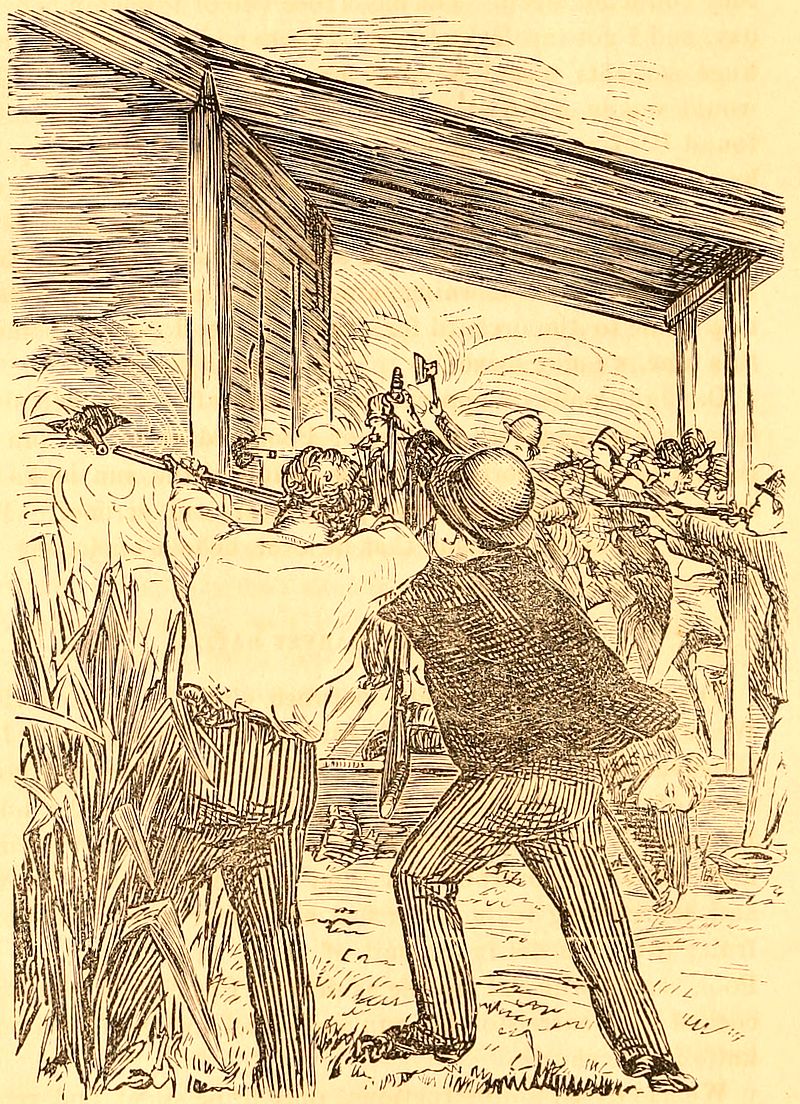
The Famous Harvey Battle.—[See page 103.
Just before dark, Stoughton went to where brother John was stationed, and they both remained until after dark; they then came up to the house, and Stoughton mounted guard. All this time Pool appeared to be in a deep study and had nothing to say, appeared dejected and low spirited. We all laid down, except Stoughton, to try to sleep; I could see Pool and John; they could not sleep. The moon rose two or three hours before day, and I got into a doze several times and each time the most huge serpents would be after me, that I ever beheld. This would waken me, and finally I got up and walked about; I found Pool was up. Stoughton said he could not sleep, and brother John got up and said he could not sleep. We then consulted together and Pool was for leaving the place before day. Stoughton objected, and said, “Let’s wait until eight or nine o’clock in the morning; after Harvey gets his breakfast he may come to the orchard for fruit. If he does not come by this time, we may leave.”
Daylight made its appearance not long after that, and shortly after the sun rose, and poor Pool said after the sun had risen above the horizon: “How beautiful the sun looks this morning; the sky looks so pure, clear and serene!” Poor fellow! It was the last sun that he ever beheld encircling this earth.
THE FAMOUS HARVEY BATTLE.
The time passed on until between eight or nine o’clock. We were all out in the yard, eating figs and peaches; John Copeland all at once cried out: “Boys, there comes a young army of Black Creek men!” We all dodged into the house. Pool seized his gun, and says, “boys take your guns!” I said to him, “they will not trouble us; they are a company out hunting, and are coming in here for figs and water melons and other fruit; they are not in pursuit of us!” “Yes they are,” said Pool, “and I will sell my life as dear as I can!” So saying he cocked both barrels of his gun and pistol and eased his bowie knife in the sheath.
We had given no instructions, only to be silent and remain still. They seemed to separate and go in different directions. On coming near the house, some one of their company hailed to the balance, “come on, boys, here they are!” “There!” said Pool, “I told you so.” So soon as we heard this, we knew that we had been discovered, and that it was to kill or be killed.
I made my escape out of the house the first opportunity I saw, dodged around a big fig tree, and looked back a moment at the house. Pool was standing in the door with his gun at a poise. Harvey came round the corner of the house, on Pool’s right, and jumped into the gallery; Pool immediately fired, and struck Harvey in the left side. Harvey immediately squared himself and shot the contents of his whole load in Pool’s side, and fell on the gallery. Pool stepped into the yard, and another man shot him in the breast, and he immediately fell dead.
At this moment Stoughton and John Copeland jumped out of the door and ran; I wheeled immediately as the crowd rushed around the house, and ran. At the report of the next gun, the shot whistled all around my head, I then heard several guns. It appeared to me there must have been five hundred at that moment; and I have no doubt that I made the best running there that I ever made in my life before. In fact, it seemed to me that it was no trouble, that I never touched the ground, but flew over it.
After I had got a sufficient distance from the place, and found I was not pursued by any of their party, I stopped to reflect to myself, and wondered what had become of Stoughton and my bother John. Pool, I knew, must be dead, for I saw him fall, and the blood gush from the wound. I felt almost certain that Stoughton and my brother John were both killed also, from the number of guns I heard fired, as I thought.
It was then that I more seriously meditated on my situation than I ever had done before, and wondered to myself what I should do for the best. I felt very sad, and thanked my God for my providential escape, believing that all the rest of my comrades were in eternity. But after I had thus meditated and reflected upon the past, I felt that I deserved death, when all my crimes again stared me full in the face. I then formed a stern resolution within my own breast, that if God would permit me ever again to reach my home, that I would refrain from all my evil ways, and become a Christian, believing that God had been merciful to me, in preserving me, and hurling my comrades and associates into another world.
After a while I became more collected and concluded I would go over to Daniel Brown’s, who, I knew, did not live far from that place. I had been there but a short time when my brother John came up, bare-headed, and mud above his knees, where he had run through a muddy reed-brake. He called me to one side, and in a few words he told me that Stoughton was not killed, but Pool was, and that our enemies had left there. He saw them carrying Harvey away, and he thought Harvey was dead; that we had better go over and do something with Pool and get Stoughton, and leave.