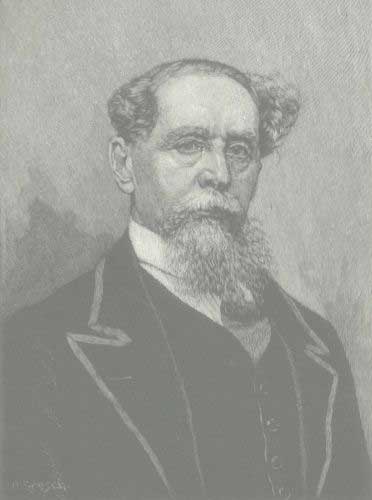
Volume 11 — CHARLES DICKENS
Reading edition
(1812-1870)

hen a great genius arises he makes his place in the world and explains himself. Criticism does not make him and cannot unmake him. He may have great defects and great faults. By exposing them and dwelling upon them, the critics may apparently nibble him all away. When the critics get through, however, he remains pretty much the force he was originally. For real genius is a sort of elemental force that enters the human world, both for good and evil, and leaves its lasting impression. It is like a new river, of waters sweet and bitter, clear and muddy, bearing on its bosom ships and wrecks, the lovely and the ugly, the incongruous elements of human life and human contrivance. When it floods and overflows, the critics run away; when it subsides the critics come back and begin to analyze it, and say, "It wasn't much of a shower."
Charles Dickens is to be judged, like any other genius, by what he created, what he brought into the world. We are not called on to say whether he was as great as Homer, as Shakespeare, as Cervantes, as Fielding, as Manzoni, as Thackeray. He was always quite himself, and followed no model, though thousands of writers have attempted to follow him and acquire the title of being Dickens-y. For over half a century he had the ear of the English-reading public the world over. It laughed with him, it cried with him, it hungered after him. Whatever he wrote, it must read; whenever he read, it crowded to hear his masterly interpretations; when he acted, it was delighted with his histrionic cleverness. In all these manifestations there was the attraction of a most winning personality.
He invented a new kind of irresistible humor, he told stories that went to the heart of humanity, he amused, he warmed, he cheered the world. We almost think that modern Christmas was his invention, such an apostle was he of kindliness and brotherly love, of sympathy with the poor and the struggling, of charity which is not condescension. He made pictures of low life, and perhaps unreal shadows of high life, and vivid scenes that lighted up great periods of history. For producing effects and holding the reader he was a wizard with his pen. And so the world hung on him, read him and re-read him, recited him, declaimed him, put him into reading-books, diffused him in common speech and in all literature. In all English literature his characters are familiar, stand for types, and need no explanation. And now, having filled itself up with him, been saturated with him, made him in some ways as common as the air, does the world tire of him, turn on him, say that it cannot read him any more, that he is commonplace? If so, the world has made him commonplace. But the publishers' and booksellers' accounts show no diminution in his popularity with the new generation.
At a dinner where Dickens was discussed, a gentleman won distinction by this sole contribution to the conversation:—"There is no evidence in Dickens's works that he ever read a book." It is true that Dickens drew most of his material from his own observation of life, and from his fertile imagination, which was often fantastic. It is true that he could not be called in the narrow sense a literary writer, that he made no literary mosaic, and few allusions to the literature of the world. Is it not probable that he had the art to assimilate his material? For it is impossible that any writer could pour out such a great flood about the world and human nature without refreshing his own mind at the great fountains of literature. And when we turn to such a tale as 'The Tale of Two Cities,' we are conscious of the vast amount of reading and study he must have done in order to give us such a true and vivid picture of the Revolutionary period.
It has been said that Dickens did not write good English, that he could not draw a lady or a gentleman, that he often makes ear-marks and personal peculiarities stand for character, that he is sometimes turgid when he would be impressive, sometimes stilted when he would be fine, that his sentiment is often false and worked up, that his attempts at tragedy are melodramatic, and that sometimes his comedy comes near being farcical. His whole literary attitude has been compared to his boyish fondness for striking apparel.
There is some truth in all these criticisms, though they do not occur spontaneously to a fresh reader while he is under the spell of Dickens, nor were they much brought forward when he was creating a new school and setting a fashion for an admiring world. His style, which is quite a part of this singular man, can easily be pulled in pieces and condemned, and it is not a safe one to imitate. No doubt he wrought for effects, for he was a magician, and used exaggeration in high lights and low lights on his crowded canvas. Say what you will of all these defects, of his lack of classic literary training, of his tendency to melodrama, of his tricks of style, even of a ray of lime-light here and there, it remains that he is a great power, a tremendous force in modern life; half an hour of him is worth a lifetime of his self-conscious analyzers, and the world is a more cheerful and sympathetic world because of the loving and lovable presence in it of Charles Dickens.
A sketch of his life and writings, necessarily much condensed for use here, has been furnished by Mr. Laurence Hutton.
CHARLES DICKENS.
THE LIFE AND WRITINGS OF DICKENS
BY LAURENCE HUTTON
Charles Dickens was born at Landport in Portsea, on the 7th of February, 1812. His childhood was a very unhappy one. He describes himself in one of his essays as "a very queer, small boy," and his biographer tells us that he was very sickly as well as very small. He had little schooling, and numberless hard knocks, and rough and toilsome was the first quarter of his journey through life. Many of the passages in 'David Copperfield' are literally true pictures of his own early experiences, and much of that work may be accepted as autobiographical. He was fond of putting himself and his own people into his books, and of drawing his scenes and his characters from real life, sometimes only slightly disguised. Tradition says that he built both Mr. Micawber and Mr. Turveydrop out of his own father; that Mrs. Nickleby was based upon his own mother; and that his wife, who was the Dora of 'Copperfield' in the beginning of their married life, became in later years the Flora of 'Little Dorrit.' The elder Dickens had unquestionably some of the traits ascribed to the unpractical friend of Copperfield's youth, and something of the cruel self-indulgence and pompous deportment of the dancing-master in 'Bleak House.' And it was during his father's imprisonment for debt when the son was but a youth, that Dickens got his intimate knowledge of the Marshalsea, and of the heart-breaking existence of its inmates. Some years before 'Copperfield' was written, he described in a fragment of actual autobiography, quoted by Forster, the following scene:—
"My father was waiting for me in the lodge [of the Debtor's Prison]; and we went up to his room, on the top story but one, and cried very much. And he told me, I remember, to take warning by the Marshalsea, and to observe that if a man had twenty pounds a year, and spent nineteen pounds nineteen shillings and sixpence, he would be happy; but that a shilling spent the other way would make him wretched."
In these chambers Dickens afterwards put Mr. Dorrit. And while the father remained in confinement, the son lived for a time in a back attic in Lant Street, Borough, which was to become the home of the eccentric Robert Sawyer, and the scene of a famous supper party given to do honor to Mr. Pickwick "and the other chaps." "If a man wishes to abstract himself from the world, to remove himself from the reach of temptation, to place himself beyond the possibility of any inducement to look out of the window, he should by all means go to Lant Street." Lant Street still exists, as Mr. Pickwick found it, and as Dickens knew it between 1822 and 1824. He had numerous lodgings, alone and with his family, during those hard times; all of them of the same miserable, wretched character; and it is interesting to know that the original of Mrs. Pipchin was his landlady in Camden Town, and that the original of the Marchioness waited on the elder Dickens during his stay in the Marshalsea.
The story of the unhappy drudgery of the young Copperfield is the story of the young Dickens without exaggeration.
"No words can express the secret agony of my soul as I sunk into this companionship," he wrote in 1845 or 1846,—"compared these every-day associates with those of my happier childhood, and felt my early hopes of growing up to be a learned and distinguished man crushed in my breast. The deep remembrance of the sense I had of being utterly neglected and hopeless; of the shame I felt in my position; of the misery it was to my young heart to believe that, day by day, what I had learned, and thought, and delighted in, and raised my fancy and my emulation up by, was passing away from me, never to be brought back any more, cannot be written. My whole nature was so penetrated with the grief and humiliation of such considerations, that even now, famous and caressed and happy, I often forget, in my dreams, that I have a dear wife and children; even that I am a man; and I wander desolately back to that time of my life."
In the course of a few years, happily, the cloud lifted; and in 1831, when Dickens was a youth of nineteen, we find him beginning life as a reporting journalist. He wrote occasional "pieces" for the magazines, and some faint hope of growing up to be a distinguished and learned man rose again, no doubt, in his breast. N. P. Willis met him one day in 1835, when, as Willis expresses it, Dickens was a "paragraphist" for the London Morning Chronicle. The "paragraphist," according to Willis, was lodging in the most crowded part of Holborn, in an uncarpeted and bleak-looking room, with a deal table, two or three chairs, and a few books. It was up a long flight of stairs, this room; and its occupant "was dressed very much as he has since described Dick Swiveller—minus the swell look. His hair was cropped close to his head, his clothes were scant, though jauntily cut; and after exchanging a ragged office coat for a shabby blue, he stood by the door collarless and buttoned up, the very personification, I thought, of a close sailer to the wind.... Not long after this Macrone sent me the sheets of 'Sketches by Boz,' with a note saying they were by the gentleman [Dickens] who went with us to Newgate. I read the book with amazement at the genius displayed in it; and in my note of reply assured Macrone that I thought his fortune was made, as a publisher, if he could monopolize the author." This picture is very graphic. But it must be accepted with a grain of salt.
The 'Sketches by Boz, Illustrative of Every-Day Life and Every-Day People,' Dickens's first printed book, appeared in 1835. A further series of papers, bearing the same title, was published the next year. "Boz" was the nickname he had bestowed upon his younger brother Augustus, in honor of the Moses of the 'Vicar of Wakefield.' The word, pronounced through the nose, became "Boses," afterwards shortened to "Boz," which, said Dickens, "was a very familiar household word to me long before I was an author. And so I came to adopt it." The sketches, the character of which is explained in their sub-title, were regarded as unusually clever things of their kind. They attracted at once great attention in England, and established the fact that a new star had risen in the firmament of British letters.
Dickens was married on the 2d of April, 1836, to Miss Catherine Hogarth, just a week after he had published the first shilling number of 'The Posthumous Papers of the Pickwick Club: Edited by Boz.' The work appeared in book form the next year. Its success was phenomenal, and it brought to its author not only fame but a fixed sum per annum, which is better. It assured his comfort in the present and in the future, and it wiped out all the care and troubles of his past. It was in itself the result of an accident. Messrs. Chapman and Hall, attracted by the popularity of the Sketches, proposed to their author a series of monthly articles to illustrate certain pictures of a comic character by Robert Seymour, an artist in their employment. Dickens assented, upon the condition that "the plates were to be so modified that they would arise naturally out of the text." And so between them Mr. Pickwick was born, although under the saddest of circumstances; for only a single number had appeared when Seymour died by his own hand. Hablot K. Browne succeeded him, signing the name of "Phiz"; and with "Boz" was "Phiz" long associated in other prosperous ventures. Mr. Pickwick is a benevolent, tender-hearted elderly gentleman, who, as the president of a club organized "for the purpose of investigating the source of the Hampstead ponds," journeys about England in all directions with three companions, to whom he acts as guide, philosopher, and friend. He is an amiable old goose, and his companions are equally verdant and unsophisticated; but since 1837 they have been as famous as any men in fiction. The story is a long one, the pages are crowded with incidents and with characters. It is disconnected, often exaggerated, much of it is as improbable as it is impossible, but it has made the world laugh for sixty years now; and it still holds its own unique place in the hearts of men.
From this period the pen of Dickens was never idle for thirty-three years. 'Pickwick' was succeeded by 'Oliver Twist,' begun in Bentley's Magazine in January, 1837, and printed in book form in 1838. It is the story of the progress of a parish boy, and it is sad and serious in its character. The hero was born and brought up in a workhouse. He was starved and ill-treated; but he always retained his innocence and his purity of mind. He fell among thieves,—Bill and Nancy Sykes, Fagin and the Artful Dodger, to whom much powerful description is devoted,—but he triumphed in the end. The life of the very poor and of the very degraded among the people of England during the latter end of the first half of the nineteenth century is admirably portrayed; and for the first time in their existence the British blackguards of both sexes were exhibited in fiction, clad in all their instincts of low brutality, and without that glamour of attractive romance which the earlier writers had given to Jack Sheppard, to Jonathan Wild, or to Moll Flanders.
Two dramatic compositions by Dickens, neither of them adding very much to his reputation, appeared in 1836, to wit:—'The Stranger Gentleman, A Comic Burletta in Three Acts'; and 'The Village Coquette,' a comic opera in two acts. They were presented upon the stage towards the close of that year, with fair success.
In 1838 Dickens edited the Memoirs of Joseph Grimaldi, a celebrated clown. His share in the composition of this work was comparatively small, and consisted of a Preface, dated February of that year. It was followed by 'Sketches of Young Gentlemen,' and by 'The Life and Adventures of Nicholas Nickleby,' both published in 1839. To this latter he signed his name, Charles Dickens, dropping from that period the pseudonym of "Boz." The titular hero is the son of a poor country gentleman. He makes his own way in the world as the usher of a Yorkshire school, as an actor in a traveling troupe, and as the clerk and finally the partner in a prosperous mercantile house in London. Smike, his pupil; Crummles, his theatrical manager; Ninetta Crummles, the Infant Phenomenon of the company, Newman Noggs, the clerk of his uncle Ralph Nickleby, the Cheeryble Brothers, his employers, are among the most successful and charming of Dickens's earlier creations. "Mr. Squeers and his school," he says, "were faint and feeble pictures of an existing reality, purposely subdued and kept down lest they should be deemed impossible." That such establishments ceased to exist in reality in England after the appearance of 'Nickleby,' is proof enough of the good his pictures did in this and in many other ways.
In 1840-1841 appeared 'Master Humphrey's Clock,' comprising the two stories of 'The Old Curiosity Shop' and 'Barnaby Rudge,' which were subsequently printed separately. The story of Little Nell, the gentle, lovable inmate of the Curiosity Shop, is one of the most sad and tender tales in fiction, and Dickens himself confessed that he was almost heart-broken when she died. Her path was crossed by Quilp, a cunning and malicious dwarf of hideous appearance, who consumed hard-boiled eggs, shells and all, for his breakfast; ate his prawns with their heads and their tails on, drank scalding hot tea, and performed so many horrifying acts that one almost doubted that he was human; and by Christopher Nubbles, a shock-headed, shambling, awkward, devoted lad, the only element of cheerfulness that ever came into her life. In this book appear Richard Swiveller and his Marchioness, Sampson and Sarah Brass and Mrs. Jarley, who to be appreciated must be seen and known, as Dickens has drawn them, at full length.
Barnaby Rudge was a half-witted lad, who, not knowing what he did, joined the Gordon rioters—the scenes are laid in the "No Popery" times of 1779—because he was permitted to carry a flag and to wear a blue ribbon. The history of that exciting period of English semi-political, semi-religious excitement is graphically set down. Prominent figures in the book are Grip the raven, whose cry was "I'm a devil," "Never say die"; and Miss Dolly Varden, the blooming daughter of the Clerkenwell locksmith, who has given her name to the modern feminine costume of the Watteauesque style.
The literary results of Dickens's first visit to the United States, in 1842, when he was thirty years of age, were 'American Notes, for General Circulation'; published in that year, and containing portions of 'Martin Chuzzlewit,' which appeared in 1844. His observations in the 'Notes' upon the new country and its inhabitants gave great offense to the American people, and were perhaps not in the best taste. He saw the crude and ridiculous side of his hosts, he emphasized their faults, while he paid little attention to their virtues; and his criticisms and strictures rankled in the sensitive American mind for many years.
Martin Chuzzlewit, the hero of the novel bearing his name, spent some time in the western half-settled portion of America, with Mark Tapley, his light-hearted, optimistic friend and companion. The pictures of the morals and the manners of the men and women with whom the emigrants were brought into contact were anything but flattering, and they served to widen the temporary breach between Dickens and his many admirers in the United States. The English scenes of 'Chuzzlewit' are very powerfully drawn. Tom and Ruth Pinch, Pecksniff, Sarah Gamp, and Betsey Prig are among the leading characters in the work.
In 1843 appeared the 'Christmas Carol,' the first and perhaps the best of that series of tales of peace and good-will, with which, at the Christmas time, the name of Dickens is so pleasantly and familiarly associated. It was followed by 'The Chimes' in 1844, by 'The Cricket on the Hearth' in 1845, by 'The Haunted Man' in 1848, all the work of Dickens himself; and by other productions written by Dickens in collaboration with other men. Concerning these holiday stories, some unknown writer said in the public press at the time of Dickens's death: "He has not only pleased us—he has softened the hearts of a whole generation. He made charity fashionable; he awakened pity in the hearts of sixty millions of people. He made a whole generation keep Christmas with acts of helpfulness to the poor; and every barefooted boy and girl in the streets of England and America to-day fares a little better, gets fewer cuffs and more pudding, because Charles Dickens wrote."
In 1846 he produced his 'Pictures from Italy'; 'The Battle of Life, A Love Story,' and began in periodical form his 'Dealings with the Firm of Dombey and Son, Wholesale, Retail, and for Exportation,' published in book form in 1847. Here we have the pathetic story of Little Paul, the tragic fate of Carker, the amusing episode of Jack Bunsby with his designing widow, and the devotion of Susan Nipper, Mr. Toots, Captain Cuttle, and Sol Gills to the gentle, patient, lovable Florence.
On the 'Personal History of David Copperfield,' published in 1850, and of Dickens's share in its plot, something has already been said here. It is perhaps the most popular of all his productions, containing as it does Mr. Dick, the Peggottys, the Micawbers, the Heeps, Betsey Trotwood, Steerforth, Tommy Traddles, Dora, Agnes, and Little Emily, in all of whom the world has been so deeply interested for so many years.
'A Child's History of England' and 'Bleak House' saw the light in 1853. The romance was written as a protest and a warning against the law's delays, as exhibited in the Court of Chancery; and it contains the tragedy of Sir Leicester and Lady Dedlock, and the short but touching story of Poor Jo.
'Hard Times,' a tale in one volume, was printed in 1854. It introduces the Gradgrind family.
'Little Dorrit' appeared in 1857. In this book he returns to the Debtor's Prison of Micawber and of his own father. Little Dorrit herself was "the child of the Marshalsea," in which she was born and brought up; and the whole story is an appeal against the injustice of depriving of personal liberty those who cannot pay their bills, or meet their notes, however small. Its prominent characters are the Clennams, mother and son, the Meagleses, Flintwinch, Sir Decimus Tite Barnacle, Rigaud and Little Cavalletto.
'A Tale of Two Cities,' a remarkable departure for Dickens, and unlike any of his other works, was the book of the year 1859. It is conceded, even by those who are not counted among the admirers of its author, to be a most vivid and correct picture of Paris during the time of the Revolution, when the guillotine was the king of France. Its central figure, Sydney Carton, one of the most heroic characters in romance, gives his life to restore his friend to the girl whom they both love.
'The Uncommercial Traveller,' a number of sketches and stories originally published in his weekly journal All the Year Round, appeared in 1860. They were supplemented in 1868 by another volume bearing the same title, and containing eleven other papers collected from the same periodical.
'Great Expectations,' 1861, like 'Copperfield,' is the story of a boy's childhood told by the boy himself, but by a boy with feelings, sentiments, and experiences very different from those of the earlier work. The plot is not altogether a cheerful one, but many of the characters are original and charming; notably Joe Gargery, Jaggles, Wemmick, the exceedingly eccentric Miss Havisham, and the very amiable and simple Biddy.
'Somebody's Luggage,' 1862; 'Mrs. Lirriper's Lodgings' 1863; 'Mrs. Lirriper's Legacy,' 1864; 'Dr. Marigold's Prescription,' 1865, 'Mugby Junction,' 1866; and 'No Thoroughfare,' 1867,—Christmas stories, all of them,—were written by Dickens in collaboration with other writers.
'Our Mutual Friend,' the last completed work of Dickens, was printed in 1865. Mr. Boffin, the Golden Dustman with the great heart, Silas Wegg, Mr. Venus, the Riderhoods, Jenny Wren, the Podsnaps, the Veneerings, Betty Higden, Mrs. Wilfer, and the "Boofer Lady," are as fresh and as original as are any of his creations, and show no trace of the coming disaster.
Before the completion of 'The Mystery of Edwin Drood' Dickens died at his home, Gadshill Place, literally in harness, and without warning, on the 9th of June, 1870.
But six numbers of this last work appeared, in periodical form. Its author left no notes of what was to follow, and the Mystery has never been solved. Mr. Charles Collins, Dickens's son-in-law, however, in a private letter to Mr. Augustin Daly of New York, who had proposed to dramatize the tale, gave some general outline of the scheme for 'Edwin Drood.' "The titular character," he said, "was never to reappear, he having been murdered by Jasper. The girl Rosa, not having been really attached to Edwin, was not to lament his loss very long, and was, I believe, to admit the sailor, Mr. Tartar, to supply his place. It was intended that Jasper should urge on the search after Edwin, and the pursuit of the murderer, thus endeavoring to divert suspicion from himself, the real murderer. As to anything further, it would be purely conjectural."
Besides this immense amount of admirable work, Dickens founded, conducted, and edited two successful periodicals, Household Words, established in March 1850, and followed by All the Year Round, beginning in April 1859. To these he contributed many sketches and stories. He began public readings in London in 1858; and continued them with great profit to himself, and with great satisfaction to immense audiences, for upwards of twelve years. He appeared in all the leading cities of Great Britain; and he was enormously popular as a reader in America during his second and last visit in 1868.
As an after-dinner and occasional speaker Dickens was rarely equaled; and as an actor upon the amateur stage, in plays of his own composition, he was inimitable.
Of his attempts at verse, 'The Ivy Green' is the only one that is held in remembrance.
A strong argument in favor of what may be called "the staying qualities" of Dickens is the fact that his characters, even in a mutilated, unsatisfactory form, have held the stage for half a century or more, and still have power to attract and move great audiences, wherever is spoken the language in which he wrote. The dramatization of the novel is universally and justly regarded as the most ephemeral and worthless of dramatic production; and the novels of Dickens, on account of their length, of the great number of figures he introduces, of the variety and occasional exaggeration of his dialogues and his situations, have been peculiarly difficult of adaptation to theatrical purposes. Nevertheless the world laughed and cried over Micawber, Captain Cuttle, Dan'l Peggotty, and Caleb Plummer, behind the footlights, years after Dolly Spanker, Aminadab Sleek, Timothy Toodles, Alfred Evelyn, and Geoffrey Dalk, their contemporaries in the standard and legitimate drama, created solely and particularly for dramatic representation, were absolutely forgotten. And Sir Henry Irving, sixty years after the production of 'Pickwick,' drew great crowds to see his Alfred Jingle, while that picturesque and ingenious swindler Robert Macaire, Jingle's once famous and familiar confrère in plausible rascality, was never seen on the boards, except as he was burlesqued and caricatured in comic opera.
It is pretty safe to say—and not in a Pickwickian sense—that Pecksniff will live almost as long as hypocrisy lasts; that Heep will not be forgotten while mock humility exists; that Mr. Dick will go down to posterity arm-in-arm with Charles the First, whom he could not avoid in his memorial; that Barkis will be quoted until men cease to be willin'. And so long as cheap, rough coats cover faith, charity, and honest hearts, the world will remember that Captain Cuttle and the Peggottys were so clad.
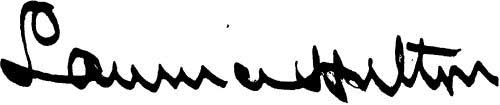
GADSHILL, THE RESIDENCE OF CHARLES DICKENS. Photogravure from a Photograph.
THE ONE THING NEEDFUL
From 'Hard Times'
"Now what I want is Facts. Teach these boys and girls nothing but Facts. Facts alone are wanted in life. Plant nothing else, and root out everything else. You can only form the minds of reasoning animals upon Facts: nothing else will ever be of any service to them. This is the principle on which I bring up my own children, and this is the principle on which I bring up these children. Stick to Facts, sir!"
The scene was a plain, bare, monotonous vault of a schoolroom, and the speaker's square forefinger emphasized his observations by underscoring every sentence with a line on the school-master's sleeve. The emphasis was helped by the speaker's square wall of a forehead, which had his eyebrows for its base, while his eyes found commodious cellarage in two dark caves, overshadowed by the wall. The emphasis was helped by the speaker's mouth, which was wide, thin, and hard set. The emphasis was helped by the speaker's voice, which was inflexible, dry, and dictatorial. The emphasis was helped by the speaker's hair, which bristled on the skirts of his bald head, a plantation of firs to keep the wind from its shining surface, all covered with knobs, like the crust of a plum pie, as if the head had scarcely warehouse-room for the hard facts stored inside. The speaker's obstinate carriage, square coat, square legs, square shoulders,—nay, his very neckcloth, trained to take him by the throat with an unaccommodating grasp like a stubborn fact, as it was,—all helped the emphasis.
"In this life we want nothing but Facts, sir; nothing but Facts!"
The speaker, and the schoolmaster, and the third grown person present, all backed a little, and swept with their eyes the inclined plane of little vessels then and there arranged in order, ready to have imperial gallons of facts poured into them until they were full to the brim.
Thomas Gradgrind, sir. A man of realities. A man of facts and calculations. A man who proceeds upon the principle that two and two are four, and nothing over, and who is not to be talked into allowing for anything over. Thomas Gradgrind, sir,—peremptorily Thomas,—Thomas Gradgrind. With a rule and a pair of scales, and the multiplication table always in his pocket, sir, ready to weigh and measure any parcel of human nature, and tell you exactly what it comes to. It is a mere question of figures, a case of simple arithmetic. You might hope to get some other nonsensical belief into the head of George Gradgrind, or Augustus Gradgrind, or John Gradgrind, or Joseph Gradgrind (all supposititious, non-existent persons), but into the head of Thomas Gradgrind—no, sir!
In such terms Mr. Gradgrind always mentally introduced himself, whether to his private circle of acquaintance, or to the public in general. In such terms, no doubt, substituting the words "boys and girls," for "sir," Thomas Gradgrind now presented Thomas Gradgrind to the little pitchers before him, who were to be filled so full of facts.
Indeed, as he eagerly sparkled at them from the cellarage before mentioned, he seemed a kind of cannon loaded to the muzzle with facts, and prepared to blow them clean out of the regions of childhood at one discharge. He seemed a galvanizing apparatus, too, charged with a grim mechanical substitute for the tender young imaginations that were to be stormed away.
"Girl number twenty," said Mr. Gradgrind, squarely pointing with his square forefinger; "I don't know that girl. Who is that girl?"
"Sissy Jupe, sir," explained number twenty, blushing, standing up, and courtesying.
"Sissy is not a name," said Mr. Gradgrind. "Don't call yourself Sissy. Call yourself Cecilia."
"It's father as calls me Sissy, sir," returned the young girl in a trembling voice, and with another courtesy.
"Then he has no business to do it," said Mr. Gradgrind. "Tell him he mustn't. Cecilia Jupe. Let me see. What is your father?"
"He belongs to the horse-riding, if you please, sir."
Mr. Gradgrind frowned, and waved off the objectionable calling with his hand.
"We don't want to know anything about that here. You mustn't tell us about that here. Your father breaks horses, don't he?"
"If you please, sir, when they can get any to break, they do break horses in the ring, sir."
"You mustn't tell us about the ring here. Very well, then. Describe your father as a horsebreaker. He doctors sick horses, I dare say?"
"Oh yes, sir."
"Very well, then. He is a veterinary surgeon, a farrier, and horsebreaker. Give me your definition of a horse."
(Sissy Jupe thrown into the greatest alarm by this demand.)
"Girl number twenty unable to define a horse!" said Mr. Gradgrind, for the general behoof of all the little pitchers. "Girl number twenty possessed of no facts in reference to one of the commonest of animals! Some boy's definition of a horse. Bitzer, yours."
The square finger, moving here and there, lighted suddenly on Bitzer, perhaps because he chanced to sit in the same ray of sunlight which, darting in at one of the bare windows of the intensely whitewashed room, irradiated Sissy. For the boys and girls sat on the face of the inclined plane in two compact bodies, divided up the centre by a narrow interval; and Sissy, being at the corner of a row on the sunny side, came in for the beginning of a sunbeam, of which Bitzer, being at the corner of a row on the other side, a few rows in advance, caught the end. But whereas the girl was so dark-eyed and dark-haired that she seemed to receive a deeper and more lustrous color from the sun when it shone upon her, the boy was so light-eyed and light-haired that the selfsame rays appeared to draw out of him what little color he ever possessed. His cold eyes would hardly have been eyes, but for the short ends of lashes which, by bringing them into immediate contrast with something paler than themselves, expressed their form. His short-cropped hair might have been a mere continuation of the sandy freckles on his forehead and face. His skin was so unwholesomely deficient in the natural tinge, that he looked as though if he were cut he would bleed white.
"Bitzer," said Thomas Gradgrind. "Your definition of a horse."
"Quadruped. Graminivorous. Forty teeth; namely, twenty-four grinders, four eye-teeth, and twelve incisive. Sheds coat in the spring; in marshy countries, sheds hoofs, too. Hoofs hard, but requiring to be shod with iron. Age known by marks in mouth." Thus (and much more) Bitzer.
"Now, girl number twenty," said Mr. Gradgrind, "you know what a horse is."
She courtesied again, and would have blushed deeper, if she could have blushed deeper than she had blushed all this time. Bitzer, after rapidly blinking at Thomas Gradgrind with both eyes at once, and so catching the light upon his quivering ends of lashes that they looked like the antennæ of busy insects, put his knuckles to his freckled forehead, and sat down again.
The third gentleman now stepped forth. A mighty man at cutting and drying, he was; a government officer; in his way (and in most other people's too), a professed pugilist; always in training, always with a system to force down the general throat like a bolus, always to be heard of at the bar of his little Public-office, ready to fight all England. To continue in fistic phraseology, he had a genius for coming up to the scratch, wherever and whatever it was, and proving himself an ugly customer. He would go in and damage any subject whatever with his right, follow up with his left, stop, exchange, counter, bore his opponent (he always fought All England) to the ropes, and fall upon him neatly. He was certain to knock the wind out of common-sense, and render that unlucky adversary deaf to the call of time. And he had it in charge from high authority to bring about the great public-office Millennium, when Commissioners should reign upon earth.
"Very well," said this gentleman, briskly smiling, and folding his arms. "That's a horse. Now, let me ask you girls and boys, Would you paper a room with representations of horses?"
After a pause one-half of the children cried in chorus, "Yes, sir!" Upon which the other half, seeing in the gentleman's face that Yes was wrong, cried out in chorus, "No, sir!"—as the custom is in these examinations.
"Of course, No. Why wouldn't you?"
A pause. One corpulent slow boy, with a wheezy manner of breathing, ventured the answer, Because he wouldn't paper a room at all, but would paint it.
"You must paper it," said the gentleman, rather warmly.
"You must paper it," said Thomas Gradgrind, "whether you like it or not. Don't tell us you wouldn't paper it. What do you mean, boy?"
"I'll explain to you, then," said the gentleman, after another and dismal pause, "why you wouldn't paper a room with representations of horses. Do you ever see horses walking up and down the sides of rooms in reality—in fact? Do you?"
"Yes, sir!" from one-half. "No, sir!" from the other.
"Of course no," said the gentleman, with an indignant look at the wrong half. "Why, then, you are not to see anywhere what you don't see in fact; you are not to have anywhere what you don't have in fact. What is called Taste is only another name for Fact."
Thomas Gradgrind nodded his approbation.
"This is a new principle, a discovery, a great discovery," said the gentleman. "Now, I'll try you again. Suppose you were going to carpet a room. Would you use a carpet having a representation of flowers upon it?"
There being a general conviction by this time that "No, sir!" was always the right answer to this gentleman, the chorus of No was very strong. Only a few feeble stragglers said Yes; among them Sissy Jupe.
"Girl number twenty," said the gentleman, smiling in the calm strength of knowledge.
Sissy blushed, and stood up.
"So you would carpet your room—or your husband's room, if you were a grown woman, and had a husband—with representations of flowers, would you?" said the gentleman. "Why would you?"
"If you please, sir, I am very fond of flowers," returned the girl.
"And is that why you would put tables and chairs upon them, and have people walking over them with heavy boots?"
"It wouldn't hurt them, sir. They wouldn't crush and wither, if you please, sir. They would be the pictures of what was very pretty and pleasant, and I would fancy—"
"Ay, ay, ay! But you mustn't fancy," cried the gentleman, quite elated by coming so happily to his point. "That's it! You are never to fancy."
"You are not, Cecilia Jupe," Thomas Gradgrind solemnly repeated, "to do anything of that kind."
"Fact, fact, fact!" said the gentleman. And "Fact, fact, fact!" repeated Thomas Gradgrind.
"You are to be in all things regulated and governed," said the gentleman, "by fact. We hope to have, before long, a board of fact, composed of commissioners of fact, who will force the people to be a people of fact, and of nothing but fact. You must discard the word Fancy altogether. You have nothing to do with it. You are not to have in any object of use or ornament what would be a contradiction in fact. You don't walk upon flowers in fact; you cannot be allowed to walk upon flowers in carpets. You don't find that foreign birds and butterflies come and perch upon your crockery; you cannot be permitted to paint foreign birds and butterflies upon your crockery. You never meet with quadrupeds going up and down walls; you must not have quadrupeds represented upon walls. You must use," said the gentleman, "for all these purposes, combinations and modifications (in primary colors) of mathematical figures, which are susceptible of proof and demonstration. This is the new discovery. This is fact. This is taste."
The girl courtesied, and sat down. She was very young, and she looked as if she were frightened by the matter-of-fact prospect the world afforded.
"Now, if Mr. M'Choakumchild," said the gentleman, "will proceed to give his first lesson here, Mr. Gradgrind, I shall be happy, at your request, to observe his mode of procedure."
Mr. Gradgrind was much obliged. "Mr. M'Choakumchild, we only wait for you."
So Mr. M'Choakumchild began in his best manner. He and some one hundred and forty other schoolmasters had been lately turned at the same time, in the same factory, on the same principles, like so many pianoforte legs. He had been put through an immense variety of paces, and had answered volumes of head-breaking questions. Orthography, etymology, syntax, and prosody, biography, astronomy, geography, and general cosmography, the sciences of compound proportion, algebra, land-surveying and leveling, vocal music, and drawing from models, were all at the ends of his ten chilled fingers. He had worked his stony way into her Majesty's most Honorable Privy Council's Schedule B, and had taken the bloom off the higher branches of mathematics and physical science, French, German, Latin, and Greek. He knew all about all the Water Sheds of all the world (whatever they are), and all the histories of all the peoples, and all the names of all the rivers and mountains, and all the productions, manners, and customs of all the countries, and all their boundaries and bearings on the two-and-thirty points of the compass. Ah, rather overdone, M'Choakumchild. If he had only learned a little less, how infinitely better he might have taught much more!
He went to work in this preparatory lesson not unlike Morgiana in the 'Forty Thieves': looking into all the vessels ranged before him, one after another, to see what they contained. Say, good M'Choakumchild. When from thy boiling store thou shalt fill each jar brim-full, by-and-by, dost thou think that then wilt always kill outright the robber Fancy lurking within—or sometimes only maim him and distort him!
THE BOY AT MUGBY
From 'Mugby Junction'
I am the boy at Mugby. That's about what I am.
You don't know what I mean? What a pity! But I think you do. I think you must. Look here. I am the Boy at what is called The Refreshment Room at Mugby Junction, and what's proudest boast is, that it never yet refreshed a mortal being.
Up in a corner of the Down Refreshment Room at Mugby Junction, in the height of twenty-seven cross draughts (I've often counted 'em while they brush the First Class hair twenty-seven ways), behind the bottles, among the glasses, bounded on the nor'west by the beer, stood pretty far to the right of a metallic object that's at times the tea-urn and at times the soup-tureen, according to the nature of the last twang imparted to its contents, which are the same groundwork, fended off from the traveler by a barrier of stale sponge-cakes erected atop of the counter, and lastly exposed sideways to the glare of Our Missis's eye—you ask a Boy so sitiwated, next time you stop in a hurry at Mugby, for anything to drink; you take particular notice that he'll try to seem not to hear you, that he'll appear in a absent manner to survey the Line through a transparent medium composed of your head and body, and that he won't serve you as long as you can possibly bear it. That's me.
What a lark it is! We are the Model Establishment, we are, at Mugby. Other Refreshment Rooms send their imperfect young ladies up to be finished off by our Missis. For some of the young ladies, when they're new to the business, come into it mild! Ah! Our Missis, she soon takes that out of 'em. Why, I originally come into the business meek myself. But Our Missis, she soon took that out of me.
What a delightful lark it is! I look upon us Refreshmenters as ockipying the only proudly independent footing on the Line. There's Papers, for instance,—my honorable friend, if he will allow me to call him so,—him as belongs to Smith's bookstall. Why, he no more dares to be up to our Refreshmenting games than he dares to jump atop of a locomotive with her steam at full pressure, and cut away upon her alone, driving himself, at limited-mail speed. Papers, he'd get his head punched at every compartment, first, second, and third, the whole length of a train, if he was to ventur' to imitate my demeanor. It's the same with the porters, the same with the guards, the same with the ticket clerks, the same the whole way up to the secretary, traffic manager, or very chairman. There ain't a one among 'em on the nobly independent footing we are. Did you ever catch one of them, when you wanted anything of him, making a system of surveying the Line through a transparent medium composed of your head and body? I should hope not.
You should see our Bandolining Room at Mugby Junction. It's led to by the door behind the counter, which you'll notice usually stands ajar, and it's the room where Our Missis and our young ladies Bandolines their hair. You should see 'em at it, betwixt trains, Bandolining away, as if they was anointing themselves for the combat. When you're telegraphed you should see their noses all a-going up with scorn, as if it was a part of the working of the same Cooke and Wheatstone electrical machinery. You should hear Our Missis give the word, "Here comes the Beast to be Fed!" and then you should see 'em indignantly skipping across the Line, from the Up to the Down, or Wicer Warsaw, and begin to pitch the stale pastry into the plates, and chuck the sawdust sangwiches under the glass covers, and get out the—ha, ha, ha!—the Sherry,—O my eye, my eye!—for your Refreshment.
It's only in the Isle of the Brave and Land of the Free (by which of course I mean to say Britannia) that Refreshmenting is so effective, so 'olesome, so constitutional a check upon the public. There was a foreigner, which having politely, with his hat off, beseeched our young ladies and Our Missis for "a leetel gloss hoff prarndee," and having had the Line surveyed through him by all, and no other acknowledgment, was a-proceeding at last to help himself, as seems to be the custom in his own country, when Our Missis, with her hair almost a-coming un-Bandolined with rage, and her eyes omitting sparks, flew at him, cotched the decanter out of his hand, and said, "Put it down! I won't allow that!" The foreigner turned pale, stepped back with his arms stretched out in front of him, his hands clasped, and his shoulders riz, and exclaimed:—"Ah! Is it possible, this! That these disdaineous females and this ferocious old woman are placed here by the administration, not only to empoison the voyagers, but to affront them! Great Heaven! How arrives it? The English people. Or is he then a slave? Or idiot?" Another time a merry, wide-awake American gent had tried the sawdust and spit it out, and had tried the Sherry and spit that out, and had tried in vain to sustain exhausted natur' upon Butter-Scotch, and had been rather extra Bandolined and Line-surveyed through, when as the bell was ringing and he paid Our Missis, he says, very loud and good-tempered:—"I tell Yew what 'tis, ma'arm. I la'af. Theer! I la'af. I Dew. I oughter ha' seen most things, for I hail from the Onlimited side of the Atlantic Ocean, and I haive traveled right slick over the Limited, head on through Jeerusalemm and the East, and likeways France and Italy Europe Old World, and am now upon the track to the Chief Europian Village; but such an Institution as Yew, and Yewer young ladies, and Yewer fixin's solid and liquid, afore the glorious Tarnal I never did see yet! And if I hain't found the eighth wonder of monarchical Creation, in finding Yew, and Yewer young ladies, and Yewer fixin's solid and liquid, all as aforesaid, established in a country where the people air not absolute Loo-naticks, I am Extra Double Darned with a Nip and Frizzle to the innermostest grit! Wheerfur—Theer!—I la'af! I Dew, ma'arm. I la'af!" And so he went, stamping and shaking his sides, along the platform all the way to his own compartment.
I think it was her standing up agin the Foreigner as give Our Missis the idea of going over to France, and droring a comparison betwixt Refreshmenting as followed among the frog-eaters and Refreshmenting as triumphant in the Isle of the Brave and Land of the Free (by which of course I mean to say agin, Britannia). Our young ladies, Miss Whiff, Miss Piff, and Mrs. Sniff, was unanimous opposed to her going: for, as they says to Our Missis one and all, it is well beknown to the hends of the herth as no other nation except Britain has a idea of anythink, but above all of business. Why then should you tire yourself to prove what is a'ready proved? Our Missis, however (being a teazer at all pints), stood out grim obstinate, and got a return pass by Southeastern Tidal, to go right through, if such should be her dispositions, to Marseilles.
Sniff is husband to Mrs. Sniff, and is a regular insignificant cove. He looks arter the sawdust department in a back room, and is sometimes, when we are very hard put to it, let behind the counter with a corkscrew; but never when it can be helped, his demeanor towards the public being disgusting servile. How Mrs. Sniff ever come so far to lower herself as to marry him, I don't know; but I suppose he does, and I should think he wished he didn't, for he leads a awful life. Mrs. Sniff couldn't be much harder with him if he was public. Similarly, Miss Whiff and Miss Piff, taking the tone of Mrs. Sniff, they shoulder Sniff about when he is let in with a corkscrew, and they whisk things out of his hands when in his servility he is a-going to let the public have 'em, and they snap him up when in the crawling baseness of his spirit he is a-going to answer a public question, and they drore more tears into his eyes than ever the mustard does, which he all day long lays on to the sawdust. (But it ain't strong.) Once when Sniff had the repulsiveness to reach across to get the milkpot to hand over for a baby, I see Our Missis in her rage catch him by both his shoulders, and spin him out into the Bandolining Room.
But Mrs. Sniff—how different! She's the one! She's the one as you'll notice to be always looking another away from you when you look at her. She's the one with the small waist buckled in tight in front, and with the lace cuffs at her wrists, which she puts on the edge of the counter before her, and stands a-smoothing while the public foams. This smoothing the cuffs and looking another way while the public foams is the last accomplishment taught to the young ladies as come to Mugby to be finished by Our Missis; and it's always taught by Mrs. Sniff.
When Our Missis went away upon her journey, Mrs. Sniff was left in charge. She did hold the public in check most beautiful! In all my time, I never see half so many cups of tea given without milk to people as wanted it with, nor half so many cups of tea with milk given to people as wanted it without. When foaming ensued, Mrs. Sniff would say, "Then you'd better settle it among yourselves, and change with one another." It was a most highly delicious lark. I enjoyed the Refreshmenting business more than ever, and was so glad I had took to it when young.
Our Missis returned. It got circulated among the young ladies, and it, as it might be, penetrated to me through the crevices of the Bandolining Room, that she had Orrors to reveal, if revelations so contemptible could be dignified with the name. Agitation become weakened. Excitement was up in the stirrups. Expectation stood a-tiptoe. At length it was put forth that on our slackest evening in the week, and at our slackest time of that evening betwixt trains, Our Missis would give her views of foreign Refreshmenting, in the Bandolining Room.
It was arranged tasteful for the purpose. The Bandolining table and glass was hid in a corner, a arm-chair was elevated on a packing-case for Our Missis's ockypation, a table and a tumbler of water (no sherry in it, thankee) was placed beside it. Two of the pupils, the season being autumn, and hollyhocks and daliahs being in, ornamented the wall with three devices in those flowers. On one might be read, "May Albion never Learn"; on another, "Keep the Public Down"; on another, "Our Refreshmenting Charter." The whole had a beautiful appearance, with which the beauty of the sentiments corresponded.
On Our Missis's brow was wrote Severity, as she ascended the fatal platform. (Not that that was anythink new.) Miss Whiff and Miss Piff sat at her feet. Three chairs from the Waiting Room might have been perceived by a average eye, in front of her, on which the pupils was accommodated. Behind them a very close observer might have discerned a Boy. Myself.
"Where," said Our Missis, glancing gloomily around, "is Sniff?"
"I thought it better," answered Mrs. Sniff, "that he should not be let come in. He is such an Ass."
"No doubt," assented Our Missis. "But for that reason is it not desirable to improve his mind?"
"Oh, nothing will ever improve him," said Mrs. Sniff.
"However," pursued Our Missis, "call him in, Ezekiel."
I called him in. The appearance of the low-minded cove was hailed with disapprobation from all sides, on account of his having brought his corkscrew with him. He pleaded "the force of habit."
"The force!" said Mrs. Sniff. "Don't let us have you talking about force, for Gracious's sake. There! Do stand still where you are, with your back against the wall."
He is a smiling piece of vacancy, and he smiled in the mean way in which he will even smile at the public if he gets a chance (language can say no meaner of him), and he stood upright near the door, with the back of his head agin the wall, as if he was a waiting for somebody to come and measure his heighth for the Army.
"I should not enter, ladies," says Our Missis, "on the revolting disclosures I am about to make, if it was not in the hope that they will cause you to be yet more implacable in the exercise of the power you wield in a constitutional country, and yet more devoted to the constitutional motto which I see before me,"—it was behind her, but the words sounded better so,—"'May Albion never learn!'"
Here the pupils as had made the motto admired it, and cried, "Hear! Hear! Hear!" Sniff, showing an inclination to join in chorus, got himself frowned down by every brow.
"The baseness of the French," pursued Our Missis, "as displayed in the fawning nature of their Refreshmenting, equals, if not surpasses, anythink as was ever heard of the baseness of the celebrated Bonaparte."
Miss Whiff, Miss Piff, and me, we drored a heavy breath, equal to saying, "We thought as much!" Miss Whiff and Miss Piff seeming to object to my droring mine along with theirs, I drored another to aggravate 'em.
"Shall I be believed," says Our Missis, with flashing eyes, "when I tell you that no sooner had I set my foot upon that treacherous shore—"
Here Sniff, either busting out mad, or thinking aloud, says, in a low voice, "Feet. Plural, you know."
The cowering that come upon him when he was spurned by all eyes, added to his being beneath contempt, was sufficient punishment for a cove so groveling. In the midst of a silence rendered more impressive by the turned-up female noses with which it was pervaded, Our Missis went on:—
"Shall I be believed when I tell you, that no sooner had I landed," this word with a killing look at Sniff, "on that treacherous shore, then I was ushered into a Refreshment Room where there were—I do not exaggerate—actually eatable things to eat?"
A groan burst from the ladies. I not only did myself the honor of jining, but also of lengthening it out.
"Where there were," Our Missis added, "not only eatable things to eat, but also drinkable things to drink?"
A murmur, swelling almost into a scream, ariz. Miss Piff, trembling with indignation, called out, "Name!"
"I will name," said Our Missis. "There was roast fowls, hot and cold; there was smoking roast veal surrounded with browned potatoes; there was hot soup with (again I ask, shall I be credited?) nothing bitter in it, and no flour to choke off the consumer; there was a variety of cold dishes set off with jelly; there was salad; there was—mark me!—fresh pastry, and that of a light construction; there was a luscious show of fruit; there was bottles and decanters of sound small wine, of every size, and adapted to every pocket; the same odious statement will apply to brandy; and these were set out upon the counter so that all could help themselves."
Our Missis's lips so quivered, that Mrs. Sniff, though scarcely less convulsed than she were, got up and held the tumbler to them.
"This," proceeds Our Missis, "was my first unconstitutional experience. Well would it have been if it had been my last and worst. But no. As I proceeded farther into that enslaved and ignorant land, its aspect became more hideous. I need not explain to this assembly the ingredients and formation of the British Refreshment sangwich?"
Universal laughter,—except from Sniff, who as sangwich-cutter, shook his head in a state of the utmost dejection as he stood with it agin the wall.
"Well!" said Our Missis, with dilated nostrils. "Take a fresh, crisp, long, crusty penny loaf made of the whitest and best flour. Cut it longwise through the middle. Insert a fair and nicely fitting slice of ham. Tie a smart piece of ribbon round the middle of the whole to bind it together. Add at one end a neat wrapper of clean white paper by which to hold it. And the universal French Refreshment sangwich busts on your disgusted vision."
A cry of "Shame!" from all—except Sniff, which rubbed his stomach with a soothing hand.
"I need not," said Our Missis, "explain to this assembly the usual formation and fitting of the British Refreshment room?"
No, no, and laughter; Sniff agin shaking his head in low spirits agin the wall.
"Well," said Our Missis, "what would you say to a general decoration of everythink, to hangings (sometimes elegant), to easy velvet furniture, to abundance of little tables, to abundance of little seats, to brisk bright waiters, to great convenience, to a prevailing cleanliness and tastefulness, postively addressing the public, and making the Beast thinking itself worth the pains?"
Contemptous fury on the part of all the ladies. Mrs. Sniff looking as if she wanted somebody to hold her, and everybody else looking as if they'd rayther not.
"Three times," said Our Missis, working herself into a truly terrimenjious state,—"three times did I see these shameful things, only between the coast and Paris, and not counting either: at Hazebroucke, at Arras, at Amiens. But worse remains. Tell me, what would you call a person who should propose in England that there should be kept, say at our own model Mugby Junction, pretty baskets, each holding an assorted cold lunch and dessert for one, each at a certain fixed price, and each within a passenger's power to take away, to empty in the carriage at perfect leisure, and to return at another station fifty or a hundred miles farther on?"
There was disagreement what such a person should be called. Whether revolutionist, atheist, Bright (I said him), or Un-English. Miss Piff screeched her shrill opinion last, in the words, "A malignant maniac!"
"I adopt," says Our Missis, "the brand set upon such a person by the righteous indignation of my friend Miss Piff. A malignant maniac. Know, then, that that malignant maniac has sprung from the congenial soil of France, and that his malignant madness was in unchecked action on this same part of my journey."
I noticed that Sniff was rubbing his hands, and that Mrs. Sniff had got her eye upon him. But I did not take more particular notice, owing to the excited state in which the young ladies was, and to feeling myself called upon to keep it up with a howl.
"On my experience south of Paris," said Our Missis, in a deep tone, "I will not expatiate. Too loathsome were the task! But fancy this. Fancy a guard coming round, with the train at full speed, to inquire how many for dinner. Fancy his telegraphing forward the number of diners. Fancy every one expected, and the table elegantly laid for the complete party. Fancy a charming dinner, in a charming room, and the head cook, concerned for the honor of every dish, superintending in his clean white jacket and cap. Fancy the Beast traveling six hundred miles on end, very fast, and with great punctuality, yet being taught to expect all this to be done for it!"
A spirited chorus of "The Beast!"
I noticed that Sniff was agin a-rubbing his stomach with a soothing hand, and that he had drored up one leg. But agin I didn't take particular notice, looking on myself as called upon to stimilate public feeling. It being a lark besides.
"Putting everything together," said Our Missis, "French Refreshmenting comes to this, and oh, it comes to a nice total! First: eatable things to eat, and drinkable things to drink."
A groan from the young ladies, kep' up by me.
"Second: convenience, and even elegance."
Another groan from the young ladies, kep' up by me.
"Third: moderate charges."
This time a groan from me, kep' up by the young ladies.
"Fourth:—and here," says Our Missis, "I claim your angriest sympathy,—attention, common civility, nay, even politeness!"
Me and the young ladies regularly raging mad all together.
"And I cannot in conclusion," says Our Missis with her spitefullest sneer, "give you a completer pictur of that despicable nation (after what I have related), than assuring you that they wouldn't bear our constitutional ways and noble independence at Mugby Junction for a single month, and that they would turn us to the right-about and put another system in our places as soon as look at us; perhaps sooner, for I do not believe they have the good taste to care to look at us twice."
The swelling tumult was arrested in its rise. Sniff, bore away by his servile disposition, had drored up his leg with a higher and a higher relish, and was now discovered to be waving his corkscrew over his head. It was at this moment that Mrs. Sniff, who had kep' her eye upon him like the fabled obelisk, descended on her victim. Our Missis followed them both out, and cries was heard in the sawdust department.
You come into the Down Refreshment Room at the Junction, making believe you don't know me, and I'll pint you out with my right thumb over my shoulder which is Our Missis, and which is Miss Whiff, and which is Miss Piff, and which is Mrs. Sniff. But you won't get a chance to see Sniff, because he disappeared that night. Whether he perished, tore to pieces, I cannot say; but his corkscrew alone remains to bear witness to the servility of his disposition.
THE BURNING OF NEWGATE
From 'Barnaby Rudge'
During the whole of this day, every regiment in or near the metropolis was on duty in one or other part of the town; and the regulars and militia, in obedience to the orders which were sent to every barrack and station within twenty-four hours' journey, began to pour in by all the roads. But the disturbances had attained to such a formidable height, and the rioters had grown with impunity to be so audacious, that the sight of this great force, continually augmented by new arrivals, instead of operating as a check, stimulated them to outrages of greater hardihood than any they had yet committed; and helped to kindle a flame in London the like of which had never been beheld, even in its ancient and rebellious times.
All yesterday, and on this day likewise, the commander-in-chief endeavored to arouse the magistrates to a sense of their duty, and in particular the Lord Mayor, who was the faintest-hearted and most timid of them all. With this object, large bodies of the soldiery were several times dispatched to the Mansion House to await his orders: but as he could by no threats or persuasions be induced to give any, and as the men remained in the open street,—fruitlessly for any good purpose, and thrivingly for a very bad one,—these laudable attempts did harm rather than good. For the crowd, becoming speedily acquainted with the Lord Mayor's temper, did not fail to take advantage of it by boasting that even the civil authorities were opposed to the Papists, and could not find it in their hearts to molest those who were guilty of no other offense. These vaunts they took care to make within the hearing of the soldiers: and they, being naturally loath to quarrel with the people, received their advances kindly enough; answering, when they were asked if they desired to fire upon their countrymen, "No, they would be damned if they did;" and showing much honest simplicity and good-nature. The feeling that the military were No Popery men, and were ripe for disobeying orders and joining the mob, soon became very prevalent in consequence. Rumors of their disaffection, and of their leaning towards the popular cause, spread from mouth to mouth with astonishing rapidity; and whenever they were drawn up idly in the streets or squares there was sure to be a crowd about them, cheering, and shaking hands, and treating them with a great show of confidence and affection.
By this time the crowd was everywhere; all concealment and disguise were laid aside, and they pervaded the whole town. If any man among them wanted money, he had but to knock at the door of a dwelling-house, or walk into a shop, and demand it in the rioters' name, and his demand was instantly complied with. The peaceable citizens being afraid to lay hands upon them singly and alone, it may be easily supposed that when gathered together in bodies they were perfectly secure from interruption. They assembled in the streets, traversed them at their will and pleasure, and publicly concerted their plans. Business was quite suspended; the greater part of the shops were closed; most of the houses displayed a blue flag in token of their adherence to the popular side; and even the Jews in Houndsditch, Whitechapel, and those quarters, wrote upon their doors or window-shutters, "This House is a True Protestant." The crowd was the law, and never was the law held in greater dread or more implicitly obeyed.
It was about six o'clock in the evening when a vast mob poured into Lincoln's Inn Fields by every avenue, and divided—evidently in pursuance of a previous design—into several parties. It must not be understood that this arrangement was known to the whole crowd, but that it was the work of a few leaders who, mingling with the men as they came upon the ground, and calling to them to fall into this or that party, effected it as rapidly as if it had been determined on by a council of the whole number, and every man had known his place.
It was perfectly notorious to the assemblage that the largest body, which comprehended about two-thirds of the whole, was designed for the attack on Newgate. It comprehended all the rioters who had been conspicuous in any of their former proceedings; all those whom they recommended as daring hands and fit for the work; all those whose companions had been taken in the riots; and a great number of people who were relatives or friends of felons in the jail. This last class included not only the most desperate and utterly abandoned villains in London, but some who were comparatively innocent. There was more than one woman there, disguised in man's attire, and bent upon the rescue of a child or brother. There were the two sons of a man who lay under sentence of death, and who was to be executed along with three others, on the next day but one. There was a great party of boys whose fellow pickpockets were in the prison; and at the skirts of all, a score of miserable women, outcasts from the world, seeking to release some other fallen creature as miserable as themselves, or moved by a general sympathy perhaps—God knows—with all who were without hope and wretched.
Old swords, and pistols without ball or powder; sledge-hammers, knives, axes, saws, and weapons pillaged from the butchers' shops; a forest of iron bars and wooden clubs; long ladders for scaling the walls, each carried on the shoulders of a dozen men; lighted torches; tow smeared with pitch, and tar, and brimstone; staves roughly plucked from fence and paling; and even crutches taken from crippled beggars in the streets, composed their arms. When all was ready, Hugh and Dennis, with Simon Tappertit between them, led the way. Roaring and chafing like an angry sea, the crowd pressed after them.
Instead of going straight down Holborn to the jail, as all expected, their leaders took the way to Clerkenwell, and pouring down a quiet street, halted before a locksmith's house—the Golden Key....
The locksmith was taken to the head of the crowd, and required to walk between his two conductors; the whole body was put in rapid motion; and without any shouting or noise they bore down straight on Newgate and halted in a dense mass before the prison gate.
Breaking the silence they had hitherto preserved, they raised a great cry as soon as they were ranged before the jail, and demanded to speak with the governor. Their visit was not wholly unexpected, for his house, which fronted the street, was strongly barricaded, the wicket-gate of the prison was closed up, and at no loophole or grating was any person to be seen. Before they had repeated their summons many times, a man appeared upon the roof of the governor's house, and asked what it was they wanted.
Some said one thing, some another, and some only groaned and hissed. It being now nearly dark, and the house high, many persons in the throng were not aware that any one had come to answer them, and continued their clamor until the intelligence was gradually diffused through the whole concourse. Ten minutes or more elapsed before any one voice could be heard with tolerable distinctness; during which interval the figure remained perched alone, against the summer evening sky, looking down into the troubled street.
"Are you," said Hugh at length, "Mr. Akerman, the head jailer here?"
"Of course he is, brother," whispered Dennis. But Hugh, without minding him, took his answer from the man himself.
"Yes," he said; "I am."
"You have got some friends of ours in your custody, master."
"I have a good many people in my custody." He glanced downward as he spoke, into the jail; and the feeling that he could see into the different yards, and that he overlooked everything which was hidden from their view by the rugged walls, so lashed and goaded the mob that they howled like wolves.
"Deliver up our friends," said Hugh, "and you may keep the rest."
"It's my duty to keep them all. I shall do my duty."
"If you don't throw the doors open, we shall break 'em down," said Hugh; "for we will have the rioters out."
"All I can do, good people," Akerman replied, "is to exhort you to disperse; and to remind you that the consequences of any disturbance in this place will be very severe, and bitterly repented by most of you, when it is too late."
He made as though he would retire when he had said these words, but he was checked by the voice of the locksmith.
"Mr. Akerman!" cried Gabriel, "Mr. Akerman!"
"I will hear no more from any of you," replied the governor, turning towards the speaker, and waving his hand.
"But I am not one of them," said Gabriel. "I am an honest man, Mr. Akerman; a respectable tradesman—Gabriel Varden, the locksmith. You know me?"
"You among the crowd!" cried the governor in an altered voice.
"Brought here by force—brought here to pick the lock of the great door for them," rejoined the locksmith. "Bear witness for me, Mr. Akerman, that I refuse to do it; and that I will not do it, come what may of my refusal. If any violence is done to me, please to remember this."
"Is there no way of helping you?" said the governor.
"None, Mr. Akerman. You'll do your duty, and I'll do mine. Once again, you robbers and cut-throats," said the locksmith, turning round upon them, "I refuse. Ah! Howl till you're hoarse. I refuse."
"Stay—stay!" said the jailer, hastily. "Mr. Varden, I know you for a worthy man, and one who would do no unlawful act except upon compulsion—"
"Upon compulsion, sir," interposed the locksmith, who felt that the tone in which this was said conveyed the speaker's impression that he had ample excuse for yielding to the furious multitude who beset and hemmed him in on every side, and among whom he stood, an old man, quite alone,—"upon compulsion, sir, I'll do nothing."
"Where is that man," said the keeper, anxiously, "who spoke to me just now?"
"Here!" Hugh replied.
"Do you know what the guilt of murder is, and that by keeping that honest tradesman at your side you endanger his life!"
"We know it very well," he answered; "for what else did we bring him here? Let's have our friends, master, and you shall have your friend. Is that fair, lads?"
The mob replied to him with a loud hurrah!
"You see how it is, sir," cried Varden. "Keep 'em out, in King George's name. Remember what I have said. Good-night!"
There was no more parley. A shower of stones and other missiles compelled the keeper of the jail to retire; and the mob, pressing on, and swarming round the walls, forced Gabriel Varden close up to the door.
In vain the basket of tools was laid upon the ground before him, and he was urged in turn by promises, by blows, by offers of reward and threats of instant death, to do the office for which they had brought him there. "No," cried the sturdy locksmith, "I will not."
He had never loved his life so well as then, but nothing could move him. The savage faces that glared upon him, look where he would; the cries of those who thirsted like wild animals for his blood; the sight of men pressing forward, and trampling down their fellows, as they strove to reach him, and struck at him above the heads of other men, with axes and with iron bars; all failed to daunt him. He looked from man to man and face to face, and still, with quickened breath and lessening color, cried firmly, "I will not!"
Dennis dealt him a blow upon the face which felled him to the ground. He sprang up again like a man in the prime of life, and with blood upon his forehead caught him by the throat.
"You cowardly dog!" he said: "Give me my daughter! Give me my daughter!"
They struggled together. Some cried "Kill him!" and some (but they were not near enough) strove to trample him to death. Tug as he would at the old man's wrists, the hangman could not force him to unclinch his hands.
"Is this all the return you make me, you ungrateful monster?" he articulated with great difficulty, and with many oaths.
"Give me my daughter!" cried the locksmith, who was now as fierce as those who gathered round him; "give me my daughter!"
He was down again, and up, and down once more, and buffeting with a score of them, who bandied him from hand to hand, when one tall fellow, fresh from a slaughter-house, whose dress and great thigh-boots smoked hot with grease and blood, raised a pole-axe, and swearing a horrible oath, aimed it at the old man's uncovered head. At that instant, and in the very act, he fell himself, as if struck by lightning, and over his body a one-armed man came darting to the locksmith's side. Another man was with him, and both caught the locksmith roughly in their grasp.
"Leave him to us!" they cried to Hugh—struggling as they spoke, to force a passage backward through the crowd. "Leave him to us. Why do you waste your whole strength on such as he, when a couple of men can finish him in as many minutes! You lose time. Remember the prisoners! remember Barnaby!"
The cry ran through the mob. Hammers began to rattle on the walls; and every man strove to reach the prison, and be among the foremost rank. Fighting their way through the press and struggle, as desperately as if they were in the midst of enemies rather than their own friends, the two men retreated with the locksmith between them, and dragged him through the very heart of the concourse.
And now the strokes began to fall like hail upon the gate and on the strong building; for those who could not reach the door spent their fierce rage on anything—even on the great blocks of stone, which shivered their weapons into fragments, and made their hands and arms to tingle as if the walls were active in their stout resistance, and dealt them back their blows. The clash of iron ringing upon iron mingled with the deafening tumult and sounded high above it, as the great sledge-hammers rattled on the nailed and plated door: the sparks flew off in showers; men worked in gangs, and at short intervals relieved each other, that all their strength might be devoted to the work; but there stood the portal still, as grim and dark and strong as ever, and saving for the dints upon its battered surface, quite unchanged.
While some brought all their energies to bear upon this toilsome task, and some, rearing ladders against the prison, tried to clamber to the summit of the walls they were too short to scale, and some again engaged a body of police a hundred strong, and beat them back and trod them under foot by force of numbers, others besieged the house on which the jailer had appeared, and driving in the door, brought out his furniture and piled it up against the prison gate to make a bonfire which should burn it down. As soon as this device was understood, all those who had labored hitherto cast down their tools and helped to swell the heap, which reached half-way across the street, and was so high that those who threw more fuel on the top got up by ladders. When all the keeper's goods were flung upon this costly pile, to the last fragment, they smeared it with the pitch and tar and rosin they had brought, and sprinkled it with turpentine. To all the woodwork round the prison doors they did the like, leaving not a joist or beam untouched. This infernal christening performed, they fired the pile with lighted matches and with blazing tow, and then stood by, awaiting the result.
The furniture being very dry and rendered more combustible by wax and oil, besides the arts they had used, took fire at once. The flames roared high and fiercely, blackening the prison wall, and twining up its lofty front like burning serpents. At first they crowded round the blaze, and vented their exultation only in their looks; but when it grew hotter and fiercer—when it crackled, leaped, and roared, like a great furnace—when it shone upon the opposite houses and lighted up not only the pale and wondering faces at the windows, but the inmost corners of each habitation—when, through the deep red heat and glow, the fire was seen sporting and toying with the door, now clinging to its obdurate surface, now gliding off with fierce inconstancy and soaring high into the sky, anon returning to fold it in its burning grasp and lure it to its ruin—when it shone and gleamed so brightly that the church clock of St. Sepulchre's, so often pointing to the hour of death, was legible as in broad day, and the vane upon its steeple-top glittered in the unwonted light like something richly jeweled—when blackened stone and sombre brick grew ruddy in the deep reflection, and windows shone like burnished gold, dotting the longest distance in the fiery vista with their specks of brightness—when wall and tower and roof and chimney-stack seemed drunk, and in the flickering glare appeared to reel and stagger—when scores of objects, never seen before, burst out upon the view, and things the most familiar put on some new aspect—then the mob began to join the whirl, and with loud yells, and shouts, and clamor, such as happily is seldom heard, bestirred themselves to feed the fire and keep it at its height.
Although the heat was so intense that the paint on the houses over against the prison parched and crackled up, and swelling into boils as it were, from excess of torture, broke and crumbled away; although the glass fell from the window-sashes, and the lead and iron on the roofs blistered the incautious hand that touched them, and the sparrows in the eaves took wing, and rendered giddy by the smoke, fell fluttering down upon the blazing pile;—still the fire was tended unceasingly by busy hands, and round it men were going always. They never slackened in their zeal, or kept aloof, but pressed upon the flames so hard that those in front had much ado to save themselves from being thrust in; if one man swooned or dropped, a dozen struggled for his place, and that, although they knew the pain and thirst and pressure to be unendurable. Those who fell down in fainting fits, and were not crushed or burned, were carried to an inn-yard close at hand, and dashed with water from a pump; of which buckets full were passed from man to man among the crowd; but such was the strong desire of all to drink, and such the fighting to be first, that for the most part the whole contents were spilled upon the ground, without the lips of one man being moistened.
Meanwhile, and in the midst of all the roar and outcry, those who were nearest to the pile heaped up again the burning fragments that came toppling down, and raked the fire about the door, which, although a sheet of flame, was still a door fast locked and barred, and kept them out. Great pieces of blazing wood were passed, besides, above the people's heads to such as stood about the ladders, and some of these, climbing up to the topmost stave, and holding on with one hand by the prison wall, exerted all their skill and force to cast these fire-brands on the roof, or down into the yards within. In many instances their efforts were successful, which occasioned a new and appalling addition to the horrors of the scene; for the prisoners within, seeing from between their bars that the fire caught in many places and thrived fiercely, and being all locked up in strong cells for the night, began to know that they were in danger of being burned alive. This terrible fear, spreading from cell to cell and from yard to yard, vented itself in such dismal cries and wailings, and in such dreadful shrieks for help, that the whole jail resounded with the noise; which was loudly heard even above the shouting of the mob and roaring of the flames, and was so full of agony and despair that it made the boldest tremble....
The women who were looking on shrieked loudly, beat their hands together, stopped their ears, and many fainted; the men who were not near the walls and active in the siege, rather than do nothing tore up the pavement of the street, and did so with a haste and fury they could not have surpassed if that had been the jail, and they were near their object. Not one living creature in the throng was for an instant still. The whole great mass were mad.
A shout! Another! Another yet, though few knew why, or what it meant. But those around the gate had seen it slowly yield, and drop from its topmost hinge. It hung on that side by but one, but it was upright still because of the bar, and its having sunk of its own weight into the heap of ashes at its foot. There was now a gap at the top of the doorway, through which could be descried a gloomy passage, cavernous and dark. Pile up the fire!
It burned fiercely. The door was red-hot, and the gap wider. They vainly tried to shield their faces with their hands, and standing as if in readiness for a spring, watched the place. Dark figures, some crawling on their hands and knees, some carried in the arms of others, were seen to pass along the roof. It was plain the jail could hold out no longer. The keeper and his officers, and their wives and children, were escaping. Pile up the fire!
The door sank down again: it settled deeper in the cinders—tottered—yielded—was down!
As they shouted again, they fell back for a moment, and left a clear space about the fire that lay between them and the jail entry. Hugh leaped upon the blazing heap, and scattering a train of sparks into the air, and making the dark lobby glitter with those that hung upon his dress, dashed into the jail.
The hangman followed. And then so many rushed upon their track that the fire got trodden down and thinly strewn about the street; but there was no need of it now, for inside and out, the prison was in flames.
During the whole course of the terrible scene which was now at its height, one man in the jail suffered a degree of fear and mental torment which had no parallel in the endurance even of those who lay under sentence of death.
When the rioters first assembled before the building, the murderer was roused from sleep—if such slumbers as his may have that blessed name—by the roar of voices, and the struggling of a great crowd. He started up as these sounds met his ear, and sitting on his bedstead, listened.
After a short interval of silence the noise burst out again. Still listening attentively, he made out in course of time that the jail was besieged by a furious multitude. His guilty conscience instantly arrayed these men against himself, and brought the fear upon him that he would be singled out and torn to pieces.
Once impressed with the terror of this conceit, everything tended to confirm and strengthen it. His double crime, the circumstances under which it had been committed, the length of time that had elapsed, and its discovery in spite of all, made him as it were the visible object of the Almighty's wrath. In all the crime and vice and moral gloom of the great pest-house of the capital, he stood alone, marked and singled out by his great guilt, a Lucifer among the devils. The other prisoners were a host, hiding and sheltering each other—a crowd like that without the walls. He was one man against the whole united concourse; a single, solitary, lonely man, from whom the very captives in the jail fell off and shrunk appalled.
It might be that the intelligence of his capture having been bruited abroad, they had come there purposely to drag him out and kill him in the street; or it might be that they were the rioters, and in pursuance of an old design had come to sack the prison. But in either case he had no belief or hope that they would spare him. Every shout they raised and every sound they made was a blow upon his heart. As the attack went on, he grew more wild and frantic in his terror; tried to pull away the bars that guarded the chimney and prevented him from climbing up; called loudly on the turnkeys to cluster round the cell and save him from the fury of the rabble, or put him in some dungeon underground, no matter of what depth, how dark it was, or loathsome, or beset with rats and creeping things, so that it hid him and was hard to find.
But no one came, or answered him. Fearful, even while he cried to them, of attracting attention, he was silent. By-and-by he saw, as he looked from his grated window, a strange glimmering on the stone walls and pavement of the yard. It was feeble at first, and came and went, as though some officers with torches were passing to and fro upon the roof of the prison. Soon it reddened, and lighted brands came whirling down, spattering the ground with fire, and burning sullenly in corners. One rolled beneath a wooden bench and set it in a blaze; another caught a water-spout, and so went climbing up the wall, leaving a long straight track of fire behind it. After a time, a slow thick shower of burning fragments, from some upper portion of the prison which was blazing nigh, began to fall before his door. Remembering that it opened outwards, he knew that every spark which fell upon the heap, and in the act lost its bright life and died an ugly speck of dust and rubbish, helped to entomb him in a living grave. Still, though the jail resounded with shrieks and cries for help,—though the fire bounded up as if each separate name had had a tiger's life, and roared as though in every one there were a hungry voice—though the heat began to grow intense, and the air suffocating, and the clamor without increased, and the danger of his situation even from one merciless element was every moment more extreme,—still he was afraid to raise his voice again, lest the crowd should break in, and should, of their own ears or from the information given them by the other prisoners, get the clew to his place of confinement. Thus fearful alike of those within the prison and of those without; of noise and silence; light and darkness; of being released, and being left there to die: he was so tortured and tormented, that nothing man has ever done to man in the horrible caprice of power and cruelty, exceeds his self-inflicted punishment.
Now, now, the door was down. Now they came rushing through the jail, calling to each other in the vaulted passages; clashing the iron gates dividing yard from yard; beating at the doors of cells and wards; wrenching off bolts and locks and bars; tearing down the doorposts to get men out; endeavoring to drag them by main force through gaps and windows where a child could scarcely pass; whooping and yelling without a moment's rest; and running through the heat and flames as if they were cased in metal. By their legs, their arms, the hair upon their heads, they dragged the prisoners out. Some threw themselves upon the captives as they got towards the door, and tried to file away their irons; some danced about them with a frenzied joy, and rent their clothes, and were ready, as it seemed, to tear them limb from limb. Now a party of a dozen men came darting through the yard into which the murderer cast fearful glances from his darkened window; dragging a prisoner along the ground, whose dress they had nearly torn from his body in their mad eagerness to set him free, and who was bleeding and senseless in their hands. Now a score of prisoners ran to and fro, who had lost themselves in the intricacies of the prison, and were so bewildered with the noise and glare that they knew not where to turn or what to do, and still cried out for help as loudly as before. Anon some famished wretch, whose theft had been a loaf of bread or scrap of butcher's meat, came skulking past, barefooted—going slowly away because that jail, his house, was burning; not because he had any other, or had friends to meet, or old haunts to revisit, or any liberty to gain but liberty to starve and die. And then a knot of highwaymen went trooping by, conducted by the friends they had among the crowd, who muffled their fetters as they went along with handkerchiefs and bands of hay, and wrapped them in coats and cloaks, and gave them drink from bottles, and held it to their lips, because of their handcuffs which there was no time to remove. All this, and Heaven knows how much more, was done amidst a noise, a hurry, and distraction, like nothing that we know of even in our dreams; which seemed forever on the rise, and never to decrease for the space of a single instant.
He was still looking down from his window upon these things, when a band of men with torches, ladders, axes, and many kinds of weapons, poured into the yard, and hammering at his door, inquired if there were any prisoner within. He left the window when he saw them coming, and drew back into the remotest corner of the cell; but although he returned them no answer, they had a fancy that some one was inside, for they presently set ladders against it, and began to tear away the bars at the casement; not only that, indeed, but with pickaxes to hew down the very stones in the wall.
As soon as they had made a breach at the window, large enough for the admission of a man's head, one of them thrust in a torch and looked all round the room. He followed this man's gaze until it rested on himself, and heard him demand why he had not answered, but made him no reply.
In the general surprise and wonder, they were used to this; without saying anything more, they enlarged the breach until it was large enough to admit the body of a man, and then came dropping down upon the floor, one after another, until the cell was full. They caught him up among them, handed him to the window, and those who stood upon the ladders passed him down upon the pavement of the yard. Then the rest came out, one after another, and bidding him fly and lose no time, or the way would be choked up, hurried away to rescue others.