Ashore in the North
Reading edition
Troops of the 3d Marine Division landed virtually in the lap of the Japanese island commander, General Takashina, whose U-shaped cave command post, carved out of a sandstone cliff, overlooked the Asan-Adelup beachhead. The looming heights dominated the beaches, particularly on the left and center, where the 3d and 21st Marines were headed for the shore.
W-Day, 21 July 1944, opened as a beautiful day, but it soon turned hazy as the violent clouds of smoke, dust, and fire spiraled skyward. At 0808 an air observer shouted into his microphone: “First wave on the beach.” At 0833, the same airborne announcer confirmed the battle was on, with: “Troops ashore on all beaches.”
The 3d Marines under Colonel W. Carvel Hall struck on the far left of the 2,500-yard beachhead, the left flank of the division near Adelup Point. Ahead was Chonito Cliff, a ridge later named Bundschu Ridge, and high, difficult ground in back of which was the final beachhead line (FBHL), or first goal of the landing. The center, straight up the middle, belonged to the 21st Marines, under Colonel Arthur H. “Tex” Butler. The regiment would drive inland, secure a line of cliffs, and defend them until the division caught up and was ready to expand the beachhead outward. Under Colonel Edward A. Craig, the 9th Marines landed on the right flank near Asan Point, ready to strike inland over paddies to and across lower and more hospitable hills, but all part of the same formidable enemy-held ridgeline.
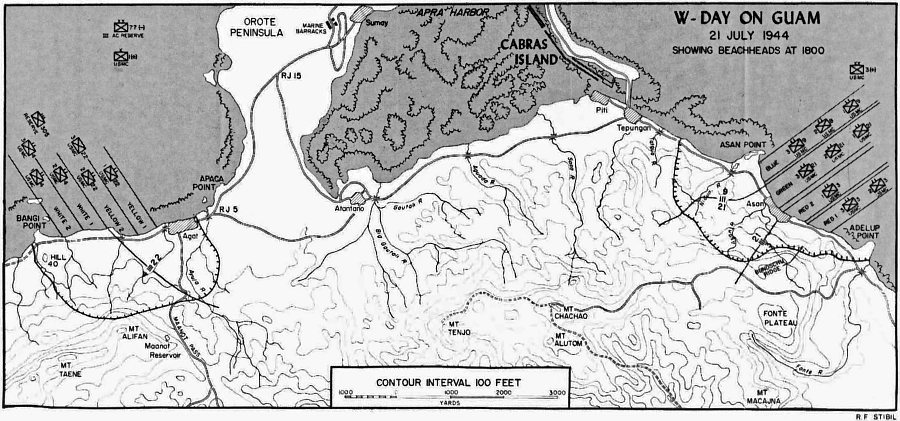
W-DAY ON GUAM 21 JULY 1944 SHOWING BEACHHEADS AT 1800
The 3d Battalion, 9th Marines, under Lieutenant Colonel Walter Asmuth, Jr., caught intense fire from the front and right flank near Asan Point, and he had to call on tanks for assistance, but one company got to the ridge ahead quite rapidly and threw the defenders at Asan Point off balance, making the regiment’s advance easier. (It would also be up to the 9th Marines to take Cabras, a little island offshore and hard against Apra Harbor. This would be accomplished with a separate amphibious landing.) With its 2d and 3d Battalions in the lead, the 9th Marines drove through its initial objectives quickly and had to slacken its advance in order not to thin out the division’s lines.
Colonel Butler’s 21st Marines, in a stroke of luck which would later be called unbelievable, found two unguarded defiles on either side of the regiment’s zone of action. His troops climbed straight to the clifftops. No attempt was made to keep contact going up, but, on top, the 2d and 3d Battalions formed a bridge covering both defiles. The 1st Battalion swept the area below the cliffs.
The 12th Marines (Colonel John B. Wilson) was quickly on the beach, with its burdensome guns and equipment, and the 3d Battalion of Lieutenant Colonel Alpha L. Bowser, Jr., was registered and firing by 1215. By 1640 every battery was in position and in support of the advance. Captain Austin P. Gattis of the 12th Marines attributed the success of his regiment in setting up quickly to “training, because we had done it over, and over, and over. It was efficiency learned and practiced and it always gave the 12th a leg up.”
On the far left, the 3d Marines was getting the worst of the enemy’s increasing resistance. The regiment received intense mortar and artillery fire coming in and on the beaches, and faced the toughest terrain—steep cliffs whose approaches were laced with interlocking bands of Japanese machine gun fire. The cliffs were defended by foes who knew and used their weapons well. The Japanese, that close, would roll grenades right down the escarpment onto the Marines. Snipers could find protection and cover in the countless folds and ridges of the irregular terrain, and the ridgetops were arrayed like the breastworks of some nightmarish castle. It appeared that ten on top could hold off hundreds below.
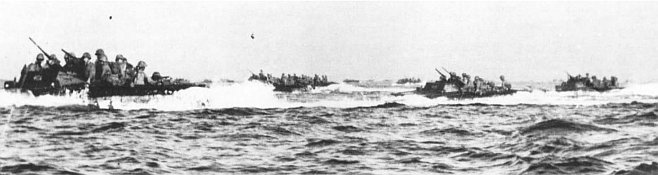
Laden amphibious tractors carry troops of the 22d Marines in the assault wave to Yellow Beaches 1 and 2 south of Agat in the Southern Sector. Here, they would face murderous fire from Japanese guns at Gaan Point and from positions overlooking the beaches on Mount Alifan and Maanot Ridge. Gaan Point was not fully neutralized until 1330, W-Day.
Department of Defense Photo (USMC) 88093
One of the defenders, Lieutenant Kenichi Itoh, recalled that despite the terrible bombardment, he felt secure, that his countrymen could hold out for a long time, even win. After the war, recalling his feelings that eventful day in July 1944, the lieutenant considered it all a bad dream, “even absurd” to think that his forces could ever withstand the onslaught.
Department of Defense Photo (USMC) 88160
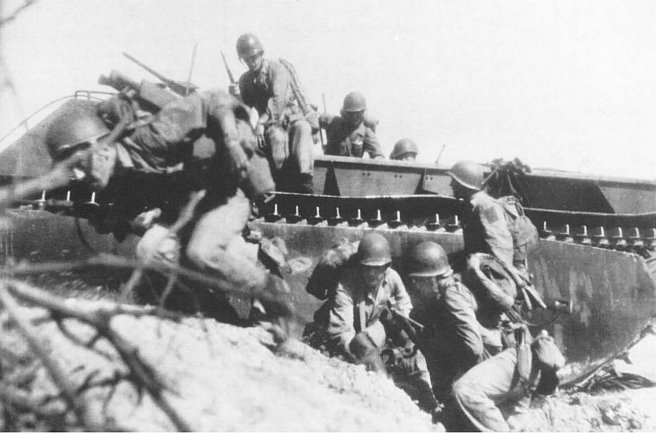
Upon reaching the beach, Marines quickly unload over the gunwales of the amtrac which brought them in and rushed off the beaches. As the frontlines advanced, succeeding waves of amphibian tractors will carry the troops further inland.
On W-Day, Lieutenant Colonel Ralph E. Houser’s 3d Battalion, 3d Marines, was on the extreme left of the line, facing Adelup Point, which, with Asan Point, marked the right and left flanks of the invasion beaches. Houser’s troops could seize the territory in his zone only with the support of tanks from Company C, 3d Tank Battalion, and half-track-mounted 75mm guns. Holding up the regimental advance was a little nose projecting from Chonito Ridge facing the invasion beach in the 1st Battalion, 3d Marines’ zone. Early on W-Day (about 1045), Captain Geary R. Bundschu’s Company A was able to secure a foothold within 100 yards of the crest of this promontory, but could not hold its positions in the face of intense enfilading machine gun fire. Captain Bundschu called for stretchers and corpsmen, then requested permission to disengage. Major Henry Aplington II, commanding the 1st Battalion, was “unwilling to give up ground in the tight area and told Captain Bundschu to hold what he had.”
Colonel Hall ordered the attack to continue in mid-afternoon behind a massive 81mm mortar barrage. None of the companies of Major Aplington’s battalion or Lieutenant Colonel Hector de Zayas’ 2d Battalion could gain any ground beyond what they already precariously held. Their opponent, the 320th Independent Infantry Battalion held fast.
A couple of hours later, Colonel Hall ordered another attack, with Companies A and E in the fore. Major Aplington recalled:
When the 1700 attack went off, it was no change. E made little progress and the gallant men of A Company attacked again and again, reached the top but could not hold. Geary Bundschu was killed and the company slid back to the former positions.
In the morning light of 22 July (W plus 1), that small but formidable Japanese position still held firmly against the 3d Marines’ advance. During the bitter fighting of the previous day, Private First Class Luther Skaggs, Jr., of the 3d Battalion, led a mortar section through heavy enemy fire to support the attack, then defended his position against enemy counterattacks during the night although badly wounded. For conspicuous gallantry and bravery beyond the call of duty, he was awarded the Medal of Honor. On the 22d, Private First Class Leonard F. Mason, a Browning automatic rifleman of the 2d Battalion, earned a posthumous Medal of Honor for single-handedly attacking and wiping out an enemy machine gun position which threatened his unit. Although wounded severely, he rejoined his fellow Marines to continue the attack, but succumbed to his fatal wounds.
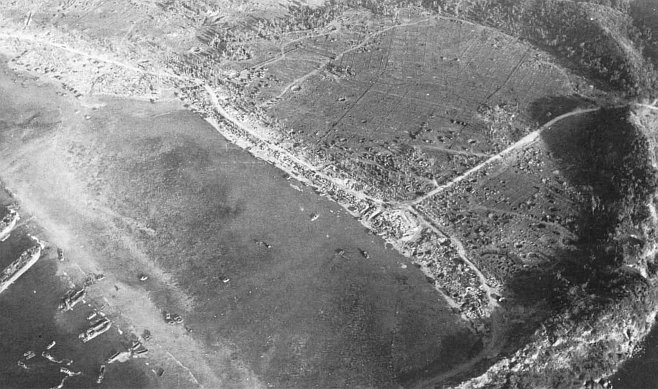
Seen from the air, 9th and 21st Marines assault Green and Blue Beaches in the Northern Sector on 21 July, W-Day. In the right, Asan Point casts a foreboding shadow over that portion of the landing area. Note LSTs beaching at the left.
During the day’s bitter fighting, Colonel Hall tried to envelop the Japanese, using Companies A and C of Aplington’s battalion and Company E of de Zayas’. On regimental orders, Aplington kicked it off at 1150. It also got nowhere at first. Company A got to the top but was thrown off. Company E was able to move ahead very slowly. Probe after probe, it found Japanese resistance perceptibly weakening. By 1900, the men of E reached the top, above Company A’s position. The Japanese had pulled back. In the morning, a further advance confirmed the enemy withdrawal.
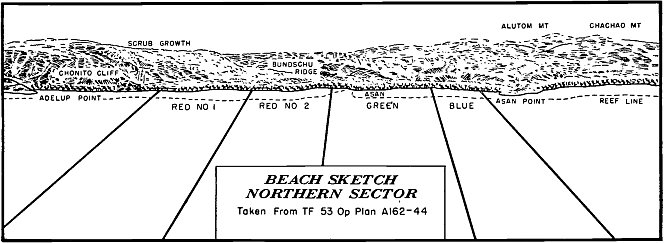
BEACH SKETCH NORTHERN SECTOR
Taken From TF 53 Op Plan A162-44
[Sidebar (page 9):]
3d Marine Division Insignia
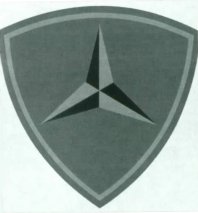
The insignia of the 3d Marine Division was adopted on 25 August 1943, when the division was in training on Guadalcanal for the upcoming invasion of Bougainville. Approved in 3d Marine Division Memorandum 274-43, the insignia consisted of a caltrop on a triangular, gold-bordered scarlet shield. The caltrop was a medieval defensive weapon used against both cavalry and infantry. During the warfare of the Middle Ages, large numbers of caltrops were scattered by defenders on the ground in front of an approaching enemy. The four-pronged, forged-iron caltrop was designed so that no matter which way it landed when thrown on the ground, one point would be up with the other three points supporting it. When used on the insignia, the caltrop represented not only the 3d Marine Division, but also the motto painted on the drums carried by the Continental Marines in the American Revolution: “Don’t Tread on Me.”