THE LETTERS LETTERS OF AN INNOCENT MAN
L. G. Moreau translation
PRISON OF CHERCHE-MIDI
Tuesday, 5 December, 1894.
My dear Lucie:
At last I can write a word to you; they have just told me that my trial is set for the 19th of this month. I am refused the right to see you.
I will not tell you all that I have suffered; there are not in the world words strong enough to express it. Do you remember when I used to tell you how happy we were? Everything in life smiled on us. Then all at once a fearful thunderbolt; my brain still is reeling with the shock. For me to be accused of the most monstrous crime that a soldier can commit! Even to-day I feel that I must be the victim of an awful nightmare.
But I hope in God and in justice. In the end the truth must come to light. My conscience is calm and tranquil. It reproaches me with nothing. I have done my duty, never have I turned from it. I have been crushed to the earth, buried in my dark prison; alone with my reeling brain. There have been moments when I have been nearly crazed, ferocious, beside myself, but even in those moments my conscience was on guard—“Hold up thy head!” it said to me. “Look the world in the face! Strong in thy conscience go straight onward! Rise! The trial is bitter, but it must be undergone!”
I cannot write any longer, for I want this letter to leave to-night.
I embrace you a thousand times, as I love you, as I adore you, my darling Lucie.
A thousand kisses to the children. I dare not say more to you; the tears come to my eyes when I think of them. Write to me soon.
Alfred.
Give my love to all the family. Tell them that I am to-day what I was yesterday, having but one care, to do my duty.
The Commissary of the Government has informed me that Me. Demange will defend me. I think that I shall see him to-morrow. Write to me to the prison. Your letters, like mine, will pass through the hands of the government commissioner.
Thursday morning, 7 December, 1894.
I am waiting with impatience for a letter from you. You are my hope; you are my consolation; were it not for you life would be a burden. At the bare thought that they could accuse me of a crime so frightful, so monstrous, my whole being trembles; my body revolts against it. To have worked all my life for one thing alone, to avenge my country, to struggle for her against the infamous ravisher who has snatched from us our dear Alsace, and then to be accused of treason against that country—no, my loved one, my mind refuses to comprehend it! Do you remember my telling you how, when I was in Mulhouse, ten years ago, in September, I heard a German band under our windows celebrating the anniversary of Sedan? My grief was such that I wept; I bit the sheets of my bed with rage, and I swore an oath to consecrate all my strength, all my intelligence, to the service of my country against those who thus offered insult to the grief of Alsace.
No, no. I will not speak of it, for I shall go mad, and I must preserve all my reason. Moreover my life has henceforth but one aim: to find the wretch who has betrayed his country; to find the traitor for whom no punishment could be too severe. Oh, dear France, thou that I love with all my soul, with all my heart! thou to whom I have consecrated all my strength, all my intelligence, how couldst thou accuse me of a crime so horrible! I will not write upon this subject, my darling; for spasms take me by the throat. No man has ever borne the martyrdom that I endure. No physical suffering can be compared to the mental agony that I feel when my thoughts turn to this accusation. If I had not my honor to defend, I assure you that I should prefer death; at least, death would be forgetfulness. Write to me soon. My love to all.
December, 1894.
My good Darling:
Thanks for your long letter of yesterday. I have never doubted your adorable devotion, your great heart. It is most of all of you that I think in these dark days; I think of your sadness, the grief that you must feel; and in this thought lies my only weakness.
As for me, fear nothing. If I have suffered deeply I have never wavered nor bowed my head. The moments of my deepest anguish have been those in which I have thought of you, my good darling, of all our family. I realised your sorrow when you were without news of me. I had time to think of you all, in the long days, in the sleepless nights, alone with my own thoughts. In those hours I had nothing to read; no way to write! I turned like a lion in its cage, trying to work out an enigma that escaped me. But everything in this world is conquered by perseverance and by energy. I swear to you that I shall discover the wretch who committed the act of infamy. Keep up your courage, my good darling, and look the world in the face. You have the right to do so.
Thank every one for the admirable devotion shown in my cause. Embrace our dear children and all the family for me.
A thousand kisses for your own self, from your devoted
Alfred.
December, 1894.
My good Darling:
Your letter, which I had impatiently awaited, gave me great consolation and at the same time it made me weep, for it brought me the vivid memory of you, my darling.
I am not perfect; what man can boast of perfection? But I can assure you truthfully that I have always gone straight forward in the way marked out by duty and by honor.
There has been no compromise between me and my conscience. If I have suffered deeply, if I have undergone the most horrible agony that can be imagined, I have at all times been sustained in this awful struggle by my conscience, which stands on guard, rigid, upright, inflexible. My natural reserve, perhaps a haughty reserve, the freedom of my speech and judgment to-day militate against me. I am not supple, nor a trimmer, nor a flatterer. We never visited the people of the world who might be useful to us now; we shut ourselves up in our own home, we were contented to be happy in ourselves.
And to-day I am accused of the most monstrous crime a soldier can commit!
Oh, if I could but hold the wretch who not only has betrayed his country, but who, besides, has tried to make me bear the burden of his infamy, I do not know what suffering I could not invent to make him expiate the agony which he has forced me to undergo! But we must not despair—they must at last find the guilty one. Without that hope we should have to believe that there is no justice in the world.
Bend all your efforts to reveal the truth; and bring to bear upon them all your intellect, if need be all my fortune.
Money is nothing. Our Honor is All! Tell M[athieu Dreyfus] that I count upon him for this work. It is not beyond his power. He must find the wretch who has dishonored us, even though he should move Heaven and Earth. I embrace you a thousand times, as I love you.
Your devoted
Alfred.
A thousand kisses for the children.
All my love to all the members of our families; thank them for their devotion to the cause of an innocent man.
Monday, 11 December.
My good Darling:
I have received your letter of yesterday; also the letters from your sister and from Henri. Let us hope that soon justice will be done me and that I shall once more be with you all. With you and with our dear children I shall find the calm that now I need so much.
My heart is deeply wounded; you know that it must be so. To have consecrated all my strength, all my intelligence, to the service of my country, and then to be accused of the most monstrous crime that a soldier can commit—it is fearful!
At the very thought of it my whole being revolts; I tremble with indignation. I ask myself by what miracle I have been kept from going mad. How has my brain resisted such a shock!
I supplicate you, my darling, do not go to my trial. It can do no good for you to impose new sufferings upon yourself; those that you have already borne, with a grandeur of soul and with a heroism of which I am proud, are more than sufficient. Save your strength for our children. We shall need all our united strength to care for each other, to help each other to forget this terrible trial—the most terrible that human strength can bear. Kiss all our good, dear ones for me, until the time comes when I can embrace them for myself. Remember me fondly to all.
I embrace you as I love you.
Your devoted
Alfred.
Tuesday, 12 December, 1894.
My dear Lucie:
Will you be my interpreter to all the members of our two families, to all who have been thoughtful of me at this time? Will you tell them how much I have been touched by their good letters and by the sympathy they have shown me?
I cannot answer them; for what could I tell them? My sufferings? They understand them, and I do not like to complain. Besides that, my brain reels, and my thoughts are at times confused. My soul alone remains unshaken, as steadfast as on that awful day before the monstrous accusation was thrown in my face. My whole being still revolts at the thought of it.
But in the end the truth must be known in spite of everything. We are not living in a century when the light can be hidden. It must be that the whole truth will be known, that my voice will be heard throughout the length and breadth of our dear France—just as my accusation has been heard. It is not only my own honor which I have to defend; it is the honor of all the corps of officers of which I am a part, and a worthy part.
I have received the clothes that you sent me. If you should have a chance, please send me my tippet. I do not need the pelisse. My tippet is in the wardrobe in the antechamber.
Embrace our darlings tenderly for me. I wept over the good letter written by our dear Pierrot. How long the time seems to me until I can embrace him and you all once more!
A thousand kisses for yourself.
Your devoted
Alfred.
Thursday, 14 December, 1894.
My dear Lucie:
I have received your good letter; also new letters from the family. Thank them all for me. All these proofs of affection and esteem touch me more than I know how to tell you. As for me, I am always the same. When a man’s conscience is pure and calm he can bear everything. I am convinced that eventually the truth will be known; that the assurance of my innocence will finally be borne in upon all minds.
At my trial I shall be judged by soldiers as loyal and as honest as myself. They will recognize—I am sure of it—the error that has been committed.
Error, unhappily, is a human thing. Who can say that he never has been deceived?
I am happy over the good news you give me regarding the children. You were right to begin to give P[ierrot] cod-liver oil; the time is propitious. Kiss the little fellow for me. How I long to hold the dear children in my arms!
I hope, with you, that they will end by letting me once more embrace you. It will be one of the happiest days of my life; it will be a consolation for all the pain I have endured.
Alfred.
Friday, 15 December, 1894.
My dear Lucie:
I have received your good letter, also mamma’s. I am grateful for the sentiment she expresses—sentiments I never have doubted, and which, I can say it proudly, I have merited always.
At last the day of my appearance before justice draws near. I am to come to the end of all this moral torture. My confidence is absolute; when the conscience is pure and tranquil then can we present ourselves everywhere, our heads high. I shall be tried by soldiers who will listen to me and understand me. The certainty that I am innocent will enter their hearts as it has always entered the hearts of my friends, of those who have known me intimately.
My whole life has been the best guarantee of my innocence. I will not speak of the infamous and anonymous calumnies that have been circulated against me. They have not touched me; I scorn them. Kiss all our darlings for me and receive for yourself the tender kisses of your devoted husband,
Alfred.
Sunday, 17 December, 1894.
My dear Lucie:
I do not know that this letter will reach you to-day, for the post-offices are closed, but I will not let the day pass without writing you one word. I am happy to know that you are surrounded by all the family; your grief must be less great, for nothing is more sustaining than such love as is being shown to you.
As to me, my darling, do not give way to any feeling of anxiety.
I am ready to appear before my judges; my mind is tranquil. I am ready to face them as I shall one day stand before God, my head high, my conscience pure.
I am happy to know that you are all well; the children also.
Continue to take good care of yourself, my darling; and keep all your courage. It is true that the trial is great, but my courage is not less great.
If I have had moments of horrible depression, if I have borne the weight of the frightful mental torture, of the suspicion which they have cast upon me, my head has never bent beneath it. To-day, as yesterday, I can look the world in the face; I am worthy to command my soldiers. Embrace the dear ones for me; affectionate kisses from your devoted
Alfred.
Monday, 18 December, 1894.
My dear Lucie:
I received to-day only your good letter of Saturday. I could not send my letter yesterday; the offices were closed and my letter could not have passed out.
How you must suffer, my poor darling! I can imagine it by comparing your suffering to my own, because I cannot see you. But we must know how to bear up, to hold our own against suffering; we must be resigned; we must preserve all dignity of conduct.
Let us show that we are worthy of one another; that trials, even the most cruel, even the most undeserved, cannot beat us down.
When the conscience is clear we can, as you say so truly, bear everything; suffer everything. It is my conscience alone that has enabled me to resist; had it not been for that I should have died of sorrow, or I should be shut up in a mad-house.
Even now I cannot look back to those first days without a shiver of horror. My brain was like a boiling cauldron; at each instant I feared that my reason would leave me.
Do not be worried by the irregularity of my letters; you know that I cannot write as I would like to; but be strong and brave; be careful of your health.
Thanks for all the news you give me of our friends. Tell them that I have often thought of them; of the grief they must feel. It must bind us in a union that nothing can ever break. Our pure, honorable life, all the past of all our kindred, our devotion to France, are the best guarantees of what we are.
I have received two good letters from J. and R.; they have given me great pleasure.
I thank you also for the news you give me of the children. Ah, the poor darlings! What joy it will be to me to be able to embrace them and you, my good darling! But I will not allow myself to think of it; for then everything seems to melt within me.
The bitterness of my heart rises to my lips—and I must preserve all my strength.
Thank M. and my brothers and my sisters and all the family for what they have done for me. Embrace them for me.
I will stop, for every memory of the happiness I have known among you all revives my grief.
To have sacrificed everything for my Country, to have served her with entire devotion, with all my strength, with all my intelligence, and then to be accused of such a frightful crime—no, no!
Write to me often; write long letters. My best moments are those when I receive news of you all.
A thousand kisses for you and for the children.
Your devoted
Alfred.
Tuesday, 18 December, 1894.
My good, dear one:
At last I am coming to the end of my sufferings, to the end of my agony. To-morrow I shall appear before my judges, my head high, my soul tranquil. The trial I have undergone, terrible as it has been, has purified my soul. I shall return to you better than I was before. I want to consecrate to you, to my children, to our dear families, all the time I have yet to live.
As I have told you, I have passed through awful crises. I have had moments of furious, actual madness at the thought of being accused of a crime so monstrous.
I am ready to appear before the soldiers as a soldier who has nothing for which to reproach himself. They will see it in my face; they will read my soul; they will know that I am innocent; as all will who know me.
Devoted to my country, to whom I have consecrated all my strength, all my intellect, I have nothing to fear.
Sleep tranquilly then, my darling, and do not give way to any care; think only of our joy when we are once more in each other’s arms—to forget so quickly these sad, dark days!
Until we meet—soon, my darling! soon shall I have the joy of embracing you and our good, dear ones.
A thousand kisses while I wait for that happy moment.
Alfred.
23 December, 1894.
My Darling:
I suffer much, but I pity you still more than myself. I know how much you love me. Your heart must bleed. On my side, my adored one, my thought has always been of you night and day.
To be innocent, to have lived a life without a stain, and to be condemned for the most monstrous crime that a soldier can commit! What could be more terrible? It seems to me at times that I am the victim of an awful nightmare.
It is for you alone that I have resisted until to-day; it is for you alone, my adored one, that I have borne my long agony. Will my strength hold out to the end? I cannot tell. No one but you can give me courage. It is only from your love that I can draw it.
At times I hope that God, who has not abandoned me thus far, will end this martyrdom of an innocent man; that He will bring to light the Guilty One.
But shall I be strong enough to hold out until that time?
I have signed my appeal for a revision. I dare not speak to you of the children; their memory rends my heart. Speak to them of me. May they be your consolation.
My bitterness is such, my heart is so bruised, that I should, already have got rid of this sad life if memory of you had not hindered me; if the fear of augmenting your grief had not stayed my arm.
To have had to hear all they said to me, when I knew in my soul and conscience that I had never failed, never committed even the most trivial imprudence, that was the most horrible of mental torture.
I shall try to live for your sake, but I have need of your aid.
Above all else, no matter what may become of me, search for the truth; move Earth and Heaven to discover it; sink in the effort, if need be, all our fortune, to rehabilitate my name, which now is dragged through the mud. No matter what may be the cost, we must wash out the unmerited stain.
I have not the courage to write more. Embrace our dear relations, our children, everyone, for me.
A thousand, thousand kisses.
Alfred.
Try to obtain permission to see me. It seems to me that they cannot refuse it now.
Monday evening, 24 December, 1894.
My Darling:
It is still to you that I write, for you are the only cord that binds me to life. I know well that all my family, all your family, love me and esteem me; but, after all, if I were to disappear, their grief, however great, would fade with the years.
It is for you alone, my poor darling, that I gather strength to struggle. It is the thought of you that stays my arm. How I feel in this hour my love for you! Never has it been so great—so all absorbing. And then a feeble hope sustains me yet a little; it is that we shall be able some day to have my good name restored to me. But, above all, believe me, if I should have strength to struggle to the end of this calvary, it will be for your sake alone, my poor darling; it will be to avoid adding a new chagrin to all those you have already borne. Do all that is humanly possible to get to see me.
I embrace you a thousand times, as I love you.
Alfred.
In the night between Monday and Tuesday, 24 December, 1894.
My dear Adored one:
I have just received your letter; I hope that you have received mine. Poor darling, how you must suffer, how I pity you! I have wept many tears over your letter. I cannot accept your sacrifice. You must stay there; you must live for the children. Think of them first, before you think of me; it is the poor, little ones who absolutely need you.
My thoughts always lead me back to you.
Me. Demange, who has just been here, has told me how wonderful you are. He has spoken words in your praise to which my heart gave back the echo.
Yes, my darling, you are sublime in your courage and devotion. You are worth more than I. I loved you before with all my heart and soul; to-day I do more—I marvel at you. You are truly one of the noblest women upon the earth. My admiration for you is so great that if I live to drink my cup to the dregs it will be because I have aspired to be worthy of your heroism.
But it will be terrible to submit to that shameful humiliation! I should rather stand before an execution squad. I do not fear death, but the thought of contempt is terrible.
However it may be, I pray you tell them all to life their heads as I lift mine; to look the world in the face without flinching. Never bow your heads—proclaim my innocence aloud.
Now, my darling, I am going anew to lay my head upon my pillow to think of you.
I kiss you; I press you to my heart.
Alfred.
Embrace the little ones tenderly for me.
Will you please deposit two hundred francs with the clerk of the prison?
25 December, 1894.
My Darling:
I cannot date this letter, for I do not even know what day it is. Is it Tuesday? Is it Wednesday? I do not know. It is always night. As sleep flies my eyelids I arise to write to you.
Sometimes it seems to me that all this has not happened; that I have never left you.
In my hallucinations all that has happened to us seems to me a bad nightmare; but the awakening is terrible.
I cannot believe in anything but your love and the affection of all of ours.
We must continually search for the guilty one. All means are good. Chance alone will not suffice.
Perhaps I shall succeed in surmounting the horrible terror with which the infamous sentence I am going to bear inspires me. To be an honorable man, to be innocent, and to see my honor torn from me and trampled under foot—oh, it is fearful! it is the worst of sufferings! worse than death!
Oh, if I go to the end it will be for your sake, my dear, adored one, for you are the only thread that binds me to life!
How we loved each other!
To-day more than ever before I know what place you hold in my heart. But, above all, be careful of your own self; think of your health. You must, at all costs, for the sake of my children, who have need of you.
Then search in Paris as you did down there for the guilty one. We must try everything; we must leave nothing undone. There are people surely, there must be people, who know the name of the guilty man.
I embrace you.
Alfred.
Wednesday, 2 P. M., 26 December, 1894.
My Darling:
I have just received your two letters and Marie’s.
You are sublime, my adored one, and I am amazed at your courage and your heroism. I loved you before. To-day I kneel before you, for you are a sublime woman. But do not allow yourself to be beaten down, I supplicate you. Think of our children, who have need of you.
It may be that in my desire to be worthy of you, to reach the heights on which you stand, I shall be able to hold out to the end. It is not physical suffering that I fear—that has never been strong enough to break me down; its blows glance off—but the torture of soul, the knowledge that my name is dragged in the mire, the name of a man who is innocent, the name of a man of honor. Cry it aloud, my darling; cry to every one that I am innocent—the victim of terrible fatality.
Shall we ever succeed in discovering the real guilty one? Let us hope it; to lose that hope would be to despair of everything.
I hope to see you soon, and that is my consolation. All the day, all the night, my thoughts fly to you—to you all. I think of the happiness we enjoyed, and I ask myself, even now, by what inexplicable fatality that happiness was broken.
It is the most awful tragedy that it has ever been given me to read, and instead of reading it, I must live it out, alas! Finally, be careful of your own self, my darling. You need all your health, all your physical vigor, if you are to bring to a successful end the task you have so nobly undertaken.
I embrace you and our poor darlings, of whom I dare not think.
A thousand kisses.
Alfred.
Wednesday, 4 o’clock, 26 December, 1894.
My Darling:
You ask me what I do all day long.
I think of you; I think of you all. If this consoling thought did not sustain me, if I could not feel through the thick walls of my prison the strengthening breath of your sympathy, I believe that I should lose my hold on reason and that despair would enter my soul. It is your love, it is the affection of you all, that gives me the courage to live on.
Me. Demange has just been here. He stayed some minutes with me. His faith in me is absolute; that also gives me courage.
It is not physical suffering that affrights me—I am able to bear that—but this continual torture of soul, this contempt that is to pursue me everywhere. I, so proud, so sure of my honor, it is that that I find so terrible; that that I shrink from.
Well, my darling, I will not torture your heart any longer; your grief is already great enough.
I embrace you fondly.
Alfred.
Wednesday, 10 P. M.
I do not sleep, and it is to you that I return. Am I then marked by a fatal seal, that I must drink this cup of bitterness! At this moment I am calm. My soul is strong, and it rises in the silence of the night. How happy we were, my darling! Life smiled on us; fortune, love, adorable children, a united family—Everything! Then came this thunderbolt, fearful, terrible. Buy, I pray of you, playthings for the children, for their New Year’s day; tell them that their father sends them. It must not be that these poor souls, just entering upon life, should suffer through our pain.
Oh, my darling, had not I you how gladly would I die! Your love holds me back; it is your love only that makes me strong enough to bear the hatred of a nation.
And the people are right to hate me: they have been told that I am a traitor. Ah, traitor, the horrible word! It breaks my heart.
I ... traitor! Is it possible that they could accuse me and condemn me for a crime so monstrous!
Cry aloud my innocence; cry it with all the strength of your lungs; cry it upon the house-tops, till the very walls fall.
And hunt out the guilty one. It is he whom we must find.
I embrace you as I love you.
Alfred.
Thursday, 10 o’clock in the evening, 27 December, 1894.
My dear Lucie:
Your heroism has conquered me. Strong in your love, strong in my conscience and in the immovable support I find in our two families, I feel my courage born again.
I shall struggle therefore to my last breath. I shall struggle to my last drop of blood.
It is not possible that light shall not be some day let in upon this crime. With the feeling that your heart is beating close to mine I shall bear all the martyrdoms, all the humiliations, without bowing my head. The thought of you, my darling, will give me the strength needful. My dear, adored one, women certainly are superior to us; and among women you are of the most beautiful and the most noble!
I always loved you deeply; you know it. To-day I do more—I marvel at and venerate you. You are a holy, a noble, woman. I am proud of you, and I will try to be worthy of you.
Yes, it would be cowardice to desert life. It would be to taint my name—the name of my dear children—to sully that name forever. I realize that to-day; but how could it be otherwise? The blow was cruel; it broke down my courage; it is you who have lifted me up.
Your soul makes mine tremble.
So, leaning one on the other, proud of one another, we shall succeed, by force of will, in clearing our name from dishonor. We shall remove the stain from that honor that has never failed us.
I embrace you as I love you.
Alfred.
Thursday, 11 o’clock in the evening.
I almost hoped to receive one more word from you this evening. If you could only know with what happiness I receive your letters, with what intoxication I read and re-read them all day long!
Good-night; sleep well, my darling. We will live still for each other.
Friday, 10 o’clock in the morning, 28 December, 1894.
My dear Lucie:
I have received your good letter dated yesterday at noon. You are right. I must live. I must live for you—for our dear children, whose name I must restore to honor. Whatever may be the terrible tortures of soul I endure, I must resist. I have no right to desert my post.
If I were alone, I should not hesitate; but your name, the name of my family—everything, all we have, is attacked. We must arm with all our courage for the struggle. By the force of our energy, our will, we shall triumph. In the end they shall speak out. Supported, sustained by your unfailing courage, we shall conquer.
Write to me often. You must relieve each other in writing; write to me in turn. Each one of your letters soothes me. It seems to me that I hear you speak—that I hear your dear parents speak.
I embrace you and all your dear family.
A thousand tender kisses to the children.
Alfred.
Friday, noon.
I received your letter dated Thursday evening, also the good words from Pierrot. Embrace the darling tenderly for me. Give Jeanne a kiss for me. Yes, I must live. I must summon all my energy to wash out the stain which sullies the name of my children. I should be cowardly should I desert my post. I will live; I will!
I embrace you.
Alfred.
Monday, 31 December, 1894.
My dear Lucie:
I thought a long time last night of my father, of all my family. I do not hide from you that I wept long. But the tears comforted me. Our consolation is the deep affection that unites us all; it is the affection which I find in your family as in my own.
It is impossible, when we are so bound together, when we are upheld by the wonderful devotion shown us by Me. Demange, that we shall not sooner or later discover the truth. I was wrong to wish to desert life. I had not the right to. I will struggle as long as I have a breath of life. In these long days, in these sad nights, my soul is purified and strengthened. My duty is clearly traced. I must leave my children a name pure and stainless.
Let us strive for that, my darling, without a truce, without rest. Let us not be rebuffed by the difficulty of any step, of any attempt. We must try everything.
The books of M. Bayles, which you sent me, are enough for the moment; later I shall need a work with exercises, with corrections on the opposite page; so that I can work by myself.
For the moment I must gather all my strength to meet the horrible humiliation that awaits me. But do not relax a single instant. You may, perhaps, enter upon a course of which I have spoken to Me. Demange this evening. Nothing must be neglected; everything must be tried.
I embrace you as I love you.
Alfred.
Good kisses to the darlings. I dare not wish you “A Happy New Year;” this feast does not accord with our present sorrow.
I have even forgotten to wish your mother a happy birthday. I pray you to repair this forgetfulness; it is excusable under the sad circumstances.
I suppose you have given the children the toys from their father. We must not let these young souls suffer through our sorrows.
I have received the inkstand. I thank you for it.
5 o’clock in the evening.
The appeal is rejected, as I might have expected it would be. They have just told me. Ask immediately for permission to see me.
Send me what I asked you for; that is to say, my sabre, my belt, and the valise with my belongings. The cruel and horrible anguish is approaching; I am going to meet it with the dignity of a pure and tranquil conscience. To tell you that I do not suffer would be to lie; but I shall not weaken. I shall be strong. Keep on, for your part, without truce, without rest.
1 January, 1895.
My Darling:
It is no longer Sunday. It is the beginning of Monday. The stroke of midnight has just sounded at this moment, as I lighted my candle. I cannot sleep. I would rather rise than toss upon my bed, and what more delicious occupation than to talk with you! When I write it seems that you are near me, as it used to be in those good evenings of my happy memories, when, as I sat at my desk, you would work by my side.
Let us hope—let us hope that happiness shall shine again for us. It is impossible that some day the light of truth shall not make all clear. I know the energetic character of Mathieu; I have learned to appreciate your energy, your profound devotion, I will say your heroism; and I do not doubt the success of your investigations.
You are right to act with calmness, with method. Your progress will be surer.
But I hope that soon I can speak of all this face to face with you.
From this hour the agony is to become still more bitter. First, the humiliating ceremony, then the sufferings which will follow it. I shall bear them calmly, with dignity—be sure of it.
To say that I have not at times moments of violent revolt would be to lie. The injustice is by far too cruel; but I have faith in the future; and I hope to have my recompense.
So I try to think that the time will come when my only care will be to ensure my happiness—the happiness of our dear children.
I have received a charming letter from Marie, which I shall answer one of these days.
Be of good courage always, my darling. Take good care of your health, for you will have need of all your strength; your courage must not betray you in the crucial moment. Good-night and good rest.
I embrace you as I love you.
Alfred.
Tuesday, 1 January, 1895.
I have not received a letter from you this morning. I miss it. I have received several others, it is true; but dare I tell you that it is not the same thing? Yesterday, when he left me, Me. Demange hoped to come back and pass some hours with me to-day; but alas! not long after his departure they told me that my appeal had been rejected; this closes my prison door to him; he will not be permitted to visit me any more. He must have been warned this morning. So I shall pass my day alone. What a sad New Year, my darling! But do not let us dwell upon this subject. It will do us no good to weep and groan; that will not open the doors of my prison. On the contrary, we must guard all our physical strength and all our mental energy; we must not relax our struggle for one instant. Let nothing beat you down; do not lose hope. Throw your nets out on all sides; the guilty one will be caught in them at last.
Have you received an answer to your application? I am waiting now with impatience for the moment when I shall hold you in my arms.
Have you bought the toys for the children? Were they pleased? I am thinking always of you and of them. I live only in the thought that some day this frightful nightmare will vanish. It seems impossible that it can be otherwise. We will help overcome it, I promise it to you. I embrace you as I love you.
Alfred.
Monday, 2 January, 1895, 11 o’clock in the evening.
My Darling:
A new year is beginning. What has it in store for us? Let us hope that it will be better than the year that is just ended. Should it be otherwise, death would be preferable. In this calm, deep night which surrounds me, I think of you all, of you, of our dear children. What a fearful stroke of fate, undeserved and cruel!
Let me give way a little, weep without restraint in your arms. Do not believe because I weep that my courage weakens. I have promised you to live; I shall keep my word. But I must always feel your heart beating close to mine. I must be sustained by your love.
We must have courage. We must have an almost superhuman energy. As for me, I can only summon my whole strength to bear all the tortures which await me.
Good-night and kisses.
Alfred.
Thursday, noon.
My Darling:
They have informed me that the supreme humiliation is set for the day after to-morrow. I expected it; I was prepared for it; but in spite of that the blow was terrible. I shall stand fast, as I promised you I would. I shall draw the force I still need for that awful day from the deep well of your love, from the affection of you all; from the memory of our dear children; from the supreme hope that some day the truth will come to light; but on every side I must feel the warmth of the affection that you all bear me. I must feel that you are struggling with me. Search always; let there be no truce, no rest.
I hope to see you soon, to gather strength from your loving eyes. Let us sustain each other through everything and against everything.
Your love is necessary to my life; without it the mainspring of my being would be broken.
When I am gone persuade them all that they must not stop their efforts.
Take measures at once, so that you may be able to come to see me on Saturday and the following days at the prison of la Santé. It is there, above all, that I must feel that I am sustained.
Find out also what I asked you yesterday—when I am to leave, how I am to go, etc.
We must be prepared for everything; we must not let ourselves be surprised.
Until the blessed moment, soon to come, when I shall see you, I embrace you.
Alfred.
4:15 P. M.
Since four o’clock my heart has been beating to bursting. You are not yet here, my darling. The seconds seem hours to me. My ear is listening—perhaps they come to call me. I cannot hear; I am waiting.
5 o’clock.
I am more calm; the sight of you has helped me. The rapture of having held you in my arms has done me immense good. I could not wait for the moment. I thank you for the joy that you have given me. How I love you, my good darling! Let us hope that some time all this sorrow is to end.
I must husband all my energy.
A thousand kisses more, my darling.
Alfred.
Thursday, 11 o’clock in the evening.
My Darling:
The nights are long; it is to you that I turn again and again; it is in your eyes that I look for all my strength. It is in your profound love that I find the courage to live. Not that the struggle makes me afraid, but truly fate is too cruel to me. Could one imagine a situation more awful, more tragic, for an innocent man? Could there be a martyrdom more fraught with sorrow?
Happy is it for me that I have the deep affection with which both our families surround me—that above everything I have your love, which pays me for all my sufferings.
Forgive me if sometimes I complain; do not think that my soul is less valiant because a groan escapes my lips; these cries relieve my heart; and to whom could I cry if not to you, my dear wife?
A thousand kisses for you and for the little ones.
Alfred.
Wednesday, 5 o’clock.
My Darling:
I wish to write these few words more, so that you may find them to-morrow morning when you awake. Our conversation, even through the bars of the prison, has done me good. My limbs trembled under me when I went down to met you, but I gathered all my strength, so that I should not fall from my emotion. Even now my hand is still trembling; our interview has violently shaken me. If I did not insist that you should stay still longer it was because I was at the end of my strength. I had to hide myself, so that I might weep a little; do not believe because I weep that my soul is less brave or less strong; but my body is somewhat weakened by three months of the prison, without a breath of the outer air. I must have had a robust constitution to have been able to resist all these tortures.
What has done me the most good is that I felt that you were so brave, so valiant, so full of love for me. Let us, my dear wife, continue to command the respect of the world by our attitude and by our courage. As for me, you must have felt that I am decided to face everything. I want my honor, and I shall have it. No obstacle shall stop me.
Kiss the babies for me. A thousand kisses.
Alfred.
The parlor is to be occupied to-morrow, Thursday, from 1 until 4 o’clock. So you must come either in the morning between 10 and 11 o’clock, or in the afternoon at 4 o’clock. This takes place only Thursdays and Sundays.
IN THE PRISON OF LA SANTE.
5 January, 1895.
I will not tell you what I have suffered to-day. Your grief is great enough already. I will not augment it.
In promising you to live, in promising you to resist until my name is rehabilitated, I have made the greatest sacrifice that a man of deep feeling of heart, an upright man, from whom his honor has been taken, can make. My God, let not my physical strength abandon me! My spirit is unshaken; a conscience that has nothing with which to reproach me upholds me, but I am coming to the end of patience and of my physical strength. After having consecrated all my life to honor, never having deserved reproach, to be here, to have borne the most wounding affront that can be inflicted upon a soldier!
Oh, my darling, do everything in the world to find the guilty one; do not relax your efforts for one instant. That is my only hope in the terrible misfortune which pursues me.
If only I may soon be with you there, and if we may soon be united, you will give me back my strength and my courage. I have need of both. This day’s emotions have broken my heart; my cell offers me no consolation.
Picture a little room all bare—four yards and a half long, perhaps—closed by a grated garret window; a pallet standing against the wall—no, I will not tear your heart, my poor darling.
I will tell you later, when we are happy again, what I have suffered to-day, in all my wanderings, surrounded by men who are truly guilty, how my heart has bled. I have asked myself why I was there; what I was doing there. I seemed the victim of an hallucination; but alas! my garments, torn, sullied, brought me back roughly to the truth. The looks of scorn they cast on me told me too well why I was there. Oh, why could not my heart have been opened by a surgeon’s knife, so that they might have read the truth! All the brave, good people along my way could have read it: “This is a man of honor!” But how easy it is to understand them! In their place I could not have contained my contempt for an officer who I had been told was a traitor. But alas! there is the tragedy. There is a traitor, but it is not I!
Write to me soon; do everything in your power so that I may see you, for my strength is giving way. I need to be upheld; come, so that we may be together once again, that I may find in your heart all the strength I need in this awful hour.
I embrace you as I love you.
Saturday afternoon.
Alfred.
Saturday, 6 o’clock, January, 1895.
In my dark cell, in the tortures of my soul, which refuses to understand why I suffer so, why God so punishes me, it is always to you that I turn, my dear wife, who, in these sad and terrible moments, have shown for me a devotion without boundaries, a love illimitable.
You have been and you are sublime; in my moments of weakness I have been ashamed not to be at the height of your heroism. But this grief must gnaw the best disciplined soul; the grief of seeing so many efforts, so many years of honor, of devotion to one’s country, lost because of a machination that seems to belong to the realms of the grotesque, rather than to real life. Sometimes I cannot believe it; but these moments, alas! are rare here, for subjected to the strictest discipline of the prison cell, everything reminds me of the dark reality. Continue to sustain me with your profound love, my darling; aid me in this awful struggle for my honor; let me feel your beautiful soul throbbing close to mine.
When can I see you?
I need affection and consolation in my sorrow.
Alas! I may have the courage of a soldier, but I ask myself have I the heroic soul of the martyr!
A thousand good kisses for you, for our darlings. May these children be your consolation.
A. Dreyfus.
Write to me often and at length. Think that I am here alone from morning until evening, and from evening until morning. Not one sympathetic soul comes to lighten my dark sorrow. I long to be there with you, where I can wait in peace and tranquillity, until they rehabilitate me—until they give me back my honor.
7 o’clock, evening, 5 January, 1895.
I have just had a moment of terrible weakness; of tears mingled with sobs; all my body shaken by the fever. It was the reaction from the awful tortures of the day. It had to be—I knew it. But alas! instead of being allowed to sob in your arms, to lean my head upon your breast, my sobs have resounded in the emptiness of my prison. It is finished. Be lifted up, my heart; I concentrate all my energy. Strong in my conscience, pure and unstained, I owe myself to my family, I owe myself to my name. I have not the right to desert. While there remains in me a breath of life I will struggle, hoping that light soon may be let in upon the truth. And do you continue your searches. As for me, the only thing that I ask is to leave here as soon as possible; to find you there; to settle down to our life there, while our friends, our families, are busy here searching for the guilty one, so that we may come back to our dear country, martyrs who have borne the most terrible, the most harrowing, of trials.
Saturday, 7:30 P. M.
It is the hour when we are obliged to go to bed. What will become of me? What am I going to do when I am in my bed, a straw mattress supported on iron rods. Physical sufferings are nothing—you know that I do not fear them—but my moral tortures are far from being ended. Oh, my darling, what did I do the day I promised you to live! I thought then that my soul was stronger. It is easy to talk of being resigned because the heart is innocent, but it is hard to be so.
Write to me soon, my darling; try to see me. I need to draw new strength from your dear eyes.
A thousand kisses.
Alfred.
Sunday, 5 o’clock, 6 January, 1895.
Forgive me, my adored one, if in my letters yesterday I poured out my grief and made a parade of my torture. I must confide them to some one. What heart is better prepared than yours to receive the overflowing grief of mine? It is your love that gives me courage to live; I must feel the thrill of your love close to my heart. Let us show that we are worthy of each other; that you are a noble, a sublime wife.
Courage, then, my darling. Do not think too much of me; you have other duties to fulfil. You owe yourself to our dear children, to our name, which must be restored to honor. Think, then, of all the noble duties incumbent upon you. They are heavy, but I know that you will be capable of undertaking, of accomplishing them all, if you do not let yourself be beaten down—if you preserve your strength.
You must struggle, therefore, against yourself. Summon all your energy; think only of your duties.
As to me, my darling, your know that I suffered yesterday even more than you can imagine. I shall tell you how much some day, when we are once more happy and united. For the present I hope but one thing. Since I am useless to you here, and since, on the other hand, the search for the guilty man will, I fear, be a long one, I hope to be sent down there soon, and under the best conditions possible to wait there with you until the combined efforts of all our relations shall have been successful. The life of the prison cell is wearing me out, and I ask but one thing, to be sent down there as soon as possible. I was heart-broken this morning because I did not get any letters. Happily, at 2 o’clock, the director of the prison brought me a package of good letters, which gave me much pleasure. They have been the one ray of joy in my wretched cell. Will you please send me my travelling rug, for it is very cold in our cells.
Try to obtain permission to see me as soon as possible.
I embrace you a thousand times.
Alfred.
Good kisses to the poor darlings.
7 o’clock in the evening.
My God, how sorrowful is my soul! What in all my life have I done that I should be thus punished? The wretch who has committed the crime of betraying me, the wretch through whom I am lost, deserves, if there is a God, a terrible chastisement. He deserves to be punished through all he loves. In the name of my poor children I curse him.
Monday, 5 P. M., 7 January, 1895.
My Darling:
I have borne for your sake, my adored one, for the name which my dear children bear, the most agonizing, the most appalling, of calvaries for a heart that is pure and honorable. I ask myself how I am yet alive. That which sustained me is, above all else, the hope that I shall soon be united to you down there. Then, though innocent as I am, but sustained as I shall be by your profound love, I shall have the patience to await in exile the vindication of my name. There, too, I shall work, I shall be busy. I shall impose silence upon my heart and my brain by force of physical fatigue. But in my prison it would be difficult to live, for my thought always brings me fatally back to my condition.
They have not given me any letter from you to-day; do not be anxious, my darling, if my letters do not reach you regularly. I will write to you every day as long as I am permitted to.
I have been told that I can see you Monday and Friday. Alas! Monday has passed, and I am obliged to wait until Friday. I wait with extreme joy for the moment when I can kiss you; when I can throw myself into your arms. It is in your eyes, in your noble heart, that I find the strength needful to enable me to bear my fearful tortures of soul. I should almost like it better had I some sin upon my conscience; then I should, at least, have something to expiate. But alas! you know, my darling, how honest, how upright, my life has always been.
I will do all I can to live. I will do all I can to resist until the supreme moment when they give back to me the honor of my name.
But I shall bear the waiting better when you are there, in exile, with me. So, together, proud and worthy of one another, we will, in exile, give proof of the calm of two pure, honest hearts; of two hearts whose thoughts have always all been given to our dear country—France.
Good kisses to our poor darlings. Kisses to all our friends.
I embrace you as I love you.
Alfred.
8 January, 1895.
My Darling:
They have given to me to-day your letters of Sunday, also those sent to me by R., H. and A.
Thank them all. Give them news of me. Pray them to write to me, but tell them that it is impossible for me to answer them all. Not that the time is lacking, alas! but I cannot abuse the time and the kindness of the director of the prison, who is obliged to read all my letters. I am relatively strong in this sense: that I live by hope. But I feel that this situation cannot be prolonged. I have, and this is easy to understand, moments of violent revolt against the injustice of my fate. It is truly terrible to suffer as I have suffered through these long months for a crime of which I am innocent. My brain, after all these shocks, has moments of wandering.
I hope to see Me. Demange this evening and to beg of him to take steps with those who have the power to grant my prayer, so that they will, under conditions which I shall indicate, arrange to have me sent into exile with you, to wait until light is let in upon this crime. As to this last, I have great hope. My efforts must eventually have their reward. But I must have air, hard physical work, your dear society, to steady my brain, which has been shaken by so many shocks. Great God, how little I expected them!
Pray Me. Demange, who has obtained permission to see me, to come as soon as he can, so that I may explain to him the favor asked by an innocent man waiting until complete justice shall be done him.
You ask me also, my darling, what I do from morning until night. I do not want to tell you all my sad reflections. Your grief is great enough, and it is useless to add to it. What I have said above will tell you what at this moment I desire, exile with you in the free air, while I await my vindication.
As to the rest I will tell it all to you by and by, when we are together again and happy.
I will confide one thing to you, however—in the moments of my deepest sadness, in my moments of violent crisis, a star shines all at once, lighting up my brain and beaming upon me. It is your image, my darling, it is your adored image that I hope soon to behold face to face. And with that before me I can wait patiently until they give me back that which I hold dearest in this world—my honor, my honor that has never failed me.
Embrace them all for me. Kisses to the darlings.
I embrace you a thousand times.
Alfred.
How impatiently I wait for Friday! What a pity that you came to-day at the hour of the director’s luncheon; had you come at some other time perhaps they might have permitted you to embrace me.
Tuesday, 7 o’clock in the evening.
They have just given me a whole package of letters—from Jeanmaire, from your father, from Louise, and from you. Thank them all for writing to me. The letters have made me weep, but they have eased my wounded soul. Answer every one for me.
9 January, 1895, Wednesday, 5 o’clock.
My good Darling:
I, also, receive my letters only after a long delay. They have only now given me your letter of Tuesday morning. With it were numerous letters from all the family. What can we do, my darling? We must bow our heads, we must suffer without complaining. Truly, even now, when I think it over, I wonder how I could have had the courage to promise you to live on after my condemnation. That day, that Saturday, is burned into my mind in letters of fire. I have the courage of the soldier who goes forward gladly to meet death face to face: but alas! shall I have the soul of the martyr?
But be tranquil, my darling. I shall force myself to live and to resist until the day of my vindication. I have borne without flinching the anguish of the most wounding affront that can be imposed upon a man of heart who is innocent, whose conscience is pure. My heart has bled; it bleeds still. I live only by the hope that they will give me back my place in the army, the place I won by gallant and meritorious conduct—the galons that no act of mine had ever sullied!
And moreover, whatever sufferings may still await me, my heart commands me to live. I must resist; I must resist for the name that is borne by my dear children, for the name of all the family.
But duty is sometimes hard to follow. You speak of my life in this prison—what good can it do to increase your sadness, my darling? Your grief is great enough without my augmenting it by my complaining.
I live by hope, my good darling. I live, because I believe that it is impossible that the truth shall not some day be made clear, because it cannot be that my innocence shall not be some day recognised and proclaimed by this dear France—my country, to whom I have always brought my intelligence and my strength—to whom I would have consecrated all the blood that is in my veins.
I must have patience; I must draw it from the deep well of your love, from the affection of all those who love us, and from the conviction that I shall ultimately be rehabilitated.
A thousand kisses to the darlings.
I embrace you as I love you.
Alfred.
Your letter tells me that they have refused to permit Me. Demange to see me; I hope, notwithstanding this, that they will soon accord him the permission.
I count the hours until Friday, when I shall see you. Thanks for the good letters I receive from all. Thank them all for me and tell them that one of the best hours in my day is that which I pass in reading my letters. But I am incapable of answering all of them. I can say nothing except that I am resigned and that I expect that the truth will be discovered.
10 January, 1895, 9 A. M.
Since two o’clock this morning I could not sleep for thinking that to-day I should see you. It seems that even now I hear your sweet voice speaking to me of my dear children, of our dear families, and if I weep I am not ashamed of it, for the martyrdom that I endure is truly cruel for a man who is innocent.
Who is the monster who has thrown the brand of evil, of dishonor, into a brave and honorable family?
If there is such a thing as justice on this earth, there is no punishment too great to be reserved for him, no torture that should not some day be inflicted on him.
But my courage is not weakening. I have painful moments, when my eyes are veiled by the mournful darkness of the present; but I comfort myself by looking forward to the future.
Your devotion is so heroic—you are all making such powerful efforts, it is impossible that the truth shall be forever hidden. Besides that, the truth must be made plain, it must be; the will is a powerful lever.
Now, at once, my darling, I am to have the joy of embracing you, of clasping you in my arms. I count the seconds which separate me from that happy moment.
Half-past 3 o’clock, P. M., 10 January, 1895.
The moment is passed, my darling; so quick, so short, that it seems to me I have not told you the twentieth part of what I had to say. How heroic you are, my adored one! How sublime is your self-forgetfulness, your devotion! I can do nothing but wonder at you.
Under the combined influence of your loving sympathy and of your heroic efforts I have not the right to hesitate.
I will suffer, then, I will not murmur, but let me when my heart overflows weep out my anguish on your breast.
The cruelest of all is this—I cannot repeat it too often—it is not the physical suffering that I endure; it is this atmosphere of contempt which surrounds my name—your name, my adored Lucie. You know that I have always been proud, dignified. You know that I have held duty above all else. You can therefore appreciate all that I suffer now. And that is why I wish to live; that is why I cry my innocence to all the world. I will cry it each day until my last breath, while in my body there is one drop of blood.
I shall find in your dear eyes the courage needful for my martyrdom. I shall draw from the memory of my children the strength to resist to the end of my agony.
Bring me your portrait, too. I will place it between the pictures of our darlings, and contemplating those faces, I shall each day, each instant, read my duty.
Embrace all for me.
Alfred Dreyfus.
Thank your sister Alice for her excellent letter, which has given me a great deal of pleasure. Also give me news of all the members of the family, to whom I cannot write. Tell them that their letters are always welcome.
I embrace you tenderly.
Alfred.
Half-past 7 in the evening.
I have to-day received no letter from you—no letter from any one. Have they been stopped on the way? However that may be, I have to-day been deprived of the only ray of sunlight which can lighten the darkness of my prison.
P. S. Just now, as I was about to go to bed, they brought me a package of letters, which I am going to devour with delight.
Thursday, 5 o’clock in the evening, 11 January, 1895.
My Darling:
I thank you for your two last letters (one written Tuesday and the other written, I think, Wednesday morning). They have just given them to me. Write to me morning and evening. Although I receive the two letters at the same time, nevertheless I can follow you in my thoughts. I see you in all you do. It seems to me that I am living near to you.
I occupy my time in reading and in writing; in that way I try to calm the fever of my brain; to think no more of my situation, so sad, so undeserved.
Forgive me, my darling, if sometimes I complain. What would you, at times memory is so bitter! I need to throw myself upon your breast, there to pour out my overburdened heart. We have always understood each other’s thoughts so well, my darling, that I am sure that your strong and generous heart beats with the indignation of my own.
We were so happy—everything in life smiled upon us. Do you remember when I told you that we had nothing for which to envy any one; that all was ours? Position, fortune, the love we bore each other, our adorable little children—we had everything.
There was not a cloud on the horizon; then came the awful thunderbolt, so unexpected, so unbelievable! Even now it seems sometimes that I must be the victim of a horrible nightmare.
I do not complain of physical sufferings, you know that I despise them; but to know that an accusation of infamy stains my name, when I am innocent—oh, no! no! This is why I have borne all my torment, all the anguish, all the insults. I am convinced that soon or late the truth will come to light, and then they will do me justice.
I can easily excuse this anger, this rage of all the people—the noble people, who have been taught to believe that there is a traitor; but I want to live so that they may know that the traitor is not I.
Upheld by your love, by the boundless love of all of ours, I shall overcome fatality. I do not say that I shall not still have moments of despondency, even of despair. Truly not to complain of an error so monstrous would require a grandeur of soul to which I cannot pretend. But my heart will remain strong and valiant.
Then courage and energy, my darling. We must all be brave and strong. Let us lift up our heads all of us, carry them high and proudly. We are martyrs. I will live, my adored one, because I will that you shall bear my name, as you have borne it until now, with honor, with joy, and with love; and because I will to transmit it to our children without a stain.
Therefore do not allow yourselves to be beaten down by adversity—neither you nor the others. Search for the truth without parleying, without a truce.
As to me, I shall wait with the strength born of a pure and tranquil conscience until this mysterious and tragical affair is dragged into the light.
You know, moreover, my darling, that the only mercy I have ever asked for is the truth; I hope that my countrymen will not fail in the duty which they owe to a fellow-man, who asks one right only—that the search for the truth may be kept up.
And when the light shines in on my vindication; when they give me back my galons that I won, and that I am as worthy to wear now as when I won them by my own might; when I am once more in my own place, at the head of my troopers, oh, then, my darling, I shall forget everything—the sufferings, the torture, the insults, the bleeding wounds.
May God and human justice grant that the day break soon!
Until to-morrow, my adored Lucie! Then shall I have the pleasure of embracing you again. Now I am counting the hours; to-morrow I shall count the minutes.
I embrace you fondly.
Alfred.
Good, long kisses to our two darlings. I dare not think of them. Talk to them about me. Let not these young souls suffer from our sadness. Embrace every one at home for me.
12 January, 1895, Saturday, 4 o’clock.
How short was that half hour yesterday! I arrange in my mind in advance just how I shall employ every minute, so that I may not forget what I want to say. Then the time goes by as in a dream; and all at once the interview is over, and again I have said almost nothing.
How can two beings like you and me be so cruelly tried?
Do you remember the charming plans that we had sketched out for this very winter? We ought to profit a little by our liberty when we are together to go back to those days when, two young lovers, we wandered together in the land of the sun. Ah, it cannot be possible! All this anguish, all that is passing now, is inhuman. If there is a God, if there is any justice in this world, we must believe that the truth must declare itself soon; that we shall be recompensed for all that we have suffered.
I have put the children’s photographs before me on the little table of my cell. When I look at them the tears rush to my eyes, my heart bursts—but at the same time it does me good, it strengthens my courage. Bring me your photograph, too. Your three faces before my eyes will be the companions of my mournful solitude.
Ah, my darling wife, you have a noble mission to fulfil, and for it you need all your energy. That is why I am always begging of you to care for your health. Your physical strength is more necessary than ever before. You owe yourself to your children first, then to the name they bear. It must be proven to the whole world that that name is pure and stainless.
Oh, for light upon my tragic situation! How I long for it! How I wait for it! How I would buy it if I could, not only with all my fortune—that would be nothing—but with my very blood!
If only I could put my brain to sleep! If I could prevent it from thinking always of this unexplainable mystery! I long to pierce the shadows; I long to tear up the earth that the daylight may burst through.
You will answer, and with justice, that I must be patient; that time is necessary to discover the truth. Alas! I know it. But what would you? The minutes to me seem hours. It always seems to me that some one will come to me in another minute and say:
“Forgive us, we were deceived; the mistake has been discovered.”
Now I am waiting for Monday. Henceforth the weeks for me are composed but of the two days when you come to visit me. You cannot know how I marvel at your self-sacrifice, your heroism, how I draw courage from your love, so profound, so devoted.
Thank your sister Alice for her excellent letter, which has given me great pleasure. Give news of me to all the members of the family to whom I cannot write. Tell them that their letters are always most welcome.
I embrace you tenderly, fondly.
Alfred.
14 January, 1895, Monday, 9 o’clock in the morning.
At last the happy day has come again when I can have the happiness of seeing you, of kissing you, of receiving news by word of mouth of you all. I have so many things to tell you; but when I see you shall not I again, in the emotion which will seize me, forget everything? Last night again I could not sleep until two o’clock. I was thinking of you, of you all, of this fearful enigma which I long to decipher. I have turned over in my mind a thousand ways, each more violent, more extravagant than the other, by which to rend the veil which shields the monster.
How can I help it, my darling? Night and day I think only of that. My mind is always straining to reach that end, and I cannot help you in any way. It is the feeling of my utter helplessness which hurts me most.
I try hard to read, but while my eyes follow the lines my thoughts wander.
And now, immediately, my darling, I am to have the joy of seeing you!
Waiting for that moment, I pace my cell like a lion in its cage.
14 January, 1895, 1 o’clock.
The time drags slowly; the minutes are hours. How can I use up my energy! How can I restrain my heart! Sometimes I lose my patience. It is not the courage, the energy that I lack—you know it well—and my conscience gives me superhuman force, but it is this terrible idleness, this longing to be able to help you to pursue the only object of my life, to discover the wretch who has stolen my honor; this is what burns in my blood. Ah, I would rather mount alone to the assault of ten redoubts than be here powerless, inactive, waiting passively for the truth to be revealed! I envy the man who breaks stones on the highway, absorbed in his mechanical labor. But, my darling, I shall soon see you now, and you will give me back my patience.
3 o’clock.
Already the time has passed as in a dream, ... and I had so many things to tell you, ... and then when I am
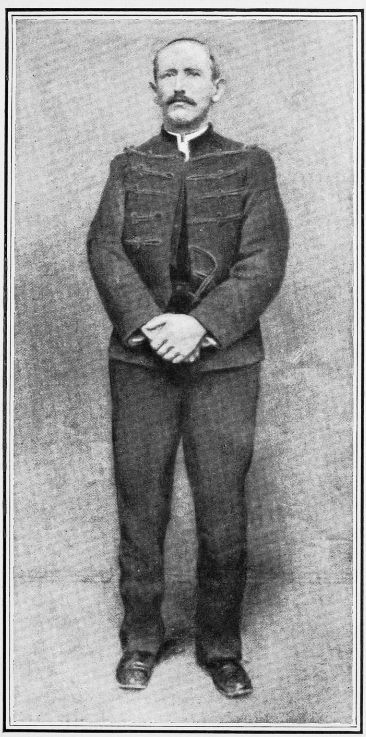
CAPTAIN ALFRED DREYFUS
This portrait is enlarged from a photograph taken on the occasion of his degradation.
in your presence I look at you, I no longer can remember anything. All that happens to me then appears a dream; it seems to me that never again shall we be separated—that I am awaking from my horrible nightmare. But alas! then comes reality—our parting.
Ah, the wretch who committed the crime—who stole our honor! It is no ordinary punishment that he deserves. When the day comes and his guilt is known I hope that public opinion may nail his name to the pillory of history, that his punishment may be beyond all that we can imagine.
I ask you to forgive me for my weakness, for my impatience. But think, my darling, what these long hours are to me—these long days.
But I am calmer after each interview. I draw new strength, a new store of patience from your looks, from your love.
Ah, the truth! We must reveal it, it must shine forth clear and luminous. I live only for that; I live only by that hope.
And this truth, as you have so truly said, must be entire, absolute—there must be left no doubt in the mind of any one. My innocence must burst forth. Everybody—all must recognize it—they must know that my honor stands as high as that of any man on the earth.
And it is to this end that I must be patient.... I realize it as you do, ... but the heart has reasons that reason knows not! If I could only put my brain to sleep until the day when they find the guilty one I should bear physical torments valiantly, I should not waver. And then think of the atmosphere that is to envelop me on the path I have yet to follow!
But my heart must be silent. I gain each time new strength, new patience, from your dear eyes.
Do not think any longer of my sufferings. You can comfort me only in doing as you have done—in searching for the guilty one, without a thought of truce—without an hour of rest.
I have read Pierrot’s few lines in Marie’s letter. Thank them both, particularly the hand that directed the hand of Pierrot.
Make of our dear children vigorous and healthy beings.
I embrace you as I love you.
Alfred.
Tuesday, 15 January, 1895, 9 o’clock in the morning.
My Darling:
I was thinking a great deal last night of what you said yesterday when you urged me to be patient; when you explained to me that nothing is done in a day. Alas! I know it well; but I suffer precisely because of my good qualities, which are defects situated as we are now. I am an active man, and I am impatient to have it deciphered—this enigma that is torturing my brain.
But you understand, my darling, since you know me so well. It is useless for me to tell each day of the fevers of impatience which at times overcome me; the paroxysms of crazy anger which at times carry me away....
Yesterday I received good news. They told me that I am to see your mother to-day. I am rejoicing over it in advance.
Half-past 5 o’clock.
I have seen Me. Demange for a few minutes; afterward I had the pleasure of seeing your mother.
I was so enervated to-day that I almost fainted before her. I could not help it. Sometimes I become again a man, with all man’s weakness, with all man’s passions. You must admit that there is in my situation enough to break down the strongest.
Ah, believe that were it not for you—for our dear children—it would be far easier for me to die! But I must bear up and face my sorrow. I must tell myself that I will bear all the agony, all the martyrdom, until the time when my innocence shall burst forth in the light of day.
It is impossible that it can be otherwise.
I shall hold out to the end, be sure of it; but at times I will give way to cries of wrath—to cries of anguish.
Embrace them all, our darlings, for me.
Your devoted
Alfred.
7 o’clock.
My moment of weakness is past. I see and I live in the future. Courage, then, all of us. Sooner or later innocence will triumph.
Go forward without flinching on the path you have marked out, as I shall go forward without weakening on my dolorous journey.
Wednesday, 16 January, 1895, 10 o’clock in the morning.
My Darling:
I have succeeded in conquering my nerves. I have silenced the tumult of my soul. It does no good to be impatient, since I am resolved to live to see my innocence proclaimed.
I know that it will require time—yes, a long time—but I shall wait, as I promised you that I would, with calmness and with dignity until the truth is known. My conscience will give me the necessary strength.
I will prepare my soul to bear without a murmur the suffering which yet awaits me. I will stifle the sobs of my bleeding heart.
Yesterday I lost for some minutes the sense of my existence; remember that it is now three months that I have been shut up in this room, a prey to the most appalling mental tortures that can be inflicted upon a man of heart; but by a violent effort of my whole being I regained possession of myself.
It is, above all, my nerves that are weak; my spirit is what it was in the beginning.
But you all are united in will, in intelligence, and in devotion; therefore I have the conviction that soon or late the day will dawn. I shall not belie your efforts.
Let us speak no more of it.
What shall I tell you? My daily life? You know it! I have described it to you in its smallest details. My thoughts? They are all of you, of our dear children, of our dear families. Still two more days to wait before I can see you and embrace you. How long the interval is that separates our interviews, and how short the time of our meetings! I would make the time run by when you are far from me. I would make it an eternity when you are with me.
What courage you give me to live, my darling; what patience I draw from the deep well of your eyes, from the memories you recall to me, from my duty to our darlings.
1 o’clock.
I have just received your two dear letters of Tuesday. You are right to speak to me of our dear ones. Though every thought of them rends my heart, their chatter, which you repeat to me, awakes in me happy and touching memories, and faith comes back to me—a faith in better days.
I agree absolutely with you as to the work in which you are engaged. Calmness, time, and perseverance are needful if we would go on to the end. I know it well; I should do just as you are doing were I in your place, preferring to advance slowly but surely rather than lose all by thoughtless haste. But I, alas! I am shut up between four walls, idle, my blood on fire and my point of view is necessarily different from yours.
They have just told me that my two sisters will come to see me at two o’clock. What a happiness it is to see those who belong to one!
5 o’clock.
I have seen Louise and Rachel. I have felt that their hearts beat with mine, that they share my sufferings. Their faith in the future is absolute. I hope as they do.
What devotion I meet in our wonderful families, in our friends! It consoles me, moreover, for the weakness of humanity. Truly we can judge of people only when we are in trouble.
I embrace you a thousand times, as I love you.
Your devoted
Alfred.
Dear Jeanne must be changing in her appearance. Is she becoming as handsome as a girl as her brother is handsome as a boy?
Thursday, 17 January, 1895, 9 o’clock.
What a part these accursed nerves play in human life! Why cannot we entirely disengage our material being from our moral personality, so that one shall not influence the other?
My moral personality is always salient, always strong, as ever resolved to go on to the end; it is determined to face all. I must get back my honor that they tore from me, although I had never faltered. But my material personality is subjected to rude shocks. My nerves, which have been too tensely strung during nearly three months, make me suffer horribly at times, and I have not even the resource of violent physical exercise by which to subdue them. I am to be given some medicine to-day to relax their tension.
Ah, when I think of those who have accused me and caused my condemnation! May remorse pursue them and make them bear the anguish that I am bearing. But let us talk of other things.
How are you, my darling? How are the children? I hope that you all may continue to be well. Be careful of yourself; you have not the right to allow yourself to be broken down. You have need of all your courage and of all your energy; and therefore you need all your physical strength.
At last the time has come. To-morrow will be Friday. How long that day is in coming! Happily the time seemed a little less long this week; for yesterday and the day before I heard of you from those who came to see me.
After all, why should not I, too, have confidence, when I feel around me all this friendship, all this affection, all this devotion!
But that which I must have above all things is patience.
2 o’clock.
They have given me your letter of yesterday. I find that I moan enough of my own accord without encouragement from you to do so still more. Ah, how terrible this helplessness is, when I long to cry aloud my innocence, proclaim it, prove it! Well, all this will do no good. It is necessary, as I cannot reiterate too often, as every one must have told you for me—it is necessary to search on without truce, without rest.
The will is a lever which pries up and breaks in pieces all obstacles.
Yesterday I received a good letter from your sister; to-day one from your mother. I have, alas! nothing in particular to tell them. My life, you know it hour by hour. You can describe it to them as completely as I could. Tell your mother that she must not fear anything. I have nervous weakness, which is easily explained, but my mind remains strong. My soul needs the truth, it demands its honor, and it shall have it. I shall not belie your efforts.
Sooner or later, my darling, our happiness will return to us. I have the firm conviction of this. The hardest of all is to have the patience that is absolutely necessary. Happy is it for you that you have a powerful diversion—action.
Until to-morrow, my darling, when I shall have the pleasure of seeing you, of talking with you, of kissing you!
A thousand kisses.
Your devoted
Alfred.
Good kisses to the dear ones.
JANUARY AND FEBRUARY, 1895.
THE PRISON OF SAINT-MARTIN DE RE.
19 January, 1895.
My Darling:
Thursday evening, toward ten o’clock, they came to wake me to bring me here, where I arrived only last night. I do not want to speak of my journey, it would break your heart. Know only that I have heard the legitimate cries of a brave and generous people against him whom they believe to be a traitor, the lowest of wretches. I am no longer sure if I have a heart.
Oh, what a sacrifice I made the day of my condemnation, when I promised you that I should not kill myself! What a sacrifice I made to the name of my poor, dear, little children, in bearing what I am undergoing! If there is a divine justice, we must hope that I shall be recompensed for this long and fearful torture, for this suffering of every minute and every instant. The other day your father told me that he would have preferred death. And I—I would rather, a hundred thousand times rather, be dead. But this right to die belongs to none of us; the more I suffer the more must it impel your courage and your resolution to find the truth. Look on for the truth, do not waver, do not rest. Let your efforts be in proportion to the sufferings which I have imposed upon myself.
Will you please ask, or have some one ask, at the Ministry for the following authorizations; the Minister alone can accord them:
1. The right to write to all the members of my family—father, mother, brothers, and sisters.
2. The right to write and to work in my cell. At present I have neither paper, nor pen, nor ink. I am given only the sheet of paper on which I write to you; then they take away my pen and ink.
3. Permission to smoke.
I beg you not to come before you are completely cured.
The climate here is very rigorous, and you need all your health, first for our dear children, then for the end for which you are working. As to my régime here, I am forbidden to speak to you of it.
And now I must remind you that before you come here you must provide yourself with all the authorizations necessary to see me; do not forget to ask permission to kiss me, etc., etc.
When shall we be reunited, my darling? I live in the hope of that, and in the still greater hope of my restoration to honor. But oh, how my soul suffers! Tell all our family that they must work on without weakening, without resting; for all that comes to us now is appalling, tragic. Write to me soon. I embrace you as I love you.
Alfred.
Tuesday, 21 January, 1895, 9 o’clock in the morning.
How you must suffer!... The tragedy of which we are the victims is certainly the most terrible of the century. To have everything—happiness, the future, a charming home—and then, all at once, to be accused and condemned for a crime so monstrous!
Ah, the monster who has cast dishonor in our family might better have killed me; at least there would then have been only me to suffer! This is what tortures me the most; it is the thought of the infamy that is coupled with my name. If I had only physical sufferings to bear, it would be nothing. Sufferings borne for a noble cause are elevating; but to suffer because I am condemned for an infamous crime—ah, no! Cannot you see that it is too much, even for energy like mine?
Oh, why am I not dead? I have not even the right to leave this life of my own will; it would be an act of cowardice. I have not the right to die, to look for oblivion, until I shall have regained my honor. The other day when they insulted me at La Rochelle, I wished that I might escape from the hands of my guards and present myself with naked breast to those to whom I was a just object of indignation and say to them: “Do not insult me; my heart that you cannot know is pure and free from all defilement; but if you believe me guilty, here, take my body; I give it up to you without regret.”
At least then, when under the sharp sting of physical suffering, I should still have cried, “Vive la France!” Perhaps then they would have believed in my innocence.
After all, what do I beg for night and day? Justice, justice! Are we in the nineteenth century, or must we turn back for centuries? Is it possible that innocence can be unrecognized in a century of light and truth? They must search for the truth. I do not ask for mercy, but I demand the justice due to every human creature. They must search. Let those who possess powerful means of investigation use them to this end; it is a sacred duty which they owe to humanity and justice. It is impossible that light shall not be thrown upon my mysterious and tragic fate.
O God! who will give me back my honor that has been stolen from me, basely stolen from me? Oh, what a dark drama, my poor darling! As you have so truly said, it surpasses anything that can be imagined.
I have but two happy moments in my days, but so short. The first is when they bring me this sheet of paper so that I can write to you—I pass a few moments in talking with you. The second is when they bring me your daily letter. The rest of the time I am alone with my thoughts; and God knows that they are sad and dark.
When is this horrible drama to end? When will the truth at last be known? Oh, my fortune, all of it, to the one who is adroit, able enough, to solve this sad enigma!
Tell me about all our friends.
Embrace them all for me.
I dare not speak of our darlings. When I look at their photographs, when I see their eyes so good, so sweet, the sobs rise from my heart to my lips. When we suffer for some thing or for some one it is easy to understand.... But why and, above all, for whom am I suffering this odious martyrdom?
I press you to my heart.
Alfred.
Do not come until you are completely recovered and in excellent health. Our children have need of you.
23 January, 1895.
My Darling:
I receive your letters every day. As yet they have given me none from any member of the family, and, on my side, I have not yet received the authorization to write to them. I have written to you every day since Saturday. I hope that you have received all my letters.