LETTERS TO HELEN (continued 2)
Reading edition
As to leave—well let's not talk about that. Every dog has his day.
You know the dog who has been shut up in a kennel for a long time? Or the dog who has been locked up in an empty house for a long time? It'll be a mixture of these.
Well, the day will come.
November 27.
Can't write properly because it's very cold and I've been riding, and that makes one's fingers like pink bananas. They don't seem to answer to the bridle. There's an awful noise of hissing going on. Hale and Hunt are busy on the horses.
November 28.
A box will arrive containing another Bristol ball, which I discovered in a cottage here, and bought for 1fr. 50c. Rather a jolly green one, biggish. Also I am enclosing the wineglass from Geudecourt, which I mentioned some time ago. There can't be any harm in mentioning this name, as we have left that area some time now. I have got several sketches of other places round about there, which I hope you will like. Won't it be fun, when the time comes, looking at them. To-day Hunt came round in a great state about the horses. Jezebel had pulled up her shackle, and was in "one of her moods," as Hunt always describes it. She had been kicking both Tank and Swallow with great violence. He had left Hale trying to get her quiet, and rushed up to report.
She was quiet again when I got down, and Hale had tied her up successfully.
THE PRUDENT SERGEANT
But the point of telling you of this episode is that meanwhile it was getting time for the post to go. Prudent Sergeant Marsden (Orderly Room sergeant) observed that I hadn't addressed the letter yet or signed it outside. So he did it himself! "You very seldom write any letters to other addresses, you see, sir, so I thought I'd better address it myself. I thought it would be inadvisable to miss a post, and I thought the young lady would forward it on if it was not for her!"
It made me laugh as I haven't laughed for a long time. Wasn't it nice and thoughtful. He tells me he duly forged my signature in the left-hand bottom corner.
Jorrocks sends his love. "Your little filly" he always calls you.
November 29.
About leave. There's no more chance of it at present, I think, as we are going up to the line again in a week or two, and we want to work off all the men, who haven't had any leave at all, before moving up mudwards, when all leave will be stopped. We are engaged at present in practically rebuilding and making sanitary an entire French village, and in "training," which means all the old dismal tedium of manœuvres plus spit and polish.
These villages are most amazingly ill-built. Swallow this morning lashed out on being bitten by Jezebel, and (dear silly Swallow!) instead of hitting Jezebel, she brought down half the wall of the shed in which they live, which frightened her to such an extent, Hunt tells me, that she allowed Jezebel to eat all her food at midday stables.
November 30.
We move next week, I think, or possibly the week after.
We are not going back to quite the same part of the line, but near it. It will be new country to me altogether, and to everyone else concerned.
Poor Swallow, poor Jezebel, poor Tank, I'd give anything to shelter you three; but, alas! I fear you are going to have a nasty time of it now. All clipped, too. It's Swallow particularly that I tremble for. He does so throw up the sponge. Tank copies Bird in everything, so she ought to pull through all right.
December 1.
AMIENS CATHEDRAL
All leave is cancelled again, at any rate in this army—possibly on account of the move, possibly on account of nasty fish in the sea. However, the telegram says "until further notice," which usually means for a short time only. Not that it affects me, but it's bad luck on some of the men who were just off.
Now about Xmas. I have got a new crop, thank you ever so much, that I bought at a town near here.
A beautiful cathedral town.
With doors all padded up with sand-bags, the great cathedral towers above the town, and is seen for miles and miles. A good effort. What fun they must have had building it. What they believed then they expressed in outward and visible form. What we think now is (or ought to be) very different indeed from what they thought then. But I can't remember having ever seen anything that begins to express what we think (or ought to think) now.
Everyone in the Church of England now seems to me to think almost exactly what was thought when this cathedral was built! If this war achieves nothing else, I pray with all my mind, and all my soul, and all my strength, that all the sects and all the churches may suddenly feel tired of all the 1001 little methods of procedure, and say: "Damn it all! what does all this ancient paraphernalia mean to us? Is God quite so complicated and involved as we have supposed? Everything else in the world progresses. Thought progresses. Let us take a deep breath, and realize that religion ought to be more 'into the future' than even Zeppelins or Tanks, please."
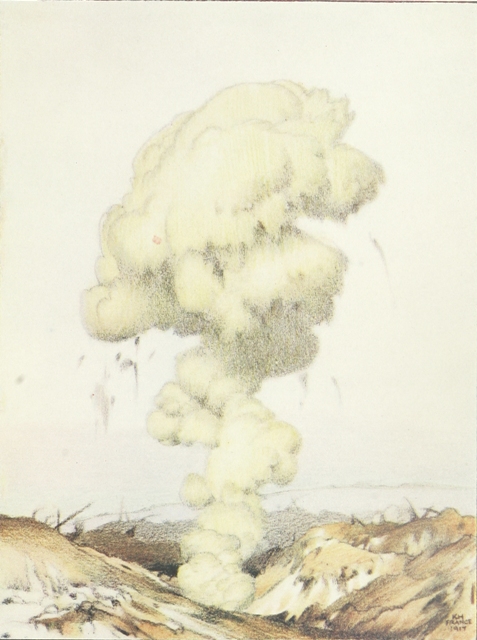
EXPLOSION OF AN AMUNITION DUMP The smoke from a large explosion usually assumes a queer tree-like form and disperses slowly.
December 2.
Just been superintending the burying of some horses. A curious job. You have to disembowel them first. Quite ghoulish. And then head and legs are cut off, and the whole is buried in a hole 12 feet deep. Up there they often lie about for some time, and get as smelly as dead human beings. Back here it all has to be done prestissimo.
The strange thing is that, whereas before the war I should have felt sick and possibly dreamt about it, now it seems merely more boring than most other things of the kind.
Up there Tommies and Honourables eat their lunch of sandwiches with lots and lots of dead people in varying stages of decomposition all round. An odour more hideous than anything you have ever imagined. But you get used to it.
TALKING ABOUT HOME
"How unpleasant they are to-day," you say to anyone you are with. And the answer is probably just a laugh. Then you go on (if things are quiet) to discuss an imaginary day at home. You would smile.
We actually discuss everybody's clothes, the things in the room, the shape of the fireplace, the look of the tea-things and the comfiness of the chairs.
And we always end up by saying: "And then after that I shall do absolutely Nothing for a fortnight!"
December 3.
December. Frost on the trees, all fairy-like in this dense mist. Not a sound. The sun quite small and white and far away. And if we were on the Cotswolds, I expect we should go out for a bit of a walk, just to warm up, after breakfast.
December 4.
A staff job has been in the air several days. It may or may not come off. I'm not very keen about it in many ways. But I've a feeling that I could do it rather well, and so I'm not sure that I oughtn't to accept.
Jezebel and Swallow have quarrelled. Isn't it awful. Hunt has had to put Tank in between them.
Jezebel kicked Swallow, and the blood fairly spouted out—got her in the leg, and she lost her temper, and began lashing out. Hunt, with great presence of mind, threw a bucket of water over them both. And as soon as they were quiet, dear, good, demure little Tank was put in between them as buffer.
It's a most dreadful nuisance. They used to get on so well together. I hope they will leave that curious little Tank alone. Swallow is as lame as a cat now. The accursed female is very exasperating, I fear. Hunt quite irritated me for a moment when he remarked, after the incident: "Oh, it's all right, sir. She was in one of her moods." I pointed out to him that it was not all right. Whereupon he took it into his head that I was strafing him, and muttered sulkily: "Well, sir, I must say I never did like Abroad."
Which made me laugh to such an extent that I got a sort of fit of laughing (don't you know?) and couldn't stop. Eventually I had to go away. He looked so comic and so dejected, and his use of the word Abroad (as if it were a country in itself) always makes me laugh idiotically. I haven't seen him since, and it will be difficult to explain the apparent frivolity.
Things have been very complicated just lately owing to our having to make arrangements about taking over this new bit of line.
December 5.
CONCERNING WORK
One of the many things the war has taught us, I think, is the comparative equality of all work. Work depends almost entirely on the actual number of hours per diem, don't you think?
Certainly brain work is more tiring than spade work. But I'll guarantee that the man who does eight hours' brain work is not much more tired than the man who does eight hours' spade work.
The only difference is that open-air work means better health, and consequently more power to work long hours.
But I really do believe that, for example, a nurse's day's work (either for wounded or babies) is just as hard as a bricklayer's day, or a bank clerk's day, or an engine driver's day. And I believe that the various degrees of skill, necessary for doing any job really well, are not very different on the whole. Different, yes, but not very different. A General's job is difficult, but not much more difficult than a nurse's job.
And so I believe all jobs ought to be paid on a rather more equal footing. Not on an equal footing, but a rather more equal footing than now.
Do you agree?
December 6.
Cathedrals, the earth, the sky, and all that in them is—those are the things that rest and soothe one out here. Thank God for cathedrals! How splendid of Litlin, to be getting Bunny taught reels. I do trust she will give lots of attention to it.
After seeing a certain amount of human misery and so forth, I believe more than ever that the whole aim of the world is in the direction of Joy. And as dancing is one of the most primitive expressions of joy, give me dancing, says I.
This is all said in the middle of dictation of orders, and so I expect it's ungrammatical, but you know what I mean.
December 7.
What do you think? I lunched to-day with George. We lunched in a most superb officers' club, formerly the house of some Count or other: all white and gold, and chandeliers and mirrors—a dream.
December 8.
JEZEBEL ACCEPTS AN APOLOGY
Our move has been postponed twice now, and we don't go till Monday.
But meanwhile I heard from Mark to-day. He is A.D.C. to the G.O.C., and apparently caught sight of Roger and me the other day, while flashing past in the G.O.C.'s car. So we are going to have a great meeting. It will be immense fun. Mark, Dennis and I were all tremendous friends—just the same type.
Swallow is much better, and Jezebel says that, if she had known Swallow would bleed so much, she would have kicked him in a different place, where he wouldn't have bled so profusely. This, for Jezebel, is extremely gracious.
Tank's only remark about being put between the two was: "Well, I'm always very glad to do what I'm told."
Swallow is desperately sorry about the whole affair, and is on tenter-hooks lest Jezebel should never speak to him again. He says she really didn't mean to kick, and she can't understand how it is that he has so little control over himself. So all's well.
December 9.
Hunt and Hale have made their very tumble-down barn a perfect model of neatness. They sleep within about 3 yards of the horses' heels. Hunt in particular never likes to be far away from "my 'osses," as he calls them. I have less and less say in the matter of the 'osses as time goes on! I merely say: "Hunt, I want a horse and an orderly at 8 a.m. to-morrow."
It's useless for me to say I'd like Swallow or Tank or Jezebel, because, if I name one in particular, there's always some reason why it would be better not to ride that one that day. Oh, "she wants shoeing behind," or, "she had one of her moods this morning, and so I exercised her very early," or "he didn't eat his corn, and had better stay in." So I just meekly ask for a horse. And a horse arrives.
Swallow is still rather lame, but seems better now. And the gentle influence of Tank is, I really believe, soothing Jezebel. Tank is a very charming creature, and her perfect manners are a good example to the other two. But—what an awful admission!—she is so good that I own I find her rather dull. Poor little Tank!
Jorrocks has gone off to a nasty place, I fear, with his troop. But all seems fairly quiet at present.
December 12.
The trek is at an end.
We have arrived at a place well behind the line, and not at all wrecked, except for holes here and there. But the river! Oh my aunt! It's marvellous. It winds in and out of low hills, and as I saw it this evening, from an eminence, it looked more snaky than ever. Huge great loops with the lovely pale sedges on either side. The almost yellow hills are dotted with junipers. I long to see it to-morrow morning. There's no doubt it's one of the most fascinating rivers I've seen. Hooded crows sailing over the uplands, and I met a flock of bright sweet goldfinches near some guns, and a tree-creeper in a copse.
SAILLY-LE-SEC
What a wonderful day! It was snowing all the time, with quite warm, sunny intervals. Swallow and Tank and Jezebel are all under cover, and I've actually got a bed! You might not call it a bed, but it is a bed, because it has four legs (one of them a biscuit tin). The place where we were going to has been rather too heavily strafed lately, so they are keeping us back here.
Things are wonderfully quiet, and there are no batteries near us, which is pleasant. I did want to show you the beautiful river winding in and out of the little hills. The great river-bed is quite untouched by shells here, and the very sight of it would soothe the most jangled nerves. Oh, it did look so heavenly this evening. Thank God for this glorious river. The snow melted as it fell. The snow flakes as they touched the river were like fairies taking headers.
December 15.
Isn't this fine about Peace?
So Fritz would like Peace, would he? No amount of flamboyant talk can possibly hide the fact that he wants peace. And it isn't the victor who asks for peace first. Carry on, say we.
December 20.
Have you had any of the letters in which I told you how the place we were to have been sent to was too continuously strafed? And how we were sent to this very quiet and unwrecked place? And how I've got a bed, and how happy the horses are?
About the intelligence job. Things are hanging fire rather, as the Staff Major, who may ask for me to come away with him to another corps, is now attached to this corps. So what will be the end of it I don't know.
Frankly, I am sore tempted for this reason, that I think I could do it rather well. Of course, each corps does things differently, but, judging from the way in which this corps likes the job done, I feel certain I could tackle it in another corps. That's boasting. But you understand so perfectly. It would be glorious to be doing something really well.
A STAFF JOB
I can't be an ordinary soldier. Too absent-minded—hopelessly vague and careless. I live on tenter-hooks always. What detail have I forgotten? What order did I give that could be taken two ways?
It's sad for Pat that his friends are gone. I feel so murky when mine go, that I understand what it must be for him. But friends or no friends, broken-hearted or whole, we must damned well carry on! And that's all about it.
A perfect letter from old Norman to-day. He must be quite useless as a soldier, whereas at his own job he stands alone, with a wonderful future before him. Well, well! I meant not to grouse to you again. And here's a letter nearly full of it. But there, I made a stupid mistake to-day, and it's all so boring and beastly.
Anyhow, we are fighting for civilization, and the Huns are, too, in a way. But our idea of civilization is better than the Huns' idea. So we gradually win.
December 21.
I have at last made up my mind. I'm going to take on this job. How unwillingly I can hardly tell you. I wanted to be in the great Push next year so badly. Everyone, everything, is preparing for it. The cavalry will get through, and I shall be driving about behind in some gilded car, or watching from some very distant hill with Jezebel (who won't care a damn whether the cavalry get through or not).
But I had two interviews with the Major and the General to-day. Coves like painters seem to be rather wanted, and—well, it's clear now. I must go.
To-morrow or next week, perhaps, the extreme fascination of the job will obliterate a certain feeling of flatness, of disappointment, of ... of ... of shirking. Yes, that's it: I feel as if I were shirking all the horrors. You see, I shall enjoy this job immensely. All the hateful "arrangering things" for large numbers of men, all the tiresome formalities, all the discomfort, all the future dangers, finished with—over. I don't say that we've had long periods of danger or much discomfort; but we've had quite enough to make a very ordinary mortal hope never to go through it again.
But to think that I've deliberately chosen the easy path. Well, I don't care! I've chosen it. I meant to choose it. I'm glad I've chosen it. That is the one job in the whole war that I could do really well. How best to serve the country—that's the only question. So there you are. I've been and took the plunge, and I believe I'm right.
First of all a week or two getting to know the ropes in this corps, and then off with the Major and the General to another corps.
My aunt! what an egoistical letter this is. However, to you no apologies.
December 22.
A DECISION
Letters have been lurching in, in threes and fours. But what matters it how they come? I always know that they are coming. And the future's where my heart is always. So here's to the letters to come, and here's to our meeting again, and here's to Life—long, sweet, glorious Life.
We shall see the Christmas roses of the Cotswolds together one day, and I think the war will have given them a mysterious loveliness that we never understood before. Every year they'll come up out of the ground again and surprise us. I shall be getting older and older—and so will you, too. And all our little plans will have a quiet, peaceful joy for us that wouldn't have been possible but for the war. Art will be like angels coming and going. Effort will be intensified. The lives of the poor must be happier, because everyone will be more ready to give and take.
It won't come all at once. But there'll be a difference. The war will have made a difference. Thank God for the war!
December 25.
CHRISTMAS 1916
Never talk about the "idle" staff. Yesterday we were working absolutely solid without any break at all except an hour for lunch and an hour for dinner (tea? away frivolous thought!) from 9 a.m. till 11.30 p.m. Most interesting; but let's hope this first day's experience won't be a fair sample, or I shall simply melt down like a guttered candle. None of the Generals and people seemed to think it unusual. At least they never said so. Personally I found it quite kolossal.
12.30 a.m.
Such a funny Christmas Day! I've been fixing on a large map all the gun positions on the corps front. There are a very great many, and the positions must be marked very exactly. I was quite nervous lest there should be a mistake. It has taken since about two o'clock till now. And I think it is accurate at last.
At about 10 p.m. I found out an awful mistake. One of the heavies quite 100 yards wrong, which might have meant that it would be ranging on the wrong place, and probably do no damage whatever. Desperate thought!
Well, the staff is the most hard-working body of men I've ever seen. They don't appear ever to get any exercise. And, really, the work is all so vital that I don't see how they ever can expect to get any exercise.
About leave. Possibly on the way up to the other corps a side-slip to Blighty will be allowed.
Don't depend on anything. There seems to be a dearth of people who can do this work, and so it would be unwise to count on getting away. The thing is, however, conceivable—that is all.
December 27.
First of all about current affairs here.
Captain G—— is probably going to Army, so it is suggested that I shall take his place here. He runs all the plotting of the aeroplane photographs, etc., for the corps. It's a most awful and alarming responsibility, and I don't feel that I can do it yet. May he not get taken away just for a little while, or I'm lost.
The corps commander sends for him (he has been doing the job for nine months), and says: "Now, where is our line at the present moment? Has so-and-so trench been repaired, and where is so-and-so German battery that was shelling the —— Brigade yesterday?" Well, of course I simply couldn't answer these questions yet.
The prospect is murky. Given a little time, I think I could do it; but ... well, one can but try.
I asked the Captain if he thought leave at all possible. He most strongly advised me not to dream of asking. The corps is certain to refuse in any case, as they will want me to sweat up the show and get to know all about it as rapidly as possible.
January 2, 1917.
I think I shall be going to live with the R.F.C., so as to be able to snatch their photographs the instant they come in—puzzle them out—put them quickly on to a map—and send them off. Everyone then will know far more quickly what Fritz is up to.
So don't be surprised if letters are addressed from R.F.C. shortly. I shall take a couple of draughtsmen and a clerk and an orderly, and Hale.
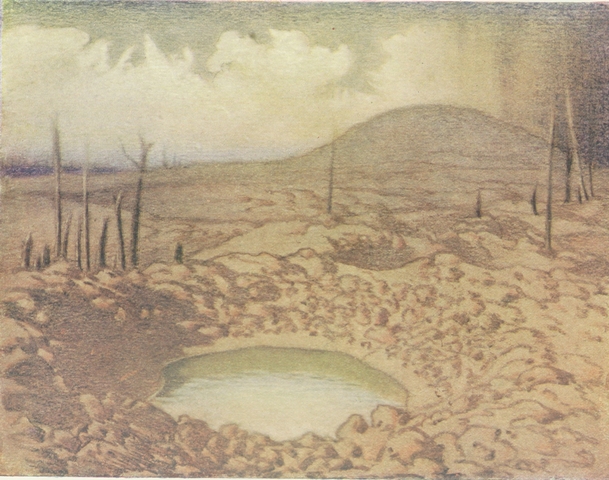
THE BUTTE DE WARLENCOURT This small chalk mound was one of the most difficult obstacles on the way to Bapaume. In the foreground a large 'crump-hole' and the remains of a little copse.
January 11.
AEROPLANE PHOTOGRAPHS
I don't know when leave will be possible. This job is rather in the making, and is really very important stuff. A great responsibility, says the corps commander. In fact, I am just a bit nervous about things generally. That battery that was reported in so-and-so wood. Is it there still? Well, where has it moved to, then? You are not sure? Why not? No recent photographs of it? But why not? Can it be in so-and-so quarry, perhaps? That light railway has been repeatedly smashed up by our heavies. Repaired? What? What evidence have you? Let me have a map as soon as possible, showing exactly where you believe that line has been repaired, and the exact position of that battery in the quarry—if it really is there. But don't tell me it's in the quarry unless you are quite sure. Yes, sir. And you'd better have the map duplicated. How many can the draughtsmen print before to-morrow? About 300. Well, send out copies. I must have that battery silenced at once. Do you see? Can I rely on it being sent out in time? Yes, sir.
That's the sort of thing. Things that must be done and quickly. Perhaps it sounds nothing much—a mere bit of a map. But maps are like lamps to men in the dark. And they must be accurate. To me, therefore, the most inaccurate, absent-minded mortal before the war that ever breathed, it is all a source of great anxiety.
January 12.
I've got a bedroom with a brick floor in a cottage. I really hardly know what it's like, as I arrive there about twelve o'clock every night and fall into bed, and then up again at 7.30 next morning as a rule, and frowsy at that. The roads here are just as muddy as ever, and if you go off the roads you go too deep. We are camouflaging the whole place, and I think it will soon be very difficult for the Huns to see it. At least, when I say "we" are camouflaging, I mean that I run out for two minutes about every three hours, and give hurried directions to a few bewildered men, and rush in again. I'm sure they think the extraordinary patterns that I order them to paint all over the huts, etc., are quite mad. The R.F.C. show isn't ready yet, but it's likely to be so shortly.
January 17.
To-day's letter got me into an absurd fit of internal laughter. Hale brought it in while I was poring over some new photographs of Boche emplacements, or dug-outs, or something—poring with a magnifying glass.... And then came your drawings of the rooms at the cottage.
That'll be admirable. I tried to hold my head and think of exactly how the cottage looked, and where the new rooms were to be; but somehow I've got no brains left. And I leave it all to you. One day we shall be able to discuss it peaceably, but at present this brain is like some limp jellyfish floating in the sea.
To-day I'm doing a map, and the draughtsmen are copying it, of some Boche dug-outs. Ye gods! what do I care about dug-outs! As well make maps of all the rabbit-holes in Glamorganshire. But there, what's the good of talking like that. It's got to be done.
January 24.
BUSY DAYS
The aeroplanes have brought in the most marvellous photographs, and I am very busy deciphering them and mapping the information on to a map.
February 8.
After many, many days of incessant work comes a brief interval of repose—till to-morrow morning.
We moved up here yesterday afternoon late.
Well, imagine a lovely large hut.
The room on the left is where all the maps, etc., are made, and the room on the right is my office.
But outsiders can't just barge into my office. Oh no! They must ask one of the orderlies if they can see me. Isn't it ridiculous!
Then there is a tiny bedroom.
The office walls are entirely covered now with aeroplane photos and maps. It is all rather fun, and I think it won't be quite such a strain. The cold is intense. Hale is functioning with the stove in my room at the moment. I have said once that I don't really need a fire in my bedroom; but he evidently has different views, and is firmly lighting it. He is quite happy here.
I'm having the hut papered, to make it warmer. And canvas curtains, if you please!
The R.F.C. people are most hospitable and nice. I like them very much. It's all quite interesting, and the aeroplanes are delicious as they move, buzzing like vast mosquitoes.
I go down in a side-car every day (that's the programme) to corps H.Q. to report and get instructions.
February 12.
Something may happen to prevent leave before leave comes. You will understand. I should have to "remain at my post," as novels say.
February 15.
WITH THE R.F.C.
A very difficult map has just been finished, and is being printed, and here we sit down for a little talk together. The war is for the moment far away. Away anxiety, away nervous apprehension, away fatigue, away responsibility, away Wilhelm! Let the doors be shut, the curtains drawn. Listen. An adventure, amusing, and rather exciting. Would you like to hear about it? Well, I was making a raised map of a particular part of the line for the corps commander. And I go up from time to time to scan the ground, so that it may be very accurate and therefore rather useful. At least that is what I hope. Yesterday, then, up into the blue, piloted by Eric.
It was not a good day. In fact, too dud for good observation. But the relief map must be ready quickly.
Imagine us, please, robed in leather coats and leather helmets and gauntlets, and with goggles, waiting at the entrance of a hangar while the mechanics bring out the gadfly. They have already looked the creature over with great care. The pale yellow wings glitter against the violet horizon. The sun is shining, but it's freezing hard. Eric climbs in, and then I do. I sit behind with the machine gun.
I clasp a sketchbook, to sketch the lie of the land. O my aunt in Jericho! isn't it Arctic! Fingers that feel like ammoniated quinine. You know, a faint unpleasant tingle.
They are starting the engines. Difficult this cold weather. The following strange colloquy ensues:
Mechanic: "Contact." Pilot: "Contact." M. "Switch off." P. "Switch off." M. "Contact." P. "Contact." M. "Switch off." P. "Suck in." M. "Contact." P. "Contact."
And with a terrific whir the propeller flashes round. The sound increases, and then decreases slightly, and increases again. The gadfly moves. Moves more rapidly. Skims along the ground. Rises, rises, rises. Ah, the beautiful river! Every time I have flown the beauty of that river catches me in the throat. But this featureless waste. Bereft of everything but earth, and a few low shelters and gun-pits, and seamed with trenches. Hideously lonely.
Well, anyhow, here we are sailing high above it all, the wind occasionally lifting one of the wings, and then the other, like a sea-gull's. There is a haze, and it's not easy to see. You peer over the edge, and behold at last the desired wood.
A SCRAP IN THE AIR
A wood? That? Good heavens! That poor miserable mess of splinters and gashed soil? Each time I see one of the woods destroyed by this war I thank God that our glorious Cotswold woods are still untouched. Primroses, wood-anemones, squirrels. To think of squirrels!... Not another aeroplane in sight. Neither our own nor Hun machines. Eric circles smoothly round above the wood, and then crosses back over no-man's-land to fly low, so that I can see the wood obliquely. Archie quite wide of his mark. This doubling and circling perplexes him. The sketch progresses. I look round from time to time to see that there are still no Huns about. Eric also looks about. No: nothing in sight. The guns are pooping off, but the noise of the engines makes the guns sound like tiny little "pops." There, now I've nearly done. Lucky I came, because the wood isn't quite what we thought. Yes, that'll do.... We are up at a considerable height....
Suddenly Rat-tat, tat, tat, tat, tat, tat, tat! above our heads. Three Hun aeroplanes right on top of us; Eric drives headlong in a spiral curve at full speed, smoke trailing out behind. The gun! I fumble. Can't get round to it. Damn!
Rat-tat, tat, tat, tat, tat, tat! go the Huns. But Eric is faster. Are they all Huns, though? Shall I fire? Yes. No. They daren't come down low over our lines. We are safe. Yes, look, they were all Huns. They hang about far up aloft. The Hun usually hunts in threes. Why, oh why, didn't I fire? Well, it can't be helped now. Eric looks round. We both laugh. "Why didn't you fire?" he shouts. I can't hear what he says, but I know from the shape of his mouth that's what he is saying. I just smile and shake my head. Can't explain now.
Where on earth did they come from? Coasting about very high up, I suppose, and suddenly swooped down at us.
However, the drawing is done. So that's that. Home, John!
One little bullet-hole through one of the wings, no more. Indifferent shooting, my friend Fritz. However, I can't talk, because I never fired at all!
February 16.
I've never thanked you for the chocolates which arrived two days ago. But they arrived during one of the avalanches of work, and were all eaten within half an hour or so; not by me, but by various R.F.C. men who are always coming in and out of my office for "the latest."
TOLL OF WAR
To-day all frosty and sunny. Think of going on to the terrace at home before breakfast and seeing some jolly little new flower out, with the Golden Valley behind, all grey-blue and woody.
It's all working well here, and, being the representative of the corps, I have a certain status which is pleasant. They think that I may or may not give them a good character to the Powers that be. Quite fun.
They are awfully nice fellows. The only two I knew before were Eric and Bill Vivian. Bill I have known for a very long time, and during the war I've seen a great deal of him, and was very fond of him. He was brought down by Archie yesterday in our lines. Burnt to death. Dead when they reached him. Yesterday night at mess we were all quite gay. Only one man showed that his heart was as heavy as lead. And it seemed bad form. Heaviness of heart is bad form. No gentleman should have a heavy heart. A sign of weakness, of ill breeding.
February 17.
To-day has been one of the jumpy, anxious days again, because something is to happen shortly, and those concerned are ringing up all the time asking me this and that about the Boche trenches, etc. And they want maps of this and plans of that and t'other. It's these times before some event that are so wearing. The smaller the event, the more wearing very often, because it's just some one or two officers, perhaps, who are doing the show, and, of course, half their success or failure depends on whether an unhappy intelligence officer can tell them exactly what they are up against, and exactly where it is and so on. I always go on the principle of assuming the worst. If I think there may be a minny to meet them, I tell them there is a minny, and probably two. It may not be very cheering to them. But if the minny is there, well, then I've put them on their guard; and if it isn't there, well, they can laugh at the work of the staff, and there's no harm done. People don't realize the awful strain and responsibility and hard work of staffs. It's sometimes a nightmare. Think of it in this way: I make a slip. A dozen men get killed. When the Push comes, I make another slip, and a hundred men get killed. Perhaps more. All the work of the lazy and incompetent staff! But if the staffs are lazy and incompetent, then, for goodness' sake, let's put more energetic and more competent people in their places. But where are these more competent people? In the divisions? in the battalions? But that is exactly where the present staffs came from! And they are the very people who originally jibed at the staffs! Well, anyhow, the war will end some day.
February 21.
THE WILD DUCK
Re America. It doesn't look much as if they were coming in now, does it? However, one of the Scots Guards gave me June as the end of the war. He offered me 10 to 1 in francs; but, as I am always rather muddled as to whether that means that he gives me 10 francs if I win, or I give him 1 franc if I lose, or what, I declined to bet. I expect he thinks I don't bet on principle. But, anyway, let's hope he wins.
Leave is off at present.
The worst of this game is that now I feel I want to do it all myself. I really do know a fair amount about the Boche lines, and I long to spend a day wandering about there taking notes!
I was up yesterday afternoon trying to find out a certain T.M. battery, and what should fly by quite close and quite unconcerned but a duck! We were not very high, and it was very misty. The duck just appeared, with his neck stretched out, eager and oblivious. And then vanished into the mist again. I was thinking about that duck too much to find out what I wanted. Anyway, it was a fruitless journey. But flying amongst clouds is very beautiful. Sometimes we got above the clouds, to where the sun was functioning away as efficiently as ever. The clouds looked like millions of feather beds.
March 2.
I have been doing some drawings of R.F.C. officers. They love being "took" out here, and my office is rapidly degenerating into a club, which makes work no easier.
Well, you see from the papers what is happening. The Boche retires to the Hindenburg Line, and we follow.
I should so love to tell you all about it, but Mum's the word. A great moral defeat for poor Fritz, anyway.
The cavalry are sharpening their swords.
The aeroplanes sail high up in the blue, like hungry hawks.
March 5.
I am probably going off to-morrow. Now, where do you think? Paris? Madrid? Anything of that sort?
Wrong again. Shall I tell you?
Victoria.
I'll send you a telegram directly I get across the briny.
And I plead for no "back from the war tea-parties," please!
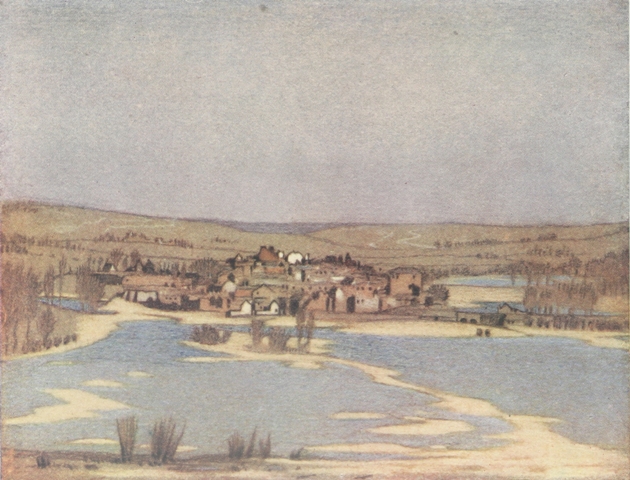
PERONNE From Biaches A few days after the evacuation. From a distance the place looked almost intact, as some of the outside walls had been left standing. That white building in the centre of the town was once the cathedral. Mont St. Quentin on the left. The thin white lines on the slopes beyond are trenches.
March 22.
THE HUN RETREAT
The Hun rearguards are now well beyond ——. I knew the place so intimately from photographs, and from high up in the air, that a view of it from terra-firma promised to be quite interesting.
So with great eagerness, some sandwiches, and the faithful sketchbook, I sallied forth. Harry came, too. A glorious day of brilliant sun and brief snowstorms.
From the aerodrome through all this devastated country, past wrecked villages, orchards laid waste, dug-out camps, bivouac camps, R.E. dumps, light railways, battered trollies lying on their sides, and all the ugly confusion of old wire rusted a red-hot colour, bits of corrugated iron, bits of netting screens, more wire, dead horses, dead men in all stages of decomposition, legs, hands, heads scattered anywhere, dead trees, mud, broken rifles, gas-bags, tin helmets, bully-beef tins, derelict trenches, derelict telephone wires, grenades, aerial torpedoes, all the toys of war, broken and useless. Tommy, the dear hairies, and the R.E. dumps, to remind you what vast stores of everything are still being accumulated.
The ground becomes more and more like boiling porridge as you approach no-man's-land. Of no-man's-land itself, perhaps, the less said the better. No-beast's-land—call it that rather. And yet men have been very brave, very tender, in no-man's-land. Next we come to those Hun trenches that I have peered at from a distance so long and mapped so often. It all seems rather futile now.
Past the support trenches. Past the second line. Damn it! how much larger and deeper that old emplacement is than I thought! The country is less pitted, too. Of course, it hasn't been fought over like our back areas. Why; here are trees scarcely knocked about at all. A recognizable field there. How real that stream looks! And, oh Jemima! a blue tit.
A little distance farther. Over that gentle rise, and there behold ——. Surely one of the loveliest towns in France, on its low hill surrounded by the quiet waters of the Somme. From a distance it looks all right; though somehow, the smoke still ascending from it doesn't look natural.
As you approach you realize that what looks so charming is just empty, shelled, charred, and broken. The Huns have destroyed every single house, all the bridges, and the cathedral, too. The cathedral that once crowned the town now stands a pale crushed ghost in the deserted market-place.
PERONNE
Some of the streets are almost amusing. Imagine Rye with the pretty alleys so encumbered and piled up with roofs, sofas, the contents of wardrobes, dormer-windows, smashed mirrors, rubble, and dust, that it's quite impossible to proceed. Very well, that's ——.
Go into the houses, and there it's just as it is in the streets. Everything crushed to atoms. Images of saints have been hurled out on to garbage-heaps, and in the cathedral huge pillars are lying about in clumsy confusion amongst chairs, organ pipes, and gilded flowers.
On a huge notice board in the Grande Place the Hun has written:
Nicht argern: nur wundern!
(Don't argue: only wonder! We the Huns did this. Why discuss what we have done? We have destroyed your city. Gape and stare, stupid fools! What does it matter to us? We took your precious town from you, because we wanted it. Now we don't want it any more. Here it is back again. With our love.) Some merry soldier wrote that up, I suppose. It was a pity.
There were French officers in —— to-day. I spoke to one. He answered with a quiet, simple bitterness and determination that would have turned even a Hohenzollern pale, I think. Unhappy Emperor! he must be feeling decidedly uneasy nowadays.
Another odd sight was a tub full of water, with a little dog trying to get out. But the little dog was dead. A crump evidently landed somewhere near, and just petrified him, as it were. You often see men like that, struck dead in the middle of some act. Men are usually turned a dull purplish or greenish black. So was this little dog. We ate a delicious lunch on the battlements, our legs dangling 50 feet above the reedy water. Lots of moorhen and coot swimming about.
The sun was warm. We enjoyed ourselves immensely. What a heavenly world it is!
April 6.
After a hectic day comes this chance of writing to you. Eleven-thirty p.m.
Would you like to hear about night flying? I didn't go, but I sketched the others going. And these are some notes. A bombing raid. It had been ordered in the morning. A raid on ——. After a cheery dinner we trooped out, singing foolish songs. The hangars a few hundred yards away across the mud. They looked huge and eerie, looming up from the dark ground, all stately in the moonlight. The moon had a halo, but was very bright, bright enough to sketch by.
NIGHT FLYING
Six flares were flickering at intervals round the aerodrome. A vivid orange colour against the dim blue sky. The horizon was greyer, and little flames flashed intermittently from it. There were the aeroplanes waiting.
It was very cold. Soon the mechanics were starting the machines. The usual loud spurting and fizzing till presently the first machine begins to move. A big semi-luminous beetle lurching forward; then faster and faster and away, lifting up, up, up into the night. Only the lights visible now, but you can hear the hum of the engines a long way off. Other machines follow. The sky is full of twinkling fairies. They circle about for a bit, and then all head towards the east. Gradually the humming dies away in the distance. Look out for yourselves, you sleeping Huns!
A long while afterwards the humming again.
The first aeroplane is coming home. There he is. Gradually lower and nearer. The machine descends smoothly on to the ground, turns and "taxis," spitting angrily towards the hangar where it lives. Muffled figures get out, and the mechanics take in the machine tail first to its home. What? oh yes, quite successful. Smashed the place to blazes. Anyone got a cigarette? Other machines begin coming in. It's such a clear night that we still stand about in groups waiting for the last one to arrive. Damn it all! where can old Rupert have got to? We'll just wait till he comes back, and then bundle off to bed. Anxious? Good Lord, no! What about?
Suddenly a small sharp flash high up in the night. Another and another. The Huns! They are coming. Archie is shelling them. Now another Archie poops off nearer here. Quick! Where's the orderly officer?
In a couple of minutes all is dark. Gradually the drone of the Huns, high up in the air, becomes audible. No. They seem to be steering more towards ——. Searchlights from three different directions grope slowly to and fro. Where the devil are the Huns? The searchlights cannot find them. They must be cruising somewhere up above those thin cirrus clouds. Are they going to drop bombs on us? No, their direction is too far south. The searchlights cannot find them.
THE END
No sign of Rupert yet. Probably he has landed at another aerodrome. Dear old Rupert. One of the very best in this world. He'll be all right. Come on. It's too cold. Let's turn in.
printed by billing and sons, limited guildford, england
Select Announcements of some new and recent volumes published by Chatto & Windus.
NEW BOOKS
Published by Chatto & Windus
A SHORT HISTORY OF ENGLAND
By G.K. CHESTERTON
Crown 8vo., cloth, 5s. net
BOOKS AND PERSONS
By ARNOLD BENNETT
Second Impression. Crown 8vo., cloth, 5s. net
GERMAN PROBLEMS AND PERSONALITIES
By CHARLES SAROLEA
Crown 8vo., cloth, 5s. net
FORTY YEARS OF "SPY"
By LESLIE WARD
New and Cheaper Edition, with all the original colour plates. Demy 8vo., cloth, 7s. 6d. net
THE INDUSTRIAL OUTLOOK
By Various Authors. Edited by H. SANDERSON FURNISS
Crown 8vo., cloth, 3s. 6d. net
JANUS AND VESTA
A STUDY OF THE WORLD CRISIS AND AFTER
By BENCHARA BRANFORD
Crown 8vo., cloth, 6s. net
IN THE ROYAL NAVAL AIR SERVICE
BEING THE WAR LETTERS OF HAROLD ROSHER
With Preface by ARNOLD BENNETT
Illustrated, crown 8vo., cloth, 3s. 6d. net
New and Cheaper Edition, with coloured wrapper.
Small crown 8vo., paper, 1s. net
BY THE WAYSIDE
LITTLE TALES AND LEGENDS
From the Danish of VIGGO STUCKENBERG
Illustrated and Translated by UNA HOOK
Fcap. 4to., boards, 3s. 6d. net
RECENT POETRY
Published by Chatto & Windus
THE CITY OF FEAR
By GILBERT FRANKAU
Fcap. 4to., cloth, 3s. 6d. net
ONE OF US A NOVEL IN VERSE
By GILBERT FRANKAU
New Edition, illustrated by "FISH"
Fcap. 4to., boards, 5s. net
Also 110 copies signed by the Author and the Artist, of which 100 are for sale, parchment, 12s. 6d. net
ARDOURS AND ENDURANCES
By ROBERT NICHOLS
Second Edition. Crown 8vo., cloth, 3s. 6d. net
THE TIDINGS BROUGHT TO MARY
A MYSTERY: BY PAUL CLAUDEL
Translated from the French by LOUISE MORGAN SILL
Fcap. 4to., cloth, 6s. net
BOOKS ON ART
Published by Chatto & Windus
NOTES ON THE SCIENCE OF PICTURE MAKING
By C.J. HOLMES
With Photogravure Frontispiece Demy 8vo., cloth, 7s. 6d. net
NOTES ON THE ART OF REMBRANDT
Fully Illustrated, demy 8vo., cloth, 7s. 6d. net
ART
By CLIVE BELL
Third Edition, Revised
Illustrated, crown 8vo., buckram, 5s. net
CHILDREN'S PICTURES AND THE TEACHING OF ART
By ROGER FRY
With 10 Illustrations in Colour and Monochrome
Fcap. 4to., boards, 2s. 6d. net
THE TALES OF ANTON TCHEHOV
Published by Chatto & Windus
Translated from the Russian by CONSTANCE GARNETT
Pocket Volumes, in the St. Martin's Library, pott 8vo., cloth, 2s. net each, or in leather, gilt edges, 3s. 6d. net
VOLUME ONE
THE DARLING, AND OTHER STORIES
VOLUME TWO
THE DUEL, AND OTHER STORIES
VOLUME THREE
THE LADY WITH THE DOG, AND OTHER STORIES
VOLUME FOUR
THE PARTY, AND OTHER STORIES
Other Volumes in preparation