Chapter VI · LETTERS TO DARWIN AND OTHERS. 1860-1868. (continued 2)
Reading edition
Time was when we should have highly valued English appreciation of the right cause. We have long ceased to care or think about it.
We only wish you had the city of New York. But the sympathizers with secession and riot there have done their worst, and lost their game. The city of New York is the only part of our country which I am ashamed of; and the trouble there is that it is not American.
Enough; good-bye. A. G.
September 1.
Your fine, long letter of August 4th reached me up in the country, in my native region, in the centre of the State of New York, rusticating and enjoying ourselves mightily. We were among the people of a thriving region; a well-to-do set; no poverty near us for miles and miles, i. e., no hardship, except any that a drunken laborer might bring on his family; and I longed to take you out with us in our drives, that you might see a happy and comfortable country, more and more so every year, and perhaps a larger ratio of the population refined to a reasonable degree in feeling and life than I know of in any other part of the world.
I will consider about fantastic variation of pigeons. I see afar trouble enough ahead quoad design in nature, but have managed to keep off the chilliness by giving the knotty questions a rather wide berth. If I rather avoid, I cannot ignore the difficulties ahead. But if I adopt your view bodily, can you promise me any less difficulties?
If your Lythrum paper shall be at all equal in interest to that on Linum, it will be a gem.
As to tendrils, what are Hooker and Oliver (the latter a professor, too) about, and where have they lived not to know anything of them? Everybody must have seen, in Cucurbitaceæ and Passiflora, tendrils reaching out straight for a certain time, and then, if they reach nothing, coiling up from the end. Also the sweeping of stems....
P. S. [To the above?] Three numbers of Boston newspapers recently sent you, two by this mail (in which my good beau-père is again “spiking the English”), please to forward to Reuben Harvey, Esq., Limerick, Ireland.
You are quite out in supposing that hatred of England is increasing, or that there is the least desire to meddle with you, except in self-defense.
My own feelings were very sensitive at first, because I expected better things, and I then deferred much to British opinion. I now do neither, and nothing strikes me more than the smallness of mind and largeness of gullibility of the British people, as far as I can judge from their press (weeklies, quarterlies, and “Times”). But I do not suppose you will fight us because you dislike us; and so conversely. I suppose I do not see the papers which so abuse England, though I read influential and respectable papers; but from what I do see, I think we receive far more abuse and misrepresentation and unfair usage than we give.
As to the course of the war and policy of our country as to slavery, some day when you turn back to some early letter of mine you will see that I was a fairly good prophet; that the South might have delayed the abolition of slavery by giving up early in the conflict, but that every month of continued resistance hastened and insured the downfall of slavery. That is now doomed, and sure near to rapid death; quick in some places, slower in others, but sure.
Ill-usage of negroes—who make such good soldiers—will soon be unheard of, except with Irish. It will take some generations of American life to breed out the barbarian they bring to the country.
November 23.
The next best thing, of late, is the exposé of Lindsay and George Saunders (the Confederates) by Historicus.
I trust Historicus’ previous letters, in which he shows (about the same time my father-in-law’s articles on the subject reached England) that it is the duty of a country to see that armed or war vessels are not fitted out, quite irrespective of all municipal law, have produced their proper effect. Something has produced a great effect, and a great change in the idea of what it was incumbent on the government to do; and nothing can be more satisfactory than the views now taken; and the effect here is excellent. For we are sure that when the right notions once get a lodgment, as they have, England will faithfully carry them through. Lawyers whom I knew here were confident how the law would ultimately be laid down by your courts; but we greatly feared it would be done only after a few more such vessels had got to sea. All will go well now.
The newspaper I occasionally send you is a fair specimen of the influential part of the press here. Such articles as the “Times” likes to cite have far less effect here than you suppose in the determination of events.
TO GEORGE ENGELMANN.
Cambridge, December 11, 1863.
My dear Engelmann,—Our good old friend Von Martius writes me that on the 30th March next, he will reach his fiftieth anniversary of his doctorate. I dare say his friends will commemorate it in Germany. It occurs to me that it would be a good idea for some of us, his friends and correspondents, to compliment him upon the occasion. Suppose you draw up in German a letter of congratulation, etc., to be signed by yourself, Torrey, Sullivant, etc., and forward about the proper time. Send me, with your German circular letter to Martius, a translation in English....
Yes, I will let you work at botany when I guard you.[57] Your botanical work is far better than your politics. But you must swear the President’s oath, Proclamation and all!!
Martius is not a very remarkable botanist, but good; is a genial, philosophical soul (full of Plato, etc.), a good explorer, has worked up the Palms, etc., well, and is a wonderful man for the amount he knows on a vast number of different subjects,—philology, antiquities, philosophy, et id genus omne.
May 3, [1864].
... Spring is opening here, but late. From this to July 10, I am engaged in college every day in the week. Also am watching the herbarium building go up, the brick walls of which, if good weather, may be all up this week, and the roof put on next week.
Your circular letter to good Martius was very good, especially in its original German. Thanks....
Never mind if “Sagittaria graminea, Michaux,” is applicable to only one form. You had best keep the old name, the more so as that you propose, S. simplicifolia, is “not always correct.” We can’t let you change a name because you can improve it. Too many can and would play at that game, and less discreetly than you would, and then cite your example!
If Fendler gets tired of bush-clearing, and will come to me this fall, I will give him $500 a year as curator, lodgings, two rooms in gardener’s house, which I have reserved; and let him have say three days in the week for himself, if he wants them.
The people are determined to support and reëlect their excellent President Lincoln (what a noble letter that last of his), whether Frémont and the like make a coalition with copperheads or not. It is all the same to us. Lincoln will walk the course. God bless him!
Wright is coming home for a few months this summer.
TO CHARLES WRIGHT.
Cambridge, September 18, 1863.
What Don José affirms about coast and mountain vegetation being much the same is curious, unlikely, yet you seem to find it so. That bit of coast with all microphyllous and spiny vegetation is also curious.
I am glad you like him for being an abolitionist. Though not very much of an abolitionist myself, at the start, I hope I can fall in with, and welcome, the ways of Providence, when Providence takes the matter in hand, and say Amen....
Well, you are doing well in botanizing, and should finish up Cuban botany while you are at it. And on your return, you and Grisebach should join teams, and do up Cuban botany in a full memoir. You are right to stay till next spring. You are happy in Cuba; you would not be so here. Things in the United States do not go to suit you at all. “Things is working,” and in the right way,—but the end must be the total suppression of the rebellion,—the exile or punishment of rebel leaders, the return of the masses to their duty, and they will put things straight. Just what is now going on in Tennessee will go on elsewhere, I suppose. I know only one man in Cambridge that you could talk secesh to. We can correspond very well, and keep cool. But if we were together, during the war, we should get into a row at once. It could not be otherwise....
When the Union is restored (which it is to be, of course, when the rebellion is put down) those who do not love us well enough to resume their duties and privileges have only to take themselves off to some country they like better. The United States of America belongs to loyal Americans. After the war the country will prosper wonderfully. And the South will get to be something.
December 1.
Things move on.
“The mills of the Gods grind slow, but they grind exceeding fine.” Wait in Cuba a year longer, and you may return to a country in which slavery, having tried to get more, has lost all, and as a system is defunct, to the lasting benefit of all parties.
You might now revisit your old Texan haunts, under General Banks’s protection.
The November elections show a united North. Peace democracy has made its issue, and is dead. The reëlection of Lincoln by acclamation seems probable, supported by moderate men of all sorts, the extremes of the opposing parties alone going against him....
Merry Christmas to you.
January 21, 1864.
By the steamer of Saturday, which takes this, a good young fellow, Mr. Kennedy, a member of our Senior class, goes to Cuba, to look after business of his father, and, when he can, to botanize, only four or five weeks, that is, in vacation. He is very fond of botany, and bids fair to be a botanist some day, if he does not take to money-making instead....
This war, we think, will be pretty much over next summer; and then, back in the Union, with slavery pretty much nowhere, by the hearty wish of a majority of the people, we may expect a career of prosperity and real advance of the South, such as it has never known. At least we hope so.
TO R. W. CHURCH.
Cambridge, December 25, 1863.
For ourselves, your letter found us here just on the eve of our month’s holiday, a trip to Lake George, and thence to my natal region, in the most beautiful (and the most English-looking) part of the State of New York.... My wife was well enough to do her small part in a great fair held in Boston for the United States Sanitary Commission (which has kept the ladies very busy for the last six months), which has just closed, having brought the net proceeds of about $125,000 (it turns out $140,000) for the relief of suffering.
As to our national affairs, I should like now and then to send you such comments or articles as seem to me to throw most light upon our condition. There is little I could say in a letter. I said very early to English friends that if the rebellion were short it might leave things much as they were before (no desirable state), but if long and obstinate, it would cut the knot we were unable to untie and completely destroy the slave system. You see now it is coming to pass, by rather slow but sure steps, and a great blessing it is to be to the South. To the North the war, with all its sad evils, has been a great good, morally and politically. The end is in the hands of Providence, and we humbly wait for it; but there is very little diversity of opinion here as to what, essentially, the end is to be, that is, the complete territorial reinstatement of the Union, and the abolition of slavery. Very sanguine, you think, in England. We must wait and see, and on our part hope and labor.
Now for a little personal matter. I have long been anxious for the safety and final destination of my herbarium and other botanical collections, which in my house (besides that, there is not room for them) are too liable to destruction from fire. I had offered them, with my botanical library, to our university, if they would build in the Botanic Garden a fireproof building to hold them, and raise a small fund for their support. Recently and quite unexpectedly, a banker in Boston, almost unknown to me personally, has offered in any case to construct the building, and a few friends are taking steps, with good prospects, to raise by gifts a fund of $10,000 for the support of the establishment. When done, I shall feel that my collections, which are most important for North American botany, are secure for the use of future botanists. To secure this I gladly divest myself of the ownership of collections which have absorbed most of my small spare means for the last thirty years, and which are valued at $20,000 or more....
In the council of our American Academy (of which since May last I have been president) we have nominated Dean Milman to the foreign honorary membership vacated by the death of Whately, and Max Müller to that vacated by Grimm. The election has not yet taken place.
Mrs. Gray, with kind regards, joins me in best wishes for the new year to you and yours.
Very sincerely yours, Asa Gray.
TO A. DE CANDOLLE.
Cambridge, December 22, 1863.
My dear De Candolle,—I thank you cordially for your letter of the 13th November, and for the copy of Thury’s interesting and curious paper. This I had not seen, neither Pictet’s notice. I find it very interesting, but I do not see how he got a legitimate deduction from the facts given by Knight in the vegetable kingdom to his principle in the animal kingdom. However, that is of small moment if the principle holds. The subject is one which will naturally attract much attention, and which, as you remark, has philosophical bearings. I mean to bring it up, next week, for discussion at our private (social) scientific club in Cambridge.
I thank you also for the good spirit in which you take, as I meant them, my criticisms upon your article on Species, etc. There is no progress to be made upon such interesting subjects without free criticism, because without it we cannot perfectly clear up our own views nor impart them perfectly to others. And especially, since I have so often to criticise the views or writings of persons for whom I have no particular regard, it is pleasant, if only for the sake of impartiality, to criticise those for whom you have the greatest regard and respect. So I particularly like it when I can criticise such a near friend as J. D. Hooker or Bentham, and I believe they like it, too, at least Hooker, who is himself a very free critic. Of course, I know very well that you will be likely to turn all the points I made. The question upon which of the two foundations the idea of species rests, I well know is not to be settled off-hand by any bit of argument. Pray take up the cudgels against me whenever an occasion offers.
As to theoretical views, you and I receive and use them as means, not as ends, and expect to change many of them from time to time. Such especially as relate to origins and causes are the questions which we ask, rather than answers that we receive; and we put our questions variously according to the leadings of the case at the time. But this is all commonplace and trite.
It is curious to see that Owen, in his Aye-aye paper, has come to adopt Heer’s[58] views essentially, of course without the slightest allusion to Heer.
Our civil war goes on slowly, but very surely, toward the destruction of negro slavery; and with all its great cost, we may hope for future benefit in proportion. By the time we have nearly ended our war, it may be that Europe will have its turn again. I hope not.
A. Gray.
TO JAMES D. DANA.
Cambridge, January 20, [1864].
My dear Dana,—Perhaps you may not know, and I hope you may be as pleased as I was to know, that your article of last summer on Geological Periods is reprinted in full in the “Reader” (of London), with an appreciative prefix.
Cephalization goes on bravely in your very taking article which you have just sent me. I am much struck with it.
In one thing you zoölogists miss it, I think,—in following French customs in dropping the Latin, the vernacular of science, in names. I wish you would write Aphaniptera, etc., which is just as much English after all as Aphanipters, and good for all languages.
Have Englishified contractions for all such names if you will; it is well. But in proposing and formally writing of such divisions, etc., pray use the scientific form.
The other course has greatly jargonified zoölogy.
In botany we have always been more dignified. Moreover I detest “larve,” though Kirby tried to introduce the word. “Larva” has got to be as English as “phenomenon.”
But I dare say most would agree with you.
I like the ring of most of the new technical terms you have coined....
Ever yours, A. Gray.
TO CHARLES DARWIN.
February 16, 1864.
My dear Darwin,—Here we are past midwinter, and not being stimulated as of old by your exciting letters, I have not written you a line since Christmas. Not that I have had anything in particular to tell you. I write now to say how very sorry I am that the word or two I get about you from Hooker gives me the idea that you are having an uncomfortable and suffering time, as well as entirely broken off from scientific work. I feel very sorry about it, and do long for better news of you....
I have lately printed a couple of monographs, one pretty big one, of American Astragali. I do not know that they contain anything you would care to see. Yet I think I shall send you a copy presently, through Hooker.
I feel much the loss of dear old Boott, so good, so true a friend, and he was always writing me little notes telling me of all that was going on.
The sentiment of our country, you must see, at least I assure you, has settled, as I knew it would if the rebellion was obstinate enough, into a determination to do away with slavery. Homely, honest, ungainly Lincoln is the representative man of the country.
A Boston gentleman, at cost of $11,000 or more, is to build a fireproof house for my herbarium, which I give to the university, with my botanical library. A fund of $12,000 is raising to support it, which will relieve me of the expenditure of about $500 a year. But I shall have double care and bother all the coming spring and summer.
Dr. Scudder has gone to Cuba, to attend an invalid, and wishes to examine orchid fertilization, and asks me what in particular he should look at.
Pray get well, dear Darwin, and believe me to be ever,
Yours cordially, Asa Gray.
TO R. W. CHURCH.
Cambridge, April 4, 1864.
My dear Mr. Church,—If you have long ago written your American correspondent off your books, as being a right shabby fellow, he could not complain.
Here is your agreeable letter of January 19th, a most prompt and more than kind response to mine of Christmas, still unacknowledged by me!
The fact simply is that I have been delaying week by week in the hope of being able to announce to you that the subscription for the support of our botanical establishment was filled up. I am sorry to say that this cannot yet be said. The matter has been privately conducted, that is, nothing said about it in the public prints; but the two gentlemen who took the matter in hand have quietly circulated the paper among their well-to-do acquaintances in Boston, not beginning till late in January, under the idea that the fair for the Sanitary Commission had perhaps exhausted their friends’ purses. Since then, far greater and more pressing demands have been made upon the benevolent and the public-spirited, for a variety of good objects; and our affair has gone slowly in consequence.
I have not heard for a week respecting it, but a week ago the sum subscribed was a little less than seven thousand dollars, the greater part in sums of $500 each. The $10,000 is obviously secure, for subscribers of $100 each, yet to be appealed to, may be relied on for a good part of the lacking sum. But it begins to be clearly seen that $12,000 are needed for the capital of the fund, and this, at the present rate, it will take some time to secure.
Your own offer of a small subscription, I can truly say, not only gratified me in the highest degree, as an expression of an interest in our affair which I had no reason to expect, but has already been of use,—has really been as good for us as any contribution you ought to make. For I took the liberty to read that portion of your letter to three or four friends, and their interest in the matter was sensibly quickened and exalted by this evidence of the lively interest in the matter taken by a country parson, far away in England! So pray consider that you have already helped us on, and we are truly grateful to you for your generous proffer. There is, indeed, a strong temptation to accept your kind offer in the fact that, in the present state of exchanges, owing to our paper currency not on a specie basis (one of the sad consequences of our civil war), every pound sterling in England, in normal times worth only from $4.90 to $5.00, is worth nearly or quite $8.00, so that a contribution of £5 sterling really now counts here for about forty dollars!! So you see how hard it is for me to discourage your kind intentions. But I really feel that the sum which I specified, as the condition of my own gift to our university, is really quite sure, though slower in coming than we had hoped.
As to the building for the herbarium, I have only to state it goes on famously. It is considerably enlarged in plan from what was at first contemplated, and a favorable early spring has allowed of more progress than could have been expected at this season.
The generous donor of the building not only adopted at once the larger plans as soon as suggested, but himself proposed improvements and additions.
The building, the foundations of which are already laid, in the most substantial manner, is 32 by 57 feet, and is connected with my private study in the house I reside in by a neat conservatory 18 feet long, which takes the place of the simple wooden corridor at first intended. The whole will cost Mr. Thayer, the donor, by the contracts, more than $11,000, and is likely, by extras, to reach the round sum of $12,000. And all will be done before the summer is over, we trust.
See how the expression of your interest to me has led me on, to the neglect of everything else I want to write about.... I wish to say something about the troubles in your Old World, which, with all its age and wisdom, falls into “difficulties” hardly less grave than ours. I hope poor brave Denmark will not be crushed out of existence. There are English questions which we regard with much attention, ecclesiastical and social questions, on which I would fain know what you think. But I cannot write longer now.
Only as to our war, I beg you to believe that we (the earnest thoughtful people and most around us, according to their measure) have acted and are acting from the highest sense of duty,—duty to our beloved country and to humanity; and we keep the full conviction that great and permanent good is to result. Much of the good we see already, and more comes near to realization every day. So we work and trust, and suffer cheerfully. We only wish our views and motives were better appreciated in general in the country and by the people whose good opinion we most value. But even the lack of that appreciation, which is far from universal, is likely to do us good. I am always sure of your thoughtful good wishes for us. But I must break off.
Ever yours most sincerely, Asa Gray.
TO A. DE CANDOLLE.
Cambridge, May 30, 1864.
My dear De Candolle,—I have let your very kind letter of 28th January lie on my desk a long time, always expecting to write soon, but, having been extremely busy with various administrative matters and college work since it reached me, the convenient moment for writing to you has not arrived till now. I inclose a note to my young friend and late colleague, Professor Eliot, which I beg you to send to the poste restante on arrival. I learn from his friends here that he may be expected to be in Geneva about the time this reaches you.
In my note I ask him to call upon you, as a friend of mine. He will of course be unwilling to make any demands upon your time or attention. But I should like him to see you, and perhaps he might through you pay his respects to the savans in his line, notably to De la Rive. Having wife, etc., with him, and little time, his visit will be transient. Eliot is a chemist and physicist, a man of much promise, we think, and a most gentlemanly man. He is a very trusty friend of mine. He has passed the autumn and winter in Paris, studying hard, and will soon return here, bringing the latest news of you. He and his lady companions are just such people as we should like you to know America by.
I should say to you, moreover, that I gave to another colleague of mine, Professor Cooke, a note to you. He is a chemist and mineralogist, is full of research and zeal, a most estimable man.
You know, perhaps, that I have made over (or am to make over) all my herbarium and library to our university, in consideration of a fireproof building made to receive them, and a fund, of moderate extent, raised for the permanent support.... During the summer or early autumn, my collections will be transferred to this their permanent home, to my great relief.
It is probable that I shall continue to spend upon these collections all my available means, and I hope they will be of use in the future, as well as safe, which they are not in my wooden house. My own donation is reckoned in money value at about $20,000.
Charles Wright is expected home from Cuba soon, when there will be a new and interesting distribution of his phænogamous plants.
We trust that our civil war is in its last year, that is, if we are victorious, as we hope to be. In that case your American stocks will be all right again. Nearly all the little I possess is cheerfully put into United States government stocks, where I am well content it should be.
Small countries, which you prefer, would do very well if all were small, but the few large, like England and France, will domineer unpleasantly over the smaller. Just look now at poor Denmark, which has the misfortune to be small, and so is made to suffer! All Scandinavia had best combine, and build up a strong nation. Natural selection is hard upon the weak! However it may be in Europe, you must excuse us for endeavoring to prevent, while we may, even at great cost, the establishment of a European system on this side of the Atlantic; so we must not fail to put down the Confederacy. We shall, after that, in a quiet way, make the French emperor very uncomfortable in Mexico; but we hope that country may yet be a strong power, but not a French power.
Enough of politics! And believe me to be, with affectionate regard,
Ever yours, Asa Gray.
Cambridge, January 30, 1865.
My dear De Candolle: ... This very day, I have received your envoi by post of the neat little article on leaves of Fagus, which I had seen in English dress, and the copy of Heer’s address. Many thanks to you. I have received also, and thank you much for it, the “Prodromus,” XIV., I. I have this evening read over Heer’s address. It is, as you say, capital. It interests me in its proof of the antiquity of the present flora; and I admit that he very neatly puts the case between his view of the production of our species out of the older ones, and that of Darwin. Here it still rests: Darwin has the great advantage of
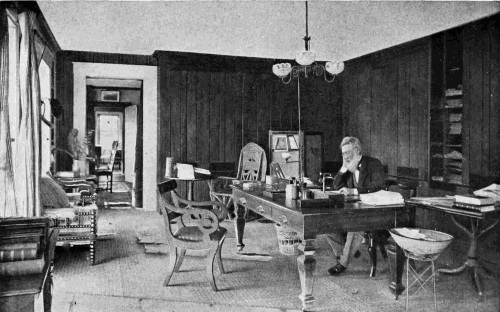
DR. ASA GRAY IN HIS STUDY
being able to assign a vera causa. Heer has the disadvantage of having no known cause to assign; but he shows that things do not appear to have proceeded as Darwin’s theory requires. It does seem as if there were times of peculiar change as well as of great stability. But were this time of change and that of stability simultaneous for the species of a flora? And does Heer allow enough for the species which now occur under many forms,—show great polymorphism. I continually meet with these in the North American flora; in which the dying out of some forms, and their replacing by others, which may well take place in time, would, in effect, just give a change like that to be accounted for. But I cannot say that these varieties come in insensibly, very likely not.
Now, to speak of myself. My summer was much frittered away; the superintending of the new building for my herbarium just preventing any serious study. The autumn was devoted to the removal and rearrangement of plants and books, and to assisting Charles Wright in the collation and distribution into sets of his collections in Cuba for the last three years past; very full and interesting collections, and requiring much care and labor, on account of this distribution being a continuation of former distributions. I laid out into the sets every specimen with my own hands, Mr. Wright adding the tickets and numbers. It was an immense labor, and was finished only at the close of the last day of the year....
I mean to prepare for “Silliman’s Journal” a brief and simple notice of the edifice for my herbarium, so I will not speak further of it here; further than to say that I am well satisfied, only I sadly need a curator!
And now, I turn to your letter of September 29, and ask your pardon for having so long neglected it. Your letters, your reflections upon social and political, as well as upon scientific questions, are always very interesting and instructive to me. I regret that I can render so little return in kind....
As to our national troubles, the prospect brightens that we shall end the rebellion and slavery before long. God grant it.
Believe me to be, as ever, my dear De Candolle, very faithfully yours,
A. Gray.
TO GEORGE ENGELMANN.
February 14, 1865.
... Wright is here, distributing and finishing up his North Pacific Expedition Collection; ... will return to Cuba in a month or two, to take a year or two more there, revisit some old parts and explore some new; then I urge Hayti, but Wright seems rather loth.
Rothrock—from northwestern Pennsylvania—is a bright lively pupil of mine for last three or four years, when not serving his country in the army, where he has done good service as private in infantry, and as captain in Pennsylvania cavalry, etc. He had to leave his thesis partly unfinished. But the real credit of all belongs to him. His father is M. D., and he is now studying medicine, attending lectures at Philadelphia. But botany is in him, and will probably come out....
There, I believe this is about all. J. A. Lowell has made a nice present of costly botanical books, of which more anon.
[March 18.]
... Rothrock is going with Kinnicut this week, to Northwestern America, Norton’s Sound, etc., to explore on telegraph route close along the Arctic Circle. Any pines there you want?...
March 29.
... No, Mrs. Gray did not go to inauguration ball. But she has had a good time. Her brother, the general, took her from Fortress Monroe, where she went, up to the front and close to rebel lines; where she had the honor of having a rebel shell thrown at her!
I expect her home again to-morrow.
No, I don’t get a curator, and I want one sadly. Yet it is as well Fendler did not come, as it might have been difficult for me to pay him. He, however, is just the man I want here, to take charge of herbarium and garden....
TO W. J. HOOKER.
Cambridge, April 24, 1865.
Mr. Wright is about to return to Cuba, to have one year more of exploration there, and especially to visit Turquino, the highest mountain of the island, and some other parts which are still promising.
He will now be able—as he is always most ready—to attend to the gathering of seeds of palms, or other seeds, or things you may want at Kew. He has now some good and kind friends in the country, and deserves them, for he is one of the most hearty, single-minded, and disinterested persons I ever knew, as well as an admirable collector; but being rather rough in exterior, he does not like to come into contact with official people, unless properly accredited. But if armed with official instructions to British consuls, etc., and so having the means of very promptly turning over, without bother or uncertainty, whatever he may collect for you, I have no doubt you may turn him to excellent account. Perhaps, however, he will not long remain in Cuba; for there is a prospect of getting him attached (nominally, without any emolument) to the United States consulate-general at Hayti, so that he may explore the botany of that island, as he has done that of Cuba. But I doubt if he will keep in the field many years more, or do such hard work as he has done in former years. I wish him to explore Hayti, however, and then associate himself with Grisebach in the production of a Flora Antillana, or at least a Flora Cubensis, if Grisebach inclines to work longer at West Indian botany, after having finished the critical enumeration of Cuban plants (founded mainly on Wright’s collections) which he is now occupied with....
It seems like old times to be writing to you. We have the less occasion for direct correspondence of late years, owing to my having such a capital correspondent, as well as a capital friend, in Joseph. I know not how I could get on without him. I look with great satisfaction upon his splendid scientific career, and feel that you must take great pride in it. I rejoice to hear that you are so well and hearty, and at work with vigor, comfort, and success upon the “Synopsis Filicum.”
Dr. Brewer[59] sends his regards. He goes this week to New Haven (Yale College), to attend to the opening of his work as professor of agriculture. I was running over his collections, naming and characterizing the new things, and laying out a set for you of all you could wish. But since spring opened, my college work has been so pressing that all else has been interrupted, perhaps will be in abeyance till near midsummer.
I must not fail to tell you that our good friend Dr. Torrey sailed yesterday for California! via the Isthmus, to return three or four months hence, perhaps overland.
He is a much trusted officer of government, as assayer of the United States assay office at New York, and the secretary of the treasury, knowing that he needs some respite and change, has arranged this trip for him, upon business of the department, by no means of an onerous character.
He has long wished to set eyes upon California, and I am glad he has such a pleasant opportunity of doing so.
TO R. W. CHURCH.
May 1, 1865.
I have long wished to communicate with you, but it is long since I have written any but pressing letters; a large and ever-increasing scientific correspondence and various business matters absorbing all my leisure and powers, as the times and events also absorb our thoughts. You can imagine how deeply we have felt, rejoiced, and suffered during the last month or so.
Well, “treason has done its worst,” and rebellion, as an organized power, is essentially brought to an end. Slavery is done away, and we have now the task of establishing a new and better order of things at the South, of replacing barbarous by civilized and free institutions. A heavy task, no doubt; but the good Providence that has so wonderfully shaped our ways and sustained us thus far, we humbly and confidently rely on to carry our dear country through all its trials.
I doubt if you will have in England a full conception of the profound impression which this last atrocious crime has made,[60] filling the whole land with the deepest and tenderest grief, like that of a personal bereavement; inexpressibly shocking, but never for a moment bewildering the country nor deranging the action of the government. The manner in which both our victories and sorrows have affected the country is most hopeful, and promises the best results. There is much yet to do and to suffer, and there is need of wisdom, patience, and sacrifice in the renovation of our country, and the establishment of free institutions throughout the South, involving as it does the complete reconstruction of society there. But under God’s blessing, we expect full success in due time.
As to myself, I can say little now. I am quite overworked at this season, but I hope that hereafter a rearrangement of my work in the university may bring some relief.
I am beginning to enjoy the advantage and comfort of the establishment of my herbarium, and the building quite meets my expectations. The collections are fast increasing; faster than I can take care of them, through the bounty of my scientific correspondents; while Mr. Lowell’s donation of botanical books is of the value of about £300.
November 16, 1865.
Now do not be startled at a letter from me written the very evening of the day in which arrived your pleasant favor of the 1st inst. For to-day I also received the inclosed official letter, which has been lying, I suppose, for want of your address. And so I send it forward at once.
In fact, the fund raised for the support of the herbarium (nearly $11,000) has been till very lately retained in the hands of the gentleman who took charge of raising it, in the form of a good investment, and is now at length made over to the corporation of the university in trust. Your £5 I turned in at the time when exchange was at the highest (i. e., our currency most depreciated), so it figures as fifty dollars,—quite a sum,—and for it, as for the rest of the capital, we get, up to 1881, six per cent per annum in gold, if the United States government lasts. And we now feel confident enough of that.
Your letters are always very pleasant to us, and that of to-day is very gratifying.
Yes, we, too, should not have said this was the way in which we would have had slavery destroyed,—by no means. We wished it by a slow process which would have cost no life, injured no property, but benefited all as it went on. But our misguided Southern brethren would have it otherwise, and so it was. And it is something to be glad of, after all, that it was done in our day, and we think thoroughly. I take a weekly newspaper, the “Nation,” which is on the plan of the “Spectator” and the “Saturday Review,” etc., but we have few good paragraph-writers, and our best writers will not write. But this paper may interest you, at least in the letters of its correspondent traveling in the South. I post some numbers to your address, and I will send some more if you care to see them. Otherwise the numbers are thrown aside, for I do not keep them.
Even here we have the same sort of liking for Palmerston which the mass of English have, and no better reason to give for it; and we look with a sort of fascinated interest upon Gladstone, and expect to see him premier before long, in a year or two, and we wonder how he will get on in so critical a position as he will be in. Goldwin Smith I met, but saw not very much of. He was in very delicate health. Fraser I did not see, though he was my father-in-law’s guest, and was very much liked by all. Both had troops of friends. Mrs. Gray and I were in the country when Fraser was at Mr. Loring’s house on the shore.
The short space left on my sheet must be all devoted to an earnest exhortation for you to follow your two friends’ example. Come over and see us, and make our quiet house your home, from which you can travel as much as you like and see the country in this interesting phase. Pray think of it seriously. The expense need not be great.
Mrs. Gray, with kindest remembrances, seconds my request, and wishes it extended to Mrs. Church.
Cordially yours, Asa Gray.
TO CHARLES DARWIN.
May 15, 1865.
Your kind letter of the 19th ult. crossed a brief note from me. I am too much distracted with work at this season to write letters on our affairs, and if I once begin, I should not know where to stop. You have always been sympathizing and just, and I appreciate your hearty congratulations on the success of our just endeavors. You have since had much more to rejoice over, as well as to sorrow with us. But the noble manner in which our country has borne itself should give you real satisfaction. We appreciate, too, the good feeling of England in its hearty grief at the murder of Lincoln.
Don’t talk about our “hating” you, nor suppose that we want to rob you of Canada, for which nobody cares.
We think we have been ill-used by you, when you thought us weak and broken, and when we expected better things. We have learned that we must be strong to live in peace and comfort with England, otherwise we should have to eat much dirt. But now that we are on our feet again, all will go well, and hatred will disappear. Indeed I see little of that.
I must look to the Plantago dimorphism, for, as you say, these plants, fertilized by the wind, would gain nothing by being dimorphic. No dimorphic species grows very near here, nor can I now get seeds of P. Virginica. Perhaps a good look at even dried specimens, under your hints, may settle the matter.
I was exceedingly interested with the Lythrum paper (but had no time to write a notice of it), and I wait expectingly for your Climbing plants. You are the very prince of investigators. We hope presently to make Mrs. Wedgewood’s acquaintance.
July 24.
I am reading in snatches your admirable paper on Climbing plants,—as yet only eighty-eight pages of it, and am watching with great interest all the climbers I have at hand. What a nice piece of work you have made of it!
I see you explain and illustrate at length the double turn of a caught tendril. Is it not enough to say that, with both ends fixed, if it shortens, say by the contraction of one side, it must by mechanical necessity turn its coil different ways from a neutral point?
Ere this, Mrs. Wedgewood should be back from Canada, but I have not yet learned that she is so. She was to let me know, and we would have a day on the shore, where Mr. Loring lives in summer,—a pretty bit of country. But it is now too late.
I wish she could have been here on Friday, when we welcomed back our Harvard men who had been in the war,—over five hundred of them,—and remembered those who had died for their country. What a day we had!
Jefferson Davis richly deserves to be hanged. We are willing to leave the case in the hands of the government, who must take the responsibility. If I were responsible, I would have him tried for treason (the worst of crimes in a republic), convicted, sentenced to death; and then I think I should commute the penalty, not out of any consideration for him, but from policy, and for his more complete humiliation. The only letters I have received expressing a desire to hang him are from rebeldom itself,—from Alabama. You see slavery is dead, dead,—an absolute unanimity as to this. The revolted States will behave as badly as they can, but they are so thoroughly whipped that they can’t stir, hand or foot, and we are disbanding all our armies,—a corporal’s guard is enough to hold South Carolina. Seriously, there are difficult questions before us, but only one result is possible: the South must be renovated, and Yankeefied.
Well, take good care of yourself, and let me know that you are again in comfortable condition.
November 6.
I am very glad to hear from you, and to see half your letter of October 19 in your own handwriting is a good sign. I do hope you may get a comfortable winter, and bring out your next volume without breaking down.
I am pleased that you approve my abstract of your Climber paper, but observe it was only of the first part of your elaborate article. But as to the praise you speak of, I am sure you pay me back with interest.
I lately sent “Silliman” as much more—a large part, indeed, extracts, which I could not shorten—on the Tendril-bearing part of your paper. But Dana sent me the proof, with all my long extracts omitted for want of room. This reduced my article to incoherence, so I begged all to be laid over for the January number, when I hope to have room. I entertained our social scientific club here with your article, and all were greatly interested.
As to climbing roses, they are the strong summer shoots, growing after flowering, which I find frequently running their heads into dark corners of the porch over my door, etc.
That is very curious, but quite what I looked for, that dimorphous species self-fertilized should act like hybrids (sterile or dwarf, etc.).
You must publish these facts in some brief article.
“Stephens” (Stevens) was a New Yorker; is dead, years ago; wrote most amusing and popular travels; in Egypt, as well. Central America was his first and freshest book, but only amusing, as far as I recollect.
So Palmerston is gone. A fine specimen of a John Bull he was, a very typical specimen. We Yankees can’t help admiring and liking him, though not for any good he ever did us. But as for his successor, he is a prig, a juiceless stick.
Don’t you think Adams pays him back nicely for proposing that they should sit down and rejoice together over the abolition of slavery? Just see how the world has moved. Turn back to Russell’s lecture to be read to Mr. Lincoln on occasion of his proclamation of emancipation!
Good-by, my dear, good fellow, and recover health as fast as ever you can.
Yours affectionately, A. Gray.
TO CHARLES WRIGHT.
Cambridge, June 28, 1865.
I am not going on so any more. A letter from me you shall have. To be sure I have had none from you since you sailed, but that is no matter. College and garden and herbarium work together are enough to drive one mad; but now the college work begins to hold up, and will soon be over. And as to herbarium, Fendler has at length promised to come at the end of the summer and help me—all winter at least, perhaps longer....
Oh, yes! I have yours of “Habana,” May 9th, with your shipboard studies on the variations of Chapman and Grisebach. Well, sometimes one wrong, sometimes the other; sometimes a difference as to who the author of a book is,—Michaux, whose name is on the work, Richard, who wrote it incog.
I inclose my last from Grisebach. I am hoping to arrange to have the catalogue of Cuba plants printed or stereotyped at Göttingen, for the Smithsonian contributions, and have written Grisebach to cultivate his Spanish influence in the view of having that government at length patronize effectively the bringing out of a Flora Cubensis, by Wright and Grisebach.
You owe this letter partly to the general disturbance of an uneasy conscience, and partly to a sudden cold caught by carelessness in hot weather, which unfits me for more driving work. It is getting better. I hope to write you again before I catch a new one.
July 4, Eighty-ninth Anniversary of the United States.
Yours of June 9-21 reached me the very day that I mailed my last missive to you, a good long letter. Here is a fine letter from you, showing how busy and active a man you are. Pretty well for a man of your age to be shinning up palm-trees, and barking your shins. Be careful! Grisebach will take your criticisms all right, no doubt. Yesterday I got the inclosed from him. Very well. Is the Cuban M. Sauvalle?...
Dr. Hooker has sent me a specimen of Welwitschia, that queer African tree a foot high, many years old, and with only two leaves, and those all in shreds....
September 5.
... Dear, good Sir William Hooker is dead,—of diphtheria,—on the 15th August, six weeks over eighty years. I have no news yet from the family; but learn indirectly that Dr. Hooker is sick, “a gastric affection.” I do hope it is nothing dangerous....
Dr. Gray wrote for the “American Journal of Science”[61] a memoir of his dear friend, Sir William Hooker, in which, after describing his immense labors in publications of so many different branches, he says:—
“Our survey of what Sir William Hooker did for science would be incomplete indeed if it were confined to his published works, numerous and important as they are, and the wise and efficient administration through which, in a short space of twenty-four years, a queen’s flower and kitchen garden and pleasure grounds have been transformed into an imperial botanical establishment of unrivaled interest and value. Account should be taken of the spirit in which he worked, of the researches and explorations he promoted, of the aid and encouragement he extended to his fellow-laborers, especially to young and rising botanists, and of the means and appliances he gathered for their use no less than his own.
“The single-mindedness with which he gave himself to his scientific work, and the conscientiousness with which he lived for science while he lived by it, were above all praise. Eminently fitted to shine in society ... he never dissipated his time and energies in the round of fashionable life, but ever avoided the social prominence and worldly distractions which some sedulously seek....
“Nor was there in him the least manifestation of a tendency to overshadow the science with his own importance, or of indifference to its general advancement....
“To the wide circle of botanists in which he has long filled so conspicuous a place, ... it is superfluous to say that Sir William Hooker was one of the most admirable of men, a model Christian gentleman.”
Dr. Gray was appointed by Mr. Peabody himself a member of the “Board of Trustees of the Peabody Museum of American Archæology and Ethnology in connection with Harvard University” when it was founded in 1866. The Hon. Robert C. Winthrop, offering the resolutions in memory of Dr. Gray, at the meeting in 1888, says, “From first to last, as I can bear witness, he was a most faithful and valuable member of our Board; he was always at our meetings and took an active interest in all our work. In 1874, on the death of Jeffries Wyman, he voluntarily assumed the curatorship of our Museum, and did excellent service until the appointment of Professor Putnam.”
TO R. W. CHURCH.
Sunday evening, February 25, 1866.
The number of the “Guardian” followed closely upon your note of the 9th instant, and I have just risen from the reading of your review of “Ecce Homo.” I knew nothing of this remarkable book, beyond having seen the title. The notice in the “Spectator” had escaped me, or rather, through a change in the order of circulation in our book club, that number of “Spectator” has not yet come round to me. But I have to thank you heartily for calling my attention to it, and especially for sending me your own published and well-considered thoughts of it. I greatly admire your analysis of the book, and what I thus learn of it greatly impresses me. I shall procure it without delay. I long, not only to read it myself, but to put it into the hands of some friends. Such a production is timely, and will be very useful. I hope the unknown writer will go on, and as he goes on bring out, in the same fresh and untechnical way, all the essentials of Christian belief. Even if he does not, it will have great value as it is; and one will be curious to see how he can fail to raise the superstructure which this foundation seems to be designed to bear. I have long thought it very important that these subjects and the whole range of connected questions need to be treated by a layman from an unprofessional point of view, and quite apart from theological language or conventional modes of thought, say by a lawyer of a judicial turn of mind, or by a physicist or naturalist, who understands and feels the scientific difficulties, and the prevalent state of mind, especially among scientific people, which most divines persist in ignoring.
As soon as I get this book, and have attentively read it, I shall probably wish to speak of it again to you. If I find that it does not receive notice in this country, I will see that attention is in some way called to it. But I should think it likely to attract attention in this country at once.
I have never thanked you for your letter of December 6, and for the hope, faint though it be, that you may come over and see us some day. Pray don’t give over the thought, and some day you may chance to bring it about. Cambridge is not a bad point from which to sally forth in little explorations of American life....
We have much anxiety as to what we can do with the South now we have got it; and our President Johnson is not a Lincoln. The breach which has just occurred, and which may cause great trouble, has been feared for some time; and the blame is to be assigned in part to the indiscretion and impracticability of a few of the advanced Republican leaders. We have survived worse scenes and darker prospects, and shall surmount these troubles, I trust, in time. But here things cannot always be done in the wisest way....
I imagine Earl Russell is safe for a year or two, since no other minstry could well be found to replace him. I should like, before long, to see Gladstone at the helm.
TO GEORGE ENGELMANN.
... The small parcel from Andersson[62] has come. From him I have a nice oil copy of the portrait of Linnæus,[63] painted by Madame Andersson.
Chapman[64] is here, excellent, loyal man all through; hates copperheads; is soon going back, so that you can write him at Apalachicola for Junci. I have told him what you are at with the genus.
March 20, 1866.
I have got Mann[65] well installed in Fendler’s place, and he is doing well, doing botanical work, too, on his Sandwich Island plants; will bring out an Enum. Pl. Hawaiens....
July 30.
Back to-day from a coasting voyage of four or five days, I find yours of 25th instant....
I have promised Clinton[66] I will go to Buffalo, to the meeting reviving the American Association; then back home, to work, by 20th August.
About the Prussian war I think as you do. About domestic matters I have not changed at all my mode of thinking, as I know. But no time for these things....
TO CHARLES WRIGHT.
May 19, 1866.
... I am so driven, so distracted. Bless your stars you are not a professor, and president of Academy, and have a botanical garden and no gardener well trained, and have students, and everything. My correspondence all in arrears, and I am getting hardened and don’t care....
You know I am always hard pressed and hard worked at this season; and this year it is far worse than ever. Besides the bother of my classes, unusually bothering on the new arrangement, there is a new gardener and a great deficit or rather deficiency of funds to carry on the Garden, so I have to run that concern pretty much myself. And, to crown all, my little new French gardener, in his anxiety over the work, has got into a state of nervous excitement, gets no sleep nights, and if not soon relieved will, I fear, become truly insane.... If he continues half crazed, you may expect me crazed next. Then there are some special scientific students working up here, to add to my botheration.
So do not you “growl” at me now if you can help it....
Alas, your Algæ will be too late for dear Harvey. He is dying of consumption, and we may hear of the end any day. This is all at present from
Your old, worn-out friend, Asa Gray.
TO GEORGE BENTHAM.
June 12, 1866.
We have as many asters as we can manage in America, and in the northern hemisphere of the Old World. I pray you keep out at least Australian things if it be possible.
I envy you more and more in being able to devote yourself to systematic botany steadily, without the distraction and sad consumption of time in professional and administrative duties and avocations, which make havoc of the opportunities of most botanists, and make their work which they are able to do far less valuable than it would otherwise be. And you work on with such quiet determination! The lamented losses of the last year or two have already made you the Nestor, though I cannot think you old. I do hope you have a fair number of good working years yet, in which you can make your great experience tell to utmost advantage....
Much against my will, I have this summer to work upon a new edition of my “Manual of the Northern United States Botany,” to which there is much to be done. I shall not, however, so recast the work as I should if I could defer it till I had blocked out the outlines of a similar but much larger volume for all the United States of America, and till your “Genera Flora” had been carried much farther.
What do you intend for this summer? A Continental excursion?
Ever, my dear Bentham, most cordially yours,
A. Gray.
Dr. Farlow, in his memoir in “Proceedings of the American Academy,” speaks of the great interest which Dr. Gray took at this time in observing tendrils and climbing plants. The glass corridor then connecting the herbarium and his study was very much occupied by climbers, and notes were constantly taken of times of revolution, etc. He says, “Dr. Gray hardly ever passed in or out of the herbarium without stroking (patting them on the back by way of encouraging them, it almost seemed) the tendrils of the climbers on the walls and porch; and on the announcement that a student had discovered another case of cross-fertilization in the garden, he would rush out bare-headed and breathless, like a schoolboy, to see the thing with his own critical eyes.”
TO CHARLES DARWIN.
May 7, 1866.
I am so delighted to get a letter from you, written with your own hand, and to see that you can work again a little.
I have no new facts about the influence of pollen on fruits, nor about influence of grafts.
I have got a little plant of Bignonia capreolata growing here. I punched a lot of holes into the shady side of a lath; the tendrils thrust their ends in; also into a cornice, but did not stay; either the movement of the stem or tendril, or, at length, the shortening of the body of the tendril by coiling, which it does promptly, brought all away. I have stuck some cotton on to the lath at the proper height for the next pair of tendrils. The tendril near by stuck fast at once, and is beginning to develop the disks, and now the tendril of the other leaf has bent abruptly round, and seized the cotton with avidity. Are there any new observations I can make?
The Fenian scare, we have supposed here, was mainly a plan of certain rogues here to fleece their poor countrymen and women, poor servants and working-men! Nothing more could come of it. But I sadly fear many here have enjoyed the trouble it has given and the alarm it has excited, especially among our neighbors in New Brunswick, who rather enjoyed our woes two or three years ago.
Yes, slavery is thoroughly done for. We have a bad set to deal with at the South; and holding wolf by the ears is no pleasant nor hopeful occupation, as the temper of the wolf does not improve under the holding. But we shall jangle out of the difficulty in time, even with such a crooked character as our President to deal with also.
Bring out the book on Variation soon.
July 3.
... So there is war on the Continent; really a war “for empire,” as Lord Russell said our war was. Now our war was a simple necessity; this Continental one a crime, in which all parties participate. I wish, but do not expect, Prussia to be crushed as one result. I wish all her coast could be annexed to Denmark! However, it is no affair of ours, being on the other side of the Atlantic. And when a nation can get strength and power by robbery, it will be likely to rob.
August 7.
... You should study Wyman’s observations in his own papers. He is always careful to keep his inferences close to his facts, and is as good an experimenter, I judge, as he is an observer. He has a new series of observations to publish. I think that he has not at all pronounced in favor of spontaneous generation, but I will bet on his experiments against Pasteur, any day.
TO CHARLES WRIGHT.
November 23.
You may well complain that I neglect you. But—
1. I had, till now, nothing special to write.
2. I have been daily expecting to hear from Grisebach, and have sheets to send you, or the copies via Westermann. But not a bit of it yet. The conquest of Hanover by the Prussians seems to have annihilated Grisebach.
3. I have been, am so—busy is not the word for it. I can’t think of any to express it. I suppose that I have now lying by me more than fifty unanswered letters, though I keep answering the most pressing as fast nearly as they come in. But the rest get neglected, inevitably. I read your letters and follow your work in Cuba with interest. I want you to get all the plants you can (but I see not that you can exhaust Cuba), and then come and settle down here, and work up, as you only can, a nice Flora Cubana. That you are bound to do, just as I am to do the Flora of North America. I see some faint prospect that I may yet, and before very long, be able to sit down to it. But you and I are bound to do these two things yet!...
The seeds I put loose in this sheet are Cinchona officinalis. Get the tree introduced into your cooler region, that is, the Caffetals of east Cuba, and the tree will be commercially important in time, and you will be a benefactor of your species. Enough for once.
Ever your old friend, A. Gray.
TO GEORGE ENGELMANN.
November 20, 1866.
Dear Engelmann,—Yes, I have a heap of unanswered letters from you. But I have not one moment of time.
I have copy of “Manual” in printer’s hands up to Compositæ, and am only now two days ahead; have been only two hours ahead day after day!! It is awful! So much other work too!...
If I could get five hundred to one thousand more a year I would at once resign professorship and salary....
I am well, never more hearty; but worked like a coach-horse. I have got my fund raised for the Garden: small, but we have now clear $2,500 or $2,600 a year for Garden.
February 27, 1867.
How much I am indebted to you! No one else who undertakes to help me ever makes out much, at least to save me time and trouble....
I have not time to write details of the little I know about the National Academy. But I have seen enough to make it clear that I should not be taking any more responsibility about it. So last month I sent my resignation. They have put me on the list of Honorary Members. The American Academy is as much as I want to attend to, and I do my duty to society in looking well after that....
TO A. DE CANDOLLE.
September 10, 1866.
... The war near you was sharp and quick. Switzerland is as fortunately placed as any small nation can be, when surrounded by strong ones; but you see that in this world only strength can be relied on. See what indignity small and weak nations have to suffer. I trust present peace may last to consolidate a new Germany. But if not, you may have to dread a more general upturning on the Continent.
October 21, 1867.
... Your analysis of the whole subject of rules in nomenclature I think is sound and lawyer-like, or rather judicial, as well as judicious. There are dangers and inconveniences on every side, and good sense and discretion are needed in the application of these as of all rules....
Very faithfully yours, Asa Gray.
TO GEORGE BENTHAM.
January 21, 1867.
My dear Bentham,—Many thanks for your kind remembrance of us in your letter at the end of the year, which reached me only three or four days ago. I avail myself of the first foreign post since to return, with Mrs. Gray’s love, our heartiest good wishes to Mrs. Bentham and yourself, and I trust you will be able to keep up yet, for a good many precious years, the steady botanical work which you make so telling....
I have no doubt of the full and entire correctness of the principles you work on; and the Kew Floras and the “Genera Plantarum” will more than anything else determine the public botanical opinion and mode of working for the next generation. But I suspect that there will remain after all a great many monotypic genera (consider how many of the most distinct genera are so, or nearly so); and I imagine it is best to work without prejudice for or against them.
I dare promise I shall be satisfied with all you have done in Compositæ. As to Umbelliferæ, I wish you joy of the job, and do hope you will reduce the genera twenty per cent at least. I never could take the least satisfaction in them. I never could collate our Umbelliferæ with European genera, and I have no clear conception of more than half a dozen of our genera....
Ever, dear Bentham, yours most cordially, A. Gray.
TO CHARLES DARWIN.
Cambridge, March 26, 1867.
This is to acknowledge yours of February 28.
You see I have printed your queries[67] privately (fifty copies), as the best way of putting them where useful answers may be expected. Most of them will go into the hands of agents of the Freedmen’s Bureau, etc. Others to persons I or Wyman may know and rely on. I wish I had had them sooner. My crony Wyman has been two months in Florida, but will be home again before I could send to him.
I did not write the article in the “Nation” on Popular Lecturing, though it contains so many things I have said over and over that it startled me. Then it hits so many nails square on the head that I should think it could be written only in Cambridge or hereabouts.
It is generally supposed to be written by a person in New York, but I suspect a person near by here,—only suspect....
Yes, Magnolia seeds hang out awhile in autumn, finally stretch and break the threads of spiral vessels. Whether birds eat them I don’t know. They look enticing and have a pulpy coat, are bitter and spicy.
Shall I send you more of these circulars?
I shall send to Indian people too.
TO CHARLES WRIGHT.
April 2, 1867.
I sent your twenty dollars to aid the subscription for the starving Southerners. There have been handsome sums raised for them in the Northern States. But I am afraid you must get most imperfect and one-sided statements of the doings of Congress by the tone of your letters, and decidedly need enlightenment. It is the President, not Congress, that needs to learn the Constitution and the laws of the land. And your Southern loyal friends, if you could get voice of them, would beg Congress to take even more urgent steps for their protection and defense by reconstruction. However, things seem to be going on now pretty satisfactorily. The President is sinking into his deserved insignificance, and the leading rebels are coming out decidedly more sensibly than many of their professed Northern friends. And we hope, therefore, that they may begin to give some fair chance to the loyal men of the South to be heard and to get their rights, which have been indeed shamefully trampled upon by the President and the dominant party at the South....
I have not time to answer all your interesting botanical notes, and can only thank you for them. I hope you will continue to keep well.
Our spring is late and wet. There is still quite a covering of snow in the garden, and we have had a deal of it in the winter, and wretched walking and getting about in every way. Happy you, in the tropics.
You ask who Austin[68] is. He was an old protégé of Dr. Torrey; lives now in New Jersey, and studies Lemnaceæ and Hepaticæ.
... You will be more delighted than I am to know that the Democrats have probably carried Connecticut. But I am not much the contrary; for the Republicans are too many in Congress for their own good, or ours, and it secures the defeat of Barnum for Congress; as it should be....
April 8.
I have been having a Sunday’s work over your plants.
It grieves my heart and will grieve yours badly when I tell you that your boxes were put under a cargo of wet sugar, which drained into them, and have ruined the collection.
... As to specimens to dispose of, say only one half or one third of the whole mass is left fit for it. Oh dear! God grant you patience! Will you have the courage to set to work over again?
I will try next to tell you what is worst.
Ever your disconsolate, A. Gray.
TO WILLIAM M. CANBY.[69]
July 8, 1867.
My dear Canby, ... I am charmed with what you say of Dionæa, can confirm some of it, and believe all the rest. Never mind the anatomy of the leaf now—little promise from that; but do go on with experiments on feeding, and record them carefully, and publish when ready.
I am going to send your letter to Darwin, who will be delighted, and will probably suggest experiments. He has an eminently suggestive mind.
I suppose you know the slow way Drosera rotundifolia catches flies, doubtless for same purpose, though it can absorb the juices only through its bristles. I always thought it took in only the gases disengaged by putrefaction.
If you don’t know the trick of Drosera, which you should study, too, I will tell you, if you write to me at Sauquoit, Oneida County, New York.
Sauquoit, N. Y., July 17.
I have here yours of 13th.
If on leaf of Drosera rotundifolia, in good healthy condition, you put a small fly—somewhat crippled is surer—the sticky pellucid glands will hold him fast. By degrees (I have never seen it under ten or twelve hours at least) some of the bristles outside, which have not touched the fly, will turn inward and bring their sticky tip against the insect; later still others and more external ones turn in, and so the fly is bound by many liliputian bands. As it putrefies, I wonder if the leaf merely takes its chance of getting some of the disengaged gases, or whether it reabsorbs the clear fluid of the glands, charged now with some animal matter.
In transplanting some Drosera into a pan with wet moss, the older leaves may not work well; but the new ones developed soon will do better. Pray experiment upon this and Dionæa. I wonder if there ever were series of intermediate states between the inefficient Drosera, and the expert Dionæa....
August 21.
... I inclose half a letter which came from Darwin this morning. I hope you will go on with work on Dionæa....
C. DARWIN TO A. GRAY. (Half of letter referred to above.) Down, Bromley, Kent, August 8.
My dear Gray,—I have been glad to see Mr. Canby’s interesting letter on Dionæa, and I thank you for sending it; but unfortunately the facts are not new to me. Several years ago I observed the secretion of the “gastric juices” and the close adhesion of the two sides of the leaf when a fly was caught. I keep my notes in such an odd fashion that it would take me some time to find them. I am almost sure I ascertained the acid reaction of the secretion and its antiseptic power, but I cannot remember whether in this, or in analogous cases, I found its subsequent reabsorption. This letter fires me up to complete and publish on Drosera, Dionæa, etc., but when I shall get time I know not. I am working like a slave to complete my book.
TO GEORGE ENGELMANN.
July 6, 1867.
... Well, I have been free from much college work for ten days, and am quite free after Wednesday morning.
I seem as well as possible, bright and clear, and should be content just to visit my old mother and come right back to work on Californian plants, which I have been looking at for a few days. But my wife says I shall take four weeks, and on being weighed I find that my former 140-143 lbs. is reduced to 131.
So I must waste time and money in traveling, which I am reconciled to, as Mrs. Gray needs it much.
From Oneida County, New York, I am going (with Mrs. G.) to drive into northwest and central Pennsylvania and then visit a sister in Michigan. Mrs. Gray insists that we must go to Chicago, which she wishes to see, though I do not. I hate towns, especially new ones. Only think how near I shall be to you!
So you saw old Bigelow, who is quite delighted with Shaw’s grounds, etc.
Torrey has just made me a little visit. Good, kind soul he is....
August 15.
We got home three days ago. Hot weather broke down my wife’s courage, as I feared, and we went no farther west than Tecumseh, Michigan; made a short visit to Sullivant at Columbus, then meandered through west and north of Pennsylvania to central New York again, and hearing of Mrs. Gray’s father’s illness came rapidly home....
I am very well; have put on three pounds’ weight.
We must go and see you and all the great West at some proper season, spring or late fall....
I germinated for two years Nelumbium, but soon lose them. If you can, send me some seeds this fall to try once more....
TO GEORGE BENTHAM.
October 14, 1867.
... Yes, I did receive your address,[70] read it hastily, and sent it to “Silliman’s Journal” to be reprinted. It was too late for the September number, but will be the leading article in the November number. I have read a proof and am daily expecting a printed sheet, which I can send to you, with one or two little remarks. I was exceedingly pleased with it; so is Professor Henry. We both wondered how you could have so exactly hit not one, but several nails on the head, as you have done. It will be much read here, and will be truly useful.
You remind me that I ought to have criticised your working of Australian Compositæ. The trouble is, that, except North American genera, these things have long been quite out of my head. It will be unsafe for me to approve or otherwise till I can get at work a little over them, which it is not likely I can at present. I just fancy that in your dislike of monotypic genera—which you abhor as nature does a vacuum—you may have lumped up the angiantheous genera rather too much.
I am straining every nerve to get into a position to get at a synopsis of North American plants, and my present work upon Bolander’s collection is a part of the preparation. But I cannot lay the corner-stone till college work is over, next July. Meanwhile I want suggestions as to form, and how to condense references to the utmost and crowd a page, yet leaving it clear and comely. When I have got the thing blocked out, and have worked up a part, then Mrs. G. and I hope to go over and see you, and to stay a good long while. Adieu, till next week.
Ever yours, A. Gray.
TO R. W. CHURCH.
December 5, 1867.
Before the year closes I mean you shall have a note from me, to renew on my part an intercourse which has been interrupted through negligence of mine. I find I get more and more overloaded as I grow older, and I dare say you find it the same. Still we must exchange a word now and then.
I have to tell you of the severe loss we have had in the death, in October, of Mrs. Gray’s good and kind father, Mr. Loring. He and my wife were very much to each other, and in former years had been unusually intimate companions; and his death at seventy-three, quite unexpected till within a few weeks of the event, is very much felt. Mrs. Gray’s own health, too, is but poor, though on the whole I trust it is becoming firmer.
If you see your friend Mr. Fraser (whom I, unfortunately, did not) you may learn from him what manner of man Mr. Loring was. I wish I knew him, to say to him how highly we value a letter he lately addressed to Mrs. Loring, and which I read yesterday,—so full of sympathy and just appreciation.
Mr. Fraser, you may be sure, is very much thought of here.
I hope that Dr. Hooker, of Kew, has sent on to you the numbers of the “Nation,” which I have for a year or more regularly posted to him, originally requesting he should do so. But it is quite likely the busy man has forgotten all about it.
For myself, I have passed my fifty-seventh anniversary, in firm health, feeling my age only in a treacherous memory—as respects names, etc., not as to events or friends. The memory of our delightful visit to Oxford is ever fresh.
TO CHARLES DARWIN.
February 24, 1868.
The other evening here I discoursed at our private club, by giving them an abstract of the chapters on Inheritance and Pangenesis; the former for Professor Bowen’s benefit. He and Agassiz took it all very well; and pangenesis seemed to strike all of us as being as good an hypothesis as one can now make....
On inside of leaf of Dionæa see the copious glands for secreting gastric juice.
... I do not wonder at your book[71] being taken up at once, by the great numbers of people who need and understand it, and the thousands who jump at anything written by so notorious a writer as you are. The “Origin” will sell anything; and I believe people will get more for their money in this book than in even that, if they care for facts, which generally they do not.
May 25.
I want to write you a long letter, but the time is not to be had now. Many thanks for yours of May 8.
My notice of your book in the “Nation” was not intended to have anything in it, except for the groundlings; was only to make the book known and understood, a light affair.
My preface was written at the publishers’ request simply because yours had not come. The fellows put in both. The edition is not very nicely printed. Judging from the newspaper notices I think the book is taking famously. That agricultural newspaper is taken by the hundred thousand in the country. As to close of my article, to match close of your book,—you see plainly I was put on the defense by your reference to an old hazardous remark of mine. I found your stone-house argument unanswerable in substance (for the notion of design must after all rest mostly on faith, and on accumulation of adaptations, etc.); so all I could do was to find a vulnerable spot in the shaping of it, fire my little shot, and run away in the smoke.
Of course I understand your argument perfectly, and feel the weight of it.
We were intensely amused at the Edinburgh man, who suggests that I could easily smash you into little pieces! I wish he may live to see it done!
I am half dead with drudgery, half of it at least for other people; see no relief but to break up, and run over, with wife, who needs a change, to your side of the water for a good long while.
TO R. W. CHURCH.
June 22, 1868.
I have to send you—in a hasty line—my best thanks for remembering me so kindly: 1. In your letter of January 17, which I am so tardy in responding to.
2. The copy of Hooker edited by you, which I was pleased to have.
3. Your sermon at St. Mary’s, which Mrs. Gray and I both read with much interest. I admired your handling of an important topic, and the solid strength which comes from moderation of statement. It reminded me much of one of our best sermonizers here, who, though a good deal heterodox (I am sorry to say), treats such subjects more impressively than any one else and much in that way, his guarded understatements or concessions telling heavily in the argument.
I read and think of nothing but botany of late, having been too hard pressed for a long while. But last Sunday I read with interest the latter part of Mr. Gladstone’s essay on “Ecce Homo.”
There is something which seems to me very admirable and attachable about Gladstone. I wonder if his church friends and supporters will mostly drop him at the coming struggle, for his action looking to the disestablishment of the Irish church.
But the gist of my present note is to say, that I have got a year’s leave of absence, and Mrs. Gray and I expect to cross over to England in two months.
I find I must break up a set of engagements and of work, mainly for others, which absorbs too much of my time, and Mrs. Gray’s health makes me anxious to avoid another winter here, at present. The change will be good for us both. We mean to pass the whole autumn in England, mostly at Kew, and most of the winter in Italy and perhaps Egypt, where Mrs. Loring, now on the Continent (tell Mr. Fraser), expects to be, and we may be able to join the party, in a climate which may be advantageous after such a winter as our last.
Very sincerely yours, Asa Gray.