Chapter IV · A DECADE OF WORK AT HOME. 1840-1850. (continued 2)
Reading edition
Cordially yours, A. Gray.
February 12, 1845.
My first lecture is to-day finished, and has this evening been read to Mr. Albro.[137] Half of it is devoted to a serving up of “Vestiges of Creation” (which Boott says is written by Sir Richard Vivian), showing that the objectionable conclusions rest upon gratuitous and unwarranted inferences from established or probable facts. Peirce is examining Mulder,[138] that we may fairly get at his point of view. His conclusions as to equivocal generation are non-constat from his own premises. On the whole series of subjects Peirce—who is much pleased with the way I have put the case in my introductory—and myself think of concocting a joint article, though my time will prevent me from working out some of the subsidiary points just now.
I assure you I am quite well and hearty, just in capital working mood. As to the lectures, I must work hard all the way through, but do not feel any misgivings. My house is hot enough, I assure you; no trouble on that score. As to spontaneous generation, the experiment of Schultz[139] is nearly or quite a test, and goes against it. Love to all.
Ever yours, A. Gray.
The next letter contains the first allusion to Isaac Sprague, so long associated with Dr. Gray as illustrator of his works. Isaac Sprague was born in Hingham in 1811. He early showed a faculty for observation, and a gift for painting birds and flowers from nature. His talent was discovered, and he was invited by Audubon in 1843 to join his expedition to Missouri, and to assist in making drawings and sketches. President, then Professor, Felton, having met him in Hingham, and knowing Dr. Gray was looking for some one for his scientific drawings, recommended Mr. Sprague, and he began with the illustrations for the Lowell lectures and the new edition of the “Botanical Text-Book.” Dr. Gray was delighted with his gift for beauty, his accuracy, his quick appreciation of structure and his skill in making dissections. Mr. Sprague was from that time the chief, and mostly only, illustrator for his books, both educational and purely scientific.
Dr. Gray is said to have stated that Mr. Sprague had but one rival,—Riocreux; and he considered that draughtsman’s classical drawings inferior to Mr. Sprague’s.
TO JOHN TORREY.
Cambridge, March 8, [1845?]
... I finish Lichens this afternoon; and have next two lectures on Fungi and spontaneous generation to give. I interweave a good deal of matter, such as, on Ferns, the part they played in the early times of the world, à la Brongniart. Mosses, filling up lakes and pools; Sphagnum, Peat. Lichens, first agents in clothing rocks with soil. I have noble illustrations of rust in wheat, ergot, etc., and Sprague is now hard at work on smut, à la Bauer.
You remember the letter I sent you from Prestele of “Ebenezer, near Buffalo,” and which you still hold. Well, he has sent me for inspection a most superb set of drawings, both of cultivated and of some native plants, exceedingly well done. Also specimens of his work in cutting on stone, which he does admirably. He did the work in Bischoff’s “Terminology,” which perhaps you remember, two quarto volumes. What a pity he did not have the State-Flora plates to execute!
If Dr. Beck and yourself go on with your plan, he is your man to engrave the plates on stone. Our Illicium is now in full flower; but I cannot spare Sprague a moment to draw it yet; unless, indeed, it is quite certain you will want it this year, when I would try. He must work hard for me two weeks longer....
My cutting up of “Vestiges of Creation” was a fine blow, and told. Peirce, who you know was rather inclined to favor Rogers a while ago, is now sound and strong. We think of sending a critical analysis of the first part of Mulder, as our joint work (if he finds time to put in form the physiological deductions I give him), to the meeting of geologists and naturalists at New Haven next month.
Mulder is very ingenious; but we can blow up the whole line of his arguments, and show that it all amounts to nothing; that he has not in this advanced our knowledge a particle; and that his generalizations are unsound. Why did you not have a part of my article reprinted in New York? That would be the best reply to all his stuff.
The printing of my book will be through next week.
March 30.
I am now half through, and have got almost done with Fungi. The audience take so much to the “Cryptogamic matters,” especially the afternoon audience, which is as a whole the most intelligent and refined, that I let them run on, and they will occupy the whole course, except three lectures. I gave one lecture, generally thought nearly the best, on the large Fungi, mushrooms, truffles, morels, puff-balls, with some good general matters. To-day I have taken the small ones, moulds, mildews, rust, and smut in wheat, with superb illustrations. Ergot is still left over, along with the diseases in potatoes, the plant of fermentation, the Botrytis that kills silk-worms, with some recapitulatory matters on spontaneous generation, which must be cooked up for Friday. Then comes Algæ; the large proper ones (Lecture 8), of which a fine series of illustrations is now nearly done.
Lecture 9. Then the low, minute forms and Confervæ come, and gory dew, red snow, superbly illustrated, ending with diatoms, transitions to corallines through sponge, etc., and the locomotive spores of Confervæ, Zoösporæ.
Lecture 10. Whole subject of spontaneous movements and sensibility in flowering plants, the life of plants, etc. (treated in a somewhat original way), and the real differences between plants and animals.
Lecture 11. The principles of classification. Individuals, species, their permanence, genera, orders, etc.
Lecture 12. Historical development. The Linnæan system, the natural. This ends so as to give me a fine place to begin at next year....
I shall soon be able to spare Sprague to draw the Illicium, if it still holds on. But I cannot spare him just yet. He has still to copy the red-snow bank from Ross, eighteen feet long!—finish two pieces of algæ, etc., etc.
TO A. DE CANDOLLE.
April 5, 1845.
I anxiously wait for the notices of the life and writings of your lamented father, which you so kindly offer. I agree with you that that of Daubeny[140] gives the best view of the philosophy of his science; and yet there are points of view that he has not touched upon. You, of course, know better than any one else what were your father’s philosophical views in natural history, his modes of thinking and working; and if, when you send me the above-mentioned documents, you would also feel at liberty to place such confidence in me as to give me your own views and suggestions upon the subject, and especially upon the points that other writers appear to have overlooked, I should be able to produce, in the “North American Review,” a much more important article and a worthier tribute to the memory of one so revered on this side of the Atlantic as well as in Europe. May I hope you will favor me in this respect?
Many thanks for the botanical news. I long to be delivered from the pressure of the engagements that have consumed so much of my time for the last year or two, and finish the “Flora of North America.”
I remain, ever, my dear friend, faithfully yours, A. Gray.
TO JOHN TORREY.
August, 1845.
The new post-office law is an excellent thing, as it enables us to exchange our missives frequently, to send little pieces of news, and ask and answer questions without waiting for time and matter to fill up a formal letter.
I must tell you a little change made in my sanctum here. You are to imagine me writing at a sort of bureau-escritoire (standing under Robert Brown’s picture), which I fortunately picked up the other day for $10. It is of old dark wood a century old, and contains below four drawers, while the upper part, which opens into a fine writing-table, has eight pigeon-holes, six drawers, and a little special lock-up with several drawers and pigeon-holes more. You know I like any quantity of these stowaway places. I have sent upstairs the table which stood in its place, and brought down the round one, so that I have more room than before.
TO W. J. HOOKER.
October 14, 1845.
Your excellent father lived to a truly patriarchal age. Mine, who has been in failing health for some time, I learn to-day is suddenly and extremely sick, and I set out for my birthplace immediately, in hopes yet to see him once more.
His father died October 13, before he reached Sauquoit. He had made his son a visit in Cambridge after he was established at the Garden house, more especially to consult a physician for his failing health.
TO JOHN TORREY.
Cambridge, November 15, 1845.
My visit to Oakes[141] I was chiefly to this intent. You know that I have been waiting and waiting for Oakes to give, not his New England “Flora” (which I fear he will always leave unfinished), but a predromus of it, for my use and for New England. The consequence of waiting is that Wood[142] is just taking the market, against my “Botanical Text-Book,” mostly by means of his “Flora.” Letters from Hitchcock—and elsewhere—all point to the probability that they will have to use his book (of which, by the way, he is preparing a second edition, which he cannot but improve), and ask me to prevent it by appending a brief description of New England or Northern plants to my “Botanical Text-Book.” A plan has occurred to me by which this might be done, were it not that I will not tread on the heels of anything that Oakes (who has devoted a life of labor to this end) will actually do.
As something must be done at once, I have proposed to Oakes to make myself the necessary conspectuses of orders, analyses, etc.; to join the proposed thing on, or to dove-tail it into, the “Text-Book;” and also to furnish the generic characters, and he is to write the specific characters and all that for New England plants. I give him as limit 250 pages brevier type, 12mo (say 300), and insist upon having the greater part of the copy on the 1st March, and that it shall be published on the 1st April. That I may cover the ground of Wood, and introduce it into New York, I propose, if you think it right and proper, to add the characters of the (about 150) New York plants not found in New England, distinguishing that by a †.
Oakes promises to do it. But our understanding is explicit that if he cannot get through with it in time, he is soon to let me know, and to furnish me with New England matters, when I am to do, not exactly this, but a more compendious manual of the botany of New England, New York, New Jersey, and Pennsylvania, that is, the Northern States proper. It will be imperfect and hasty, but it will prevent Wood from fixing himself so that he cannot be driven out.
I propose to have a sufficient number of copies of this (in whatever form it may appear) bound up with the “Botanical Text-Book” to meet the demands of the one-book system in New England and New York, and to afford it at a price reduced to a minimum, so that nothing is to be made out of it, at least out of the first edition.
How does this all strike you? I am convinced that something must be done, and I will see if we can’t have a very popular, and at the same time a pretty good book.
George[143] sends his warm regards.
21st November, 1845.
I have driven Oakes so absolutely into a corner that I think he will work for once. The man’s preparations and materials are enormous! and for his sake I hope he will. If he does not, I shall know in time,—that is, as soon as I can use the knowledge,—and then the plan may take such form as may be deemed best. I should then wish to make it more absolutely a supplement of “Botanical Text-Book;” but only for the proper North. In the way in which it would then be done, with Persoonish[144] compactness and brevity, I doubt if you would care to engage in it. As soon as we can get out the proper Botany of the United States, I should wish it to supersede this to a great extent. In my hands, I would sell it so cheaply as to make very little, except as it promotes the sale of the “Botanical Text-Book.” I would sell the “Text-Book” with it for $2, or less even. The great object is to keep the ground clear by running an uncompromising opposition against the threatening interlopers.
My lectures are to commence January 13th.
TO J. D. HOOKER.
Cambridge, 31st December, 1845.
I was much pleased to receive your pleasant letter of the 29th October last, and I read with interest the account of the debate on the occasion of the election by the Edinburgh Town Council. Such defeats can do you no harm. I suppose you are now going on with the “Flora Antarctica.” I need not say that I should be very glad to see the Antarctic plants of the Wilkes Expedition in your hands. The botanist who accompanied the expedition is no doubt perfectly incompetent to the task, so greatly so that probably he has but a remote idea how incompetent he is. I have not seen him nor the plants. Certainly I would not touch them (any but the Oregon and Californian) if they were offered to me, which they are not likely to be. I consider myself totally incompetent to do such a work without making it a special study for some years, and going abroad to study the collections accumulated in Europe. Of course if they are worked up at all in this country, they will be done disgracefully. I publicly expressed my opinion on the subject in “Silliman’s Journal.” But I have long been convinced that nothing can be done. The whole business has been in the hands till now of Senator——, the most obstinate, wrong-headed, narrow-minded, impracticable ignoramus that could well be found.... If to this you add an utter ignorance of those principles of comity and the spirit of interchange that prevail among naturalists, and a total want of comprehension of what is to be done in the scientific works in question, and you will see that nothing is to be expected from such sources. They have thrown every obstacle they could in the way of their naturalists—Dana and Pickering, for instance—so much so that Pickering, though a patient man, once threw up his position in disgust, I have heard, but, by some concessions made to him, was finally persuaded to retain it.
Some of the scientific reports will soon be published, Dana on the Corals, etc., which will, I suppose, be very creditable to him. When any of the volumes appear I am somewhat inclined to call public attention to some of this gross mismanagement and incompetency in these wrong-headed managers, in a review. I thank you very much for all the botanical news you give, and hope you will still favor me now and then with other such epistles.
I have never worked so hard as for the last four years, nor accomplished so much. Still it will not show for much in your eyes, and I receive many an exhortation like yours to go on with the “Flora.” But a world of work that could only be done by myself, the pressure of the duties of my new position, and the necessity of taking, indeed of creating, and maintaining a stand that should make my department felt and appreciated, has indeed sadly interrupted the work which I am of all others most desirous to complete. I have already a great deal of matter in a state of forwardness, and another year (Deo favente) will, I trust, give you a better account of me. My last course of public lectures in Boston commences in a fortnight, and will be over towards the close of February. You will admit that there is some temptation to a person who has so many uses for money, when I tell you that I received twelve hundred dollars for the delivery of twelve lectures, and that there are strong reasons beyond what the institution that employs me may justly demand, that I should do my best. This, however, will soon be over, and the “Flora” shall be pushed with vigor.... I greatly long to revisit England and to see you all once more. Nothing would delight me more; and there is a world of work I want to do in the collections of England and the Continent. Indeed you may look to see me one of these days, for I cannot long be satisfied or quiet without such a visit; though I shall hardly dare to show my face till the “Flora” is finished. How glad I shall be to see you in your quarters at Kew, and renew my acquaintance with all the family, of whom I retain so many pleasant memories. With kind regards to all, believe me,
Ever your affectionate friend, A. Gray.
TO JOHN TORREY.
Cambridge, January 26, 1846.
Your favor of the 22d I found this evening on my return from my afternoon’s lecture. I am very tired and cannot write much this evening. Four of my lectures[145] are off. You will be glad to know that they have gone off very well—the three first admirably; indeed I was surprised myself at the fluency, ease, and “enlargement” which was given me. The fourth, both last evening and this afternoon, was poorer—interesting details, but scrappy, and less comfort in speaking. Splendid illustrations up though.... The pictures were worth something, if the lecture was not. I shall spur myself up hard for those four to come, which are fully illustrated, in fact a complete embarras de richesses. Then come the four geographical lectures, which if Sprague gets the illustrations ready will be very interesting, I think. I must work them off well, for at least two of our seven members of corporation are constant hearers.
... There is a formidable amount of work of various sorts that should be accomplished (Deo favente) before the July vacation.... The contemplated expedition is a land one, from Lake Superior by North Pass to upper Oregon, down to Lewis River; up that, and then over to the Gila River in California. I know of no botanist to go. Can you find one? Sprague cannot be spared, and will not leave his wife and family for so long.
... Some of our Congressmen must feel a little ashamed that England is so cool and quiet in spite of all their bluster. Capital for peace that the Peel ministry is still in. We owe much gratitude to the new Lord Grey....
TO GEORGE ENGELMANN.
Cambridge, April 8, 1846.
What is Lindheimer about? Why is not his last year’s collection yet with you? We have just got things going, and we can sell fifty sets right off of his further collections, and he can go on and realize a handsome sum of money, if he will only work now! And he will connect his name forever with the Texan Flora!
I am at the “Flora” again and hope to do great things this year,—shall work hard and constantly.
Besides, by the aid of my young and excellent artist Sprague’s drawings, and Prestele to engrave cheaply and neatly on stone, I am going to commence a Genera Illustrata of the United States, like T. Nees von Esenbeck’s “Genera Germanica Iconibus Illustrata.”—the plates to be equally good, and quite cheap too. The first volume, one hundred plates, going on regularly from Ranunculaceæ, will be preparing this summer, and will be out in the fall....
May 30.
Have done something at the “Flora;” shall do much work this season after July 4th, when college duties are over. Drawings for “Genera” are getting on well.
One word now on another point. We must have a collector for plants living and dry to go to Santa Fé, with the Government Expedition. If I were not so tied up, I would go myself. Have you not some good fellow you can send? We could probably get him attached somehow so as to have the protection of the army, and if need be I could raise here two hundred dollars as an outfit. He could make it worth the while. He could collect sixty sets of five hundred plants (besides seeds and Cacti) very soon, which, named by us, would go off at once at ten dollars per hundred. Somebody must go into this unexplored field! Let me know if you think anything can be done, and I will set to work. The great thing is a proper man.
July 15.
I duly received your favor of June 25th; am delighted that you found a man to send to Santa Fé. I approve your mode of carrying out the plan, and will not be slow to aid in it. I wrote at once to Sullivant, telling him to forward fifty dollars for Fendler,[146]—to take his pay in Mosses and Hepaticæ, and to give instructions about collecting these, his great favorites. Before this reaches you, I am sure you will hear from him. He is a capital fellow, and Fendler must be taught to collect Mosses for him.
Then came your letter of July 3d. All right. I immediately wrote to Marcy, the Secretary of War, and to Colonel Abert, the head of the Topographical Engineer Corps; asked for protection and transportation; told the secretary to send anything he might be disposed to do to you at St. Louis. I then inclosed your letter to Mr. Lowell, and have just received it back again, with his letter, which I inclose to you! Is it not handsome?... Now Fendler has money enough to begin with. As soon as he is in the field, and shown by his first collections that he is deserving, I can get as much more money advanced for him, from other parties. If he only makes as good and handsome specimens as Lindheimer, all will be well. His collections should commence when he crosses the Arkansas; his first envoi should be the plants between that and Santa Fé, and be sent this fall, with seeds, cacti, and bulbs, the former of every kind he can get. These must be confined to yourself, Mr. Lowell, and me, till we see what we get by raising them. Other live plants he had better not attempt now.
His next collection must be at and around Santa Fé. But instruct him to get into high mountains, or as high as he can find, whenever he can. The mountains to the north of Santa Fé often rise to the snowline, and are perfectly full of new things. But you can best judge what instructions to give him. We can sell just as many sets of plants as he will make good specimens of. But forty sets is about as many as he ought to make....
It is said that a corps of troops is to be sent up through Texas towards New Spain. Lindheimer ought to go along, and so get high up into the country, where so much is new, and the plants have really “no Latin names.”
October 8th.
By the way, meeting Agassiz last evening, I was pleased to learn that he claimed you as a schoolmate, and spoke of you with lively pleasure. He is a fine, pleasant fellow. We shall take good care of him here.
January 5, 1847.
I am glad so fine a collection is on the way from Lindheimer, and greatly approve his going to the mountains on the Guadaloupe. How high are the mountains? If good, real mountains, and he can get on to them, and into secluded valleys, he will do great things....
We will keep ahead of the Bonn people. By the close of next summer (Deo favente) we may hope to have the botany of Texas pretty well in our hands.
Do you hear from Fendler? Hooker says that region, the mountains especially, is the best ground to explore in North America! There is a high mountain right back of Santa Fé. Fendler must ravish it.
TO JOHN TORREY.
Wednesday, [October, 1846].
A Mr. Baird,[147] of Carlisle, Pa., called on me yesterday, evidently a most keen naturalist (ornithology principally), but a man of more than common grasp. He talked about an evergreen-leaved Vaccinium, which I have no doubt is V. brachycerum, Mx., that I have so long sought in vain!...
13th October, 1846.
I leave Agassiz in New York. He will leave New York Wednesday morning; join me at Princeton, and go on with us to Philadelphia that evening. We shall probably go together to Carlisle, where he has something to do with that capital naturalist, Professor Baird, and I have to get live Vaccinium brachycerum. He will soon return to make ready his lectures here.
Agassiz is an excellent fellow, and I know you will be glad to make his personal acquaintance. I must make my stay, such as it can be, at Princeton, on my return....
9th December, 1846.
Agassiz lectured first last evening; fine audience; he had a cold; was very hoarse, so that he spoke with discomfort to himself, but it went off very well. Though he by no means did himself justice, the audience seemed well pleased, and the persons I spoke with at the time, the most intelligent people, were quite delighted and impressed. He has repeated to-day. I expect to hear him again on Friday....
I have sixteen proofs of “Genera Illustrata.” The engraving is clean and neat, but except a few of the last, they are not done so well as we expect, and do not do justice to the drawings, which, indeed, are almost matchless. Prestele has, in some, altered the arrangement of the analyses on the plate; consequently they must be done over again.
I am clear that Prestele can do what I want, so I have given him further instructions, and have raised his pay to $2.50 each; increasing my own risk thereby. Sprague has discovered some new quiddities about the position of the ovule in Ranunculaceæ. The raphe is dorsal in all of them, with pendulous ovules; also in Nelumbium.
He will go on very slowly; I can’t hurry him. He has not yet taken up Croomia.
You have not told me about Chapman’s queer plant yet!...
Unless Nuttall has arrived, which I do not hear of, it is too late for him till next fall; for his object was to secure three months’ absence out of the present year, and three out of next.[148]
January 24, 1847.
Agassiz has finished his lectures with great eclât—most admirable course—and on Thursday evening last he volunteered an additional one in French, which was fine.
I gave you the explanation you asked for in my last letter, which I still hope you will find. What I then said about the excellent tone of his lectures generally was fully sustained to the last; they have been good lectures on natural theology. The whole spirit was vastly above that of any geological course I ever heard, his refutation of Lamarckian or “Vestiges” views most pointed and repeated. The whole course was planned on a very high ground, and his references to the Creator were so natural and unconstrained as to show that they were never brought in for effect.
The points that I. A. Smith has got hold of were a few words at the close of his lecture on the geographical distribution of animals, in which he applied the views he maintains (which are those of Schouw still further extended) to man.
He thinks that animals and plants were originally created in numbers, occupying considerable area, perhaps almost as large as they now occupy. I should mention that he opposes Lyell and others who maintain that very many of the Tertiary species are the same as those now existing. He believes there is not one such, but that there was an entirely new creation at the commencement of the historic era, which is all we want to harmonize geology with Genesis. Now, as to man he maintains distinctly that they are all one species. But he does not believe that the Negro and Malay races descended from the sons of Noah, but had a distinct origin. This, you will see, is merely an extension of his general view. We should not receive it, rejecting it on other than scientific grounds, of which he does not feel the force as we do.
But so far from bringing this against the Bible, he brings the Bible to sustain his views, thus appealing to its authority instead of endeavoring to overthrow it. He shows from it (conclusively) that all the sons of Noah (Ham with the rest) were the fathers of the extant Caucasian races,—races which have remained nearly unaltered from the first, and that if any negroes proceeded from Ham’s descendants, it must have been by a miracle. That is the upshot of the matter. We may reject his conclusions, but we cannot find fault with his spirit, and I shall be glad to know that Dr. I. A. Smith, in the whole course of his public teaching, has displayed a reverence for the Bible equal to that of Agassiz. I have been on the most intimate terms with him: I never heard him express an opinion or a word adverse to the claims of revealed religion. His admirable lectures on embryology contain the most original and fundamental confutation of materialism I ever heard.
I make the “Manual” keep clear of slavery,—New Jersey, Pennsylvania (if little Delaware manumits perhaps I can find a corner for it), Ohio, Indiana or not as the case may be, leave out Illinois, which has too many Mississippi plants, take in Michigan and Wisconsin, at least Lapham’s[149] plants near the Lakes. That makes a very homogeneous florula.
I have made as usual much less progress than I supposed; so now, pressed at the same time with college duties, I have to work very hard indeed. Carey is coming on to help me.... Sheet full.
July 20, 1847.
Did you not know that an application has come from Wilkes through Pickering[150] to Sprague to make some botanical drawings for the Exploring Expedition, which, as I supposed they were to be for your use, I persuaded Sprague to promise to undertake, at ten dollars for each folio drawing with the dissections full.... The price we fixed is as low as Sprague can do them for, to any advantage, even if he had nothing else to do. The price I fixed for the drawings of “Genera,” and which I thought very large, ($6 per plate) does not thus far pay Sprague day wages, he takes so much time and care with them. I can only hope that the experience and facility he is getting will enable him to knock them off faster hereafter. You see therefore that Sprague cannot afford to make the drawings for Emory at the price he made those for Frémont—two dollars apiece. He will do them better; having now such skill in dissections he will display structure finely, but he must not undertake them under six dollars apiece, since they will cost him as much time as do my octavo “Genera” drawings. He might make what you want along this summer and autumn; I am not crowding him.
September 28, 1847.
I had a pleasant visit to Litchfield of three days, including the Sabbath. On the banks of a lake in the neighborhood I stumbled on a species of Cyperus dentatus, which in the “Flora of the Northern States” you credit to Litchfield, Brace.[151] This Mr. Brace, who is an uncle of J.’s, I met for a moment at New Milford, where he now lives. There are three great aunts, most excellent old ladies, who live in a simple and most delightful manner at Litchfield. The youngest, who has been J.’s guardian almost from infancy, returned with us to Boston for a week or two. Their brother, Mr. Pierce, who died only last year, was, it seems, an old friend of yours, through whom they feel almost acquainted with you. He passed a part of his life in New York, was a mineralogist, and I think I have seen his name as a member of the Lyceum. Pray tell me about him.
I found it not easy to make an arrangement in New York for the publication of the “Illustrated Genera,” by which I could get back directly the money I have expended in it. I think, therefore, I shall go on to defray the expenses of the first volume myself, which I think I shall be able to do, and thus manage to get the immediate proceeds myself. As to the “Manual,” I have unwittingly made it so large, in spite of all my endeavors at compression, that I can make nothing to speak of from the first edition, even if it sells right off.
TO J. L. L.
Monday evening, 9 o’clock, 1847.
When I reached home Henry and Agassiz were here. No one else came (as I expected), and Agassiz insisted on returning in the nine o’clock omnibus. Agassiz and Henry enjoy and admire each other so richly, and talk science so glowingly and admiringly, that I think I should not have been at all surprised to see them exchange kisses before they were done. And Agassiz told him he meant to come to Cambridge, and they began to talk of their children, and Agassiz read extracts from letters just received from his wife and his son, who—to Agassiz’s great pride and satisfaction—had just climbed the Fellenberg in the Breisgau, slept on the summit in the open air to see the sun rise in the morning, then descended and walked, I forget how many miles. Pretty well for a lad of eleven.
It is not a year since I told Henry that he should have either Agassiz or Wyman at Washington, but that we must have one of them at Cambridge. Beyond all expectation we have them both!
Henry gave me—I know not what led to it—a full detailed account of his life from early boyhood, which was full of curious interest and suggested much matter for reflection. In the evening we fell to discoursing on philosophical topics, and Henry threw out great and noble thoughts, and as we both fell to conversing with much animation my headache disappeared entirely. There is no man from whom I learn so much as Henry. He calls out your own powers, too, surprisingly....
I have been addling my brain and straining my eyes over a set of ignoble Pond-weeds (alias Potamogeton) trying to find the
“difference there should be Twixt tweedle-dum and tweedle-dee,”
and wasting about as much brain in the operation as your dear paternal would expend in an intricate law case, for all of which I suppose nobody will thank me and I shall get no fee. Indeed, few would see the least sense in devoting so much time to a set of vile little weeds. But I could not slight them. The Creator seems to have bestowed as much pains on them, if we may use such a word, as upon more conspicuous things, so I do not see why I should not try to study them out. But I shall be glad when they are done, which I promise they shall be before I sleep.
10.45 P.M.—There, the pond-weeds are done fairly.
TO W. J. HOOKER.
Cambridge, December 1st, 1847.
I reply early to your kind letter of October 30th to assure you that I shall with much pleasure contribute so far as I have opportunity to the new Botanical Museum, which, under your charge, and with your great opportunities for obtaining things from every part of the world, will soon become a magnificent collection. I have already several things to send you, such as two very large entwined stems of Aristolochia Sipho, which I brought from the mountains of Carolina.; a Dasylirion from Texas, etc. I have some time ago made arrangements for getting curious stems from Para, through a friend in Salem, who will also incite the masters and supercargoes of ships from that port which trade with various out-of-the-way parts of the world. The first things sent from Para were slabs rather than truncheons of wood (all ordinary exogenes), but I am promised palm stems and woody climbers, of which I shall take a portion to build up our general Natural History Museum at Cambridge, which with the zeal of Agassiz and Wyman is now likely to grow; the rest I will send to you. If you will send me a few duplicates of your circular, I will have them placed in proper hands where they may turn to good account. I am delighted to hear such pleasant things of Dr. Hooker, which I had also heard last summer from Mrs. McGilvray. I owe him a letter, but it is too late to send my congratulations, now that he is probably far on the way to India. I admire his zeal and energy, and wish him an excellent time and a prosperous return. The government has behaved most handsomely in affording him such important aid in his undertaking.
Proper specimens of maple sugar will keep perfectly well if placed in a glass jar with a closed cover. I will surely send some in the spring.
TO GEORGE ENGELMANN.
Cambridge, December 20, 1847.
I got a parcel from New York on Saturday evening, containing a few welcome plants of Wislizenus’[152] collection, and a set of Fendler’s from Santa Fé, up to Rosaceæ. The specimens are perfectly charming! so well made, so full and perfect. Better never were made. In a week I shall take them right up to study, and they are Rocky Mountain forms of vegetation entirely, so I can do it with ease and comfort. It is a cool region that, and dry. If these come from the plains, what will the mountains yield? Fendler must go back, or a new collector, now that order is restored there.
All Fendler’s collection will sell at once, no fear, such fine specimens and so many good plants. Pity that F. did not know enough to leave out some of the common plants, except two or three specimens for us, and bestow the same labor on the new plants around him.
Send on the rest soon.
Yours cordially, A. Gray.
TO CHARLES WRIGHT.
Cambridge, January 17, 1848.
Dear Friend,—That I ought to have replied to your letter of the 19th November, to say nothing of that of September 21 and June 18, there is no doubt. The letter I have carried in my pocket a good while, hoping to catch a moment somewhere and some time to write to you, especially as the time approaches in which I may be sending a parcel to New Orleans for you. But I have not had an hour’s leisure not demanded by letters of immediate pressing consequence, or in which I was not too tired to write.
There are many correspondents whom I have neglected almost as much as I have you. I have worked like a dog, but my work laid out to be finished last July is not done yet.
But from about the time of your last letter a providential dispensation has prevented me from doing what I would, namely, the sickness, by typhoid fever, of a beloved brother (a Junior in college here), who required every leisure moment from the time he became seriously sick up to the 9th inst.—a week ago—when it pleased the Sovereign Disposer of events, to whom I bow, to remove him to a better world; and I am but recently returned from the mournful journey to convey to the paternal home (in western New York) his mortal remains. This has somewhat interrupted the printing of the last sheets of my “Manual of North American Botany;” which, with all my efforts at condensation, has extended to almost eight hundred pages!! (12mo), including the introduction. It will be difficult to get the volume within covers. A year’s hard labor is bestowed upon it; I hope it will be useful and supply a desideratum. As a consolation for my honest faithfulness in making it tolerably thorough, and so much larger than I expected it would prove, it is now clear that I shall get nothing or next to it for my year’s labor. At the price to which it must be kept to get it into our schools, etc., there is so little to be made by it, that I cannot induce a publisher to pay the heavy bills, except upon terms which swallow up all the proceeds; or at the very least I may get $200, if it all sells, a year or two hence.
Meanwhile, I have paid the expenses principally incurred on the first volume of “Illustrated Genera,” which I can’t print and finish till the “Manual” is out; have run heavily into debt in respect to these works, which were merely a labor of love for the good of the science and an honorable ambition; and how I am going to get through I cannot well see....
I should despond greatly if I were not of a cheerful temperament....
I wish I could write to you as you wish, all about botany, etc. I wish I could aid you as I desire, but I fear it is impossible. I must have rest and less anxiety. Two more years like the last would probably destroy me. If I had an assistant or two, to take details off my hands, I might stand it; as it is I cannot. Carey spent three months with me last season, and was to study and ticket your Texan collection in my hands, take a set for his trouble, and Mr. Lowell and Mr. S. T. Carey would take what they needed and pay for them, so that I could pay your book-bill at Fowle’s. The utmost Carey found time to do was to throw the collection into orders; there they still lie, in the corner! There perhaps they had best lie, now, till the collection of the past season reaches me, when I will try to study them all together, along with Lindheimer’s collections, a set of which still waits for me to study them. Will you wonder that I am a little disheartened when, in spite of every effort, I make so little progress? And in six weeks I begin to lecture in college again; and in April the Garden will require more time than I can give it. Such are merely some of the things on my hands, some of my cares! Still I am interested in you, and in your collections, and will do what I can....
Then if you will continue to send seeds (pretty largely), also bulbs, cacti, tubers, etc., now in early spring (and root-cuttings of some vines), taking pains that they are sent in a direct way, so as to come alive in May, etc., I will get an appropriation allowed from the Garden for you. Don’t try other live plants till we have better communication with Texas. We have sunk money in this already and had to give it up....
Forgive my long neglect; accept my apologies. I’ll see if I can do any better hereafter, when I have a wife to write letters for me.
March 10th.
Besides all the rest, the Academy’s correspondence presses hard on me. I have written twenty-four letters for the steamer to-morrow. Fairly to keep up my correspondence and answer all my letters would take full two hours every day of the week except the Sabbath. So have mercy, and long patience....
Meanwhile my “Manual” is out; but not published till the 10th February. What can you expect from a man who takes up a job in February, 1847, to finish in May or June certain; but who, though he works like a dog, and throws by everything else, does not get it done till February comes round again. So it is only now that I have anything to send you. I am now printing off my “Genera Illustrata”—the text for one hundred plates; mean to have it out in a month; but I will not wait any longer....
TO GEORGE ENGELMANN.
Cambridge, February 29, 1848.
... Now for Fendler himself. He ought to go back, and without delay. He has gained much experience, and will now work to greater advantage. He makes unrivaled specimens, and with your farther instructions will collect so as to make more equable sets. If he will stay and bide his time he can get on to the mountains, and must try the higher ones, especially those near Taos.
Let him stay two years, and if he is energetic he will reap a fine harvest for botany, and accumulate a pretty little sum for himself, and have learned a profession, for such that of a collector now is. Drummond made money quite largely.
I had rather Fendler would go north and west than south of Santa Fé. New Spain and Rocky Mountain botany is far more interesting to us than Mexican.
TO JOHN TORREY.
March 29, 1848.
Your parcel came to-day; many thanks. After dinner I have just looked over the Mexican Compositæ of Gregg,[153] which are numerous, and quite a bonne bouche. My old love of the dear pappose creatures revived at the sight, and I longed to take them by the beard. If at liberty to do so (am I?) I think I will, at the same time I do the Santa-Féans; and at the same time I will study any of Abert’s or Emory’s Mexican or North Spain Compositæ you have not already disposed of. As to the parcel to be divided, of which there are no duplicates, whoever packed your parcel has taken care that there shall be pieces enough, if no specimens! They were in longer paper than the other bundles; not protected by binder’s board, and therefore both ends, for two or three inches, were nicely bent up against the ends of the shorter bundle next them; which was very pretty for the shape of the parcel, but death to many of the plants; for the fold came just below the heads in most cases, too many of which were decapitated like the victims of the (last but two) French revolution.
I have been going on with recitations for some time, twice a week (two hours), and to-day I began my lectures to the whole Junior class, on Geographical Botany for the present.
What with these duties, superintending gardener, and painting and papering in the house, and Sprague drawing for the second volume of “Genera,” and I printing the first, with the printer ever on my heels for copy, and at the same time printing Memoirs and Proceedings of the Academy, and managing large correspondence, you may conceive that my hands are full.
Yours most cordially, A. Gray.
TO W. J. HOOKER.
Cambridge, 2d May, 1848.
I send ... a copy (roughly put into paper covers) of the first volume of “Genera Illustrata,” regretting there is not time to send you a bound copy. I hope you will like it. Sprague is improving fast, reads Brown’s papers, etc., and is getting a good insight into structural botany, even the nicest points. We mean to carry on the work, and I hope for considerable London sale of it. The price is $6, or in London, £1 10s., which I trust will be thought low. Please notice it in the “Journal.” The proceeds go principally to support Sprague in carrying on the work. I put his name on the title-page without his knowledge and at the expense of his great modesty.
I want to introduce the tussock grass on our eastern coast, where it will thrive well. Is it too late to send this spring? Or will you send in autumn?
P. S.—The last steamer brought good news of peace and strength in England, dissipating the alarm of many, but I felt none myself, having a strong confidence in the soundness of Old England and the durability of her institutions, of which I am here esteemed an over admirer.
Dr. Gray was married, May 4, 1848, to Jane L., daughter of Charles Greely Loring, a lawyer in Boston. In June they made a short journey to Washington, that Dr. Gray might, on undertaking to describe the plants of the United States Exploring Expedition, see Commodore Wilkes.
TO JOHN TORREY.
Cambridge, 8th May, 1848.
Yesterday I sent to Grant at Wiley’s for you a parcel containing some “Linnæas,” etc., received from Hamburg, your copy of Seubert on Elatine, and a bound copy of the “Genera Floræ Americæ Boreali-Orientalis Illustrata,” which I ask you to accept, and which I trust you will like. There is also a specimen inclosed of some vegetable product that has lately become somewhat common here, and which I thought you might like to examine. It is apparently of a rather complicated structure, in fruit evidently, but syncarpous; the heterogenous and baccate or fleshy ovaries being immersed without apparent order in a farinaceous receptacle. If you should be at all puzzled. with it, and can’t find out to what particular family it belongs, you might call in the aid of Mrs. Torrey and the girls, to aid in the investigation. I dare say you will make it out.
June, 1848.
I am just home this morning, and as I had no time yesterday to reply to your kind letter of Saturday, I write at once now....
Friday evening we were at the White house, to see Madame Polk. We have accomplished a great deal of sight-seeing and all in our week and a day, and J.
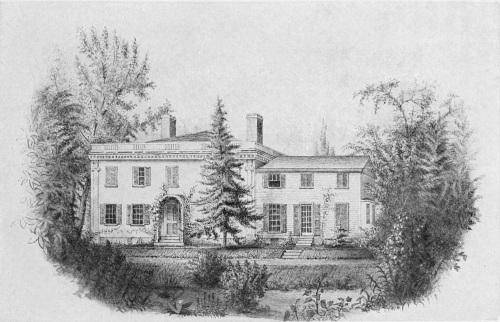
THE BOTANIC GARDEN HOUSE IN 1852
has enjoyed it much, except the drawback of not seeing Mrs. T. and the girls and yourself at home, which she greatly wished....
Now as to Exploring Expedition. We will talk it over in full when you come on here toward the end of this month.
Suffice it to say (as I am pressed for time) that I had made up my mind what I would do it for before I left home; that on looking over the collection, as to various parts of it, as far as time allowed, I found it less ample than I supposed, but with many difficulties owing to specimens in fruit only, or flower only. I think it no very awful job, if done in the way I propose, which is, not by monographs by people abroad, which the committee will not agree to, but by working up a part abroad in Hooker’s, or Bentham’s, or Garden of Plants herbarium.
The chairman of the committee and Wilkes behaved very well, and told me they were very desirous I should take it up.
On Friday evening Wilkes came in, before we went to the President’s; asked me to say what I would do. I told him at once what I would do (just what I had told J. before we left Cambridge), and Wilkes at once accepted my terms, as I supposed he would. My terms were based on the supposition that there is five years’ work in preparing for the press the collections left on hand, and in superintending the printing....
We must settle together the typographical form of the work, etc., when you come, and we will make the other writers conform to the plan we agree on, which perhaps you have already fixed.
Now I want a careful and active curator. What young botanist can I get?...
27th Nov., 1848.
Wright is up from Texas (with his mother at Wethersfield, Connecticut); he will soon be here as curator to me, taking Lesquereux’s[154] place, who has been with me a little, but now, as a consequence of his visit to Columbus, goes to aid Sullivant, with a provision that makes the truly worthy fellow perfectly happy. They will do up bryology at a great rate. Lesquereux says that the collection and library of Sullivant in muscology are “magnifique, superbe, the best he ever saw.”
TO GEORGE ENGELMANN.
January 24, 1849.
Halstead, I believe, has nearly decided to go on the Panama Railroad Survey; I trust to get Wright attached to the boundary survey. I have a letter from Fendler, in which he expressed his willingness to go to the Great Salt Lake country, if he can get government protection and food, etc. In a few days I shall write to Marcy; send him the sheets of “Plantæ Fendlerianæ,” and make a vigorous application for this aid. No doubt I shall get it, I think. But perhaps it might be almost as well for Fendler to go over with a party of emigrants directly to Mormon City. But probably there will be emigrants bound for the same place, accompanying the regiment, as near as they go. Fendler can do admirably well in that region, if he perseveres. But will he not take the gold-fever and leave us in the lurch? Will not living, etc., be very dear in Mormon City also? I fear it. I must leave. much to your discretion. Only if you think Fendler has a strong tendency to gold-hunting (which few could resist) let him go. And afterwards, if he chooses to collect plants, very well. Few can withstand the temptation when fairly within the infected region, and we hear the Mormons have found gold also....
February 25, 1849.
I have just received from the secretary of war, Mr. Marcy, and inclose to you, what I think will procure all the facilities that Fendler can wish from United States troops. If, as I was informed, the secretary has no right to issue an order for rations to Fendler, he has certainly done the best thing by issuing a recommendation which will, if the commander is favorably disposed, enable him to give all without any order. Indeed, I think we could ask nothing better....
In my haste, and multitude of business, I have shabbily neglected to send the copies of “Plantæ Fendlerianæ” to Hamburg for Braun. And now the Danes have blockaded the Elbe....
I think I shall soon send the smaller things to you by express, and retain the three volumes of “Memoirs” for some opportunity less expensive. We want railroad all the way to St. Louis.
I am crowded—overwhelmed—with work. But college work will be over in July, and the second volume of “Genera,” which I am now hard at work on, will soon be printed off; a week more and I shall have finished the copy.
I must then work at Exploring Expedition Compositæ, and soon at Fendlerianæ, and (when the sets arrive) at Lindheimer’s, if you wish. I have made a genus of the Texan Rue—between Ruta and Aplophyllum,—e. g., Rutosma. I think there are some good remarks you will like in the second volume of “Genera.”
I foresee an unusually good chance to get rid of the college work a year hence, and must therefore try to overhaul the Exploring Expedition plants, so as to get them into some shape, and next year (May or April) go abroad with them, sit down in London and Paris, and work them off. I will then drum up subscribers for Fendler and Lindheimer.
I want you to help me a little about Trees; our native trees up to Cornus inclusive, for this year, for the report I have promised the Smithsonian Institution.[155] I wish I had a good assistant; one who could work at botany. Perhaps I can find one abroad.
TO JOHN TORREY.
February 26, 1849.
Having determined on an expedition for Wright, you may be sure I was not going to be altogether disappointed. Accordingly I have got one all arranged (Lowell[156] and Greene subscribing handsomely) which is as much better than Emory’s as possible, and thus far everything has wonderfully conspired to favor it. Wright has left me this morning to go to his mother’s in Connecticut (Wethersfield); there to make his portfolios and presses; comes on to New York soon; takes first vessel for Galveston (I expect a letter from Hastings telling when it sails), and to reach Austin and Fredericksburg in time to accompany the troops that are about to be sent up, by a new road, across a new country, to El Paso, in New Mexico. Look on the map (Wislizenus) and you will see the region we mean him to explore this summer; the hot valley of Rio del Norte, early in the season, the mountains east, and especially those west in summer. He will probably stay two years, and get to Taos and Spanish Peaks this year or next. We shall have government recommendations to protection, and letters to an officer (commanding) who, through Henry, has already made overtures to collect himself or aid in the matter.
26th May, 1849.
I have finished all the copy of “Genera Illustrata,” vol. ii., at length; the printer has yet two or three sheets to set up. The plates are working off in New York. It will now soon be off my hands. It is long since I have done anything at Exploring Expedition plants. I am now going at them. It is a shabby, unsatisfactory collection....
Cambridge, November 2, 1849.
... Sorry I am that you could not be here while Harvey is here; he will he south by Christmas. He desires me to say that he expects to spend the first half of December in New York at Dr. Hosack’s, and will be most glad to see you. I am sure you will like him. We are perfectly charmed with him. A quiet, unaffected, pleasant man—extremely lovable. He works away at a table in my study. His course is a very interesting one. He is a beautiful writer, but not very fluent extempore, though with more practice he would be a fine lecturer. He has a good audience....
Sprague has promised now to take up and finish your quarto drawings. He says he can work but a little while at a time, from a difficulty of breathing. Had I foreseen his health and vigor giving way, I should not have undertaken the Trees, which, as to illustrations (as he is more fond of them than of anything else, and has made fine drawings), we have gradually enlarged our ideas about them much beyond the original plan, as to the figures. He must get this volume off his hands this winter, anyhow. The “Genera” will lie in abeyance....
My plan is only to bring out one volume of the Tree-Report next spring, and not to go beyond the limits of the United States proper, those of “Genera Illustrata,” except to mention the trees of the far West in a general way; otherwise it would be far too formidable....
Sir John Richardson dropped in on me the very day Harvey arrived, expressed regret he could not see you, learned here the rumored news of Franklin. I wish you could have been here at a little dinner party we made for them. He is at home by this time.
TO W. J. HOOKER.
December 3, 1849.
... We are glad to hear what fine discoveries your son is making in Thibet, etc.
I saw to-day for the first time, at Green’s, the Himalaya Rhododendrons....
I have just parted from Harvey, who has passed seven weeks with us, and having finished his course at the Lowell with much acceptance now joins his friends at New York and Philadelphia till Christmas, and then goes south to Florida, Alabama, and probably either to Jamaica (where Dr. Alexander now is) or to the mountains at the St. Iago end of Cuba, a terra incognita nearly. Harvey is a most winning man; my wife and I have become extremely attached to him, and are sorry to part with him.
We do not mean to let any naturalist be idle who comes to this country, so he is already engaged to give illustrations of our peculiar Algæ for the Smithsonian contributions and to prepare (after his return home, of course) a manual of United States Algæ after the fashion of his second edition of “British Algæ.” There will be no small demand for it....
P. S.—Mr. Wright got through to El Paso in southern New Mexico, and is on his way back, with, he says, a fine collection.
We got some fine daguerreotypes of Harvey, so much better, he says, than he has seen in England that he has had an extra one taken for Lady Hooker.
TO GEORGE BENTHAM.
Cambridge, January 7, 1850.
Your letter of December 4th and your very flattering article in the December number of “Hooker’s Journal” were both most gratifying; and the remarks on the Mimosa were timely, as I was just about consigning the manuscript of the earlier part of the new “Plantæ Lindheimerianæ” to the printer. I like what you say about “deduplication” much, and freely accept almost all. I took the name coined to my hand, not feeling at liberty to coin a new one. I think the production of new organs one before the other can be pretty well explained morphologically and anatomically, in accordance with your hint, and shall attempt to work it out in the third edition of my “Botanical Text-Book,” which I am now preparing for the press. I shall be most glad of any further hints.
May I ask you what you think of Adrien de Jussieu’s way of explaining the regular alternation of organs in the flower? I greatly incline to it....
I have to finish this Lindheimer collection, finish Fendler’s, distribute and study Wright’s collection when I get it, carry the “Botanical Text-Book” through the press, rewriting and expanding it (thus far I have made it all over), write the first volume of an elaborate report on the Trees of United States for the Smithsonian Institution, in fact a Sylva, with colored plates by Sprague (which I could not resist taking in hand, as that institution promised to bring it out, and handsomely, at their expense), and give my course of lectures in the college from March to June. When all this is done I can cross the Atlantic.... By engaging a brother professor to take the duties which I have for the autumn term (assigning to him pro rata from my salary), I shall be free until 1st March ensuing. But I mean to ask for leave of absence for a year, and trust I shall get it....
As far as it has yet shaped itself my plan is ... to sit down hard to work for the autumn and winter on the Exploring Expedition plants, to go to Paris in the spring and settle such questions as must be settled there after I come to know better than I now do (except in the Compositæ) what they are. Excepting the Oregon and Californian plants, which are assigned to Torrey, and the Sandwich Islands Collection, a fine one, the collection is a poor one, often very meagre in specimens, too much of an alongshore and roadside collection to be of great interest. I am not familiar with tropical forms and have no great love for them. I dislike to take the time to study out laboriously and guessingly, with incomplete specimens, and no great herbaria and libraries to refer to, these things which are mostly well known to botanists, though not to me, and I want to be taken off from North American botany for as short a time as possible. I must therefore come abroad with them, which the pay that is offered will enable me to do. I have found a good deal to interest me in the Compositæ, especially those of Rio Negro, of north Patagonia and of the Andes of Peru....
Now, will you take it as a bore, an imposition on your kindness, if I frankly ask whether I can possibly offer you any sort of inducement to aid me, at least so far as to run over the collections with me, and name those that are familiar to you as we pass, and refer others, as nearly as one can without study, to their proper places? Your mere comments in running through would save half my time.
It is most natural that you should not incline to any such trouble, and I know your hands are always full; so, if you say no, I shall feel it is quite right, and do the best I can....
We shall be most glad to visit you at Pontrilas house at whatever time best suits Mrs. Bentham and yourself, whether in summer or in autumn, any time before we settle down into our winter quarters....
With best wishes to Mrs. B. and yourself for the new year, I am very faithfully yours,
A. Gray.
TO W. J. HOOKER.
April 2, 1850.
We were most glad to receive your kind favor of January 29, which, however, lay over a fortnight in England, and in the mean time we heard not only of Dr. Hooker’s capture, but also, with much gratification, of his release. What an indefatigable man he is!
Finding myself greatly behindhand, on account of various hindrances and miscalculation of time, and utterly unable to accomplish half the work I had intended to do this spring, I have decided to break off; and to sail, in a packet-ship from Boston, on the 5th of June, with Mrs. Gray, for Liverpool, which we may hope to reach by the close of that month. This will give us an opportunity of seeing England in its summer dress, and to make, almost immediately following the sea voyage, a trip up the Rhine to Switzerland. On our return I must set to work diligently, and for a little while with Mr. Bentham, who has kindly offered to look over the tropical collections, which I know little of, and love as little.
The rewriting of all the structural parts of my 3d edition of the “Botanical Text-Book,” which I was inadvertently drawn into, has proved a most time-consuming business. It is not yet through the press.
Wright’s collection of seeds I had divided into two parts, and I send you one by the hands of Mr. Lowell, who with his whole family goes out by this steamer. You will receive them in good time to raise them....
Mr. Lowell is of great use to us, in helping on these explorations, and I look to his visit to Europe, the sight of the great collections, and the society of naturalists to strengthen his tastes and fire his zeal in these respects.
I long to have him and Mrs. Lowell, a very good. friend of ours, make your acquaintance.