VOLUME II. (continued 3)
A. J. W. (Alexander James William) Morrison translation
The celebration of my birthday consisted mainly in sending me several poems in the name of my commenced but unfinished works. Among these, one was distinguished above the rest. It was called the Birds. A deputation of these happy creatures being sent to a true friend earnestly entreat him to found at once and establish the kingdom so long promised to them. Not less obvious and playful were the allusions to my other unfinished pieces, so that, all at once, they again possessed a living interest for me, and I related to my friends the designs I had formed, and the entire plans. This gave rise to the expression of wishes and urgent requests, and gave the game entirely into Herder's hands, while he attempted to induce me to take back these papers, and, above all, to bestow upon the Iphigenia the pains it well deserved. The fragment which lies before me is rather a sketch than a finished piece; it is written in poetical prose, which occasionally falls into a sort of Iambical rhythm, and even imitates other syllabic metres. This, indeed, does great injury to the effect unless it is read well, and unless, by skilful turns, this defect is carefully concealed. He pressed this matter on me very earnestly, and as I concealed from him as well as the rest the great extent of my intended tour, and as he believed I had nothing more in view than a mountain trip, and as he was always ridiculing my geographical and mineralogical studies, he insisted I should act much wiser if, instead of breaking stones, I would put my hand to this work. I could not but give way to so many and well-meant remonstrances; but, as yet, I have had no opportunity to turn my attention to these matters. I now detach Iphigenia from the bundle and take her with me as my fellow-traveller into the beautiful and warm country of the South. The days are so long, and there will be nothing to disturb reflection, while the glorious objects of the surrounding scenery by no means depress the poetic nerve; indeed, assisted by movement and the free air, they rather stimulate and call it forth more quickly and more vividly.
FROM THE BRENNER TO VERONA.
Trent, morning of the 11th Sept.
After full fifty hours, passed in active and constant occupation, I reached here about 8 o'clock yesterday evening, and soon after retired to rest, so that I now find myself in condition to go on with my narrative. On the evening of the 9th, when I had closed the first portion of my diary, I thought I would try and draw the inn and post-house on the Brenner, just as it stood. My attempt was unsuccessful, for I missed the character of the place; I went home therefore in somewhat of an ill-humor. Mine host asked me if I would not depart, telling me it was moon-light and the best travelling. Although I knew perfectly well that, as he wanted his horses early in the morning to carry in the after-crop (Grummet), and wished to have them home again in time for that purpose, his advice was given with a view to his own interest, I nevertheless took it, because it accorded with my own inclination. The sun reappeared, the air was tolerable, I packed up, and started about 7 o'clock. The blue atmosphere triumphed over the clouds, and the evening was most beautiful.
Trent.
The postilion fell asleep, and the horses set off at a quick trot down-hill, always taking the well-known route. When they came to a village they went somewhat slower. Then the driver would wake up, and give them a fresh stimulus, and thus we descended at a good pace with high rocks on both sides of us, or by the banks of the rapid river Etsch. The moon arose and shed her light upon the massive objects around. Some mills, which stood between primæval pine-trees, over the foaming stream, seemed really everlasting.
When, at 9 o'clock, I had reached Sterzingen, they gave me clearly to understand, that they wished me off again. Arriving in Mittelwald, exactly at 12 o'clock, I found everybody asleep except the postilion, and we were obliged to go on to Brixen, where I was again taken off in like manner, so that at the dawn of day I was in Colman. The postilions drove so fast that there was neither seeing nor hearing, and although I could not help being sorry at travelling through this noble country with such frightful rapidity; and at night, too, as though I was flying the place, I nevertheless felt an inward joy, that a favorable wind blew behind me, and seemed to hurry me towards the object of my wishes. At day-break I perceived the first vineyard. A woman with pears and peaches met me, and thus we went on to Teutschen, where I arrived at 7 o'clock, and then was again hurried on. After I had again travelled northwards for a while, I at last saw in the bright sunshine the valley where Botzen is situated. Surrounded by steep and somewhat high mountains, it is open towards the south, and sheltered towards the north by the Tyrolese range. A mild, soft air pervaded the spot. Here the Etsch again winds towards the south. The hills at the foot of the mountain are cultivated with vines. The vinestocks are trained over long but low arbourwork; the purple grapes are gracefully suspended from the top, and ripen in the warmth of the soil, which is close beneath them. In the bottom of the valley, which for the most part consists of nothing but meadows, the vine is cultivated in narrow rows of similar festoons, at a little distance from each other, while between grows the Indian corn, the stalks of which at this time are high. I have often seen it ten feet high. The fibrous' male blossom is not yet cut off, as is the case when fructification has ceased for some time.
I came to Botzen in a bright sunshine. A good assemblage of mercantile faces pleased me much. Everywhere one sees the liveliest tokens. An existence full of purpose, and highly comfortable. In the square some fruit-women were sitting with round fiat baskets, above four feet in diameter, in which peaches were arranged side by side, so as to avoid pressure. Here I thought of a verse, which I had seen written on the window of the inn at Ratisbon:
Comme les pêches et les melons Sont pour la bouche d'un Baron, Ainsi les verges et les bâtons Sont pour les fous, dit Salomon.
It is obvious that this was written by a northern baron, and no less clear is it that if he were in this country, he would alter his notions.
At the Botzen fair a brisk silk-trade is carried on. Cloths are also brought here, and as much leather as can be procured from the mountain districts. Several merchants, however, came chiefly for the sake of depositing their money, taking orders, and opening new credits. I felt I could have taken great delight in examining the various products that were collected here; but the impulse, the state of disquiet, which keeps urging me from behind, would not let me rest, and I must at once hasten from the spot. For my consolation, however, the whole matter is printed in the statistical papers, and we can, if we require it, get such instructions from books. I have now to deal only with the sensible impressions, which no book or picture can give. In fact, I am again taking interest in the world, I am testing my faculty of observation, and am trying how far I can go with my science and my acquirements, how far my eye is clear and sharp, how much I can take in at a hasty glance, and whether those wrinkles, that are imprinted upon my heart, are ever again to be obliterated. Even in these few days, the circumstance that I have had to wait upon myself, and have always been obliged to keep my attention and presence of mind on the alert, has given me quite a new elasticity of intellect. I must now busy myself with the currency, must change, pay, note down, write, while I formerly did nothing but think, will, reflect, command, and dictate.
Botzen—Trent.
From Botzen to Trent the stage is nine leagues and runs through a valley, which constantly increases in fertility. All that merely struggles into vegetation on the higher mountains, has here more strength and vitality; the sun shines with warmth, and there is once more belief in a Deity.
A poor woman cried out to me to take her child into my vehicle, as the hot soil was burning its feet. I did her this little service out of honour to the strong light of heaven. The child was strangely decked out, but I could get nothing from it in any way.
The Etsch flows more gently in these parts, and it makes broad deposits of gravel in many places. On the land, near the river and up the hills, the planting is so thick and close, that one fancies one thing will suffocate the other. It is a regular thicket of vineyards, maize, mulberry trees, apples, pears, quinces, and nuts. The danewort (Attig) thrives luxuriantly on the walls. Ivy with solid stems runs up the rocks, on which it spreads itself; the lizards glide through the interstices, and whatever has life or motion here, reminds one of the most charming works of art. The braided top-knots of the women, the bared breasts and light jackets of the men, the fine oxen which you see driven home from market, the laden asses,—all combine to produce one of Heinrich Roos's animated pictures. And when evening draws on, and through the calmness of the air, a few clouds rest upon the mountains, rather standing than running against the sky, and, as immediately after sunset, the chirp of the grasshoppers begins to grow loud, one feels quite at home in the world, and not a mere exile. I am as reconciled to the place as if I were born and bred in it, and had now just returned from a whaling expedition to Greenland. Even the dust, which here as in our fatherland often plays about my wheels, and which has so long remained strange to me, I welcome as an old friend. The bell-like voice of the cricket is most piercing, and far from unpleasant. A cheerful effect is produced, when playful boys whistle against a field of such singers, and you almost fancy that the sound on each side is raised by emulation. The evening here is perfectly mild no less than the day.
If any one who lived in the South, or came from the South, heard my enthusiasm about these matters, he would consider me very childish. Ah, what I express here, I long ago was conscious of, while ruffling under an unkindly sky; and now I love to experience as an exception the happiness which I hope soon to enjoy as a regular natural necessity.
Trent, the evening of the 10th Sept.
I have wandered about the city, which has an old, not to say a very primitive look, though there are new and well-built houses in some of the streets. In the church there is a picture in which the assembled council of the Jesuits is represented, listening to a sermon delivered by the general of the order. I should like to know what he is trying to palm upon them. The church of these fathers may at once be recognised from the outside by pilasters of red marble on the façade. The doors are covered by a heavy curtain, which serves to keep off the dust. I raised it, and entered a small vestibule. The church itself is parted off by an iron grating, but so that it can be entirely overlooked. All was as silent as the grave, for divine service is no longer performed here. The front door stood open, merely because all churches must be open at the time of Vespers.
Trent.
While I stood considering the architecture, which was, I found, similar to other Jesuit churches, an old man stepped in, and at once took off his little black cap. His old faded black coat indicated that he was a needy priest. He knelt down before the grating, and rose again after a short prayer. When he turned round, he said to himself half-aloud: "Well, they have driven out the Jesuits, but they ought to have paid them the cost of the church. I know how many thousands were spent on the church and the seminary." As he uttered this he left the spot, and the curtain fell behind him. I, however, lifted it again, and kept myself quiet. He remained a while standing on the topmost step, and said: "The Emperor did not do it; the Pope did it." With his face turned towards the street, so that he could not observe me, he continued: "First the Spaniards, then we, then the French. The blood of Abel cries out against his brother Cain!" And thus he went down the steps and along the street, still talking to himself. I should conjecture he is one who, having been maintained by the Jesuits, has lost his wits in consequence of the tremendous fall of the order, and now comes every day to search the empty vessel for its old inhabitants, and, after a short prayer, to pronounce a curse upon their enemies.
A young man, whom I questioned about the remarkable sights in the town, showed me a house, which is called the "Devil's house," because the devil, who is generally too ready to destroy, is said to have built it in a single night, with stones rapidly brought to the spot. However, what is really remarkable about the house, the good man had not observed, namely, that it is the only house of good taste that I have yet seen in Trent, and was certainly built by some good Italian, at an earlier period. At 5 o'clock in the evening I again set off. The spectacle of yesterday evening was repeated, and at sun-set the grasshoppers again began to sing. For about a league the journey lies between walls, above which the grape-espaliers are visible. Other walls, which are not high enough, have been eked out with stones, thorns, &c., to prevent passengers from plucking off the grapes. Many owners sprinkle the foremost rows with lime, which renders the grapes uneatable, but does not hurt the wine, as the process of fermentation drives out the heterogeneous matter.
Evening of September 11.
I am now at Roveredo, where a marked distinction of language begins; hitherto, it has fluctuated between German and Italian. I have now, for the first time, had a thoroughly Italian postilion, the inn-keeper does not speak a word of German, and I must put my own linguistic powers to the test. How delighted I am that the language I have always most loved now becomes living—the language of common usage.
Torbole, 12th September (after dinner).
How much do I wish that my friends were with me for a moment to enjoy the prospect, which now lies before my eyes.
I might have been in Verona this evening but a magnificent natural phenomenon was in my vicinity—Lake Garda, a splendid spectacle, which I did not want to miss, and now I am nobly rewarded for taking this circuitous route. After 5 o'clock I started from Roveredo, up a side valley, which still pours its waters into the Etsch. After ascending this, you come to an immense rocky bar, which you must cross in descending to the lake. Here appeared the finest calcareous rocks for pictorial study. On descending you come to a little village on the northern end of the lake, with a little port, or rather landing-place, which is called Torbole. On my way upwards I was constantly accompanied by fig-trees, and, descending into the rocky atmosphere, I found the first olive-tree full of fruit. Here also, for the first time, I found as a common fruit those little white figs, which the Countess Lanthieri had promised me.
A door opens from the chamber in which I sit into the court-yard below. Before this I have placed my table, and taken a rough sketch of the prospect. The lake may be seen for its whole length, and it is only at the end, towards the left, that it vanishes from our eyes. The shore, which is inclosed on both sides by hill and mountain, shines with a countless number of little hamlets.
After midnight the wind blows from north to south, and he who wishes to go down the lake must travel at this time, for a few hours before sunset the current of air changes, and moves northward. At this time, the afternoon, it blows strongly against me, and pleasantly qualifies the burning heat of the sun. Volkmann teaches me that this lake was formerly called "Benacus," and quotes from Virgil a line in which it was mentioned:
"Fluctibus et fremiter resonans, Benace, marino."
This is the first Latin verse, the subject of which ever stood visibly before me, and now, in the present moment, when the wind is blowing stronger and stronger, and the lake casts loftier billows against the little harbour, it is just as true as it was hundreds of years ago. Much, indeed, has changed, but the wind still roars about the lake, the aspect of which gains even greater glory from a line of Virgil's.
The above was written in a latitude of 45° 50'.
I went out for a walk in the cool of the evening, and now I really find myself in a new country, surrounded by objects entirely strange. The people lead a careless, sauntering life. In the first place, the doors are without locks, but the host assured me that I might be quite at ease, even though all I had about me consisted of diamonds. In the second place, the windows are covered with oiled paper instead of glass. In the third place, an extremely necessary convenience is wanting, so that one comes pretty close to a state of nature. When I asked the waiter for a certain place, he pointed down into the court-yard: "Qui, abasso puo servirsi!" "Dove?" asked I. "Da per tutto, dove vuol," was the friendly reply. The greatest carelessness is visible everywhere, but still there is life and bustle enough. During the whole day there is a constant chattering and shrieking of the female neighbors, all have something to do at the same time. I have not yet seen an idle woman.
Lago Di Garda.
The host, with Italian emphasis, assured me, that he felt great pleasure in being able to serve me with the finest trout. They are taken near Torbole, where the stream flows down from the mountains, and the fish seeks a passage upwards. The Emperor farms this fishery for 10,000 gulden. The fish, which are large, often weighing fifty pounds, and spotted over the whole body to the head, are not trout, properly so called. The flavour, which is between that of trout and salmon, is delicate and excellent.
But my real delight is in the fruit.—in the figs, and in the pears, which must, indeed, be excellent, where citrons are already growing.
Evening of September 13.
At 3 o'clock this morning I started from Torbole, with a couple of rowers. At first the wind was so favorable that we put up a sail. The morning was cloudy but tine, and perfectly calm at day-break. We passed Limona, the mountain-gardens of which, laid out terrace-fashion, and planted with citron-trees, have a neat and rich appearance. The whole garden consists of rows of square white pillars placed at some distance from each other, and rising up the mountain in steps. On these pillars strong beams are laid, that the trees planted between them may be sheltered in the winter. The view of these pleasant objects was favored by a slow passage, and we had already passed Malsesine when the wind suddenly changed, took the direction usual in the day-time, and blew towards the north. Rowing was of little use against this superior power, and, therefore, we were forced to land in the harbour of Malsesine. This is the first Venetian spot on the eastern side of the lake. When one has to do with water we cannot say, "I will be at this or that particular place to-day." I will make my stay here as useful as I can, especially by making a drawing of the castle, which lies close to the water, and is a beautiful object. As I passed along I took a sketch of it.
Sept. 11th.
The wind, which blew against me yesterday, and drove me into the harbour of Malsesine, was the cause of a perilous adventure, which I got over with good humour, and the remembrance of which I still find amusing. According to my plan, I went early in the morning into the old castle, which having neither gate nor guard, is accessible to everybody. Entering the court-yard, I seated myself opposite to the old tower, which is built on and among the rocks. Here I had selected a very convenient spot for drawing;—a carved stone seat in the wall, near a closed door, raised some three or four feet high, such as we also find in the old buildings in our own country.
An incident at Malsesine.
I had not sat long before several persons entered the yard, and walked backwards and forwards, looking at me. The multitude increased, and at last so stood as completely to surround me. I remarked that my drawing had excited attention; however, I did not allow myself to be disturbed, but quietly continued my occupation. At last a man, not of the most prepossessing appearance, came up to me, and asked me what I was about. I replied that I was copying the old tower, that I might have some remembrance of Malsesine. He said that this was not allowed, and that I must leave off. As he said this in the common Venetian dialect, so that I understood him with difficulty, I answered, that I did not understand him at all. With true Italian coolness he took hold of my paper, and tore it, at the same time letting it remain on the pasteboard. Here I observed an air of dissatisfaction among the by-standers; an old woman in particular said that it was not right, but that the podestà ought to be called, who was the best judge of such matters. I stood upright on the steps, having my back against the door, and surveyed the assembly, which was continually increasing. The fixed eager glances, the good humoured expression of most of the faces, and all the other characteristics of a foreign mob, made the most amusing impression upon me. I fancied that I could see before me the chorus of birds, which, as Treufreund, I had often laughed at, in the Ettersburg theatre. This put me in excellent humour, and when the podestà came up with his actuary, I greeted him in an open manner, and when he asked me why I was drawing the fortification, modestly replied, that I did not look upon that wall as a fortification. I called the attention of him and the people to the decay of the towers and walls, and to the generally defenceless position of the place, assuring him that I thought I only saw and drew a ruin.
I was answered thus: "If it was only a ruin, what could there be remarkable about it?" As I wished to gain time and favour, I replied very circumstantially, that they must be well aware how many travellers visited Italy, for the sake of the ruins only, that Rome, the metropolis of the world, having suffered the depredations of barbarians, was now full of ruins, which had been drawn hundreds of times, and that all the works of antiquity were not in such good preservation as the amphitheatre at Verona, which I hoped soon to see.
The podestà, who stood before me, though in a less elevated position, was a tall man, not exactly thin, of about thirty years of age. The flat features of his spiritless face perfectly accorded with the slow constrained manner, in which he put his questions. Even the actuary, a sharp little fellow, seemed as if he did not know what to make of a case so new, and so unexpected. I said a great deal of the same sort; the people seemed to take my remarks good naturedly, and on turning towards some kindly female faces, I thought I could read assent and approval.
When, however, I mentioned the amphitheatre at Verona, which in this country, is called the "Arena," the actuary, who had in the meanwhile collected himself, replied, that this was all very well, because the edifice in question was a Roman building, famed throughout the world. In these towers, however, there was nothing remarkable, excepting that they marked the boundary between the Venetian domain and Austrian Empire, and therefore espionage could not be allowed. I answered by explaining at some length, that not only the Great and Roman antiquities, but also those of the Middle-Ages were worth attention. They could not be blamed, I granted, if, having been accustomed to this building from their youth upwards, they could not discern in it so many picturesque beauties as I did. Fortunately the morning sun, shed the most beautiful lustre on the tower, rocks, and walls, and I began to describe the scene with enthusiasm. My audience, however, had these much lauded objects behind them, and as they did not wish to turn altogether away from me, they all at once twisted their heads, like the birds, which we call "wry necks" (Wendehälse), that they might see with their eyes, what I had been lauding to their ears. Even the podestà turned round towards the picture I had been describing, though with more dignity than the rest. This scene appeared to me so ridiculous that my good humour increased, and I spared them nothing—least of all, the ivy, which had been suffered for ages to adorn the rocks and walls.
The actuary retorted, that this was all very good, but the Emperor Joseph was a troublesome gentleman, who certainly entertained many evil designs against Venice; and I might probably have been one of his subjects, appointed by him, to act as a spy on the borders.
"Far from belonging to the Emperor," I replied, "I can boast, as well as you, that I am a citizen of a republic, which also governs itself, but which is not, indeed, to be compared for power and greatness to the illustrious state of Venice, although in commercial activity, in wealth, and in the wisdom of its rulers, it is inferior to no state in Germany. I am a native of Frankfort-on-the-Main, a city, the name and fame of which has doubtless reached you."
An incident at Malsesine.
"Of Frankfort-on-the-Main!" cried a pretty young woman, "then, Mr. Podestà, you can at once see all about the foreigner, whom I look upon as an honest man. Let Gregorio be called; he has resided there a long time, and will be the best judge of the matter."
The kindly faces had already increased around me, the first adversary had vanished, and when Gregorio came to the spot, the whole affair took a decided turn in my favor. He was a man upwards of fifty, with one of those well-known Italian faces. He spoke and conducted himself like one, who feels that something foreign is not foreign to him, and told me at once that he had seen service in Bolongari's house, and would be delighted to hear from me something about this family and the city in general, which had left a pleasant impression in his memory. Fortunately his residence at Frankfort had been during my younger years, and I had the double advantage of being able to say exactly how matters stood in his time, and what alteration had taken place afterwards. I told him about all the Italian families, none of whom had remained unknown to me. With many particulars he was highly delighted, as, for instance, with the fact that Herr Alessina had celebrated his "golden wedding,"[2] in the year 1774, and that a medal had been struck on the occasion, which was in my possession. He remembered that the wife of this wealthy merchant was by birth a Brentano. I could also tell him something about the children and grand-children of these families, how they had grown up, and had been provided for and married, and had multiplied themselves in their descendants.
When I had given the most accurate information about almost everything which he asked, his features alternately expressed cheerfulness and solemnity. He was pleased and touched, while the people cheered up more and more, and could not hear too much of our conversation, of which—it must be confessed—he was obliged to translate a part into their own dialect.
At last he said: "Podestà, I am convinced that this is a good, accomplished, and well-educated gentleman, who is travelling about to acquire instruction. Let him depart in a friendly manner, that he may speak well of us to his fellow-countrymen, and induce them to visit Malsesine, the beautiful situation of which is well worthy the admiration of foreigners. I gave additional force to these friendly words by praising the country, the situation, and the inhabitants, not forgetting to mention the magistrates as wise and prudent personages."
This was well received, and I had permission to visit the place at pleasure, in company with Master Gregorio. The landlord, with whom I had put up, now joined us, and was delighted at the prospect of the foreign guests, who would crowd upon him, when once the advantages of Malsesine were properly known. With the most lively curiosity he examined my various articles of dress, but especially envied me the possession of a little pistol, which slipped conveniently into the pocket. He congratulated those who could carry such pretty weapons, this being forbidden in his country under the severest penalties. This friendly but obtrusive personage I sometimes interrupted to thank my deliverer. "Do not thank me," said honest Gregorio, "for you owe me nothing. If the Podestà had understood his business, and the Actuary had not been the most selfish man in the world, you would not have got off so easily. The former was still more puzzled than you, and the latter would have pocketed nothing by your arrest, the information, and your removal to Verona. This he rapidly thought over, and you were already free, before our dialogue was ended."
Towards the evening the good man took me into his vineyard, which was very well situated, down along the lake. We were accompanied by his son, a lad of fifteen, who was forced to climb the trees, and pluck me the best fruit, while the old man looked out for the ripest grapes.
While thus placed between these two kindhearted people, both strange to the world, alone, as it were, in the deep solitude of the earth, I felt, in the most lively manner, as I reflected on the day's adventure, what a whimsical being Man is—how the very thing, which in company he might enjoy with ease and security, is often rendered troublesome and dangerous, from his notion, that he can appropriate to himself the world and its contents after his own peculiar fashion.
Towards midnight my host accompanied me to the barque, carrying the basket of fruit with which Gregorio had presented me, and thus, with a favorable wind, I left the shore, which had promised to become a Læstrygonicum shore to me.
Lago Di Garda.
And now for my expedition on the lake. It ended happily, after the noble aspect of the water, and of the adjacent shore of Brescia had refreshed my very heart. On the western side, where the mountains cease to be perpendicular, and near the lake, the land becomes more flat, Garignano, Bojaco, Cecina, Toscolan, Maderno, Verdom, and Salo, stand all in a row, and occupy a reach of about a league and a half; most of them being built in long streets. No words can express the beauty of this richly inhabited spot. At 10 o'clock in the morning I landed at Bartolino, placed my luggage on one mule and myself on another. The road went now over a ridge, which separates the valley of the Etsch from the hollow of the lake. The primæval waters seem to have driven against each other from both sides, in immense currents, and to have raised this colossal dam of gravel. A fertile soil was deposited upon the gravel at a quieter period, but the labourer is constantly annoyed by the appearance of the stones on the surface. Every effort is made to get rid of them, they are piled in rows and layers one on another, and thus a sort of thick wall is formed along the path. The mulberry-trees, from a want of moisture, have a dismal appearance at this elevation. Springs there are none. From time to time puddles of collected rain-water may be found, with which the mules and even their drivers quench their thirst. Some wheels are placed on the river beneath, to water, at pleasure, those plantations that have a lower situation.
The magnificence of the new country, which opens on you as you descend, surpasses description. It is a garden a mile long and broad, which lies quite flat at the foot of tall mountains and steep rocks, and is as neatly laid out as possible. By this way, about 1 o'clock on the 10th of September, I reached Verona, where I first write this, finish, and put together the first part of my diary, and indulge in the pleasing hope of seeing the amphitheatre in the evening.
Concerning the weather of these days I have to make the following statement:—The night from the 9th to the 10th was alternately clear and cloudy, the moon had always a halo round it. Towards 5 o'clock in the morning all the sky was overcast with gray, not heavy clouds, which vanished with the advance of day. The more I descended the finer was the weather. As at Botzen the great mass of the mountains took a northerly situation, the air displayed quite another quality. From the different grounds in the landscape, which were separated from each other in the most picturesque manner, by a tint more or less blue, it might be seen, that the atmosphere was full of vapors equally distributed, which it was able to sustain, and which, therefore, neither fell in the shape of dew, nor were collected in the form of clouds. As I descended further I could plainly observe, that all the exhalations from the Botzen valley, and all the streaks of cloud which ascended from the more southern mountains, moved towards the higher northern regions, which they did not cover, but veiled with a kind of yellow fog. In the remotest distance, over the mountains, I could observe what is called a "water-gull." To the south of Botzen they have had the finest weather all the summer, only a little water (they say aqua to denote a light rain), from time to time, and then a return of sunshine. Yesterday a few drops occasionally fell, and the sun throughout continued shining. They have not had so good a year for a long while; everything turns out well; the bad weather they have sent to us.
I mention but slightly the mountains and the species of stone, since Ferber's travels to Italy, and Hacquet's journey along the Alps, give sufficient information respecting this district. A quarter of a league from the Brenner, there is a marble quarry, which I passed at twilight. It may, nay, must lie upon mica-slate as on the other side. This I found near Colman, just as it dawned; lower down there was an appearance of porphyry. The rocks were so magnificent, and the heaps were so conveniently broken up along the highway, that a "Voigt" cabinet might have been made and packed up at once. Without any trouble of that kind I can take a piece, if it is only to accustom my eyes and my curiosity to a small quantity. A little below Colman, I found some porphyry, which splits into regular plates, and between Brandrol and Neumark some of a similar kind, in which, however, the laminæ separated in pillars. Ferber considered them to be volcanic productions, but that was fourteen years ago, when all the world had its head on fire. Even Hacquet ridicules the notion.
From Brenner to Verona.
Of the people I can say but little, and that is not very favorable. On my descent from the Brenner, I discovered, as soon as day came, a decided change of form, and was particularly displeased by the pale brownish complexion of the women. Their features indicated wretchedness, the children looked equally miserable;—the men somewhat better. I imagine that the cause of this sickly condition may be found in the frequent consumption of Indian corn and buckwheat. Both the former, which they also call "Yellow Blende," and the latter, which is called "Black Blende," is ground, made into a thick pap with water, and thus eaten. The Germans on this side, pull out the dough, and fry it in butter. The Italian Tyrolese, on the contrary, eat it just as it is, often with scrapings of cheese, and do not taste meat throughout the year. This necessarily glues up and stops the alimentary channels, especially with the women and children, and their cachectic complexion is an indication of the malady. They also eat fruit and green beans, which they boil down in water, and mix with oil and garlic. I asked if there were no rich peasants. "Yes, indeed," was the reply. "Don't they indulge themselves at all? don't they eat anything better?" "No, they are used to it." "What do they do with their money then? how do they lay it out?" "Oh, they have their ladies, who relieve them of that." This is the sum and substance of a conversation with mine host's daughter at Botzen.
I also learned from her, that the vine-tillers were the worst off, although they appeared to be the most opulent, for they were in the hands of commercial towns-people, who advanced them enough to support life in the bad seasons, and in winter took their wine at a low price. However, it is the same thing everywhere.
My opinion concerning the food is confirmed by the fact, that the women who inhabit the towns appear better and better. They have pretty plump girlish faces, the body is somewhat too short in proportion to the stoutness, and the size of the head, but sometimes the countenances have a most agreable expression. The men we already know through the wandering Tyrolese. In the country their appearance is less fresh than that of the women, perhaps because the latter have more bodily labour, and are more in motion, while the former sit at home as traders and workmen. By the Garda Lake I found the people very brown, without the slightest tinge of red in their cheeks; however they did not look unhealthy, but quite fresh and comfortable. Probably the burning sunbeams, to which they are exposed at the foot of their mountains, are the cause of their complexion.
FROM VERONA TO VENICE.
Verona, Sept. 16th.
Well then, the amphitheatre is the first important monument of the old times that I have seen—and how well it is preserved! When I entered, and still more when I walked round the edge of it at the top, it seemed strange to me, that I saw something great, and yet, properly speaking, saw nothing. Besides I do not like to see it empty, I should like to see it full of people, just as, in modern times, it was filled up in honour of Joseph I. and Pius VI. The Emperor, although his eye was accustomed to human masses, must have been astonished. But it was only in the earliest times, that it produced its full effect, when the people was more a people than it is now. For, properly speaking, such an amphitheatre is constructed to give the people an imposing view of itself,—to cajole itself.
When anything worth seeing occurs on the level ground, and any one runs to the spot, the hindermost try by every means to raise themselves above the foremost; they get upon benches, roll casks, bring up vehicles, lay planks in every direction, occupy the neighbouring heights, and a crater is formed in no time.
If the spectacle occur frequently on the same spot, light scaffoldings are built for those who are able to pay, and the rest of the multitude must get on as it can. Here the problem of the architect is to satisfy this general want. By means of his art he prepares such a crater, making it as simple as possible, that the people itself may constitute the decoration. When the populace saw itself so assembled, it must have been astonished at the sight, for whereas it was only accustomed to see itself running about in confusion, or to find itself crowded together without particular rule or order, so must this many-headed, many-minded, wandering animal now see itself combined into a noble body, made into a definite unity, bound and secured into a mass, and animated as one form by one mind. The simplicity of the oval is most pleasingly obvious to every eye, and every head serves as a measure to show the vastness of the whole. Now we see it empty, we have no standard, and do not know whether it is large or small.
Verona.
The Veronese deserve commendation for the high preservation in which this edifice is kept. It is built of a reddish marble, which has been affected by the atmosphere, and hence the steps which have been eaten, are continually restored, and look almost all new. An inscription makes mention of one Hieronymus Maurigenus, and of the incredible industry, which he has expended on this monument. Of the outer wall only a piece remains, and I doubt whether it was ever quite finished. The lower arches, which adjoin the large square, called "Il Bra," are let out to workmen, and the reanimation of these arcades produces a cheerful appearance.
Verona, Sept. 16.
The most beautiful gate, which, however, always remains closed, is called "Porta stupa," or "del Pallio." As a gate, and considering the great distance from which it is first seen, it is not well conceived, and it is not till we come near it, that we recognise the beauty of the structure.
All sorts of reasons are given to account for its being closed. I have, however, a conjecture of my own. It was manifestly the intention of the artist to cause a new Corso to be laid out from this gate, for the situation, or the present street, is completely wrong. On the left side there is nothing but barracks; and the line at right angles from the middle of the gate leads to a convent of nuns, which must certainly have come down. This was presently perceived, and besides the rich and higher classes might not have liked to settle in the remote quarter. The artist perhaps died, and therefore the door was closed, and so an end was put to the affair.
Verona, Sept. 16.
The portico of the theatre, consisting of six large Ionic columns, looks handsome enough. So much the more puny is the appearance of the Marchese di Maffei's bust, which as large as life, and in a great wig, stands over the door, and in front of a painted niche, which is supported by two Corinthian columns. The position is honorable, but to be in some degree proportionate to the magnitude and solidity of the columns, the bust should have been colossal. But now placed as it is on a corbel, it has a mean appearance, and is by no means in harmony with the whole.
The gallery, which incloses the fore-court, is also small, and the channelled Doric dwarfs have a mean appearance by the side of the smooth Ionic giants. But we pardon this discrepancy on account of the fine institution, which has been founded among the columns. Here is kept a number of antiquities, which have mostly been dug up in and about Verona. Something, they say, has even been found in the Amphitheatre. There are Etruscan, Greek, and Roman specimens, down to the latest times, and some even of more modern date. The bas-reliefs are inserted in the walls, and provided with the numbers, which Maffei gave them, when he described them in his work: "Verona illustrata." There are altars, fragments of columns, and other relics of the sort; an admirable tripod of white marble, upon which there are genii occupied with the attributes of the gods. Raphael has imitated and improved this kind of thing in the scrolls of the Farnesina.
The wind which blows from the graves of the ancients, comes fragrantly over hills of roses. The tombs give touching evidences of a genuine feeling, and always bring life back to us. Here is a man, by the side of his wife, who peeps out of a niche, as if it were a window. Here are father and mother, with their son between them, eyeing each other as naturally as possible. Here a couple are grasping each other's hands. Here a father, resting on his couch, seems to be amused by his family. The immediate proximity of these stones was to me highly touching. They belong to a later school of art, but are simple, natural, and generally pleasing. Here a man in armour is on his knees in expectation of a joyful resurrection. With more or less of talent the artist has produced the mere simple presence of the persons, and has thus given a permanent continuation to their existence. They do not fold their hands, they do not look towards heaven, but they are here below just what they were and just what they are. They stand together, take interest in each other, love one another, and this is charmingly expressed on the stone, though with a certain want of technical skill. A marble pillar, very richly adorned, gave me more new ideas.
Verona.
Laudable as this institution is, we can plainly perceive that the noble spirit of preservation, by which it was founded, is no longer continued. The valuable tripod will soon be ruined, placed as it is in the open air, and exposed to the weather towards the west. This treasure might easily be preserved in a wooden case.
The palace of the Proveditore, which is begun, might have afforded a fine specimen of architecture, if it had been finished. Generally speaking, the nobili build a great deal, but unfortunately every one builds on the site of his former residence, and often, therefore, in narrow lanes. Thus, for instance, a magnificent façade to a seminary is now building in an alley of tire remotest suburb.
While, with a guide, whom I had accidentally picked up, I passed before the great solemn gate of a singular building, he asked me good-humouredly, whether I should not like to step into the court for a while. It was the palace of justice, and the court, on account of the height of the building, looked only like an enormous wall. Here, he told me, all the criminals and suspicious persons are confined. I looked around, and saw that round all the stories there were open passages' fitted with iron balustrades, which passed by numerous doors. The prisoner, as he stepped out of his dungeon to be led to trial, stood in the open air, and was exposed to the gaze of all passers, and because there were several trial-rooms, the chains were rattling, now over this, now over that passage, in every story. It was a hateful sight, and I do not deny that the good humour, with which I had dispatched my "Birds," might here have come into a strait.
I walked at sunset upon the margin of the crater-like amphitheatre, and enjoyed the most splendid prospect over the town and the surrounding country. I was quite alone, and multitudes of people were passing below me on the hard stones of the Bra; men of all ranks, and women of the middle-ranks were walking. The latter in their black outer garments look, in this bird's-eye view, like so many mummies.
The Zendale and the Veste, which serves this class in the place of an entire wardrobe, is a costume completely fitted for a people that does not care much for cleanliness, and yet always likes to appear in public, sometimes at church, sometimes on the promenade. The Veste is a gown of black taffeta, which is thrown over other gowns. If the lady has a clean white one beneath, she contrives to lift up the black one on one side. This is fastened on so, as to cut the waist, and to cover the lappets of a corset, which may be of any colour. The Zendale is a large hood with long ears; the hood itself is kept high above the head by a wire-frame, while the ears are fastened round the body like a scarf, so that the ends fall down behind.
Verona, Sept. 16.
When I again left the Arena to-day, I came to a modern public spectacle, about a thousand paces from the spot. Four noble Veronese were playing ball against four people of Vicenza. This pastime is carried on among the Veronese themselves all the year round, about two hours before night. On this occasion there was a far larger concourse of people than usual, on account of the foreign adversaries. The spectators seem to have amounted to four or five thousand. I did not see women of any rank.
When, a little while ago, I spoke of the necessities of the multitude in such a case, I described the natural accidental amphitheatre as arising just in the manner, in which I saw the people raised one over another on this occasion. Even at a distance I could hear the lively clapping of hands, which accompanied every important stroke. The game is played as follows: Two boards, slightly inclined, are placed at a convenient distance from each other. He who strikes off the ball stands at the higher end, his right hand is armed with a broad wooden ring, set with spikes. While another of his party throws the ball to him, he runs down to meet it, and thus increases the force of the blow with which he strikes it. The adversaries try to beat it back, and thus it goes backwards and forwards till, at last, it remains on the ground. The most beautiful attitudes, worthy of being imitated in marble, are thus produced. As there are none but well-grown active young people, in a short, close, white dress, the parties are only distinguished by a yellow mark. Particularly beautiful is the attitude into which the man on the eminence falls, when he runs down the inclined plain, and raises his arm to strike the ball;—it approaches that of the Borghesian gladiator.
It seemed strange to me that they carry on this exercise by an old lime-wall, without the slightest convenience for spectators; why is it not done in the amphitheatre, where there would be such ample room?
Verona, September 17.
What I have seen of pictures I will but briefly touch upon, and add some remarks. I do not make this extraordinary tour for the sake of deceiving myself, but to become acquainted with myself by means of these objects. I therefore honestly confess that of the painter's art—of his manipulation, I understand but little. My attention, and observation, can only be directed to the practical part, to the subject, and the general treatment of it.
Verona.
S. Georgio is a gallery of good pictures, all altar-pieces, and all remarkable, if not of equal value. But what subjects were the hapless artists obliged to paint? And for whom? Perhaps a shower of manna thirty feet long, and twenty feet high, with the miracle of the loaves as a companion. What could be made of these subjects? Hungry men falling on little grains, and a countless multitude of others, to whom bread is handed. The artists have racked their invention in order to get something striking out of such wretched subjects. And yet, stimulated by the urgency of the case, genius has produced some beautiful things. An artist, who had to paint S. Ursula with the eleven thousand virgins, has got over the difficulty cleverly enough. The saint stands in the foreground, as if she had conquered the country. She is very noble, like an Amazonia's virgin, and without any enticing charms; on the other hand, her troop is shown descending from the ships, and moving in procession at a diminishing distance. The Assumption of the Virgin, by Titian, in the dome, has become much blackened, and it is a thought worthy of praise that, at the moment of her apotheosis, she looks not towards heaven, but towards her friends below.
In the Gherardini Gallery I found some very fine things by Orbitto, and for the first time became acquainted with this meritorious artist. At a distance we only hear of the first artists, and then we are often contented with names only; but when we draw nearer to this starry sky, and the luminaries of the second and third magnitude also begin to twinkle, each one coming forward and occupying his proper place in the whole constellation, then the world becomes wide, and art becomes rich. I must here commend the conception of one of the pictures. Sampson has gone to sleep in the lap of Dalilah, and she has softly stretched her hand over him to reach a pair of scissors, which lies near the lamp on the table. The execution is admirable. In the Canopa Palace I observed a Danäe.
The Bevilagua Palace contains the most valuable things. A picture by Tintoretto, which is called a "Paradise," but which, in fact, represents the Coronation of the Virgin Mary as Queen of Heaven, in the presence of all the patriarchs, prophets, apostles, saints, angels, &c., affords an opportunity for displaying all the riches of the most felicitous genius. To admire and enjoy all that care of manipulation, that spirit and variety of expression, it is necessary to possess the picture, and to have it before one all one's life. The painter's work is carried on ad infinitum,; even the farthest angels' heads, which are vanishing in the halo, preserve something of character. The largest figures may be about a foot high; Mary, and the Christ who is crowning her, about four inches. Eve is, however, the finest woman in the picture; a little voluptuous, as from time immemorial.
A couple of portraits by Paul Veronese have only increased my veneration for that artist. The collection of antiquities is very fine; there is a son of Niobe extended in death, which is highly valuable; and the busts, including an Augustus with the civic crown, a Caligula, and others, are mostly of great interest, notwithstanding the restoration of the noses.
It lies in my nature to admire, willingly and joyfully, all that is great and beautiful, and the cultivation of this talent, day after day, hour after hour, by the inspection of such beautiful objects, produces the happiest feelings.
Verona.
In a land, where we enjoy the days but take especial delight in the evenings, the time of nightfall is highly important. For now work ceases; those who have gone out walking turn back; the father wishes to have his daughter home again; the day has an end. What the day is we Cimmerians hardly know. In our eternal mist and fog it is the same thing to us, whether it be day or night, for how much time can we really pass and enjoy in the open air? Now, when night sets in, the day, which consisted of a morning and an evening, is decidedly past, four and twenty hours are gone, the bells ring, the rosary is taken in hand, and the maid, entering the chamber with the lighted lamp, says, "felicissima notte." This epoch varies with every season, and a man who lives here in actual life cannot go wrong, because all the enjoyments of his existence are regulated not by the nominal hour, but by the time of day. If the people were forced to use a German clock they would be perplexed, for their own is intimately connected with their nature. About an hour and a half, or an hour before midnight, the nobility begin to ride out. They proceed to the Piazza della Bra, along the long, broad street to the Porta Nuova out at the gate, and along the city, and when night sets in, they all return home. Sometimes they go to the churches to say their Ave Maria della sera: sometimes they keep on the Bra, where the cavaliers step up to the coaches and converse for a while with the ladies. The foot passengers remain till a late hour of night, but I have never stopped till the last. To-day just enough rain had fallen to lay the dust, and the spectacle was most cheerful and animated.
That I may accommodate myself the better to the custom of the country I have devised a plan for mastering more easily the Italian method of reckoning the hours. The accompanying diagram may give an idea of it. The inner circle denotes our four and twenty hours, from midnight to midnight, divided into twice twelve, as we reckon, and as our clocks indicate. The middle circle shows how the clocks strike at the present season, namely, as much as twelve twice in the twenty-four hours, but in such a way that it strikes one, when it strikes eight with us, and so on till the number twelve is complete. At eight o'clock in the morning according to our clock it again strikes one, and so on. Finally the outer circle shows how the four and twenty hours are reckoned in actual life. For example, I hear seven o'clock striking in the night, and know that midnight is at five o'clock; I therefore deduct the latter number from the former, and thus have two hours after midnight. If I hear seven o'clock strike in the day-time, and know that noon is at five, I proceed in the same way, and thus have two in the afternoon. But if I wish to express the hour according to the fashion of this country, I must know that noon is seventeen o'clock; I add the two, and get nineteen o'clock. When this method is heard and thought of for the first time, it seems extremely confused and difficult to manage, but we soon grow accustomed to it and find the occupation amusing. The people themselves take delight in this perpetual calculation, just as children are pleased with easily surmounted difficulties. Indeed they always have their fingers in the air, make any calculation in their heads, and like to occupy themselves with figures. Besides to the inhabitant of the country the matter is so much the easier, as he really does not trouble himself about noon and midnight, and does not, like the foreign resident, compare two clocks with each other. They only count from the evening the hours, as they strike, and in the day-time they add the number to the varying number of noon, with which they are acquainted. The rest is explained by the remarks appended to the diagram:—
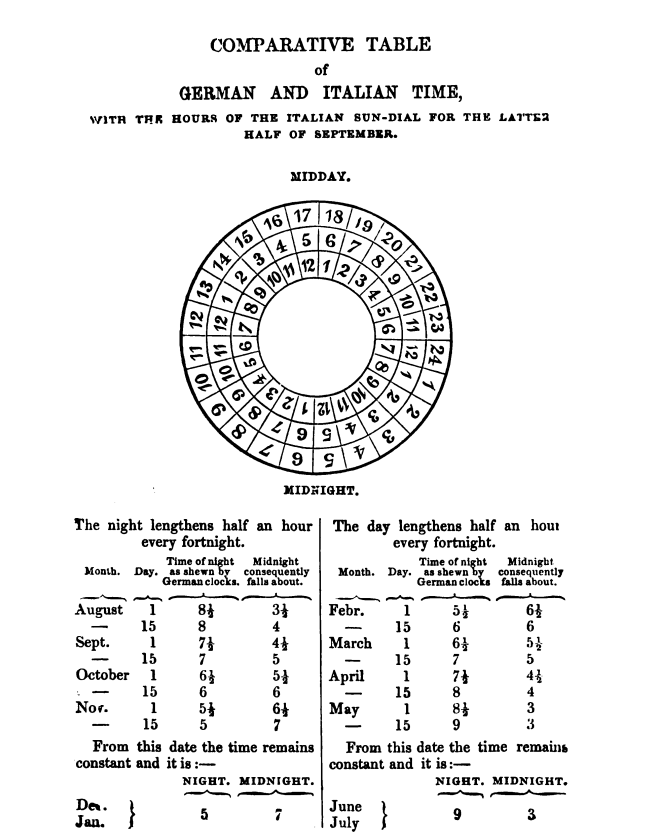
Verona, Sept. 17.
The people here jostle one another actively enough; the narrow streets, where shops and workmen's stalls are thickly crowded together, have a particularly cheerful look. There is no such thing as a door in front of the shop or workroom; the whole breadth of the house is open, and one may see all that passes in the interior. Half-way out into the path, the tailors are sewing; and the cobblers are pulling and rapping; indeed the work-stalls make a part of the street. In the evening, when the lights are burning, the appearance is most lively.
The squares are very full on market days; there are fruit and vegetables without number, and garlic and onions to the heart's desire. Then again throughout the day there is a ceaseless screaming, bantering, singing, squalling, huzzaing, and laughing. The mildness of the air, and the cheapness of the food, make subsistence easy. Everything possible is done in the open air.
At night singing and all sorts of noises begin. The ballad of "Marlbrook" is heard in every street;—then comes a dulcimer, then a violin. They try to imitate all the birds with a pipe. The strangest sounds are heard on every side. A mild climate can give this exquisite enjoyment of mere existence, even to poverty, and the very shadow of the people seems respectable.
The want of cleanliness and convenience, which so much strikes us in the houses, arises from the following cause:—the inhabitants are always out of doors, and in their light-heartedness think of nothing. With the people all goes right, even the middle-class man just lives on from day to day, while the rich and genteel shut themselves up in their dwellings, which are not so habitable as in the north. Society is found in the open streets. Fore-courts and colonnades are all soiled with filth, for things are done in the most natural manner. The people always feel their way before them. The rich man may be rich, and build his palaces; and the nobile may rule, but if he makes a colonnade or a fore-court, the people will make use of it for their own occasions, and have no more urgent wish than to get rid as soon as possible, of that which they have taken as often as possible. If a person cannot bear this, he must not play the great gentleman, that is to say, he must act as if a part of his dwelling belonged to the public. He may shut his door, and all will be right. But in open buildings the people are not to be debarred of their privileges, and this, throughout Italy, is a nuisance to the foreigner.
To-day I remarked in several streets of the town, the customs and manners of the middle-classes especially, who appear very numerous and busy. They swing their arms as they walk. Persons of a high rank, who on certain occasions wear a sword, swing only one arm, being accustomed to hold the left arm still.
Although the people are careless enough with respect to their own wants and occupations, they have a keen eye for everything foreign. Thus in the very first days, I observed that every one took notice of my boots, because here they are too expensive an article of dress to wear even in winter. Now I wear shoes and stockings nobody looks at me. Particularly I noticed this morning, when all were running about with flowers, vegetables, garlic, and other market-stuff, that a twig of cypress, which I carried in my hand, did not escape them. Some green cones hung upon it, and I held in the same hand some blooming caper-twigs. Everybody, large and small, watched me closely, and seemed to entertain some whimsical thought.
Verona-Vicenza.
I brought these twigs from the Giusti garden, which is finely situated, and in which there are monstrous cypresses, all pointed up like spikes into the air. The Taxus, which in northern gardening we find cut to a sharp point, is probably an imitation of this splendid natural product. A tree, the branches of which, the oldest as well as the youngest, are striving to reach heaven,—a tree which will last its three hundred years, is well worthy of veneration. Judging from the time when this garden was laid out, these trees have already attained that advanced age.
Vicenza, Sept. 19.
The way from Verona hither is very pleasant: we go north-eastwards along the mountains, always keeping to the left the foremost mountains, which consist of sand, lime, clay, and marl; the hills which they form, are dotted with villages, castles, and houses. To the right extends the broad plain, along which the road goes. The straight broad path, which is in good preservation, goes through a fertile field; we look into deep avenues of trees, up which the vines are trained to a considerable height, and then drop down, like pendant branches. Here we can get an admirable idea of festoons! The grapes are ripe, and are heavy on the tendrils, which hang down long and trembling. The road is filled with people of every class and occupation, and I was particularly pleased by some carts, with low solid wheels, which, with teams of fine oxen, carry the large vats, in which the grapes from the vineyards are put and pressed. The drivers rode in them when they were empty, and the whole was like a triumphal procession of Bacchanals. Between the ranks of vines the ground is used for all sorts of grain, especially Indian corn and millet (Sörgel).
As one goes towards Vicenza, the hills again rise from north to south and enclose the plain; they are, it is said, volcanic. Vicenza lies at their foot, or if you will, in a bosom which they form.
Vicenza, Sept. 19.
Though I have been here only a few hours, I have already run through the town, and seen the Olympian theatre, and the buildings of Palladio. A very pretty little book is published here, for the convenience of foreigners, with copper-plates and some letter-press, that shows knowledge of art. When once one stands in the presence of these works, one immediately perceives their great value, for they are calculated to fill the eye with their actual greatness and massiveness, and to satisfy the mind by the beautiful harmony of their dimensions, not only in abstract sketches, but with all the prominences and distances of perspective. Therefore I say of Palladio: he was a man really and intrinsically great, whose greatness was outwardly manifested. The chief difficulty with which this man, like all modern architects, had to struggle, was the suitable application of the orders of columns to buildings for domestic or public use; for there is always a contradiction in the combination of columns and walls. But with what success has he not worked them up together! What an imposing effect has the aspect of his edifices: at the sight of them one almost forgets that he is attempting to reconcile us to a violation of the rules of his art. There is, indeed, something divine about his designs, which may be exactly compared to the creations of the great poet, who, out of truth and falsehood elaborates something between both, and charms us with its borrowed existence.
Vicenza.
The Olympic theatre is a theatre of the ancients, realized on a small scale, and indescribably beautiful. However, compared with our theatres, it reminds me of a genteel, rich, well-bred child, contrasted with a shrewd man of the world, who, though he is neither so rich, nor so genteel, and well-bred, knows better how to employ his resources.
If we contemplate, on the spot, the noble buildings which Palladio has erected, and see how they are disfigured by the mean filthy necessities of the people, how the plans of most of them exceeded the means of those who undertook them, and how little these precious monuments of one lofty mind are adapted to all else around, the thought occurs, that it is just the same with everything else; for we receive but little thanks from men, when we would elevate their internal aspirations, give them a great idea of themselves, and make them feel the grandeur of a really noble existence. But when one cajoles them, tells them tales, and helping them on from day to day, makes them worse, then one is just the man they like; and hence it is that modern times take delight in so many absurdities. I do not say this to lower my friends, I only say that they are so, and that people must not be astonished to find everything just as it is.
How the Basilica of Palladio looks by the side of an old castellated kind of a building, dotted all over with windows of different sizes (whose removal, tower and all, the artist evidently contemplated),—it is impossible to describe—and besides I must now, by a strange effort, compress my own feelings, for, I too, alas! find here side by side both what I seek and what I fly from.
Sept. 20.
Yesterday we had the opera, which lasted till midnight, and I was glad to get some rest. The three Sultanesses and the Rape of the Seraglio have afforded several tatters, out of which the piece has been patched up, with very little skill. The music is agreeable to the ear, but is probably by an amateur; for not a single thought struck me as being new. The ballets, on the other hand, were charming. The principle pair of dancers executed an Allemande to perfection.
The theatre is new, pleasant, beautiful, modestly magnificent, uniform throughout, just as it ought to be in a provincial town. Every box has hangings of the same color, and the one belonging to the Capitan Grande, is only distinguished from the rest, by the fact that the hangings are somewhat longer.
The prima donna, who is a great favorite of the whole people, is tremendously applauded, on her entrance, and the "gods" are quite obstreperous with their delight, when she does anything remarkably well, which very often happens. Her manners are natural, she has a pretty figure, a fine voice, a pleasing countenance, and, above all, a really modest demeanour, while there might be more grace in the arms. However, I am not what I was, I feel that I am spoiled, I am spoiled for a "god."
Sept. 21.
To-day I visited Dr. Tura. Five years ago he passionately devoted himself to the study of plants, formed a herbarium of the Italian flora, and laid out a botanical garden under the superintendence of the former bishop. However, all that has come to an end. Medical practice drove away natural history, the herbarium is eaten by worms, the bishop is dead, and the botanic garden is again rationally planted with cabbages and garlic.
Dr. Tura is a very refined and good man. He told me his history with frankness, purity of mind, and modesty, and altogether spoke in a very definite and affable manner. At the same time he did not like to open his cabinets, which perhaps were in no very presentable condition. Our conversation soon came to a stand-still.
Sept. 21. Evening.
I called upon the old architect Scamozzi, who has published an edition of Palladio's buildings, and is a diligent artist, passionately devoted to his art. He gave me some directions, being delighted with my sympathy. Among Palladio's buildings there is one, for which I always had an especial predilection, and which is said to have been his own residence When it is seen close, there is far more in it than appears in a picture. I should have liked to draw it, and to illuminate it with colors, to show the material and the age. It must not, however, be imagined that the architect has built himself a palace. The house is the most modest in the world, with only two windows, separated from each other by a broad space, which would admit a third. If it were imitated in a picture, which should exhibit the neighbouring houses at the same time, the spectator would be pleased to observe how it has been let in between them. Canaletto was the man who should have painted it.
Vicenza.
To-day I visited the splendid building which stands on a pleasant elevation about half a league from the town, and is called the "Rotonda." It is a quadrangular building, enclosing a circular hall, lighted from the top. On all the four sides, you ascend a broad flight of steps, and always come to a vestibule, which is formed of six Corinthian columns. Probably the luxury of architecture was never carried to so high a point. The space occupied by the steps and vestibules is much larger than that occupied by the house itself; for every one of the sides is as grand and pleasing as the front of a temple. With respect to the inside it may be called habitable, but not comfortable. The hall is of the finest proportions, and so are the chambers; but they would hardly suffice for the actual wants of any genteel family in a summer-residence. On the other hand it presents a most beautiful appearance, as it is viewed on every side throughout the district. The variety which is produced by the principal mass, as, together with the projecting columns, it is gradually brought before the eyes of the spectator who walks round it, is very great; and the purpose of the owner, who wished to leave a large trust-estate, and at the same time a visible monument of his wealth, is completely obtained. And while the building appears in all its magnificence, when viewed from any spot in the district, it also forms the point of view for a most agreeable prospect. You may see the Bachiglione flowing along, and taking vessels down from Verona to the Brenta, while you overlook the extensive possessions which the Marquis Capra wished to preserve undivided in his family. The inscriptions on the four gable-ends, which together constitute one whole, are worthy to be noted down:
Marcus Capra Gabrielis filius Qui ædes has Arctissimo primogenituræ gradui subjecit Una cum omnibus Censibus agrisvallibus et collibus Citra viam magnam Memorise perpetuæ mandans hæc Dum sustinet ac abstinet.
The conclusion in particular is strange enough. A man who has at command so much wealth and such a capacious will, still feels that he must bear and forbear. This can be learned at a less expense.
Sept. 22.
This evening I was at a meeting held by the academy of the "Olympians." It is mere play-work, but good in its way, and seems to keep up a little spice and life among the people. There is the great hall by Palladio's theatre, handsomely lighted up; the Capitan and a portion of the nobility are present, besides a public composed of educated persons, and several of the clergy; the whole assembly amounting to about five hundred.
The question proposed by the president for to-day's sitting was this: "Which has been most serviceable to the fine arts, invention or imitation?" This was a happy notion, for if the alternatives which are involved in the question are kept duly apart, one may go on debating for centuries. The academicians have gallantly availed themselves of the occasion, and have produced all sorts of things in prose and verse,—some very good.
Then there is the liveliest public. The audience cry bravo, and clap their hands and laugh. What a thing it is to stand thus before one's nation, and amuse them in person! We must set down our best productions in black and white; every one squats down with them in a corner, and scribbles at them as he can.
Vicenza.
It may be imagined that even on this occasion Palladio would be continually appealed to, whether the discourse was in favour of invention or imitation. At the end, which is always the right place for a joke, one of the speakers hit on a happy thought, and said that the others had already taken Palladio away from him, so that he, for his part, would praise Franceschini, the great silk-manufacturer. He then began to show the advantages which this enterprising man, and through him the city of Vicenza, had derived from imitating the Lyonnese and Florentine stuffs, and thence came to the conclusion that imitation stands far above invention. This was done with so much humour, that uninterrupted laughter was excited. Generally those who spoke in favor of imitation obtained the most applause, for they said nothing but what was adapted to the thoughts and capacities of the multitude. Once the public, by a violent clapping of hands, gave its hearty approval to a most clumsy sophism, when it had not felt many good—nay, excellent things, that had been said in honour of invention. I am very glad I have witnessed this scene, for it is highly gratifying to see Palladio, after the lapse of so long a time, still honoured by his fellow-citizens, as their polar-star and model.
Sept. 22.
This morning I was at Tiene, which lies north towards the mountains, where a new building has been erected after an old plan, of which there may be a little to say. Thus do they here honour everything that belongs to the good period, and have sense enough to raise a new building on a plan which they have inherited. The château is excellently situated in a large plain, having behind it the calcareous Alps, without any mountains intervening. A stream of living water flows along the level causeway from each side of the building, towards those who approach it, and waters the broad fields of rice through which one passes.
I have now seen but two Italian cities, and for the first time, and have spoken with but few persons, and yet I know my Italians pretty well. They are like courtiers, who consider themselves the first people in the world, and who, on the strength of certain advantages, which cannot be denied them, can indulge with impunity in so comfortable a thought. The Italians appear to me a right good people. Only one must see the children and the common people as I see them now, and can see them, while I am always open to them,—nay, always lay myself open to them. What figures and faces there are!
It is especially to be commended in the Vicentians, that with them one enjoys the privileges of a large city. Whatever a person does, they do not stare at him, but if he addresses them, they are conversable and pleasant, especially the women, who please me much. I do not mean to find fault with the Veronese women; they are well made and have a decided pupil, but they are, for the most part, pale, and the Zendal is to their disadvantage, because one looks for something charming under the beautiful costume. I have found here some very pretty creatures, especially some with black locks, who inspire me with peculiar interest. There are also fairer beauties who, however, do not please me so well.
Padua, Sept. 26. Evening.
In four hours I have this day come here from Vicenza, crammed luggage and all into a little one-seated chaise, called a "Sediola." Generally the journey is performed with ease in three hours and a half, but as I wished to pass the delightful day-time in the open air, I was glad that the Vetturino fell short of his duty. The route goes constantly southwards over the most fertile plains, and between hedges and trees, without further prospect, until at last the beautiful mountains, extending from the east towards the south, are seen on the right hand. The abundance of the festoons of plants and fruit, which hang over walls and hedges, and down the trees, is indescribable. The roofs are loaded with gourds, and the strangest sort of cucumbers are hanging from poles and trellises.
From the observatory I could take the clearest survey possible of the fine situation of the town. Towards the north are the Tyrolese mountains, covered with snow, and half hidden by clouds, and joined by the Vicentian mountains on the north-west. Then towards the west are the nearer mountains of Este, the shapes and recesses of which are plainly to be seen. Towards the south-east is a verdant sea of plants, without a trace of elevation, tree after tree, bush after bush, plantation after plantation, while houses, villas, and churches, dazzling with whiteness, peer out from among the green. Against the horizon I plainly saw the tower of St. Mark's at Venice, with other smaller towers.
Padua, Sept. 27.
Padua.
I have at last obtained the works of Palladio, not indeed the original edition, which I saw at Vicenza, where the cuts are in wood, but a fac-simile in copper, published at the expense of an excellent man, named Smith, who was formerly the English consul at Venice. We must give the English this credit, that they have long known how to prize what is good, and have a magnificent way of diffusing it.
On the occasion of this purchase I entered a book-shop, which in Italy presents quite a peculiar appearance. Around it are arranged the books, all stitched, and during the whole day good society may be found in the shop, which is a lounge for all the secular clergy, nobility, and artists who are in any way connected with literature. One asks for a book, opens it, and amuses himself as one can. Thus I found a knot of half a dozen all of whom became attentive to me, when I asked for the works of Palladio. While the master of the shop looked for the book, they commended it, and gave me information respecting the original and the copy; they were well acquainted with the work itself and with the merits of the author. Taking me for an architect they praised me for having recourse to this master in preference to all the rest, saying that he was of more practical utility than Vitruvius himself, since he had thoroughly studied the ancients and antiquity, and had sought to adapt the latter to the wants of our own times. I conversed for a long time with these friendly men, learned something about the remarkable objects in the city, and took my leave.
Where men have built churches to saints, a place may sometimes be found in them, where monuments to intellectual men may be set up. The bust of Cardinal Bembo stands between Ionic columns. It is a handsome face, strongly drawn in, if I may use the expression, and with a copious beard. The inscription runs thus: "Petri Bembi Card. imaginem Hier. Guerinus Ismeni f. in publico ponendam curavit ut cujus ingenii monumenta æterna sint, ejus corporis quoque memoria ne a posteritate desideretur."
With all its dignity the University gave me the horrors, as a building. I am glad that I had nothing to learn in it. One cannot imagine such a narrow compass for a school, even though, as the student of a German university, one may have suffered a great deal on the benches of the Auditorium. The anatomical theatre is a perfect model of the art of pressing students together. The audience are piled one above another in a tall pointed funnel. They look down upon the narrow space where the table stands, and, as no daylight falls upon it, the Professor must demonstrate by lamplight. The botanic garden is much more pretty and cheerful. Several plants can remain in the ground during the winter, if they are set near the walls, or at no great distance from them. At the end of October the whole is built over, and the process of heating is carried on for the few remaining months. It is pleasant and instructive to walk through a vegetation that is strange to us. With ordinary plants, as well as with other objects that have been long familiar to us, we at last do not think at all, and what is looking without thinking? Amidst this variety which comes upon me quite new, the idea that all forms of plants may, perhaps, be developed from a single form, becomes more lively than ever. On this principle alone it would be possible to define orders and classes, which, it seems to me, has hitherto been done in a very arbitrary manner. At this point I stand fast in my botanical philosophy, and I do not see how I am to extricate myself. The depth and breadth of this business seem to me quite equal.
The great square, called Prato della Valle, is a very wide space, where the chief fair is held in June. The wooden booths in the middle of it do not produce the most favourable appearance, but the inhabitants assure me that there will soon be a fièra of stone here, like that at Verona. One has hopes of this already, from the manner in which the Prato is surrounded, and which affords a very beautiful and imposing view.
A huge oval is surrounded with statues, all representing celebrated men, who have taught or studied at the University. Any native or foreigner is allowed to erect a statue of a certain size to any countryman or kinsman, as soon as the merit of the person and his academical residence at Padua are proved.
Padua.
A moat filled with water goes round the oval. On the four bridges which lead up to it stand colossal figures of Popes and Doges; the other statues, which are smaller, have been set up by corporations, private individuals, or foreigners. The King of Sweden caused a figure of Gustavus Adolphus to be erected, because it is said he once heard a lecture in Padua. The Archduke Leopold revived the memory of Petrarch and Galileo. The statues are in a good, modern style, a few of them rather affected, some very natural, and all in the costume of their rank and dignity. The inscriptions deserve commendation. There is nothing in them absurd or paltry.
At any university the thought would have been a happy one (and here it is particularly so), because it is very delightful to see a whole line of departed worthies thus called back again. It will perhaps form a very beautiful Prato, when the wooden Fièra shall be removed, and one built of stone, according to the aforesaid plan.
In the consistory of a fraternity dedicated to S. Anthony, there are some pictures of an early date, which remind one of the old German paintings, and also some by Titian, in which may be remarked the great progress which no one has made on the other side of the Alps. Immediately afterwards I saw works by some of the most modern painters. These artists, as they could not hope to succeed in the lofty and the serious, have been very happy in hitting the humorous. The decollation of John by Piazetta is, in this sense, a capital picture, if one can once allow the master's manner. John is kneeling, with his hands before him, and his right knee on a stone, looking towards heaven. One of the soldiers, who is binding him, is bending round on one side, and looking into his face, as if he was wondering at his patient resignation. Higher up stands another, who is to deal the fatal blow. He does not, however, hold the sword, but makes a motion with his hands, like one who is practising the stroke beforehand. A third is drawing the sword out of the scabbard. The thought is happy, if not grand, and the composition is striking and produces the best effect.
In the church of the Eremitani I have seen pictures by Mantegna, one of the older painters, at which I am astonished. What a sharp, strict actuality is exhibited in these pictures! It is from this actuality, thoroughly true, not apparent, merely and falsely effective, and appealing solely to the imagination, but solid, pure, bright, elaborated, conscientious, delicate, and circumscribed—an actuality which had about it something severe, credulous, and laborious; it is from this, I say, that the later painters proceeded (as I remarked in the pictures of Titian), in order that by the liveliness of their own genius, the energy of their nature illumined at the same time by the mind of the predecessors, and exalted by their force, they might rise higher and higher, and elevated above the earth, produce forms that were heavenly indeed, but still true. Thus was art developed after the barbarous period.
The hall of audience in the town-house, properly designated by the augmentative "Salone," is such a huge inclosure that one cannot conceive it, much less recall it to one's immediate memory. It is three hundred feet long, one hundred feet broad, and one hundred feet high, measured up to the roof, which covers it quite in. So accustomed are these people to live in the open air, that the architects look out for a market-place to over-arch. And there is no question that this huge vaulted space produces quite a peculiar effect. It is an inclosed infinity, which has more analogy to man's habits and feelings than the starry heavens. The latter takes us out of ourselves, the former insensibility brings us back to ourselves.
For the same reason I also like to stay in the Church of S. Justina. This church, which is eighty-five feet long, and high and broad in proportion, is built in a grand and simple style. This evening I seated myself in a corner, and indulged in quiet contemplation. Then I felt myself truly alone, for no one in the world, even if he had thought of me for the moment, would have looked for me here.
Now everything ought to be packed up again, for to-morrow morning I set off by water, upon the Brenta. It rained to-day, but now it has cleared up, and I hope I shall be able to see the lagunes and the Bride of the Sea by beautiful daylight, and to greet my friends from her bosom.
VENICE
Now it stood written on my page in the Book of Fate, that on the evening of the 28th of September, by 5 o'clock, German time, I should see Venice for the first time, as I passed from the Brenta into the lagunes, and that, soon afterwards, I should actually enter: and visit this strange island-city, this heaven-like republic. So now, Heaven be praised, Venice is no longer to me a bare and a hollow name, which has so long tormented me,—me, the mental enemy of mere verbal sounds.
As the first of the gondoliers came up to the ship (they come in order to convey more quickly to Venice those passengers who are in a hurry), I recollected an old plaything, of which, perhaps, I had not thought for twenty years. My father had a beautiful model of a gondola which he had brought with him [from Italy]; he set a great value upon it, and it was considered a great treat, when I was allowed to play with it. The first beaks of tinned iron-plate, the black gondola-gratings, all greeted me like old acquaintances, and I experienced again dear emotions of my childhood which had been long unknown.
I am well lodged at the sign of the Queen of England, not far from the square of S. Mark, which is, indeed, the chief advantage of the snot. My windows look upon a narrow canal between lofty houses, a bridge of one arch is immediately below me, and directly opposite is a narrow, bustling alley. Thus am I lodged, and here I shall remain until I have made up my packet for Germany, and until I am satiated with the sight of the city. I can now really enjoy the solitude for which I have longed so ardently, for nowhere does a man feel himself more solitary than in a crowd, where he must push his way unknown to every one. Perhaps in Venice there is only one person who knows me, and he will not come in contact with me all at once.
Venice, September 28, 1786.
A few words on my journey hither from Padua. The passage on the Brenta, in the public vessel, and in good company, is highly agreeable. The banks are ornamented with gardens and villas, little hamlets come down to the water's edge, and the animated highroad may be seen here and there. As the descent of the river is by means of locks, there is often a little pause, which may be employed in looking about the country, and in tasting the fruits, which are offered in great abundance. You then enter your vessel again, and move on through a world, which is itself in motion, and which is full of life and fertility.
To so many changing forms and images a phenomenon was added, which, although derived from Germany, was quite in its place here—I mean two pilgrims, the first whom I have seen closely. They have a right to travel gratis in this public conveyance; but because the rest of the passengers dislike coming into contact with them, they do not sit in the covered part, but in the after-part beside the steersman. They were stared at as a phenomenon even at the present day, and as in former times many vagabonds had made use of this cloak, they were but lightly esteemed. When I learned that they were Germans, and could speak no language but their own, I joined them, and found that they came from the Paderborn territory. Both of them were men of more than fifty years of age, and of a dark, but good-humoured physiognomy. They had first visited the sepulchre of the "Three Kings" at Cologne, had then travelled through Germany, and were now together on their way back to Borne and Upper Italy, whence one intended to set out for Westphalia, and the other to pay a visit of adoration to St. James of Compostella.
Their dress was the well-known costume of pilgrims, but they looked much better with this tucked up robe, than the pilgrims in long taffeta garments, we are accustomed to exhibit at our masquerades. The long cape, the round hat, the staff and cockle (the latter used as the most innocent drinking-vessel)—all had its signification, and its immediate use, while a tin-case held their passports. Most remarkable of all were their small, red morocco pocket-books, in which they kept all the little implements that might be wanted for any simple necessity. They took them out on finding that something wanted mending in their garments.
The passage to Venice.
The steersman, highly pleased to find an interpreter, made me ask them several questions, and thus I learned a great deal about their views, and especially about their expedition. They made bitter complaints against their brethren in the faith, and even against the clergy, both secular and monastic. Piety, they said, must be a very scarce commodity, since no one would believe in theirs, but they were treated as vagrants in almost every Catholic country, although they produced the route which had been clerically prescribed, and the passports given by the bishop. On the other hand, they described, with a great deal of emotion, how well they had been received by protestants, and made special mention of a country clergyman in Suabia, and still more of his wife, who had prevailed on her somewhat unwilling husband to give them an abundant repast, of which they stood in great need. On taking leave, the good couple had given them a "convention's dollar,"[3] which they found very serviceable, as soon as they entered the Catholic territory. Upon this, one of them said, with all the elevation of which he was capable: "We include this lady every day in our prayers, and implore God that he will open her eyes, as he has opened her heart towards us, and take her, although late, into the bosom of the Catholic Church. And thus we hope that we shall meet her in Paradise hereafter."