Chapter VI · LATUDE. (continued 2)
George Maidment translation
In the following year (1789) Latude made a journey into England. He had taken steps to sue Sartine, Lenoir, and the heirs of Madame de Pompadour in the courts in order to obtain the damages due to him. In England, he drew up a memorandum for Sartine, in which he informed the late lieutenant of police of the conditions on which he would withdraw his actions. “M. de Sartine, you will give me, as compensation for all the harm and damage you have made me suffer unjustly, the sum of 900,000 livres; M. Lenoir, 600,000 livres; the heirs of the late Marquise de Pompadour and Marquis de Menars, 100,000 crowns; in all, 1,800,000 livres;” that is to say, about £160,000 in English money of to-day.
Latude. From the Painting by Vestier (Hôtel Carnavalet).

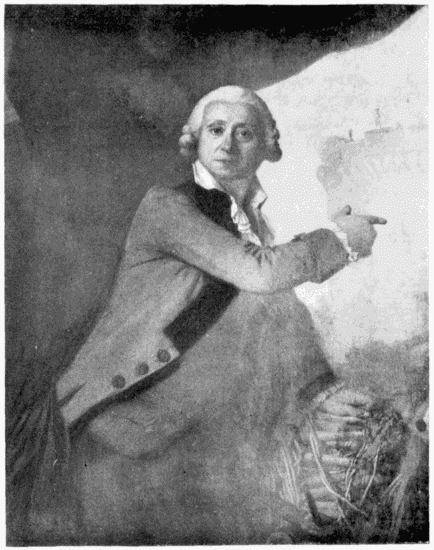
The Revolution broke out. If the epoch of Louis XVI., with its mildness and fellow-feeling, had been favourable to our hero, the Revolution seems to have been ordained on purpose for him. The people rose against the tyranny of kings: the towers of the Bastille were overthrown. Latude, the victim of kings, the victim of the Bastille and arbitrary warrants, was about to appear in all his glory.
He hastened to throw into the gutter his powdered peruque and viscount’s frock; listen to the revolutionist, fierce, inflexible, indomitable, uncompromising: “Frenchmen, I have won the right to tell you the truth, and if you are free, you cannot but love to hear it.
“For thirty-five years I meditated in dungeons on the audacity and insolence of despots; with loud cries I was calling down vengeance, when France in indignation rose up as one man in one sublime movement and levelled despotism with the dust. The will to be free is what makes a nation free; and you have proved it. But to preserve freedom a nation must make itself worthy of it, and that is what remains for you to do!”
In the Salon of 1789 there were two portraits of Latude with the famous ropeladder. Below one of these portraits, by Vestier, a member of the Royal Academy, these lines were engraved:—
Instruit par ses malheurs et sa captivité A vaincre des tyrans les efforts et la rage, Il apprit aux Français comment le vrai courage Peut conquérir la liberté.[50]
In 1787 the Marquis de Beaupoil-Saint-Aulaire had written, inspired by Latude himself, the story of the martyr’s captivity. Of this book two editions appeared in the same year. In 1789 Latude published the narrative of his escape from the Bastille, as well as his Grand Mémoire to the Marquise de Pompadour; finally, in 1790 appeared Despotism Unmasked, or the Memoirs of Henri Masers de Latude, edited by the advocate Thiéry. The book was dedicated to La Fayette. On the first page we see a portrait of the hero, his face proud and energetic, one hand on the ropeladder, the other extended towards the Bastille which workmen are in the act of demolishing. “I swear,” says the author at the commencement, “that I will not relate one fact which is not true.” The work is a tissue of calumnies and lies; and what makes a most painful impression on the reader is to see this man disowning his mother, forgetting the privations she endured out of love for her son, and ascribing the credit of what little the poor thing could do for her child to a Marquis de la Tude, knight of St. Louis, and lieutenant-colonel of the Orleans Dragoons!
But the book vibrates with an incomparable accent of sincerity and of that profound emotion which Latude knew so well how to infuse into all those with whom he had to do. In 1793, twenty editions had been exhausted, the work had been translated into several languages; the journals had no praise strong enough for the boldness and genius of the author; the Mercure de France proclaimed that henceforth it was a parent’s duty to teach his children to read in this sublime work; a copy was sent to all the departments, accompanied by a model of the Bastille by the architect Palloy. With good reason could Latude exclaim in the National Assembly: “I have not a little contributed to the Revolution and to its consolidation.”
Latude was not the man to neglect opportunities so favourable. To begin with, he sought to get his pension augmented, and presented to the Constituent Assembly a petition backed by representative Bouche. But Camus, “rugged Camus,” president of the committee appointed to investigate the matter, decided on rejection; and at the sitting of March 13, 1791, deputy Voidel delivered a very spirited speech; his view was that the nation had unhappy folk to succour more worthy of their concern than a man whose life had begun with roguery and villainy. The Assembly sided with him; not only was Latude’s pension not increased, but on consideration, the pension granted by Louis XVI. was altogether withdrawn.
Horror and infamy! “What madness has seized on the minds of the representatives of the most generous nation in the world!... To slay a hapless wretch the mere sight of whom awakens pity and warms into life the most sluggish sensibility ... for death is not so terrible as the loss of honour!” The valiant Latude will not abide the stroke of such an insult. Ere long he has brought Voidel to retract; in the heart of the Assembly he gains an influential supporter in the Marshal de Broglie. The Constituent Assembly is replaced by the Legislative, and Latude returns to the charge. He is admitted to the bar of the House on January 26, 1792; the matter is re-committed and gone into a second time on February 25. We should like to be able to quote at length the speech which Latude himself composed for his advocate; here is a portion of the peroration:—
“That a man, without any outside assistance, should have been able to escape three times, once from the Bastille and twice from Vincennes, yes, gentlemen, I venture to say he could not have succeeded except by a miracle, or else that Latude has more than extraordinary genius. Cast your eyes on this ladder of rope and wood, and on all the other instruments which Latude constructed with a mere knife, which you see here in the centre of this chamber. I resolved to bring before your own eyes this interesting object, which will for ever win admiration from men of intelligence. Not a single stranger comes to Paris without going to see this masterpiece of intelligence and genius, as well as his generous deliverer, Madame Legros. We have resolved to give you, gentlemen, the pleasure of seeing this celebrated woman, who unremittingly for forty months set despotism at defiance, and vanquished it by dint of virtue. Behold her there at the bar with M. de Latude, behold that incomparable woman, for ever to be the glory and the ornament of her sex!”
It is not surprising that the Legislative Assembly was deeply moved by this eloquent harangue and this exhibition of the lady, as touching as unexpected. It unanimously voted Latude a pension of 2000 livres, without prejudice to the pension of 400 livres previously awarded. Henceforth Latude will be able to say: “The whole nation adopted me!”
However, the little mishap in the Constituent Assembly was to be the only check that Latude suffered in the course of his glorious martyr’s career. Presented to the Society of “Friends of the Constitution,” he was elected a member by acclamation, and the Society sent a deputation of twelve members to carry the civic crown to Madame Legros. The leader of the deputation said, in a voice broken by emotion, “This day is the grandest day of my life.” A deputation from the principal theatres of Paris offered Latude free admission to all performances, “so that he might go often and forget the days of his mourning.” He was surrounded by the highest marks of consideration; pleaders begged him to support their cases before the tribunals with the moral authority bestowed on him by his virtue. He took advantage of this to bring definitively before the courts his claims against the heirs of the Marquise de Pompadour. Citizen Mony argued the case for the first time before the court of the sixth arrondissement on July 16, 1793; on September 11 the case came again before the magistrates: Citizens Chaumette, Laurent, and Legrand had been designated by the Commune of Paris as counsel for the defence, and the whole Commune was present at the hearing. Latude obtained 60,000 livres, 10,000 of which were paid him in cash.
And now his life became more tranquil. Madame Legros continued to lavish her care on him. The 50,000 livres remaining due to him from the heirs of the Marquise were paid in good farm lands situated in La Beauce, the profits of which he regularly drew.
Let us hasten to add that France did not find in Latude an ungrateful child. The critical situation in which the nation was then struggling pained him deeply. He sought the means of providing a remedy, and in 1799 brought out a “Scheme for the valuation of the eighty departments of France to save the Republic in less than three months,” and a “Memoir on the means of re-establishing the public credit and order in the finances of France.”
When the estates of Madame de Pompadour were sequestrated, the farms Latude had received were taken from him; but he induced the Directory to restore them. He was less fortunate in his requisition for a licence for a theatre and a gaming-house. But he found consolation. The subsidies he went on extorting from right and left, the proceeds of his farms, the sale of his books, and the money brought in by the exhibition of his ropeladder, which was exhibited by a showman in the different towns of France and England, provided him with a very comfortable income.
The Revolution became a thing of the past. Latude hailed the dawning glory of Bonaparte, and when Bonaparte became Napoleon, Latude made his bow to the emperor. We have a very curious letter in which he marks out for Napoleon I. the line of conduct he should pursue to secure his own welfare and the good of France. It begins as follows:—
“Sire,—I have been five times buried alive, and am well acquainted with misfortune. To have a heart more sympathetic than the common run of men it is necessary to have suffered great ills.... At the time of the Terror I had the delightful satisfaction of saving the lives of twenty-two poor wretches.... To petition Fouquet d’Etinville on behalf of the royalists was to persuade him that I was one myself. When I braved death in order to save the lives of twenty-two citizens, judge, great Emperor, if my heart can do ought but take great interest in you, the saviour of my beloved country.”
We are given some details of the last years of Latude’s life in the Memoirs of his friend, the Chevalier de Pougens, and in the Memoirs of the Duchess d’Abrantès. The Chevalier tells us that at the age of seventy-five years he still enjoyed good health; he was “active and gay, and appeared to enjoy to the full the delights of existence. Every day he took long walks in Paris without experiencing the least fatigue. People were amazed to find no trace of the cruel sufferings he had undergone in the cells during a captivity of thirty-five years.” His popularity suffered no diminution under the Empire. Junot awarded him a pension from funds at his disposal. One day the general presented him to his wife, along with Madame Legros, whose side Latude never left. “When he arrived,” says the Duchess d’Abrantès, “I went to greet him with a respect and an emotion that must have been truly edifying. I took him by the hand, conducted him to a chair, and put a cushion under his feet; in fact, he might have been my grandfather, whom I could not have treated better. At table I placed him on my right. But,” adds the Duchess, “my enchantment was of short duration. He talked of nothing but his own adventures with appalling loquacity.”
At the age of eighty, a few months before his death, Latude wrote in the most familiar terms to his protector, the Chevalier de Pougens, a member of the Institute: “Now I assure you in the clearest possible words, that if within ten days of the present time, the 11th Messidor, you have not turned up in Paris (the Chevalier was staying at his country estate), I shall start the next day and come to you with the hunger of a giant and the thirst of a cabby, and when I have emptied your cellar and eaten you out of house and home you will see me play the second act of the comedy of Jocrisse[51]; you will see me run off with your plates, and dishes, and tankards, and bottles—empty, you may be sure—and fling all your furniture out of the window!”
On July 20, 1804, Latude compiled one more circular, addressed to the sovereigns of Europe: the kings of Prussia, Sweden, and Denmark, the Archduke Charles, brother of the Emperor; and to the President of the United States. To each of them he sent a copy of his Memoirs, accompanied by the famous scheme for replacing with muskets the pikes with which the sergeants were armed. He explained to each of the sovereigns that as the country he ruled was profiting by this child of his genius, it was only just that he should reap some benefit.
Jean Henri, surnamed Danry, alias Danger, alias Jedor, alias Masers d’Aubrespy, alias De Masers de Latude, died of pneumonia at Paris, on January 1, 1805, aged eighty years.