THE LEGEND OF SERJEANT JOHN SMITH’S ADVENTURES CONTINUED.
Reading edition
You will remember, gentlemen, that when I was interrupted, I was about to follow John Smith on his march with Captain M’Taggart. Well, you see, Prince Charles Edward chanced to be at this time at Kilravock Castle, the ancient seat of the Roses. Thither the sagacious captain thought it good policy to present himself, with the motley company, the greater number of the individuals of which he had himself collected. There he received his due meed of praise for his zeal, with large promises of future preferment for his energetic exertions in the Prince’s cause. But although the Captain thus took especial care to serve himself in the first place, he made a point of strictly keeping his own promise to John Smith, for he did present him to the Prince, along with some five or six other recruits, whom he had cajoled to follow him, somewhat in the way he had cajoled John. But this their presentation was more with a view of enhancing the value of his own zeal and services, for his own private ends, than for the purpose, or with the hope of benefiting them in any way. The Prince came out to the lawn with M’Taggart, and some of his own immediate attendants. The men were presented to him by name; and John Smith was especially noticed by him. He spoke to each of them in succession; and then, clapping John familiarly on the shoulder,—
“My brave fellows,” said he, “you have a glorious career before you. The enemy advances into our very hands. I trust we shall soon have an opportunity of fighting together, side by side. Meanwhile, go, join the gallant army which I have so lately left at Culloden, eagerly waiting the approach of our foes. I shall see you very soon, and I shall not forget you.” So saying, he took off his Highland bonnet; and, whilst a gentle zephyr sported and played with his fair curls, he bowed gracefully to the men, and then retired into the house.
“She’s fichts to ta last trap o’ her bluids for ta ponny Princey!” cried John, with an enthusiasm which was cordially responded to by shouts from all present.
M’Taggart then gave the word, and the party wheeled off on their march in the direction of Inverness, in the vicinity of which town the Prince’s army was encamped. Their way lay down through the parish of Petty, and past Castle-Stuart. As they moved on, they were every where loudly cheered by the populace—men, women, and children, who turned out to meet them, and showered praises and blessings upon them; and this friendly welcome seemed to await them all along their route, till they joined the main body of their forces, which lay about and above the mansion house of Culloden.
John Smith would have much preferred to have placed himself under the standard of the Mackintosh, whom the Smiths or Gowe, the descendants of the celebrated Gowin Cromb, who fought on the Inch of Perth, held to be their chief, as head of the Clan-Chattan. But M’Taggart was unwilling to lose the personal support of so promising a soldier. Perhaps also he began to feel a certain interest in the young man; and he accordingly advised him to stick close to him at all times.
“Stick you by me, John,” said he—“stick close by my side; I shall then be able to see what you do, as well as to give a fair and honest, and I trust not unfavourable report of the gallant deeds which your brave spirit may prompt you to perform. Depend upon it, with my frequent opportunities of obtaining access to the Prince, I can do as much good for you, at least, as any Mackintosh.”
On the night of the 14th of April then, John Smith lay with M’Taggart and his company, among the whin and juniper bushes in the wood of Culloden, where the greater part of the Jacobite army that night disposed of themselves. Whatever might have been the ill-provided state of the other portions of the Prince’s troops, that with which John was now consorted, had no reason to complain of any want of those refreshments which human nature requires, and which are so important to soldiers. Large fires were speedily kindled; and the Pensassenach’s great sow, with all her little pigs, and the poor woman’s poultry of all kinds, together with some few similar delicacies which had elsewhere been picked up here and there, were soon divided, and prepared to undergo such rude cookery as each individual could command; and these, with the bread and cheese, and other such provisions, which they had carried off from the Pensassenach, as well as from some other houses, enabled them to spread for themselves what might be called a vurra liberal table in the wilderness. But the savoury odour which their culinary operations diffused around, brought hungry Highlanders from every quarter of the wood, like wolves upon them, so that each man of their party was fain to gobble up as much as he could swallow in haste, lest he should fail to secure to himself enough to satisfy his hunger, ere the whole feast should disappear under the active jaws of those intruders. The liquor was more under their own control. The flask was allowed to circulate through the hands of those only to whom it most properly belonged by the right of capture. John, for his part, had a good tasse of the Pensassenach’s brandy; and the smack did not seem to savour the worse within his lips, because it was prefaced with the toast of—“Success to the Prince, and confusion to the Duke of Cumberland!”
After this their refreshment, the men and officers disposed themselves to sleep around the fires of their bivouac, each in a natural bed of his own selection, John Smith, being a pious young man, retired under the shelter of a large juniper bush, and having there offered up his evening prayer to God, he wrapped himself up in his plaid, and consigned himself to sleep. How long he had slept he knew not; when, as he turned in his lair to change his position, his eye caught a dim human figure, which floated, as it were, in the air, stiff and erect, immediately under the high projecting limb of a great fir tree, that grew at some twenty paces distant from the spot where he lay. The figure seemed to have a preternatural power of supporting itself; and as the breeze wailed and moaned through the boughs, it appeared alternately to advance and to recede again with a slow tremulous motion. John’s heart, stout as it was against every thing of earthly mould, began to beat quick, and finally to thump against his very ribs, with all manner of superstitious fears. He gazed and trembled, without the power of rising, which he would have fain done, not for the purpose of investigating the mystery, but to take the wiser course of looking out for some other place of repose, where he might hope to escape from the appalling contemplation of this strange and most unaccountable apparition. He lay staring then at it in a cold sweat of fright, whilst the faint glimmering light from the nearest fire, as it rose or fell, now made it somewhat more visible, and now again somewhat more dim. At length, an accidental fall of some of the half burnt fuel, sent up a transient gleam that fully illuminated the ghastly countenance of the spectre, when, to John’s horror, he recognised the pale and corpse-like features of Mr. William Dallas, the packman, whom he had left so ingeniously inserted into the sack, and deposited in the Pensassenach’s lint-pot. Though the gag was gone, the mouth was wide open, and the large, protruded, and glazed eye-balls, glared fearfully upon him. Though the light was not sufficient to display the figure correctly, John’s fancy made him vividly behold the sack. He would have spoken if he could; but he felt that the apparition of a murdered man was floating before him. His throat grew dry of a sudden. He gasped—but could not utter a word. He doubted not that the packman had been forgotten by Morag, and that, having fallen down into the water through cold and exhaustion, the wretch had at last miserably perished; and he came very naturally to the conclusion, that he who had put the unfortunate man there, was now doomed to be henceforth continually haunted by his ghost. Fain would he have shut out this horrible sight, by closing his eyes, or by drawing his plaid over them; but this he was afraid to do, lest the object of his dread should swim towards him through the air, and congeal his very life’s-blood by its freezing touch. Much as he loved Morag, he had some difficulty in refraining from inwardly cursing her, for her supposed neglect of his express injunctions to relieve the packman from the pool. As he stared on this dreadful apparition, the flickering gleam from the faggot sunk again, and the countenance again grew dim; but John seemed still to see it in all its intensity of illumination. No more rest had he that night. Still, as he gazed on the figure, he again and again fancied that he saw it gradually and silently gliding nearer and nearer to him. The only relief he had was in fervent and earnest prayers, which he confusedly murmured, from time to time, in Gaelic. He eagerly petitioned for daylight, hoping that the morning air might remove all such unrealities from the earth. At length, the eastern horizon began to give forth the partial glimmer of dawn; but John was somewhat surprised to find, that, instead of the apparition fading away before it, the outlines of its horrible figure became gradually more and more distinct as it advanced, until even the features were by degrees rendered visible. But although John, by this time, began to discover that his fancy had supplied the sack, he now perceived something which he had not been able to see before, and that was, a thin rope which hung down from the horizontal limb of the fir tree, and suspended, by its lower extremity, the body of the poor packman by the neck. John was much shocked by this discovery. But he could not help thanking God that he was thus acquitted of the wretched man’s death; and after the misery that he had suffered from the supposed presence of the apparition of a man who had been drowned through his means, however innocently, the relief he now experienced was immense. He called up some of his comrades to explain the mystery; and from them he learned, that Mr. Dallas had been caught in the early part of the night, in the very act of attempting to carry off Captain M’Taggart’s horse from its piquet, and that he had been instantly tucked up to the bough of the fir tree, without even the ceremony of a trial.
The young Prince Charley was in the field by an early hour on the morning of the 15th, and being all alive to the critical nature of his circumstances, and by no means certain as yet how near the enemy might by this time be to him, he judged it important to collect, and to draw up his army on the most favourable ground he could find in the neighbourhood. He therefore marched them up the high, partly flattish, and partly sloping ridge, which, though commonly called Culloden Moor, from its being situated immediately above the house and grounds of that place, has in reality the name of Drummossie. He led them to a part of this ground, a little to the south eastward of their previous position in the wood of Culloden, and there he drew them up in order of battle. There they were most injudiciously kept lying on their arms the whole day, and if Captain M’Taggart’s men had feasted tolerably well the previous night, their commons were any thing but plentiful during the time they occupied that position. It was not in the nature of things, that subordination could be so strictly preserved in the Prince’s army, as it was in that of the Duke of Cumberland. I, who am well practeesed in the discipline of boys, gentlemen, know very well that it would be impossible to bring a regiment of them under immediate command, if the individuals composing it were to be collected together all at once, raw and untaught, from different parts of the district. It is only by bringing one or two at a time, into the already great disciplined mass, that either a schoolmaster, or a field-marischal can promise to have his troops always well under control. By the time evening came, the officers, as well as the men of the Prince’s army, began to suffer under the resistless orders of a commander to whom no human being can say nay. Hunger, I may say, was rugging at their vurra hearts, and as they all saw, or supposed that they saw, reason to believe that there was no chance of the enemy coming upon them that night, many of them went off to Inverness and elsewhere, in search of food. M’Taggart himself could not resist those internal admonitions, which his stomach was so urgently giving him from time to time, and accordingly, John Smith conceived he was guilty of no great dereliction of duty, in strictly following the first order which his captain had given him, viz., to “stick by his side,” which he at once resolved to do, as he saw him go off to look for something to support nature.
But the captain and his man had hardly got a quarter of a mile on the road to Inverness, when they, with other stragglers, were called back by a mounted officer, who was sent, with all speed, after them, to tell them that they must return, in order to march immediately. The object of their march was that ill-conceived, worse managed, and most unlucky expedition for a night attack on the Duke of Cumberland’s camp at Nairn, which had that evening been so hastily planned. Hungry as they were they had no choice but to obey, and accordingly they hurried to their standards. The word was given, and after having been harassed by marching all night, without food or refreshment of any kind, they at last got only near enough to Nairn just to enable them to discover that day must infallibly break before they could reach the enemy’s camp, and that consequently no surprise could possibly take place. Disheartened by this failure, they were led back to their ground, where they arrived in so very faint and jaded a condition, that even to go in search of food was beyond their strength, so that they sank down in irregular groups over the field, and fell asleep for a time. Awakened by hunger after a very brief slumber, they arose to forage. M’Taggart, and some of his party, and John Smith amongst the rest, went prowling across the river Nairn, which ran to the south of their position, and there they caught and killed a sheep. They soon managed to kindle a fire, and to subdivide the animal into fragments, but ere each man had time to broil his morsel, an alarm was given from their camp. Like ravenous savages they tore up and devoured as much of the half raw flesh as haste would allow them to swallow, and hurrying back, they reached their post about eight o’clock in the morning, when they found that the Duke of Cumberland was approaching with his army in full march.
The position chosen by the Prince as that where he was to make his stand on that memorable day, the 16th of April, was by no means very wisely or very well selected. It was a little way to the westward of that which his army had occupied on the previous day. Somewhat in advance, and to the right of his ground, there stood the walls of an enclosure, which the experienced eye of Lord George Murray soon enabled him to perceive, and he was at once so convinced that they presented too advantageous a cover to the assailing enemy, to be neglected by them, that he would fain have moved forward with a party to have broken them down, had time remained to have enabled him to have effected his purpose. But the Duke of Cumberland’s army was already in sight, advancing in three columns, steadily over the heath, from Dalcross Castle, the tower of which was seen rising towards its eastern extremity. The Highlanders were at this time dwindled to a mere handful, and some of the best friends of the cause of the Stewarts who were present, and perhaps even the young Prince himself, began to believe that he had been traitorously deserted. But the alarm had no sooner been fully spread by the clang of the pipes, and the shrill notes of the bugles, than small and irregular streams of armed men, in various coloured tartans, were seen rushing towards their common position, like mountain rills towards some Highland lake, and filling up the vacant ranks with all manner of expedition. Many a brave fellow, who had gone to look for something to satisfy the craving of an empty stomach, came hurrying back with as great a void as he had carried away with him, because he preferred fighting for him whom he conscientiously believed to be his king, to remaining ingloriously to subdue that hunger which was absolutely consuming him. No one was wilfully absent who could possibly contrive to be present, but yet the urgent demands of the demon of starvation, to which many of them had yielded, had very considerably thinned their numbers, and, in addition to this source of weakness, there was another obvious one, arising from the physical strength of those who were present being wofully diminished by the want they had endured, and the fatigue they had undergone. But with all these disadvantages the heroic souls of those who were on the field remained firm and resolute.
John Smith’s military knowledge was then too small to allow him to form any judgment of the state of affairs, far less to enable him to carry off, or to describe, any thing like the general arrangement of the order of battle on both sides. He could not even tell very well what regiments his corps was posted with: he only knew this, that according to the order he had received he stuck close to Captain M’Taggart. He always remembered with enthusiasm, indeed, that the Prince rode through the ranks with his attendants, doing all that he could to encourage his men, and that when he passed by where John himself stood, he smiled on him like an angel, and bid him do his duty like a man.
“Och, hoch!” cried John, with an exultation, which arose from the circumstance of his not being in the least aware that every individual near him had, like him, flattered himself that he was the person so distinguished.—“Fa wad hae soughts tat ta ponny Princey wad hae mindit on poor Shon Smiss? Fod, but she wad fichts for her till she was cut to collops!”
But John had little opportunity of fighting, though he appears to have borne plenty of the brunt of the battle. There were two cannons placed in each space between the battalions composing the first line of the Duke of Cumberland’s army, and these were so well served as to create a fearful carnage among the Highland ranks. To this dreadful discharge John Smith stood exposed, with men falling by dozens around him, mutilated and mashed, and exhibiting death in all his most horrible forms, till, to use his own very expressive words,—“She was bitin’ her ain lips for angher tat she could not get at tem.” But before John could get at them, the English dragoons, who, under cover of the walls of the enclosure I have mentioned, had advanced by the right of the Highland army, finally broke through the fence, and getting in behind their first line, came cutting and slashing on their backs, whilst the Campbells were attacking them in front, and mowing them down like grass. Then, indeed, did the melée become desperate, and then was it that John began to bestir himself in earnest. Throwing away his plaid, and the little bundle that it contained, he dealt deadly blows with his broad-sword, everywhere around him. He fought with the bravery and the perseverance of a hero. At length his bonnet was knocked from his head, and although he was still possessed with the most anxious desire to obey Captain M’Taggart’s order to stick to his side, he was surprised on looking about him to find that there was no M’Taggart, no, nor any one else left near him to stick to but enemies.
John Smith’s spirit was undaunted, so that, seeing he had no one else to stick to, he now resolved to stick to his foes, to the last drop of life’s blood that was within him. Furiously and fatally did he cut and thrust, and turn and cut and thrust again, at all who opposed him; but he was so overwhelmed by opponents, that in the midst of the blood, and wounds, and death which he was thus dealing in all directions, he received a desperate sabre cut, which, descending on him from above, entirely across the crown of his bared head, felled him instantaneously to the ground, and stretched him senseless among the heather, whilst a deluge of blood poured from the wound over both his eyes.
When John began partially to recover, he rubbed the half-congealed blood from his eyelids with the back of his left hand, and looking up and seeing that the ground was somewhat clear around him, he griped his claymore firmly with his right hand, and raising himself to his feet, he began to run as fast as his weak state would allow him. He thought that he ran in the direction of Strath Nairn, and he ran whilst he had the least strength to run, or the least power remaining in him. But his ideas soon became confused, and the blood from the terrible gash athwart his head trickled so fast into his eyes, that it was continually obscuring his vision. At length he came to a large, deep irregular hollow hag, or ditch, in a piece of moss ground, which had been cut out for peats, and there, his brain beginning to spin round, he sank down into the moist bottom of it to die, and as the tide of life flowed fast from him, he was soon lost to all consciousness of the things or events of this world.
Whilst John was lying in this senseless state, he was recognised by one of the fugitives, who, in making his own escape, chanced to pass by the edge of the ditch in the moss where the poor man lay. This was a certain Donald Murdoch, who had long burned with a hopeless flame for black-eyed Morag. With a satisfaction that seemed to make him forget his present jeopardy in the contemplation of the death of his rival, he looked down from the edge of the peat hag upon the pale and bloody corpse, and grinned with a fiendish joy.
“Ha! there you lie!” cried he in bitter Gaelic soliloquy.—“The fiend a bit sorry am I to see you so. You’ll fling or dance no more, else I’m mistaken.—Stay!—is not that the bit of blue ribbon that Morag tied round his neck, the last time that we had a dance in the barn? I’ll secure that, it may be of some use to me;” and so saying he let himself down into the peat hag, hastily undid the piece of ribbon,—and then continued his flight with all manner of expedition.
Following the downward course of the river Nairn, running at one time, and ducking and diving into bushes, and behind walls at another, to avoid the stragglers who were in pursuit, he by degrees gained some miles of distance from the fatal field, and coming to a little brook, he ventured to halt for a moment, to quench his raging thirst. As he lay gulping down the crystal fluid, he was startled by hearing his own name, and by being addressed in Gaelic.
“Donald Murdoch!—Oh, Donald Murdoch, can you tell me is John Smith safe? Oh, those fearful cannons how they thundered!—Oh, tell me, is John Smith safe?—Oh, tell me! tell me!”
“Morag!” cried Donald, much surprised, but very much relieved to find that it was no one whom he had any cause to be afraid of,—“Morag!—What brought you so far from home on such a day as this?”
“Oh Donald!” replied Morag, “I came to look after John Smith;—oh, grant that he be safe!”
“Safe enough, Morag,” replied Donald, galled by jealousy. “I’ll warrant nothing in this world will harm him now.”
“What say you?” cried Morag. “Oh, tell me! tell me truly if he be safe?”
“I saw John Smith lying dead in a moss hole, his skull cleft by a dragoon’s sword,” replied Donald with malicious coolness.
“What?” cried Morag, wringing her hands, “John Smith dead! But no! it is impossible!—and you are a lying loon, that would try to deceive me, by telling me what I well enough know you would wish to be true. God forgive you, Donald, for such cruel knavery!”
“Thanks to ye, Morag, for your civility,” replied Donald Murdoch calmly; “but if you wont believe me, believe that bit of ribbon—see, the very bit of blue ribbon you tied round John Smith’s neck, the night you last so slighted me at the dance in the barn. See, it is partly died red in his life’s blood.”
“It is the ribbon!” cried Morag, snatching it from his hand with excessive agitation, and kissing it over and over again, and then bursting into tears. “Alas! alas! it must be too true! What will become of poor Morag!—why did I not go with him! What is this world to poor desolate Morag now?—And yet—he may be but wounded after all. It must be so—he cannot be killed. Where did you leave him?—quick, tell me!—oh, tell me, Donald. Why do we tarry here? let us forward and seek him!—there may be life in him yet, and whilst there is life there is hope. Let me pass, Donald; I will fly to seek him!”
“I love you too well to let you pass on so foolish and dangerous an errand,” said Donald, endeavouring to detain her. “I tell you that John Smith is dead; but you know, Morag, you will always find a friend and a lover in me. So think no more——”
“I will pass, Donald,” cried Morag, interrupting him, and making a determined attempt to rush past him.
“That you shall not,” replied Donald, catching her in his arms.
“Help, help!” cried Morag, struggling with all her might, and with great vigour too, against his exertions to hold her.
At this moment the trampling of a horse was heard, and a mounted dragoon came cantering down into the hollow. His sabre gleamed in the air—and Donald Murdoch fell headlong down the bank into the little rill, his skull nearly cleft in two, and perfectly bereft of life.
“A plague on the lousy Scot!” said the trooper, scanning the corpse of his victim with a searching eye. “His life was not worth the taking, had it not been, that the more of the rascally race that are put out of this world, the better for the honest men that are to remain in it, and therefore it was in the way of my duty to cut him down. There is nought on his beggarly carcase to benefit any one but the crows.—And so the knave would have kissed thee against thy will, my bonny black-eyed wench. Well, ’tis no wonder thou shouldst have scorned that carotty-pated fellow; you showed your taste in so doing, my dear: and now you shall be rewarded by having a somewhat better sweetheart.—Come!” continued he, alighting from his charger, and approaching the agitated and panting girl—“Come, a kiss from the lips of beauty is the best reward for brave deeds; and no one deserves this reward better than I do, for brave deeds have I this day performed. Why do you not speak, my dear? Have you no Christian language to give me? Can it be possible that these pretty pouting lips have no language but that of the savages of this country?—Come, then, we must try the kissing language; I have always found that to be well understood in all parts of the world.”
“Petter tak’ Tonald’s pig puss o’ money first,” said Morag, pointing down to the corpse in the hollow.
“Ha! money saidst thou, my gay girl?” cried the trooper. “Who would have thought of a purse of money being in the pouch of such a miserable rascally savage as that? But the best apple may sometimes have the coarsest and most unpromising rhind; and so that fellow, unseemly and wretched as he appears, may perchance have a well-lined purse after all. If it be so, girl, I shall say that thy language is like the talk of an angel. Then do you hold the rein of this bridle, do you see, till I make sure of the coin in the first place—best secure that, for no one can say what mischance may come; or whether some comrade may not appear with a claim to go snacks with me. So lay hold of the bridle, do you hear, and dont be afraid of old Canterbury, for the brute is as quiet as a lamb.”
Morag took the bridle. The trooper descended the bank, and he had scarcely stooped over the body to commence his search for the dead man’s supposed purse, when the active girl, well accustomed to ride horses in all manner of ways, vaulted into the saddle, and kicking her heels into Canterbury’s side, she was out of the hollow in a moment. Looking over her shoulder, after she had gone some distance, she beheld the raging dragoon puffing, storming, and swearing, and striding after her, with, what might be called, that dignified sort of agility, to which he was enforced by the weighty thraldom of his immense jack-boots. Bewildered by the terror and the anxiety of her escape, she flew over the country, for some time, without knowing which way she fled. At length she began to recover her recollection, so far as to enable her to recur to the object which had prompted her to leave home. On the summit of a knoll she checked her steed—surveyed the country,—and the whole tide of her feelings returning upon her; she urged the animal furiously forward in the direction of the fatal field of Culloden.
She had not proceeded far, when, on coming suddenly to the edge of a rough little stoney ravine, she discovered five troopers refreshing themselves and their horses from the little brook that had its course through the bottom. She reined back her horse, with the intention of stealing round to some other point of passage; but as she did so, a shout arose from the hollow of the dell.—She had been perceived. In an instant the mounted riders rushed, one after another, out of the ravine, and she had no chance of escape left her, but to ride as hard as the beast that carried her could fly, in the very opposite direction to that which she had hitherto pursued, for there was no other course of flight left open to her.
The five troopers were now in full chase after Morag, shouting out as they rode, and urging on their horses to the top of their speed. The ground, though rough, stony, and furzy, was for the most part firm enough, and the poor girl, now driven from that purpose to which her strong attachment to John Smith had so powerfully impelled her, and being distracted by her griefs and her fears, spared not the animal she rode, but forced him, by every means she could employ, either by hands, limbs, or voice, to the utmost exertion of every muscle.
“Lord, how she does ride!” said one trooper to the others; “I wish that she beant some of them witches, as, they say, be bred in this here uncanny country of Scotland.”
“Bless you no, man,” said another; “them devils as you speak of ride on broomsticks. Now, I’se much mistaken an’ that be not Tom Dickenson’s horse Canterbury.”
“Zounds, I believe you are right, Hall,” said another man; “but that beant no proof that she aint a witch, for nothing but a she-devil, wot can ride on a broom, could ride ould Canterbury in that ’ere fashion, I say.”
“Witch or devil, my boys, let us ketch her if we can,” shouted another.—“Hurrah! hurrah!”
“Hurrah! hurrah! hurrah!” re-echoed the others, burying their spurs in their horses’ sides, and bending forward, and grinning with very eagerness.
For several miles Morag kept the full distance she had at first gained on her pursuers, but having got into a road, fenced by a rough stone wall upon one side, and a broad and very deep ditch on the other, the troopers, if possible, doubled their speed, in the full conviction that they must now very soon come up with her, and capture her. Still Morag flew,—but as she every moment cast her eyes over one or other of her shoulders, she was terrified to see that the troopers were visibly gaining upon her. The road before her turned suddenly at an angle,—and she had no sooner doubled it, than, there, to her unspeakable horror—in the very midst of the way—stood Tom Dickenson, the dismounted dragoon from whom she had taken the very charger, called Canterbury, which she then rode. The time of the action of what followed was very brief. For an instant she reined up her horse till he was thrown back on his haunches.—Tom Dickenson’s sword-blade glittered in the sun.
“By the god of war, but I have you now!” cried he in a fury.
The triumphant shouts of Morag’s pursuers increased, as they neared her, and beheld the position in which she was now placed. No weapon had she, but the large pair of scissors that hung dangling from her side, in company with her pincushion. In desperation she grasped the sharp-pointed implement dagger fashion, and directed old Canterbury’s head towards the ditch. Dickenson saw her intention, and wishing to counteract it, he rushed to the edge of the ditch. The hand of Morag which held the scissors descended on the flank of the horse, and in defiance of his master, who stood in his way, and the gleaming weapon with which he threatened him, old Canterbury, goaded by the pain of the sharp wound inflicted on him, sprang towards the leap with a wild energy, and despite of the cut, which deprived him of an ear, and sheared a large slice of the skin off one side of his neck, he plunged the unlucky Tom Dickenson backwards, swash into the water, and carried his burden fairly over the ditch.
Morag tarried not to look behind her, until she had scoured across a piece of moorish pasture land, and then casting her eyes over one shoulder, she perceived that only two of the troopers had cleared the ditch, and that the others had either failed in doing so, or were engaged in hauling their half-drowned comrade out of it. The two men who had taken the leap, however, were again hard after her, shouting as before, and evidently gaining upon her. The moment she perceived this, she dashed into a wide piece of mossy, boggy ground, a description of soil with which she was well acquainted. There the chase became intricate and complicated. Now her pursuers were so near to her, as to believe that they were on the very point of seizing her, and again some impassable obstacle would throw them quite out, and give her the advantage of them. Various were the slips and plunges which the horses made; but ere she had threaded through three-fourths of the snares which she met with, she had the satisfaction of beholding one of the riders who followed her, fairly unhorsed, and hauling at the bridle of his beast, the head and neck of which alone appeared from the slough, in which the rest of the poor animal was engulfed. The man called loudly to his comrade, but he was too keenly intent on the pursuit, to give heed to him. The hard ground was near at hand, and he pushed on after Morag, who was now making towards it. She reached it, and again she plied the points of her scissors on the heaving flanks of old Canterbury. But she became sensible that his pace was fast flagging,—and that the trooper was rapidly gaining on her. In despair she made towards a small patch of natural wood.—She was already within a short distance of it. But the blowing and snorting of the horse behind her, and the blaspheming of his rider, came every instant more distinctly upon her ear. Some fifty or an hundred yards only now lay between her and the wood. Again, in desperation, she gave the point of the scissors to her steed—when, all at once he stopped—staggered—and, faint with fatigue and loss of blood, old Canterbury fell forward headlong on the grass.
“Hurrah!” cried the trooper, who was close at his heels, “witch or no witch, I think I’ll grapple with thee now.”
He threw himself from his heaving horse, and rushed towards Morag. But she was already on her legs, and scouring away like a hare for the covert. Jack-booted, and otherwise encumbered as he was, the bulky trooper strode after her like a second Goliah of Gath, devouring the way with as much expedition as he could possibly use. But Morag’s speed was like that of the wind, and he beheld her dive in among the underwood before he had covered half the distance.
“A very witch in rayal arnest!” exclaimed the trooper, slackening his pace in dismay and disappointment. And then turning towards his comrade, who, having by this time succeeded in extricating his horse from the slough, was now coming cantering towards him, “Hollo, Bill!” shouted he, “I’ve run the blasted witch home here.—Come away, man, do; for if so be that she dont arth like a badger, or furnish herself with a new horse to her own fancy out of one of ’em ’ere broom bushes, this covert aint so large but we must sartinly find her. So come along, man, and be active.”
But we must now return to poor John Smith, whom we have too long left for dead in the bottom of a peat-hag. The cold and astringent moss-water flowing about his head, by degrees checked the effusion of his blood, and at length he began to revive.
When his senses returned to him, he gathered himself up, and leaning his back against the perpendicular face of the peat bank above him, he drank a little water from the hollow of his hand, and then washed away the clotted blood from his eyes. The first object that broke upon his newly recovered vision was an English trooper riding furiously up to him, with his brandished sword. John was immediately persuaded that he was a doomed man, for he felt that, in his case, resistance was altogether out of the question. He threw himself on his back in the bottom of the broad deep cut in the peat-hag. The trooper came up, and having no time to dismount, he stooped from his saddle and made one or two ineffectual cuts at the poor man. The horse shyed at John’s bloody head as it was raised in terror from the peat-hag, and then the animal reared back as he felt the soft mossy ground sinking under him. The trooper was determined,—got angry, and spurred the beast forward, but the horse became obstinate and restive. At length the trooper succeeded in bringing him up again to the edge of the peat-hag; but just as he was craning his neck over its brink, John, roused by desperation, pricked the creature’s nose with the point of his claymore. It so happened that he accidentally did this, at the very instant that the irascible trooper was giving his horse a dig with his spurs, and the consequence of these double, though antagonist stimulis, was, that the brute made a desperate spring, and carried himself and his rider clean over the hag-ditch, John Smith and all, and then he ran off with his master through the broken moss-ground, scattering the heaps of drying peats to right and left, until horse and man were rolled over and over into the plashy bog.
Uninjured, except as to his gay clothes and accoutrements, which were speedily dyed of a rich chocolate hue, the trooper arose in a rage, and could he have by any means safely left his horse so as to have secured his not running away, he would have charged the dying man on foot, and so he would have very speedily sacrificed him; but dreading to lose his charger if he should abandon him, he mounted him again, and was in the act of returning to the attack, with the determination of putting John to death, at all hazards, either by steel or by lead, when he was arrested by the voice of his officer, who was then passing along a road tract, at some little distance, with a few of his troop, and who called out to him in a loud authoritative tone, “Come away you, Jem Barnard! Why dont you follow the living? Why waste time by cutting at the dying or dead?”
On hearing this command, the trooper uttered a half-smothered curse, and unwillingly turned to ride after his comrades, throwing back bitter execrations on John Smith as he went. John’s tongue was otherwise employed. He used it for the better purpose of returning thanks to that Almighty Providence who had thus so wonderfully protected him.
After this pious mental exercise, John thought that he felt himself somewhat better. He made a feeble effort to rise, but it was altogether abortive. The blood still continued to flow from his head—he began to feel very faint, and a raging thirst attacked him. Turning himself round in the peat-hag, he contrived to lap up a considerable quantity of the moss water, which, however muddy and distasteful it might be, refreshed him so much as to give him strength sufficient to raise himself up a little, so as to enable him to extend the circuit of his view. He had now a moment’s leisure to look about him, and to consider, as well as the confusion of his ideas would allow him, what he had best to do. But what was his surprise and dismay to see, that although many were yet flying in all directions, and many more pursuing after them, whole battalions of the enemy still remained unbroken in the vicinity of the field of battle, and that some were marching up, in close order, both to the right and left of him. There was but little time left him for farther consideration, as one of these battalions was so near to him, that he saw, from the course it was holding, that it must soon march directly over the spot where he was. The first thought that struck him was that his best plan would be to lie down and feign that he was dead. But it immediately afterwards occurred to him that a thrust from some curious or malicious person, who might be the bearer of one of those bayonets, which already glittered in his eyes, might do his business even more effectually than the sword of the trooper might have done. He became convinced that he had nothing left for it but to run. But although he was now somewhat revived, and that the dread of death gave new strength to exhausted nature, he felt persuaded of the truth, that if his wound should continue to bleed, as it had already again began to do, his race could not be a long one in any sense of the word, even if he should have the wonderful luck to escape the chance of its being shortened by the sword, bayonet, or bullet of an enemy. To give himself some small chance of life, John, though he was no surgeon, would have fain tried some means of stanching the blood, but he lacked all manner of materials for any such operation, and he could only try to cover the wound very ineffectually with both hands, whilst the red stream continued to run down through his fingers. At length, necessity, that great mother of invention, and wisest of all teachers, enabled him to hit off in a moment, a remedy, which, as it was the best he could have possibly adopted in his present difficult and distressing situation, might perhaps, even on an occasion where no such embarrassment exists, be found as valuable and effective as any other which the most favourable circumstances could afford, or the most consummate skill devise. Stooping down, he picked up a large mass of peaty turf, of nearly a foot square, and two or three inches thick. This had been regularly cut by the peat-diggers, but having tumbled by chance into the bottom of the peat-hag, it had been there lying soaking till the soft unctuous matter of which it was composed was completely saturated with water like a sponge. John proceeded upon no certain ratio medicandi, except this, that as his life’s blood was manifestly welling fast away from him, he thought that the wet peat would stop the flow of it, and as his head was in a burning fever, every fibre of his scalp seemed to call out for the immediate application of its cold and moist surface. John seized it then with avidity, and clapping it instantly on his head, with the black soft oleaginous side of it next to the wound, and the heathery top of it outwards, he pressed it down with great care all over his skull, and then quickly secured it fast, by tying a coarse red handkerchief over it, the ends of which he fastened very carefully under his chin. The outward appearance of this strange uncouth head-gear may be easily imagined, with the heather-bush rising everywhere around his head over the red tier that bound it on, and surmounting a countenance so rueful and bloody; but the effect within was so wonderfully refreshing and invigorating, that he felt himself almost immediately restored to comparative strength. He started to his feet; and, being yet uncertain as to which way he should run, he raised his head slowly over the peat-hag to reconnoitre.
Now, it happened, that, at this very moment, a couple of English foot soldiers came straggling along, thirsting for more slaughter, and prowling about for prey and plunder. Ere John was aware of their proximity to him, they were within a few yards of the peat-hag. As he raised his head, he beheld them approaching with their muskets and their bayonets reeking with gore. Believing himself to be now utterly lost, a deep groan of despair escaped from him. The soldiers had halted suddenly on beholding the bloody face and neck of what scarcely seemed to be a human being, with a huge overgrown forest of heather on the head instead of hair, appearing, as it were by magic, out of the very earth. They started back, and stood for an instant transfixed to the spot by superstitious fear.
“Waunds, Gilbert, wot is that?” cried one, his eyes staring at John with horror.
Seeing, that as he was now discovered, his only chance lay in working upon that dread which he saw that he had already excited, John first gradually drew down his head below the bank, and then again raised it slowly and portentously, and uttered another groan more deep and ghostly and prolonged than the first. The effect was instantaneous.
“Oh Lord! oh Lord! one of them Highland warlocks of the bog, wot dewours men, women, and children!” cried Gilbert. “Fly—fly, Warner, for dear life!”
Off he ran, and his comrade staid not to question farther, but darted away after him, and John had the satisfaction to see the two heroes, from whom he had looked for nothing but sudden death, scouring away over the field, and hardly daring to look behind them.
John Smith was considerably emboldened by the discovery that his appearance was so formidable to his foes. He again applied himself to the consideration of the question as to which way it was best for him to fly. He cast his eyes all over the field of action around him; and, much to his satisfaction, he perceived that the officer at the head of the red regiment of Englishmen, which had previously given him so much alarm, had been so very obliging as to determine this difficult question for him. Some movement of the flying clans, who had retreated on Strath Nairn, had induced the officer to alter his line of march; and, in a very short time, John had the happiness of seeing himself very much in the rear of the red battalion, instead of being immediately in its front, as he had formerly been. Looking to the north-eastward, he perceived that all was comparatively clear and quiet, so far as he could see. There were now no longer any regular masses of men on the field, neither were there any signs of flight or pursuit in that direction. A few stragglers were to be seen, it is true, moving about, like evil spirits among the killed, and perhaps performing the office of messengers of death to the wounded. Strange, indeed, was the change that had taken place, upon that which had been so lately a scene of stormy and desperate conflict. A few large birds of prey were soaring high in air, in eager contemplation of that banquet which had been so liberally spread for them on the plain by ferocious man. But, in the immediate neighbourhood of the spot where John Smith was, the terrified pewit had already settled down again with confidence on her nest, the robin had again begun to chirp, and to direct his sharp eye towards the earth in search of worms; and the lark was again heaving herself up into the sky, giving forth her innocent song as she rose,—all apparently utterly unconscious that any such terrible and bloody turmoil had taken place between different sections of the human race. John therefore made up his mind at once; and, scrambling out of the peat-hag, he darted away over the moor, and flying like a ghost across the very middle of the field of battle, through the heaps of dead and dying, to the utter terror and discomfiture of those wolves and hyenas in the shape of men—aye, and of women too—who were preying, as well upon those who had life, as upon those who were lifeless, he scattered them to right and left in terror at his appalling appearance, and dived amid the thick woods of Culloden.
Having once found shelter among the trees, John stopped to breathe awhile, and then he again set forward to unravel his way. It so happened, that, as he proceeded, he chanced to come upon the very spot where he had feasted with MacTaggart and his comrades on his mistress the Pensassenach’s sow, and the other good things which the Highlanders had taken from her. The gnawing demon of hunger that possessed him, inserted his fell fangs more furiously into his stomach, from very association with the scene. What would he not have now given for the smallest morsel of that goodly beast, the long and ample side of which arose upon his mind’s eyes, as he had beheld her carcase hanging from the bough of a tree, previous to the rapid subdivision which it underwent. Alas! the very thought of it was now an unreal mockery. Yet he could not help looking anxiously around, though in vain, among the extinguished remains of the fires of the bivouacs; and he figured to himself the joy and comfort and refreshment he would have experienced, if his eyes could have lighted even on a half-broiled fragment of one of the pettitoes, which he might have picked at as he fled. John’s eyes were so intently turned to the ground, that he saw not the unfortunate Mr. Dallas, who still dangled from the bough of the fir tree above him.
Whilst John was poking about in this manner, earnestly turning over the ashes, and looking amongst them as if he had been in search of a pin, he suddenly heard the tramp of horses at some little distance. The sound was evidently coming towards him; and he could distinguish men’s voices. He cast his eyes eagerly around him, to discover some ready place of concealment; and now, for the first time, he caught sight of the wasted figure of Mr. Dallas, swinging at some distance above him, with the dull glassy eyeballs apparently fixed upon him. His heart sank within him; for the corpse of the wretched man seemed to typify his own immediate fate. He was paralyzed for a moment. But the sound drew nearer; and, spying a holly-tree with a reasonably tall stem, and a very thick and bushy head, which happened to grow most fortunately near him, he ran towards it, reached up his hands, seized hold of its lower branches, and, weak though he was, the energy of self-preservation enabled him very quickly to coil himself up amongst its dense foliage, where he sat as still as death, and scarcely allowing himself to breathe. The holly-tree stood by the side of a horse-track that led through the wood, and which crossed the small open space where most of the fires of Captain M’Taggart’s bivouac had been kindled. Two troopers came riding leisurely up through the wood along it, their horses considerably jaded by the work of the day.
“Ha!” said one of them to the other, reining up his steed as he spoke, just on entering the open space,—“What have we here, Jack?”
“I should not wonder now if ’em ’ere should be the remains of the fires of some of them rebel rascals,” said Jack, with wonderful acuteness. “Them is a proper set of waggabones, to be sure. How we did lick the rascals! Didn’t we, Bob?”
“To be sure we did, Jack,” replied Bob.
“But you and I aint made much on it, arter all. I wish the captain at the devil—so I do—for sendin’ us a unting arter that officer he was a wanting to ketch.”
“Aye,” said Jack; “so do I, from the bottom of my soul. But if we had ketcht him, I think we should ’a gained a prize, seeing that he wur walued at twenty golden pieces by his Highness the Duke. Whoy, who the plague could he be? Not the chap they calls Prince Charles Stuart himself surelye? I should think that his carcase would fetch a deal more money.”
“A deal more money indeed!” said Bob.
“Lord bless thee, I would not sell my share of him for an underd. But why may we not ketch him yet, Jack? Look sharp; do—and see if you can spy ere an oak in this wood, with a head so royal as to hide this Prince Charles Stuart in it, as that ’ere one did King Charley the Second arter the great battle of Worcester. Zounds! what a fortin you and I should make, an’ we could only ketch him!”
“Pooh!” replied Jack, moving so close to the little holly, that his head and that of John Smith were within two yards of each other—“Pooh man! there beant no oaks bigger than this here holly, in all this blasted, cold, and wretched country.” And, at the same time, he gave its bushy head a thwack with the flat of his sword that set every leaf of it in motion, and John’s heart, body, muscles, and nerves, shaking in sympathy with them.
“Beg your pardon,” said Bob. “I was in a great big wood yesterday—that same, I mean, that spreads abroad all over the country, above that ’ere ould castle wot they calls Cawdor Castle. And sitch oak trees as I seed there! My heyes, some on ’em had heads as would cover half a troop! But, hark ye, Jack! Is there no tree, think ye, fit to have a man in’t but an oak? Dost not think that a good stout fir-tree now might support a man?”
“Oh,” replied Jack, “surelye, surelye. This here holly, for instance, might hide a man in its head;”—and, as he said so, he gave the holly another thwack, that, for a few moments, banished every drop of blood from the heart of John Smith. “But your oak is your only tree for concealing your King or your Prince; for, as the old rhyme has it,
‘The royal oak is not a joke.’
As for your firs, they may be well enough for affording a refuge to your men of smaller mark.”
“Then you don’t think that ’ere feller, wot hangs from yonder fir tree, can be a King or a Prince, do you, Jack?” demanded Bob, laughing heartily at his own joke.
“My heyes!” exclaimed Jack, rubbing his optics, and looking earnestly for some time at the corpse of Mr. Dallas; “sure I cannot be mistaken? As I’m a soldier, that ’ere is the very face, figure, clothes, and, above all, short leg and queer shoe, of the identical feller wot sould me an ould watch, wot was of no use, because you know it never went, and therefore it stands to reason that it could only tell the hour twice in the twenty-four. I say surelye, surelye, that ’ere is the very feller as sould me this here ould useless watch, for a bran new great goer. Well, if it be’ant some satisfaction to see the feller hanging there, my name aint Jack Blunt!”
“Them rascally rebels has robbed and murdered the poor wretch,” said Bob.
“Well,” replied Jack, “I am a right soft arted Christine; and therefore most surelye do I forgive ’em for that same hact, if they’d never ha’ done no worse. But come Bob, my boy; an’ we would be ketching kings or princes, I doubt we mun be stirrin’.”
“Aye, aye, that’s true—let’s be joggin’,” replied Bob.
You may believe, gentlemen, that it was with no small satisfaction that John Smith beheld them apply their spurs to the sides of their weary animals. He listened to their departing footsteps until they were beyond the reach of his hearing; and then, conscious as he felt himself, that he was in much too weak a state to have maintained an unequal combat against two fresh and vigorous men, with the most distant chance of success, he put up a fervent ejaculation of thankfulness for their departure, and his own safety.
He was in the act of preparing himself to drop from the tree, that he might continue his flight, and was just putting down his legs from amid the thick foliage, when he met with a new alarm, that compelled him to draw them up again with great expedition. Some one on foot now came singing along up the path, and John had hardly more than time to conceal himself again, when he beheld the person enter upon the open space, near the holly tree where he was perched. And a very remarkable and striking personage he was. He wore an old, soiled, torn, and tarnished regimental coat, which, though now divested of every shred of the lace that had once adorned it, seemed to have once belonged to an English officer; and this was put on over a tattered Highland kilt, from beneath which his raw-boned limbs and long horny feet appeared uncased by any covering. A dirty canvas shirt was all that showed itself where a waistcoat should have been, and that was all loose at the collar, fully exhibiting a thin, long, scraggy neck, that supported a head of extraordinary dimensions, and of the strangest malconformation, having a countenance, in which the appearance of the goggle eyes alone, would have been enough to have satisfied the most transient observer of the insanity of the individual to whom they belonged. An old worn-out drummer’s cap completed his costume. He came dancing along, with a large piece of cheese held up before him with both hands, and he went on, singing, hoarsely and vehemently,—
“Troll de roll loll—troll de loll lay;
If I could catch a reybell, I would him flay—
Troll de roll lay—troll de roll lum—
And out of his skin I wud make a big drum.
Ho! ho; ho; that wud be foine. But stay; I mun halt here, and sit doon, and munch up mye cheese that I took so cleverly from that ould woman.—Ho! ho! ho! ho!—How nice it is to follow the sodgers! Take what we like—take what we like!—Ho! ho!—This is livin’ like a man! They ca’ed me daft Jock in the streets o’ Perth; but our sarjeant says as hoo that I’m to be made a captain noo.—Ho! ho!—A captain! and to have a lang swurd by my side!—Ho! ho! ho!—I’ll be grand, very grand—and I’ll fecht, and cut off the heads o’ the reybel loons!—Ho! ho! ho!
Troll de roll loll—troll de roll lay—
If I could catch a reybell I wud him——”
“Hoch!”—roared out John Smith, his patience being now quite exhausted, by the thought that his chance of escaping with life was thus to be rendered doubly precarious, by the provoking delay of this idiot.—“Hoch!” roared he again, in a yet more tremendous voice, whilst at the same time he thrust his head—and nothing but his turf-covered head—with his bloody countenance, partially streaked with the tiny streams of the inky liquid that had oozed from the peat, and run down here and there over his face;—this horrible head, I say, John thrust forth from the foliage, and glared fearfully at the appalled songster, who stopped dead in the midst of his stave.
“Ah—a-ach—ha—a-ah—ha!” cried the poor idiot, in a prolonged scream of terror that echoed through the wood, and off he flew, and was out of sight in a moment.
John Smith lost not another instant of time. Dropping down from the tree, he hastily picked up a small fragment of the cheese which the idiot had let fall in his terror and confusion, and this he devoured with inconceivable rapacity. But although this refreshed him a little, it stirred up his hunger to a most agonizing degree, so that if he had had no other cause for running, he would have run from the very internal torment he was enduring. Dashing down through the thickest of the brakes of the wood, so as to avoid observation as much as possible, he at last traversed the whole extent of it in a north-easterly direction, and gained the low open country beyond it, whence he urged on his way, until he fell into that very line of road, in the parish of Petty, which he had so lately marched over in an opposite direction, and under circumstances so different, with Captain M’Taggart and his company, on the afternoon of the 14th, just two days before.
Remembering the whole particulars of that march, and the cheers and the benedictions with which they had been every where greeted, John Smith flattered himself that he had now got into a country of friends, and that he had only to show himself at any of their doors, wounded, weary, an’ hungered and athirst, as he was, to ensure the most charitable, compassionate, and hospitable reception. But, in so calculating, John was ignorant of the versatility and worthlessness of popular applause. He forgot that when he was passing to Culloden, with the bold Captain M’Taggart and his company, they had been looked upon as heroes marching to conquest; whilst he was now to be viewed as a wretched runaway from a lost field. But he still more forgot, that the same bloody, haggard countenance, and horrible head-gear, which had been already so great a protection to him by terrifying his enemies, could not have much chance of favourably recommending him to his friends.
John stumped on along the road, therefore, with comparative cheerfulness, arising from the prospect which he now had of speedy relief. At some little distance before him, he observed a nice, trig-looking country girl, trudging away barefoot, in the same direction he was travelling. He hurried on to overtake her, in order to learn from her where he was most likely to have his raging hunger relieved. The girl heard his footstep coming up behind her, whilst she was yet some twenty paces a-head of him;—she turned suddenly round to see who the person was that was about to join her, and beholding the terrible spectre-looking figure which John presented, she uttered a piercing shriek, and darted off along the highway, with a speed that nothing but intense dread could have produced. Altogether forgetful of the probable cause of her alarm, John imagined that it must proceed from fear of the Duke of Cumberland’s men, and, with this idea in his head, he ran after her as fast as his weak state of body would allow him, earnestly vociferating to her to stop. But the more he ran, and the more he shouted, just so much the more ran and screamed the terrified young woman. Another girl was seated, with a boy, on the grassy slope of a broomy hillock, immediately over the road, tending three cows and a few sheep. Seeing the first girl running in the way she was doing, they hurried to the road side to enquire the cause of her alarm, but ere they had time to ask, or she to answer, she shot past them, and the hideous figure of John Smith appeared. Horror-struck, and so bewildered that they hardly knew what they were doing, both girl and boy leaped into the road, and fled along it. A little farther on, two labourers were engaged digging a ditch, in a mossy hollow below the road. Curiosity to know what was the cause of all this shrieking and running, induced these men to hasten up to the road-side. But ere they had half reached it, they beheld John coming, and turning with sudden dismay, they scampered off across the fields, never stopping to draw breath till they reached their own homes. John minded them not,—but fancying that he was gaining on the three fugitives before him, and perceiving a small hamlet of cottages a little way on, he redoubled his exertions.
Some dozen of persons, men, women, and children, were assembled about a well, at what we in Scotland would call the town-end. They were talking earnestly over the many, and most contradictory rumours, that had reached them of the events of that day’s battle, their rustic and unwarlike souls having been so sunk, with the trepidation occasioned by the distant sound of the heavy cannonade, that they as yet hardly dared to speak but in whispers. Suddenly the shrieking of the three young persons came upon their ears. They pricked them up in alarm, and turned every eye along the road. The shrieking increased, and the two girls and the boy appeared, with the formidable figure of John Smith in pursuit of them.
“The Duke’s men! the Duke’s men! with the devil at their head!” cried the wise man of the hamlet in Gaelic. “Run! or we’re all dead and murdered!”
In an instant every human head of them had disappeared, each having burrowed under its own proper earthen hovel, with as much expedition as would be displayed by the rabbits of a warren, when scared by a Highland terrier. So instantaneously, and so securely, was every little door fastened, that it was with some difficulty that the three fugitives found places of shelter, and that too, not until their shrieks had been multiplied ten-fold. When John Smith came up, panting and blowing like a stranded porpus, all was snug, and the little hamlet so silent, that if he had not caught a glimpse of the people alive, he might have supposed that they were all dead.
John knocked at the first door he came to.—Not a sound was returned but the angry barking of a cur. He tried the next—and the next—and the next—all with like success;—at last he knocked at one, whence came a low, tremulous voice, more of ejaculation than intended for the ear of any one without, and speaking in Gaelic.
“Lord be about us!—Defend us from Satan, and from all his evil spirits and works!”
“Give me a morsel of bread, and a cup of water, for mercy’s sake!” said John, poking his head close against a small pane of dirty glass in the mud wall, that served for a window.
“Avoid thee, evil spirit!” said the same voice.—“Avoid thee, Satan!—O deliver us from Satan!—Deliver us from the Prince of Darkness and all his wicked angels!”
“Have mercy upon me, and give me but a bit of bread, and a drop of water, for the sake of Christ your Saviour!” cried John earnestly again.
“Avoid, I say, blasphemer!” replied the voice, with more energy than before. “Name not vainly the name of my Saviour, enemy as thou art to him and his. Begone, and tempt us not!”
John Smith was preparing to answer and to explain, and to defend himself from these absurd and unjust imputations against him, when he heard the sound of a bolt drawn in the hovel immediately behind him. Full of hope that some good and charitable Christian within, melted by his pitiful petitions, had come to the resolution of opening his door to relieve him, he turned hastily round. But what was his mortification, when, instead of seeing the door opened, he beheld the small wooden shutter of an unglazed hole in the wall, slowly and silently pushed outwards on its hinges, until it fell aside, and then the muzzle of a rusty fowling-piece was gradually projected, levelled, and pointed at him. John waited not to allow him who held it to perfect his aim. He sprang instantly aside towards the wall, and fortunately, the tardy performance of the old and ill constructed lock enabled him to do so, just in time to clear the way for the shower of swan-shot which the gun discharged in a diagonal line across the way. Luckily for John, he had thus no opportunity of judging of the weight of the charge in his own person, but he was made sufficiently aware that it was quite potent enough, by its effects on an unfortunate sheep-dog, that happened to be at that moment lying peaceably gnawing a bone on the top of a dunghill, some fifty yards down the road, on the opposite side of the way to that where the hovel stood from which the shot had been fired. The poor animal sprang up, and gave a loud and sharp yelp, when he received the shot, and then followed a long and dismal howl, after which he rolled over on his back and died. After such a hint as this, John staid not to make farther experiments on the hospitality of the little place, but, getting out at the farther end of its street with all manner of expedition, he slowly proceeded on his way, weary, faint, and heart-sunken.
Just as sunset was approaching, he came to the door of a small single cottage, hard by the way-side. There he knocked gently, without saying a word.
“Who is there?” asked a soft woman’s voice in Gaelic, from within.
“A poor man like to die with hunger and thirst,” replied John in the same language. “For the love of God give me a piece of bread, and a drink of water.”
“You shant want that,” said the good Samaritan woman within, who promptly came to undo the door.
“Heaven reward you!” said John fervently, as she was fumbling with the key in the key-hole, and with an astonishing rapidity of movement in his ideas, he felt, by anticipation, as if he was already devouring the food he had asked for.
“Preserve us, what’s that?” cried the woman, the moment the half-opened door had enabled her to catch a glimpse of his fearful head and bloody features.
The door was shut and locked in an instant; and whether it was that the poor young lonely widow, for such she was, had fainted or not, or whether she had felt so frightened for herself and her young child, that she dared not to speak, all John’s farther attempts to procure an answer from her were fruitless. It was probably from the cruel and unexpected disappointment that he here had met with, just at the time when his hopes of relief had been highest, that his faintness came more overpoweringly upon him. He tottered away from the widow’s door, with his head swimming strangely round, and he had not proceeded above two or three dozen of steps, when he sank down on a green bank by the side of the road, where he lay almost unconscious as to what had befallen him.
He had not lain long there, when the tender hearted widow, who had reconnoitred him well through a single pane of glass in the gable end of her house, began to have her fears overcome by her compassion. Seeing that he was now at some distance from her dwelling, she ventured again to open her door, and perceiving that he did not stir, she retired for a minute, and then reappeared with a bottle of milk and two barley cakes, with which she crept timorously, and therefore slowly and cautiously, along the road. Her step became slower and slower, as, with fear and trembling, she drew near to John. At last, when within three or four yards of him, she halted, and, looking back, as if to measure the distance that divided her from her own door, she turned towards him, and ventured to address him.
“Here, poor man,” said she, setting down the cakes and the bottle of milk on the bank. “Here is some refreshment for you.”
John Smith raised his eyes languidly as her words reached him, and spying the food she had brought him, he started up and proceeded to seize upon it with an energy which no one could have believed was yet left in him; and, as the benevolent widow was flying back with a beating heart to her cottage, she heard his thanks and benedictions coming thickly and loudly after her. John devoured the barley cakes, and drank the milk, and felt wonderfully refreshed, and then, placing the bottle on the bank in view of the cottage, he knelt down and offered up his thanks to God for his mercy, and prayed for blessings on the head of her who had relieved him. He then arose, and having waved his hand two or three times towards the cottage in token of his gratitude, he proceeded with some degree of spirit on his journey. I may here remark, gentlemen, that however those worthies who denied John admittance to their houses may have passed the night, I may venture to pronounce, and that with some probability of truth too, that the sleep of that virtuous young widow, with her innocent child in her arms, was as sweet and refreshing as the purity and balminess of her previous reflections could make it.
John Smith had not gone far on his way till the sun went down; but, as the moon was up, and he knew his road sufficiently well, he continued to trudge on without fear, until he approached the old walls of an ancient church, the burying yard of which had an ugly reputation for being haunted, and then he began to walk with somewhat more circumspection. As he drew nearer to it, he halted under the shadow of a bank, and stood for a time somewhat aghast, for, in the open part of the grave-yard, between the church and the high-road, he beheld three figures standing in the moonlight which then prevailed. At first John quaked with fear, lest they should prove to be some of the uncanny spirits which were said to frequent the place. But he soon became reassured, by observing enough of them and of their motions to convince him that they were men of flesh and blood, yea, and Highlanders too, like himself.
As John Smith had no fear of mortal man, he would have at once advanced. But there was something so suspicious in the manner in which the three fellows hung over the wall, as if they were watching the public road, that he became at once convinced that they were lying in wait for a prey; and although he had nothing to lose, he did not feel quite assured as to the manner in which they might be disposed to accost him; and in his present weak state, he felt prudence to be the better part of valour. Availing himself of the concealment of the bank, therefore, until he had entered a small opening in the churchyard wall, he crept quietly across a dark part of the churchyard itself, by which means he got into the deep shadow that fell with great breadth all along the church wall, between the moon and the three figures who were watching the road, and who consequently had their backs to the old building. Having succeeded in accomplishing this, John was stealing slowly and silently along the wall, with the hope of passing by them, altogether unnoticed, when, as ill luck would have it, one of them chanced to turn round, so as dimly to descry his figure.
“What the devil is that gliding along yonder?” cried the man, in Gaelic, and in a voice that betrayed considerable fear.
“Halt you there!” cried another, who was somewhat bolder. “Halt, I say, and give an account of yourself.”
John saw that there was now no mode of escaping the danger but by boldly bearding it. He halted therefore, but still keeping deep within the shade, he drew out his claymore, and placed his back to the church wall to prepare for defence.
“Ha! steel!” cried the third fellow; “I heard it clash on the stones of the wall, and I saw it bring a flash of fire out of them too. Come, come, goodman, whoever you are—come out here, and give us your claymore.”
“He that will have it, must come and take it by the point,” said John, in Gaelic, and in a stern, hoarse, hollow voice; “and he had better have iron gloves on, or he will find it too hot for his palms.”
“What the devil does he mean?” said the first.
“We’ll detain you as a runaway rebel,” said the third.
“The boldest of men could not detain me,” replied John, now recognising the last speaker, by the moonlight on his face, as well as by his voice. “But for a base traitor like you, Neil MacCallum, better were it for you to be lying dead, like your brave brother, among the slain on Drummosie Moor, than to encounter me here in this churchyard, at such an hour as this!”
“In the name of wonder, how knows he my name?” exclaimed MacCallum in a voice that quavered considerably.
“Oh, Neil! Neil!” cried the first speaker, in great dismay, “it is no man! it is something most uncanny: For the love of God, parley with it no farther!”
“Pshaw—nonsense!” exclaimed the second speaker. “Its a man, and nothing else. Let us all rush upon him at once. Surely, if he were the devil himself, three of us ought to be a match for him.”
“I am the devil himself!” cried John Smith in a terrible voice, and at the same time stalking slowly forth from the shadow, with the bloody blade of his claymore before him, he strode into the moonlight, which at once fully disclosed his hideous head-gear and ghastly features, to which at the same time it gave a tenfold effect of horror.
“Oh, the devil!—the devil!—the devil!” cried the fellows, the moment they thus beheld him; and, overpowered by their terror, they rushed forward towards the churchyard wall, and threw themselves over it pell-mell, tumbling higgledy-piggledy into the road, and scampering out of sight and out of hearing in a moment, leaving John Smith sole master of the field.
In the midst of all his miseries, John could not help laughing heartily at the suddenness of their retreat. But gravity of mood came quickly over him again, when he heard his laugh re-echoed—he knew not how, as it were in a tone of mockery, from the old church walls. He began to recollect where he was, and he half repented that he had so indiscreetly used the name of Satan in the manner he had done.
“The Lord be about us!” ejaculated John most fervently, whilst his knees smote against each other violently, and his jaws were stretched to a fearful extent.
He felt that the shorter time he tarried in that uncanny place the better it would be for his comfort; and, accordingly, he began to move forward as quickly as he could towards a wicket gate, which he well knew gave exit to the footpath at the other end of the churchyard.
John, now proceeding at what might rather be called an anxious pace than a quick one, had very nearly reached the wicket, when his eye caught a tall white figure, standing within a few yards of it, and posted close by the path which he must necessarily pursue. The moonshine enabled him to see a terrible face, with a huge mouth; and, so far as his recollection of his own natural physiognomy went, derived as it was from his shavings on Saturday nights ever since his chin had required a razor, he felt persuaded that the countenance before him was a fac-simile of his own. It was, moreover, very ghastly, and very bloody. His eyes fixed themselves upon it with unconquerable dismay, and he shook throughout every nerve, like the trembling poplar. But that which most astonished and terrified him, as he gazed on this apparition, was, the strange circumstance, that he could distinctly perceive, that it had already assumed a head-gear precisely similar to the very remarkable one which he had been so recently compelled from necessity to adopt. On the summit of its crown appeared a huge sod, with all its native plants upon it, and these waved to and fro before him with something like portentous omen. John felt as if he had only fled from the battle-field of Culloden to meet both death and burial in this most unchancy churchyard, and if his knees smote each other before, they now increased their reciprocal antagonist action in a degree that was tenfold more striking. John felt persuaded beyond a doubt, that the devil had been permitted thus to assume his own appearance, and to come thus personally to reprove him for the indiscreet use which he had made of his name. Sudden death seemed to be about to fall on him. The grave appeared to be about to open to receive his wounded and worn-out body. But these were evils which, at that dreadful moment, John hardly recognized, for the jaws of the Evil Spirit himself seemed to him to be slowly and terribly expanding themselves to swallow up his sinful soul. Fain would John have fled, but he was rivetted to the spot. No way suggested itself to his distracted mind by which he could escape, and he well knew that he had no way that led homewards to that spot where he looked for concealment and safety, save that which went directly by the dreaded object before him. For some time he stood trembling and staring, in a cold sweat, until at length, overpowered by his feelings, he dropped upon his knees, and began putting up such snatches of prayer to Heaven, for help against the powers of darkness, as his fears allowed him to utter.
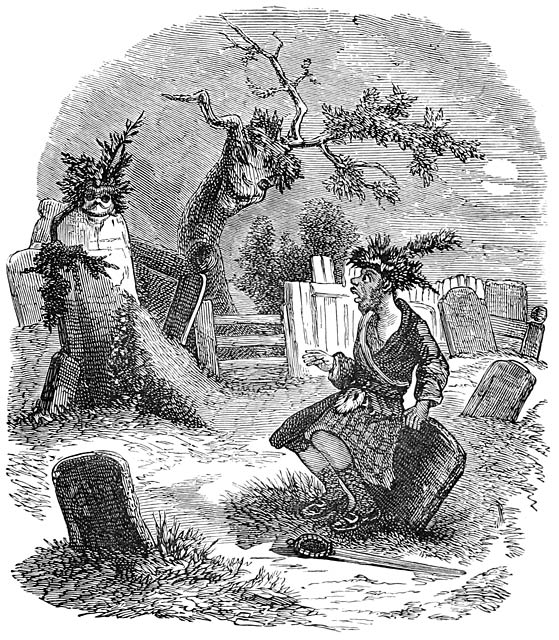
For some time he stood trembling and staring, in a cold sweat.
As John thus sat on his knees, praying and quaking, his animal courage so far returned to him as to permit him to observe that the object of his terror remained unchanged and immovable. At length his mind recovered itself to such an extent, as to enable him to revert to that night of misery which he had so recently experienced, in beholding that which he had believed to be the spirit of Dallas the packman, and remembering how that matter had been cleared up by the appearance of daylight, he began to reason with himself as to the possibility of this being a somewhat similar case. Having thus so far reduced his fears within the control of his reason, he summoned up resolution to raise himself from his knees, and to advance one step nearer to the phantom which had so long triumphed over the courage that was within him. And, seeing that, notwithstanding this movement of his, it still maintained its position, and uttered no sound, he ventured to take a second step—and then a third step, until the truth, and the whole truth, began gradually to dawn upon his eyes and his mind, and then, at last, he discovered, to his very great relief, that the horrible and much-dreaded demon whose appearance had so disturbed and discomposed his nervous system, was no other than a tall old tombstone, with a head so fearfully chisselled on the top of it, as might have left it a very doubtful matter, even in the day-time, for any one, however learned in such pieces of art, to have determined whether the rustic sculptor had intended it for a death’s-head or a cherubim. Some idle artist of the brush, in passing by that way with a pot full of red paint, prepared for giving a temporary glory to a new cart about to be turned out from a neighbouring wright’s shop, had paused as he passed by, and exhausted the full extent of his small talents in communicating to the countenance that bloody appearance, the effect of which had so much appalled John Smith, and some waggish schoolboy had finished the figure, by tearing up a sod covered with plants of various kinds, and clapping it on its top, so as thereby very much to augment its artificial terrors. John Smith drew a long breath of inconceivable relief on making this discovery, and then darting through the wicket, he pursued his journey with as much expedition as his weakness and fatigue permitted him to use.
John walked on for some hour or twain with very determined resolution, but at length the great loss of blood he had experienced, brought on so unconquerable a drowsiness, that he felt he must have a little rest, were it but for a few minutes, even if his taking it should be at the risk of his life. John was never wont to be very particular as to the place where he made his bed, but on the present occasion it happened, probably from the blood-vessels of his body having been so much drained, that he had a most unpleasant chill upon him. He felt as if ice itself was shooting and crystallizing through every vein and artery within him. Then the night had become somewhat raw, and he had left his plaid, which is a Highlander’s second house, on the fatal field of battle. Under all these circumstances, John was seized with a resistless desire to enjoy the luxury of sleep for a short time, under the shelter of a roof, and in the vicinity of a good peat fire. Calling to mind that there was an humble turf-built cottage in a hollow a little way farther on, by the side of a small rushy, mossy stream, he made the best of his way towards it.
The house consisted of three small apartments, one in the middle of it, opposite to the outer door, and one at either end, which had their entrances from that in the centre. When John came to the brow of the bank that looked down upon this humble dwelling, he was by no means sorry to perceive that the middle apartment had a good blazing fire in it, as he could easily see through the window and outer door, which last chanced to be invitingly open. John, altogether forgetful of his uncouth and terrific appearance, lost not a moment in availing himself of this lucky circumstance. But he had no sooner presented his awful spectral form and visage within the threshold, than he spread instantaneous terror over the group assembled within.
“Oh, a ghost! a ghost!” cried out in Gaelic a pale-faced girl of some eight or nine years of age, as she dropped on her knees, shaken by terror in every limb and feature.
“Oh, the devil! the devil!” roared an old man and woman, who also sank down before John, bellowing out like frightened cattle. “Och, och! we shall all be swallowed up quick by the Evil One!”
“Fear nothing,” said John Smith, in a mild tone, and in the same tongue. “I am but a poor wounded and wearied man. I only want to lie down and rest me a little, if you will be so charitable as to grant me leave.”
“Wounded!” said the old man, rising from his knees, somewhat reassured; “where were you wounded?”
“In the head here,” said John, with a stare that again somewhat disconcerted the old man; “and if it had not been for this peat that I clapped on my skull, I believe my very brains would have been all out of me.”
“Mercy on us, where got ye such a mischance as that?” exclaimed the old woman.
“At Culloden, I’ll be sworn,” said the old man.
“Aye, aye, it was at Culloden,” replied John. “But, if ye be Christians, give me a drink of warm milk and water, to put away this shivering thirst that is on me, and let me lie down in a warm bed for half an hour.”
“Och aye, poor man, ye shall not want a drop of warm milk and water, and such a bed as we can give you,” said the old woman, moving about to prepare the drink for him.
“Thank ye—thank ye!” said John, much refreshed and comforted by swallowing the thin but hot potation. And then following the old man into the inner apartment on the right hand, he sank down in a darksome nook of it, on a pallet among straw, and covering himself up, turf, nightcap and all, under a coarse blanket, he was sound asleep before the old man had withdrawn the light, and shut the door of his clay chamber.
“Oh that our boys were back again safe and sound!” cried the old woman, wringing her hands.
“Safe and sound I fear we cannot expect them to be, Janet,” replied the old man. “But oh that we had them back again, though it was to see them wounded as badly as that poor fellow! Much do I fear that they are both corpses on Drummossie Moor.”
“What will become of us!” cried the old woman, weeping bitterly; “what will become of this poor motherless lassie now, if her father be gone?”
But, leaving this aged couple to complain, and John Smith to enjoy his repose, we must now return to poor Morag, whom, as you may recollect, gentlemen, we left hunted into covert by the two dragoons who had so closely pursued her. The patch of natural wood into which she dived was not large. It chiefly consisted of oaks and birches, which, though they had grown to a considerable size in certain parts, so that their wide-spreading heads had kept the knolls on which their stems stood, altogether free from the incumbrance of any kind of brushwood,—had yet in most places risen up thinner and smaller, leaving ample room and air around them to support thickets of the tallest broom and juniper bushes.
It chanced that Morag was not altogether unacquainted with the nature of the place, having at one time, in earlier life, been hired to tend the cows of a farmer at no great distance from it. She was well aware that a rill, which had its origin in the higher grounds at some distance, came wimpling into the upper part of the wood, and thence, during its descent over the sloping surface of the ground, from its having met with certain obstructions, or from some other cause, it had worn itself a channel through the soft soil, to the depth of some six feet or so, but which was yet so narrow, that the ferns and bushes growing out of the undermined sods that fringed the edges of it, almost entirely covered it with one continued tangled and matted arch. Towards this rill Morag endeavoured to make her way through the tall broom, and, as she was doing so, she heard the dismounted trooper, who had by this time entered the wood after her, calling to his comrade, who sat mounted outside:
“Bill! do you padderowl round the wood, and keep a sharp look out that she don’t bolt without your seeing her. I’ll follow arter her here, and try if I can’t lay my hands on her; and if I do but chance to light on her, be she witch or devil, I’ll drag her out of her covert by the scruff of the neck.”
Morag heard no more than this.—She pressed forward towards the bed of the rill, and having reached it, she stopped, like a chased doe, one moment to listen, and hearing that the curses, as well as the crashing of the jack-boots of her pursuer, as yet indicated that he was still at some distance behind her, and evidently much entangled in his progress, she carefully shed the pendulous plants of the ferns asunder, and then slid herself gently down into the hollow channel. There finding her feet safely planted on the bottom, she cautiously and silently groped her way along the downward course of the rill, through the dark and confined passage which it had worn out for its tiny stream. In this way she soon came to the lower edge of the wood, where the hollow channel became deeper, and where it assumed more of the character of a ravine, but where it was still skirted with occasional oaks, mingled with thickets of birches, hazels, and furze bushes.