RESOLUTIONS BY CAMPS AND CHAPTERS (continued 2)
Reading edition
Resolved, That the comrades of Camp No. 135, Confederate Veterans, have heard with sorrow and regret of the death of this brave general and fearless commander.
Resolved, Educated in the profession of arms, he gave the best years of his life to the service of his country. For twenty-five years prior to the action which necessitated his State severing her connection with the Union, he most valiantly drew his sword in her defence. Through the Mexican War and during the continuous troubles with the Indians on our Western plains his services were so conspicuous for gallantry that he attained the rank of major.
Resolved, When his State could no longer remain in the Union, but withdrew, he resigned his commission, and cast his lot with that of his State. As he had been gallant and successful in the army of the Union, he now became more so in the army of the Confederacy. The enlarged opportunities furnished what his great ability needed. From the rank of major he rose rapidly to that of lieutenant-general and second in command to our peerless Lee. As brigadier-general at Manassas he engaged the left wing of the enemy with the result that is familiar to all of us. As major-general he was selected to cover Johnston’s retreat in the Peninsula. He won Williamsburg and was at Seven Pines. For his service in the Seven Days’ fight around Richmond Congress rewarded him with the rank of senior lieutenant-general and second in command of all the Confederate forces. He was at the second Manassas with Jackson, and at South Mountain. At Sharpsburg he was knighted “War-Horse” by his chieftain. Fredericksburg, Gettysburg, Chickamauga, and the Wilderness felt his presence; while Petersburg, Five Forks, and Appomattox beheld his gallantry. Comrades, we knew him, we loved him, we trusted him. To-day we would pay him his tribute; believing him to be worthy to be placed beside Lee, Albert Sidney and Joseph E. Johnston, and Jackson.
Resolved, That these resolutions be spread upon the minutes of our Camp, copies be furnished each of our county papers for publication, and that a copy be sent to Mrs. Longstreet, together with expressions of our sympathy by the adjutant.
J. W. Sherrill. W. H. Morgan. R. L. Suggs.
*****
(John B. Hood Camp.)
“Oblivion will shut out those who assail his great name.”
To the Officers and Members of John B. Hood Camp, No. 103, U. C. V.:
Comrades,—We, your committee, appointed at a meeting held this day to draft resolutions upon the death of Lieutenant-General James Longstreet, late commander of the First Corps, Army of Northern Virginia, beg leave to submit the following:
Whereas, It having pleased the Deity to call our great commander to cross over the river and take permanent position with the majority of his old comrades who have preceded him; therefore, be it
Resolved, That in the death of General Longstreet we realize the loss of the senior and last surviving lieutenant-general of the Army of Northern Virginia, and while freighted with the events of eighty-three years, and suffering from the effects of many wounds received in battle, still he bore up with a fortitude becoming his great spirit.
Resolved, That in his character we recognize the true patriot and soldier, devotion to duty, and a genius which added glory to our arms and inspired faith in our cause.
Resolved, That in the remotest history his achievements will be appreciated with all the glory that came to us during that bloody drama, while oblivion will shut out those who would assail his fair name.
Resolved, That to his family we tender sincere condolence, with the assurance that his kind consideration for his men, courtly bearing, and bravery will ever have a place in the memory of the survivors of his command, who followed him from the first Manassas to Appomattox.
Resolved, That these resolutions be spread upon the minutes of this camp; the adjutant to forward a copy to the family, and that the State press be requested to publish same.
J. D. Roberdeau. Val C. Giles. W. R. Hamby. C. F. Dohine.
*****
(John B. Gordon Chapter, U. D. C.)
“As gallant a soldier as wore the gray.”
Wetumpka, Alabama, January 12, 1904.
Whereas, The Ruler of the Universe has seen fit to call from his earthly home the spirit of General Longstreet, and take him to his home on high, as a bright reward for his faithfulness and fidelity here in life. General Longstreet was as brave and gallant a soldier as wore the gray during the fierce struggle of the South. He was known and loved throughout this fair sunny Southland, not only as a soldier and general who so gallantly and fearlessly led his men in the Southern cause, but as a true and noble man, and when his final summons came and he laid down his earthly armor for a heavenly crown, it cast a shadow over all the South, that another of her brave generals who had so nobly defended her cause was no more.
But since he has left us and is no more among his family, comrades, and friends, be it
Resolved, That this Chapter of the Daughters of the Confederacy regrets with deepest sorrow the death of General Longstreet, and through this little tribute to his memory expresses its deepest and sincerest sympathy.
Resolved, That his State and nation has lost a grand and noble man, the Southern cause a gallant and fearless soldier.
Resolved, That a copy of these resolutions be placed on the minute-book of the Chapter and a copy be sent to General Longstreet’s family.
Mrs. S. J. McMorris. Mrs. W. H. Gregory. Miss Fanny Gokon.
*****
(George W. Johnson Camp.)
“True and faithful to every duty.”
At a meeting of the George W. Johnson Camp, Confederate Veterans’ Association of Kentucky, to take in consideration the death of Lieutenant-General James Longstreet, the following resolutions were reported and adopted:
Resolved, That in the death of General Longstreet has passed from the stage of action one of the central and most prominent figures of our late war.
Resolved, In him we recognized one of the ablest and most gallant soldiers of the lost cause.
Resolved, As commander of one of the corps of the Army of Northern Virginia his name is inseparably connected with the glory that rightly gathers about the achievements of that immortal organization.
Resolved, True and faithful to his every conviction of duty, and unswerving in his devotion to his country and people in the hour of their supremest trial and need, his name deserves to be enrolled among the immortals of our Southland.
Resolved, That we extend to the bereaved family our deepest sympathy, and that a copy of these resolutions be sent to the family and to the Confederate Veteran.
A. H. Sinclair, Commander. Elley Blackburn, Adjutant.
*****
(Tennessee Division, Daughters of the Confederacy.)
“Mankind will find no brighter page of history than that written by Longstreet’s corps.”
Resolutions of the Tennessee Division of the Daughters of the Confederacy:
Entered into rest January 2, 1904, at his home in Gainesville, Georgia, surrounded by his family, consisting of his wife and five children, at the ripe old age of eighty-three years, Lieutenant-General James Longstreet.
A graduate of West Point, one of the heroes of the Mexican War, where he was desperately wounded, in storming Cherubusco, and where he was twice brevetted for gallantry on the field of battle,—once as captain, for Churubusco, and again as major, for Molino del Rey,—a professional soldier in the army of the United States, the highest in rank from the State of Alabama at the time of the secession of that State, he resigned from the United States army, tendered his sword to Alabama, and from thenceforward was identified with the South in her immortal struggle for the right of local self-government, guaranteed to her in the Constitution of the United States, and as laid down in the Declaration of Independence, from Bull Run to Appomattox, and, at its close, was recognized as “the left arm of Lee.”
Since his death, his record as a soldier has been criticised, at a time when he cannot defend himself, but we congratulate the people of the South and the future historian that the Congress of the Confederate States, February 17, 1864, passed unanimously resolutions thanking Lieutenant-General Longstreet and his command for their patriotic services and brilliant achievements in Virginia, Maryland, Pennsylvania, Georgia, and Tennessee, and participating in nearly every great battle fought in those States, the commanding general ever displaying great ability, skill, and prudence in command, and the officers and men the most heroic bravery, fortitude, and energy in every duty that they have been called upon to perform.
This resolution was approved by Jefferson Davis, and was adopted on the recommendation of the commanding general of the army of the Confederate States of America, the immortal Robert E. Lee. After the adoption of these resolutions, nothing which we can say could add to his soldier’s record. He needs no defence. We consign his name to history; so long as mankind reads it, they will find no brighter page than that written by Longstreet’s corps.
He illustrated the South in a long life, the best years of it devoted to her and her cause, he sacrificed to serve her as much as any other one man, he fought a score of battles for her, and never one against her, and this State, over his grave, mingle their tears with those of the people whom he served and the devoted family who survive him; therefore
Resolved, That the Army of the Confederate States of America is rapidly passing to the Great Beyond, leaving a record, a part of the history of the American people, to which we point with pride, and to which in a few generations civilized man will look, and admit that it illustrated the highest type of American citizenship.
Resolved, That we extend our sympathies to the surviving family of General Longstreet and to the South, at his death, and that a copy of the foregoing preamble and resolutions be furnished to his family and to the press.
Miss Kate Fort, Chairman. Mrs. James P. Smartt. Mrs. M. H. Clift. Mrs. Wm. G. Oehmig, President.
*****
“Longstreet’s magnificent service at Gettysburg gives that field the great place it holds in history to-day.”
As one of his defenders, in the interest of truth, justice, and fairness, having participated in the battle of Gettysburg, Pennsylvania, in Pegram’s battery, A. P. Hill’s corps, and knowing, from frequent visits to that sanguinary field since the engagement, something about what occurred on that eventful occasion, I can confidently say that General Longstreet and those under him performed such grand and magnificent service on that battle-field as to give it the great and important place it holds in history to-day. We never knew that it was otherwise questioned until after the war. Future history will vindicate his character in his course on that field and everywhere else where duty called him during the eventful period from ’61 to ’65.—John T. Callaghan, Vice-President Confederate Association.
Washington, D. C.
*****
(Encampment No. 9, Union Veteran Legion, New Castle, Pennsylvania.)
“A brave, generous, and great man.”
Resolved, That the death of Lieutenant-General James Longstreet has caused the loss to the nation of a brave, generous, and great man. None knew his bravery or his greatness as a commander better than we of the Union Veteran Legion who often met him on fields that tested to the limit the fighting qualities of the American.
We extend to his wife and family our sympathy in their bereavement, and the assurance of our great respect for their lost one.
Samuel F. Ellison,
Colonel Commanding.
George W. Gageby,
Adjutant.
*****
(George E. Pickett Camp.)
“In nearly all the leading battles of the South there was Longstreet to lead his men to fame and glory.”
January 25, 1904.
To the Officers and Members of George E. Pickett Camp, C. V.:
Your committee appointed on resolutions relative to the death of Lieutenant-General Longstreet desire to have it placed on record, that we, the survivors of Confederate Veterans, lost in the recent death of General Longstreet one of our best and bravest officers, under whose command the Army of Northern Virginia gained its reputation as the grandest fighting army the world ever produced. At Bull Run, Williamsburg, Seven Pines, Second Manassas, Boonboro, Sharpsburg, Fredericksburg, and in nearly all of the principal battles and victories of the South, there was Longstreet to lead his men to fame and glory.
We therefore express our sentiment that in the death of General Longstreet we have lost a true and good Confederate, loyal to the cause for which he bled and fought.
Resolved, That we extend our heartfelt sympathy to his widow and family, and that a copy of these resolutions be spread on our minutes.
Chas. T. Loehr, Wm. E. Talley, W. U. Bass,
Committee.
Adopted by vote of camp and copy ordered sent to Mrs. General James Longstreet.
R. N. Northen, Adjutant No. 204, N. C. V. S.
*****
(John Bowie Strange Camp.)
“Those who followed Longstreet in the fitful fever of war ever had confidence in his ability, courage, and fidelity.”
The John Bowie Strange Camp of Confederate Veterans of Charlottesville, Virginia, assembled in special meeting for the purpose, desire to spread on their record a tribute to the memory of James Longstreet, lieutenant-general in the armies of the Confederate States, whose death has been recently announced. The Virginians who served under him in the great Civil War recognize his splendid ability as a corps commander, his dauntless courage, and the absolute confidence reposed in him by that immortal band of Southerners who will go down in history wreathed in immortal fame as Longstreet’s corps in the Army of Northern Virginia. This camp, a large proportion of whose members belonged to regiments and organizations led by him in the Virginia campaigns, wish to record the fact that whatever criticisms may have been passed upon his conduct on crucial occasions, yet those who followed him in the fitful fever of war ever had confidence in his fidelity, his loyalty, and his devotion to the Southern cause; and along with other comrades from the South who followed him on the line of danger, they had absolute faith in his splendid courage and ability as their commander. It is an historical fact that he so possessed the confidence of our immortal leader, R. E. Lee, the commander-in-chief of the Confederate forces, that he continued him in command as lieutenant-general until the fateful day of Appomattox, when in the expiring crisis of the Confederacy Longstreet and his corps of Southerners were in line of battle, ready and willing to risk and lay down their lives in defence of the South, until ordered by their great chieftain to sheath their swords, stack their guns, and furl their flags.
Resolved, That a copy of these resolutions be published in the local papers and also be sent to the bereaved widow of this distinguished Southerner.
Micajah Woods, George L. Petrie, J. M. Murphy,
Committee.
The foregoing resolutions, presented by the committee appointed for the purpose, were unanimously passed by the John Bowie Strange Camp of Confederate Veterans at Charlottesville, Virginia. Witness the signature of H. Clay Michie, commander of said Camp, and attested by W. N. Wood, Adjutant and Secretary of said Camp.
H. Clay Michie, Commander.
This 12th day of January, 1904. W. N. Wood, Adjutant and Secretary.
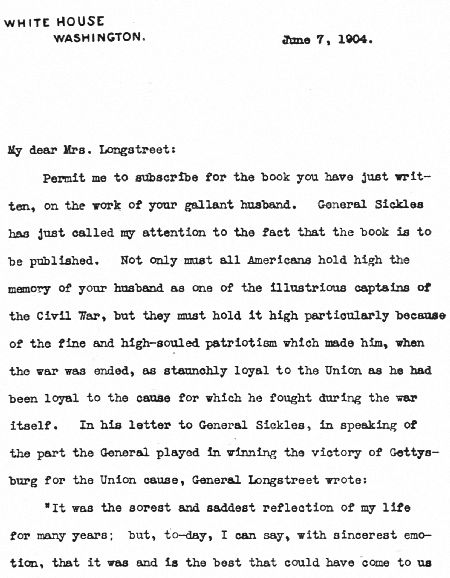
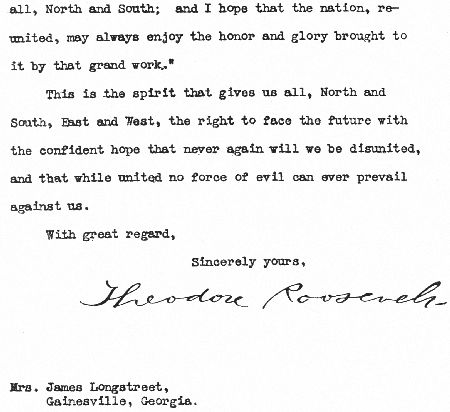
Fac-simile of Letter from President Theodore Roosevelt
WHITE HOUSE WASHINGTON.
June 7, 1904.
My dear Mrs. Longstreet:
Permit me to subscribe for the book you have just written, on the work of your gallant husband. General Sickles has just called my attention to the fact that the book is to be published. Not only must all Americans hold high the memory of your husband as one of the illustrious captains of the Civil War, but they must hold it high particularly because of the fine and high-souled patriotism which made him, when the war was ended, as staunchly loyal to the Union as he had been loyal to the cause for which he fought during the war itself. In his letter to General Sickles, in speaking of the part the General played in winning the victory of Gettysburg for the Union cause, General Longstreet wrote:
“It was the sorest and saddest reflection of my life for many years; but, to-day, I can say, with sincerest emotion, that it was and is the best that could have come to us all, North and South; and I hope that the nation, reunited, may always enjoy the honor and glory brought to it by that grand work.”
This is the spirit that gives us all, North and South, East and West, the right to face the future with the confident hope that never again will we be disunited, and that while united no force of evil can ever prevail against us.
With great regard,
Sincerely yours, Theodore Roosevelt
Mrs. James Longstreet, Gainesville, Georgia.