Front matter (continued 2)
Reading edition
And as I sat in the magic bus and saturated myself with this intoxicating vision of the Eden that will come when the madness is past, I wondered what I should do on entering that blessed realm that was lost and that we yearn to regain. Yes, I think I should fall on my knees. I think we shall all want to fall on our knees. What other attitude will there be for us? Even my barber will fall on his knees. "If I thought peace was coming to-morrow," he said firmly the other day, "I'd fall on my knees this very night." He spoke as though nothing but peace would induce him to do such a desperate, unheard-of thing. I tried to puzzle out his scheme of faith, but found it beyond me. It rather resembled the naked commercialism of King Theebaw, who when his favourite wife lay ill promised his gods most splendid gifts if she recovered, and when she died brought up a park of artillery and blew their temple down. But my barber, nevertheless, had the root of the matter in him, and I would certainly follow his example.
But then—what then? Well I should want to get on to some high and solitary place—alone, or with just one companion who knows when to be silent and when to talk—there to cleanse my soul of this debauch of horror. I would take the midnight train and ho! for Keswick. And in the dawn of a golden day—it must be a golden day—I would see the sun
Flatter the mountain tops with sovran eye
and set out by the lapping waves of Derwentwater for glorious Sty Head and hear the murmurs from Glaramara's inmost caves and scramble up Great Gable and over by Eskhause and Scafell and down into the green pastures of Langdale. And there in that sanctuary with its starry dome and its encompassing hills I should find the thing I sought.
Then, like the barber, I shall be moved to do something desperate. I shall want some oblation to lay on the altar, and if I know my companion he will not have forgotten his hundred foot of rope or his craft of the mountains and together we will
Leave our rags on Pavey Ark, Our cards on Pillar grim.
And then, the consecration and the offering complete, back to the world that is shuddering, white-faced and wondering, into its Paradise Regained.... Why, here is St. John's Wood already. And Lord's! Of course, I must have a day at Lord's. It will be a part of the ritual of reconciliation. The old players will not be there, for the gulf with the past is wide and the bones of many a great artist lie on distant fields. But we must recapture their music and pay homage to their memory. Yes, I will take my lunch to Lord's—or perchance the Oval—and sit in the sunshine and hear the merry tune of bat and ball, and walk over the greensward in the interval and look at the wicket, and talk for a whole day with my companion of the giants of old and of the doughty things we have seen them do. Haig and Hindenburg, Tirpitz and Jellicoe, all the names that have filled our nightmare shall be forgotten: there shall fall from our lips none but the names of the goodly game—"W.G." and Ranji, Johnny Briggs and Lohmann, Spofforth and Bonner, Ulyett and Barnes (a brace of them) and all the jolly host. We'll not forget one of them. Not one. For a whole day we will go it, hammer and tongs.
And there are ever so many more things I shall want to do. I shall want to go and see the chestnuts at Bushey Park on Chestnut Sunday. I shall want to send Christmas cards, and light bonfires on the Fifth, and make my young friends April fools on the First, and feel what a tennis racket is like, and have hot cross buns on Good Friday and pancakes on Shrove Tuesday. I shall want to go and sit on the sands and hear nigger minstrels again, and talk about the prospects of the Boat Race, and take up all the pleasant threads of life that fell from our hands nearly four years ago. In short, I shall plunge into all the old harmless gaieties that we have forgotten, have no time for, no heart for, no use for to-day.
But the bus has stopped and I am turned out of Eden into the snow and the slush and the never-ending night. The magic chariot goes on with its blazing lights, and a bend in the road quenches the pleasant vision in darkness.
ON A COMIC GENIUS
"Like to see Harry Lauder? Of course I should like to see Harry Lauder. But how can I decently go and see Harry Lauder with Lord Devonport putting us on rations, with every hoarding telling me that extravagance is a crime, and with Trafalgar Square aflame with commands to me to go to the bank or the post-office and put every copper I have, as well as every copper I can borrow, into the War Loan? Do you realise that the five shillings I should pay for a seat to see Harry Lauder would, according to the estimate of the placards on the walls, buy thirty-one and a half bullets to send to the Germans? Now, on a conservative estimate, those thirty-one and a half bullets ought to——"
"My dear fellow, Harry Lauder has subscribed £52,000 to the War Loan. In going to see him, therefore, you are subscribing to the War Loan. You are making him your agent. You pass the cash on to him and he passes the bullets on to the Germans. It is a patriotic duty to go and see Harry Lauder."
I fancy the reasoning was more ingenious than sound, but it seemed a good enough answer to the hoardings, and I went. It was a poor setting for the great man—one of those dismal things called revues, that are neither comedies nor farces, nor anything but shambling, hugger-mugger contraptions into which you fling anything that comes handy, especially anything that is suggestive of night-clubs, fast young men and faster young women. I confess that I prefer my Harry without these accompaniments. I like him to have the stage to himself. I like Miss Ethel Levy to be somewhere else when he is about. I do not want anything to come between me and the incomparable Harry any more than I want anyone to help me to appreciate the Fifth Symphony by beating time with his foot and humming the melody.
And for the same reason. The Fifth Symphony or any other great work of art creates a state of mind, a spiritual atmosphere, that is destroyed by any intrusive and alien note. And it is this faculty of creating a state of feeling, an authentic atmosphere of his own, that is the characteristic of the art of Harry Lauder, and the secret of the extraordinary influence he exercises over his public. If you are susceptible to that influence the entrance of the quaint figure in the Scotch cap, the kilt and the tartan gives you a sensation unlike anything else on the stage or in life. Like Bottom, you are translated. Your defences are carried by storm, your severities disperse like the mist before the sun, you are no longer the man the world knows; you are a boy, trooping out from Hamelin town with other boys to the piping of the magician. The burden has fallen off your back, the dark mountain has opened like a gateway into the realms of light and laughter, and you go through, dancing happy, to meet the sunshine.
This atmosphere is not the result of conscious art or of acting in the professional sense. It would even be true to say that Harry Lauder is not an actor at all. Contrast him with the other great figure of the music-hall stage in this generation, Albert Chevalier, and you will understand what I mean. Chevalier is never himself, but always somebody else, and that somebody else is astonishingly real—an incomparable coster, a serio-comic decayed actor, a simple old man celebrating the virtues of his "Old Dutch." With his great powers of observation and imitativeness he gives you a subtle study of a type. He is so much of an artist that his own personality never occurs to you. If Chevalier came on as Chevalier you would not know him.
But Harry Lauder is the most personal thing on the stage. You do not want him to imitate someone else: you want him to be just himself. It doesn't much matter what he does, and it doesn't much matter how often you have seen him do it. In fact, the oftener you have seen him do it the better you like it. His jokes may be old, but they are never stale. They ripen and mellow with time; they are like old friends and old port that grow better with age. His songs may be simple and threadbare. You don't care. You just want him to go on singing them, singing about the bluebells in the dells and the bonnie lassie, and the heather-r, the bonnie pur-r-ple heather-r, and pausing to explain to you the thrifty terms on which he has bought "the ring." You want to see him walk, you want to see him skip—oh, the incomparable drollery of that demure little step!—you want to hear him talk, you want to hear him laugh. In short, you just want him to be there doing anything he likes and making you happy and idyllic and childlike and forgetful of all the burden and the mystery of this inexplicable world.
He has art, of course—great art; a tuneful voice; a rare gift of voice-production, every word coming full and true, and with a delicate sense of value; a shrewd understanding of the limits of his medium; a sly, dry humour which makes his simple rusticity the vehicle of a genial satire. And his figure and his face add to his equipment. His walk is priceless. His legs—oh, who shall describe those legs, those exiguous legs, so brief and yet so expressive? Clothed in his kilt and his tartan, he is grotesque and yet not grotesque, but whimsical, droll, a strange mixture of dignity and buffoonery. Your first impulse is to laugh at him, your next and enduring impulse is to laugh with him. You cannot help laughing with him if you have a laugh in you, for his laugh is irresistible. It is so friendly and companionable, so full of intimacies, so open and sunny.
He comes to the footlights and talks, turns out his pockets and tells you the history of the contents, or gossips of the ways of sailors, and you gather round like children at a fair. The sense of the theatre has vanished. You are not listening to an actor, but to an old friend who is getting nearer and nearer to you all the time, until he seems to have got you by the button and to be telling his drolleries to you personally and chuckling in your own private ear. There is nothing comparable to this intimacy between the man and his audience. It is the triumph of a personality, so expansive, so rich in the humanities, so near to the general heart, that it seems a natural element, a sort of spirit of happiness, embodied and yet all-pervasive.
But perhaps you, sir, have not fallen under the spell. If so, be not scornful of us who have. Be sorry for yourself. Believe me, you have missed one of the cheerful experiences of a rather drab world.
ON A VANISHED GARDEN
I was walking with a friend along the Spaniards Road the other evening, talking on the inexhaustible theme of these days, when he asked: "What is the biggest thing that has happened to this country as the outcome of the war?"
"It is within two or three hundred yards from here," I replied. "Come this way and I'll show it to you."
He seemed a little surprised, but accompanied me cheerfully enough as I turned from the road and led him through the gorse and the trees towards Parliament Fields, until we came upon a large expanse of allotments, carved out of the great playground, and alive with figures, men, women, and children, some earthing up potatoes, some weeding onion beds, some thinning out carrots, some merely walking along the patches and looking at the fruits of their labour springing from the soil. "There," I said, "is the most important result of the war."
He laughed, but not contemptuously. He knew what I meant, and I think he more than half agreed.
And I think you will agree, too, if you will consider what that stretch of allotments means. It is the symptom of the most important revival, the greatest spiritual awakening this country has seen for generations. Wherever you go that symptom meets you. Here in Hampstead allotments are as plentiful as blackberries in autumn. A friend of mine who lives in Beckenham tells me there are fifteen hundred in his parish. In the neighbourhood of London there must be many thousands. In the country as a whole there must be hundreds of thousands. If dear old Joseph Pels could revisit the glimpses of the moon and see what is happening, see the vacant lots and waste spaces bursting into onion beds and potato patches, what joy would be his! He was the forerunner of the revival, the passionate pilgrim of the Vacant Lot; but his hot gospel fell on deaf ears, and he died just before the trumpet of war awakened the sleeper.
Do not suppose that the greatness of this thing that is happening can be measured in terms of food. That is important, but it is not the most important thing. The allotment movement will add appreciably to our food supplies, but it will add far more to the spiritual resources of the nation. It is the beginning of a war on the disease that is blighting our people. What is wrong with us? What is the root of our social and spiritual ailment? Is it not the divorce of the people from the soil? For generations the wholesome red blood of the country has been sucked into the great towns, and we have seen grow up a vast machine of industry that has made slaves of us, shut out the light of the fields from our lives, left our children to grow like weeds in the slums, rootless and waterless, poisoned the healthy instincts of nature implanted in us, and put in their place the rank growths of the streets. Can you walk through a London working-class district or a Lancashire cotton town, with their huddle of airless streets, without a feeling of despair coming over you at the sense of this enormous perversion of life into the arid channels of death? Can you take pride in an Empire on which the sun never sets when you think of the courts in which, as Will Crooks says, the sun never rises?
And now the sun is going to rise. We have started a revolution that will not end until the breath of the earth has come back to the soul of the people. The tyranny of the machine is going to be broken. The dead hand is going to be lifted from the land. Yes, you say, but these people that I see working on the allotments are not the people from the courts and the slums; but professional men, the superior artisan, and so on. That is true. But the movement must get hold of the intelligenzia first. The important thing is that the breach in the prison is made: the fresh air is filtering in; the idea is born—not still-born, but born a living thing. It is a way of salvation that will not be lost, and that all will traverse.
This is not mere dithyrambic enthusiasm. Take a man out of the street and put him in a garden, and you have made a new creature of him. I have seen the miracle again and again. I know a bus conductor, for example, outwardly the most ordinary of his kind. But one night I touched the key of his soul, mentioned allotments, and discovered that this man was going about his daily work irradiated by the thought of his garden triumphs. He had got a new purpose in life. He had got the spirit of the earth in his bones. It is not only the humanising influence of the garden, it is its democratising influence too.
When Adam delved and Eve span, Where was then the gentleman?
You can get on terms with anybody if you will discuss gardens. I know a distinguished public servant and scholar whose allotment is next to that of a bricklayer. They have become fast friends, and the bricklayer, being the better man at the job, has unconsciously assumed the role of a kindly master encouraging a well-meaning but not very competent pupil.
And think of the cleansing influence of all this. Light and air and labour—these are the medicines not of the body only, but of the soul. It is not ponderable things alone that are found in gardens, but the great wonder of life, the peace of nature, the influences of sunsets and seasons and of all the intangible things to which we can give no name, not because they are small, but because they are outside the compass of our speech. In the great legend of the Fall the spiritual disaster of Man is symbolised by his exclusion from a garden, and the moral tragedy of modern industrialism is only the repetition of that ancient fable. Man lost his garden, and with it that tranquillity of soul that is found in gardens. He must find his way back to Eden if he is to recover his spiritual heritage, and though Eden is but a twenty-pole allotment in the midst of a hundred other twenty-pole allotments, he will find it as full of wonder and refreshment as the garden of Epicurus. He will not find much help from the God that Mr. Wells has discovered, or invented, but the God that dwells in gardens is sufficient for all our needs—let the theologians say what they will.
Not God in gardens? When the eve is cool? Nay, but I have a sign— 'Tis very sure God walks in mine.
No one who has been a child in a garden will doubt the sign, or lose its impress through all his days. I know, for I was once a child whose world was a garden.
*****
It lay a mile away from the little country town, shut out from the road by a noble hedge, so high that even Jim Berry, the giant coal-heaver, the wonder and the terror of my childhood, could not see over, so thick that no eye could peer through. It was a garden of plenty, but also a garden of the fancy, with neglected corners, rich in tangled growths and full of romantic possibilities. It was in this wilder terrain that I had found the hedgehog, here, too, had seen the glow-worm's delicate light, and here, with my brain excited by "The Story of the Hundred Days," that I knew the Frenchmen lurked in ambush while I at the head of my gallant troop of the Black Watch was careering with magnificent courage across the open country where the potatoes and the rhubarb and the celery grew.
It was ever the Black Watch. Something in the name thrilled me. And when one day I packed a little handbag with a nightgown and started out to the town where the railway station was, it was to Scotland I was bound and the Black Watch in which I meant to enlist. It occurred to me on the road that I needed money and I returned gravely and asked my mother for half a crown. She was a practical woman and brought me back to the prose of things with arguments suitable to a very youthful mind.
The side windows of the house commanded the whole length of the garden to where at the end stood the pump whence issued delicious ice-cold water brought up from a well so deep that you could imagine Australia to be not far from the bottom.
If only I could get to Australia! I knew it lay there under my feet with people walking along head downwards and kangaroos hopping about with their young in their pockets. It was merely a question of digging to get there. I chose a sequestered corner and worked all a summer morning with a heavy spade in the fury of this high emprise, but I only got the length of the spade on the journey and retired from the task with a sense of the bitter futility of life.
Never was there a garden more rich in fruit. Around the western wall of the house was trained a noble pear tree that flung its arms with engaging confidence right up to my bedroom window. They were hard pears that ripened only in keeping, and at Christmas melted rich and luscious in the mouth. They were kept locked up in the tool-shed, but love laughs at locksmiths, and my brother found it possible to remove the lock without unlocking it by tearing out the whole staple from its socket. My father was greatly puzzled by the tendency of the pears to diminish, but he was a kindly, unsuspecting man who made no disagreeable inquiries.
Over the tool-shed grew a grape vine. The roof of the shed was accessible by a filbert tree, the first of half a dozen that lined the garden on the side remote from the road. On sunny days there was no pleasanter place to lie than the top of the shed, with the grapes, small but pleasant to the thirsty palate, ripening thick around you. A point in favour of the spot was that it was visible from no window. One could lie there and eat the fruit without annoying interruptions.
Equally retired was the little grass-grown path that branched off from the central gravelled path which divided the vegetable from the fruit garden. Here, by stooping down, one was hidden from prying eyes that looked from the windows by the thick rows of gooseberry bushes and raspberry canes that lined the path. It was my favourite spot, for there grew a delicious gooseberry that I counted above all gooseberries, small and hairy and yellow, with a delicate flavour that is as vivid to-day as if the forty years that lie between now and then were but a day. By this path, too, grew the greengage trees. With caution, one could safely sample the fruit, and at the worst one was sure to find some windfalls among the strawberry beds beyond the gooseberry bushes.
I loved that little grass-grown path for its seclusion as well as for its fruit. Here, with "Monte Cristo" or "Hereward the Wake," or "The Yellow Frigate," or a drawing-board, one could forget the tyrannies of school and all the buffets of the world. Here was the place to take one's griefs. Here it was that I wept hot tears at the news of Landseer's death—Landseer, the god of my young idolatry, whose dogs and horses, deer and birds I knew line by line through delighted imitation. It seemed on that day as though the sun had gone out of the heavens, as though the pillars of the firmament had suddenly given way. Landseer dead! What then was the worth of living? But the wave of grief passed. I realised that the path was now clear before me. While Landseer lived I was cribbed, cabined, confined; but now—— My eyes cleared as I surveyed the magnificent horizon opening out before me. I must have room to live with this revelation. The garden was too narrow for such limitless thoughts to breathe in. I stole from the gate that led to the road by the pump and sought the wide meadows and the riverside to look this vast business squarely in the face. And for days the great secret of my future that I carried with me made the burden of a dull, unappreciative world light. Little did those who treated me as an ordinary idle boy know. Little did my elder brother, who ruled me with a rod of iron, realise that one day, when I was knighted and my pictures hung thick on the Academy walls, he would regret his harsh treatment!
But to return to the garden. The egg-plum tree had no favour in my sight. Its position was too open and palpable. And indeed I cared not for the fruit. It was too large and fleshy for my taste. But the apple trees! These were the chief glory of the garden. Winter apple trees with fruit that ripened in secret; paysin trees with fruit that ripened on the branches, fruit small with rich crimson splashes on the dark green ground; hawthorndean trees with fruit, large, yellow-green, into which the teeth crunched with crisp and juicy joy. There was one hawthorndean most thoughtfully situated behind the tool-shed. And near by stood some props providentially placed there for domestic purposes. They were the keys with which I unlocked the treasure house.
A large quince tree grew on the other side of the hedge at the end of the garden. It threw its arms in a generous, neighbourly way over the hedge, and I knew its austere fruit well. Some of it came to me from its owner, an ancient man, "old Mr. Lake," who on summer days used to toss me largess from his abundance. The odour of a quince always brings back to me the memory of a sunny garden and a little old man over the hedge crying, "Here, my boy, catch!"
I have said nothing of that side of the garden where the vegetables grew. It was dull prose, relieved only by an occasional apple tree. The flowers in the fruit garden and by the paths were old-fashioned favourites, wallflowers and mignonette, stocks and roses. And over the garden gate grew a spreading lilac whose tassels the bold militiamen, who camped not far away, would gaily pluck as they passed on the bright May days. I did not resent it. I was proud that these brave fellows in their red coats should levy tribute on our garden. It seemed somehow to link me up with the romance of war. By the kitchen door grew an elderberry tree, whose heavy and unpleasant odour was borne for the sake of the coming winter nights, when around the fire we sat with our hot elderberry wine and dipped our toast into the rich, steaming product of that odorous tree—nights when the winter apples came out from the chest, no longer hard and sour, but mellow and luscious as a King William pear in August, and when out in the garden all was dark and mysterious, gaunt trees standing out against the sky, where in the far distance a thin luminance told of the vast city beneath.
I passed by the old road recently, and sought the garden of my childhood. I sought in vain. A big factory had come into the little town, and workmen's dwellings had sprung up in its train. Where the garden had been there was now a school, surrounded by cottages, and children played on the doorsteps or in the little back yards, which looked on to other little back yards and cottages beyond. My garden with its noble hedge and its solitude, its companionable trees and grass-grown paths, had vanished. It was the garden of a dream.
ALL ABOUT A DOG
It was a bitterly cold night, and even at the far end of the bus the east wind that raved along the street cut like a knife. The bus stopped, and two women and a man got in together and filled the vacant places. The younger woman was dressed in sealskin, and carried one of those little Pekinese dogs that women in sealskin like to carry in their laps. The conductor came in and took the fares. Then his eye rested with cold malice on the beady-eyed toy dog. I saw trouble brewing. This was the opportunity for which he had been waiting, and he intended to make the most of it. I had marked him as the type of what Mr. Wells has called the Resentful Employee, the man with a general vague grievance against everything and a particular grievance against passengers who came and sat in his bus while he shivered at the door.
"You must take that dog out," he said with sour venom.
"I shall certainly do nothing of the kind. You can take my name and address," said the woman, who had evidently expected the challenge and knew the reply.
"You must take that dog out—that's my orders."
"I won't go on the top in such weather. It would kill me," said the woman.
"Certainly not," said her lady companion. "You've got a cough as it is."
"It's nonsense," said her male companion. The conductor pulled the bell and the bus stopped. "This bus doesn't go on until that dog is brought out." And he stepped on to the pavement and waited. It was his moment of triumph. He had the law on his side and a whole busful of angry people under the harrow. His embittered soul was having a real holiday.
The storm inside rose high. "Shameful"; "He's no better than a German"; "Why isn't he in the Army?"; "Call the police"; "Let's all report him"; "Let's make him give us our fares back"; "Yes, that's it, let's make him give us our fares back." For everybody was on the side of the lady and the dog.
That little animal sat blinking at the dim lights in happy unconsciousness of the rumpus of which he was the cause.
The conductor came to the door. "What's your number?" said one, taking out a pocketbook with a gesture of terrible things. "There's my number," said the conductor imperturbably. "Give us our fares back—you've engaged to carry us—you can't leave us here all night." "No fares back," said the conductor.
Two or three passengers got out and disappeared into the night. The conductor took another turn on the pavement, then went and had a talk with the driver. Another bus, the last on the road, sailed by indifferent to the shouts of the passengers to stop. "They stick by each other—the villains," was the comment.
Someone pulled the bell violently. That brought the driver round to the door. "Who's conductor of this bus?" he said, and paused for a reply. None coming, he returned to his seat and resumed beating his arms across his chest. There was no hope in that quarter. A policeman strolled up and looked in at the door. An avalanche of indignant protests and appeals burst on him. "Well, he's got his rules, you know," he said genially. "Give your name and address." "That's what he's been offered, and he won't take it." "Oh," said the policeman, and he went away and took his stand a few yards down the street, where he was joined by two more constables.
And still the little dog blinked at the lights, and the conductor walked to and fro on the pavement like a captain on the quarter-deck in the hour of victory. A young woman, whose voice had risen high above the gale inside, descended on him with an air of threatening and slaughter. He was immovable—as cold as the night and hard as the pavement. She passed on in a fury of impotence to the three policemen, who stood like a group of statuary up the street watching the drama. Then she came back, imperiously beckoned to her "young man" who had sat a silent witness of her rage, and vanished. Others followed. The bus was emptying. Even the dashing young fellow who had demanded the number, and who had declared he would see this thing through if he sat there all night, had taken an opportunity to slip away.
Meanwhile the Pekinese party were passing through every stage of resistance to abject surrender. "I'll go on the top," said the sealskin lady at last. "You mustn't." "I will." "You'll have pneumonia." "Let me take it." (This from the man.) "Certainly not"—she would die with her dog. When she had disappeared up the stairs, the conductor came back, pulled the bell, and the bus went on. He stood sourly triumphant while his conduct was savagely discussed in his face by the remnant of the party.
Then the engine struck work, and the conductor went to the help of the driver. It was a long job, and presently the lady with the dog stole down the stairs and re-entered the bus. When the engine was put right the conductor came back and pulled the bell. Then his eye fell on the dog, and his hand went to the bell-rope again. The driver looked round, the conductor pointed to the dog, the bus stopped, and the struggle recommenced with all the original features, the conductor walking the pavement, the driver smacking his arm on the box, the little dog blinking at the lights, the sealskin lady declaring that she would not go on the top—and finally going....
"I've got my rules," said the conductor to me when I was the last passenger left behind. He had won his victory, but felt that he would like to justify himself to somebody.
"Rules," I said, "are necessary things, but there are rules and rules. Some are hard and fast rules, like the rule of the road, which cannot be broken without danger to life and limb. But some are only rules for your guidance, which you can apply or wink at, as common sense dictates—like that rule about the dogs. They are not a whip put in your hand to scourge your passengers with, but an authority for an emergency. They are meant to be observed in the spirit, not in the letter—for the comfort and not the discomfort of the passengers. You have kept the rule and broken its spirit. You want to mix your rules with a little goodwill and good temper."
He took it very well, and when I got off the bus he said "Good night" quite amiably.
ON THE AMERICAN SOLDIER
I hope the young American soldier, with whom we are becoming so familiar in the street, the tube and the omnibus, has found us as agreeable as we have found him. We were not quite sure whether we should like him, but the verdict is very decisively in the affirmative. It has been my fortune to know many Americans in the past, but they were for the most part selected Americans, elderly persons, statesmen, writers, diplomatists, journalists, and so on. Not having been in America I had not realised what the plain, average citizen, especially the young citizen, was like. Now he is here, walking our streets and rubbing shoulders with us in sufficient numbers for a general impression to be taken. It is a pleasant impression. I like the air of plenty that he carries with him, the well-nourished body, the sense of ease with himself and the world, the fund of good nature that he seems to have at command, the frankness of bearing, and, what was least expected, the touch of self-conscious modesty that is rarely absent.
If I may say so without offending him, he seems extraordinarily English. Physically he is rather bulkier than the average English youth, and his accent distinguishes him; but these differences only serve to sharpen the impression that he is one of ourselves who has been away somewhere—in a civilised land, where the larder is full, the schools plenty, and the family life homely and cordial. It is very rare that you see what you would call a foreign face in the uniform. This is singular in view of the mighty stream of immigration from Continental countries that has been flowing for three-quarters of a century into the melting pot of the United States; but I do not think the fact can be doubted. The blood is more mixed than ours, but the main current is emphatically British.
Perhaps the difference that is observable could be expressed by saying that the American is not so much reminiscent of ourselves as of our forebears. He suggests a former generation rather than this. We have grown sophisticated, urban, and cynical; he still has the note of the country and of the older fashions that persist in the country. Lowell long ago pointed out that many of the phrases which we regarded as American slang were good old East Anglian words which had been taken out by the early settlers in New England and persisted there after they had been forgotten by us. And in the same way the moral tone of the American to-day is like an echo from our past. He preserves the fervour for ideals which we seem to have lost. There is something of the revivalist in him, something elemental and primitive that responds to a moral appeal.
It is this abiding strain of English Puritanism which is responsible for the tidal wave of temperance that has swept the United States. Already nearly half the States have gone "bone dry," and it is calculated that, perhaps in two years, certainly in five, with the present temper in being, the whole of the Union will have banished the liquor traffic. A moral phenomenon of this sort might have been possible in the England of two or three generations ago; it is unthinkable in the moral atmosphere of to-day. The industrial machine has dried up the spring of moral enthusiasm. It will only return by a new way of life. Perhaps the new way of life is beginning in the allotment movement which is restoring to us the primal sanities of nature. We may find salvation in digging.
It is sometimes said that the American is crude. It would be truer to say that he is young. He has not suffered the disenchantment of an old and thoroughly exploited society. We have the qualities of a middle aged people who have lost our visions and are rather ashamed to be reminded that we ever had any. But a youthful ardour and buoyancy is the note of the American. He may think too much in the terms of dollars, but he has freshness and vitality, faith in himself, a boyish belief in his future and a boyish zest in living. His good temper is inexhaustible, and he has the easy-going manner of one who has plenty of time and plenty of elbow-room in the world.
For contrary to the common conception of him as a hurrying, bustling, get-on-or-get-out young man, he is leisurely both in speech and action, cool and unworried, equable of mood, little subject to the extremes of emotion, bearing himself with a solid deliberateness that suggests confidence in himself and inspires confidence in him. You feel that he will neither surprise you, nor let you down.
Not the least noticeable of his qualities is his accessibility. The common language, of course, is a great help, and the common traditions also. You are rarely quite at home with a man who thinks in another language than your own. The Tower of Babel was a great misfortune for humanity. But it is not these things which give the American his quality of immediate and easy intercourse. There is no ice to break before you get at him. There is no baffling atmosphere of doubt and hesitancy to get through; no fencing necessary to find out on what social footing you are to stand. You are on him at once—or rather he is on you. He comes into the open, without reserves of manner, and talks "right ahead" with the candour and ease of a man who is at home in the world and at home with you. He is free alike from intellectual priggishness and social aloofness. He is just a plain man talking to a plain man on equal terms.
It is the manner of the New World and of a democratic society in which the Chief of the State is plain Mr. President, who may be the ruler of a continent this year and may go back to his business as a private citizen next year. It is illustrated by the tribute which Frederick Douglass, the negro preacher, paid to Lincoln. "He treated me as a man," said Douglass after his visit to the President. "He did not let me feel for a moment that there was any difference in the colour of our skins." It is a fine testimony, but I do not suppose that Lincoln had to make any effort to achieve such a triumph of good manners. He treated Douglass as a man and an equal because he was a man and an equal, and because the difference in the colour of their skins had no more to do with their essential relationship than the difference in the colour of their ties or the shape of their boots.
The directness and naturalness of the American is the most enviable of his traits. It gives the sense of a man who is born free—free from the irritating restraints, embarrassments and artificialities of a society in which social caste and feudal considerations prevail as they still prevail in most European countries. Perhaps Germany is the most flagrant example. It used to be said by Goethe that there were twenty-seven different social castes in Germany, and that none of them would speak to the caste below. And Mr. Gerard's description of the Rat system suggests that the stratification of society has increased rather than diminished since the days of Goethe.
The disease is not so bad in this country; but we cannot pretend that we have the pure milk of democracy. No people which tolerates titles, and so deliberately sets up social discriminations in its midst and false idols for its worship, can hope for the free, unobstructed intercourse of a real democracy like that of America. It was said long ago by Daniel O'Connell that "the Englishman has all the qualities of a poker except its occasional warmth." It is a caricature, of course, but there is truth in it. We are icy because we are uncertain about each other—not about each other as human beings, but about each other's social status. We have got the spirit of feudalism still in our bones, and our public school system, our titles, and our established Church system all tend to keep it alive, all work to cut up society into social orders which are the negation of democracy.
And as if we had not enough of the abomination, we are imitating the German Rat system with the grotesque O.B.E. We shall get stiffer than ever under this rain of sham jewellery, and shall not be fit to speak to our American friends. But we shall still be able to admire and envy the fine freedom and human friendliness which is the conspicuous gift of these stalwart young fellows who walk our streets in their flat-brimmed hats.
Perhaps when the account of the war is made up we shall find that the biggest credit entry of all is this fact that they did walk our streets as comrades of our own sons. For over a century we two peoples, talking the same language and cherishing the same traditions of liberty, have walked on opposites sides of the way, remembering old grudges, forgetting our common heritage, forgetting even that we gave the world its first and its grandest lead in peace by proclaiming the disarmament of the Canadian-United States frontier. Now the grudges are forgotten, and we have found a reconciliation that will never again be broken, and that will be the corner-stone of the new world-order that is taking shape in the furnace of these days.
'APPY 'EINRICH
The waiter certainly was rather slow, or perhaps it was that we were hungry and impatient. In any case, I apologised to my guest, a young fellow home on leave, and explained that the waiter was entitled to be a little absent-minded, for he had lost two sons in the war and his only remaining son had been invalided out of the Army, a permanent wreck.
"He tells me," I said, "that the boy never talks about the war or his experiences. He just seems silent and numbed. All that they know is that he killed five Germans, and that he is sorry for one of them. It happened while he was on patrol. There had been a good deal of indignation at that part of the line because there had been cases reported in which 'hands up' had been a trick for ensnaring some of our men, and the order had been given that the signal was to be ignored and those making it shot at sight. It was twilight and a young German soldier was seen running forward with his hands up. The patrol fired and he fell. He was quite unarmed and alone. On his body they found letters from his sweetheart in England—old letters that he had apparently carried with him all through the war. They showed that he had been at work at some place in London and had been engaged to be married when the war broke out."
"Yes," said my companion, as the waiter came up with the fish. "Yes, when the enemy turns from an abstraction to an individual you generally find there's something that makes you hate this killing business. I don't know that I have felt more sorry for any man's death in this war than for that of a German.
"You've been to F——, haven't you? You know that bit of line north of the M—— road that you reach by the communication trench that is always up to your knees in mud no matter how dry the weather is. You remember how close the lines are to each other at that point—not forty yards apart? I was there in a dull season."
"You were lucky," I said. "It isn't often dull there."
"No, but it was then. The Boche would drop over an occasional whiz-bang as a reminder, and he'd have his usual afternoon cock-shy over our heads at the last pinnacle standing on the ruins of the cathedral in the town behind us. But really there was nothing doing, and we got rather chummy with the fellows over the way. We'd put up a target for them, and they'd do the same for us. They'd got some decent singers among them, and we'd shout for the 'Hate' song or 'Wacht am Rhein' or 'Tannenbaum' or something of that sort and they always obliged, and we gave them the best we had back.
"Yes, we got quite friendly, and one morning one of their men got up on the parapet over the way, bowed very low, and shouted 'Goot morning.' Our men answered, 'Morgen, Fritz. How goes it?' and so on. He was a big fat fellow, with glasses, and a good-humoured face, and to our great joy he began to sing a song in broken English. And after he had finished we called for more. He had a real gift for comedy; seemed one of those fellows who are sent into the world with their happiness ready made. He laughed a great gurgling laugh that made you laugh to hear it. Our chaps gave him no end of applause, and called for his name. He beamed and bowed, said 'Thank you, genteelmen,' and said that his name was Heinrich something or other.
"So we called him 'Appy 'Einrich,' and whenever our men were bored and things had gone to sleep someone would sing out 'We want 'Einrich. Send us 'Appy 'Einrich to give us a song.' And up would come Heinrich on to the parapet, red and smiling and bowing like a prima donna. And off he would start with his programme. He always seemed willing and evidently greatly enjoyed his popularity with our fellows.
"This went on for some time, and then one day we got the news that we were to be relieved at once. We were to clear out that night and our place was to be taken by a Scotch regiment. You need not be told that we were glad. Life in the trenches when there is nothing doing is about as deadly a weariness as man has invented. We got our kit together and when night fell and our relief had come we marched back under the stars through F—— towards B——.
"We had been too much occupied with the prospect of release to give a thought to the fellows over the road or to Heinrich. I remembered him afterwards and hoped that someone had told the new men that Heinrich was a good sort and would always give them a bit of fun, if he was asked, or even if he wasn't asked.
"Some weeks afterwards at B—— I ran across a man in the Scotch regiment which had followed us in the trenches on the M—— road, and we talked about things there. 'And how did you get on with Heinrich?' I asked. 'Heinrich?' he said, 'Who is he?' 'Why, surely,' said I, 'you know Heinrich, the fat fellow across the way, who gets up on the parapet and says "Goot morning," and sings comic songs?' 'Never heard of him,' he said. 'Ah,' I said, 'he would have heard we were relieved and didn't find you so responsive a crowd as we were.' 'Never heard of him,' he repeated—then, after a pause, he added, 'There was an incident the morning after we took over the line. Some of our fellows saw a bulky Boche climbing on to the parapet just across the way and had a little target practice, and he went down in a heap.' 'That was him,' I said, 'that was 'Appy 'Einrich. What a beastly business war is, and what ungrateful beggars we were to forget him!'
"Yes, a beastly business, killing men," he added. "I don't wonder the waiter's son doesn't want to talk about it. We shall all be glad to forget when we come out of hell."
ON FEAR
I am disposed to agree with Captain Dolbey that the man who knows no fear exists only in the imagination of the lady novelist or those who fight their battles at the base. He is invented because these naïve people suppose that a hero who is conscious of fear ceases to be a hero. But the truth surely is that there would be no merit in being brave if you had no fear. The real victory of the hero is not over outward circumstance, but over himself. One of the bravest men of our time is a man who was born timid and nervous and suffered tortures of apprehension, and who set himself to the deliberate conquest of his fears by challenging every danger that crossed his path and even going out of his way to meet the things he dreaded. By sheer will he beat down the enemy within, and to the external world he seemed like a man who knew no fear. But the very essence of his heroism was that he had fought fear and won.
It is time we got rid of the notion that there is anything discreditable in knowing fear. You might as well say that there is something discreditable in being tempted to tell a falsehood. The virtue is not in having no temptation to lie, but in being tempted to lie and yet telling the truth. And the more you are tempted the more splendid is the resistance. Without temptation you may make a plaster saint, but not a human hero. That is why the familiar story of Nelson when a boy—"Fear! grandmother. I never saw fear. What is it?"—is so essentially false. Nelson did some of the bravest things ever done by man. They were brave to the brink of recklessness. The whole episode of the battle of Copenhagen was a breathless challenge to all the dictates of prudence. On the facts one would be compelled to admit that it was an act of uncalculating recklessness, except for one incident which flashes a sudden light on the mind of Nelson and reveals his astonishing command of himself and of circumstance. When the issue was trembling in the balance and every moment lost might mean disaster, he prepared his audacious message of terms to the Crown Prince ashore. It was a magnificent piece of what, in these days, we should call camouflage. When he had written it, a wafer was given him, but he ordered a candle to be brought from the cockpit and sealed the letter with wax, affixing a larger seal than he ordinarily used. "This," said he, "is no time to appear hurried and informal." With such triumphant self-possession could he trample on fear when he had a great end in view. But when there was nothing at stake he could be as fearful as anybody, as in the accident to his carriage, recorded, I think, in Southey's "Life of Nelson."
That incident of young Swinburne's climb of Culver Cliff, in the Isle of Wight, expresses the common-sense of the matter very well. At the age of seventeen he wanted to be a cavalry officer, and he decided to climb Culver Cliff, which was believed to be impregnable, "as a chance of testing my nerve in the face of death which could not be surpassed." He performed the feat, and then confessed his hardihood to his mother.
"Of course," he said, "she wanted to know why I had done such a thing, and when I told her she laughed a short sweet laugh, most satisfactory to the young ear, and said, 'Nobody ever thought you were a coward, my boy.' I said that was all very well, but how could I tell till I tried? 'But you won't do it again?' she said. I replied, 'Of course not—where would be the fun?'"
It was not that he had no fear: it was that he wanted to convince himself that he was able to master his fear when the emergency came. Having discovered that he had fear under his control there was no sense in taking risks for the mere sake of taking them.
Most fears are purely subjective, the phantoms of a too vivid mind. I was looking over a deserted house situated in large grounds in the country the other day. It had been empty since the beginning of the war. Up to then it had been occupied by a man in the shipping trade. On the day that war was declared he rushed into the house and cried, "We have declared war on Germany; I am ruined." Then he went out and shot himself. Had his mind been disciplined against panic he would have mastered his fears, and would have discovered that he had the luck to be in a trade which has benefited by the war more, perhaps, than any other.
In this case it was the sudden impact of fear that overthrew reason from its balance, but in other cases fear is a maggot in the brain that grows by brooding. There is a story of Maupassant's, which illustrates how a man who is not a coward may literally die of fright, by dwelling upon fear. He had resented the conduct of a man in a restaurant, who had stared insolently at a lady who was with him. His action led to a challenge from the offender, and an arrangement to meet next morning. When he got home, instead of going to bed, he began to wonder who his foe was, to hunt for his name in directories, to recall the cold assurance of his challenge, and to invest him with all sorts of terrors as a marksman. As the night advanced he passed through all the stages from anxious curiosity to panic, and when his valet called him at dawn he found a corpse. Like the shipowner, he had shot himself to escape the terrors of his mind.
It is the imaginative people who suffer most from fear. Give them only a hint of peril, and their minds will explore the whole circumference of disastrous consequences. It is not a bad thing in this world to be born a little dull and unimaginative. You will have a much more comfortable time. And if you have not taken that precaution, you will do well to have a prosaic person handy to correct your fantasies. Therein Don Quixote showed his wisdom. In the romantic theatre of his mind perils rose like giants on every horizon; but there was always Sancho Panza on his donkey, ready to prick the bubbles of his master with the broadsword of his incomparable stupidity.
ON BEING CALLED THOMPSON
Among my letters this morning was one which annoyed me, not by its contents, but by its address. My name (for the purposes of this article) is Thomson, but my correspondent addressed me as Thompson. Now I confess I am a little sensitive about that "p." When I see it wedged in the middle of my name I am conscious of an annoyance altogether disproportioned to the fact. I know that taken in the lump the Thompsons are as good as the Thomsons. There is not a pin to choose between us. In the beginning we were all sons of some Thomas or other, and as surnames began to develop this man called himself Thomson and that man called himself Thompson. Why he should have spatchcocked a "p" into his name I don't know. I daresay it was pride on his part, just as it is my pride not to have a "p."
Or perhaps the explanation is that offered by Fielding, the novelist. He belonged to a branch of the Earl of Denbigh's family, but the Denbighs spelt their family name Feilding. When the novelist was asked to explain the difference between the rendering of his name and theirs, he replied: "I suppose they don't know how to spell." That is probably the case of the Thompsons. They don't know how to spell.
But whatever the origin of these variations we are attached to our own forms with obstinate pride. We feel an outrage on our names as if it were an outrage on our persons. It was such an outrage that led to one of Stevenson's most angry outbursts. Some American publisher had pirated one of his books. But it was not the theft that angered him so much as the misspelling of his name. "I saw my book advertised as the work of R. L. Stephenson," he says, "and I own I boiled. It is so easy to know the name of a man whose book you have stolen, for there it is full length on the title-page of your booty. But no, damn him, not he! He calls me Stephenson." I am grateful to Stevenson for that word. It expresses my feelings about the fellow who calls me Thompson. Thompson, indeed!
I felt at this moment almost a touch of sympathy with that snob, Sir Frederic Thesiger, the uncle of the first Lord Chelmsford. He was addressed one day as "Mr. Smith," and the blood of all the Thesigers (whoever they may have been) boiled within him. "Do I look like a person of the name of Smith?" he asked scornfully, and passed on. And as the blood of all the Thomsons boils within me I ask, "Do I look like a person of the name of Thompson? Now do I?" And yet I suppose one may fall as much in love with the name of Smith as with the name of Thesiger, if it happens to be one's own. I should like to try the experiment on Sir F. E. Smith. I should like to address him as Sir Frederic Thesiger and see how the blood of all the Smiths would take it.
It is, I suppose, the feeling of the loss of our identity that annoys us when people play tricks with our names. We want to be ourselves and not somebody else. We don't want to be cut off from our ancestry and the fathers that begat us. We may not know much about our ancestors, and may not care much about them. Most of us, I suppose, are in the position of Sydney Smith. "I found my neighbours," he said, "were looking up their family tree, and I thought I would do the same, but I only got as far back as my great-grandfather, who disappeared somewhere about the time of the Assizes." If we go far enough back we shall all find ancestors who disappeared about the time of the Assizes, or, still worse, ought to have disappeared and didn't. But, such as they are, we belong to them, and don't want to be confounded with those fellows, the Thompsons.
And there is another reason for the annoyance. To misspell a man's name is to imply that he is so obscure and so negligible that you do not know how to address him and that you think so meanly of him that you need not trouble to find out. It is to offer him the subtlest of all insults—especially if he is a Scotsman. The old prides and hatreds of the clans still linger in the forms of the Scotch names, and I believe you may make a mortal enemy of, let us say, Mr. Macdonald by calling him Mr. M'Donald or vice versa. Indeed, I recall the case of a malignant Scotch journalist who used systematically to spell a political opponent's name M'Intosh instead of Mackintosh because he knew it made him "boil," as Stephenson made R. L. S. boil or as Thompson makes me boil.
Nor is this reverence for our names a contemptible vanity. I like a man who stands by his name and distrust the man who buys, borrows, or steals another. I have never thought so well of Bishop Percy, the author of "Percy's Reliques," since I discovered that his real name was Piercy, and that, being the son of a grocer, he knocked his "i" out and went into the Church, in order to set up a claim to belong to the house of the Duke of Northumberland. He even put the Percy arms on his monument in Dromore Cathedral, and, not content with changing his own name, altered the maiden name of his wife from Gutteridge to Godriche. I am afraid Bishop Percy was a snob.
There are, of course, cases in which men change their names for reputable reasons, to continue a distinguished family association and so on; but the man who does it to cover up his tracks has usually "something rotten about him," as Johnson would say. He stamps himself as a counterfeit coin, like M. Fellaire in Anatole France's "Jocaste." When he first started business his brass plate ran "Fellaire (de Sisac)." On removing to new premises he dropped the parentheses and put up a plate with "Fellaire, de Sisac." Changing residence again, he dropped the comma and became "Fellaire de Sisac."
It is possible of course to go to the other extreme—to err, as it were, on the side of honesty. I know a lady who began life with the maiden name of Bloomer. She married a Mr. Watlington and became Mrs. Bloomer-Watlington. Her husband died and she married a Mr. Dodd, whereupon she styled herself Mrs. Bloomer-Watlington-Dodd. She is still fairly young and Mr. Dodd, I regret to say, is in failing health. Already I have to write her name in smallish characters to get it into a single line on the envelope. I see the time approaching when I shall have to turn over and write, let us say,
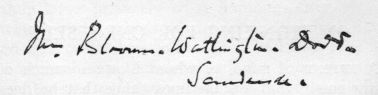
There is no need to be so aggressively faithful to one's names as all this. It is hard on your children and trying to your friends, who may have difficulty in remembering which husband came before the others. After all, a name is only a label, and if it is honest the shorter it is the better.
But the spirit of the thing is right. Let us avoid disguises. Let us stick to our names, be they ever so humble. Let us follow the great example of Cicero. His name originated with an ancestor who had a nick or dent at the tip of his nose which resembled the opening in a vetch—cicer. When he was standing for public office some anxious friends suggested that the young man should assume a nobler name, but he declined, saying that he would make the name of Cicero more glorious than the Scauri or Catuli. And grandly did he redeem the promise. The Scauri and the Catuli live to-day only by the fact that Cicero once mentioned them, while we know Cicero far better than we know our next door neighbour. It is a good precedent for Thomson. I have a mind to make that name outlast the Cecils and Marlboroughs, if not the Pyramids. And cursed be he who desecrates it with a "p."
ON THINKING FOR ONE'S SELF
A friend of mine, to whom I owe so much of my gossip that I sometimes think that he does the work and I only take the collection, told me the other day of an incident at a picture exhibition which struck me as significant of a good deal that is wrong with us to-day. He observed two people in ecstasies before a certain landscape. It was quite a nice picture, but my friend thought their praises were extravagant. Suddenly one of the two turned to the catalogue. "Why, this is not the Leader picture at all," said she. "It is No. So-and-so." And forthwith the two promptly turned away from the picture they had been admiring so strenuously, found No. So-and-So, and fell into raptures before that.
Now I am not going to make fun of these people. I am not going to make fun of them because I am not sure that I don't suffer from their infirmity. If I don't I am certainly an exceptional person, for the people who really think for themselves are almost as scarce as virtuous people were found to be in the Cities of the Plain. We are most of us second-hand thinkers, and second-hand thinkers are not thinkers at all. Those good people before the picture were not thinking their own thoughts: they were thinking what they thought was the right thing to think. They had the luck to find themselves out. Probably it did not do them any good, but at least they knew privately what humbugs they were, what empty echoes of an echo they had discovered themselves to be. They had been taught—heaven help them!—to admire those vacant prettinesses of Leader and they were so docile that they admired anything they believed to be his even when it wasn't his.
It reminds me of the story of the two Italians who quarrelled so long and so bitterly over the relative merits of Tasso and Ariosto that at last they fought a duel. And as they lay dying on the ground one of them said to the other, "And to think that I have never read a line of them." "Nor I either," said the other. Then they expired. I do not suppose that story is true in fact, but it is true in spirit. Men are always dying for other people's opinions, prejudices they have inherited from somebody else, ideas they have borrowed second-hand. Many of us go through life without ever having had a genuine thought of our own on any subject of the mind. We think in flocks and once in the flock we go wherever the bellwether leads us.
It is not only the ignorant who are afflicted with this servility of mind. Horace Walpole was enraptured with the Rowley Poems when he thought they were the work of a mediæval monk: when he found they were the work of Chatterton himself his interest in them ceased and he behaved to the poet like a cad. Yet the poems were far more wonderful as the productions of the "marvellous boy" of sixteen than they would have been as the productions of a man of sixty. The literary world of the eighteenth century thought Ossian hardly inferior to Homer; but when Macpherson's forgery was indisputable it dropped the imposture into the deepest pit of oblivion. Yet, as poetry, it was as good or bad—I have never read it—in the one case as in the other.
There is a delicious story told by Anatole France which bears on this subject. In some examination in Paris the Military Board gave the candidates a piece of dictation consisting of an unsigned page. It was printed in the papers as an example of bad French. "Wherever did these military fellows," it was asked, "find such a farrago of uncouth and ridiculous phrases?" In his own literary circles Anatole France himself heard the passage held up to laughter and torn to tatters. The critic who laughed loudest, he says, was an enthusiastic admirer of Michelet. Yet the passage was from Michelet himself, from Michelet at his best, from Michelet in his finest period. How the great sceptic must have enjoyed that evening!
It is not that we cannot think. It is that we are afraid to think. It is so much easier to go with the tide than against it, to shout with the crowd than to stand lonely and suspect in the midst of it. Even some of us who try to escape this hypnotism of the flock do not succeed in thinking independently. We only succeed in getting into other flocks. Think of that avalanche of crazy art that descended on us some years ago, the Cubists and Dottists and Spottists and Futurists and other cranks, who filled London with their shows, and set all the "advanced" people singing their praises. They were not real praises that expressed genuine feeling. They were the artificial enthusiasms of people who wanted to join in the latest fashion. They would rave over any imbecility rather than not be in the latest fashion—rather than not be thought clever enough to find a meaning in things that had no meaning.
We are too timid to think alone, too humble to trust our own feeling or our own judgment. We want some authority to lean up against, and when we have got it we mouth its shibboleths with as little independent thought as children reciting the "twice-times" table. I would rather a man should think ignorantly than that he should be merely an echo. I once heard an Evangelical clergyman in the pulpit, speaking of Shakespeare, gravely remark that he "could never see anything in that writer." I smiled at his naïveté, but I respected his courage. He couldn't see anything in Shakespeare and he was too honest to pretend that he could. That is far better than the affectations with which men conceal the poverty of their minds and their intellectual servility.
In other days the man that dared to think for himself ran the risk of being burned. Giordano Bruno, who was himself burned, has left us a description of the Oxford of his day which shows how tyrannical established thought can be. Aristotle was almost as sacred as the Bible, and the University statutes enacted that "Bachelors and Masters who did not follow Aristotle faithfully were liable to a fine of five shillings for every point of divergence and for every fault committed against the Logic of the Organon." We have liberated thought from the restraints of the policeman and the executioner since then, but in liberating it we have lost our reverence for its independence and integrity. We are free to think as we please, and so most of us cease to think at all, and follow the fashions of thought as servilely as we follow the fashions in hats.
The evil, I suppose, lies in our education. We standardise our children. We aim at making them like ourselves instead of teaching them to be themselves—new incarnations of the human spirit, new prophets and teachers, new adventurers in the wilderness of the world. We are more concerned about putting our thoughts into their heads than in drawing their thoughts out, and we succeed in making them rich in knowledge but poor in wisdom. They are not in fear of the stake, but they are in fear of the judgment of the world, which has no more title to respect than those old statutes of Oxford which we laugh at to-day. The truth, I fear, is that thought does not thrive on freedom. It only thrives under suppression. We need to have our liberties taken away from us in order to discover that they are worth dying for.
ON SAWING WOOD
I do not think this article will be much concerned with the great art of sawing wood; but the theme of it came to me while I was engaged in that task. It was raining hard this morning, and it occurred to me that it was a good opportunity to cut some winter logs in the barn. The raw material of the logs lies at the end of the orchard in the shape of sections of trunks and branches of some old apple trees which David cut down for us last autumn, to enable us to extend the potato-patch by digging up a part of the orchard. I carried some of the sections into the barn and began to saw, but I was out of practice and had forgotten the trick. The saw would go askew, the points would dig in, and the whole operation seemed a clumsy failure.
Then I remembered. You are over-doing it, I said. You are making a mess of the job by too much energy—misdirected energy. The trick of sawing wood is to work within your strength. You are starting at it as if you intended to saw through the log at one stroke. It is the mistake the Rumanians have made in Transylvania. They bit off more than they could chew. You are biting off more than you can chew, and you and the log and the saw get at cross purposes, with the results you see. The art of the business is to work easily and with a light hand, to make the incision with a firm stroke that hardly touches the surface, to move the saw forward lightly so that it barely touches the wood, to draw it back at a shade higher elevation, and above all to take your time and to avoid too much energy. "Gently does it," is the motto.
It is a lesson I am always learning and forgetting. I suppose I am one of those people who are afflicted with too eager a spirit. We want a thing done, but we cannot wait to do it. We rush at the task with all our might and expect it to surrender on the spot, and when it doesn't surrender we lose patience, complain of our tools, and feel a grievance against the perversity of things. It reminds me of the remark which a professional made to me at the practice nets long ago. He was watching a fast bowler who was slinging the ball at the batsman like a whirlwind, and with disastrous results for himself. "He would make a good bowler," said the professional, "if he wouldn't try to bowl three balls at once." Recall any really great bowler you have known and you will find that the chief impression he left on the mind was that of ease and reserve power. He was never spending up to the hilt. There was always something left in the bank. I do not speak of the medium-paced bowler, like Lohmann, whose action had a sort of artless grace that masked the most wily and governed strategy; but of the fast bowler, like Tom Richardson or Mold or even Spofforth. With all their physical energy, you felt that their heads were cool and that they had something in hand. There was passion, but it was controlled passion.
And if you have tried mowing a meadow you will know how much the art consists in working within your powers, easily and rhythmically. The temptation to lay on with all your might is overpowering, and you stab the ground and miss your stroke and exhaust yourself in sheer futility. And then you watch John Ruddle at the job and see the whole secret of the art reveal itself. He will mow for three hours on end with never a pause except to sharpen the blade with the whetstone he carries in his hip pocket. What a feeling of reserve there is in the beautiful leisureliness of his action! You could go to sleep watching him, and you feel that he could go to sleep to his own rhythm, as the mother falls asleep to her own swaying and crooning. There is the experience of a lifetime in that masterful technique, but the point is that the secret of the technique is its restraint, its economy of effort, its patience with the task, its avoidance of flurry and hurry, and of the waste and exhaustion of over-emphasis. At the bottom, all that John Ruddle has learned is not to try to bowl three balls at once. He is always master of his job.
And if you chance to be a golfer, haven't you generally found that when you are "off your game" it is because you have pitched the key, as it were, too high? You smite and fail, and smite harder and fail, and go on increasing the effort, and as your effort increases so does your futility. You are playing over your strength. You are screaming at the ball instead of talking to it reasonably and sensibly. Then perhaps you remember, cut down your effort to the scope of your powers, and, behold, the ball sails away on its errand with just the right flight and just the right direction and just the right length. And you purr to yourself and learn once more that the art of doing things is moderation.
It is so in all things. The man who wins is the man who keeps cool, whose effort is always proportioned to his power, who gives the impression that there is more in him than ever comes out. I have seen many a man lose the argument, not because he had the worse case, but because he was too eager, too impatient, too unrestrained in presenting it. What is the secret of the extraordinary influence which Viscount Grey exercises over the mind but the grave moderation and reserve of his style? There are scores of more eloquent speakers, more nimble disputants than he, but there has been no one in our time with the same authority and finality of speech. He conveys the sense of a mind disciplined against passion, austere in its reserve, implacably honest, understating itself with a certain cold aloofness that leaves controversy silent. Take his indictment of Germany as an example. It was as though the verdict of the Day of Judgment had fallen on Germany. Yet it was a mere grave, dispassionate statement of the facts without a word of extravagance or violence. It was the naked truthfulness of it that was so terrible and unanswerable.
And much the most impressive description I have seen of the horrors of war was in the letter of a German artillery officer telling his experiences in the first great battle of the Somme. Yet the characteristic of the letter was its plainness and freedom from any straining after effect. He just left the thing he described to speak for itself in all its bare horror. It was a lesson we people who write would do well to remember. Let us have fewer adjectives, good people, fewer epithets. Remember, the adjective is the enemy of the noun. It is the scream that drowns the sense, the passion that turns the argument red in the face and makes it unbelievable. Was it not Stendhal who used to read the Code Napoléon once a year to teach him its severity of style?
*****
It is still raining. I will return to the barn and practise the philosophy of moderation on those logs.
VARIATIONS ON AN OLD THEME
I
A soldier, whom I met in the train the other day, said that the most unpleasant thing in his experience of the war was the bodies which got caught in the barbed wire in No Man's Land, and had to be left corrupting in the sun. "It isn't healthy," he said. There was no affectation of bravado in the remark. He made it quite simply, as if he were commenting on the inclemency of the weather or the overheating of the carriage. It was not the tragedy of the thing that affected him, but its insanitariness. Yet he was obviously a kindly and humane man, and he talked of his home with the yearning of an exile. "It makes you think something of your home," he said, speaking of the war. "I shan't never want to leave my home when I get out of this, and I shan't never grumble at the missus again," he added, as though recalling the past.
I suppose everyone who has talked to soldiers back from the war has been struck by this attitude of mind towards death. I remember a friend of mine, who was afterwards killed in the first battle of the Somme while trying to save one of his men who had been wounded, telling me of the horror of the first days of his experience of war, and of the subsequent calm with which he saw a man who had been his friend blown to pieces by his side. "It is as though war develops another integument," he said. "Your sensibilities are atrophied. Your nerve ends are deadened. Your normal feelings perish, and you become a part of a machine that has no feelings—only functions."
In some measure the same phenomenon is apparent in the minds of most of us. There has not been since the Great Plague swept Europe 250 years ago such a harvesting of untimely death as we have witnessed during the last two and a half years. If the ghostly army of the slain were to file before you, passing in a rank of four for every minute that elapsed, you could sit and watch it day and night for five years without pause before the last of the phantom host had gone by. And if behind the dead there followed the maimed, blind, and mentally shattered, you could sit on for twenty years and still the end of the vast procession would not be in sight. If we had been asked three years ago whether the human mind could endure such a deliberate orgy of death in its most terrible form, we should have said the thing was incredible. Yet we live through it without revolt, clamour about the shortage of potatoes, crowd the cinemas to see the latest extravagance of Charlie Chaplin, and have forgotten to glance at the daily tale of dead that fills the obscure columns of the newspapers—such of them as trouble any longer to give that tale at all.
It is not merely that we avert our eyes from the facts. That is certainly done. You may go to see the "war pictures" at the cinema and come away without supposing that they represent anything more than a skilfully arranged entertainment—in which one attractive "turn" follows another in swift succession. Once they actually showed a man falling dead, and there was a cry of indignation at such an outrage. Ten millions have fallen dead, but we must not look on one to remind us of the reality behind this pictured imposture. There has never been a lie on the scale of these "war pictures" that leave out the war and all its sprawling ugliness, monotony, mutilation, and death.
But it is not this fact that explains our apparent indifference to the Red Harvest. We are like the dyer's hand. We are subdued to what we work in. Even those who have been directly stricken find that they bear the blow with a calm that astonishes themselves. We have got into a new habit of thought about death—in a sense a truer habit of thought. It used to be screened from the light of day, talked of in hushed voices, surrounded with the mystery and aloofness of a terrible divinity. It has come into the open, brutal, naked, violent. We accept it as the commonplace it is, instead of enveloping it in a cloud of tragic fear and strangeness. The heart seems steeled to the blows of fate, looks death steadily in the face, understands that the individual life is merged in issues more vast than this little tale of years that, at the most, is soon told.
It may be that, like the soldiers, our senses are only numbed by events, and that when we come out of the nightmare the old feelings will resume their sway. But it will be long before they recover their former tyranny over the mind. This generation has companioned Death too closely to see him again quite as the hooded terror of old. And that, I think, is a gain. I have always felt that Johnson's morbid attitude towards death was the weakest trait in a fine character, and that George Selwyn's perpetual absorption in the subject was a form of mental disease. Montaigne, too, lived with the constant thought of the imminence of death, so much so that if, when out walking, he remembered something he wanted done, he wrote down the request at once, lest he should not reach home alive. But he was quite healthy in his thought. It was not that he feared death, but that he did not want to be caught unawares.
In this, as in most things, Cæsar shone with that grand sanity that makes him one of the most illuminated secular minds in history. He neither sought death nor shunned it. When Hirtius and Pansa remonstrated with him for going unprotected by a bodyguard, he answered, "It is better to die once than always to go in fear of death." That is the common-sense attitude—as remote from the spirit of the miser as from that of the spendthrift. And that other comment of his on death is equally deserving of recall. He was dining the night before his murder at the house of Decimus Brutus, who had joined the conspiracy against him. As he sat dispatching his letters, the others talked of death and of that form of death which was preferable. One of the group asked Cæsar what death he would prefer. He looked up from his papers and said, "That which is least expected." This was not an old man's weariness of life such as that which made Lord Holland, the father of Charles James Fox, write to Selwyn: "And yet the man I envy most is the late Lord Chamberlain, for he is dead and he died suddenly." It was just the Roman courage that accepted death as an incident of the journey.
Of that high courage the end of Antoninus Pius is an immortal memory. As the Emperor lay dying in his tent the tribune of the night-watch entered to ask the watchword. "Æquanimitas," said Antoninus Pius, and with that last word he, in the language of the historian, "turned his face to the everlasting shadow."
With that grave calm the philosophy of the ancient world touched its noblest expression. It faced the shadow without illusions and without fear. It met death neither as an enemy, nor as a friend, but as an implacable fact to be faced implacably. Sir Thomas More met it like a bridegroom. In all the literature of death there is nothing comparable with Roper's story of those last days in the Tower. Who can read that moving description of the farewell with his daughter Margaret (Roper's wife) without catching its pity and its glory? "In good faythe, Maister Roper," said stout Sir William Kingstone, the gaoler, "I was ashamed of myself that at my departing from your father I found my harte soe feeble and his soe stronge, that he was fayne to comfort me that should rather have comforted him." And when Sir Thomas Pope comes early on St. Thomas' Even with the news that he is to die at nine o'clock that morning and falls weeping at his own tidings—"Quiet yourselfe, Good Maister Pope," says More, "and be not discomforted; for I trust that we shall once in heaven see eche other full merily, where we shalbe sure to live and love togeather, in joy full blisse eternally." And then, Pope being gone, More "as one that had beene invited to some solempne feaste, chaunged himself into his beste apparrell; which Maister Leiftenante espyinge, advised him to put it off, sayinge that he that should have it was but a javill (a common fellow: the executioner). What, Maister Leiftenante, quothe he, shall I accompte him a javill that shall doe me this day so singular a benefitt? Nay, I assure you, were it clothe of goulde, I would accompte it well bestowed upon him, as St. Ciprian did, who gave his executyoner thirtye peeces of golde.... And soe was he by Maister Leiftenante brought out of the Tower and from thence led towardes the place of execution. Wher, goinge up the scaffold, which was so weake that it was readye to fall, he said merilye to Maister Leiftenante, I praye you, Maister Leiftenante, see me safe uppe and for my cominge down let me shift for myselfe. Then desired he all the people there aboute to pray for him, and to bare witnes with him that he should now there suffer deathe, in and for the faith of the Holy Catholicke Churche. Which donne, he kneeled downe; and after his prayers sayed, turned to the executioner, and with a cheerfull countenance spake thus unto him: 'Plucke uppe thy spiritts, manne, and be not affrayde to doe thine office; my necke is very shorte, take heede, therfore, thou strike not awrye for savinge of thine honesty.' So passed Sir Thomas More out of this worlde to God, upon the very same daye (the Ntas. of St. Peter) in which himself had most desired."
The saint of the pagan world and the saint of the Christian world may be left to share the crown of noble dying.
II
I had rather a shock to-day. I was sitting down to write an article on a subject that had still to be found, and had almost reached the point of decision, when a letter which had been addressed to the Editor of The Star, and which he had sent on to me, started another and more attractive hare. It was a letter announcing my lamented demise. There was no doubt about it. There was the date and there was the name (a nice name, too), and there were the circumstances all set out in black and white. And the writer wanted to know, in view of all this, why no obituary notice of me had appeared in the columns of the paper I had adorned.
Now this report, however it arose, is, to use Mark Twain's famous remark in similar circumstances, "greatly exaggerated." I am not dead. I am not half dead. I am not even feeling poorly. I had a tooth out a week or two ago, but otherwise nothing dreadful has happened to me for ever so long. I was once nearly in a shipwreck, but that was so long ago that I had almost forgotten the circumstance. Moreover, as all the people in the ship were saved I could not possibly have died then even if I had been on board. And I wasn't on board, for I had left at the previous port of call. It was a narrow escape, but I can't pretend that I wasn't saved. I was. But though I am most flagrantly and aggressively alive, the announcement of my death has set me thinking of myself as if I were dead. I find it quite an agreeable diversion. Not that I am morbid. I do not share my friend Clerihew's view, expressed in his chapter on Lord Clive in that noble work "Biography for Beginners." You may remember the chapter. If not, it is short enough to repeat:
What I like about Clive Is that he is no longer alive. There's something to be said For being dead.
That is overdoing the thing. What I find agreeable is being alive and thinking I am dead. You have the advantage of both worlds, so to speak. In company with this amiable correspondent, I have shed tears over myself. I have wept at my own grave-side. I have composed my own obituary notice, and I don't think I have ever turned out a more moving piece of work. I have met my friends and condoled with them over my decease, and have heard their comments, and I am proud to say that they were quite nice. Some of them made me think that I might write up the obituary notice in a rather higher key, put the virtues of the late lamented "Alpha of the Plough" in more gaudy colours, tone down the few, the very few, weak points of his austere, saintly, chivalrous, kindly, wise, humorous, generous character—in a word, let myself go a bit more. Old Grumpington at the club, it is true, said that I should be no great loss to the world, and that so far as he was concerned I was one of the people that he could do without. But then Old Grumpington never says a good word for anybody, living or dead. I discounted Grumpington. I took no notice of Grumpington—the beast.
And then I passed from the living world I had left behind to the contemplation of the said Alpha, fallen on sleep, and I found his case no subject for tears. After all, said I, the world is not such a gay place in these days, that I need worry about having quitted it. I have left some dear friends behind, but they will pass the toll-gate, too, in due course, and join me and those who have preceded me. "What dreams may come!" Well, so be it. I have no fear of the dreams of death, having passed through the dream of life, which was so often like a nightmare. If there are dreams for me, I think they will be better dreams. If there are tasks for me, I think they will be better tasks. If there are no dreams and no tasks, then that also is well. "I see no such horror in a dreamless sleep," said Byron in one of his letters, "and I have no conception of any existence which duration would not make tiresome." And so, dreamless or dreaming, I saw nothing in the circumstances of the departed Alpha to lament....