§ XIX. OF GUTTERS.
Reading edition
In England the gutters of important churches were generally formed behind the stone parapet, but at Lincoln the whole is formed of lead above a carved stone cornice. It is about two feet high and the outside is decorated with foiled circles closer or farther apart with due disregard for precision. In France gutters were often like this made on the top of the stone cornice; irons turned up carry a continuous rod, over which the lead was dressed, and as the outlets were frequent little fall was required.[31]
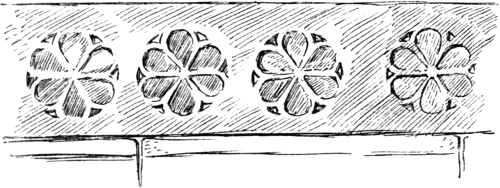
Fig. 65.—Gutter, Lincoln Cathedral.
To some bay windows of a fine old timber house at Derby there are little parapets formed out of lead, the front edge being cut into notches like a tiny battlement, and short lengths of pipe form spouts for the water. At Taunton there is a bay window with a similar battlement of lead; this is cast with a running pattern and wavy upper edge, to this below is soldered a similar strip reversed making a fringe; the same pattern forms the isolated gutters at Poundisford House above mentioned. At Montacute the spouting has a series of little upright panels, the top moulding breaking up higher over every alternate pair in crenelations, leaving a space filled with a boss. At Bramhall there is a cottage to which both the spouting and the down pipe have a running scroll of flowery ornament. Sometimes the end of a roof gutter between two gables is stopped by an apron of lead with pattern on it, such as a knot of cord and initials.
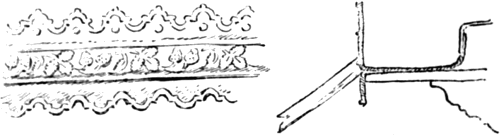
Fig. 66.—Gutter, Taunton.