Front matter
Reading edition · Edition 2
THE MARIE ANTOINETTE ROMANCES.
LE CHEVALIER DE MAISON-ROUGE.
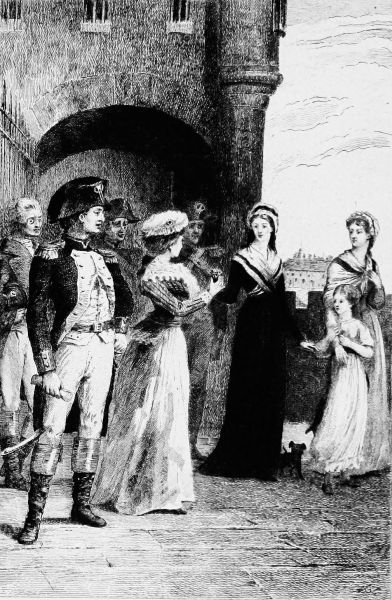
"OH, HOW LONG IT IS SINCE I HAVE SEEN ANY FLOWERS!" Drawn and etched by E. Abot. Chevalier de Maison-Rouge.
LE
CHEVALIER DE MAISON-ROUGE.
BY
ALEXANDRE DUMAS.
BOSTON: LITTLE, BROWN, AND COMPANY.
1897.
Copyright, 1890, 1894, By Little, Brown, and Company.
University Press: John Wilson and Son, Cambridge, U.S.A.
INTRODUCTORY NOTE.
The "Chevalier de Maison-Rouge," though it deals with events subsequent to those covered by the earlier stories of the Marie Antoinette cycle, was written at an earlier date. In it we are introduced to a new set of personages, and see no more of the characters whose fortunes furnish the fictitious as distinguished from the historical interest of the earlier stories.
The months which elapsed between the execution of the King and the appearance in the Place de la Révolution of the ill-fated Marie Antoinette were thickly strewn with tragedy, particularly after the final conflict between the Gironde and the Mountain, and the decisive victory of the latter, resulting in the undisputed supremacy of the band of men in whom we now see the personification of the Reign of Terror.
Those portions of the narrative which describe the life of the queen at the Temple, and subsequently in the Conciergerie, are founded strictly upon fact. Of the treatment accorded to the little Dauphin by Simon, who is given much prominence in the story, it need only be said that it falls far short of the truth as it is to be found in numberless memoirs and documents. There is nothing in all history more touching and heart-rending than the fate of this innocent child, who was literally done to death by sheer brutality in less than two years; nor is there any one of the excesses committed by the extreme revolutionists which has done more to cause posterity to fail to realize the vast benefits which mankind owes to the Revolution, in the face of the unnamable horrors which were perpetrated in its name.
The noble answer of Marie Antoinette to the unnatural charges brought against her by Hébert (not Simon) was actually made at her trial.
There is no direct historical authority for the various attempts herein detailed to effect the escape of the Queen, although rumors of such were circulating unceasingly. The titular hero of the book is not an historical personage, nor are Maurice Lindey and Lorin; but the latter are faithful representatives of a by no means small class of sincere and devoted republicans who turned aside with shrinking horror from the atrocities of the Terror.
The mutual heroism of Maurice and Lorin in the final catastrophe reminds us of the similar conduct of Gaston in the "Regent's Daughter" when he fails to reach Nantes with the reprieve until the head of one of his comrades had fallen. Nor can one avoid a thought of Sydney Carton laying down his life for Charles Darnay, in Charles Dickens's "Tale of Two Cities," wherein the horrors of the Terror are so vividly pictured.
One must go far to seek for a more touching and pathetic love-episode than that of Maurice and Geneviève, whose sinning, if sinning it was, was forced upon them by the cold and unscrupulous Dixmer in the pursuit of his one unchangeable idea.
On the 16th of October, 1793, the daughter of the Cæsars lost her life through the instrumentality of the machine which we saw Cagliostro exhibit to her in a glass of water at the Château de Taverney more than twenty years before. Then she was in the bloom of youth and beauty, a young queen coming to reign over a people who had just begun to realize their wrongs and their power. To-day she is a woman of thirty-eight, prematurely aged, but bearing about her still the noble dignity of her ancient race, and proving anew, as Charles I. had proved, and as her own husband had proved, that the near approach of death brings forth the noblest qualities in those of royal lineage.
We cannot better end this brief note than by quoting the characteristic but powerful apostrophe of Carlyle in his essay upon the "Diamond Necklace."
"Beautiful Highborn, thou wert so foully hurled low! For if thy being came to thee out of old Hapsburg dynasties, came it not also (like my own) out of Heaven? Sunt lachrymæ rerum, et mentem mortalia tangunt. Oh, is there a man's heart that thinks without pity of those long months and years of slow-wasting ignominy: of thy birth, soft-cradled in imperial Schönbrunn, the winds of Heaven not to visit thy face too roughly, thy foot to light on softness, thy eye on splendor: and then of thy death, or hundred deaths, to which the guillotine and Fouquier-Tinville's judgment bar was but the merciful end? Look there, O man born of woman! The bloom of that fair face is wasted, the hair is gray with care: the brightness of those eyes is quenched, their lids hang drooping, the face is stony pale, as of one living in death. Mean weeds, which her own hand has mended, attire the Queen of the World. The death-hurdle, where thou sittest pale, motionless, which only curses environ, has to stop; a people, drunk with vengeance, will drink it again in full draught, looking at thee there. Far as the eye reaches, a multitudinous sea of maniac heads: the air deaf with their triumph yell! The living-dead must shudder with yet one other pang: her startled blood yet again suffuses with the hue of agony that pale face which she hides with her hands. There is, then, no heart to say, God pity thee? O think not of these: think of HIM whom thou worshippest, the Crucified,—who also treading the wine-press alone, fronted sorrow still deeper: and triumphed over it, and made it holy: and built of it a Sanctuary of Sorrow for thee and all the wretched! Thy path of thorns is nigh ended. One long last look at the Tuileries, where thy step was once so light,—where thy children shall not dwell. The head is on the block: the axe rushes—Dumb lies the World: that wild-yelling World and all its madness is behind thee."
LIST OF CHARACTERS.
Period, 1793.
Marie Antoinette, }
The Dauphin, } prisoners at the Temple.
Madame Royale, }
The Princess Elizabeth, }
Chevalier de Maison-Rouge, }
M. Dixmer, }engaged in an attempt to rescue the Queen.
Geneviève, his wife, }
Sophie Tison, }
Lieutenant Maurice Lindey, a patriot, in love with Geneviève.
Maximilien-Jean Lorin, his friend.
Santerre, Commandant of the Parisian National Guard.
Simon, a cobbler.
President Harmand, of the Revolutionary Tribunal.
Fouquier-Tinville, the public accuser.
M. Giraud, the city architect.
Chauveau Lagarde, counsel for the Queen.
Jean Paul Marot, }
Robespierre, }
Danton, }
Chénier, } Montagnards.
Hébert, }
Fabre d'Églantine, }
Collot d'Herbois, }
Robert Lindet, }
MM. Vergniaud, }
Féraud, }
Brissot, }
Louvet, }Girondins.
Pétion, }
Valazé, }
Lanjuinais, }
Barbaroux, }
MM. Roland, }
Servien, }
Clavières, }of the French Ministry, August, 1793.
Le Brun, }
and Monge, }
Generals Dumouriez, }
Miacrinski, }
Steingel, }
Neuilly, }officers commanding the French armies on the frontiers.
Valence, }
Dampierre, }
Miranda, }
Henriot, Commandant-General of the National Guard.
Citizen Devaux, of the National Guard.
Citizens Tonlan, }
Lepître, }
Agricola, }of the Municipal Guard.
Mercevault, }
Grammont, Adjutant-Major.
Tison, employed at the Temple Prison.
Madame Tison, his wife.
Arthémise, ex-dancer at the opera.
Abbé Girard.
Dame Jacinthe, his servant.
Turgy, an old waiter of Louis XVI., attending the royal family at the Temple.
Muguet, femme-de-chambre of Dixmer.
Madame Plumeau, hostess of an alehouse near the Temple.
Agesilaus, servant to Maurice Lindey.
Aristide, concierge at Maurice's house.
Gracchus, a turnkey at the Conciergerie.
Richard, jailer at the Conciergerie.
Madame Richard, his wife.
Duchesse, }Gendarmes at the Conciergerie.
Gilbert, }
Sanson, the executioner.
CONTENTS.
Chapter Page
I. The Enrolled Volunteers 1
II. The Unknown 13
III. The Rue des Fossés Saint Victor 22
IV. Manners of the Times 30
V. What Sort of Man the Citizen Maurice Lindey was 40
VI. The Temple 46
VII. The Oath of the Gamester 57
VIII. Geneviève 68
IX. The Supper 79
X. Simon the Shoemaker 90
XI. The Billet 100
XII. Love 110
XIII. The Thirty-First of May 141
XIV. Devotion 148
XV. The Goddess Reason 157
XVI. The Prodigal Child 163
XVII. The Miners 171
XVIII. Clouds 182
XIX. The Request 191
XX. The Flower-Girl 200
XXI. The Crimson Carnation 207
XXII. Simon the Censor 215
XXIII. Arthémise 222
XXIV. The Mother and Daughter 231
XXV. The Conspiracy 240
XXVI. The Little Dog Jet 252
XXVII. The Muscadin 263
XXVIII. The Chevalier de Maison-Rouge 273
XXIX. The Patrol 282
XXX. The Password 292
XXXI. The Search 300
XXXII. The Fire 309
XXXIII. The Morrow 322
XXXIV. The Conciergerie 326
XXXV. La Salle des Pas-Perdus 337
XXXVI. The Citizen Théodore 347
XXXVII. The Citizen Gracchus 355
XXXVIII. The Royal Child 361
XXXIX. The Bouquet of Violets 372
XL. The Tavern of Noah's Well 384
XLI. The Registrar of the Minister of War 392
XLII. The Two Billets 399
XLIII. The Preparations of Dixmer 405
XLIV. The Preparations of the Chevalier 412
XLV. The Inquiry 420
XLVI. The Sentence 429
XLVII. The Priest and the Executioner 437
XLVIII. The Cart 445
XLIX. The Scaffold 453
L. The Visit to the Domicile 461
LI. Lorin 466
LII. Sequel to the Preceding 475
LIII. The Duel 482
LIV. The Salle des Morts 490
LV. Why Lorin went out 502
LVI. Long Live Simon! 505
LE CHEVALIER DE MAISON-ROUGE.
CHAPTER I.
THE ENROLLED VOLUNTEERS.
It was on the evening of the 10th of March, 1793, ten o'clock was striking from Notre Dame, and each stroke sounding, emitted a sad and monotonous vibration. Night had fallen on Paris, not boisterous and stormy, but cold, damp, and foggy. Paris itself at that time was not the Paris of our day, glittering at night with thousands of reflected lights,—the Paris of busy promenades, of lively chat, with its riotous suburbs, the scene of audacious quarrels, and daring crime,— but a fearful, timid, busy city, whose few and scattered inhabitants, even in crossing from one street to another, ran concealing themselves in the darkness of the alleys, and ensconcing themselves behind their portes-cochères, like wild beasts tracked by the hunters to their lair.
As we have previously said, it was the evening of the 10th of March, 1793. A few remarks upon the critical situation of the country, which had produced the changed aspect of the capital, before we commence stating the events the recital of which form the subject of this history.
France, by the death of Louis XVI., had become at variance with all Europe. To the three enemies she had first combated,—that is to say, Prussia, the Empire, and Piedmont,—were now joined England, Holland, and Spain. Sweden and Denmark alone preserved their old neutrality, occupied as they were besides in beholding Catharine II. devastating Poland.
The state of affairs was truly frightful. France, more respected as a physical power, but less esteemed as a moral one, since the massacres of September and the execution of the 21st of January, was literally blockaded, like a simple town, by the whole of Europe. England was on our coasts, Spain upon the Pyrenees, Piedmont and Austria on the Alps, Holland and Prussia to the north of the Pays-Bas, and with one accord from the Upper Rhine to the Scheldt two hundred and fifty thousand combatants marched against the Republic. Our generals were repulsed in every direction. Miacrinski had been obliged to abandon Aix-la-Chapelle, and draw back upon Liege; Steingel and Neuilly were driven back upon Limbourg; while Miranda, who besieged Maestricht, fell back upon Tongres. Valence and Dampierre, reduced to beat a retreat, did so with a loss of half their number. More than ten thousand deserters had already abandoned the army, and cleverly scattered themselves in the interior. At last the Convention, having no hope except in Dumouriez, despatched courier after courier, commanding him to quit the borders of the Biesboos (where he was preparing to embark for Holland), and return to take the command of the army of the Meuse.
Sensitive at heart, like an animate body, France felt at Paris—that is to say, at its core—each and every blow levelled at it by invasion, revolt, or treason, even from quarters the most distant. Each victory was a riot of joy; every defeat an insurrection of terror. It is therefore easy to comprehend what tumult was produced by the news of these successive losses which we had just experienced.
On the preceding evening, the 9th of March, they had had at the Convention a sitting more stormy than usual; all the officers had received orders to join their regiments at the same time, and Danton, that audacious proposer of improbable things (but which nevertheless were accomplished),—Danton mounting the tribune, cried out, "Soldiers are wanting, say you? Offer Paris an opportunity of saving France. Demand from her thirty thousand men, send them to Dumouriez; and not only is France saved, but Belgium is secured, and Holland is conquered." This proposition had been received with shouts of enthusiasm, registers had been opened in all the sections, calling on them to assemble in the evening. Places of public amusement were closed to avoid all distraction, and the black flag was hoisted at the Hôtel de Ville, in token of distress. Before midnight, five and thirty thousand names were inscribed on the registers; only this evening, as it had before occurred in September, in every section, while inscribing their names, the enrolled Volunteers had demanded that before their departure the traitors might be punished.
The traitors were in fact the "contre-revolutionists,"—the hidden conspirators who from within menaced the Revolution, thus menaced from without. But as may be easily understood, the word "traitor" extended to all those to whom the extreme parties who at this period tore France wished to apply it. The traitors were the weaker party; as the Girondins were the weakest, the Montagnards decided that the Girondins must be the traitors.
On the next day, which was the 10th of March, all the Montagnard deputies were present at the sitting. The Jacobins, armed, filled the tribunes, after having turned out the women; the mayor presented himself with the Council of the Commune, confirming the report of the Commissioners of the Convention respecting the devotedness of the citizens, but repeating the wish, unanimously expressed the preceding evening, for a Tribunal Extraordinary appointed to judge the traitors. The report of the Committee was instantly demanded with loud vociferations. The Committee met immediately, and in five minutes afterward Robert Lindet declared that a Tribunal would be formed, composed of nine judges (independent of all forms, and acquiring proof by every means), divided into two permanent sections, and prosecuting, by order of the Convention or directly, all those who were found guilty in any way of attempting to mislead the people.
This was a sweeping clause, and the Girondins, understanding it as their death-warrant, rose en masse. Death, cried they, rather than submit to the establishment of this Venetian inquisition.
The Montagnards, in reply to this apostrophe, demanded to put the matter to the vote in loud tones. "Yes," exclaimed Féraud, "let us vote to make known to the world the men who are willing to assassinate innocence under the mask of the law." They voted at length; and against all expectation the majority decided—(1) that they would have juries; (2) that these juries should be of equal numbers in the departments; (3) that they should be nominated by the Convention. At the moment when these three propositions were approved, loud cries were heard; but the Convention, accustomed to receive occasional visits from the populace, inquired their wishes, and were informed in reply that it was merely a deputation of enrolled Volunteers, who, having dined at the Halle-au-Blé, demanded to be permitted to display their military tactics before the Convention.
The doors were opened immediately, and six hundred men, armed with swords, pistols, and pikes, apparently half-intoxicated, filed off amid shouts of applause, and loudly demanded the death of the traitors. "Yes," replied Collot d' Herbois, addressing them, "yes, my friends, we will save you—you and liberty—notwithstanding their intrigues." These words were followed by an angry glance toward the Girondins, which plainly intimated they were not yet beyond reach of danger. In short, the sitting of the Convention terminated, the Montagnards scattered themselves among other clubs, running first to the Cordeliers and then to the Jacobins, proposing to place the traitors beyond the reach of the law by cutting their throats that very night.
The wife of Louvet resided in the Rue Saint Honoré, near the Jacobins. She, hearing these vociferations, descended, entered the club, and heard this proposition; then quickly retraced her steps, and warned her husband of the impending danger. Louvet, hastily arming himself, ran from door to door to alarm his friends, but found them all absent; then fortunately ascertaining from one of the servants they had gone to Pétion's house, he followed them there. He found them quietly deliberating over a decree which ought to be presented on the morrow, and which by a chance majority they hoped to pass. He related what had occurred, communicated his fears, informed them of the plot devised against them by the Cordeliers and Jacobins, and concluded by urging them on their side to pursue some active and energetic measure.
Then Pétion rose, calm and self-possessed as usual, walked to the window, opened it, looked at the sky, and then extended his hand, which he drew in covered with moisture. "It rains," said he; "there will be nothing to-night."
Through this half-opened window the last vibration of the clock was heard striking ten.
Such were the occurrences of the 10th of March and the evening preceding it,—occurrences which, in this gloomy obscurity and menacing silence, rendered the abodes destined to shelter the living like sepulchres peopled by the dead. In fact, long patrols of the National Guard, preceded by men marching with fixed bayonets, troops of citizens, armed at hazard, pushing against each other, gendarmes closely examining each doorway, and strictly scrutinizing every narrow alley,—these were the sole inhabitants who ventured to expose themselves in the streets. Every one instinctively understood that some unusual and terrible plot was in progress.
The cold and drizzling rain, which had tended so much to reassure Pétion, had considerably augmented the ill-humor and trouble of these inspectors, whose every meeting resembled preparation for combat, and who, after recognizing each other with looks of defiance, exchanged the word of command slowly and with a very bad grace. One would have said on seeing them separate and return to their several posts, that they mutually feared an attack from behind.
On the same evening, when Paris was a prey to one of these panics (so often renewed that they ought, in some measure, to have become habitual),—the evening on which the massacre of the lukewarm revolutionists was secretly debated, who after having voted (with reservation for the most part) the death of the king, recoiled to-day before the death of the queen, a prisoner in the Temple, with her children and her sister-in-law,—a woman, enveloped in a mantle of lilac printed cotton with black spots, her head almost buried in her hood, glided along the houses in the Rue Saint Honoré, seeking concealment under a door-porch, or in the angle of a wall, every time a patrol appeared, remaining motionless as a statue and holding her breath till he had passed, and once more pursuing her anxious course with increased rapidity, till some danger of a similar nature again compelled her to seek refuge in silence and immobility.
She had already (thanks to the precautions she had taken) travelled over with impunity part of the Rue Saint Honoré, when at the corner of the Rue de Grenelle she suddenly encountered, not a body of patrol, but a small troop of our brave enrolled Volunteers, who, having dined at the Halle-au-Blé, found their patriotism considerably increased by the numerous toasts they had drunk to their future victories. The poor woman uttered a cry, and made a futile attempt to escape by the Rue du Coq.
"Ah, ah, Citizen!" cried the chief of the Volunteers (for already, with the need of command natural to man, these worthy patriots had elected their chief), "Ah, where are you going?"
The fugitive made no reply, but continued her rapid movement.
"What sport!" said the chief; "it is a man disguised, an aristocrat who thinks to save himself."
The sound of two or three guns escaping from hands rather too unsteady to be depended upon, announced to the poor woman that her haste was a fatal mistake.
"No, no," cried she, stopping short, and retracing her steps; "no, Citizen; you are mistaken. I am not a man."
"Then advance at command," said the chief, "and reply to my questions. Where are you hastening to, charming belle of the night?"
"But, Citizen, I am not going anywhere. I am returning."
"Oh! returning, are you?"
"Yes."
"It is rather a late return for a respectable woman, Citizeness?"
"I am returning from visiting a sick relative."
"Poor little kitten!" said the chief, making a motion with his hand, before which the horrified woman quickly recoiled, "where is your passport?"
"My passport! What is that, Citizen? What do you mean?"
"Have you not read the decree of the Commune?"
"No."
"You have heard it proclaimed, then?"
"Alas, no! What, then, said this decree, in the name of God?"
"In the first place, we no longer say 'God'; we only speak of the 'Supreme Being' now."
"Pardon my error. It is an old custom."
"Bad habit—the habit of the aristocracy."
"I will endeavor to correct myself, Citizen; but you said—"
"I said that the decree of the Commune prohibited any one to go out, after ten at night, without a civic pass. Now, have you this civic pass?"
"Alas! no."
"You have forgotten it at your relative's?"
"I was ignorant of the necessity of taking it with me on going out."
"Then come with us to the first post; there you can explain all prettily to the captain; and if he feels perfectly satisfied with your explanation, he will depute two men to conduct you in safety to your abode, else you will be detained for further information. File left! forward! quick march!"
From the cry of terror which escaped the poor prisoner, the chief of the enrolled Volunteers understood how much the unfortunate woman dreaded this interview.
"Oh, oh!" said he, "I am quite certain we hold distinguished game. Forward, forward—to the route, my little ci-devant."
And the chief seizing the arm of the captive, placed it within his own, and dragged her, notwithstanding her cries and tears, toward the post of the Palais Egalité.
They were already at the top of the barrier of Sergents, when suddenly a tall young man, closely wrapped in a mantle, turned the corner of the Rue des Petits-Champs at the very moment when the prisoner was endeavoring, by renewing her supplications, to regain her liberty. But without listening the chief dragged her brutally forward. The woman uttered a cry of grief mingled with terror. The young man saw the struggle, heard the cry, and bounding from the opposite side of the street, found himself facing the little troop.
"What is all this? What are you doing to this woman?" demanded he of the person who appeared to be the chief.
"Before you question me, you had better attend to your own business."
"Who is this woman; and what do you want with her?" repeated the young man, in a still more imperative tone than at first.
"But who are you, that you interrogate us?"
The young man opened his cloak, when an epaulet was visible, glistening on his military costume.
"I am an officer," said he, "as you can see."
"Officer! In what?"
"In the Civic Guard."
"Well, what of that?" replied one of the troop. "What do we know here of the officers of the Civic Guard?"
"What is that he says?" asked another man, in a drawling and ironical tone peculiar to a man of the people, or rather of the Parisian populace, when beginning to be angry.
"He says," replied the young man, "that if the epaulet cannot command respect for the officer, the sword shall command respect for the epaulet."
At the same time, making a retrograde movement, the unknown defender of the young woman had disengaged his arm from the folds of his mantle, and drawn from beneath it, sparkling by the glimmer of a lamp, a large infantry sabre. Then with a rapid movement which displayed his familiarity with similar scenes of violence, he seized the chief of the Volunteers by the collar of his jacket, and placing the point of the sabre to his throat, "Now," said he, "let us speak like friends."
"But, Citizen," said the chief, endeavoring to free himself.
"I warn you, that at the slightest movement made, either by you or any of your men, I pass my sabre through your body."
During this time two men belonging to the troop retained their hold of the woman.
"You have asked who I am," continued the young man, "which you had no right to do, since you do not command a regular patrol. However, I will inform you. My name is Maurice Lindey; I commanded a body of artillery-men on the 10th of August, am now lieutenant in the National Guards, and secretary to the section of Brothers and Friends. Is that sufficient?"
"Well, Citizen Lieutenant," replied the chief, still menaced with the blade, the point of which he felt pressing more and more, "this is quite another thing. If you are really what you say,—that is, a good patriot—"
"There, I knew we should soon understand each other," said the officer. "Now, in your turn, answer me: why did this woman call out, and what are you doing with her?"
"We are taking her to the guard-house."
"And why are you taking her there?"
"Because she has no civic pass, and the last decree of the Commune ordered the arrest of any and every individual appearing in the streets of Paris without one, after ten o'clock at night. Do you forget the country is in danger, and that the black flag floats over the Hôtel de Ville?"
"The black flag floats over the Hôtel de Ville, and the country is in danger, because two hundred thousand slaves march against France," replied the officer, "and not because a woman runs through the streets of Paris after ten o'clock at night. But never mind, citizens. There is a decree of the Commune, it is true, and you only did your duty; and if you had answered me at once, our explanation might have been a much shorter and probably a less stormy one. It is well to be a patriot, but equally so to be polite; and the first officer whom the citizens ought to respect is he, it seems to me, whom they themselves appointed. In the mean time, take the woman with you, if you please. You are at liberty to depart."
"Oh! Citizen," cried the woman, who had listened to the whole of this debate with the most intense anxiety,—"Oh! Citizen," she cried, seizing the arm of Maurice, "do not abandon me to the mercy of these rude and half-drunken men."
"Well, then," said Maurice, "take my arm, and I will conduct you with them as far as the Poste."
"To the Poste!" exclaimed the terrified woman, "and why to the Poste, when I have injured no one?"
"You are taken to the Poste," replied Maurice, "not because you have done any one wrong, or because you are considered capable of so doing, but on account of the decree issued by the Commune, forbidding any one to go out without a pass, and you have none."
"But, Monsieur, I was ignorant of the law."
"Citizen, you will find at the Poste brave and honorable men, who will fully appreciate your reasons, and from whom you have nothing to fear."
"Monsieur," said the young woman, pressing Maurice's arm, "it is no longer insult that I fear, it is death; if they conduct me to the Poste, I am lost."
CHAPTER II.
THE UNKNOWN.
There was in this voice an accent of so much terror, mingled with superiority, that Maurice was startled. Like a stroke of electricity, this vibrating voice had touched his heart. He turned toward the enrolled Volunteers, who were talking among themselves. Humiliated at having been held in check by a single individual, they were now consulting together with the visible intention of regaining their lost ground. They were eight against one; three were armed with guns, the remainder with pistols and pikes. Maurice wore only his sabre. The contest could not be an equal one. Even the woman comprehended this, as she held down her head and uttered a deep sigh.
As to Maurice, with his brows knit, his lip disdainfully curled, and his sabre drawn from its scabbard, he stood irresolute, fluctuating between the sentiments of a man and a citizen,—the one urging him to protect the woman, the other counselling him to give her up. All at once, at the corner of the Rue des Bons-Enfans, he saw the reflection of several muskets, and heard also the measured tread of a patrol, who, perceiving a crowd, halted within a few paces of the group, and through the corporal demanded, "Who goes there?"
"A friend," said Maurice. "A friend! Advance, Lorin!"
He to whom this order was addressed, placed himself at the head of his eight men, and quickly approached.
"Is it you, Maurice?" said the corporal. "Ah, libertine! what are you doing in the streets at this hour?"
"You see, I come from the section of Brothers and Friends."
"Yes; to visit that of sisters and friends. We know all about that.
"Ah, listen, ma belle, When the dusk midnight hour The church-bell shall toll, I will haste to thy bower; To thy side I will steal, Spite of bolts and of bars, And my love will reveal 'Neath the light of the stars.
Is it not so, eh?"
"No, friend, you are mistaken. I was on my way home when I discovered this citizen struggling in the hands of these citizen Volunteers, and ran up to inquire why they wished to detain her."
"It is just like you," said Lorin.
"For all the world knows that the fair sex so dear Has ever a friend in the French cavalier."
Then turning toward the Volunteers, "Why did you stop this woman?" inquired the poetical corporal.
"I have already told the lieutenant," replied the chief of the little troop, "because she had no pass."
"Bah! bah!" said Lorin, "a great crime, certainly."
"Are you then ignorant of the decree of the Commune?" demanded the chief of the Volunteers.
"Yes; but there is another clause which annuls that."
"Which?"
"Listen:—
"On Pindus and Parnassus, it is decreed by Love, That Beauty's witching face, That Youth and fairy Grace, Without a pass, by day or night, may through the city rove.
What do you say to this decree, Citizen? it is gallant, it seems to me."
"Yes; but it does not appear to me peremptory. In the first place it has not appeared in the 'Moniteur;' then we are neither upon Pindus nor Parnassus; it is not yet day; and lastly, the citizeness is perhaps neither graceful, young, nor fair."
"I wager the contrary," said Lorin. "Prove that I am in the right, Citizeness; remove your hood that all may judge if you come under the conditions of the decree."
"Monsieur," said the young woman, pressing closer to Maurice, "having saved me from your enemies, protect me now from your friends, I beseech you."
"You see," said the chief, "how she hides herself. In my opinion she is a spy of the aristocrats,—some street-walker."
"Oh, Monsieur!" said the young woman, stepping before Maurice, and discovering a face radiant with youth, rank, and beauty, visible by the light of the lamp, "do I look like what they have termed me?"
Maurice was dazzled. He had never even dreamed of beauty equal to that he had caught sight of for a moment, and only for a moment, since the unknown had again concealed her face in the hood as rapidly as she had unveiled it. "Lorin," said Maurice, in a whisper, "claim the prisoner, that you may conduct her to your post; you have a right to do so as chief of patrol."
"Very good," said the young corporal, "I understand with half a word."
Then, addressing himself to the unknown, "Let us go, ma belle," continued he; "since you will not afford us the proof that you are within the conditions of the decree, you must follow us."
"Why follow you?" said the chief of the enrolled Volunteers.
"Certainly. We shall conduct the citizeness to the post of the Hôtel de Ville, where we are on guard, and there she will be examined."
"Not so, not so," said the chief of the first troop; "she belongs to us, and we will keep her."
"Citizens, citizens," said Lorin, "you will make me angry!"
"Angry, or not angry, morbleu, it is equally the same to us. We are true soldiers of the Republic, and while you patrol the streets, we go to shed our blood on the frontier."
"Take care you do not shed it by the way, citizens, which is very likely to occur, if you are not rather more polite than you are at present."
"Politeness is a virtue appertaining to the aristocracy, and we belong to the lower orders," replied the chief.
"Do not speak of these things before Madame," said Lorin, "perhaps she is an Englishwoman. Do not be angry at the supposition, my beautiful bird of the night," added he, gallantly, turning toward the unknown. "Doubtless you are conversant with the poets, and one of them tells us 'that England is a swan's nest situated in the midst of a large pond.'"
"Ah! you betray yourself," said the chief of the enrolled; "you avow yourself a creature of Pitt, in the pay of England. A—"
"Silence," said Lorin; "you do not understand poetry; therefore I must speak to you in prose. We are National Guards, affable and patient fellows enough, but still children of Paris,—that is to say, if we are provoked we strike rather hard."
"Madame," said Maurice, "from what you have now witnessed you can easily imagine what will soon follow. In five minutes ten or twelve men will be cutting one another's throats for you. Is the cause your defenders have embraced worthy of the blood they are about to shed?"
"Monsieur," replied the unknown, clasping her hands, "I can only assure you that if you permit me to be arrested, the result to myself will be dreadful, but to others fatal; and that rather than you should abandon me, I would beseech you to pierce me through the heart with the weapon you hold in your hand, and cast my corpse into the Seine."
"Madame," replied Maurice, "I will take all the responsibility upon myself;" and letting drop the hand of the lovely incognita which he held in his own,—
"Citizens," said he, addressing himself to the National Guard, "as an officer, as a patriot, and a Frenchman, I command you to protect this woman. And, Lorin, if any of these canaille say one word, put them to the bayonet."
"Carry arms!" cried Lorin.
"God of mercy!" cried the unknown, enveloping her head still closer in her hood, and supporting herself against a post, "O God! protect him!"
The Volunteers directly placed themselves on the defensive, and one among them fired his pistol, the ball passing through the hat of Maurice.
"Charge bayonets!" cried Lorin.
Then, in the darkness of night, a scene of struggling and confusion ensued, during which one or two shots were heard, followed by cries, imprecations, and blasphemies; but no one appeared, because, as we have said, a massacre was secretly debated, and it was believed that it had commenced. Two or three windows only were opened for an instant, but were immediately closed. Less in number, and worse armed, the enrolled Volunteers were in an instant defeated. Two were badly wounded and four others pinned against the wall, each with a bayonet at his breast.
"There," said Lorin, "I hope now you will remain as quiet as lambs. As for you, Citizen Maurice, I order you to conduct this woman to the post of the Hôtel de Ville. You understand you are answerable for her."
"Yes," said Maurice. Then, in a low tone, "And the password?" added he.
"The devil!" said Lorin, rubbing his ear, "the password; it is—"
"Do not fear I shall make a bad use of it."
"Faith," said Lorin; "make what use you like of it, that is your concern."
"Tell me then," said Maurice.
"I will tell you all in good time, but let us first dispose of these tipsy fellows. Then, before we part, I shall not be sorry to give you a few words of advice."
"Well, I will wait."
Lorin then turned to his National Guards, who still kept the enrolled Volunteers in subjection.
"Now," said he, to the latter, "have you had sufficient?"
"Yes, dog of a Girondin," replied the chief.
"You deceive yourself, my friend," said Lorin, coolly; "we are better sans-culottes than yourselves, seeing that we belong to the club of Thermopyles, of whose patriotism no one, I hope, entertains a doubt. Let these citizens go," continued Lorin, "they resist no longer."
"It is not the less true that if this woman is an object of suspicion—"
"If she was a suspicious character she would have made her escape during this skirmish, and not, as you see she has done, waited till it had terminated."
"Hum!" said one of the Volunteers, "What the Citizen Thermopyle observes is quite true."
"Besides, we shall know, since my friend is going to conduct her to the Poste, while we go and drink to the health of the nation."
"Are we going to drink?" said the chief.
"Certainly, I am very thirsty, and I know a pretty little cabaret at the corner of the Rue Thomas du Louvre."
"Why did you not say so at once, Citizen? We are sorry to have doubted your patriotism; and to prove it, let us, in the name of the nation and the law, embrace each other as friends."
"Let us embrace," said Lorin.
And the enrolled Volunteers and the National Guards embraced with warm enthusiasm. At this period the French people were as anxious to embrace as to behead one another.
"Let us now go," cried the two united troops, "to the corner of the Rue Thomas du Louvre."
"And we," said one of the wounded, in a plaintive voice, "do you intend to abandon us here?"
"Ah, well! yes," said Lorin, "abandon the heroes who have fallen bravely fighting for their country against patriots—it is true by mistake, but still true for all that; we will send you some wheelbarrows. Meanwhile you can sing the Marseillaise, it will divert you."
Then approaching Maurice, who was waiting for him, with the unknown, at the corner of the Rue du Coq, while the National Guards and enrolled Volunteers arm-in-arm retraced their steps toward the square of the Palais-Egalité,—
"Maurice," said he, "I promised you some counsel, and it is this. Be persuaded to accompany us, rather than compromise yourself by protecting this young woman, who, it is true, is very charming, and on that account not the less to be suspected; for charming women who run about the streets of Paris at midnight—"
"Sir," said the young woman, "judge me not from appearances, I implore you."
"In the first place, you say sir, and that is a great fault. Do you understand, Citizeness, what I say?"
"Of course I do, Citizen; but allow your friend to accomplish his kind action."
"In what way?"
"By conducting me home, and protecting me on my road."
"Maurice, Maurice," said Lorin, "consider well what you are about; you will compromise yourself terribly."
"I know it well," said the young man; "but what would you have me do? If I leave the poor woman, she will be stopped at every step by the patrols."
"Oh, yes, yes! while with you, sir,—while with you, Citizen, I meant to say, I shall be safe."
"You hear," said Lorin, "safe! She then runs great danger?"
"My dear Lorin," said Maurice, "let us be just. She must be either a good compatriot or an aristocrat. If she is an aristocrat, we have erred in protecting her; if she is a good patriot, it is our duty to preserve her."
"Your pardon, friend; I am sorry for Aristotle, but your logic is at fault. See what he says:—
"Iris my reason steals away, And yet she tells me to be wise; Oh, lady! I can only say, Then turn away those glorious eyes."
"Lorin," said Maurice, "a truce to Dorat, to Parny, and to Gentil-Bernard, I pray you. Speak seriously; will you, or will you not, give me the password?"
"That is to say, Maurice, you place me in this dilemma,—I must either sacrifice my duty to my friend, or my friend to my duty; but I fear, Maurice, my duty will fall the sacrifice."
"Decide, then, for one or the other, my friend; but in the name of Heaven, decide quickly."
"You will not abuse it?"
"I promise you."
"That is not sufficient; swear!"
"Upon what?"
"Swear upon the altar of your country."
Lorin pulled off his hat, presenting to Maurice the side with the cockade, and Maurice, finding the affair very simple, took, without smiling, the oath required upon this improvised altar.
"Now, then," said Lorin, "this is the password—France and Lutèce; perhaps you would say, France and Lucrèce; but let that pass, it is Roman all the same."
"Fair Citizeness," said Maurice, "I am now at your service. Thanks, Lorin."
"Bon voyage," cried Lorin, replacing on his head "the altar of his country," and faithful to his Anacreontic taste, departed singing:—
"Eleonora, Eleonora! Now I've taught you how to love, Tell your passionate adorer Does the lesson weary prove?"
CHAPTER III.
THE RUE DES FOSSES SAINT VICTOR.
Maurice finding himself alone with the young woman felt for the moment deeply embarrassed. The fear of being duped, attracted by her marvellous beauty, troubled his conscience as a pure and exalted Republican, and caused him to hesitate when about to offer her the support of his arm.
"Where are you going, Citizeness?" said he.
"Alas, sir, a long way from here," replied she.
"But how far?"
"By the side of the Jardin des Plantes."
"It is some distance; let us proceed on our way."
"Ah, sir!" said the unknown; "I plainly perceive I am a burden to you; but indeed it is no ordinary danger that I incur. Were it not so, believe me, I should not abuse your generosity."
"But, Madame," said Maurice, who during this tête-à-tête had totally forgotten the language imposed by the Republican vocabulary, and returned to the language of a gentleman, "how is it, in all conscience, that at this hour you are found in the streets of Paris, where, with the exception of ourselves, you do not see a solitary individual?"
"I have told you, sir; I have been paying a visit to the Faubourg du Roule. Leaving home at mid-day, and knowing nothing of what had taken place, I returned in equal ignorance, all my time having been spent in deep retirement."
"Yes," murmured Maurice, "in some retired house, the resort of the aristocrats. Confess, Citizeness, that, while outwardly demanding my protection, you laugh in your sleeve at my egregious folly."
"Why should I act thus?"
"You are aware that a Republican is your guide. Well, this Republican betrays his cause, that is all."
"But, Citizen," quickly rejoined the unknown, "I, as well as you, love the Republic; you labor under a mistake concerning me."
"Then, Citizeness, if you are a good patriot, you can have no cause for concealment. Where do you come from?"
"Monsieur, excuse me."
There was in this "monsieur" so much sweetness and modesty of expression, that Maurice believed it to be founded on some sentiment concealed.
"Surely," said he, "this woman is returning from some assignation."
At this moment, without knowing why, he felt deeply oppressed at this thought, and for a short time he remained silent.
When these two nocturnal promenaders had reached the Rue de la Verrerie, after having encountered three or four patrols, who, thanks to the password, allowed them free passage, the last watchman appeared somewhat suspicious. Maurice found it necessary to give his name and residence.
"That is all that is required from you," said the officer; "but the citizeness, who is she?"
"The sister of my wife."
The officer permitted them to pass.
"You are then married, sir?" murmured the unknown.
"No, Madame; why do you think so?"
"Then," said she, laughing, "you had better have said I was your wife."
"Madame," said Maurice, "the name of wife is rather too sacred to be lightly bestowed. I have not the honor of your acquaintance."
The unknown in her turn felt an oppression of the heart, and remained silent and confused. At this moment they crossed the Bridge Marie. The young woman quickened her pace as they approached the end of their journey. They crossed the Bridge de la Tournelle.
"We are now, I believe, in your quarter," said Maurice, planting his foot on the Quai Saint Bernard.
"Yes, Citizen," replied the young woman; "but it is precisely here I most require your kind assistance."
"Really, Madame," said Maurice, "you forbid me to be indiscreet, yet do all in your power to excite my curiosity. This is not generous. Grant me your confidence. I have merited it, I think. Will you not do me the honor to tell me to whom I speak?"
"You speak, sir," said the unknown, smiling, "to a woman whom you have saved from the greatest danger she has ever encountered; to one who owes you a debt of everlasting gratitude."
"I do not require so much, Madame; be less grateful, and pending the second we shall yet be together, tell me your name."
"Impossible!"
"You would have told it nevertheless to the first sectionary, if you had been taken to the station."
"No, never!" exclaimed the unknown.
"But in that case you would have gone to prison."
"I had considered all that."
"And prison at this moment—"
"Means the scaffold; I know all that."
"And you would have preferred the scaffold?"
"To treason,—to discover my name would be treason."
"I said truly, you compel me to act a singular part for a Republican!"
"You act the part of a truly generous man. You find a poor woman subjected to insult; you do not contemn her because she might be 'one of the people,' but that she may be exempted from fresh annoyances, to save her from shipwreck, you reconduct her to the miserable quarter she inhabits."
"As far as appearances go, you state the matter correctly, and I might have credited you, had I never either seen you or heard you speak; but your beauty and mode of expression stamp you as a woman of distinction, and it is just this distinction, in opposition to your costume and this miserable quarter, which proves to me that your absence from home at this unseasonable hour conceals some mystery. You are silent. We will speak no more. Are we far from your house, Madame?"
At this moment they entered the Rue des Fossés Saint Victor.
"You see that small dark building," said the unknown to Maurice, pointing toward a house situated beyond the walls of the Jardin des Plantes. "When we reach there you must quit me."
"Very well, Madame, issue your orders; I am here only to obey."
"You are angry."
"I angry?—not the least in the world; besides, what does it matter to you?"
"It matters much, since I have yet a favor to ask of you."
"What is that?"
"A kind and frank adieu,—the farewell of a friend."
"The farewell of a friend! Oh, Madame, you do me too great an honor. A singular friend, not to know the name of his friend, who even conceals from him where she resides, no doubt from the fear of being too much troubled with his company."
The young woman hung down her head, but did not reply to this sarcasm.
"As to the rest, Madame," continued Maurice, "if I have discovered a secret, I did so involuntarily, and without any effort on my part to do so."
"I have now reached my destination, sir," said the unknown.
They were opposite the old Rue Saint Jacques, lined with tall dark-looking houses, intersected by obscure narrow alleys, leading to streets occupied by manufactories and tanyards, as within two steps ran the little river De Bièvre.
"Here!" said Maurice, "is it here that you live?"
"Yes."
"Impossible!"
"It is so, nevertheless. And now, adieu! my brave chevalier, my generous protector, adieu!"
"Adieu! Madame," said Maurice, with slight irony of tone, "but first again assure me you run no further risk of danger."
"None whatever."
"In that case I will leave you."
Maurice then bowed coldly and retired a few paces. The unknown remained standing for an instant in the same place.
"I do not like to take my leave of you thus," said she. "Come, Monsieur Maurice, your hand."
Maurice approached, and held out his hand, and then felt the young woman slip a ring on his finger.
"Oh, Citizen! what have you done? Do you not perceive that you have lost one of your rings?"
"Sir, you wrong me much."
"The crime of ingratitude is wanting in me; is it not so, Madame?"
"Come, I beseech you, sir—my friend, do not leave me thus. What do you wish to know? What do you ask?"
"Payment—is it not so?" said the young man, bitterly.
"No," said the unknown, with a bewitching expression; "but forgive me the secrecy I am obliged to preserve toward you."
Maurice, seeing in the obscurity those beautiful eyes wet with tears, feeling the pressure of that soft hand reposing between his own, hearing the accents of that persuasive voice, which had almost descended to the depths of prayer, felt his anger all at once yield to admiration.
"What do I ask?" said he. "To see you again."
"Impossible! utterly impossible."
"If only for once—one hour, a minute, a second."
"I tell you it is impossible."
"Do you tell me seriously," said Maurice, "that I shall never see you again!"
"Never," said the unknown, in a desponding tone.
"Madame," said Maurice, "you certainly jest with me." Then, raising his noble head, he shook his hanging curls like a man wishing to escape from some power which, in spite of himself, still bound him. The unknown regarded him with an undefinable expression. It was evident she had not altogether escaped the sentiment she had inspired.
"Listen," said she, after a moment's silence, interrupted only by a sigh, which Maurice had in vain endeavored to suppress. "Swear to me, upon your honor, to shut your eyes the moment I desire you to do so, and to keep them closed while you count sixty. Mind, upon your honor."
"If I swear, what will happen to me?"
"It will happen that I will prove my gratitude to you in a manner that I faithfully promise you I will never again to any other person, should he even do more for me than you have done, which would be no easy matter."
"But, at least, am I not to know—"
"No; trust to me. You will see—"
"In truth, Madame, I know not whether you are angel or demon."
"Will you swear it?"
"Yes; I swear to do as you desire me."
"Whatever occurs, you will not open your eyes—whatever happens. You understand? even if you should feel yourself struck with a poniard."
"You bewilder me. My word of honor required with so much urgency?"
"Swear, then, Monsieur. It appears to me that you run no great risk in so doing."
"Well, I swear," said Maurice, "whatever may happen," closing his eyes.
He hesitated.
"Let me see you only once more—only once more," said he. "I entreat you."
The young woman let fall her hood, with a smile not quite free from coquetry, when, by the light of the moon, which at this moment shed its lustre between two clouds, he again beheld, for the second time, the raven hair hanging in masses of shining curls, the beautifully arched and pencilled eyebrows overshadowing the almond-shaped eyes, so soft and languishing, an exquisitely formed nose, and lips fresh and brilliant as coral.
"Oh, you are beautiful, lovely, divine!" said Maurice.
"Shut your eyes," said the unknown.
Maurice obeyed.
The young woman took both his hands within her own, and placed him in the desired position.
Suddenly he felt a warm perfume pervade his face, and lips slightly touch his mouth, leaving between his lips the disputed ring.
All passed rapid as thought. Maurice experienced a sensation almost amounting to pain, so deep was it and unexpected, penetrating to his very inmost soul.
He made a brusque movement, and extended his arms before him.
"Your oath!" said a voice, already in the distance.
Maurice clasped his hands over his eyes the more strenuously to resist the strong inclination he felt to perjure himself. He counted no more; he thought no more, but remained tottering, his nerves totally unstrung.
In about an instant he heard a noise like that of a door closing a few paces distant from him; then again everything was silent. Then he removed his hand, and opened his eyes, looking round about him like a man just awakened from a deep sleep, and might, perhaps, have fancied all that had occurred a passing dream, had he not held between his lips the identical ring, proving that the adventure, however incredible, was an incontestable reality.
CHAPTER IV.
MANNERS OF THE TIMES.
When Maurice came to himself, he looked around, but saw only the gloomy, dirty alleys extending to his right and left. He essayed to find out exactly where he was, that he might recognize it again; but his mind was disturbed, the night was dark, and the moon, which for a moment had appeared to light up the lovely face of the fair unknown, had again retired behind the clouds. The young man, after a moment of cruel incertitude, retraced his steps toward his own house, situated in the Rue de Roule.
Arriving at the Rue Sainte Avoie, Maurice was much surprised at the number of patrols in motion in that quarter of the Temple.
"What is the matter now, Sergeant?" inquired he, of the chief of patrol, who, all on the alert, had just been thoroughly searching the Rue des Fontaines.
"What is it?" said the sergeant. "It is this, mon officier. It was intended this night to carry off the woman Capet, and the whole nest besides."
"How was that?"
"A band of Royalists had, I do not know how, procured the password, and introduced themselves into the Temple in the costume of chasseurs of the National Guard. Fortunately, he who represented the corporal, when speaking to the officer on guard, addressed him as 'Monsieur.' He sold himself,—the aristocrat!"
"The devil!" said Maurice; "and have they not arrested the conspirators?"
"No. The Royalists reached the street, and dispersed."
"And is there any hope of capturing any of these fellows?"
"There is only one among the number of sufficient importance to arrest,—that is the chief, a very slight man, who had been introduced among the men on guard by one of the municipals of the service. We gave the villain chase, but he found a door behind, and fled through the Madelonnettes."
Under any other circumstances, Maurice would have remained for the rest of the night with the patriots who guarded the safety of the Republic; but since one short hour, love of country was no longer his sole engrossing thought. He continued his way, and the tidings he had just learned were soon banished from his mind by the recent stirring events in which he had himself taken so active a part. Besides, these pretended attempts at rescue had become very frequent, and the patriots themselves were aware that under certain circumstances politicians made use of them to advance their own ends; therefore, this news caused our young Republican no great disquietude.
On returning home, Maurice found his "official" (at this epoch they had no longer servants),—Maurice, say we, found his official waiting, but who, while waiting, had fallen asleep, and while sleeping snored uneasily. He awoke him, and with all due regard for his fellow-man, made him pull off his boots, then dismissed him, that he might not interrupt his cogitations, and jumping into bed, it being very late, and he also having youth on his side, slept soundly, notwithstanding the preoccupation of his thoughts.
The next day he discovered a letter on his table-de-nuit. This letter was written in a clear, elegant hand, but unknown to him. He looked at the seal. Engraved on it was the single English word, "Nothing." The letter merely contained these words, "Thank you. Everlasting gratitude in exchange for everlasting forgetfulness." Maurice summoned his domestic (the true patriot never rang, the bell denoted servility; indeed, many officials only entered the service of their masters on this express condition).
The official of Maurice had received, nearly thirty years before, at the baptismal font, the name of John; but in '92 he was, by private authority, rebaptized (John savoring of Aristocracy and Deism), and now called himself "Scævola."
"Scævola," demanded Maurice, "do you know where this letter came from?"
"No, Citizen."
"Who brought it to you?"
"The concierge."
"And who brought it to him?"
"A messenger, no doubt, since it has no post-mark."
"Go down, and request the concierge to walk up."
The concierge complied, because it was Maurice who made the request, and he was much beloved by all the officials with whom he was concerned in any way; but at the same time the concierge declared that had it been any other tenant, he should have asked him to walk down.
The concierge was called Aristide.
Maurice interrogated him. It was a stranger who had brought the letter, about eight in the morning. The young man multiplied his questions, and varied them in every possible shape, but could elicit nothing further. Maurice requested his acceptance of six francs, also desiring, if this stranger again presented himself, that he would follow him, without appearing to do so, and inform him (Maurice) where he went.
We hasten to say, that, much to the satisfaction of Aristide, who felt himself rather insulted by this proposition, the man returned no more.
Maurice remained alone, crushing the letter with vexation; he drew the ring from his finger, and placed it with the crumpled letter upon the table-de-nuit, then turned toward the wall, with the foolish idea of sleeping afresh; but at the end of an hour Maurice, relinquishing his attempted coolness, kissed the ring and re-read the letter. The ring was a splendid sapphire; the letter, as we have said, was a charming little billet, displaying its aristocracy in every line.
As Maurice re-read and examined it, the door opened. Maurice hastily replaced the ring on his finger, and concealed the note under his pillow. Was this the modesty of newly awakened love; or was it the shame of a patriot, who would not wish it to be known that he was in relation with people imprudent enough to write such a billet, of which the perfume alone was sufficient to compromise both the hand that penned it and the hand that received it?
He who entered was a young man attired as a patriot, but a patriot of surpassing elegance. His jacket was composed of fine cloth, his breeches of cashmere, and his stockings of fine striped silk. As to his bonnet, it might have shamed from the elegance of its form and splendid purple color even those of the Trojan Paris himself. Added to all this, he carried in his belt a pair of pistols of the royal manufacture of Versailles, and a short sabre like those of the pupils of Champ-de-Mars.
"Ah! thou sleepest, Brutus," said the new-comer, "and the country is in danger. Fi, donc!"
"No, Lorin," said Maurice, laughing, "I do not sleep, I dream."
"Yes, I understand, of Eucharis."
"Well, as for me, I cannot understand."
"Bah!"
"Of whom do you speak? Who is this Eucharis?"
"Why the woman—"
"What woman?"
"The woman of the Rue Saint Honoré,—the woman of the patrol, the unknown, the woman for whom you and I risked our heads last night."
"Oh, yes," said Maurice, who knew perfectly well what his friend would say, and only feigned ignorance, "the unknown."
"Well, who was she?"
"I know nothing about her."
"Was she pretty?"
"Pshaw!" said Maurice, pouting his lips disdainfully.
"A poor woman forgotten in some love adventure.
"Yes; weak creatures that we are, 'Tis Love that ever tortures man."
"Possibly," said Maurice, to whom such an idea was at this moment peculiarly repugnant, and who would have much preferred finding the unknown to be even a conspirator rather than a light woman.
"And where does she live?"
"I know nothing concerning her."
"Come, now; you know nothing, that's impossible!"
"Why so?"
"You escorted her back."
"She escaped from me at the Bridge Marie—"
"Escaped from you!" cried Lorin, with a roar of laughter; "a woman escape from you!
"Say, can the trembling dove elude The vulture,—tyrant of the air; The fawn, on whom the tiger rude Springs from his solitary lair."
"Lorin," said Maurice, "I wish you would accustom yourself to speak like other people. You annoy me horribly with your atrocious poetry."
"To speak like other people, indeed! Now, it appears to me I speak better than most people. I speak as the Citizen Demoustier, both in prose and poetry. As for my poetry, mon cher, I know a certain Emilie who does not consider it so bad. But to return to yours."
"My poetry!"
"No; your Emilie."
"Have I an Emilie?"
"Ah, ah! your gazelle may have turned tigress, and shown her teeth in a manner that may not have pleased you, although in love."
"I in love?" said Maurice, shaking his head.
"Yes, you in love.
"Deadly are the bolts of Jove, But deadlier far the shafts of love."
"Lorin," said Maurice, arming himself with a pipe-key which lay upon the table; "I swear that if you will spout verses I will whistle."
"Then let us talk politics; besides, that brought me here. Have you heard the news?"
"I know that Widow Capet wished to escape."
"Oh, that is nothing!"
"What more is there, then?"
"The famous Chevalier de Maison-Rouge is in Paris!"
"Is that true?" said Maurice, raising himself to a sitting posture. "When did he come?"
"Yesterday evening."
"But how?"
"Disguised as a chasseur of the National Guard. A woman who is thought to be an aristocrat, disguised as a woman of the people, took him the clothes to the barrier gate; an instant afterward they came in arm-in-arm. It was not till after they had passed that the suspicion of the sentinel was excited. He had seen the woman pass with a bundle and repass accompanied by a soldier, when it suddenly struck him something was wrong, and he ran after them. They had disappeared in a hôtel of the Rue Saint Honoré, where the door was opened as if by magic. The hôtel had a second point of egress, leading on to the Champs Elysées. Bon soir to the Chevalier de Maison-Rouge and his companion; they had both vanished. Our rulers will demolish the hôtel and guillotine the proprietor, but that will not deter the chevalier from renewing the attempt which has hitherto failed; it is four months since his first failure, and yesterday was his second."
"Is he not arrested?" demanded Maurice.
"Ah! well. Yes, mon cher, as well attempt to stop Proteus, arrest Proteus; you know the trouble Aristæus had to accomplish it,—
"'Pastor Aristæus, fugiens Peneïa Tempe.'"
"Take care," said Maurice, carrying the key to his mouth.
"Take care yourself, for this time you will not whistle at me, but at Virgil."
"That is very true, and as long as you do not translate him I have nothing to say. Now, to return to the Chevalier de Maison-Rouge."
"We agree that he is a brave man."
"The fact is, that to undertake such things he must possess immense courage."
"Or intense adoration."
"Do you believe, then, in the love of the chevalier for the queen?"
"I do not believe it. I only mention what report says. Besides, she has turned the brains of so many others, that this would not be at all surprising. She once fascinated Barnave, they say."
"Never mind; the chevalier must have had confederates even in the Temple."
"Very possibly,—
"Love breaks through bars, And laughs at bolts."
"Lorin!"
"Ah! it is true."
"Then you think like the rest?"
"Why not?"
"Because according to your account the queen must have had already two hundred lovers."
"Two, three, four hundred. She is quite handsome enough for that. I do not say that she loves them; but in short, they love her. All the world beholds the sun, but the sun does not see all the world."
"You say, then, that the Chevalier de Maison-Rouge—"
"I say they are on his track at this moment, and if he escapes this time the bloodhounds of the Republic, he will be a cunning fox."
"And what does the Commune in all this affair?"
"The Commune is about to issue a decree, by which every house (like an open register) must display on the front the name of every inhabitant, both male and female. This is realizing the dream of the ancients,—why should there not be a window in every breast, that all the world may see what passes there?"
"An excellent idea that," said Maurice.
"To place windows in men's breasts?"
"No; but to place a list of names on every door."
Maurice felt, in fact, that this might be the means of assisting him to discover the unknown, or at least afford him some clew whereby he might be able to trace her.
"Is it not so?" said Lorin. "I have already betted this measure will secure us a batch of five hundred aristocrats. By the bye, we have received this morning, at our club, a deputation of enrolled Volunteers; they arrived conducted by our adversaries of last night, whom I had not abandoned till dead drunk,—they came, I tell you, with garlands of flowers and immortal crowns."
"Indeed," replied Maurice, laughing; "and how many were there?"
"They were thirty, and were shaved, wearing bouquets in their button-holes.
"'Citizens of the Club of Thermopyles,' said the orator, 'as true patriots, we wish the union of Frenchmen not to be interrupted by any misunderstanding; we therefore come to fraternize with you anew.'"
"Well, what then?"
"Then we again fraternized, and in this reiteration, as Diafoirus expresses himself, we raised an altar to the country, with the table of the secretary and two carafes in which the nosegays were deposited. As you were the hero of the feat, you were three times summoned to appear, that you might be crowned; but as you did not reply, seeing you were not present, and it was necessary to crown something, they crowned the bust of Washington. This was the order of the ceremony."
As Lorin concluded this statement, which at this epoch had nothing of burlesque, a noise was heard proceeding from the street; and drums, first heard in the distance, now approached nearer and nearer. This, at that period, was the common way of issuing general orders.
"What is all that?" said Maurice.
"The proclamation of the decree of the Commune," said Lorin.
"I will run to the station," said Maurice, leaping from his bed, and calling his servant to assist him.
"I will return home and go to bed," said Lorin. "I had not two hours' sleep last night, thanks to those outrageous Volunteers. If they only fight a little, let me sleep; but if they fight much, come and fetch me."
"But why are you so smart to-day?" said Maurice, eyeing him all over as he rose to withdraw.
"Because on my way here I am obliged to pass the 'Rue Béthisy,' and in the Rue Béthisy, on the third flat, is a window which always opens when I pass."
"Then you do not fear being taken for a fop?"
"I a fop! I am, on the contrary, known for a French sans-culotte. But one must make some sacrifice to the softer sex. The worship of the country does not exclude that of love; indeed, one commands the other:—
"Our Republicans profess We should follow ancient lore; Beauty we prize none the less, That we love our freedom more.
Dare to whistle to that, and I denounce you as an aristocrat. Adieu, mon ami."
Lorin held out his hand to Maurice, which the young secretary cordially shook, and went out thinking of a sonnet to Chloris.
CHAPTER V.
WHAT SORT OF MAN THE CITIZEN MAURICE LINDEY WAS.
While Maurice Lindey, having dressed quickly, proceeds to the section of the Rue Lepelletier, of which, as we already know, he was secretary, we will endeavor to lay before the public the antecedents of this young man, introduced upon the scene by one of those impulses so familiar to powerful and generous natures.
The young man had spoken the plain truth the preceding evening, when in reply he had said his name was Maurice Lindey, resident in the Rue du Roule. He might have added he was a child of that half aristocracy accorded to the gentlemen of the robe. His ancestors, for two hundred years, had distinguished themselves by that invariable parliamentary opposition which had rendered so illustrious the names of Molé and Maupeou. His father, honest Lindey, who had passed his life grumbling against despotism, when on the fourteenth of July, '89, the Bastille had fallen by the hands of the people, died from sudden fright and the shock of seeing despotism replaced by a liberty militant, leaving his only son independent in fortune and republican in principle.
The Revolution which had closely followed this great event found Maurice in all the vigor and maturity of manhood befitting a champion about to enter the lists; his republican education improved by his assiduous attendance of the clubs, and by his reading all the pamphlets of that period. God alone knows how many Maurice had read. Deep and rational contempt for the hierarchy, philosophical consideration of the elements which form the social body, absolute denial of all nobility which is not personal, impartial appreciation of the past, ardor for new ideas, a sympathy with the people which was blended with a belief in aristocratic organizations,—such were the morals, not of the hero we should have chosen, but of him whom the journal from which we draw our facts has given us as the hero of our narrative.
As to his personal appearance he was in height five feet eight inches, from twenty-five to twenty-six years of age, and muscular as Hercules. His beauty was of the cast characteristic of the Frank,—that is to say, fair complexion, blue eyes, curling chestnut hair, rosy cheeks, and ivory teeth.
After the portrait of the man comes the position of the citizen. Maurice, not rich, but still independent, bore a name much respected, and above all popular. Maurice, known by his liberal education and principles still more liberal than his education,—Maurice placed himself, so to speak, at the head of a party composed of all the young citizen-patriots. It was well that with the sans-culottes he passed for rather lukewarm, and with the sectionaries as rather foppish. But the sans-culottes no longer remembered his lukewarmness when they saw him snap in twain the knotted cudgels, and the sectionaries pardoned his elegance when he one day scientifically planted a blow between two eyes that had been for some time watching him in an offensive manner.
And now for the physical, moral, and civic combined. Maurice had assisted at the taking of the Bastille; he had been on the expedition to Versailles, had fought like a lion on the 10th of August; and in this memorable journey, it is only justice to observe, he had killed as many patriots as Swiss,—not being more willing to tolerate an assassin in a blouse than an enemy to the Republic in a red coat. It was he who in order to exhort the defenders of the chȃteau to surrender themselves, and to prevent the shedding of blood, threw himself before the mouth of a cannon which a Parisian artillery-man was about to discharge; it was he who by a window first entered the Louvre, regardless of the firing of five hundred Swiss and as many gentlemen in ambush; and when he perceived the signal of surrender, his avenging sword had already cut through more than ten uniforms. Then, seeing his friends leisurely massacring some prisoners, who having thrown down their arms and clasping their hands supplicated for life, he furiously attacked these friends, which gained for him a reputation worthy of the good days of Rome and of Greece. War declared, Maurice enrolled himself, and departed for the frontier in the rank of lieutenant, with the first 1500 volunteers the city sent against the invaders, which volunteers were each day to be followed by 1500 others.
At the first battle in which he assisted—that is to say at Jemappes—he was struck by a ball, which after having divided the muscles of his shoulder lodged against the bone. The representative of the people knew Maurice, and sent him back to Paris for surgical treatment.
For a whole month, consumed by fever, he tossed upon his bed of suffering; but in January was able to resume his command, if not by name, at least in fact, of the club of Thermopyles,—that is to say of one hundred young men of the Parisian citizens, armed to oppose any attempt in favor of the tyrant Capet. And yet more, Maurice, with contracted brows, dilated eyes, and pale face, his heart filled with a strange mixture of moral hatred and physical pity, assisted, sword in hand, at the execution of the king, and perhaps he alone of all that throng remained silent when the head of the son of Saint Louis fell on the scaffold; and then Maurice only raised on high his redoubtable sabre, while his friends, loudly shouting Vive la liberté, omitted to notice that on this occasion at least one voice did not unite itself with their own.
This was the individual who on the morning of the 14th of March bent his steps toward the Rue Lepelletier, and of whose stormy career our history will furnish further details.
Toward 10 o'clock, Maurice reached the section of which he was the secretary. The commotion was great. The question in agitation was, to vote an address to the Convention in order to repress the conspiracies of the Girondins. They impatiently awaited the arrival of Maurice.
The only subject talked about was the return of the Chevalier de Maison-Rouge, the audacity with which this arch-conspirator had for the second time entered Paris, where he well knew a price was now fixed on his head.
To this circumstance was attributed the attempt made the preceding evening on the Temple, and each one expressed his hatred and indignation against the traitors and aristocrats.
Contrary to the general expectation, Maurice appeared preoccupied and silent, wrote down the proclamation, finished his employment in three hours, demanded if the sitting had terminated, and receiving an answer in the affirmative, took his hat, and proceeded toward the Rue Saint Honoré.
Arrived there, Paris appeared quite different to him. He revisited the corner of the Rue du Coq, where during the night he had first seen the lovely unknown struggling in the hands of soldiers. Thence he proceeded to the Pont Marie, the same road he had travelled by her side, stopping where the different patrols had stopped them, repeating in the same places (as if they had preserved an echo of their words) the sentences exchanged between them; only it was now one o'clock in the afternoon, and the sun, shining brilliantly upon this walk, reminded him at every step of the occurrences of the past night.
Maurice crossed the bridges, and entered directly the Rue Victor, as it was then called.
"Poor woman," murmured Maurice, "she did not reflect yesterday that the duration of the night was only twelve hours, and that her secret would not in all probability last longer than the night. By the light of the sun, I will endeavor to find the door through which she vanished, and who knows but I may perhaps even see her at a window?"
He then entered the old Rue Saint Jacques, and placed himself in the same spot as the unknown had placed him on the preceding evening. For an instant he closed his eyes, perhaps foolishly expecting the kiss he had then received would again impress his lips. But he felt nothing but the remembrance; 'tis true that burned yet.
Maurice opened his eyes and saw two little streets, one to the right, the other to the left. They were muddy, dirty, and badly paved, furnished with barriers, cut by little bridges thrown over a kennel. There might be seen the beams of arches, nooks, corners, and twenty doors propped up, fast falling into decay. Here was hard labor in all its misery, here was misery in all its hideousness. Here and there was a garden enclosed by a fence, others by palisades of poles, some by walls; skins were hanging in the out-houses, diffusing around that disgusting odor always arising from a tanyard.
Maurice's search lasted for nearly two hours, during which he found nothing, and divined nothing, and ten times he had retraced his steps to consider where he was. But all his efforts were in vain, his search was a fruitless one, as all trace of the young woman seemed to have been effaced by the fog and rain of the previous night.
"Truly," said Maurice, "I must be in a dream. This filthy place could not for an instant have afforded refuge for my beautiful fairy of last night."
There was, in this wild Republican, more real poetry than in his friend of the Anacreontic quatrains, since he clung to this idea, fearful to sully, even in thought, the spotless purity of the unknown. But all hope had now forsaken him.
"Adieu," said he; "mysterious beauty, you have treated me like a child and a fool. Would she have led me here if she really lived in this wretched locality? No; she would only pass as a swan over the infected marsh, and like a bird in the air leave no trace behind."
CHAPTER VI.
THE TEMPLE.
The same day and the same hour, when Maurice, disappointed and unhappy, repassed the Bridge de la Tournelle, several municipals, accompanied by Santerre, Commandant of the Parisian National Guard, made a visit of inquiry to the Temple, which had been transformed into a prison, since the 13th of August, 1792.
The visit was made especially to a portion of the third story, consisting of an antechamber and three rooms. One of these chambers was occupied by two females, a young girl, and a child of nine years old, all dressed in mourning. The elder of the females was about seven or eight and thirty. She was seated at a table reading.
The second, whose age appeared twenty-eight or twenty-nine, was engaged on a piece of tapestry.
The young girl, who was about fourteen, was seated near the child, who, ill and in bed, closed his eyes as if asleep, although that was utterly impossible, owing to the noise made by the municipals. While some moved the beds, others examined their clothes and linen; the rest, when their search was concluded, remained rudely staring at the unfortunate prisoners, who never even raised their eyes,—the one from her book, the other from her embroidery, and the third from her brother.
The eldest of these women was tall, handsome, and very pale. She appeared to concentrate all her attention on her book, although in all probability her eyes read, but not her mind. One of the municipals approached her, brutally snatched away her book, and flung it into the middle of the room. The prisoner stretched her hand across the table, took up another book, and continued to read.
The Montagnard made a furious gesture, as if he would take away the second, as he had the first; but at this attempt, which startled the prisoner at her embroidery near the window, the young girl sprang forward, and encircling the reader's head with her arms, weeping, exclaimed, "My poor mother! my poor mother!" and then embraced her. As she did so the prisoner placed her mouth to her ear, and whispered: "Marie, there is a letter concealed in the stove; remove it."
"Come! come!" said the municipal, brutally dragging the young girl toward him, and separating her from her mother, "shall you soon have finished embracing?"
"Sir," said the girl, "has the Convention decreed that children shall not embrace their mothers?"
"No; but it has decreed that traitors, aristocrats, and ci-devants shall be punished. That is why I am here to interrogate you. Answer, Antoinette."
She who was thus grossly accosted did not even deign to look at her examiner, but turned her head aside, while a flush passed over her face, pale with grief and furrowed with tears.
"It is impossible," said he, "that you are ignorant of the attempt last night. Whence came it?"
The prisoners still maintained silence.
"Answer, Antoinette," said Santerre, approaching her, without remarking the almost frenzied horror which had seized the young woman at sight of this man, who, on the morning of the 21st of January, conducted Louis XVI. from the Temple to the scaffold. "Reply. They were conspiring last night against the Republic, and seeking your escape from the captivity in which you are kept till you receive that punishment of your crimes which the will of the people may inflict upon you. Tell me, do you know who are the conspirators?"
Marie started at the harsh tone of that voice, which she endeavored to fly from by removing her chair to the greatest distance possible, but replied no more to this question than to the former ones, paid no more deference to Santerre than she had done to the municipal.
"You are then determined not to reply?" said Santerre, stamping his foot furiously.
The prisoner took up a third volume from the table, Santerre turned himself away. The brutal power of this man who commanded 80,000 men, who had only need of a gesture to drown the voice of the dying Louis XVI., was defeated by the dignity of a poor prisoner, whose head he could cause to fall, but whose will he could not bend.
"And you, Elizabeth," said he, addressing the other lady, who at that instant ceased from her embroidery to join her hands in prayer, not to these men, but to God, "will you reply?"
"I do not know what you ask," said she; "therefore I cannot reply."
"Morbleu! Citizen Capet," said Santerre, impatiently, "I think what I say is sufficiently clear too. I again tell you, that yesterday an attempt was made for your escape; and you certainly must know the culprits."
"Having no communication with those outside, Monsieur, we cannot possibly tell what people do, either for or against us."
"Very well," said the municipal; "we will now hear what your nephew will say."
And he approached the bed of the young dauphin. At this menace, Marie Antoinette suddenly rose.
"Monsieur," said she, "my son is ill, and now asleep—do not wake him."
"Reply then."
"I know nothing."
The municipal walked straight to the bed of the little prisoner, who, as we have said, feigned sleep.
"Come, wake up, Capet," said he, shaking him roughly.
The child opened his eyes and smiled.
The municipals then surrounded his bed.
The queen, agitated with fear and grief, made a sign to her daughter, who, profiting by this moment, glided from the apartment into the room adjoining, opened the mouth of the stove, drew out a letter and burned it; then, reentering the room, reassured her mother with a glance.
"What do you want with me?" asked the sick child.
"To inquire if you heard nothing during the night?"
"No; I was asleep."
"You are very fond of sleep, it seems."
"Yes; for when I sleep I dream."
"And what do you dream?"
"That I again see my father, whom you killed."
"Then you heard nothing!" said Santerre, quickly.
"Nothing."
"These wolf's cubs are, in truth, well-agreed with the she-wolf," said the municipal, furious with rage. "There has been, notwithstanding, a plot."
The queen smiled.
"She defies us, the Austrian!" cried the municipal. "Well, since it is thus, let us execute in all its rigor the decree of the Commune. Get up, Capet."
"What would you do?" said the queen, forgetting herself. "Do you not see my son is ill, and suffering from fever? Do you wish to kill him?"
"Your son," said the municipal, "is the cause of constant alarm to the Council of the Temple; he is the point at which all the conspirators aim, and flatter themselves they shall carry you all off together. Well, let them come. Tison—call Tison."
Tison was a species of journeyman, charged with all the heavy household work in the prison. He appeared. He was a man of forty years old, much sunburnt, of a rude and ferocious aspect, with matted black hair overhanging his eyebrows.
"Tison," said Santerre, "who came yesterday to bring the prisoners' food?"
Tison gave the name.
"And their linen, who brought it to them?"
"My daughter."
"Then your daughter is a laundress?"
"Certainly."
"And you gave her the washing of the prisoners?"
"Why not? She might as well gain that as another; it is no longer the tyrant's money, but belongs to the nation, who pays for them."
"You were told to examine the linen with the greatest attention."
"Well, do I ever fail in my duty? In proof of which, they had yesterday a handkerchief tied in two knots. I took it to the Council, who ordered my wife to undo the knots, iron, and return it to Madame Capet, without saying anything about it."
At this remark of two knots being tied in the pocket-handkerchief, the queen trembled, the pupils of her eyes dilated, and she and Madame Elizabeth exchanged hasty glances.
"Tison," said Santerre, "your daughter is a person of whose patriotism no one can entertain a doubt; but when she leaves the Temple to-day she returns there no more."
"Ah, mon Dieu!" said Tison, terrified, "what are you saying to me? Shall I not see my daughter except when I go out?"
"You shall go out no more," said Santerre.
Tison looked wildly around, without allowing his eye to remain fixed on any particular object, and suddenly exclaimed, "I am not to go out; that is it, is it? Well, then, I will go out altogether. Give me my dismissal. I am neither traitor nor aristocrat, that I should be detained in prison. I tell you I will go out."
"Citizen," said Santerre, "obey the orders of the Commune, and be silent; or I tell you it may be all the worse for you. Remain here and watch all that passes. There is an eye on you. I warn you."
During this time the queen, who thought herself for a moment forgotten, recovered by degrees, and replaced her son in his bed.
"Desire your wife to come up," said the municipal to Tison.
He obeyed without a word. The threats of Santerre had rendered him as meek as a lamb.
Tison's wife came up.
"Come here, Citizeness," said Santerre; "we are going into the antechamber; during that time, search all the prisoners."
"Listen, wife," said Tison; "they are not going to permit our daughter to come to the Temple any more."
"What! they will not permit our daughter to come here! Then we shall see her no more?"
Tison mournfully shook his head.
"What do you say to this?"
"I say we shall make a report to the Council of the Temple, and the Council will decide it. In the mean time—"
"In the mean time I will see my daughter again."
"Silence," said Santerre, "you were brought here for the purpose of searching the prisoners; search them, then, and afterward we shall see—"
"But—now—"
"Oh, oh!" said Santerre, knitting his brows, "you are contaminated, it appears to me."
"Do as the Citizen General tells you, wife," Tison said; "afterward, we shall see."
And Tison regarded Santerre with a humble smile.
"Very well," said the woman; "go, then, I am ready to search."
The men went out.
"My dear Madame Tison," said the queen, "you know—"
"I only know, Citizeness Capet," said the horrible woman, gnashing her teeth, "that you are the cause of all the misery of the people; and also that I have reason to suspect you, and you know it."
Four men waited at the door, to assist Tison's wife, if the queen offered any resistance.
The search commenced on the queen.
There was found on her person a handkerchief tied in three knots, which unfortunately appeared a reply to the one spoken of by Tison; a pencil, a scapulary, and some sealing-wax.
"Ah! I knew it," said Tison's wife; "I have often told the municipals she wrote, the Austrian! The other day I found a lump of sealing-wax in the socket of the candlestick."
"Ah, Madame," said the queen, in a supplicating tone, "only show the scapulary, I entreat you."
"Yes," said the woman, "I feel pity for you, who have felt so much pity for me to take my daughter from me."
Madame Elizabeth and Madame Royale had nothing found upon them.
The woman Tison recalled the municipals, who entered, Santerre at their head. She showed them the articles found upon the queen, which, as they passed from hand to hand, afforded subject for an infinite variety of conjectures; but the handkerchief tied in three knots excited, above all, the imagination of these persecutors of the royal race.
"Now," said Santerre, "we are going to read the decree of the Convention to you."
"What decree?" demanded the queen.
"The decree which orders you to be separated from your son."
"Is it, then, true that this decree exists?"
"Yes; the Convention has too much regard for the health of a child confided to its guardianship, to leave him in the care of a mother so depraved."
The eyes of the queen flashed lightning.
"But make some accusation at least, tigers that you are."
"That is not at all difficult," said a municipal; and he pronounced one of those infamous accusations brought by Suetonius against Agrippina.
"Oh!" cried the queen, standing, pale with indignation, "I appeal from it to the heart of every mother."
"That is all very fine," said a municipal; "but we have already been here two hours, and cannot lose the whole day. Get up, Capet, and follow us."
"Never, never!" cried the queen, rushing between the municipals and the young Louis, and preparing to defend the approach to his bed, as a tigress the entrance to her den. "Never will I permit you to carry away my child!"
"Oh, Messieurs," said Madame Elizabeth, clasping her hands in the most touching attitude of prayer, "Messieurs, in the name of Heaven, have pity on us two mothers."
"Then speak," said Santerre; "state the names, avow the project of your accomplices; explain what they wished to intimate by the knots made in the pocket-handkerchief brought with your linen by Tison's daughter, and the meaning of those tied in the handkerchief found in your pocket, and on these conditions I will leave you your child."
A look from Madame Elizabeth seemed to implore the queen to submit to this dreadful sacrifice.
But quietly brushing from her eye a tear which sparkled like a diamond, "Adieu, my son!" cried she; "never forget your father who is in heaven, or your mother who will soon join him there, and never omit to repeat morning and evening the prayer I have taught you. Adieu! my son."
She gave him a last kiss; then rising calm and inflexible, "I know nothing, Messieurs," said she, "do as you please."
But the queen must have required more fortitude than is contained in the heart of a woman, and above all of a mother. She fell back fainting upon a chair, while they carried away the child, who with fast flowing tears held out his arms, but uttered not a single word or cry.
The door closed behind the municipals who carried away the royal child, and the three women remained alone. There was for a moment the deep silence of despair, interrupted only by occasional sobs.
The queen first broke silence.
"My daughter," said she, "that letter?"
"I burned it, as you desired me, mother."
"Without reading it?"
"Without reading it."
"Adieu, then, to the last ray of hope, divine hope!" murmured Madame Elizabeth.
"You are right, my sister, you are right; it is almost beyond endurance." Then turning toward her daughter, "But you at least saw the hand-writing, Marie?"
"Yes, mother, for a moment."
The queen rose, went to the door to make sure she was not observed; then drawing a pin from her hair, approached the wall, and from a chink drew out a small paper folded like a letter, and showing it to Madame Royale, "collect your thoughts before you reply, my child," said she; "was the writing the same as this?"
"Yes, yes, mother!" cried the princess; "I recognize it!"
"God be praised, then!" cried the queen, falling with fervor on her knees. "If he could write since this morning, he is safe. Thanks, O God! thanks! So noble a friend deserves thy miraculous preservation."
"Of whom do you speak, mother?" demanded Madame Royale. "Who is this friend? Tell me his name, that I may commend him to God in my prayers."
"You are right, my child; never forget it. This name, for it is the name of a gentleman replete with honor and courage, one not devoted to us through ambition, for he has only revealed himself since our misfortunes. He has never seen the queen of France, or rather the queen of France has never seen him, and he devotes his life to her defence. Perhaps he will be recompensed as all virtue is now recompensed, by a dreadful death. But—if he dies.—Oh! I shall still think of him in heaven. He is called—"
The queen looked uneasily around, then lowering her voice, "He is called the Chevalier de Maison-Rouge. Pray for him."