LAST CALL FOR SECTOR 9G (continued 2)
Reading edition
Durham said quietly, "I've been to a lot of trouble already to put a rope around their necks. I'm ready to go to a lot more. They've used me like—" He could not think of the right word. Jubb nodded.
"Contempt is not an easy thing to take. I know. Then you will help?"
"In any way I can."
"I want you to go back with me to The Hub, Mr. Durham. Before, I was helpless without proof. Now, as head of a planetary government, I can insist on seeing the ranking Ambassador himself, and I can bypass Hawtree now that I know who he is. I want you to be my witness."
"Nothing," said Durham, "would please me more."
"Good," said Jubb. "Good. Karlovic, it looks as though the end of our long fight may be in sight at last. Take good care of Mr. Durham. He is more precious than gold.
"Meanwhile, Morrison had made us a problem on transportation. We provided that particular ship for the consul's comfort, when there was reason for him to travel in our territory, and we had planned to refit it so that it would accommodate two on the return journey. Now I must ask a ship from our friends on Nanta Dik, and that may take a little time. So rest well, Mr. Durham."
He went out, and Karlovic led Durham back into the hall and from there into a tall gloomy chamber that had a shiny little kitchen lost in one corner of it. There was a table and chairs. Durham sat down and watched Karlovic busy himself with packages of food.
"You don't look very happy about all this," he said.
"I'm not unhappy. I'm worried."
"About what? Morrison can't do anything now."
"No? Listen, Mr. Durham, the emperors of Rome only ruled part of one little world, but they didn't give it up easily. Morrison won't, either. Remember, things are so bad for him now they can't possibly get any worse, only better."
Durham looked out the window. It was a double one, with a vacuum between the panes and protective mesh on the outside. The green air pressed thick against it. The sun had wheeled far over, and the shadows of the buildings were long and black.
"Do you stay here much?" he asked.
"I have lately," said Karlovic. "I had to. My life wasn't safe on Nanta Dik. You've no idea how high their feelings run there, thanks to Morrison." He began to set the table. Durham made no move to help. He was tired. He watched the shadows lengthen and fill the circle of lofty walls with their darkness.
"Couldn't the government there protect you?"
"Only part of the government wants to. And Morrison is working hard to frighten them with all this propaganda about the Bitter Star."
"Propaganda. That's what he said. Is it?"
"Absolutely—as far as the Senyans using it is concerned. But the thing itself is real. It's in the city here. I've seen it."
Karlovic put the heated containers on the table and sat down. He began methodically to eat.
"It's kind of a weird story. Probably it could only have happened on a world like this, with a totally non-human, bio-chemical set-up. Senyan science started early and advanced fast, a good deal faster than it did on Nanta Dik, for some reason. They did a lot of experimenting with solar energy and atomics and the forces that lie just on the borderline of life—or maybe intelligence would be a better word."
"Aren't the two more or less synonymous?"
"A hunk of platinum sponge or a mess of colloids can be intelligent, but never alive. The Star is. The darkbirds are. They're not matter, they're merely a nexus of interacting particles. But they live and think."
"What about the Star?"
"The scientists were trying for an energy matrix that would absorb solar power and store it like a battery. Something slipped, and the result was the Bitter Star. It absorbs solar power, all right, but in the form of heat, and it will take heat from anything. And it doesn't give it up. It merely absorbs more and more until every living thing near it is frozen and there's no more heat to be had. The Senyan scientists didn't know quite what to do with this thing they had created, but they didn't want to destroy it, either. It had too many angles they wanted to study. So they made the darkbirds, on the same pattern but without the heat-hunger, and with a readier intelligence, to be a bridge between themselves and the Star, to control it. They studied the thing until it proved too dangerous, and they prisoned it by simply starving it at a temperature of absolute zero. So it has stayed ever since, but the darkbirds still guard it in case anything should happen to free it again. They almost seem to love it, in some odd unfleshly way."
Durham frowned. "Then it could be used against Nanta Dik."
"Oh yes," said Karlovic sombrely. "In fact it was, once. The Star shone in their sky in midsummer, and the crops blackened and the rivers froze, and men died where they stood in the fields. The Senyans won the war. That was a thousand years ago, but the Nantans never quite forgot it."
He got up and went morosely to the sink, carrying dishes. "I keep telling Jubb he ought to get rid of the thing. It's a sore point. But—"
Somewhere below there was a very loud noise. The floor rose up and then settled again. Almost at once the air was full of dust, and an alarm bell began a strident ringing. Karlovic's mouth opened and closed twice, as though he was trying to say something. He let the dishes fall clattering around his feet, and then he ran with all his might out of the room and along the hall.
Durham followed him. There was now no sound at all from below. The pumps had stopped.
Karlovic found his tongue. "Cover your face. Don't breathe."
Durham saw a thin lazy whorl of greenish mist moving into the hall. He pressed his handkerchief over his mouth and nose and made his legs go, hard and fast. He was right on top of Karlovic when they stumbled into the airlock. It was still clear.
They helped each other into their suits, panting in the stagnant air. Then, through the helmet audio, Durham could hear sounds from outside, muffled shouts and tramplings. Karlovic went back into the consulate where the green mist was already clinging around his knees, and looked out a window into the circle. Over his shoulder Durham could see Senyans milling around and he thought they were rioters, but Karlovic said, "It's all right, they're Jubb's guards."
They went back to the airlock, and from there into the open circle. Senyans escorted them hastily into the adjoining building, and Durham saw that guard posts were being set up. There was a gaping hole in the side of the consulate and the pavement was shattered, and there were pieces of machinery and stuff lying around. Durham figured rapidly in his head how much oxygen he had in his suit pack, and how long it would take to repair the consulate and get the air conditioning working again, and how long it would be before a ship could get here from Nanta Dik. He looked at Karlovic, whose face was white as chalk inside his helmet.
"The lifeboat," he said.
Karlovic nodded. Some color came back into his face. "Yes, the lifeboat. We can live in it until the ship comes." He ran his tongue over his lips as though they were very dry. "Didn't I tell you Morrison wouldn't give up easy? Oh lord, the lifeboat!" He began to jabber urgently at the Senyans in their own tongue, and again his expression was agonized. Durham didn't need to be told what he was thinking. If anything happened to that lifeboat, they were two dead men on a world where humans had no biological right to be.
They were brought into a room where Jubb was busy with a bank of communicators and a batch of harried aides. The room was enormous, but it did not dwarf the Senyans, and the sombre colors did not seem depressing in their own light. Jubb said, as they came in the door,
"I've had a heavy guard set on your lifeboat. I don't think anyone can repeat that hit-and-run bombing—" He cursed in a remarkably human fashion, naming Morrison and the Senyan fools who let themselves be used. "You are all right, Karlovic—Mr. Durham? Quite safe? I've ordered a motor convoy. There are signs of unrest all over the city—apparently word has gone out that you, Durham, are carrying the unification agreement for my signature, and that the terms are a complete surrender on our part to human rule. Does it cheer you two to know that the human race is not alone in producing fools and madmen? Once on the spaceport you will be safe, my naval units will see to that, and my troops are already in the streets. They have orders to look out for you. Go with fortune."
They were taken out another way, where three heavy trucks and several smaller vehicles were drawn up. The Senyans in them wore a distinctive harness and were armed, and the vehicles all had armor plated bodies. Durham and Karlovic were lifted into one of the trucks, which was already filled with Senyan soldiers. The convoy moved off.
Durham braced himself in a corner and looked at Karlovic. "Happened fast, didn't it? Awfully fast."
"Violent things always do. You're not much used to violence, are you? Neither am I. Neither are most people. They get it shoved at them."
"I don't think we're through with it yet," said Durham.
Karlovic said, "I told you."
For some time there was only the rushing and jolting of the truck, the roar of motors and a kind of dim uneasy background of sound as though the whole city stirred and seethed. Durham was frightened. The food he had eaten had turned against him, he was stifling in his own sweat, and he thought of Morrison cruising comfortably somewhere out in space, smoking cigarettes and drinking good whiskey and sending down a message now and then, the way a man pokes with a stick at a brace of beetles, stirring them casually toward death. He ground his jaws together in an agony of hate and fear, and the taste of them was sour in his mouth.
Somebody said to them, "We're on the spaceport highway now. It won't be long."
A minute later somebody shouted and Karlovic caught the Senyan word and echoed it. "Barricade!" The truck rocked and whirled about and there were great crashes in the night that had fallen. Durham was thrown to his knees. The truck raced at full speed. There were sounds of fighting that now rose and now grew faint, and the truck lurched and swerved, and then there were more roars and crashes and it came violently to a halt. The Senyans began firing out of the loopholes in the armored sides. Some of them leaped out of the truck, beckoning Durham and Karlovic to come after them. A large force of rioters was attacking what remained of the convoy, which had been forced back into the city. Four of the Senyan soldiers ran with the two men into a side street, but a small body of rioters caught up with them. The soldiers turned to fight, and Karlovic said in a voice that was now curiously calm,
"If we're quick enough they may lose sight of us in the darkness."
He turned into an areaway between two buildings, and then into another, and Durham ran beside him through the cold green mist and the dim glow of lamps that glimmered on the alien walls. The sound of the fighting died away. They turned more corners, hunting always for the darkest shadows, hoping to meet a patrol. But the streets were deserted and all the doors barred tight. Finally Durham stopped.
"How much oxygen you got left?"
Karlovic peered at the illuminated indicator on the wrist of his suit. "Hour. Maybe less."
Both men were breathing hard, panting, burning up the precious stuff of life. Durham said,
"I won't last that long. Listen, Karlovic. Where is the Bitter Star?"
Karlovic's face was a pale blur inside his helmet. "You crazy? You can't—"
Durham put his two hands on the shoulders of Karlovic's suit and leaned his helmet close so that it clicked on Karlovic's.
"Maybe I'm crazy. In thirty, forty minutes I'll be dead, so what will it matter then? Listen, Karlovic, I want to live." He pointed back the way they had come. "You think we can walk through that to the spaceport in time?"
"No."
"We got anyplace else to go?"
"No."
"All right then. Let's give 'em hell."
"But they're not all our enemies. Jubb, my friends—"
"Friend or enemy, they'll clear the way. We might just make it, Karlovic. You said the darkbirds control it, and you can talk to them." He shook Karlovic viciously. "Where is it? Don't you understand? If we use it we can hound Morrison out of space!"
Karlovic turned and began to walk fast, sobbing as he went. "The darkbirds will never let us. You don't know what you're doing."
"I know one thing. I'm sick of being pushed, pushed, pushed, into corners, into holes, where I can't breathe. I'm going to—" He shut his teeth tight together and walked fast beside Karlovic, starting at every sound and shadow.
By twining alleys and streets where nothing moved for fear of the violence that was abroad that night, Karlovic led Durham to an open space like a park with vast locked gates that could keep a Senyan out but not a little agile human who could climb like a monkey with the fear of death upon him. Beyond the gates great wrinkled lichens as tall as trees grew in orderly rows, and a walk led inward. The lichens bent and rustled in the wind, and Durham's suit was wet with a poisonous dew.
The walk ended in a portico, and the portico was part of a building, round and squat as though a portion of its mass was underground. They passed through a narrow door into a place of utter silence, and a darkbird hung there, barring their way.
"Jubb," said Durham. "Tell it Jubb has sent us. Tell it the Bitter Star must be freed again to destroy Jubb's enemies."
Karlovic spoke to the shadow. Others came to join it. There was a flurry of hooting and chittering, and then the one Karlovic had been speaking to disappeared in the uncanny fashion of its kind. The others stayed, a barrier between the two men and a ramp that led steeply down.
Karlovic sat down wearily on the chill stone. "It isn't any use," he said. "I knew it wouldn't be. The darkbird has gone to ask Jubb if what we say is true."
Durham sat down, too. He did not even bother to look at the indicator on his wrist. No use. The end. Finish. He shut his eyes.
There was a stir and a hooting in the air. Karlovic gasped. Then he began to shake Durham, laughing like a woman who has heard a risque story. "Didn't you hear? The bird came back, and Jubb said—Jubb said Morrison has been preaching the war of the Bitter Star, so let him have it."
He grasped Durham's suit by the shoulders and pulled him to his feet, and they ran with the cloud of shadows, down into the dimness below.
VIII
There was a small sealed chamber with a thick window, and beyond it was a circular space, not too large, walled with triple walls of glass with a vacuum between. The air was full of darkbirds, moving without hindrance through the walls or hovering where they chose, above the thing that slept inside.
Durham blinked and turned his head away, and then looked back again. And Karlovic said softly, "Beautiful, isn't it? But sad, too, somehow, I don't know why."
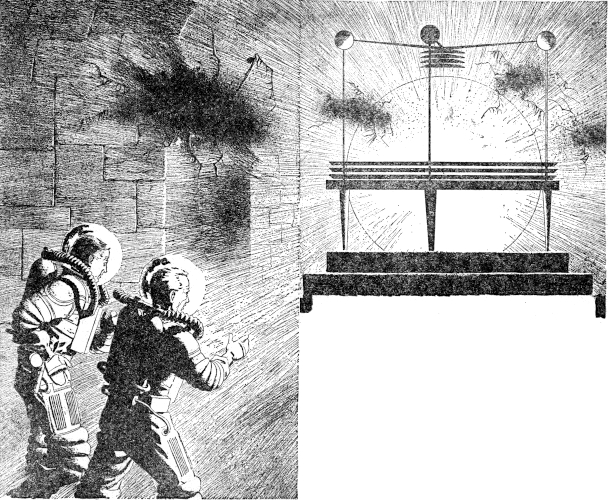
Durham felt it, a subliminal feeling without any reason to it, like the sadness of a summer night or of birth and laughter or of gull's wings white and swift against the sky. The Star shone, palely, gently. He tried to see if it was round or any other shape, if it was solid or vaporous, but he could not see anything but that soft shining, like mist around a winter moon.
Durham shook himself and wondered why, when he was already so sure of death, he should be so afraid. "All right," he said. "How is it freed?"
"The darkbirds do that. Watch."
He spoke to them, one word, and in the glass-walled prison there was a stirring and a swirling of shadows around the soft shining of the Star. Durham saw a disc set in the metal overhead. One of the darkbirds touched it. There was an intense blue flare of light, and Durham felt the throbbing of hidden dynamos, a secret surge of power. The glass walls darkened and grew dim, the low roof turned and opened to the sky. And through the barrier window, Durham watched the waking of a star.
He saw the frosty shining brighten and spread out in slow unfurling veils. There was a moment when the whole building seemed filled with moonfire as cold as the breath of outer space and as beautiful as the face of a dream, and then it was gone, and the darkbirds were gone with it.
"Come on," said Karlovic, a harsh incongruous voice in the stunned darkness that was left behind, and Durham came, up the ramp and out into the parklike space beyond, and all the tall lichens were standing dead and sheathed in ice.
High above, burning cold over the city, a new star shone.
They followed it, through a silence as deep as the end of the world. Everything had taken cover at the rising of that star, and only the two men moved, the thermal units of their suits turned on high, through streets all glazed with ice and cluttered here and there with the wreckage and the dead of the rioting. The darkbirds were forcing the Star to stay high, but even so nothing could live long without protection in that sudden, terrible winter.
The road to the port lay blank and bare. They found one of the smaller vehicles, its driver dead beside it. Karlovic got it going, moving the great levers with Durham's help. After that they rushed faster through the empty night. Durham shut his eyes, thinking.
He opened them, and the spaceport of Senya Dik lay black and deserted around him, and Karlovic was gasping to him for help. Together they pulled down the lever that stopped their conveyance. They scrambled down and ran out toward the small lifeboat, slipping and stumbling, dying inside their suits. They fell into the airlock, and Durham slammed the door and spun the wheel, waiting out the agonizing seconds while the tiny chamber cleared and then refilled, and they could tear off their helmets and breathe again. They looked at each other and laughed, and hugged each other, and laughed again, and then went in to the cabin.
The communicator was flashing its light and burring stridently.
Durham switched it on. Jubb's face appeared in the tiny screen. "You are safe? Good, good. For a moment I thought—! Listen. I have word from my patrol that Morrison has other ships with him now, spread out to catch you if by chance you get through. That is what decided me to use the Bitter Star. I am angry, Karlovic. I am tired of mockery and lies and secret violence. I am tired of peace which is only a cloak for another man's aggression."
A darkbird came into the cabin and hung over Durham's shoulder. "It will carry your messages," said Jubb. "I am leaving now for the port, and my own flagship. We go together. Good luck."
The screen went dead. Durham said, "Strap in, we're taking off."
The Star, with its herding pack of shadows, set a course that took them steeply up out of Senya Dik's shadow, into the full flood of the green sun's light. The darkbird spoke by Durham's shoulder, and Karlovic said,
"The Star must feed—or recharge itself, as you would say, with solar heat. Watch it, Durham. Watch it grow."
He watched. The Star spread out its misty substance, spreading it wide to the sun, and the soft shining of it brightened to an angry glare that grew and widened and became like a burning cloud, not green like the sunlight but white as pearl.
Far off to one side of it Durham saw the glinting of a ship's hull. He pointed to it.
Karlovic worked with the communicator. In a minute the screen lit up, and Morrison's face was in it.
"Hello, Morrison," he said. "Hello, thief."
Morrison's face was as hard and white as something carved from bone.
"It wasn't just an old wive's tale, Morrison," he said. "It was true, and here it is. The Bitter Star, Morrison."
Karlovic reached over and shook him, pointing out the viewport. Coming swiftly in toward them was a small ship, curiously shaped before.
"Space-sweep," Karlovic said. "Those funny bulges are torpedo tubes, and the torpedoes carry heavy scatter charges to clear away debris so the ore ships can come in."
Durham said to the image in the screen, "Call him off."
Morrison showed the edges of his teeth, and asked, "Why should I?"
Durham nodded to Karlovic, who spoke to the darkbird. It disappeared. Within a few seconds the Star had begun to move. It moved fast, the angry gleaming of its body making a streak like a white comet across the green-lit void. It wrapped itself around the space-sweep, and then it lifted and the ship continued on its way unchanged.
Morrison laughed.
The sweep rushed on toward the lifeboat. Its tubes were open, but nothing came out of them. Durham shifted course to clear it, and it blundered on by. In the screen, Morrison's image turned and spoke to someone, and the someone answered, "I can't, they just aren't there."
Morrison turned again to Durham, or rather to the image of him that was on his own screen. "I know what I'm supposed to say now, but I'm not going to say it. I've got Miss Hawtree with me, had you forgotten that? I don't think you've suddenly acquired that kind of guts."
Durham shook his head. "I don't need them. I want you alive, Morrison. But I don't give a tinker's damn what happens to anybody else in this whole backside of nowhere you call 9G. Nobody and nothing. And I have the Bitter Star to back me up. I am wondering how many loyal employees of Universal Minerals, and how many stupid Wanbecqs are going to sacrifice their lives just to keep me from getting my hands on you. Call them up, Morrison, and count them out, and we'll send the Star to see them."
The Star glowed and glimmered and grew to a great shining, and a look of worry deepened on Karlovic's face. Morrison did not answer, and Durham could see the thoughts going round and round in his mind, the possibilities being weighed and evaluated. Then the someone who was behind Morrison and out of scanner range said in a queer flat voice,
"The tug Varney calling in, sir. They boarded the sweep."
"Well?"
"All dead, sir. Frozen. Even the air was frozen. They said to tell you they're going home."
"All right," said Morrison softly. "Durham, I'm going home too, to Nanta Dik. Let's see if you can follow me there."
He broke contact. In the distance, Durham saw the bright speck that was Morrison's ship make a wheeling curve and speed away. Durham said grimly to Karlovic,
"Tell the darkbirds to follow with the Star. And then get hold of somebody on Nanta Dik, somebody with authority. Tell them everything that's happened. Tell them Morrison is all we want. We'll see how close they let him get to home."
"I don't know," said Karlovic, and got busy with the communicator. Half an hour later he sighed and blanked the screen. "They're sending up a squadron to intercept Morrison. But they're scared. They're scared of the Star. I've promised them—and nothing had better happen, Durham."
Durham said, "We'd better send word to Jubb."
For what seemed an eternity they fled through the green blaze of the sun, after the ship Durham could no longer see. And ahead of the lifeboat, a light and a portent in the void, went the Bitter Star with its attendant shadows. And Durham, too, began to worry, he was not sure why. Jubb's flagship closed up to them, a vast dark whale beside a minnow. And after a while a tiny bright ball that was a planet came spinning toward them. Karlovic pointed.
Hung like a net across space, between them and the planet, was a series of glittering metallic flecks.
"The squadron."
The communicator buzzed. Karlovic snapped it on, and the face of a Nantan officer appeared on the screen.
"We have Morrison," he said. "Come no closer with the Star."
Karlovic spoke to the darkbird. Durham's hands, heavy with weariness, slowed the lifeboat until it hung almost motionless. Jubb's great dark cruiser slowed also. Above and between them burned the Bitter Star. It had ceased to move.
Durham said, "The Star will come no closer."
"Mr. Karlovic," said the Nantan. "Bring your lifeboat in slowly, and alone."
The lifeboat came in among the ships of the squadron.
"Now," said the Nantan officer, "withdraw the Star."
Karlovic said, "Jubb will do so—"
"No," said Durham suddenly, "Jubb will not. Look there!"
Shining with a furious light, the Star had torn itself away from the clustering shadows that hung around it.
Durham's heart congealed with a foretaste of icy death. The face of the Nantan officer paled, and Karlovic said in a voice that was not like his voice at all, "I must talk to Jubb."
He reached out to shift their single screen, and the Nantan officer said, "Wait, he is speaking on our alternate. I can adjust the scanner—"
The picture flopped, blurred, and cleared again, showing now in addition to the officer a part of the Nantan's alternate-channel screen. Jubb was speaking, and it seemed to Durham that the Senyan's strange face was clearly, humanly alarmed.
He said, "I cannot withdraw the Star. No, this is not a lie, a trick—hold your fire, you idiots! I'm the only hope you have now. The Star has profited by the lesson of its docility a thousand years ago, when it let itself be led back into captivity. Now it has grown, too much. It cannot be brought back to any world."
Durham looked out at the beautiful deadly thing blazing so splendidly in the void. "Can it be destroyed?"
"The darkbirds can destroy it," said Jubb. "If they will."
The Nantan officer, speaking from lips the color of ashes, said to the image of Jubb on the screen, "You have one minute to get it out of here before I fire."
Jubb turned his face away and spoke, to something they could not see.
Durham turned to Karlovic. "He said, 'If they will.' Does that mean—"
"I told you," said Karlovic, looking out the port, "that the darkbirds were created to guard the Star. And that, in a way, they love it. Who can say how much?"
They watched.
Out in space the little cloud of darkbirds moved toward the Star. Then, hesitantly, they stopped.
"They won't," said Karlovic, in a whisper. "Not even for Jubb."
Again Jubb spoke to the unseen messenger, as quietly as though it was a casual order. And presently a troubled movement rippled the swirling darkbirds.
Suddenly they moved, again herding the Star. Slowly at first, then more and more swiftly until it was only a streak of brilliant light, the darkbirds drove the Star straight toward the sun. And it was less a driving than an urging, a tempting, a promise of glory, a sweet betraying call from the mouth of the eternal Judas. The darkbirds led it, and it followed them.
In a moment, in that greater blaze, the Star was lost to view.
Karlovic's breath came out of him in a long sigh. "The only way it could be destroyed. Even its appetite for thermal energy could not swallow a sun."
"The darkbirds are coming back," Durham said. Then, wonderingly, "But they're not—"
The darkbirds were coming back from the green sun, but not toward Jubb's ship. And not toward any planet. They were flying like blurring shadows toward outer space, and if they heard Jubb's calling voice they paid no heed at all.
"They're gone," Karlovic said, unbelievingly.
"Yes," said Jubb, very slowly. "They obeyed that order, but it was the last." He looked at the humans facing him, the men of Earth and the men of Nanta Dik, and he said, "Do you see now that there is no difference between us, that we of Senya Dik can teach betrayal just like men?"
Durham looked out into the shining void, but there was no sign now of the fleet and flying shadows. Intelligences, minds, beyond the understanding of heavy creatures like himself and Jubb. He wondered how far they would go, how long they would live, what things they would see.
Darkbirds, darkbirds, will you come back some day when we of flesh are ghosts and shadows, to frolic on our lonely worlds?