INVOCATION (continued 2)
Reading edition
‘Silvery till ruffled by the wind,’ he went on, ‘as Lorenzo so admirably describes it in his poem on the Ambra.
‘L’uliva, in qualche dolce piaggia aprica, Secondo il vento par, or verde, or bianca.‘
‘What an incautious quotation!’ said Lamia; ‘and, were I a critic, I should at once fasten on you a charge of gross plagiarism. I remember, if you do not:—
‘The smiling slopes with olive groves bedecked, Now darkly green, now, as the breeze did stir, Spectral and white, as though the air were flecked With elfin branches laced with gossamer; And then so faint, the eye could scarce detect Which the gray hillside, which the foliage fair; Until once more it dense and sombre grew, To shift again just as the zephyr blew.
‘Have I not established my case?’
‘Completely, my dear Lamia; and I am glad to find myself in such excellent company as that of Lorenzo, more especially now that we have taken possession of a villa where he must often have been a guest, with Politian for host, and Poggio and Pico della Mirandola for companions.‘ ‘I fear,’ said Lamia modestly, ‘I should have found them too learned to be congenial society.’
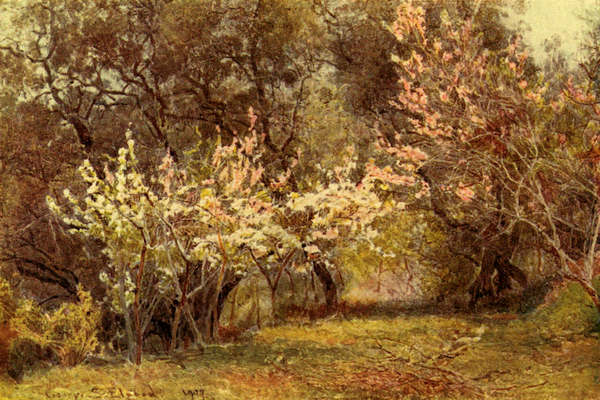
PEACH, PLUM, AND PEAR-BLOSSOM
‘Not when Lorenzo was with them; for he assimilated their learning to life, and contrived to make gaiety out of their scholarship. With more even than the statesmanship of his grandfather, and of whom it may equally be said that he ruled without arms and without a title, endowed with no inconsiderable portion of the culture of the students he so generously abetted, Lorenzo was a thorough man-of-the-world, and more than a respectable man-of-letters. I recommend to you his description, in the Selve d’ Amore, of the shepherd leading his flock from the wintry fold to the Spring pasture, and carrying in his arms a newly-dropped lamb, his sonnet on the origin of the violet, and, still more perhaps, the one in praise of rural sights, sounds, and solitude. Permit me to cite at least a portion of it:—
‘Cerchi, chi vuol, le pompe, e gli alti onori, Le piazze, e tempi, e gli edifizi magni, Le delicie, il tesor, qual accompagni Mille duri pensier, mille dolori. Un verde praticel pien di bei fiori, Un rivolo che l’erba intorno bagni, Un augelletto che d’amor si lagni, Acqueta molto meglio i nostri ardori.‘
‘I fear,’ said Lamia, ‘I have not yet made sufficient progress in my studies to follow your recitation completely. Will you kindly translate?’
‘Let a spontaneous paraphrase suffice, which will reproduce the original with, if with less literary perhaps with more spiritual, accuracy.
‘Covet who will the patronage of Kings, And pompous titles Emperors bestow, Splendour, and revelry, and all that brings A thousand bitter thoughts, a world of woe: A meadow glistening in an April shower, A green-banked rivulet, and, near his nest, A blackbird carolling in guelder bower, ‘Tis these that soothe and satisfy the breast.‘
‘Surely it is strange,’ I said, ‘that a man so occupied with affairs of State as Lorenzo, conspiring and conspired against from morning to night, a landowner not indifferent to the prosperity of his estate, a banker attentive to the profitable employment of his capital, a father most anxious for the wise bringing up of his sons, a collector of manuscripts, gems and intaglios, a founder of libraries, an owner of alum mines, a prince, a statesman, and a diplomatist, should not only have experienced such a sentiment as you have cited, but should have found leisure to give expression to it.’
‘And in so short a space of time,’ said Lamia, more indulgent than usual to my observations. ‘Was he not only forty-one when he died?’
‘He was,’ I said, ‘but he seems to have lived every hour of his life, and to have acted on the principle he lays down in his contribution to the Disputationes Camaldulenses, that life should consist in equal parts of action and contemplation; thereby being rather at issue with Plato, whom he loved so well. But even in his most contemplative moods he never seems to be divorced from the themes that interest mankind. There is a passage in a poem of his expository of the Platonic Philosophy which some critics have thought gave Michelangelo the suggestion for his famous marble Sonno, which you will shortly see in the Sacristy of San Lorenzo; while, in his Simposio there is a description of a toping friar which is worthy of Chaucer, and in the Canzoni a Ballo and the Canti Carnascialeschi, which I cannot recommend you to read save in what you will scarcely find, an expurgated edition, he expresses the very thoughts, feelings, and ideals of the populace of Florence.’
‘Veronica shall be my Bowdler,’ said Lamia, ‘and meanwhile I thank you for your erudition! But, as it happens to be my birthday, do you think you could forget the Medici for a few moments, if only to wish me, in the most conventional manner, “many happy returns”?‘
I had not forgotten the circumstance, and indeed had armed myself with a propitiatory gift which I intended to offer later in the day. But, before I could stammer out my excuses, she put her hand in that of the Poet, and said:
‘Perhaps you have forgotten that, not very long ago, you rebuked me most gently for one of my numerous foibles, and that I asked you to tell me what I ought to do, and to be, in order to merit your approval. Will you, for a birthday present, tell me now?’
We had come, in our saunterings, to the long low wall, leaning over which we gazed down direct on Florence.
‘With pleasure,’ he said, ‘and I must only hope you will not think me too severe.
A BIRTHDAY PRESENT
I ‘“Say what, to please you, you would have me be.” Then listen, dear! I fain would have you very fair to see, And sweet to hear. II ‘You should have Aphrodite’s form and face, With Dian’s tread; And something of Minerva’s lofty grace Should crown your head. III ‘Summer should wander in your voice, and Spring Gleam in your gaze, And pure thoughts ripen in your heart that bring Calm Autumn days. IV ‘Yours should be winning ways that make Love live, And ne’er grow old, With ever something yet more sweet to give, Which you withhold. V ‘You should have generous hopes that can beguile Life’s doubts and fears, And, ever waiting on your April smile, The gift of tears. VI You should be close to us as earth and sea, And yet as far As Heaven itself. In sooth, I’d have you be Just what you are.‘
O these poets! I need scarcely say that, after this insidious effusion, I stowed away the present I had intended for Lamia in a secret drawer, reserving it for some more propitious occasion. I hope I am not prejudiced when I say that the verses were scarcely among the Poet’s happier compositions. But diamonds would have lacked lustre, after such metrical adulation.
But did you go all that way, it will perhaps be asked, and introduce Lamia to the acknowledged fascinations of Tuscany, only to wander in search of wild-flowers, to climb rural hill-sides, to rave about scenery and sunshine, to listen reverentially to the Poet’s rhymes, and to discuss things in general, and Lamia’s favourite themes in particular? Surely, you may be disposed to add, all those things could have been done just as well at home. Had Florence itself, its churches, its palaces, its galleries, its storied thoroughfares, no attraction for you all?
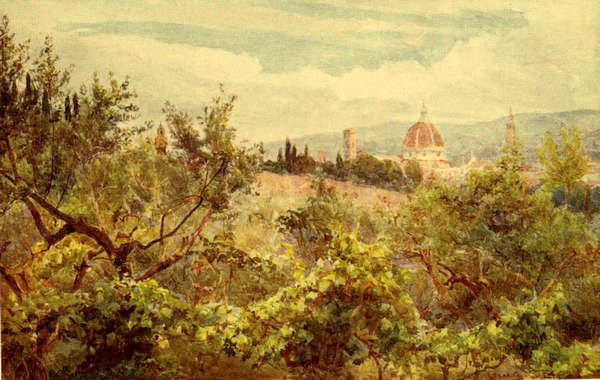
FLORENCE
Indeed they had. But these have been written about with such minuteness by the learned, and with such fervour by the enthusiastic, that you would hardly thank so homely a pen as mine for describing them afresh. Moreover, let it be confessed that we had a way of our own, which is hardly the common way, of impressing Lamia’s sensitive mind with the artistic marvels of the City of Flowers. To the rest of us, Florence was already as familiar even as the Garden that we love, and the Poet had a theory, in which I entirely concurred, as to how Lamia’s familiarity should grow to be like ours, with a reserved freshness of its own. ‘There are two ways,’ he said, ‘of approaching a place like Florence. You can try to take possession of it, or you can allow it to take possession of you. The first is the more usual, but the second is, I would suggest, the more excellent way. Once when I was travelling hitherward, I remember an American tourist who was the only other occupant of the railway compartment, asking me if I knew Pisa; and, on my replying that I did, he said he should be much obliged if I would point it out to him. Shortly we approached it, and the train slackened pace in order to make the customary halt of some seven or eight minutes. “This is Pisa,” I said, and he at once leaned out of the window, and there he remained intently gazing till its Duomo, Leaning Tower, and Baptistery, could be seen no more. Then he turned to me, and said, “I thank you, sir, for showing me Pisa. I should not have liked to return to the States without having seen Pisa.” I beg of you not to take my fellow-traveller as a national type, for Americans are as various, and differ from each other as much, as the people of other countries. But I cannot think he had seen Pisa. Yet numbers of people resemble him in their tacit assumption that a hasty visual impression or snapshot, so to speak, deserves to be described as seeing, though, assuredly, where great works of art are concerned, it is not to see with the mind’s eye, to say nothing of the spirit’s.‘
‘I am easily taken possession of, as you know,’ said Lamia, for a moment pointedly turning to me, who certainly know nothing of the kind, and indeed know very much the reverse, and then redirecting her attention to the Poet. ‘But, if one is to be taken possession of by all the lovely places and things in this world, would not one have to live to a rather venerable age?’
‘There is an alternative,’ I said, ‘is there not? which is to be taken possession of by only some of them, but to be taken possession of by these thoroughly.’
‘How conjugal and domestic that sounds. But it makes no allowance for feminine curiosity. I should be sorry, when we leave Florence, to think there was anything in it worth seeing I had not seen.‘ ‘Neither shall there be, I hope,’ said the Poet, ‘but, if one is really to see what is worth seeing, I think one must bridle one’s curiosity a little about much that is not worth seeing. The specialist, no doubt, must be boundlessly curious concerning his particular pursuit, and the professional student of Art is a specialist. We are, at best, only dilettanti, and seek solely to expand our minds through sympathetic and discriminating enjoyment.‘
‘In fact,’ said Lamia, ‘it is with Art as with Life. If one is to enjoy it, one must not know too much about it. In that case, I can promise myself, during the next few weeks, no end of pleasure.’
We none of us, unless it be Veronica sometimes, resent Lamia’s seemingly irrelevant way of diverting a discussion, and the Poet has less reason than any of us to do so, since she not only accepts his utterances as words of absolute wisdom, but invariably strives to shape herself according to his canons of life and conduct. Accordingly, when we descended into Florence, which was pretty often, she manifested neither impatience nor curiosity, but suffered herself to fall into the fortuitous fashion of wandering about it that he recommended. We had neither guide nor guide-book; and, if any of us showed a disposition to enter here or to linger there, we entered or lingered as a matter of course. Lamia was left to her own impulses in giving much or little attention to tomb, fresco, statue, altar-piece, pulpit, or doorway; nor was she distracted by any information concerning them till she asked for it. Then, indeed, it was given most willingly, and it was rarely that one or other of us could not answer her inquiries. The Poet and I were sometimes at fault, but Veronica never. If you think that by such a method as this much must have been overlooked that is well deserving of notice, you must remember there was nothing to prevent us from returning to the same chapel or sacristy, the same monument or bas-relief, again and again; and, so varying is the human mood in general, and Lamia’s mood in particular, that what she would pass by on one occasion would wholly engross her attention in another. Thus there was a certain method underlying our apparent purposelessness, and I fancy she ended by knowing fully as much about Florence as those who order their visits to its innumerable treasures, while I am sure she enjoyed herself infinitely more. Moreover, this unsystematic system of artistic vagrancy issued sometimes in welcome surprises that extended the experience of all of us. One evening, for instance, just as we were on the point of quitting the city and driving homeward, Lamia said:
‘Let us go into the Duomo for a few minutes.’
‘But it is so dark,’ I suggested, ‘you will see nothing!’
We entered, nevertheless. It was the eve of Good Friday, when, according to the Roman Catholic Ritual, the Host, instead of being enshrined as usual on the High Altar, is, in commemoration of the sacred tragedy of Calvary, borne to a dimly-lighted Sepulchre, where, all night long, the faithful come to watch and pray. The Office of Tenebræ was just over, and the worshippers had all passed out of the Cathedral. There remained in the doubtful light only a Verger and ourselves, till, from either side of the Choir, there emerged a figure robed in black, and bearing a lighted torch. Slowly, solemnly, and parallel to each other, they skirted the inner walls of the building, till they met at the main doorway, and then, at the same grave pace, they walked up the long empty nave. I had a surmise of what was signified by this slow and lonely procession, but in order to be quite sure I said to the Verger:
‘Cosa fanno?’ (What are they doing?)
‘Cercano Il Signore, e non lo trovano,’ he replied. (They are looking for Our Lord, and cannot find Him.)
We all had heard the reply. Then we quitted the Duomo, and drove home in silence.
Surely it is true, is it not, that accidental experiences have a sharper savour and leave behind them a more enduring reminiscence than projected ones? What one expects but rarely comes up to expectation, and has generally cost some thought or trouble to procure. What happens unexpectedly, if it be of the welcome kind, finds one disarmed and indisposed to criticise, and the emotion it excites is all sheer gain, no price of admission, to so speak, having been paid for it. Just as wandering along a river is more agreeable than walking along a canal, so people who canalise their lives and prearrange their enjoyments lose much of the enchantment which attends the guiding beneficence of chance. In Florence, you can scarcely halt anywhere, but story sacred or profane, saint or scholar, painter or patriot, poet, martyr, or enthusiast, has left some indelible trace to mark and glorify the spot, and to make you lift your head and then your heart. The very lapidary inscriptions let into the walls where architect or sculptor, jurist or astronomer once abode, are a continual invitation to the wayfarer to pause, to read, to ponder. Nor is it perhaps the most famous or the best known that are the most interesting and suggestive. The Poet seemed to have a special faculty for arresting our footsteps by those most worthy of contemplation. ‘Is not this one,’ he said, ‘peculiarly consolatory in a period like the present, when most people, and the Italians especially, seem to think that originality consists in artificial novelty and even grotesqueness—for that is where such novelty too often leads—of manner and expression.’
Thereupon he read: ‘Qui visse e morì Benedetto da Majano, chi nelle opere sue confrontò con venustà di stile e di forme le grandi idee del genio creatore.’ (Here lived and died Benedetto da Maiano, who in his works conferred charm of style and beauty of form on the lofty ideas of creative genius.)
‘To do that,’ he said, ‘is to overcome the main difficulty and solve the essential problem of Art, whether in marble or in language. In our day, too many persons shirk the difficulty and ignore the problem, and seek to conceal the poverty of their ideas under the extravagance of their manner.’
‘Some of these are very successful,’ I ventured to observe.
‘Not,’ said Veronica, ‘if in the notion of success be included that of succession. Congratulated to-day, will they not be consigned to oblivion to-morrow, when right taste has resumed its authority, or when some one yet more extravagant creates an impression, equally sudden and equally transitory, of a somewhat similar character?’
‘I think so,’ said the Poet, ‘and I am sufficiently enamoured of venustà di stile to hope so. As great a master of style as this century has produced says somewhere, “On peut tout dire dans le style simple et correct des bons auteurs. Les expressions violentes viennent toujours ou d’une prétention, ou de l’ignorance de nos richesses réelles.” Do you mind, Lamia, committing that sentence to memory, for I see you sometimes deeply immersed in works of much pretension, but consisting for the most part of expressions violentes, though I never observe you admiring in marble or on canvas the violence or the profuse colouring you occasionally tolerate in language?‘
‘Is it not,’ said Veronica, ‘that in architecture, painting, and sculpture, the manner in which a thing is done is so much more conspicuous, so to speak, than what is done, that failure, whether it arise from feebleness or from violence, strikes us at once; whereas, in language, what is said, if interesting in itself, makes us indulgent to, and indeed forgetful of, the manner of saying it?’
‘I suppose that is so,’ he answered; ‘and perhaps it is one of the incidental drawbacks to literature. Fortunately, however, what you say is more true of prose than of verse; defect of style in poetry being at least as obvious to fastidious readers as in marble. And yet,’ he added, ‘in our time, a grotesque, violent, and what seems to me lamentable way of saying things has been more than tolerated in verse, for the sake of the things said. For my part, I should be sorry to be original, either in prose or verse, at the expense of truth or beauty.’
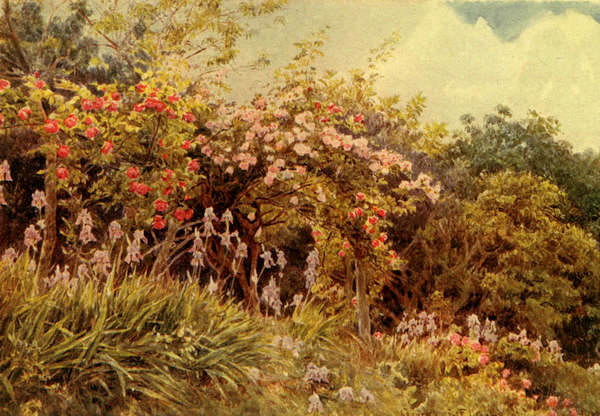
ROSES AND IRIS
The absence of method in our visits to cloister or gallery seemed to govern most of our movements. Sometimes we were but two, sometimes but three, of a company; and it would happen that, when we were four, we lost touch of each other for a time, and went our separate ways. Veronica not infrequently was missing; and generally, when this occurred, when she returned alone to the villa, she brought with her some ‘object of antiquity,’ as the Florentine dealers in curios and old furniture call such things, purchased after considerable thought and much bargaining. I think you know Veronica has a large heart, and would defraud no one of his due, and indeed would give any one more than his due, where no bargaining was in question. But she knows just as much about the date and value of cassettone, triptych, or embroidery, as any of the various dealers on the Ponte Vecchio or in the Via de’ Serragli; and she not unnaturally enjoyed displaying her peculiar learning in those interesting haunts. Her perfect familiarity with the language, and indeed even with Florentine patois, added to her advantage and strengthened her position in appraising the value of mediæval picture-frame or sixteenth-century mirror. Moreover, it is the greatest possible error to suppose that Florentine dealers are consumed with a single-minded desire to rob unwary purchasers; and I am convinced they much preferred to conclude a fair bargain with Veronica, than an unfair one with the first ignorant comer. Oriental ways and traditions of business still linger sufficiently with them to make prezzo fisso or a rigidly-fixed price exceedingly distasteful. Their day is long, they have abundance of time on their hands, and, if the few things they sell in the course of the week were sold without demur and in a couple of minutes, life would be insufferably tedious for want of human intercourse and agreeable conversation. Veronica invariably regaled us with minute accounts, on the occasion of each fresh purchase, of the polite but protracted controversy that had attended it; and very diverting these were. She preferred to conduct these transactions without our company; for, in the first place, as she truly enough remarked, we knew nothing whatever upon the subject and could therefore be of no use to her, and, in the second place, when we honoured her with our useless society, one or other of us invariably ended by showing signs of impatience, and to be impatient over a bargain is inevitably to get the worst of it. She did not always come off a winner in these friendly encounters; and she was just as candid and as diverting in confessing her defeats as in recording her victories. On one occasion she suffered a peculiarly humiliating disaster, which she detailed with much zest at her own expense. Wishing to give an agreeable surprise to Lamia on the occasion of that Birthday, when, as you will perhaps remember, I was so sorely discomfited, she went in search of some amber beads which Lamia had more than once expressed a longing to find in order to complete a set she already possessed. But it was indispensable they should be of a special hue. At length, Veronica discovered some in a shop in the Por Santa Maria, but, do what she would, and notwithstanding all her Florentine wit, she could not bring the owner of them into what she deemed a reasonable frame of mind as regards price.
‘Ebbene,’ she said, ‘I will try elsewhere,’
She tried everywhere, but in vain, and so at length had to go back to the Por Santa Maria, and say she would take the beads at the man’s own price.
‘But now, Signora mia,’ he said, ‘that is no longer the price: you can find no others in Florence to suit you, so these in the meantime have become more valuable.’ And he added some insignificant sum to the original figure, more for the sake of triumph than from any mercenary motive. Had Veronica been making a purchase for herself, I am sure she would have defrauded him of his victory by leaving him in possession pf his amber treasures. But she would not disappoint Lamia, and so paid the forfeit of her unsuccessful strategy.
But we had a less humorous and far more touching experience on another occasion. Visiting a hillside village some twenty-five miles away, we were all much taken by a small altar-piece, a Presentation in the Temple, which stood in a side-chapel in a little church of otherwise no particular pretension. We discussed, then and there, by whom it may have been painted, for I need scarcely say that, on that subject, we all, like so many other people, consider ourselves exceedingly expert, and quite competent to express an opinion. The Parroco, a venerable Priest of courtly manners but much humility, did not affect to adjudicate among us, but was evidently much interested in our deliberations, and still more in our admiration of the picture. At last he hesitatingly asked Veronica if we should like to become the owners of it. This had certainly not occurred to us, and we were rather taken aback by the question. But Veronica, enchanted at the chance of an unexpected bit of bargaining, said ‘Yes,’ without a moment’s hesitation. So modest a sum, however, was asked, if compared with the high artistic qualities we had been attributing to it, that it went against her conscience, which, as you know, is the strongest part of her, to offer anything less. Moreover, she probably remembered, on second thoughts, that the place was not a suitable one for financial transactions; and any remaining scruple we might have had in completing the bargain was set at rest by his telling us that he had long been anxious to buy a second-hand harmonium that was for sale, whereby the services of his little church could be conducted in a more seemly manner.
The picture was carried off; and, by the time it had been in our possession forty-eight hours, its artistic value had enormously increased, and there was hardly any Umbrian painter, Raphael perhaps excepted, to whom we were not ready to ascribe it. We discussed, over and over again, where it should be hung when we returned to England, and first one position of honour and then another was suggested for it. But, as I knew well enough from the first would turn out to be the case, it was finally assigned by Veronica to the Poet’s study.
For a week she had the satisfaction of seeing all of us as much interested in, and as proud of, a purchase as herself. But, on the morning of the eighth day after our mountain excursion, the old Priest suddenly made his appearance at the villa, whither he had walked all the way; and, in a state of much agitation, he said that he had come to ask us to give him back the picture, the price of which he would restore and which he had in his hand. At first there was a protesting chorus, and Veronica was particularly eloquent in pointing out that the request was most unreasonable, as we had given the full amount asked for, without any demur. Thereupon the poor old man explained, with tears in his eyes, that his parishioners had missed the picture, and, though he had told them of his intended purchase of the harmonium, they insisted on its being restored to its traditional home, and all his pleas and arguments had proved unavailing with them. To such an appeal but one answer was possible. The picture was returned, and the Poet’s study will never see that Umbrian masterpiece. Our disappointment was great; but why, said Veronica, should everybody be disappointed? Poor old man! He stood there a most touching figure. So we put our hearts and purses together; and the sound of the second-hand harmonium now follows on his quavering voice, when, in answer to his Dominus vobiscum, the entire mountain congregation shrills out, to its instrumental accompaniment, Et cum spiritu tuo.
As a rule, however, Veronica’s purchases, over and above being definitive, were as useful as they were ornamental; and it sometimes seemed as though Lamia’s predictions concerning the transformation that was gradually to come over the villa were about to be fulfilled. Veronica invariably declared that the furniture she brought back with her from the Via Maggio, or the Piazza Santa Maria Novella, was intended strictly for home consumption, and would in due course be packed and dispatched to England. Where she would find room in a house already remarkably well stocked, was a mystery to all of us; and meanwhile it remained on the spot, to whose aspect it certainly added finish and charm, and to whose commodiousness it materially contributed.
‘I told you,’ said Lamia, ‘I should end by having a comfortable armchair, and you see I have. Nor can I well doubt that a host of work-people have been secretly introduced by Veronica, for I can now count on my bell ringing with absolute certainty; and, as for Placida and Perfetta,’—Placida and Perfetta were two handmaidens,—‘though they still regard fair words and sweet smiles as the principal ingredients of domestic service, they have developed a talent for tidying my drawers and arranging my toilet-table which cannot but have proceeded from severe drilling by Veronica, while you and I were discussing the Infinite under the shade of cheerful boughs. Shortly after we first came, Veronica gave one of our dear devoted but somewhat primitive attendants a sponge, for what purpose I cannot say. But this domestic novelty was found so useful, that each of them in turn, she discovered, had the loan of it, till it came to enjoy an absolute monopoly in the cleaning of the establishment. Now, I believe, sponges, and all other requisites of a well-ordered place of residence, are as plentiful as blackberries. Do you remember,’ she said, turning to me, ‘your giving me some most lovely flowers last week, which, of course, I treasured beyond words, even after they had faded? But I discovered, the next morning, that Perfetta, moved by a spirit of economy which seems to be a perfect passion with these dear people, was applying them, on the carpet, to the same purpose, I am told, for which we sometimes use tea-leaves in England. That was a sad ending, was it not, to your lovely gift?’
Lamia’s observation on ‘the principal ingredients of domestic service,’ as understood in Italy by those who render it, was strictly accurate. They wait on you with a smile, and minister to your need with copious conversation. They will end by giving you all you ask for; but you must ask, and you must not expect that, having asked for it ninety-nine times, you will get it the hundredth, without asking for it again. That would be to defraud them, and you as well, of an opportunity of talk, the thing they love most in the world. Moreover, they have an invincible objection to being made methodical; nor can you give them greater pleasure than to ask them to do the work naturally pertaining to somebody else. The cook would be delighted to nurse the baby, the housemaid would find it quite natural to be bidden to cook the dinner, the butler would eagerly go in search of the vegetables, and the gardener at once mount the box and drive you into Florence. Only do not ask them to be perfect, according to English ideas, in their own line. They will do anything on earth for you, if you go the right way about it; but they will not be turned into machines. Nothing I have ever seen in Veronica is more admirable, or shows so conclusively the discrimination she can blend with her love of order, than the amount of method, limited no doubt but quite unusual, with which, for the time at least, she imbued those about us; and Lamia, as we have seen, indulged in a little characteristic raillery on the subject.
‘It is all very well,’ said the Poet, ‘for us to have our little joke about a certain person’s passion for discipline. But, upon my word, what Italy stands in need of is a Ruler with plenary powers, of the temperament and talents of Veronica. So the Roman Empire was founded, so the British. Dear Lamia, you are very charming; our friend here is, I do not forget, a gardener of much repute, and I write verses which, I am told, sometimes give pleasure to people who are easily pleased. But Veronica is worth all of us put together a hundred times over.‘
‘Quite so,’ said Lamia. ‘Veronica is our Minerva Medica, whose salutary if sometimes unpalatable wisdom keeps us in such tolerable health as moral valetudinarians like myself are capable of; whereas I am but a would-be Egeria, who have not yet succeeded in inducing any one, and you, dear Poet, least of all, to be my Numa. Still, do not judge me altogether by the way in which I conduct myself here, among a people very much after my own heart. I have a conscience, which I showed by declaring it at the frontier, as I heard it was contraband. I proved to be right; it was confiscated, and I have got on very comfortably without it ever since. Indeed, I should have missed a new gown much more. Poets, we all know, never have a conscience, in any country. But, as Veronica has enough for two, indeed—obligingly remembering my existence—for three, I daresay we shall continue to manage fairly well in this easy-going land, with Veronica’s occasional assistance.‘
At this moment, Veronica joined us under the lower loggia, where we had for some time been sitting, and desisting more frequently than perhaps you have imagined, from audible converse, in order to commune silently with the plashing of the fountain in front of us, with city, plain, and river far below, and with hill-slope and summit everywhere around us. The sun had just disappeared; and, each instant, mountain and sky grew more and more unreal, more and more transfigured in the afterglow. The last Ave Maria bell had rung; the last wain drawn by the sleek, swaying oxen had creaked up the hill; and, somewhere among the more distant olives, a peasant lingering at his work, but pondering aloud on his love, sang out with clear voice to the clear air:
‘Fin al fin de’ giorni miei, Io te sola voglio amar.‘
‘You never told us,’ said Veronica, ‘what you two did yesterday afternoon.’ The two were the Poet and Lamia.
‘You scarcely gave us the chance,’ Lamia replied. ‘We were all so absorbed in admiring the bust you brought from Florence of the founder of the Magliabecchian Library, whose name I have already forgotten, but who was himself, you told us, what you, dear Veronica, will become if you go on accumulating stray black-letter volumes at the rate you are doing at present,—quædam bibliotheca. But have a care. What if they were lost or stolen? I was reading only yesterday that, when Guarino, returning to Florence from Constantinople with a cargo of Greek manuscripts, was shipwrecked, and all his treasures went to the bottom of the sea, his hair turned white. See how well-informed I am getting. I can tell you still more on this interesting subject, and indeed meditate lecturing on it next winter in the Sala Dante. Cosimo de’ Medici healed a political breach with Alfonso of Naples by sending him a Manuscript of Livy; and Lorenzo declared to Pico della Mirandola, probably where we are now sitting, that, if his fortune proved insufficient, he would pledge his furniture in order to buy books. But, when your purse gives out, you will spare my easy-chair, Veronica, won’t you?‘
‘You have still not told us where you went yesterday afternoon.’
Lamia remained silent; leaving it to the Poet to reply:
‘We carried some flowers to the grave of Elizabeth Barrett Browning.’
Again there was silence. Then, shortly, Veronica asked:
‘Did nothing come of it?’
We all well knew the meaning of the question, and so did he, and accordingly replied:
‘Well, yes, something came of it, such as it is’; and, not waiting for us to express a desire he was aware we all entertained, he unaffectedly recited to us the following lines:—
AT HER GRAVE
I Lo, here among the rest you sleep, As though no difference were ‘Twixt them and you, more wide, more deep, Than such as fondness loves to keep Round each lone sepulchre. II Yet they but human, you divine, Warmed by that heavenly breath, Which, when ephemeral lights decline, Like lamp before nocturnal shrine, Still burneth after death. III Yes, here in Tuscan soil you lie, With Tuscan turf above; And, lifting silent spires on high, The cypresses remind the sky Of the city of your love. IV And you did grow so like to her Wherein you dwelt so long, Your thoughts, like her May roses, were Untrained, unchecked, but how astir, And oh how sweet, with song! V The Poet of Olympian mien His frenzy doth control, And, gazing on the dread Unseen, Keep mind majestic, will serene, And adamantine soul. VI He, save to Wisdom sternly true, Is but the sport of Fate And gladiatorial pain. But you! A poet, and a woman too! The burden was too great. VII And so you laid it down, and here, Oblivious of life’s load, Quiet you sleep through all the year, Young Spring, staid Summer, Autumn sere, And Winter’s icy goad. VIII The swallows, freshly on the wing, In April’s sun rejoice; The nightingales unceasing sing; Yes, Spring brings back the birds of Spring, But not, alas! your voice. IX So round your sleep I soft let fall Frail emblems of regret; The lowly wind-flower, tulip tall, The iris mantling wayside wall, And weeping violet. X My votive flowers to-day will blow, To-morrow be decayed; But, though long sunk from sight, I know, The glory of your afterglow Will never wholly fade.
LAMIA’S WINTER-QUARTERS
It was Pasqua delle Rose, literally Easter of Roses, to distinguish it from Pasqua delle Uova, or Easter of Eggs; in other words, Whitsuntide. We were indebted to Lamia for this pretty designation, which was new to all of us, and she had made acquaintance with it in the course of conversation with Perfetta, who, though by no means what her name implied, and, indeed, as Veronica said, the most imperfect of our native retainers, had long since quite won Lamia’s heart by a spontaneous compliment. Very early on in her study of Italian, Lamia had displayed an extraordinarily fine ear for the pronunciation of that language, and a quick talent for assimilating its most familiar phrases, so that Perfetta one day declared she must surely be of Italian parentage.
‘Indeed she is not,’ I said. ‘Guess from what land she comes?’
Perfetta looked at her for a moment, and then exclaimed: ‘Dal Paradiso.’
Lamia treated this suggestion of celestial origin with much levity, but, all the same, made Perfetta a present of a gown which she declared was worn out; though to my masculine perception it seemed almost as good as new, and Veronica confirmed my impression by reproving her for spoiling Perfetta at the same time that she deprived herself of a still very excellent garment.
‘I am sure,’ said Lamia, apologetically, ‘you would not scold me if you had seen Perfetta’s delight, and heard her expression of it. If one gives a gown to one’s English maid, one receives a most respectful “Thank you, Miss,” and never hears another word about it; and, likely enough, she sells it, having no sentiment on the subject whatever. But Perfetta went into raptures over the poor little gown, hugged it, kissed it, spread it to the light, and has recurred to it again and again. Indeed, to listen to her is to have a lesson in Italian expletives of admiration. She would keep it, she said, for Feast days, not even for ordinary Sundays, unless perhaps she put it on, for the first time, on the festival of her patron Saint. Finally, she declared she would wear it, for the first time, at Pasqua delle Rose, and so you saw her in it yesterday. But, if I gave her the gown, I have likewise made you all a present of a most beautiful phrase; and, if you still are of opinion that I have left myself short of a frock, it is always open to any one to manifest gratitude by replacing it.‘
It was, indeed, an Easter, or, if you will, a Whitsuntide, of Roses. They were everywhere; clambering up the house, drooping from the roof, running along the walls, carpeting the ground, festooning themselves from elm to elm, interlaced with the cypresses, peering through porch and casement, covering stable and concealing shed, scaling the tallest and seemingly most inaccessible places, and thence falling down in untrained profusion, veritable cascades of colour. We talked of them from morning to night; we lived, moved, and had our being among them, left them only to go back to them, vowed these were the most beautiful,—no, those,—no, those others, and perpetually expressed ourselves in fickle and contradictory adoration. As Lamia wandered among them, she would break into song, chanting their praises, now in one tongue, now in another.
‘Roses crimson, roses white, Deadly pale or lovely blushing, Both in love with May at sight, And their maiden blood is rushing To and fro in hope to hide Tumult it but thus discloses. Bring the Bridegroom to the Bride! Everywhere are roses, roses.’
Then she would remember snatches of Lorenzo’s Canzone a Ballo, ‘Ben venga Maggio,’ written in the local dialect of the time, and improvise for them a suitable strain.
‘E voi, donzelle a schiera, Con li vostri amadori, Che di rose e di fiori Vi fate belle, il Maggio, Che è giovane e bella, Deh non sie punto acerba, Che non si rinnovella L’ età come fa l’ herba. Nessuna stia superba. Al’ amadore, il Maggio.‘
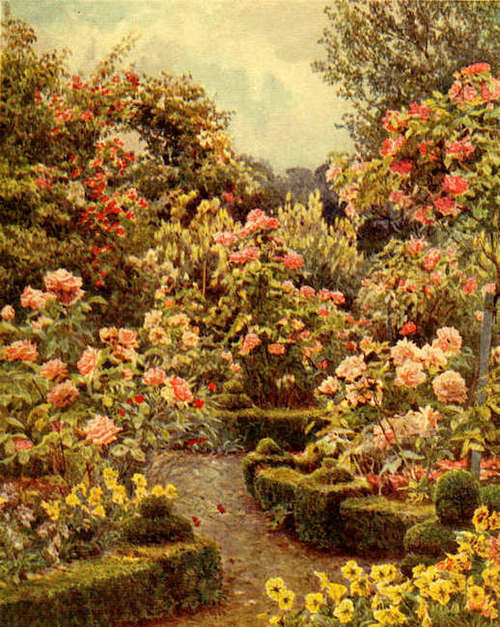
‘EVERYWHERE ARE ROSES, ROSES’
Then she would revert to her own tongue, in its paraphrase of the pagan song the Compagnacci used to troll in the days of Savonarola, when they wanted to protest against the austerity of his followers and the Burning of the Vanities.
‘Every wall is white with roses, Linnets pair in every tree; Brim your beakers, twine your posies, Kiss and quaff ere Springtime closes; Bloom and beauty quickly flee.’
If we drove down to Florence, we drove along roads that were avenues of roses; and, in the Fair City itself, we forget to look at palace, or façade, or bridge, absorbed in gazing on the white and yellow Banksias that hung in bunches and clusters over intramural garden-walls. But, as the year expanded and deepened in beauty, we grew more and more unwilling to stir from the enchanting surroundings of the villa itself, unless it were to wander in other poderi and among other vineyards, or to make expeditions that took us uninterruptedly through a world of radiant newness. Lamia did not now inquire how we proposed to employ ourselves, since being alive was in itself occupation enough. Lest, however, as she said, Veronica’s conscience should prick her for so much time passed in the mere delight of doing nothing, she read us the following passage written by Lorenzo de’ Medici, and which she said she intended to recite to a larger audience whenever she delivered those lectures in the Sala Dante.
‘What can be more worthy of desire to a well-regulated mind than the enjoyment of leisure with dignity? That is what all good men wish to attain, but what great men alone accomplish. In the progress of public affairs we may indeed be allowed to look forward to a period of rest; but no repose should totally seclude us from attention to the concerns of our country. I cannot deny that the path it has been my lot to tread has been arduous and rugged, full of danger, and beset with treachery; but I console myself with the thought of having contributed to the welfare of the State, the prosperity of which now rivals that of any other, however flourishing. Neither have I been inattentive to the interests and advancement of my family, having always proposed for my imitation the example of my grandfather Cosimo, who watched over his public and his private concerns with equal vigilance. Having now attained the object of my cares, I trust I may be allowed to enjoy the sweets of leisure, to share in the reputation of my fellow-citizens, and to exult in the glory of my native city.’
‘The passage is very interesting,’ said the Poet, ‘and serves to strengthen one’s impression of the sanity and completeness of Lorenzo’s talents. But is it not also another contribution to the vanity of human wishes and the fatuity of human self-complacency? I do not think Lorenzo ever attained to that enjoyment of dignity with leisure of which he speaks; and assuredly he had not long been dead before the glory of his native city, in the sense in which he used the phrase, passed away.‘
‘If one is to believe Politian,’ I said, ‘either the famous death-bed colloquy with Savonarola never took place, or it left but little impression on the dying man.’
‘That is a story,’ said the Poet, ‘one would part with unwillingly. But what is it that Politian says?’
‘That to judge by Lorenzo’s behaviour, and that of his attendants, when he was dying, you would have thought it was they who momentarily expected that fate, and he alone that was exempt from it.‘
‘There is no tomb nor inscription, is there,’ asked Lamia, ‘to mark the place that received his ashes, while his unworthier successors have a sumptuous monument designed by Michelangelo, whom in the budding days of his genius Lorenzo used to place, out of respect for his talent, above his own sons at table?’
‘I suppose,’ said Veronica, ‘he was paid for the monument he executed, and could not execute the one the cost of which there was no one to defray. But do not let us forget that what he felt concerning the contrast between the earlier and the later Medici is for ever embodied in his famous quatrain. Repeat it to us, Lamia.’
‘With pleasure, if I can.‘
‘Grato m’ è il sonno, e più l’ esser di sasso, Mentre che il danno e la vergogna dura. Non veder, non sentir, m’ è gran ventura: Però, non mi destar. Deh! parla basso.‘
‘How would one translate it?’
‘Translation is a difficult craft,’ said the Poet; ‘but, after visiting San Lorenzo again the other day, I could not resist trying to render those noble lines into our own tongue.
‘Nay, let me sleep, or, best, be stone or steel, While still endures this infamy of woe. My one sole bliss is nor to see nor feel: So, wake me not; and, lest you should, speak low.’
‘How utterly out of place,’ said Lamia, ‘a character like Michelangelo seems in Florentine history! whereas Lorenzo is its very type and representative.’
‘Do you not forget,’ said Veronica, ‘that perhaps the three most austere human figures known to us were Florentines, either by birth or by adoption: Michelangelo, Dante, and Savonarola.’
‘That only makes it all the more strange,’ I said.
‘But why?’ said the Poet. ‘Have we not, in these days, succumbed too readily to the notion that we are the creatures of our surroundings, and what is called our habitat? And is not that theory a mere ex-post-facto explanation that explains nothing? Who would ever have thought of predicting that any of the three great Puritans you have named would be associated with Florence, and the greatest of the three be born and bred in the very heart of her? Must we not look elsewhere for the explanation?’
‘Know, Nature, like the cuckoo, laughs at law, Placing her eggs in whatso nest she will; And when, at callow-time, you think to find The sparrow’s stationary chirp, lo! bursts Voyaging voice to glorify the Spring.‘
‘In the same way characters, austere or the reverse, make their appearance in the most unlikely places. We hear too much, I think, of the Spirit of the Age. Shall we not rather believe that the Age is what great Spirits make it?’
‘There,’ said Veronica, ‘do you not press your own theory too far? Without for one moment denying that the sudden appearance of great characters, or the place where they appear, is not to be foretold, one can hardly help feeling that Dante, Savonarola, and Michelangelo, in consequence of something adverse in the Florentine character, did not succeed in making Florence what they would fain have made her.’
‘Truly great characters,’ said Lamia, ‘always fail. Only second-rate people succeed. For my part I am very glad of it, for nothing is so disappointing as failure,—except success.’
‘There is a good deal in what you say,’ I was rather surprised to hear the Poet reply. ‘But perhaps we have all, and myself most of all, drifted into a vein of exaggeration. I was betrayed into it by the excessive claim which it seems to me many nowadays advance for Science, as compared with other sources of instruction and helps to life. Our debt to Science is great. At the same time, it has its limits, and I cannot think it is the greatest of our obligations. Do you remember that profound saying of Pascal, “La science des choses extérieures ne me consolera pas de l’ignorance de la morale au temps d’affliction, mais la science des mœurs me consolera toujours de l’ignorance des sciences extérieures”? Such a line, for instance, as that of Shakespeare,
“In Nature there’s no blemish but the mind,”
is more deeply and enduringly helpful than steam-engines, electric lights, or anæsthetics. One can, in case of necessity, dispense with tramways and telephones; but we cannot dispense with right thinking and right feeling. The material discoveries of the Age do it much honour; but man’s triumph over matter is most nobly displayed when he triumphs over the matter of which he is himself composed; when he ignores physical pain, and tramples on his non-spiritual passions. Science is the language of the Intellect, Literature of the Soul; and Poetry, the highest expression of Literature, does for language, and sometimes for life, what the Soul does for the body, and what this glorious Italian sun does for mountain and plain: it spiritualises matter. Let me add, lest I should seem too partial to the particular art I practise so imperfectly, that this is true of all imaginative Art; and, far from fearing lest Science should sap and supersede it, I trust and believe that Art will ever remain its complement, and, where necessary, its corrective.‘
‘Do you consider Italians,’ asked Lamia, ‘artistic or scientific, material or spiritual?’
‘They are both, surely,’ he replied. ‘But, if we took the modern Florentine as the Italian type, I fear we would have to reply they are rather too prone to worship material science. The artistic faculty in them seems almost extinct, save for purposes of imitation; and, even when they imitate the art of the past, they do so without any discrimination between the good and the bad. But in railways, telegraphs, telephones, tramways, they take inexhaustible delight. They have disfigured much of Florence, and most of Rome, in their determination not to lag behind in the general march of what is termed material progress.’
‘Is it not,’ suggested Veronica, ‘that they are essentially a practical race? When the world first took to commerce, the Florentines became great merchants and great bankers. When Popes and Princes posed as patrons of architecture, sculpture and painting, they produced palaces, statues, and pictures.’
‘Just so,’ said Lamia; ‘and now that the whole world has taken to travelling, Representative Institutions, and Music Halls, they have Circular Tours and a popular Parliament, both of which they work exceedingly badly, and a Caffè Savonarola Spettacolo Diverso, a piece of profanation for which I confess I should like to smack them.’
‘There is a good deal of vulgarity,’ I ventured to plead, ‘in modern life, and in compliance with the theory you have all been pressing, they are vulgar accordingly. But would it not be more indulgent, and equally true, to say that Italy is the one country, and the Italians are the one race, whose vitality is inexhaustible? They have been well before the world, if you will pardon that expression, for more than two thousand five hundred years; and, during all that period, they have never altogether dropped out of sight. Neither do they now appear in the least disposed to retire into private life, or to preserve their ruins, however much some of us would like them to do so, for the satisfaction of our romantic feelings. Who would have believed, asked Saint Jerome fifteen hundred years ago, that Rome would ever be sunk so low that, at the very seat of its Empire, it would be reduced to fight, not for glory, but for self-preservation. Yet what do we see to-day? Rome, not only safe against foreign assault, but, with the aid of railways and Maxim guns, meditating new triumphs and new glories.’
‘That,’ said the Poet, and I felt much flattered by his approval, ‘is the more generous, and therefore the more just way of putting it. The Italians have a great Past, which they refuse to forget. It still continues to animate their ambition, and forbids them to rest satisfied with that dolce far niente with which they once were reproached. When the period of the Renaissance came to an end, Italy might have seemed to say, in the words of Nero, Qualis artifex pereo, and to perish most artistically. But Italy was not dead, as she has shown so clearly during the last thirty years. One’s only regret is that the existing type of national greatness is so costly, that Italians have to pay a desperately heavy price for refusing to exist without it.‘
‘People,’ said Lamia, ‘frequently complain of the excessive loads Italian carters expect their horses and their mules to draw. But the whole of Italy seems to me to be suffering from the same infliction.’
‘I fear,’ observed Veronica, ‘there is much truth in what you say. Only yesterday I remonstrated with the driver of the carriage I had hired to bring me back to the Villa, because his horse seemed in a shockingly poor condition. His answer was, “Campa come me,—he fares as I do. When I have plenty, he has plenty. When I have little, there is little for him also. When there are more forestieri, he will have more oats.”‘
‘Let us have a carriage apiece every afternoon,’ said Lamia, ‘and do what we all shall hate, drive round and round the Cascine from five to seven. Only, in that case, I must have that new gown.’
‘A firefly! A firefly!’
It was Veronica, invariably the most observant of us, whose voice called to us to welcome the fairy visitor, whose arrival is as delightful and momentous an event in Italy as the wing of the first swallow, the call of the first cuckoo, or the note of the first nightingale, in England. We were all on the alert in a moment, calling in return:
‘Where? Where?’
It was a single, solitary firefly, for one may say of fireflies as of primroses:
First you come by ones and ones, Lastly in battalions,
and it moved and twinkled in the deepening twilight, among the olive-trees, a miniature and terrestrial planet, having no fixed orbit. I need scarcely say that this was some days before Pasqua delle Rose, though Whitsuntide happened to be an early one; and, the following night, we saw three, and, the night after, seven. Then, for May can be capricious in Tuscany as elsewhere, the weather was not propitious for them. But, by the time the moon was nearly at full, they were plenteous as stars in the Milky Way; and while they flitted and glistened among the darkening leaves, the nightingales rejoiced and enlivened each other with the song that an ancient story and inherited association have transformed for us into a strain of imaginary sadness. Life offers no more enchanting combination of sensations than fall to one’s lot on a warm Italian night in May, when moonlight, fireflies, and nightingales weave their concerted charm; and, night after night, we repaired to the same antique marble seat, where we liked to think Lorenzo and his associates had often sat, in front of the same dark silent cypresses, and drank in the same sweet, grave, harmonious delights. Perhaps you think us a company of selfish Hedonists, wholly given up to pleasurable sensations, poor weak copies of our Pagan Renaissance predecessors on the self-same spot? Whether that be true or not of some of us, I will not undertake to say. But certainly it is not true of Veronica, nor yet, I think, of Lamia. Indeed, speaking generally, I think one ought to entertain one’s friends with a record of one’s happiness rather than with a recital of one’s woes; but it does not follow, does it, that there is no pathetic minor in one’s life because one is not always sounding it? Indeed, amid all the enchantments of that Italian season when Spring and Summer are indistinguishable, we had been conscious of the shadow of pain which is cast by the surely approaching extinction of a young life in one’s own immediate precincts; and the shadow was all the darker because the season was so bright. Ilaria, the youngest and comeliest of the daughters of our contadini, whose acquaintance you perhaps remember our first making, had, we were assured, till within a twelvemonth ago, more than justified her pretty name by the joyousness of her ways. But there was a canker in the bud, which thus was destined never to open fully to the meridian of life; and, shortly after our arrival, her figure was no longer seen among the olives, or her voice heard among the vines. Veronica was much troubled by the utter lack of creature comforts in the spacious casa colonica, or farmhouse, where Ilaria was patiently awaiting the end, though in reality their absence was only part of that rudimentary simplicity of existence which is universal among a people untainted by Northern ideas of luxury. She and Lamia were unremitting in their visits, their nursing, and their solicitude. But these proved unavailing; and Pasqua delle Rose had to spare some of its luxuriant blooms for the grave of poor Ilaria. In the simple rustic household where she had left a vacant place, we liked to think that, in the daytime at least, the continual demands of Nature, in her busiest and most growing season, on the energy and co-operation of Man, diverted their thoughts somewhat from the missing figure; but, when we met and wished them good-day in the podere, tying the vines, training the pomi-d’oro, or cutting the sweet green fodder, that smile of which I once spoke as invariably accompanying their salutations for awhile vanished from their faces, and at nightfall we knew they were brought into undistracted consciousness of their bereavement. We grieved for them, and felt, moreover, a separate grief of our own; and neither the luminous May moon, nor the fairy-flitting fireflies, nor the silvery fluting of the nightingale, could wean us from the gravity of our thoughts. Even the purest and most generous sympathy borrows something of its tenderness, I suppose, from the knowledge that we are one and all subject to the dispensation of grief, and that those who console to-day may themselves need to be consoled to-morrow; and this is peculiarly so with the advent of the shadow of death, from which not even the strongest nor the most sanguine can hope to escape. Thus, without saying it, we were all, I suspect, musing on our common mortality, and thinking how the continuance of the deepest and dearest of our joys depends on the favour and forbearance of Heaven.
But the Poet has a theory, which we have all more or less adopted, and which he generally expresses by the words, ‘Cheerfulness is the most serviceable form of human charity’; and he never, if he can prevent it, permits us to linger over-long in the fruitless gloom of sentimental sorrow. I think that was why, on the fourth evening after we had strewn the roses on Ilaria’s grave, he recited to us, uninvited,—an unusual thing with him,—the following consolatory lines:—
WHEN I AM GONE
When I am gone, I pray you shed No tears upon the grassy bed Where that which you have loved is laid Under the wind-warped yew-tree’s shade. And let no sombre pomp prepare My unreturning journey there, Nor wailing words nor dirges deep Disturb the quiet of my sleep; But tender maidens, robed in white, Who have not yet forgotten quite The love I sought, the love I gave, Be the sole mourners round my grave. And neither then, nor after, raise The bust of pride, the slab of praise, To him who, having sinned and striven, Now only asks to be forgiven, That he is gone. When I am gone, you must not deem That I am severed, as I seem, From all that still enchains you here, Throughout the long revolving year. When, as to Winter’s barren shore The tides of Spring return once more, And, wakened by their flashing showers, The woodland foams afresh with flowers, You sally forth and ramble wide, I shall walk silent at your side, Shall watch your mirth, shall catch your smile, Shall wander with you all the while, And, as in many a bygone Spring, Hear cuckoo call and ousel sing. And, when you homeward wend, along A land all blithe with bleat and song, Where lambs that skip and larks that soar Make this old world seem young once more, And with the wildwood flowers that fill Your April laps deck shelf and sill, I shall be there to guide your hand, And you will surely understand I am not gone. When Summer leans on Autumn’s arm, And warm round grange and red-roofed farm Is piled the wain and thatched the stack, And swallows troop and fieldfares pack; When round rough trunk and knotted root Lies thick the freshly-fallen fruit, And ‘mong the orchard aisles you muse On what we gain, on what we lose, Now vernal cares no more annoy, And wisdom takes the place of joy, I shall be there, as in past years, To share your steps, to dry your tears, To note how Autumn days have brought Feelings mature and mellow thought, The fruitful grief for others’ smart, The ripeness of a human heart. And, when the winds wax rude and loud, And Winter weaves the stark year’s shroud, As round the flickering household blaze You sit and talk of vanished days, Of parent, friend, no longer nigh, And loves that in the churchyard lie, And lips grow weak, and lids grow wet, Then, then, I shall be with you yet, Though I seem gone.
As the time drew nearer and nearer for leaving the Tuscan home where we had been so happy, Veronica began to manifest a certain solicitude, in consequence of our leisurely and unsystematic ways, lest we should have omitted to make Lamia acquainted with some cloister or bas-relief, some bit of quaint street architecture, or some hillside sanctuary, ignorance whereof might expose her to the reproach of a want of intelligent curiosity. But we found the omissions were few and unimportant, and this left us all the more free, during the now brief and regretful remainder of our sojourn, to pay farewell visits to the frescoes and altar-pieces, the monuments and statues, that had most engaged her affections. Where Giotto worked, where Savonarola preached, where Fra Angelico painted and prayed, where Michelangelo fought, where Dante sate, where Donatello slept, in death as in life not severed from his beloved Medicean patron, these and kindred spots had to be seen just once more. When one quits a place where one has been residing for some little time, one says good-bye to one’s friends; and these were, one and all, very dear friends to us, and we could not but take of them affectionate farewell. The Luca della Robbia in the Ospedale degli Innocenti, the Perugino in the Maddalena dei Pazzi, the Fountain by Verrocchio in the cortile of the Palazzo Vecchio, the recumbent Bishop in San Miniato, the Mino da Fiesole in the Badia, the bronze David in the Bargello;—but, unless I have a care, I shall fall into the fault I have been trying to avoid, of troubling you with a catalogue of familiar names. There were favourite spots, too, to drive to once again, happily too numerous to cite, and too lovely for any one to be so foolish as to attempt to describe. Exception, however, shall be made of one of these, for I fancy it is but little known, and therefore has not become hackneyed. Accident made us acquainted with it, and design had often and often taken us there again. It was in a podere some two miles or so outside the Porta San Niccolò, whence, over a wall lined with irises, one looks down the river immediately in front of one straight away to Florence, but sees nothing there save, through the feathery foliage of distant poplars, the cupola of the Duomo, Giotto’s campanile, and the Tower of the Palazzo Vecchio. Beyond, far beyond, are visible, on propitious days, the majestic peaks of the Carrara Mountains, and, a little farther towards the north, the snowy summits of the Apennines above Pistoia. It was a place that fascinated us, and we returned to it again and again. One evening, when the light was even exceptionally beautiful, but the air a little chill, and we had therefore, for Lamia’s sake, to curtail our enjoyment of it, I remember her exclaiming:
‘O, do let us stay. Even if it were deadly, it would be worth dying for. It may never be so beautiful again.’
That expresses a feeling which, I think, one often has in Italy. It is the intense beauty of certain moments, certain views, certain sunsets, that makes one declare one never before has seen anything so lovely, and dread lest on such loveliness one never more may gaze. A foolish fear; for to-morrow renews the radiance and raptures of to-day.
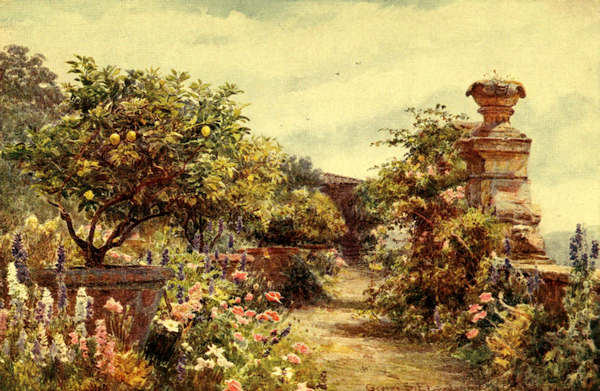
OUR TUSCAN GARDEN
But the closing hours of the now lengthening days were always spent in the loggia, the garden, or the podere of our Villa; and Veronica, who, so English at home, was here the most Italian of us all, would, whenever the weather permitted, arrange for us to have our evening meal al fresco, in the society of the roses and the nightingales. Lamia had, as you may suppose, picked up many a Tuscan stornello and canzone, and would sing them to us, to the accompaniment of her guitar; and, between song and song, discourse would run on all the beauty and the wonders we had seen that day.
‘What is it,’ said Lamia, ‘that, more than anything else, constitutes the charm of Italy?’
‘Ancientness,’ said the Poet, ‘and an ancientness that never grows old. For Italy, notwithstanding its centuries of history, art, warfare, misfortune, remains perennially young. More than once, the rash have said, “Italy is dead.” Italy never dies. She has the gift of perpetual life; but, with all her indestructible freshness, she carries about her the dignity of bygone times and the majesty of tradition. The new is always more or less vulgar. Refinement is the work of time. You remember Aristotle’s definition of Aristocracy, Ancient riches. Italy has ancient riches, the riches of law, religion, poetry, and the arts, long established, and she has therefore what is most precious in aristocracy. She has ancient speech and ancient manners. Her mountains are necessarily ancient, the Soracte of Horace, the Alps of Hannibal. But her plains and valleys are equally so, for she has an ancient agriculture. We are sitting at this moment surrounded by a rural cultivation that is described with absolute accuracy in the Georgics, and again by Politian in his Rusticus, written on this very spot, and that has not changed since the days of Cincinnatus. Listen to that fellow singing among the olives. Virgil has described him,—Canit fundator ad auras,—and might be his contemporary. It is this far-backness, if I may coin a word to express my meaning, that sheds a glamour over everything in Italy, a far-backness, however, that endures and persists, that is with us and around us, and compels us to bend with reverence before it, as we must ever do before the parent Past we still have with us. In proportion as Italy parts with its Past, Italy will lose its charm. The temptation to do so in this age is great, and I fear it is not being sufficiently resisted.
‘Dear Poet,’ said Lamia, ‘will you forgive me if I object that I have sometimes been told, though I am sure most inaccurately, that I, for instance, am charming; and yet I am not ancient.’
‘Dear Lamia,’ he replied, ‘you are very ancient, and are under deep obligation to ancestors you never saw, and probably never heard of; and I hope you will be yet more charming for your visit to this old and captivating land. For my part, I always seem to miss something in people who have not fallen under its spell. You have succumbed to it entirely. I shall never weary, and I hope I shall never weary you, in extolling the power of the Past. Would the descant of those nightingales have the same charm for us, if they had not been singing thus for myriads of Mays? Spring is so irresistibly charming because it recalls and renews the Aprils that are gone. Time consecrates and confirms. The deeper our roots, the loftier our thoughts, and the sounder our hearts. I remember a great poet of this age saying to me that he could not see that, as some one had affirmed, he in his writings so much resembled Keats. “You are Keats’s own child,” I replied, “and are of noble parentage.” But indeed every great poet is the lineal descendant of every other great poet. At any given moment, what exercises most influence is, not the present, but the Past. I ventured, the other day, to observe that there are only two sorts of people, the noble and the ignoble. Dear Lamia, let us try to belong to the noble, since every one may be a member of that untitled aristocracy; so that, when we ourselves are, as some of us are gradually becoming, portions of the Past, we may influence beneficently an unborn Future.‘
‘There never was anything more untrue,’ said Lamia, who was quick to surmise the more personal meaning that underlay those closing words, ‘than the saying “On n’est jeune qu’une fois.” I have been old several times; but I always get young again.‘ ‘And you will do so very often, I dare say, for many years to come. Moreover, I like to think there is the youth of one’s youth, the youth of one’s manhood, and, finally, the youth of one’s old age. But, when one has reached this last, man’s capacity for rejuvenescence is exhausted.‘
Lamia rose from her seat, placed herself close beside him, and taking his hand, replied:
‘Dear Poet, even in my youngest moments, compared with you I am in my dotage.’ And I would at that moment have been any age you will, to be treated thus tenderly.
We made many expeditions of which I have not told you, just as we visited, again and again, churches, palaces, and dismantled monasteries I have not named. But Lamia particularly wished to see a Convent,—a Convent, that is to say, in the Italian signification, of monks, not disestablished, but allowed still to survive, with a certain number of its inmates, as a national monument. She had heard me speak of the attractive hospitality I had enjoyed in them in days gone by; and we selected for our monastic excursion a Convent in the Apennines not too remote from Florence, and the drive to which would take us through Gavinana, a spot none of us had ever visited. Does the word Gavinana suggest anything to you? Probably not; yet it was there that the liberties of Florence received their final extinction. Indeed I fancy that, of the thousands of people who nowadays visit the Tuscan Capital, many are unaware that, in the earlier part of the sixteenth century, it underwent a Siege whose incidents strongly resemble many that occurred during the siege of another Capital nearly thirty years ago. Only Florence is much more beautiful than Paris, and less suggestive of the horrors of war. Yet the Siege of Florence lasted ten months, or more than twice as long as that of Paris; its inhabitants underwent far greater hardships, and displayed much greater heroism. We might have been a little sceptical on those points had Florentine historians been our only authority for them. But the copious and impartial Reports of the Venetian Ambassadors who were in the Fair City at the time render doubt impossible, and establish the courage, pertinacity, and patience of the besieged against Emperor and Pope. All the villas within a certain radius of Florence were rased to the ground, lest they should furnish help and corn to the besiegers; and all its silver plate, both sacred and profane, was melted down to replenish the coffers of the Republic. It is the noblest, perhaps it is the one perfectly noble, incident in the story of Florence; and I sometimes have thought, and the Poet agrees with me, that Francesco Ferruccio, whose statue is among that series of famous Florentines outside the Uffizi, is its most heroic and effective figure. He would in all probability have saved Florence, had the timidity of some of his fellow-countrymen, and the treachery of others, allowed him; for he proposed to create a diversion by marching on Rome, and menacing it with another sack such as had recently taken place under the Constable Bourbon. His project was overruled, and he died fighting in the piazza at Gavinana; his only consolation, in his last moments, being that the Leader of the Imperial Army, the Prince of Orange, was also slain. ‘The ill-omened spot,’ says the historian of the Commonwealth of Florence, ‘lies within sight of the traveller as he passes, about a mile to the right of it, on his way from Pistoia to Modena. And not a peasant of those mountains, though ignorant as his yoke of dove-coloured oxen of all the history of his country from that day to this, not a goat-herd tending his flock by the roadside, not a grimy muleteer bringing down his string of charcoal-laden beasts from the forests of the Upper Apennine, will be unable to point out to the stranger the field on which, nearly four hundred years ago, Tuscan liberty was fought for and lost.’
Drinking our coffee, for which we paid an incredibly small sum, under the plane trees of the square where Ferruccio and Florence fell, we again discoursed on the arbitrary hazards of Time that made the City justly called Fair, and to which one is often disposed to apply what Ovid represents Helen as saying to her Grecian paramour:—
‘Apta magis Veneri quam sunt tua corpora Marti: Bella gerant alii; tu, Paris, semper ama,’
a place of arms, a city woeful and intrepid, the champion of freedom against Sceptre and Tiara.
‘Surely,’ said Lamia, ‘Dante would have forgiven Florence could he have lived to see that day. The times were grim, and the deeds austere enough even for one “who had seen Hell.” Would you not rather,‘ she continued, turning to the Poet, ‘have it said of you that you had seen Heaven?’
‘Remember,’ said Veronica, ‘Dante saw both.’
The twilight was deepening into dusk before we reached the Convent whither we were bound, for our driver had taken a wrong turning during the last few miles of our journey; and Lamia was quick to note, as characteristic of Italy, that, when inquiry put us on the right one, the directions given were, not as in England, according to signposts, but to little tabernacles or shrines at the parting of the ways: now of the Annunciation, now of Saint Agatha or Saint Barbara, now of Saint Francis of Assisi receiving the Stigmata. I am afraid her curiosity was more piqued than satisfied when we reached our bourne; for, though we were most piously welcomed, Veronica and she were not allowed to violate that portion of the Convent which is defended from female gaze by the word Clausura; and she not unnaturally, though quite inaccurately, imagined that she was not shown what was most worth seeing. The Poet and I were allotted sleeping-cells within the Monastery, but our companions, of course, had to pass the night in the Foresteria, or strangers’ quarter, outside, in charge of a lay-brother, and it was there we all had our truly ascetic supper. But the guests of Sallust never enjoyed one more; for our host, the Prior, was an ideal monk, majestic yet saintly of aspect, with long flowing beard, silky and snowy, measured manners, and paternally caressing voice. The Rules of his Order forbid any instrumental accompaniment either at Mass or the other Sacred Offices of the twenty-four hours; but he had always loved music for its own sake, and he had made for himself a primitive sort of spinette, on which he said he would play to us, for our further entertainment, when the lay-brother who was waiting on us had retired, and all the Confraternity were in their first deep sleep. The performance, like the instrument, was touching in its simplicity; and Veronica, wishing to make him some return, said that Lamia, too, was fond of music, and would, she was quite sure, sing to him if he cared to hear her. Even in the Foresteria, I fear, there was a touch of the profane in the suggestion; but he evidently could not resist the temptation thus presented to him, and begged Lamia to sing, but with not too loud and penetrating a voice. She at once broke into the wild and melancholy chant the Italian recruits used to sing in the days of Napoleon, when they were dragged from their homes to face the snows of Russia:—
‘Partir, partir bisogna, Dove commanderà il mio Sovrano.’
But Lamia got no further than those two lines; for our venerable host suddenly exclaimed, the colour mounting to his face, and the tears brimming in his eyes:
‘Stop! stop! Mi monta la fantasia.’ And he went on to tell us how he had not heard that strain for five-and-forty years, and that it used to be sung by one whose caprice had caused him to abandon the world and assume the habit of Saint Bruno.
On our journey homeward, the following morning, Lamia asked:
‘How would you translate the words the dear old Prior used last night, Mi monta la fantasia?’
‘They are not easily rendered into another tongue,’ said Veronica, ‘for they mean so much in the original. But when he said, “the fantasy mounts and seizes hold of me,” he doubtless meant that your voice suddenly made him feel all he had felt five-and-forty years ago.‘
‘O, how delightful!’ said Lamia. ‘Then I forced the Clausura, after all.’
‘It is a pity,’ said Veronica, whose sane nature and active temperament render her a little intolerant of monasticism in any form, ‘that you could not break it down altogether, and so make an end of it.’
‘And yet,’ said the Poet, who has rather more indulgence for the weaknesses of human nature, perhaps because he shares them more, ‘I doubt if we have done with the motives, many and various, that once engendered and still foster monasticism. The strong, the valiant, the sensible, require no shelter from the rough usage of the world. But, as in the days of savage militarism, so in these of an almost equally pitiless industrialism, terror, timidity, indolence, mysticism, love of meditation, longing for silence, and a certain passive piety, make men fly the market-place for the cloister. When Dante, exiled from Florence, appeared at the Convent in the Apennines, and was asked by the monks who he might be, did he not answer, “One who is in quest of peace”? There is no second Dante, but there are many exiles in this modern world, and I fear their number every day increases. As the struggle for existence waxes fiercer and fiercer, I think I hear them, too, exclaiming, Dona nobis pacem.‘
‘Listening first to Veronica,’ said Lamia, ‘and then to you, I am forced to the conclusion that many things are intolerable which we cannot do without. Yet I confess a Convent of Nuns seems more natural than a Confraternity of Monks.’
‘More natural, perhaps,’ said the Poet, ‘but hardly so necessary. For, even in the very heart of the world, every good woman is more or less nunlike, by virtue of her purity, her reserve——’
‘And, I suppose,’ interrupted Lamia, ‘her obedience?’
Nothing disconcerted, he re-echoed the words: ‘And her obedience.’
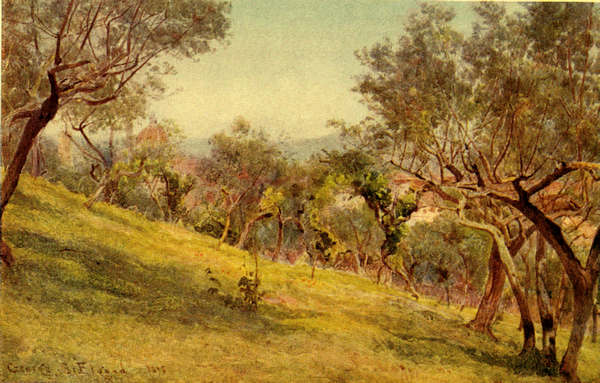
THROUGH THE OLIVES, FLORENCE
‘Have you not, dear,’ asked Veronica, ‘confuted yourself by anticipation? It was a man, not a woman, was it not, that took leave of the Prior, who would fain have detained him, with the words—
‘Father, farewell! Be not distressed, And take my vow, ere I depart, To found a Convent in my breast, And keep a cloister in my heart.’
‘One is constantly confuting oneself,’ he replied.
‘How should it be otherwise?’ said Lamia. ‘Verse being the expression, not of the convictions, but of the emotions, poets cannot be taxed with inconsistency, though they contradict themselves a thousand times.’
‘Thank you, dear Lamia,’ he said. ‘You are the most ingenious of apologists. If ever I have to defend myself, you shall be my Portia.’
But the last day, the last night, and then the very morning of departure at length arrived, when Florence, with its gorgeous towers and cloud-capped palaces, was, for a time at least, to dissolve like the baseless fabric of a vision. Perfetta was in tears; Ippolito had a mazzetto of carnations for us all; the contadini desisted from their work to cluster in the garden in order to see us off with many gracious words and expressions of hope that next year we should return; and the entire household manifested by melancholy smiles their sorrow at our going. Pasquale, the cameriere, had come into my room early that morning with a doleful face, and, in reply to a renewed inquiry whether we could not help him to find another place, assured me that he would not care to serve anybody else; and he launched into touching eulogies of Veronica’s considerateness and universal capacity, of Lamia’s irresistible charm, of the genius of the Poet,—Il Gran Poeta, he called him, though utterly ignorant, I need scarcely say, of the very language in which that retiring person writes,—and of the thousand-and-one virtues which, finally, he ascribed to myself. If you think that he was insincere, because he in some degree exaggerated, I can assure you that you are mistaken. He believed it all.
‘No, no,’ he said. ‘Ringrazio tanto la sua signoria, but I could not serve any one else. Riprenderò il mio antico mestiere’ (I will return to my old calling).
‘And what may that be?’ I asked.
‘Do you not know?’ he said. ‘Io son comico’ (I am an actor).
The dear people we were leaving are all of them so much more or less histrionic, that Pasquale’s occasionally fine gestures had never struck me as singular or exceptional.
‘Sì, Signore, son comico io,’ he went on, ‘I am an actor, and have played at Lucca, at Fiesole, at Pisa, yes and at Siena. Once I was in the same cast with the stupendous tragedian, Salvini.’
‘Yes, a great actor, indeed,’ I said. ‘I once saw him in an Italian version of our English drama Othello.’
He was in his early morning dress, wearing no coat nor jacket, and having in his turned-up white apron my boot-trees, which he was just about to pack. But he drew himself up with much dignity, and, with the one disengaged hand suiting the action to the word, he said:
‘I, too, have played the part of Otello.’ And, without more ado, he recited, in his sonorous language, the lines:
Farewell the tranquil mind! farewell content! Farewell the plumed troop, and the big wars; That make ambition virtue! O, farewell!
And the earnestness with which he recited that pathetic passage completely submerged the sense of humour that was beginning to rise in me.
As we entered Florence, so did we quit it, leisurely, and without the disenchanting scenes of a modern railway station. We were to drive across the Apennines to Bologna, and, as we reached the last flower-stall near the Gate that looks thitherward, Lamia expressed a wish for one more flower. It was a lovely rose, the only one on a plant that occupied among the others the place of honour.
‘It is a pity to spoil the plant,’ said the woman, who was well known to us, for we had often halted to make purchases from her. ‘Will not another serve equally well?’
You will easily surmise Lamia’s reply. No rose in the world but that one would have satisfied her desire.
‘Come vuole, said the woman (‘be it as you wish’), and she severed the fair flower from its stalk.
‘How much is it?’ I asked, eagerly availing myself of the opportunity to make dear Lamia a parting gift from the City of Flowers.
‘Don’t trouble about it,‘ said the woman, ‘you can pay some other time.’
‘But there will be no other time,’ said Lamia, ‘for we are going away for good and all.’
‘Dunque, non si paga. Addio, e buon viaggio! ‘was the reply. (‘In that case, you must not pay at all. Happy be your journey! Good-bye!’)
If people love their home, there is no wrong time for coming back to it; and, were it not for the delight of returning, I doubt if it would be wise, save under compulsion, ever to leave it. Tacitus asks, Who would quit Italy for Germany, were it not that Germany is his own country? Over English folk, at all worthy of their great descent, the name of England exercises a more enthralling spell even than that of Italy; and the Garden that I love is all the dearer to me because it is thoroughly English. But the moment for returning to it fell out most felicitously; and, gazing on the scene that awaited us, we were instantly weaned from all regret even for the sky and sunshine of Tuscany. Under the broad-trunked, wide-spreading Oak,—Veronica has christened this particular plot of ground the Oak Parlour,—Five O’Clock Tea was waiting for us, and once more we looked on one of those Urns which, I am told, have made the owner’s name a household word in many kindly hearts. I need not say again how happy we had been in our Tuscan villa, and I verily believe that Veronica would contrive to make us comfortable in the desert of Sahara. But it is idle to pretend that all we mean by the word ‘Home’ is to be had save in this, our own island; and there is all the difference in the world between Perfetta and the tearful cameriere who, I suppose, has now returned to his antico mestiere, and is smothering Desdemona before some provincial Tuscan audience, and the Northern handmaidens who, moulded by the genius of Veronica, perform with noiseless celerity every office that can minister to the grace of existence. Do not think me material if I say that that first Five O’Clock Tea in the Oak Parlour after our return was an event in our life; for its charm was compounded of many elements, into which entered the abiding influence of unluxurious domestic refinement. The green antiquity of the oak, the smooth verdure of the lawn, unattainable, I fear, by the services of a shepherd lass and her flock of nibbling sheep, the luxuriance and variety of the flowers, the view, under the oaken branches, of the Manor-House, white with roses from ground to gable, the snowy face of the tablecloth, the glow of the burnished urn, the brightness, the spotlessness, the seemliness of everything, all contributed to the welcome that attended us, and to the pleasure we received from it.
But something more awaited us than the renewal of old delights. Shortly before we started for our six months’ absence, we had decided, after much deliberation, to add, in a modest way, to the home that we had a thousand times declared, in our optimistic fashion, to be already ample for our needs; and the result was now before us. You may easily imagine our anxiety to discern if the decision had been wise or the reverse; for, though we had gone into the plan with a most competent architect to the utmost detail, and though Veronica had brought her practical and tasteful mind to bear upon window and overmantel, hinge and door-plate, moulding and lining-paper, there is always a danger lest instructions should have been misunderstood or imperfectly carried out, or that the instructions themselves were wholly or in part a mistake. We were prepared to be pleased, but also to criticise; but for fault-finding there was, in truth, no possible room. Animated by reverence for what already existed, we had bound architect and builder to certain well-defined lines and curves, prohibiting externally all originality save what is perhaps the best kind of it in these days, pious and humble reproduction of what is already recognised as beautiful. A room, which was originally spoken of as a billiard-room, and which for a brief while retained that designation, though all idea of having a billiard-table in it had been promptly abandoned, and which now is known as the Morning Room, because, as Lamia says, we nearly always sit there of an evening, a new boudoir for Veronica, who has at last a refuge of her own worthy of her beneficent labours, three new sleeping-chambers, and another staircase, composed the new quarter. And will you believe it?—it was already furnished; Veronica having made due preparations and given minute instructions for this end partly before our departure, and partly during our absence. Now, did she triumph over us in the matter of those various purchases in Florence that used to move our ignorant mirth; for everything she had acquired had been sent home in time to be unpacked and placed in the room and the position allotted to it. Thus, at every turn, we were reminded of the Fair City and the bewitching land we had so lately left, and of which, not to be ungrateful, we still talked affectionately even in the hours of our home-coming.
But Veronica had no monopoly of success in the swift adornment of our new wing. I, too, had a little triumph of my own, but, I need scarcely say, out-of-doors. I do not often sing my own praises, do I, preferring to extol the Poet and Veronica, who are more deserving of eulogy. But, on this occasion, I think I really did deserve the congratulations that were lavished on me. For, with a truly foreseeing mind, I had been growing on, to use a gardener’s phrase, a certain number of climbing roses, clematis, jessamine, and other creepers, and had given the strictest injunctions that they were to be planted against the new building the very instant the masons had finished it, and were to be fostered and trained with constant and unremitting attention; and, as they were then already robust in growth and vigorous at the root, they were well on their way up the new wing on our arrival. A legend has since grown up that I did not leave England at all, but remained on the spot with barrow, trug, and trowel, and that, fast as the work-people laid a course of stone or brick, I planted a creeper. But, as a fact, it happened as I have said.
As for the garden, the garden that the too kindly sympathy of others permits one to say we all love, I can only say I wish the whole of Italy could have seen it. The Tea Roses, more numerous and more beautiful than ever, seemed smilingly to say, ‘Has Tuscany roses to show more fair?’ Larkspurs, of every imaginable shade of blue, from azure to cerulean; lupines, white, purple, and yellow; foxgloves, snowy-white and without a freckle; seemed to challenge each other as to which would tower highest in the summer air. The Pæony Poppies, some purposely some accidentally sown, were a garden in themselves, fair but fugitive, yet making up by their number and infinite variety for the briefness of their existence. They were everywhere in the beds and borders, and, as it seemed, where they had chosen to be; there, by the right of supreme loveliness, and the Swan-neck Poppies, the Caucasian, and the Victoria Cross, rocked more humbly beside them. No other plant of such supreme beauty has so solid a stem and such imposing foliage for so fragile a flower; and this it is, I think, which mainly constitutes its fresh charm. Every one now loves flowers, and I have no need to weary you with a catalogue of those in the Garden that I Love. But I doubt if there be any perennial plant of real beauty and value that will grow in our latitude which is not to be found there; and I can say with truth, of every bed and border, that you could not see the ground for flowers. As for the winding turf walk, which perhaps you remember as the South Enclosure, it is not I who will say what it looked like when we returned. For one who has justly acquired honour, not only by the beauty of her own home, but by her charming pages concerning all that appertains to a garden, and who had visited it the day before our arrival, left a little line for Veronica, in which she generously said it was the loveliest she had ever seen. I should hesitate to repeat so flattering an opinion, were it not for some injustice to myself that followed. ‘As for the winding turf walk and its glow of bloom and colour on either side,’ said the kindly writer, ‘nowhere, I am sure, is there anything like it; and only the Poet could have conceived it.’ As if it was the Poet who had conceived it! It was I who,—but so it is in this unfair world, where everybody bows down before prestige. Lamia herself could not have been more partial or more unjust.
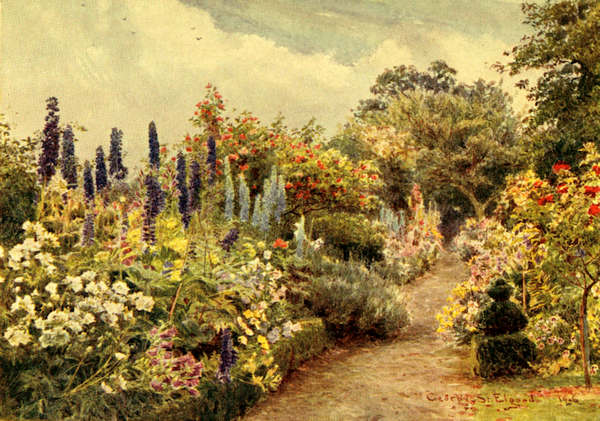
LARKSPURS
I made some observation of the kind to Veronica, imagining we were alone, and got for reply,—
‘My dear, you will never understand women.’
‘How is it possible,’ I asked, a little nettled by the implied rebuke, ‘when no two women are alike?’
‘No one woman is alike,’ said Lamia, suddenly emerging from a luxuriance of leaf and flower that had concealed her from view; and, though Veronica was there to disprove the universal application of her aphorism, I think she spoke from the very depths of her own inner consciousness.
Not even the novelty of the fresh wing, though we kept returning to it again and again in the course of that to us memorable evening, could keep us indoors. Lilac, hawthorn, and laburnum had of course flowered and faded, and the glory of the rhododendrons was fast passing away. But the air was fragrant with the newly-made but yet uncarted hay; the scent of the elder was wafted from the lane; the smell of sweet-briar, with its profusion of little pink rosebuds, was everywhere in the garden; and we kept stopping ever and again to inhale the penetrating perfume of the freshly-opened tassels of the lime. Longer and darker grew the shadows on the lawn, then gradually drew themselves in, and vanished. The Tea Roses, no longer languid from the heat of the long summer day, lifted their fair faces freshened with evening dew; the streaks of crimson that point the pathway of departed days gradually faded from the west, and the lingering love-song of the missel-thrush at length came to end, absorbed into the general silence. It was twilight still, but a twilight slowly succumbing to the Midsummer night, if night it could be called to which the darkness never wholly came. Elsewhere, on shrub and sward the deepening dusk brought its beneficent tribute of abounding moisture; but, under the manifold foliage of the Oak, the ground retained the dryness of noon. Under its protecting canopy therefore, as many a time before, satisfied and silent we sate; till Lamia, moved by the influence of the hour, once again liberated her fresh young voice, and wedded to notes of almost austere simplicity the no less simple measure of this Vesper Hymn.