C. N. & A. M. WILLIAMSON (continued 5)
Reading edition
His eyes began to sparkle with anger. I believe he would have liked to box my ears, and I know I could have boxed his.
"I thought English girls were brought up to be sensible," said he, "and amiable."
"I can't help what you thought," I answered, rudely, for I was getting desperate. "You've no right to keep me here like this, and it won't do you a bit of good, for if you stand there till we're both in our second childhood, I won't change my mind. You ought to know that now, Mr. Parker. Please let me go."
He didn't move.
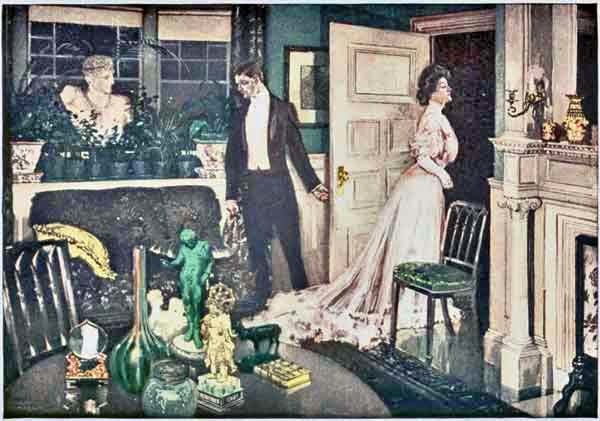
"If you don't, I'll scream at the top of my lungs," I said. And he must have seen that I meant it, for he flung open the door with a slam and I swept past him, with my nose in the air, trying to look like Mother.
"I swept past him with my nose in the air, trying to look like Mother"
I didn't see him again till it was time to go home. Then he drove back with Mrs. Ess Kay and me to The Moorings in the shut-up motor car, and didn't open his mouth once on the way--which was wonderful for him, and seemed somehow ominous.
I had been too angry and excited after that scene of ours to feel unhappy, or to worry much about what might come next, but that drive, short as it was, with Potter freezingly silent, and Mrs. Ess Kay alarmingly polite, made me feel that the end had come. I was sure she had been told by her brother what an obstinate, ungrateful girl I was, and I had a guilty sinking of the heart, as if I really had been both. There was no Sally to protect me now, no one to advise me what to do, and there was a big lump in my throat as I said good night and went to my own room.
I hadn't been there long when there came a knock at the door--the same determined kind of inexorable knock which Mother gives when I've been found out in something which she thinks it her duty to make me sorry for.
I'd locked the door, and would have liked to make some excuse not to open it; but it was Mrs. Ess Kay's door, and Mrs. Ess Kay's room, just as much as it was Mrs. Ess Kay's brother I had refused.
She sailed in all in black, like an executioner, though of course, executioners don't go down into history wearing chiffon trimmed with jet.
"My dear Betty," said she, subsiding into a large armchair, "I want to have a serious talk with you."
It would have been stupid pretending not to understand, so I just looked at her, and waited.
"I daresay, you can guess what it's about?" she went on.
"I suppose so," I said. "I'm very sorry about everything. But I can't help not being in love with Mr. Parker, can I?"
"I should have thought," said Mrs. Ess Kay, "that your Mother's daughter would have attached very little importance to being in love. Apparently she hasn't been as successful with you as with Lady Victoria. Believe me, Betty, there's nothing in it--nothing at all."
"In what?"
"In what you call 'being in love.' A girl fancies a man for his eyes, or his dancing, or because he is strong, and she thinks she's in love with him, but it's only a fancy which passes before she's been his wife for twelve months, and she wonders what she ever saw in him then. A year after you have been married to my brother, you will be very fond of him, and you will be one of the most important young women in America as well as in Europe. Oh, my dear, you will have to take him. Your Mother will never forgive you, if you don't. It was quite an understood thing between us, when she lent you to me, that if possible there was to be a match. Your beauty and name, and Potter's money. He's really a very good fellow--a temper, perhaps; but I wouldn't give much for a man without one, and like most Americans, he'll make a splendid husband."
"For someone," I murmured.
"For you, Betty. I assure you, I daren't tell the Duchess you've definitely refused Potter. You must be persuaded. Be engaged to him; let him follow you to England."
"If I did that, I should find myself being married off to him before I knew."
"Well, and if you did? It would be because you'd had the chance to change your mind."
I shook my head. "I must go home to England," I said, "but Mr. Parker mustn't follow me."
Mrs. Ess Kay's face hardened.
"I'm afraid if you go home after refusing Potter, you'll have a very poor welcome, my child. The Duchess has been kind enough to take me a little into her confidence. I don't think she would have sent you over with me, if she hadn't known something about Potter; and your sister's affairs aren't arranged yet. Oh, you needn't blush, and look so indignant. The Duchess didn't mind putting her difficulties in a letter, when I wrote her you weren't behaving quite satisfactorily, and you may take it from me that at present things stand like this: You must go back an engaged girl or else stay away until Lady Victoria is married."
If Mother were different, I should have hoped Mrs. Ess Kay was exaggerating; but as it was, I believed her, though I did my best to be high-eyebrowed and incredulous, till she remarked that I could see the Duchess's letter if I liked, though it might be rather embarrassing.
I was sure it would be, and preferred to take its contents on faith; but I was so miserable that I had to keep my eyes staring wide open to prevent the tears dropping down. I was tired, and forlorn, and homesick--for Vic and Stan, and the dear dogs and everything except Mother--and I felt such a horrible weakness creeping over me that I could even imagine myself by and by doing what they meant me to do. I thought the best thing was to gain a respite, lest Mrs. Ess Kay should drag some kind of a concession from me, which I would have to live up to, afterwards.
"I can't talk any more about it now," I said. "I believe what you say, but it only makes it worse for me, to think that Mother should have made what amounts to a kind of bargain with you. Maybe by to-morrow everything won't seem so dreadful."
She got up, with a relieved air. Perhaps even she hadn't been enjoying the conversation.
"Of course it won't," said she. "It won't seem dreadful at all. You've no idea how happy we're all going to be. Now, just you sleep well, and dream sweet dreams, and you'll wake up feeling a different girl. Maybe poor Potter hasn't been as tactful as he might be; that's because he's too much in love to be clever. But he has a lovely surprise for you to-morrow. Something connected with a certain finger of your left hand. I promise you that you'll like it; and now I'm going to leave you in peace for the night." I can't tell what savage deed I mightn't have been capable of doing if she had had the idea of kissing me; but she hadn't. She merely patted me on the shoulder, and went out, leaving me to stare aimlessly at the door after she had softly closed it.
XIII
ABOUT RUNNING AWAY
I don't know how long it was before the thought came to me that I would take Vivace and a handbag and run away to Sally; but anyway it was before it had occurred to me to sit down.
Sally said before she went away that I was to go to her if I felt like it, and Sally always means what she says. Now I felt like it so much that it seemed suddenly the only possible thing to do, so all I had to decide was the best way and the best time to do it.
As for the time, if I didn't escape before Mrs. Ess Kay and Potter formed a hollow square round me to pour their volleys into my heart in the morning, all that was prophetic in my soul said I would never escape, but would suffer great confusion and rout.
As for the way, it was more difficult to make up my mind, but the first thing was to see how much money I had in my exchequer--which happened to be a gold purse Sally had given me.
I hadn't spent much, and since coming over, dear old Stan had sent me another fifteen pounds, which he wrote was part of one night's winnings at bridge--unusual for him, if it's true, as Vic thinks that he continually loses. Altogether, I had nearly thirty pounds in hand, which seemed a lot, only I didn't know at all how much it would cost for Vivace and me to reach Sally in Chicago; and I couldn't tell until I had got irrevocably away from Mrs. Ess Kay and The Moorings.
By this time it was nearly two o'clock, and in a couple of hours it would be light. I must sneak out of the house with a dressing bag before any of the servants were stirring, and meanwhile I must pack up all my belongings except such things as Mrs. Ess Kay had given me--so that I could write and have my boxes sent on by and by.
As soon as I had realised that there wasn't a minute to throw away, the worst was over, for I didn't stop to grizzle. I finished getting out of my bridesmaid's dress in which I had danced so gaily a little while ago, dashed a thin frock, a dressing gown and a few others things into my fitted dressing bag (which was almost too heavy to carry, but not quite), and then stuffed everything else, except a travelling frock, into the boxes that were stored in a huge wardrobe built into the wall.
I made all the haste I could, but I'm not clever at packing, so I heard some clock striking four, when I had slipped on my thin grey canvas coat and skirt, and was putting on my hat, with cold hands that trembled so much I could hardly stick in the hat pins.
I had been excited enough the day I heard I was to come to Mrs. Ess Kay, but I was twice as excited now when I was going to leave her. I felt rather frightened, still I couldn't help smiling when I said to myself how little I had thought when I learned the great news about America and Mrs. Ess Kay, in what circumstances I should part from her.
Each step Vivace and I took in the corridors and on the stairs seemed to make such an incredible noise in the quiet house, that I felt like a runaway elephant eloping with a hippopotamus, but either it wasn't as bad as I thought, or everyone was lying charmed in a magic sleep, for we got out through a window in the dining room, down the verandah steps and across the lawn without being stopped, as I half expected.
I knew the way to the railway station very well, for I had often been there since I arrived (the last time was when I saw Sally off), but the question was, when would there be a train? And a good deal depended on that question, for though Mrs. Ess Kay and Potter might not exactly have the power to drag me back, I wanted to get as far away from them as I could before they discovered that I had gone.
I was horrified to find when we arrived that--as the Americans say--there was "nothing doing," not a soul in sight, and there I was, very hot and hysterical, with Vivace and my dressing bag looking like an escaped burglaress. I had been so nervous while I was packing, that I'd been afraid of everything, even the soap in the soap dish, which had two great blinking bubbles at one end, like a pair of goblin eyes that watched me move, but I was much worse now, and I could have fallen on the neck of the first official person I saw moving about the station after I had waited for perhaps a quarter of an hour. I don't know what he was, but when I appealed to him for news of a train for New York, instead of calling the police to give Vivace and me in charge as a dangerous pair, he scratched his head and said there was a milk train due presently, if I was mighty anxious.
A milk train sounded innocent and suitable to a girl travelling alone, but even if it hadn't I should have been thankful to go in it. I couldn't buy a ticket, it appeared, in the ordinary way; but when the milk train came my man introduced me to another. Perhaps he was a milkman; anyway he seemed to have authority, and he said as a favour Vivace and I could be taken. He was a nice person, and he talked a great deal after the train had given several false starts and at last had got off. I sat on my bag, as I had on the docks, in a bare, curious car, which really belonged to the milk, and sometimes when we bumped I should have fallen on the floor if it hadn't been for him. He told me all about himself, and wanted to be told all about me, but I thought, nice as he was, it would be safer not. He asked leading questions which it was hard to keep from answering, unless I hurt his feelings; but I think he somehow got the impression that I was going to see a sick relative, though I never exactly said so.
I don't know what time I should have got to New York if I had had to travel all the way with the milk, for milk it seems objects to speed; but after we had jogged along for a couple of hours, we crawled into a station where a real train was ready to start. There were just five minutes to say farewell to my friend, and buy a ticket, when all flushed and panting, I found myself and Vivace and the bag, in a car different from any I had seen yet. It had no nice easy chairs and plate glass mirrors and wire nettings in the windows, like the one in which I'd travelled to Newport, but there were two rows of seats, and when the train moved a cloud of coal smoke poured in through the door at the front end. Babies squalled, children whined, and their faces grew black and damp with mingled dirt and heat while grown-up people scolded; but a dear old lady got into my seat before long, and just because I helped her with a band-box, she made me a present of a huge peach. I was thankful to have it, for by this time I was collapsing with hunger, having been up all night without anything to eat.
The peach made me think of Mr. Brett, and the little basket he had sent me on the docks. Then this thought suggested another. He had said he would do anything for me that was in his power, and if he were still in New York, it was in his power to help me a good deal. He could tell me how much it would cost to go to Chicago, and he could show me how to get there.
I really believe that at first I hadn't had a thought of seeing him, but once it had got into my head, I welcomed it, begged it to sit down and make itself at home.
I could have clapped my hands with joy when I saw the Grand Central Station and the delightful café au lait porters with their red caps. It looked as familiar and comforting as if I'd passed through a hundred times instead of once, and I had the nice feeling that now something pleasant was sure to happen, which one has when one first arrives in Paris.
Vivace brightened up, too, and he took me out, rather than I him. I was in such a hurry to get away, for fear Potter might have come after me by a quick train, and be looking somewhere, that I flew along with my bag and Vivace, without waiting for a porter. I followed other people out of the station, with the intention of finding a cab and driving to the Club where Mr. Brett was employed; but though there were dozens of hansoms drawn up by the pavement, they had the air of being private ones. It did seem queer that so many people should have private hansoms waiting for them at this particular hour (it was half past twelve) but the drivers with their tall shiny hats, smart coats and bright, clever faces, the glitter of the harness, the newness of the cab linings and appointments all forbade any other thought. I wandered wistfully along the line, wondering if there were no public conveyances of any kind at the Grand Central, besides the trams which were as appalling as a procession of African lions. When I came to the end I caught the eye of a well-groomed young man in a pale gray top coat, looking down from his high seat at the back of a dark green hansom with great round portholes knocked in the sides, and it struck me that there was pity kindling in his glance. I snatched at the ray as if it had been that everlasting straw which always seems to be bobbing about when an author is drowning one of his characters.
"Do you think there is anybody who could drive me?" I enquired, meekly.
"You bet, Miss," said he. "I'm engaged myself, or I'd be only too pleased, but you just speak to that other gentleman there,"--with an encouraging jerk of his sleek head towards the next vehicle. "He'll take you anywhere you want to go."
"Are you sure it isn't a private hansom?" I breathed up to him in a low, confidential voice, for the cab he indicated was even finer than his, and Stan doesn't look as smart on his coach on a Coaching Parade day in the Park, as did the gentleman I was recommended to address.
"Sure pop," said my friend, grinning, but not in a way to hurt my feelings; so I thanked him, and we both bowed very politely; and the new man, who had heard after all, said that none of the hansoms were private; anybody might have them who could pay; but I needn't be afraid, he wouldn't charge me too much.
When he asked where I wanted to go, after all I hadn't the courage to mention the Club. The only other place I could think of was the Waldorf-Astoria, where Potter had said any stranger who liked could walk in and sit down. I told the man to drive me there, so he did, and only charged me fifty cents, which he hinted was a very special price. "We don't want you English young ladies to think bad of us," he explained, and I assured him there was no danger of that, if I could judge by myself.
They wouldn't let me go into the Turkish room--which I remembered very well--with Vivace, so I had to give him up to be fed and taken care of, and I was obliged to part with my bag too. Then I wrote a note to Mr. Brett, just a few lines, saying that I was alone in New York, in a little difficulty, and remembering his kind offer, I ventured to ask if he would come to the Turkish Room at the Waldorf-Astoria to help me with advice.
A messenger took the letter--such an aggressively brisk child, I was sure he wouldn't waste a second on the way--and as soon as he had gone I was beset with fears lest Mr. Brett should have left New York, or lest, if still in town, he might be surprised or shocked at my taking him at his word.
I was past being hungry now, but my head ached and I felt dull and stupid. There was hardly anyone in the Turkish Room, for all the world of the Waldorf-Astoria was lunching. I sat watching the door, watching the door, until I seemed to have been in that place doing that one thing and nothing else for years. My eyelids would keep dropping, and my thoughts slipping away as if they flowed past me on a slow stream. I caught them back again and again, but at last I forgot and let them go.
The next thing I knew I was raising my head with a jerk, and opening my eyes to look straight into those of Mr. Brett. It was he, there was no doubt of that, and yet he was different. In my dreamy state, I couldn't think how for an instant, but as I came to myself I saw it was all a question of dress. He had, perhaps, been making money in journalism, for he was no longer good looking in spite of his clothes. He had the most excellent grey flannels, or something of the sort; just the right kind of collar (I know it must be right, for Stan always wears it) and a waistcoat Potter himself might have envied. I didn't exactly think of these things then, but I must have unconsciously taken them all in, in a flash, for I knew them afterwards.
By the time the flash had passed we were shaking hands, and he was saying in his nice voice how awfully sorry he was to have kept me waiting. He had been at the Club, but owing to a stupid mistake there had been some delay in his getting my letter.
I was even more pleased to see him than I had thought I was going to be. I felt as if I had known him all my life, and he looked so strong and handsome, and dependable, that I couldn't bear to take my eyes off his face, lest I should wake up and find him gone--because I'd been dreaming him.
"I'll tell you all about everything, if you'll sit down," I said, but instead of doing as I asked, he enquired with a queer, worried expression on his face whether I had had lunch.
"No, nor breakfast either," I replied quite gaily, but with a watery smile.
"Good heavens," said he, going as red as if I had accused him of snatching it from my lips. "Then you must have both together, before you begin to tell me anything."
"We might go out and have a sandwich somewhere," I suggested.
"There's nothing the matter with the Waldorf sandwiches."
"Except that they're expensive," said I. "You must remember you and I aren't millionaires."
"I've been doing pretty well lately," said he. "I can almost call myself rich. Please have some lunch, I can afford it, and if you refuse I'll know it's because——"
I guessed what he might be going to say, so I stopped him.
"Nonsense!" I exclaimed. "But I've run away from Mrs. Stuyvesant-Knox, and I don't want to be found. If she or her brother should have come to New York, or if anybody else——"
"I've thought of that," said he, quickly, "but we've no time to waste. You're starving. If you wouldn't mind my getting you a private dining room, and sending you in some lunch——"
"But I want you to be with me," I insisted.
He evidently hesitated, but only for a minute. I don't think he's the sort of man to hesitate long about anything.
"Very well, that's what I'd like best, of course, if you don't mind," said he. "I'll go and see to everything, and be back before you can count sixty, if you do it slowly."
I didn't do it at all, but thought how thankful I was that he had come to me, for I was sure everything would go right now.
In two or three minutes he came back to take me into a charming little dining room, where there was no danger that Mrs. Ess Kay or Potter could pounce upon us, as it was for Mr. Brett and me alone. I shuddered to think what it must be costing, but his clothes were so exceedingly good I hoped he hadn't exaggerated about the luck that had come to him.
Naturally I couldn't tell the part of my story which concerned Potter Parker; but I said that Mrs. Ess Kay wanted me to do things which I didn't think it right to do, and I couldn't stay in her house even a day longer.
"I should like to go home," I went on, "but I can't yet, and the only other thing is to join Miss Woodburn in Chicago. You remember Miss Woodburn, don't you?"
He said he remembered her very well, had read in the newspapers that she had left Newport for Chicago, and thought it was a wise idea of mine to join her.
"I'm glad you think that," said I, "for I want to start to-day; and I hope you'll tell me how to go, how much money it will be, how long it takes to get there, and all about it."
He didn't answer for a minute, but sat looking very grave, staring at his brown hand on the white tablecloth, as if he'd never seen it before. Then he said:
"Curiously enough, I am going West this afternoon too. Would you object to my being in the same train? I wouldn't suggest such a thing, only you see as you're a stranger in the country, I might be able to help you a little."
"How splendid!" I exclaimed. "It seems almost too good to be true. You can't fancy what a relief it is to my mind."
He looked pleased at that, and said I was very kind, though I should have thought it was the other way round.
"I'll get your ticket then," he went on. "If you'll give me twenty-five dollars--five pounds, you know--I'll hand you back the change; but I'm afraid it won't be much."
"Change?" I echoed. "Why, I supposed it would be ever so much more than five pounds to get to Chicago, which is almost in Central America, isn't it?"
"The people who live there think it's central," said Mr. Brett. "But they make the railroad men keep prices down, so that dissatisfied New Yorkers can afford to go and live there. It isn't a bad journey, you'll find. I think it will interest you. You sleep and eat in the train, you know."
"What fun!" I exclaimed. "I've never slept in a train, even on the Continent."
"If you had, it would be different from this one," said he. "Can you be ready in twenty-five minutes? The train which we call the Twentieth Century, starts at 2.45."
"I'm ready now," said I. "The sooner we're on the way the better. But oh, about Vivace. Will they allow him to sleep and eat too?"
"I expect I can arrange that," Mr. Brett answered, in such a confident way that I felt sure he could do it, or anything else he set out to do. It really was lucky for me that he happened to be travelling West that same day, and such an extraordinary coincidence, too.
"Are you going on journalistic business?" I asked.
"No, it's business I'm undertaking for a friend," he explained. "But I hope to get something good for myself out of it in the end."
"Oh, I do hope you will," I replied. "I'm sure you deserve to."
"I'm sure I don't," said he, laughing. "But I shall try hard for it, all the same. You know, you told me to be ambitious."
"I know I did," I answered.
A moment later he said that he must hurry off and attend to the tickets, and I had only time to glance through some papers the waiter brought me, with columns full of Mohunsleigh's marriage, when he was back again with a cab.
While I read an account of the wedding, and gushing paragraphs about me, I wondered if there mightn't be things not so flattering in the same papers to-morrow.
"If it got out that I had run away, would there be a scandal?" I asked Mr. Brett in the cab. But he said that I needn't be afraid; Mrs. Stuyvesant-Knox was much too clever a woman to let anything she wouldn't like get into the papers. She would send a paragraph to the effect that Lady Betty Bulkeley had been suddenly called home or had gone to visit other friends, or something of that sort. "But she will almost certainly cable to your people," he went on.
"Yes, but she won't know where I've gone till afterwards, and anyhow, they can't object to my being with Miss Woodburn," I answered him.
"You don't think they'll send for you to come home at once?"
I shook my head. "They won't do that. They don't want--that is, they think it wiser for me to stop on this side longer, now I'm here."
"I'm very glad of that," said Mr. Brett and he looked at me as if he really were glad, in spite of all the trouble I'd made him.
XIV
ABOUT THE TWENTIETH CENTURY LIMITED AND CHICAGO
The train for Chicago is perfectly wonderful, not like an ordinary, human kind of train at all. I'm in it now, and have been writing everything about the wedding and what happened afterwards, because I have a whole room of my own, and I'm much too excited to sleep.
There's a bed in the room--not a hard shelf, but quite a wide, springy bed, with electric light close by the pillow; there are walls made of mirrors; there's a sofa, a washhand-stand, and a palm-leaf fan; there's netting in the window so that you can have it open without getting black; and there would be plenty of places to put my things if I'd brought three times as many. But better than anything else, there's a soft, sweet, brown maid who goes with the room and isn't an extra. She's the same brown as the porters, only paler than most, and the train wasn't ten minutes outside New York when she appeared, to ask what she could do for me. There was nothing at the time, but she didn't go away. She looked about for a minute, then pouncing on the palm leaf she began to fan me, slowly and gracefully, not holding on by anything, though the train was hurling itself through the State of New York apparently with the speed in which light travels round the world. (I never could remember how many times it can do the whole distance in a minute, but whatever it is, it has the air of being a boast.)
I thanked her a good deal, and said I wouldn't trouble her any more, though it was very nice; but she kept straight on, like a mechanical doll, until I felt that in common humanity I ought to fan her. If anyone in England, especially anyone in her position (only there aren't such positions) had asked half as many questions as she did, people would be extremely surprised and offended; but I would defy even the crossest person to be offended with this soft brown thing. It would have been too ungrateful not to answer her nicely when she was keeping my flies at bay with extreme inconvenience to herself, so I admitted that I was English, told what county I came from, how long I'd been in the States, where I'd been staying, how I liked America, where I was going now, and ended up by satisfying her as to my age and whether I had a mother. I also stated that I was neither married nor engaged. The dear creature rewarded me for all this by telling me a great deal about herself and her relatives, and a church picnic she attended last Sunday, where there were more young gentlemen than ladies--"which always makes parties so nice for us girls."
"I must say that's a mighty pretty hat you've got," said she at last. "I reckon it came from England. And my, but that is a sweet waist. I'd give my life for that waist."
If I had had a twin sister of the sweet waist with me, I couldn't have resisted pressing it upon her, and I don't believe she would have refused.
As soon as Mr. Brett got me nicely settled in my room, he said we wouldn't meet again during the journey. I was sorry and wanted to know why, so he explained that his ticket was different from mine. I hope that is the only reason, really, and that it isn't because he thinks he ought not to be travelling with me. I suppose he is going second class.
I did miss him at dinner, which I had in a grand restaurant car, about half a mile away from me in the train. It was fun being there, seeing all the people, and being served by fascinating black waiters, but it would have been more fun with him. I longed to exclaim to Mr. Brett about the glorious sunset which marched with us along the Hudson River for an enchanted hour, and I couldn't half enjoy it for wondering every minute, as it changed from one beauty to another, whether he were watching too.
We have tenderly radiant sunsets at home, which I love; but they're not startlingly magnificent as in America, where all things--even cloud effects--are managed on such a sensational scale. I saw some skies to remember, in Newport, though never one like this; but perhaps the magical charm of it was partly dependent on the gleaming river.
When the daylight blue had faded, there was a kind of dusky lull. Then, as if flames leaped up out of the clear water, river and mountains and sky ran gold, reddening slowly till the colour burned deep and vivid as the heart of a rose. From crimson was born violet, soft blue-violet that hung like a robe over the mountains, while the living azure of the river was slashed with silver; and as one gazed and gazed, afraid to turn away, there broke a sudden flood of amethyst light out of the floating haze. It was dazzling for a moment, but before one realised the change the brilliance had been drunk up by purple shadows. The outline of trees and foot-hills melted into the pansy gloom, and at last, with one dying quiver of light all warmth of colour was blotted out. Water and sky paled to a pensive grey-blue, and as the French say, "it made night."
There was a tremendous menu for dinner, such as we used to have for breakfast on shipboard, and droves of things whose names I'd never heard before. Just for curiosity, I ordered several of the strangest, and some of them were a great success. For instance, there was "succotash," which sounds as if it might be a guttural insult flung at the mouth of one Red Indian Brave by another; but when it was (figuratively speaking) flung at mine by a black waiter, it turned out to be something more in the nature of a compliment. It looked like beryls mixed with pearls, though it was really only green beans stirred up with American corn; and the two got on so well together you felt they had been born for each other.
It's now about two o'clock in the morning, and it seems as if we must have raced across half America, but we have a long, long way to go still, so says the soft brown thing, who looked in on me about an hour ago to ask in a casual way whether, if she should go to Europe to live, she might not be taken for an Italian?
When I was a little girl, and my nurse used to make up tales to put me to sleep at night, I would sometimes get impatient and tell her to "go down into the story and find out what happened next." Just now, I feel as if that is what I should like to do in my future.
XV
ABOUT SEEING CHICAGO
The first face I saw on the platform when we arrived in Chicago was Mr. Brett's. He was waiting to help me, and looked as fresh as if he hadn't spent eighteen hours in the train. He said I looked fresh, too; but if I did it must have been excitement, as I'd written half the night and dreamed desperately the other half, about Potter Parker--dressed like one of those Red Indians they have for cigar signs in New York--pursuing me with a jewelled tomahawk.
Mr. Brett had insisted on my telegraphing to Sally before we left New York, to say I was coming, and asking her to meet the train, therefore, we were surprised not to find her at the station. I was rather anxious, and so I could see was Mr. Brett. He thought he had better not drive in a cab with me to the friend's house where she was staying, but he told me the name of a hotel where he would go at once, and made me promise that I would send him a line by the cabman to say whether everything was well with me.
"Miss Woodburn probably has a headache, or perhaps is out of town for the day," said he. "It can't be anything else; still, I shall be a little uneasy till I hear. And you know I hold myself absolutely at your service."
"What about your friend whose business you've come to attend to?" I asked. "I mustn't be so selfish as to interfere with that, whatever happens."
"Oh, I can attend to both interests," he assured me, "without neglecting either. I shan't need to let one interfere with the other. And remember, I won't stir out of my hotel till I've had your note."
Bereft of him, Chicago overawed me, and took my breath away. It is a good thing I saw New York first, for if I'd come straight from England with only memories of peaceful London to support me through the ordeal, I don't know but it might have affected my brain.
For one thing, there was a high wind which seemed to have a fancy for making off with your hat. It was an exciting sort of wind, too, which played with your nerves; but whether it was that, or whether something extraordinary was happening just out of sight round the corner of nearly every street we passed, and all the people we saw were tearing like mad to the spot, I don't know, but anyhow they seemed a good deal agitated, and there were more varieties of startling street noises even than in New York. The cable cars were like live, untamed things that scorned to wait the convenience of wretched little human beings. Such women and girls as had performed the feat of clambering on board didn't dream for a moment that the creatures might be induced to stop and let them get down. They simply hurled themselves off as they could, and my heart was in my mouth for them, and for myself, many times while my cab mingled with the surging and apparently uncontrolled traffic.
It was a long drive, though, and as I had time to calm down I saw that numbers of the huge buildings are nobly designed, and very magnificent in decoration, making a splendid effect in spite of their vast size rather than because of it. And such shops, too! They're like the fairy palaces my nurse used to tell me about, as big as whole cities, where you could get anything you wanted just by wishing.
On the way, I made up my mind to ask Sally a number of questions; why they have the curbstones so high in Chicago; why the women, though dressed much the same as in New York, look quite different and have a style of their own, even in their walk; why almost all the men are young; and why, though there is such a network of trams, nearly everybody seems to need a motor car?
I think American girls must be braver than English ones, for where with us, if a girl drives a motor she is so remarkable that her picture is at once put in a newspaper, in the States a girl in a car, in the midst of howling traffic, doesn't even have the air of wanting to scream or faint, but just sits straight up and smiles with her figure looking inexpressibly French; and there are two or three of her in every important street.
There was a wonderful swinging bridge which we had to wait for until it chose to come to us, like the mountain to Mahomet, and presently we trotted into a beautiful Avenue near a startlingly unexpected blue sea which I thought must be a mirage, till the cabman said it was Lake Michigan. But who would have thought of a lake being like that? The only ones I ever saw were pretty little things in parks where you fed swans.
At last we stopped before a large, handsome house, with a lawn round it and no fence. The house was stone in front, but had brick sides which gave it a queer effect, yet somehow didn't spoil it; and wherever there wasn't a porch, it had broken out in bow windows.
I told the cabman to wait, and then ran up the four or five steps to ring the front door bell. In a minute a maid came who would have been very smart-looking if she had only worn a proper cap.
"Is Miss Woodburn stopping here?" I asked.
"No, she isn't," returned the young woman with a glint of the eye which seemed to say, she would perish sooner than call anyone "Miss," and I shouldn't wonder if she would have felled me to the earth rather than give me a "ladyship" had it been required of her.
"Are you sure?" I persisted, my heart preparing for a plunge bootward.
"I guess so," said the girl with a superior but not ill-natured smile. "She was staying with us, but she went day before yesterday. I don't think she'll be back, because she's gone to take care of a friend who's real sick, way back in Ohio somewhere."
"Way back in Ohio somewhere!" The words were like a knell for all my hopes. I didn't know what was to become of me now.
"I am sorry," I said. "Do you know if a telegram came for Miss Woodburn yesterday?"
"Yesindeed," replied the young woman, all in one word, but her face brightened. Suddenly she was looking at me like a long-lost friend. "I guess you're expected. Mrs. Hale, that's the lady of the house here, sent the telegram on, and Miss Woodburn telegraphed back about you. Mrs. Hale went to meet your train, but maybe she didn't recognise you or else she got caught at the bridge. Anyhow she hasn't come back yet. I guess you'd better come in. Your room is all ready for you."
"My room?" I stammered.
"Why--yes, of course. Mrs. Hale expects you to stay with us till you're good and ready to go somewhere else. You'll like her. She's a nice lady, if I do say it myself."
"She's too kind," I exclaimed. "I never heard of such kindness to a stranger."
"Oh, maybe you haven't been in America long," said the kind lady's servant. "I guess it would be just the same in most any house over here. You come right in, and I'll take you up to your room."
I hadn't thought at first I could like that girl so much, but my heart warmed to her and her mistress, and everything that was hers. Only I couldn't stay. I would have to move on somewhere, like the poor tramps in the Park at home.
"I can't do that, though I'm very grateful indeed to Mrs. Hale," I said. "I--I have other plans. I'll just scribble a little note to tell her so, and thank her, then I must go."
"She'll just never forgive me if I let you," protested the young woman.
I began to be a little afraid that I might be detained by well-meant force; but when I had written a letter to Mrs. Hale, (squeezing Vivace under one arm and sitting at a desk in a bright, charming drawing-room where three Persian cats, six Japanese spaniels and a number of birds played about the floor) I contrived to persuade the hospitable creature that my immediate departure was practically a matter of life or death. Then I threaded my way out of the drawing-room without squashing any of the little tropical, flowerlike things that hopped about and--according to the maid--were worth more than their weight in gold.
I knew I should have loved Mrs. Hale, for her own sake and Sally's and the happy family's in the drawing-room, but I felt I must vanish before she came home, or I should be saddled upon her, and she would feel bound to keep me indefinitely, till Sally returned or I was sent for like a missing parcel by my own people.
So instead of writing my news to Mr. Brett, I went back with it to him, like a bad penny. He must have been surprised when he heard that a lady was waiting in the drawing-room of his hotel, and hurried in to see me sitting there. I should have felt ready to die if he had looked bored, but he didn't a bit.
I told him all my adventures, and about the dogs and cats and birds, and then I asked what on earth I should do now. "I suppose I shall have to go back to New York," I said gloomily, "and cable to my brother. I could stop at some pension and wait till I heard--a quiet pension, Mrs. Stuyvesant-Knox wouldn't be likely to know about."
"You alone in a New York boarding house!" exclaimed Mr. Brett. "Never."
"Then could you find me a Chicago one?"
"There'd be nothing to choose between. No, Lady Betty, but I can suggest something better. Only--I don't know how you'll take it. Wouldn't you rather be near Miss Woodburn than anything else, until your future plans are settled?"
"Of course," said I, "but that's impossible now."
"I'm not so sure. I think--in fact I know, where she is. You say Mrs. Hale's maid told you she'd gone to Ohio, to take care of a sick friend. I can tell you where that friend lives, and her name, because I have relatives in the neighbourhood. I don't often go there, but I've heard from them of Miss Woodburn's visits. My cousins have a farm; and I was wondering whether you could content yourself boarding with them for awhile, so near Miss Woodburn you could see her every day?"
"Oh, I should love it," I cried. "But would they have me?"
"They would be happy to have you, I know. The only question is, would you be happy? They're simple folk, with simple ways, such as you would expect of my people, Lady Betty; but they've hearts of gold."
"Like yours," I thought; but I didn't say it. I said instead that I was fond of simple ways. And I asked where the place was, and if it was far off?
"It will take us about twelve hours to get there," he answered.
"Us?" I echoed. "Why, you can't——"
"I can if you'll let me," said, he, growing red. "I've finished my business in Chicago, already, and——"
"What, while I was away?"
"It was a short affair, though important."
"But I thought you weren't going to leave the hotel till I wrote?"
"I didn't need to. My friend came to me, and we fixed up everything between us in a few minutes. Now, I'm free again; and my idea in any case was to drop in on my Ohio cousins. You see, twelve hours' travelling is nothing to us Americans, and they wouldn't like it if I didn't just say 'how do you do,' when I'm so near."
"Oh, well, if that's really true, and you aren't doing it only to help me," said I, with a sigh of relief. "I was afraid you were. I shouldn't mind the journey a bit if you were with me; but I do hope we'll have the same kind of ticket this time. Do get mine like yours, won't you?"
His eyes had a beautiful expression in them as he thanked me, and said he would do the best he could; only I couldn't exactly make it out. I hoped it wasn't pity, but I'm afraid it may have been, as I must have seemed rather forlorn, depending so entirely upon him.
"The best train to take would be this evening," he went on. "That would give my cousins, Mr. and Mrs. Trowbridge, plenty of time to get ready for you too, for I'll wire them that you're coming. But how could you pass the day? Would you--let me show you the sights of Chicago?"
"Would I? It would be the best of fun. Oh, I am glad I came, after all."
"Then that's settled. I'll send off that telegram and one or two others, and come back with an automobile. Don't look like that, please, Lady Betty. It isn't going to cost me all I've got to hire one. They're cheap here; besides I know a man who will give me one for the day, for next to nothing. And I'll bring you one of those silk things with talc windows to wear over your head and face, so no one will see that Lady Betty Bulkeley is 'doing' Chicago to-day."
"I don't know a soul here," said I. "And anyway I wouldn't be ashamed. I shall be doing no wrong."
"Of course not, or I hope I wouldn't have proposed it," said Mr. Brett.
Then he went away, and in about half an hour he was back with the promised motor hood and a dust coat, both of which he said were thrown in with the car for anyone who hired it, if desired.
I was as pleased as Punch. As Caro Pitchley said when she was engaged, I felt I was "going to have the time of my life." And it was fun. I shall never forget that day of mine in Chicago with Mr. Brett, if I live to be a hundred.
The only sight I did not want to see was the poor pigs walking into a trough wagging their tails and coming out of another one eventually as a string of sausages or something. But we didn't miss any of the other sights, and there were enough to last us from morning till evening without stopping once. We bowled along wide boulevards, and saw Lincoln Park, and the Midway and Jackson Park. We had things to eat on the lake shore near a pier, and afterwards we had ice cream in the old German Building of the World's Fair. There were some beautiful lagoons, and Mr. Brett rowed me about in a boat. I should have liked to stop there for hours, but there were too many other things to do. We had to see Sans Souci, a sort of Chicago Coney Island, which was a tremendous lark, with Helter Skelters, and Air Ships, and a Laughing Gallery and a trip to Hades. I wouldn't miss anything, and Mr. Brett must have found me a handful, I'm afraid, though I do think he enjoyed it almost as much as I did. Usually he is rather grave, but before half the day was gone he was like a boy. We talked together as if we had been friends for years and told each other anecdotes of our past lives. He didn't care about talking of himself, but I made him by asking questions, and refusing to tell things about myself unless he would. I found it a great deal more interesting to listen to such stories than to hear about the history of Chicago, and he has had the most extraordinarily interesting life. His mother died when he was a little boy, and he had a horrid stepmother who was so cruel that he ran away from home and had all sorts of adventures at the age when the boys I know at home would be just beginning to look forward to Eton. I had to draw the details from him, and I felt so sorry for all the poor fellow had gone through that I longed with my whole heart to do something to make up to him for his past hardships. But I haven't thought of anything yet that a girl could do, which would be really useful.
The best fun of all was the Chinese restaurant where we had dinner. It's in a queer street where there are some famous pawn shops, it seems, and I wanted to go into them, but Mr. Brett wouldn't take me. To get to the restaurant you go up a long flight of marble stairs, with two grinning Chinese devil-heads, like watch dogs, on the wall at the top.
Nothing could be more modern and Western than the Chicago surging and roaring outside. But as you pass the guardian devils and cross the threshold of that restaurant you turn your back on the present and find yourself in the Far East. I liked it better than Mrs. Ess Kay's gorgeous Aladdin's Cave, for there's nothing imitation or stagey about this place. There's real lacquer, and real silver and gold on the strange partitions; real Chinese mural paintings; real Chinese lamps swinging from the ceilings; real ebony stools to sit on at the inlaid octagon tables, and real ebony chopsticks to eat with if you choose, instead of commonplace knives and forks.
Of course we did choose; I would be ashamed to bow to myself in the looking glass if we hadn't; and we pretended that we were making an actual tour in China as we ate strange yet delicious food such as my wildest imagination could not have conjured. I was a great princess, and Mr. Brett was my Chief Grand Marshal. He wanted to be my courier, but I wouldn't have him for anything so ignominious. I reminded him that I had counselled ambition, and I gave him for a decoration a little steel and paste button which just then came off my grey bolero where it didn't show much. He immediately pinned it under the lapel of his coat, and looked suddenly quite solemn as he said he would keep it always.
We had Bird's Nest Bud-ball Yet-bean War; and Shark's Fin, Loung-fong Chea; and Duck, Gold-silver Tone Arp; eggs with Shrimp Yook; cake called Rose Sue; and Ting Moy, which was a Canton preserve; and various other things that I picked out from the names Mr. Brett read me from the funny yellow menu card. Afterwards we had Head-loo-hom tea in beautiful little cups without handles, much prettier than those which Mother keeps in a cabinet in the room that smells of camphor from Mohunsleigh's polar bear. I was horrified when the bill came, to see that it was about half a yard long, and that Mr. Brett had to pay with a number of expensive-looking greenback things, but he laughed when he saw my frightened face, and said the dinner didn't really cost all that, he only wanted change. I begged him to let me go halves with everything, as I'd invited myself, in a way, but he told me I didn't understand American customs yet, and asked if I had the heart to spoil the happiest day of his life?
I couldn't resist telling him it was the happiest of mine, too--that I had never amused myself half as well.
"Not even in Newport?" said he.
"Not even in Newport," I repeated. "It was delightful there, and everybody was kind and charming to me, but--you see I had no real friends, like you, to go about with; and that makes the greatest difference, doesn't it?"
His eyes lit up again at that, and I could see the blood mounting under his brown skin.
"All the difference in the world," he answered in a low voice. Then he looked as if he were going to say something else, but shut his lips tight together and didn't. One wouldn't dare speak out the truth like this, to a rich man one might be supposed to be trying to marry; I remember enough of what Mother and Vic have told me about proper behaviour in a débutante, to know that. But I've never wanted to talk in such a way to any man except Mr. Brett, which is lucky, as he always understands me; and that's one reason why it's pleasanter to be with him than any other person I've ever met yet.
XVI
ABOUT THE VALLEY FARM
After all, Mr. Brett's ticket was different from mine again, but I suppose he couldn't arrange to have the same kind and see something of me on the journey, because, as I'd asked him, he would have done it if possible. We went back part of the way we had come the night before, in the same grand kind of train, as far as Cleveland, which we reached in the morning, quite early. We got out there, for no fine trains like that stop at the village near which Mr. Brett's cousins live, and he said the best thing we could do would be to drive to the farm in a motor car. It was about forty miles away, but with a good car which he could easily get, we wouldn't be more than two hours, allowing for bad roads. If we didn't take a motor, we should have to wait half the morning for a slow train, and then have a drive at the end, of six or seven miles in some kind of a country conveyance.
When I hesitated, thinking of expense, Mr. Brett explained that among his many other occupations, he had once acted as a chauffeur, therefore, knowing the tricks of the trade and being a sort of professional himself, he could always hire a motor at a nominal price. This settled my doubts. We drove in a cab to a hotel, where he left me, with Vivace, while he went to search for a car. Presently he came back with a smart grey thing which matched my clothes; and not only was there a grey chauffeur to go with it, but a grey holland coat for me, and a grey silk hood with a lace curtain. I do think they do things well in America.
Mr. Brett wanted to know if I would like a short run about Cleveland before starting, so I said yes, as I love seeing new things; and it was beautiful. I don't remember learning Cleveland on the map of the States when I did geography, so I hadn't realised that it could be important. But Bournemouth and Folkeston and Harrogate rolled into one wouldn't fill it, and Cleveland is a great deal grander than any of them. Even Bellevue Avenue in Newport is hardly handsomer than Euclid; but what an odd name to give a street! But to me the names of streets in America don't sound as interesting and individual as ours do.
I looked forward to seeing the country between Cleveland and Aristo (which is the name of the town nearest to the Valley Farm) because except for the drives I had had near Newport, I knew nothing at all of the real country in America. I had an idea that we should pass some fine country houses and see a number of pretty little nestling villages.
The name of Aristo was rather impressive and classical sounding, I thought, and I had visions of meeting on the way pretty girls driving or riding, and good-looking, well-groomed men such as I had met always in the country round Newport. But as we went on and on, I was disappointed. The scenery itself was lovely, rich, and peaceful, with groves of maple trees which would have been quite new to me if I hadn't seen a few in the East; but the villages were blots rather than beauty spots, and we saw only peasants and farm people.
Mr. Brett was driving the car with me beside him, while the chauffeur sat behind, and I made some such remark to him before I stopped to remember that his relatives were farm people. I could have bitten my tongue then, but he didn't seem to be offended.
"Outside the towns in the West there are few of what you would call gentlefolk," said he, with just the faintest emphasis of good-natured scorn for English prejudice; "nor are there any 'country houses' as you understand the name in England. Here people live in the country to till the land and to live by tilling it; yet they don't call themselves 'peasants,' either. It isn't that they're snobbish and want to seem to be what they are not, don't think that for a moment. But they--well, I won't try to describe them. Many people from the Old World would never understand what they really are, or their point of view; but you will, Lady Betty. You are quick, and sympathetic, and intelligent; and when I ask you to define for me the difference between the farmers of Ohio, as typified by my cousins and their neighbours in Summer County, I shall be surprised if you don't exactly hit the nail on the head. They'll surprise you a little at first, I warn you, and for about ten minutes maybe you won't know what to make of them. But I count on you to see the point in spite of all your traditions."
"What have my traditions got to do with it?" I asked.
"Wait and see."
I laughed. "Well, I only wish I knew what my traditions are," said I. "I suppose I ought to know, but I don't think I do."
"You may feel them prickling up and down your spine for a bit, while you're getting used to a new order of things at the Valley Farm," answered Mr. Brett. "And yet I don't know. I shall be enormously interested in watching the effect upon you, before I--have to say good-bye."
I forgot everything else he had been saying when I heard that last sentence.
"Will you have to say good-bye soon?" I asked in a crestfallen voice.
He didn't speak for a minute, perhaps on account of a series of bumps in the road which, though so pretty, was much worse for driving than any I have seen at home. I don't believe Englishmen would stand it. They would keep writing to The Times and signing their letters "Motorist," or "Sportsman," or "Mother of Ten Cyclists," till somebody was forced to do something.
At last he said, "To tell you the truth, Lady Betty, I should like to stop and pay my cousins a little visit, but--I don't know if I have a right to."
"Oh, why not?" I asked. "Wouldn't they be delighted to keep you?"
"Perhaps. I hope so. But what about you?"
"If it depended one bit on me, you'd make a long visit."
"Wouldn't you really mind seeing me hanging around--sometimes? Just at meals, you know--or to take you a drive once in awhile?"
I looked at him merrily through my talc window, for I felt happy and light-hearted, and the world seemed such a very nice place to live in at that moment.
"Do you truly need to have me answer that question?" I asked. "If you do, we can't be real friends as I thought, after all."
"You say that because you are kind--too kind to have reflected enough, perhaps. An accident--the happiest accident in the world for me--has given me a chance to see something of you, Lady Betty; but do you understand that only by an accident could a rough fellow like me have any place at all in your life, no matter how small or temporary? I don't want to take advantage of that sweet kindness of yours, which is partly all your own, and partly the essence of your youth and innocence."
"Now you are making me very cross," said I. "I won't hear you talk so. You may laugh at me, because we've known each other such a short time, but really and truly you are the best friend I've ever had. I wouldn't lose you for anyone or anything in the world, and I don't mean to, unless you get tired of me--so, there!"
"Tired of you! Good heavens, I tired of you!"
"Very well, then," said I flippantly, "so far as I'm concerned you needn't say 'good-bye' to the Valley Farm till you feel the first symptoms coming on."
"Lady Betty," remarked Mr. Brett, "I wonder if there's another girl like you in the world?"
"According to my Mother, there isn't another so vexing," I replied.
We both laughed; and then he suddenly said, "Here is Aristo."
I stared about wildly. "Where, where?" I asked.
He laughed a great deal more. "Why, you're looking right at the postoffice and the grocery and drygoods store."
Sure enough, there was a brown wooden building at the top of a dusty hill we were just climbing; but there was nothing else anywhere, except a clear brown creek, and some sweet-smelling meadows with a white horse gazing in a bored way over rather a queer fence, and some cows asleep under a clump of maple trees on our side of a young birch grove.
"Where's the rest of it?" I went on. "Where are the other shops, and the houses, and the people?"
"Oh, the other shops and the houses aren't built yet, but they may be any time; and then the people will come. But the fact that they haven't come yet doesn't prevent this from being Aristo. The slow trains from Cleveland stop just behind that hill, several times a day, which is very convenient for the farmers in the neighbourhood, otherwise they would have to go all the way to Arcona, twelve miles away. But you mustn't think this is the only place you will have to do your shopping when you're at the Valley Farm. Wait till you see Hermann's Corners. There's a great Emporium there, and you'll ruffle the feelings of half the ladies of Summer County if you don't fall in love with it, and its proprietor, Whit Walker. Promise you'll let me be the first one to introduce you to both?"
I promised, and wanted to be prepared for what I must expect to find; but Mr. Brett would tell me nothing. He said that neither the great Whit Walker nor Hermann's Corners Emporium could possibly be described for the comprehension of a foreigner.
We were in a sweet and gracious country now. It looked as if Mother Nature would never allow any of her children who obeyed her, to be poor or unhappy here. As we whizzed along the up and down road between billowing meadows of grain, we could see here and there a farm house showing between trees, or peering over the brow of a rounded hill; but there was none where I longed to stop until we came in sight of a dear, old, red-brick house--really old, not what some Americans call old. It was set back several hundred yards from the road, and an avenue of magnificent maples--each one a great green temple--led up to the comfortable, rose-draped porch which sheltered the door. There was an old-fashioned garden on one side, with a running flame of hollyhocks hemming it in; the background was a dark green oak and maple grove; and in a clover meadow beyond the garden was a colony of beehives. It looked an ideal, storybook place, and I wished it might be the Valley Farm, but thought such a thing too good to be true. When one is going to stop at a house one has never seen, as Vic says, it usually turns out to be the one of all others you like least.
So I was delighted when we turned in at the open gate with its guardian apple tree on either side. We sailed up the avenue under the maples, but instead of making for the front entrance, turned off into a farm road which led round the side of the house, and the tooting of our horn brought three women smiling and waving to a door under a long, narrow verandah before we stopped.
One was a tall, thin, middle-aged woman, with grey-brown hair pulled away from her forehead and done in a knob at the back of her head. Her skin was sunburned; she wore a black and white print frock, without so much as a ruffle or tuck, and her sleeves were rolled up over her sun-browned arms above the elbow; she had no real pretensions to being pretty, and yet, somehow, she was one of the nicest-looking women I ever saw. She had the sort of expression in her eyes, and in her smile, you would like your mother to have, if you could have had your mother made to order exactly according to your own ideas.
On her right stood a very pretty girl with a dazzling white complexion, all the whiter for a gold-powder of freckles; black eyes rather deep set, dimples, and a quantity of curly, bright-red hair wound in a crown of braids round her head. She was in print, too, but it was blue, and very becoming.
On the tall woman's left was another girl, also pretty, though in a florid way, with great blue eyes, a full mouth, and a mouse-coloured fringe down to her eyebrows. She was more elaborately dressed than the others, with a lot of coarse lace on her blouse, and a pink skirt. But she hadn't the look of simple refinement which the first two had in spite of their plain clothes and rolled-up sleeves. All three waved something excitedly. One had a huge kitchen spoon, another a book, and the third a towel.
"Howdy, Cousin Jim!" cried the nice woman with the expression, as Mr. Brett stopped the car in front of the door. "We're mighty glad to see you again. This is the young Lady Bulkeley, isn't it? We're mighty glad to see her, too, and we're going to try to make her as happy as we can."
"I knew you would, Cousin Fanny, or I wouldn't have brought her to you," said Mr. Brett, jumping out and helping me down. "But she's Lady Betty."
"I thought that would be a little too familiar to begin with," said the dear woman, with a perfectly angelic smile, and a pleasant American accent with rather more roll of the "r" than I'd heard in the East. "But you shall be called just what you like best, my dear."
"Shall I? Then I should like you to call me Betty," said I, shaking hands hard with Mr. Brett's Cousin Fanny, and my heart warming to her for her own sake as well as his. There was a good smell about her of linen dried on the grass and of freshly-baked cake. I can never smell those smells, I know, without remembering her.
She smiled, and pressed my hand. "Why, you are just like an American girl, my dear," she exclaimed. "Not a bit stiff and English like we supposed you would be. We all thought we were going to be afraid of you, but I guess we won't, will we, Patty and Ide?"
I saw that I was expected to take this as an introduction. I smiled and bowed to the two girls, and when they put out their hands I put mine out too. They didn't lift my hand up high to shake, as people do at home a little, and as they do in New York and Newport a great deal more, but just thumped it up and down cordially in about the longitude of their waists.
"I'm very happy to know you," said Patty, the pretty, red-haired one.
"How do you do?" enquired Ide, the one with the fringe.
I fancied that they must both be Mrs. Trowbridge's daughters, but she continued the ceremony of presentation by saying:
"Patty is Miss Pinkerton; and Ide is Miss Jay. They generally stay with Mr. Trowbridge and me pretty nearly all the year round. Patty takes music lessons in Arcona twice a week, and keeps up her other studies, and Ide helps me look after the house and the milk. I should have hard work to get along without either one of them, it seems to me; and I expect I shall be feeling just the same way about you before you leave us. Here comes Mr. Trowbridge, now. See, Cousin Jim, here comes your Cousin Hezekiah. He's been hiving a swarm of bees; that's why he's got that mosquito net veil around his hat. Something like your automobile one, Lady Betty."
A man of fifty or more, in white duck trousers and a bluish shirt with a turned-down collar a little open at the neck, was coming towards the house from the direction of the beehive colony. He had on no coat; in fact, I think a grey linen thing hanging over a wooden rocking-chair on the verandah must have been his. His battered straw hat, with the "mosquito-net veil" which Mrs. Trowbridge had mentioned, was on the back of his head, and when he saw us, he snatched it off and waved it as his wife had waved her spoon and Ide her towel. From a distance he looked just an ordinary farmer, but when he came near enough for me to make out his features I saw that he was very far from ordinary. He had a splendid head, the head of a statesman, and his face was clear and intellectual, with keen, kind eyes. It had a remarkable resemblance to lots of pictures I had seen since coming to the States, of the Father of his Country, General Washington.
He shook hands, too, with me and Mr. Brett, but first he wiped some honey from his fingers, on the side of his trousers. As he did it, it was a dignified and laudable act. There was no reason why he should have been glad to see me, a perfect stranger, but he seemed to be so honestly pleased that it warmed my heart, and made me feel already at home in the sweet, old, red-brick farmhouse, which reminded me, in its soft colours, of a great bunch of wall flowers.
"I reckon we're going to be real good friends," said he. "If we'd known just how you was coming, Jim, I'd have liked to meet you and her little ladyship--the first ladyship we've had in these parts. You didn't give us any idea, though, and now I see why. But look here, Mother, you might have had the front door open. I'm afraid the young lady from England will think we're mighty informal."
"I shouldn't wonder if that's just about what she'll like to think, Father," said Mrs. Trowbridge, with her smile that was so motherly and friendly at the same time. "Miss Woodburn would have been over to see you if she could; she was just ready to jump for joy when Patty ran across to tell her you were coming; but Mis' Randal is pretty sick, and Sally felt she couldn't leave her yet awhile. So she sent you her love, and she'll be along the minute she can git away."
Just for an instant it struck me as odd to hear this simple farm woman in her straight print calmly calling my charming, dainty friend "Sally," as if there could be no shadow of doubt in anyone's mind of their perfect social equality. But in another second I could have boxed my own ears for my denseness and snobbish stupidity. Already--even in these few minutes--I was beginning faintly to understand some of the "points" at which Mr. Brett had hinted.
"Maybe you'd like to go and have a look at your room," went on Mrs. Trowbridge. "Patty and Ide have picked you some flowers, and I hope you'll find everything right——"
"Oh, Mis' Trowbridge, do let me take her," exclaimed Patty.
"Me too!" cried Ide.
"They're just like children. I guess we'll have to humour them this once," laughed Mr. Brett's Cousin Fanny.
When I smiled at Patty, she cuddled her arm round me, and then Ide promptly did the same. Thus interlaced, the procession moved into the house.
The door of the verandah opens into a cosy sitting-room. There is nothing which you could point out as pretty in the furnishing, and decoration there is none; but the room has a delicious, welcoming look, and makes you want to live in it.
There is the queerest carpet on the floor, with irregular stripes of different colours mingling indistinctly with the grey groundwork, and all has faded into a pleasant indefiniteness of tint. There's a high-backed sofa upholstered with black horse-hair, and the springs have evidently been pressed by generations of Trowbridges who have been born, and reared, and died in the old Valley Farmhouse. The big, ugly clock, too, with the pendulum showing through a wreath of flowers on its glass door, has attained the dignity of age, and earned a right to its place on the crowded mantelpiece by ticking out the years for these same generations. There are patchwork cushions and others embroidered with worsted and beads, on the sofa and in the great horse-hair-covered armchair, and the two or three hospitable-looking chairs with rockers. Curious shells, and wax flowers under a glass case, adorn a carved wooden bracket; and there are family portraits, enlarged in crayons from old photographs, hanging on the quaintly-papered wall. Between two windows stands a "secretary bookcase," with a propped-up shelf spread with writing materials and files of paper. In the middle of the room is a round table with a homemade fancy-work cover, scarcely showing under its great bowl of mixed country flowers, and its neat piles of books and magazines. As I went in, the sun blinds were bowed for the summer heat, and the room was filled with a cool, sea-green light.
Suddenly I thought of Mrs. Ess Kay's magnificent palace in New York, with its fountain court and splendid drawing rooms. I saw her "little cottage" at Newport, and the other "cottages" and castles I had grown accustomed to there; but somehow the startling contrast between these pictures and this only made me more content with my present surroundings.
"What a nice room!" I exclaimed to the girls, pausing for a glance around.
They looked surprised.
"Do you think so?" asked Patty. "We were afraid maybe you wouldn't. The things you're used to must be a good deal handsomer. Everything's so old here."
"I love old things," said I. "Our house at home is very old, and I wouldn't have anything changed for worlds, even if it were to be made better."
"Why, that's kind of the way I feel, too!" exclaimed Patty, giving my waist a sympathetic squeeze. "I like this living-room. But Ide doesn't admire it a little bit."
"If I was Mis' Trowbridge I'd always sit in the parlour," said Ide, "instead of keeping it shut up, except for best, just because Mr. Trowbridge's ma did before her. It's a real pretty room. There's a Brussels carpet with roses on the floor, and a handsome suite of red velvet furniture, and a piano, and a marble table. Patty practises her music there, but aside from that none of us see the room, only to sweep and dust, till Thanksgiving and Christmas, when the relations come, or when Mis' Trowbridge has company to tea in winter. Would you like to see it? You can if you want."
I thanked her, but thought we had better put off the treat until another time, as we were on our way to my room. I was wondering how to define the difference between Patty and Ide. I saw that it was very marked, yet I didn't quite understand. The two girls appeared to be on the same footing in the house, I said to myself, but Ide was far more showy than Patty, seeming to put herself forward, as if she were afraid of not being noticed, and then she was dressed so much more elaborately. Perhaps, I thought, Patty was poor, and in a more dependent position than Ide.
The stairway, very steep and narrow, leads straight up from the "living-room," which is apparently in the centre of the house and fills the place of a hall. There are no balusters, but a whitewashed wall on either side, and only one person can go up at a time. At the top is a landing, with a bare, painted floor, and doors opening from it. One of the doors is mine; and as they showed me in I could see that Patty and Ide both waited breathlessly for my verdict, their faces looking quite strained and anxious until I exclaimed:
"How fresh and pretty it is here!"
I meant it, too. It is a dear room, with something pathetic about its simple sweetness, and the kind thought to give me pleasure which shows in every little innocent detail. The floor is covered with a white straw matting, and there are no two pieces of furniture that match. There's a wide, wooden bed of no particular period that I can recognise, yet with an air of being old-fashioned, and there are stiff, square shams to hide the pillows and turn down over the top of the sheet, with fluted frills round the edges. There's a thing covered with a veneer of mahogany, which I should call a chest of drawers, if Patty and Ide hadn't mentioned it as a "bureau." A mirror divided into two halves hangs over it, with a white crocheted cover to protect the gilt frame from flies; there's a crocheted pin-cushion, too; and in vases painted by home talent bloom the sweetest grass-pinks I ever smelled. There are little blue summer houses with pink children and brown dogs in them, matched all wrong at the edges, on the wall paper; there is a wash-handstand and a table with a white cover and more flowers; and that's all except a basket rocking-chair and some hanging shelves; but the white muslin curtains are tied with blue ribbons, and there's a hand-braided rug before the bed, and there are little lace mats under the vases. The scent of dried rose leaves and lavender mingles with the perfume of the pinks; and some of the summer house pagodas on the wall are hidden with old-fashioned steel engravings and photographs in home-made frames.
I didn't stop to examine the pictures at first, but after Patty and Ide had tripped away ("to see about my dinner," they said) I was attracted by a faded cabinet photograph framed with shells. It was a full length figure of a young man on horseback. He was dressed something like those splendid cowboys they took me to see at Earlscourt when I was a little girl, and the face was Mr. Brett's. It was so handsome and dashing I could hardly stop staring at it while I washed off the dust of motoring. Evidently the photograph in its frame has been on the wall a long time. I am glad they happened to put it in what they call the "spare room," so I can look at it whenever I like without anyone noticing.
XVII
ABOUT COWS AND NATIONAL CHARACTERISTICS
When I went downstairs, dinner was ready in a cool, shady dining-room, with a bare floor painted brown, and a long table down the middle. It wasn't quite two o'clock, but it turned out that the family had had their dinner at noon exactly, and this was a meal only for Mr. Brett and me, with Patty and Ide to bring us things from the kitchen and wait upon us, while Mrs. Trowbridge flitted in smiling from time to time, to ask how we were "getting along." It was she who was cooking for us, and I felt quite distressed at the trouble I was giving, on such a hot day, too, but she said she was enjoying it.
It was a very funny dinner, according to my ideas, for I never had a meal a bit like it at home, even when I was small and dined in the daytime with the governess. But it was tremendously good, though none of the things went together properly. We had delicious young chicken--quite babies they were, poor dears--fried with cream; and wreathed all round our plates in a semicircle were a quantity of tiny dishes. Each one had a big dab of something different in it; mashed potatoes, succotash, green peas, a kind of vegetable marrow to which they gave the unworthy name of "squash," raw tomatoes, sweet green pickles, preserved strawberries, and goodness knows what all besides; while, if we stopped eating to breathe or speak, Patty flew in with a plate of freshly-made things of the most heavenly nature, called corn fritters. Mrs. Trowbridge beamed all over when I said I should like to live on them for a month. To drink we had tumblers of iced tea, and there was raspberry vinegar, too, which we were supposed to swallow with our dinner; and afterwards there was hot apple pie, with custard and slabs of cheese to eat at the same time.
We were obliged to eat a good deal of everything, otherwise Mrs. Trowbridge would have felt hurt, and I felt sleepy when we had finished, but I refused to go and lie down to rest, as they wanted me to, it seemed such a waste of time. At last Mr. Trowbridge offered to show "Cousin Jim" round the farm, and maybe I looked wistful, for when they found that I was determined not to take a nap, they asked if I would go with them.
Mr. Trowbridge had on a linen coat now, a long, yellow one, which I should laugh at if I saw it on the stage in a play, but it suited him, and he looked quite impressive in it. He fanned himself with a large straw hat, without any ribbon, and talked splendidly to us, as we three walked together under the trees.
If any English person should write a novel, and make a farmer in it talk like Mr. Trowbridge, everyone who read the book would say he was impossible. His way of speaking was a little slipshod, sometimes (though not a bit more than ours when we drop our "g's" and things like that, only more guileless sounding); but without seeming a bit as if he wanted to show off what he knew--which is so boring--he quoted Shakespeare, and Wordsworth, and Tennyson; and in mentioning his work at the hives in the morning, asked if we had read Mæterlinck's "Life of the Bee." From that he fell to discussing other things of Mæterlinck's with Mr. Brett, and incidentally talked of Ibsen. There wasn't the least affectation about it all. The quotations and allusions he made were mixed up incidentally with conversation about the beauty of the country, and life on a farm. He was interested in the subjects, and took it for granted that we were, so he chatted about things he cared for, modestly and happily.
By and by he left us alone for a few minutes, while he went to speak to a man who works on the farm. He was going to show us the maple sugar camp when he came back, and we sat on a felled oak and waited, with a smell of clover coming to us on the warm breeze, and the "tinkle, tankle" of cow-bells in the distance.
"What an extraordinary man!" I said to Mr. Brett.
"You mean because he's a farmer," said he, his eyes laughing.
"Well--I suppose I do. But then, of course, he's a gentleman farmer, not an ordinary one at all."
"He's a gentleman in the way that all the good people in the country round are gentlefolk, because they're self-respecting and kind-hearted and intelligent. But he comes of generations of workers. They make no pretensions to blue blood, though perhaps they may have some in their veins, and don't think themselves superior socially to their own farm hands--like that one over there. Nor do they consider themselves inferior to anybody. Not that they would think of asserting their claims to equality with your friend Mrs. Stuyvesant-Knox, for instance. They simply take it for granted that they are the equals of any other American, or for the matter of that, persons of any foreign nations. You will perhaps hear them talking about your king and queen as 'Edward' and 'Alexandra'; but they won't mean the slightest disrespect."
"You needn't be afraid I shall misunderstand anything they may do or say," said I. "My ideas about them are beginning to crystallise already, as you thought they would. But I'm wondering at them all, still. They're so utterly new to me, so absolutely different from any types we have or could have at home."
"What would your mother the Duchess think of them--now, honour bright? Don't dream you'll hurt my feelings because they're my cousins and we come of the same stock."
I thought for a minute, and then I said:
"Mother would begin to patronise them graciously at first, as if they could be classified with our farmers--I mean, the peasant ones, not the younger-son or poor-gentleman kind. When she found she couldn't, she would be inclined to resent it. Then, at last, when a dim, puzzled inkling of the truth came into her head, and she found out that they knew as much as she about books and politics and all sorts of things--oh, I can hardly fancy exactly what she would feel; but I'd trust Mr. and Mrs. Trowbridge or anyone like them not to appear at a disadvantage with her, whatever she did with them. They wouldn't have self-consciousness enough to be overawed by her, though she can be so dreadfully alarming. Why, Mr. Brett, in a way I believe they're like Us--more like us, really, deep down and far back, than a good many enormously rich people I met at Newport, who think no end of themselves and live in palaces, and know Royalties abroad. Just as I said once to Sally--Miss Woodburn--we take ourselves for granted, and then don't make any more fuss or bother about our manners or whether we're going to do the right thing or not. But a few of the people even in your Four Hundred don't seem quite easy in their minds about themselves. I've never seen anything in big houses at home, where I've been with Mother or Vic, to come near the luxury of theirs, yet several I've met can't seem to relax and look thoroughly comfortable, as if they really liked it. They don't loll about as we do; they only pretend to loll, because it's in their part in the play they're acting--oh, such a smart, society kind of play, with lots of changes of dress and scene in every act. They build castles because it's the smartest thing they can do, and because grand people always did it a long time ago. Of course, in old times you had to live in them and couldn't have nice seaside cottages with balconies, because if you did your enemies shot off your head, or poured boiling oil on you; but nowadays they merely say horrid things behind your back, and it's just play-acting to build new ones. People talk about a man being 'worth' so many millions, as if it didn't matter what else he's worth, and they seem to be worrying a lot about themselves. Now, I can't imagine your cousins doing that. They just take themselves for granted, as we do in England. Their behaviour is like the air they breathe, and as much a part of themselves as that air is when it's in their lungs. There's a kind of invisible bond between our kind of people at home and people like these, I think, if you come to study it. Partly, it's from having all one's natural interests in the country, maybe, and not just going into the country from a town to play. They are real. There's nothing artificial about them."
"You've got hold of things even sooner than I thought you would, Lady Betty," said Mr. Brett, when I stopped, horrified at myself for my long harangue, in which I'd been thinking out things as I went on. "But all the same, though these new types and this pleasant Ohio farm interest you now, you know you'd rather die than be doomed to live among such people and in such a place."
"Perhaps I should be bored after a while, but I don't feel now as if I should. I know I could be happy if I had people with me whom I loved."
"But could you love anyone who——"
"Well, I've got rid of that fellow," said Mr. Trowbridge cheerfully. "Now we'll have a look around the camp and I'll show you how we tap the maple trees for the sap; then afterwards we'll go into the sugar house where we boil it down and make the maple syrup."
We'd been talking so earnestly that we hadn't heard him come up, and I felt quite dazed for a minute.
He explained everything to us, or rather to me, for Mr. Brett knew all about it beforehand. Then we had a long walk over the hills, which are billowy and wooded, like Surrey, and when we came back Mr. Trowbridge took me to the beehives to get some honey and show me what a queen bee is like. He gave me a hat with a mosquito-net veil and put on one himself. Then he opened a hive, and when I wasn't a bit nervous, because I trusted him, he said, "I tell you what it is, Lady Betty, you're a trump. I shouldn't be surprised if there isn't something in blood after all."