MRS. POWER O'DONOGHUE (Nannie Lambert). (continued 4)
Reading edition
The offer which I made at the conclusion of my Ladies on Horseback, to answer private inquiries, has led to such a host of letters that, although I regularly devote one hour every morning to the task of replying to each in turn, I find it impossible to keep pace with the work. Will you, therefore, sir, with the kindness extended to me upon a former occasion, suffer me to answer a few of my correspondents through the medium of your columns.
Richard R.—One measure three times daily, with a good double-handful of Indian corn mixed through it.
Captain Swordarm.—The oats will require two waters. The grains should swell and separate, like rice boiled for curries.
Evelyn Harkess.—Your parcel has not reached me. My tailor will endeavour to please you.
Jane V.—A very cruel practice.
Reform.—You will see that I have acknowledged your letter. Judging by the postmark it should have come to hand three days ago, but you gave the wrong address, and it went on a seeking expedition. "Dublin" will at any time find me. This is also for "Quilp," "B. Max," and "Violet Grey."
Ella.—Your horse is evidently a rough trotter, and can never be pleasant to ride. Try to exchange or sell him.
Mary Perplexed.—The pommels of your saddle are most likely too far apart; that is, the leaping head is placed too low. If you cannot change it, ride with a longer stirrup-leather. I have been lately shown the preparation for an improved side-saddle, by Messrs. F. V. Nicholls & Co., of 2 Jermyn Street, comprising a patented arrangement for the third crutch or leaping-head. I think that this will be a great boon to those ladies who, like myself, have suffered inconvenience and accident from the leaping-head being a fixture, and not in the position required to afford a proper degree of support, and at the same time to admit of the stirrup-leather being used of correct length for an easy, secure, and graceful seat. The improvement of the new saddle consists in a sliding socket or apparatus, by which the leaping-head can be moved freely backward or forward to any position, and instantly fixed firmly by the rider herself, thus enabling a lady to alter at any time the length of her stirrup, and yet gain every requisite support from the third crutch. Another little innovation by the same experienced saddlers in riding bridles, an adaptation of my favourite double-ring snaffle. The loose rings of the snaffle have some extra loops, appended to which is a short noseband, acted upon by one rein, giving a powerful effect in stopping a runaway horse, whilst the use of the other rein singly has the pleasant and easy nature of the ordinary snaffle-bridle. The principle of this bridle, which is called "the improved Newmarket snaffle" is, of course, equally applicable to the use of persons of either sex.
Giles.—Have the shoe taken off and give him rest.
Ursa Major.—There is no real cure for ringbone. Do not waste your money.
Claude, Emma Vane, N. Parkes, Henry B., Rhoda, Nellie K., and thirty-one others, write to me for—photographs! I am sorry that "for lack of gold" I cannot supply a kindly public with my pictures, and I am not vain enough to state publicly where they may be had.
Nimrod.—Pleader was purchased from me last week by the Earl of Eglinton. It will, therefore, be unnecessary for me to reply to any further inquiries respecting him. I named his price and made no change, nor was I asked to do so.
Cropper.—You were evidently sitting loosely, and thus suffered for your carelessness. You will not be caught napping the next time.
Anxious, Martha, and a host of others have asked me a very familiar question, "How I learned to ride?" I have hitherto avoided answering, rather than introduce a name whose owner did not wish me to do so. But I think I may hope to win his pardon. Most, if not all, my skill in the saddle is mainly due to the kind and untiring patience of my dear old friend and teacher, Mr. Allan McDonogh, who—despite his threescore years and ten—was, up to the time of his lamentable accident, ever ready to act as my pilot and instructor.
Enquirer.—Ride a steady horse, and your nerve will come back again. Mine did, after a much more terrible mischance.
Corsican Brother.—It is not true.
Critic.—You only discovered one mistake, but there are really three in my story, "In Search of a Wonder," which appeared in the Christmas Number of this journal. In place of "hustled me out of a sort of enclosure," read "to a sort of enclosure." Also, "suddenness" requires two n's, and "carrattella" is the correct way to spell a word which signifies a small cart or rough carriage peculiar to the Piedmontese. These are all printer's errors, and should have been corrected by me, but I revised my proof in a crowded coffee-room of a London hotel, with at least a dozen persons talking to me as I did so, and thus, being also pressed for time, a few mistakes escaped my notice.
To you, sir, and to all my friends, best wishes for the New Year, and many grateful thanks for more kindness than I can deem myself worthy of.
Yours obediently,
Nannie Power O'Donoghue.
Dublin, December 1880.
Sir,—In case no one more able than myself answers "Hersilie's" letter in this week's number of your valuable paper, will you allow me, in the name of many lady riders who "can" use the side-saddle, to write and protest against the idea cropping up of our riding like men? I cannot help feeling justly indignant with those who try to introduce such a radical change, for, surely, we are already too much inclined to follow all the ways and pursuits of the opposite sex without so far forgetting ourselves as to wish to ride as they do. I do not want to criticise what one is often obliged to do in foreign lands; there it may prove a necessity, for the riding is not simply for pleasure, but often the only means of transport, and the horses may not be fitted for our saddles, nor we accustomed to their paces; but, in England, the idea of a number of ladies fantastically dressed and mounted like men must shock many of your readers. I hope "X. Y. Z.," who first wrote in favour of this change some weeks ago, may pardon me if I say that the ladies of his or her acquaintance who, in consequence of only one stirrup, cannot avoid inclining the head and shoulders too much to the left, &c., and in addition gall their horses' backs, had better not attempt to ride at all. What is a prettier sight than a neatly-dressed Englishwoman riding a horse, "as a lady," and should we retain the same respect we now get if we gave up, in this particular, the few feminine tokens left to us. Why not let us accept the male attire altogether? It would be far more to our comfort in getting about on foot, and if one change is so advisable, surely the other is quite as sensible. I agree with "Hersilie" in thinking that the habits of the present day are indelicately short, and I cannot see that ladies ride any better showing their boots and with their arms akimbo than they did a year or so ago, when their feet were covered and no daylight showed between their arms. I come of as "horsey" a family as any in England, and have ridden ever since I could sit upright; but I never experienced, or knew that my sisters experienced, any of the troubles "X. Y. Z." and "Hersilie" complain of. My father, who was our sole instructor, put us on any animal that he thought likely to suit his own riding, and no matter where we were, in the hunting-field or elsewhere, the least deviation from sitting square would bring from him the sharp reprimand of, "What are you doing? Bring that left shoulder up, and don't let me see any daylight between your arms!" He also insisted that our stirrups should be short, even to discomfort, until we got used to it; but this prevented any chance of our hurting the horse's back, which most frequently comes from a lady riding with a long stirrup, and when she trots having to seek her stirrup, which constantly moves her saddle, and makes her as well look most awkward and one-sided.
If not trespassing too much, may I say one other little word in the interest of the horses I love so well? Over and over again, lately, have I seen the advice given in your paper that we should never be without a spur. Now, sir, if my experience can have any weight, I will say that I have hunted and ridden across country in all parts of Gloucestershire all my young days, that I was put on horses whether they or I liked it or not, both kind, unkind, or violent ones, and I am thankful to say that the idea of my wearing a spur never entered my father's head nor mine. It seems to me such an underhand way of punishing one's horse—a real feminine species of torture, for no one sees the dig, dig, dig, but there it is all the time; and many a horse, I firmly believe, comes to grief with its rider simply because, not understanding its power, she taxes it beyond its strength. Not one horse in twenty will refuse, or need either whip or spur if he knows his mistress, and if he does he is not fit for inexperienced riders.
I wish every girl was taught as I have been, "that a horse can do no wrong." This made me study the peculiarities of every animal I was put upon, and I have never had an accident of any kind. Every horsewoman who loves riding must be proud of the feats accomplished by Mrs. Power O'Donoghue in the side-saddle, but would she be admired or respected as she is if she turned out as a man and rode as men do? It is being able to sit square and ride straight on a side-saddle, that we should be vain of, and not wish to make a change, which could only bring Englishwomen down in the estimation of all those who are now so justly proud of them on horseback.
I am, Sir,
Yours, &c.
The Ladybird.
December 18, 1880.
Sir,—Will you allow me to make one or two remarks upon a letter I read last night in your valuable paper? It is from a correspondent speaking of the ill effects produced by the use of side-saddles.
In the first place your correspondent should remember that the back of the horse, as well as the shoulder, is soft and tender when not in condition, that is, in constant work, and not fit for either riding or driving long distances at once, without damage. Get the back carefully and well seasoned, or accustomed to the side-saddle, during the time the horse is getting into condition for the hunting-field, and use a leather saddle-cloth under the saddle; let it be long enough, and not the shape of the saddle, and have all properly put on the horse, and you will not come to grief with six or seven hours' work, or before the lady is tired; that is, provided the lady will sit well down and steady in her saddle, and keep her horse as much from trotting as possible. Her horse must learn to canter slowly both to cover and home, it will be much better for the horse and much easier for the lady when she is accustomed to it; she will not be troubled any more with horses with sore backs. Another remark from "X. Y. Z." is, it is said that curvature of the spine sometimes ensues from children being taught at too early an age to ride on side-saddles. I fear the mistake is by the said children not having been taught how to sit or to put themselves in form for their own comfort, but left to sit as they like on horseback and get bad habits they cannot get rid of, never throwing the weight of the body in its proper place. Then, as to the remark about the riding-habit on the pommels, that disadvantage either has, or ought to have, passed away a long time ago; for I am well satisfied that a lady can so dress herself for the hunting-field in boots, Bedfords, and plenty of flannel that she can keep herself warm and comfortable without a great, strong, heavy, long riding-habit. Let the habit be short and very light, and by no means bound round the bottom part with anything strong, but left so that it will give way either in a fall or in leaping through a high fence. I wonder if Mr. Lovell had his knife in his pocket when he saw his daughter suspended by the habit, which would neither tear nor be removed; had it been of light, thin material, and short, the sad accident would not have occurred. I am satisfied a little care and proper attention will put all things right of which your correspondent complains.
I am, &c.
O. P.
December, 1880.
Sir,—In your issue of the 4th December, "Farmer" writes that his horses are fed upon oats which have been soaked in cold water, and that he has the corn thus prepared because he could not easily manage to have a steaming apparatus for cooking the food in the way that is recommended by Mr. Edward Mayhew M.R.C.V.S., in his Illustrated Horse Management. The plan that I have adopted during the last two months has been to have the oats put in a pail (made of oakwood) in the evening, and to pour upon them from a kettle a sufficient quantity of boiling water to rise a little above the oats; a sack is placed over it to keep in the heat, and the oats are then left to soak during the night; on the following morning the husk is so much softened that it will yield to the pressure of the thumb and finger. In this state the oats are more easily digested by the horse, and it is better for his teeth than to have to bite a hard substance. A wooden pail is preferable to a zinc one, because it does not conduct the heat from the oats so much as one of the latter description does. A lid would be, perhaps, better than a sack. The pail should not be filled with the oats, because the latter will swell when soaked. In the stall in our stable there is no water-trough at the side of the manger, and in order that the horse may have water within reach during the day and night, a zinc pail is placed in and at the end of the manger, and the handle of it is secured by a chain to the iron bars forming the upper part of the partition between the two stalls. In the loose-box, a pail containing water is suspended by a chain to some iron bars placed inside the window.
I am, &c.
X. Y. Z.
London, December, 1880.
Sir,—I cannot but feel flattered that Mrs. O'Donoghue has so frankly and kindly invited me to "break a lance" with her. I do, with both my hands and with all my heart, reciprocate her "warm shake-hands," and, vizor down and spear in rest, ride full tilt at her in fair and open fight to do my poor devoirs, if you will allow me once again to enter the lists in your paper. If Mrs. O'Donoghue will read her paper in your number for November 27th she will find these words: "My companion was in ease while I was in torture." Why was this? "Because he had a leg on either side of his mount, his weight equally distributed, and an equal support upon both sides; in fact, he had, as all male riders have, the advantage of a double support in the rise; consequently, at the moment when his weight was removed from the saddle, it was thrown upon both sides, and this equal distribution enabled him to accomplish without fatigue that slow rise and fall which is so tiring to a lady whose weight, when she is out of the saddle, is thrown entirely upon one delicate limb, thus inducing her to fall again as soon as possible."
Again, in the very next paragraph, Mrs. O'Donoghue says, "A man will be able to stand in his stirrups for a considerable time, even to ride at a gallop, so doing because he transfers his weight equally to his feet; but how rarely do we see a lady balanced upon one leg! The sensation is not agreeable, and would, moreover, be unpleasantly productive of wrung backs." These are verbatim extracts from "Part Three continued." I think my preference for a leg on each side of my horse, and a distribution of my weight equally on to each foot, is most eloquently and forcibly justified by Mrs. O'Donoghue when she wrote the above. I did not suggest, or at any rate did not mean to suggest, that she advocated a cross-seat for ladies, but that she unmistakably pointed out the great advantages of such a seat her own words abundantly testify. Again, some of the healthiest children I have ever seen are poor little gipsy girls, who, from being able to mount a donkey, have always ridden astride when once past the pannier period of their nomadic life. Also, some of the short, stout peasant women of Normandy ride thus, as well as the Indian squaws, and certainly these will compare favourably as to robust health with their side-saddle sisters of civilisation; to say nothing of the South American ladies. We have also the testimony of many lady travellers as to the superiority of a cross-seat when horseback is the only mode of transit. I cannot admit that in any case, even for "short women" or "little girls," it would be "most objectionable," that is, from a hygienic point of view. On the score of modesty, de gustibus, &c. &c. But then I allow a great latitude on such a point (our highest order carries the truest motto, honi soit qui mal y pense). In fact, I do not regard it as a question of modesty at all; simply of convenience, efficiency, and comfort. Mrs. O'Donoghue also says how rare it is to meet with a perfect lady's horse. "In all my wide experience I have met but two." Why? because a lady (and mainly on account of her side-seat, as I believe) is heavily handicapped as compared with a man in her choice of a horse, or, I should say, in her requirements from her horse. Every remark in the whole of the papers, "Ladies on Horseback," as to kindness, temper, and gentleness in the treatment of a horse I most cordially endorse, and I have to thank the fair authoress for the pleasure I have had in their perusal.
A word or two in answer to "The Ladybird." In reply to her opening remarks, I merely observe, "use is second nature," and had she happened to have lived before "Anne of Bohemia" introduced side-saddles she would have had no room for "indignation"; possibly in that case she would have always ridden pillion. Oh! if we could only once realise how much we are the slaves of fashion, how soon would the yoke be broken! Contrast the crinoline of 1857 and the umbrella-case attire of 1877; put a fashionable belle of the latter alongside her sister of only twenty years earlier mode. What a satire on taste, on modesty so called! But I would also ask "Ladybird" (if it be worth her while) to read again my letter of the 18th, and she will find I did not complain of the side-saddle, which I have an idea I can use, but pointed out its great inferiority (which I maintain) to the cross-saddle. The best test perhaps is the foreign one. Mount a horse without a saddle, but properly bitted, and then decide which is the more natural and easier seat; in one case you feel an appendage; in the other almost part of the horse. In the name of womanhood I repudiate the suggestion of an "underhand way of punishment," being "a real feminine species of torture." Perhaps it is, under the skirts of a habit, possible to "dig, dig, dig," for no one sees, truly; but surely no lady could, or would, spur her horse for the sake of tormenting him; in my attire at any rate it would not be unseen. The extraordinary teaching that a "horse can do no wrong" is an axiom with which I cannot agree. I have been mounted on horses that "could do no right," or if they could do it would not. And it has taken me all my time and taxed all my energies to prevent them from doing the things which they ought not to do; for I do object to a horse attempting to erect himself in a perpendicular attitude, either from a fore or aft basis, when I am on his back, and I rejoice to know that I have (in such cases) on each foot a sharp spur to use with him as a cogent argument in convincing him that ordinary progression on four legs is infinitely better than saltimbantique performance on two—at least from my, his rider's, point of view. On a well-bred, highly-trained animal a spur is scarce ever required to be used, but even then the emergency may arise. I really laughed outright when I read what you, Sir, said of the "shoals of letters" arriving from fair correspondents "desiring to ride" as "Hersilie" suggested, but this only convinces me that there are many ladies who feel that it would be—just exactly as I described it—"a new life on horseback." I could add much more on the subject, but have already trespassed too long on your space. I only repeat, let any lady once fairly try it, and she will always prefer it. I do not for a moment imagine she will always do it. I admit we must conform to custom, and I strongly deprecate individual eccentricity, especially in a lady. I shall continue to read all that appears in your paper on this and kindred topics with deep interest. Again, I specially thank Mrs. Power O'Donoghue for her genial and kindly expression of goodwill, and again heartily shake the shadowy hand she offers. I quite believe a No. 6 gloved hand can control a horse as well as any 7, 7½, or 8, if it only be possessed of the cunning. And thanking you, sir, for your kindness, allow me as a woman to have the last word, and again assert, "the cross seat is much the better."
Yours, &c.
Hersilie.
Ambleside (pro tem.), Dec. 1880.
Sir,—Kindly permit me to say a few words in reply to "Hersilie's" letter, which appeared in your issue of last week. I am referred to my own paper in your number for November 27, but "Hersilie" does not quote correctly, or perhaps the error is the printer's. I think I said "My companion was at ease, whilst I was in torture." Now, I merely related the incident with which these words were associated in order to instruct ladies how to avoid the double rise—not to advocate for a single instant their riding upon a cross-saddle. I am quite ready to reiterate my statement that the position of a man enables him to ride a rough or clumsy trotter with infinitely greater ease than can a woman; but women should not, in my opinion, ride such at all, nor should I have done so, as related in your paper of November 27, were it not that my host, an immensely heavy man, had none but big rough horses in his stable, and I was obliged either to accept a mount upon one of them, for at least once, or give offence to a dear kind friend, which I would not do to avoid even a greater amount of inconvenience than I experienced upon the occasion in question.
The cross-seat is not the only thing which ladies may envy the sterner sex, without at the same time advocating the propriety of encroaching upon their privileges. For my own part I never yet set out to walk on a wet or muddy day without sincerely envying every man who passed me, his big boots, tucked-up trousers, and freedom from the petticoats and furbelows which encumber us and make us feel miserable in the rain; yet I certainly never felt the smallest desire to adopt his costume. Nor have I ever seen two persons, or two big dogs, engaged in fighting, that I did not envy the man who rushed between the combatants and stopped the unseemly exhibition; yet I decidedly experienced no wish to do it myself. It would not be my place. Men have their costume, their avocations, their sayings and doings, their varied callings in the world, and women have theirs. Each should be separate and distinct from the other. A manly woman, or a womanly man, is, in the eyes of all rightly-judging persons, a most objectionable creature. There are many things which a woman may legitimately admire, and, in a certain sense, envy, yet with which she should never desire to meddle, unless she is ambitious to merge her womanhood in the semblance of man. The cross-saddle is one of these. It may do very well in the wilds of a country whose inhabitants are from childhood accustomed to it, and where all ride alike, but not in civilised England. As well seek to advocate the dress (or undress) of the Indian squaws, as to endeavour to introduce their style of riding into a land whose daughters are as modest as they are fair.
"Hersilie" says:—"I do not regard it as a question of modesty at all, simply of convenience, efficiency, and comfort." The subject is one upon which a woman can touch but very lightly, yet may I affirm that if all women were to lay aside their chief charm, and simply go in for "convenience, efficiency, and comfort," society would present fewer attractions than it at present does? I shall leave "The Ladybird" to answer for herself, but I cannot help saying that I think "Hersilie" is hard upon her. She and I have met but once, yet I know that she is gentle and highborn, and worthy of nothing but the love of which her own Christian heart is composed.
You, sir, must also fight your own little battle, and tell "Hersilie" she is not to "laugh outright" at any of your "Circular Notes." She may laugh, of course, at small fry like myself, but I really can't have my Editor laughed at! nor my sweet "Ladybird" crushed!
And now, having said so much, I once again offer a shadowy hand to my adversary, and hope that though at present we see one another but darkly, we may yet do so "face to face," and meet as friends.
A word, with your permission, to correspondents:—
Evelyn Harkess.—I have discovered your parcel. I thought you were sending it addressed to me. You shall have the contents in a few days.
Flink.—There is never one worth buying, although unwise persons bid fast and high. Try a private source, and beware of imposition.
R. King.—The horse is sold.
H. Dunbar, Shamus O'Brien, W. Hatfield, and Rose Marie.—Your questions are of too personal a nature. If time permits I will answer privately.
Ignoramus.—Dose him with aloes until he is dead sick; then put a saddle on him, with a sand-bag at either side, and ring him for an hour. I warrant he will allow a man upon his back after this, nor will he seek to dislodge him either. It is much better and more humane than the whipping and spurring which is so grievous to a sensitive looker-on.
Hugh.—Apply to Mr. Chapman, Oaklands, Cheltenham.
I. Stark.—How shall I thank you? but I know not when I can ride again. Your recipe, if effectual, would be indeed invaluable. I shall look for a purchaser for your cob.
May-blossom.—The nicest modern saddles have no stitching about them. Call at 2, Jermyn Street.
Nimrod II.—I have nothing that would suit you, nor do I ever sell my horses, unless under exceptional circumstances. I am, of course, flattered that so many are desirous of possessing what I have ridden, but my stable is extremely limited. See my reply to Hugh.
Hannah Powell.—I shall answer by letter.
Synnorix.—I said in a former letter that there was no cure for ringbone; I have since heard of one which I consider invaluable, and the lady who possesses it would sell it for a trifling sum. Apply to Mrs. Slark, Rose Cottage, Bletchley. I hope Ursa Major will see this reply to Synnorix, and will profit by my advice, which is to apply at once for the cure.
K. C., Redcar.—I am pleased you found my system effectual, but are you sure you did not carry it out too rigorously? Few would have such courage.
Jockey.—An authority says Fairyhouse, and I dare say he is right, although there is a double at Punchestown—a big one—at which many a good man and true has come to signal grief. I saw a fine young racer killed there last year.
To Edith, Paul Pry, Jane Burkitt, Constance Haye, and Mousquetaire, many thanks. If you write to the Editor he may perhaps give you information as to the possibility of what you ask.
Yours obediently,
Nannie Power O'Donoghue.
Sir,—As I learned from a recent letter from that most amiable and talented lady, Mrs. Power O'Donoghue, that her teacher has been the fine old sportsman, Allen McDonogh, I need wonder no longer at her having become the very brilliant horsewoman which undoubtedly she is. A finer or more graceful horseman than her teacher was, has never lived. Since growing years and increasing weight prevented him from riding his own horses he has brought out very many crack gentlemen riders within the past twenty years, some of them quite shining lights. Amongst some may be enumerated his great friend, Captain Tempest, 11th Hussars; Captain Prichard Rayner, 5th Dragoon Guards; Mr. Laurence, 4th Hussars; Captain, now Major, Hutton, 1st Royal Dragoons; Captain Brown, of the Royal Horse Artillery, who unfortunately was killed a few years since crossing the railway returning from a steeplechase meeting held near London; Captain Ricardo, 15th Hussars; Lieutenant-Colonel McCalmont, 7th Hussars; Captain Soames, 4th Hussars; and the ever-to-be-regretted Captain the Hon. Greville Nugent; and last, but by no means least, Mr. Thomas Beasley, besides many others, all these gentlemen, excepting Mr. Laurence, having their first winning mount on Mr. McDonogh's horses. As professionals, he brought out Paddy Gavin and George Gray, the former of whom, when scarcely more than a child, and weighing but 4 st. 7 lb., rode and won the Prince of Wales' Steeplechase, at Punchestown, on Blush Rose. I think I may be permitted to mention two of Mr. McDonogh's daring feats. When riding Sailor in a steeplechase, over an awfully severe country, close to the town of Bandon, Co. Cork (where started, amongst nine others, the celebrated horses Monarch and Valentine, the latter running second, two years later, for the Liverpool Grand National, and the former sold soon afterwards to the great Marquis of Waterford for a large sum, showing that the company at Bandon was by no means a contemptible lot), in this race, the distance of which was 4-1/2 miles, Sailor fell four times, each time unseating his rider; yet so active was his pilot in those days that he was as quickly in the saddle as out of it. At his fourth and last fall, the horse chested the bank, flung his rider some distance from him, and having a tight hold of the bridle reins, the throat-lash gave way, and the bridle came off the horse's head. As Sailor was getting on his legs, Mr. McDonogh jumped into the saddle, and setting his horse going was soon in pursuit of the leaders. There were in the 1-1/2 miles that had yet to be travelled nearly ten awkward double-posted fences. The third last impediment was a narrow lane—called in Irish a "boreen"—with an intricate bank into and out of it. The riders of Valentine and Monarch had bridles; consequently they could steady their horses and jump in and out "clever." Not so Mr. McDonogh, who had nothing to guide his horse but his whip. Steering the animal, however, for the "boreen" he put him at his best pace, and without ever laying an iron on it, he went from field to field and landed alongside the leaders. The riders of the other horses, seeing he had no power to guide his mount, endeavoured to put him outside a post that had to be gone round to make the turn into the straight line for home; but the young jockey, stretching his arms almost round his horse's nose, by some means got him straight, and, making the remainder of the running, won easily. Valentine's rider at the scales objected to Sailor for not having carried a bridle, but Mr. McDonogh was able to draw the weight, and was declared the winner amidst the wildest enthusiasm. The other extraordinary performance occurred one day on his pet mount, the celebrated Brunette, at Cashel. When riding Mountain Hare the previous day over the same course he was crossed by an old woman at an ugly up bank. The horse struck the woman in the chest and very nearly put an end to his rider also, who, in the fall, got his collar-bone and six ribs broken. The late Dr. Russell, of Cashel, was quickly by his side, and telling the Marquis of Waterford of the serious injuries Mr. McDonogh had received, that most noble-hearted man instantly sent for his carriage, which, with two post-horses, speedily took the invalid to the hotel in Cashel. The collarbone being set and ribs bandaged, he passed a miserable night. Brunette was in a race the next day, and as he would allow no man to sit on her back, he got out of his bed, mounted the mare, and, bandaged as he was and in great pain, won the race. Lord Waterford's Regalia was second, his lordship jestingly remarking that if he had known Brunette's master would have ridden her he would have left him lying at the bank, In conclusion, Mr. Editor, permit me to say that we Irish are charmed with Mrs. O'Donoghue's writings, as also with your most interesting and beautifully got-up paper.
Yours, &c.
Maurice Lawlor.
Battlemount, Ballytore, Co. Kildare.
Sir,—Notwithstanding the enterprise of the large number of ladies who, you say, desire to ride after the fashion of the Mexican senoras, I venture to hope that the present custom of riding in a side-saddle will not be departed from by ladies, except in case of necessity; and I point out that in India, South Africa, and all the Australian colonies the side-saddle is always used, though there can be no doubt that if there was any real advantage in the Mexican style it would be readily adopted in new countries. Many persons appear to be quite unaware of what the lady's seat in the side-saddle should be. I describe it thus: let a man seat himself properly in his saddle, shorten the left stirrup two or three holes, and then, without moving his body or his left leg, put his right leg over the horse's wither; the man will then be seated on his horse precisely as a lady should be seated in her side-saddle. A lady's seat in a side-saddle, of the size suited to her, is extremely firm; any one who has not tried a side-saddle with the third crutch has no idea of the firm seat that a lady has. I was quite astonished when I tried it, and I believe that, after practising for a day or two to get the balance, I could ride any horse in a side-saddle that I could ride at all; whilst the exploits of ladies show clearly that a change of style is not required for the purpose of obtaining a more secure seat. One of the greatest difficulties that ladies have to contend with in this country in learning to ride is that they often get such poor instructors. Many of those who call themselves riding masters are little better than grooms, and the people who offer to turn out accomplished horsewomen in twelve easy lessons for £2 2s. must know that, except in a few cases of natural special aptitude, they cannot do much more than teach a lady how to avoid tumbling too quickly out of the saddle. On the other hand, a lady who has been through a full course of instruction from a good master, has little to learn except those matters of detail which experience alone can teach; but far better than any professional instruction is that constant and careful supervision from a good horseman, such as Mrs. Power O'Donoghue and "The Ladybird" mentioned in a late issue, one who will not be afraid of being called a "bother" when he points out and corrects every fault, however small. I consider, sir, that you have given good advice to ladies when you say, "I think a lady should wear a spur," though she may not often find it necessary to use it. In your last issue two experienced ladies give their opinions on this subject; one disapproves of the spur, the other says she always wears one. Everyone will agree with "The Ladybird" that when it is "dig, dig, dig" all the time, such use of a spur is improper; for though a sharp stroke is required sometimes—for instance, Mrs. Power O'Donoghue, when describing her flight into the farmyard, says: "I dug him with my spur"—the proper way to apply a spur is, in general, as described by Mrs. Power O'Donoghue in your last issue, by pressure. The term "box spur" is usually applied to spurs that fit into spring boxes or sockets in the heels of the boots; a spur with a spring sheath over the point is usually called a "sheath spur"; for hunting, anything that will act as a goad will answer the desired purpose, but for park or road riding the spur should be one with which a very slight touch or a sharp stroke can be given, as may be required. I know that the spur with a five-pointed rowel is preferred by ladies who have tried it to any other; but, whatever spur is selected, a lady should take care that the points are long enough to be effective when the habit intervenes. I think, sir, with you, that a lady should always wear a spur; and I notice in this correspondence, the ladies who denounce the use of a spur almost invariably say that they have never tried one; whilst ladies who have once experienced the advantage and convenience of it, never willingly mount a horse without one. There is not any real mystery about ladies' riding or ladies' horses; almost any horse that will carry a man will carry a woman, and the latter, when on horseback, ought to be provided, as nearly as possible, with the same aids and appliances as are required by the former. It is not every lady who can indulge in the luxury of a three-hundred-guinea saddle-horse, and the treatment that may answer with such a horse is not necessarily suited to an ordinary hack; yet some of the handsomest and most highly-trained ladies' horses in the Row are ridden with a spur, and it is only proper that they should be; they have been trained by the professional lady riders with a spur, and they are accustomed to receive from a slight touch of the spur the indications of the rider's wish; whilst as to the common livery-stable hacks, it is often painful to ride them until they feel that you are provided with spurs, when their whole nature appears to change, and you can enjoy a tolerably pleasant ride. "The Ladybird" says she was taught "that a horse can do no wrong." As a matter of theory the idea is a very pretty one, but I can only say, as a simple matter of fact, that I have often known a horse exhibit a very large amount of what the late Mr. Artemus Ward called "cussedness"; and I know of nothing that, when a horse is in that frame of mind, will bring him to his senses so quickly, so effectually, and with so much convenience to the rider, as a sharp spur. In far-off lands, I was once nearly two hours doing a distance of some seven miles on a new purchase. I was then without spurs; but the next day, when I was provided with them, the same animal did the same distance easily and pleasantly in about forty minutes. I very much dislike to see a lady use a whip to her horse: and, as I have always proved spurs to be a great convenience, I recommend a lady to wear one, and to use it when necessary in preference to the whip.
I am, &c.
Southern Cross.
December, 1880.
Sir,—Since I have come to London I have been asked so many questions respecting the reason why ladies so often "pull their horses," that I feel I may accomplish some good by answering, or may at least assist in doing away with a very crying evil. My opinion is that there is usually but one reason, viz. because the horses pull them; but for a woman to pull against a pulling horse only increases the evil. It is a fallacy, and can never accomplish the desired end. A determined puller cannot, under any circumstances, be suitable to a lady, and should never be ridden by one, unless she be a sufficiently good rider and have sufficiently good hands to make the horse's mouth, which is not the case with one woman in five hundred, or, I might almost say, one man either. Horses that pull have been almost invariably spoilt in the training. Occasionally a fine-mouthed animal will be ruined by an ignorant or cruel rider, but I must say, in justice to my sex, that they are seldom guilty of doing it. The fault lies amongst men. Many women are ignorant riders; but, thank God! the blot of cruelty rarely defaces their name. Women are naturally gentle, kindly, and—cowardly; three things calculated not to injure a horse, except it be the latter, which enables him to discover that he can be master if he please. Doubtless there are cruel women, also, who cut and lash, and tug and spur, and treat heaven's noble gifts as though they were mere machinery, and not flesh and blood like ourselves; but how often shall I say, in answer to the numerous cases cited to me, that in writing upon this or any other subject I speak of the rule, not of the isolated exceptions. When a man begins to break a horse he regularly prepares for combat. He sets himself to work with a resolute determination to fight and be fought, as though he had a strong rebellious spirit to deal with and conquer, instead of a loving, kindly, timid nature, which needs nought save gentleness to make it amenable to even the rudest hand. The man begins by pulling; the horse, on the schoolboy "tit for tat" principle, pulls against him in return; is sold before his education (bad as it has been) is half completed; is ridden out to exercise by grooms with heavy iron hands; is handed over to the riding-school and to carry young ladies when every bit of spirit has been knocked out of him, except the determined one of pulling—pulls resolutely against the feeble hands striving to control him; is pulled and strained at in return, and becomes in time a confirmed and unmanageable brute. I wish I could persuade ladies not to pull their horses. In a former number I endeavoured to tell them the proper method of managing or dealing with a pulling animal: neither to drop their hands to him, nor to pull one ounce against him. He will be certain after a few strides to yield a bit, when the hands—hitherto firm, should immediately yield to him, thus establishing a sort of give and take principle, which will soon be perfectly understood by the intelligent creature under control. We do not half appreciate our horses. Every touch of our fingers, every word we utter, every glance from our eye is noted by the horse, and is valued or resented as it deserves. So many animals are made unruly by the undue use of a severe curb that I strongly advise a trial of the snaffle only, holding the curb-rein loosely over the little finger, so that it may be in an instant taken up in case it prove necessary, which, in my opinion, it rarely will. To illustrate my meaning, on Monday last I rode a mare for a lady, who was very desirous of ascertaining whether the animal was capable of carrying a lady with safety. The groom, who was to accompany me, was evidently extremely nervous. He told me, as we started, that the mare had never done any saddle work, except with a very wild young gentleman-rider, who had bitted her severely, and yet found her difficult to manage; and he implored me earnestly to keep a good hold of the curb. I found that she hung desperately upon her bridle, kept her head between her knees with a strong, determined, heavy pull upon the bit, and rough, jerky action, which was most unpleasant. When I got her into the Row she nearly pulled my arms out in her canter—the tug she had upon the bridle was quite terrific; and, evidently prepared for the accustomed fight, she put back her ears and shook her wicked head angrily. I rode her from Palace Gate to Hyde Park Corner in the same manner as I have sought to impress upon my lady readers—namely, not pulling one atom against her, but keeping my hands low and firm, and yielding slightly to her in her stride. By the time we had turned at the Corner she had quite given up fighting. I then dropped the curb, and rode her entirely upon the snaffle. The effect was magical. She lifted her head, ceased pulling altogether, and went along in a pleasant joyous canter, going well up to her bridle, but not attempting any liberties whatever, In an hour's time, as you, sir, who were riding with me will bear testimony, I was holding her with one hand, stooping forward, and making much of her with the other, an attention which she evidently regarded as a pleasing novelty, and highly appreciated. Finding her slightly untractable during the ride homeward I once more lightly took up the curb. It maddened her in a moment. She turned round and round, ran me against a cart, and behaved so excitedly that it required my best skill, confidence, and temper to restore her equanimity and steer her safely (using the snaffle only) to her destination. On dismounting I observed to the groom that considering the amount of exercise and excitement through which she had passed, it was wonderful she had not sweated. His answer was that she was always fed upon cooked food, and that the chief sustenance of the horse which he himself was riding—a remarkably fine three-year-old—was boiled barley. I have never, myself, tried this feeding, but if looks and condition may be regarded as recommendation, it must be most excellent.
I am, Sir,
Yours obediently,
Nannie Power O'Donoghue.
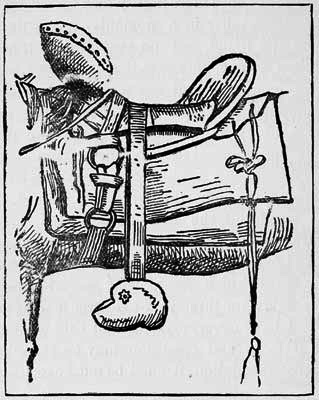
Sir,—I have been very greatly interested by the remarks on saddles, spurs, &c., made by your lady correspondents. My husband is a large ranchero, or cattle-farmer, on the Rio Grande, between Mexico and Texas, and naturally I have had much experience of hard as well as long-distance riding. Having been accustomed to hunting when I was a girl, I came out here with an exaggerated idea of my skill in horsemanship. My first ride in Mexico was one of three hundred miles, which we did in seven days; I rode on an English hunting-saddle almost, if not quite, as "straight as a board." After the second day I found it as uncomfortable a seat as could be desired, and was glad to change it for the peon's ordinary Mexican saddle, which I found perfectly easy and comparatively comfortable to my English one. This last I have found exceedingly fatiguing and ill-adapted to a long journey, although very good for a few hours' ride after wild cattle, which is a certain approach to hunting, although the jumping is not stiff. Lately I had another saddle sent out from England, which was a little deeper, and I find it much more useful for long distances. As ladies are not in the habit of riding steeplechases, I would venture to suggest that, for hard riding, such as hunting, the saddle might rather be heavier than lighter, as I am sure that this must give more relief to the horse's back. In fact, I believe that the sore backs so often produced by ladies' saddles are more frequently caused by the saddle being too light than too heavy. I quite agree with some of your correspondents that the padded stirrup is most dangerous, as it is not easy to get the foot out quickly if anything should happen.
The principle, as stated by the Mexicans, of striking a horse between the ears is not to bring him down by fright, but to bring him down by force, so as to "stun" him. Now, do you think that any of your fair correspondents could accomplish this with a light park or hunting-whip? I may be very bold to offer any suggestions, but the lady's sidesaddle of the nineteenth century is very far from being pleasant. Why should not ladies in this age of progression begin to ride on saddles shaped like a man's, with the same seat a man uses? It would be much more comfortable, as even a stout lady could not look much more ungraceful than she does now, besides materially lessening the danger. I send you a sketch of a Mexican saddle.
I am, &c.
Campesina.
San Antonio de Bexar, Texas, U.S.A.
P.S.—I would not like you to imagine that I intend to slight such an admirable authority as Mrs. Power O'Donoghue, but I should be much obliged to any of your correspondents for the design of an improved saddle, suitable alike for riding a young nervous horse and for journey purposes. I have a design for such a saddle, but I do not know how far it may be practicable. I think if ladies would give their ideas upon this subject through the medium of your columns, some real improvement might be arrived at.
C.
Sir,—In your issue of the 27th November my letter appeared, recommending that the use of side-saddles should be discontinued. Your correspondent, "Jack Spur," mentions, in a letter published on the 13th November, that in some works concerning the Sandwich Islands, in the Northern Pacific Ocean, and the Rocky Mountains, North America, the authoress, Miss Isabella L. Bird, states that she was accustomed, while there, to ride on horseback astride.
A few extracts from her above-mentioned writings will probably interest your readers. When in Hawaii, or Owyhee, one of the Sandwich Islands, the authoress referred to accompanied some friends on horseback to the Anuenue Falls on the Wailuku river (a river which forms a boundary between two great volcanoes), and on that occasion used a side-saddle, but was afterwards advised by one of the party to follow the native fashion of riding astride. Having acted upon this advice, she was well satisfied with the result of the trial, and continued to adopt that style while in the Sandwich Islands, and also in the Rocky Mountains, where she remained nearly four months. The following extract from a letter written by her about the 28th of January, from Hilo, Hawaii, and published in The Hawaiian Archipelago: Six Months in the Sandwich Islands, 1875, page 66, gives further particulars of her visit to the Anuenue Falls, above referred to:—
"Everything was new and interesting, but the ride was spoiled by my insecure seat in my saddle, and the increased pain in my spine which riding produced. Once, in crossing a stream, the horses had to make a sort of downward jump from a rock, and I slipped round my horse's neck; indeed, on the way back I felt that on the ground of health I must give up the volcano, as I would never consent to be carried to it, like Lady Franklin, in a litter. When we returned, Mr. Severance suggested that it would be much better for me to follow the Hawaiian fashion, and ride astride, and put his saddle on the horse. It was only my strong desire to see the volcano which made me consent to a mode of riding against which I have so strong a prejudice; but the result of the experiment is that I shall visit Kilanea thus or not at all. The native women all ride astride on ordinary occasions in the full sacks, or holukus, and on gala days in the pan, the gay winged dress which I described in writing from Honolulu. A great many of the foreign ladies in Hawaii have adopted the Mexican saddle also" (this means that they ride astride) "for greater security to themselves and ease to their horses on the steep and perilous bridle-tracks, but they wear full Turkish trousers, and jauntily-made dresses reaching to the ankles."
After leaving the Sandwich Islands she went to the Rocky Mountains, and in a letter dated the 23rd of October, and published in A Lady's Life in the Rocky Mountains, 1879, she writes from the Colorado District, North America:—
"I rode sidewise till I was well through the town, long enough to produce a severe pain in my spine, which was not relieved for some time even after I had changed my position. It was a lovely Indian summer day, so warm that the snow on the ground looked an incongruity."
From the fact that many ladies, when in the Sandwich Islands, ride astride, and that Miss Bird found this position preferable in many respects to that which a side-saddle obliges the rider to take, I infer that ladies in England would be pleased if a change in the mode of riding were introduced.
Proprietors of circuses will perhaps permit me to offer for their consideration that by allowing this mode of riding to form a part of some of the circus performances, they might do a great deal towards causing it to be recognised by the public as the correct style, and that one great obstacle in the way of its being generally adopted by horsewomen would then be removed.
I wish also to suggest that it should be taught at several riding-schools, so that a large number of pupils may commence at the same time.
I am, Sir,
Your obedient servant,
X. Y. Z.
Sir,—The letters of your correspondent, Mrs. Power O'Donoghue, are very instructive and trustworthy, because founded upon practical experience. In her letter of last week she recommends the feeding of hunters upon cooked food. This to many sportsmen will be a new theory; not so to me, and I wish to confirm her views, but I carry them out in a more economical way. My establishment is but a small one. I cannot afford space or attendance for a cooking-house, but I believe I arrive at the same results as she does, by steeping my oats in cold water for a given number of hours, and adding a pound of Indian meal, with a handful of chopped hay and oaten straw to each feed three times a day. My horses have a constant supply of water in a manger in a convenient corner of their stables. I believe horses fed upon dry oats and hay suffer much from thirst. I observe my horses take many sups of water through the day, but take much less on the whole than when watered upon the old practice twice daily. Practically, I find my horses very healthy, strong, and enduring, and I would freely recommend the adoption of this mode of feeding hunters to my sporting friends.
Farmer.
Sir,—I am still so inundated with correspondence—many writers asking me precisely the same questions—that I shall regard it as a favour if you will again allow me to answer a few of them through the medium of your paper.
Conn. Dashpur.—You and your horse were immersed in the river, simply because you did not give him sufficient head-room to enable him to take the jump with safety. In coming up to a wide stretch of water you should always leave your mount abundant opportunity to extend his head and neck, nor should you wait to do this until you are just on the brink,—it will then, most likely, be too late to save you and him a wetting. A horse stretches his neck coming up to a water-jump, partly that he may see well what is before him, and partly because his intelligence tells him that he cannot compass it if tightly reined in. Leave him his head, and if he is a hunter worth riding he will calculate his distance and bear you safely over. At the same time you must remember to give him sufficient support when he lands, or he may peck, or roll, and give you an ugly fall. A horse is much more liable to come down over a water-jump than at a fence, for the swinging pace at which you must necessarily send him at it—combined with the absolute necessity for leaving him complete freedom of his head—forbids that "steadying" process, which, at the hands of an accomplished rider, usually ensures safety over wall or ditch. Questions similar to yours have been asked me by H. Cadlicott, Maurice Hone, and Guy. In answering one, therefore, I reply to each.
Ellice Greenway.—Your MS. never reached me; you must have misdirected it,—but in any case I could not have been of service to you, as I have no time for revising other people's work, nor would my recommendation carry any weight. Publishers judge for themselves. Your papers must go in on their merits, and be accepted or rejected accordingly. I quite agree with you that declined MSS. should—when accompanied by a stamped and addressed envelope—be returned to the sender with the least possible delay. No matter how great or hurried may be the business of an office, there is in reality no excuse for inattention to this rule. The very best and busiest of the weekly journals comply with it, and persons who do not want to be treated with snobbish indifference had better not write for any other. Perhaps if you call, or send a line privately to the Editor, you may succeed in getting back your work; but do not be expectant.
King Lear.—The horse you name attained his victory in 1878. He carried 12 st. 7 lbs.
G. Hunt.—Beauparc; but he did not win.
P. Ryall.—At Thirsk. He fell at the second obstacle, and although speedily remounted, his chance was extinguished. Pinnace ran well, and was in great form. His defeat was a surprise, but your informant has not given you reliable details.
James.—Read Silk and Scarlet, one of the "Druid" series. Thanks for too flattering opinion.
Fordham.—The course is a most trying one, and the feat was one never before attempted by a lady. I did it to show that my horse was capable of accomplishing the task, and the risk was not what you describe it, for he was too clever to put a foot astray. Major Stone of the 80th accompanied me, and gave me a good lead. The only time I passed him was when his horse refused at an ugly post and rail. It is not true that he was thrown. He rode splendidly, managing a difficult horse. There was no "crowd," and in short it is evident that you have received an exaggerated account of the affair.
J. Dunne.—He won at Newcastle in 1879.
Collins W.—She was, in my opinion, unfairly handicapped, and the verdict was general respecting the matter.
Douglas.—The horse was not shot for five hours after, and lay quivering all that time. The owner was absent, and four of us galloped in search of him. Nobody was to blame. Mr. W. B. Morris, 7th Hussars, was the rider, and no better ever wore silk.
Montauban.—I have already detailed at some length my objections to children riding before they have strength and judgment sufficient to enable them to manage a horse. Moreover, if a child—say a little girl—gets a severe fall, the shock to her nervous system is most likely to be a lasting one, and in some cases is never got over; whereas grown girls are less liable to fall, if they have any sort of fair teaching, and certainly have stronger nerves and firmer resolution to enable them to bear the casualties attendant upon the practice of the art.
Curious.—Griffin and Hawkes, of Birmingham, by the burning of whose premises some of my most valued MSS. were lost.
Jessica.—It is quite untrue. Her Imperial Majesty dresses and mounts in ordinary fashion. There is not one word of truth in the widely-circulated statement that her habit is buttoned on after she has mounted, nor is her jacket ever made "tight." It is close-fitting and beautifully adapted to her figure, but sufficiently large to leave her abundant room to move in. The Empress despises tight stays, gloves, and boots. Her waist is small, but not wasp-like. The absurd announcement that it measured but twelve inches (recently published in one of the weekly journals) is as false as it is foolish. Nobody could exist with such a deformity. The Empress takes morning exercise upon a trapeze. Her hair is dark, shaded to gold-colour, like a wood in autumn. The report that she dyes it is one of the many calumnies of which she is the subject, but which happily cannot harm her. She is not affable; her manner is stately in the extreme, to all except those with whom she desires to converse. She speaks fair but not fluent English. This reply to Jessica is also for Frank Kurtz, Amy Robsart, and Alicia Bond.
Julius.—It was not I who wrote it. I got the credit of it, but did not covet the distinction.
George K.—Nobody assists me. Of course you mean as an amanuensis: otherwise your question would be an offence. I write my thoughts in short-hand, and copy at leisure for the press. My time for writing is when the house is quiet,—generally from 10 P.M. to 2 or 3 in the morning. I have answered you—but against my will, as I much dislike personal questions. Were I to reply to such in general, my entire life would be laid bare to the eyes of a disinterested public, in order to gratify a few persons, who have no motive save one of idle curiosity.
T. Cannon.—Grandfather's Hunter is sold out. Horses and Horsemen is to be had, but its price puts it beyond the pale of ordinary purchasers. Try Bumpus, or Mudie.
Oxonian.—You are wrong,—nor have I asked your opinion. It is easier to criticise than to write. Having done the former, pray do the latter, and submit to others' criticism.
Marcia Flood.—Two yards round the hem is amply sufficient width. I consider the price you name quite exorbitant. Try one of those mentioned by me in my chapter upon riding-gear.
Thanking you, Sir, for your kindness in granting me so much of your valuable space.
I am, yours obediently,
Nannie Power O'Donoghue.
Sir,—In a recent edition "Jack Spur" asks if it is usual in any country for ladies to ride à la Duchess de Berri, i.e. as a gentleman, astride. In Mexico and the States of the River Plate this is the usual mount of the fair ones of the district, and, clad in loose Turkish pantalettes tucked into the riding-boots of soft yellow leather, a loose sort of tunic secured by a belt, and wearing the ladies' "sombrero," very charming these fair équestriennes look, and splendid horsewomen they are. Talk of ladies, your "Fair Play" should see the long, sharp, Mexican spurs attached to the heels of these fair prairie-rangers, and witness how unsparingly they are used. Sometimes I, who am no namby-pamby rider, and have seen my share of rough work, have ventured to remonstrate in a half-jocular manner (as became a stranger and foreigner) when riding along with a Mexican lady, who generally keeps her steed at a full gallop by the remorseless application of these instruments of punishment. But the reply was merely a silvery laugh, and "Ah, senor, here horses are cheap, and when one is finished we have plenty more for the catching. Come along!" My experience of ladies on horseback as a rule is that they are more severe than men; perhaps it is thoughtlessness, but certainly for hard riding and severe spurring I have never seen any to surpass a Mexican senora, whose favourite pace is a stretching gallop without cessation, until her steed is perfectly pumped out, and as horseflesh is of no value whatever, and no Society for the Prevention of Cruelty to Animals exists, I am afraid I must record a verdict of cruelty against some of the most charming women I ever met. To their fellow mortals all kindness and goodness, but when mounted on their mustang they seem to forget that he can feel either fatigue or pain. Certainly the temptation is great. A horse is of no value; you seldom mount the same twice on a journey, and across the beautiful prairies a wild gallop is the pace. But I should be sorry to see an English lady dismount from her steed, leaving him utterly exhausted and pumped out, and his flanks streaming with blood from deep spur-strokes. This I have too often seen in South America. Everyone does it, and it is little thought of; but by all means let us cherish a better feeling, and not give any needless pain to that noble animal, the horse. Let the ladies avoid the use of sharp spurs; most horses ridden by ladies here are perfectly amenable to the whip and rein, and the use of the spur is somewhat inharmonious with the gentle character of our English women.
Guacho.
St. Leonards, 1880.
"The correspondence upon this subject, called forth by Mrs. Power O'Donoghue's admirable papers 'Ladies on Horseback,' has been so voluminous, and appears likely to go on for such a lengthened period, that I am reluctantly obliged to bring it to a close, in order to make space for other matter."—Ed. Illustrated Sporting and Dramatic News.
London: Printed by W. H. Allen & Co., 13, Waterloo Place, S.W.
WORKS PUBLISHED
BY
W. H. ALLEN & CO.
HOW TO RIDE AND SCHOOL A HORSE, With a System of Horse Gymnastics. By Edward L. Anderson. Crown 8vo. 2s. 6d.
MAYHEW (EDWARD) ILLUSTRATED HORSE DOCTOR. Being an Accurate and Detailed Account, accompanied by more than 400 Pictorial Representations, characteristic of the various Diseases to which the Equine Race are subjected; together with the latest Mode of Treatment, and all the requisite Prescriptions written in Plain English. By Edward Mayhew, M.R.C.V.S. 8vo. 18s. 6d.
Contents.—The Brain and Nervous System.—The Eyes.—The Mouth.—The Nostrils.—The Throat.—The Chest and its contents.—The Stomach, Liver, &c.—The Abdomen.—The Urinary Organs.—The Skin.—Specific Diseases.—Limbs.—The Feet.—Injuries.—Operations.
"The book contains nearly 600 pages of valuable matter, which reflects great credit on its author, and, owing to its practical details, the result of deep scientific research, deserves a place in the library of medical, veterinary, and non-professional readers."—Field.
"The book furnishes at once the bane and the antidote, as the drawings show the horse not only suffering from every kind of disease, but in the different stages of it, while the alphabetical summary at the end gives the cause, symptoms, and treatment of each."—Illustrated London News.
MAYHEW (EDWARD) ILLUSTRATED HORSE MANAGEMENT.—Containing descriptive remarks upon Anatomy, Medicine, Shoeing, Teeth, Food, Vices, Stables; likewise a plain account of the situation, nature, and value of the various points; together with comments on grooms, dealers, breeders, breakers, and trainers; Embellished with more than 400 engravings from original designs made expressly for this work. By E. Mayhew. A new Edition, revised and improved by J. I. Lupton, M.R.C.V.S. 8vo. 12s.
Contents.—The body of the horse anatomically considered. Physic.—The mode of administering it, and minor operations. Shoeing.—Its origin, its uses, and its varieties. The Teeth.—Their natural growth, and the abuses to which they are liable. Food.—The fittest time for feeding, and the kind of food which the horse naturally consumes. The evils which are occasioned by modern stables. The faults inseparable from stables. The so-called "incapacitating vices," which are the results of injury or of disease. Stables as they should be. Grooms.—Their prejudices, their injuries, and their duties. Points.—Their relative importance, and where to look for their development. Breeding.—Its inconsistencies and its disappointments. Breaking and Training.—Their errors and their results.
DAUMAS (E.) HORSES OF THE SAHARA, AND THE MANNERS OF THE DESERT. By E. Daumas, General of the Division Commanding at Bordeaux, Senator, &c. &c. With Commentaries by the Emir Abd-el-Kadir (Authorized Edition). 8vo. 6s.
"We have rarely read a work giving a more picturesque and, at the same time, practical account of the manners and customs of a people, than this book on the Arabs and their horses."—Edinburgh Courant.
THURSTON & CO.
BILLIARD TABLE
MANUFACTURERS.
LAMP MAKERS AND GAS FITTERS.
BY APPOINTMENT TO HER MAJESTY THE QUEEN, AND HER ROYAL HIGHNESS THE PRINCESS OF WALES.
ESTABLISHED A.D. 1814.
16, CATHERINE STREET, STRAND, LONDON.
PRIZE MEDAL, SYDNEY, 1879, FIRST AWARD.
S. & H. HARRIS'S
57, MANSELL STREET, E.,
Ebonite Waterproof Blacking
FOR HUNTING OR WALKING BOOTS.
REQUIRES NO BRUSHING.
HARNESS COMPOSITION (Waterproof).
SADDLE PASTE (Waterproof).
JET BLACK OIL, For Harness.
BLACK DYE, FOR STAINING HARNESS, And all kinds of Leather.
WATERPROOF DUBBIN, For Boots and Harness.
BREECHES POWDER, For Cleaning Hunting Breeches.
POLISHING PASTE, For Cleaning Metals and Glass.
S. & H. HARRIS,
57, MANSELL STREET, E.

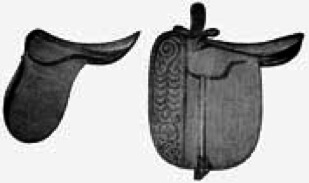
H. PEAT & CO.,
173, PICCADILLY,
LONDON, W.,
SADDLERS & HARNESS MAKERS
TO THEIR ROYAL HIGHNESSES
The Prince of Wales, the Duke of Edinburgh,
Her Majesty's Cavalry and the Crown Agents for the Colonies.
[The following advertisements have been moved from the beginning of the book.]
Silver Medal Vienna 1873. Paris 1878. Philadelphia 1876.
SWAINE ADENEY,
WHIP MANUFACTURERS,
To THE QUEEN, THE PRINCE and PRINCESS OF WALES and the ROYAL FAMILY,
185, PICCADILLY,
LONDON, W.
WHIPS OF EVERY DESCRIPTION FOR RIDING, DRIVING, & HUNTING, &c.
WHIPS MOUNTED IN GOLD AND SILVER, FOR PRESENTATION, ALWAYS ON HAND.
HUNTING FLASKS, HORNS, &c.
THE
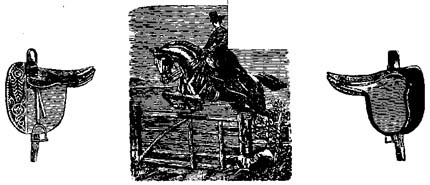
NEW LEVEL-SEAT SIDE SADDLE,
With Adjustable Third Crutch and other Improvements,
As recommended and used by Mrs. Power O'Donoghue, Authoress of "Ladies on Horseback," &c. &c.
This perfect Side Saddle is moderate in price, light and elegant in appearance, faultless in materials and workmanship, ensures ease, comfort, and security to the rider, and obviates sore backs with horses.
MADE TO ORDER AND MEASURE BY
F. V. NICHOLLS & CO.,
Hunting & Military Saddlers,
Manufacturers of Harness, Horse Clothing, Whips, and Stable Requisites,
2, JERMYN STREET, HAYMARKET,
LONDON.
The Gentleman's narrow-grip "Brough" Saddle, any size and weight, from £7, complete.
The Gentleman Rider's Racing Saddle, £3 to £4, complete, very roomy, with Buckskin Flaps, &c.
THE IMPROVED NEWMARKET & ING GUY SNAFFLE BRIDLES, FOR PULLING HORSES.
Branch Business: 18, ARTILLERY PLACE, WOOLWICH.
ROWLANDS' ODONTO OR PEARL DENTIFRICE
has been celebrated for more than half a century as the best, purest, and most fragrant preparation for the teeth ever made. Health depends in a great measure upon the soundness of the teeth, and all dentists will allow that neither washes nor pastes can possibly be as efficacious for polishing the teeth and keeping them sound and white as a pure and non-gritty tooth-powder; such Rowlands' Odonto has always proved itself to be. Great care must be taken to ask for ROWLANDS' ODONTO, of 20, Hatton Garden, London, and to see that each box bears the 3d. Government Stamp, without which no ODONTO is genuine.
ROWLANDS' MACASSAR OIL
is universally in high repute for its unprecedented success during the last 80 years in promoting the growth, restoring, improving, and beautifying the human hair. For children it is especially recommended, as forming the basis of a beautiful head of hair, while its introduction into the nursery of Royalty is a sufficient proof of its merits. It is perfectly free from any lead, mineral, or poisonous ingredients.
ROWLANDS' KALYDOR
produces a beautiful pure and healthy complexion, eradicates freckles, tan, prickly heat, sunburn, &c., and is most cooling and refreshing to the face, hands, and arms during hot weather.
Ask any Perfumery dealer for ROWLANDS' Articles, of 20, Hatton Garden, London, and avoid spurious worthless imitations.
MESSRS. JAY
Have the honour to solicit a visit from the Beau Monde to inspect a variety of Elegant Silk Costumes, Mantles, Artistic Millinery, Hats, also Novelties in Dress, specially selected in Paris from the best Artistes representing the Fashions of the Season.
243, 245, 247, 249, 251, & 253, Regent Street, W.
W. FAULKNER,
LADIES' & GENTLEMEN'S
HUNTING, SHOOTING, & WALKING
BOOT MAKER,
52, SOUTH MOLTON STREET, BOND STREET, W.
Manufacturer of the Celebrated Edinburgh Boot Varnish, Blacking, and Waterproof Leather Dressing.
MILITARY BOOTS.
The "Bective" Boots and Shoes to match Costumes.
Improved Flexura Boots. Mountain Boots. Skating Boots. Lawn Tennis Shoes. Oxford Shoes. Slippers to any style.
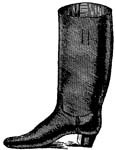
LADIES' RIDING & HUNTING BOOTS OF EVERY DESCRIPTION.
The Shape of the Feet taken and Lasts Modelled on the most approved, anatomical principles, and kept exclusively for each customer.
W. Faulkner begs most respectfully to call the attention of Ladies and Gentlemen to the BOOT TREE Branch. Boot Trees assist to keep the boots in proper shape, preventing them from wrinkling and shrinking after they have been worn in the wet; they can be cleaned better, and do not require so much blacking, thereby preventing the deleterious effect produced by its frequent application.
Lasts and Boot Trees of every description Manufactured on the Premises.
Ladies residing in the Country can have Boots or Boot Trees sent their exact size by forwarding an Old Boot by Post.
To H.R.H. PRINCESS CHRISTIAN.

SYKES, JOSEPHINE, & CO.
"CORSETS."
280, REGENT STREET, LONDON,
AND
56A, OLD STEYNE, BRIGHTON.
RIDING CORSETS OF EVERY DESCRIPTION MADE TO ORDER.
Manufactories
{RUE RAMBUTEAU, PARIS.
{GREAT CASTLE STREET, LONDON.
HOW TO RIDE
AND
SCHOOL A HORSE
BY
E. L. ANDERSON.
Crown 8vo. Price, 2s. 6d.
"It requires the study of only a very few pages of this book to convince the reader that the author thoroughly understands his subject."—Illustrated Sporting and Dramatic News.
"Concise, practical directions for riding and training, by which the pupil may become his own master."—Land and Water.
"A useful and carefully-written volume."—Sporting Times.
"It is sensible and practical."—Whitehall Review.
"We cordially commend this book."—Indian Daily News.
"The work is a good riding-master's book, with no superfluous words, and with plain, straightforward directions throughout. The chapter on 'The Walk and the Trot' seems to us especially practical and good."—Farmer.
"Goes straight to the core of the subject, and is throughout replete with sound sense."—Home News.
"Cannot fail to be of service to the young equestrian, while it contains many hints that may be advantageously borne in mind by experienced riders."—Scotsman.
"Mr. Anderson gives good practical advice, and we commend the work to the attention of our readers."—Live Stock Journal.
London: W. H. ALLEN & CO., 13 Waterloo Place.
THE ILLUSTRATED HORSE DOCTOR
Being an Accurate and Detailed Account, accompanied by more than 400 Pictorial Representations, characteristic of the various Diseases to which the Equine Race are subjected; together with the latest Mode of Treatment, and all the requisite Prescriptions written in Plain English.
By EDWARD MAYHEW, M.R.C.V.S.
8vo., 18s. 6d.
Contents.—The Brain and Nervous System.—The Eyes.—The Mouth.—The Nostrils.—The Throat.—The Chest and its contents.— The Stomach, Liver, &c.—The Abdomen.—The Urinary Organs.—The Skin.—Specific Diseases.—Limbs.—The Feet.—Injuries.—Operations.
"The book contains nearly 600 pages of valuable matter, which reflects great credit on its author, and, owing to its practical details, the result of deep scientific research, deserves a place in the library of medical, veterinary, and non-professional readers."—Field.
"The book furnishes at once the bane and the antidote, as the drawings show the horse not only suffering from every kind of disease, but in the different stages of it, while the alphabetical summary at the end gives the cause, symptoms and treatment of each."—Illustrated London News.
ILLUSTRATED HORSE MANAGEMENT.
Containing Descriptive Remarks upon Anatomy, Medicine, Shoeing, Teeth, Food, Vices, Stables; likewise a plain account of the situation, nature, and value of the various points; together with comments on grooms, dealers, breeders, breakers, and trainers. Embellished with more than 400 engravings from original designs made expressly for this work.
By E. MAYHEW.
A New Edition, Revised and Improved, 8vo., 12s.,
By J. I. LUPTON, M.R.C.V.S.
Contents:—The body of the horse anatomically considered. Physic.—The mode of administering it, and minor operations. Shoeing.—Its origin, its uses, and its varieties. The Teeth.—Their natural growth, and the abuses to which they are liable. Food.—The fittest time for feeding, and the kind of food which the horse naturally consumes. The evils which are occasioned by modern stables. The faults inseparable from stables. The so-called "incapacitating vices," which are the results of injury or of disease. Stables as they should be. Grooms.—Their prejudices, their injuries, and their duties. Points.—Their relative importance, and where to look for their development. Breeding.—Its inconsistencies and its disappointments. Breaking and Training.—Their errors and their results.
LONDON: W. H. ALLEN & CO., 13 WATERLOO PLACE.
SELECTION FROM
W. H. Allen & Co.'s Catalogue.
SKETCHES FROM NIPAL. Historical and Descriptive, with Anecdotes of Court Life and Wild Sports of the country in the Time of Maharaja Jang Bahadur, G.C.B. With Illustrations of Religious Monuments, Architecture, and Scenery, from the Author's own Drawings. By the late Henry Ambrose Oldfield, M.D., many years Residency Surgeon at Khatmandu, Nipal. 2 vols. 8vo., 36s.
"The work is full of facts, intelligently observed and faithfully recorded."—Saturday Review.
"We have nothing but unqualified praise for the manner in which Dr. Oldfield's manuscript has been edited and published by his relatives. The sketches have just claims to rank very high amongst the standard works on the Kingdoms of High Asia."—Spectator.
RECORDS OF SPORT AND MILITARY LIFE IN WESTERN INDIA. By the late Lieutenant-Colonel G. T. Fraser, formerly of the 1st Bombay Fusiliers, and more recently attached to the Staff of H.M.'s Indian Army. With an Introduction by Colonel G. B. Malleson, C.S.I. Crown 8vo., 7s. 6d.
"The style is free from humbug and affectation, and none of the stories are incredible…. Some of the anecdotes about the early life of Outram confirm the opinion of that gallant officer held by his contemporaries."—Saturday Review.
"Records his experience in a very simple and unaffected manner, and he has stirring stories to tell."—Spectator.
THIRTEEN YEARS AMONG THE WILD BEASTS OF INDIA; THEIR HAUNTS AND HABITS. From Personal Observation; with an account of the Modes of Capturing and Taming Wild Elephants. By G. P. Sanderson, Officer in Charge of the Government Elephant Keddahs at Mysore. With 21 full-page Illustrations and Three Maps. Second Edition. Fcp. 4to. £1 5s.
LATCHFORD & WILLSON,
11, UPPER ST. MARTIN'S LANE,
LONDON, W.C.,
By Appointment to HER MAJESTY, H.R.H. THE PRINCE OF WALES, &c. &c.
MAKERS
OF ALL KINDS OF
BRIDLE-BITS, STIRRUPS, & SPURS.
ALL MODERN FASHIONS, ARMY REGULATIONS, &c.
THE LORINER: Latchford on Bridle-bits and the Bitting of Horses. Illustrated, 7s.
PRIZE MEDAL, PARIS.
Just Published, Price 2s. 6d.,
A SYSTEM OF
SCHOOL TRAINING FOR HORSES.
By E. L. ANDERSON,
AUTHOR OF "HOW TO RIDE AND SCHOOL A HORSE."
"He is well worthy of a hearing."—Bell's Life.
"There is no reason why the careful reader should not be able, by the help of this little book, to train as well as ride his horse."—Land and Water.
"Each successive stage of the school system is carefully traced, and anyone accustomed to the management of horses will therefore be able to follow and appreciate the value of Mr. Anderson's kindly method of training."—Daily Chronicle.
London: W. H. ALLEN & CO., 13 Waterloo Place.
HOUSE! STABLE! FIELD!
W. CLARK'S ELASTIC WATERPROOF POLISH, for Hunting, Shooting, and Fishing Boots; also for Ladies' and Gentlemen's ordinary Walking Boots and Shoes.
W. CLARK'S BROWN BOOT-TOP FLUID, for restoring Brown Top-Boots to their original colour; also a Cream for Polishing, making them equal to new.
W. CLARK'S BREECHES PASTE, for softening and preserving Hunting Breeches, Gloves, &c.
W. CLARK'S BOOT-TOP POWDERS, of various colours, White, Pink, Rose Pink, Straw, Salmon, Natural, Flesh, Cream, Drab, Melton Brown, three colours of Brown, all of the newest description.
W. CLARK'S LIQUID SHOE BLACKING, the best in the world for softening, preserving, and superior brilliancy.
W. CLARK'S WATERPROOF HARNESS BLACKING requires neither Oil nor Dye.
W. CLARK'S Newly-invented PASTE, for Harness, Patent and Enamelled Leathers. This preparation does not wash off, it renders the leather soft, and produces a polish superior to any of its kind in existence.
W. CLARK'S PLATE POWDER, for Cleansing and Restoring Plate, Brass, and Metals of every description.
W. CLARK'S SADDLE PASTE, for Softening, Preserving, and Beautifying Saddles, Bridles, and every description of Brown Leather, &c.
W. CLARK'S METROPOLITAN POLISH. This article is used for Ladies' and Gentlemen's Patent, Enamel, Bronze Glace, Morocco, Kid Boots and Shoes, producing a superior polish.
W. CLARK'S PATENT KID REVIVER, for cleaning Black Kid Boots and Shoes, making them equal to new, also for reviving all kinds of Black, Blue, and Dark Silks, removes grease spots.
W. CLARK'S NE PLUS ULTRA RAVEN JET FRENCH VARNISH, for Ladies' and Gentlemen's Evening Dress and ordinary Walking Boots and Shoes, producing a most brilliant polish, warranted not to crack or soil the finest Cambric.
W. CLARK'S BRASS PASTE produces a fine polish upon Brass, Copper, Tin, Pewter, Britannia Metal, Coach Glasses, and Windows.
W. CLARK'S WATERPROOF POUCH PASTE, for Pouches, Belts, Straps, Knapsacks, Canteen Coverings, Boots, Leggings &c.
W. CLARK'S EMBROCATION FOR HORSES AND CATTLE, gives immediate relief in all cases of Lameness, Sore Throat, Influenza, and Rheumatism.
W. CLARK'S
PATENT HORSE CLIPPERS.
Has been before the Public for 12 years, giving the greatest satisfaction, the cheapest and best in the market.
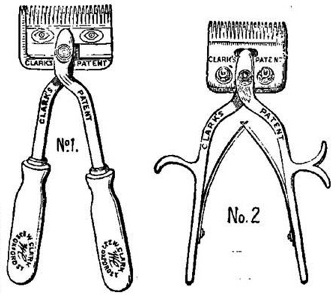
A one-handed Machine for Heads, Ears, Necks, Quarters, Stomachs, Stifle, and all difficult parts; also extensively used in cutting the human hair in hot climates, where it is required to be cut close.
SADDLERY, HARNESS, HORSE CLOTHING &c.
Saddlers by Appointment.

URCH & CO.,
(ESTABLISHED 1835,)
84, LONG ACRE, LONDON, W.C.
MANUFACTURERS OF EVERY DESCRIPTION OF SADDLERY, HARNESS, &c.
WHOLESALE AND RETAIL.
A LARGE ASSORTMENT ALWAYS KEPT IN STOCK.
URCH and CO.'S PATENT DOUBLE SPRING BAR for Releasing the Stirrup Leather when thrown, can be seen at the above establishment "in working order."
By Appointment to H.M. THE QUEEN OF ENGLAND. By Appointment to H.M. THE QUEEN OF DENMARK.
REDFERN,
LADIES' TAILORS,
By Special Appointments
To H.R.H. THE PRINCESS OF WALES and H.I.H. THE EMPRESS OF RUSSIA,
26, CONDUIT STREET,
Bond Street, London, W.
SPECIALITIES—
RIDING HABITS,
From specially prepared Melton Cloths, &c.
John Redfern and Sons would particularly draw the attention of Ladies to their Improvements in the cut of Riding Habit Skirts, on the proper set of which depends the whole effect of the Habit. These improvements, while maintaining a tight, well-fitting appearance, give perfect comfort and safety to the rider.
DRIVING COATS,
From Waterproofed Box-Cloths, Faced Cloths, Tweeds, &c.
These, together with J. R. and Son's Improved Newmarket Coats, will be found most useful for driving to meet and for constant wear.
Branch Businesses at Cowes, Isle of Wight, and 242, Rue de Rivoli (Place de la Concorde), Paris.
"The most noted Firm of Ladies' Tailors in the world, and, be it said, the most original."—Extract from Court Journal.
By Appointment to H.M. THE QUEEN OF ENGLAND. By Appointment to H.M. THE QUEEN OF DENMARK.
REDFERN,
LADIES' TAILORS,
By Special Appointments
To H.R.H. THE PRINCESS OF WALES and H.I.H. THE EMPRESS OF RUSSIA,
26, CONDUIT STREET,
BOND STREET, LONDON, W.
SPECIALITY—
YACHTING & TRAVELLING GOWNS.
From original Colourings in Cloth and Serge, &c.

The Firm personally superintend every order, and a perfect fit is guaranteed.
N.B.—On the occasion of the visit to England of H.S.H. the Princess Helena of Waldeck, in March 1882, John Redfern and Sons had the honour of making for Her Serene Highness.
On the visit of H.I.M. the Empress Eugenie, accompanied by the late Napoleon III., J. R. and Sons had a similar honour.
On the visit of H.I.H. the Crown Princess of Germany, J. R. and Sons had the honour of making for Her Imperial Highness and all the Princesses.
On the visit to the Queen of T.R.H. the Princesses of Hesse Darmstadt, J. R. and Sons had the honour of making for their Royal Highnesses.
On the visit to Her Majesty of the Daughters of H.R.H. the late Princess Alice, J. R. and Sons had a similar honour.
Branch Businesses at Cowes, Isle of Wight, and 242, Rue de Rivoli (Place de la Concorde), Paris.
"The most noted Firm of Ladies' Tailors in the world, and, be it said, the most original."—Extract from Court Journal.
LADIES' RIDING BOOTS.
Established 1839. N. THIERRY, Established 1839.
LADIES' AND GENTLEMEN'S
Boot & Shoe Manufacturer,
LONDON,
{ 70 QUADRANT, REGENT STREET, W.,
{ AND 48, GRESHAM STREET, E.C.
MANCHESTER, 2, St. Ann's Sq.; LIVERPOOL, 5, Bold St.
Complete Illustrated Price Lists Post Free.
NO INFERIOR ARTICLES KEPT. ALL GOODS WARRANTED AND MARKED IN PLAIN FIGURES. THE LARGEST STOCK OF BEST QUALITY GOODS IN ENGLAND ALWAYS READY. 26,000 PAIRS TO CHOOSE FROM.
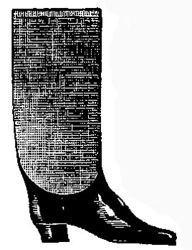
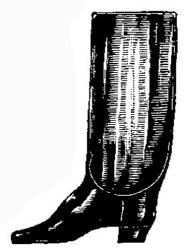
LADIES' RIDING BOOT, 50s., all Patent or with Morocco Legs. LADIES' NEWMARKET RIDING BOOT, Cloth legs, 50s.
Note.—To order, 2s. per pair extra for fitting and keeping special lasts.
LADIES' SPURS, Silver Plate, Strap, & Buckle complete, 9s, 6d.
PRICE LIST of a few Leading Articles, Ladies' Department:—
BOOTS. SHOES.
Button or Lace 17s. 0d. Oxford Tie, Morocco 14s. 0d.
Do. do. Hessians, from 19s. 6d. Do. do. Glacé 16s. 0d.
Do. do. Cork Clumps 24s. 0d. Do. Richelieu, Louis XV. Heels 23s. 0d.
Do. High Glacé Louis XV. Heels 27s. 29s. Patent Court Heels and Bows 8s. 6d.
Glacé Kid, Embroidered. 11s. 6d.
A GREAT VARIETY of very Fashionable Ladies' Dress Shoes in Glace Kid or Satin (various Colours), Embroidered Jet, Gold, Steel, or Bijou.
A LARGE ASSORTMENT OF CHILDREN'S BOOTS AND SHOES, AND EVERY VARIETY OF GENTS' RIDING, WALKING, & DRESS BOOTS & SHOES.
Goods sent on approval on receipt of satisfactory references (a London tradesman preferred), or cheque for the amount. An old boot or shoe should be sent as a guide for size, paper patterns and other measurements being of little use. Goods that do not suit will be exchanged or the money returned.
FIVE PER CENT. DISCOUNT FOR CASH.
PLEASE NOTE—70, REGENT STREET QUADRANT, as there is another house of the same Surname in the street.