LADIES IN THE FIELD (continued 2)
Reading edition
The chase continues down-wind. How they swing and try. Look how they drive as they hit the scent, then spread themselves like a fan, only to fly together again as a trusted comrade speaks to the line.
"All this comes of condition," as my old gentleman says.
Hark! a holloa forward.
Do you think a sensible man will lift them?
No; so long as they can carry on, he knows they will go quicker than he can take them.
More patient hunting, through sheep and over bad ground, the huntsman cheering his hounds, but never interfering with them, as they work out all the turns of a sinking fox for themselves.
They'll have him directly, one can see by the determined rush of the older hounds. Sure enough! In another minute they run from scent to view, and pull their fox down in the open.
Five-and-forty minutes, and I ask you if this is not a sporting hunt.
My old friend dismounts, leading his horse away, at the same time remarking,—
"It is a nasty sight to see ladies watching a poor fox pulled to pieces."
Although a note on the subject of blowing a hunting-horn may not be of great interest to many people, still, I venture to think, no harm can be done in placing before your readers how a huntsman ought to communicate on that instrument with his hounds and field.
When he views a fox—
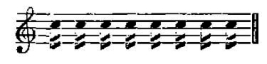
In-drawing (especially in a big wood)—
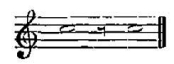
if hounds are wide of him, they stop to listen to the first note, and go to the second. To stop hounds off heel or riot—
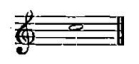
To call hounds in the open to cast—
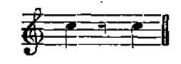
"Gone away"—

To draw hounds out of covert—
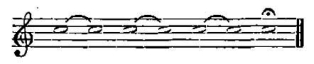
When a fox is killed—
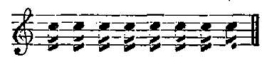
also,
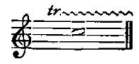
Some people only use the long rattle at the death, but my opinion is that the eight very sharp notes should be blown, as hounds know that they mean a fox, and a fox only, whether alive or dead.
TEAM AND TANDEM DRIVING.
By Miss Rosie Anstruther Thomson.
Being almost a beginner myself, it is with diffidence that I commence to relate my small experiences in four-in-hand driving. It is only because I have had the advantage of watching a first-rate coachman in my father that I venture to do so—having taken care to gather from him many hints and wrinkles as to what to do, and not to do, and more especially the reason why.
It is, I know, supposed to be easier to drive a team than a tandem, because two horses abreast are believed to be less foolish than two single horses. Personally, I think all horses are astonishingly foolish at times, and, for a lady, a tandem is much less heavy.
Of course it depends in a measure on people's hands whether horses feel heavy and hang, but the weight of four horses on a woman's wrist is decidedly a strain, until, through practice, she becomes accustomed to the feeling—that is, unless the team is so perfectly trained that they almost drive themselves.
In driving a team, the first thing to be learnt is the art of "catching" a four-in-hand whip. It certainly looks easy enough, and many a time have I watched my father, with one upward turn of his wrist, catch it unerringly every time, and felt—"Of course any duffer could do that!"—eagerly proclaiming my ability to do it too. This, however, is an altogether different affair. No twisting, no jerking is allowed, but simply a turn of the wrist, making something like a figure eight in the air, and leaving the thong caught on the stick (never try to catch your thong with the stick) with a loop above and a few turns round the stick below, which brings both lash and stick into your hand together. It is an impossible thing to describe, and the only way to learn it is to get some patient friend to show you how. And you will require all your Job-ish propensities, for it is by no means easy at first, and it makes you feel very foolish when all your efforts fail, after it has looked so ridiculously simple in the hands of an expert. Nothing looks worse than people essaying to drive a team without knowing how to catch their whip, and their wild attempts to attain that end are almost pathetic, for the flourishes they make, end invariably only in a hopeless complication and tangle.
Having mastered your whip, the next thing to do is to defeat your reins—and beware that they do not defeat you, for they are very mixing, and the numbers one has to deal with make one almost giddy, after the ordinary single pair. In driving a team, or a tandem, you should not hold your reins one through each finger, as in riding, but put one rein—your near leader's—over the top of the fore-finger of your left-hand, and the other leader's rein—the off—and the near wheeler's reins BOTH between your first and middle fingers (the leader's upmost), while your off wheeler's rein comes lowest of all, between your middle and third finger. It looks rather complicated on paper, but is really very quickly learnt, especially if the wheeler's reins are a little different in colour, having probably become darker through more constant wear.
Mind you take your reins before you get on to your box, and never commit the folly of getting into a carriage before your coachman, or coachwoman, has hold of the reins, for it is both dangerous and foolish.
Before you take the reins, it is well to look round all the harness and satisfy yourself that the curb chains and throat-lashes are loose enough (grooms are so fond of pulling everything up as tight as it will go, and often seem to treat throat lashes and curb chains on the same principle as girths). See that the bits are not too short in the horses' mouths, that your leaders are properly coupled, and also your wheelers. You cannot be too particular about detail in this case, and mind the pole chains are not too tight. They should be easy, so that they can just swing—the pole carrying itself without resting any weight on the horses' collars.
After you have seen that all is right, go round to the off side wheeler and take your leader's reins from off his pad, put them in your left-hand, with forefinger between, then pick up your wheeler's in your right-hand, with forefinger between. Now pass them on to their ultimate destination (one on each side of the third finger of your left-hand), and draw the near reins through your fingers till you get them so short (while you are still on the ground) that they will all come even when you are sitting on your box. Nothing denotes a muff more than omitting to do this. Of course the driver must judge how much rein to take in, with his or her eye, before getting up.
As you cannot swarm on to your box hampered by the reins in your left-hand, you must take them in your right until you have settled yourself comfortably, and are sitting (not standing) firmly on your seat, which should not slant up too much, for one gets more purchase if one is not merely leaning against the box. Once there, change your reins back into your left-hand, take the whip out of the socket, catch it, drop your hand, and set sail.
The correct thing, I believe, is to have the whip ready caught and laid across the wheeler's quarters. That is what they did in old coaching days, and the driver used to take it up with his reins together in his right-hand, with the whip pointing towards his right shoulder. He then got up, with reins and whip all ready to start as soon as he said the word "Go!"
It would be a good thing if grooms at the horses' heads would let go the instant you give them the hint to do so. Nothing is more irritating to both horse and driver than a man who will hold on after you have started.
In starting, you should have your leaders a little shorter by the head than the wheelers, as the wheelers should start the coach. Letting the leaders start first is very likely to end in disaster. Like buckets in a well, they jump off with a jerk before the wheelers are ready. Just as they subside, off go the wheelers. The result is confusion, and possibly a broken trace. [7] Take up your reins then, to avoid this calamity, feeling all your horses' mouths, but with the leaders' accentuated; and, when you are quite ready to start, just drop your hand and chuckle to them. Never "kiss" at your horses, and never say "Pull up,"—both are shocking and unpardonable.
As to the use of a four-in-hand whip, there is almost as much art in hitting the leaders as there is in throwing a fishing-fly. You should always hit your leaders under the bars, and quietly, to avoid startling the other horses. In driving anything, whether one horse or four, you should always begin by touching your horse quite gently at first, just drawing the whip across his shoulder. If this hint is not enough, repeat it a little harder and a little harder still, so that he improves his pace gradually, this obviates the uncomfortable jolts and jerks caused by bad coachmen when using their whips; they make the mistake of hitting hard the first time, the horse jumps forward and the passengers nearly dislocate their necks in consequence. Also, you should always hold them a little tighter when you are going to use the whip to prevent their starting forward, for many horses will jump at the first touch, no matter how lightly it is laid across them.
In turning a corner with a team or tandem, take up your leaders' reins a little and give them the hint which turn to take before you get to the corner (this is technically called "pointing your leaders"). They are generally quick enough at taking your hint, and then mind you allow enough space for the hind wheels of your coach.
Always go quite slow off the top of a hill. Take up your leaders before you get to it. You can get safely down any hill, no matter how steep, provided you start slow enough off the top. The pace is bound to increase the further down you get, so it is wise not to start too fast, otherwise you end in an uncomfortable sort of gallop, with the coach overhauling the horses all the way. Sometimes it is a good plan to increase your pace, supposing there is a hill to be got up just in front of you; in that case, get your horses into a gallop going down so as to get a run at the next hill, and the impetus will carry you up much easier if you have a real good swing at it. Of course a long hill is a different thing, especially if it is off the flat, and in every case your horses must be considered.
It is important that horses should be brought in cool, therefore one should do the last mile of the journey slowly and quietly that they may not be too hot on arriving at their stable.
It is a bad thing to keep horses waiting at the start, they are not generally gifted with much more patience than we are, and it is worse to check them once they are on the move, therefore it is best, when all the passengers are on board, that the last to get up should sing out "Right," to let the coachman know they are really ready to be off, and so prevent the risk of being implored to "wait just one moment" for the forgotten coat or umbrella, or the thousand and one things people always do forget until the very last instant, notwithstanding what is usually the fact that they have been dawdling about hours before hand, with nothing else to do but to prepare themselves for the cold and rain which, in this climate, is about the only thing one can count on.
Once off, try to leave your reins alone as much as possible; it is irritating to your horses' mouths, and looks bad, to be always fidgeting and pulling at either one rein or the other. Don't let your leaders do all or nearly all the work, and going down hill don't let them do any, but catch hold of them pretty short just before you get to the brow of the hill and pull them back—a tiny bit on one side to prevent the wheelers treading on their heels.
In taking up and shortening your reins, many people say you should always push them from in front with the right-hand, and not draw them through the fingers from behind, though the latter way often seems the most natural, and all coachmen do not agree on this point. It looks better to drive with one hand, the left, and to keep the right for the whip and an occasional assistance only; but a woman must have wrists of iron to drive a team with one hand for long, especially as the wrist should always be bent in driving as well as in riding. Driving with straight wrists is altogether wrong. One thing never to be forgotten is always to make your wheelers follow your leaders, thereby you can generally assume an air of nonchalance, and pretend that you intended the sudden deviation off the middle of the road caused by the digression of the leaders, if your wheelers immediately follow in their footsteps. Should it be only a slight digression, a pull at the two reins between your first and second fingers both at once, will put them right immediately, as that gets at your off leader and near wheeler at the same time, and is a very quick way of getting the team straight again. It is better form not to use the break unless it is absolutely necessary. People bore one so who are always putting their drags on and off. I do not mean the "shoe," as that, of course, must be put on, on occasions when the hill is steep to prevent the coach running on to the horses.
I remember once driving with my father in the Fife country, where the roads resemble switchback railways more than Christian highways. We had arrived at the top of a very steep pitch, and the grooms having slipped on the shoe, we were trundling serenely down, when, just as we reached the middle of the hill where the whole impetus of the coach was at its worst, snap went the chain and away rolled the shoe off down the hill on its own account, of course the sudden release sent the coach with a great lurch on the top of the wheelers, while we all clung on, craning our necks to see what was going to happen next. Quick as thought out flew the whip thong, and in an instant my father had touched the horses all round and we were flying down the hill at racing pace. We got to the bottom all safe and had galloped to the top of the next hill before he took a pull. It was very exciting for the time, and the only thing to be done under the circumstances to keep the horses going quicker than the coach, but not an experiment one would care to try with an inferior coachman.
We have all been mercifully blessed with nerve, and many a time has our courage been severely put to the test. We had a very near shave one day some years ago coming back from Ascot. We were driving all the way home to London after the last day's racing. Our off leader was a very violent, hot horse, called "The Robber," who kept raking and snatching at his bridle from morning till night. As we were passing through a little town—Brentford—we tried to worm our way between the pavement and a baker's cart, which was proceeding slowly in front and giving us very little room to pass.
This irritated The Robber, who, making a wild bounce forward, wrenched the bridle clean off the wheeler's head! (His rein was passed through the upright terret on the top of the wheeler's bridle, and must have got caught somehow). The bridle flopped against the pole, which frightened the whole lot and they started off at a gallop. The baker, seeing this, thought we were anxious to race him, and set sail too. Naturally his increasing pace excited our horses more than ever, and the three with bridles pulled their hardest, while the loose one pegged along with his head in the air.
The off-horse being bitless, it was only the near-side rein that took effect on their mouths, so the end was that we edged nearer and nearer to the pavement, till, at last, the leaders turned and jumped on to it. At the same moment Captain Carnegy (who, luckily, was just sitting behind the box) leapt to the ground, and made a grab at the loose wheeler, catching him by the nose, and so saved us from some trouble. The leaders, in the meantime, had run straight into a draper's shop, and were curveting about on the top of four or five school children, whom they had hustled to the ground.
It looked very nasty for a minute, but they were mercifully extracted all unhurt, and a few coins soon mollified their gaping parents.
Apropos of having the leaders' reins through the top terret, it is supposed to look smarter, but that it is not a very good plan is proved by the aforesaid catastrophe. The rings on the wheelers' throat-lashes are really much better for ordinary use.
My father used to drive a great deal, and, before he joined the Four-in-hand Club, he used to drive the Exeter and London mail-coaches regularly, three or four times a week, fifty years ago, when he was in the Ninth Lancers. It must have been hardish work, for he drove all night. He started at seven p.m. after his day's soldiering, and drove forty-four miles each way, getting back to barracks at seven p.m. next morning.
He tells me they only took eight passengers with them, four inside and four out, besides the coachman, and the guard who sat by himself behind, with his feet resting on the lid of the box in which lay the mail-bags, and always armed with two pistols and a blunderbuss, besides the horn.
There is nothing so pretty as hearing a coach-horn really well blown, and very few indeed can do it properly. It is, unfortunately, a thing which people have no conscience about attempting, though their listeners are not left in doubt as to whether they are proficients in the art from the first moment they seize the instrument. How senseless of failure they are, too, as they puff out their cheeks in fatal perseverance, while tears start from their eyes, and the noise!—well, that once heard, is not easily forgotten. Though it is not within the province of a coachman, it is well to know how to make "music on three feet of tin," for it is often very necessary to arouse sleepy carters and all the other drowsy souls who encumber the earth and the Queen's highway.
Like catching a whip, it is an impossible thing to explain, beyond saying that you should begin by putting the tip of your tongue into the mouthpiece, and bring it sharply out again with a little tip sort of sound, and without puffing out your cheeks at all. The higher the notes you want to get, the harder you should compress your lips to the mouthpiece. And after all is said and done, the horn it is that generally retains the mastery, and blessed indeed is he who achieves anything beyond the air generally associated with the decrease of our ancient friend the cow.
The first tandem I ever drove was a long time ago, when I was quite small, and exceedingly proud I was of my turnout. It was very smart, all white.
It certainly had the merit of being unique, for my wheeler was a milk-white goat of tender years, while my leader was a disreputable-looking old bull-dog of equally snowy hue, and the harness was—well, pocket-handkerchiefs—mostly other people's.
I drove them in a little go-cart on low wheels, and they went very well, poor little things, though I always had to run in front myself and call them, if I wanted them to go at all fast.
That tandem came to a very sad and tragic end, for I grieve to say that, after many months of close friendship, my leader found it in his heart to devour the wheeler, which black deed brought my tandem to an abrupt termination.
Some years ago I got a lot of practice driving a scratch team down from Banffshire to Fife. A long journey, which took three days to accomplish, and over a very rough road too, for the first stage was forty miles right across the moors. Splendid wild scenery, but most horrible going, up hills and down dales, through water courses, and scrambling along old stage-coach roads, which could hardly be dignified now by the title of tracks. We scrambled up and down the steepest of mountains, and altogether felt rather relieved when at length we deserted the moor and gained the level road quite close to Balmoral. [8] It is a beautiful road from Balmoral into Braemar, broad and level, with wide verges of grass on either side, and bordered by fir trees, lighted up here and there by the silver stems and golden leaves of graceful birches, while the river Dee dances along over the rocks and stones by the side of the road, brawling its running accompaniment to the rattle of the bars and the rhythm of the horses' hoofs. Passing below the "Lion's Face," and just outside the beautiful "policies" of Invermark, we trotted cheerily into the little town of Braemar, and there put up for the night.
The second stage was further still, and we guessed it at about sixty miles on to Perth.
Happily the horses came out looking fresh and fit, having fed and rested well, and, by ten o'clock, we were once more on the move.
This time the roads were better, but still rather elementary in some places, and we encountered several of those old hogbacked bridges which are very trying to the pole, and more than likely to break it as it jerks up, on the top, when the leaders are going down one side, while the wheelers are still climbing up the other. We stopped an hour at Blair Athole on the way, and fed the horses, while we ourselves had lunch.
The team was pretty well steadied by this time, and as easy to drive as a single horse; though, of course, it needed judgment to keep them trotting steadily on for the ten or eleven hours it took to do the journey.
The last stage, from Perth to Fife, was on the beautiful old north road all the way, and, as it was only a distance of twenty miles, we did it leisurely, and turned into our own stable-yard about three hours after we started.
It was great fun, and, after driving for so long, I felt I could have gone on for weeks, but for an acute knowledge of where every bone began and ended in both my arms and back.
We accomplished that same journey twice that year; the first time in spring, and again in September we came down after the grouse-shooting with a different team. That second time was not quite such a success, as the cold was something frightful, and the hurricanes that swept over the tops of those moorland hills nearly blew us all away (we had a brake instead of the coach, as being lighter for the horses and handier for the luggage, etc.). The whole of the first two days it poured unceasingly, a good, honest, unrelenting deluge, and I never shall forget our plight on arriving at Blair Athole, soaked to the skin, while my coat pockets were so full of water that my pocket-handkerchief was floating about on the surface like a boat on a pond.
We dried ourselves as best we could at the kitchen and laundry fires of the hotel, but we were just as sopped as ever ten minutes after we had started again. However, 'tis a poor heart that never rejoices, and we all revived later in the evening, after we had become dry and warm and recurled (which is very important to a lady's happiness). Nothing makes one feel so miserable and dejected as the knowledge one is "quite unbanged," as an American was once heard to exclaim, on catching sight of her straightened fringe in the looking-glass.
I have always been very fortunate in my cargo, which makes a vast difference to one's pleasure in driving.
I do not object to my passengers clinging on to the carriage, nor even to their pinching each other, but people who shiver and squeak, and, worse than all, make clutches at the reins, ought really to be condemned to take the air in handcuffs, or else to walk.
My particular friends have always rather erred on the side of foolhardiness, and I shall never forget my intense surprise at the rashness displayed by a large party at a house where I was staying two years ago. Our host, being the possessor of a very nice team, had promised to drive us over to an Agricultural Show about to be held in an adjacent town on a certain Wednesday. We were all looking forward to our outing with great glee, and nothing occurred to agitate our minds until the very day of the anticipated treat, when early that morning a pencil scrawl was brought me from my host saying he had been suddenly called away to attend some important function at the opposite end of the country; he therefore could not come to the show, but if I cared to take his place and drive his team they should be ready at eleven o'clock.
I immediately thought—the question was not so much would I like to drive the party, as would they like to be driven by me?
However, after most anxious and searching inquirings on my part as to whether they were all insured, to my amazement they bravely asserted they would in any case risk it and come!
So round came the coach. I must confess to a slight misgiving on beholding that the usual near wheeler had been put off leader for a change, and in his stead they had given me an ancient and ill-favoured roan mare, who, I knew, had never been driven in a team before.
No sign of apprehension escaped me, however, as I clambered sternly on to the box. The start was a little sketchy, as the roan mare began by making a series of low curtseys, instead of progressing in the ordinary way, while the ex-wheeler was a little out of his element too, as a leader. By the mercy of Providence I succeeded in landing my coach-load safely through the narrow gateway, and on to the field (filled as it was by a stupid Scotch crowd) and I pulled up in triumph by the barrier of the show-ring.
I am afraid I must in honesty confess that I did run both my chariot and horses into one wire fence on the way—but the leaders would think, and the horses were all so determined, that they knew the way better than I did, that they had borne us half-way past the corner before I could get hold of them to turn down the way I wished to go. There was no harm done, luckily, and I managed to haul them out again undamaged, and proceeded without further misadventure.
There are not many things much more calculated to annoy, than a horse who always "thinks," the stupid beast who will stop at every shop passing through his own village on a Sunday, when he must surely see that all the shops are shut, or the animals who turn eagerly down every lane and corner that they come to, albeit they have passed by that road a thousand times before and have never been called upon to turn either to right-hand or to the left. And yet a horse who wont think is almost equally exasperating. Such a beast seems glad enough to lame himself or stamp on one's toes without thinking even for a moment whether it might be inconvenient or otherwise distasteful to his employers.
One thing I have forgotten to put down, is what to do in the event of a wheeler lying on the pole (which of course shoves it to one side, and the coach must needs follow in its train). Supposing, then, your off wheeler happens to be performing this antic and is pushing the whole coach by his weight to the left side. You should pull your leaders to the right, and, by so doing, make them pull the pole across until you get the concern straight again.
The only upset my father ever had with a team was caused by his omitting to do this, and that is why he told me never to forget it.
I have been implicated in many other strange drives, notably two with tandems and one with three horses abreast.
I will begin with the last one first, as it was a very transient experience.
One very snowy winter we had to take recourse to a sledge to get about the roads at all, and although it is very delightful at first, when one hopes that every night will bring a nice thaw (how the frozen-out fox-hunter prays for that night), after three or four weeks' incessant frost and snow the novelty of sleighing wears off and one longs for some new excitement.
We had arrived at these extremes, my father and I, so, struck by a happy inspiration, we one day determined to "yoke" three ponies abreast in our sledge and see what would happen. We had not long to wait for the result, for no sooner were they harnessed and we leapt in, than away they all went with one accord down the avenue as hard as ever they could rattle, kicking great hard snow-balls into our faces all the way. Down the hill and across the grass like mad things. My father put the whip between his teeth and held on with all his might. I relieved him of his whip and sat tight, until we reached a big beech tree, with a sort of mound round its roots. Here the ponies disagreed as to which side they should go, but, to avoid any jealousy or ill-feeling, they settled the question by one going to the right, while the other two elected to take the left-hand side of the tree. This fairly finished our flight, for the sledge dashed up sideways against the roots and then turned over like a turtle. Of course we were both precipitated on to the road and were dragged along some little way by the rugs. Fortunately there was a gate which happened to be shut a little further on, and this ended our troubles by stopping the ponies altogether, and there they all stood with their heads craning over the fence, while we picked ourselves up and disentangled ourselves from the débris. Luckily the sledge being so very near the ground we were not hurt, and really, being dragged along by the rugs was rather a pleasant sensation. Though it is a good thing to remember, when one is being run away with, under ordinary circumstances in a carriage, to undo the rugs and keep your legs clear, in case of accidents.
How often have rugs and petticoats caused one to fall headlong in getting in and out of "machines" (as our Scotch people say). Never shall I forget one Sunday morning, on our arrival at the church door, when I proceeded (in all the glory of my Sunday-go-to-meeting apparel) to climb down from the dog-cart, which was pretty high and fitted out with the most inhuman arrangements of steps. I tripped jauntily off the first step towards the second when I became aware that my body was extended on the cold, cold ground, and my head was resting confidingly between the horses two hind feet. What had happened? Oh, only my frock had remained swathed round the top step, that was all. Mercifully the horse was tame, and made no objection to my unexpected arrival among his hind legs. I had to crawl out from under the cart, covered with mud and speechless with fury. Two broken knees, and two scratched palms, gloves destroyed beyond all hope, and my hat jobbed over one eye, everybody in fits of laughter, of course, especially my own family. Why is it, I wonder, that one's own relations always display such extreme lack of good taste on such occasions? I must say I arose from that puddle in anything but a Christian-like and Sabbatical frame of mind.
I fared better, however, than another young friend of mine, who, in dismounting out of the very same cart, turned a catherine wheel and alighted on the road with a broken arm.
Be cautious, therefore, and always scramble out of a cart or carriage backwards, and, if the step be high, see that your dress descends with you and does not remain at the top.
One of the tandem drives I mentioned happened some two years ago, when my sister and I were staying with some friends about sixteen miles from home. We had been out cub-hunting all morning, found an old fox, and had a capital run, which landed us quite close to our own front door just in time for luncheon. This, of course, we could not resist, so we put our horses in and to our joy discovered a dog-cart had arrived—sent by our kind hostess to convey us back to her house, while the groom led our horses home. Having sent them off under his charge we proceeded to put the harness horse into his dog-cart, and were just about to start when a telegram arrived from my father (who was also away from home), ordering our groom to take a horse over to K—— for him to hunt next day.
As "K" happened to be the very place we were starting for, we determined to take his horse over ourselves. But how? that was the question.
We did not quite like the idea of tying him on behind, for well we knew he would be certain to tumble over something during the journey and contrive to break his knees.
Why not tie him on in front we both exclaimed, with that "one great mind which jumps."
Of course that was obviously the way to get him over those intervening sixteen miles of hill.
As he was the bigger of the two, and had never been driven in tandem before, we thought we had better put him in wheeler. Hastily pulling out the horse which was already harnessed we proceeded to try and fit our own rotund steed between the shafts. His figure, however, was hardly slim enough for the position, and he began to resent the suggestion with some asperity.
Satisfied that we should do no good with them that way on, we reversed the order; replacing the original horse in the wheel, we hitched our obese animal on in front. We then started. I must say he fired some most alarming salutes with his heels going down the avenue, and terrified us for the safety of our borrowed wheeler, but the ensuing hills very soon settled him down and brought him to reason, which was well for us, as we had not started on our journey till pretty late, and it was rapidly becoming dark. Needless to say we had no lamps, the road was horribly rough and mountainous, and we had still many miles to go. At last we turned in to the lodge gates and up the avenue at K—. It was dark enough outside on the road, where I could just see my wheeler's outline in the gloom, but here among the trees (for the approach is more of a wood than an avenue) it was so pitch dark I positively could not see my own hand in front of me. Having no light, we proceeded by faith, and appeared to be getting on extremely well, when suddenly, with an awful jolt and a bump, the whole concern stopped short and I nearly flew off my perch with the jerk. My sister was out like a shot and got to the wheeler's head. He was still there, that she could feel; groping a little further she collided with the leader, he was there too, that was a comfort, anything further she could nob discover without the aid of a light.
Fortunately we had provided ourselves with some matches just in case, and, on striking one, we discovered both horses standing on three legs, one of the leader's traces having caught round his off hind leg, while the other trace was twisted over the wheeler's near fore-leg! They both behaved like true Britons, and waited patiently until we got them disentangled and set straight again, when we set off once more and managed to get to our destination without further mishap.
The last exciting drive I had with a tandem was again with my father, and again in the snow. The roads were barely passable with snowdrifts piled up on either side six foot high or more. It so happened that Colonel Gardyne had been staying with us, and it behoved him to get away by a certain train on a certain day.
Inexorable to our entreaties to postpone his departure, we were obliged to accede to his request that he might be borne somehow to the station. As the roads were very bad and too heavy with snow for one horse, we selected another out of the stable and put him on in front; we then scrambled into the dog-cart and prepared for the worst. As it happened, however, we were not prepared for what followed. The leader had not been in before and did not fancy the game, nor did he approve of the snow walls; notwithstanding this we got to the station fairly intact and deposited our guest in safety.
We had not proceeded far on our homeward journey when a great black puffing engine made its appearance round a corner, with crimson eyes, and snorts, and noise, and all the honours attendant on a perambulating thrashing machine. Horrid things they are at the best of times, but more especially objectionable when one has a couple of three-cornered horses, one behind the other. Of course the effect of this apparition was wild confusion, the leader waltzed round and round till he got tied up into a knot, then set to work, and kicked himself free, breaking every stitch of harness on his body.
We had no extra tackle (which was foolish), therefore the only thing to be done was to get him home. Luckily we were not far away, so I scrambled on to his back and rode him, using the remains of the pad as a pommel and got him in all safe.
My father having some business in the neighbouring town went on in the cart alone. Soon he overtook an ally, who, bent on the same errand, was stumping bravely through the slush (having wisely refrained from taking out his own horses on such a road). On being offered a lift he mounted gladly, thankful to curtail his disagreeable tramp, and reassured by the sight of a single and confidential-looking quadruped. His joy, however, was shortlived, for the very next turn happened to lead straight up to our park gates. Dobbin (being one of the genus I object to so strongly who "think") instantly thought, and made a dive for the corner. The wheel, colliding violently against the curb-stone, precipitated the unfortunate passenger headlong into a snow-drift, where he remained half buried, with only a large pair of feet flapping in the air to indicate the spot where the casualty had occurred.
Rosie Anstruther Thomson.
"TIGERS I HAVE SHOT."
By Mrs C. Martelli.
My personal experiences of tiger-shooting in India have been neither on a large scale nor of a very heroic and exciting nature; yet, such as they are, I gladly place them upon record for the sake of those who may not have had the good fortune to see sport of this particular kind. Tiger-shooting, however, has been so well and so often described that I cannot hope to be able to tell anything of a novel character about it.
It has been my good fortune to "assist" (in the French sense of the word) at the death of five tigers. And here I should premise that, according to the laws of Indian sport, a tiger is considered the trophy of the gun that first hits it, whether that shot prove fatal or not. As will be seen presently, I succeeded in killing the third of the five, but it was my husband's tiger and not mine, as my first shot missed it. I did not kill the first and second of the five, but they were my tigers because I was the first to hit them. In the case of the fourth tiger I was the first to hit, and with a second shot I killed it; but the tiger was mine by virtue of the first shot, not the second. This is a not unfair rule, because the first shot often proves fatal, even though for a time the tiger manages to get away, and if some rule of the kind were not in existence, and the tiger were supposed to belong to the gun that appeared to administer the coup de grâce, there would be a great deal of indiscriminate firing, which would result, to say the least of it, in the skin being hopelessly ruined.
But to come to my story. In January 1887, my husband, Colonel Martelli, who was at the time Political Agent and Superintendent of the Estates of Rewa, Central India (the Maharajah being a minor), was making his annual tour, and we were in camp at Govindghar, about fourteen miles from the capital. There were with us my sister, the agency surgeon and the usual tribe of camp followers.
After we had been in camp about a week, a shikari brought us news that there was unquestionably a tiger not many miles away. To discover more exactly where he was, buffaloes were tied as bait to trees in four or five places, at a radius of three or four miles from the camp, and we waited in much excitement for further intelligence. As apparel of a very noticeable or attractive character is obviously unsuited to a tiger-hunt, I gave my native tailor overnight some plain cotton material, and he presented it to me in the morning, dyed green and made up into a serviceable dress. He had also covered my Terai sun-hat with the same material. Early in the morning word came into camp that we were to be on the alert, and, about ten a.m., news reached us that the tiger had been seen.
We started off immediately, my husband and I on one elephant, and the doctor and my sister on another. Seated behind us in the howdah was a shikari, carrying our guns. My weapon was a 450 double express rifle, by Alex. Henry.
We had had Chota Hazrie, so took a lunch-breakfast with us. Passing on our way what we thought would be a charming spot for our déjeuner, we left our servant Francis there with our hamper. Imagine our disgust when, upon reaching this spot, hungry and expectant, on our return, we found that Francis had disappeared, and with him all traces of the hoped-for meal. It turned out afterwards that some bears had come unexpectedly upon the scene, and Francis had, not altogether unnaturally, sought refuge in flight.
Ignorant of the fate of our breakfast, however, we pushed on, and about two miles from camp met the head shikari—Mothi Singh by name. Acting under his instructions we dismounted and followed him through the jungle. We pushed along what professed to be a path, but of which all I can say in its favour is that it was slightly better than the jungle of grass and underwood through which it passed, more than once indeed boughs and branches had to be cut down to make it possible for my sister and myself to get along.
We at length reached a rock, fifteen or twenty feet in height, on the summit of which Mothi Singh placed us, and past which the tiger would be driven. I was to have first shot. The beaters, three hundred or four hundred in number, now began their work, shouting, beating drums and tom-toms, blowing bugles, firing blank cartridges, and steadily pressing forward in our direction. We, of course, maintained the most profound silence, and watched with the deepest interest for the appearance of the tiger. As we waited, all sorts of creatures, scared by the beaters, passed us—pig and deer, pea-fowl and jungle fowl, the majestic sambhur, and the pretty nilghai, not to mention foxes and jackals, went by within shot, but for to-day, at anyrate, they were safe. At last came the tiger. He advanced like an enormous cat, now crouching upon the ground, now crawling forward, now turning round to try and discover the meaning of the unwonted noise behind him. When he was about eighty yards from us I fired and hit him on the shoulder; then the others fired, and the tiger bolted. At this moment Hera Sahib, the commander-in-chief of the Rewa army, and who had been directing "the beat," came up on an elephant, and, as he had brought with him a spare elephant, my husband mounted the latter, and they went off together in search of the tiger, leaving us upon the rock.
Two hours later they came upon the wounded tiger hiding in the jungle. The moment he saw that he was discovered, he charged Hera Sahib's elephant, and the latter, being a young animal, bolted. The tiger then turned and charged the elephant my husband was riding, which stood his ground. The tiger, charged underneath the elephant, but fortunately my husband got a snap-shot at him and rolled him over. He crept into the jungle again, however, but was now past serious resistance, and although he made a brave attempt to reach his enemies, he was easily despatched. He measured over nine feet in length.
My husband's tour over, we returned to our head-quarters at Rewa, and a very few days later, in the dusk of the evening, news came that another tiger had been seen in the same neighbourhood as that in which we shot the first. My husband and I started off at three the next morning in a dog-cart; our horse was only half broken in, and I was driving. About eleven and a half miles from Govindghar our steed deposited us in a ditch, and we were compelled to walk the rest of the way there. At Govindghar elephants were in waiting for us, and we made our way in much the same fashion as on the previous occasion to the rock of which I have already told. The beat, too, was precisely similar to the former one. Presently the tiger appeared. I was so struck by his magnificent appearance, that, although I was to have first shot, I waited so long that eventually my husband and I fired together. The tiger facing us, I fired again, and then, in his rage, he charged straight at the rock on which we were standing. As he came on I fired a third time, and hit him between the shoulders. He disappeared somewhere at the base of the rock, and, although he was out of sight, we could hear him growling with pain. We did not dare, of course, to come down from our rock, as we had no idea where he was, or to what extent he was crippled, but, after waiting about half-an-hour, Hera Sahib came up on an elephant and killed him. It turned out that the tiger had crept under another rock at the base of that on which we were standing, and was too badly wounded to come out and face his foes. This tiger was a much handsomer, and a larger one than the first.
Not long after the above, my husband was appointed Political Agent, Eastern States, Rajputana, which consists of Bhurtpore, Dholepore, and Karowlie. Each state has its own Rajah. I did no more tiger-shooting until the early part of the year 1891.
In February then we went to Karowlie, and on our arrival there we were met by the Maharajah, who at once informed us that news had just arrived that a tiger was in the neighbourhood, and courteously asked us to accompany him in pursuit of it. We gladly accepted this invitation, and were told to hold ourselves in readiness, as a gun would be fired from the palace as soon as definite information arrived, and it would then be necessary to start at once.
The gun was fired at about noon and off we went, the Maharajah and his retinue, and our two selves. We were conducted through very thick jungle to the Maharajah's shooting-box, about nine miles distant. We were able to ride only a portion of the way, part of the remainder I was carried in a "Tonjon" (sedan chair), and for the rest of the journey I had to walk and struggle through the dense jungle as best I could. The shooting-box we found to consist of a small stone tower, built on the edge of a ravine. We were posted upon the top of the tower, and the tiger was to be driven up the ravine and within shot of our rifles.
The Maharajah is a very keen sportsman and a capital shot, but with great politeness he insisted upon my firing first. Alas, when the moment arrived—and the tiger—the jungle was so thick that I could hardly see the animal, and, I regret to say, I missed him altogether. My husband fired and wounded the tiger severely; I then fired again and killed him.
News was brought to us not to leave our post as there was another tiger in the jungle. The Maharajah had been much put out at my missing my first shot and so losing the tiger, but insisted courteously on my having an opportunity of retrieving my disaster; of course I was only too glad to avail myself of his kindness.
A few minutes later the second tiger appeared, and, getting a better view of him than of his predecessor, I succeeded in hitting him in the chest. The Maharajah then fired and put a second bullet into him; I fired and gave him his coup de grâce.
Within a week news was brought to Karowlie that another tiger had made his appearance, this time about ten miles away, and in quite another direction. The whole country in this neighbourhood was cut up by ravines, and when we arrived at the place indicated to us, we found that there was no rock which we could turn into a citadel, no handy tree from whose branches we might fire upon the foe, and of course no shooting-box; and, as in addition, it was quite impossible to bring the elephants along, we had to take our stand on foot and hope for the best. Should the wounded tiger charge us, we should have to make sure of stopping him before he could reach us. With us, on this occasion, were three young officers, who had never been present at a tiger-hunt, and who probably had never seen a tiger out of the Zoological Gardens. Accordingly, they were allowed to draw for choice of places and for first shot. They naturally selected the coign of vantage, and between them slew the tiger. I did not even see him till he was dead. They went off immediately, in a great state of elation; but the Maharajah told me that there was a panther in the jungle. Presently the animal came in sight with a tremendous rush, and I fired, wounding him severely; but although we traced him for some miles we saw no more of him and he got away.
This is all I have to tell. If, from the description I have given, anyone should be inclined to say that the tiger does not appear to have much chance of escape, the answer is that it is not intended that he should have any. Tigers are shot in India, not as game is in England for hunting, to give amusement to men, horses and dogs, not as in pheasant or partridge shooting, with a remote reference to the demands of the table, but to save the lives of the natives and their cattle. If you don't kill the tiger he will kill you. But although the odds are on the shikari and against the tiger, whether you fire from the back of an elephant, from the top of a rock, or in the branch of a tree, there is always room, unfortunately, for a misadventure, and consequently tiger-shooting will always be a useful school for endurance, judgment and self-reliance.
Kate Martelli.
RIFLE-SHOOTING.
By Miss Leale.
At the Bisley Meeting of 1891, I took part in some of the competitions open to all comers. The measure of success which I achieved has gained a publicity for which I was scarcely prepared, and has brought around me a group of correspondents who have plied me with questions as to my experience in rifle-shooting, and the rise and progress of my devotion to an accomplishment so unusual for ladies, and even deemed by many to be somewhat out of their reach.
I purpose, therefore, to put a few notes together, in which I shall endeavour to answer some of the questions proposed to me, and to relate such passages of my experience as may serve to encourage those of my own sex who may have some ambition in this direction.
It was a little more than four years ago when I first handled a Martini-Henry rifle. I was looking on at the shooting one afternoon at the Guernsey "Wimbledon," and wondered if it was a very difficult thing to hit the target, which appeared to me to be such a mere speck when seen from so great a distance. I had, some time before this, fired a few shots with a fowling-piece at an impromptu target, but rifle-shooting looked to me far more real and interesting. At length I succeeded in persuading my father to allow me to try my hand at a shot with a rifle.
I remember that there was some discussion, at that time, about the recoil, but as I was so very ignorant of the management and powers of the rifle, I did not give this really serious question the necessary attention. I believe that had I heard, at this early stage, as much about recoil as I have since, I should probably have been afraid to shoot with a Martini.
A certain militia man, who is now one of our best shots, related to me a curious incident which happened to him when he first fired with a service rifle. He was shooting in the prone position; and, after pulling the trigger, he heard a great noise, and immediately there was a good deal of smoke about; but the rifle had disappeared. On looking round, however, he saw his rifle behind him! He had been resting the under part of the butt lightly on his shoulders, and holding the rifle loosely; thus the force of the recoil had actually driven it past him over his shoulder.
I have heard of many other cases of the recoil becoming dangerous; but I believe it is from fear of being "kicked" that recruits fail to hold their rifles properly while pulling the trigger.
In my own case, certainly, "ignorance was bliss"; for, in firing my first shot, I was enabled to give my whole attention to keeping the rifle steady, and placing it firmly against my shoulder for that purpose alone undisturbed by any fear of recoil. And I believe that this absence of fear is the chief reason why I have been able to use a Martini-Henry rifle without suffering from the recoil.
Thinking from the experience of my first shot that shooting was easy, I was anxious to go on with it. Many experienced shots volunteered information which was very helpful; but I soon discovered that I was wrong in thinking that rifle-shooting was merely a matter of seeing the bull's eye over the sights. The first difficulty was that of keeping the rifle steady. I had to learn exactly how to hold it and for this I had to study position.
I had fired my first shot in the kneeling position. I did not then know of any other, except the standing and lying down. The former I could not manage, as the rifle was too heavy to hold up without any support for the arms; and the lying down position seemed to me, then, to require a great deal of practice. This conjecture has been well justified by my subsequent experience. I have never since fired from the kneeling position, as a much better one was recommended to me, namely, the sitting position. In this way I can have a rest for both arms, which is an advantage over the other method in which it is only possible to rest one.
Having chosen a position, I found that it needed a great deal of studying. It was then that I discovered another great difficulty, i.e., that of pulling the trigger without disturbing the aim. I received some advice on this subject which at first sounded rather curious. I was told to squeeze the trigger "like I would a lemon" and to let it go off without my knowing. This accomplishment requires a great deal of practice, but is well worth the trouble of learning; for I am confident that it is the great secret of good shooting.
During my first few months of shooting, I only used to think of taking a correct aim at the bull's eye, and trying to keep still while pulling the trigger. I was so absorbed in this effort, that it did not occur to me for some time that there was much more than this dexterity to be gained in order to be sure of making a good score. There remained the great question of finding the bull's eye.
This, of course, involves the scientific part of rifle-shooting; and although, at first, I was alarmed at the difficulty of the subject, I soon saw that the shooting would become tame and monotonous without it.
The range where I was in the habit of practising (and still do practise) is near the sea. The targets have the sea for a background, and, as is often the case near the sea, we have a great deal of wind. It was quite easy to understand that the wind would affect the course of the bullet; but it did not turn out to be so easy as it appeared, to calculate in feet and inches how much allowance should be made for this source of disturbance. Fortunately "young shots" are not expected to be able to find out this for themselves by the long and painful discipline of repeated failure; and it is always easy for them to obtain advice from persons on the range who have had more experience than themselves. I was very fortunate in that way myself, and feel very grateful for the good instruction I have received from several "crack-shots."
There are two things to be considered—the elevation and windage.
The elevation does not vary so much as the windage. Having once found the normal elevation of a given rifle for the different ranges, it will not afterwards need very great alterations. But the different effects of wind, light, and atmosphere upon it are interesting, and require careful attention.
If the wind is blowing straight down the range from the targets, it will naturally increase the resistance for the bullet. Also, by retarding its speed the trajectory will be lowered, thus causing the shot to strike below the spot aimed at. To counteract this the aim must be taken higher, but the rifle is so constructed that by raising the slide of the backsight a little, aim may be taken at the original spot.
When the wind is blowing towards the targets, from the firing point, it has little or no effect upon the bullet, as the speed of the latter is so much greater than that of the wind. A side wind will slightly alter the elevation of the bullet, in a ratio to its strength.
Most good shots agree that it is safer always to take up the same amount of foresight into the alignment; as by taking a large foresight at one time and a small one at another, one is apt to get confused, especially when other matters have to be considered at the same time. But it must also be remembered that the different degrees of the light's intensity have a marked effect upon the appearance of the foresight, and must be allowed for. If the light is very dull, the foresight will not be very distinctly seen; and, unconsciously, more of it will be brought up. This has the effect of bringing up the muzzle end of the rifle, and of giving the bullet a higher trajectory, thus causing the shot to strike high. But, on the other hand, if the light is bright the foresight is easily seen, and less of it is unconsciously taken up, so causing the shot to drop. These differences in the appearance of the foresight are corrected by raising the backsight in a bright light, and lowering it when dull.
Mirage and refraction are very troublesome matters to deal with, for the bull's eye appears to be where in reality it is not. And it is almost impossible to ascertain the allowances which should be made for this source of error without the advantage of a trial shot.
The condition of the atmosphere as to temperature and humidity has much to do with the fouling inside the rifle. In hot, dry weather it is apt to get hard and dry. After a few shots have been fired, it cakes and fills up the grooving of the rifle. Consequently the amount of the spin of the bullet is affected, often causing the shots to drop, and spoiling all chance of accurate shooting. This can be avoided by blowing down the rifle after each shot, when the moisture of the breath will greatly improve the condition of the encrusted barrel. Many rifle shots have indiarubber tubes for this purpose, and blow down the barrel through them from the breech end. Some competitors even take more trouble; for, after each shot, they shut the breech, and get up from their position in order to blow down from the muzzle end. This method involves more exertion, but it is evident that any moisture blown down with one end stopped, and thus permitted to accumulate, must of necessity be more effective in cleansing the barrel.
In warm, damp weather, the fouling becomes moist and greasy, letting the bullet slip through easily. These differences in elevation caused through fouling can also be allowed for by altering the elevation on the rifle between the shots.
An ingenious little instrument called the Vernier is used for measuring the elevation, When it is considered, that, at 600 yards distance from the targets, the difference of 1/150th of an inch on the backsight will be equal to half a foot on the target, it will evidently be of the greatest importance to be able to adjust the sights accordingly. For this purpose Verniers are made so delicate as to move the backsight through such a small space as the 1/150th of an inch at a time. By this means of adjustment, should a shot strike straight above the bull's eye, you have only to notice the exact amount of the error in inches, and then the elevation can be lowered 1/150th of an inch, or a "degree" as it is called for every six inches the shot is above the mark; provided always that the other conditions are the same as before.
Theoretically, wind is far more easy to deal with than elevation; for, if the wind blows across the targets from the left, it would naturally drive the bullet to the right. Therefore, by aiming in the direction the wind is blowing from, proper allowance can be made. The difficulty lies in the practical part, i.e., of judging exactly how far the bullet will be driven from its true course. Practice is the only possible teacher in this matter; and it is wonderful to see how some experienced shots will estimate the strength of the wind, acting only on their own judgment, and succeed in hitting the bull's eye at first shot, and especially when we learn that at 600 yards as much as fifteen feet of windage is sometimes required. But at times there seems to be a certain amount of chance attached to the "finding of the bull's eye." I have heard of a competitor who had fired several shots and could not find the bull's eye. He was firing in a competition called "Cartons," in which the most central hit takes the highest prize. After several unsuccessful shots, he wished to alter some part of his rifle and for this purpose turned it upside down. In doing so he accidently pulled the trigger. This turned out to be a singular instance of good luck, for the shot not only was fired without harming anyone, but actually hit the very centre of the target! This undesigned shot proved to be the best Carton of the meeting, bringing the competitor a prize of several pounds. I have often heard it said on the range that "there is no luck in shooting except bad luck;" and it certainly is very disappointing to lose several points in a competition before you succeed in finding the bull's eye; but it is still more disappointing, when, having found it, the wind keeps changing its force or direction, and so increasing your perplexity. The only consolation in this disagreeable experience is, that a great deal more is learnt from one bad score under these circumstances, than from many good ones made with a steady wind.
All my remarks have referred to target-shooting only, in those cases where competitors are not hurried, but can take their own time to paint their sights and adjust them with "machines," carefully marking the allowance for windage on their sights, so that they may aim at the bull's eye every time, and have no more to think of but holding the rifle steady. I use all these helps myself, finding them a great advantage; and I believe that studying all these minute but necessary particulars is a good training for those who may have to use their rifles for more serious purposes than competing for prizes at rifle meetings. For, although in practical shooting they will be obliged to use the rifle just as it is served out, they will prove themselves to be experienced shots, and know how to handle their weapons with that skill which is always the result of careful training and practice.
Winifred Louis Leale.
DEER-STALKING AND DEER-DRIVING.
By Diane Chasseresse.
Deer-stalking is like marriage, it should not be "enterprised nor taken in hand unadvisedly or lightly," nor should it be undertaken by those who are weak and delicate, for it entails many hardships and much exposure to wet and cold.
Imagine the state of a thorough-bred racehorse, if it were kept standing for hours in a snowstorm, with no clothing on, directly after it had run a race. Yet, a like sudden change from violent exercise taken in great heat, to hours of immovability in the most bitter cold, is of constant occurrence when stalking deer in the late autumn, in the Highlands of Scotland. For instance, the stalker may have to toil with wearied feet up a steep hill, under the burning rays of an October sun, when, suddenly and unexpectedly, some deer will come in sight, hurrying over the ridge in front of him to seek for shelter from an impending storm. Retreat is impossible, there is no time even to choose a hiding-place; the stalker must throw himself face downwards, most likely in the middle of a bog, and remain there without moving hand or foot as long as the storm lasts and the deer remain in sight. In the meantime the sun has vanished, and the day has changed from broiling heat to piercing cold; and, while the wind gets up and the hail beats pitilessly on his prostrate form, the stalker must be ready, with numbed and aching finger to pull the trigger of his rifle, the moment the darkness has lifted sufficiently, for him to make out which are the largest and most shootable deer.
It will be seen from this that deer-stalking is not all pleasurable excitement, and that those who go after deer must be prepared to endure a certain amount of physical discomfort. Pipes cannot be smoked, nor can whisky be imbibed within sight and within shot of deer; neither can sandwiches be munched, nor may you even take a drink at a burn. The soul of the sportsman must soar above hunger and thirst—such luxuries as two o'clock lunch and five o'clock tea are not for him—even the simple use of a pocket-handkerchief is denied him under certain circumstances.
The paraphernalia needed by the stalker is very limited in extent. It consists of a rifle, a dozen cartridges, a telescope, and a long knife. Stout, easy-fitting nailed boots are de rigueur for walking; also thick stockings—not necessarily rough or irritating to the skin—and neutral-coloured clothes, light in weight. Nothing else is essential. I have given elsewhere a detailed description of the dress I myself found most suitable for the hills, so I will only repeat here that it should be of either drab or grey cloth—water-proof, but not air-proof—with a dash of pink, green, or orange in it according to the prevailing colour of the ground over which you have to stalk. A long grey macintosh of the best quality can be carried in the forester's pocket and put on during heavy storms. This should have a separate hood, which may be used either to sit on, or as a protection to the head and neck from rain and wind.
The fewer people the stalker has to accompany him the more likely he is to get sport. One man to carry the rifle, or stalk for him, is sufficient. It is quite unnecessary to have a second forester with dogs, as they only disturb the deer and are seldom required.
Foresters, whether from an imperfect knowledge of English or from "thinking the more," are usually a silent and uncommunicative race. The sort of way an ignorant—or supposed to be ignorant—sportsman is treated when sent out with an experienced stalker for the first time, is much after this fashion.
The forester shoulders the rifle and goes up the side of a hill with quick, elastic step, and you follow with aching muscles and panting breath. At last there is a halt, and he takes out his glass and looks carefully over the ground, first searching the places where deer are usually to be discovered, then scanning the rest of the vast expanse of hill and valley spread out before him. You, also, take out your glass and strain your unaccustomed eye in looking for deer. After a time you find some, and wonder if by chance they have escaped the keen eye of the forester, for he has shut his telescope, and is silently descending the hill again.
"Sandy!" you call out.
"Surr—mem?" correcting himself as he remembers your sex.
"Did you see those deer?"
"Hwhich deer was it?"
"There are some deer feeding on that green patch, didn't you see them?"
"Ou—ay."
"But wouldn't they do to go after?"
"They're no verra bug, but I'm thunkin' one of them micht do," and Sandy moves on again.
"But, Sandy!"
"Surr—mem!"
"Why can't we go after the one that might do?"
"We'll require to go round a bittee and come doon on them."
To "go round a bittee" you find to your cost means to go right back to the bottom of the hill whence you came, to tramp miles round the base of the mountain, and finally to climb up over the top so as to come down on the deer. On the way you come across some small staggies which decline to move, being quite well aware that they are not worth shooting. Fearing they will spoil all your sport by moving the other deer, Sandy lies still and taps two stones together to frighten them a little, but they still refuse to go away and only stare stupidly at you.
"Ye'll jist wave yer hwhite mop," whispers Sandy.
You wonder what he means, as you do not generally carry mops about the hills. Then Sandy, seeing your bewilderment, makes a gesture with his hands over his face in the most solemn manner, and you are reminded of the children's game:—
"I wipe my face with a very good grace, Without either laughing or smiling."
and produce your white pocket-handkerchief—which certainly, there is no denying, has been used as a mop pretty often on the way up—and waving it at the deer, have the satisfaction of seeing them trot away in a direction where they will do no harm.
After that Sandy says nothing more, but goes trudging on ahead till he stops to take the rifle out of its case and load it. Then he begins to crawl very slowly and cautiously, taking care not to scrape the heather, or knock the stones, and you do exactly the same till you join him behind a big boulder; when he puts the rifle in your hand, saying in a whisper,—
"Noo then, ye'll tak yon beast that's feeding to the west."
And you look up excitedly, not knowing in the very least the whereabouts of the deer; but while you are trying to make out which is the "beast that is feeding to the west," a greater beast that is feeding to the east, in the shape of a hind, has already made you out, and the whole herd of deer have galloped away without giving you the chance of a shot. You turn and look blankly at Sandy, and Sandy looks disgustedly at you, and behind your back he exclaims, that you "jist mak' him seeck."
Little of the science of deer-stalking can be learnt from following blindly behind a silent forester; though no doubt a novice would get more deer and disturb less ground by putting himself entirely into the hands of a first-rate stalker than by attempting to go his own way, and acquiring experience at the expense of repeated failure.
The two great difficulties with which the amateur has to contend are, the wrong impression given by the appearance of ground when seen from a distance, and the imperfect knowledge of the direction from which the wind will blow when he gets within reach of deer. The other difficulties, such as keeping out of sight of the deer he wishes to shoot, and avoiding other deer or sheep, can be overcome, with practice, by any intelligent person; but to know the direction in which certain winds will blow in certain places, is a constant puzzle even to the oldest and most experienced sportsman.
If a valley lies east and west, and the wind blows east or west, you can generally count on being able to stalk up-wind. But should the wind be north in a valley lying east and west, it will constantly blow south on the southern side of a northern mountain, or it might blow east or west. There is only one manner of ascertaining the direction of a light and doubtful breeze, and that is by continually plucking little bits of the fluff off your homespun coat, and allowing them to float about in the air.
Deer are far more frightened at getting the wind of a human being than they are at seeing him; consequently they will gallop away faster, and run to a much greater distance after scenting a person than they will after seeing him. They are also far more frightened at sight of a man walking upright at a considerable distance, than at seeing one crouched up and immovable quite near them—though in the latter case he may be so close that his face, hands, and even the rifle are discernible.
When a seal is doubtful about anything floating on the water, it will take a long circuit round, and keep out of shot until it has got to windward of the suspicious object. Once to windward all doubt is at an end, and, if the object should prove to be an enemy, the seal will immediately disappear under water. But, fortunately for sportsman, deer are not clever enough to adopt this plan, or we should find stalking even more difficult than it is now. For if deer catch sight of a suspicious-looking object, the hinds generally come a step or two nearer to it, instead of going round to get the wind, and when they have quite decided that it looks like something uncanny, they will go off with a bark, occasionally stopping to look back. In the meantime the stags will be preparing to rise, so you must be ready to seize your chance of a broadside shot—for a stag lying with face towards you, will generally, on rising, turn his body broadside before bolting away. Should the deer, however, get a puff of your wind, it is of no use to wait; you must either take a snap-shot at their retreating heels, or refrain from firing at all, and trust to getting another stalk when they have settled down again later in the day.
You can never, under any circumstances, take a liberty with the wind; but, on wet and stormy days, it is extraordinary how you may crawl about in full view of deer without frightening them, so long as they do not happen to be looking at you while you are actually moving. To begin with, the wet deadens any sound you may make in crawling; ferns do not crackle, nor does the grass rustle, and, as there is no light and shade, objects are less distinctly seen. But a sky line must always be avoided when possible, or, if not, it should be crossed with the utmost care by keeping flat and moving slowly; as deer are quick to note any strange excrescence on the edge of a hill.
There are only two really important things to avoid when out stalking. One is the unnecessary disturbance of deer by firing shots late at night, or by careless stalking—both of which will send them off the ground you are on, and over to that of your neighbour—and the other is shooting at deer when the chances are more in favour of wounding them than of killing them outright.
Sport is sometimes cruel—though never so cruel as nature, as any observer can bear witness—but that is no reason why sportsmen should be careless about giving unnecessary pain.
There are so many different sorts of rifles turned out by the various gunmakers, that it would be difficult to say which kind is the best. I have not had a large experience, but, having tried a single-barrelled Henry—with which I regularly missed—a double-barrelled Lankaster, and a Purdey, besides the various kinds of small rifles made by Rigby, Adams, and Holland, I do not hesitate to say that the best shots I ever made were at running deer with an old-fashioned muzzle-loader, with solid conical bullets!
One of the great charms of deer-stalking, besides the delightful feeling of being out all day long in the fresh air surrounded by the most beautiful scenery, is, that there is so much variety in it, as no two stalks are ever in the least alike. One might go season after season over the same ground, but it would be impossible to shoot two deer under precisely similar conditions.
A beginner can scarcely understand the fascination which deer-stalking exercises over a more practised sportsman. When a novice is taken out, the stalker is naturally anxious to give him every chance, and, at the same time, is not over-particular about the size of the deer—which may possibly be missed; so he generally manages to bring him up to within easy distance of a single stag, standing broadside. The novice knows nothing of the intricacies of the stalk, or of the difficulties which have been overcome. He has, perhaps, been taken up one deep burn, and brought down another on the same hillside, possibly without having had any climbing, crawling, or wading to do; after which he is told to look between some tufts of heather over the edge of a bank, when he will see the stag feeding just below. He then raises up the loaded rifle, and, feeling rather as though he were going to shoot at a red cow, calmly takes a deliberate aim, with his elbows resting on the bank, and hits the beast right through the heart. The whole business has appeared so easy that he cannot understand the excitement of the stalker over it; and he feels rather ashamed than otherwise of the fuss that is made about him on his return home. But, the next time he goes out, he may have to shoot immediately after a stiff climb uphill; the deer is further off than he thinks, and is very much the same colour as the ground; he is out of breath, and more careless about his aim, and the consequence is that he misses it clean, and fires the second barrel with no better result. After this, the novice begins to see that it is not altogether so tame and easy a business as it appeared at first; and, when next he gets a chance at a stag, his heart will commence to beat, he will feel nervous about his aim, his knees will tremble and his hand shake, and he will at last feel that there is some excitement about deer-stalking after all.
Deer-driving is by no means such good sport as deer-stalking. When deer are driven, if they go the way that is intended—which depends chiefly on the weather and not at all on the skill of the sportsmen—all that is necessary to obtain a large number of stags is to keep a cool head, and to take a steady aim. But these qualifications are usually just those which are conspicuous by their absence at the generality of deer drives; consequently, the number of shots that are fired at deer—all within easy distance—in proportion to the number of deer slain or wounded, is quite remarkable.
I have often wondered how soldiers behave on a field of battle, where there is danger to life and limb, added to the noise, smoke, bustle and excitement. Do they ever hit a man at all except by accident? And is it likely that the time, ammunition and money annually wasted on firing at a mark will teach men not to lose their heads on a field of battle, with the enemy advancing towards them, when they cannot even keep cool at a deer drive, where there is absolute silence and stillness, and the deer are often too frightened and bewildered to do more than stand still to be shot at!
It would be very interesting to keep a record of the number of drives which come off properly, compared with those which are failures; and of the number of shots fired at each drive, in proportion to every deer killed. I also fancy it would improve the sport in a forest far more if a record were kept of all the misses which were made out stalking, than if a high average of weights were insisted on, as this can only be accomplished by sparing the old deer, which, being past their prime and deteriorating every season, should certainly be killed at the expense of the average.
Deer-driving, more than any other kind of sport, depends on weather. When out stalking one generally succeeds in getting more deer on a stormy than on a fine day, but with driving it is just the reverse. The day cannot be too fine, as the mist and rain, which so constantly accumulate about high mountains, are the chief reasons why drives are such frequent failures.
The way a drive is arranged is as follows. Every available stalker, forester and gillie is sent out before daylight to make an immense circle round the corries and mountains from which the deer are to be driven. Unfortunately the mist usually comes low down in the night, and the men cannot possibly tell, when they make their early start, whether it will lift or not.
Deer have certain passes which they use when going from one corrie to another, and, if they are disturbed, they make for one of these passes up-wind. But when everything has been settled, the guns are placed in a pass which is down-wind to the deer, and out of sight of the corrie, into which they are being collected by the beaters.
It is a very difficult matter to force deer to go down-wind, as it is against all their instincts to do so, and, if they have had much experience, they will be perfectly aware that men with rifles are awaiting them on the ridge, and, instead of going forward over the pass, they will break back at the last minute and rush through the beaters—who can only pelt them with sticks and stones—rather than face the known danger of the guns in front of them.
In a deer drive it is necessary for the day to be clear, in order that the beaters may see each other as well as the deer. It is equally important that the deer should see the beaters, as these latter are placed as stops to prevent them going to the passes up-wind where there are no guns. If the deer are quite determined not to go down-wind over a pass, nothing that the beaters can do to force them will make any difference, and the drive is consequently spoilt. If the wind changes, or does not blow fair, the guns know at once that their chance of sport is over, for deer would rather face an army which they can see, than a puff of wind from an unknown foe.
Shooting at driven deer is much less fatiguing than stalking. The drive is fixed to come off at a certain hour, and the sportsmen ride ponies or walk to their posts, each carrying his own rifles—as the foresters are all employed in beating. The ponies are then left in charge of some boys, and each man is allotted a post in which he can make himself comfortable, put on his cloak and eat his lunch; pipes also are not forbidden for a while. But, after a bit, he must, on no account, move or leave his place, even if there is snow on the ground and he is perished with cold, for it is very possible that a few deer, not belonging to the drive, might be feeding just below the ridge of the hill, and, seeing other deer disturbed and coming towards them, they would probably feed quietly over the pass close to all the guns. If they were to see anyone move, they would at once bolt back whence they came, and every deer in sight would know that they were fleeing from danger, and would refuse to come up the pass. But if they were allowed to move quietly on till all the guns were passed, they would soon disappear, and their fresh tracks would be of use in keeping the deer which followed from being suspicious of any lurking danger.
The first deer to appear over a pass are usually a hind and calf; and hearts begin to beat furiously as, after many hours of waiting, they walk slowly past the line of guns, pricking their long ears forward and staring right and left suspiciously. Suddenly the hind gives a start—she has come across a footprint; she sniffs at it, quickens her pace, and trots away with her little calf beside her. All at once she gets a puff of the wind and away she goes—bark, bark, bark—but as there are no other deer in sight she can do no harm. Then some more hinds come on, followed by a few small staggies, and the excitement among the guns becomes intense as they know now that the drive has begun. As the first deer get the wind and begin to gallop, a grand Royal appears. He passes most of the rifles scathless—for there is no greater crime than to fire at one of the first few deer and so turn all the others back—but the last gun, seeing that there are now plenty of good stags over the brae, lets fly at him and may bowl him over (this is purely imaginary, for my experience is that he does not bowl him over), then crack, crack, go the other rifles as barrel after barrel is fired—two or three rifles to each man, and two barrels to each rifle—and the fat and heavy deer come panting by, bewildered by the incessant firing and the whizz of the bullets about their ears, driven forward by the shouts of the beaters behind, who are pressing them on to their death, and terrified when some magnificent beast makes a plunge forward on receiving its death-wound, and tears up the soft ground with its hoofs as it rolls over and over, its thick horns crashing against the rocks. Then the last and heaviest of the deer come rushing down the pass followed by the beaters, capless and perspiring. The ground is strewn with dead and dying, the sportsmen leave their posts and each claims his deer (many more claims being made for the large than for the small ones); the dogs are let loose after the wounded, and thus the most successful drive of the season comes to an end.
The ponies which have conveyed the sportsmen up the mountain now come in useful to carry home the dead beasts; and, in the evening, after dinner, the ladies, in their dainty dresses and flashing diamonds, come out across the yard to inspect the trophies of the chase which are laid out on the ground in front of the larder; while the weird and fantastic scene is lighted up by blazing torches held aloft by kilted Highlanders.
Diane Chasseresse.
SHOOTING.
By Lady Boynton.
"The reason firm, the temperate will,
Endurance, foresight, strength, and skill."
"A mingled yarn—good and ill together."
A few years ago a "shooting-lady" was almost as much a rara avis as the Great Auk; if here and there one member of the sex, more venturesome than her fellows, were bold enough to take to the gun in preference to the knitting needle, she was looked upon as most eccentric and fast, and underwent much adverse criticism. Now, however, nous avons changé tout cela. Ladies who shoot, and who shoot well, too, are springing up on all sides, and the clamour raised by their appearance is gradually subsiding. There are still dissentient voices here and there, it is true, voices which proclaim aloud that women have no place in the covert and among the turnips, and that the cruelty of the sport should be an insuperable objection to their joining in it. A discussion of all these pros and cons is, however, outside the scope of these notes, we have simply to deal with facts as they stand, and, undoubtedly, the "shooting-lady" is now as much an established fact as is her sister the "hunting-woman."
That a woman who is fond of sport need lose nothing in grace, charm, or refinement, we have ample evidence to show. She does not necessarily become masculine either in manner or conversation; but she should, nevertheless, endeavour to master the rudiments of whatever sport she engages in; and it is with the hope of assisting some of my fellow-sportswomen to accomplish this, that I here record some of my experiences, not omitting my mistakes, and adding a few hints to beginners; though I regret that I have no moving accidents by flood or field, nor "hairbreadth 'scapes" to recount!
There is certainly a pleasant amount of excitement about shooting—not perhaps equal to that afforded by "forty minutes without a check," but quite enough to make one willing to brave the elements, even on a raw November morning, and to stand with one's fingers aching with cold behind a fence waiting for the advent of that little brown bird who will flash past you like a meteor—alas! too frequently only to leave a feather or two floating behind him, and then to continue his course rejoicing!
I well remember the first running rabbit I ever killed. I was armed with an old-fashioned muzzle loader—we were walking round the hedgerows in some pastures. The rabbit was sitting in a tussock about thirty yards from the fence. I cautiously advanced in such a manner as to get a crossing shot. The rabbit was put up, and I, taking a very deliberate aim, had the intense satisfaction of seeing him double up just as he reached the fence! What a moment! No 'Royal' killed at 140 yards could have afforded more delight than did that wretched little bunny.
Of course, previously to this, I had fired at a mark and at sitting objects, in order to get into the way of handling the gun, aiming and so forth.
It is of the first and greatest importance on beginning to shoot to learn to be careful, and the golden rule is, always to handle a gun as though it were loaded and cocked; the habit once acquired, it is just as easy to carry a gun safely as not.