WESTERBOTTEN, or WESTBOTHLAND.
Charles Troilius translation
The ground here is tolerably level; the soil sand, sometimes clay. In some places are large tracts of moss. The whole country, owing to the sand and the moss, is by no means fertile, though it affords a good deal of milk. Barley is the chief corn raised here, rye being very seldom sown, and when any is sown, it is commonly summer rye.
Before I reached Sörmjole, two male reindeer came up to me. I was mounted on a mare, which had nearly thrown me. No flowers were here to be seen, not even the Wood Sorrel (Oxalis Acetosella), my only consolation in Angermanland. Caltha palustris alone appeared in the marshes, which in this country is the first blossom of the spring. The Cotton Rush with one spike and that with many spikes (Eriophorum vaginatum and polystachion) were now coming into bloom. Betula nana was abundant enough, but as yet showed no signs of catkins or leaves. Throughout the whole of this country no Ash, Maple, Lime, Elm nor Willow is to be seen, much less Hazel, Oak or Beech.
Towards evening I reached Röbäck, where I passed the night. The wind blew hard from the north-east, and the evening was cold.
May 24.
Close to Röbäck is a fine spacious meadow, which would be quite level, were it not for the hundreds of ant-hills scattered over it.
Near the road, and very near the rivulet that takes its course towards the town of Umoea, are some mineral springs, abounding with ochre, and covered with a silvery pellicle. I conceive that Röbäck may have obtained its name from this red sediment, from röd red, and bäck a rivulet. Not far from this town is another mineral spring, by drinking of which several persons have lost their lives. It flows down an adjacent hill.
Umoea, situated on the abovementioned little river, which is passed in a ferry-boat, and navigable for merchandise to the sea, is but a small town, not having yet recovered from the damage done it by the enemy, who burnt it to the ground. The ferry-boat was conducted by a brawny, though bald and grey-bearded Charon, in an old grey coat, just such as Rudbeck describes.
I waited on Baron Grundell, Governor of the province, who is a pattern of mildness, and he received me in the kindest manner. He showed me several curiosities, and gave me much interesting information.
He had two Crossbills (Loxia curvirostra) in a cage, which fed on the cones of the spruce fir (Pinus Abies) with great dexterity. They took up a cone with their beak, and, holding it fast with one foot, picked out the seeds by means of their forked mandibles, of which the upper is very thick, ending in an oblong curved very sharp point. The lower is shorter, and cuts obliquely, sometimes to the right, sometimes to the left. Both these were male birds; their feathers of a tawny red, except the wings and forked tail, which were black.
From the window I perceived in an adjoining fen the Yellow-hammer (Motacilla flava) and some Swallows.
Baron Grundell told me he often had Snow Buntings (Emberiza nivalis), and Ortolans (E. Hortulanus), which last are frequently sold in France for the value of a ducat (nine shillings). These birds are also to be met with in Scania. Here had been plenty of Ruffs and Reeves this year (Tringa pugnax).
He showed me the skins of blue and black Foxes, and also of the variety called Korssraf, Cross Fox (Canis Vulpes β Faun. Suec.), which is of a yellow colour except the shoulders and hind quarters, and they are of a greyish black. He told me he had lately sent the king a live Jarf (Mustela Gulo), and that he had once had another of that species so much domesticated, that when he would have turned it into the water, at the first cutting of the ice, it would not leave him, nor would it feed on any kind of fish alive.
In the garden the Governor showed me the garden orache, sallad, and red cabbage, which last thrives very well, though the white will not come to perfection here; also garden cresses, winter cresses (Erysimum Barbarea β Fl. Suec.), scurvy-grass, chamomile, spinach, onions, leeks, chives, cucumbers, columbines, carnations, sweet-williams, gooseberries, currants, the barberry, elder, guelder-rose and lilac. Potatoes here are not larger than poppy-heads. Tobacco managed with the greatest care, and when the season is remarkably favourable, sometimes perfects seed. Dwarf French beans thrive pretty well, but the climbing kinds never succeed. Broad beans come to perfection; but peas, though they form pods, never ripen. Roses, apples, pears, plums hardly grow at all, though cultivated with the greatest attention. The garden however affords good radishes, mustard and horse radish, and especially leeks, chives, winter cresses, columbines, goose-tongue (Achillea Ptarmica), rose-campion (Agrostemma coronaria), scurvy-grass, currants, gooseberries, barberry-berries, wild rose, and lovage (Ligusticum Levisticum), though scarcely cherries, apples or plums.
Barley in some of the neighbouring fields was now beginning to spring up, but in others it was not yet sown.
The Governor informed me of a singular opinion prevalent here concerning the clay in the sand-hills, that it increases and decreases with the moon, so that by digging during the full moon clay may be obtained, but, on the contrary, when the moon is in the wane, sand only will be found in the same spot. The same gentleman remarked that cracks or chasms in the ground are observable in fine or dry weather, which close in cloudy or wet seasons, and may have given rise to the above idea.
Near the water side I caught an Ephemera, of which I made a drawing and description. It was however of a distinct genus from the proper Ephemera, having the wings inclining downwards, not erect, the tail with two bristles instead of three, and the antennæ bent near the extremity. (This appears to have been a small specimen of the Phryganea bicaudata.)
From my first arrival in Westbothland, I had remarked that all the inhabitants used a peculiar kind of shoes or half-boots, called Kängor. These seemed at first sight very awkward, but I soon found they had many advantages over common shoes, being easier in wearing, and impenetrable to water. Those who wear them may walk in water up to the tops without wetting their feet; for the seams never give way as in our common shoes. Another advantage is that they require no buckles, and serve equally well for shoes or boots, so that those who follow the plough are not obliged to buy boots for that purpose. The lowest price of a pair of common boots is nine dollars, and of strong shoes five; but these cost only two dollars. They are cut so that not a morsel of leather is wasted. Thick soles, formed as usual of three or four layers of leather, are here needless, neither are heels wanted. Nature, whom no artist has yet been able to excel, has not given heels to mankind, and for this reason we see the people of Westbothland trip along as easily and nimbly in these shoes as if they went barefoot.
In the cornfields lay hundreds of Gulls (Larus canus) of a sky-blue colour.
May 26.
I took leave of Umoea. The weather was rainy, and continued so during the whole day. I turned out of the main road to the left, my design being to visit Lycksele Lapmark. By this means I missed the advantage I had hitherto had at the regular post-houses, of commanding a horse whenever I pleased; which is no small convenience to a stranger travelling in Sweden. It now became necessary for me to entreat in the most submissive manner when I stood in need of this useful animal. The road grew more and more narrow and bad, so that my horse went stumbling along, at almost every step, among stones, at the hazard of my life. My path was so narrow and intricate, along so many by-ways, that nothing human could have followed my track. In this dreary wilderness I began to feel very solitary, and to long earnestly for a companion. The mere exercise of a trotting horse in a good road, to set the heart and spirits at liberty, would have been preferable to the slow and tedious mode of travelling which I was doomed to experience. The few inhabitants I met with had a foreign accent, and always concluded their sentences with an adjective. Throughout this whole day's journey nothing occurred to my observation worth notice, except a fine kind of sand by the rivulet at Gubbele near Brattby, which would be excellent for the purpose of making moulds for casting metal.
Not far from Spoland I caught on a willow a small insect of the beetle tribe, of a red colour, with black branching lines surrounding the whole body, and a golden head.
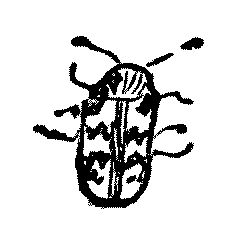
(This appears by the drawing, here copied from the original manuscript, to be Chrysomela lapponica.) Here grew a Salix with ovate-oblong leaves, very hairy all over (S. lanata); its catkins were, for the most part, far advanced and faded.
In the evening I arrived at Jamtboht, where some women were sitting employed in cutting the bark of the aspen-tree (Populus tremula) into small pieces, scarcely an inch long, and not half so broad. The bark is stripped from the tree just when the leaves begin to sprout forth, and laid up in a place under the roof of a house till autumn or the following spring, when it is cut into the small fragments above described. In this state it serves as food for cows, goats and sheep, instead of hay, the latter being a very scarce article in these parts; for the fields consist principally of marshy tracts, whose herbage is but of a coarse kind.
On my inquiring what I could have for supper, they set before me the breast of a Cock of the wood (Tetrao Urogallus), which had been shot and dressed some time the preceding year. Its aspect was not very inviting, and I imagined the flavour would not be much better; but in this respect I was mistaken. The taste proved delicious, and I wondered at the ignorance of those who, having more fowls than they know how to dispose of, suffer many of them to be spoiled, as often happens at Stockholm. I found with pleasure that these poor Laplanders know better than some of their more opulent neighbours, how to employ the good things which God has bestowed upon them. After the breast is plucked, separated from the other parts of the bird, and cleaned, a gash is cut longitudinally on each side of the breast-bone, quite through to the bottom, and two others parallel to it, a little further off, so that the inside of the flesh is laid open in order that it may be thoroughly dressed. The whole is first salted with fine salt for several days. Afterwards a small quantity of flour is strewed on the under side to prevent its sticking, and then it is put into an oven to be gradually dried. When done, it is hung up in the roof of the house to be kept till wanted, where it would continue perfectly good, even for three years, if it were necessary to preserve it so long.
It rained so violently that I could not continue my journey that evening, and was therefore obliged to pass the night at this place. The pillows of my bed were stuffed with the hair of the reindeer instead of feathers. Under the sheet was the hide of a reindeer with the hair on, the hairy side uppermost, on which the people told me I should lie very soft.
May 27.
In the morning the continued rain prevented my pursuing my journey till noon. The bark of the large smooth kinds of Willow is here used for tanning leather. The smooth bark of the upper branches, cut into small pieces, is chosen for the purpose, the coarse part on the bottom of the stem being useless.
At noon I departed from the place where I had slept, and continued to pursue the same bad road as the preceding day, which was indeed the worst I ever saw, consisting of stones piled on stones, among large entangled roots of trees. In the interstices were deep holes filled with water by the heavy rains. The frost, which had but just left the ground, contributed to make matters worse. All the elements were against me. The branches of the trees hung down before my eyes, loaded with rain-drops, in every direction. Wherever any young birch trees appeared, they were bent down to the earth, so that they could not be passed without the greatest difficulty. The aged pines, which for so many seasons had raised their proud tops above the rest of the forest, overthrown by the wrath of Juno, lay prostrate in my way. The rivulets which traversed the country in various directions were very deep, and the bridges over them so decayed and ruinous, that it was at the peril of one's neck to pass them on a stumbling horse. It seemed beyond the power of man to make the road tolerable, unless a Bjelke (Governor of Gefle) had the command of the district.
Many persons had confidently assured me, that it was absolutely impossible to travel to Lycksele in the summer season; but I had always comforted myself with the saying of Solomon, that "nothing is impossible under the sun:" however, I found that if patience be requisite any where, it is at this place. To complete my distresses, I had got a horse whose saddle was not stuffed, and instead of a bridle I had only a rope, which was tied to the animal's under jaw. In this trim I proceeded on my journey.
Here and there, in the heart of the forest, were level heathy spots, as even as if they had been made so by a line, consisting of barren sand (Arena Glarea), on which grew a few straggling firs, and some scattered plants of ling. Some places afforded the perforated coralline Lichen (L. uncialis), which the inhabitants, in rainy weather when it is tough, rake together into large heaps, and carry home for the winter provender of their cattle. These sandy spots were in extent three quarters of a mile or a mile, encompassed as it were with a rampart, or very steep bank, fifteen or twenty ells in height, so nearly perpendicular that it was not to be ascended or descended without extreme difficulty. They might be compared to the mountain which Alexander the Great ascended with so much labour. It often happened that above one of these sandy heaths lay another equally barren. They resembled the ridges of a field, except the perfect flatness and great breadth of the surface of each, and their being destitute of stones. The interstices of the country between these embanked heaths were occupied by water, rocks and marshes, producing abundance of firs intermixed with some birches, all covered with black and white filamentous Lichens. Juniper bushes but rarely occurred, and were all of a very diminutive size, and close-pressed to the ground.
At Skullbacken is a small current of water, which rises out of the ground at that very spot. I tried to feel the bottom with my stick, but could not reach it.
At Abackan, and on the road beyond it for a considerable way, some loose ice still remained, which surprised me much at this season of the year; yet I recollected that but a week before I had met with snow in the neighbourhood of mount Skula.
Here and there on the road lay a crustaceous Byssus, consisting as it were of a white rough brittle membrane, with white grains scattered over it[18].
On the sandy heaths among the perforated Lichen (uncialis) grew another kind much resembling it, but as thick as the finger, snow-white, and with more copious and dense entangled branches, which, not having been hitherto described, I denominated Coralloides ramosissimum perforatum, ramis implexis, niveum[19]. There was also an elegant cup-moss, (L. cocciferus,) repeatedly proliferous from the centre of its cups, two or more cups originating together from one centre, all over of a grey hue, except the scarlet tubercles which bordered the uppermost cups. Every where in the road grew the beforementioned leafy sulphur-coloured Lichen (nivalis?) in the greatest profusion.
The marshy places abounded with Muscus tectorius[20] and Polytrichum, intermixed with abundance of Black Whortle-berries.
Wherever I came I could get nothing to drink but water.
Against the walls of the houses the Agaric shaped like a horse's hoof (Boletus igniarius) was hung up to serve as a pin-cushion.
As a protection against rain, the people wear a broad horizontal collar made of birch bark, fastened round the neck with pins.
The women wash their houses with a kind of brush, made of twigs of spruce fir, which they tie to the right foot, and go backwards and forwards over the floor[21].
I observed they had gathered some of the Water Trefoil (Menyanthes trifoliata), which is the plant here called Missne. It is ground and mixed with their corn to make bread. They also boil it with some kinds of berries into an electuary, but it is in every state very bitter. The root only is used.
Part of this day's journey was performed in a Lapland boat, which will be described hereafter.
The peasants of this country, instead of tobacco, smoke the buds of hops, or sometimes juniper berries, and when nothing else can be had, the bark of the juniper tree; but to supply the want of snuff they use ashes mixed with a small portion of real snuff. They strain their milk through platted tufts of hair from a cow's tail.
In the evening I reached Teksnas, situated in the parish of Umoea. Seven miles distant from this place is the church, the road to which is execrable, insomuch that the people are obliged to set out on Friday morning to get to church on Sunday. On this account they can very seldom attend divine service, except on fast days, Whitsunday, Easter Sunday, and Christmas day.
How trifling would be the expense of building a small church, and how much have those in authority to answer for before God for neglecting to provide one! Timber for the purpose was brought here so long ago as the time of the late Abraham Lindelius; but it has lain till it is rotten, as the clergy find some difficulty in the undertaking: nor is this the only obstacle!
Here I observed a kind of dark-coloured gnat with very large dark wings (Empis borealis.)
May 28.
I left Teksnas and proceeded to Genom; but as there is no conveyance but by water, from the last-mentioned place to Lycksele, and the wind blew very hard, I was obliged to stop at Genom till the following day. Indeed I did not arrive there till nine o'clock, when I found the people assembled at prayers, after which a sermon was read out of a book containing several; and as this service did not end till eleven, it would then have been too late to have set out for Lycksele, more than five miles distant, without any house or resting-place between.
One of the peasants here had shot a small Beaver. I inquired concerning the food of this animal, and was told it was the bark of trees, the birch, fir, and mountain ash, but more especially the aspen, and the castor becomes larger in proportion as the beaver can get more of the aspen bark. This confirmed the truth of what Assessor Rothman formerly asserted, that castor is secreted from the intermediate bark of the poplar, which has the same scent, though not quite so strong: hence it is to be presumed that a decoction of this bark, if the dose were sufficiently large, would have the same medicinal effects.
I wonder no naturalist has classed this animal with the Mouse tribe, (Mures. Linnæus afterwards called the Order Glires,) as its broad depressed form at first sight suggested to me that it was of that family; in which opinion I was confirmed when I examined the broad naked tail, the short obtuse ears, and the two pair of parallel front teeth, so well formed for cutting, of which the lower pair are the largest.
The people here eat the flesh of the beaver as well as of the hare and squirrel, which indeed are all of the same natural family. The Romans, we are told, ate mice by way of a choice dainty. The beaver is very seldom roasted, but generally boiled. The rump is thrown away, but the feet are eaten. The skin spread out and dried is worth twelve dollars. The castor fetches half a dollar, or sometimes a dollar. I found the boiled flesh very insipid, for want of salt.
This young Beaver, which fell under my examination, was a foot and half long, exclusive of the tail, which was a palm in length and two inches and a half in breadth. The hairs on the back were longer than the rest; the external ones brownish black, the inner pale brown. The belly clothed with short dark-brown fur. Body depressed. Ears obtuse, clothed with fine short hairs, and destitute of any accessory lobe. Snout blunt, with round nostrils. Upper lip cloven as far as the nostrils; lower very short. The whiskers black, long and stout. Eye-brow of three bristles like the whiskers over each eye. Neck none. The fur of the belly was distinguished from that of the sides by a line on each side, in which the skin was visible. Feet clothed with very short hairs, quite different from those of the body. A fleshy integument invested the whole body. The intestinum cæcum was large, with a very large appendix. Upon the stomach lay two large cellular glands, of whose nature and use I am ignorant. There were two cutting teeth in each jaw, of which the upper pair were the shortest, and notched at the summit like steps; the lower and larger pair were sloped off obliquely. Grinders very far remote from the fore-teeth, which is characteristic of the animal, four on each side. Hind feet webbed, but fore feet with separate claws. Tail flat, oblong, obtuse, with a reticulated naked surface.
The strength of the Beaver in its fore teeth, so as to cut through the trunk of the largest aspen trees, is I believe beyond that of any other animal.
May 29.
Very early in the morning I quitted Genom in a haœ9;p or small boat, such as shall be hereafter described, proceeding along the western branch of the river of Umoea; for the river which takes its name from that place divides into two branches near Gresele, two miles from Umoea. One branch comes from Lycksele, the other, as I was told, from Sorsele. By the western branch, as I have just mentioned, we proceeded to Lycksele. When the sun rose, nothing could be more pleasant than the view of this clear unruffled stream, neither contaminated by floods, nor disturbed by the breath of Æolus. All along its translucent margin the forests which clothed its banks were reflected like another landscape in the water. On both sides were several large level heaths, guarded by steep ramparts towards the river, and these were embellished with plants and bushes, the whole reversed in the water appearing to great advantage. The huge pines, which had hitherto braved Neptune's power, smiled with a fictitious shadow in the stream. Neptune however, in alliance with his brother Æolus, had already triumphed over many of their companions, the former by attacking their roots, while the latter had demolished their branches.
We passed several small islets separated from the main land by the action of the current, as Calnäsholm (the isle of Calnäs), &c. Close to the shore were many Charadrii Hiaticulæ (Ringed Plovers) and Tringæ (Sandpipers). One of the latter my companions shot, but destroyed it so completely that we obtained only a wing and a leg entire, the remaining parts being so torn that I could not make out the species. The foot consisted of four toes, of which the hinder one was very small, and the two external ones joined by a web at their base.
A little further on a couple of young owls were suspended on a tree. On my inquiring what these birds had done to be so served, the rower made me remark, on the most lofty of the fir trees, concave cylinders of wood, closed at top and bottom, and having an aperture on one side. These cylinders are placed on the highest part of the trees, in order to tempt Wild ducks to lay their eggs in them, and they are afterwards plundered by the country people. In one of these nests a brood of young owls had been hatched instead of young ducks.
Presently afterwards the breast of a Cock of the wood was given me to eat, by way of a bait. It had been shot this spring and dried in the sun, without being previously cooked; neither had it so many longitudinal cuts as that I have described in the foregoing pages.
As we proceeded further we saw seven or eight large white swans lying on the water, making a loud noise, and biting one another with their beaks. Cranes also are found here. The rower said he had shot one and nailed it up against the wall, with all its flesh and feathers on. What an absurdity!
The peasant who was my rower and companion had placed nets all along the shore, in which he caught plenty of pike. He had upwards of thirty small nets. The money with which he pays his taxes is chiefly acquired by fishing. A dried pike of twenty pounds weight is sold for a dollar and five marks, silver coin.
In one of the nets he found a large male Goosander caught (Mergus Merganser).
The bill of this bird was long and narrow, of a blood red, blackish on the upper edge. Its upper mandible longest, tipped with a hooked point which rendered it obtuse, and furnished with thirty large teeth pointing inwards. Lower mandible channelled underneath, and furnished with about forty smaller teeth, likewise pointing inwards. A triple row of very small teeth was observable in the upper mandible within the others. Tongue narrow, bordered with bristles and with a double row of very minute teeth. Nostrils oblong, placed in the substance of the bill. Eyes round, with a crimson iris. A pellucid membrane, proceeding from the inner corner of the eye, covers the ball while the bird is diving under water; which is remarkable. It has besides a whitish membrane of greater thickness (membrana nictitans), which closes the eye as in other birds. The head is of a grey colour, with a very long pendulous blackish crest composed of a few light downy feathers. Neck like that of a Woodcock. Breast and belly white. Middle of the back black, with white lateral spots, further on grey or whitish, with transverse undulated lines. The ten outermost large feathers of the wing are black; the inner ones black and white, so that the speculum, or spot of the wing, is very large and white, divided by two black transverse lines. Tail short, ash-coloured. Feet red. Legs compressed. Hind toe very small, with a membranous lobe, and curved inwards. Fore toes three, the outermost of four joints, middle one of three, and the innermost of two only. All the toes are connected by a palmate web, and the innermost has, besides, a marginal longitudinal membrane. The windpipe is remarkable, formed not of half rings, as in most birds, but of circular ones. About the middle it is dilated into a sort of bag, and further down into another smaller one[22].