Old Stories (continued 2)
Reading edition
*
On the seventh day after the boy's birth, we partly shaved his head. And in the evening we had the shichiya [seventh-day festival]—but, this time, all by ourselves.
—My husband had caught a bad cold some time before; and he could not go to work next morning, as he was coughing badly. So he remained in the house.
Early in the morning the child had taken his milk as usual. But, about ten o'clock in the forenoon, he seemed to be suffering great pain in his breast; and he began to moan so strangely that we sent a man for a doctor. Unfortunately the doctor that we asked to come was out of town; and we were told that he would not come back before night. Therefore, we thought that it would be better to send at once for another doctor; and we sent for one. He said that he would come in the evening. But, about two o'clock in the afternoon, the child's sickness suddenly became worse; and a little before three o'clock—the twenty-seventh day of the second month—aënaku![48]—my child was dead, having lived for only eight days....
*
—I thought to myself that, even if this new misfortune did not cause my husband to feel an aversion for me, thus having to part with all my children, one after another, must be the punishment of some wrong done in the time of a former life. And, so thinking, I knew that my sleeves would never again become dry,—that the rain [of tears] would never cease,—that never again in this world would the sky grow clear for me.
And more and more I wondered whether my husband's feelings would not change for the worse, by reason of his having to meet such trouble, over and over again, on my account. I felt anxious about his heart, because of what already was in my own.
Nevertheless, he only repeated the words, Temméï itashikata koré naku: "From the decrees of Heaven there is no escape."
*
—I thought that I should be better able to visit the tomb of my child if he were buried in some temple near us. So the funeral took place at the temple called Sempu-kuji in Ōkubo; and the ashes were buried there....
Tanoshimi mo Samété hakanashi Haru no yumé![49]
[Translation.]
—All the delight having perished, hopeless I remain: it was only a dream of Spring![50]
[No date.]
... I wonder whether it was because of the sorrow that I suffered—my face and limbs became slightly swollen during the fortnight[51] after my boy's death.—It was nothing very serious, after all, and it soon went away.... Now the period of twenty-one days [the period of danger] is past....
*
Here the poor mother's diary ends. The closing statement regarding the time of twenty-one days from the birth of her child leaves it probable that these last lines were written on the thirteenth or fourteenth day of the third month. She died on the twenty-eighth of the same month.
*
I doubt if any one not really familiar with the life of Japan can fully understand this simple history. But to imagine the merely material conditions of the existence here recorded should not be difficult:—the couple occupying a tiny house of two rooms—one room of six mats and one of three;—the husband earning barely per month;—the wife sewing, washing, cooking (outside the house, of course);—no comfort of fire, even during the period of greatest cold. I estimate that the pair must have lived at an average cost of about seven pence a day, not including house-rent. Their pleasures were indeed very cheap: a payment of twopence admitted them to theatres or to gidayū-recitations; and their sight-seeing was done on foot. Yet even these diversions were luxuries for them. Expenses represented by the necessary purchase of clothing, or by the obligation of making presents to kindred upon the occasion of a marriage or a birth or a death, could only have been met by heroic economy. Now it is true that thousands of poor folk in Tōkyō live still more cheaply than this,—live upon a much smaller income than £1 per month,—and nevertheless remain always clean, neat, and cheerful. But only a very strong woman can easily bear and bring up children under such conditions,—conditions much more hazardous than those of the harder but healthier peasant-life of the interior. And, as might be supposed, the weakly fail and perish in multitude.
*
Readers of the diary may have wondered at the eagerness shown by so shy and gentle a woman to become thus suddenly the wife of a total stranger, about whose character she knew absolutely nothing. A majority of Japanese marriages, indeed, are arranged for in the matter-of-fact way here described, and with the aid of a nakōdo; but the circumstances, in this particular case, were exceptionally discomforting. The explanation is pathetically simple. All good girls are expected to marry; and to remain unmarried after a certain age is a shame and a reproach. The dread of such reproach, doubtless, impelled the writer of the diary to snatch at the first chance of fulfilling her natural destiny. She was already twenty-nine years old;—another such chance might never have offered itself.
*
To me the chief significance of this humble confession of struggle and failure is not in the utterance of anything exceptional, but in the expression of something as common to Japanese life as blue air and sunshine. The brave resolve of the woman to win affection by docility and by faultless performance of duty, her gratitude for every small kindness, her childlike piety, her supreme unselfishness, her Buddhist interpretation of suffering as the penalty for some fault committed in a previous life, her attempts to write poetry when her heart was breaking,—all this, indeed, I find touching, and more than touching. But I do not find it exceptional. The traits revealed are typical,—typical of the moral nature of the woman of the people. Perhaps there are not many Japanese women of the same humble class who could express their personal joy and pain in a record at once so artless and pathetic; but there are millions of such women inheriting—from ages and ages of unquestioning faith—a like conception of life as duty, and an equal capacity of unselfish attachment.
Heiké-gani
In various countries of which the peoples appear strange to us, by reason of beliefs, ideas, customs, and arts having nothing in common with our own, there can be found something in the nature of the land—something in its flora or fauna—characterized by a corresponding strangeness. Probably the relative queerness of the exotic nature in such regions helped more or less to develop the apparent oddity of the exotic mind. National differences of thought or feeling should not be less evolutionally interpretable than the forms of vegetables or of insects; and, in the mental evolution of a people, the influence of environment upon imagination must be counted as a factor....
*
These reflections were induced by a box of crabs sent me from the Province of Chōshū,—crabs possessing that very same quality of grotesqueness which we are accustomed to think of as being peculiarly Japanese. On the backs of these creatures there are bossings and depressions that curiously simulate the shape of a human face,—a distorted face,—a face modelled in relief as a Japanese craftsman might have modelled it in some moment of artistic whim.
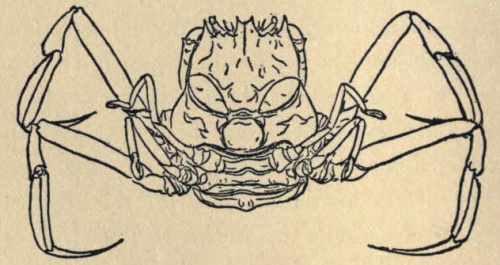
Two varieties of such crabs—nicely dried and polished—are constantly exposed for sale in the shops of Akamagaséki (better known to foreigners by the name of Shimonoséki). They are caught along the neighbouring stretch of coast called Dan-no-Ura, where the great clan of the Heiké, or Taira, were exterminated in a naval battle, seven centuries ago, by the rival clan of Genji, or Minamoto. Readers of Japanese history will remember the story of the Imperial Nun, Nii-no-Ama, who in the hour of that awful tragedy composed a poem, and then leaped into the sea, with the child-emperor Antoku in her arms.
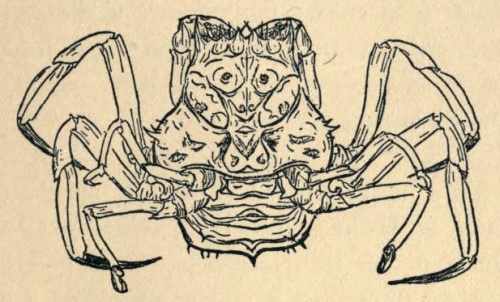
Now the grotesque crabs of this coast are called Heiké-gani, or "Heiké-crabs," because of a legend that the spirits of the drowned and slaughtered warriors of the Heiké-clan assumed such shapes; and it is said that the fury or the agony of the death-struggle can still be discerned in the faces upon the backs of the crabs. But to feel the romance of this legend you should be familiar with old pictures of the fight of Dan-no-Ura,—old coloured prints of the armoured combatants, with their grim battle-masks of iron and their great fierce eyes.
The smaller variety of crab is known simply as a "Heiké-crab,"—Heiké-gani. Each Heiké-gani is supposed to be animated by the spirit of a common Heiké warrior only,—an ordinary samurai. But the larger kind of crab is also termed Taishō-gani ("Chieftain-crab"), or Tatsugashira ("Dragon-helmet"); and all Taishō-gani or Tatsugashira are thought to be animated by ghosts of those great Heiké captains who bore upon their helmets monsters unknown to Western heraldry, and glittering horns, and dragons of gold.
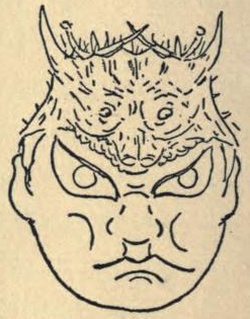
I got a Japanese friend to draw for me the two pictures of Heiké-gani herewith reproduced; and I can vouch for their accuracy. But I told him that I could not see anything resembling a helmet, either in his drawing of the Tatsugashira, nor in the original figure upon the back of the crab.
"Can you see it?" I asked. "Why, yes,—somewhat like this," he answered, making the following sketch:—
"Well, I can make out part of the head-gear," I said;—"but that outline of yours is not according to facts,—and that face is vapid as the face of the Moon. Look at the nightmare on the back of the real crab!..."
Fireflies
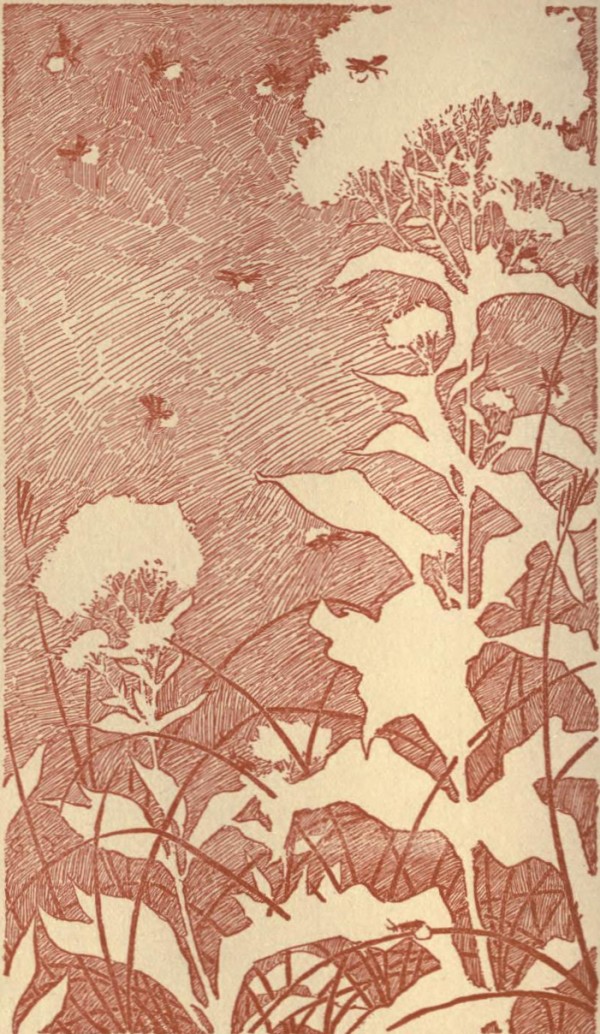
I
I want to talk about Japanese fireflies, but not entomologically. If you are interested, as you ought to be, in the scientific side of the subject, you should seek enlightenment from a Japanese professor of biology, now lecturing at the Imperial University of Tōkyō. He signs himself "Mr. S. Watasé" (the "S" standing for the personal name Shozaburo); and he has been a teacher as well as a student of science in America, where a number of his lectures have been published,[1]—lectures upon animal phosphorescence, animal electricity, the light-producing organs of insects and fishes, and other wonderful topics of biology. He can tell you all that is known concerning the morphology of fireflies, the physiology of fireflies, the photometry of fireflies, the chemistry of their luminous substance, the spectroscopic analysis of their light, and the significance of that light in terms of ether-vibration. By experiment he can show you that, under normal conditions of temperature and environment, the number of light-pulsations produced by one species of Japanese firefly averages twenty-six per minute; and that the rate suddenly rises to sixty-three per minute, if the insect be frightened by seizure. Also he can prove to you that another and smaller kind of firefly, when taken in the hand, will increase the number of its light-pulsings to upward of two hundred per minute. He suggests that the light may be of some protective value to the insect,—like the "warning colours" of sundry nauseous caterpillars and butterflies,—because the firefly has a very bitter taste, and birds appear to find it unpalatable. (Frogs, he has observed, do not mind the bad taste: they fill their cold bellies with fireflies till the light shines through them, much as the light of a candle-flame will glow through a porcelain jar.) But whether of protective value or not, the tiny dynamo would seem to be used in a variety of ways,—as a phototelegraph, for example. As other insects converse by sound or by touch, the firefly utters its emotion in luminous pulsings: its speech is a language of light.... I am only giving you some hints about the character of the professor's lectures, which are never merely technical. And for the best part of this non-scientific essay of mine,—especially that concerning the capture and the sale of fireflies in Japan,—I am indebted to some delightful lectures which he delivered last year to Japanese audiences in Tōkyō.
II
As written to-day, the Japanese name of the firefly (hotaru) is ideographically composed with the sign for fire, doubled, above the sign for insect. The real origin of the word is nevertheless doubtful; and various etymologies have been suggested. Some scholars think that the appellation anciently signified "the First-born of Fire"; while others believe that it was first composed with syllables meaning "star" and "drop." The more poetical of the proposed derivations, I am sorry to say, are considered the least probable. But whatever may have been the primal meaning of the word hotaru, there can be no doubt as to the romantic quality of certain folk-names still given to the insect. Two species of firefly have a wide distribution in Japan; and these have been popularly named Genji-botaru and Heiké-botaru: that is to say, "the Minamoto-Firefly" and "the Taira-Firefly." A legend avers that these fireflies are the ghosts of the old Minamoto and Taira warriors; that, even in their insect shapes, they remember the awful clan-struggle of the twelfth century; and that once every year, on the night of the twentieth day of the fourth month,[2] they fight a great battle on the Uji River. Therefore, on that night all caged fireflies should be set free, in order that they may be able to take part in the contest.
*
The Genji-botaru is the largest of Japanese fireflies,—the largest species, at least, in Japan proper, not including the Loochoo Islands. It is found in almost every part of the country from Kyūshū to Ōshū. The Heiké-botaru ranges further north, being especially common in Yezo; but it is found also in the central and southern provinces. It is smaller than the Genji, and emits a feebler light. The fireflies commonly sold by insect-dealers in Tōkyō, Ōsaka, Kyoto, and other cities, are of the larger species. Japanese observers have described the light of both insects as "tea-coloured" (cha-iro),—the tint of the ordinary Japanese infusion, when the leaf is of good quality, being a clear greenish yellow. But the light of a fine Genji-firefly is so brilliant that only a keen eye can detect the greenish colour: at first sight the flash appears yellow as the flame of a wood-fire, and its vivid brightness has not been overpraised in the following hokku:—
Kagaribi mo Hotaru mo hikaru— Genji kana!
"Whether it be a glimmering of festal-fires[3] [far away], or a glimmering of fireflies, [one can hardly tell]—ah, it is the Genji!"
*
Although the appellations Genji-botaru and Heiké-botaru are still in general use, both insects are known by other folk-names. In different provinces the Genji is called Ō-botaru, or "Great Firefly"; Ushi-botaru, or "Ox-Firefly"; Kuma-botaru, or "Bear-Firefly"; and Uji-botaru, or "Firefly of Uji,"—not to mention such picturesque appellations as Komosō-botaru and Yamabuki-botaru, which could not be appreciated by the average Western reader. The Heiké-botaru is also called Himé-botaru, or "Princess-Firefly"; Nennéi-botaru, or "Baby-Firefly"; and Yuréi-botaru, or "Ghost-Firefly." But these are only examples chosen at random: in almost every part of Japan there is a special folk-name for the insect.
III
There are many places in Japan which are famous for fireflies,—places which people visit in summer merely to enjoy the sight of the fireflies. Anciently the most celebrated of all such places was a little valley near Ishiyama, by the lake of Ōmi. It is still called Hotaru-Dani, or the Valley of Fireflies. Before the Period of Genroku (1688-1703), the swarming of the fireflies in this valley, during the sultry season, was accounted one of the natural marvels of the country. The fireflies of the Hotaru-Dani are still celebrated for their size; but that wonderful swarming of them, which old writers described, is no longer to be seen there. At present the most famous place for fireflies is in the neighbourhood of Uji, in Yamashirō. Uji, a pretty little town in the centre of the celebrated tea-district, is situated on the Ujigawa, and is scarcely less famed for its fireflies than for its teas. Every summer special trains run from Kyōtō and Ōsaka to Uji, bringing thousands of visitors to see the fireflies. But it is on the river, at a point several miles from the town, that the great spectacle is to be witnessed,—the Hotaru-Kassen, or Firefly Battle. The stream there winds between hills covered with vegetation; and myriads of fireflies dart from either bank, to meet and cling above the water. At moments they so swarm together as to form what appears to the eye like a luminous cloud, or like a great ball of sparks. The cloud soon scatters, or the ball drops and breaks upon the surface of the current, and the fallen fireflies drift glittering away; but another swarm quickly collects in the same locality. People wait all night in boats upon the river to watch the phenomenon. After the Hotaru-Kassen is done, the Ujikawa, covered with the still sparkling bodies of the drifting insects, is said to appear like the Milky Way, or, as the Japanese more poetically call it, the River of Heaven. Perhaps it was after witnessing such a spectacle that the great female poet, Chiyo of Kaga, composed these verses:—
Kawa bakari, Yami wa nagarété—? Hotaru kana!
—Which may be thus freely rendered:—
"Is it the river only?—or is the darkness itself drifting?... Oh, the fireflies!..."[4]
IV
Many persons in Japan earn their living during the summer months by catching and selling fireflies: indeed, the extent of this business entitles it to be regarded as a special industry. The chief centre of this industry is the region about Ishiyama, in Goshū, by the Lake of Ōmi,—a number of houses there supplying fireflies to many parts of the country, and especially to the great cities of Osaka and Kyōtō. From sixty to seventy firefly-catchers are employed by each of the principal houses during the busy season. Some training is required for the occupation. A tyro might find it no easy matter to catch a hundred fireflies in a single night; but an expert has been known to catch three thousand. The methods of capture, although of the simplest possible kind, are very interesting to see.
Immediately after sunset, the firefly-hunter goes forth, with a long bamboo pole upon his shoulder, and a long bag of brown mosquito-netting wound, like a girdle, about his waist. When he reaches a wooded place frequented by fireflies,—usually some spot where willows are planted, on the bank of a river or lake,—he halts and watches the trees. As soon as the trees begin to twinkle satisfactorily, he gets his net ready, approaches the most luminous tree, and with his long pole strikes the branches. The fireflies, dislodged by the shock, do not immediately take flight, as more active insects would do under like circumstances, but drop helplessly to the ground, beetle-wise, where their light—always more brilliant in moments of fear or pain—renders them conspicuous. If suffered to remain upon the ground for a few moments, they will fly away. But the catcher, picking them up with astonishing quickness, using both hands at once, deftly tosses them into his mouth—because he cannot lose the time required to put them, one by one, into the bag. Only when his mouth can hold no more, does he drop the fireflies, unharmed, into the netting.
Thus the firefly-catcher works until about two o'clock in the morning,—the old Japanese hour of ghosts,—at which time the insects begin to leave the trees and seek the dewy soil. There they are said to bury their tails, so as to remain viewless. But now the hunter changes his tactics. Taking a bamboo broom he brushes the surface of the turf, lightly and quickly. Whenever touched or alarmed by the broom, the fireflies display their lanterns, and are immediately nipped and bagged. A little before dawn, the hunters return to town.
At the firefly-shops the captured insects are sorted as soon as possible, according to the brilliancy of their light,—the more luminous being the higher-priced. Then they are put into gauze-covered boxes or cages, with a certain quantity of moistened grass in each cage. From one hundred to two hundred fireflies are placed in a single cage, according to grade. To these cages are attached small wooden tablets inscribed with the names of customers,—such as hotel proprietors, restaurant-keepers, wholesale and retail insect-merchants, and private persons who have ordered large quantities of fireflies for some particular festivity. The boxes are despatched to their destinations by nimble messengers,—for goods of this class cannot be safely intrusted to express companies.
Great numbers of fireflies are ordered for display at evening parties in the summer season. A large Japanese guest-room usually overlooks a garden; and during a banquet or other evening entertainment, given in the sultry season, it is customary to set fireflies at liberty in the garden after sunset, that the visitors may enjoy the sight of the sparkling. Restaurant-keepers purchase largely. In the famous Dōtombori of Ōsaka, there is a house where myriads of fireflies are kept in a large space enclosed by mosquito-netting; and customers of this house are permitted to enter the enclosure and capture a certain number of fireflies to take home with them.
*
The wholesale price of living fireflies ranges from three sen per hundred up to thirteen sen per hundred, according to season and quality. Retail dealers sell them in cages; and in Tokyo the price of a cage of fireflies ranges from three sen up to several dollars. The cheapest kind of cage, containing only three or four fireflies, is scarcely more than two inches square; but the costly cages—veritable marvels of bamboo work, beautifully decorated—are as large as cages for song-birds. Firefly cages of charming or fantastic shapes—model houses, junks, temple-lanterns, etc.—can be bought at prices ranging from thirty sen up to one dollar.
Dead or alive, fireflies are worth money. They are delicate insects, and they live but a short time in confinement. Great numbers die in the insect-shops; and one celebrated insect-house is said to dispose every season of no less than five shō—that is to say, about one peck—of dead fireflies, which are sold to manufacturing establishments in Osaka. Formerly fireflies were used much more than at present in the manufacture of poultices and pills, and in the preparation of drugs peculiar to the practice of Chinese medicine. Even to-day some curious extracts are obtained from them; and one of these, called Hotaru-no-abura, or Firefly-grease, is still used by woodworkers for the purpose of imparting rigidity to objects made of bent bamboo.
A very curious chapter on firefly-medicine might be written by somebody learned in the old-fashioned literature. The queerest part of the subject is Chinese, and belongs much more to demonology than to therapeutics. Firefly-ointments used to be made which had power, it was alleged, to preserve a house from the attacks of robbers, to counteract the effect of any poison, and to drive away "the hundred devils." And pills were made with firefly-substance which were believed to confer invulnerability;—one kind of such pills being called Kanshōgan, or "Commander-in-Chief Pills"; and another, Buigan, or "Military-Power Pills."
V
Firefly-catching, as a business, is comparatively modern; but firefly-hunting, as a diversion, is a very old custom. Anciently it was an aristocratic amusement; and great nobles used to give firefly-hunting parties,—botaru-gari. In this busy era of Meiji the botaru-gari is rather an amusement for children than for grown-up folks; but the latter occasionally find time to join in the sport. All over Japan, the children have their firefly-hunts every summer;—moonless nights being usually chosen for such expeditions. Girls follow the chase with paper fans; boys, with long light poles, to the ends of which wisps of fresh bamboo-grass are tied. When struck down by a fan or a wisp, the insects are easily secured, as they are slow to take wing after having once been checked in actual flight. While hunting, the children sing little songs, supposed to attract the shining prey. These songs differ according to locality; and the number of them is wonderful. But there are very few possessing that sort of interest which justifies quotation. Two examples will probably suffice:—
(Province of Choshū.) Hotaru, koi! koi! Koi-tomosé! Nippon ichi no Jōsan ga, Chōchin tomoshité, Koi to ina!
Come, firefly, come! Come with your light burning! The nicest girl in Japan wants to know if you will not light your lantern and come!
(Dialect of Shimonoséki.) Hōchin, koi! Hōchin, koi! Séki no machi no bon-san ga, Chōchin tomoshité, Koi! Koi!
Firefly, come! firefly, come! All the boys of Séki [want you to come] with your lantern lighted! Come! come!
*
Of course, in order to hunt fireflies successfully, it is necessary to know something about their habits; and on this subject Japanese children are probably better informed than a majority of my readers, for whom the following notes may possess a novel interest:—
*
Fireflies frequent the neighbourhood of water, and like to circle above it; but some kinds are repelled by impure or stagnant water, and are only to be found in the vicinity of clear streams or lakes. The Genji-firefly shuns swamps, ditches, or foul canals; while the Heiké-firefly seems to be satisfied with any water. All fireflies seek by preference grassy banks shaded by trees; but they dislike certain trees and are attracted by others. They avoid pine trees, for instance; and they will not light upon rose-bushes. But upon willow trees—especially weeping willows—they gather in great swarms. Occasionally, on a summer night, you may see a drooping willow so covered and illuminated with fireflies that all its branches appear "to be budding fire." During a bright moonlight night fireflies keep as much as possible in shadow; but when pursued they fly at once into the moonshine, where their shimmering is less easily perceived. Lamplight, or any strong artificial light, drives them away; but small bright lights attract them. They can be lured, for example, by the sparkling of a small piece of lighted charcoal, or by the glow of a little Japanese pipe, kindled in the dark. But the lamping of a single lively firefly, confined in a bottle, or cup, of clear glass, is the best of all lures.
*
As a rule the children hunt only in parties, for obvious reasons. In former years it would have been deemed foolhardy to go alone in pursuit of fireflies, because there existed certain uncanny beliefs concerning them. And in some of the country districts these beliefs still prevail. What appear to be fireflies may be malevolent spirits, or goblin-fires, or fox-lights, kindled to delude the wayfarer. Even real fireflies are not always to be trusted;—the weirdness of their kinships might be inferred from their love of willow trees. Other trees have their particular spirits, good or evil, hamadryads or goblins; but the willow is particularly the tree of the dead—the favourite of human ghosts. Any firefly may be a ghost—who can tell? Besides, there is an old belief that the soul of a person still alive may sometimes assume the shape of a firefly. And here is a little story that was told me in Izuno:—
*
One cold winter's night a young shizoku of Matsuë, while on his way home from a wedding-party, was surprised to perceive a firefly-light hovering above the canal in front of his dwelling. Wondering that such an insect should be flying abroad in the season of snow, he stopped to look at it; and the light suddenly shot toward him. He struck at it with a stick; but it darted away, and flew into the garden of a residence adjoining his own.
Next morning he made a visit to that house, intending to relate the adventure to his neighbours and friends. But before he found a chance to speak of it, the eldest daughter of the family, happening to enter the guest-room without knowing of the young man's visit, uttered a cry of surprise, and exclaimed, "Oh! how you startled me! No one told me that you had called; and just as I came in I was thinking about you. Last night I had so strange a dream! I was flying in my dream,—flying above the canal in front of our house. It seemed very pleasant to fly over the water; and while I was flying there I saw you coming along the bank. Then I went to you to tell you that I had learned how to fly; but you struck at me, and frightened me so that I still feel afraid when I think of it.. .." After hearing this, the visitor thought it best not to relate his own experience for the time being, lest the coincidence should alarm the girl, to whom he was betrothed.
VI
Fireflies have been celebrated in Japanese poetry from ancient time; and frequent mention of them is made in early classical prose. One of the fifty-four chapters of the famous novel, Genji-Monogari, for example,—written either toward the close of the tenth century or at the beginning of the eleventh,—is entitled, "Fireflies"; and the author relates how a certain noble person was enabled to obtain one glimpse of a lady's face in the dark by the device of catching and suddenly liberating a number of fireflies. The first literary interest in fireflies may have been stimulated, if not aroused, by the study of Chinese poetry. Even to-day every Japanese child knows a little song about the famous Chinese scholar who, in the time of his struggles with poverty, studied by the light of a paper bag filled with fireflies. But, whatever the original source of their inspiration, Japanese poets have been making verses about fireflies during more than a thousand years. Compositions on the subject can be found in every form of Japanese poetry; but the greater number of firefly poems are in hokku,—the briefest of all measures, consisting of only seventeen syllables. Modern love-poems relating to the firefly are legion; but the majority of these, written in the popular twenty-six-syllable form called dodoïtsu, appear to consist of little more than variants of one old classic fancy, comparing the silent burning of the insect's light to the consuming passion that is never uttered.
*
Perhaps my readers will be interested by the following selection of firefly poems. Some of the compositions are many centuries old:—
Catching Fireflies Mayoi-go no Naku-naku tsukamu Hotaru kana!
Ah! the lost child! Though crying and crying, still he catches fireflies!
Kuraki yori Kuraki hito yobu: Hotaru kana!
Out of the blackness black people call [to each other]: [they are hunting] fireflies!
Iu koto no Kikoëté ya, takaku Tobu hotaru!
Ah! having heard the voices of people [crying "Catch it!"], the firefly now flies higher!
Owarété wa Tsuki ni kakururu Hotaru kana!
Ah, [the cunning] fireflies! being chased, they hide themselves in the moonlight!
Ubayoté Fumi-koroshitaru Hotaru kana!
[Two firefly-catchers] having tried to seize it [at the same time], the poor firefly is trampled to death!
The Light of Fireflies Hotarubi ya! Mada kuréyaranu, Hashi no uri.
Fireflies already sparkling under the bridge,—and it is not yet dark!
Mizu-gusa no Kururu to miété Tobu hotaru.
When the water-grasses appear to grow dark, the fireflies begin to fly.[5]
Oku-no-ma yé Hanashité mitaru Hotaru kana!
Pleasant, from the guest-room,[6] to watch the fireflies being set free in the garden!
Yo no fukuru Hodo ōkinaru Hotaru kana!
Ever as the night grows [deeper, the light of] the firefly also grows [brighter]!
Kusakari no Sodé yori idzuru, Hotaru kana!
See! a firefly flies out of the sleeve of the grass-cutter!
Koko kashiko, Hotaru ni aoshi Yoru no kusa.
Here and there the night-grass appears green, because of the light of the fireflies.
Chōchin no Kiyété, tōtoki Hotaru kana!
How precious seems [the light of] the firefly, now that the lantern-light has gone out!
Mado kuraki, Shōji wo noboru Hotaru kana!
The window itself is dark, but see!—a firefly is creeping up the paper pane!
Moë yasuku, Mata kéyé yasuki, Hotaru kana!
How easily kindled, and how easily put out again, is the light of the firefly!
Hitotsu kité, Niwa no tsuyukéki, Hotaru kana!
Oh! a single firefly having come, one can see the dew in the garden!
Té no hira wo Hau ashi miyuru Hotaru kana!
Oh, this firefly!—as it crawls on the palm of my hand, its legs are visible [by its own light]!
Osoroshi no Té ni sukitōru, Hotaru kana!
It is enough to make one afraid! See! the light of this firefly shows through my hand![7]
Sabéshisaya! Isshaku kiyété Yuku hotaru!
How uncanny! The firefly shoots to within a foot of me, and—out goes the light!
Yuku saki no Sawaru mono naki Hotaru kana!
There goes a firefly! but there is nothing in front of it to take hold of [nothing to touch: what can it be seeking—the ghostly creature?].
Hōki-gi ni Ari to wa miyété, Hotaru kana!
In this hoki-bush it certainly appeared to be,—the firefly! [but where is it?]
Sodé é kité, Yōhan no hotaru Sabishi kana!
This midnight firefly coming upon the sleeve of my robe—how weird[8]!...
Yanagi-ba no Yami saki kaësu Hotaru kana!
For this willow tree the season of budding would seem to have returned in the dark—look at the fireflies!
Mizu soko no Kagé wo kowagaru Hotaru kana!
Ah, he is afraid of the darkness under the water,—that firefly! [Therefore he lights his tiny lantern!]
Sugitaru wa! Mé ni mono sugoshi Tobu hotaru!
Ah, I am going too far!... The flitting of the fireflies here is a lonesome sight!
Hotarubi ya! Kusa ni osamaru Yoäkégata.
Ah, the firefly-lights! As the darkness begins to break, they bury themselves in the grass.
Love-Poems Muréyo, hotaru, Mono iu kao no Miyuru hodo!
O fireflies, gather here long enough to make visible the face of the person who says these things to me![9]
Oto mo sédé, Omoi ni moyuru, Hotaru koso, Naku mushi yori mo Awaré nari-kéri!
Not making even a sound [yet] burning with desire,—for this the firefly indeed has become more worthy of pity than any insect that cries![10]
Yū sareba, Hotaru yori ki ni Moyurédomo, Hikari minéba ya Hito no tsurénaki!
When evening falls, though the soul of me burn more than burns the firefly, as the light [of that burning] is viewless, the person [beloved] remains unmoved.[11]
Miscellaneous Suito yuku, Mizu-gi wa suzushi, Tobu-hotaru!
Here at the water's edge, how pleasantly cool!—and the fireflies go shooting by—suito!
Midzu é kité, Hikuu naritaru Hotaru kana!
Having reached the water, he makes himself low,—the firefly![12]
Kuzu no ha no Ura, utsu amé ya, Tobu-hotaru!
The rain beats upon the Kuzu-plant;[13]—away starts the firefly from the underside of the leaf!
Amé no yo wa, Shita bakari yuku Hotaru kana!
Ah! this rainy night they only go along the ground,—the fireflies!
Yura-yura to Ko-amé furu yo no Hotaru kana!
How they swing themselves, to and fro, the fireflies, on a night of drizzling rain!
Akinuréba, Kusa nomi zo Hotaru-kago.
With the coming of dawn, indeed, there is nothing visible but grass in the cage of the firefly!
Yo ga akété, Mushi ni naritaru Hotaru kana!
With the coming of the dawn, they change into insects again,—these fireflies!
Hiru miréba, Kubi-suji akaki Hotaru kana!
Oh, this firefly!—seen by daylight, the nape of its neck is red!
Hotaru kōté, Shiba shi-go-mai ni Fuzeï kana!
Having bought fireflies, respectfully accord them the favour of four or five tufts of lawn-grass![14]
Song of the Firefly-seller Futatsu, mitsu, Hanashité misénu Hotaru-uri. Mitsu, yotsu wa, Akari ni nokosé Hotaru-uri. Onoga mi wa Yami ni kaëru ya Hotaru-uri.
He will not give you the chance to see two or three fireflies set free,—this firefly-seller.
He leaves in the cage three or four, just to make a light,—this firefly-seller.
For now he must take his own body back into the dark night,—this firefly-seller.
VII
But the true romance of the firefly is to be found neither in the strange fields of Japanese folk-lore nor in the quaint gardens of Japanese poetry, but in the vast profound of science. About science I know little or nothing. And that is why I am not afraid to rush in where angels fear to tread. If I knew what Professor Watasé knows about fireflies, I should feel myself less free to cross the boundaries of relative experience. As it is, I can venture theories.
*
The tremendous hypotheses of physical and psychical evolution no longer seem to me hypotheses: I should never dream of doubting them. I have ceased to wonder at the growth of Life out of that which has been called not-living,—the development of organic out of inorganic existence. The one amazing fact of organic evolution, to which my imagination cannot become accustomed, is the fact that the substance of life should possess the latent capacity or tendency to build itself into complexities incomprehensible of systematic structure. The power of that substance to evolve radiance or electricity is not really more extraordinary than its power to evolve colour; and that a noctiluca, or a luminous centipede, or a firefly, should produce light, ought not to seem more wonderful than that a plant should produce blue or purple flowers. But the biological interpretation of the phenomenon leaves me wondering, just as much as before, at the particular miracle of the machinery by which the light is made. To find embedded in the body of the insect a microscopic working-model of everything comprised under the technical designation of an "electric plant," would not be nearly so wonderful a discovery as the discovery of what actually exists. Here is a firefly, able, with its infinitesimal dynamo, to produce a pure cold light "at one four-hundredth part of the cost of the energy expended in a candle flame"!... Now why should there have been evolved in the tail of this tiny creature a luminiferous mechanism at once so elaborate and so effective that our greatest physiologists and chemists are still unable to understand the operation of it, and our best electricians impotent to conceive the possibility of imitating it? Why should the living tissues crystallize or build themselves into structures of such stupefying intricacy and beauty as the visual organs of an ephemera, the electrical organs of a gymnotus, or the luminiferous organs of a firefly?... The very wonder of the thing forbids me to imagine gods at work: no mere god could ever contrive such a prodigy as the eye of a May-fly or the tail of a firefly.
Biology would answer thus:—"Though it is inconceivable that a structure like this should have been produced by accumulated effects of function on structure, yet it is conceivable that successive selections of favourable variations might have produced it." And no follower of Herbert Spencer is really justified in wandering further. But I cannot rid myself of the notion that Matter, in some blind infallible way, remembers; and that in every unit of living substance there slumber infinite potentialities, simply because to every ultimate atom belongs the infinite and indestructible experience of billions of vanished universes.
A Drop of Dew
Tsuyu no inochi. —Buddhist proverb.
To the bamboo lattice of my study-window a single dewdrop hangs quivering.
Its tiny sphere repeats the colours of the morning,—colours of sky and field and far-off trees. Inverted images of these can be discerned in it,—also the microscopic picture of a cottage, upside down, with children at play before the door.
Much more than the visible world is imaged by that dewdrop: the world invisible, of infinite mystery, is likewise therein repeated. And without as within the drop there is motion unceasing,—motion forever incomprehensible of atoms and forces,—faint shiverings also, making prismatic reply to touches of air and sun.
*
Buddhism finds in such a dewdrop the symbol of that other microcosm which has been called the Soul.... What more, indeed, is man than just such a temporary orbing of viewless ultimates,—imaging sky and land and life,—filled with perpetual mysterious shudderings,—and responding in some wise to every stir of the ghostly forces that environ him?...
*
Soon that tiny globe of light, with all its fairy tints and topsy-turvy picturings, will have vanished away. Even so, within another little while, you and I must likewise dissolve and disappear.
Between the vanishing of the drop and the vanishing of the man, what difference? A difference of words.... But ask yourself what becomes of the dewdrop?
By the great sun its atoms are separated and lifted and scattered. To cloud and earth, to river and sea they go; and out of land and stream and sea again they will be updrawn, only to fall and to scatter anew. They will creep in opalescent mists;—they will whiten in frost and hail and snow;—they will reflect again the forms and the colours of the macrocosm; they will throb to the ruby pulsing of hearts that are yet unborn. For each one of them must combine again with countless kindred atoms for the making of other drops,—drops of dew and rain and sap, of blood and sweat and tears....
How many times? Billions of ages before our sun began to burn, those atoms probably moved in other drops, reflecting the sky-tints and the earth-colours of worlds in some past universe. And after this present universe shall have vanished out of Space, those very same atoms—by virtue of the forces incomprehensible that made them—will probably continue to sphere in dews that will shadow the morning beauty of planets yet to be.
*
Even so with the particles of that composite which you term your very Self. Before the hosts of heaven the atoms of you were—and thrilled,—and quickened,—and reflected appearances of things. And when all the stars of the visible Night shall have burnt themselves out, those atoms will doubtless again take part in the orbing of Mind,—will tremble again in thoughts, emotions, memories,—in all the joys and pains of lives still to be lived in worlds still to be evolved....
*
Your personality?—your peculiarity? That is to say, your ideas, sentiments, recollections?—your very particular hopes and fears and loves and hates? Why, in each of a trillion of dewdrops there must be differences infinitesimal of atom-thrilling and of reflection. And in every one of the countless pearls of ghostly vapour updrawn from the Sea of Birth and Death there are like infinitesimal peculiarities. Your personality signifies, in the eternal order, just as much as the especial motion of molecules in the shivering of any single drop. Perhaps in no other drop will the thrilling and the picturing be ever exactly the same; but the dews will continue to gather and to fall, and there will always be quivering pictures ... The very delusion of delusions is the idea of death as loss.
There is no loss—because there is not any Self that can be lost. Whatsoever was, that you have been;—whatsoever is, that you are;—whatsoever will be, that you must become. Personality!—individuality!—the ghosts of a dream in a dream! Life infinite only there is; and all that appears to be is but the thrilling of it,—sun, moon, and stars,—earth, sky, and sea,—and Mind and Man, and Space and Time. All of them are shadows. The shadows come and go;—the Shadow-Maker shapes forever.
Gaki
—"Venerable Nagasena, are there such things as demons in the world?"
—"Yes, O King."
—"Do they ever leave that condition of existence?"
—"Yes, they do."
—"But, if so, why is it that the remains of those demons are never found?"...
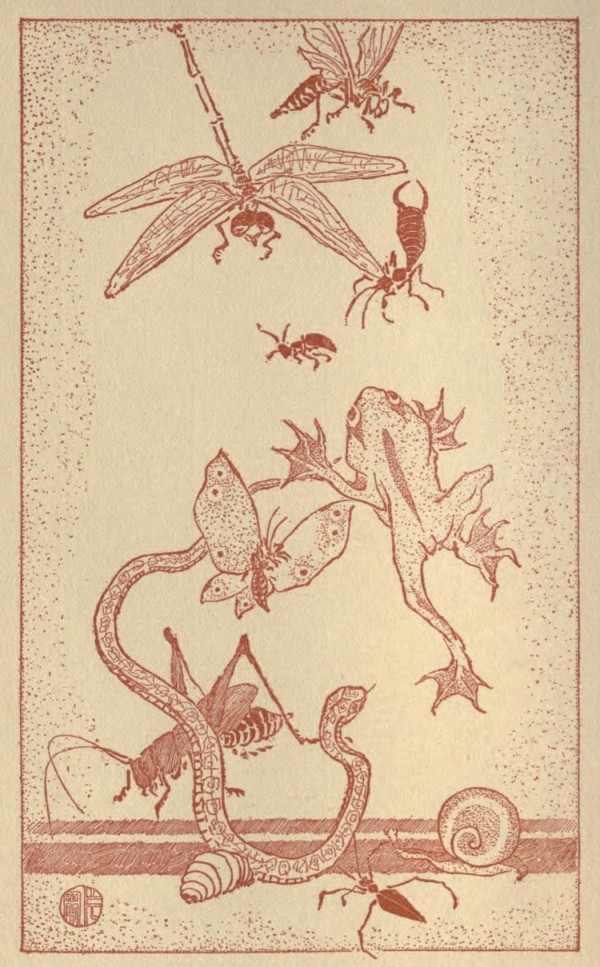
—"Their remains are found, O King.... The remains of bad demons can be found in the form of worms and beetles and ants and snakes and scorpions and centipedes."...
—The Questions of King Milinda.
I
There are moments in life when truths but dimly known before—beliefs first vaguely reached through multiple processes of reasoning—suddenly assume the vivid character of emotional convictions. Such an experience came to me the other day, on the Suruga coast. While resting under the pines that fringed the beach, something in the vital warmth and luminous peace of the hour—some quivering rapture of wind and light—very strangely bestirred an old belief of mine: the belief that all being is One. One I felt myself to be with the thrilling of breeze and the racing of wave,—with every flutter of shadow and flicker of sun,—with the azure of sky and sea,—with the great green hush of the land. In some new and wonderful way I found myself assured that there never could have been a beginning,—that there never could be an end. Nevertheless, the ideas of the moment were not new: the novelty of the experience was altogether in the peculiar intensity with which they presented themselves; making me feel that the flashing dragon-flies, and the long gray sand-crickets, and the shrilling sémi overhead, and the little red crabs astir under the roots of the pines, were all of them brothers and sisters. I seemed to understand, as never before, how the mystery that is called the Soul of me must have quickened in every form of past existence, and must as certainly continue to behold the sun, for other millions of summers, through eyes of other countless shapes of future being. And I tried to think the long slow thoughts of the long gray crickets,—and the thoughts of the darting, shimmering dragonflies,—and the thoughts of the basking, trilling cicadæ,—and the thoughts of the wicked little crabs that lifted up their claws from between the roots of the pines.
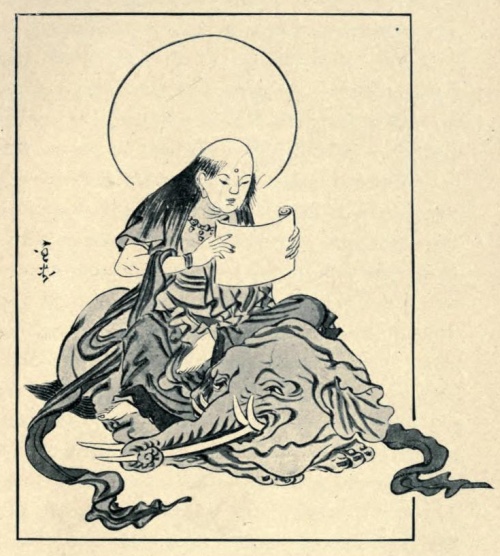
Presently I discovered myself wondering whether the consequence of such thoughts could have anything to do with the recombination of my soul-dust in future spheres of existence. For thousands of years the East has been teaching that what we think or do in this life really decides,—through some inevitable formation of-atom-tendencies, or polarities,—the future place of our substance, and the future state of our sentiency. And the belief is worth thinking about—though no amount of thinking can enable us either to confirm or to disprove it. Very possibly, like other Buddhist doctrines, it may adumbrate some cosmic truth; but its literal assertions I doubt, because I must doubt the power ascribed to thought. By the whole infinite past I have been moulded, within and without: how should the impulse of a moment reshape me against the weight of the eternities?... Buddhism indeed answers how, and that astounding answer is irrefutable,—but I doubt....
Anyhow, acts and thoughts, according to Buddhist doctrine, are creative. Visible matter is made by acts and thoughts,—even the universe of stars, and all that has form and name, and all the conditions of existence. What we think or do is never for the moment only, but for measureless time: it signifies some force directed to the shaping of worlds,—to the making of future bliss or pain. Remembering this, we may raise ourselves to the zones of the Gods. Ignoring it, we may deprive ourselves even of the right to be reborn among men, and may doom ourselves, though innocent of the crimes that cause rebirth in hell, to reënter existence in the form of animals, or of insects, or of goblins,—gaki.[1]
So it depends upon ourselves whether we are to become insects or goblins hereafter; and in the Buddhist system the difference between insects and goblins is not so well defined as might be supposed. The belief in a mysterious relation between ghosts and insects, or rather between spirits and insects, is a very ancient belief in the East, where it now assumes innumerable forms,—some unspeakably horrible, others full of weird beauty.
"The White Moth" of Mr. Quiller-Couch would not impress a Japanese reader as novel; for the night-moth or the butterfly figures in many a Japanese poem and legend as the soul of a lost wife. The night-cricket's thin lament is perhaps the sorrowing of a voice once human;—the strange red marks upon the heads of cicadæ are characters of spirit-names;—dragon-flies and grasshoppers are the horses of the dead. All these are to be pitied with the pity that is kin to love. But the noxious and dangerous insects represent the results of another quality of karma,—that which produces goblins and demons. Grisly names have been given to some of these insects,—as, for example, Jigokumushi, or "Hell-insect," to the ant-lion; and Kappa-mushi, to a gigantic water-beetle which seizes frogs and fish, and devours them alive, thus realizing, in a microcosmic way, the hideous myth of the Kappa, or River-goblin. Flies, on the other hand, are especially identified with the world of hungry ghosts. How often, in the season of flies, have I heard some persecuted toiler exclaim, "Kyō no hai wa, gaki no yo da ne?" (The flies to-day, how like gaki they are!)
II
In the old Japanese, or, more correctly speaking, Chinese Buddhist literature relating to the gaki, the Sanscrit names of the gaki are given in a majority of cases; but some classes of gaki described have only Chinese names. As the Indian belief reached Japan by way of China and Korea, it is likely to have received a peculiar colouring in the course of its journey. But, in a general way, the Japanese classification of gaki corresponds closely to the Indian classification of the pretas.
The place of gaki in the Buddhist system is but one degree removed from the region of the hells, or Jigokudō,—the lowest of all the States of Existence. Above the Jigokudō is the Gakidō, or World of Hungry Spirits; above the Gakidō is the Chikushōdō, or World of Animals; and above this, again, is the Shuradō, a region of perpetual fighting and slaughter. Higher than these is placed the Ningendō, or World of Mankind.
Now a person released from hell, by exhaustion of the karma that sent him there, is seldom reborn at once into the zone of human existence, but must patiently work his way upward thither, through all the intermediate states of being. Many of the gaki have been in hell.
But there are gaki also who have not been in hell. Certain kinds or degrees of sin may cause a person to be reborn as a gaki immediately after having died in this world. Only the greatest degree of sin condemns the sinner directly to hell. The second degree degrades him to the Gakidō. The third causes him to be reborn as an animal.
*
Japanese Buddhism recognizes thirty-six principal classes of gaki. "Roughly counting," says the Shōbō-nen-jō-kyō, "we find thirty-six classes of gaki; but should we attempt to distinguish all the different varieties, we should find them to be innumerable." The thirty-six classes form two great divisions, or orders. One comprises all "Gaki-World-dwellers" (Gaki-Sekai-Ju);—that is to say, all Hungry Spirits who remain in the Gakidō proper, and are, therefore, never seen by mankind. The other division is called Nin-chū-Jū, or "Dwellers among men": these gaki remain always in this world, and are sometimes seen.
There is yet another classification of gaki, according to the character of their penitential torment. All gaki suffer hunger and thirst; but there are three degrees of this suffering. The Muzai-gaki represent the first degree: they must hunger and thirst uninterruptedly, without obtaining any nourishment whatever. The Shōzai-gaki suffer only in the second degree: they are able to feed occasionally upon impure substances. The Usai-gaki are more fortunate: they can eat such remains of food as are thrown away by men, and also the offerings of food set before the images of the gods, or before the tablets of the ancestors. The last two classes of gaki are especially interesting, because they are supposed to meddle with human affairs.
*
Before modern science introduced exact knowledge of the nature and cause of certain diseases, Buddhists explained the symptoms of such diseases by the hypothesis of gaki. Certain kinds of intermittent fever, for example, were said to be caused by a gaki entering the human body for the sake of nourishment and warmth. At first the patient would shiver with cold, because the gaki was cold. Then, as the gaki gradually became warm, the chill would pass, to be succeeded by a burning heat. At last the satiated haunter would go away, and the fever disappear; but upon another day, and usually at an hour corresponding to that of the first attack, a second fit of ague would announce the return of the gaki. Other zymotic disorders could be equally well explained as due to the action of gaki.
*
In the Shōbō-nen-jō-kyō a majority of the thirty-six kinds of gaki are associated with putrescence, disease, and death. Others are plainly identified with insects. No particular kind of gaki is identified by name with any particular kind of insect; but the descriptions suggest conditions of insect-life; and such suggestions are re-ënforced by a knowledge of popular superstitions. Perhaps the descriptions are vague in the case of such spirits as the Jiki-ketsu-gaki, or Blood-suckers; the Jiki-niku-gaki, or Flesh-eaters; the Jiki-da-gaki, or * * * * * *-eaters; the Jiki-fun-gaki, or * * * *-eaters; the Jiki-doku-gaki, or Poison-eaters; the Jiki-fu-gaki, or Wind-eaters; the Jiki-ké-gaki, or Smell-eaters; the Jiki-kwa-gaki, or Fire-eaters (perhaps they fly into lamps?); the Shikkō-gaki, who devour corpses and cause pestilence; the Shinen-gaki, who appear by night as wandering fires; the Shin-ko-gaki, or Needle-mouthed; and the Kwaku-shin-gaki, or Cauldron-bodied,—each a living furnace, filled with flame that keeps the fluids of its body humming like a boiling pot. But the suggestion of the following excerpts[2] will not be found at all obscure:—
*
"Jiki-man-gaki.—These gaki can live only by eating the wigs of false hair with which the statues of certain divinities are decorated.... Such will be the future condition of persons who steal objects of value from Buddhist temples.
"Fujō-ko-hyaku-gaki.—These gaki can eat only street filth and refuse. Such a condition is the consequence of having given putrid or unwholesome food to priests or nuns, or pilgrims in need of alms.
"Cho-ken-ju-jiki-netsu-gaki.—These are the eaters of the refuse of funeral-pyres and of the clay of graves.... They are the spirits of men who despoiled Buddhist temples for the sake of gain.
"Ju-chū-gaki.—These spirits are born within the wood of trees, and are tormented by the growing of the grain. ... Their condition is the result of having cut down shade-trees for the purpose of selling the timber. Persons who cut down the trees in Buddhist cemeteries or temple-grounds are especially likely to become ju-chū-gaki."[3]
Moths, flies, beetles, grubs, worms, and other unpleasant creatures seem thus to be indicated. But some kinds of gaki cannot be identified with insects,—for example, the species called Jiki-hō-gaki, or "Doctrine-eaters." These can exist only by hearing the preaching of the Law of the Buddha in some temple. While they hear such preaching, their torment is assuaged; but at all other times they suffer agonies unspeakable. To this condition are liable after death all Buddhist priests or nuns who proclaim the law for the mere purpose of making money.... Also there are gaki who appear sometimes in beautiful human shapes. Such are the Yoku-shiki-gaki, spirits of lewdness,—corresponding in some sort to the incubi and succubi of our own Middle Ages. They can change their sex at will, and can make their bodies as large or as small as they please. It is impossible to exclude them from any dwelling, except by the use of holy charms and spells, since they are able to pass through an orifice even smaller than the eye of a needle. To seduce young men, they assume beautiful feminine shapes,—often appearing at wine parties as waitresses or dancing girls. To seduce women they take the form of handsome lads. This state of Yoku-shiki-gaki is a consequence of lust in some previous human existence; but the supernatural powers belonging to their condition are results of meritorious Karma which the evil Karma could not wholly counterbalance.
Even concerning the Yoku-shiki-gaki, however, it is plainly stated that they may take the form of insects. Though wont to appear in human shape, they can assume the shape of any animal or other creature, and "fly freely in all directions of space,"—or keep their bodies "so small that mankind cannot see them...." All insects are not necessarily gaki; but most gaki can assume the form of insects when it serves their purpose.
III
Grotesque as these beliefs now seem to us, it was not unnatural that ancient Eastern fancy should associate insects with ghosts and devils. In our visible world there are no other creatures so wonderful and so mysterious; and the true history of certain insects actually realizes the dreams of mythology. To the minds of primitive men, the mere facts of insect-metamorphosis must have seemed uncanny; and what but goblinry or magic could account for the monstrous existence of beings so similar to dead leaves, or to flowers, or to joints of grass, that the keenest human sight could detect their presence only when they began to walk or to fly? Even for the entomologist of to-day, insects remain the most incomprehensible of creatures. We have learned from him that they must be acknowledged "the most successful of organized beings" in the battle for existence;—that the delicacy and the complexity of their structures surpass anything ever imagined of marvellous before the age of the microscope;—that their senses so far exceed our own in refinement as to prove us deaf and blind by comparison. Nevertheless the insect world remains a world of hopeless enigmas. Who can explain for us the mystery of the eyes of a myriad facets, or the secret of the ocular brains connected with them? Do those astounding eyes perceive the ultimate structure of matter? does their vision pierce opacity, after the manner of the Röntgen rays? (Or how interpret the deadly aim of that ichneumon-fly which plunges its ovipositor through solid wood to reach the grub embedded in the grain?) What, again, of those marvellous ears in breasts and thighs and knees and feet,—ears that hear sounds beyond the limit of human audition? and what of the musical structures evolved to produce such fairy melody? What of the ghostly feet that walk upon flowing water? What of the chemistry that kindles the firefly's lamp,—making the cold and beautiful light that all our electric science cannot imitate? And those newly discovered, incomparably delicate organs for which we have yet no name, because our wisest cannot decide the nature of them—do they really, as some would suggest, keep the insect-mind informed of things unknown to human sense,—visibilities of magnetism, odours of light, tastes of sound?... Even the little that we have been able to learn about insects fills us with the wonder that is akin to fear. The lips that are hands, and the horns that are eyes, and the tongues that are drills; the multiple devilish mouths that move in four ways at once; the living scissors and saws and boring-pumps and brace-bits; the exquisite elfish weapons which no human skill can copy, even in the finest watch-spring steel—what superstition of old ever dreamed of sights like these? Indeed, all that nightmare ever conceived of faceless horror, and all that ecstasy ever imagined of phantasmal pulchritude, can appear but vapid and void by comparison with the stupefying facts of entomology. But there is something spectral, something alarming, in the very beauty of insects....
IV
Whether gaki do or do not exist, there is at least some shadowing of truth in the Eastern belief that the dead become insects. Undoubtedly our human dust must help, over and over again for millions of ages, to build up numberless weird shapes of life. But as to that question of my revery under the pine trees,—whether present acts and thoughts can have anything to do with the future distribution and requickening of that dust,—whether human conduct can of itself predetermine the shapes into which human atoms will be recast,—no reply is possible. I doubt—but I do not know. Neither does anybody else.
*
Supposing, however, that the order of the universe were really as Buddhists believe, and that I knew myself foredoomed, by reason of stupidities in this existence, to live hereafter the life of an insect, I am not sure that the prospect would frighten me. There are insects of which it is difficult to think with equanimity; but the state of an independent, highly organized, respectable insect could not be so very bad. I should even look forward, with some pleasurable curiosity, to any chance of viewing the world through the marvellous compound eyes of a beetle, an ephemera, or a dragon-fly. As an ephemera, indeed, I might enjoy the possession of three different kinds of eyes, and the power to see colours now totally unimaginable. Estimated in degrees of human time, my life would be short,—a single summer day would include the best part of it; but to ephemeral consciousness a few minutes would appear a season; and my one day of winged existence—barring possible mishaps—would be one unwearied joy of dancing in golden air. And I could feel in my winged state neither hunger nor thirst,—having no real mouth or stomach: I should be, in very truth, a Wind-eater. ... Nor should I fear to enter upon the much less ethereal condition of a dragon-fly. I should then have to bear carnivorous hunger, and to hunt a great deal; but even dragon-flies, after the fierce joy of the chase, can indulge themselves in solitary meditation. Besides, what wings would then be mine!—and what eyes!... I could pleasurably anticipate even the certainty of becoming an Amembō,[4] and so being able to run and to slide upon water—though children might catch me, and bite off my long fine legs. But I think that I should better enjoy the existence of a sémi,—a large and lazy cicada, basking on wind-rocked trees, sipping only dew, and singing from dawn till dusk.
Of course there would be perils to encounter,—danger from hawks and crows and sparrows,—danger from insects of prey—danger from bamboos tipped with birdlime by naughty little boys. But in every condition of life there must be risks; and in spite of the risks, I imagine that Anacreon uttered little more than the truth, in his praise of the cicada: "O thou earth-horn,—song-loving,—free from pain>—having flesh without blood,—thou art nearly equal to the Gods!"... In fact I have not been able to convince myself that it is really an inestimable privilege to be reborn a human being. And if the thinking of this thought, and the act of writing it down, must inevitably affect my next rebirth, then let me hope that the state to which I am destined will not be worse than that of a cicada or of a dragon-fly;—climbing the cryptomerias to clash my tiny cymbals in the sun,—or haunting, with soundless flicker of amethyst and gold, some holy silence of lotos-pools.
A Matter of Custom
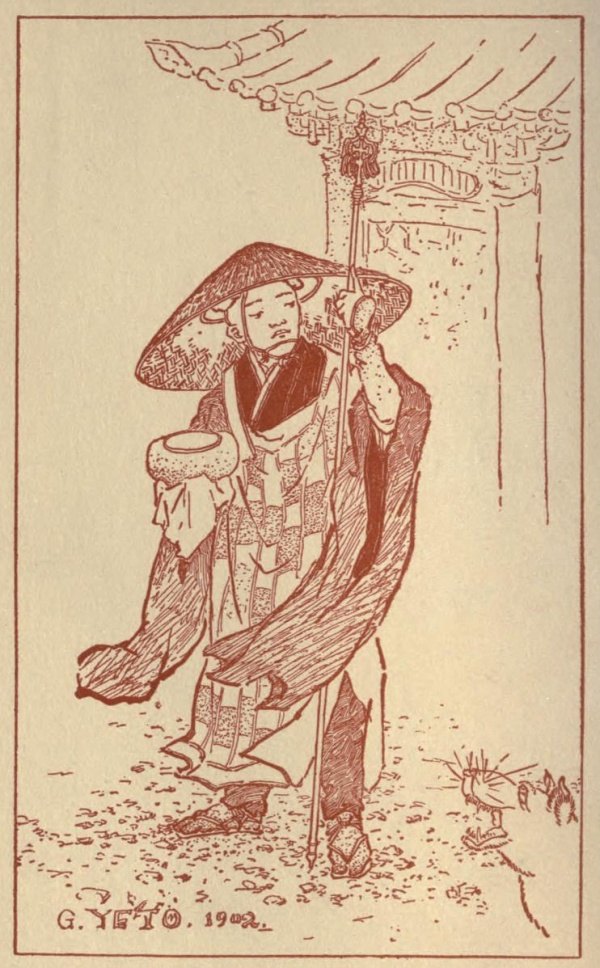
There is a nice old priest of the Zen sect,—past-master in the craft of arranging flowers, and in other arts of the ancient time,—who comes occasionally to see me. He is loved by his congregation, though he preaches against many old-fashioned beliefs, and discourages all faith in omens and dreams, and tells people to believe only in the Law of the Buddha. Priests of the Zen persuasion are seldom thus sceptical. But the scepticism of my friend is not absolute; for the last time that we met we talked of the dead, and he told me something creepy. "Stories of spirits or ghosts," he said, "I always doubt. Sometimes a danka[1] comes to tell me about having seen a ghost, or having dreamed a strange dream; but whenever I question such a person carefully, I find that the matter can be explained in a natural way.
"Only once in my life I had a queer experience which I could not easily explain. I was then in Kyūshū,—a young novice; and I was performing my gyō,—the pilgrimage that every novice has to make. One evening, while travelling through a mountain-district, I reached a little village where there was a temple of the Zen sect. I went there to ask for lodging, according to our rules; but I found that the priest had gone to attend a funeral at a village several miles away, leaving an old nun in charge of the temple. The nun said that she could not receive me during the absence of the priest, and that he would not come back for seven days.... In that part of the country, a priest was required by custom to recite the sûtras and to perform a Buddhist service, every day for seven days, in the house of a dead parishioner.... I said that I did not want any food, but only a place to sleep: moreover I pleaded that I was very tired, and at last the old nun took pity on me. She spread some quilts for me in the temple, near the altar; and I fell asleep almost as soon as I lay down. In the middle of the night—a very cold night!—I was awakened by the tapping of a mokugyo[2] and the voice of somebody chanting the Nembutsu[3], close to where I was lying. I opened my eyes; but the temple was utterly dark,—so dark that if a man had seized me by the nose I could not have seen him [hana wo tsumarété mo wakaranai]; and I wondered that anybody should be tapping the mokugyo and chanting in such darkness. But, though the sounds seemed at first to be quite near me, they were somewhat faint; and I tried to persuade myself that I must have been mistaken,—that the priest had come back and was performing a service in some other part of the temple. In spite of the tapping and chanting I fell asleep again, and slept until morning. Then, as soon as I had washed and dressed, I went to look for the old nun, and found her. After thanking her for her kindness, I ventured to remark, 'So the priest came back last night?' 'He did not,' she answered very crossly—'I told you that he would not come back for seven days more.' 'Please pardon me,' I said; Mast night I heard somebody chanting the Nembutsu, and beating the mokugyo, so I thought that the priest had come back.' 'Oh, that was not the priest!' she exclaimed; 'that was the danka.' 'Who?' I asked; for I could not understand her. 'Why,' she replied, 'the dead man, of course![4] That always happens when a parishioner dies; the hotoké comes to sound the mokugyo and to repeat the Nembutsu ...' She spoke as if she had been so long accustomed to the thing that it did not seem to her worthwhile mentioning."
Revery
It has been said that men fear death much as the child cries at entering the world, being unable to know what loving hands are waiting to receive it. Certainly this comparison will not bear scientific examination. But as a happy fancy it is beautiful, even for those to whom it can make no religious appeal whatever,—those who must believe that the individual mind dissolves with the body, and that an eternal continuance of personality could only prove an eternal misfortune. It is beautiful, I think, because it suggests, in so intimate a way, the hope that to larger knowledge the Absolute will reveal itself as mother-love made infinite. The imagining is Oriental rather than Occidental; yet it accords with a sentiment vaguely defined in most of our Western creeds. Through ancient grim conceptions of the Absolute as Father, there has gradually been infused some later and brighter dream of infinite tenderness—some all-transfiguring hope created by the memory of Woman as Mother; and the more that races evolve toward higher things, the more Feminine becomes their idea of a God.
Conversely, this suggestion must remind even the least believing that we know of nothing else, in all the range of human experience, so sacred as mother-love,—nothing so well deserving the name of divine. Mother-love alone could have enabled the delicate life of thought to unfold and to endure upon the rind of this wretched little planet: only through that supreme unselfishness could the nobler emotions ever have found strength to blossom in the brain of man;—only by help of mother-love could the higher forms of trust in the Unseen ever have been called into existence.
*
But musings of this kind naturally lead us to ask ourselves emotional questions about the mysteries of Whither and Whence. Must the evolutionist think of mother-love as a merely necessary result of material affinities,—the attraction of the atom for the atom? Or can he venture to assert, with ancient thinkers of the East, that all atomic tendencies are shapen by one eternal moral law, and that some are in themselves divine, being manifestations of the Four Infinite Feelings?... What wisdom can decide for us? And of what avail to know our highest emotions divine,—since the race itself is doomed to perish? When mother-love shall have wrought its uttermost for humanity, will not even that uttermost have been in vain?
*
At first thought, indeed, the inevitable dissolution must appear the blackest of imaginable tragedies,—tragedy made infinite! Eventually our planet must die: its azure ghost of air will shrink and pass, its seas dry up, its very soil perish utterly, leaving only a universal waste of sand and stone—the withered corpse of a world. Still for a time this mummy will turn about the sun, but only as the dead moon wheels now across our nights,—one face forever in scorching blaze, the other in icy darkness. So will it circle, blank and bald as a skull; and like a skull will it bleach and crack and crumble, ever drawing nearer and yet more near to the face of its flaming parent, to vanish suddenly at last in the cyclonic lightning of his breath. One by one the remaining planets must follow. Then will the mighty star himself begin to fail—to flicker with ghastly changing colours—to crimson toward his death. And finally the monstrous fissured cinder of him, hurled into some colossal sun-pyre, will be dissipated into vapour more tenuous than the dream of the dream of a ghost....
What, then, will have availed the labour of the life that was,—the life effaced without one sign to mark the place of its disparition in the illimitable abyss? What, then, the worth of mother-love, the whole dead world of human tenderness, with its sacrifices, hopes, memories,—its divine delights and diviner pains,—its smiles and tears and sacred caresses,—its countless passionate prayers to countless vanished gods?
*
Such doubts and fears do not trouble the thinker of the East. Us they disturb chiefly because of old wrong habits of thought, and the consequent blind fear of knowing that what we have so long called Soul belongs, not to Essence, but to Form.... Forms appear and vanish in perpetual succession; but the Essence alone is Real. Nothing real can be lost, even in the dissipation of a million universes. Utter destruction, everlasting death,—all such terms of fear have no correspondence to any truth but the eternal law of change. Even forms can perish only as waves pass and break: they melt but to swell anew,—nothing can be lost....
In the nebulous haze of our dissolution will survive the essence of all that has ever been in human life,—the units of every existence that was or is, with all their affinities, all their tendencies, all their inheritance of forces making for good or evil, all the powers amassed through myriad generations, all energies that ever shaped the strength of races;—and times innumerable will these again be orbed into life and thought. Transmutations there may be; changes also made by augmentation or diminution of affinities, by subtraction or addition of tendencies; for the dust of us will then have been mingled with the dust of other countless worlds and of their peoples. But nothing essential can be lost. We shall inevitably bequeath our part to the making of the future cosmos—to the substance out of which another intelligence will slowly be evolved. Even as we must have inherited something of our psychic being out of numberless worlds dissolved, so will future humanities inherit, not from us alone, but from millions of planets still existing.
For the vanishing of our world can represent, in the disparition of a universe, but one infinitesimal detail of the quenching of thought: the peopled spheres that must share our doom will exceed for multitude the visible lights of heaven.
Yet those countless solar fires, with their viewless millions of living planets, must somehow reappear: again the wondrous Cosmos, self-consumed, must resume its sidereal whirl over the deeps of the eternities. And the love forever with rise again, infinitudes of the everlasting battle. The light of the mother's smile will survive our sun;—the thrill of her kiss will last beyond the thrilling of stars;—the sweetness of her lullaby will endure in the cradle-songs of worlds yet unevolved;—the tenderness of her faith will quicken the fervour of prayers to be made to the hosts of another heaven,—to the gods of a time beyond Time. And the nectar of her breasts can never fail: that snowy stream will still flow on, to nourish the life of some humanity more perfect than our own, when the Milky Way that spans our night shall have vanished forever out of Space.
Pathological
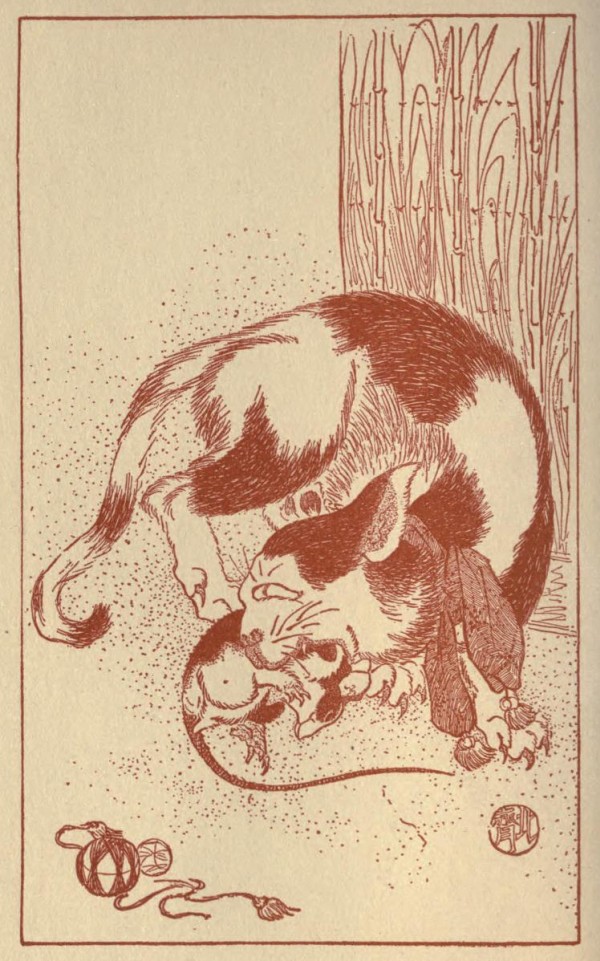
Very much do I love cats; and I suppose that I could write a large book about the different cats which I have kept, in various climes and times, on both sides of the world. But this is not a Book of Cats; and I am writing about Tama for merely psychological reasons. She has been uttering, in her sleep beside my chair, a peculiar cry that touched me in a particular way. It is the cry that a cat makes only for her kittens,—a soft trilling coo,—a pure caress of tone. And I perceive that her attitude, as she lies there on her side, is the attitude of a cat holding something,—something freshly caught: the forepaws are stretched out as to grasp, and the pearly talons are playing.
*
We call her Tama ("Jewel")—not because of her beauty, though she is beautiful, but because Tama is a female name accorded by custom to pet cats. She was a very small tortoise-shell kitten when she was first brought to me as a gift worth accepting,—a cat-of-three-colours (miké-neko) being somewhat uncommon in Japan. In certain parts of the country such a cat is believed to be a luck-bringer, and gifted with power to frighten away goblins as well as rats. Tama is now two years old. I think that she has foreign blood in her veins: she is more graceful and more slender than the ordinary Japanese cat; and she has a remarkably long tail, which, from a Japanese point of view, is her only defect. Perhaps one of her ancestors came to Japan in some Dutch or Spanish ship during the time of Iyéyasu. But, from whatever ancestors descended, Tama is quite a Japanese cat in her habits;—for example, she eats rice!
*
The first time that she had kittens, she proved herself an excellent mother,—devoting all her strength and intelligence to the care of her little ones, until, by dint of nursing them and moiling for them, she became piteously and ludicrously thin. She taught them how to keep clean,—how to play and jump and wrestle,—how to hunt. At first, of course, she gave them only her long tail to play with; but later she found them other toys. She brought them not only rats and mice, but also frogs, lizards, a bat, and one day a small lamprey, which she must have managed to catch in a neighbouring rice-field. After dark I used to leave open for her a small window at the head of the stairs leading to my study,—in order that she might go out to hunt by way of the kitchen roof. And one night she brought in, through that window, a big straw sandal for her kittens to play with. She found it in the field; and she must have carried it over a wooden fence ten feet high, up the house wall to the roof of the kitchen, and thence through the bars of the little window to the stairway. There she and her kittens played boisterously with it till morning; and they dirtied the stairway, for that sandal was muddy. Never was cat more fortunate in her first maternal experience than Tama.
But the next time she was not fortunate. She had got into the habit of visiting friends in another street, at a perilous distance; and one evening, while on her way thither, she was hurt by some brutal person. She came back to us stupid and sick; and her kittens were born dead. I thought that she would die also; but she recovered much more quickly than anybody could have imagined possible,—though she still remains, for obvious reasons, troubled in spirit by the loss of the kittens.
*
The memory of animals, in regard to certain forms of relative experience, is strangely weak and dim. But the organic memory of the animal,—the memory of experience accumulated through countless billions of lives,—is superhumanly vivid, and very seldom at fault.... Think of the astonishing skill with which a cat can restore the respiration of her drowned kitten! Think of her untaught ability to face a dangerous enemy seen for the first time,—a venomous serpent, for example! Think of her wide acquaintance with small creatures and their ways,—her medical knowledge of herbs,—her capacities of strategy, whether for hunting or fighting! What she knows is really considerable; and she knows it all perfectly, or almost perfectly. But it is the knowledge of other existences. Her memory, as to the pains of the present life, is mercifully brief.
*
Tama could not clearly remember that her kittens were dead. She knew that she ought to have had kittens; and she looked everywhere and called everywhere for them, long after they had been buried in the garden. She complained a great deal to her friends; and she made me open all the cupboards and closets,—over and over again,—to prove to her that the kittens were not in the house. At last she was able to convince herself that it was useless to look for them any more. But she plays with them in dreams, and coos to them, and catches for them small shadowy things,—perhaps even brings to them, through some dim window of memory, a sandal of ghostly straw....
In the Dead of the Night
Black, chill, and still,—so black, so still, that I touch myself to find out whether I have yet a body. Then I grope about me to make sure that I am not under the earth,—buried forever beyond the reach of light and sound.... A clock strikes three! I shall see the sun again!
Once again, at least. Possibly several thousand times. But there will come a night never to be broken by any dawn,—a stillness never to be broken by any sound.
This is certain. As certain as the fact that I exist.
Nothing else is equally certain. Reason deludes; feeling deludes; all the senses delude. But there is no delusion whatever in the certain knowledge of that night to come.
Doubt the reality of substance, the reality of ghosts, the faiths of men, the gods;—doubt right and wrong, friendship and love, the existence of beauty, the existence of horror;—there will always remain one thing impossible to doubt,—one infinite blind black certainty.
The same darkness for all,—for the eyes of creatures and the eyes of heaven;—the same doom for all,—insect and man, ant-hill and city, races and worlds, suns and galaxies: inevitable dissolution, disparition, and oblivion.
And vain all human striving not to remember, not to think: the Veil that old faiths wove, to hide the Void, has been rent forever away;—and Sheol is naked before us,—and destruction hath no covering.
So surely as I believe that I exist, even so surely must I believe that I shall cease to exist—which is horror!... But—
Must I believe that I really exist?... In the moment of that self-questioning, the Darkness stood about me as a wall, and spake:—
"I am only the Shadow: I shall pass. But the Reality will come, and will not pass.
"I am only the Shadow. In me there are lights,—the glimmering of a hundred millions of suns. And in me there are voices. With the coming of the Reality, there will be no more lights, nor any voice, nor any rising, nor any hope.
"But far above you there will still be sun for many a million years,—and warmth and youth and love and joy.. .. Vast azure of sky and sea,—fragrance of summer bloom,—shrillings in grass and grove,—flutter of shadows and flicker of light,—laughter of waters and laughter of girls. Blackness and silence for you,—and cold blind creepings."
I made reply:—
"Of thoughts like these I am now afraid. But that is only because I have been startled out of sleep. When all my brain awakens, I shall not be afraid. For this fear is brute fear only,—the deep and dim primordial fear bequeathed me from the million ages of the life of instinct.... Already it is passing. I can begin to think of death as dreamless rest,—a sleep with no sensation of either joy or pain."
The Darkness whispered:—
"What is sensation?"
And I could not answer, and the Gloom took weight, and pressed upon me, and said:—
"You do not know what is sensation? How, then, can you say whether there will or will not be pain for the dust of you,—the molecules of your body, the atoms of your soul?... Atoms—what are they?"
Again I could make no answer, and the weight of the Gloom waxed greater—a weight of pyramids—and the whisper hissed:—
"Their repulsions? their attractions? The awful clingings of them and the leapings?... What are these?... Passions of lives burnt out?—furies of insatiable desire?—frenzies of everlasting hate? —madnesses of never ending torment?... You do not know? But you say that there will be no more pain!..."
Then I cried out to the mocker:—"I am awake—awake—fully awake! I have ceased to fear;—I remember!... All that I am is all that I have been. Before the beginnings of Time I was;—beyond the uttermost circling of the Eternities I shall endure. In myriad million forms I but seem to pass: as form I am only Wave; as essence I am Sea. Sea without shore I am;—and Doubt and Fear and Pain are but duskings that fleet on the face of my depth.. .. Asleep, I behold the illusions of Time; but, waking, I know myself timeless: one with the Life that has neither form yet also one begins and the grave and graves,—the the eater of neither form nor name, yet also one with all that begins and ends,—even the grave and the maker of graves,—the corpse and the eater of corpses...."
*
A sparrow twittered from the roof; another responded. Shapes of things began to define in a soft gray glimmering;—and the gloom slowly lightened. Murmurs of the city's wakening came to my ears, and grew and multiplied. And the dimness flushed.
Then rose the beautiful and holy Sun, the mighty Quickener, the mighty Putrefier,—symbol sublime of that infinite Life whose forces are also mine!...
Kusa-Hibari
Issun no mushi ni mo gobu no tamashii.—Japanese Proverb.
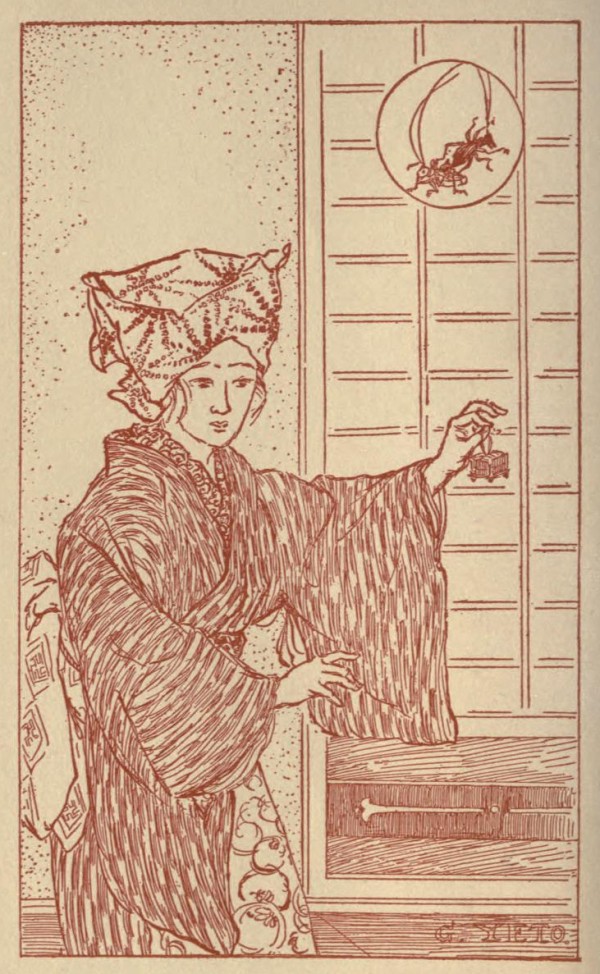
His cage is exactly two Japanese inches high and one inch and a half wide: its tiny wooden door, turning upon a pivot, will scarcely admit the tip of my little finger. But he has plenty of room in that cage,—room to walk, and jump, and fly; for he is so small that you must look very carefully through the brown-gauze sides of it in order to catch a glimpse of him. I have always to turn the cage round and round, several times, in a good light, before I can discover his whereabouts; and then I usually find him resting in one of the upper corners,—clinging, upside down, to his ceiling of gauze.
Imagine a cricket about the size of an ordinary mosquito,—with a pair of antennae much longer than his own body, and so fine that you can distinguish them only against the light. Kusa-Hibari, or "Grass-Lark," is the Japanese name of him; and he is worth in the market exactly twelve cents: that is to say, very much more than his weight in gold. Twelve cents for such a gnat-like thing!...
By day he sleeps or meditates, except while occupied with the slice of fresh egg-plant or cucumber which must be poked into his cage every morning. ... To keep him clean and well fed is somewhat troublesome: could you see him, you would think it absurd to take any pains for the sake of a creature so ridiculously small.
But always at sunset the infinitesimal soul of him awakens: then the room begins to fill with a delicate and ghostly music of indescribable sweetness,-a thin, thin silvery rippling and trilling as of tiniest electric bells. As the darkness deepens, the sound becomes sweeter,—sometimes swelling till the whole house seems to vibrate with the elfish resonance,—sometimes thinning down into the faintest imaginable thread of a voice. But loud or low, it keeps a penetrating quality that is weird.... All night, the atomy thus sings: he ceases only when the temple bell proclaims the hour of dawn.
*
Now this tiny song is a song of love,—vague love of the unseen and unknown. It is quite impossible that he should ever have seen or known, in this present existence of his. Not even his ancestors, for many generations back, could have known anything of the night-life of the fields, or the amorous value of song. They were born of eggs hatched in a jar of clay, in the shop of some insect-merchant; and they dwelt thereafter only in cages. But he sings the song of his race as it was sung a myriad years ago, and as faultlessly as if he understood the exact significance of every note. Of course he did not learn the song. It is a song of organic memory,—deep, dim memory of other quintillions of lives, when the ghost of him shrilled at night from the dewy grasses of the hills. Then that song brought him love—and death. He has forgotten all about death; but he remembers the love. And therefore he sings now—for the bride that will never come.
So that his longing is unconsciously retrospective: he cries to the dust of the past,—he calls to the silence and the gods for the return of time.... Human lovers do very much the same thing without knowing it. They call their illusion an Ideal; and their Ideal is, after all, a mere shadowing of race-experience, a phantom of organic memory. The living present has very little to do with it.... Perhaps this atomy also has an ideal, or at least the rudiment of an ideal; but, in any event, the tiny desire must utter its plaint in vain.
The fault is not altogether mine. I had been warned that if the creature were mated, he would cease to sing and would speedily die. But, night after night, the plaintive, sweet, unanswered trilling touched me like a reproach,—became at last an obsession, an affliction, a torment of conscience; and I tried to buy a female. It was too late in the season; there were no more kusa-hibari for sale,—either males or females. The insect-merchant laughed and said, "He ought to have died about the twentieth day of the ninth month." (It was already the second day of the tenth month.) But the insect-merchant did not know that I have a good stove in my study, and keep the temperature at above 75° F. Wherefore my grass-lark still sings at the close of the eleventh month, and I hope to keep him alive until the Period of Greatest Cold. However, the rest of his generation are probably dead: neither for love nor money could I now find him a mate. And were I to set him free in order that he might make the search for himself, he could not possibly live through a single night, even if fortunate enough to escape by day the multitude of his natural enemies in the garden,—ants, centipedes, and ghastly earth-spiders.
*
Last evening—the twenty-ninth of the eleventh month—an odd feeling came to me as I sat at my desk: a sense of emptiness in the room. Then I became aware that my grass-lark was silent, contrary to his wont. I went to the silent cage, and found him lying dead beside a dried-up lump of egg-plant as gray and hard as a stone. Evidently he had not been fed for three or four days; but only the night before his death he had been singing wonderfully,—so that I foolishly imagined him to be more than usually contented. My student, Aki, who loves insects, used to feed him; but Aki had gone into the country for a week's holiday, and the duty of caring for the grass-lark had devolved upon Hana, the housemaid. She is not sympathetic, Hana the housemaid. She says that she did not forget the mite,—but there was no more egg-plant. And she had never thought of substituting a slice of onion or of cucumber! ... I spoke words of reproof to Hana the housemaid, and she dutifully expressed contrition. But the fairy-music has stopped; and the stillness reproaches; and the room is cold, in spite of the stove.
*
Absurd!... I have made a good girl unhappy because of an insect half the size of a barley-grain! The quenching of that infinitesimal life troubles me more than I could have believed possible. ... Of course, the mere habit of thinking about a creature's wants—even the wants of a cricket—may create, by insensible degrees, an imaginative interest, an attachment of which one becomes conscious only when the relation is broken. Besides, I had felt so much, in the hush of the night, the charm of the delicate voice,—telling of one minute existence dependent upon my will and selfish pleasure, as upon the favour of a god,—telling me also that the atom of ghost in the tiny cage, and the atom of ghost within myself, were forever but one and the same in the deeps of the Vast of being.... And then to think of the little creature hungering and thirsting, night after night, and day after day, while the thoughts of his guardian deity were turned to the weaving of dreams!... How bravely, nevertheless, he sang on to the very end,—an atrocious end, for he had eaten his own legs!... May the gods forgive us all,—especially Hana the housemaid!
Yet, after all, to devour one's own legs—for hunger is not the worst by that can happen to a being cursed with the gift of song. There are human crickets who must eat their own hearts in order to sing.
The Eater of Dreams
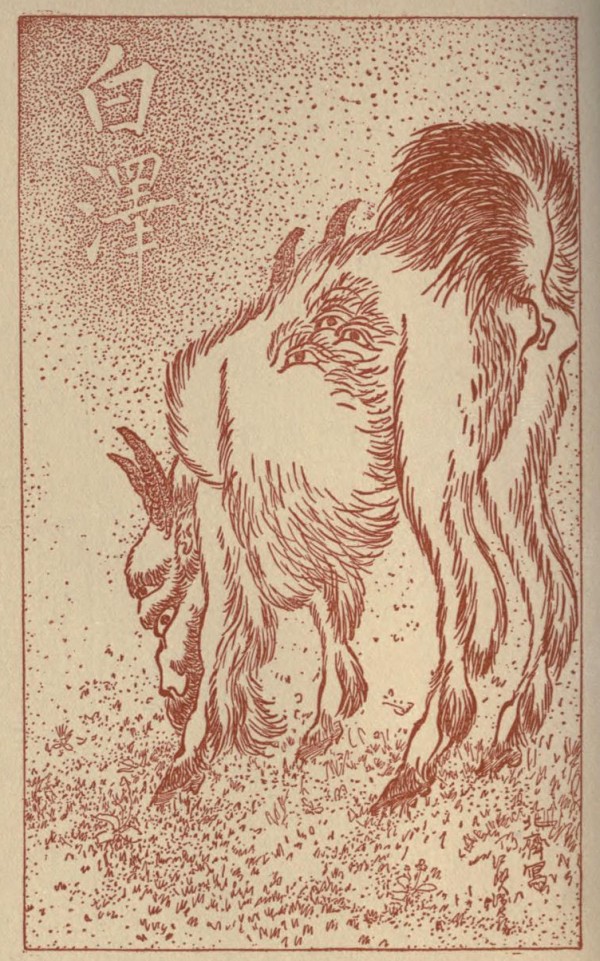
Mijika-yo ya! Baku no yumé kū Hima mo nashi!
—"Alas! how short this night of ours! The Baku will not even have time to eat our dreams!"—Old Japanese Love-song.
The name of the creature is Baku, or Shirokinakatsukami; and its particular function is the eating of Dreams. It is variously represented and described. An ancient book in my possession states that the male Baku has the body of a horse, the face of a lion, the trunk and tusks of an elephant, the forelock of a rhinoceros, the tail of a cow, and the feet of a tiger. The female Baku is said to differ greatly in shape from the male; but the difference is not clearly set forth. In the time of the old Chinese learning, pictures of the Baku used to be hung up in Japanese houses, such pictures being supposed to exert the same beneficent power as the creature itself. My ancient book contains this legend about the custom:—
"In the Shōsei-Roku it is declared that Kōtei, while hunting on the Eastern coast, once met with a Baku having the body of an animal, but speaking like a man. Kōtei said: 'Since the world is quiet and at peace, why should we still see goblins? If a Baku be needed to extinguish evil sprites, then it were better to have a picture of the Baku suspended to the wall of one's house. Thereafter, even though some evil Wonder should appear, it could do no harm.'"
Then there is given a long list of evil Wonders, and the signs of their presence:—
"When the Hen lays a soft egg, the demon's name is Taifu.
"When snakes appear entwined together, the demon's name is Jinzu.
"When dogs go with their ears turned back, the demon's name is Taiyō.
"When the Fox speaks with the voice of a man, the demon's name is Gwaishū.
"When blood appears on the clothes of men, the demon's name is Yūki.
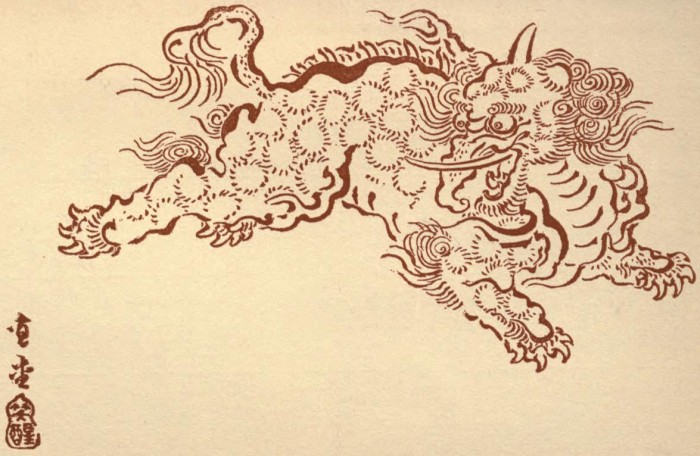
"When the rice-pot speaks with a human voice, the demon's name is Kanjo.
"When the dream of the night is an evil dream, the demon's name is Ringetsu...."
And the old book further observes: "Whenever any such evil marvel happens, let the name of the Baku be invoked: then the evil sprite will immediately sink three feet under the ground."
*
But on the subject of evil Wonders I do not feel qualified to discourse: it belongs to the unexplored and appalling world of Chinese demonology, and it has really very little to do with the subject of the Baku in Japan. The Japanese Baku is commonly known only as the Eater of Dreams; and the most remarkable fact in relation to the cult of the creature is that the Chinese character representing its name used to be put in gold upon the lacquered wooden pillows of lords and princes. By the virtue and power of this character on the pillow, the sleeper was thought to be protected from evil dreams. It is rather difficult to find such a pillow to-day: even pictures of the Baku (or "Hakutaku," as it is sometimes called) have become very rare. But the old invocation to the Baku still survives in common parlance: Baku kuraë! Baku kuraë!—"Devour, O Baku! devour my evil dream!"... When you awake from a nightmare, or from any unlucky dream, you should quickly repeat that invocation three times;—then the Baku will eat the dream, and will change the misfortune or the fear into good fortune and gladness.
*
It was on a very sultry night, during the Period of Greatest Heat, that I last saw the Baku. I had just awakened out of misery; and the hour was the Hour of the Ox; and the Baku came in through the window to ask, "Have you anything for me to eat?"
I gratefully made answer:—
"Assuredly!... Listen, good Baku, to this dream of mine!—
"I was standing in some great white-walled room, where lamps were burning; but I cast no shadow on the naked floor of that room,—and there, upon an iron bed, I saw my own dead body. How I had come to die, and when I had died, I could not remember. Women were sitting near the bed,—six or seven,—and I did not know any of them. They were neither young nor old, and all were dressed in black: watchers I took them to be. They sat motionless and silent: there was no sound in the place; and I somehow felt that the hour was late.
"In the same moment I became aware of something nameless in the atmosphere of the room,-a heaviness that weighed upon the will,—some viewless numbing power that was slowly growing. Then the watchers began to watch each other, stealthily; and I knew that they were afraid. Soundlessly one rose up, and left the room. Another followed; then another. So, one by one, and lightly as shadows, they all went out. I was left alone with the corpse of myself.