Conquest of Georgia and South Carolina
Reading edition
The ports of Savannah and Charleston were vitally needed to support the new invasion and the British set out first to capture them. At the direction of Sir Henry Clinton, the first British landing was made in Georgia, and Savannah fell on December 29, 1778. By February 1779, Augusta and other key points in the State were captured, and by summer the British dominated Georgia. Their first move against Charleston ended in failure in June 1779, but they successfully forestalled a combined French and American attempt to recapture Savannah in the fall of that year.
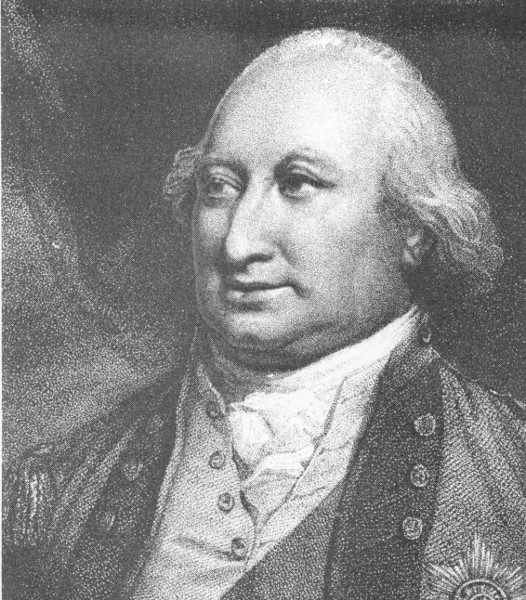
Lt. Gen. Earl Charles Cornwallis, British commander in the South, 1780-81. Courtesy Clements Library, University of Michigan.
The fortunes of war turned further against the southern patriots in 1780. Returning to Charleston in the spring of 1780, Clinton besieged the city with overwhelming numbers and forced the surrender 4 of Gen. Benjamin Lincoln’s American garrison on May 12. The loss of this large, well-equipped army was a marked disaster for the patriot cause in the South and greatly strengthened the British position in South Carolina. Soon Clinton could depart for New York by sea, leaving Lord Cornwallis in command of a large British force which in a few months quickly occupied fortified points in much of the State.
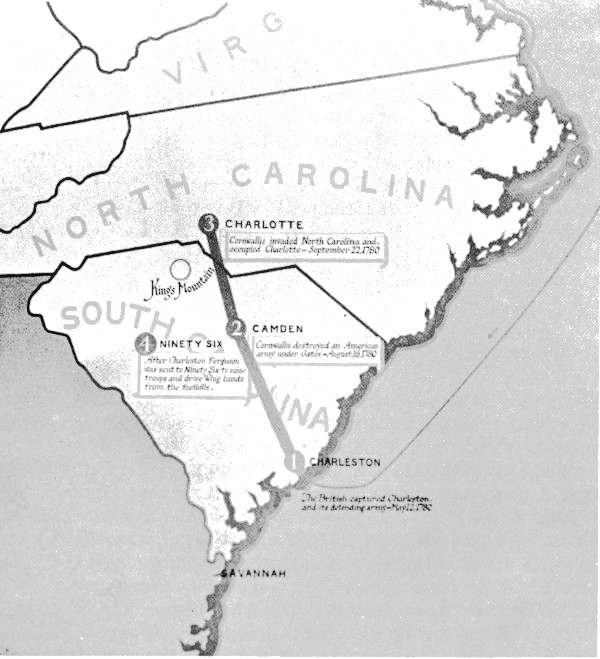
British campaign in the Carolinas during 1780 before the Battle of Kings Mountain.
1 NINETY SIX
After Charleston Ferguson was sent to Ninety Six to raise troops and drive Whig bands from the foothills.
2 CAMDEN
Cornwallis destroyed an American army under Gates—August 16, 1780
3 CHARLOTTE
Cornwallis invaded North Carolina and captured Charlotte—September 22, 1780
5
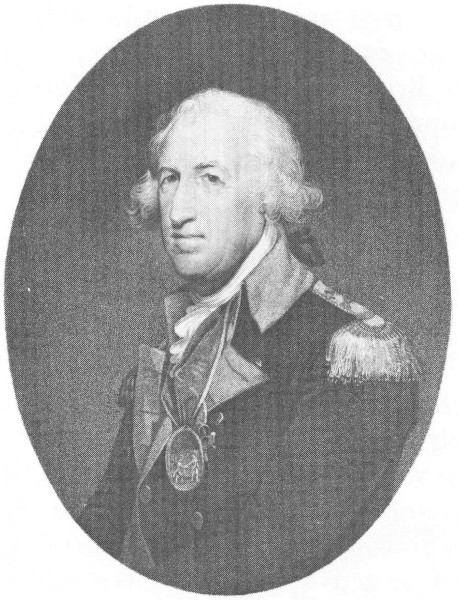
Gen. Horatio Gates, American commander in the South during most of 1780. Courtesy Emmet Collection, New York Public Library.
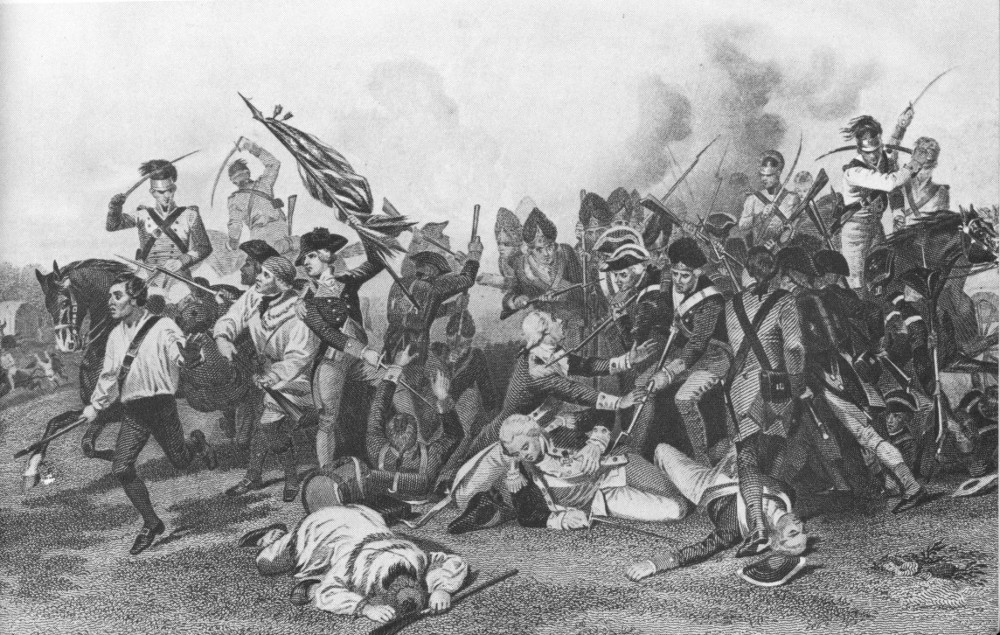
Scene at the Battle of Camden, August 16, 1780, which gave the British almost complete control of South Carolina. From a painting by Chappel. Courtesy The Caroliniana Library, University of South Carolina, Columbia.
Believing South Carolina to be largely subdued, Cornwallis now began a northward march for the purpose of invading and overrunning North Carolina. His plans were upset temporarily by the advance of a new American army under the command of Gen. Horatio Gates, the patriot victor at Saratoga. Appointed by Congress to succeed General Lincoln as American commander in the South, Gates had reached North Carolina in July. Moving southward to capture the important British post of Camden, S. C., he commanded an army composed of veteran Delaware and Maryland continental troops and raw Virginia and North Carolina militia. In a surprise meeting for both forces near Camden on August 16, 1780, Gates’ tired and disorganized 6 army was crushingly defeated by Cornwallis. The last large organized American army in the South had been destroyed, and the British, more than ever before, appeared to be invincible. Their triumph at Camden opened the way for the resumption of Cornwallis’ triumphant march and the invasion of North Carolina in September 1780.