"A Tale of Mountain, Moorland and Sea" (continued 2)
Reading edition
But it was not the gorcock, nor black cock, nor the ptarmigan, nor the great golden eagle itself they were after, but the white or mountain hare.
And the sport was good. They took time to dine, though, for the air was bracing and keen; then they shot again till nearly sunset, and Kenneth’s cheek flushed redder than usual as Dugald praised him for his skill as a marksman. But at the same time Dugald praised himself indirectly, for he added, “But no thanks to you, lad; sure, haven’t you had Dugald McCrane himself to teach you this many a long day?”
Archie was wonderfully strong, but he couldn’t carry half the hares, so Dugald and Kenneth had to help him as well as carry their own and their guns, and even Shot carried a white hare all the way to the glen below.
“Of course,” said Kenneth, “you’ll come up the glen, Dugald, to our cottage, and let us show my mother our game; she will be so pleased.”
“’Deed, and I will, then,” replied Dugald, “and there will be a pair of hares for the old lady, too, and one for Nancy the witch—goodness be about us—for the laird wrote me to say if I killed more than a dozen and a half to-day, I was to do what I liked with the rest.”
“Dear old laird!” said Kenneth; “why doesn’t he come down from London and stay among his people? We all love him so much.”
“Ah! Kennie, he has ruined himself, like mony mair Highland lairds, by stoppin’ in the big city, and it’s myself that is sorry. But see, wha comes here?”
It was a tall stranger, dressed in knickerbockers, a broad-brimmed soft felt hat, and a surtout coat, a very ridiculous association of garments.
He carried a gun over his shoulder, and two beautiful Irish setters walked behind him. Both dogs were lame.
“Hullo, fellows!” he said. “Glad I’ve met some one at last. How far have I to walk to the little inn at the klakkin?”
Dugald threw down his game-bag, so did the others their burdens. No one was sorry to rest a bit, so they leant against the dyke and quietly surveyed the stranger. Meanwhile Shot was standing defiantly in front of the setters.
Shot wanted to know if either of these dogs would oblige him by fighting, singly or the two at once. But they did not seem inclined to accept the challenge.
“My good fellow,” said the stranger, “when you have stared sufficiently to satisfy you, perhaps you will be good enough to answer my question.”
“Well,” said Dugald, “I’m staring because it’s astonished I am.”
“You’d be more astonished if you knew who I am. But never mind. I’ve been travelling all day among these tiresome hills and only managed to kill one brown hare. I was told at the inn that the white hares were in hundreds.”
“Very likely,” said Dugald, “but it’s no’ in the glen you’ll find them.
“You’re two miles from the clachan,” continued Dugald. “I’m McGregor’s keeper—his chief keeper. I’ll trouble you, sir, to show your permit.”
“You’re a saucy fellow. I’m the future owner of these glens and all the estate, and lord of Castle Alva.”
“I’ll believe it when I see it. You’re neither lord nor laird yet. Your permit, please. I believe nobody since two students poached all over the hills here and called themselves friends of the laird’s.”
“As to my permit, fellow, I did not trouble to bring it from C—.”
“Then you’ll consider yourself my prisoner till you can produce it.”
The stranger was a man about forty-five, tall and wiry and haughty. He looked at Dugald up and down for a moment.
“Dare you, fellow?” he shouted.
Dugald quietly laid down his gun and threw off his jacket. He then took off his scarf, and stretched it out in front of the stranger. It measured fully a yard and a half.
“I’ve tied the hands and feet of a poacher before,” he said, “a bigger man than you. And I mean to do my duty by you.”
“Dugald,” said Kenneth, “this gentleman may really be what he says.”
“Let him come quietly, then,” replied Dugald. “No stranger that ever walked will lead Dugald McCrane into trouble again. Is it going to surrender you are, sir? Consider while I count ten. One—two—three—”
“Enough, enough. I’m your prisoner, fellow. It is very ridiculous. Perhaps you’ll live to rue this day. Come on with me to the inn.”
Dugald laughed.
“Not just yet,” he answered; “it’s the other way; you come with me.”
The stranger bit his lip and frowned.
Then he put his hand in his pocket and produced a gold piece.
“This is yours,” he said, “if you come at once.”
Fire seemed to flash from Dugald’s eyes. He clenched his fists convulsively, and looked for a moment as if he meant to spring at the stranger’s neck.
“Put up your bawbees,” he said at length. “If Highlanders are poor, they are also proud, and the gold isn’t dug yet that would tempt Dugald McCrane to neglect his duty. And if the auld laird himsel’ was standing there, he’d tell you it’s the truth I’m speaking. Right about face, my man, and march with us to the glen-head, or it may be the worse for you.”
The stranger gave a sigh and a sickly kind of smile, but he shouldered his gun and prepared to follow.
“One minute,” said Dugald, for Kenneth had beckoned him aside.
Kenneth and he conversed for a moment; then Dugald returned.
“You look tired,” he said, shortly; “we’ll go your road. Archie,” he continued, “pick the ice-balls from the feet of those twa poor dogs. Your dogs, sir, are but little used to our Hielan’ hills.”
“And indeed, my fine fellow,” replied the stranger, “am but little used to your Highland manners, but grateful to you, young sir,”—he was addressing Kenneth—“for saving me a longer journey than needful.”
In half an hour’s time the future laird of Alva, for it was no other, found himself a prisoner at the little inn of the clachan. This for a night; next day he produced a letter from McGregor himself—he had despatched a messenger to C— for it—which quite satisfied Dugald McCrane.
Dugald was satisfied of something else as well, namely, that he had done his duty without exceeding it.
Kenneth and Dugald visited Nancy Dobbell’s next day and told her the story.
“Och! och!” she said, “it will be a sore day for the folks of the clachan, when a stranger steps into the shoes of poor auld Laird McGregor.
“But a cloud is rising o’er the hills, my laddies; there will be little more peace in Glen Alva. A cloud is rising o’er the hills, and that cloud will burst, and wreck and ruin will fall on the poor people. My dreams have told me this many and many a day since. Heigho! but Nancy’s time is wearin’ through. She’ll never live to see it.”
Kenneth took the old thin hand that lay in her lap in both his, and looked into her face, while the tears gathered in his eyes.
He was going to say something. But he did not dare trust himself to speak. He simply petted the poor wrinkled hand.
Is Campbell the poet right, I wonder?
“Does the sunset of life give us mystical lore? Do coming events cast their shadows before?”
Chapter Seven.
The Death of Poor Nancy.
“I’m wearin’ awa’, Jean, Like snaw-wreaths in thaw, Jean; I’m wearin’ awa’ To the Land o’ the Leal.” Old Song.
Scene: Kenneth at home in his mother’s humble cot. A fire of peats and wood burning on the low hearth. Kenneth’s mother reading the good Book with spectacles on her eyes. Kenneth leading also at the other side of the fire. Above the mantelpiece a black iron oil lamp is burning, with old-fashioned wicks made from peeled and dried rushes. Between the pair, his head on his paws, Kooran is lying. He is asleep, and probably dreaming of the sheep that he cannot get to enter the “fauld,” for he is emitting little sharp cheeping barks, as dogs often do when they dream.
Kenneth gets up at last and reaches down his plaid and crook.
“Dear laddie,” says his mother, “you’re surely not going out to-night!”
Kooran jumps up and shakes himself.
“Yes, mother; I must,” is the quiet reply. “I had a strange dream about poor Nancy last night. She has been ill, you know, and I haven’t called for three days.”
“But in such a night, laddie! Listen to the wind! Hear how the snow and the hail are beating on the window!”
Kenneth did listen.
It was indeed a fearful night.
The wind was sighing and crying through every cranny of the window, and shaking the sash; it was howling round the chimney, and wailing through the keyhole of the door.
Snow was sifting in underneath the door, too, and lying along the floor like a stripe of light.
Kenneth drew his plaid closer round him.
“I must go, mother,” he said; “I could not sleep to-night if I didn’t.
“Don’t be uneasy about me even if I don’t return till morning. I may stay all night at Dugald’s.”
When Kenneth opened the door he was almost driven back with the force of the wind, and almost suffocated with the soft, powdery, drifting snow. But he closed the door quickly after him and marched boldly on down the glen, rolling the end of his plaid about his neck, and at times having even to breathe through a single fold of it to prevent suffocation.
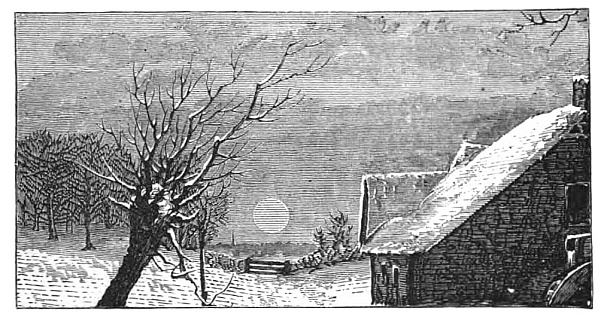
It was now well on in January. There had been but little snow all the winter, but this storm came on sharp and sudden. All day gigantic masses of cloud had been driving hurriedly over the sky on the wings of an easterly wind; the ground was as hard as adamant, and towards sunset the snow had begun to fall. But it took no time to settle on the bare ground; it was blown on and heaped wherever there was a bit of shelter from the fierce east wind. So it lay under the hedges and dykes, and on the lee-side of trees, and deep down in the ravines, and under banks and rocks, and across the road here and there in rifts like frozen waves of the ocean.
The wind howled terribly across the moorland. There was a moon, but it gave little light.
Kooran knew, however, where his master was going, and went feathering on in front, stopping now and then to turn round and give a little sharp encouraging bark to his sturdy young master.
Kenneth was all aglow when he reached Nancy’s hut, and his face wet and hot. His hair and the fringes of the plaid and even his eyebrows were covered with ice.
He shook the plaid and his bonnet, and folded the former under the porch for Kooran to lie on. Then he opened the latch and entered.
All was dark. Not a blink of fire was on the hearth, and long white lines across the floor showed him where the snow had been sifting in through the holes that did duty as windows. Kenneth’s heart suddenly felt as cold and heavy as lead.
“Nancy,” he cried, “Nancy, oh! Nancy.”
There was a feeble answer from the bed in the corner.
He advanced towards it. There were two shining lights there, the cat’s eyes. Poor pussy was on the bed watching by her dying mistress.
He felt on the coverlet and found Nancy’s hand there. It was cold, almost hard. “Nancy,” he said, “it is Kennie, your own boy Kennie; don’t be afraid.”
It did not take long for Kenneth to light a roaring fire on the hearth. As soon as it burned up he held the iron lamp over it to melt the frozen oil; then he hung it up. The water in a bucket was frozen, and even some milk that stood on a little table near Nancy’s bed was solid.
The inside of that cot was dreary in the extreme, but Kenneth soon made it more cheerful.
Poor old Nancy smiled her thanks and held out her hand to her boy, as she always called Kennie. He chafed it while he entreated her to tell him how she felt.
“Happy! happy! happy!” she replied, “but, poor boy, you are shaking.”
Kenneth was, and he felt his heart so full that tears would have been a relief, but he wisely restrained himself.
He melted and warmed the milk, and made her drink some. Then, at her own request, he raised her up in the bed.
“Dinna be sorry,” she said, “when poor auld Nancy’s in the mools. It is the gate we have a’ to gang. But oh! dear boy, it’s the gate to glory for poor Nancy. And so it will be for you, laddie, if you never forget to pray. Prayer has been the mainstay and comfort o’ my life; God has always been near me, and He’s near me now, and will see me safe through the dark waters o’ death. Here’s a little Bible,” she said. “It was Nancy’s when young. Keep it for her sake, and oh! never forget to read it.
“Now, laddie, can you find your way to Dugald’s? Send him here. There is an aulder head on his shoulders than on yours, and I have that to say a man should hear and remember.”
“I’ll go at once,” said Kenneth, “and come back soon, and bring the doctor too, Nancy. I won’t say good-night, I’ll be back so soon.”
Kenneth gulped down his tears, patted her hand, and rushed away.
“Come on, Kooran,” he cried. “Oh! Kooran, let us run; my heart feels breaking.”
He took his way across the moor in a different direction from that in which he had come. The storm had abated somewhat. The wind had gone down, and the moon shone out now and then from a rift in the clouds.
He determined to take the shortest cut to Dugald’s house, though there would be the stream to ford, and it must be big and swollen. Never mind; he would try it.
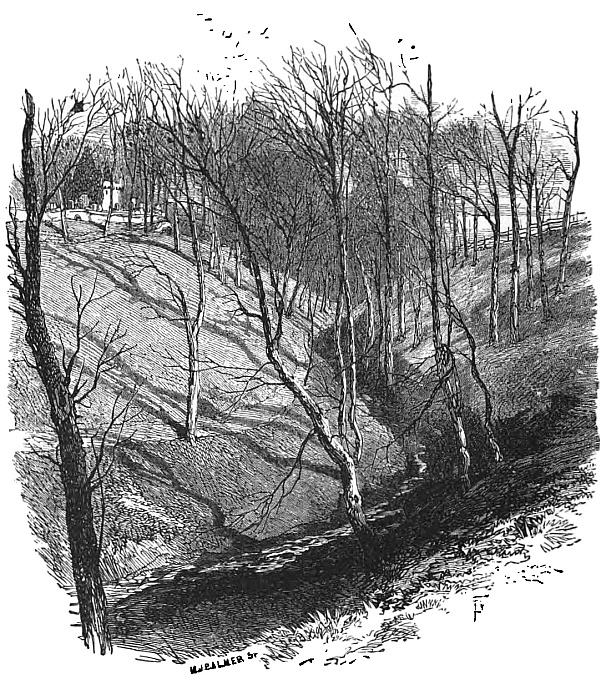
He soon reached a scattered kind of wood of stunted trees; there was no pathway through it, but he guided himself by the moon and kept going downhill. He would thus strike the river, and keeping on by its banks, ford wherever he could.
Nothing could be easier. So he said to himself, and on he went. It was very cold; and though the wind was not so fierce, it moaned and sighed most mournfully through the trees in this wood. Even Kooran started sometimes, as a spruce or Scottish fir tree would suddenly free itself from its burden of snow as if it were a living thing, free itself with a rushing, crackling sort of sound, and stand forth among its fellows dark and spectre-like.
Kenneth had gone quite a long way, but still no stream came in sight. He listened for the sound of running water over and over again, and just as often he seemed to hear it, and went in that direction, but found it must be only wind after all.
He grew tired all at once, tired, weak, and faint, and sat down on a tree stump, and Kooran came and licked his cheek with his soft warm tongue. He placed one hand in the dog’s mane, as if to steady himself, for his head began to swim.
“I must go on, though,” he muttered to himself. “Poor old Nancy. The doctor. I’ll soon be back—I—”
He said no more for a time. He had fainted. When he recovered, he started at once to his feet.
“I’ve been asleep,” he cried. “How could I!” He ate some snow; then he began to move on automatically, as it were, the dog running in front and barking. The dog would have led him home. “No, no, Kooran,” he said; “the river, doggie, the river.”
Kenneth tried to run now. His teeth were chattering with the cold, but his face was hot and flushed.
His nerves had become strangely affected. He started fifty times at imaginary spectres. Some one was walking on in front of him—some shadowy being. He ran a little; it eluded him. Then he stopped; he was sure he saw a head peering at him over a piece of rock. He called aloud, “Archie! Archie!”
His voice sounds strange to his own ears. He runs towards the rock. There is no one behind it. No one. Nothing.
He feels fear creeping over his heart. He never felt fear before.
But still he wanders on, muttering to himself, “I’ll soon be back. Poor old Nancy! Poor old Nancy!”
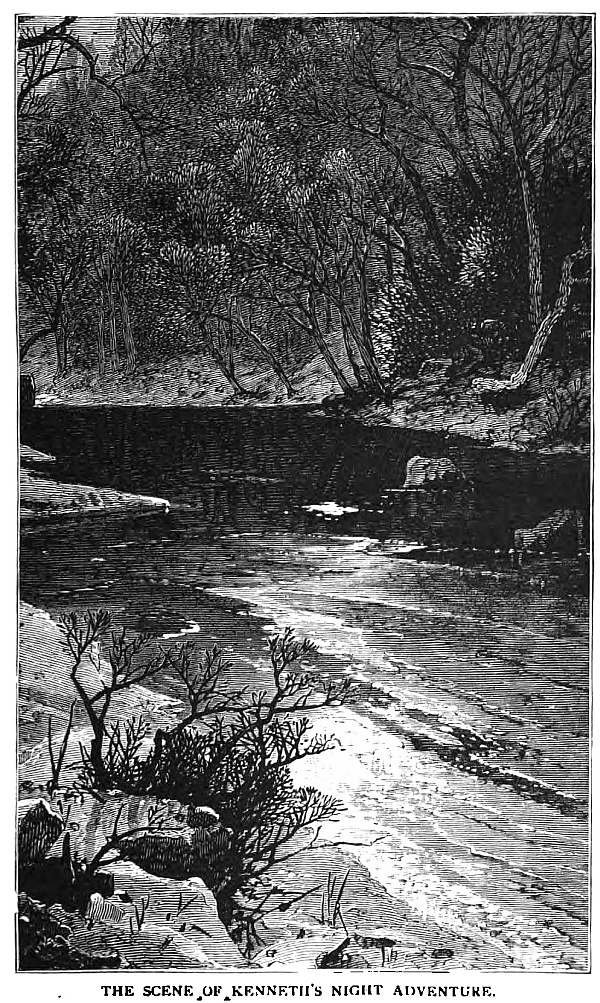
All at once—so it seems—he finds himself at the banks of a stream. He is bewildered now, completely. He presses his cold hand against that burning brow of his.
What is this river or stream? Where is he going? Did he cross this stream before? He must cross it now, but where is the ford? How deep and dark and sullen it looks.
He seats himself on the icy bank to think or try to think.
He is burning, yet he shivers.
Stories of water-kelpies keep crowding through his mind, and the words and weird music of a song he has heard,—
“Kelpie dwells in a wondrous hall Beneath the shimmering stream; His song is the song of the waterfall, And his light its rainbow gleam. The rowans stoop, And the long ferns droop Their feathery heads in the spray.”
And now he jumps to his feet. He has recollected himself, he was going for the doctor for poor Nancy, and this is the stream he was looking for. He must seek the ford. He cannot have far to go now. Once over the river, and a run will take him to Dugald’s cottage.
But stay; what cares he for the ford? He will plunge into the deepest pool, and swim across. He is hot; he is burning; it will cool him.
He walks on a little way, and still the kelpie song runs in his brain. The trees seem singing it; the wind keeps singing it; the driving clouds nod to its music.
“Where the foam flakes are falling, Falling, falling, falling, Falling for ever and ay—”
Ha! here is a deep dark pool at last. Why, yonder is the kelpie himself beckoning to him, and the maiden.
“When forest depths were dim, For love of her long golden hair—”
The poor dog divines his intention. He rushes betwixt him and the cold black water, uttering a cry that is almost human in its plaintive pathos.
Too late. He laughs wildly, and plunges in. Then there is a strange sense of fulness in his head. Sparks crackle across his eyes.
“Falling, falling, falling, Foam flakes are—”
He remembers no more.
But the brave dog has pulled him to the brink, and sits by his side, lifting his chin up towards the sky, and howling most pitifully.
Ah! if we only knew how much our faithful dogs love us, and how much they know in times of trouble and anguish, we would be kinder to them even than we are, even now, while sorrow smees far away from us.
Presently it appeared to strike even Kooran that giving vent to his grief would result in nothing very practical, so he suddenly ceased to whine. He bent down and licked his master’s cold inanimate face.
He howled once again after this, as if his very heart were breaking.
Then he looked all round him.
No help, I suppose, he thought, could come from these cold woods, and no danger.
So he emitted one little impatient bark, as if his mind were quite made up as to what he should do, turned tail, and trotted off.
Chapter Eight.
Kenneth and Jessie.
“Will cannot hinder nor keenness foresee What Destiny holds in the darkness for me.” Tupper.
Scene: Dugald’s garden on the cliff top. You have to climb up to it from the road that goes winding through a wooded ravine, up a few steep gravel steps. It is spring-time, and the soft west wind goes sighing through the trees.
It is gloomy enough in the ravine below, but here the sun is brightly shining, and primroses are blooming on the borders, and the blue myosotis that rivals the noonday sky in the brightness of its colour.
On a wooden dais, near the keeper’s door, Kenneth is lying rolled in his plaid and propped up with pillows. On the arm of the dais old Nancy’s cat is seated, blinking in the sunshine and singing. On the pathway is Kooran, and book in hand—’tis Burns’s poems—Archie is seated on a stone.
Kenneth’s mother comes out and stands beside her boy, smiling and talking for a little, then goes in again. Dugald himself comes up the path, gun on shoulder, singing low, but he finishes the line in a louder voice when he sees Kenneth.
“Ah, lad! out once more,” he cries joyfully. “Och, man! it’s myself that is glad to see you.”
The moisture had gathered in the honest fellow’s eye. Kenneth smiled faintly.
“You’ll soon see me on foot again, the doctor says.”
“But, man, if I live to be as auld as Methuselah, I’ll never forget that dreary nicht your Kooran came howling to the door. He would hardly give me time to put my plaid on, and then he led me away and away to Brownie’s Howe, and I found your body—there seemed no life in it—and carried you hame here on my shoulder.
“Ay, and Kooran has never left ye one hour since then, nor Nancy’s cat either. She came here the very day after Nancy’s funeral. Poor auld Nancy! How quietly she wore away. And how sensible she was to the last. And she told me a story about the laird, our dear laird McGregor, that you maunna hear noo, Kenneth. Good-bye. I’m off to the hills. Mind to keep the wind from him, Archie.”
“How I should like to go too, Archie,” said Kenneth.
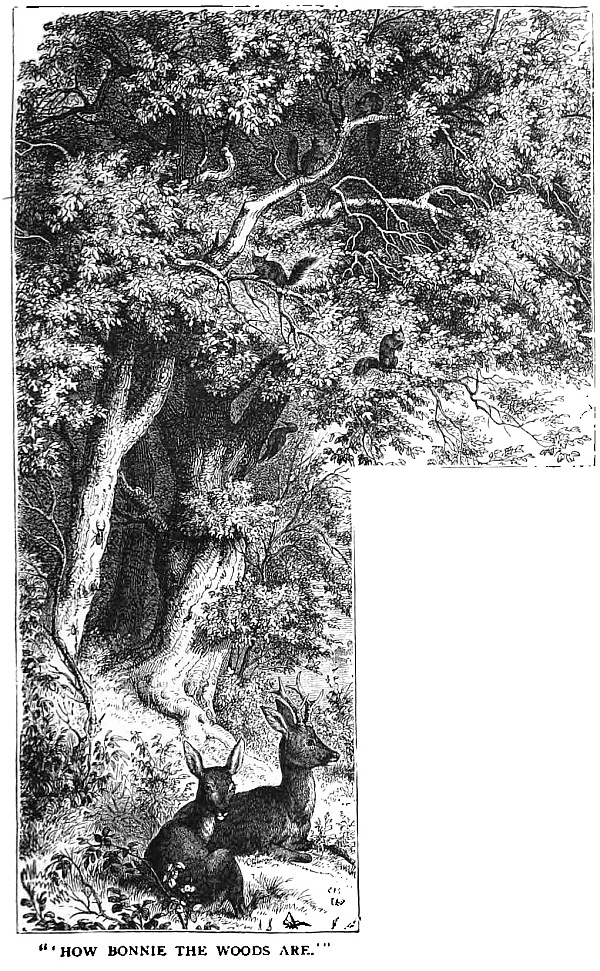
“Oh!” said the boy, “that will soon be now. And oh! how bonnie the woods are, and the birds have all begun to build.”
“Are the woods very bonnie, Archie?”
“Oh! delightful,” cried the boy. “The moss is so soft and green under the trees. The wild flowers are creeping out and blowing on the banks. The pine trees are all stuck over with long white-green fingers.”
“I know,” said Kenneth.
“The birch tree stems are whiter than ever I saw them, just like silver, Kennie.”
“Yes.”
“And their branches are trailing down with the weight of their bonnie wee glittering leaves.”
“Yes, yes.”
“Then the needles on the larch trees were never so soft and green before, I’m sure, and they are just covered with red tassels.”
“Yes.”
“And the rowan trees (Rowan tree—the mountain ash) are covered with white flowers. What lots of scarlet roddans they’ll have in autumn! And the birds are all building, as I said. I have a hoody-craw’s nest in a Scotch fir in Alva, and a kestrel’s in a terribly tall tree at Aultmore. That magpie is building a brand-new nest; I knew she’d have to.”
“Well?”
“Well, there are five eggs in a laverock’s among the corn, and I know where there is a ptarmigan’s and a whaup’s, far away up among the mountains.”
“Oh! I do so long to be well, Archie.”
“And the sheep, Archie?” continued poor Kenneth. “I’ve dreamed about them so often since I’ve been sick. I always see them lookin’ up, Archie, with their bonnie brown een” (eyes), “and wonderin’ what has come of me. And I’m sure Kooran wants to see them.”
“Kooran could see them any day, and they’re doin’ finely, but Kooran won’t leave you.”
“Dear me, what shall I do?” cried Archie’s mother, running distractedly up the garden with a bucketful of greens in her hand. To have seen her half-scared looks, one would have imagined something terrible was about to happen. “Gentry coming, and I’m no’ dressed.”
The gently arrived about five minutes afterwards, little Jessie, Miss Gale, and Miss Grant.
As soon as she found herself on the garden path Jessie, who had a bunch of primroses in her hand, and some long drooping crimson-tipped twigs from the larch, started to run. But she paused half-way, and an expression of sadness stole over her face, as she noticed how wan and white Kenneth was looking.
She advanced more slowly and tendered the flowers.
“Poor boy!” she said; “are you very, very ill?”
Kenneth took the flowers, and a flush of joy lit his pale cheeks as he replied,—
“Not now, Miss Jessie. The doctor says I have nothing to do but get well.”
“Oh, I’m so glad,” cried Jessie.
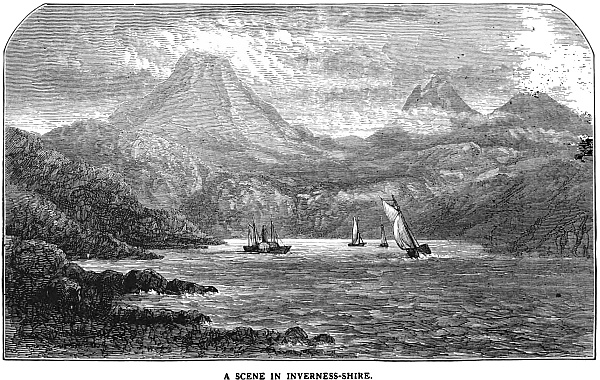
Her governess now came up, and Miss Grant. The latter had been often before to see the invalid, but Jessie and Miss Gale had only recently arrived from Inverness-shire, and were loud in their praises of its magnificent scenery. Archie went and brought a chair for Jessie, so that she could sit while she talked to the invalid boy. Archie was improving. He even spoke to Jessie to-day, and promised to bring her something very nice if she would accept it. The something very nice ultimately proved to be a young hedgehog, so young that its spines had only just turned hard.
Presently the ladies went into the keeper’s cottage. Archie lay down on the gravel-path with his head on Kooran’s neck, and Jessie sat and talked to Kenneth.
What was she telling him? He looked intensely interested. His eyes were dilated, his hands clasped, his face flushed. It was but a simple story she was telling him, told in simple child’s language. The story of her own London life, her life in society. But it was all, all so new to Kenneth.
Ah! little did innocent Jessie know that her prattle had lighted the fires of ambition in that boy’s soul. But so it was. She had inaugurated a new phase in his existence. She had inadvertently led him to see that there were other—can I say better worlds than his?
So Jessie went away, with many a promise to come again when he was stronger, and could play soft melodies on the flute,—melodies, she said, that made her feel she wanted to cry, but that she loved all the same.
Jessie went away. She had found the boy on this bright lovely spring morning but a boy; she left him a man at heart.
Archie came and sat by him, and recommenced his tales of mountain and moorland and forest. He told him of the fairy knoll and the smugglers’ cave, about the heather, now so green and promising, about early lambs, and all the little incidents of life in the hills. Kenneth listened, but his thoughts were far away.
These glens and wilds, dearly though he loved them, were not all the world. The poets and writers that had so charmed him hitherto, and served to throw a glamour of romance over the beautiful land in which he lived—Burns, Ossian, Tannahill, Campbell, Scott, and the Ettrick Shepherd,—they had made him love it, oh! so dearly love it, with that burning, passionate patriotism which only the heart can feel.
“That beats beneath a Scottish plaid.”
But—had he not been living too much in the past? was there not a power setting in that was threatening to tear Scotland from the hands of the Scotch? Ought he to stay among these mountains and dream dreams, instead of going out into the world beyond to work or fight for the dear land that gave him birth? Ought he not to try even to gather wealth for the sake of those he would leave behind?
Clouds were gathering over the glen. A foreigner was soon to take possession of it, with no more love for the soil than if the heather that grew on every acre of it had not been dyed a hundred times over with the blood of the hero and the patriot. Could he stay at home and see his father’s grave, poor old Nancy’s too, levelled?
His thin hands covered his face, the boy sobbed quietly, and the tears trickled through his fingers.
Chapter Nine.
The Storm Cloud Bursts over the Glen.
“When simmer comes smilin’ o’er mountain and lea, The green haughs and glens are pleasant to see, And pleasant the hum o’ the merry wild bee, When the rose, when the rose and lily are blawin’. An’ blithely the mavis salutes the gay morn As sweetly he sings on the snawy white thorn, While the laverock soars high o’er the lang yellow corn, And the moorcocks, the moorcocks are cheerily crawin’.” Old Song.
Scene: Summer once more on hill and glen. On the mountain brow, the heather is bursting into bloom and bee-haunted. Down in the lower lands the corn is growing long and green, mingled with orange of marigold and crimson blush of wild poppy, and the meadows snowed over with gowan and scented clover. Fish leap gladly in stream and tarn, the lofty pines wave their dark plumes in the sunny air, and every wood and copse is filled with melody.
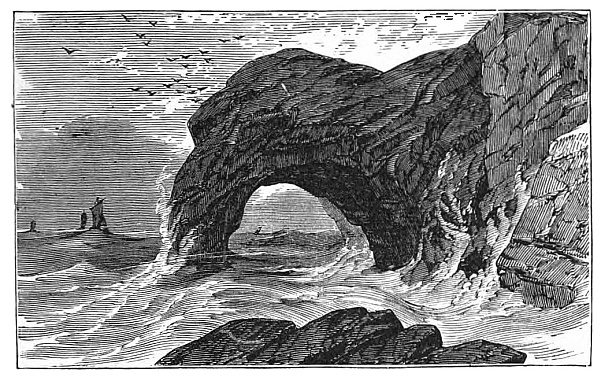
A right merry party are returning from the rocks by the seashore, where they have spent hours in wandering and wondering, for they found something new to admire at every turn.
Jessie is here with her governess and Miss Grant, and Kenneth strong and well again, to say nothing of Kooran and Shot, and last—probably least—Archie McCrane.
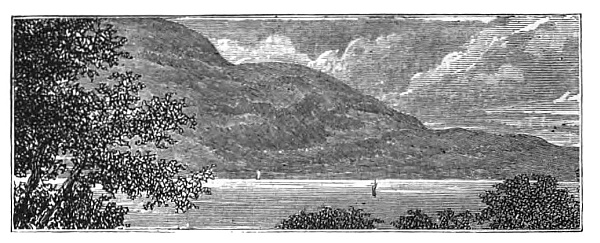
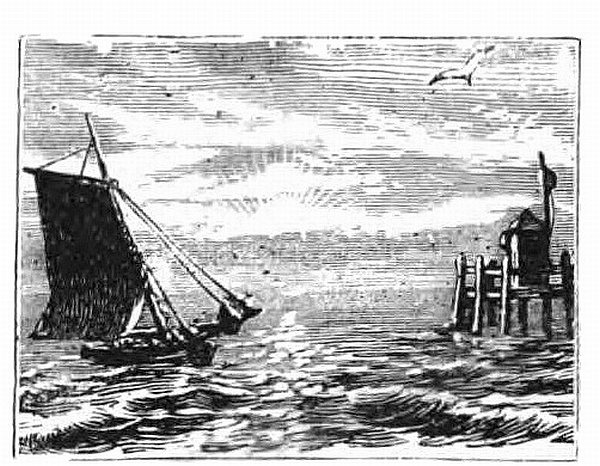
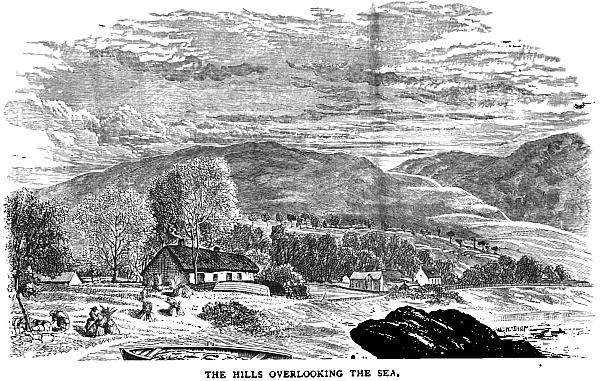
They have gained the brow of a hill overlooking the wide Atlantic. Far beneath them the sea-birds are wheeling and shrieking among the rocks, while out on the sea’s blue breast is many a little white sail, some so far, far away that though they have three masts, and must therefore be mighty ships, they seem from here not a bit bigger than a sixpenny piece.
Little Jessie is looking radiant and lovely, Kenneth gallant and gay, and everybody else, always including the dogs, as healthy and happy as the summer’s day is long.
Well, no wonder. They have spent such a gloriously pleasant day.
They took lunch with them to eat at sea. Yes, at sea, for old Duncan Reed took them out to the island and far beyond it, and Kenneth was proud on the whole to exhibit his skill as an oarsman. And Duncan had not hesitated to tell the ladies that he—Duncan Reed—had taught the boy all he knew about boating and fishing too.
The ladies were delighted with Duncan, especially Miss Gale, to whom he was something quite new. She must even sketch the little old man leaning there on his oar in his shirt-sleeves and night-cap, and Duncan was so delighted when he saw it, that his old eyes sparkled like the inside of an oyster-shell.
He shared the luncheon, and when they landed they went to his strange house, with the boat for a roof, and there he made them tea, although there were not cups for all, and Duncan himself had to drink his out of a mug.
But there really was more in this little old fisherman than might at first appear. Anyhow he astonished Miss Gale by his recitations of Ossian’s poems, both in the ancient Gaelic, and in English. Even Jessie, child though she was, experienced a thrill of indefinable pleasure as she listened to the rise and fall of the measured words, the magic of the wondrous verse, rolling out from the lips of this little old man, who looked so wild and weird, and mingling with the dull roar of the breaking waves.
The child never forgot it.
And now the little party stood on the hill overlooking the sea, and a walk of two miles took them, after a rest, to the fairy glen. But Archie, while they rested, had run on before, for everybody was coming to the cave, and Archie must see that it was neat and tidy.
There were freshly pulled ferns or brackens laid down as a carpet for the cave, and seats constructed out of the blooming heather. While making these Kenneth was thinking all the time about Jessie, and about how her eyes would sparkle when she saw these.
As they walked on over the hills, Kenneth by golden-haired Jessie’s side, the sky above them blue and clear, the clouds on the horizon looking like snow-white feathers, and the bees making drowsy music among the pinky heath, Kenneth got his child-companion to talk and tell him more about the great world, that mighty ocean of life that lay in the far beyond, the ceaseless throb of whose billows was hardly ever heard among those peaceful hills.
The boy stopped and looked backwards and away out towards the sea. Probably he never looked half so handsome as he did now, with his heart filled with manly resolves, with the light of a half-kindled ambition making his face to shine.
“I’m very, very happy here, Miss Jessie,” he said. “I may never, never be so happy as I am now, as I have been to-day. But before long I mean to leave this country, leave Scotland, and go away into the world, Miss Jessie.”
The child looked at him half afraid.
“Yes, I’m foolish, I suppose, but I cannot help it; go I must. I daresay I have read too many books, but—I long to go.
“I’m going to take Nancy’s Bible with me,” he said, smiling and looking half ashamed. “I’ll never part with that.”
“Let me see it,” said Jessie.
He took from his bosom a little old-fashioned Bible, with the Psalms of David—those heavenly gems of poetry and song—in metre at the end of the book, and placed it in the child’s hand.
“You are a very good boy,” she said, for the child felt she must say something.
“But oh!” she added, “here is a pressed primrose in the book.”
“It is one of those you gathered for me; don’t you remember?”
“Oh! yes,” she replied, smiling, “but it looks so lonely; here, place this little tiny bit of heather beside it.”
It was an innocent child-like action to place the bit of heather bloom there with the primrose, but one that Kenneth never forgot.
Archie was indeed a proud boy when Jessie and Miss Gale fell into raptures over the cave. Everything was admired, the heather seats, the rustic sofa, the rude bookcase containing the authors the boys read almost every day, and even the carpet of brackens.
“Did you get them?” said Kenneth in a stage whisper to Archie.
“Yes,” replied Archie, with eyes as big as two-shilling pieces, “and such a fine lot they are. And the cream. Yes, and plates and spoons and all.”
To the astonishment of his guests, Kenneth now placed a table in the centre of the cave, and bade them all sit down. Then from a dark recess he excavated a huge dish of mountain strawberries (Rubus chamaemorus), a jar of cream, and plates and spoons. Neither Jessie nor Miss Gale had ever eaten anything so delicious before.
“But what are they, Kenneth?” she said.
“They are called cloud-berries,” replied Kenneth; “they only grow far up in the mountain tops, and some call them fairy food. People about here say that these berries creep in under their leaves, and hide when any one with a baneful eye looks at them, and that only good people can gather them.”
“And who gathered these?” said Miss Gale.
“Archie.”
“Oh! Archie, you are good.”
Archie felt prouder even than before.
But after the cloud-berries were discussed, wee Jessie, sitting there on her heather couch, said, with a half-arch smile,—
“There is something else. Look at your tablets, Miss Gale.”
“Oh yes,” said Miss Gale. “Here it is—Flute.”
Kenneth had the flute in his pocket. He was a marvellous player for a boy. His whole soul seemed to breathe through the instrument.
To-day he played a battle-piece of his own putting together—not composing.
First came the gathering of the clans, bold, energetic, soul-touching, then the plaintive farewell to native glens, as the Highlanders marched away,—
“Maybe to return to Lochaber no more.”
Next came the spirited march, then the wilder pibroch as the foe was sighted, then wilder rushing music still; the fight was going on now, you could feel that. You could hear the shrill slogan of the Highlander mingling with shout of victor and shriek of wounded. Then a pause, and anon the coronach or wail for the dead.
And so the music died away.
Down the glen now the party went, for the sun was sinking low in the west, and the fairy glen was miles from the clachan.
But Jessie must see the sheep. Dugald was acting as shepherd to-day, and doffed his Highland bonnet as the ladies approached him.
There was not a sheep there that Kenneth did not know. They bleated a kindly welcome as he approached. They even played with Kooran, making great pretence to knock him down or to hit him with their hard feet, all of which Kooran took in good part, and kindly pretended to run from them, then turning and barking in a funny remonstrative voice, as if he really were laughing at heart, and enjoyed the fun immensely, and I have no doubt he did.
Dugald took Kenneth aside.
“There is bad news come,” he said; “all is lost. The glen is to be evicted.”
Kenneth’s heart sank within him.
The cloud then that had been gathering so long was about to burst.
It was well-nigh a year since the tenantry had been asked to leave. They heeded not the summons. They could not believe that their own auld laird McGregor would send his people away. Little they knew. McGregor would never appear among them again. The edict sent through him was sent by or at the instigation of the new American laird. The glens were no good to him with people in them—so he said—he must have deer; he was buying the land for the “sport” it would afford him, his family and friends. Yet he doubted his own power, being a foreigner, to evict.
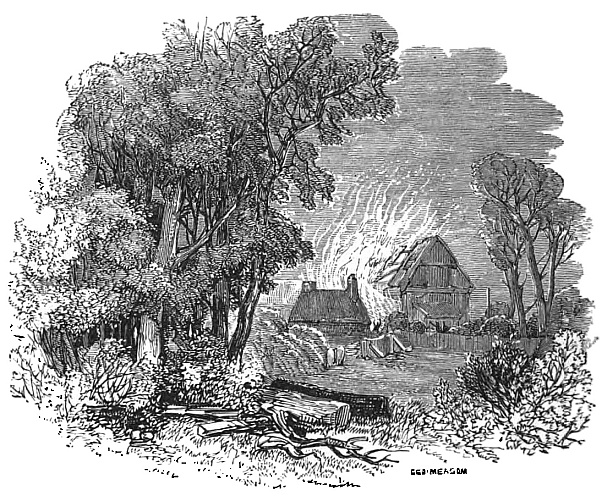
But that very day the last summons was given previous to forcible expulsion.
And the young men of the clachan and glens were wild. They would stand by their homesteads, they would grasp dirk and claymore, they would fight, they would die where they stood.
But at the great meeting that took place the wisdom of the grey-haired prevailed. And with sorrow, ay, and tears, they all came at last to the conclusion that resistance would be worse than useless.
They would not go till they were forced, they would stay and see the last of the dear old spot, but they would bend their necks to the yoke, they would maintain a passive attitude.
In this they showed their wisdom. The auld laird McGregor sent them a most affecting letter. “Their sorrows,” it ended, “and his own misfortune had broken his heart, and though he could see them no more in life, his thoughts and mind were with them.”
True, for the auld laird lived scarcely a year after the eviction of Glen Alva.
But with a portion of the remains of his fortune he paid the passage money to America of as many of his tenants as were willing to accept his offer.
I would not harrow the feelings of my readers by describing the last sad scene in Glen Alva, when in the darkness of night the people were turned out; when more than seventy houses—well, call them huts, they were homesteads, at all events—were given to the flames; when the aged and the sick were laid on the bare hillside to shiver and to die; and when neither the wail of the widow nor plaintive cry of the suffering infant could move to pity or mercy the minions of the Yankee laird, who preferred deer to human beings.
Selah!
Chapter Ten.
The Last Link is Broken.
“Farewell, farewell, my native land, Thy lonely glens and heath-clad mountains.”
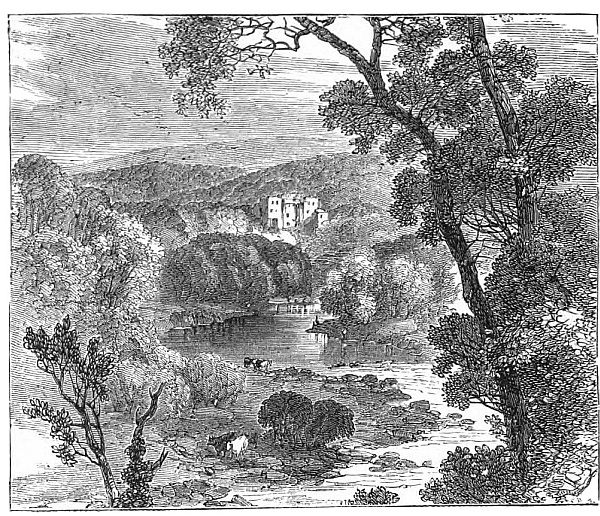
Scene: The fairy glen once more, and in the background the fairy knoll. Kenneth and Archie, both looking very sad, are in the foreground by a new-made grave. Kenneth has been planting a little tree there, only a young Scotch pine, dug from the moor, a treelet that had grown from a cone which the rooks had fetched from Alva’s gloomy forest. Kenneth has planted the tree, and the spade has dropped from his fingers and fallen among the heather.
Archie’s dog Shot is standing near. He has been watching all the proceedings. Watching, and probably wondering. For dogs do think.
But where is Kooran? Kooran is under the sod. His bonnie brown eyes have closed for ever; his faithful heart will never feel love or friendship more—it has ceased to beat. Nor cry of wild bird on the mountain, nor plaintive bleat of lamb, no, nor his master’s voice, will ever move him again.
“I canna but believe,” says Hogg, the Ettrick Shepherd, “that dogs hae sowls.”
There are many more believe with you, dear Hogg.
But about honest Kooran. When dogs get old, you know—and Kooran had got old before he died—a slight stiffness may be noticed in their gait. I am positive that they begin to wonder what ails them. Wonder why they cannot run so fast as they used to, in the good days of yore. Wonder why they get tired and out of breath so soon. Wonder, too, why master speaks so low, or why the sheep do not bleat so loudly or the birds sing so much as they used to. They do not know that this is only failure in their own powers of hearing. And they wonder also why the trees and grass and hedgerows have ceased to be so bright and green, even in spring-time, as once they were; why master’s face seems dimmer. They cannot now stand the cold so well; they seem to want a thicker coat, but alas! the coat grows thinner. They would fain seek the shelter of indoors, even curl up on the hearthrug. How seldom do they get the chance! How often they receive the brutal kick when they most need comfort!
Then comes the day when they feel the cold no longer.
It had never occurred to Kenneth that some time or other Kooran and he must part—that Kooran must die. He was ever kind and attentive to this faithful friend of his; he never forgot him. He might have been excused if he had, for the scenes at the eviction and the burning of the glen were awful enough, in all conscience, to have driven everything else out of the boy’s head.
Of all the houses in the glen, that alone of Kenneth’s mother had been spared. Not that she meant to accept the favour thus offered her and stay on. Both she and Kenneth were far too proud for that. But at the cottage they lived for a time. And at the cottage Kooran died.
He came wet and weary one evening and threw himself down at his master’s feet.
When Kenneth spoke to him he looked pleadingly up into his face and shivered. Kenneth had never seen him shiver before. The dog went and lay before the fire, and his master covered him up with his plaid. Kooran licked his hands.
Something, he knew not what, awoke the boy long before dawn next day, and his first thought was of his old favourite.
He peeped out at the little gable window in the garret where he lay. A pale scimitar moon was declining behind the trees. These looked black and spectre-like.
Kenneth went gently down the ladder, and lit the oil lamp. The fire was very low, and he replenished it. Then he gently lifted a corner of the plaid. The action aroused the dog, and he crawled forth. He seemed to feel for Kenneth’s knee, and on this he laid his head.
Kenneth knew this was death. He put his hand tenderly on the poor dog’s muzzle, for he could not hear him breathe.
The tongue came out to lick the hand. It was a farewell.
And the boys had rolled the body of poor Kooran in a piece of old tartan plaid, and, followed by Shot, carried him up to the fairy glen, and buried him near the fairy knoll. Remember they were only boys.
Then Kenneth sat down and cried. Archie had never before seen such an exhibition of weakness on the part of his friend, so what could he do but sit down and keep him company? They were only boys.
Shot looked very sad. He did not know what to make of it all. He whined impatiently. Then he licked Archie’s wet face and touched Kenneth under the arm with his nose, as some dogs have a way of doing.
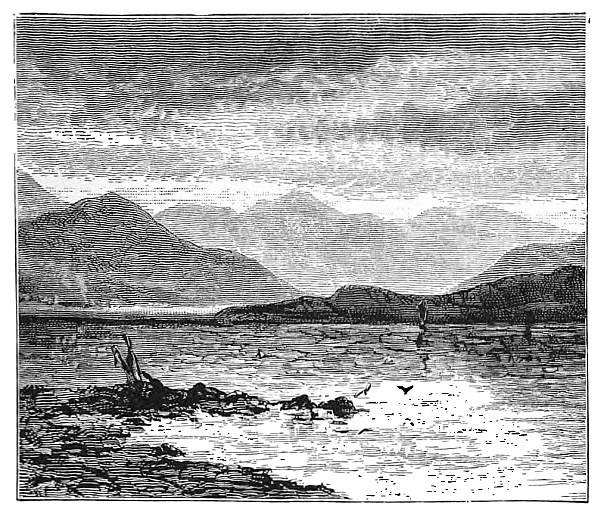
“Poor Shot!” said Kenneth. “You too have lost a faithful friend.”
Together, after this, they took their way down the hill.
A short, crisp, and gentlemanly letter came to Kenneth two days after this. It was from Jessie’s father.
“My daughter has spoken much about you,” said this epistle, “and quite induced me to take an interest in your welfare. The situation of under-ghillie at my Highland shooting-box is vacant. I have much pleasure in placing it at your disposal. You will be good enough therefore to enter on your duties on Monday next, etc, etc.”
Kenneth’s cheek burned like a glowing peat. He tore the letter in fragments, and threw them in the fire.
“Mother,” he cried, “dear mother, it needed but this! I shall leave the glen. I go to seek our fortune—your fortune, mother, and my own. I shall return in a few years as wealthy mayhap as the proud Saxon who now offers me the position of under-ghillie. Mother, it is best I should go.”
I pass over the parting between the mother and her boy.
With his flute in his pocket, with no other wealth except a few shillings and his Bible, Kenneth McAlpine turned his back on the glen, and went away out into the wide, wide world to seek his fortune.
For years, if not for ever, he bade farewell to his Highland home and all he held so dear.
End of Book First.
Chapter Eleven.
For Auld Lang Syne.
“We twa have paddled in the burn Frae mornin’ sun till dine. But seas between us broad hae rolled Since the days o’ auld lang syne.” Burns.
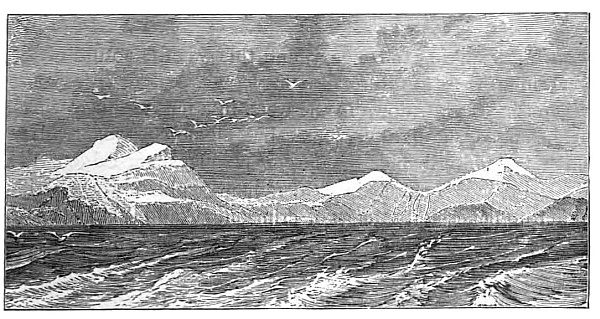
Scene: Landscape, seascape, and cloudscape.
A more lovely view than that which met the eye of a stranger, who had seated himself on Cotago Cliff this evening, it was never surely the lot of mortal man to behold. It was on the northern shores of South America, and many miles to the eastward of Venezuela Gulf.
Far down beneath him lay the white villas and flat-roofed houses of a town embosomed in foliage, which looked unnaturally green against their snowy walls. To the right, and more immediately below the spot where the stranger sat under the shade of trees, that towered far up into the sky, was a long, low, solitary-looking beach, with the waves breaking on it with a soft musical sighing sound; it was as if the great ocean were sinking to slumber, and this was the sound of his breathing.
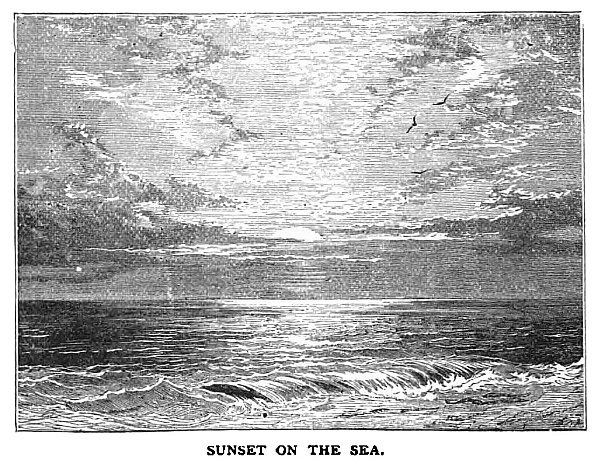
The sun was low down in the west, in a purple haze, which his beams could hardly pierce, but all above was a glory which is indescribable, the larger clouds silver-edged, the smaller clouds encircled with radiant golden light, with higher up flakes and streaks of crimson. And all this beauty of colouring was reflected from the sea itself, and gave a tinge even to the wavelets that rippled on the silver sands.
It was very quiet and still up here where the stranger sat. The birds had already sought shelter for the night; well they knew that the sunset would be followed by speedy darkness. Sometimes there would be a rustle among the foliage, which the stranger heeded not. He knew it was but some gigantic and harmless lizard, looking for its prey.
“I must be going back to my hotel,” he said to himself at last. He talked half aloud; there was no human ear to listen.
“I must be going home, but what a pity to leave so charming a place! I do not know which to admire the most, the grand towering tree-clad hills, the sea, or the forest around me.
“Hullo!” he added, “yonder round the point comes a little skiff. How quickly and well he rows! He must be a Britisher. No arms of lazy South American ever impelled a boat as he does his. Going to the hotel, I suppose. No, he seems coming straight to the beach beneath me. Hark! a song.”
The rower had drawn in his oars, leaving the little boat to continue its course with the “way” already on her, while he gazed about him. Then, as if impelled to sing by the beauty around him, he trilled forth a verse of a grand old sea song.
“The morn was fair, the sky was clear, No breath came o’er the sea, When Mary left her Highland cot And wandered forth with me. Though flowers bedecked the mountain side, And fragrance filled the vale, By far the sweetest flower there Was the Rose of Allendale.”
Then there was silence once again. The rower rowed more slowly now, but soon he beached his boat, and drew it up, and hid it by drawing it in among the rocks.
The stranger soon afterwards rose to go.
He had not proceeded many yards along the hillside, when, on rounding a gigantic cactus bush, and close beside it, he stood face to face with the oarsman.
The former lifted his hat to bow, but instead of replacing it on his head he dashed it on the ground, and springing forward, seized the other by the hand.
“Archie! Archie McCrane!” he cried; “is it possible you do not know me, that you have forgotten Kenneth McAlpine?”
Poor Archie! for a moment or two he could not speak.
“Man!” he said at last, in deep, musical Doric; “is it possible it is you, Kennie?”
The tears were blinding him, both hearts were full, and they said no more for many seconds, merely standing there under the cactus tree holding each other’s hands.
“God has heard my prayer,” said Kenneth at last.
“And mine.
“But how you have altered, Kenneth! How you must have suffered to make you look so old!”
“You forget I am old, twenty-one next birthday; and you are only a year less. But what wind blew you here? I thought, Archie, you had settled down as an engineer on shore.”
“Your letters roused a roving spirit in me, Kenneth. I determined to see the world. I took the first appointment I could get. On a Frenchman. I haven’t had much luck. We have been wrecked at Domingo, and I came here last night in a boat. But come, tell us your own adventures. I have all your letters by heart, but I must hear more; I must hear everything from your own mouth, my dear brown old man.”
Kenneth was brown; there was no mistake about that, very brown, and very tall and manly-looking, and the moustache he wore set off his beauty very much. No, he had not cultivated his moustache. It had cultivated itself.
“Come down to the hotel,” said Archie. “I am not poor. We saved everything. It was a most unromantic shipwreck.”
“No,” replied Kenneth, “not to the hotel to-night. Come up the mountain with me to my cottage.”
“Up the mountain?”
“Yes, my lad,” said Kenneth, smiling. “Up the mountain. Haven’t forgotten how to climb a hill, have you, I say, Archie, boy? for, as brown as I look, I am an invalid.”
“What!” cried Archie, in some alarm. “Nothing serious, I sincerely hope.”
“Nothing, old man, nothing. But when they left me here six weeks ago, I thought that no power could have saved me. I had yellow-Jack. That’s all. I could not have lived in the hotel. Good as it is, it is too low. But come; old Señor Gasco waits supper for me.”
Up and up they struggled, arm in arm. Kenneth knew every foot of the pathway through the forest; it was well he did, for night had quite fallen over sea and land, and the stars were glinting above them ere they reached a kind of tableland, and presently stood in front of the rose-covered verandah of a beautiful cottage.
The French windows were open, and they entered sans cérémonie. It was a lofty, large room, furnished with almost Oriental splendour, with brackets, ottomans, and suspended lamps, that shed a soft light over everything around.
And here were books, and even musical instruments galore, among the latter a flute. It was not the flute Kenneth used to play in Glen Alva, and up among the mountains, while herding his sheep; it was a far better one, but the sight of it brought back old times to Archie’s memory.
Kenneth had left him for a few minutes.
Archie sank down upon an ottoman with the flute in his hand, and when Kenneth returned he found his friend in dreamland apparently.
But with a sigh Archie arose and followed Kenneth to an inner room.
“Señor Gasco,” said the latter, “this is Archie McCrane, the friend of my boyhood, of whom you have so often heard me speak.
“Archie, this gentleman has saved my life. He is a kind of a hermit. Aren’t you, mon ami?”
“No, no, no,” cried Señor Gasco, laughing. “Only I love pure, fresh, cool air and quiet; I cannot get these in the town beneath, so I live here among my books.”
He was a tall, gentlemanly-looking Spaniard, of some forty years or over, and spoke beautiful English, though with a slightly foreign intonation.
A supper was spread here that a king might have sat down and enjoyed.
Two tall black servants, dressed in snow-white linen, waited at the table. They were exceedingly polite, but they had rather larger mouths and considerably thicker lips than suited Archie’s notions of beauty.
Out into the verandah again after supper, seated in rocking-chairs; the cool mountain air, so delicious and refreshing, was laden with the perfume wafted from a thousand flowers. There were the stars up in heaven’s blue, and myriad stars, the fire-flies, that danced everywhere among the trees and bushes. Archie said they put him in mind of dead candles.
“And now for your story, Kenneth.”
“It is a long one, but I must make it very brief. You know most of it, dear Archie, so why should I repeat it?”
“Because,” said Archie, “I do so love to hear you speak. Your voice is not changed if your face is, and when I sit here in this semi-darkness, and listen to you, man, I think we are both bits of boys again, wandering through the bonnie blooming heather that clothes the hills above Glen Alva.”
“Now you have done it,” cried Kenneth, laughing.
“Done what?” said Archie.
“Why, you have to tell the first story. If you hadn’t mentioned home, if you hadn’t spoken about the hills and the heather, I would have told my tale first.”
“But—” said Archie.
“Not a single excuse, my boy. I am home-sick now. Answer a few questions, and I’ll let you off.”
“Well, go on,” said Archie; “ask away.”
“My dear, dear mother! Have you seen her grave lately?”
“It was the last spot I visited when I went to the clachan,” replied Archie sadly.
“Heigho!” sighed Kenneth. “And I was all ready to go home. We were lying at the Cape, if you remember, when your letter arrived. Yes, and I left my ship, I threw up a good appointment on receipt of the sad intelligence; and Archie, dear lad, I shall go back to Scotland when I make my fortune—not before, and that may be never.”
“Do not speak like that.”
“But I must and will. How changed everything must be from the time I kept the sheep among the hills. And how do the clachan, the glen, and the hills look now?”
“The clachan is but little changed. Mr Steve did not tear down the village and church, as he first threatened. No, the clachan is the same, but poor Mr Grant has gone.”
“Dead! You did not tell me this in your letter.”
“No, no, not dead. He has got a better living in the city.”
“Yes?”
“Yes, and I went to see them. The Misses Grant keep every letter ever you wrote them, and they do long, I can tell you, for the return of the wanderer.”
“Bless their dear hearts!”
“I went over to the wee village by the sea and saw Duncan Reed.”
“Is he changed?”
“Not in the very least. Looks hardier than ever.”
“And your father and mother you have already said are well?”
“Yes, but father doesn’t like town life. How he would love the old days to come back again; how he would love to rove once again over the hills gun on shoulder and dog at his heel!”
“He is not very old; he may yet have his wish.”
“I fear not.”
“Well?”
“Well, the glens and hills all around are planted with trees. This was done as soon as Mr Steve took possession of the estate, and before poor old Chief McGregor died.”
“He is dead, then?”
“Yes. I would have told you, but I wanted to make my letters to you as bright as possible.”
“So the dear old man is dead. Heigho! And the estate planted. You did not even tell me that.”
“No, and for the same reason. But the trees are getting quite tall already. Most of the higher parts of the glens are covered with Scotch firs and spruces and larches, the lower lands with elm and plane and scrubby oaks. At the risk of being taken as a trespasser, I went all over the estate. I penetrated up to the fairy knoll and saw poor Kooran’s grave. There are young trees all round there now.”
“Archie,” said Kenneth, leaning forward and peering into his companion’s face, “I hope they didn’t interfere with poor Kooran’s grave.”
“No, nor with anything around it.”
“Go on, lad; I’m so pleased.”
“Well, I’ve little more to say. I was not taken prisoner, though I startled the wild deer in all directions.”
“But the grand old hills themselves?”
“Nay, they are not planted. Green in summer and purple and crimson in autumn, there they are the same, and ever will remain.”
There was a pause. Then Kenneth spoke once again.
“Did you ever see Miss Gale since?”
“Only once,” replied Archie, “and Miss Redmond—Jessie—she has grown tall, and oh! Kenneth, so beautiful, but still so child-like and graceful.”
“I can easily believe that, boy. And did she—”
“Yes, dear lad,” said Archie. “She did ask all about you, so kindly. And I gave her your last letter to read. And—”
“And she read it, Archie? Tell me, did she read it?”
“Yes, she read it over and over again.”
“Now, I’ll tell you my own adventures.”
“Begin at the beginning, won’t you? The very beginning, from the day you and I parted.”
“I will.”
But what Kenneth said deserves a chapter to its own account.
Chapter Twelve.
Kenneth and Archie.
“Adieu, adieu; my native land Fades o’er the waters blue; The night-winds sigh, the breakers roar, And shrieks the wild sea-mew. Yon sun that sets upon the sea We follow in his flight; Farewell awhile to him and thee, My native land, good-night.” Byron.
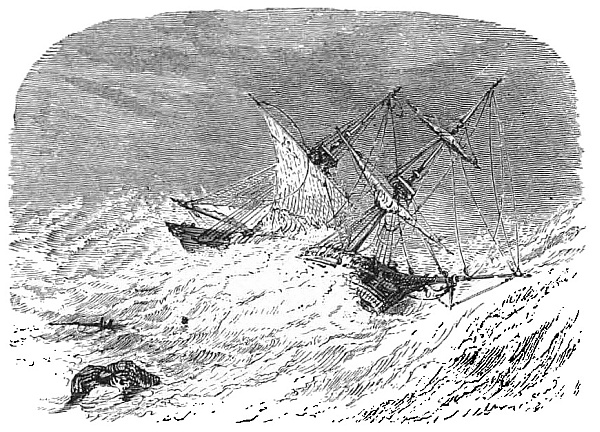
Scene: Kenneth and Archie still seated in the verandah of the Spaniard’s cottage. The light from the casement window is streaming outwards through the creepers and climbing plants all around them; the beautiful bell-like flowers, down-drooping, touch their very faces. But all the colour up there in the verandah’s roof does not belong to these flowers. No, for birds are sheltering their bright wings from the night dews; that rich orange spot in the corner is a bird, so is that patch of crimson and steel, and yonder one of snow-white and blue. If you looked steadily for a moment at them, you could see round heads turned downwards and wondering beads of eyes. The birds are considering whether or not all is safe, or whether they had better fly away out into the night and the darkness.
Kenneth is waiting for the Señor to come. There is hardly a sound except a gentle sighing of wind among the trees, now and then the shriek of a night bird, the constant chirp of cicada, or rap, rap, rap, of green lizard as he beats to death some unhappy moth he has captured.
“Now, Señor, come and sit you down. Light your great pipe. That is right. Thanks, yes, both Archie and I will have a little palm-leaf cigarette. Coffee? Oh! delightful! Archie: old man, there isn’t any one in all the wide world ever made coffee half so well as the Señor Gasco. Flattery, Señor? No, not a bit of it. The truth cannot be flattery.”
“The coffee,” said Archie, “is delicious.”
“Heigho!” sighed Kenneth. “I am so happy to-night, dear Archie. I believe it will really do me good to tell you of some of the troubles I have come through; it will dilute my joy.
“I don’t know, Archie, old man, how ever I became a sailor. I’m not quite sure, mind you, that I am altogether a sailor yet at heart, though I dearly love the sea, and a roving life is the life for a man of my temperament. Señor is smiling; he will never admit I am a man. But I have come through so much, and the years I have spent since I left the dear old glen have been indeed eventful, and seem a long, long time.
“But, Archie, lad, when I began my wanderings through the world, I can tell you my ambition was very great indeed. I determined, you know, to make my fortune, and I determined to make it in a very short time. The details of the process of fortune-manufacture, however, didn’t present themselves to me, all at once anyhow. I turned my back on Glen Alva, and so full was my heart that I put at least ten miles behind me before I sat down to rest. I got inside a wood at last, and seated myself beneath a tree, and counted my money, three shillings and fivepence-halfpenny! Well, many a man has begun the world on less.
“But this money couldn’t last long. What then should I do? I’ll tell you what I did do. I fell sound asleep, and the sun was setting when I awoke, and flooding all the wood with mellow light.
“There was a blackbird came and perched half-way up a neighbouring spruce tree and began fluting.
“‘Oh!’ I said half aloud, ‘two of us can flute.’
“So the blackbird and I piped away there till it got nearly dark. But I felt hungry now, and music is not very filling, Archie. So I put up my flute and started to my feet; I felt stiff now, but it soon wore off.
“I went on and on and on, getting hungrier every minute, but there was no sign of village or house. I drank some water from a rill that came tumbling down through a bank of ferns, and felt better.
“I was beginning to wonder where I should sleep, when the sound of merry laughing voices fell upon my ear. The party, whoever it was, came rapidly on towards me from among the trees.
“‘Hullo, lad!’ said one; ‘are ye comin’ to the dance?’
“‘Dance!’ I cried; ‘why, my feet are all one bag of blisters, and I’m faint with hunger. Dance, indeed!’
“‘It’s a puir beggar laddie,’ said a girl, whose face I could hardly see in the uncertain light.
“‘Beggar!’ I exclaimed. ‘Who d’ye call a beggar? I’ve a whole pocketful of money, only I’ve lost the road.’
“‘Come along, then,’ they all cried. ‘Come along with us.’
“And off we all went singing. We struck off the road down across the fields, and soon I heard the music of a fiddle and saw bright lights. A young man came out of a farmhouse to welcome us. He told us dolefully that only one fiddler had come, and plaintively asked what could be done.
“‘I’ve a flute,’ I cried.
“‘Hurrah!’ they answered. ‘Come in, my boy.’
“‘The laddie maun eat first,’ said the girl who had called me a beggar.
“I blessed her with all my heart, though not in words.
“What a supper they gave me! And didn’t I eat just! I could play now, and we spent such a joyful night, and dawn was breaking and the blackbirds up and fluting again long before the merry party broke up.
“I got a bed and slept far into the day; then, after a good dinner from these kind-hearted farm folks, I began my journey in search of fortune once more.
“By evening I saw great grey clouds lying in the hollows before me. It was smoke. I was nearing Glasgow, and in two hours more I was walking along the Broomielaw.
“I had never seen so many people before in my life, but hardly anybody looked at the shepherd lad in Highland garb. I determined they should, though. I put my flute together, and standing near the bridge, commenced to play ‘The Flowers of the Forest.’
“Was it the singular plaintiveness of this beautiful air, I wonder, or was it that my thoughts were away back again in the glen I had left, and with those I loved so dearly? I do not know, but I seemed to become oblivious to everything. My very soul was breathed into the music; I was speaking and appealing to the crowd through the instrument.
“The crowd! Yes, there was a crowd. I became aware of that as soon as I had finished, and money, piece after piece, was forced into my hand. I took the money. I felt ashamed of it next moment, but to have gone off then would have seemed ungrateful. I played still another air. Again I paused.
“‘No more money,’ I cried aloud as I fled away.
“They must have thought the Highland boy was mad.
“Some time afterwards I found myself standing at a book-seller’s window looking at a picture, a ship, a gallant ship in a gale of wind.
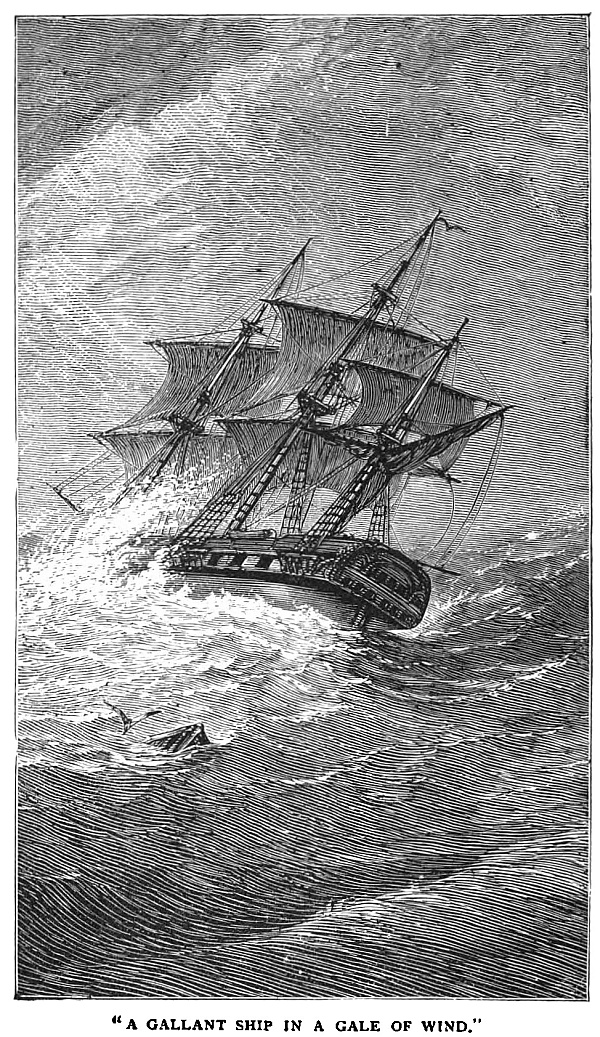
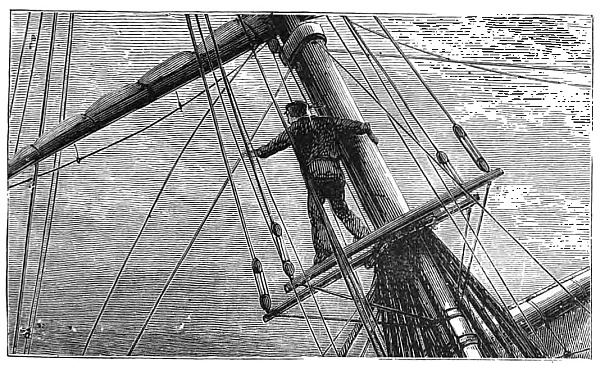
“How I longed to be at sea then! How I hated the bustle and stir and talking and noise all round me! That splendid ship—the sea was wild and rough all around her, the spray dashing over her bows; there would be the roar of the wind through rigging and shroud, and the wild scream of sea bird rising high over the dash of the waves. She bore it well; the sheets were taut; the sails were rounded out and full. How I longed to be at sea!
“A hand was laid on my shoulder. I started and looked up. No need to start.
“A kindly face looked down into mine.
“‘You are in grief of some kind, my boy,’ he said, this white-haired old gentleman. ‘Nay, don’t be too proud to admit it. Pride has been the downfall of the Highland race.’
“‘If you please, sir,’ I replied, boldly enough now, ‘the Highlanders are not a downfallen race.’
“‘I did not mean it in that way,’ he said, smiling at my vehemence. ‘But come with me, boy; I know we will be friendly.’
“Where he took me, or what he said to me, I need not tell you.
“Suffice it to say that next day we left Scotland and journeyed south by rail, and I wept—yes, I do not now think it shame to say so, though I struggled then to hide my tears—I wept to cross the border.
“‘It will be such a pleasant change for you, my dear boy,’ said good old Major Walton—for that was the gentleman’s name, and he had quite taken to me after hearing all my story—‘a delightful change indeed after your own bleak, cold, wild hills. We have a very pretty home in Hampshire. You’ll soon forget you were ever anywhere else.’
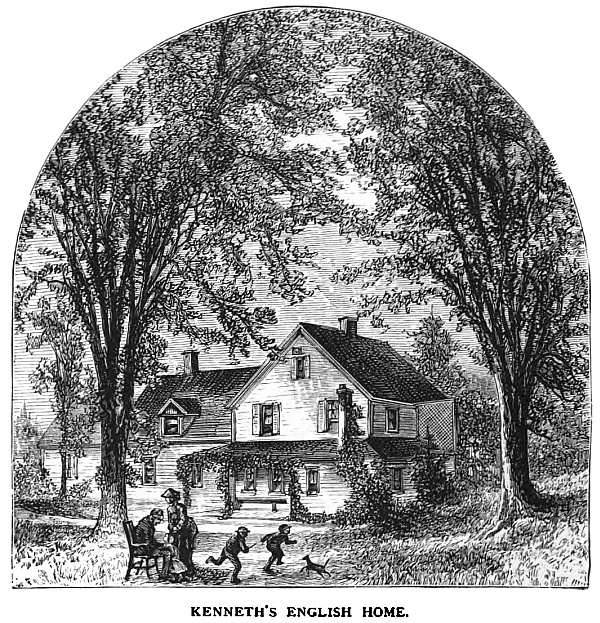
“The Major’s home was indeed a very nice one; close to the borders of the New Forest it was, and not a great way from the sea.
“But ah! Archie, lad, everything was very foreign to me; the very trees looked strange and uncouth, especially the docked pollards, that stood by the banks of the sluggish streams. The style of the houses was strange to me, and the lingo and talk of the people, who, in my opinion, were terribly ignorant.
“The Major was kindness itself, and so were his wife, her sister, and two children. The major had but one hobby—music. He played the violin himself, and he told me honestly that his chief reason for ‘taking me’—these are his very words—was because I played with such feeling.
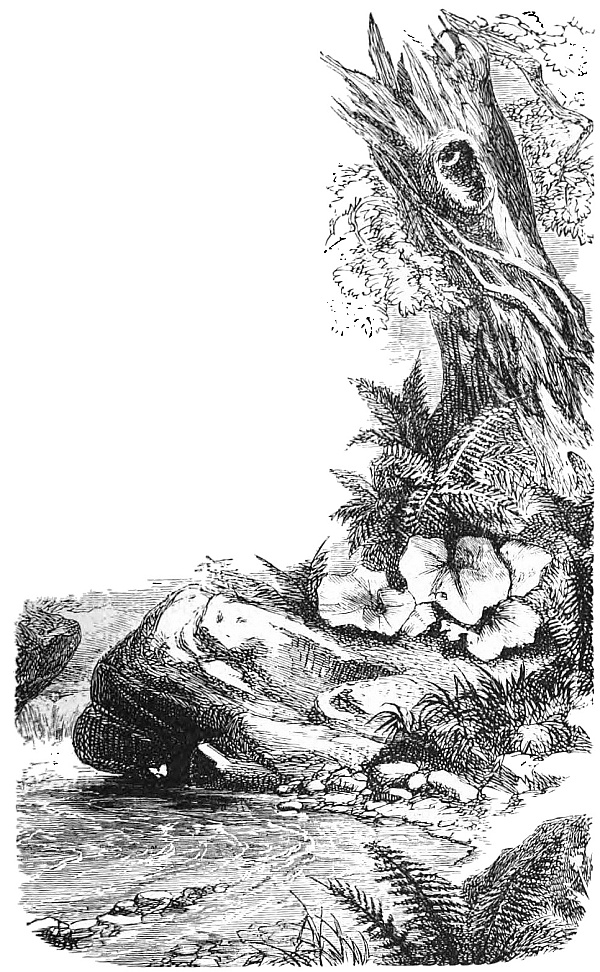
“My evenings were happy enough in this English home of mine; my days I spent in the garden, where I was allowed to work, or in the great forest. You must not imagine, Archie, the New Forest is anything like a deer forest in our own land. There are in it no wild mountains, no deep dark dells, no beetling crags and cliffs, no cataracts, no foaming torrents; the red deer does not toss his wide antlers here and fly proudly away at your approach, nor far above you in the sky do you see the bird of Jove circling upwards round the sun.
“Wilson would never have said about the New Forest,—
“‘What lovely magnificence stretches around! Each sight how sublime, how awful each sound; All hushed and serene, like a region of dreams, The mountains repose ’mid the roar of the streams.’
“But many a long day I spent roaming about in this forest, nevertheless.
“I was charmed with the solitary grandeur of the place. I had no idea it was so extensive either, or so varied in its beauties. Why, here one might wander about for weeks and never weary, for he would always be coming to something new. Is this the reason, I wonder, that it is called the New Forest? New in point of time it certainly cannot be termed, for everything in it and about it is old, extremely old. The oaks are gnarled and wrinkled, and grey with age; its elms and its ash trees, its limes and its alders, are bent and distorted by the touch of time, and the lichens that cling to their stems only add to their general appearance a look of hoariness that is far from unpleasing to the eye.
“Then the heather which covers the large sweeps of moorland that you see here and there is very sturdy and strong, while from the furze or whins boats’ masts could be made.
“The creatures, too, that one sees while walking through this forest, seem birds and beasts of some bygone time, and look as if they hardly, if ever, saw a human being from one year’s end to the other.
“The hares or rabbits, instead of scurrying away at your approach, sit leisurely on one end while they wash their faces and study you. The blackbirds and the mavises hardly trouble themselves to cease their song even when you walk close by the trees on which they are perched. The great beetles and other members of the coleoptera tribe are far too busy to take the slightest notice of your presence, and the great velvety bees go on working and humming just as if there were no such creature as you within a thousand miles of them.
“Then the voles or water rats that live in the depths of this truly English forest are not the least curious specimens of animal life to be found therein. If you happen to be reclining anywhere near a pool that by long-established custom belongs to them alone, before many minutes one, if not two of them, will come out to stare and wonder at you; they, like the hares, sit up on one end to conduct their scrutiny; and they gaze and gaze and gaze again, digging their finger joints or knuckles into their eyes, in a half-human kind of a way, to squeeze out the water, and clear their sight for one more wondering look.”
(My country readers, who love nature, must have noticed the voles at this queer performance.)
“What is he at all? Where did he come from? What is he going to do? These are the questions those voles seem trying in vain to solve.
“Here in this New Forest is a silence seldom broken save by the song of bird or cry of some wild creature in pain, while all around you is a wealth of floral beauty and verdure that is charming in the extreme.
“Yes, Archie, I came ere autumn was over to love that forest well. I was not selfish enough, though, to keep all the pleasures of it quite to myself, and the Major’s children often accompanied me in my rambles. I used to read Burns and Ossian to them. They liked that, but they liked the flute far better. It appealed straight to their senses.
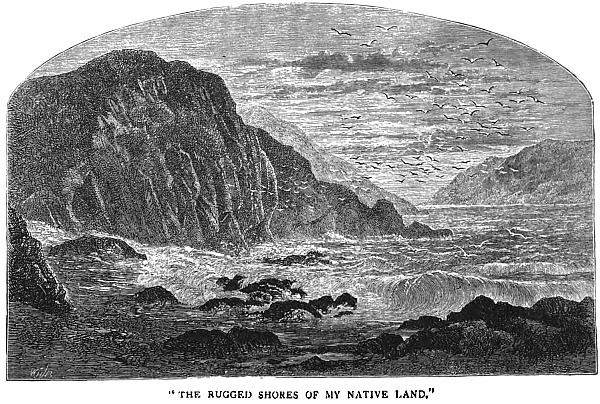
“But when autumn passed away, when the leaves fell, and the fields were bleak and bare, at night, when the wind moaned around the house which I now called home, then, Archie, I used to dream I heard the surf beating in on the rugged shores of my native land. I would start and listen, and long to be once more in Scotland.
“I went, one day, to the forest all alone; I went to think.
“‘What are you staying here for?’ perhaps said one little thought. ‘Major Walton may leave you money when he dies.’
“I smothered that thought at its birth, and crushed many more like it.
“Kind good old Major Walton! I must tear myself away; I must be independent; I must push my own way in the world.
“‘Heaven help me to do so,’ I prayed. Then I took out the little old Bible Nancy had given me, Archie, and I found some comfort there.
“I was putting it back again in my bosom when a little card dropped out; I picked it up. On it were pressed these, Archie.”
Kenneth took the Book from his breast as he spoke, and opening it, handed the card to Archie.
“I know,” said the latter: “the primrose and the bit of heather.”
“Yes, dear boy, foolish of me, I know; but I have never parted with them, and if I go to Davy Jones’s locker—as we sailors say—if I am drowned, Archie, these flowers will sink with me.
“But on that winter’s day in the forest, Archie, these flowers seemed to speak to me, or rather the golden-haired child spoke to me through these flowers. I was back again on the hills above Glen Alva walking by her side; the sky above us was blue and clear, the clouds on the horizon looking like snow-white feathers, and the bees making drowsy music among the pinky heath.
“I started up, and the vision fled, and around me were only the bare bleak forest trees and the fading heather. The vision fled, but it left in my breast the desire stronger now than ever to make my own way in the world, by the blessing of Providence; and Providence has never deserted me yet, Archie, lad.
“I went straight home. I saw Major Walton, and talked to him, and told him all.
“He seemed sorry. The last words he said to me when I went away—and there was moisture in the old man’s eyes as he spoke—were these:—
“‘Mind, I’m not tired of you, and I hope to live to meet you once again.’
“I went to Southampton next day. I thought I had nothing to do but march on board some outward-bound ship, that they would be glad to have me.
“Alas! I was disappointed.”
(The author hopes some boy who meditates running away to sea may read these lines.)
“I was rudely jostled and laughed at, I was called a Scot, a Sawnie, a Johnny-raw, but work was never once offered me.
“I wandered about the streets, not knowing what to do. The few coins I had in my possession did not last many days.
“I felt sad and unhappy. I felt almost sorry I had left the good people who had done so much for me. The ‘bairnies’ had been in tears when I went away; even the black-and-tan terrier had followed me a long way down the road, and looked very ‘wae and wistfu’’ at me with his brown beseeching eyes when I said he must go back.
“For two whole days I had hardly anything to eat. My flute, that I was fain to fall back upon, failed to support me, for the English, Archie, have not so much music and romance in their souls as the Scotch have. But one thing the English have is this, Archie, sound common-sense and a love of derring-do.
“I was standing one day on the pier at Plymouth. I had played my way with my flute all this distance in the hopes of getting a ship. I was no more successful than before.
“On this particular day, Archie, the drum was up (the storm signal), the wind blew cold and high, and the seas tossed their white manes as they rushed each other up the bay. I was feeling very sad and disconsolate, when all at once I heard a voice say to a man beside me,—
“‘I’ll give a guinea to be taken out to yonder ship.’
“‘I don’t care to win no guinea,’ said the fellow addressed, a hulking boatman in a rough blue jersey. ‘I don’t care to win no guinea on a day like this. ’Sides, sir, I hain’t got no mate.’
“‘I’ll go,’ I cried.
“‘You!’ said the gentleman; ‘why, you’re but a child.’
“‘I’m a Scotch boy,’ I replied, ‘and I know boating well.’
“‘All right, my lad; jump in.’
“It took us nearly an hour, but we did it.
“I was very wet, and the gentleman kindly took me below, and gave me warm coffee.
“‘Now,’ he said, ‘I’m going to give you half a guinea, and the man half, for if he has to change the gold, he will cheat you.’
“‘Are you captain of this ship, sir?’ I asked.
“‘I am, lad; I’m all that is for the captain.’
“‘Well, sir,’ I said, ‘give the man all the guinea, and take me with you as a boy.’
“I then told him all my story.
“‘We don’t sail for a week,’ he said, ‘and if in that time you get your mother’s consent, I’ll be glad to have so plucky a youngster on board my craft.’
“My dear mother gave her consent, as you know, Archie; and so I became a sailor and a wanderer.”
I have but epitomised Kenneth’s story. He took much longer time to tell it than I, the author of this little book, am doing, and besides, there was much conversation interspersed with it betwixt him and his old friend Archie.
The moon was high up above the forest trees before he finished, shedding a flood of golden light over mountain and sea, so, promising to resume his narrative next evening, Kenneth arose, and soon after all was silent and dark inside this peaceful cottage.
Chapter Thirteen.
Kenneth’s Story (continued)—At the Cave.
“On, on the vessel flies; the land is gone, And winds are rude in Biscay’s sleepless bay; Four days are sped, but with the fifth anon, New shores descried make every bosom gay.” Byron.
Scene: The Spanish Señor and his two guests, Kenneth and Archie, once more together, not in the mountain cottage to-night, but in a cave, close down by the edge of the sea. It was the sea that was lisping on the sands not far from where they sat on the rocks, but the view beyond was one of moonlight, trees, rocks, and water combined, altogether very beautiful, and in some respects almost English-like.
Yes, now by moonlight it looked thoroughly English, but if by day you had rowed round these rocks, you would soon have been undeceived, for sharks in dozens visited the deep water, and in the cracks beyond were alligators, active and strong, and very hideous-looking crabs often crawled up the wet black cliffs; and among the trees themselves were great snakes, deadly and venomous; but it all looked very quiet and lovely now.
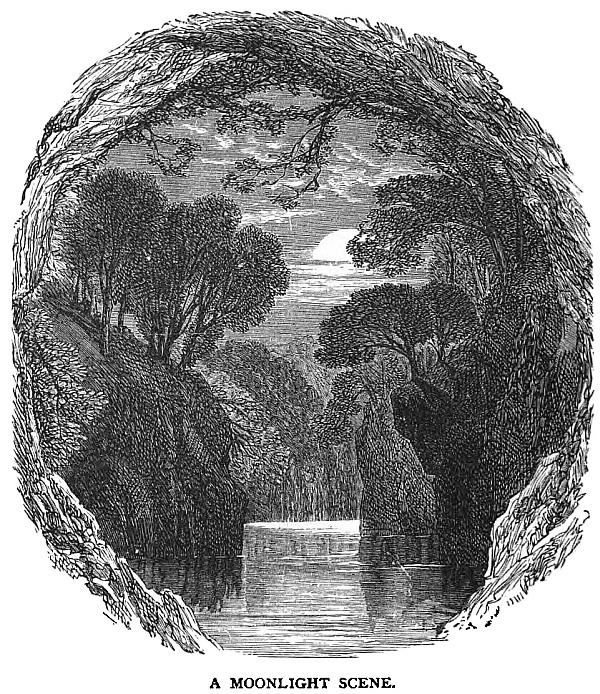
Kenneth was fond of caves, and there were plenty of them about here. He kept his boat in one. That very day, together the two friends had launched it, and spent all the long hours of sunlight in sailing or rowing about among the lovely islands of this sparkling sea, that look on a calm day as if they were actually afloat not in the water, but in the sky itself.
“My life,” said Kenneth, resuming his narrative of the day before, “my life, I thought, was going to be all rose-tinted now.
“Alas! Archie, lad, I soon found it quite the reverse, and it does really seem to me that those writers of books who paint a sailor’s existence as one long picnic do grievous wrong to the young folks who read them.
“A sailor’s life is like the billowy ocean on which he resides, all ups and downs, Archie.”
“I can easily believe that,” said his friend.
“But Captain Pendrey was very good to me, and there was an old boatswain on board who became my friend from the very first. He taught me to reef, to splice, and to steer, ay, and a deal more; in fact, during the two years I sailed in the old Miranda, he made a man of me.
“You see, Archie, I was already so far a seaman that I was not afraid of the ocean; and I was good at an oar.
“I was downright seasick when I first went out of Plymouth Sound. We had a head wind, and being only a sailing craft, had to beat and beat for days. I didn’t care much then what became of me. But the rough old bo’sun came and shook me up—I was lying nearly dead on a sea-chest—‘Pull yourself together, youngster. Go on deck,’ he said, ‘and look at the waves. Ain’t they mountains, just! It won’t do to give in.’
“I did go on deck and look at the waves, just for a moment. A green sea came thundering over the bows, took me off my legs, and washed me away down into the lee-scuppers, where I would have been drowned if the bo’sun hadn’t caught me up.
“‘I’m not going below again, though,’ I said to myself.
“Nor did I.
“The boats were all on board; I got into one of these as night fell, lashed myself to a thwart, and wet though I was, I slept with my head on a coil of ropes all through that stormy night. Stiff in the morning? Yes, a little, but I was better. I got my clothes off, and a man dashed buckets of sea water over me, and this revived me so much that I went below.
“The men in my mess were at breakfast; they were sitting on deck, jammed into corners anyhow, with their sou’wester hats between their legs to steady their coffee mugs.
“‘Salt pork, my lad,’ said the bo’sun. ‘You’re just at that stage that salt pork will turn the scale.’
“I took the hunk of pork he gave me and devoured it.
“Well, the bo’sun was right. It did turn the scale with a vengeance: I went on deck and hove the lead apparently. The steward passed me and said,—
“‘You’re not sick, are you, Sandie?’
“‘No,’ I said, ‘I’m only shamming. Ugh!’
“But by the time we were over the bay I was as sea-fast as any one on board. I got my sea legs, too.
“How blue the sea was now! How white the birds that skimmed over its surface! And the sails of ships that appeared in the distance were like snow when the sun shone over them.
“It wasn’t all sunshine even then, for a smart breeze was blowing, and cloud shadows chasing each other over the sea, just as I had often seen them do over fields of ripening grain in Glen Alva.
“I settled down to sea-life very easily now and very naturally. I soon knew every rope and spar and bolt in her, and was as happy as the sea-gulls. I cannot say more.
“We touched at Madeira, and here the captain took me on shore, and all over the place. What an isle of romance and beauty it is!
“We called in both at Saint Helena and Ascension, the former not the lonely sea-girt rock that old books describe, but a charming island of mountain, strath, and glen. Nor did I find Ascension to be a cinder with a few turtles on its beach. It has been cultivated to a wonderful extent, and I never did see a bluer, brighter ocean than that which laves its shores. The Cape of Good Hope hove in sight at last. I watched its bold and rugged coast as we came nearer and still more near to it.
“It was but like a long irregular cloud lying along the horizon at first. Then this cloud grew higher and darker and more defined. Then it grew bluer in parts, and lines stood boldly out towards us, then it turned blue and purple, oh! so lovely, and last of all it was a cloud no longer, but mountains stern and wild, and braelands covered half-way up with purple heath and wild flowers—geraniums I found afterwards these were—with rocks on the shore and a long white line of surf and sand.
“We did our business at the Cape and bore up for Australia.
“What a stretch of sea we had to cross, and what a length of time it was ere we reached Sydney!
“But I was not idle all these months. It was so good of Captain Pendrey, but he seemed to take a delight in teaching me navigation. He flattered me, too, I fear.
“‘You’re far too good and bright a boy,’ he said, ‘to stick before the mast.’
“So I worked and worked not only to please him, but because there was a prospect of my one day walking on the snowy quarter-deck of some beautiful barque, her proud commander.
“Every one on board loved our captain, although they called him the old man behind his back. From Australia we went to Hong Kong, then to Ceylon, from there to Calcutta, and then back again to Ceylon, and returned to India, lying up for repairs at the city of Bombay. And my kind captain never once went on shore without taking me with him, so that I saw so much that was strange in life, lad, that I could sit and talk in this cave for a month if my good friend here would bring us prog, and then I wouldn’t have half told you all my strange experiences.
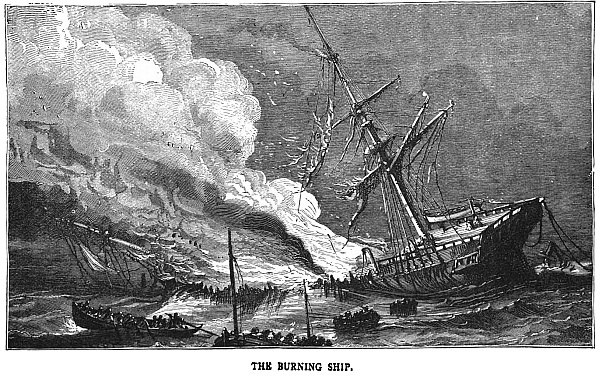
“I had been now nearly two years at sea, and had passed one examination, so things were looking up.
“I dearly loved the sea and sea-life now. I would not have changed places with a land-lubber for all the world.
“We had many narrow escapes, of course, for our ship was a clipper, and the captain ‘cracked on.’ He did not mind risk so long as he made good voyages. But somehow I never dreamt of danger, not even while in the centre of a tornado in the Indian Ocean at night, and if there be a more fearful experience than that in the life of a mariner, I have yet to encounter it.
“Nor did I dream of danger even when seated of a night under the bright stars at the fo’c’stle head, while the men spun yarn after yarn of the awful dangers they had come through.
“‘I’ve been wrecked often and often,’ said our old ‘bo’sun’ one night. ‘I was in the Bombay when she was burned; I was a man-o’-war’s man then. Ah! Kennie, lad, it is a fearful thing, a fire at sea. I hope you’ll never see a burning ship. Over seventy of my shipmates were doomed that night, and some of them met worse deaths than drowning.
“‘Another time,’ he went on, ‘I was the only one saved out of a gunboat. I was taken off a bit of wreckage and rigging by the lifeboat after drifting about for twelve wet, cold, weary hours. Strange thing was this. I had been made captain of the foretop only a week before we were wrecked. ’Tis funny, mate, but it was on that same foretop I floated about so long. He! he! I was captain of the foretop then, and no mistake, and monarch of all I surveyed.’
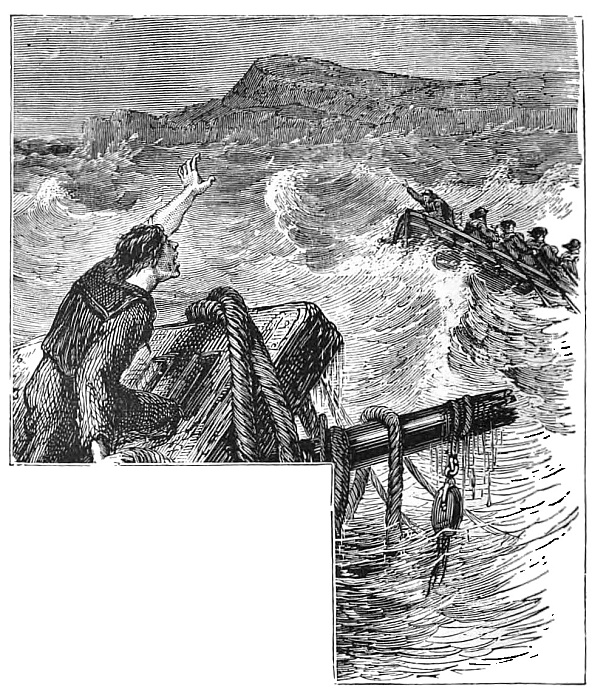
“Just three weeks after this particular evening, Archie, I was away aloft one beautiful day. We were well down over the line, and bearing about South-South-East.
“There was a kind of haze over the ocean that day which made seeing distinctly difficult at any great distance, but I noticed what at first sight I thought was a bird or a shark’s fin. I hailed the deck as soon as I made out it was something afloat with men on it.
“‘Where away?’ came the reply.
“On pointing in the direction, the yards were trimmed, and we soon got nearer.
“The sight that met my eyes I will not forget till my dying day. The survivors of a ship that had foundered they were, half-naked, half-dead, sun-blistered, sinking wretches, five in all.
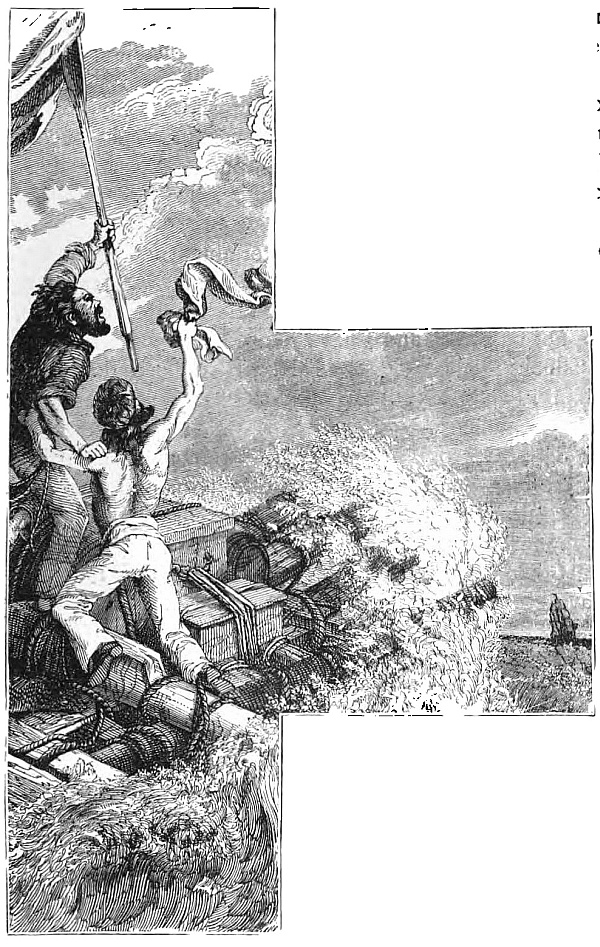
“They had been afloat on a raft for nine days without food to eat, and with hardly a drop of water to quench their awful thirst.
“From that day, Archie, I began to think that a sailor’s life had its dark as well as its rosy side.
“A year after this grief came. We were homeward bound. We got nearly to the Cape, and there our ship was dashed on a lee-shore, and I lost two of the best friends ever I had at sea, our poor captain and the dear old bo’sun.
“I was landed at Symon’s Town at last, and there, Archie, I got your letter, and found I was an orphan. And all this great grief came to me within a fortnight.
“I had been bound for English shores; my hopes beat high; in a few months longer, at most, I would once again clasp my dear mother in my arms, once more visit my home. Changed I knew the glen would be, but old friends would give me a warm greeting.
“Heigho! the blow fell; I determined not to return, and, Archie, from that day to this I have been a wanderer.
“But bless Providence for all His mercies! Archie, lad, I’m not badly off, and I have you.
“Shake hands, old boy. Now I’ve been doing all the talking, I shall take it out of you next, for I dearly love to hear your voice.
“Señor Gasco, mon ami, suppose we launch our little boat, and be off. I’m longing for supper and longing to sit down and rest in our mountain cottage. I don’t think I’ve been so happy for many and many a long year.
“Come along, Archie. How lovely the moonlight is playing over the water!”
Chapter Fourteen.
Friday Night at Sea.
“Now round the galley fire the merry crew, With song and yarn and best of cheer, Have gathered. And storms may rage, and seas may rise, And thunders roll; they know not fear.” Anon.
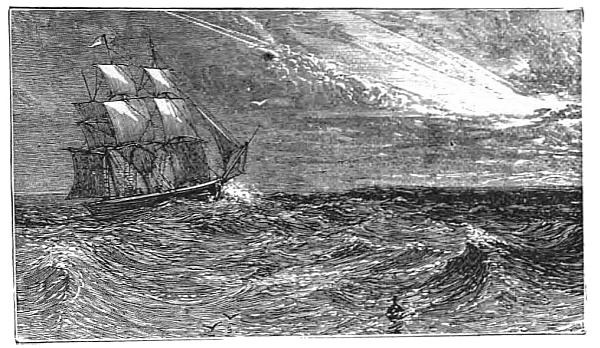
Scene: A ship at sea, south of the Cape of Good Hope. A steamer evidently from her build, though the funnel has been lowered, and a gale of wind is roaring through her rigging, bellying out the few sails she is able to carry till it looks as though the cloth would bust. She is making heavy weather, dipping the ends of her long yards right into the water, and plunging so much, that at times neither her jib-boom nor bows are visible in the foam and spray. She must be shipping tons of water. Looking at her as we are now doing with the eye of imagination, it would seem there could be little else save discomfort on board of her. And the night, too, is closing around her dark and thick. The sea is very troubled, the waves are racing, brawling, foam-crested billows, lightning plays around the ship every now and then, and thunders hurtle in the air, the awful noise appearing to run along over the sea. But let us go on board of her.
Here are Kenneth and Archie. Neither is on duty. Kenneth’s watch will come on deck at midnight. Archie, who is engineer of this craft, may be called upon at any moment to stir up the banked fires and get up steam.
This is the ship in which Kenneth has been second mate for eighteen months, including the time he lay sick or roamed convalescent on the South American shore, where Archie found him. They have bidden farewell to that beautiful coast, which in some parts is so enchanting, with its wealth of vegetation, its grand old woods, its fruit trees, its flower-trees, its flowers themselves, the life and loveliness that teems everywhere on the earth, in the air, in the sea, on the little islands, green and feathery, that peep up here and there out of the blue, on mountain top, and even in its caves, that I feel sad as well as sorrowful. I cannot pause to describe it all.
But why should I? My descriptions, after all, would fall flat on the senses of the reader, even with the aid of the best of illustrations, for no artist can give colour and movement combined. Go, reader, and see the world for yourself if you feel so inclined, and if ever you have the chance, I can tell you from long experience it is a very beautiful one.
“Well,” said Kenneth, “we came up here, Archie, lad, to have a walk, but I don’t see much chance. What a night it is going to be! How black the sky! How vivid the lightning! How close the horizon is—”
The last part of Kenneth’s sentence was lost in a peal of thunder.
“Stand by! Jump, Archie. There is a comber.”
They both leapt on the top of the capstan as an immense green sea swept over the bows and came tearing aft, carrying everything movable before it.