Kellogg Pedigree Plants and How They Are Produced
Reading edition
A juicy, tender sirloin costs more than a chuck steak; silver although it glitters is not as valuable as gold and you would expect to pay more for a wool garment than one of a lower grade fabric.
These comparisons emphasize the fact that any article of superior quality—whether food, clothing, luxury, or any commodity—even though sold at a higher price, invariably proves the best and most economical investment.
Ranking as ‘top-notchers’ in every test, dependable as Mother Nature herself and yielding berries of a quality unsurpassed in delicious flavor and smooth texture by anything in the fruit or vegetable kingdom, it is not surprising that Kellogg Pedigree Plants are the choice of such a vast majority of strawberry growers. Many of these growers too are shrewd, seasoned business men and women whose intimate contact with industry has taught them the folly of seeking bargains and the wisdom in investing only where quality is assured. Theirs is indeed a wise discrimination in selecting Kellogg Pedigree Plants for nowhere is the lack or presence of quality more convincingly shown than in strawberry plants at fruiting time.
We of course claim superiority for Kellogg Pedigree Plants. This you would naturally expect and our strongest claims would count for naught were they not verified by thousands who know and grow them. Throughout this book we have reproduced reports selected at random as representative of many which have come to us from growers whose interest in our plants exists merely because they have found them in every way the most profitable and desirable. If better plants were to be had they would readily plant and endorse them.
Reasons for Superiority
For every result there must be a corresponding cause. We have referred to the superior qualities of Kellogg Pedigree Plants. Now we are going to explain the reasons why these plants are superior both in plant growth and berry production.
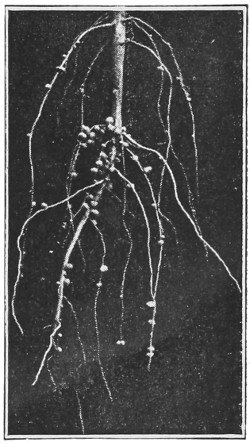
Root of two-months-old legume plant showing numerous bacteria nodules. These vary in size, shape and number according to the age of the plant.
First Step in Crop Rotation
Follow us please through our regular process of crop rotation and soil preparation beginning just as we have finished digging and shipping a crop of Kellogg Pedigree Plants in May.
The ground on which these plants were grown is first plowed deeply (eight to nine inches) after which it is harrowed repeatedly both with spring tooth and disc. Following this it is packed with roller and the result is a perfect seed bed thoroughly pulverized the full depth of plowing. All vegetation which remained at the time of plowing has been cut up and crushed so as to decay rapidly.
The ground is then seeded to alfalfa and remains in this crop for three years. The first two years it is cut for hay. The third year the first crop is mowed and allowed to remain on the field as a mulch just as it falls from the mower blade. The second growth comes up through this mulch and the entire crop is then plowed under.
Value of Legumes
Alfalfa is a legume or nitrogen gathering plant. An examination of the roots of leguminous plants reveals numerous bacteria nodules which vary in size, shape and number according to the kind and age of the plant. A very close relation has been found to exist between leguminous plants and the bacteria existing within these nodules. The plant furnishes the nourishment required by the bacteria while the bacteria in turn draw nitrogen from the air and render it available for the use of the plant. Nitrogen is essential to plant life. The plowing under and resulting decay of legume plants releases vast quantities of nitrogen into the soil where it may be absorbed and assimilated by succeeding crops.
The accompanying illustration shows the nodule development on the roots of a two-months-old legume plant.
Other Rotation Crops
Following the alfalfa, we sow a mixture of rye and vetch which is plowed under when the rye is in head and the vetch in bloom as at this time the vetch (which also is a legume) attains its greatest development of nitrogen nodules and the rye its greatest humus value. After this has been incorporated with the soil and a pulverized seed bed formed as before, it is seeded to a mixture of cow-peas and buckwheat.
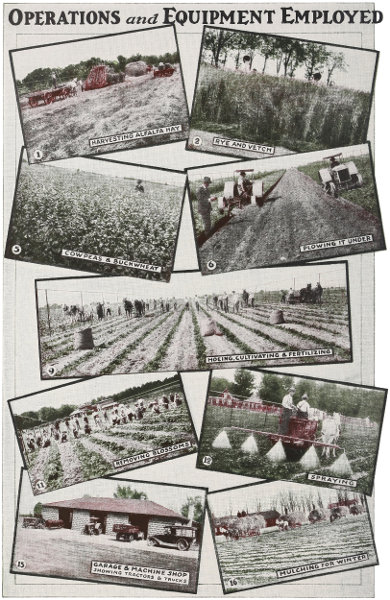
Larger illustration (500 kB)
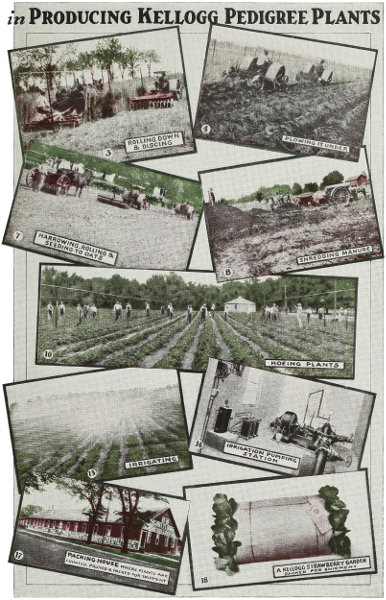
Larger illustration (500 kB)
Operations and Equipment Employed in Producing Kellogg Pedigree Plants
1 HARVESTING ALFALFA HAY 2 RYE AND VETCH 3 ROLLING DOWN & DISCING 4 PLOWING IT UNDER
5 COWPEAS & BUCKWHEAT 6 PLOWING IT UNDER 7 HARROWING, ROLLING & SEEDING TO OATS 8 SHREDDING MANURE
9 HOEING, CULTIVATING & FERTILIZING 10 HOEING PLANTS
11 REMOVING BLOSSOMS 12 SPRAYING 13 IRRIGATING 14 IRRIGATION PUMPING STATION
15 GARAGE & MACHINE SHOP SHOWING TRACTORS & TRUCKS 16 MULCHING FOR WINTER 17 PACKING HOUSE WHERE PLANTS ARE COUNTED, PRUNED & PACKED FOR SHIPMENT 18 A KELLOGG STRAWBERRY GARDEN PACKED FOR SHIPMENT
The resulting growth seems almost magic for in a few weeks both the buckwheat and cow-peas are in bloom and the growth becomes so rank and dense that it is difficult if not actually impossible to progress far into the field afoot. Just before the seed ripens this growth is rolled down, cut up with disc and plowed under. The buckwheat adds humus and the cow-peas, (another legume), both humus and additional nitrogen. After this has been thoroughly worked into the soil and a perfect seed-bed again formed fall has arrived and the ground is seeded to oats.
The Final Rotation Crop
Oats serves a double purpose;—provides to a certain extent a winter protection against the porosity caused by alternate freezing and thawing and its decay renders the soil mellow and easily worked.
During the winter a top dressing of stable manure is applied at the rate of fifteen tons per acre and the oats and manure are plowed under just as early as the soil can be worked the following spring. The manure furnishes nitrogen, potassium and phosphorus in quantities which with that already furnished by the rotation crops, makes a properly balanced plant food.
Again it is worked and with spring tooth and disc harrows and rolled until it forms a pulverized seed-bed and after being marked into rows and cross marked, it is again ready for Kellogg Pedigree Plants.
We Practice and Recommend Spring Planting
We practice what we preach by setting our plants in the spring exclusively (during April or May) as we have found through many years of experience that spring setting gives surest results in the North. In the Southern States plants may be set with success either in the spring or fall.
Kellogg Pedigree Plants,—Yearlings
Every spring the fields which have just produced plants are plowed at the close of our shipping season and put through our crop rotation process. This thoroughly renovates the soil and supplies in proper proportions nitrogen, phosphorus and potassium, the essential elements of plant food together with an abundance of humus, the medium through which plants feed. It is what might be termed a regenerative process because it actually renews or rebuilds the soil.
It is impossible to find any plants on the Kellogg farm more than one year old except in our testing and experimental beds, and the mother plants in our propagating fields. In digging plants for shipment all mother plants are thrown out. Only their offspring,—strong, sturdy, young runner plants, are used in filling orders. This assures Kellogg customers young blood, full of life and stamina. When such plants are set in the customer’s field or garden, growth is rapid and vigorous.
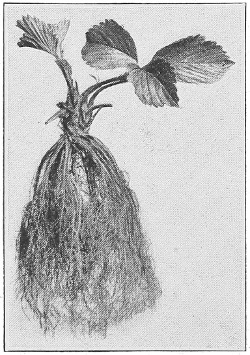
Kellogg Pedigree runner plant pruned and ready for packing. Vigorous, heavily rooted one-year-old plants of this type are responsible for the universal success of Kellogg customers.
Answering an Appeal for Moisture “When Nature Refuses”
During periods of drouth, our Skinner Irrigation System is relied upon as crop insurance. It’s value is not limited to furnishing moisture to Kellogg Pedigree Plants alone for it is just as frequently used in supplying moisture to our rotation crops.
Like the good Samaritan of Sacred History, it brings water from the nearby stream and applies it soothingly to the thirsty plants in the form of gentle, mist-like, refreshing rain which thoroughly saturates the ground to their very root tips. If drouth prevails at seeding time, its near-natural-rainfall insures prompt germination of seed which is necessary to a successful crop. It likewise is depended upon to furnish an uninterrupted supply of moisture ‘whenever Nature refuses’. Often it is the only means of saving the crop.
This system enables us to furnish Kellogg Pedigree Plants with moisture throughout the growing season, insuring unhampered and unchecked development both of plant and root systems.
With this dependable substitute for natural rainfall, the intense and prolonged drouth of 1921 (the most serious in many years) was not the serious matter with us which it otherwise would have been.
There is also another way in which our Skinner Irrigation System serves our customers, for it gives us an increased production of thousands of plants per acre. As the size of our plant crop bears a direct relation to the prices of Kellogg Pedigree Plants, you can readily see that this increased production is an important factor in enabling us to quote the low prices given on Page 66 of this book.
Hoeing, Cultivating and Removing Blossoms
Our propagating fields are hoed and cultivated repeatedly during the growing season and all blossoms are removed as fast as they appear. We remove the blossoms from the everbearers just as late as we possibly can, but during the fall they blossom so profusely that this would require a small army. At that time however, they are firmly established and have a fully developed root and crown system and are therefore not unfavorably affected by these late blossoms and the few berries which develop.
Spraying
Dangerous insects and dangerously contagious plant diseases are strangers on the Kellogg farm. As precaution against any possible attacks by pests however, Kellogg Pedigree Plants are sprayed frequently during the growing season with Bordeaux mixture, arsenate of lead and lime-sulphur. This prevents the possibility of contamination of any nature.
Mulching
Our plants are mulched for winter to the extent that we are able to obtain material for mulching. The mulching is applied after the first heavy freezing in the winter. This protects the ground against alternate freezing and thawing. The mulching is removed in the spring before the plants are dug.
Digging
Every Kellogg Plant is freshly dug at time of shipment in the spring and practically every plant is packed and on the way to the customer within twenty-four hours after it is dug. We never dig plants in the fall and hold them in storage over winter for spring shipment as we do not believe in this practice and do not have any storage facilities of this nature.
Packing for Shipment
In packing Kellogg Pedigree Plants for shipment, we use only the highest grade sphagnum moss containing a proper amount of moisture. Larger orders are packed in wooden crates. Smaller orders are either wrapped in heavy moisture-proof paper or packed in strong corrugated cartons. Our packing methods are the most scientific and our containers the highest quality we can obtain.
Kellogg Pedigree Plants are tied into uniform bunches of 25 plants, each bunch containing a label bearing the name of the variety. We never furnish less than 25 plants of any variety, nor can we furnish plants except in exact multiples of 25; that is,—25, 50, 75, 100 and so on. By adopting this uniform size, our counting and bunching department is able to develop the highest efficiency.
Resulting Superiority
A striking contrast which tells more forcibly than words the value of our intensive soil preparation, cultural and packing methods is shown by comparing the health, vigor and productiveness of Kellogg Pedigree Plants with that of common plants. Such comparison proves conclusively that Kellogg Pedigree Plants are far superior to the ordinary.
Their stored up vitality enables them to survive for a long period in transit. Like storage batteries they are charged with energy which gives them a running start in the right direction.
If you feel tempted to set ordinary plants because they may be purchased at a trifle lower price, stop and ask yourself which eventually will be the more desirable—a big crop of fancy delicious berries such as Kellogg Pedigree Plants produce, or a small inferior crop with the satisfaction (if it may be called such) that the plants were a trifle lower in price.
Look ahead to fruiting time when this question may become a reality and let your better judgment influence you in placing your order for plants.
OUR MISTAKES
To deny making mistakes is a frank acknowledgment of retrogression or a movement toward ultimate failure. Yes, we make mistakes occasionally but what’s more, we make them serve as stepping stones to successful achievement rather than permitting them to remain as stumbling blocks to retard our progress.
We were gratified at the following voluntary tribute expressed in our office one day last summer by a traveling salesman who, although having called on us many times, had not succeeded in securing our order. In the course of his conversation he remarked: “There’s one thing I like about you people and that is your perfect frankness and the fact that you are just as ready to admit your mistakes as to boast of your achievements.”
While we make as few mistakes as possible, we can truthfully say that they result eventually to the interest of our customers as practically all are made and discovered in our testing and experimental plots. Any new method, plan or variety which emerges therefrom virtually has undergone a test of fire and more than made good.
In other words we never pass anything on to our customers until we have developed it beyond the experimental stage to a point where its value is unquestioned. In this way we constantly safeguard the interests of those who place their confidence in Kellogg Pedigree Plants and our Company.
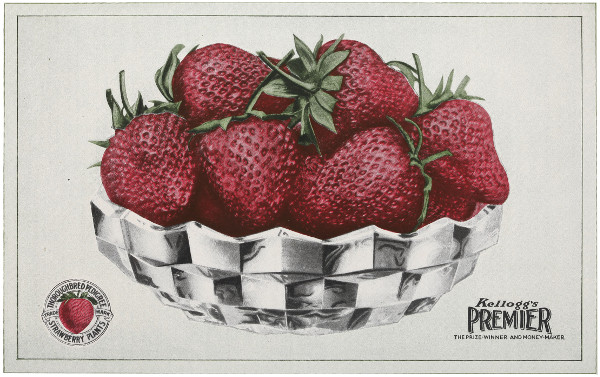
Kellogg’s PREMIER THE PRIZE-WINNER AND MONEY-MAKER
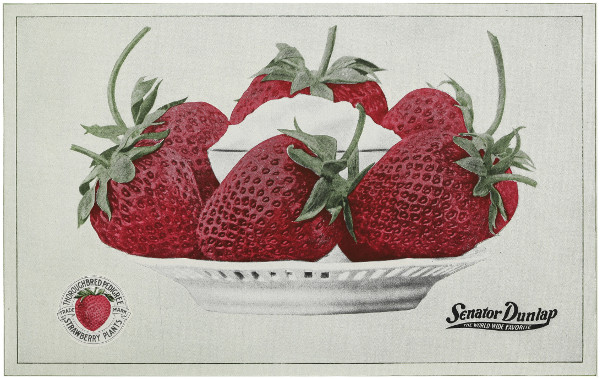
Senator Dunlap THE WORLD-WIDE FAVORITE