Volume 2 — LETTERS (continued 2)
Reading edition
I received Francis Carlin’s wholly heavenly book just before I went to the hospital, and have read it many times with delight. When you see him, give him my homage. He should be walking goldener floors than those of a mortal shop—he should rather be over here with us, whatever his convictions may be. For it is wrong for a poet—especially a Gael—to be listening to elevated trains when there are screaming shells to hear, and to be sleeping soft in a bed when there’s a cot in a dug-out awaiting him, and the bright face of danger to dream about, and see.
I treasure your picture, and Christopher’s shadowy profile—send me more photographs. Love me constantly, never let a day pass without going to church for me.
Joyce.
* * * * *
March 14, 1918.
Dear Aline:
I enclose some verses that you may like very much. That is, I think I enclose them—I have yet to consult with our Regimental censor as to whether or not I may send them. If the place name is cut out, put in its stead any French proper name that rhymes and do with the poem as you will. Perhaps the best thing to do with it will be to hand it to Bob for publishing.
As to my book—why don’t worry about it—we all will live just as long and just as happily and probably be just as wealthy—or poor—if it is never written. I am cheerfully neglecting it, for many reasons. One is, of course, the censorship, which prevents the sending out of articles sufficiently topical and specific to be interesting. Another is a military regulation which forbids an officer or enlisted man from acting as a correspondent or writing for publication on a military subject. This will not, I suppose, prevent the publication of such of my verses and essays as are inspired by my experiences. But it will prevent my making for serial publication any consecutive record of events. What I will do will be to assemble, after the war is over, or after I have returned from it, such random essays or rhymes as I have made and bind them together with a thread of reminiscence—partly introspective, partly—what is the word? extraspective? external, at any rate. I shall write nothing that has any news value. I believe in my vanity that it will be a most charming book, not without its high lights of something more than charm. It really is the sort of book I’d like greatly to read, and I think that it will reach a public tired of the many war-narratives. And don’t think people won’t read it after the war is over! They will! The only sort of book I care to write about the war is the sort people will read after the war is over—a century after it is over! And that is the sort of book I am going to make. A journal intime, but as close to literature, as carefully thought and wrought as I can do. It will be episodic—chaotic, perhaps—no glib tale, no newspaper man’s work—but with God’s help, a work of art. So clamour not for copy! My enclosures of some weeks ago may have pleased you, but you’ll like this better.
Which for no reason brings me to the subject of growing middle-aged, an experience which you are enjoying, I trust; I know I enjoy it. What an advantage we have over our children! While they, to their embarrassment, grow up—voices changing, legs and arms becoming too obvious, self-consciousness and shallow romanticism seizing them—we gracefully, comfortably, grow down. Perhaps it is as a protective measure that I, a private soldier, grow vain—as snails develop shells—but I confess it is with consummate pleasure that I contemplate my senility and, may I say, mediævality. I picture myself at forty, rotund but eminently presentable, moustache and hair delicately grayed, tailored admirably, with the leisurely power no young man may have. I picture myself at sixty, with a long white moustache, a pale gray tweed suit, a very large Panama hat. I can see my gnarled but beautifully groomed hands as they tremblingly pour out the glass of dry sherry which belongs to every old man’s breakfast. I cannot think of myself at seventy or eighty—I grow hysterical with applause—I am lost in a delirium of massive ebony canes, golden snuff-boxes, and daily silk hats.
And as for you! My God! what a vision! That dear autumnal hair silvering—the mouth of my delight exquisitely etched with honourable lines—each one the record of a year’s love—those eyes richer in their mystery—but I cannot write of this—for the thought might give me power to sweep away the years and make me find you, when I come back from the Wars, becapped and tremulous and leaning on two sticks! NO! I don’t want you to be old now—I want you to be the innocent sophisticated young woman you are in the little picture I carry (traditionally!) over my heart. But I want to watch you grow old—if I can watch you and at the same time hold you in my arms.
Joyce.
* * * * *
April 1, 1918.
Dear Aline:
This letter is written to you from a real town—written, in fact, above ground. You may be surprised to know that recent letters to you were not written in these conditions. They were written in a dug-out, but I was not permitted to tell you so at the time. In a dug-out, also, were written the verses I sent you some two weeks ago—you may remember their damp-clayey flavour. I slept and worked (the latter sometimes for twenty hours at a time) in this dug-out for a month, except for one week when I was out on special work with the Regimental Intelligence Section. You don’t begrudge me that week, do you? I cannot now describe it, but it was a week of wonder—of sights and sounds essential, I think, to my experience. For there are obligations of experience—or experiences of obligation—to be distinguished from what I might call experiences of supererogation or experiences of perfection—but what rubbish this is! Let us rather consider my present great luxury, and the marvels of which it is composed. In the first place, one room (not a cot in a crowded barrack, not a coffin-like berth in a subterranean chamber) but a real room, with windows and a large bed and a table and chairs and a practical wash stand. The bed I share with one L—— D——, an amiable gamin, about to be made a Corporal. I am a Sergeant—with stripes some five days old. (It is the height of my ambition, for to be commissioned I’d be sent to school for three months and then, whether or not I succeeded, be assigned to another Regiment. And I’d rather be a Sergeant in the 69th than lieutenant in any other outfit.)
To continue—I also eat from a table excellent meals, with a napkin on my knees. I have soldiered pretty hard for some months now, taking everything as it came, and I think I’ve honestly earned my stripes. Now I’m going to have an easier life—not working less hard, but not seeking hardships. So I am paying seven francs a day for meals, and six francs a week for my share in a bed-room. And it’s delightfully refreshing. Also, I yesterday had a hot shower-bath—very much a novelty!
This morning I received two letters from you, to my great joy. The pictures of the children are excellent. I am glad to see Deborah’s hair so long and lovely. Do, by all means, send me pictures of yourself and Deborah in a leather case, as you promise. I can imagine no possible gift I’d rather receive. Mail is coming here every day now, so I look forward to frequent messages from you.
What a cheerless place the States must be these days! Don’t send me American papers (except the Times Book Review) for they depress me, showing me what a dismal land you live in. This meatless, wheatless day business is very wearying. It can do no earthly good—it is merely giving comfort to the enemy, who undoubtedly know all about it. I wish—aside from the obvious greatest reasons—that you were here in France—you’d like everything, but especially the gentle, kind, jovial, deeply pious people. Time enough—to resume—for wheatless days when the enemy takes your wheat. Until then, carpe diem!—that is, eat buckwheat cakes with plenty of syrup.
I am disgusted with all I read in the American Magazines about the Americans in France. It is all so hysterical and all so untrue. It isn’t jealousy that makes me say this—I have no desire to compete with newspaper-correspondents—but it annoys me to see the army to which I belong and the country on and for whose soil we are fighting so stupidly misrepresented.
I hope you received “Rouge Bouquet”—if you did receive it I know you liked it. General —— (I forgot, I mustn’t name generals lower in rank than Major-Generals) had twelve copies of it made. I sent it to you two weeks ago—you should be receiving it now. The newspapers by now have re-revealed its meaning to you, if any explanation was needed. It was read at an evening entertainment at one of our camps at the front. Father Duffy read it, and taps was played on the cornet before and after. I couldn’t get down to hear it—I was further front, at work in the dug-out that night.
I think most of my war book will be in verse. I prefer to write verse, and I can say in verse things not permitted to me in prose. You remember—no, probably you don’t—Coventry Patmore and his confessor. The confessor objected to the passionate explicitness of some of Coventry’s devotional poems—they dealt with things esoteric, he said, and should be set forth in Latin, not in the profane tongue. And Coventry replied that for most people poetry was an incomprehensible language, more hidden than Latin—or more hiding.
And speaking of Coventry Patmore, the best way to fry potatoes is to have deep oil or butter violently boiling in a great pot, to slip the slices of potatoes into it and stir them persistently, never letting them touch the pot’s bottom, to lift them out (when they are golden brown) by means of a small sieve, and to place them on paper so that the grease may be absorbed.
The best news I’ve had since I reached France is about Kenton’s medal. I’m going to write to-day and tell him so.
I love you, Joyce.
* * * * *
April 19, 1918.
Dear Aline:
My chief occupation at the present time is awaiting a letter from you.
It is several hours since I wrote the first paragraph of this letter. I have been to supper (I am hitting the mess-line these days, for my money gave out and I didn’t want to borrow any more) and ridden in a motor-cycle-side car all over the countryside—through a dozen little villages, every one full of French and American soldiers, with a sprinkling of coolie labourers, in quest of a certain village which holds two companies of a certain outfit with which I had to have a conference. The village was hard to find (their names all sound alike, and old French ladies, when interrogated as to direction, always point in a direction in which there is no road and say something that sounds like “Honk! honk! Ba! ba!”) and also the night was cold. I have enjoyed many rides more. Returning to the office (I sleep in the same building) half frozen and weary, I found that not two truck-loads, but two sacks of letters had been delivered, and that I had received three letters. I leaped at the letters—one was an invitation to a Ladies’ Day at the Columbia University Club, another was from my mother, another from Fr. Garesché. None from You! You accused me in one of your letters of writing to you when I was depressed—well, I’m depressed now, all right! I’ll wait until to-morrow morning to finish this letter, I guess, or else I’ll give you real cause for complaint. Not that I blame you, or think you haven’t written often—it’s the mail system’s fault. Good night!
I hope Kenton has learned to serve Mass by this time. I wrote to him a long time ago and told him to see Fr. Morris about it, but I fear that he would be too shy to do this unless some pressure were brought to bear. If you would ask Fr. Morris to teach him how to serve Mass, and persuade him to ask Kenton to come to see him about it, so that the initiative would seem to come from Fr. Morris, I think things would work out well. I pray for Kenton to have the grace of a vocation to the priesthood—I hope he may have a Jesuit vocation—and I think it is good to do all we can toward the fulfillment of this desire—this is, I think, a supplementary way to “sway the designs of God.” I think of the children often and can visualise them well in spite of my long absence from them, that is, all except young Christopher. I am aware of Kenton’s gravity and of his thoughtful and radiant smile, of Deborah’s vivacity and exquisite colouring (she is like one of her mother’s gay thoughts), of Michael’s magnetic rotundity, of his blue eyes, of his charming habit of toppling over like a toy tumbler of lead and celluloid. And of Rose I am nearly always conscious, delightfully, when I am awake and often when I am asleep, and especially when I am in the church—which is twice every day, to receive Holy Communion immediately after Reveille and to pray for a few minutes in the evening. We have a magnificent old church in this town, as near to where I am now as the church is to our house in Larchmont. And right by the tower-door is a big statue of St. Nicholas of Bari, in his episcopal robes, and hopping around his feet are two little bits of babies he saved and brought back to life after they’d been cut up and pickled. Very nice! You’d like it! Pray to St. Nicholas for me, and to St. Stephen, St. Brigid, St. Michael, St. Christopher, St. Joseph, St. Anthony of Padua, St. Teresa, and all our other good friends in Heaven, and love me.
Joyce.
* * * * *
April 21, 1918.
Dear Aline:
I am glad of the auspicious beginning of Eleanor’s romance. I would so regard it, for I cannot understand the interpretation which makes marriage the termination instead of the beginning of a splendid adventure. If there should ever be the perfect novel of love, it would begin rather than end “And they were married.” Would the phrase continue: “And lived happily ever after”? I doubt it—but that depends upon the definition of happiness. I know that you dislike the symbolism which is the basis of Coventry Patmore’s greatest poems, but I think you will admit that there is this truth in his idea—the relationship of man and wife is like that of God and the soul in that it must be purified and strengthened by suffering. Also—to put it on a lower plane—Eleanor is enough of a poet to take some enjoyment out of being the wife of a soldier gone to the wars—or Irish enough, which is the same thing.
As to the matter of my own blood (you mentioned this in a previous letter) I did indeed tell a good friend of mine who edits the book-review page of a Chicago paper that I was “half Irish.” But I have never been a mathematician. The point I wished to make was that a large percentage—which I have a perfect right to call half—of my ancestry was Irish. For proof of this, you have only to refer to the volumes containing the histories of my mother’s and my father’s families. Of course I am American, but one cannot be pure American in blood unless one is an Indian. And I have the good fortune to be able to claim, largely because of the wise matrimonial selections of my progenitors on both sides, Irish blood. And don’t let anyone publish a statement contradictory to this.
Speaking of publishers, please be very careful that there is nothing in the book you and Margaret wrote to offend, in the slightest degree. I would go so far as to say that if the spirit of the book is not obviously and definitely Catholic—readily so recognised by Catholic readers—it would grieve me to see it published with your name attached—grieve me deeply. I don’t want anyone to say of you, “There is nothing about that novel to show she is a Catholic.” I don’t think Catholic writers should spend their time writing tracts and Sunday-school books, but I think that the Faith should illuminate everything they write, grave or gay. The Faith is radiantly apparent in your last poems. It is in Tom Daly’s clowning as it is in his loftier moods. Of course anyone would rather write like Francis Thompson than like Swinburne. But I can honestly say that I’d rather write like John Ayscough than like William Makepiece Thackeray—infinitely greater artist though Thackeray be. You see, the Catholic Faith is such a thing that I’d rather write moderately well about it than magnificently well about anything else. It is more important, more beautiful, more necessary than anything else in life. You and I have seen miracles—let us never cease to celebrate them. You know that this is not the first fever of a convert’s enthusiasm—it is the permanent conviction of a man who prayed daily for months for the Faith before that grace was given him. The Faith has done wonderful things for you, but I think since I have been in France it has done more for me. It has carried me through experiences I could not otherwise have endured. I do not mean that it has kept me from fear—for I have no fear of death or wounding whatever. I mean that it has helped me to endure great and continued hardships. These hardships are now past—they belong to last December—but I cannot forget what made me live through them and bear myself like a man. Therefore—for this and a multitude of other reasons, among which let me put that it is my most earnest request—be zealous in using your exquisite talent in His service of Whom, I am glad to have said, Apollo was a shadow. If what you write does not clearly praise the Lord and his Saints and Angels, let it praise such types of Heaven as we know in our life—God knows they are numerous enough.
Does this sound like the writing of the least desirable of your aunts? Forgive me if it does, and heed my request even if it seem unreasonable—the request, I mean, not to sign your name to the book if it is not Catholic in spirit. I can honestly offer “Trees” and “Main Street” to Our Lady, and ask her to present them, as the faithful work of her poor unskilled craftsman, to her Son. I hope to be able to do it with everything I write hereafter—and to be able to do this is to be a good poet.
Speaking of Poetry, I have read with exquisite relish, several times, the copy of the Bulletin you sent me. And always I stop reading—prevented from continuing by irresistible mirth. God help us! Let all the world, especially all of it that deals in thought, beat its breast and repeat after me “God help us.” Here are young men battling in a strange land to win back for the people of that land their decent homes. Here are French peasants (old men, children and women) kneeling at mass in a church with a yawning shell hole through the tower. Among them are American soldiers. And other American soldiers (God rest their brave young souls) rest in new graves by a fair road I know. We hear the crash of shells, the tattoo of machine guns, we see unearthly lights staining the black sky. And—Oh, God help us! Send me more bulletins! I want to read more about Mr. —— whose “mystic” (of course!) poems, seem to ... “to challenge comparison with the works of Tagore.” I want to read more about ... chaunting to crowds of old ladies who stink of perfume and cold cream and gasoline, while a young female shakes her shanks and “gives a visual embodiment of the poet’s idea.” I want to read about A ... “What a privilege to be at once a poet and a fairy godmother!” And I want to read about W ... going West and—just being himself! God forgive me for being a Pharisee, and keep me from judging others! But I do love to read about these things and then go across the street and drink a large drink with Joe Brady, meanwhile singing a coarse ballad entitled “The Old Gray Mare.”
We’re going to be paid to-morrow, I’m glad to say, so I’ll be able to have a few meals indoors. This roadside picnic stuff is all right in fair weather, but French weather is not always what it should be. I hope your allotment is arriving, but I doubt it. I think we’ll collect it in our old age. I read recently that a Civil War Veteran had just succeeded in collecting some pay due him in 1862—perhaps we’ll be as lucky. We’ll buy a carton of cigarettes for Christopher’s youngest son with the first payment.
Your poem “Experience” has lodgment in my brain and heart and soul. “She walks the way primroses go.” Simple—isn’t it? that line—to make it nothing much was required—genius merely. Thank God there’s you in a world of ——s and ——s. Do you mind being considered the “one just man”? Figuratively I kiss your hand—it was absurd of me to preach to you who are my mistress in the art of devotion as in the art of poetry.
Joyce.
* * * * *
April 27th, 1918.
Dear Aline:
Some mail came to-day and in it was a package containing ten boxes of tobacco, Merci bien! (when I get back I’ll talk just like —— or ——.) I received a box of admirable cigars yesterday (they were originally awarded to Father Daly in payment for a contribution to America, and he kindly directed that they be sent to me).
We are in a new town now (new to us, that is) a little bit of a place. We have been recently in a rather large town, where I lived very comfortably. I am comfortable here (especially since yesterday afternoon, when I had a hot shower bath and had my clothes sterilized) but not luxurious. But I’m looking forward to a much easier and vastly more interesting time for the rest of my stay in France. I have asked to be relieved from my office job, and my request has been granted. I hope on Monday (this is Saturday night) to become a member of the Regimental Intelligence Section, and the Adjutant tells me I am to be transferred as a Sergeant, although I was willing to give up my stripes for the sake of getting into this work. So henceforth I’ll be peering at the Germans through field glasses from some observatory instead of toiling in a dug-out or crowded office. You wouldn’t want me to come back round-shouldered and near-sighted, would you? Well, that would be the result of keeping on this statistical job much longer. The intelligence work is absolutely fascinating—you’ll be glad I took it up.
You would have liked the gutter-babies in our last town. About a dozen of them used to come out at meal times and besiege our mess-line. They brought their dad’s canteens to be filled with coffee, and they accepted, politely, bread and karo. They were very nice, and fat, as all French babies are. I don’t know whether the French are so devoted to my dear patron St. Nicholas of Bari, because they love children, as he does, or are devoted to children because they love him. Anyway they have the nicest children there are outside of Larchmont Manor and Heaven (these words mean nearly the same thing) and they treat them most enthusiastically. Large crowds of men and women stand for half an hour in a busy city street watching a young baby learn to walk, the baby being decorated, for the occasion, with his big sister’s broad-brimmed hat. And also nearly every church has a statue or window representation of St. Nicholas of Bari with the three babies he restored to life. It helps me to feel at home. I hope you and Kenton pray to him often, he is a very generous saint and has treated me beautifully.
I had a quaint experience to-night. There is no priest now in this town, but there is a fine old church, with God in it. Since there is no priest, I can’t get my daily communion, but I go in occasionally to say my prayers. Well, to-night there was a very old lady in the church. She was so crippled with age and rheumatism that she could not kneel, so she was huddled up on a bench near the rail. And she had a white cap on, and she carried a tall staff with a crutch top such as witches use. She was very pious, and prayed audibly, making pious ejaculations, like an old Irish lady. For some time she didn’t know anyone else was in the church. But when she found I was there, she waited until I had said my beads and then she came over to me (rising with great difficulty and putting on the heavy wooden shoes that lay beside her). Then she extended to me her beads. The link between two of them was undone, and she asked me to mend it. I tried to do so, but my clumsy fingers had little success. So I gave her my rosary in exchange for hers—which I can easily mend with a pair of pincers—and she was very grateful. But I feel that I got the best of the bargain, for there may be a special sort of a blessing attached to beads worn by the gnarled fingers of one so near God. I could make a rhyme out of this experience, but it would seem a profanation. You see some of the possible interpretations of it, don’t you?
The news about D—— is interesting—well, he is trying to serve his conscience, and I am trying to serve mine, and that’s all a gentleman can do. And since we’re both suffering, I believe we’ve both followed the right course. There are many ways to Heaven, but only one Lamp—as I once said in some verses.
But as to suffering—don’t be pitying me! It’s you that are doing the suffering, you with no exhilaration of star-shells and tattoo of machine-guns, you without the adventure. I feel very selfish, often.
I love you and you are never away from me.
Joyce.
* * * * *
April 29, 1918.
Dear Aline:
For Heaven’s sake, don’t tell me about how bad tea rooms are! I admit that I used to scorn them. Now I could live in one, enthusiastically. I wouldn’t mind at all the closeness, the bad service, the soiled table linen. Why, Max’s Busy Bee sounds better to me now than Sherry’s used to sound.
“She walks the way Primroses go” reechoes in my soul. What a delightful poet you are! Send me some more poems, at once, please.
It’s time I heard from you again. Some mail came to-day, but I got nothing from you. You should write me long letters often. By all means take up Fr. Hayes’ lecture offer. You can make your lectures chiefly readings. Get Dr. Pallen to help you make a circular, and put on it testimonials from whomever he suggests. Get Bob Holliday’s advice as to form of circular. You will find valuable suggestions as to engagements in my correspondence files, wherever they are.
(Here I paused to eat ten cakes purchased at the Y. M. C. A. for a franc.)
Young —— is in a nearby town—an amiable child indeed he is. I saw him twice, and he presented me with a bag of cakes and a box of cigars. He reminds me very much of Kenton, but is in many respects his inferior. I’d like to see Kenton and Fr. Daly and Deborah and Michael and Christopher and Sister Emerentia and some Bass’ Ale and some dry sherry and a roast of lamb with mint sauce and Blackwood’s Magazine and the bar in the Auditorium Hotel in Chicago and a straw hat and the circus. And I really wouldn’t mind seeing you.
Joyce.
* * * * *
May 15, 1918.
Dear Aline:
Your friends are a bit impertinent, I think. I don’t claim to be a learned French scholar (although I have talked French every day for six months). But I do claim to know the name of the place where I lived in constant danger of death for six weeks, where many of my friends gave their lives for their country. It is Rouge Bouquet, not Rouge Bosquet. I’ll be deeply grieved if it appears in print incorrectly. Also, I wish the grace in “Holy Ireland” to stand as I wrote it. It is just as Frank Driscoll said it on that unforgettable night—it is the grace used in Jesuit houses. Please see to this, and don’t let all the world revise my mss. I rather expected you’d like the poem better, but perhaps the reason the fellows in the Regiment liked it so much is because we all felt keenly the event it memorizes.
I’ll write to you more to-morrow. I love you.
Joyce.
* * * * *
The above is rather stern and brusque, isn’t it? Well I wrote it in rather stirring times—now only memories. I am resting now, in a beautiful place—on a high hilltop covered with pine and fir trees. I never saw any mountain-place in America I thought better to look at or from. I sleep on a couch made soft with deftly laid young spruce boughs and eat at a table set under good, kind trees. A great improvement on living in a dug-out and even (to my mind) an improvement on a room with a bed in a village. I am not on a furlough, I am working, but my work is of a light and interesting kind and fills only six out of twenty-four hours. So I have plenty of time for writing, and have started a prose-sketch (based on an exciting and colourful experience of the last month) which I will send you soon. Everything I write, I think, in prose or verse, should be submitted to Doran first.
I wish I could tell you more about my work, but at present I cannot. But there are advertised in the American magazines many books about the Intelligence Service—get one of them and you’ll find why I like my job. The work Douglas is doing is not allied to mine. Only I suppose he’ll have a commission. I won’t work for one, because I don’t want to leave this outfit. I love you more than ever, and long for the pictures you promise me. You will be amused by the postcards I enclose.
Joyce.
Say, the stuff about your not appreciating “Rouge Bouquet” was written before I got your delightful letter of April 18, admirable critic!
* * * * *
Dear Aline:
I have just received your letters of April 1st and April 5th. “Moonlight” is noble, like its author. As to being worried about you because it expresses pain, why, I’d be worried only if you did not sometimes feel and express pain. Spiritual pain (sometimes physical pain) is beautiful and wholesome and in our soul we love it, whatever our lips say. Do you not, in turn, worry because of my foolish letter to you from the hospital. At that time I was just an office hack—now I am a soldier, in the most fascinating branch of the service there is—you’d love it! It is sheer romance, night and day—especially night! And I am now therefore saner than when I wrote to you from the hospital. I’ve had only a week of this work—but I’m already a much nicer person.
“For Sergeant Joyce is three, and Oh, He knows so much he did not know!”
As to the picture I sent you, why, surely I have a moustache, and not a “morning pout.” Mechante. A long moustache I have (illustration of moustache) comme ca. Also, I have thick hair which stands up (illustration) comme ci. I had my head shaved last November, you know, and it had a good effect. My letter is thrilling, isn’t it, with all these martial details? A veritable cross-section of battle, a flower from No Man’s Land. Well, I am sending some battling picture-postcards soon which you will find amusing, I think—portraits, in two striking histrionic poses, of myself. You know now, from my previous letters, that I am no longer (I thank God!) doing statistics, so gently, but widely and most firmly, correct the statement that I have a bullet-proof job. I had one, but succeeded, after two months’ intriguing, in getting rid of it. It wasn’t a shell-proof job—nothing in a real regiment is. (Such jobs are in the Ordnance or Supply Departments, back of the lines.) It wasn’t shell-proof, I say, and if I should be squashed by a shell, wouldn’t you hate to have it said that I was nobly holding my post in the office, or bravely manning my typewriter? Now, I’m doing work I love—and work you may be proud of. None of the drudgery of soldiering, but a double share of glory and thrills. But it is not so glorious and thrilling as you.
Joyce.
* * * * *
May 24, 1918.
Dear Aline:
I don’t know just what kind of a mental picture you have of my present life—to be accurate it would need to be rather kaleidoscopic, for my activities and the spheres of them vary frequently and greatly. But this afternoon you (or perhaps not you, but readers of Empey and Private Peat and the rest of that mob of war writers—thank God, let me Pharisaicly say, that I am not one of them—would do so) would have been amazed at the martial picture before you, had you seen me. Just outside the edge of the forest of firs and spruce in which we fourteen men live is a lovely meadow. There, among the knee-high buttercups, lay in the May sunshine all afternoon three warriors—myself being one. Whiles we smoked and gazed at the lovely valley miles below us—whiles we took turns in reading aloud from—what do you suppose? The Oxford Book of English Verse! We read Gray’s Elegy, the first chorus from Atalanta in Calydon, “They told me, Heraclitus,” that witch poem of William Bell Scott, “Love in the Valley,” “Lake Isle of Innisfree,” “Keith of Ravelston,” and half a dozen other poems, all of which brought you most poignantly and beautifully before me. No, they didn’t bring you before me—you are always before me and with me and in my heart and brain—but it’s dangerous to write this—it draws so tight the cords that bind me to you that they cut painfully into my flesh. Well, we are to be together sometime, inevitably, and soon in terms of eternity. For we are absolutely one, incomplete apart, and in Heaven is completeness. How unhappy must lovers be who have not the gracious gift of faith!
There is to be an Homeric banquet at our house one day—the day when I exhibit to my comrades the glory of my life—yourself. You will like them all—Watson (a gifted artist from Richmond, who is now at work on a fine drawing which must accompany Rouge Bouquet in Scribner’s), Bob Lee, Titterton (my especial friend), Beck, Mott, Kerrigan, Levinson—say a prayer for them all, they’re brave men and good, and splendid company. They are all men of education, and breeding, and humour, and we have fine times. Dangers shared together and hardships mutually borne develops in us a sort of friendship I never knew in civilian life, a friendship clean of jealousy and gossip and envy and suspicion—a fine hearty roaring mirthful sort of thing, like an open fire of whole pine-trees in a giant’s castle, or a truly timed bombardment with eight-inch guns. I don’t know that this last figure will strike you as being particularly happy, but it would if you’d had the delight of going to war.
Right here I had to pause to discuss theology with Watson, Titterton, Levinson and Jongberg. Jongberg is up here for a brief spell; he is a Swedish-Irishman, and now he is posing for St. Michael for Watson, using a bayonet for a sword. Levinson (in full uniform, including belt and helmet) is being model for the soldiers leaving Rouge Bouquet for Heaven. He is a quaint little French-Jewish-American, with whom we have a lot of fun. They all trooped into the room where Titterton and I sit writing to our respective sweethearts, to ask about the style of St. Michael’s sword and that of his halo. These questions settled, Watson became enamoured of the idea of angels saluting, and devised a whole manual of arms for angels—as “Angels, attention! Wings raised, by the numbers. 1 up! 2 down! Wings flap! Hey you down there! what’s the matter with you? Don’t you know enough to keep your hands down when you flap your wings? Awkward squad for you to-morrow!” Then they went back to their work.
Well, I don’t know how long the Intelligence Section is to stay in this lovely summer resort of a place, but it’s certainly fine while it lasts. And I am very fortunate to have such a crowd as this to work with. I never was with so congenial a company in civilian life. Fr. O’Donnell came up to see us yesterday—he is stationed not far away. Fr. Duffy has an assistant—Fr. Kennedy—a Jesuit, thank God! I have not met him yet. He is a brother of the publishers of Barclay Street. I have a new stripe—an inverted chevron of bright gold on the left cuff for six months service. Let you be proud of that too, please, and let my children be proud of it. That is all the news except that I love you.
Joyce.
* * * * *
Dear Aline:
To-day I was made very happy by receiving two nice little ridiculous letters from you—one of which considered itself to be long. As to Sr. Mary Leo—if you happen to be writing to her (you will be, for I told her to ask you for “Rouge Bouquet”) ask her by all means to tell you how her grandmother taught her geography. It’s an absolutely delightful story, and she’s a delightful old saint.
You say Tad will go “in a few months.” I’m glad I’m not Tad. There are many reasons for this, of course, but I mean I am especially glad I’m not to go in a few months. I’m glad I’m a Sergeant in the 69th, a volunteer regiment, the bravest and best regiment in the army. I’m glad I have a golden service chevron on my left arm—that means six months service in France, and is better than two bars on my shoulder, which would mean only three months stay at Plattsburg. If I get an honorable wound that will unfit me for soldiering but not for civilian work, that civilian work will not be hack-writing. It may be straight reporting, or editing, or writing (Evening World at $80 a week, for instance) a weekly essay-column, or dramatic criticism (this last appeals to me strongly). Also I’ll do less lecturing and more oratory—bombastic, thundering, literary, Henry Woodfin Grady oratory! It is exciting, and lecturing isn’t, especially.
Meanwhile I find myself approving your plan of getting literary work, although doing it makes me feel like a coloured man approving his wife’s plan of taking in washing. You relieve my mind greatly by your willingness to keep your name off the book. I thought I would acknowledge to you the pleasure I got from “A Wind Rose in the Night.” It is a holy and dear poem.
Please see that Kenton learns to serve Mass, won’t you? Sorry to keep teasing you about this, but you never write anything about it.
Your poem “To a Sick Child” is beautiful, and “cookies” is the making of it. I love you.
Joyce.
* * * * *
May 18, 1918.
Dear Aline:
I didn’t get your letter expressing enthusiastic approval of “Rouge Bouquet” until I had received two others just mentioning it. I certainly am glad the poem “got” you, as it got me. The Regiment—and soldiers outside the Regiment as high as a Brigadier General—are wonderfully enthusiastic. The Brigadier General had twenty-four copies made to send his friends. Of course we are especially moved by it because the event is so close to us. But to appreciate it you should have heard taps played and at a soldier’s funeral. P. C. ought to know the distinction between peacemakers and pacifists. I wonder he didn’t include St Michael in his catalogue of pacifists. We are peace-makers, we soldiers of the 69th, we are risking our lives to bring back peace to the simple, generous, gay, pious people of France, whom anyone (knowing them as I have come to know them in the last six months) must pity and admire and love. They are an invaded people—and invaded people always are right. The careful study of certain ghostly villages (I cannot forget them) has taught me where I would have stood in the 60’s and that is on the side of the invaded Southern States. God keep me from ever being ordered to take part in an invasion of a peaceful land! So long as I am helping drive out the invader, I know I’m right—and all questions of international politics are of no importance whatever. Here are nice old ladies, fat babies, jovial humorous men, and little girls just after making their First Communions. They’ve been driven out of their pretty sleepy little villages. They want to get back and mend the shell holes in the roof and go to school and take their place drinking red wine of an evening according to their tastes and ages. Well, we men of the 69th are helping to give these people back their homes—and perhaps to prevent our homes from one day being taken from us by the same Power—of whom nothing at all worse need be said than that it is an invader. And St. Patrick and St. Bridgid and St. Columkill and all the other Saints are with us—they are no more pacifists than they are Roycrofters! And God keep us from Washington Square! No Man’s Land is a damn sight healthier place—I have tried both, and I know what I’m talking about.
And as for you, you young flippertigibbet, you won’t be middle-aged, you say? Well, we’ll see about that! I’ll probably come back with one eye, one arm, one leg and a horrible temper, and turn your hair white in a day. Stop calling any child of ours “Billy.” When you referred to “Billy” in previous letters I thought you meant some rather unfortunately named dog or cat. Now I am annoyed to find out you meant Michael. The habit of so designating him probably started humorously—please stop it at once.
I have not read “The Tree of Heaven,” to which you refer in a recent letter. But I have read Carnival—and if when I get back to the States I find that you really think such books are “fine,” as you say in your letter, I’ll grab a baby (probably young Michael) and start for whatever South American Republic or other bellicose land has need of the services of a ranting, roaring, slashing, dashing young Sergeant, fresh from the ranks of the quarrelsome Irish, veteran of the Great War.
Joyce.
* * * * *
May 27, 1918.
Dear Aline:
I enclose three bits of verse by various hands. “A Nun’s Prayer for a Soldier” is by dear old Sister Mary Leo. The flattering sonnet was sent to me by Sr. Mary Emerentia, having been copied from a paper published by the girls of St. Mary’s College, Notre Dame, Indiana. I destroyed Sr. Emerentia’s letter before I copied down the author’s name, so I couldn’t write to thank her, unfortunately. “The Green Estaminet” I want carefully preserved, for it must go in every anthology made by you or me or anybody we know. I like it better than any war poem I’ve read since I became a soldier, and I deeply regret that I didn’t write it. Many and many a jovial evening I have spent in just such bistrals as the poet describes. Dear old Madame—she always has that “strange disease,” and she finds that white bread is good for it—and in exchange for that white bread (from army kitchens) she gives the delicious soft-crumbed brittle-crusted war-bread, better than any bread in the States. “The great round songs begin”—they do, indeed! “Bing Bang Bingen on the Rhine!” “Down in the Heart of the Gas House District,” “Sidewalks of New York,” and always “Madelon,” in which the French soldiers in the corner enthusiastically join. Cecil Chesterton told me he always judged a country by its drinking-places. Well, here are the merriest, bravest drinking places in the world. If the States go dry, I’m going to bundle all you young critters over here to live—a comfortable, humorous, Catholic country. Honestly, the only drawback to living in this country is the absence of you and your gang. I’d like a house on the very mountain top I now inhabit, and I know you’d enjoy it tremendously. I’m perfectly serious about this, and look forward to bringing you here.
Write oftener, and longer! I love you.
Joyce.
* * * * *
June 1, 1918.
Dear Aline:
A terrible thing, this war, what with a pine forest to live in, all the latest novels to read, and bridge every evening. And now I am preparing for a short week-end in a certain nice small city, an hour’s walk through the forest and across the mountains. It is a lovely forest in which to wander of a June day—so deliberately European—a forest whose tall evergreen trees and smooth brown floor suggest all the folk tales I ever heard your dear voice beautify for our children’s delight. Reaching this certain town, I have interesting things to do—to collect my pay for one thing. To get mail—I hope from you. To go to confession to Fr. Duffy or Fr. Kennedy, S. J., our new assistant chaplain, or to some curé with thin hands and long white hair. To drink a bottle of beer at the Sergeants’ Club—among my brother noncoms, French, Italian and American, in horizon blue, green and olive drab respectively. To mail to you this letter and a splendid drawing for “Rouge Bouquet,” by Emmett Watson, of ours. To dine sumptuously on steak and fried potatoes and Pinard at a merry bistral on a side-street, where Madame la patronne will present me with a sprig of lilies of the valley, which I (imagine a boutonierre with an American uniform!) will present to the baby of the tailor’s daughter. To attend the movies—two sous! To sleep between clean sheets in a hotel-bedroom—half a franc! And to-morrow to be (gold service stripe flashing in the sunlight, trench-stick jauntily swinging) a part of the many-coloured Sunday afternoon procession along a certain broad avenue. Then back to my forest-lodge for supper.
I have written a long topical poem about a hike which I’ll send you soon.
I love you.
Joyce.
* * * * *
A. E. F., France.
Dear Aline:
So far, I have told about six people about your rejoicing in the fact that the possession of a kitten justifies you in purchasing a bird-cage. An absolutely delightful character-revelation—that is, the revelation of a delightful character. And the most genuine sample of you I have had since last November.
I am writing this letter in the end of one of our barracks, which its partition cuts to make an airy office for the Supply Sergeant of Headquarters Company. You’d like him very much—a very beautiful person of about my age, a playwright by profession, educated in Paris. At the other end of the long table sits a bridge party, of which the members are the Supply Sergeant (Lemist Esler is his name), Howard Young (who was a Marine before he became a fighting Irisher), Sergeant Kenneth Russell (a wealthy and charming business man of very literary taste, who knows most of the living poets we know and revels in the Oxford Book of English Verse), and Tom O’Kelly, who has the most beautiful tenor voice you ever heard. He is a professional singer from Dublin, with very tightly curled close-cropped hair, a reddish brown face, and the build of a prize-fighter. In the lulls of the game he sings snatches of “Digging for Gould” and other nice ballads. Admirable person.
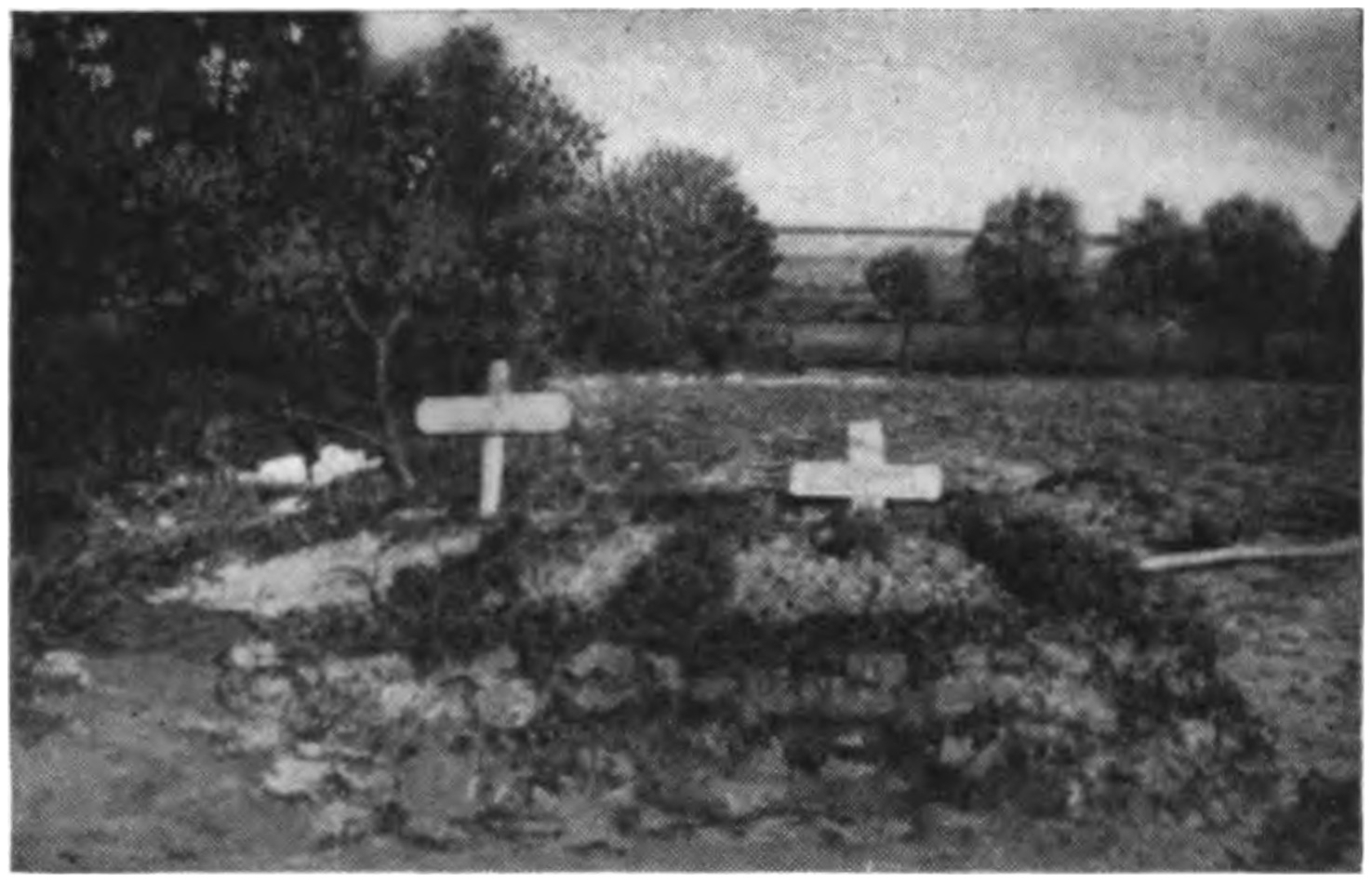
“HE LIES BURIED, ON THE RIGHT, BESIDE LIEUTENANT OLIVER AMES, AT THE EDGE OF A LITTLE COPSE KNOWN AS THE WOOD OF THE BURNED BRIDGE, CLOSE TO THE PURLING OURCQ”
I am with the Regiment now—the Intelligence Section is back from its Post, the beautiful place from which I wrote you many letters. Now we are in very flat country, the flattest I ever saw. Very violent flowers, chiefly scarlet poppies and small blue things, cornflowers, I believe. Gloriously hot, with good swimming nearby, and the best sort of shower-bath, obtainable by merely sitting under the spout of a pump while an obliging friend turns the handle.
Your letter of May twenty-sixth came after I had received a June letter. I am delighted to hear of Kenton’s confirmation and of his choice of a name—St. Stephen is a gallant gentleman and a true friend and does wonderful things for me.
I’m not very enthusiastic about that group picture of office-workers in which I appear—I like myself better as I am now, a soldier instead of a clerk, visiting the office only occasionally—to work on my history. And I’m ever so much happier now than when the picture was taken.
Is Kenton serving Mass yet? Please have him do so. And please send me my Anthology—I believe restrictions no longer keep packages from soldiers. I love you.
Joyce.