THE OLD OAKEN BUCKET11-1
Reading edition
THE OLD OAKEN BUCKET11-1
By Samuel Woodworth
How dear to my heart are the scenes of my childhood, When fond11-2 recollection presents them to view; The orchard, the meadow, the deep, tangled wild-wood, And every loved spot that my infancy11-3 knew. The wide-spreading pond, and the mill11-4 that stood by it; The bridge and the rock where the cataract fell; The cot of my father, the dairy house11-5 nigh it, And e’en the rude bucket which hung in the well— The old oaken bucket, the iron-bound bucket, The moss-covered bucket which hung in the well.
That moss-covered bucket I hail as a treasure; For often at noon, when returned from the field, I found it the source of an exquisite pleasure, The purest and sweetest that nature can yield. How ardent I seized it, with hands that were glowing, And quick to the white-pebbled bottom it fell12-6; Then soon with the emblem of truth12-7 overflowing, And dripping with coolness it rose from the well— The old oaken bucket, the iron-bound bucket, The moss-covered bucket arose from the well.
INCLINED TO MY LIPS
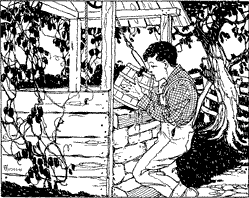
How sweet from the green mossy brim to receive it, As poised on the curb,12-8 it inclined to my lips! Not a full blushing goblet13-9 could tempt me to leave it, Though filled with the nectar13-10 that Jupiter sips. And now, far removed from the loved situation,13-11 The tear of regret will oftentimes swell, As fancy returns to my father’s plantation, And sighs for the bucket which hangs in the well— The old oaken bucket, the iron-bound bucket, The moss-covered bucket which hangs in the well.
If we compare The Old Oaken Bucket with The Daffodils (page 1), we will see that the lines of the former are longer, and when we read aloud a few lines from the one and compare the other, we see that the movement is very different. In The Old Oaken Bucket the accents are farther apart, and the result is to make the movement long and smooth, like that of a swing with long ropes.
Let us examine more closely the lines of The Old Oaken Bucket in a manner similar to that suggested on page 2, for The Daffodils. If we place the accent on the proper syllables in the first four lines, they will read as follows:
How dear´| to my heart´| are the scenes´| of my child´|hood, When fond´| rec-ol-lec´|tion pre-sents´| them to view’; The or´|chard, the mead´|ow, the deep´| tan-gled wild´|-wood, And ev´|’ry loved spot´| that my in´|fan-cy knew.´
The vertical lines above are drawn at the ends of the feet. How many feet are there in the first line; how many in the second; how many in the third; how many in the fourth? How many syllables in the first foot in the first line? How many other feet do you find containing the same number of syllables? How many syllables are there in the second foot in the first line? How many other feet are there containing the same number of syllables? Examine the feet that contain three syllables. On which syllable is the accent placed when there are three syllables in the foot? A poetic foot of three syllables which bears the accent on the third syllable is called an anapestic foot. The meter of this poem, then is anapestic tetrameter, varied by an added syllable in most of the odd-numbered lines and by an iambic foot at the beginning of each line.
Can you find any other poem in this volume in which the meter is the same? Can you find such poems in other volumes?