Chapter V · Reading and the Building of Character
Reading edition
I
The influences which unite to make character are so numerous, subtle and complex that it is next to impossible to detect them or to classify them in order of importance. Not only is this true of the aggregate, but it is true of the individual. It is doubtful if any person in middle life can tell just what he is or just how he became himself. He is aware of some great influences that have exerted their power over him at certain crises in his life, but the little things which, taken together, have done more to form and fix his character are often unrecognized or undervalued. Fortunately, at this time we need to give attention to only one phase of the great question.
Character is the one important thing. Great as is the value of book education, of practical power and of good health, still greater is the importance of sound, wholesome character; and, consciously or unconsciously, intentionally or unintentionally, the teacher and the parent are incessantly at work building the characters of the young people placed in their charge. Most of us, too, are working toward right ends as conscientiously as possible. Yet often we grow faint-hearted, or are puzzled to know what we can do to help the children and how we can do it most effectively.
That the influence of reading on character is one of the most powerful is granted by every high-minded person who has written or spoken upon the subject. Really, it is not an influence, but a series of influences, wide, complex, far-reaching. The extended range of subjects, the infinite variety in style, the unlimited shades in sentiment to be found in literature make its presence influential everywhere and always. In reading there is comfort for the sorrowing, companionship for the lonely, encouragement for the downcast, entertainment for the leisurely, inspiration for the sluggish. Gentle, pervasive, almost unnoticed, yet stronger than iron bands, is the power of literature over us. We are what we read.
If such be the case, then there need be no argument concerning the importance of suitable reading matter for the young. To leave a child wholly to his own inclinations in reading is as absurd as to send him to take honey from a swarm of angry bees and not expect him to be stung. Inevitably, he will be injured, and that seriously. To supply him with honey, all that he wants, at all times and without exertion to himself, is to clog his taste and destroy his appetite. We must see that he is led to look for the sweet, taught to recognize it when he finds it, and to extract it from the comb. He will enjoy working to get it. On the other hand, he must not be sent where his reward is too difficult to find and secure, lest he become discouraged and cease to work.
School readers furnish much excellent material for reading; in the majority of schools there is furnished more or less of supplementary reading which is quite as good as that in the text-books and which will have the merit of novelty and exclusiveness. Yet, in spite of this, parents and teachers are continually finding themselves at a loss for fresh and inspiring things for special occasions. All these may be had from Journeys Through Bookland and to assist in finding them and in using them after found the following has been written.
II
Character is made up of a great variety of traits; some of the mind, some of the heart, some of the soul. That is, what we are is composed of what we know, what we feel and what we believe. In response to those things we act; we govern ourselves in respect to ourselves and in respect to others.
The grave responsibility that rests upon parents and teachers is to encourage those traits which make for noble manhood and womanhood and to correct or eradicate as far as possible those which are bad in themselves or which help to neutralize or destroy the good ones.
Much may be accomplished by correct teaching of good principles, but human nature is such that people learn even more through indirection than through instruction. By means of the study of literature the best direct instruction may be given, and wholesome lessons may be taught abundantly in that charming way which accomplishes its purpose without a recognition on the part of the readers that they are being taught. The force and persistence of a good lesson of the latter kind cannot be estimated. It may be years before it exhausts itself, and its effect may be revolutionary.
The wise instructor, though she does not make known all her plans, works systematically. That is, having learned that a child is lacking in some respect, such as a knowledge of what constitutes good character, or in certain desirable traits of character, or possesses some characteristics that should be changed, she proceeds slowly and persistently to bring about the results she desires.
III
In Journeys Through Bookland the mother will find much to assist her. The influence of nearly all the selections will be for the betterment of character, will tend to make better men and women of the children. But when she is looking for some direct help, for something to produce a certain definite result, she will study the books carefully and select the things which are most effective. To help her in her selection we have prepared the following outline. It does not contain everything of value, but it is sufficiently comprehensive for its purpose, and will save much time for anyone.
Now let us not be unwise in teaching these things. Let us be satisfied if we secure the interest of the pupils in the selection and get from them the smile of approval, the look of guilt, the slight indication of a determination to profit by the lesson. Many times we will refrain from comment lest we spoil the effect of something much finer, more inspiring than anything we can say ourselves.
The things we have chosen for their direct influence on the growing character of children will be grouped by subject in three general classes:
A. The selections in this group are calculated to set children to thinking properly about some serious subjects. While not as important as some others may be in the formation of character, they are yet of no small consequence.
1. Wisdom, ignorance, keenness, wit, etc., in some of their many phases are shown in the fables and the brief poem listed here:
The Ass in the Lion’s Skin, Volume I, page 65.
The Fox and the Stork, I, 73.
The Fox and the Grapes, I, 135.
The Bat and the Two Weasels, I, 154.
The Horse and the Stag, I, 338.
The Fox, the Wolf and the Horse, I, 377.
The Bald Knight, I, 385.
The Wolf and the Lamb, I, 455.
Minerva and the Owl, II, 7.
The Country Squire, VI, 474. (To ridicule ignorance but not the ignorant person is sometimes a valuable means of inciting a love for knowledge.)
2. The importance of attention to little things is inculcated in the following:
The Lion and the Mouse, Volume I, page 75.
The Reaper and the Flowers, I, 410.
The Daffodils, VII, 1.
The Petrified Fern, VII, 77.
3. The following will help to create habits of promptness, industry and perseverance:
Time to Rise, Volume I, page 340.
The Hare and the Tortoise, I, 71.
The Lark and Her Young Ones, I, 131.
Industry and Sloth, I, 300.
Whittington and His Cat, I, 442.
Tom, the Water Baby, II, 215.
The Village Blacksmith, IV, 86.
Bruce and the Spider, V, 314.
4. These show the sterling worth of independence and the real equality of man:
The Village Blacksmith, Volume IV, page 86.
For A’ That and A’ That, VII, 149.
5. Courage and bravery are shown to be admirable and cowardice is made shameful in these selections:
The Boy and the Nettle, Volume I, page 65.
The Mice and the Cat, I, 197.
6. The evil of conceit and overweening self-esteem may be shown emphatically by the use of such selections as these:
The Gnat and the Bull, Volume I, page 70.
The Cock and the Horses, I, 146.
The Pea Blossom, I, 205.
The Sparrow and the Eagle, II, 8.
The Milkmaid, II, 374.
7. Flattery as a vice is made to seem unworthy, and its victim ridiculous in the two selections following:
The Fox and the Crow, Volume I, page 64.
The Spider and the Fly, III, 19.
B. Our character is largely made up of our feelings and emotions. Reason takes us in hand and tells us right from wrong, but we must feel before we can act. To cultivate right feeling, laudable emotions; to make one wish to do and hence will to do is perhaps the greatest function of real literature, that is the literature of beauty and of inspiration. Our collection is rich in this direction and to find material for lessons is an easy task. Yet not everyone has the time to find, classify and use everything; hence the following lists.
Before giving them, however, a word of caution is necessary. Remember that these selections are not all suitable for children of every age. Some that will delight the little children and stimulate them to enthusiastic efforts to do right, will not appeal to older ones. Moreover, the natural bent of a child’s mind, the associations he has formed, his home surroundings, and his present character will all need to be considered before making choice of the subject matter. As for the manner of presentation, enough will be found in the studies in Journeys Through Bookland and in other parts of this volume safely to guide the young and inexperienced.
1. The influences of home and family are the greatest that come into the lives of most children. Love of home, of parents, of brothers and sisters, of children, are the perfectly natural things of existence. Yet often the ties are weak; not infrequently are they broken. Children drift away from the restraining and helpful influence of their parents, and families disintegrate. The results are bad. By properly teaching such selections as the following, much may be done to correct the evil and to intensify the highest, holiest emotions of mankind:
The Rock-a-by Lady, Volume I, page 94.
Little Birdie, I, 142.
Sleep, Baby, Sleep, I, 204.
Old Gaelic Lullaby, I, 203.
Lady Button-Eyes, I, 366.
The First Snowfall, II, 403.
Rain on the Roof, IV, 7.
Pictures of Memory, IV, 127.
Bernardo del Carpio, IV, 270.
Rab and his Friends, VI, 99.
Childhood, VI, 124.
Home, Sweet Home, VI, 221.
Home They Brought Her Warrior Dead, VI, 231.
A Christmas Carol, VI, 244.
To My Infant Son, VI, 478.
The Old Oaken Bucket, VII, 11.
My Old Kentucky Home, VII, 179.
The Forsaken Merman, VII, 180.
Tom and Maggie Tulliver, VII, 186.
The Family of Michael Arout, VII, 314.
On Receipt of My Mother’s Picture, VII, 331.
Extract from Snowbound, VII, 388.
The Cotter’s Saturday Night, VIII, 319.
Dream Children, VIII, 335.
2. Honesty and truthfulness are cardinal virtues; they are the foundation of every strong character. Teach these selections and note their effect:
The Shepherd Boy and the Wolves, Volume I, page 92.
The Falcon and the Partridge, II, 6.
The Pied Piper of Hamelin, III, 384.
The Cubes of Truth, VII, 406.
3. Friendliness, kindness, consideration of others, charity and love are a group of strong characteristics which are admirably shown in the following:
The Two Travelers, Volume I, page 109.
Cinderella, I, 224.
Baucis and Philemon, I, 431.
The Snow Queen, II, 124.
The King of the Golden River, II, 405.
Auld Lang Syne, VI, 228.
A Christmas Carol, VI, 244.
Florence Nightingale, IX, 13.
4. Generosity is admirable; selfishness is despicable. Prove the facts by these:
The Two Travelers, Volume I, page 109.
The Two Travelers and the Oyster, I, 111.
The Cat and the Chestnuts, I, 142.
Baucis and Philemon, I, 431.
5. Kindness to animals is next to kindness and sympathy for human beings. It is best inculcated by teaching the beauty and loveliness of animals, their value to man and their dependence upon him. The following will help:
The Boys and the Frogs, Volume I, page 63.
The Brown Thrush, I, 147.
Mercy to Animals, I, 413.
The Ugly Duckling, I, 414.
Tom, the Water Baby, II, 215.
Who Stole the Bird’s Nest? II, 399.
A Dog of Flanders, IV, 93.
Rab and His Friends, VI, 99.
The Rime of the Ancient Mariner, VII, 29.
6. Patience and gentleness seem charming in these selections:
The Wind and the Sun, Volume I, page 95.
Cinderella, I, 224.
Rab and His Friends, VI, 99.
7. Faithfulness is a virtue. We admire it in:
Something, Volume I, page 395.
Whittington and His Cat, I, 442.
The Mirror of Matsuyana, II, 36.
The Snow Queen, II, 124.
Casabianca, VIII, 313.
8. That envy and covetousness are unpleasing and unprofitable are shown by these:
The Dog and His Shadow, Volume I, page 63.
The Frog Who Wished to Be as Big as an Ox, I, 66.
The Golden Touch, II, 43.
9. Contentment, peacefulness, hopefulness are made very attractive in the following:
The Town Mouse and the Country Mouse, Volume I, page 199.
The Pea Blossom, I, 205.
The Flax, I, 378.
The Discontented Stone Cutter, II, 12.
The Fir Tree, II, 68.
The Blind Lassie, VI, 120.
Pippa Passes, IX, 293.
C. We have grouped together here two classes of selections which inculcate patriotism or devotion to one’s fatherland and devotion to God. How admirable the selections are! You have only to read them to see:
1. Patriotism:
Holger Danske, Volume II, 377.
Incident of the French Camp, IV, 174.
The American Flag, V, 396.
Battle Hymn of the Republic, V, 399.
Stonewall Jackson’s Way, V, 400.
Horatius, VI, 1.
Bannockburn, VII, 15.
Breathes There The Man, VII, 151.
How Sleep the Brave, VII, 151.
Make Way for Liberty, VII, 172.
The Old Continentals, VII, 175.
America, VIII, 60.
The Battle of Thermopylae, VIII, 81.
The Fall of the Alamo, VIII, 141.
Hervé Riel, VIII, 168.
The Battle of Trafalgar, VIII, 284.
The Gettysburg Address, IX, 321.
2. Suitable selections under this topic are difficult for teachers to find, owing to the objection there is against religious teaching in the public schools. Parents have greater liberty of selection. The following are beautiful and seem wholly unobjectionable:
A Thought, Volume I, page 66.
The First Snowfall, II, 403.
Nearer Home, IV, 126.
Stonewall Jackson’s Way, V, 400.
The Rainbow, VI, 91.
A Child’s Thought of God, VII, 418.
Who Stole the Bird’s Nest?
The obvious purpose of these verses (Volume II, page 399), is to create a love for birds by making things appear uncomfortable for the boy who steals their nests. Perhaps the lesson is too obvious. The people who never steal nests and who always treat birds lovingly will approve of the verses, but the boy to be reached is the one who does destroy nests and frightens or kills their owners or the boy who is liable to be led to do such things. Such a child may have no interest in the verses, may laugh at the sentiment, even if he can be induced to read or listen to the rhymes. Sometimes interest can be created and good effects produced by making prominent every feature except the moral. This can be made into a little play or dialogue with the following characters:
The Yellow-breast
The Cow
The Dog
The Bobolink
The Sheep
The Crow
The Hen
A Bird
Mary Green
Alice Neal
The Little Boy
Unfortunately, there is only one boy character and he is any boy, in fact almost every boy, at some time in his life. But he is so ashamed that he doesn’t speak, not even to give his name. Suppose, then, we don’t mention him at all. Just leave him off the list. If he isn’t mentioned and is in the audience, he’ll remember what he has done and feel ashamed and go home and perhaps hide behind the bed and resolve never to steal another nest. Yes, we are inclined to agree with you that the poem might be better if there were no last stanza. So the little drama, in outline, is something like this.
The Yellow-breast. Who stole my nest and the four eggs I laid?
The Cow. I didn’t take your nest. I wouldn’t do such a thing. I gave you a wisp of hay.
The Yellow-breast. Who stole my nest? Bobolink, who do you think stole my nest from the plum tree?
The Dog. (Interrupting). I didn’t; I wouldn’t be so mean. I gave my hairs to make the nest.
The Yellow-breast. Now listen to me. Who stole my nest, Bobolink?
The Bobolink. Yes, who stole the Yellow-breast’s pretty nest?
The Sheep. Not I. I wouldn’t treat a bird so. I gave my wool to line the nest.
The Yellow-breast. Who stole my nest, I say?
The Bobolink. Who stole her nest?
The Crow. I should like to know the thief. Who was it?
The Hen. Don’t ask me. The chicks and I each gave a feather and she used them. We would be ashamed to intrude on her.
A Bird. Let’s all make a stir and find out who it is. Then we’ll cry “For shame!” together.
Mary Green. I wouldn’t rob a bird. I never heard anything so mean.
Alice Neal. It is very cruel. I wonder if the thief knew how sad the Yellow-breast would feel.
Boys do not steal nests because they are mean and want to give pain. They admire the pretty eggs, they like the skilfully built nests, and they do not realize that anything suffers real pain. That is a lesson they must be taught. Can you teach kindness by cruelty? Is it not rather cruel to say right out before Mary Green and Alice Neal and the other girls that the boy was so ashamed he hung his head, hid behind the bed and wouldn’t tell his name?
Lead, Kindly Light
Note.—John Henry Newman, the author of this beautiful poem (Volume V, page 110), was born in London in 1801. He entered Oxford before he was sixteen and achieved the highest distinction in his college course. He entered the Church of England and became noted for his wonderful sermons. After some years of prominence in his calling, he was convinced that his belief was wrong, and in 1845 he entered the Roman Catholic Church. In 1879 he was created cardinal by Pope Leo XIII. but he continued to reside in England, where he died in 1890. Besides his great influence as a spiritual thinker, Newman’s writings and sermons were characterized by a forcible and elevated style and by remarkably melodious utterance. Lead, Kindly Light shows these traits.
Some words and phrases in the hymn may be made clearer by explanation: “Kindly Light.”—“The light shall shine upon thy ways.” (Job xxii, 28.) “The Lord is my light and my salvation.” (Psalms xxvii, 1.) “The Lord shall be thine everlasting light, and the days of thy mourning shall be ended.” (Isaiah lx, 20.)
In the Bible there are many other instances besides those just given in which there is a figurative use of the word light. It is a natural and beautiful figure. A person in doubt intellectually or spiritually looks upon himself as in darkness, and light to him is an intellectual or spiritual awakening. The light that came to the poet was a kindly light; it removed his doubts and comforted him.
“Garish day.” The dazzling or glaring day.
“Moor and fen.” While these words seem new and unusual to us, we must remember that in England they are as common as the terms marsh and swamp are with us.
“Those angel faces smile,” etc. The subject of this clause is faces, and the verb is smile.
Children will love this hymn though they cannot appreciate its full significance till maturer years have brought with them the deeper experiences of life. Still they should know and love the poem and may be led to a partial understanding of its beauty in sentiment by means of interpretation carried not too far. By comment and reading somewhat in the following manner may the most be accomplished:
1. The poet had reached mature years and had felt the oppressing influence of questioning and doubt, but had reached a sublime faith in the power and love of God. He still feels, however, the need of the personal care and guidance of the Almighty, and asks that it may continue through life. So we may imagine him in one of those thoughtful moments which come to every one, musing thus: Darkness and night surround me with their encircling gloom, and I feel that years must pass before I reach my heavenly home, so—
Lead, kindly light, amid the encircling gloom, Lead thou me on; The night is dark, and I am far from home; Lead thou me on;
While he no longer doubts the care and protection of God, yet he feels that his own strength is not sufficient; that he may err and stumble in the path he has chosen. He does not ask that all should be clear, nor that he should see the long course of his life, but is content to pray—
Keep thou my feet; I do not ask to see The distant scene; one step enough for me.
2. After this invocation and prayer, his thoughts turn back into the past, and he remembers that in youth he had not this divine faith, nor did he wish to place his reliance in God. He preferred to lay out his own course and to plan his life far into the future, without the feeling of dependence that now rules him. So he sings:
I was not ever thus, nor prayed that thou Shouldst lead me on; I loved to choose and see my path, but now Lead thou me on;
He remembers that then he loved display and ostentation and was proud, wilful and self-confident; nevertheless, there were times when for a moment he feared, but in spite of that timidity, he went on in his masterful way:
I loved the garish day, and, spite of fears, Pride ruled my will:
The thought of his self-complacency, his pride and arrogance brings out the plea, the supplication, “remember not past years.”
Sir Francis Bacon Jonathan Swift Cardinal Newman Daniel Defoe Cardinal Wiseman Cervantes Father Ryan
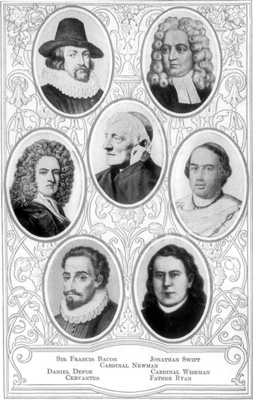
3. He remembers that through all his rebellions he has been surrounded by the power and goodness of God, who has led him through all his devious paths, and the feeling comes that the same protecting influence will surround him till doubt is swept aside.
So long thy power hath blessed me, sure it still Will lead me on O’er moor and fen, o’er crag and torrent, till The night is gone.
He is confident, too, that the same power will lead him through the dark night of doubt till the angels of love and faith, in whom he once trusted but whom he has doubted for a time, will come about him and smile their welcome to the light:
And with the morn those angel faces smile Which I have loved long since, and lost the while.
Poor Richard’s Almanac
It is doubtful if Journeys Through Bookland contains any other selection so full of meat as this extract (Volume VI, page 407) from the writings of Benjamin Franklin; in fact, it is so full of wisdom on so many homely subjects and contains so much practical advice that no one can master it in a single reading.
It is condensed to the utmost limit and every sentence should be weighed and considered. The wise maxims and old saws need to be expanded in thought, illustrated by example and applied to the reader’s personal experience.
As a whole it is not particularly attractive to young people, but every child can be attracted to parts of it. A little of it to-day, more of it next week, a third part some time in the future, and in time the whole will be assimilated.
If the truths in this one selection are thoroughly embedded in the mind of a boy, if the traits of character here taught are made a part of him, he will be a sound man of business, a sensible head of a family and a valuable citizen in a community.
Poor Richard’s Almanac contains the religion of work, of economy, of prosperity. It is a manly doctrine, a clear-cut, respectable philosophy, a reasonable rule of business activity. Never more than today were the precepts needed. The whole tendency of our modern activities is against its precepts. Disaster and ruin may be seen on every hand and traced directly to the neglect or violation of those sound principles which the wise old Franklin put in such homely words.
These maxims of life and policy are not those which it is the special province of the school to teach. They are the elementary law which a boy or girl must learn in his home and see exemplified therein if they are ever to become a practical part of life’s equipment.
The wisdom of the Almanac is the wisdom of practical experience, the wisdom of those who have lived and worked, who have lost and won. It does not deal with the finer phases of character, but with those practical things which lead to a bread-and-butter success.
A boy who knows what Poor Richard teaches and follows his precepts will be a business success. If a parent can grind into the character of his child these lessons of industry, simplicity, temperance and frugality he will have left a legacy more valuable a thousand times than the wealth he may have amassed, although that is reckoned by the millions.
Because of the extreme condensation of the address by Father Abraham, the following outlines have been made to enable a parent to find easily what is wanted and to present it attractively. The selection is one of those which children will not master by themselves, but one which the parent can easily make interesting if he will follow the plans given below.
Analysis
I. (Page 409.) Taxes are heavy, but we are taxed:
1. Twice as much by our Idleness.
2. Three times as much by our Pride.
3. Four times as much by our Folly.
II. Idleness and Industry. (pages 409, 411.)
1. Time wasted in doing nothing (page 409), sloth.
(In this connection see fable, Industry and Sloth, Volume I, page 300. Consult index in this volume).
2. Time wasted in sleep (page 410).
3. Time wasted in wishing and hoping (page 411).
4. Industry lost by putting off till tomorrow (page 412).
5. Steadiness in industry wins (page 412).
III. Folly. (pages 414-416).
1. Of trusting to others (page 414).
2. Of neglect of small matters (page 414).
3. Of extravagance and the sensibleness of frugality (page 414).
4. Of vice (page 415).
5. Of high living (page 415).
6. Of purchasing unnecessary things (page 415).
7. Of luxury (page 416).
IV. Pride. (page 417).
1. Of dress (page 417).
2. In table luxuries (page 417).
3. Of appearance (page 417).
V. The Madness of Debt. (pages 417-420).
1. Brings shame (page 417).
2. Causes lying (page 418).
3. Destroys virtue (page 418).
4. Brings slavery (page 419).
5. Prevents success (page 420).
VI. Ask for the Blessing of Heaven (page 420).
VII. Accept Counsel. Do not wait for Experience.
Following the arrangement of the analysis above we may group a series of typical maxims, each of which can be made the basis of one of those little fireside talks which bear so prominent a part in the recollection of every man and woman who had the blessing to be brought up in a real home where father and mother joined in a sincere effort to bring up their children to honest, earnest, successful maturity.
I. “We are taxed twice as much by our Idleness, three times as much by our Pride and four times as much by our Folly.”
II. Idleness and Industry.
1. “Sloth, like rust, consumes faster than labor wears; while the used key is always bright.”
2. “The sleeping fox catches no poultry.”
3. “He that lives on hope will die fasting.”
4. “Industry need not wish.”
5. “Have you somewhat to do tomorrow? Do it today.”
6. “Three removes are as bad as a fire.”
III. Folly.
1. “If you would have a faithful servant and one that you like, serve yourself.”
2. “For want of a nail the shoe was lost; for want of a shoe the horse was lost; for want of a horse the rider was lost.”
3. “A fat kitchen makes a lean will.”
4. “What maintains one vice would bring up two children.”
5. “Who dainties love shall beggars prove.”
6. “At a great pennyworth pause awhile.”
7. “Silks and satins, scarlets and velvets put out the kitchen fire.”
IV. Pride.
1. “Fond pride of dress is, sure, a very curse. Ere fancy you consult, consult your purse.”
2. “Pride breakfasted with plenty, dined with poverty and supped with infamy.”
3. “What is a butterfly? At best He’s but a caterpillar drest.”
V. The Madness of Debt.
1. “You will be ashamed to see your creditor.”
2. “Lying rides upon debt’s back.”
3. “It’s hard for an empty bag to stand upright.”
4. “Creditors have better memories than debtors.”
5. “Those have short Lent who owe money to be paid at Easter.”
VI. “Job suffered and was afterward prosperous.”
VII. “They that won’t be counselled can’t be helped.”
“If you will not hear reason, she’ll surely rap your knuckles.”