Journey to the Southward Begins.[186]
Reading edition
Journey to the Southward Begins.[186]
14th, Tuesday. Having taken leave of all our acquaintances, we set off at ten o'clock, this morning, in company with Ephraim, his wife, his wife's mother, two of her sisters, and a young brother, who were to accompany her as far as Pescatteway.[187] We stepped into the boat, where we found three horses, two Quakers, and another Englishman. We were not long in starting. The wind was from the west, which is a head wind for sailing to Achter Kol. The sky began to be heavily overcast, and the wind to freshen up more, so that we had to tack. Ephraim being afraid the wind might shift to the northwest, and blow hard, as it usually does when it is from that quarter, wished to return, and would have done so, if the skipper had not tried to go ahead more than he did. The tide running out, and the boat advancing but little, and being fearful of the flood tide, which would delay us, if it did not drive us back, and as there was room to work with the rudder, I went and took hold of the tiller myself, and brought the boat, with the flood tide, just within the point of Staten Island, where we found a ketch bound for Achter Kol, and further up to Snake Hill. Having now the tide with us, we tacked about, and quickly passed by Schutters Island, lying in the mouth of a kill, on the north side of the Kil achter Kol. This island is so called, because the Dutch, when they first settled on the North River, were in the practice of coming here to shoot wild geese, and other wild fowl, which resorted there in great numbers. This kill, when the water is high, is like a large river, but at low water it is dry in some places. Up above it divides itself into two branches, one of which runs about north to Snake Hill and Ackingsak; and the other, called the Northwest Kill, because it extends in that direction, runs to Aquakenom, of which we will speak hereafter.[188] We sailed inside of Schutters Island, although the passage is very small, and thus obtained the in-running current; because the flood tide which came from Achter Kol, and that from the North River, strike each other here, and thus shoot together in this kill. With much effort we reached the point of Elizabeth's Kill, where we were compelled to come to anchor, at four o'clock. We all went ashore, and lodged for the night in the house of the French people, of whom we have spoken before, and who were not yet rid of the suspicion they had conceived, notwithstanding the declarations we had made to the contrary. We all slept on the floor, and supped upon what we had brought with us. We were no sooner in the house, than it began to rain and blow hard from the northwest, and to be very cold. We saw herein the good providence of the Lord again, whom we had so many times, during our journeying, so visibly perceived, watching and protecting so faithfully those who cared for nothing, except for Him and to do His will.
15th, Wednesday. It still blew stiff out of the northwest, so that our skipper had little disposition to weigh anchor and get under sail, especially with the horses on board, although we would have willingly proceeded. It was, therefore, determined that the horses should go by land with the servant and brother of Ephraim, and the Quakers resolved to do the same. The rest of the company went on board the boat, and after taking in a large reef, we got under sail, with a head wind, but ebb tide. It blew hard and squally, and we had to look out well, with sheets in hand. We made good progress, and came to Smokers Hoeck, which is about half way of Kil achter Kol. We came to anchor here, because the next reach was directly against the wind, and it blew too hard to tack. We all stepped ashore here, and went on foot to an English village called Wout Brigg,[189] where we should find the horses. Smoker's Hoeck is the easterly point of the kill, which runs up to Wout Brigg, and we would have sailed up this creek, but it was ebb tide. We passed over reasonably fair and good land, and observed particularly fine salt meadows on the creek, on which there was built a good grist mill,[190] and over which we had to cross. We arrived about noon or one o'clock, at this English village. Ephraim, not wishing to go with his family to the ordinary tavern, went to another house or tavern, where he had been many times before, and where the people were under some obligations to him. But he could not lodge there now; and we were, therefore, compelled to go to the common tavern, which was full of persons, sitting drinking, and where nothing was to be obtained except that vile rum. Nevertheless, we had to pass the day there, waiting for the boat and the baggage; but these did not come up to-day, in consequence of the hard wind. We had, therefore, to lie down here upon the ground all together, on a little hay, as we had done last night.
16th, Thursday. The weather moderated and it cleared up, but we had to wait till about noon, before the goods arrived from the boat, which the skipper had to bring up in a canoe, because the boat could not come. We obtained here another horse, making five horses we had, and another servant of Ephraim. We then dined, and politely took our leave of Madam van B.[191], the mother of Ephraim's wife, and of her two sisters, who had come to conduct her as far as here, and from here were to return home again in the same boat, but the little brother went with us to the south, to live with Ephraim. It was then about three o'clock, when we mounted the horses, namely, Ephraim and his wife upon the best one, my comrade and myself each upon the one we had obtained at Woodbridge, his brother and servant on one, and the other servant upon another. Our horses, like the riders, were very poor. We proceeded on, however, and about four o'clock arrived at Pescatteway, the last English village in New Jersey, for thus the government of the Governor my Lord Catrix [Carteret] is called; which begins on the west side of the North River, and extends about half way to the South River, though this division did not seem to me to be well made. We rode about two English miles through Pescatteway, to the house of one Mr. Greenland,[192] who kept a tavern there. We had to pass the night here, because it was the place of crossing the Milstoons [Millstone] River, which they called the falls. Close by there, also, was the dwelling of some Indians, who were of service to this Mr. Greenland, in many things. We were better lodged and entertained here, for we slept upon a good bed, and strengthened ourselves against the future.
17th, Friday. As the water was high in the kill or Millstone River, Ephraim would not ride over the fall, on account of the current of water, which made it dangerous. He, therefore, determined after breakfast we should be set across in a canoe, and the horses should swim across, as they did. We reached the other side about nine o'clock, and proceeded on horseback. The road from here to the falls of the South River, runs for the most part W.S.W., and then W. It is nothing but a foot-path for men and horses, between the trees and through the small shrubs, although we came to places where there were large plains, beset with a few trees, and grown over with long grass, which was not the worst. When you have ridden a piece of the way, you can see over the lands of the Nevesink, far off on the left hand, into the ocean, affording a fine view. The land we rode over was neither the best, nor the worst. The woods consist of reasonably straight oak and hickory, with some chestnut, but they are not very close. They would, therefore, afford tolerably good tillable land; but we observed the best pieces lay here and there, along the creeks. We saw many deer running before us, out of the road, sometimes five or six together, starting off at the sound of the horses. When about half way, you come to a high, but very rocky hill, which is very difficult for man or beast to walk upon. After crossing it, you come to a large valley, the descent to which, from this hill, is very steep, by a very shrubby road; and you must dismount, in order to lead your horses down carefully, as well as to descend carefully yourselves. We were in the middle of this valley, when a company met us on horseback, from the South River. They were acquaintances of Ephraim, and some of them were his relations. They wished each other welcome, and mutually inquired after various matters, after which we separated, exchanging one of our horses, which Ephraim's brother rode, and was to be sent back to the Manathans, for one of theirs, which must return to the South River. We rode on a little further, and came to Millstone River again, which runs so crookedly, that you cross it at three different places. After we crossed it now, we took the bridles from the horses, in order that they might eat something, while we sat down and dined together, upon what we had in our travelling bags. We remounted in about an hour, and rode on, continuing our way and course as before. About three o'clock we came again to Millstone River, which we again waded over, but it had gradually become smaller. Resuming our route, we arrived at the falls of the South River about sundown, passing a creek where a new grist-mill was erected by the Quakers, who live hereabouts in great numbers, and daily increase.[193] But it seemed to us as if this mill could not stand long, especially if the flow of water were heavy, because the work was not well arranged. We rode over here, and went directly to the house of the person who had constructed it, who was a Quaker, where we dismounted, and willingly dismissed our horses. The house was very small, and from the incivility of the inmates and the unfitness of the place, we expected poor lodgings. As it was still daylight, and we had heard so much of the falls of the South River, or, at least, we ourselves had imagined it, we went back to the river, in order to look at them; but we discovered we had deceived ourselves in our ideas. We had supposed it was a place, where the water came tumbling down in great quantity and force from a great height above, over a rock into an abyss, as the word falls would seem to imply, and as we had heard and read of the falls of the North River, and other rivers. But these falls of the South River are nothing more than a place of about two English miles in length, or not so much, where the river is full of stones, almost across it, which are not very large, but in consequence of the shallowness, the water runs rapidly and breaks against them, causing some noise, but not very much, which place, if it were necessary, could be made navigable on one side. As no Europeans live above the falls, they may so remain. This miller's house is the highest up the river, hitherto inhabited. Here we had to lodge; and although we were too tired to eat, we had to remain sitting upright the whole night, not being able to find room enough to lie upon the ground. We had a fire, however, but the dwellings are so wretchedly constructed, that if you are not so close to the fire as almost to burn yourself, you cannot keep warm, for the wind blows through them everywhere. Most of the English, and many others, have their houses made of nothing but clapboards, as they call them there, in this manner: they first make a wooden frame, the same as they do in Westphalia, and at Altena,[194] but not so strong; they then split the boards of clapwood, so that they are like cooper's pipe staves, except they are not bent. These are made very thin, with a large knife, so that the thickest end is about as thick as a little finger, and the other is made sharp, like the edge of a knife. They are about five or six feet long, and are nailed on the outside of the frame, with the ends lapped over each other. They are not usually laid so close together, as to prevent you from sticking a finger between them, in consequence either of their not being well joined, or the boards being crooked. When it is cold and windy the best people plaster them with clay. Such are almost all the English houses in the country, except those they have which were built by people of other nations. Now this house was new and airy; and as the night was very windy from the north, and extremely cold with clear moonshine, I shall not readily forget it. Ephraim and his wife obtained a bed; but we passed through the night without sleeping much.
18th, Saturday. About ten o'clock, after we had breakfasted, we stepped into a boat, in order to proceed on our journey down the river. The ebb tide was half run out. Although there is not much flood tide here, as it is stopped by the falls, yet, the water rises and falls with the ebb or flood, or through the ebb or flood, because the water, although it runs down, increases through the flood, in consequence of its being forced up, and is diminished with the ebb, because the ebb gives it so much the more course to run down. We went along, then, moving with the tide; but as Ephraim was suffering with the quartan ague, and it was now its time to come on, we had to go and lie by the banks of the river, in order to make a fire, as he could not endure the cold in the boat. This continued for about an hour and a half. The water was then rising, and we had to row against the current to Borlinghton [Burlington], leaving the island of Matinakonk[195] lying on the right hand. This island, formerly, belonged to the Dutch governor, who had made it a pleasure ground or garden, built good houses upon it, and sowed and planted it. He also dyked and cultivated a large piece of meadow or marsh, from which he gathered more grain than from any land which had been made from woodland into tillable land. The English governor at the Manathans now held it for himself, and had hired it out to some Quakers, who were living upon it at present. It is the best and largest island in the South River; and is about four English miles in length, and two in breadth. It lies nearest to the east side of the river. At the end of this island lies the Quakers' village, Borlington, which east side of the river the Quakers have entirely in their possession, but how they came into its possession, we will show in another place.[196] Before arriving at this village, we stopped at the house of one Jacob Hendrix, from Holstein, living on this side. He was an acquaintance of Ephraim, who would have gone there to lodge, but he was not at home. We, therefore, rowed on to the village, in search of lodgings, for it had been dark all of an hour or more; but proceeding a little further, we met this Jacob Hendrix, in a canoe with hay. As we were now at the village, we went up to the tavern, but there were no lodgings to be obtained there, whereupon we reembarked in the boat, and rowed back to Jacob Hendrix's, who received us very kindly, and entertained us according to his ability. The house, although not much larger than where we were the last night, was somewhat better and tighter, being made according to the Swedish mode, and as they usually build their houses here, which are block-houses, being nothing else than entire trees, split through the middle, or squared out of the rough, and placed in the form of a square, upon each other, as high as they wish to have the house; the ends of these timbers are let into each other, about a foot from the ends, half of one into half of the other. The whole structure is thus made, without a nail or a spike. The ceiling and roof do not exhibit much finer work, except among the most careful people, who have the ceiling planked and a glass window. The doors are wide enough, but very low, so that you have to stoop in entering. These houses are quite tight and warm; but the chimney is placed in a corner. My comrade and myself had some deer skins, spread upon the floor to lie on, and we were, therefore, quite well off, and could get some rest. It rained hard during the night, and snowed and froze, and continued so until the
19th, Sunday, and for a considerable part of the day, affording little prospect of our leaving. At noon the weather improved, and Ephraim having something to do at Borlinton, we accompanied him there in the boat. We went into the meeting of the Quakers, who went to work very unceremoniously and loosely. What they uttered was mostly in one tone, and the same thing, and so it continued, until we were tired out, and went away. We tasted here, for the first time, peach brandy, or spirits, which was very good, but would have been better if it had been more carefully made. Ephraim remained there for the evening, and we returned back to our former lodgings, where we slept on a good bed, the same that Ephraim and his wife had the night before. This gave us great comfort, and recruited us greatly.
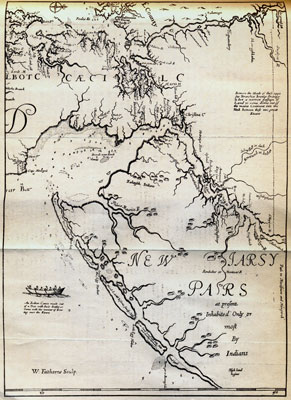
THE NORTHEAST PORTION OF AUGUSTINE HERRMAN'S MAP OF MARYLAND, 1673
From Mr. P.L. Phillips's facsimile
[Enlarge]
20th, Monday. We went again to the village this morning, and entered the ordinary exhorters' house, where we breakfasted with Quakers, but the most worldly of men in all their deportment and conversation. We found lying upon the window a volume of Virgil, as if it were a common hand-book, and also Helmont's book on Medicine,[197] whom, in an introduction, which they have made to it, they make pass for one of their sect, although in his life time he did not know anything about Quakers; and if they had been in the world, or should have come into it, while he lived, he would quickly have said, no, to them; but it seems these people will make all those who have had any genius, in any respect, more than common, pass for theirs; which is certainly great pride, wishing to place themselves far above all others; whereas, the most of them, whom I have seen as yet, are miserably self-minded, in physical and religious knowledge. It was then about ten o'clock, and it was almost noon before we left. The boat in which we had come as far as there with its owner, who intended to return in it, was exchanged for another, belonging to Oplant [Upland],[198] of which a Quaker was master, who was going down with several others of the same class; but as it was half ebb tide, and the shallop was lying far up in the mud, no one of these zealous people was willing to bring her through it, into the water. Ephraim, in order to get started, and to shame them, did not hesitate long, and followed by his servant and both of us, very soon had the boat afloat in the water. Pursuing our journey, we arrived about two o'clock at the house of another Quaker, on the west side of the river, where we stopped to eat our dinner and dry ourselves. We left there in an hour, rowing our best against the flood tide, until, at dark, we came to Takany,[199] a village of Swedes and Finns, situated on the west side of the river. Ephraim being acquainted, and having business here, we were all well received, and slept upon a parcel of deer skins. We drank very good beer here, brewed by the Swedes, who, although they have come to America, have not left behind them their old customs.
21st, Tuesday. The tide falling, we set out with the day, and rowed during the whole ebb and part of the flood, until two or three o'clock, when we arrived at the island of Tynakonk,[200] the fifth we had passed. Matinakonk and this Tinakonk are the principal islands, and the best and the largest. The others are of little importance, and some of them, whose names we do not know, are all meadow and marsh, others are only small bushes. The pleasantest thing about them is, they afford an agreeable view and a variety to the traveller, and a little divertissement to those who go up and down the river; also some conveniences for fishing in the river, and other accommodations for the planters.
This Tinakonk is the island of which M. Arnout de La Grange[201] had said so much; but we were much disappointed in comparing it with what he had represented, and what M. La Motte has written about it. The first mistake is in the name, which is not Matinakonk—the name rather of the island of which we have spoken before—but Tinakonk. It lies on the west side of the river, and is separated from the west shore, not as he said, by a wide running branch of the river, as wide as the Eemster, near Amsterdam, but by a small creek, as wide as a large ditch, running through a meadow. It is long and covered with bushes, and inside somewhat marshy. It is about two miles long, or a little more, and a mile and a half wide. Although there are not less miles than he said, he did not say they were English miles, which are only one-fourth the length of Dutch miles, of fifteen to a degree. The southwest point, which only has been and is still cultivated, is barren, scraggy, and sandy, growing plenty of wild onions, a weed not easily eradicated. On this point three or four houses are standing, built by the Swedes, a little Lutheran church made of logs,[202] and the remains of the large block-house, which served them in place of a fortress, with the ruins of some log huts. This is the whole of the manor. The best and pleasantest quality it has, is the prospect, which is very agreeable, and one of the principal things for which Mons. La Motte recommends it, namely, belle videre. I have made a sketch of it, according to my ability.[203] But as to there being a mine of iron ore upon it, I have not seen any upon that island, or elsewhere; and if it were so, it is of no great importance, for such mines are so common in this country, that little account is made of them. Although Ephraim had told us every thing in regard to the condition of the land, as well as the claim which Mons. de La Grange makes to it, yet we ourselves have observed the former, and have ascertained the latter, from a person who now resides there, which is as follows: When the Swedish colony was flourishing under its own government, this island belonged to a Mr. Papegay [Papegoia], the Swedish governor, who lived upon it, and cultivated it, the church and the fort still existing there as monuments to prove the fact. Although the Swedes have had fortresses, from time to time, in several other places, at this time, this was called New Gottenburg. This governor died leaving a widow;[204] and she, Madam Papegay, sold the island, which was then very flourishing, to the father of de La Grange, for six thousand guilders, in the money of Holland, though the person who now lives upon it says it was seven thousand guilders, to be paid in several installments, here in New Netherland. Some of the first payments were duly made by de La Grange, but the last two, I think, he was not so ready to make, as he had to procure the money from Holland, and that, I know not why, did not come. Thereupon Mons. de La Grange determined to go to Holland himself, and bring the money with him; but he died on the voyage, and the payments were not made. It remained so for a long time, and at length the widow Papegay cited the widow de La Grange before the court, claiming as her right, payment in full, or restitution of the land, as de La Grange had been in possession of the land for some years, and had enjoyed the profits, and the time for the last payment had also expired some years before. In the mean time comes one M. La Motte, who it seems was to assist Madam de La Grange, either by discharging the debt or by defending the suit, and in order the better to do so, he buys the island from the widow de La Grange, seeking her also in marriage. But as Madam Papegay persevered, and the affair of Mons. La Motte and the widow de La Grange came to nothing, and on the other hand the widow de La Grange could not deliver the land to La Motte, and La Motte could not pay, the widow de La Grange was therefore condemned to restore the island to Madam Papegay, and pay her costs, and also to pay the income which she had received from the island for the time she had lived upon it, and for the buildings which she had allowed to go to waste. Madam de La Grange, conceiving this decree to be unjust, appealed to the high court—the country having in the mean time been taken by the English—and was again condemned, and therefore, had to deliver up the land.[205] Now, in this last war with Sweden,[206] Madam Papegay, who has two brothers in Sweden, in the service of the crown,[207] was sent for by them to come home, whereupon, she sold the island to Mr. Otto Kuif[208] a Holsteiner, who now lives upon it, for fifteen hundred guilders in zeewant, as it was very much decayed and worn out. This is three hundred guilders in the money of Holland. Hereupon, Madam Papegay delivered full possession thereof to this Otto. Now, M. Arnout de La Grange, as heir of his father, when he was here last year laid claim to the island from Mr. Otto, who told him he did not know him in the matter, and if M. de La Grange had any lawful claim, he must not apply to him, but to the court, as his possession was under its judgment; but if M. de La Grange wished to buy it from him, he would let him have it for three hundred pounds sterling, or as they might agree. Whereupon, de La Grange flew into a passion, and threatened to appeal to London. "That you can do," said Otto, "if you have money enough. All this affects me not, since I have bought and paid for it, and have been put in possession of it by order of the court." De La Grange has not proposed to purchase the island again of Mr. Otto, although he could do it very favorably, notwithstanding Mr. Otto asked so much for it. Ephraim told me that Mr. Otto had said to him, confidentially, that in case he could obtain for it what it had cost him, he would let it go, as he had other land lying elsewhere, and that he had asked so much for it, merely to hear what he [de La Grange] would say, and in order to scare him. Should you lay out three hundred guilders in Holland for merchandise, and sell it here, which usually yields an hundred per cent. profit, or is so reckoned in barter, you could have this island almost for nothing, or at least for very little. But there is better land to be bought cheaper. De La Grange has let this slip by, and it seems as if he had not much inclination to stir the subject any more. He has given me to understand that he disregards it, or at least regards it as little now, as he formerly prized and valued it; as indeed he shows, for he has now bought land on Christina Creek, consisting of two or three old plantations, which, perhaps, are not much better than this island, and cost him enough. He has obtained another piece from the governor, lying between Burlington and the falls, on the west side, but will not accomplish much with it. I forgot to mention that de La Grange, four years ago when he was in Holland, gave one Mr. Peter Aldrix,[209] who now resides on the South River, and is one of the members of the court, authority to make this man deliver the island to him, which Aldrix refused, and advised him that he was well assured he could not accomplish anything with it. Yet to satisfy La Grange he laid the matter before Mr. Otto, who gave him the same answer he had given La Grange. As I understand and have heard, La Grange bases his claim under the English law, that the son is the heir of the father's possessions; but the possession of the father being disputed, and he himself disinherited by two courts, the claim is null and of no value.[210]
When we arrived at this island, we were welcomed by Mr. Otto, late medicus, and entertained at his house according to his condition, although he lives poorly enough. In the evening there also arrived three Quakers, of whom one was their greatest prophetess, who travels through the whole country in order to quake. She lives in Maryland, and forsakes husband and children, plantation and all, and goes off for this purpose. She had been to Boston, and was there arrested by the authorities on account of her quakery. This worthy personage came here in the house where we were, although Ephraim avoided her.[211] They sat by the fire, and drank a dram of rum with each other, and in a short time afterwards began to shake and groan so, that we did not know what had happened, and supposed they were going to preach, but nothing came out of it. I could not endure them, and went out of doors. They left for Upland, which is three or four miles from there on the same side of the river, in the same boat in which we came.
22d, Wednesday. It was rainy all this day, which gave us sufficient time to explore the island. We had some good cider which he had made out of the fruit from the remains of an old orchard planted by the Swedish governor. The persons of whom we have before spoken having left for Upland, Ephraim did not wish to go there because he thought they would preach; and it being rainy, and no fit boat at hand, we remained here the whole day. We saw an ox as large as they have in Friesland or Denmark, and also quite fat—a species of which we have observed more among the Swedes, and which thrive well. It clearing up towards evening, we took a canoe and came after dark to Upland. This is a small village of Swedes, although it is now overrun by English. We went to the house of the Quaker who had brought us down, and carried the other persons from Tinakonk. His name was Robert Willemsen or Weert.[212] We found here the prophetess or apostle-ess, with her company. Among others, there were two widows, who were at variance, and whom the prophetess with all her authority and spiritual power could not reconcile, or had not endeavored to do so. They would have been compelled to have gone before the court, had not Ephraim striven his best to make them adjust the matter, and brought them to a settlement. One of these widows, named Anna Salters, lived at Takany, and was one of those who, when ——[213] gave himself out as the Lord Jesus, and allowed himself to be carried around on an ass, shouted Hosanna as he rode over their garments, for which conduct he was arrested, his tongue bored through with a red-hot iron, and his forehead branded with a B, for blasphemer. She was not only one of those, but she anointed his head and feet, and wiped them with her hair. The other widow, named Lysbeth, was also one of the principal persons. She lived a little lower down than Takoney, on the same side of the river. The state of the difference between them was this. They had agreed between themselves to exchange or barter their plantations, and each made a writing and each kept her own. Anna Salters afterwards repented her bargain, and went to Elizabeth, and desired that each should take back the writing subscribed by her; but it so happened that Anna Salters went away, having given up hers, and the other not being then to be found. She had given hers to Elizabeth, supposing she would afterwards obtain the other; but when she went again to demand it, Elizabeth said the paper had become wet, and in her attempting to dry it, was burnt up. It was believed that Elizabeth had the two writings in her possession, and consequently both plantations, which, they said, she wanted to sell privately. Whereupon Anna called upon her to restore either the deed or the plantation. Elizabeth charged that Anna was indebted to her for a certain amount of tobacco, which she had taken to England for her, and of which she had never been able to obtain a correct account. It was really confusion and rascality. Elizabeth, who was a bad person, appealed always to some papers which she said she had not with her. Ephraim who was clerk of both the courts, namely, of Upland and Nieu Castel [Newcastle],[214] wrote down separately from the beginning the claims which they set up against each other, and decided that the plantations should be mutually restored, and the debts balanced, and he made them agree to it, although Elizabeth was very unwilling. Robbert Weert, who is the best Quaker we have yet seen, and his wife, who is a good woman, were both troubled, as they said, as also was the prophetess, that such things should take place among their people before strangers, and be settled through them, and when there were other strangers present. Whereupon Ephraim said, "Who do you suppose we are? Possibly we are as good Christians as you are." And certainly he exhibited something more christianly in reconciling and pacifying them than they who brewed this work had done, or those who would be so very devout that they would neither speak to them authoritatively nor admonish them with kindness to any effect. The Lord has caused us to see this example that we might know that these people are still covetous, and that almost all of them are attached to the world and to themselves—that is, they are worldly people, which shows the holiness of the spirit by which they are actuated! As regards Anna Salters, it was said she was mundane, carnal, covetous, and artful, although she appeared to be the most pious. Her sayings and discussions were continually mixed up with protestations of the presence and omniscience of God, and upon the salvation of her soul, so truly gross that if the ordinary boors had talked so, they would have been punished and expelled. But what are not those people capable of, who present themselves to be carried away as we have mentioned above; as well as others in this country, who publish and declare, one, that she is Mary the mother of the Lord; another, that she is Mary Magdalen, and others that they are Martha, John, etc., scandalizers, as we heard them in a tavern, who not only so called themselves, but claimed to be really such. For this reason, Mr. Weert would no longer have them in his house, making them leave, although it was well in the evening; for the Weerts said they could not endure it. Indeed, God the Lord will not let that pass by, for it is not far from blasphemy. He will bring them to justice, if they be of His elect.
It was very late in the evening, in consequence of this dispute, before we supped and went to sleep. We were taken to a place to sleep directly before an open window, to which there was no shutter, so that it could not be closed, and as the night was very cold, and it froze hard, we could scarcely keep ourselves warm.
23d, Thursday. It was late before we left here, and we therefore had time to look around a little, and see the remains of the residence of Madame Papegay, who had had her dwelling here when she left Tinakonk. We had nowhere seen so many vines together as we saw here, which had been planted for the purpose of shading the walks on the river side, in between the trees. The dinner being ready, I was placed at the table next to the beforenamed prophetess, who while they all sat at the table, began to groan and quake gradually until at length the whole bench shook. Then rising up she began to pray, shrieking so that she could be heard as far as the river. This done, she was quickly in the dish, and her mouth began immediately to prate worldly and common talk in which she was not the least ready. When the meal was finished, Ephraim obtained a horse for himself and his wife, and we followed him on foot, carrying our travelling bags. Our host took us to the path, and Ephraim's servant was to act as our guide. In travelling along we observed the difference between the soil on the North River and this, and also that this difference was not so great as is usually asserted. After we had proceeded about three hours, our guide missed the way, and we had gone a good distance before he became aware of it, and would have gone on still further if we had not told him that we thought the course we were going was wrong. We therefore left one road, and went straight back in search of the other which we at length found. A man overtook us who was going the same way, and we followed him. We crossed the Schiltpads Kill,[215] where there was a fall of water over the rocks, affording a site for a grist-mill which was erected there. This Schilpads Kil is nothing but a branch or arm of Christine Kill into which it discharges itself, and is so named on account of the quantities of tortoises which are found there. Having crossed it we came to the house of the miller who was a Swede or Holsteiner whom they usually call Tapoesie. He was short in person, but a very friendly fellow. Ephraim had told us we would find him such as we did, for he had ridden there before us. He had, as it appeared, several well-behaved children, among whom was a little girl who resembled very much our little Judith in her whole countenance and figure, and was about the same age, and had she met us by our house, I should have considered her Judith. Her name was Anne Mary. We were welcome here, and were entertained according to the man's circumstances.
24th, Friday. Ephraim having some business here, we did not leave very speedily. This miller had shot an animal they call a muskrat, the skin of which we saw hanging up to dry. He told us they were numerous in the creeks. We asked them why they gave them that name, and he said because they smelt so, especially their testicles, which he had preserved of this one, and gave my comrade, remarking that they were intended for some amateur or other, and he could do little with them. The muskrat is not larger than the common rat. It has gray hair, and the fleece is sometimes sold with other peltries, but it is not worth much, although it has some odor. It was about noon when we were set across the creek in a canoe. We proceeded thence a small distance over land to a place where the fortress of Christine[216] had stood which had been constructed and possessed by the Swedes, but taken by the Dutch governor, Stuvesant, and afterwards, I believe, demolished by the English. We went into a house here belonging to some Swedes, with whom Ephraim had some business. We were then taken over Christine Creek in a canoe, and landed at the spot where Stuyvesant threw up his battery to attack the fort, and compelled them to surrender.[217] At this spot there are many medlar trees which bear good fruit from which one Jaquet,[218] who does not live far from there, makes good brandy or spirits, which we tasted and found even better than French brandy. Ephraim obtained a horse at this Jaket's, and rode on towards Santhoek, now Newcastle, and we followed him on foot, his servant leading the way. We arrived about four o'clock at Ephraim's house, where we congratulated each other, and were glad, thanking the Lord in our hearts for His constantly accompanying grace. We found here the young brother of the wife with the servant, who had come with the horses from the falls overland, and had been at the house several days. We also saw here Ephraim's sister, Miss Margaret Hermans,[219] who showed us much kindness. She was a little volatile, but of a sweet and good disposition. She had been keeping house during the absence of Ephraim. Truly the Lord has in all these things been very good to us, for we knew not where to go, and He has directed us among these people, who have done out of love what they have shown us. We knew not where to lodge, and He has provided us lodgings where we were so free and had, according to the circumstances of the time, what we desired. We hope and doubt not the Lord will visit that house in grace, and even gives us some assurances in what we have seen.
25th, Saturday. We rested a little to-day. Ephraim and his wife and we ourselves had several visits from different persons who came to welcome us, as Mons. Jan Moll,[220] whom we had conversed with in New York, and who now offered us his house and all things in it, even pressing them upon us. But we were not only contented with our present circumstances, but we considered that we should not be doing right to leave Ephraim's house without reason. We therefore thanked him, but nevertheless in such a manner, that we took notice of his kindness, and answered accordingly. Pieter Aldrix also showed us much attention, as did others, to all of whom we returned our thanks. We went out to view this little place, which is not of much moment, consisting of only forty or fifty houses. There is a fine prospect from it, as it lies upon a point of the river where I took a sketch.[221]
26th, Sunday. We went to the church, but the minister, Tessemaker, who has to perform service in three places, over the river, at the Sandhook, and at Apoquemene,[222] was to-day over the river, and there was, therefore, nothing done, except what was done by a poor limping clerk, as he was a cripple and poor in body. He read from a book a sermon, or short explanation, and sang and made a prayer, if it may be called such, and then the people went home. In the afternoon there was a prelection again about the catechism.
27th, Monday. The weather was sharp and windy. We had intended to proceed on our journey but we could not very well do so. My comrade had also been indisposed in the night. We therefore waited for the opportunity which the Lord would present. Meanwhile we had another visit. Ephraim advised us to wait a day or two until his brother, Kasparus Herman,[223] whom he expected there, should arrive, and who would conduct us farther into Maryland.
28th, Tuesday. Little transpired while we were waiting to-day, except that we spoke to several persons of the way of the Lord, and particularly to the sister of Ephraim, Miss Margaret, who received with some favor what was said to her, and also to Ephraim and his wife, who we hope will bring forth the seed the Lord has sown in them, in His own time.
29th, Wednesday. We were still waiting, although Ephraim had sent for his brother; but we obtained tidings that he had gone to Maryland, and was coming back home immediately, as he had gone to visit his father who lives at the entrance into Maryland and was sick.
30th, Thursday. The weather had been cold and windy, but had now cleared up; so that some of the servants of Kasparus came, who confirmed the account that their master had gone to Maryland, but they were expecting him home. Whereupon Mons. Moll, who had to go to one of his plantations lying on the road leading to Kasparus's house, requested us to accompany him, so that the servants of Kasparus on their return home would find us at his place and take us on to the house of Kasparus. We accordingly started, Mr. Moll riding on horseback and we following him on foot, carrying our travelling sacks, but sometimes exchanging with him, and thus also riding a part of the way. This plantation of his is situated about fifteen miles from the Sandhook. It was about ten o'clock in the morning when we took leave of our friends and left. We passed through a tolerably good country, but the soil was a little sandy, and it was three o'clock in the afternoon when we reached the plantation. There were no persons there except some servants and negroes, the commander being a Parisian. The dwellings were very badly appointed, especially for such a man as Mons. Moll. There was no place to retire to, nor a chair to sit on, or a bed to sleep on. For their usual food the servants have nothing but maize bread to eat, and water to drink, which sometimes is not very good and scarcely enough for life, yet they are compelled to work hard. They are brought from England in great numbers into Maryland, Virginia and the Menades and sold each one according to his condition, for a certain term of years, four, five, six, seven or more. And thus they are by hundreds of thousands compelled to spend their lives here and in Virginia and elsewhere in planting that vile tobacco, which all vanishes into smoke, and is for the most part miserably abused.[224] It is the chief article of trade in the country. If they only wished it they could have everything for the support of life in abundance, for they have land and opportunity sufficient for that end; but this insatiable avarice must be fed and sustained by the bloody sweat of these poor slaves. After we had supped, Mr. Moll, who would be civil, wished us to lie upon a bed that was there, and he would lie upon a bench, which we declined; and as this continued some length of time I lay down on a heap of maize, and he and my comrade afterwards did the same. This was very uncomfortable and chilly, but it had to go so.
December 1st, Friday. Mr. Moll wishing to do us every kindness, as he indeed did do many, wrote addresses which might be serviceable to us in Maryland, for he was not only very well known there, but had influence among the people by reason of the trade they had with each other, and of his being a member of the court, and having some authority. He also gave us some letters of recommendation and credit in case we might have any necessity for the latter, in all which he indeed showed he had an affection for us. After we had breakfasted, the servants of Kasparus not having arrived, he himself conducted us to one of the nearest plantations where his cooper was, who had also something to do for Kasparus, and would conduct us farther on, as took place; and we arrived about three o'clock at the house of Kasparus. But he had not yet come home nor had the servants arrived, for whom we had been waiting.
2d, Saturday. We waited here all this day, and had time and opportunity to explore this place, which they call St. Augustine.[225] We found that it was well situated, and would not badly suit us. There are large and good meadows and marshes near it, and the soil is quite good. It has much good timber and a very fine prospect, for looking from the strand you can see directly south into the mouth of the bay, as this place lies on the west side of the river in a bend. There is much land attached to it, which he purchased from the Indians for almost nothing, or nothing to signify. Towards evening two Englishmen and a Quaker stopped here to pass the night who were also going to Maryland.
3d, Sunday. The Englishmen left this morning at daylight, and after breakfast we determined also to leave, delivering a letter, which Ephraim had given us for his brother, to his wife. We started at nine o'clock, and followed a large broad wagon road, which Kasparus had made through the woods, from his house to his father's, who lived in the uppermost part of Maryland, that is, as high up as it is yet inhabited by Christians. This road is about twenty-two miles long, and runs almost due west, but a little more northerly than southerly.[226] When we were about half way we met Kasparus on horseback with a cart, his wife having described him to us. We told him we had been to his house waiting for him, and had left a letter there for him from his brother. He regretted, he said, he had not known it and was not at home, but he hoped, and so did we, that we should be able to converse together on our return, and with this we pursued our respective roads. It was very warm to-day, and we were all in a perspiration. We reached Augustynus Hermans[227] the father of these two brothers, about three o'clock. This Augustynus Hermans is a Bohemian, and formerly lived on the Manathans, and had possessed farms or plantations there, but for some reason, I know not what, disagreeing with the Dutch governor, Stuyvesant, he repaired to this place, which is laid down upon a complete map, which he has made of Maryland and Virginia, where he is very well acquainted, which map he has dedicated to the king. In consequence of his having done the people of these two countries a great service, he has been presented with a tract of land of about a thousand or twelve hundred acres, which he, knowing where the best land was, has chosen up here, and given it the name of Bohemia.[228] It is a noble piece of land, indeed the best we have seen in all our journey south, having large, thick, and high trees, much black walnut and chestnut, as tall and straight as a reed.
It was, then, on this day and at this plantation, that we made our entry into Maryland, which was so named, I believe, in Queen Mary's time,[229] when it was discovered or began to be settled. It is a large territory, but has as yet no fixed boundaries, except only on the south where it is separated from Virginia by a straight line running westerly from ——[230] to the river. All north of this line is Maryland, and all south of it Virginia. On the east it is bounded by New Netherland, but that line is undefined; and on the north and west indefinitely by the Indians. It comprises four great provinces, as ——. The principal rivers are on the east side of the bay of ——.[231]
Maryland is considered the most fertile portion of North America, and it were to be wished that it was also the most healthy, though it is more healthy than its neighbor, Virginia, which has to give passage by water through the great bay of ——,[232] to Maryland. It is also very rich in fish as well as in all kinds of water fowl. There are few Indians in comparison with the extent of country. When the English first discovered and settled Virginia and Maryland, they did great [wrong] to these poor people, and almost exterminated them.[233]
To return to Augustine Hermans, he was sick when we arrived at his house.[234] We found there the three Englishmen before mentioned, who had left the house of Kasparus in the morning. They were about proceeding further on their journey. We delivered to Augustine a letter from his son Ephraim, and related to him how we had travelled with him from the Manathans, and how he was, which rejoiced him. Becoming thus acquainted he showed us every kindness he could in his condition, as he was very miserable, both in soul and body. His plantation was going much into decay, as well as his body, for want of attention. There was not a Christian man, as they term it, to serve him; nobody but negroes. All this was increased by a miserable, doubly miserable wife;[235] but so miserable that I will not relate it here. All his children have been compelled on her account to leave their father's house. He spoke to us of his land, and said he would never sell or hire it to Englishmen, but would sell it to us cheap, if we were inclined to buy. But we satisfied ourselves and him by looking at it then, hoping that we might see each other on our return. We were directed to a place to sleep, but the screeching of the wild geese and other wild fowl in the creek before the door, prevented us from having a good sleep, though it answered.
4th, Monday. After breakfast we were set over this creek, or Bohemia River, in a canoe, after Augustine had, as the head man of the place, signed the passport which Mr. Moll, Ephraim and Aldrix had given us. Our first address was to one Mr. van Waert,[236] who had arrived from England the day before, and who gave us little news, except that a certain skipper Jacob, who lived at the Manathans, had left England some days before him, bound there. We were glad of this, thinking we would receive some letters from Fatherland, as we had, when we were at Newcastle, written to our hostess at New York, that in case the skipper Jacob had letters for us, she should send them to the South River. Towards evening we came to a Swede's, named Mouns,[237] where we had to be put across a creek, after we had mistaken the road. We spent the night with him, and were entirely welcome. He and his wife and some of his children spoke good Dutch, and conversed with us about various matters concerning the country.
5th, Tuesday. We left after breakfast, and he took us upon the road to go to Captain Frisby's.[238] Leaving Mr. Blacstoon's [Blackstone's] plantation on the right hand of Frisby's, we came to the court house standing on the Sassafrix [Sassafras] River, which is also an ordinary. We requested to be taken over the river, as there is a ferry here, which they did, and it cost us each an English shilling. We then travelled along the river until we came to a small creek, which runs very shallow over the strand into the river. Here we had to take off our shoes and stockings in order to cross over, although it was piercing cold. We continued some distance further, along the river, to the Great Bay, when we came to another creek and called out to be taken across, which was done. The road was shown us further on to Mr. Howel's, where we had a letter of recommendation and credit to deliver Captain Seybry,[239] who was not at home, but had gone to the ships which had arrived. So we gave the letter to Mr. Howel, to hand to Mr. Seybry. We slept here this night, and were welcome.
6th, Wednesday. This morning we crossed a creek, and were shown the way to another plantation, where we would be set over still another. To this plantation we soon came, but the people excused themselves from taking us over, saying that their canoe was not at home, and sent us to another plantation on the right. We crossed there and saw on almost every tree one or two grape-vines, and that for a long distance along the road until we reached the plantation of one Hendrick Hendricksen, where no one was at home except a woman, who nevertheless lent us a canoe with which we might not only cross over, but go a considerable distance down the creek, trusting her canoe to us. We arrived in this at the plantation of Mr. Hopkins, who was not at home. Being fatigued, and not having yet breakfasted, we asked for something to drink that clear water from, and afterwards for something to eat; but we could obtain nothing except a piece of maize bread with which we satisfied ourselves. The worst was, she would not show us the way, which, however, we found ourselves. We arrived at noon at Salsberry's, who also was not at home. They had all sailed down below to the ships. But we found a good old woman who immediately put before us something to eat, and gave us some exceedingly good cider to drink. We were, therefore, somewhat strengthened. This plantation is one of the most pleasantly situated I have seen, having upon the side of the great bay a fine prospect, and a pretty view in the distance, as the sketch shows.[240] We left here about three o'clock, and were taken across the creek and put upon the road, and at evening came to the house of one Richard Adams, an Englishman, who had a Dutch wife born at Deventer. The husband was not at home, and she had almost forgotten her Dutch. However, we were welcome, and we remained there for the night, and rested reasonably well.
7th, Thursday. We left there after breakfast, and were put across a creek which runs by the door, and shown the road to go to an English plantation. The owner was not at home, but we first passed a small plantation where an Amsterdamer was engaged in carpenter work, who very willingly pointed out the road. We found at the Englishman's a young man from Middelburgh,[241] who had been sold as a servant, but had served out his time. He was in the last English war, had been taken by a privateer and carried to Virginia, and there sold for four years, which having expired, he thought of returning to Fatherland next year. We were unacquainted with each other, but he was glad to see one of his countrymen. He took us to the road, and we proceeded on to a plantation where the people were in the woods working, to whom we went to inquire the way. The master of the plantation came to meet us, accompanied by his wife and a person who spoke high Dutch.[242] The owner's name was Miller. We told him we wished to learn the road to Mr. Hosier's. He was about to show us the way, but as this was far around, his wife said he had better let us be taken over a creek which ran in front of his plantation, and we would have a less distance to go, whereupon he gave us directions that it should be so done. We thanked him, and went to his plantation for the purpose of going over, but we were not there soon enough, for there was a man gone over who was now almost on the other side, who called out to us that he was not coming back, because there was another canoe on this side where there was a woman. This I immediately launched in the water, as we had permission, and went over, and the woman took it back. We had here as company the man who had crossed over before us, for a piece of the way, and he directed us to another plantation, also with a creek in front of it where we had to cross. There was no one here except some women attending upon another sick woman. The man who had travelled with us a part of the way, afterwards came up and again directed us, but we came to a different plantation from what we intended. If we had gone to right hand, we should have proceeded straight, for we should then have found Mr. Commegys, a Dutchman, whom we were in search of according to the address Mr. Moll had given us, and for whom we had inquired.[243] We should have found him with many of his people bringing slaughtered meat over the creek. The owner of the plantation we had come to, had no canoe at home; but he assisted us by going with us himself, where a son of Mr. Commegys, as he said, worked a plantation, who, if he heard us call, would certainly come and take us over. But when we came to the creek we saw all those people who had carried the meat over in the boat, but this man did not know them, and doubted whether they were Commegys's men. We arrived at last at Cornelis's, the son of Commegys, and called out to him, and he brought a canoe which relieved us, as it was close on to evening. We thanked the person who had brought us, and stepped into the canoe. Cornelis, who was an active young man, was pleased to meet Hollanders, although he himself was born in this country. We found Mr. Commegys on the next plantation, who bade us welcome, and after we had drunk some cider, accompanied us with one of his company to Mr. Hosier's, who was a good generous-hearted man, better than any Englishman we had met with in this country. He had formerly had much business with Mr. Moll, but their affairs in England running behindhand a little, they both came and settled down here; and, therefore, Mr. Moll and he had a great regard for each other. He showed us very particular attention, although we were strangers. Something was immediately set before Mr. Commegys and ourselves to eat, in which the wife manifested as much kindness as the husband. This was not unacceptable, for we had eaten nothing all day. They requested Mr. Commegys and us very urgently to stay all night, but he desired to go home, although it was two or three hours distant from there, and it already began to grow dark. However, we left with him on foot, but he obtained a horse on the road which enabled him to travel better than we could with our wearied feet. We reached his house about eight o'clock, where he and his wife bade us welcome. We were well entertained, and went easily to sleep, having travelled during the day a great distance.
8th, Friday. We advised this morning with Mr. Commegys as to proceeding further down to Virginia, and crossing the bay, in pursuance of the address which we had received from Mr. Moll, and our recollection, to wit, that arriving at Mr. Commegys's we should then consult him, and he would give us further information. In talking the matter over with him, he said, he saw no probability of our being able to accomplish this, and advised us against it, for several reasons. First, the country below there was full of creeks and their branches, more so than that we had passed over, and it was difficult to get across them, as boats were not always to be obtained, and the people were not very obliging. As to going by water, either down or across the bay, there was not much navigating at this time of year, the winter being so close at hand, and the worst of it would be to get back again. To go by sea to the South River, or New York, there was not much opportunity, and it was attended with great danger and inconvenience. As to exploring the land, he assured us we had seen the best; the rest of it was poor and covered with bushes, especially in Virginia. It would cost us much at this time, and we would have to do with a godless and very crafty people, who would be the more so towards us, because we were strangers who could not speak their language, and did not understand the customs of the country, and so forth, all which we took into consideration. After breakfast a man arrived with a letter from Mr. Miller, requesting Commegys to go with him in his boat across the bay to the ships. Commegys not wishing to go, answered the letter, and said to us in general terms something about a man who wished to cross the bay in a boat, but he did not express himself fully, and we also did not understand him well. We supposed the man was at his plantation with a boat, and after waiting awhile without perceiving anything of him, we asked him where the man was with the boat. He said he was not there, but that it was Captain Miller's boat which was going, and he lived about ten or twelve miles off. We immediately resolved to go there, which we did, about noon, after having breakfasted and dined together. Mr. Commegys was from Vianen,[244] and had had a Dutch woman for a wife, who had taught her children to speak the Dutch language; they therefore had a kind disposition towards Hollanders. After her death he married an English woman, and he had himself learned many of the English maxims, although it was against his feelings; for we were sensible that he dared not work for us with an open heart. He told us he would rather live at the Cape of Good Hope than here. "How is that," said I, "when there is such good land here?" "True," he replied, "but if you knew the people here as well as I do, you would be able to understand why."
We departed from his house over the same road by which we had come, thinking that if nothing more should result from this opportunity, we would at least have advanced so far on our way back. We arrived at about three o'clock at Mr. Hosier's,[245] who received us kindly, and would have cheerfully kept us all night, but understanding our intention, he not only let us go and showed us the road, but went with us himself in order to facilitate our getting over the creek; but on arriving at the next plantation on the creek, there was no canoe to put us over, and he therefore took us to another, the same one where we had found the Commegys, and where we now found his son, of whom I have before spoken, who soon had his boat ready, when thanking Mr. Hosier, and taking our leave of him, we crossed over. Young Commegys showed us the road, which we followed to a creek, where we found a canoe, but no person with it. We took ourselves over in it, and came to the house where we left the sick woman before spoken of. There were now some men at home whom we requested to show us the road, and the same person who brought us here over the same road, accompanied us a part of the way, and gave us directions how to proceed. We struck the creek directly opposite Mr. Miller's plantation, as it began to get dark, and on calling out were taken over. We inquired of Mr. Miller whether he intended to cross the bay in his boat and when, and whether he would take us with him. He said yes, but he did not know whether he would leave the next day or not. He would start as soon as the weather would permit, as he had some casks of tobacco to carry over, with which we might help him; but he did not know how we would manage on the other side, as he had to go further up the river from there, and he saw no chance for us to go down the bay or to cross back again. We finally concluded we would go with him, and remain on board the ships until he came back to take us with him, he promising not to leave there without coming for us. We also found here the person who spoke high Dutch, and of whom we have before said a word. We were able to converse with him, but my companion could do so the best.[246] He resided on this plantation, and was a kind of proctor or advocate in the courts. We passed the evening with him. We were well entertained here, and had a good bed to sleep on, which was very agreeable.
9th, Saturday. We expected the trip would be made this morning, but no mention was made of it, and we asked him at last whether it would not be proceeded with. He said the weather was not fit, and that as soon as it was suitable we would start. But about noon the wind blowing very fresh from the west, which was straight ahead, we gave up all hope of going to-day. Seeing that the same difficulty might exist on Monday and the following days, as he said he would not go over on Sunday, we determined to proceed, after we had dined, with our journey back to Newcastle, which we did, excusing ourselves on the ground that we could not wait so long, and that time pressed us. So we took our leave and went to Richard Adams's as we had promised his wife when we went on, to stop there on our return; but missing the way, or not knowing it, we came to a plantation and house about three o'clock, where there was neither man nor beast, and no one from whom we could inquire the road. We chose the one we thought best, and walked on till evening. We came to a plantation on the point of the creek where Richard Adams lived on the opposite side, being now on the Great Bay about four miles below where we had to be. We were strangers here, and had no address to these people, who, nevertheless, showed us every kindness and treated us well. They told us we had lost the way at the empty house, by taking the road to the left instead of the right.
10th, Sunday. The son, who went out to shoot at daylight, put us on the road which would lead us to the creek directly opposite Richard Adams's house, taking us back to the empty plantation which we now left on the right hand. We arrived at the place about eight o'clock, and were taken over the creek by Richard Adams himself. He and his wife were glad to see us, and bade us welcome. As it was Sunday, and we had promised to write a letter to Holland for his wife, we remained there this day, writing the letter after dinner, and having time also to look around a little. These people were so delighted at the service we were to do them in Holland, of posting a letter to Steenwyk,[247] and sending an answer back to them, that they did not know what to do for us. He gave us some French brandy to drink, which he had purchased of the captains of the ships who had brought it from England; but as it was an article prohibited on pain of forfeiture, it was not to be bought here, and scarcely anything else, for he had made a useless journey below, not being able to obtain shoes and stockings for his little children who were bare-legged.
I have nowhere seen so many ducks together as were in the creek in front of this house. The water was so black with them that it seemed when you looked from the land below upon the water, as if it were a mass of filth or turf, and when they flew up there was a rushing and vibration of the air like a great storm coming through the trees, and even like the rumbling of distant thunder, while the sky over the whole creek was filled with them like a cloud, or as the starlings fly at harvest time in Fatherland. There was a boy about twelve years old who took aim at them from the shore, not being able to get within good shooting distance of them, but nevertheless shot loosely before they flew away, and hit only three or four, complained of his shot, as they are accustomed to shoot from six to twelve and even eighteen and more at one shot. After supper we ate some Maryland or Virginia oysters which he had brought up with him. We found them good, but the Gouanes oysters at New York are better.
11th, Monday. We left there after breakfast, the man conducting us to the path which led to the plantation of Mr. Stabley, whose address we had from Mr. Moll, but he was sick. We were here a little while, but nothing was offered us to eat, and we only asked to drink. We wished to be put across the Sassafras River here, but could not accomplish it, although we were upon the bank of the river. We were directed to the ferry at the court house, which was about two miles west, but difficult to find through the woods. A person gave us a letter to take to the Manathans, who put us in the path leading to the ferry, where we arrived about two o'clock, and called out to them to come and take us over. Although the weather was perfectly still and they could easily hear us, we were not taken over, though we continued calling out to them until sundown. As no one came for us, we intended to go back to the plantation of Mr. Stabley, or one of those lying before us, and to proceed there along the strand, but a creek prevented us, and we had to search for the road by which we came. We missed this road, although we were upon it, and could not find that or any other plantation, and meanwhile it became dark. Although the moon shone we could not go straight, for it shone above, and did not give us light enough to see through the trees any houses or plantations at a distance, several of which we passed as the result proved. We were utterly perplexed and astray. We followed the roads as we found them, now easterly and then westerly, now a little more on one side, and then a little more on the other, until we were completely tired out, and wished ourselves back again upon the strand. We had to keep on, however, or remain in the woods, and as the latter did not suit us, we chose the former, fatigued as we were, and uncertain as was the issue. I plucked up courage and went singing along, which resounded through the woods, although I was short of breath through weariness. My comrade having taken his compass out of his sack in order to see how we were going, had put it back again, and we were walking on, when he discovered he had by that means lost his sword; though we had gone some distance, we returned again to look for it, and I found it at last. We continued on westerly again, but as we came to no end, we determined to go across, through the thickets and bushes, due north, in order that if we could not discover any plantation, we might at least reach the strand. It was now about nine o'clock in the evening. After having proceeded about an hour in that direction, we heard directly in front of us a dog barking, which gladdened us. It was a remarkable circumstance, as dogs are used to keep men away from dwellings, but served to bring us to them, and was remarkable also for the providence of the Lord, who caused this dog to bark, who, the nearer we approached, heard more noise made by us among the leaves and bushes, and barked the more, calling to us as it were, to come straight up to him, which we endeavored to do. We soon came, however, to a very deep hollow, where we could see over the tops of the trees in it, and on the other side what seemed to be a shed of a plantation in which the dog was barking. This encouraged us, but we had yet to go through the hollow, where we could see no bottom, and the sides were steep. We scrambled down I know not how, not seeing whether there was water or a morass there; but on reaching the bottom, we found it was a morass grown up with bushes. My comrade, who followed me, called out to know whether we could not pass round it, but we had to go through it. We came at length to a small brook, not broad, which we crossed and clambered up the side again, when we came to the shed where the dog continued barking, and thus led us to the house. His master was in bed, and did not know what noise it was he heard. On our knocking, he was surprised to hear such strange people at the door, not knowing whether we were few or many, or whether he dared invite us in or not, but he did. We had then little trouble. When we entered the house he was astonished to see us, inquiring what people we were, where we came from, where we were going, but especially how we reached there. No one, he said, could get there easily in the day time, unless he were shown or knew the way well, because they were very much hidden, and he would come to have the other plantations sooner than this one. We told him our adventures, at which he was as much astonished as we were rejoiced. We had reason to behold the Lord in all this, and to glorify Him as we did silently in our hearts. The wife arose and offered us a little to eat of what she had, and afterwards gave me some deer skins, but they were as dry and hard as a plank. I lay down upon them, and crept under them, but was little covered and still less warmed by them. My companion went to lie with a servant in his bunk, but he did not remain there long before a heavy rain came—before which the Lord had caused us to enter the house against all appearances—and compelled him to evacuate his quarters very quickly. The water entered in such great quantities that they would otherwise have been wet through, though already it did not make much difference with my comrade. We passed the night, however, as well as we could, sitting, standing, or lying down, but cold enough.
12th, Tuesday. This plantation was about four miles below the court house or ferry, westerly towards the bay, and we did not know if we went to the ferry that we would not be compelled again to remain there calling out, uncertain when we would be carried over. We therefore promised this servant if he would put us across we would give him the money, which we would otherwise have to pay at the ferry. The master made some objections on account of the servant's work and the distance from the river, and also because they had no canoe. The servant satisfied him on these points, and he consented. We breakfasted on what we could get, not knowing how or where we would obtain anything again. We three, accordingly, went about two miles to the strand, where we found a canoe, but it was almost entirely full of water, and what was the worst of it, we had nothing with which to bale it out. However, by one means and another we emptied it and launched the canoe. We stepped in and paddled over the river to the plantation of a Mr. Frisby. I must not forget to mention the great number of wild geese we saw here on the river. They rose not in flocks of ten or twelve, or twenty or thirty, but continuously, wherever we pushed our way; and as they made room for us, there was such an incessant clattering made with their wings upon the water where they rose, and such a noise of those flying higher up, that it was as if we were all the time surrounded by a whirlwind or a storm. This proceeded not only from geese, but from ducks and other water fowl; and it is not peculiar to this place alone, but it occurred on all the creeks and rivers we crossed, though they were most numerous in the morning and evening when they are most easily shot.
Having crossed this river, which is of great width, we came to the plantation of Mr. Frisby, which stands upon an eminence and affords a very pleasant prospect, presenting a view of the Great Bay as well as the Sassafras River. When we first came on, we stopped here, but the master was not at home; and as we had a letter of recommendation and credit to him, he found it at his house when he returned. When we arrived there now, we intended merely to ask his negroes for a drink, but he being apprised of our arrival, made us go into the house, and entertained us well. After we had partaken of a good meal, he had horses made ready for us immediately to ride to Bohemia River, which hardly deserves the name of a river in respect to other creeks. We mounted on horseback, then, about ten o'clock, he and one of his friends leading a piece of the way. Upon separating, he left us a boy to show us the path and bring back the horses. This boy undertaking more than he knew, assured us he was well acquainted with the road; but after a while, observing the course we rode, and the distance we had gone, and that we had ridden as long as we ought to have done, if we had been going right, we doubted no longer we had missed the way, as truly appeared in the end; for about three o'clock in the afternoon we came upon a broad cart road, when we discovered we had kept too far to the right and had gone entirely around Bohemia River. We supposed we were now acquainted with the road, and were upon the one which ran from Casparus Hermans's to his father's, not knowing there were other cart roads. We rode along this fine road for about an hour or an hour and a half, in order to reach Augustine Hermans, when we heard some persons calling out to us from the woods, "Hold, where are you riding to?" Certain, as we supposed we were, in our course, we answered, "to Augustine Hermans." "You should not go that road then," they rejoined, "for you are out of the way." We therefore rode into the bushes in order to go to them, and learned hat we were not upon the road we thought we were, but on the road from Apoquemene, that is, a cart road made from Apoquemene, a small village situated upon a creek, to Bohemia Creek or river. Upon this road the goods which go from the South River to Maryland by land, are carried, and also those which pass inland from Maryland to the South River, because these two creeks, namely, the Apoquemene and the Bohemia, one running up from Maryland, and the other from the Delaware River, as the English call the South River, come to an end close to each other, and perhaps shoot by each other, although they are not navigable so far; but are navigable for eight miles, that is two Dutch miles of fifteen to a degree. When the Dutch governed the country the distance was less, namely, six miles. The digging a canal through was then talked of, the land being so low; which would have afforded great convenience for trade on the South River, seeing that they would have come from Maryland to buy all they had need of, and would have been able to transport their tobacco more easily to that river, than to the great bay of Virginia, as they now have to do, for a large part of Maryland. Besides, the cheap market of the Hollanders in the South [River] would have drawn more trade; and if the people of Maryland had goods to ship on their own account, they could do it sooner and more readily, as well as more conveniently in the South [River] than in the Great Bay, and therefore, would have chosen this route, the more so because as many of their goods, perhaps, would for various reasons be shipped to Holland, as to England. But as this is a subject of greater importance than it seems upon the first view, it is well to consider whether it should not be brought to the attention of higher authorities than particular governors. What is now done by land in carts, might then be done by water, for a distance of more than six hundred miles.[248]
We had, then, come on this road with our horses to the carrying-place into Maryland and more than three miles from where we supposed we were. To go there we would have had to pass through woods and over small morassy creeks. The sun was nearly down, and we therefore advised with the persons before mentioned. One of them was a Quaker who was building a small house for a tavern, or rather an ale-house, for the purpose of entertaining travellers, and the other was the carpenter who was assisting him on the house, and could speak good Dutch, having resided a long time at the Manathans. We were most concerned for the young man and the horses. The Quaker, who had put up a temporary shed, made of the bark of trees, after the manner of the Indians, with both ends open, and little larger than a dog's kennel, and where at the best we three might possibly have been able to lie, especially when a fire was made, which would have to be done, offered us his lodgings if we wished, and as good accommodations as he had, which were not much. He had nothing to eat but maize bread which was poor enough, and some small wild beans boiled in water; and little to lie on, or to cover one, except the bare ground and leaves. We would not have rejected this fare if the Lord had made it necessary, and we were afterwards in circumstances where we did not have as good as this; but now we could do better. The other person, an Irishman, who lived about three miles from there, did not urge us much, because, perhaps, he did not wish us to see how easily he would make two English shillings for which we had agreed with him to take the horses and boy to the creek, and put them on the path to reach home. We were to walk to his house, conducted by the Quaker, while he rode round the creek with the horses. We had to cross it in a canoe, which, when we were in it, was not the breadth of two fingers above water, and threatened every moment to upset. We succeeded, however, in crossing over, and had then to make our way through bushes by an untrodden path, going from one newly marked tree to another. These marks are merely a piece cut out of the bark with an axe, about the height of a man's eyes from the ground; and by means of them the commonest roads are designated through all New Netherland and Maryland; but in consequence of the great number of roads so marked, and their running into and across each other, they are of little assistance, and indeed often mislead. Pursuing our way we arrived at the house of Maurits, as the carpenter was called, where he had already arrived with the horses, and had earned two shillings sooner than we had walked three miles, and more than he had made by his whole day's work. We went into the house and found his Irish wife, engaged in cooking, whereby we made reprisals in another way. After we had thus taken a good supper, we were directed to a place to sleep which suited us entirely and where we rested well.
13th, Wednesday. As soon as it was day we ate our breakfast and left, after giving this man his two shillings, who also immediately rode off with the young man and the horses, to put him on the path to Sassafras River, while the Quaker who had remained there during the night, was to take us to the broad cart-road where he had found us. But neither he nor we could follow the new marked trees so well in the morning light, and we soon missed the way, and no wonder, for we now had the marks behind the trees. We went again through thickets and bushes of the woods, to and fro, for full three hours without any prospect of getting out, and that within a distance of not over three-quarters of an hour. We struck a foot-path at last which led us to Bohemia Creek, directly opposite the house which was being built. We descended in order to wade over it, the bottom appearing to be hard on this side, and promising a good passage; but when we were in the middle of it, we sank up to our knees in the mud. When we were over we went into the Quaker's hut, who warmed up some beans, and set them before us with maize bread. Not to leave him like an empty calabash, we gave him an English shilling for leading us astray, and other things. We had now a fine broad cart-road to follow, eight miles long, which would lead us to Apoquemene, as it did, and where we arrived about noon. They are almost all Dutch who live here, and we were again among the right kind of people, with whom we could at least obtain what was right. We stepped into a house and were welcome. Some food was immediately set before us to eat, and among other things butter, cheese, and rye bread which was fresh and so delicious that my companion said it was to him like sweet cake. We left there after we had taken dinner, a boy leading us upon the way as far as a long wooden bridge or dam over a meadow and creek, and proceeded on to Kasparus Hermans's, the brother of Ephraim, about six miles from there, where we arrived at three o'clock, but again found him absent from home. As the court was sitting at Newcastle he had to be there as one of its members. We were, however, welcomed by his wife. Her name was Susanneken, and his, Kasparus or Jasper; which led my thoughts further, communing with God in His love, who makes the past as well as the future to be present, and who consumes the present in Him with the future and the past, as it proceeds from Him with all our sensations.[249] We passed the night there, and had to sleep with a Quaker who was going next day to Maryland.
14th, Thursday. While we were waiting for Casparus, we embraced the opportunity to examine his place again, which pleased us in all respects, and was objectionable only because it lay on the road, and was therefore resorted to by every one, and especially by these miserable Quakers. He returned home in the afternoon, and was glad to find us. We spoke to him in relation to a certain tract of land which we wished to look at, and Ephraim and his father had told us of; and when we heard what it was, it was a part of Bohemia, which we had already tolerably well looked at on our way to Maryland, being that which lies on the creeks and river, and which, on our return and twice losing the way, lay higher up in the woods; but we reserved the privilege in case we should winter on the South River, of riding over it thoroughly on horseback, with him and his brother Ephraim.[250] For the present, time compelled us to see if we could not yet reach the Manathans for the winter; and we were the more induced to the attempt because a servant of Ephraim had arrived this evening by water in a boat, and would be ready to return with it to Newcastle early in the morning. We therefore excused ourselves and let the subject rest. We heard here that his father Augustine Hermans was very sick and at the point of death, and that Miss Margaret had gone there to attend upon him in that condition.
15th, Friday. It was flood tide early this morning, and our servant slept a little too long, for it was not far from high water when he appeared. We hurried, however, into the boat and pushed on as hard as we could, but the flood stopped running, when we were about half way. We continued on rowing, and as the day advanced we caught a favorable wind from the west and spread the sail. The wind gradually increasing brought us to Newcastle about eight o'clock among our kind friends again, where we were welcome anew. We were hardly ashore before the wind, changing from the west to the northwest, brought with it such a storm and rain that, if we had still been on the water, we should have been in great peril, and if we had been at Kasparus's we should not have been able to proceed in such weather. We here again so clearly perceived the providence of the Lord over us, that our hearts were constrained to ascend to Him, and praise him for what He is and does, especially towards His children. As we have confined ourselves quite strictly to the account of our journey, we deem it serviceable to make some observations upon some general matters concerning Maryland, in addition to what we have before remarked.