Chapter XVII
Reading edition
Departure from Egga — A sea-gull observed — Rivery scenery — Arrive at Kacunda — Mahomedan schoolmaster — Natives — The king’s brother — Accounts of the natives below Kacunda — Superstitious demands of the king and his people — The Tshadda river — Departure from Kacunda — Precautions against an attack — A night on the river — Pass the Tshadda — The Bird Rock — Natives surprized — Perilous condition of the travellers at Bocquâ — Geographical information — Departure from Bocquâ — Towns of Atta and Abbazacca — Departure from Abbazacca — The travellers stopped at Damuggoo.
Friday, October 22nd.—At half past six this morning our people set about loading the canoe according to my expectations, but with a bad grace, and nothing but sulky looks, grumbling, and fearful apprehensions passed among them. They were, however, unwilling to lose their wages, which would certainly have been the case had they persisted in their refusal to proceed, and they seemed to have no wish to remain at Egga. Having no one to look to for protection, it is not improbable but that they would have been made slaves immediately after our departure, so that they had made up their minds to accompany us, although, when they took their paddles and we were fairly starting, they seemed to feel their situation more keenly than ever, and said that we were going to take them to a country where they would all be murdered. We endeavoured as much as possible to pacify their fears, but were obliged to have recourse to threats, and therefore said we would throw them overboard if they were not quiet and worked the canoe properly. This and other threats to the same effect silenced them, and we were not sorry to see it, for we should have had a difficult matter to get others to fill their places had they persisted in leaving us.
At seven o’clock, all being ready, we bade farewell to the old chief, whose good humour had afforded us so much amusement, although his wives had nearly suffocated us, and on leaving the landing-place of Egga we fired off three muskets as a parting salute. Several of the principal inhabitants came hurrying down to the water-side to take their leave, to give us their blessing, and wish us a successful voyage. Our men at first paddled sluggishly, and the canoe went slowly through the water. It was nine before we reached the middle of the river. A little below Egga we passed two very beautiful small islands, which were covered with cultivation, and well inhabited; we did not stop, but kept our course down the river. A few miles from the town we saw, with emotions of pleasure, a sea-gull, which flew over our heads; this was a most gratifying sight to us. It reminded us forcibly of the object we had in view, and we fondly allowed it to confirm our hopes that we were drawing very near to our journey’s end. We likewise beheld, for the first time, about half a dozen large white pelicans, which were sailing gracefully on the water.
It was a fine cheerful morning; our spirits were buoyant, and our hearts light, as we passed smoothly, swiftly, and pleasantly along. We had been informed at Egga that we should soon meet with canoes of very different construction from any which we had before seen, and have to communicate with various tribes and nations, different in all respects from the people with whom we have heretofore maintained any intercourse. We were likewise cautioned to be guarded in our conduct and demeanour, because those tribes are pronounced by the Noufanchie to be bloody, savage and ferocious in their habits and manners. We had also been advised to part with our strange-looking canoe, which might attract their curiosity and excite suspicion, and in consequence endanger our personal safety. After making every allowance for exaggeration, still we fancy there is sufficient truth in these reports to make us watchful and cautious, and to put us on our guard.
The borders of the river during the morning were generally low and swampy: high land appeared beyond them, but at some distance from the water, and the intermediate spaces are occupied by extensive morasses. The current swept us into one with great force, because we happened to keep too near, nor were we able to extricate ourselves from this unpleasant situation without infinite labour and difficulty, and much loss of time. The hills seen on the 19th, now appear to take the same direction as the river, which is here about south-east. The west side of the river is low, while a double range of hills border the eastern bank. These appear very fertile, and covered with verdure nearly to their summits. In the afternoon, both the banks of the Niger became more fertile, more pleasing, and more elevated. We saw, in the earlier part of the day, several small and wretched-looking villages which lay nearly under water, and also very extensive plantations of rice, at an immense distance from any human habitation, but the tops of these plants only were visible, and no cultivated land anywhere appeared. Afterwards, however, the soil was more rich and grateful, and the country more varied in its appearance. At eleven A.M., we passed a very large market-town on our left, situated at the foot of a high hill and very near the water’s edge. The hill was immediately over it, and seemed ready to fall upon it every instant. We inquired the name of it among our people, but they knew nothing of it, and our time was too precious to stop, although several canoes from it passed near us. We observed an immense number of canoes lying off it, built in the same manner as those of the Bonny and Calabar rivers. This is another symptom of communication with those people, and confirms our opinion that we are drawing near the sea. A great many of them were moving to and fro on the river; some passed close to us, and their crews gazed at us with astonishment, but did not offer to interfere with us. It is a source of annoyance that we have no means of conversing with these people, and it may prove of serious inconvenience hereafter.
For many miles we could see nothing but large, open, well-built villages on both banks of the river, but more especially on the eastern, and tracts of land covered with verdure, or prepared for cultivation, between them. Here Nature seems to have scattered her favours with an unsparing hand. Yet we touched at none of these goodly places, but continued our journey till the sun began to decline, and the men to be fatigued, when we stopped at a small hamlet on an island, intending to sleep there. At first the inhabitants mistrusted our intentions, and were alarmed at our appearance. They no sooner saw us than they raised the war-cry, and every man and woman armed themselves with swords and dirks, bows and arrows, assuming a threatening and alarming position. We called out lustily to them in the Hàussa language, but they were unable to understand either our words or gestures. Fortunately, in a few minutes a woman, who could converse a little in the Hàussa tongue, came down to us at the water-side, and we informed her that we were friends and Christians, travelling down the river to our native country, and that it was not our wish to make war with them. All this she repeated to those around her, and succeeded but partially, however, in removing their prejudices and suspicions. Had it not been for the timely arrival of this woman, we should certainly have had a volley of arrows among us, for we were taken for Falàtahs at first, and we observed the woman persuading them to the contrary. Still the people could not, or rather would not, accommodate us with a lodging for the night, which was contrary to our expectations, though we solicited them with much importunity to grant us this favour, and though we assured them that the most homely, the most shattered hut would answer our purpose, for we cared not for matters of such trifling consequence. They were all deaf to our entreaties; but fearing that we could enforce our request, they did all they could to induce us to proceed onwards a little further, when we should arrive at a city of considerable importance, called Kacunda, at which place we recollected that the people of Egga had strongly advised us to stay. They also told us, that at Kacunda we should get plenty of provisions, and receive much attention from the inhabitants; and also, that we should meet with people from Funda who understood the Hàussa language.
We therefore left the village, but were almost immediately afterwards hailed by them to come back again, and remain there for the night. Our men were glad of this, for they were tired, and they struggled hard to stem the current, but it was so impetuous, that, instead of nearing the village, we found that we were fast receding from it; therefore, we had no other resource, when the attempt was discovered to be impracticable, than to follow the advice which had previously been given us by the villagers, and we continued down the stream.
Kacunda is situated on the western bank of the river; and at a little distance, it has an advantageous and uncommonly fine appearance. The only access to the town is by winding channels that intersperse an unwholesome swamp, which is nearly two miles in breadth. It was evening when we arrived there. The people at first were alarmed at our appearance, but we were soon welcomed on shore by an old Mahomedan priest, who speedily introduced us into an excellent and commodious hut, once the residence of a prince, but now the domicile of a school-master. This old man had come from Cuttumcurrafee. He told us that he heard of two Christians being in Borgoo, and supposed that we were them. The room to which he took us, is the largest we have ever seen, and is used by him for the purpose of instructing the children of Kacunda in the Mahomedan prayers. This old man seemed to take a great deal of interest in us, for seeing the people alarmed at our first appearance, he exerted himself in quieting them; saying, that we were quite harmless, and took us immediately under his protection. He told us that a hut was preparing for us at a short distance in the town, but the weather being excessively hot and fatiguing, we preferred remaining where we were, thinking also, that any other we might be taken to would not be so large and airy as this. Therefore we requested his permission to be allowed to stay with him, to which the old man readily assented.
We are informed that the chief of Kacunda resides a distance of four miles from where we are now, and near the market-place. The old Mallam would not allow us to go and visit him, but promised to send a messenger for the chief’s brother to come and see us to-morrow morning, an arrangement with which we were perfectly satisfied. About ten gallons of country beer were sent to us, with some good pounded corn and stewed fowls for our supper, and having made a hearty meal, we retired thankfully to rest.
The river runs in a serpentine direction, between this place and Egga, varying between south and south-east; there are several islands in it, all of which are cultivated and inhabited. The current is very rapid, and certainly runs at the rate of four or five miles an hour, if we may judge from the difficulty with which we even paddled against it without making any progress towards the island after we had left it. Near this island, which lies nearer the north than the south bank of the river, the former is rather low, but still well cultivated, and below this, it continues low as far as opposite to Kacunda. The south bank is rather higher. We are informed, that at the town we observed on the left bank in the morning, a little below Egga, the dominion of the chiefs of territories is no longer acknowledged, but that at every other on the banks of the river below it, each town has its own chief. The Nouffie territory terminates at Egga.
Saturday, October 23d.—Kacunda, properly speaking, consists of three or four villages, all of them considerably large, but unconnected, though situated within a very short distance of each other. It is the capital of a state or kingdom of the same name, which is quite independent of Nouffie, or any other foreign power. Its government is despotic, and all power is invested with the chief or king, who exercises it with lenity: in all cases of emergency, he never depends upon his own judgment entirely, but consults the opinion of the elders of the people. Kacunda maintains little intercourse with Nouffie, or any other considerable nation, but confines its trade, almost exclusively, to divers people inhabiting the banks of the Niger to the southward; and slaves purchased here are said to find their way to the sea. In their persons, the natives are chiefly tall, well-formed, and muscular. Their ornaments are few; strings of red cornelian stone (which is plentiful in Nouffie), cut into something like the shape of a heart, and which are smooth, flat, and highly polished, are what they are most fond of wearing, and, in many cases, these are their only decoration. The only dress that the natives wear, is a piece of cotton cloth round the loins. This is made by themselves, and is dyed of various colours, according to the taste of the owner. The women wear small earrings of silver, but use no paint, nor bedaub their persons with any sort of pigment. In the productions of the country there is nothing peculiar; and in the manufacture of cloth, &c. these people are greatly inferior to their neighbours. The Nouffie language is not understood in Kacunda, notwithstanding its proximity to that kingdom; but, as in almost every place which we have visited, the Hàussa tongue is spoken fluently by several individuals.
The chief excused himself from visiting us this morning, but sent his brother in his stead, to assure us of the pleasure he felt in our arrival, and that he welcomed us with the utmost gratification.
At 11 A.M., a large double-bank canoe, paddled by fourteen men, arrived at Kacunda, and we shortly found that the king’s brother had come in her to see us. He was saluted, on landing, with a discharge from five old rusty muskets. A messenger was immediately despatched to us, announcing that he was ready to see us, and I sent word that I begged he would come. The brother came, attended by a long train of followers, and in the name of the chief he presented us with a few goora-nuts, a goat, some yams, and an immense quantity of country beer. They were all dressed in the Mahomedan costume, although pagans, and appeared very clean in their persons. Several gallons of ale were likewise sent us in huge calabashes, from the more wealthy part of the population of the town. Our meeting was very cordial, and we shook hands heartily with, and immediately explained to him our business. On seeing the goat he had brought with him, I told him we was sorry he had brought so valuable a present, as we had nothing to give him in return which would be worth presenting to his brother; that we had been so long in the country, all our presents were expended before we arrived at Kacunda. I then took out a pair of silver bracelets, and begged he would present them to his brother, and tell him the reason we could give him nothing better. He took them from me, but did not seem to be much interested about them, or to care at all for them. But looking round our room, he perceived several little things to which he took a fancy, and which, being of no value whatever to us, were readily presented to him; and it was satisfactory to see him much pleased with them.
We had now become great friends, and he commenced giving us a dreadful account of the natives down the river, and would have us not think of going among them, but return by the way we had come. He said to us, with much emphasis, ‘If you go down the river, you will surely fall into their hands and be murdered.’ ‘Go we must,’ I said, ‘if we live or die by it, and that also to-morrow.’ I then asked him if he would send a messenger with us, for that he might ensure our safety, coming from so powerful a person as the Chief of Kacunda. But he replied directly, ‘No, if I were to do such a thing, the people at the next town would assuredly cut off his head; but,’ he added, ‘if you will not be persuaded by me to turn back, and save your lives, at least you must not leave this by day-light, but stop until the sun goes down, and you may then go on your journey—you will then pass the most dangerous town in the middle of the night, and perhaps save yourselves.’ We asked him whether the people he spoke of had muskets or large canoes? To which he replied, ‘Yes; in great numbers—they are very large and powerful, and no canoe can pass down the river in the day-time without being taken by them and plundered; and even at night, the canoes from here are obliged to go in large numbers, and keep close company with each other, to make a formidable appearance in case of their being seen by them.’
We had no reason whatever to doubt this information, and being well aware how little we could do if we should be attacked by these formidable fellows, we determined on going at night, according to the custom of the rest, and propose starting at half-past four to-morrow evening. I told the chief’s brother of our intentions, at which he seemed quite astonished; and we have no doubt that this determined conduct, which we have everywhere shown, and apparent defiance of all danger, in making light of the dreadful stories we have heard, has had much influence on the minds of the people, and no doubt inspired them with a belief that we were supernatural beings, gifted with more than ordinary qualifications. Having communicated our intentions to our friend, and given him all the little trifling things he wished for, he departed with the present for his brother the chief.
The few things which we sent back to the chief, trifling as they were, gave him complete satisfaction: they were received by him in a much more gracious manner than we had anticipated. He besought us earnestly to write him a few charms—one of which is to insure a continuance of peace and prosperity to the kingdom; another to prevent quarrels, abuses, and disturbances in the market-place; to obviate the shedding of human blood therein, which has recently been of frequent occurrence; and to bring to the market a greater number of buyers and sellers, which would proportionably augment the amount of duty exacted from them. Another charm he wants of us is to possess the virtues of a panoply, for preserving all persons, whilst bathing, from the fangs of the crocodiles, which infest the adjoining slough in great numbers, and which, it is said, have lately carried off and destroyed several children. Another charm he requires is to have still more powerful properties, and cause a neighbouring rivulet, which has heretofore been dried up in the summer season, to be filled with water, and flow all the year round.
All ranks of people are firmly persuaded that we are necromancers, or at least that we are capable of performing any miracle, and, therefore, they believe that the making of these charms is but a trifling effort, compared with what we might do, were we to exert the whole of our power. An attempt to undeceive the ignorant, credulous, and deluded people, we know, would be unavailing and useless, and fear that it would be dangerous; therefore we dare not meddle with their superstitions or prejudices, but conform to their wishes, and let them enjoy their own opinions in peace.
Several of the inhabitants have brought us little presents of goora-nuts, Chili and Cayenne pepper, a bit of fish or any such trifle, in the expectation of receiving a hundred times their value in the shape of charms. We have been pestered all day by a young native, to get a charm from us to enable him to catch plenty of fish. The poor fellow followed us about like a child begging for a toy, and offered us a variety of little trifling things which he could afford, such as country beer, goora-nuts, &c.; and we believe there was nothing he had that he would not have willingly given us, so great was his faith in the power we had of bestowing on him the means of enriching himself by catching fish. There was no getting rid of him without complying with his request, so we gave him a small piece of paper on which something had been written, of no consequence whatever. The poor fellow no sooner got it, than he looked at it with much earnestness, and proceeded with great solemnity to fasten it to the end of his fishing-line. Having done this, he set off with great glee to go and fish, congratulating himself, no doubt, on the multitude of fishes his charm would obtain him.
It is painful to contemplate the melancholy ignorance and superstition in which the minds of the natives are involved; nor is this confined to Kacunda alone—at Egga, and other places up the river, they are equally as bad. Ready for the first impression, and easily imposed on, the minds of these poor creatures naturally receive as truth whatever is told them. Their faith in charms, and their credulity in the power of white men, is not to be wondered at. The former they are taught by the Mahomedan Mallams, and these again are equally as credulous as the natives, of the efficacy of anything coming from us.
The natives are successful in their fishing expeditions, and generally use a line with a piece of iron fastened to the end of it, bent in the shape of a hook. They use a large worm as bait, and more frequently part of a fish. The line is made of a tough grass neatly twisted. In these excursions they sometimes carelessly expose themselves to the attacks of the alligators, of which there are great numbers in the river, and the natives are frequently sufferers by them. In fetching water for use from the river at night they often become a prey to them. They destroy the crocodile and eat its flesh, as well as that of the hippopotami, which are equally as numerous. The eggs of the former also they are very fond of.
We have been visited by the chief of a neighbouring province, and an impostor, who represents himself as son to Ederesa, the ex-king of Nouffie, both of whom, like their less presumptuous brethren, are disappointed in their hopes of receiving valuable presents, for we are daily diminishing the few things which were left, and must not be prodigal in giving away.
As at Egga, we are here earnestly solicited by the Mallams to stop two or three days, to give the market-people an opportunity of accompanying us to Bocquâ, every one warning us that we shall be in jeopardy of our lives, unless we take this precaution. The manners of the people all along the banks of the Niger from hence, they also represent to us as being in the highest degree dangerous. They are said to be public robbers, without laws or regulations of any kind; that they live under no king, and acknowledge no human authority—in a word, that they are a community of ferocious outlaws. We hear nothing but stories about the inhabitants of Egga, who, when they attend the Bocquâ market for the purposes of trade, are obliged to sail in companies of ten or twelve canoes, for mutual encouragement and protection; and that even then the merchants dare not travel in the day-time, but pass those places which are considered as dangerous in the darkness of night, when there is least fear of molestation: such stories, similar to that of the king’s brother, are told us to prevent our proceeding.
Well might the king of Yarriba hesitate on sending either Captain Clapperton or ourselves to the banks of the Niger, when he knew that he had neither a single town so far to the eastward, nor a single subject from Yàoorie to the sea. Above Egga, as far as Wowow, the western bank of the river, which he boasts as being in his dominions, is thickly inhabited solely by Noufanchie; and below that town they are peopled by strange and distinct tribes, who have never heard his name, nor an echo of his glory and power! We observe here, for the first time, that the natives have a custom of marking themselves, so that their tribe may be known from the rest. The distinguishing mark of the people of Kacunda is three cuts down the face from the temple to the chin, which gives them an odd appearance. They are a mild, harmless, and inoffensive race of people, and very industrious. Their huts are the largest and cleanest we have seen in the whole country. Our old friend the schoolmaster informs us that we shall very soon pass the Tshadda river, as it is only a day’s journey distant from here down the river. He was a very communicative old man, and informed me that the city of Funda is not on the banks of the Quorra, but situated a distance of three days’ journey up the Tshadda. According to his report, the Tshadda is a large river, nearly as much so as the Quorra. Canoes, he said, frequently go up the Tshadda to Bornou, and that it was only fifteen days’ journey from hence to that place by the Tshadda. The countries of Jacoba and Adamowa, he said, are at peace with Bornou, and the communication open from both those places by water, as well as land. The Pagan countries, it appears, are all greatly alarmed by the expectation of an attack from the Falàtahs when the dry season arrives. The Tshadda, he said, was very safe, and much frequented by canoes. A town called Cuttumcurrafee, which has been before alluded to, he informed us was seated at the junction of the Tshadda with the Quorra.
Sunday, October 24th.—The children of the more respectable inhabitants of Egga are placed at a very early age under the tuition of our friendly host, the schoolmaster, who teaches them a few Mahomedan prayers; all, indeed, with which he himself may be acquainted in the Arabic tongue. In this consists the whole of their education. The boys are diligent in their exercises, and arise every morning between midnight and sunrise, and are studiously employed by lamplight in copying their prayers, after which they read them to the master one after another, beginning with the eldest. This is repeated in a shrill, bawling tone, so loud as to be heard at the distance of half a mile at least, which is believed to be a criterion of excellence by the parents; and he who has the strongest lungs and clearest voice is of course considered as the best scholar, and caressed accordingly. The Mahomedans, though excessively vain of their attainments, and proud of their learning, and intellectual superiority over their companions, are nevertheless conscious of the vast pre-eminence of white men over themselves, for they have heard many marvellous stories of Europeans, and their fame has been proclaimed with a trumpet-voice among all people and nations of the interior, insomuch that they are placed on an equality with supernatural beings. As an illustration of this, a priest, himself a writer of charms, made a pressing application to-day for an amulet from us, which he begged might possess properties so extraordinary and amazing, as to be the wonder of the whole country; and so firmly persuaded was he that it was in our power, and ours only, to grant this request, that we could not induce him by any means to forego his application. He gave us a large pot of beer, and would not leave our hut until he had exacted a promise that we would give him the paper which he had craved so piteously. We have likewise been perplexed with other demands of a similar nature, and the tearful importunities of the poor applicants has troubled us exceedingly. In all obstinate cases of this nature, we have found it expedient to follow the example of Mr. Park, which is, to give the superstitious people a copy of the Lord’s Prayer, which, at least, can produce no mischievous effects.
The chief’s brother paid us a visit again this morning, and urged us by every argument which he could think of, to defer our departure for our own sakes, for two or three days, that canoes might be got ready to accompany us on our voyage; and he endeavoured again to impress on our minds the danger which we should inevitably incur, if we were determined to go alone. Yet, it was apparent to us, after all that he had said, that covetousness was his predominant feeling, and therefore we paid little attention to his remarks, further than that we consented to wait till the afternoon for a man to accompany us in capacity of messenger to the so-much-talked-of Bocquâ market, where, it is asserted, we shall be perfectly safe; and beyond which place the people are represented as being less rapacious, so that we shall have little to fear from them.
The description which the chief’s brother has given us of the people residing a day’s journey from hence, is too shocking to describe. To use a very common and familiar expression: ‘What every one says must be true,’ and we begin to give credence to the rumours so often repeated, of the fierceness and cruelty of this race of human beings which occupy both sides of the Niger, between Kacunda and Bocquâ, though we make every allowance for exaggeration, because the natives are fond of the marvellous, and are apt to magnify the most trifling circumstances into incidents of the last importance.
As the afternoon came on, we inquired in vain for the promised guide; and when we found that the chief, or rather his brother, felt no disposition whatever to redeem his pledge, we made immediate preparations to leave the town, to the manifest disappointment of the latter, who made a very dolorous lament, and did all in his power, except employing actual force, to induce us to change our resolution.
At three in the afternoon, we offered up a prayer to the Almighty Disposer of all human events, for protection on our future voyage, that he would deign to extend to us his all-saving power among the lawless barbarians it was our lot to be obliged to pass. Having done this, we next ordered Pascoe and our people to commence loading the canoe. I shall never forget them, poor fellows, they were all in tears, and trembled with fear. One of them, named Antonio, a native of Bonny, and son to the late chief of that river, who had joined us from his Majesty’s brig the Clinker, with the consent of Lieutenant Matson, her commander, was as much affected as the rest, but on a different account. For himself, he said that he did not care, his own life was of no consequence. All he feared was, that my brother and I should be murdered: he loved us dearly: he had been with us ever since we had left the sea, and it would be as bad as dying himself to see us killed.
At half past four in the afternoon, in pursuance of our plan, we bade adieu to the kind inhabitants of Kacunda, and everything having been conveyed to the canoe, and our men in their places, we embarked and pushed off the shore in sight of multitudes of people. We worked our way with incredible difficulty, through the morass, before we were enabled to get into the body of the stream. The poor natives gazed at us with astonishment, and followed us with their eyes as long as they could, no doubt expecting that we should never be seen or heard of more.
We were now fairly off, and prepared ourselves for the worst. ‘Now,’ said I, ‘my boys,’ as our canoe glided down with the stream, ‘let us all stick together. I hope that we have none among us who will flinch, come what may.’ Antonio and Sam said they were determined to stick to us to the last. The former I have before alluded to; the latter is a native of Sierra Leone, and I believe them both to be firm fellows when required. Old Pascoe and Jowdie, two of my former people, I knew could be depended on; but the new ones, although they boasted much when they found that there was no avoiding it, I had not much dependence on, as I had not had an opportunity of trying them. We directed the four muskets and two pistols to be loaded with ball and slugs, determined that our opponents, whoever they might be, should meet with a warm reception; and having made every preparation for our defence which we thought would be availing, and encouraging our little band to behave themselves gallantly, we gave three hearty cheers, and commended ourselves to Providence.
Our little vessel moved on in grand style under the vigorous and animated exertions of our men. There were no tears now, and I thought, as they propelled her along with more than their usual strength, that they felt they were a match for any canoe that would dare to attack us. Shortly after leaving Kacunda, the river took a turn due south, between tolerably high hills; the strength of the current continued much about the same. A few miles further on, we observed a branch of the Niger, rather diminutive, running off in a westerly direction; but are not certain whether this was only a creek, or a branch of the river: the banks of it were covered with palm trees, and little hills were scattered over them. We found ourselves opposite a large, spreading town, from which issued a great and confused noise, as of a multitude quarrelling, or as the waves of the sea rolling upon a rocky beach; we saw also other towns on the western bank of the river, but we cautiously avoided them all. The evening was calm and serene, the heat of the day was over, the moon and stars now afforded us an agreeable light—everything was still and pleasant; we glided smoothly and silently down the stream, and for a long while we saw little to excite our fears, and heard nothing but a gentle rustling of the leaves, occasioned by the wind, the noise of our paddles, or now and then the plashing of fishes, as they leapt out of the water.
About midnight we observed lights from a village, to which we were very close, and heard people dancing, singing, and laughing in the moonshine outside their huts. We made haste over to the opposite side to get away, for fear of a lurking danger, and we fancied that a light was following us, but it was only a ‘Will o’ the wisp,’ or some such thing, and trees soon hid it from our sight. After the moon had gone down, it became rather cloudy, so that we could not discern the way as plainly as we could have wished, and the consequence was, that we were suddenly drifted by the current into an eddy, and in spite of all our exertions to get out of it, we swept over into a small, shallow channel which had been formed by the overflowing of the river, and it cost two hours’ hard labour to get into the main stream again. The course of the river was turned to the south-east by a range of very high hills. We also passed a great number of islands.
Banks of the Quorra.
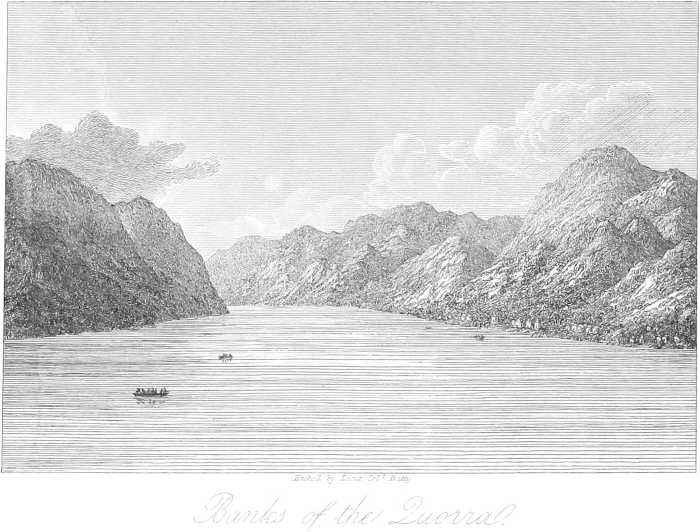
Monday, October 25th.—At one A.M., the direction of the river changed to south-south-west, running between immensely high hills. At five o’clock this morning, we found ourselves nearly opposite a very considerable river, entering the Niger from the eastward; it appeared to be three or four miles wide at its mouth, and on the bank we saw a large town, one part of which faced the river, and the other the Quorra. We at first supposed it to be an arm of that river, and running from us; and therefore directed our course for it. We proceeded up it a short distance, but finding the current against us, and that it increased as we got within its entrance, and our people being tired, we were compelled to give up the attempt, and were easily swept back into the Niger. Consequently we passed on, but determined on making inquiries concerning it the first convenient opportunity. But we conclude this to be the Tshadda, and the large town we have alluded to, to be Cuttumcurrafee, the same which had been mentioned to us by the old Mallam. At all events, we had satisfied ourselves it was not a branch of the Niger. The banks on both sides, as far as we could see up it, were very high, and appeared verdant and fertile.
The morning was dull and cloudy; yet, as soon as the sun had partially dispersed the mists which hung over the valleys and upon the little hills, we could distinguish irregular mountains jutting up almost close to the water’s edge, whose height we were prevented even from guessing at; because their summits were involved in clouds, or inwrapped in vapours, which yet lingered about their sides. A double range of elevated hills appeared beyond them on the south-east side; and on the north-west side a chain of lesser hills extended as far as the eye could discern. They appeared very sterile. Those on the north-west were formed of clumps, very much resembling the shape of those we had seen in Yarriba, which are here called the Kong mountains.
At seven o’clock the Niger seemed free of islands and clear of morasses on both sides, and its banks were well wooded, and much higher than we had observed them for a long time previously; nevertheless, it ran over a rocky bottom, which caused its surface to ripple exceedingly. Just about the same hour, one of the canoes, which we were told of as of different make to our own, passed us. In shape, it much resembled a common butcher’s tray, and it was furnished with seats like those used on various parts of the sea-coast. It was paddled by eight or ten little boys, who sung as they worked; and they were superintended by an elderly person who sat in the middle of the canoe. The motion of their paddles was regulated by a peculiar hissing noise which they made at intervals with their mouth; and it was pleasing to observe the celerity with which this little vessel was impelled against the stream. In the early part of the morning after daylight, we passed a great many villages. The banks of the river were ornamented with palm trees, and much cultivated ground, which extended to the foot of the mountains, and among the avenues formed between them.
At 10 A.M., we passed a huge and naked white rock, in the form of a perfect dome, arising from the centre of the river. It was about twenty feet high, and covered with an immense quantity of white birds, in consequence of which we named it the Bird Rock: it is about three or four miles distant from Bocquâ, on the same side of the river. It is safest to pass it on the south-east side, on which side is also the proper channel of the river, about three miles in width. We passed it on the western side, and were very nearly lost in a whirlpool. It was with the utmost difficulty we preserved the canoe from being carried away, and dashed against the rocks. Fortunately, I saw the danger at first, and finding we could not get clear of it, my brother and I took a paddle, and animating our men, we exerted all our strength, and succeeded in preventing her from turning round. The distance of this rock from the nearest bank is about a quarter of a mile, and the current was running with the velocity of six miles an hour, according to our estimation. Had our canoe become unmanageable, we should inevitably have perished. Shortly after, seeing a convenient place for landing, the men being languid and weary with hunger and exertion, we halted on the right bank of the river, which we imagined was most convenient for our purpose. The course of the river this morning was south-south-west, and its width varied as usual from two to five or six miles. The angry and scowling appearance of the firmament forewarned us of a heavy shower, or something worse, which induced us hastily to erect an awning of mats under a palm-tree’s shade. As soon as we had leisure to look around us, though no habitation could anywhere be seen, yet it was evident the spot had been visited, and that very recently, by numbers of people. We discovered the remains of several extinct fires, with broken calabashes and pieces of earthen vessels, which were scattered around; and our men likewise picked up a quantity of cocoa-nut shells, and three or four staves of a powder-barrel. These discoveries, trifling as they were, filled us with pleasant and hopeful sensations; and we felt assured, from the circumstance of a barrel of powder having found its way hither, that the natives in the neighbourhood maintained some kind of intercourse with Europeans from the sea.
The spot, for a hundred yards, was cleared of grass, underwood, and vegetation of all kinds; and, on a further observation, we came to the conclusion that a market or fair was periodically held thereon. Very shortly afterwards, as three of our men were straggling about in the bush, searching for firewood, a village suddenly opened before them: this did not excite their astonishment, and they entered one of the huts which was nearest them to procure a little fire. However it happened to contain only women; but these were terrified beyond measure at the sudden and abrupt entrance of strange-looking men, whose language they did not know, and whose business they could not understand, and they all ran out in a fright into the woods, to warn their male relatives of them, who were labouring at their usual occupation of husbandry. Meanwhile our men had very composedly taken some burning embers from the fire, and returned to us in a few minutes, with the brief allusion to the circumstance of having discovered a village. They told us also that they had seen cultivated land, and that these women had run away from them as soon as they saw them. This we thought lightly of; but rejoiced that they had seen the village, and immediately sent Pascoe, Abraham, and Jowdie, in company, to obtain some fire, and to purchase a few yams for us. In about ten minutes after, they returned in haste, telling us that they had been to the village, and had asked for some fire, but that the people did not understand them, and, instead of attending to their wishes, they looked terrified, and had suddenly disappeared. In consequence of their threatening attitudes, our people had left the village, and rejoined us with all the haste they could. We did not, however, think that they would attack us, and we proceeded to make our fires and then laid ourselves down.
Totally unconscious of danger, we were reclining on our mats,—for we, too, like our people, were wearied with toil, and overcome with drowsiness,—when in about twenty minutes after our men had returned, one of them shouted, with a loud voice, ‘War is coming! O war is coming!’ and ran towards us with a scream of terror, telling us that the natives were hastening to attack us. We started up at this unusual exclamation, and, looking about us, we beheld a large party of men, almost naked, running in a very irregular manner, and with uncouth gestures, towards our little encampment. They were all variously armed with muskets, bows and arrows, knives, cutlasses, barbs, long spears, and other instruments of destruction; and, as we gazed upon this band of wild men, with their ferocious looks and hostile appearance, which was not a little heightened on observing the weapons in their hands, we felt a very uneasy kind of sensation, and wished ourselves safe out of their hands. To persons peaceably inclined, like ourselves, and who had done them no harm, we could look on their preparations with calmness; but as it is impossible to foresee to what extremities such encounters might lead, we waited the result with the most painful anxiety.
Our party was much scattered, but fortunately we could see them coming to us at some distance, and we had time to collect our men. We resolved, however, to prevent bloodshed if possible,—our numbers were too few to leave us a chance of escaping by any other way. The natives were approaching us fast, and had by this time arrived almost close to our palm-tree. Not a moment was to be lost. We desired Pascoe and all our people to follow behind us at a short distance with the loaded muskets and pistols; and we enjoined them strictly not to fire, unless they first fired at us. One of the natives, who proved to be the chief, we perceived a little in advance of his companions; and, throwing down our pistols, which we had snatched up in the first moment of surprise, my brother and I walked very composedly, and unarmed, towards him. As we approached him, we made all the signs and motions we could with our arms, to deter him and his people from firing on us. His quiver was dangling at his side, his bow was bent, and an arrow, which was pointed at our breasts, already trembled on the string, when we were within a few yards of his person. This was a highly critical moment—the next might be our last. But the hand of Providence averted the blow; for just as the chief was about to pull the fatal cord, a man that was nearest him rushed forward, and stayed his arm. At that instant we stood before him, and immediately held forth our hands; all of them trembled like aspen leaves; the chief looked up full in our faces, kneeling on the ground—light seemed to flash from his dark, rolling eyes—his body was convulsed all over, as though he were enduring the utmost torture, and with a timorous, yet undefinable, expression of countenance, in which all the passions of our nature were strangely blended, he drooped his head, eagerly grasped our proffered hands, and burst into tears. This was a sign of friendship—harmony followed, and war and bloodshed were thought of no more. Peace and friendship now reigned among us; and the first thing that we did was to lift the old chief from the ground, and to convey him to our encampment. The behaviour of our men afforded us no little amusement, now that the danger was past. We had now had a fair trial of their courage, and should know who to trust on a future occasion. Pascoe was firm to his post, and stood still with his musket pointed at the chief’s breast during the whole time. He is a brave fellow, and said to us, as we passed him to our encampment with the old man, ‘If the black rascals had fired at either of you, I should have brought the old chief down like a guinea-fowl.’ It was impossible to avoid smiling at the fellow’s honesty, although we were on the best of terms with the old chief,—and we have little doubt that he would have been as good as his word. As for our two brave fellows, Sam and Antonio, they took to their heels, and scampered off as fast as they could directly they saw the natives approaching us over the long grass, nor did they make their appearance again until the chief and all his people were sitting round us; and even when they did return, they were so frightened, they could not speak for some time.
All the armed villagers had now gathered round their leader, and anxiously watched his looks and gestures. The result of the meeting delighted them—every eye sparkled with pleasure—they uttered a shout of joy—they thrust their bloodless arrows into their quivers—they ran about as though they were possessed of evil spirits—they twanged their bowstrings, fired off their muskets, shook their spears, clattered their quivers, danced, put their bodies into all manner of ridiculous positions, laughed, cried, and sung in rapid succession—they were like a troop of maniacs. Never was spectacle more wild and terrific. When this sally of passion to which they had worked themselves had subsided into calmer and more reasonable behaviour, we presented each of the war-men with a quantity of needles, as a further token of our friendly intentions. The chief sat himself down on the turf, with one of us on each side of him, while the men were leaning on their weapons on his right and left. At first no one could understand us; but an old man made his appearance shortly after, who understood the Hàussa language. Him the chief employed as an interpreter, and every one listened with anxiety to the following explanation which he gave us:—
‘A few minutes after you first landed, one of my people came to me and said, that a number of strange people had arrived at the market-place. I sent him back again to get as near to you as he could, to hear what you intended doing. He soon after returned to me, and said that you spoke in a language which he could not understand. Not doubting that it was your intention to attack my village at night, and carry off my people, I desired them to get ready to fight. We were all prepared and eager to kill you, and came down breathing vengeance and slaughter, supposing that you were my enemies, and had landed from the opposite side of the river. But when you came to meet us unarmed, and we saw your white faces, we were all so frightened that we could not pull our bows, nor move hand or foot; and when you drew near me, and extended your hands towards me, I felt my heart faint within me, and believed that you were “Children of Heaven,” and had dropped from the skies.’ Such was the effect we had produced on him; and under this impression he knew not what he did. ‘And now,’ said he, ‘white men, all I want is your forgiveness.’ ‘That you shall have most heartily,’ we said, as we shook hands with the old chief, and having taken care to assure him we had not come from so good a place as he had imagined, we congratulated ourselves, as well as him, that this affair had ended so happily. For our own parts, we had reason to feel the most unspeakable pleasure at its favourable termination; and we offered up internally to our merciful Creator, a prayer of thanksgiving and praise, for his providential interference in our behalf; for the Almighty has indeed, to use the words of the Psalmist of Israel, ‘delivered our soul from death, and our feet from falling; and preserved us from any terror by night, and from the arrow that flieth by day; from the pestilence that walketh in darkness; and from the sickness that destroyeth at noon-day.’ We were grateful to find that our blood had not been shed, and that we had been prevented from spilling the blood of others, which we imagined we should have been constrained to do from irremediable necessity. Our guns were all double-loaded with balls and slugs, our men were ready to present them, and a single arrow from a bow would have been the signal for immediate destruction. It was a narrow escape; and God grant we may never be so near a cruel death again. It was happy for us that our white faces and calm behaviour produced the effect it did on these people—in another minute our bodies would have been as full of arrows as a porcupine’s is full of quills.
The old chief returned to the village, followed by his people, whom he addressed by the way from an ant-hill, on which he mounted himself. He put himself into a great variety of attitudes, and delivered them a speech which lasted more than half an hour. Whether this was relating to ourselves or not we could not ascertain; but it seemed more than probable. They came back to us again in the afternoon, bringing with them a large quantity of yams and goora-nuts as a present, and invited us with urgent importunity to sleep in their huts for the night, promising to treat us as well as their circumstances would permit. We thanked them for their kindness, but for many reasons we did not embrace their offer. However, it seemed as though this refusal on our parts caused them to be mistrustful of our intentions; for the villagers were discharging their muskets from sunset till nearly eleven o’clock at night, when the chief paid us a third visit, and brought with him eight thousand cowries, and a large heap of yams, which he laid at our feet. Poor fellow! his countenance beamed with joy on discovering that we were really his friends. At length he was induced to place confidence in us; and, as he wished us good night, he seemed well pleased with the tranquil appearance of things, and went away.
In the course of our conversation with the chief, when all his villagers were assembled around us, we pointed to their guns, and the bits of red cloth they had with them, and made them understand that they all came from our country, at which their admiration and wonder was much increased. The old man who had performed the part of our interpreter so admirably, is an old Funda Mallam. He understood the Hàussa language perfectly, and told us he had come here from Funda to attend the market which was held here every nine days. He informed us that many people came from the sea-coast, with goods from the white men to purchase slaves, a great number of which he said came from his country. He told us that this place is the famous Bocquâ market-place, of which we had heard so great talk, and that the opposite bank of the river belonged to the Funda country. We now asked the old Mallam the distance from this place to the sea, and he told us about ten days’ journey. We then pointed out the hills on the opposite side of the river, and asked him where they led to? ‘The sea,’ was his answer. And ‘where do they lead to,’ we enquired, pointing to those on the same bank of the river as ourselves? He answered, they run a long way into a country we do not know. We then asked him, if he had ever heard of a country called Eyeo or Yarriba? To which he replied, he had never heard of any country of either of those names. Our next concern was about the safety of the river navigation; and we anxiously inquired his opinion of it lower down, and whether there were any rocks or dangerous places? As to the river navigation, he satisfied us by saying, he knew of no dangers, nor had he ever heard of any; but the people on the banks he said were very bad. We asked him if he thought the chief would send a messenger with us if we were to request him, even one day’s journey from this place? Without the least hesitation he answered us—‘No; the people of this country can go no further down the river; if they do, and are caught, they will lose their heads. Every town that I know of on the banks of the river is at war with its neighbour, and all the rest likewise.’ We asked him then, how far Bornou was from Funda? To which he replied, ‘Fifteen days’ journey.’ We were also anxious to know the character of the people on the borders of the Tshadda; and he informed us they were all good people, nearly all Mussulmen. There was one bad place to pass, he said, which was Yamyam. Here our conversation was interrupted by the old chief, who wished to return to the village, and the Mallam was obliged to accompany him. He was a fine respectable old man, and answered all our questions with a readiness which evinced the superiority of his class.
We offered up a prayer to the Almighty for his signal protection during this eventful day, and retired to rest.
Tuesday, October 26th.—When I awoke in the morning the first person I saw was our trusty old man, Pascoe, very busy roasting yams for our breakfast. This man has been a most valuable servant to us, and is the only staunch fellow among all our people. In spite of a good deal of rain that had fallen in the night, we got up much refreshed this morning; for our mat awning, although rather a frail covering, had excluded the rain and kept us tolerably dry. Early in the morning the chief of the village, the old man that acted as interpreter, and a number of men and women visited our encampment, and behaved themselves in the most becoming and friendly manner. Not satisfied with what they had given us yesterday, the villagers offered us another large heap of yams, which, however, we refused to accept without making a suitable recompense. We accordingly gave them some beads in exchange for them, although I believe they would have been contented had we possessed nothing to offer them in return.
We now learnt from the interpreter that buyers and sellers attend this market, not only from places adjacent, but also from remote towns and villages, both above and below, and on each bank of the Niger. A small tribute is exacted by the chief from every one that offers articles for sale at the market, and in this consists the whole of his revenues. All the villagers that came out against us yesterday are his slaves. We were likewise informed that directly opposite, on the eastern bank, is the common path to the city of Funda, which is indeed, as we had been told at Fofo, situated three days’ journey up the Tshadda from the Niger; that the large river which we observed yesterday falling into the Niger from the eastward, is the celebrated Shar, Shary, or Sharry, of travellers, or, which is more proper than either, the Tshadda, as it is universally called throughout the country. The interpreter said further that the smaller stream which we passed on the 19th, flowing from the same direction, is the ‘Coodoonia.’
The chief assured us that we had nothing to fear, having passed all those places from which we might have expected danger and molestation during the night. However he cautioned us to avoid, if possible, a very considerable town lying on the eastern bank, which we should pass in the afternoon, the governor of which, he affirmed, would detain us a considerable time in his territories, though he might treat us well. A little way below Bocquâ, he said, on the left border of the river, resides a powerful king, sovereign of a fine country, called Attà, who would force us to visit him, if by any means he were to be forewarned of our approach. He said, that he did not think he would do us any injury, but that the chief was a very extraordinary man, and if he had us in his power would detain us longer than we wished. Perhaps he might keep us in his town two or three months, but he would at least detain us till all his people had satisfied their curiosity, and then he might allow us to depart. As the chief of Bocquâ was decidedly of opinion that it would be in the power of this prince to render us the most essential service if he were our friend, we requested of him a guide and messenger to accompany us to Attà, and introduce us to the king; but he answered without hesitation, that a man from him would be captured and slain the moment he should make his appearance there, but for what reason we are left to conjecture. This did not argue, however, very favourably as to the clemency or merciful disposition of the monarch of Attà, and therefore we resolved to keep out of his reach by running along close to the shore on the opposite side of the water. The chief concluded by observing that in seven days we should reach the sea, a piece of intelligence with which we were not a little pleased. The old interpreter had told us that we should get there in ten days; therefore we cannot be far from it.
The females of Bocquâ are good-looking and very neat in their persons. The men have not the custom, as at Kacunda, of cutting marks on the face or on any part of the body. Having finished our usual scanty breakfast of a roasted yam and some water from the river, we commenced loading our canoe and preparing for our day’s journey. We had now passed the worst place on the river, which is between this and Kacunda, and there was no further necessity for travelling by night. This we by no means regret; for although we are exposed to the heat of the sun by day, yet there are dangers in the river in consequence of the water being so high, which are more easily avoided by day-light than in the dark. It is not easy to keep clear of eddies, and when influenced by them our canoe is swept out of the main stream of the river, and it is with difficulty we regain our course. The canoe being all ready, we shook hands cordially with our friend the chief, and the principal male and female villagers, and a few minutes after seven fired a salute of two or three muskets, gave three cheers, and departed from Bocquâ. We soon passed their little town, which had a neat appearance, and was fortified by a strong wooden fence.
Both banks of the river still continued hilly, and were fringed with primeval woods, which were bending over the water. At eleven, A.M., we were opposite a town, which, from the description that had been given of it, we supposed to be Attà. It is situated close to the water’s edge on the south-east bank of the river, in an elevated situation, and on a fine green sward: its appearance was unspeakably beautiful. The town is clean, of prodigious extent, and ornamented with verdant shrubs and tall goodly trees. A few canoes were lying at the foot of the town, but we escaped observation, and passed on near the opposite shore. Afterwards the margin of the river became more thickly wooded, and more umbrageous than before; and for upwards of thirty miles not a town or a village, or even a single hut, could anywhere be seen. The whole of this distance our canoe passed smoothly along the Niger, and everything was silent and solitary; no sound could be distinguished save our own voices and the plashing of the paddles with their echoes; the song of birds was not heard, nor could any animal whatever be seen; the banks seemed to be entirely deserted, and the magnificent Niger to be slumbering in its own grandeur.
From Bocquâ the river runs in a valley between mountains of a considerable height. Between Attà and Bocquâ market the course of the river is about south-west, with several turnings in it. The hills on the north-west side seemed to decrease in height about the middle of the day, and those on the eastern side are changing their course to the south-east, while the river still flows to the south-west. About two in the afternoon the nature of the banks was entirely changed; from being high they became low and swampy, particularly the left bank, and were covered with thick jungle, which mostly overhung the water. At half past two we passed two charming little islands, which appeared to be uninhabited, and at four we saw a branch of the river running off in a southerly direction, inclining a little to the east. It appeared to be a quarter of a mile wide. At about five in the evening, our people being tired, we descried a canoe, and pulled towards it; but those that were in it were frightened on seeing us, and jumped out and hid themselves in the forest. In two or three minutes we perceived on the left bank a few dilapidated huts, and we pulled the canoe ashore, intending to remain there for the night. A number of women first observed us; they were also alarmed, and hurried away to an adjacent village, where we saw them providing themselves with muskets and other uncivil weapons, and very formidable Amazons they appeared to be. However we did not seem to regard them, but jumped on shore with our mats and sat down on the ground very comfortably under the branches of a cocoa-nut tree, the first that we have seen since leaving Yarriba. We had not been long seated before a number of people made their appearance, running hastily towards us with swords and muskets in their hands. Seeing that we were sitting down quietly, without making any hostile display, they hesitated and stopped at a short distance from us, and wished to know what we wanted at their town. We had recourse to our usual method of expressing ourselves by signs, and the natives finding that we were really harmless beings, ventured to draw nearer, and very soon became reconciled to us. Shortly after they were joined by some more of their companions, and among them was a young man who imperfectly understood the Bonny language; so that Antonio, one of our men, who is son to ‘King Pepper,’ chief of that country, was enabled to enter into conversation with him, and presently made him comprehend everything relative to us, which he repeated to the villagers. We had been thus employed a short time, and had become great friends with these people, the women chatting with a familiarity we had not been accustomed to up the country, and began to find ourselves very comfortable, when the chief, a tall, Herculean, awkward figure, with a sullen and most forbidding countenance, made his appearance. He introduced himself without the smallest ceremony, and very briefly desired us to accompany him to his hut in the principal village, which is called Abbazacca. The road to this place is by a narrow foot-way, overhung by rank grass three times our own height. This formed a complete arch over our heads, and the path was exceedingly intricate. On arriving there, a clean shed was prepared for us, which, though small, was one of the largest in the village. Through the interpretation of Antonio we informed the chief who we were, and where we wished to go. He immediately said he would accompany us to a large town lower down the river, of which his brother was governor, and where we should meet with people from Bonny, Calebar, Brass, and Bini, which latter place we conclude is meant for Benin. The natives of all these places, he informed us, come up to his brother’s town for the purpose of buying slaves, and we shall then be at liberty to accompany whichever party we please. It was important to ascertain which was the largest branch, as soon as we found that these different rivers communicated with the Niger, and we asked him the question, through Antonio, which was considered the largest river. This he was unable to say, but we were told by Antonio afterwards, that he thought the Bonny was the largest. He informed us that if we intended going to the town of which his brother was governor to-morrow, that we must get up very early, otherwise we should not arrive there before sunset. After thanking the chief for his communications and attention to us, we took our leave of him for the night.
Before we had retired to rest, a few stale eggs which we could not eat, and a calabash of very inferior tuah, were sent us by the chief, with a hint that a present would be acceptable in the morning. This was very inhospitable treatment of us, and we could not help thinking the chief was a mean old fellow, for we saw plenty of poultry and goats in his yard, which he knew would be more acceptable to us than his stale eggs. At eight in the evening we lay down to sleep, but could find no rest, on account of an army of gigantic mosquitoes, which desperately attacked us from all quarters, and serenaded us till morning with their unwelcome song. The course of the river to-day has been nearly south-west, and its width varying from two to three miles.
Wednesday, October 27th.—At day-break we arose from our mats after no very comfortable night’s rest in consequence of the attacks of the musquitoes. We took a little refreshment, and commenced our preparations for starting. At six o’clock the chief, who as well as his villagers had long been on the alert, came to us for his present, and, as we suspected last evening, we found considerable difficulty in satisfying the surly old man. I accordingly gave him a pair of silver bracelets, a pair of scissors, five hundred needles, and a handsome country cloth, which the queen of Boossà had given us. The fellow was discontented with this, which was more than we had given away a long time. He began to grumble, and told us plainly, that he would not let us leave his village till something better was given to him. To enforce his threats, fourteen of his slaves stood around him armed with muskets, whose appearance alone, I suppose, he thought would be sufficient to intimidate us into compliance. We by no means wished to have any disturbance, and therefore endeavoured as much as we could to persuade him that we had nothing more to give him. I directed all our travelling things to be taken out of our boxes before him, and had them put back again and locked up. This would not satisfy him, and he desired them to be searched again, and that he himself might be allowed to examine them. Our patience was now quite exhausted: ‘Tell the chief,’ said I to Antonio, ‘the boxes shall be opened no more, and let him stop my people from loading the canoe if he dare.’ My brother and I had armed ourselves with the loaded pistols and swords, as well as all our people, and on telling the chief what we had done, we ordered them to proceed loading the canoe, which they obeyed directly. The chief stood amazed, and did not offer to interfere with us. This old rascal had muttered and grumbled at everything which was offered him; this was of no use and that of no value, and he would desire all that we had, such was his covetousness. After having gone the length he did, and having shown his insolent airs, without producing the expected impression, he feared that he should get nothing at all, and therefore accepted the present we had offered him at first. The country cloth alone, which had been given us by the queen of Boossà, was ten times more than he deserved.
At Abbazacca we saw an English iron bar, and feasted our eyes on the graceful cocoa-nut tree, which we had not seen so long. We were delighted also with the mellow whistling of grey parrots. Trifling as these circumstances may appear, yet they made our hearts beats with delight, and awakened in us a train of very pleasing associations. We indulged in a delusive, yet fanciful reverie, and we fondly hoped,—but what good would it be to tell of what we hoped so fondly?
It was the avowed intention of the chief to send a man with us as messenger to a large town, which he described to be a day’s journey from Abbazacca, and of which he said that his brother was governor; but imagining, no doubt, that he would not be paid to his satisfaction, and that, should he accompany us himself, the reward would be greater, he changed his mind, and resolved on the latter expedient. Therefore he got into one of his own canoes, and between seven and eight in the morning, our canoe having been loaded without any interference from the chief or his people, and without taking any further notice of him, we led the way from the village through a large and unwholesome swamp which is before it, and were soon followed by him. We succeeded in getting into the open river with incredible difficulty.
In consequence of the lightness of his canoe, and its superiority to our old one, which we had got at Zagōzhi, the chief passed us with the utmost facility, and touched at various towns and villages, to inform their inhabitants of the fact of our journeying down the river, and that Christians were coming from a country they had never heard of. We were solicited to stop at one or two of these, in order to please the curiosity of the people, hundreds of whom ran out into the water to obtain a better view of our persons, but we did not get out of our canoe. These brought us presents of eggs, which we accepted very gladly and passed on.
During the first part of the day the course of the river was about west-south-west, the breadth varying from two to four miles, according to our estimation. At noon we saw a small branch running off to the south-east. The chief of Abbazacca, who had kept company with us, seemed to get impatient as his canoe was so much swifter than our own, and coming close to it, told us to pull as strong as we could, or that we should not reach his brother’s town by day-light. However we did not pay much attention to his remarks, but quietly kept on our usual rate. The north-west side of the river was now low, and covered with thick jungle, and the bank in many places was overflown, so that the jungle appeared to be growing out of the water. The south-east bank was rather higher, and cultivated pieces of ground were seen now and then about three or four miles apart, with villages about them.
At two in the afternoon we came abreast of a village of pretty considerable extent, intending to pass it by on the other side. We had no sooner made our appearance than we were lustily hailed by a little squinting fellow, dressed in an English soldier’s jacket, who kept crying out as loud as his lungs would permit him, ‘Holloa, you Englishman! you come here.’ However we were not inclined to obey his summons, being rather anxious to get to the town mentioned to us by the chief of Abbazacca, and as the current swept us along past the village, we took no notice of the little man; and we had already sailed beyond the landing-place, when we were overtaken by about a dozen canoes, and the people in them stopping us, desired us to turn back, for that we had forgotten to pay our respects to the king. The name of this village, we now find, is Damuggoo. Ever willing to please and oblige all parties, as far as we are able, and being in no condition to force ourselves from the men that had interrupted us with so little ceremony, we pulled with all our strength against the current, and, after an hour’s exertion, landed amidst the cheers and huzzas of a multitude of people. The first person we observed at the landing-place was our little friend in the red jacket, whom we found out afterwards was a messenger from the chief of Bonny. His business here was to buy slaves for his master.
My brother and I were instantly conducted over a bog to a large fetish tree, at the root of which we were made to sit down, and were shaded by its branches from an intolerably hot sun. Here we waited till the arrival of the chief, who made his appearance in a few minutes, bringing with him a goat, with a quantity of yams and other provisions as a present. We arose to salute him, and he shook hands with us, welcoming us to his town with a reserved and sorrowful, yet friendly air. In his dress and person we saw nothing remarkable, save that his countenance displayed mildness and benevolence, mingled with a great deal of seriousness and native dignity. His stature is above the middle size, and he is rather advanced in years. He requested us to stop a few days at his town, which we promised him we would do, having told him that we were going to the sea. The chief of Bonny’s messenger, he said, was going there in a few days, and he would recommend us to remain with him till he went, that we might accompany him. We had no objection to this, and thought that the little squinting fellow, who was a very important personage in his own estimation, might be useful to us, and be some sort of protection to our party where he was known. He was at all events a man of some consequence even from his red jacket alone, which rendered him a conspicuous object among the dark natives by whom he was surrounded; so we congratulated ourselves with the thoughts of being quite safe.
The chief put a great many questions to us respecting ourselves and our country, the places we had come from, their distance up the river, and also concerning the river itself, and was astonished at our answers. He told us that he had never heard of any countries higher up the river than Funda and Tacwâ, by which latter we found he meant the Nouffie country. He said that he had never heard of Yarriba, Borgoo, or Yàoorie. A Mallam now joined our company, who appeared to be a respectable man. We found afterwards that he was one of Ederesa’s people, and had been sent for by the chief of Damuggoo for the purpose of writing charms to protect him from all evil which might threaten him and his village. This man seemed happy at seeing people who had come from his own country, which he told us he had heard nothing of during the last year. He was pleased in being able to talk with those who could give him information concerning it, and he offered us his services in all manner of ways, and told us he would do everything in his power to make us comfortable.
A messenger now arrived to inform us that our hut was ready. The chief, on our taking leave of him, told us we were only eight days’ journey from the sea, and that we should soon get there. We were then conducted through filthy streets of mud to a very diminutive hut, which we find excessively warm, owing to the small quantity of light and air, which are admitted into it only through a narrow aperture, opening into a gloomy and dismal passage. The appearance of the inside is better than that of the outside, being plastered rudely with clay, and surrounded with indifferently carved fetish figures, either painted or chalked a red colour.
The news of our arrival having spread through the village, the people flocked in hundreds to see us. They so completely blocked up every place through which we might receive air, that we were nearly suffocated; nor could we succeed in driving them away. We made our people arm themselves with swords and sticks to keep them off, but to no purpose; their curiosity overcame their fears, and they pressed on us as thickly as ever. This was no longer to be borne, and we were obliged to send to the chief, requesting his interference. His reply was, that if the people would not go away when they were desired, we were to fire at, and kill as many of them as we pleased. This we could not think of doing, and therefore desired he would command some of his own people to come and drive them away. They soon arrived, armed with large, heavy sticks, which they laid about the natives in so merciless a manner, that, to our great relief, our hut was soon cleared, and we again enjoyed the fresh air.
At six in the evening, the chief sent us some fofo, and a quantity of stewed goat, sufficient for thirty persons. We were not a little surprised by the addition of a small case-bottle of rum—a luxury which we have not had since we were at Kiama. It is long since we have tasted tea or coffee; but the rum was a treat that we did not expect, although it was the worst kind of trade rum I ever recollect to have tasted.
Here, to our infinite surprise, we saw, on landing, besides the little man dressed in a soldier’s jacket, several others partially clothed in European apparel, all of whom have picked up a smattering of the English language from Liverpool vessels which frequent the Bonny river for palm-oil. The messenger from the chief of that country, who has come hither to purchase slaves and ivory, asserts, that the ship Bamboo, and four other Liverpool vessels, are now at anchor in the river. Bonny is said to be four or five days’ journey from hence.
After making a hearty meal off the stewed goat and fofo, we laid ourselves down to rest, but the mosquitoes were so troublesome, that they prevented us from getting any till nearly morning. We have generally found that the mosquitoes are more troublesome and vigorous in their attacks a short time before rain than at any other. The course of the river has been much in the same direction as yesterday; the current very rapid.