Chapter VI · (continued 2)
Reading edition
4TH SEPTEMBER.—The surrounding grass, and also the reeds in the lake, had been very extensively burnt along our former tracks, and a green crop was springing to the great gratification and refreshment of our cattle. Formerly this splendid valley appeared to be uninhabited, but this day, proofs were not wanting that it was too charming a spot of earth to be left so. In proceeding over an open part of the plains bordering the river, we perceived a line of about twelve or fourteen natives before they had observed us. Through my glass, I saw they were painted red about the face, and that there were females amongst them. They halted on seeing us, but some soon began to run, while two very courageously and judiciously took up a position on each side of a reedy swamp, evidently with the intention of covering the retreat of the rest. The men who ran had taken on their backs the heavy loads of the gins, and it was rather curious to see long-bearded figures stooping under such loads. Such an instance of civility, I had never before witnessed in the Australian natives towards their females; for these men appeared to carry also some of the uncouth-shaped loads like mummies. The two acting as a rear guard behaved as if they thought we had not the faculty of sight as well as themselves, and evidently believed that by standing perfectly still, and stooping slowly to a level with the dry grass, when we passed nearest to them, they could deceive us into the idea that they were stumps of burnt trees. After we had passed, they were seen to enter the brigalow, and make ahead of us; by which movement I learnt that part of the tribe was still before us. Some time afterwards, we overtook that portion when crossing an open interval of the woods; they made for the scrub on seeing us. Meanwhile columns of smoke ascended in various directions before us, and two natives beyond the river, were seen to set up a great blaze there. To the westward of the beautifully broken rocky woody range beyond Lake Salvator, a dense smoke also arose, and continued until evening; thus adding much sublimity to the effect of a gorgeous sunset, which poured its beams through the smoke between the rocky pinnacles, as I sat drawing the scene at my camp by the lake, two miles northward of XLV. Thermometer, at sunrise, 26°; at noon, 67°; at 4 p.m., 65°; at 9, 39°;—with wet bulb, 32°.
5TH SEPTEMBER.—The cooler air reminded us that we had returned to a more elevated region than that on the Belyando. This morning heavy clouds of cumulostratus promised more rain, and gave a cool day for the last effort of the jaded animals, which the driver doubted could not be driven much farther. I cut off all the roundabouts and steep pulls, where this could be done, by laying logs across such gullies as we were obliged to cross. We thus saw more of the river and its romantic scenery, which well deserved the name of a painter. No natives, nor columns of smoke, were seen this day; and I concluded that they concentrated the tribe yesterday, and had departed this morning. We finally took up a very snug position near the pyramids, in the very gorge of the mountain valley by which we had approached this country; camp XLVI. being within sight, and the swamp with the spring, at the foot of this hill on which we now encamped, as a camp of occupation during my intended absence, on an excursion with horses only, to the north-west. The genial influence of spring had already induced many plants to show their colours, which had formerly been passed by us unnoticed. In the sandy soil, grew the purple-flowered CHLOANTHES STOECHADIS; THE ACACIA CUNNINGHAMII; the pink-flowered CRYPTANDRA PROPINQUA; and a species of CALYTRIX; these two forming small shrubs, the latter from four to six feet high. A very handsome new BORONIA, with large white and red downy flowers, here first appeared in the open forest.[*] The rocks were partly covered with a small white-flowered shrub, which proved to be a new species of LEPTOSPERMUM allied to L. PUBESCENS, but perfectly distinct.[**] At the foot of them, was found the AOTUS MOLLIS, a little hoary bush, with yellow black flowers; a santalaceous plant like CHORETRUM, forming a tree fifteen or twenty feet high: the CALLITRIS GLAUCA or CUPRESSUS GLAUCA of ALL. CUNN. (in Hook. Herb.). A small tree, about twenty-five feet high, proved to be a new species of Acacia, or possibly a variety of A. CUNNINGHAMII, but handsomer, with larger phyllodia, longer spikes of flowers, and everywhere clothed with a soft velvety pubescence.[***] Thermometer, at sunrise, 33°; at noon, 68°; at 4 p.m., 64°; at 9, 40°;—with wet bulb, 31°.
[* B. ERIANTHA (Lindl. MS.); foliis pinnatis cum impari 1-3-jugis, foliolis glaberrimis linearibus retusis emarginatisque laevibus, pedunculis solitariis unifloris axillaribus foliis brevioribus, sepalis triangularibus glabris, petalis tomentosis, staminibus 8.]
[** L. SERICATUM (Lindl. MS.); foliis obovatis linearibus planis obtusis aveniis impunctatis utrinque sericeis, calycibus tomentosis dentibus acutis persistentibus.]
[*** A. LONGISPICATA (Benth. MS.) pube brevi mollissima vestita, ramulis elevato-angulatis, phyllodiis amplis falcatis utrinque angustatis subcoriaceis tenuiter striato-multinervibus nervis 3-5 validioribus, spicis elongato-cylindricis densis, calyce dentato corolla 2-3-plo breviore, ovario villoso.]
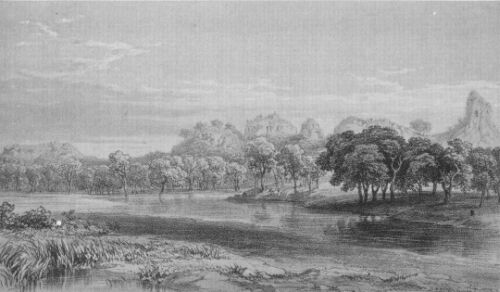
The River Salvator, 5th Sept.