E. S. INGALLS. (continued 2)
Reading edition
25 miles.
4th. Not having overtaken Reed's train, to celebrate with them, we concluded to travel to-day. The Fort Hall road here bears to the right, which is also the Oregon route; the Soda Springs cut-off route keeps directly across the old crater. We concluded to go the latter route. About 10 miles travel took us over the crater, and six miles more over the hills to a branch of the Lewis or Snake River, a branch of the Columbia River, where we found another Indian village, with some Mexicans, and about three hundred of the most beautiful Rocky Mountain horses. We passed the village and stopped to bait on the side of the hill, where we found good spring of water. We here had a pail full of punch made, cooled with a lump of snow from a deep snow bank a few rods from our camp, to celebrate our National Anniversary. Having drank our punch, and given three cheers for our glorious Union, we resumed our march. Soon after starting we came to where we had to descend a very bad hill, where we found one company with their wagon broken down, who were about to take to packing. Soon afterwards we came to another considerable stream which we traveled down a few miles and camped. We found plenty of grass on the stream and caught some fine trout.
25 miles.
5th. Passed several streams to-day, and some good springs. Roads good but somewhat hilly; plenty of grass; passed a brook about night, camped on a hill side by a spring of water. This is the most beautiful country that I ever traveled in; stupendous mountains, the bald peaks covered with snow, rearing their lofty heads far into the skies. The lesser hills green to their tops, and the valleys rich with vegetation, wild wheat, clover and oats, whilst the clear, pure, invigorating atmosphere renders it the paradise of the mountaineer in summer. It is well worth a trip to California for the slothful, ease-loving denizen of lower countries, to see the country, and recover their manhood.
23 miles.
6th. Drove about 11 miles and stopped to bait at a pretty little brook. We should have taken in water at this place, as we had to drive 18 miles to get water again. After baiting we entered a canon which we followed about eight miles to the top of a mountain. It furnished us with an excellent road, although so narrow that but one wagon could pass for most of the way, the walls rising on either side hundreds of feet. The ascent is gradual, so much so that the traveler hardly perceives any. We called this the Emigrant's Pass. It seems as if nature constructed this inclined plain expressly for the benefit of us poor mortals, but if dame Nature was moved by any such kindly feelings towards us when she was engaged on this excellent natural road, she must have got sadly miffed when she got it completed to the top of the mountain, for we had one of the most tremendous descents to make on the other side, that we have had on the journey. The descent was probably one thousand feet within the first mile, steeper than the roof of a house. It is said of an ancient Spartan, that he commenced by lifting a kid, and by continuing to add weight, soon got so that he could lift an ox. This is somewhat the case with us; when we commenced the journey, trifling hills were considered great obstacles, but now we lock our hind wheels and slide down a thousand feet, over rocks, and through gullies, with as much sang froid as a school boy would slide down a snow bank. After descending, we traveled down a valley a few miles and turned up to the foot of the mountains, and just after dark found water.
29 miles.
7th. Sunday. We concluded to lie over to-day, although we have not so good a camping ground as we could desire. One of our company, Loyd, of Mineral Point, Wis., had a horse stolen, or strayed last night. Another company, camped about eight miles from us, had three stolen by the Indians.
8th. Got an early start this morning. Passed another spring eight miles from where we camped last night. Met six men going back after the three horses that were stolen. They had recovered one, which the Indians had sold to an ox train. Passed some men digging a grave, to deposit the last remains of one who had traveled a long road to obtain a narrow home.
This afternoon, we entered another canon, similar to the Emigrant's Pass, only that instead of having a steep hill to descend, it reached quite through the mountain. The distance through, is about fifteen miles, and has several fine springs of water in it. Saw some goodly sized trees, either spruce or fir; camped at night in the canon on a spring branch which makes out on the west side of the mountain. Found good grass all day; passed over a valley covered with wild wheat, as high as my shoulders. It was headed out, and looked like a cultivated wheat field.
25 miles.
9th. Traveled down the Spring branch about six miles, when we crossed it, and traveled fourteen miles over a barren, burning sage plain, without water—to Raft river, which is the nastiest stream that we have had to cross, since leaving the Missouri. Deep, narrow and muddy, we had to pack all of our load across it, on our backs. One wagon that crossed whilst we were there, tipped end-wise over the forward wheels, as it entered the stream, throwing the two men who were in it, into the water, frightening them awfully. They caught hold of their mules' tails, and were drawn out; the king bolt of the wagon preventing its coming down upon them. We had four more, smaller streams to cross, within two miles of the Raft river, equally muddy; at one of which, we broke our hindmost evener, leaving our wagon in the water, and getting our load wet. After getting out of the scrape, we drove four miles, and crossing another branch of the Raft river, camped for the night, at the junction of the Cut-Off and Ft. Hall roads.
We are now at the end of the Soda Springs cut-off. I like this route much, with the exception of descending two bad hills; it is a good route, along which may be found abundance of grass and water, the two great desideratums on this long journey. It is somewhat infested with Indians, excepting the first 45 miles; they are the Shemook or Root Digger Indians, a thievish, rascally race. It is well for the emigrant to keep good guard over his stock on this cut-off, for they are always on the watch for an opportunity to steal. We have good grass and water to-night, and an abundance of it.
25 miles.
10th. Left our camping ground early and travelled up the creek about five miles, then crossed and passed over another dividing ridge to another small creek—came in sight of the Great Salt Lake road. Had plenty of grass and water—camped at night on a small brook in a basin in the mountains, surrounded by high granite peaks standing about in the greatest confusion, called the Steeple Rocks. They are quite a curiosity at a distance, looking like steeples rising up from the plains, some of them many hundred feet high, and covering more than an acre or two at the base.—The road has been good.
25 miles.
11th. Got an early start this morning. We had a very cold night, quite cold enough for December, but have had a very warm day.—Passed the Junction of the Salt Lake and Ft. Hall roads this morning;—saw some wagons coming that road, the men said they had been seven days coming from Salt Lake; that it was about 170 miles, and that they had some bad streams to cross, one of them (the Webber) 19 times.—Passed a new grave at noon. We saw the team to which the person belonged who died, go along while we were baiting; he was then alive;—when we came up two hours afterwards, he was buried. He was from Missouri, and had been left sick on the road by his comrades. The team that had him in charge had picked him up and brought him along over 1000 miles and attended him until he died. Humanity sickens at such selfishness as that manifested by his comrades. They were three in number—he owned one fourth of the craft in common with them, but becoming sick, the brutes left him to the mercy of Indians, wolves, or such strangers as chance might throw in his way. The scoundrels should serve 10 years in the penitentiary if they ever get back to Missouri. We find many sick on the road now, and some deaths, but three-fourths of all that are sick are from Missouri. I do not know why it is, but such appears to be the fact.
This afternoon we had a long bad hill to descend, when we reached Goose Creek, and traveled up a few miles and camped for the night.—We have had an abundance of grass and water to-day. A singular looking gigantic bluff of rocks lies directly opposite from us, which we call the castle, and it looks like an ancient castle, with its mossy battlements and sturdy towers. I saw some of the most beautiful specimens of white marble to-day that it hast been my fortune to examine. There was a quarry of it filling a mountain. It was as pure as alabaster, and probably has not a rival in the world. Horse shoe nails sold to-day for 25 cents a piece.
25 miles.
12th. Followed up the Goose creek 13 miles, then up a spring branch thro' a gorge in the mountains and across some barren ridges without water, about 12 miles, when we entered the Thousand Spring Valley. The ridge that we crossed is composed almost entirely of lava, or melted stone, and is very rough and sharp to travel over. We did not camp until after dark, there being no grass at the first springs, and then we camped in the wild sage without grass, but we could go no farther that night. Fourteen horses ran away whilst we were getting our supplies. Some of them were found during the night, and the rest in the morning; they had found good grass up in the hills. Most of our men were out all night, so that this night seems but a continuation for the morrow.
30 miles.
13th. Crossed the ridge from the Thousand Spring Valley to the Cold Creek Valley about 12 miles, no grass or water. Cold Creek is a dry creek where we struck it, but furnishes some water for stock. Our course lay up the creek, which we followed up to near its head, where we camped at some good springs impregnated with sulphur. We found plenty of grass at night, and have seen considerable quantities of alkali through the day. We passed the grave of a man drowned July 1st., [1850] but cannot imagine where it happened, as there is not water enough in the creek to drown a man, if he should lie down expressly for that purpose. The dust has been very oppressive to-day.
23 miles.
14th. Sunday. Laid over to-day. Weather very warm, but cold last night. Jonathan killed a sage hen to-day; we found it good, delicate flavored meat, much better than prairie hen. A packer had a horse shot last night with an arrow about 10 miles below us; another man lost two horses and four oxen which were stolen by the Indians.
15th. Got an early start this morning, traveled about four miles and came to the hot springs. They are curiosities worth visiting. They boil up like water in a kettle, and are hot enough to cook eggs. I attempted to put my hand into one of them to the wrist, but could not get it in to the knuckles without scalding. An amusing story is told of some Dutchmen who came to it, and stopped their teams by its side, when one of them went to the spring, and seeing it boiling up clear and limpid, threw himself down on the ground and thrust his face into the water, but instantly sprang to his feet with his eyes staring, and brushing the hot water from his face with both hands, he screamed out, "Trive on, Honce, trive on; hell ish no more dan five milsh from here!" The springs smell strong of sulphur, and discharge a large quantity of water. Near them are some good cold springs. Four miles from these springs we left the Mormon trace which leads over to Kanyon Creek, and passed through a valley to a branch of the Humboldt River. Road good but dusty, not much grass. At the point where we left the Mormon trace, we found an excellent spring of pure cold water, as cold as ice water. We passed a natural well near the place where we struck a branch of the Humboldt, and camped two miles below at some sulphur springs, strongly impregnated with alkali. This well has no soundings that have ever been reached, there are also some of the same in Thousand Spring Valley. The whole country hereabouts has been at some day past a great volcanic crater, and its distinctive features at this day will remind one of that place spoken of above by the honest Dutchman, rather than pertaining to earth. We have passed springs gushing out of the rocks to-day so poisonous that a wine glass full would kill a man as soon as so much arsenic. They can be told by the smell for 40 rods before reaching them. We found good grass to-night, although there was considerable alkali mixed with it.
33 miles.
16. About 10 miles drive brought us to the Humboldt, which is about 20 yards wide and three feet deep. We crossed it and followed down it on its west bank. The valley here is wide and filled with abundance of excellent grass, clover, wild oats, wheat and red top. The day has been very hot and dusty, yet on both sides of us, but a few miles distant, the tops of the mountains are covered with snow. We passed two new graves to-day; one of them was of a man who was shot by an Indian whilst on guard on the night of the 2d of July, and died on the fifth. His name was Oliver; he was from Waukesha, Wis. The Indians are rather troublesome of late, as the Diggers always are when they dare to be. We find a great many dead horses now, and some that are left alive, the effects of hard driving and alkali. The most of the dead stock heretofore has been oxen, but it seems now that oxen stand this part of the trip the best.
25 miles.
17th. Course still down the river—crossed a considerable branch of the Humboldt, probably the Kanyon creek. The Humboldt here is very swampy. Had some of our horses mired—general complaint of like nature. The road last year followed down the bottoms, but this year the water is so high, that the bottoms are one complete swamp, and as a consequence we have to keep on the sage plains and cross ridges, making the road longer and worse to travel, and also to wade in the mud and cut grass for our stock. Passed another grave this evening of a man killed by an Indian; also some men digging a grave for one of their comrades who had died. There is an abundance of red clover along this drive in the low grounds.
32 miles.
18th. Continued down the river—stopped and set the tire for our wagon. This afternoon we entered a canon leading across a spur of the mountain, distance about 12 miles, and without water. Camped on a small creek, with but little grass. A horse was shot a short distance from us by the Indians.
23 miles.
19th. About five miles from our last night's camp we crossed a mountain brook of excellent water, then entered a canon which we followed for 26 miles, the first 14 without water. After turning the summit, and descending about two miles we came to a spring of pure cold water by the road side. We camped this night on the Humboldt and swam our stock across the river. Our camp presents the appearance of a populous village. There are probably not far from five hundred men in it, besides many women and children. Found good grass on the opposite side of the river.
33 miles.
20th. Our road to-day led mostly away from the river, crossing some ridges in the forenoon; in the afternoon left the river and crossed a level sage plain to the base of the mountains, where we found some poor water and some grass. We followed along at the base of the hills until we reached within a few miles of the river again and camped on a bottom covered with heavy grass, and slough water. This is the best point to stop at to recruit on the Humboldt, as there are miles of good grass equal to the less cultivated meadows, and but little alkali, and by taking some pains, water may be had. It will be known by the emigrant by this description: The road leaves the river and runs directly to the hills, the river bearing to the left. The hills which you approach also bear to the left, until they approach the river, which takes a short turn around its base. The road when it reaches the hills turns to the left and follows the base of them until it strikes the river, then passes around the rocky rugged point of the mountain next to the river. After you pass this point you come into extensive salt and alkali plains. You will find good looking grass in some places, but it is so much impregnated with salt and alkali that your stock will run down on it all the time. The best place to stop here is a few miles before you reach the point of the mountain. Turn off to the left towards the river.
The day has been hot and the dust oppressive. No person in the States can have an idea of the dust in this country until he has been here. A man will settle to the ankles at every step, and his eyes and nostrils are filled with it throughout the day; and when the wind blows it is suffocating. The country is volcanic, the mountains being composed entirely of lava and cinders. We found a new variety of currants here, yellow variety, which are very good. Fuller picked a large quantity of them to-day.
30 miles.
21st. Sunday. We drove about eight miles to-day, passing the point of the mountain and camped near the river in a clover patch. There are a number of warm springs near the road by the point of the mountain.
8 miles.
22d. Left the river this morning and traveled down the second bank of the river, a nearly level plain covered with alkali and wild sage, but no grass. We went to the river once, although out of the way. The right hand road is 18 miles without grass or water, very dusty and disagreeable. Water very bad, even that in the river; camped on the river bank, no grass on our side. The boys swam the river about fifteen rods wide here, and rigged a sort of ferry with our piquet ropes, and ferried grass across on them for the night, no small job for 17 horses.
23 miles.
23d. Started this morning at four o'clock, A.M. From camp it is 14 miles to water or grass. Two miles from camp the roads branched in every direction, and the course of the river is hidden entirely by the mountain which seems to circle the whole country like the rim of a great basin, with the exception of a gap far to the right. The plain spreads out to the mountains level and desolate, a desert. This labyrinth of roads gave rise to one of the most ludicrous scenes that I ever saw. For myself, I had been lost from my wagons since daylight, without being aware of the fact, and like the rest had taken a wrong road. About noon I found some good clover and stopped to bait my horse. When I started again, on rising a gentle aclivity I found the plain alive with teams and men, who looked as though they had been struck with the confusion of Babylon. Some were driving in one direction, some in another, oxen, horses, mules, wagons, horse packers and foot packers, were hurrying across the plains, without seeming object, in every direction as far as the eye could reach, and in the most delightful confusion imaginable. Two hundred wagons and numbers of packers had lost their way, and knew not which way to turn, and as usual in such cases were going every wrong way. I rode up to a man and asked him what the deuce was to pay; if all the people were mad? He was as much in the fog as I was. Presently some packers came along who said they had been to the end of the road, and that they were lost. This explained the confusion, although not very satisfactory of itself, for we began to fear that we had inadvertantly been following some old cut-off which would take time to retrace. By good fortune I succeeded in finding one wagon belonging to our train, where I got some dinner. Our train had become broken up as well as the rest in the confusion, each one going on his own hook. After dinner I struck out in the direction where I thought to find the river, and found I was right, and about night was so fortunate as to find the ballance of the train, who had succeeded in reaching the river ahead of me. Emigrants, that is the Fools Meadow. When you get down below the point of the mountain which I spoke of before this, and come to a great basin, surrounded on all sides, but a gap far to the right, don't you pay any attention to that gap, nor come to the conclusion that the river takes a turn and runs through it, for it don't do it, but you keep the extreme left hand road, and you will find that the river runs right through the mountains as high as they look. The right hand roads are all camping roads, and extend some of them 12 miles to some clover patches, and the old Lawson cut-off leads through that gap on the right, where an Oregon party went two or three years ago and nearly all perished. Many stopped and made hay at these clover patches, thinking they were at the desert, but don't trouble yourself here, for you have got a long dreary march of a week's duration before you get to the Great Desert. We traveled hard all day to get 14 miles on our journey, but I think the emigrant who reads this will remember the Fools Meadow, and avoid the same mistake. The emigrants now begin to experience a want of provisions. Flour, pork and sugar are one dollar per lb.; coffee 50 cts., fresh beef 25, and not much to be got at those prices.
14 miles.
24th. About four miles from last night's camp ground we came to a watering place near where the river passes through the mountains. The road leaves the river here and crosses the mountains eight miles, rough road and dusty, no water. Swam the river for grass to bait our horses at noon. Passed the grave of a man who was drowned whilst getting grass across the river. Camped at night on the river; had to wade three sloughs to find grass.
20 miles.
25th. A few miles from where we camped had a bad deep creek to cross, where we found plenty of dead stock. Immediately after crossing passed over a rough stony ridge for about two miles, between two cone shaped hills or mammelles. This point is about 110 miles from the meadows at the sink of the Humboldt, and there is but little grass on the route. Litwiler cut his wagon in two and made a cart of it, we then drove about eight miles and camped. Roads sandy, weather hot. This river beginning to lose itself and grow smaller. I killed three sage hens this morning, which were very desirable as we are getting short of provisions.
18 miles.
26th. Traveled over 18 miles of very bad road to-day. It was over a table of the mountain. The sand was six inches deep, for most of the way, and the day hot; our stock suffered severely. Passed much dead stock and piles of wagon irons. Killed two sage hens—mosquitoes quite troublesome; camped on the river bottom which is narrow; but little grass.
18 miles.
27th. Started at four o'clock, A.M., traveled down the river two miles, then left the river, struck across a desert plain 12 miles to the river; many think this the Great Desert; it is desert enough, but not the Great Desert. This point will be known by a high mountain dividing two valleys. The river runs to the right of this mountain. At noon we had to feed our horses on willows, there being no grass. We got some rushes by swimming the river. We have now got far enough along to begin to have a sight of the Elephant. The river here runs through narrow clay banks like a canal. Passed the grave of a man found in the river; camped at night on a sand bank, put our horses across the river; grass poor.
17 miles.
28th. Sunday. Crossed a sand ridge about two miles, and travelled down the bottom about four miles, where we found some grass and camped. Our horses are failing fast. Kit Carson says truly that the Humboldt is the burying ground for horses and oxen. We pass daily great numbers of dead stock at the camping grounds, in the sloughs, and in the river. The river is nothing but horse broth, seasoned with alkali & salt. The appearance of emigrants has sadly changed since we started. Then they were full of life and animation, and the road was enlivened with the song of "I am going to California with my tin pan on my knee." "Oh, California, that's the land for me," but now they crawl along hungry, and spiritless, and if a song is raised at all, it is, "Oh carry me back to Old Virginia, to Old Virginia's shore." Well, they say misery loves company, so we can have some enjoyment after all, for there is plenty of that kind of company. No one seems to know where we are, even those who traveled the route last year, several of whom are along. Last year the road led immediately on the bottom, but this year it is on the sage plains or second level of the river, the bottoms being so swampy that they cannot be crossed. The Mormon guide for this end of the route, is good for nothing. Yesterday was the worst day for dust that we have had. Every body was literally covered with it so that the drivers could not be recognised.
6 miles.
29th. Litwiler and Ranahan killed three antelope yesterday. They packed in two of them about eight miles from the mountains. They arrived in camp about 11 o'clock at night. Passed the clay banks, some perpendicular banks on the opposite side of the river about 50 feet high. From this place is a desert, the river running through narrow clay banks, void of vegetation except the Artemesia or wild sage. The road generally follows the plains back from the river, only approaching occasionally for water. We camped about three P.M., and managed to get a little grass for our horses.
15 miles.
30th. Started at four A.M.; route similar that of yesterday. We are now in sight of the Pyramid, a lone peak nearly opposite the upper slough of the sink commonly called the meadow. Road touched the river once or twice to-day for water, but no grass, nothing for feed but willows.
16 miles.
31st. Started at one o'clock, A.M., struck the river again 10 miles from camp; no grass, only an arid sage desert. From this it is 25 miles to the slough or meadows, and 13 to water, which will be found at some springs in the gully directly opposite the pyramid. We reached the springs about 10 o'clock, A.M., although one of our horses gave out, which delayed us somewhat, and reached the upper end of the slough about noon, where we obtained some rushes and flags for our horses which they devoured greedily after their long fast on willows. The pyramid at a distance resembles an ancient Mexican pyramid, rising by steps. It may be seen for 40 miles up the river, and serves as a beacon, for the slough or meadows. After baiting we continued down the slough about six miles to some passable springs, and to where there is better grass. We found two cities of tents at the slough quite populous. They would do honor to more civilized countries. The road for a few days past has been strewed with dead stock. I counted to-day 120 head of horses, mules and oxen, and got tired of it before night at that. I suppose I passed 50 head more that I did not count. If there is any worse desert ahead than we have found for 70 miles back, I don't know what it may be. I have noticed several dead horses, mules and oxen, by the roadside, that had their hams cut out to eat by the starving wretches along the road; for my own part I will eat the lizzards which infest the sage bushes, before I will eat the stock that died from the alkali. The destitution has reached its height now. Hundreds are entirely out of provisions, and there are none who have any to spare, and but very few who have enough to carry them into the mines. Often, almost daily, will some poor starved fellow come up to the wagon and pray us in God's name to give or sell him a crust of bread; some of them asserting that they have eaten no food for two, or even three days. Money is no consideration for food here; no one will sell it for money, but we always give enough to prevent starvation, when thus importuned, although we have not over five days' provision on hand, putting our trust in Providence for the issue to ourselves—for so long as there is game in the mountains we will never starve.
To-day is the first, since the third day of June, that we have been out of sight of snow for a whole day; it has been excessively hot, the dust rising in clouds; roads bad, owing to the deep sand.
32 miles.
August 1st. Remained camped to-day, preparing hay for crossing the Desert, which commences 20 miles from the slough or meadow. There is an abundance of grass at this point for all the stock that can ever reach here. We have to wade to get it, then cart it to the channel, and boat it across that in a wagon box. A man with his wife came into the camp last night on foot, packing what little property they had left on a single ox, the sole remaining animal of their team; but I was informed of a worse case than this by some packers, who said they passed a man and his wife about 11 miles back who were on foot, toiling through the hot sand, the man carrying the blankets and other necessaries, and his wife carrying their only child in her arms, having lost all their team.
2d. We still remain at the meadows. A team came in yesterday evening from Sacramento, loaded with provisions. They ask for rice $2.50 per lb.; for flour $2.00; bacon $2.00; whiskey $2.00 per pint, and brandy $3.00 per pint. We killed a cow this evening which we had picked up a few days ago at a camping ground, where she had been left on account of lameness. She was not exactly beef, but she was better eating than dead mules and horses by the road side; we divided her up in the train and among the starving people who are about us, only saving a small amount for ourselves, which we jerked and dried.
3d. We are still lying by. About two miles below our camp are some falls in the river, at which point the meadows terminate. There is no more grass from here until we reach Carson River, about 66 miles.—Some of the teams that left us above Fort Kearney came in to-day, entirely destitute of provisions, and had been so for some days, although they had contrived to starve along somehow. We heard of them before they got here, and saved a little beef for them.
4th. Sunday. Broke up camp and started again. We had stopped three days to recruit our horses before taking the desert, and although we have taken the utmost pains with them, they are weaker now than when we stopped. My advice to all is not to make any stop at this point, but push on to Carson River, for there is so much alkali in the water and grass here that your stock will not recruit. There is no water for the next 20 miles fit for stock to drink. We lost one horse to-day from watering beside the road, four miles before we got to the sink. He died in thirty minutes after drinking, in the greatest agony. Two others were much injured, so much so, that we could only get them to the sink with the greatest difficulty. Trimble and Sublet also lost one. Beware of shallow water along here.
20 miles.
5th. Reached the Sink last night about sunset. This is a basin about 80 rods wide and half a mile long. It is usually the last water found on the Humboldt, or where it loses itself in the sand, hence its name, but this year the water is so high that it runs down several miles further before it entirely sinks. There is no grass here whatever, nothing but desert. We broke up our wagon to-day and made pack saddles, being convinced of the impossibility of getting our wagon across the desert, since the loss of the horse yesterday and the injury to the others. Last night while we were making our supper on coffee and boiled corn, soon after dark, a man came to us and asked for a drink of water. I gave it to him; after drinking he stood looking wistfully at our corn, then asked me if I would take half a dollar for a pint cup full of it. I told him I would not take half a dollar for it, for money was no consideration for food here. He said no more, but turned sorrowfully away, when I stopped him and asked him if he was in distress. He said that he had eaten nothing for two days but a small piece of dried meat which a man gave him. I then told him that I would not take a half dollar for the corn, but that he was welcome to sit down and eat his fill; for although we were nearly out of provisions, we would divide with a man in distress to the last morsel. He stopped the night with us, and took breakfast, and although urged to stop and cross the desert with us to-day, or take some corn with him, he would not do it, but said that he had taxed our hospitality too much already, and left us this morning. His name was Bayell, he belonged in one of the central counties of Illinois, and was a man of standing and influence at home, and a brother of the I.O.O.F. He said he hailed when he came up to our camp, but it was so dark that I did not see his hail, or I should not have put him to the test, to see whether he was really needy or not. Sublet and company, and Williams & Co. left us this morning to cross the desert; we got our pack saddles completed, and took the desert at 2 o'clock, P.M., and traveled all night. Two of our horses gave out, the same that were alkalied, and we left them. About midnight we reached the first wagon road where we found about four acres of wagons left to decay on the desert; this is the first sand ridge; we passed two other wagon yards before morning at similar ridges, besides great numbers along the road, many of them burning. Who will accurately describe this desert at this time? Imagine to yourself a vast plain of sand and clay; the moon riding over you in silent grandeur, just renders visible by her light the distant mountains; the stinted sage, the salt lakes, cheating the thirsty traveler into the belief that water is near; yes, water it is, but poison to the living thing that stops to drink. Train after train drag their tiresome course along, man and beast suffering all the pangs of thirst toil on, feeling, knowing that the burning sun finds them on the desert in the coming day, their sufferings will be enhanced ten-fold, if worn out with fatigue and thirst they do not faint by the wayside and give up altogether. Burning wagons render still more hideous the solemn march; dead horses line the road, and living ones may be constantly seen, lapping and rolling the empty water casks (which have been cast away) for a drop of water to quench their burning thirst, or standing with drooping heads, waiting for death to relieve them of their tortures, or lying on the sand half buried, unable to rise, yet still trying. The sand hills are reached; then comes a scene of confusion and dismay. Animal after animal drops down. Wagon after wagon is stopped, the strongest animals are taken out of the harness, the most important effects are taken out of the wagon and placed on their backs and all hurry away, leaving behind wagons, property and animals that, too weak to travel lie and broil in the sun in an agony of thirst until death relieves them of their tortures. The owners hurry on with but one object in view, that of reaching the Carson River before the broiling sun shall reduce them to the same condition. Morning comes, and the light of day presents a scene more horrid than the rout of a defeated army; dead stock line the roads, wagons, rifles, tents, clothes, everything but food may be found scattered along the road; here an ox, who standing famished against a wagon bed until nature could do no more, settles back into it and dies; and there a horse kicking out his last gasp in the burning sand, men scattered along the plain and stretched out among the dead stock like corpses, fill out the picture. The desert! you must see it and feel it in an August day, when legions have crossed it before you, to realize it in all its horrors. But heaven save you from the experience.
An incident occurred this evening which shows well of the selfishness of some people on this route. It was soon after dark; we had taken off the packs to rest our horses, and were sitting and lying in the sage bushes beside the road; one of our companions had a few miles back been compelled to leave a horse, which from mistaken feelings of sympathy for the poor animal, he had neglected to kill. While sitting there, a company of packers came along the road, when, although it was so dark that I could not distinguish one animal from another, our friend caught up his rifle, cocked and presented it towards one of them, exclaiming in an angry tone, "Get off that horse, you g——d d—n—d scoundrel, or I'll shoot him down under you." The fellow slid off the horse instantly, when our friend gave him one of the "dog-onit-est" blowings up, as the Missourians say, that one fellow ever got for riding the poor animal after he had given out. It was our friend's horse, who, dark as it was, recognized his faithful animal. The fellow sloped without saying a word in his defence.
6th. Morning still finds us dragging our weary steps along on the desert, with nothing near but endless sand hills and beds of clay. Passed Sublett's and Trimbles and Williams's wagons, which they were compelled from loss of stock to leave. Reached the last sand 13 miles from Carson's River, about 10 o'clock, A.M., where we found a water station, and bought some water for our horses at 75 cts. a gallon. We left the pack of one horse here for the station keeper to bring in at night, and the boys went on with the horses, leaving Fuller, who was pretty much done over, and myself, behind. They reached the river about four o'clock, P.M. We were fortunate enough to find some old friends, I. Welch, and T. Ranahan, who had got up a shelter for themselves and oxen, of tents, cloths, and wagon covers, to protect them from the sun. We stayed with them through the heat of the day, and about night started again, but turned off about a mile from the road to visit a small salt lake, where we found a very good spring of fresh water and a sulphur spring. This lake is about three miles from Carson River; its waters are more salt than the most salt brine, and its shores are encrusted with pure salt. Its bed was evidently once the crater of a volcano. We reached the river about 10 o'clock, P.M., but could not find our camp it was so dark, although we found the next day that we had passed directly through it, but the loss of tents, wagons, &c., rendered it impossible to distinguish our comrades who were snoring away, wrapped in their blankets. However, after straggling around until towards midnight, we found the tent of some old esteemed friends, Esq. Hoffman & son, who gave us a hearty welcome and a spare blanket, which, (having already filled ourselves with God's beverage from the Carson River,) was to us a perfect elysian.
46 miles.
7th. There are several stations here, at which they sell flour at $1.50 per lb.; meals at $2.00 a head, and liquor at $1.00 a drink, and measure it themselves. There are great complaints of stock stealing here, some of the station keepers having a hand in it. About 20 men went down the river to-day to take some stock away from the Indians, which they had stolen. Among them, I saw Mountaineer Jack. He was riding a pony upon the full gallop, his hair, which would reach over his shoulders, streaming in the wind; he was dressed in buckskin from head to foot, sunburnt and bearded, his head guiltless of any other covering but that of nature's; he presented the most perfect specimen of a wild man, conveying to the beholder a feeling not unmixed with dread as he approached, rifle in hand, and his belt stuck full of revolvers and bowie knives. But Jack is always the poor man's friend, and shabby as he looks, his pockets are always lined with the yellow boys. He is now here at the station, ever ready to take part in whatever comes up, whether it be a game of French monte, a frolic, or to make a foray upon the Indian villages in the mountains, or recover the emigrants horses. A good story is told of him, of an incident which transpired a few days ago. He was then over the desert on the Humboldt. A couple of starved foot packers came across him, and taking Jim from his wild appearance to be some destitute emigrant as bad off as themselves, and as misery loves company, hailed him with, "Halloo, friend, we had better travel in company; you look as if you had seen as hard times as ourselves." Jack stopped and looked at them until they came up, when he asked them what they meant. They told him that they were starving, and had neither provision nor money—"What!" said Jack, "are you going to starve in this fine country? You are a couple of d——d fools if you do." They replied that they had no money, and if they had it would not buy food here. Jack put his hand in his pocket and pulled out a 10 dollar piece and gave them, telling them to go and buy some flour. They then started for the river to where there were some trains in sight, and Jack along with them. They found on the river a large train, the men of which were feeding flour to their mules.—One of them walked up to the captain of the train, and stating their condition and circumstances asked him to sell them some flour. He refused to do it, telling them he wanted it for his mules. They told him they were starving, but he replied that he must look out for himself before he did for other folks, and that they might as well be off. Jack stood a silent listener to the conversation, but when he found that the captain would not let them have any flour, he walked up to him and asked him if he would let the men starve. In reply the captain made an insulting response, when Jack raised his fist and gave the captain a blow in the teeth, sprawling him on the ground, and telling him that he was worse than a d——d digger to refuse starving men flour, when he could feed it to mules; he left him and went with the packers to where they succeeded in buying some flour.
Moved our camp up the river six miles to better grass. Saw Bagwell again; he said that he never came so near perishing as he did in crossing the desert; that having nothing to eat but the piece of dried meat, which being somewhat salt, made him thirsty, and having no water, his tortures became almost insupportable, and that when he reached the first water camp, his tongue was swollen so that he could not keep it in his mouth, and had turned black; that he expended his half dollar, (which was all the money that he had) for water, which enabled him to reach the river, where he got a meal of victuals on credit, and went to work cutting grass and getting it across the river at sixpence a bundle, and was making five dollars a day at the business. He left the road where we struck the river for us to come up to where he was, and he would have all the grass ready for us that we should want gratis, but finding grass, we were not compelled to tax him.
We had a California court in camp to-day. A couple of Irishmen got a man drunk, and after getting him to lie down, laid themselves down one on each side of him. Presently a man from Pike co. Ill., came along, and said that they were picking his pockets. Seeing that nobody else would interfere, I went to him, tumbled him over and took the money away from him, when the bystanders, a crowd of whom had gathered around, picked him up and kicked him out of the camp. When this was settled some men came forward and stated that the other one had picked another man's pocket who was then drunk in a gully near bye, then tumbled him over, and found as drunk as he pretended to be, he got over it very easily when his turn came. He jumped upon his feet and denied the charge so vehemently, and with such brazen impudence, that many thought I was mistaken and wrong in holding him to it. I insisted on taking him to the man who was robbed, which was done, when he admitted that he picked his pocket, but said the man was his brother, which we found to be true; this so enraged those who had spoken in his favor, that they whirled him around and commenced kicking him out of the camp. In the affray he drew a revolver, which was instantly knocked out of his hand. A man on the bank of the river seeing the revolver ran for it, which led to another scuffle, those who were kicking him supposing him to be a friend to Barney, but the man succeeded in getting the pistol, which he instantly threw into the river.
A man was found dead in a wagon on the desert this morning; he probably died of hunger and thirst. The Carson River is about 12 yards wide at this place, and three feet deep. Its banks are composed of ridges with narrow bottoms covered with willows and scattering cottonwood trees, with some grass.
6 miles.
8th. Litwiler and company sold their horses this morning and started on foot. Ford, one of our men, went with them, leaving but four of us; we being nearly out of provisions. A man came to our camp this morning who had lost everything on the desert, his team, wagon, provisions, and father; he had been without sleep or food for two nights and a day, and was pretty much worn out. I made him a cup of coffee, and gave him some boiled corn, which having devoured, he laid himself down in the shade and slept until evening, then went in pursuit of his father again.—He was from Missouri.
A man came near being drowned near us this morning, but was saved by a person standing on the bank, who plunged in and brought him out. He tumbled off his horse while crossing the river, which frightened him so much that he could not help himself in the least. The traders here buy horses of the emigrants for from two lbs. of flour to 10, per head.—Such is the destitution. I saw one horse, saddle and bridle, a very good one too, sold on the desert for three gallons of water.
9th. Started again this morning, taking along the Missourian who lost his father. We consumed the last of our rice this morning, leaving us reduced to six quarts of corn, and three lbs. of dried meat for four of us. The road soon leaves the river and strikes across the desert, making the river again about two miles from the Carson River meadows. The Missourian and myself followed up the river and found a very good packing trail; we killed two turtle doves which sustained us through the day. Saw snow again to-day on the tops of the Sierra Nevadas. 22 miles.
10th. Camped on the meadows late last night where we remain to-day to recruit our horses. Jonathan and myself went into the mountains hunting, found a few deer, but they were so wild that we could not get a shot; killed a large yellow rattlesnake, a sage hare, and found an old Indian and boy fishing, traded my pocket knife to the boy for a line with 10 bone hooks I attached to it, caught about 40 small fish, and got back to camp about dark.
11th. Sunday. Still remain in camp. Fuller left us this morning, having concluded to pack through on foot with Dr. Cody, of our county. A man died near us last night. He was picked up on the desert and brought thus far by some gentlemen from Davenport, Iowa. He was left there by his messmates sick, without food or water, and when found, his hands and face were so blistered by the scorching sun that the skin all peeled from them, leaving them as raw as a piece of beef. Poor fellow!—When found he was crying in the most excruciating agony for a drop of water to quench his burning thirst. Burning at the stake would be too merciful to the hardened wretches who left him sick and helpless on those burning sands. The gentlemen who picked him up had been lying bye two or three days at this place expressly on his account. One of them was a physician; although the poor fellow was a stranger to them, they tended him with all the assiduity of brothers.
12th. Started again this morning, but our road led across a sand plain 12 miles wide, when we struck the river again, following a packing trail, thus avoiding the desert back from the river.
22 miles.
13th. Our road followed the river until noon, when we had another stretch of desert for 13 miles. The valley begins to narrow somewhat.
23 miles.
14th. Passed through a canon seven miles, continually crossing brooks of cold clear water from the mountains—beautiful meadows and rich land on the bottoms. Desert plains back, and still back lofty Sierra Nevadas, their sides covered with the evergreen pine, their summits with snow.—Passed some hot springs, and trading stations. The latter have little to sell but whiskey; some few of them beef.
27 miles.
15. Passed the Mormon station, saw a party of Californians and Mexicans prospecting. There is gold this side of the mountains. Entered the seven mile Kanyon, which begins the real pass of the Sierra Nevada. A branch of the Carson River runs through it, which stream we follow to its head. The Kanyon is a wild, picturesque place, with perpendicular wall of gray granite hundreds of feet high, with lofty pines in the bottoms, and a perfect chaos of granite blocks rent from the walls above. We were compelled to camp in it with nothing for our horses to eat, which somewhat destroyed the romance of the thing; as for eating ourselves, it is so long since we have had anything to eat that we don't trouble ourselves about it.
23 miles.
16th. Got out of the Kanyan into the valley, and stopped to bait. Drove about six miles and camped for the night; grass abundant in this valley. J. Ingalls killed a California partridge to-day. It is larger than a partridge In the States, and finely flavored.
8 miles.
17. This morning we had the Nevadas to climb; this is the point which will stop the Pacific Railroad on this route, if anything will do it. This rise is said to be 9000 feet in 13 miles. After climbing the first mountain we descended to a lake, which is the head of one of the branches of the Sacramento. It is the crater of an extinguished volcano. The next mountain, the Snowy Peak, is still worse than the last, although both for most part of the way are as steep as the roof of a house; in climbing it our road lay over the snow, which was 20 feet deep for 80 rods up its side. Having reached the top of the snowy peaks, we took a cut-off, descended about two miles and camped at a small brook where we found good grass. We had the good fortune to shoot three woodchucks [groundhogs,] this evening which, in addition to three lbs. of flour we coaxed out of a Californian, made us feel as rich as the Rothschilds. We have not eaten for the last two weeks (all of us) as much as one man would have eaten if he could have had all that he required, consequently we are living in the greatest luxury and abundance to-night, having all we can eat. It does not take much to make man happy after all; here we have been starving along for the last month, crossing deserts, drinking rotten, alkali or salt water, or deprived entirely, and now we've got to the top of the Nevadas, around our camp fire amid snow drifts, with plenty of good water and three woodchucks for three of us, and we are the happiest mortals alive; we seem to have forgotten that we ever suffered privation.
16 miles.
18th. Killed another woodchuck this morning; begin to feel as if we are getting into a land of plenty again. Passed a small lake at the foot of the snowy peak, which was well filled with spotted trout. We made a mistake and took a wrong trail this morning, after passing the lake which took us over some tremendous granite ridges to ascend and descend which we had great difficulty, often climbing and descending bare smooth rocks for rods at a place, the horses frequently sliding down such places on their haunches. We found good grass in the ravines, which was some compensation for the badness of the route. We got out to the road about dark, and reached Leek, Springs where we found some grass, and camped.
18 miles.
19th. Our road lay along the summit of a ridge covered with heavy pine and cedar forests, but no grass, and but little water. Had nothing for our horses to eat but brush this evening. A man was shot just back of us. A trader had left the road to look for grass and water, when coming to a fallen tree by a thicket, several men rose up from behind it and snapped a gun at him, which did not go off, but the trader's revolver did, tumbling one of them into the bushes, and the trader went off too, before they could make another attempt.
28 miles.
20th. We Passed the forks of the Weaver Creek and Hangtown road, but got on a wrong trail which we followed nearly to the Weaver Creek. Found plenty of grass and cut enough to supply our horses for the night, which would have cost us in Hangtown about five dollars. Met some miners who, not knowing the country much better than we did, directed us to go back by the way of Johnson's Ranch, which was about 12 miles, when we were by the right route, only seven miles from Hangtown. We reached the diggings at the head of the emigrant ravine, three miles from Hangtown, about nine o'clock, P.M., and camped.
20 miles.
21st. Leaving packs and horses in camp we entered the town this morning, where we found great numbers of our friends and county people, as also my brother, who had reached the mines 25 days ahead of us, having started on the Council Bluffs route at the same date that I did.
3 miles.
CALIFORNIA—GENERAL REMARKS.
Having reached the mines, I shall close with some remarks in relation to the country, &c. California is a country of contrarieties in every respect. Probably there is no country so much belied, for, generally, those who admire the country and speak in its praise, tell the truth in such a way that it amounts to a falsehood, when judged by the lights which his audiences in the States will have, to enable them to understand him, while the man who has been unfortunate gives it the same false coloring when detracting from its merits, and what is worse, both parties speak literally the truth, but unless his auditors have been here they cannot obtain a correct idea of the country. It is the best country in the world, and at the same time the worst, as every man will find that comes here, according to the circumstances in which he may chance to be placed. It is thought that the diggings are exhausted, but from observation I am satisfied that so far from this being the case, their riches have only began to be discovered, and although the gulch and ravine diggings are pretty much worked out, yet all those mountains and hills composed of gravel and earth, will be found to contain riches of great value, on the surface of rock upon which they rest. Mining hereafter will be attended with greater expense, on account of the depth which the miner will have to dig to reach the gold, but there will be rich gold diggings in California for a hundred years to come, in my opinion. Great sickness has prevailed thro' the fall in the mines, there being buried from Hangtown alone about 13 a day. At the least calculation, one fourth of the emigration of 1850 have, or will die, by the first of January 1851. Miners at this time are getting but small pay, very many not more than paying board. Almost all who came here thought that they should make from 12 to 20 dollars a day, but instead of those prices, they are glad to get from four to eight per day, and very many do not make but half that sum. Yet nevertheless California is a good country, and if people would move to it with their families, and make their homes here, in a few years they would be richly paid.
The old adage, "a rolingstone gathers no moss," is exemplified every day here. The same restless spirit that prompted men to come, keeps them constantly on the move while here. Many who are making from three to six dollars a day, work until they obtain two or three hundred dollars, then hearing of richer diggings otherwheres, pull up and leave sure work and travel until they have spent what they have got and a month or two in prospecting, when they become strapped, to use a favorite expression here, and are compelled to work for less pay, until they make a raise, when the same spirit puts them in motion again. I have known men who have been here two years, and have sometimes had a thousand dollars on hand, that, when I saw them, had not a dollar, and were compelled to obtain credit to enable them to live for a time until they could make a raise again, and all the result of this restless spirit. In my opinion one half of the aggregate time of the miners of California is spent in traveling from one section of the mines to another. California may be properly divided into four ranges, or divisions. The first, the alluvial bottoms of the rivers or bays, and the plains, which comprise all of the agricultural country in the State, the area of which would probably amount to one half of the area of the State of Illinois. This range is exceedingly fertile, probably equal to any soil on the earth. The climate is excellent, the air pure and healthy, neither too cool nor too hot, and well calculated for the products of a temperate climate, as well as many of tropical. Grass grows on the bottoms all the year, and farming may be carried on in all months of the winter, if not prevented by the rain. No frosts ever nip the crops, and the seasons present a perpetual spring. The plains are somewhat elevated from the bottoms, gently rolling, and resemble our prairies. The soil is fertile, but cannot be cultivated without irrigation in the summer, although crops are raised by sowing in November and December, which enables them to get so far advanced by the commencement of the dry season as to avoid the drouth. In the spring they are covered with a great variety of flowers, wild oats, and clover. The timber on this range consists of live oak, and various oaks resembling white burr and black oak, besides various shrubs. The second range is the lower hill or mountain range, which is also the gold range. The soil would admit of cultivation if it could be irrigated, but this would be impossible, from the nature of the country. It will be only available for its gold, which is inexhaustible in my opinion, although the business of gathering it will not be as profitable hereafter as it has been. The timber in the range consists of the various kinds of oak and pine, with some cedar and spruce; it is not valuable, but will answer the wants of this range for the present. The third range is the timber range, which in time will be the most valuable part of California. Probably no part of the world will furnish such pine and cedar timber. The valleys are filled with trees from two to three hundred feet high, clear from limbs nearly to their tops, and of the best quality for lumber; many of the trees from five to ten feet in diameter at the foot. I saw a pine tree said to be 11, and a cedar 15 feet thro', and have no doubt but such was the fact. They can only be got out of the mountains by railways or the rivers at flood time, consequently it will be some years before the attention of the Californian will be turned to this branch of trade. But little gold has been found in this range, or probably ever will be, as the quartz veins, the original deposit of gold, if they exist at all in it, lie deep under the granite ridges.
The next range and the last lies upon the bald peaks of the Sierra Nevadas, and is too much elevated even for timber to grow to any extent. Their summits are covered eternally with snow, and their sides, where uncovered, present a barren shingle, or ragged walls of lava. But little gold is found in this range, and I know of no use of it in the economy of nature except to hold the world together. The valleys fit for cultivation, are so cold that vegetation cannot grow, except grass, which is of better quality where it can grow, than in the two next lower ranges. This range was also the district of volcanoes, the extinct craters of which indent the mountains in every direction, and are now generally lakes and ponds forming the heads of the various streams. The water in them is very pure and clear; they are well stocked with trout. By their sides in many places, the ragged perpendicular walls of lava rise thousands of feet high, black and gloomy, as it cooled off, when thrown from the bowels of the earth. The east side of the mountains on the descent to the Carson Valley is well timbered, and furnishes some good gold diggings, although not very much prospected. The Carson Valley is perhaps one of the most desirable farming districts in California. The bottom is very fertile, and covered with a heavy growth of wild clover, wheat, oats, &c. The plains by the side of the bottoms are barren deserts covered with wild sage, and utterly worthless. The climate is very favorable to the growth of the cereal grains, but the nights are too cold for corn. It is best calculated for stock growing, and is capable of supporting a population of many thousands.—The air is very pure, and the water power and water very abundant, and of excellent quality, the valley being well supplied with numerous small clear streams of ice cold water, running from the mountains across the valley, and emptying into the Carson River. The California railroad, if built by way of the South Pass of the Rocky Mountains, will follow up the valley of this river, in which case this fertile valley will soon teem with populous villages of civilized men, instead of the few squalid, thieving diggers who are now its sole tenants.
The gold digging of California is much less profitable than it was in 1849, the shallow ravine diggings having been pretty much worked out, but there is no doubt but that the hills still contain inexhaustible supplies, which though attended with greater expense in obtaining, will nevertheless pay well for working, when the same shall be worked by a permanent settled population, aided by mechanical science. It is folly in my opinion for a man to leave home and family, with all his home interests, to go to California for a mere temporary sojourn for one or two years. A man should take his family and household goods with him, and make a permanent settlement, which would aid him very materially in his business prospects. He would then remain in one location, and would consequently save both time and money. And there is another gain in locating more permanently, that is in acquiring a better knowledge of his location. Every section of the mines has its distinct characteristic, and a person having learnt the location and features of gold deposits in one section, in removing to another will have to learn this anew. When this fact is taken into consideration it will be quite evident that a man will always succeed best when permanently located. Any man of sober, industrious habits, who may make his home in California, will in 10 years, with ordinary luck and health, and the vicissitudes of life, acquire a fortune sufficiently ample to maintain himself for the balance of his life in the old states, but many who have resided for that length of time in California will be unwilling to leave its beautiful climate to go back to the old states to live in their variable climates.
Many conjectures have been put forth as to the cause of the deposits of native gold on the surface, and many have asserted that it came there by being thrown out of the craters of volcanoes. This idea is now pretty much exploded amongst intelligent miners. It is evident that the gold originally lay in the quartz mines, and has been loosened by the action of fire decomposing the quartz, and by abrasion of the atmosphere and water. In evidence of this it will be observed that in those sections richest in melted or deposit gold, there are but few gold bearing quartz veins, and those bearing evidence of great heat, while in those locations rich in quartz veins, there is but little surface gold, and that very fine, and generally found on the bars of the rivers, and along their banks. The whole country has at some day been in a state of fusion, as the quantity of cinders found in the gulches bear ample testimony, and in those sections where the heat was greatest, the quartz became intirely decomposed, allowing the gold to drop like molten lead upon the slate and granite substratum, where when undisturbed by the action of water, it now remains imbedded in the rock. This is not mere opinion, but a statement made from personal observation in working in deep diggings, where it was evident that the gold had not been disturbed since it was melted from the quartz veins, I having frequently taken pieces from the slate that fitted the interstices as closely as it would have done if I had melted it myself and turned it in to cool.
The best mining country appears to be a strip of land about 30 or 40 miles wide, running north and south, or nearly so, and extending the whole length of California, and as I have been informed on reliable authority as far north as Puget's Sound, where gold has been found in small quantities. This information I had from a gentleman of intelligence and observation, from Missouri, Mr. Sherwin, who spent the summer of 1850 at that place. The quartz veins also lie in this general course, one of which may be traced hundreds of miles. No great amount of gold has been found out of this district, although it is possible that in time it may be; but in my opinion, if the original stratum of quartz veins extended back into the mountains, that it there ceases to be the surface, and becomes the substratum; if this proves to be the case, there is no estimating the mineral wealth of California. It will take ages to exhaust the supply. The supposition that this stratum does reach back of the now known district, under the mountains, is a reasonable one, as the rock in view, generally, on the first range or plains, is slate; in the second range, quartz veins resting in and on slate, in the third range granite ridges, with occasional spur quartz veins in view, and on the fourth or summit range, either granite, or molten rock, or lava cooled off, as it was cast out of the numerous extinguished craters, California furnishes a great field for study to the geologist, and much may be learned which is not now known, and which will be useful in developing her vast resources.
Many suppose that gold was not known here until discovered by the Americans. This I am disposed to doubt, but whether known to civilized man, or only the native digger, I would not hazard an opinion. A discovery which occurred immediately under my own observation, satisfies me that the gold had been sought for many years before that time. A miner in sinking a hole at the head of the Spanish Ravine, which had been one of the richest in California, found a plain gold ring of rude workmanship, soldered together with silver, or some white metal, about four feet from the surface of the ground. On the inside of it was a cross stamped very legibly, indicating that it was made by a christian. This was in new diggings, where the earth had never been disturbed so far as appearances would indicate, and moreover he found but one small piece of gold besides that in the claim. How long it would take to form four feet of solid earth, or how it came there, no one can say, but certainly it must take a great number of years for that depth of soil to form, and the ring itself shows workmanship of an early and rude age.
The limited space of this work necessarily precludes me from going into a lengthened detail of incidents and description of California, but in closing I must remark that California, from its variety of climate, which is so great that a man may walk in a day from the region of snow through a temperate climate to another of perpetual summer, where the flowers cover the earth, and render the air fragrant with their perfume. From its great resources in gold and other mineral treasures, and its boundless forests of pine and cedar, from its great amount of water power, and its great agricultural and commercial advantages, is yet destined to be the first State in the Union, as it now is the most pleasant to reside in, and it behooves our government to so cement the bonds of union in commercial interests—while now cemented by the feelings of "Padre pais"—with a belt of iron from ocean to ocean, with the iron horse with the sinew of steel and breath of fire for a messenger, that the time may not come, when the diverse interests of the Pacific states may induce their inhabitants to form a government of their own.
It is a well known fact in history, that a country divided by a great natural barrier, cannot remain long under one government, but that their several interests call for separate governments. The great natural barrier between the Atlantic and Pacific States is, the Rocky mountains and the deserts, which can only be overcome by railroads, which will bring the two sides of the continent within a few days of each other, and render much now useless territory available, either in an agricultural, manufacturing or commercial point of view. Although the country, from the Missouri river to the Pacific, is quite as well adapted to the building of railroads—if we except the Nevada Mountains, and this exception would not apply to the Oregon route—as any of the eastern States, yet no private company can, or should be allowed to build such road, but it should be a national work, and subject to the regulation of the government, for the good of the people, when completed. If it should be built by a private company, it would become one of the greatest and worst monopolies in the country, rivaling the British East India company monopoly. This may not be so evident to a person who has not traveled the route, but I believe that every thinking man who has traveled it will agree with me. This is a matter which it were well for our legislators to consider well and act upon before it is too late, for it will soon be found that those routes now opening through Central America and the Isthmus, will not answer the wants of the growing commerce with the Pacific, and every year is cementing the bonds of interest between California and Oregon, and the Spanish countries on the Pacific.
But I must bring my work to a close, and bid farewell to California, its lofty snow capped peaks, its beautiful valleys, its flowery plains, its rapids, rivers and broad bays. Farewell! It was with a feeling of sadness, that I turned, on the last range of hills to look back towards those busy valleys teeming with life and energy, and when on the planks of the vessel crossing the bar into the broad ocean, I turned to look for the last time on the Queen City of the Pacific, embosomed in hills, by the sparkling waters of the Bay. But home, family and friends, call me away.
Farewell Reader!
Improved Farms for Sale.
A RARE CHANCE FOR EMIGRANTS AND OTHERS WISHING TO PURCHASE IMPROVED FARMS.
The undersigned, Real Estate Agent, has constantly at his disposal, Improved Farms of various size and quality of improvement, which he offers for sale to Emigrants and others as cheap, if not cheaper than can be bought in the Western country. These farms are located in and about Antioch, Lake county, Illinois; also in McHenry county, Ill., and Kenosha county, Wisconsin.
They are situated in one of the most desirable sections of the western country, are mostly opening timber and small prairie, combining the advantages of excellent land, easy of cultivation, with abundance of timber and fuel, and good water on the same farm. The country is well watered by the Fox and O'Plain rivers and their branches, and by numerous small clear lakes of excellent water, well stocked with fish.
The country around is one of the best stock and grain countries in the world, and from its proximity to Lake Michigan, and to the valuable markets, which its numerous part towns afford, and the cheapness of improved farms, the emigrant cannot find a more desirable country to locate in.—All who are desirous of purchasing a farm will find it for their interest to give the undersigned a call at Antioch, Lake county, Illinois, before buying elsewhere.
Antioch is a flourishing village, situated in the north-west corner of the county, four miles east of Fox River, and one mile south from the Wisconsin State line. It has two dry goods stores, one shoe store, one hotel, a saw-mill, and various mechanics, and more are wanted. Chicago is distant 48 miles south and east; Waukegan 17 miles south and east; Kenosha 18 miles north and east; Racine 25 miles north and east, Milwaukee 42 miles north and east, consequently Antioch has five lake cities within a day's drive of it. There are five flouring mills, and five saw-mills within 12 miles of the village, two of which and three saw-mills are within six miles of it. Besides these, a company has been formed and a part of the stock subscribed for a steam flouring mill to be built in the village, and a Plank Road is in contemplation of being built directly from Waukegan to Antioch. The country around being removed from the raw winds near Lake Michigan, and at the same time near enough to it for all practical wants, is one of the most desirable to locate in that the emigrant, seeking a new home in the far west, will be able to find, combining all the advantages of proximity to good markets, and good lands, good society, and everything that the heart of man can desire. Remember to call on the undersigned, who will give you the best bargains in farms that can be got in this country.
The following is the route from different cities on the Lake to Antioch: From Chicago to Dutchman's Point, 12 miles; to Indian Creek 26 miles; to Libertyville 32 miles; to Antioch 48 miles.
From Waukegan to the O'Plain bridge, four miles; to Milburn 11 miles; to Antioch 17 miles. From Kenosha to Jackson's Tavern at the O'Plain river, 12 miles; to Brass Balls 16 miles; to Antioch 22 miles (via. Bristol nearer, but not so good a road.)
From Racine to Martin Stand, (Ingall's Hotel) on Pleasant Prairie, nine miles; to Jackson's Tavern 18 miles; to Brass Balls 22 miles; to Antioch 28 miles.
From Milwaukee to Ive's Grove in Yorkville, 20 miles (through the Milwaukee woods); To Paris 29 miles; to Brass Balls 37 miles; to Antioch 43 miles.
(Another route quite as good, but distance greater, is by way of Racine, and another by Rochester on the Fox river. Antioch is 25 miles from Rochester, Wis.)
Antioch, June 1852.E. S. INGALLS.
E. S. INGALLS,
Attorney and Counsellor at Law, County Justice of the Peace, Notary Public, Commissioner of Deeds, &c., for Wisconsin, and General Land Agent. Will give prompt attention to all business entrusted to his care, in Northern Illinois and Southern Wisconsin.
Farms constantly on hand to suit purchasers, of all descriptions, sizes and improvements. Conveyancing done to order. Prompt attention will be given to the execution of deeds, &c., and the taking of depositions to be used in any part of Wisconsin, his seal of office as Commissioner of Deeds being legal authentication of his official acts throughout said State.
Collecting attended to with promptness. Office corner of Main and Clay streets, Antioch, Lake county, Illinois.
JOHN H. ELLIOTT,
Wholesale and retail dealer in Dry Goods, Groceries, and Crockery.—Keeps constantly on hand an extensive assortment of every variety of Silk, woollen, Worsted and cotton goods, Groceries, Crockery and Hardware, ever called for in the western country. Will purchase, or receive in exchange for goods; horses, cattle, wool, grain, or any other product for transhipment at as good prices as may be obtained at the Lake ports. Store under the Antioch Hall, Main street.
Antioch, Lake Co., Ill.
GEORGE HALE,
County Surveyor for Lake county, Illinois; and Draftsman. Will give particular attention to drafting in its various branches. Office Main street.
Antioch, Lake co., Illinois.
LEROY D. GAGE,
Justice of the Peace, Insurance and collecting Agent. Will give prompt attention to all business entrusted to his care. Office corner of Main and Clay streets.
Antioch, Lake co. Illinois.
WM. H. RING,
Dealer in Dry Goods, Groceries, Crockery, Hardware, and all goods used in the western country. Keeps constantly on hand every variety of goods and wares that can be called for. Prompt attention always given to customers. All kinds of produce taken in exchange for goods. Store on Main Street. Antioch, Lake co. Illinois.
GAGE & LEWIS,
Physicians & Surgeons. Particular attention given to optical diseases
LEROY D. GAGE. DANIEL LEWIS.
Office corner of Main and Clay streets. Antioch, Lake co. Illinois.
WILLIAM L. STEVENS,
Attorney and Counsellor at Law. Will attend promptly to all business entrusted to his care in Lake and McHenry counties, Illinois, and Racine and Kenosha counties, Wisconsin. Office corner of Main & Clay sts.
Antioch, Lake co. Illinois.
J. B. RICE,
Architect. Will give prompt attention to all applications for drafts and plans for buildings of every kind. Office on Main street.
Antioch, Lake co. Illinois.
PARKS, FREEMAN & HAINES,
Attornies and Counsellors at Law, and Solicitors in Chancery.
Waukegan, Illinois.
Will practice in the Courts of Lake, Cook, and McHenry counties.—Prompt attention will be given to the collecting and securing of demands in Illinois and Wisconsin. Also to the sale and purchase of real estate, investigation of titles, payment of taxes, &c. The best of reference will be given.
C. C. PARKS, JAS. FREEMAN, E. M. HAINES.
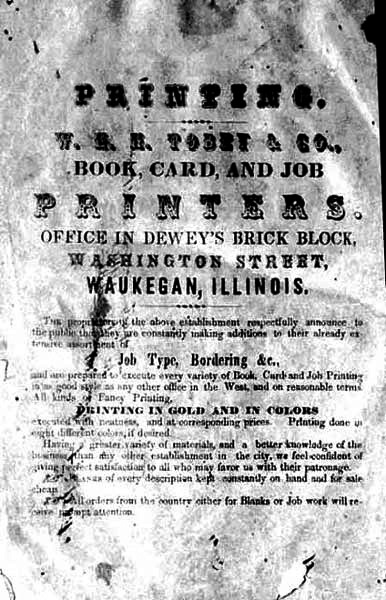
PRINTING.
W. H. H. TOBET & CO.,
BOOK, CARD, AND JOB
PRINTERS.
OFFICE IN DEWEY'S BRICK BLOCK, WASHINGTON STREET, WAUKEGAN, ILLINOIS.
The proprietors of the above establishment respectfully announce to the public that they are constantly making additions to their already extensive assortment of
Job Type, Bordering &c.,
and are prepared to execute every variety of Book, Card and Job Printing in as good style as any other office in the West, and on reasonable terms. All kinds of Fancy Printing,
PRINTING IN GOLD AND IN COLORS
executed with neatness and at corresponding prices. Printing done in eight different colors, if desired.
Having a greater variety of materials, and a better knowledge of the business than any other establishment in the city, we feel confident of giving perfect satisfaction to all who may favor us with their patronage.
Blanks of every description kept constantly on hand and for sale cheap.

All orders from the country either for Blanks or Job work will receive prompt attention.