APPENDIX L.
Reading edition
Notes on the Roman Remains known to the Moors as the Castle of Pharaoh, near Mouley Edris el Kebir.
Communicated by Messrs. W. H. Richardson and H. B. Brady, F.R.S.
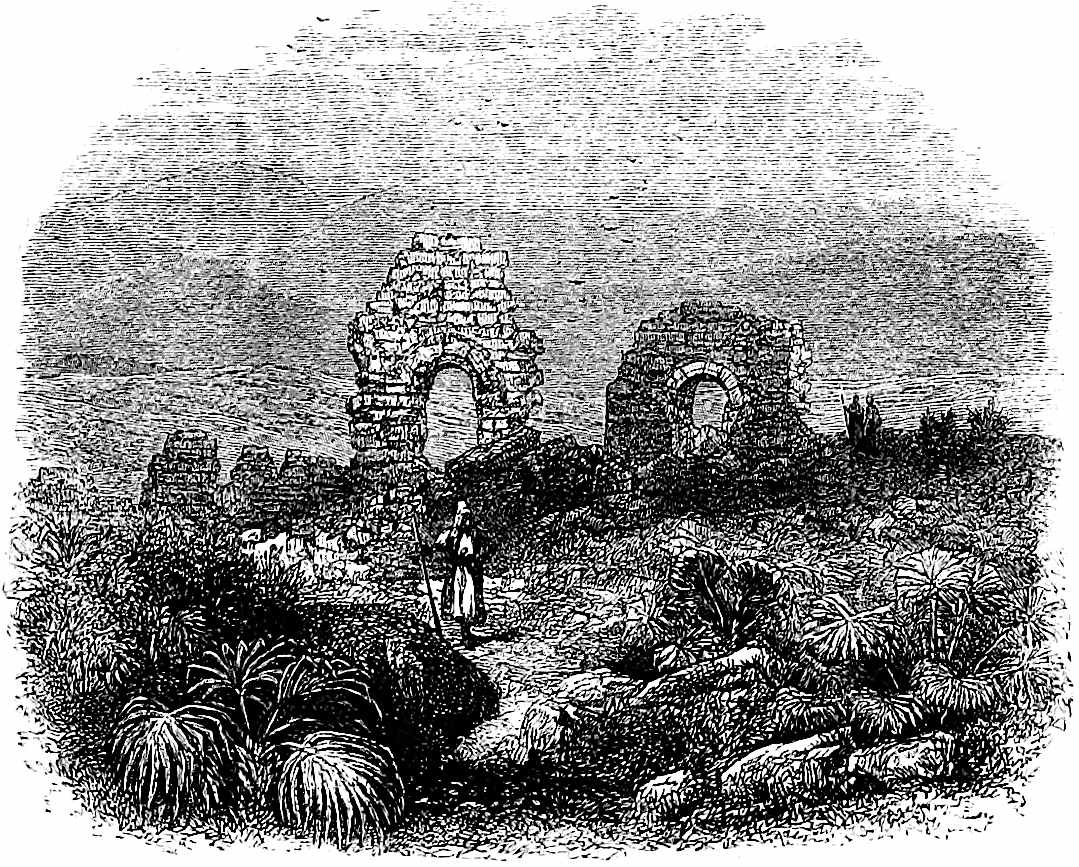
Learning that a party of English travellers had visited these ruins in the spring of 1878, and believing that they had not been seen by any European traveller since Jackson visited the place early in the present century, we were anxious for information respecting them; and in reply to our request we received an account of their visit kindly drawn up by Messrs. W. H. Richardson and H. B. Brady, F.R.S. We have also been favoured with the loan of a sketch executed by Mr. G. T. Biddulph, who formed one of the same party, from which the vignette given p. 487 is taken.
After the notes were in the hands of the printer the appearance in the ‘Academy,’ No. 32, p. 581, of a very full account of the ruins by Dr. Leared, already well known as a successful Marocco traveller, informed us that the ruins had been visited by him in 1877, in company with the members of the Portuguese mission to the Sultan, and about the same time by some members of the German Diplomatic Mission. Dr. Leared has fully succeeded in establishing the identity of the so-called Castle, or Palace, of Pharaoh with the Roman town of Volubilis, and has left little to be said on that point. Nevertheless the ruins are interesting enough to make the additional notes of other travellers useful and valuable; and we have therefore availed ourselves of the greater part of the paper kindly sent to us by Messrs. Richardson and Brady.
‘One of the points we had determined to visit on our tour was the ruin known by the Moors as “Pharaoh’s Palace,” or “Pharaoh’s Tomb.” The time of our journey was in some respects unfortunate for visiting places held in veneration by the natives; we were, in fact, staying in Fez at the time of Mohammed’s birthday, when religious fanaticism exhibits itself, not merely in holidays and powder-play, alternating with devotional exercises, but in processions to the shrines of saints, and in sundry manifestations of ill-will to unbelievers. We had considerable difficulty in obtaining intelligible information as to the exact site of the ruins. Our idea had been that they ought to have been accessible from the road between Alcazar and Fez, striking off near Sidi Guiddar. The interpreter and the mounted soldiers who were with us, overruled this when it was proposed, and we therefore continued our journey. They were probably right; but in our various conversations with them on the subject they managed to convey the impression that either they did not themselves know the precise locality, or that they did not intend that we should visit the place.
‘During our stay in Fez we were joined by two Englishmen, Messrs. G. T. Biddulph, and F. A. O’Brien, whose acquaintance we had made in Tangier, and we proceeded to Mekinez in company. Mekinez is a sort of Mecca to the Aissowies—the most fanatical of all the sects of western Mohammedans—and the road was thronged with devotees returning from their annual pilgrimage to the city of Mohammed-ben-Aissa, their prophet. We were kindly received by the Lieutenant Bashaw (Kaïd Hamo), who seemed desirous to forward our views in every way in his power. He thought it necessary on our departure to provide us with a soldier who knew the district thoroughly, so that altogether we had a guard of four regular soldiers. Thus furnished, the tone of our interpreter changed, and we had no more obstacles thrown in our way.
‘We proposed to make the Roman station the first stage on our road from Mekinez to Rabat. Whether it would have been better to have taken it, as we had originally intended, on the way to Fez, or subsequently, between Fez and Mequinez, it is needless now to inquire; it certainly is a good deal out of the direct route between Mekinez and Rabat, if maps are to be trusted. However, we got on the way on March 23 a little after 10 A.M. The site of the ruin is some fifteen miles north-west of Mekinez, at no great distance from Mouley Edris el Kebir; both are on the southern slopes of one of the ranges that constitute the Lesser Atlas. There was little of interest by the way. Part of the road was on the horizon of a bed of white, friable, microzoic, tertiary limestone, which forms a conspicuous feature in the mountain strata of this district. This is traceable for a great distance, and its exposure at one or two points in the heights to the far east, we had at first mistaken
Roman ruins of Volubilis.
for snow. After about four hours’ riding we had to diverge from the main road; and here we learned that it would be necessary to encamp at some distance to the south-west, in the last douar within the government of Mekinez. The hill-country, it was said, was so infested by a lawless set of Berebers that we should not be safe out of the jurisdiction of the Bashaw. Before the evening was out we had reason to know that these fears were not entirely groundless. Leaving our servants with the luggage, therefore, we took two soldiers and rode across country to the object of our journey.
‘The ruins stand on a little hill, a mile or more from the road. At the base of the hill runs a bright little mountain stream. The ground for many acres is strewed and heaped with squared stones, the débris of ancient buildings; lines of wall-foundations appear in every direction, and pillar bases in rows or squares, arranged as though for the support of colonnades surrounding courts or patios. The demolition is no doubt largely due to spoliation, but it is also partly the result of the unstable character of the mortar, which has to a great extent weathered out from between the stones. In some of the walls still standing the stones appear to retain their places by their own weight rather than by the help of any cement that is left to hold them together. Two perfect Roman arches still remain, and one or two nearly complete, but even these look as though they might not long withstand the mountain winds.’[1]
A X C P I A E B S I T I
‘In the present condition of the place it is impossible even to guess what was the original ground-plan of the buildings. The principal frontage appears to have had the west aspect, and there is still the remnant of a sort of façade. Amongst the fallen stones of this front is part of an entablature which has borne an inscription in four lines. We could only find one stone of it; and this bore the following letters, about eight inches in height. There were the shafts of many marble columns amongst the fallen stones, and not a few capitals, some simple, others more or less carved with volutes, Ionic fashion, and one at least with the remnant of acanthus leaves, as though derived from a Corinthian building. Some of the mouldings had the common egg and arrow ornament, and there was a portion of a narrow frieze on the western side with one of the common frets of classic architecture formed of a double series of interlacing
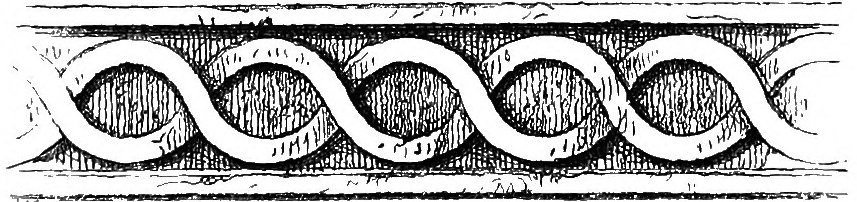
curved lines; but beyond these there was but little decorative sculpture. There is clearly a basement storey of very large stones lying underneath the present ground level. Here and there the subsidence of the ground, or the falling in of the masonry, reveals passages and what appear to be small rooms or vaults, with solid, well constructed walls. In the short hour that circumstances permitted us to linger, it was impossible to do more than observe things as they stood. The mere removal of the loose stones would do a good deal, and a very little excavation would do much more, to indicate the history of the original structures, and we have little doubt that many inscribed stones might still be found that would help materially to the same end. On the north side of the western arch and façade is a sort of enclosure formed of loose stones piled together as a rude wall, and whitewashed. This wall has been reared by pilgrims, each of whom has carried and placed a stone, according to their custom, at what they regard as a “saint’s place.”’
Up to the year 1877 no traveller appears to have visited the ruins since Jackson, who twice refers to them in his ‘Account of the Empire of Marocco.’ In a note to p. 21 (3rd Edition, 1814) he says: ‘The father of the Sultan Sulieman built a magnificent palace on the banks of the river of Tafilelt, which bounds his dominions on the eastward; the pillars are of marble, and many of them were transported across the Atlas, having been collected from the (Ukser Farawan) Ruins of Pharaoh near the sanctuary of Muly Dris Zerone, west of Atlas.’ In another place (p. 146) he says: ‘When I visited these ruins in my journey from the sanctuary of Muly Dris Zerone, near to which they are situated, in the plain below, the jealousy of the (Stata) protecting guide sent by the Fakeers to see me safe to the confines of their district was excited, and he endeavoured to deter me from making any observations by insinuating that the place was the haunt of large and venomous serpents, scorpions, &c. A good number of cauldrons and kettles filled with gold and silver coins have been excavated from these ruins.’
FOOTNOTES:
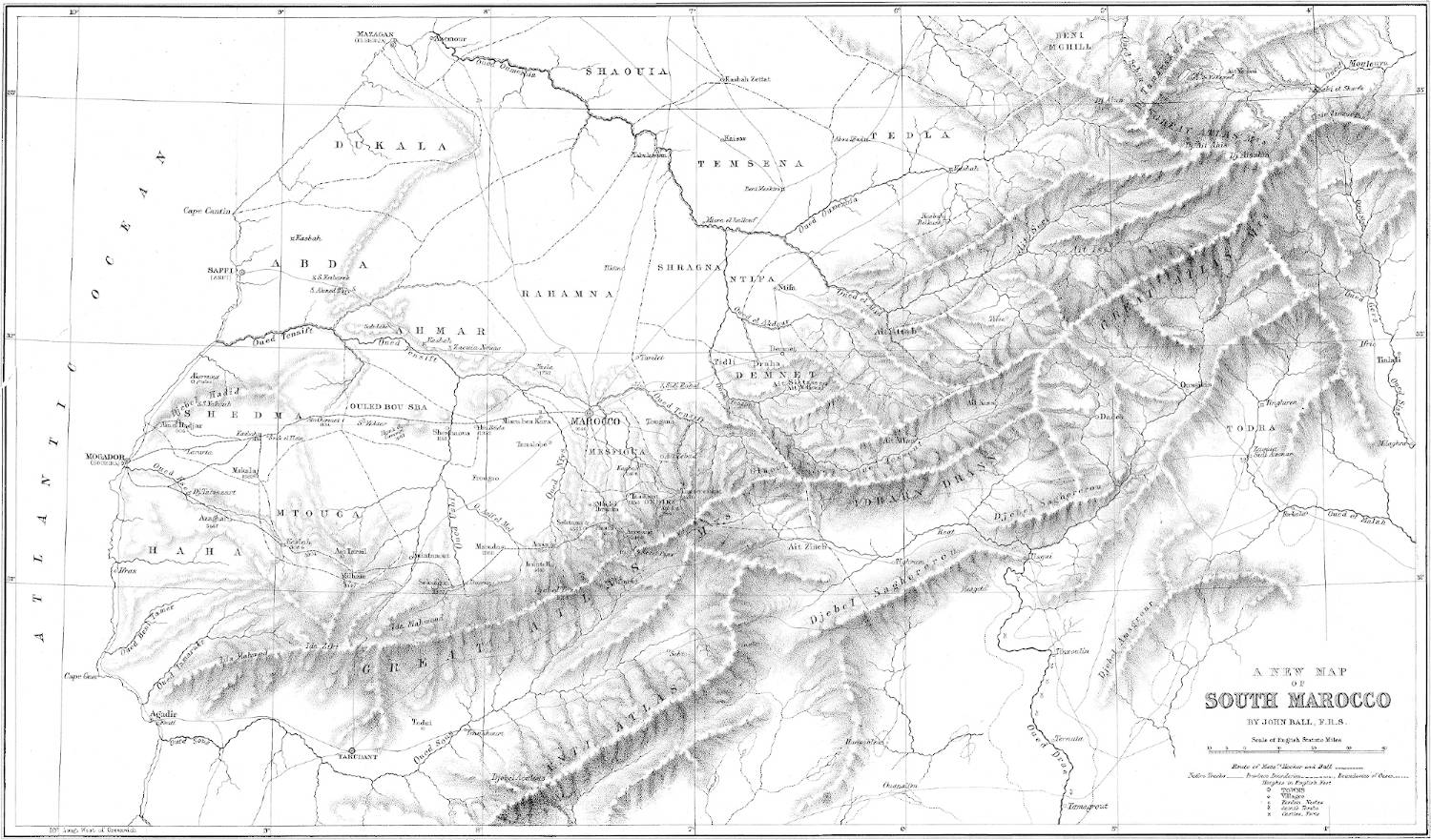
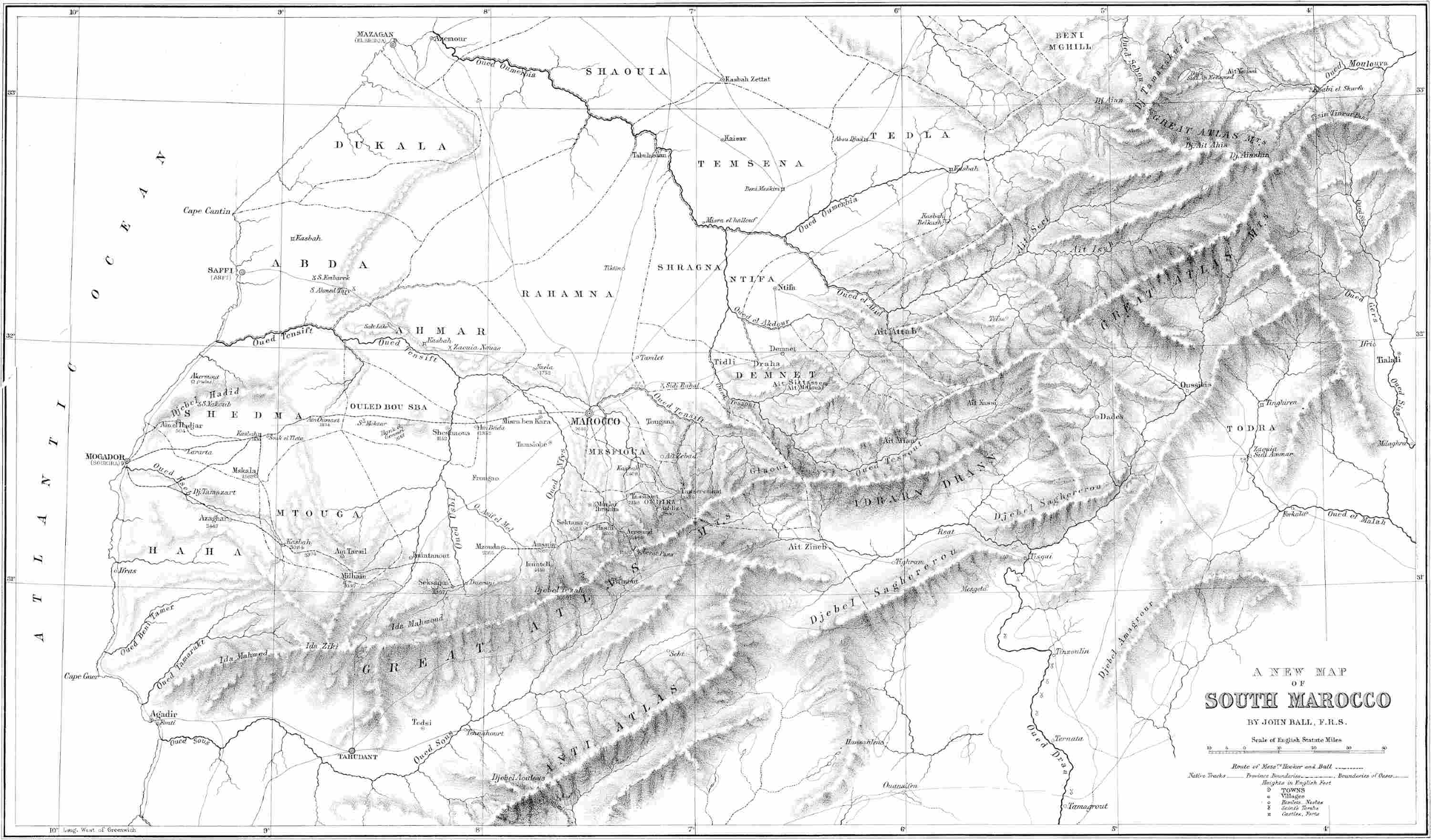
A NEW MAP OF SOUTH MAROCCO BY JOHN BALL, F.R.S (Large-size, Largest size)