Note 346 — Chapter VI · SOME REMARKS ON THE COMPARATIVE GEOGRAPHY OF THE WESTERN AND NORTHERN PARTS OF ASIA MINOR.
Reading edition
A re-examination of the ruins of Priene and Branchidæ was a principal object of the second Asiatic Mission of the Society of Dilettanti. Their late publication renders it unnecessary for me to make any observations on the great monuments at those two places: but the reader will not be displeased at my here inserting a curious inscription, in Boustrophedon, from Branchidæ. It was copied by Sir W. Gell from the chair of a sitting statue on the Sacred Way, or road leading from the sea to the temple of Apollo Didymeus. This road—bordered on either side with statues on chairs of a single block of stone, with the feet close together and the hands on the knees—is an exact imitation of the avenues of the temples in Egypt. The inscription (which is perfect to the right and incomplete to the left) is as follows:
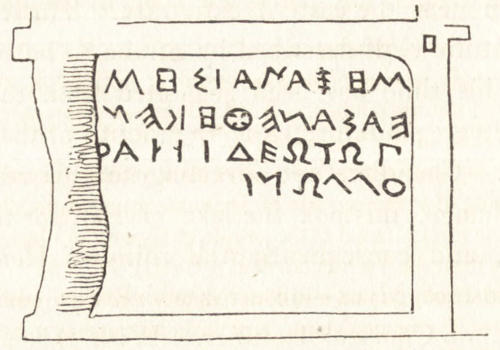
The name at the beginning was probably Hermesianax. It appears by ἡμεὰς (Ion. for ἡμὰς us) ἀνέθηκεν, that the inscribed statue speaks for them all. The word at the beginning of line 3 may possibly be ΒΡΑΝΚΙΔΕΩ. Of the crasis instanced in ΤΩΠΟΛΛΩΝΙ, there are several examples in the Sigeian inscription, in the Eleian tablet, and in other monuments of a time when the Greeks wrote rather by sound than grammar. It seems to have been particularly at the end of inscriptions that the Greek ear required an agreeable cadence and combination of vowel sounds; and hence their inscriptions sometimes ended in metre, although the former part was not constructed by any such rules. Thus the last line of the following Doric inscription on a helmet lately found at Olympia appears to be the end of a hexameter verse: a supposition which will account for the crasis or omission of two of the vowels.
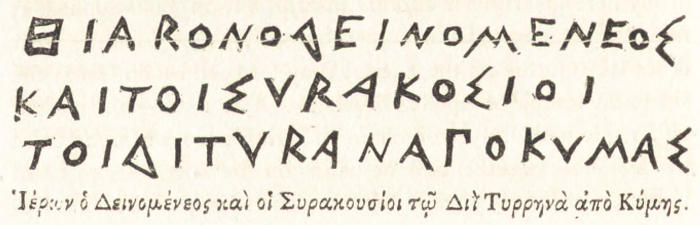
Ἱέρων ὁ Δεινομένεος καὶ οἱ Συρακουσίοι τῷ Διῒ Τυρρηνὰ ἀπὸ Κύμης.
The single instead of double liquid in TVRANA, seems to have been not uncommon in the old Doric—we have ΑΛΑΛΟΙΣ for ἀλλήλοις in the Eleian tablet.
This curious inscription relates to a military expedition of Hiero king of Syracuse, son of Deinomenes, (commonly called Hiero the First,) in aid of the people of Cyme, who had suffered severely from the Tyrrhenian fleet. (Diod. l. 11. c. 51.) The triremes of Hiero gained a brilliant victory and destroyed a great number of Tyrrhenian ships; and the helmet seems to have been among the Tyrrhenian spoils which upon this occasion Hiero and his Syracusans dedicated at Olympia. A few years before this exploit, the same prince had obtained a victory in the Olympic games, which the first Ode of Pindar has made more illustrious than the historian Diodorus has rendered his triumph over the Tyrrhenians: though the poet alludes also to the latter victory. (Pyth. l. v. 137.) Pausanias, who has described (Eliac. post. c. 12. Arcad. c. 42.) the magnificent dedications of Deinomenes the son of Hiero, in honour of his father’s three victories in the Olympic games, says nothing of the offerings of Hiero after his success over the Tyrrhenians: but so numerous were these martial dedications at Olympia, that the omission is not surprising. Pausanias had enough to do to describe the great monuments of art and religion.