I 1850 (ÆT. 32-33)[1] (continued 2)
Reading edition
I do not know whether the practice of putting indigo-weed about horses’ tackling to keep off flies is well founded, but I hope it is, for I have been pleased to notice that wherever I have occasion to tie a horse I am sure to find indigo-weed not far off, and therefore this, which is so universally dispersed, would be the fittest weed for this purpose.
The thistle is now in bloom, which every child is eager to clutch once,—just a child’s handful.
The prunella, self-heal, small purplish-flowered plant of low grounds.
Charles[55] grew up to be a remarkably eccentric man. He was of large frame, athletic, and celebrated for his feats of strength. His lungs were proportionally strong. There was a man who heard him named once, and asked if it was the same Charles Dunbar whom he remembered when he was a little boy walking on the coast of Maine. A man came down to the shore and hailed a vessel that was sailing by. He should never forget that man’s name.
It was well grassed, and delicate flowers grew in the middle of the road.
I saw a delicate flower had grown up two feet high Between the horses’ path and the wheel-track, Which Dakin’s and Maynard’s wagons had Passed over many a time. An inch more to right or left had sealed its fate, Or an inch higher. And yet it lived and flourished As much as if it had a thousand acres Of untrodden space around it, and never Knew the danger it incurred. It did not borrow trouble nor invite an Evil fate by apprehending it.[56] For though the distant market-wagon Every other day inevitably rolled This way, it just as inevitably rolled In those ruts. And the same Charioteer who steered the flower Upward guided the horse and cart aside from it. There were other flowers which you would say Incurred less danger, grew more out of the way, Which no cart rattled near, no walker daily passed, But at length one rambling deviously— For no rut restrained—plucked them, And then it appeared that they stood Directly in his way, though he had come From farther than the market-wagon.
And then it appeared that this brave flower which grew between the wheel and horse did actually stand farther out of the way than that which stood in the wide prairie where the man of science plucked it.
To-day I climbed a handsome rounded hill
Covered with hickory trees, wishing to see
The country from its top, for low hills
Show unexpected prospects. I looked
Many miles over a woody lowland
Toward Marlborough, Framingham, and Sudbury;
And as I sat amid the hickory trees
And the young sumachs, enjoying the prospect, a neat herd of cows approached, of unusually fair proportions and smooth, clean skins, evidently petted by their owner, who must have carefully selected them. One more confiding heifer, the fairest of the herd, did by degrees approach as if to take some morsel from our hands, while our hearts leaped to our mouths with expectation and delight. She by degrees drew near with her fair limbs progressive, making pretense of browsing; nearer and nearer, till there was wafted toward us the bovine fragrance,—cream of all the dairies that ever were or will be,—and then she raised her gentle muzzle toward us, and snuffed an honest recognition within hand’s reach. I saw ’t was possible for his herd to inspire with love the herdsman. She was as delicately featured as a hind. Her hide was mingled white and fawn-color, and on her muzzle’s tip there was a white spot not bigger than a daisy, and on her side toward me the map of Asia plain to see.
Farewell, dear heifer! Though thou forgettest me, my prayer to heaven shall be that thou may’st not forget thyself. There was a whole bucolic in her snuff. I saw her name was Sumach. And by the kindred spots I knew her mother, more sedate and matronly, with full-grown bag; and on her sides was Asia, great and small, the plains of Tartary, even to the pole, while on her daughter it was Asia Minor. She not disposed to wanton with the herdsman.
And as I walked, she followed me, and took an apple from my hand, and seemed to care more for the hand than apple. So innocent a face as I have rarely seen on any creature, and I have looked in face of many heifers. And as she took the apple from my hand, I caught the apple of her eye. She smelled as sweet as the clethra blossom. There was no sinister expression. And for horns, though she had them, they were so well disposed in the right place, bent neither up nor down, I do not now remember she had any. No horn was held toward me.[57]
Sept. 11. Wednesday. The river higher than I ever knew it at this season, as high as in the spring.
Yesterday, September 14, walked to White Pond in Stow, on the Marlborough road, having passed one pond called sometimes Pratt’s Pond, sometimes Bottomless Pond, in Sudbury. Saw afterward another pond beyond Willis’s also called Bottomless Pond, in a thick swamp. To name two ponds bottomless when both of them have a bottom! Verily men choose darkness rather than light.[58]
The farmers are now cutting—topping—their corn, gathering their early fruit, raking their cranberries, digging their potatoes, etc.
Everything has its use, and man seeks sedulously for the best article for each use. The watchmaker finds the oil of the porpoise’s jaw the best for oiling his watches. Man has a million eyes, and the race knows infinitely more than the individual. Consent to be wise through your race.
Autumnal mornings, when the feet of countless sparrows are heard like rain-drops on the roof by the boy who sleeps in the garret.
Villages with a single long street lined with trees, so straight and wide that you can see a chicken run across it a mile off.
Sept. 19. The gerardia, yellow trumpet-like flower. Veiny-leaved hawkweed (leaves handsome, radical excepting one or two; know them well) (Hieracium venosum), flower like a dandelion. Canada snapdragon, small pea-like blue flower in the wood-paths, (Antirrhinum Canadense). Pine-weed, thickly branched low weed with red seed-vessels, in wood-paths and fields, (Sarothra gentianoides). Cucumber-root (Medeola). Tree-primrose. Red-stemmed cornel. The very minute flower which grows now in the middle of the Marlborough road.
I am glad to have drunk water so long, as I prefer the natural sky to an opium-eater’s heaven,—would keep sober always, and lead a sane life not indebted to stimulants. Whatever my practice may be, I believe that it is the only drink for a wise man, and only the foolish habitually use any other. Think of dashing the hopes of a morning with a cup of coffee, or of an evening with a dish of tea! Wine is not a noble liquor, except when it is confined to the pores of the grape. Even music is wont to be intoxicating. Such apparently slight causes destroyed Greece and Rome, and will destroy England and America.[59]
I have seen where the rain dripped from the trees on a sand-bank on the Marlborough road, that each little pebble which had protected the sand made the summit of a sort of basaltic column of sand,—a phenomenon which looked as if it might be repeated on a larger scale in nature.
The goldenrods and asters impress me not like individuals but great families covering a thousand hills and having a season to themselves.
The indigo-weed turns black when dry, and I have been interested to find in each of its humble seed-vessels a worm.
The Deep Cut is sometimes excited to productiveness by a rain in midsummer. It impresses me somewhat as if it were a cave, with all its stalactites turned wrong side outward. Workers in bronze should come here for their patterns.
Those were carrots which I saw naturalized in Wheeler’s field. It was four or five years since he planted there.
To-day I saw a sunflower in the woods.
It is pleasant to see the Viola pedata blossoming again now, in September, with a beauty somewhat serener than that of these yellow flowers.
The trees on the bank of the river have white furrows worn about them, marking the height of the freshets, at what levels the water has stood.
Water is so much more fine and sensitive an element than earth. A single boatman passing up or down unavoidably shakes the whole of a wide river, and disturbs its every reflection. The air is an element which our voices shake still further than our oars the water.
The red maples on the river, standing far in the water when the banks are overflown and touched by the earliest frosts, are memorable features in the scenery of the stream at this season.
Now you can scent the ripe grapes far off on the banks as you row along. Their fragrance is finer than their flavor.
My companion said he would drink when the boat got under the bridge, because the water would be cooler in the shade, though the stream quickly passes through the piers from shade to sun again. It is something beautiful, the act of drinking, the stooping to imbibe some of this widespread element, in obedience to instinct, without whim. We do not so simply drink in other influences.
It is pleasant to have been to a place by the way a river went.
The forms of trees and groves change with every stroke of the oar.
It seems hardly worth the while to risk the dangers of the sea between Leghorn and New York for the sake of a cargo of juniper berries and bitter almonds.
Oh, if I could be intoxicated on air and water![60] on hope and memory! and always see the maples standing red in the midst of the waters on the meadow!
Those have met with losses, who have lost their children. I saw the widow this morning whose son was drowned.
That I might never be blind to the beauty of the landscape! To hear music without any vibrating cord!
A family in which there was singing in the morning. To hear a neighbor singing! All other speech sounds thereafter like profanity. A man cannot sing falsehood or cowardice; he must sing truth and heroism to attune his voice to some instrument. It would be noblest to sing with the wind. I have seen a man making himself a viol, patiently and fondly paring the thin wood and shaping it, and when I considered the end of the work he was ennobled in my eyes. He was building himself a ship in which to sail to new worlds. I am much indebted to my neighbor who will now and then in the intervals of his work draw forth a few strains from his accordion. Though he is but a learner, I find when his strains cease that I have been elevated.
The question is not whether you drink, but what liquor.
Plucked a wild rose the 9th of October on Fair Haven Hill.
Butter-and-eggs, which blossomed several months ago, still freshly [in] bloom (October 11th).
He knew what shrubs were best for withes.
This is a remarkable year. Huckleberries are still quite abundant and fresh on Conantum. There have been more berries than pickers or even worms. (October 9th.)
I am always exhilarated, as were the early voyagers, by the sight of sassafras (Laurus Sassafras). The green leaves bruised have the fragrance of lemons and a thousand spices. To the same order belong cinnamon, cassia, camphor.
Hickory is said to be an Indian name. (Nuttall’s continuation of Michaux.)
The seed vessel of the sweet-briar is a very beautiful glossy elliptical fruit. What with the fragrance of its leaves, its blossom, and its fruit, it is thrice crowned.
I observed to-day (October 17th) the small blueberry bushes by the path-side, now blood-red, full of white blossoms as in the spring, the blossoms of spring contrasting strangely with the leaves of autumn. The former seemed to have expanded from sympathy with the maturity of the leaves.
Walter Colton in his “California”[61] says, “Age is no certain evidence of merit, since folly runs to seed as fast as wisdom.”
The imagination never forgives an insult.
Left Concord, Wednesday morning, September 25th, 1850, for Quebec. Fare $7.00 to and fro. Obliged to leave Montreal on return as soon as Friday, October 4th. The country was new to me beyond Fitchburg.
In Ashburnham and afterwards I noticed the woodbine.[62]
[Eighty-four pages missing,—doubtless the Canada journal.]
However mean your life is, meet it and live; do not shun it and call it hard names. It is not so bad as you are. It looks poorest when you are richest. The faultfinder will find faults even in paradise. Love your life, poor as it is. You may perchance have some pleasant, thrilling, glorious hours, even in a poorhouse. The setting sun is reflected from the windows of the almshouse as brightly as from the rich man’s house. The snow melts before its door as early in the spring. I do not see but a quiet mind may live as contentedly there, and have as cheering thoughts as anywhere, and, indeed, the town’s poor seem to live the most independent lives of any. They are simply great enough to receive without misgiving. Cultivate poverty like sage, like a garden herb. Do not trouble yourself to get new things, whether clothes or friends. That is dissipation. Turn the old; return to them. Things do not change; we change. If I were confined to a corner in a garret all my days, like a spider, the world would be just as large to me while I had my thoughts.[63]
In all my travels I never came to the abode of the present.
I live in the angle of a leaden wall, into whose alloy was poured a little bell-metal. Sometimes in the repose of my mid-day there reaches my ears a confused tintinnabulum from without. It is the noise of my contemporaries.[64]
That the brilliant leaves of autumn are not withered ones is proved by the fact that they wilt when gathered as soon as the green.
But now, October 31st, they are all withered. This has been the most perfect afternoon in the year. The air quite warm enough, perfectly still and dry and clear, and not a cloud in the sky. Scarcely the song of a cricket is heard to disturb the stillness. When they ceased their song I do not know. I wonder that the impetus which our hearing had got did not hurry us into deafness over a precipitous silence. There must have been a thick web of cobwebs on the grass this morning, promising this fair day, for I see them still through the afternoon, covering not only the grass but the bushes and the trees. They are stretched across the unfrequented roads from weed to weed, and broken by the legs of the horses.
I thought to-day that it would be pleasing to study the dead and withered plants, the ghosts of plants, which now remain in the fields, for they fill almost as large a space to the eye as the green have done. They live not in memory only, but to the fancy and imagination.
As we were passing through Ashburnham, by a new white house which stood at some distance in a field, one passenger exclaimed so that all the passengers could hear him, “There, there’s not so good a house as that in all Canada.” And I did not much wonder at his remark. There is a neatness as well as thrift and elastic comfort, a certain flexible easiness of circumstance when not rich, about a New England house which the Canadian houses do not suggest. Though of stone, they were no better constructed than a stone barn would be with us. The only building on which money and taste are expended is the church.[65] At Beauport we examined a magnificent cathedral, not quite completed, where I do not remember that there were any but the meanest houses in sight around it.
Our Indian summer, I am tempted to say, is the finest season of the year. Here has been such a day as I think Italy never sees.
Though it has been so warm to-day, I found some of the morning’s frost still remaining under the north side of a wood, to my astonishment.
Why was this beautiful day made, and no man to improve it? We went through Seven-Star (?) Lane to White Pond.
Looking through a stately pine grove, I saw the western sun falling in golden streams through its aisles. Its west side, opposite to me, was all lit up with golden light; but what was I to it? Such sights remind me of houses which we never inhabit,—that commonly I am not at home in the world. I see somewhat fairer than I enjoy or possess.
A fair afternoon, a celestial afternoon, cannot occur but we mar our pleasure by reproaching ourselves that we do not make all our days beautiful. The thought of what I am, of my pitiful conduct, deters me from receiving what joy I might from the glorious days that visit me. After the era of youth is passed, the knowledge of ourselves is an alloy that spoils our satisfactions.
I am wont to think that I could spend my days contentedly in any retired country house that I see; for I see it to advantage now and without incumbrance; I have not yet imported my humdrum thoughts, my prosaic habits, into it to mar the landscape. What is this beauty in the landscape but a certain fertility in me? I look in vain to see it realized but in my own life. If I could wholly cease to be ashamed of myself, I think that all my days would be fair.
When I asked at the principal bookstore in Montreal to see such books as were published there, the answer was that none were published there but those of a statistical character and the like, that their books came from the States.[66]
[Two thirds of a page missing]
As once he was riding past Jennie Dugan’s, was invited by her boys to look into their mother’s spring-house. He looked in. It was a delectable place to keep butter and milk cool and sweet in dog-days,—but there was a leopard frog swimming in the milk, and another sitting on the edge of the pan.
[Half a page missing.]
Thou art a personality so vast and universal that I have never seen one of thy features. I am suddenly very near to another land than can be bought and sold; this is not Charles Miles’s swamp. This is a far, far-away field on the confines of the actual Concord, where nature is partially present. These farms I have myself surveyed; these lines I have run; these bounds I have set up; they have no chemistry to fix them; they fade from the surface of the glass (the picture); this light is too strong for them.
[Four and two thirds pages missing.]
My dear, my dewy sister, let thy rain descend on me. I not only love thee, but I love the best of thee; that is to love thee rarely. I do not love thee every day. Commonly I love those who are less than thou. I love thee only on great days. Thy dewy words feed me like the manna of the morning. I am as much thy sister as thy brother. Thou art as much my brother as my sister. It is a portion of thee and a portion of me which are of kin. Thou dost not have to woo me. I do not have to woo thee. O my sister! O Diana, thy tracks are on the eastern hills. Thou surely passedst that way. I, the hunter, saw them in the morning dew. My eyes are the hounds that pursue thee. Ah, my friend, what if I do not answer thee? I hear thee. Thou canst speak; I cannot. I hear and forget to answer. I am occupied with hearing. I awoke and thought of thee; thou wast present to my mind. How camest thou there? Was I not present to thee likewise?[67]
The oystermen had anchored their boat near the shore without regard to the state of the tide, and when we came to it to set sail, just after noon, we found that it was aground. Seeing that they were preparing to push it off, I was about to take off my shoes and stockings in order to wade to it first, but a Dutch sailor with a singular bullfrog or trilobite expression of the eyes, whose eyes were like frog ponds in the broad platter of his cheeks and gleamed like a pool covered with frog-spittle, immediately offered me the use of his back. So mounting, with my legs under his arms, and hugging him like one of [the] family, he set me aboard of the periauger?
They then leaned their hardest against the stern, bracing their feet against the sandy bottom in two feet of water, the Dutchman with his broad back among them. In the most Dutch-like and easy way they applied themselves to this labor, while the skipper tried to raise the bows, never jerking or hustling but silently exerting what vigor was inherent in them, doing, no doubt, their utmost endeavor, while I pushed with a spike pole; but it was all in vain. It was decided to be unsuccessful; we did not disturb its bed by a grain of sand. “Well, what now?” said I. “How long have we got to wait?” “Till the tide rises,” said the captain. But no man knew of the tide, how it was. So I went in to bathe, looking out for sharks and chasing crabs, and the Dutchman waded out among the mussels to spear a crab. The skipper stuck a clamshell into the sand at the water’s edge to discover if it was rising, and the sailors,—the Dutchman and the other,—having got more drink at Oakes’s, stretched themselves on the seaweed close to the water’s edge [and] went to sleep. After an hour or more we could discover no change in the shell even by a hair’s breadth, from which we learned that it was about the turn of the tide and we must wait some hours longer.[68]
I once went in search of the relics of a human body—a week after a wreck—which had been cast up the day before on to the beach, though the sharks had stripped off the flesh. I got the direction from a lighthouse. I should find it a mile or two distant over the sand, a dozen rods from the water, by a stick which was stuck up covered with a cloth. Pursuing the direction pointed out, I expected that I should have to look very narrowly at the sand to find so small an object, but so completely smooth and bare was the beach—half a mile wide of sand—and so magnifying the mirage toward the sea that when I was half a mile distant the insignificant stick or sliver which marked the spot looked like a broken mast in the sand. As if there was no other object, this trifling sliver had puffed itself up to the vision to fill the void; and there lay the relics in a certain state, rendered perfectly inoffensive to both bodily and spiritual eye by the surrounding scenery,—a slight inequality in the sweep of the shore. Alone with the sea and the beach, attending to the sea, whose hollow roar seemed addressed to the ears of the departed,—articulate speech to them. It was as conspicuous on that sandy plain as if a generation had labored to pile up a cairn there. Where there were so few objects, the least was obvious as a mausoleum. It reigned over the shore. That dead body possessed the shore as no living one could. It showed a title to the sands which no living ruler could.[69]
My father was commissary at Fort Independence in the last war. He says that the baker whom he engaged returned eighteen ounces of bread for sixteen of flour, and was glad of the job on those terms.
In a pleasant spring morning all men’s sins are forgiven. You may have known your neighbor yesterday for a drunkard and a thief, and merely pitied or despised him, and despaired of the world; but the sun shines bright and warm this first spring morning, and you meet him quietly, serenely at any work, and see how even his exhausted, debauched veins and nerves expand with still joy and bless the new day, feel the spring influence with the innocence[70] [Two thirds of a page missing.]
There is a good echo from that wood to one standing on the side of Fair Haven. It was particularly good to-day. The woodland lungs seemed particularly sound to-day; they echoed your shout with a fuller and rounder voice than it was given in, seeming to mouth it. It was uttered with a sort of sweeping intonation half round a vast circle, ore rotundo, by a broad dell among the tree-tops passing it round to the entrance of all the aisles of the wood. You had to choose the right key or pitch, else the woods would not echo it with any spirit, and so with eloquence. Of what significance is any sound if Nature does not echo it? It does not prevail. It dies away as soon as uttered. I wonder that wild men have not made more of echoes, or that we do not hear that they have made more. It would be a pleasant, a soothing and cheerful mission to go about the country in search of them,—articulating, speaking, vocal, oracular, resounding, sonorous, hollow, prophetic places; places wherein to found an oracle, sites for oracles, sacred ears of Nature.
I used to strike with a paddle on the side of my boat on Walden Pond, filling the surrounding woods with circling and dilating sound, awaking the woods, “stirring them up,” as a keeper of a menagerie his lions and tigers, a growl from all. All melody is a sweet echo, as it were coincident with [the] movement of our organs. We wake the echo of the place we are in, its slumbering music.
I should think that savages would have made a god of echo.
I will call that Echo Wood.
Crystal Water for White Pond.
There was a sawmill once on Nut Meadow Brook, near Jennie’s Road. These little brooks have their history. They once turned sawmills. They even used their influence to destroy the primitive [forests] which grew on their banks, and now, for their reward, the sun is let in to dry them up and narrow their channels. Their crime rebounds against themselves. You still find the traces of ancient dams where the simple brooks were taught to use their influence to destroy the primitive forests on their borders, and now for penalty they flow in shrunken channels, with repentant and plaintive tinkling through the wood, being by an evil spirit turned against their neighbor forests.
What does education often do? It makes a straight-cut ditch of a free, meandering brook.
You must walk like a camel, which is said to be the only beast which ruminates when it walks.
The actual life of men is not without a dramatic interest to the thinker. It is not in all its respects prosaic. Seventy thousand pilgrims proceed annually to Mecca from the various nations of Islam.
I was one evening passing a retired farmhouse which had a smooth green plat before it, just after sundown, when I saw a hen turkey which had gone to roost on the front fence with her wings outspread over her young now pretty well advanced, who were roosting on the next rail a foot or two below her. It completed a picture of rural repose and happiness such as I had not seen for a long time. A particularly neat and quiet place, where the very ground was swept around the wood-pile. The neighboring fence of roots, agreeable forms for the traveller to study, like the bones of marine monsters and the horns of mastodons or megatheriums.
You might say of a philosopher that he was in this world as a spectator.
A squaw came to our door to-day with two pappooses, and said, “Me want a pie.” Theirs is not common begging. You are merely the rich Indian who shares his goods with the poor. They merely offer you an opportunity to be generous and hospitable.
Equally simple was the observation which an Indian made at Mr. Hoar’s door the other day, who went there to sell his baskets. “No, we don’t want any,” said the one who went to the door. “What! do you mean to starve us?” asked the Indian in astonishment, as he was going out [sic] the gate. The Indian seems to have said: I too will do like the white man; I will go into business. He sees his white neighbors well off around him, and he thinks that if he only enters on the profession of basket-making, riches will flow in unto him as a matter of course; just as the lawyer weaves arguments, and by some magical means wealth and standing follow. He thinks that when he has made the baskets he has done his part, now it is yours to buy them. He has not discovered that it is necessary for him to make it worth your while to buy them, or make some which it will be worth your while to buy. With great simplicity he says to himself: I too will be a man of business; I will go into trade. It isn’t enough simply to make baskets. You have got to sell them.[71]
I have an uncle who once, just as he stepped on to the dock at New York from a steamboat, saw some strange birds in the water and called to [a] Gothamite to know what they were. Just then his hat blew off into the dock, and the man answered by saying, “Mister, your hat is off,” whereupon my uncle, straightening himself up, asked again with vehemence, “Blast you, sir, I want to know what those birds are.” By the time that he had got this information, a sailor had recovered his hat.
Nov. 8. The stillness of the woods and fields is remarkable at this season of the year. There is not even the creak of a cricket to be heard. Of myriads of dry shrub oak leaves, not one rustles. Your own breath can rustle them, yet the breath of heaven does not suffice to. The trees have the aspect of waiting for winter. The autumnal leaves have lost their color; they are now truly sere, dead, and the woods wear a sombre color. Summer and harvest are over. The hickories, birches, chestnuts, no less than the maples, have lost their leaves. The sprouts, which had shot up so vigorously to repair the damage which the choppers had done, have stopped short for the winter. Everything stands silent and expectant. If I listen, I hear only the note of a chickadee,—our most common and I may say native bird, most identified with our forests,—or perchance the scream of a jay, or perchance from the solemn depths of these woods I hear tolling far away the knell of one departed. Thought rushes in to fill the vacuum. As you walk, however, the partridge still bursts away. The silent, dry, almost leafless, certainly fruitless woods. You wonder what cheer that bird can find in them. The partridge bursts away from the foot of a shrub oak like its own dry fruit, immortal bird! This sound still startles us. Dry goldenrods, now turned gray and white, lint our clothes as we walk. And the drooping, downy seed-vessels of the epilobium remind us of the summer. Perchance you will meet with a few solitary asters in the dry fields, with a little color left. The sumach is stripped of everything but its cone of red berries.
This is a peculiar season, peculiar for its stillness. The crickets have ceased their song. The few birds are well-nigh silent. The tinted and gay leaves are now sere and dead, and the woods wear a sombre aspect. A carpet of snow under the pines and shrub oaks will make it look more cheerful. Very few plants have now their spring. But thoughts still spring in man’s brain. There are no flowers nor berries to speak of. The grass begins to die at top. In the morning it is stiff with frost. Ice has been discovered in somebody’s tub very early this morn, of the thickness of a dollar. The flies are betwixt life and death. The wasps come into the houses and settle on the walls and windows. All insects go into crevices. The fly is entangled in a web and struggles vainly to escape, but there is no spider to secure him; the corner of the pane is a deserted camp. When I lived in the woods the wasps came by thousands to my lodge in November, as to winter quarters, and settled on my windows and on the walls over my head, sometimes deterring visitors from entering. Each morning, when they were numbed with cold, I swept some of them out. But I did not trouble myself to get rid of them. They never molested me, though they bedded with me, and they gradually disappeared into what crevices I do not know, avoiding winter.[72] I saw a squash-bug go slowly behind a clapboard to avoid winter. As some of these melon seeds come up in the garden again in the spring, so some of these squash-bugs come forth. The flies are for a long time in a somnambulic state. They have too little energy or vis vitæ to clean their wings or heads, which are covered with dust. They buzz and bump their heads against the windows two or three times a day, or lie on their backs in a trance, and that is all,—two or three short spurts. One of these mornings we shall hear that Mr. Minott had to break the ice to water his cow. And so it will go on till the ground freezes. If the race had never lived through a winter, what would they think was coming?
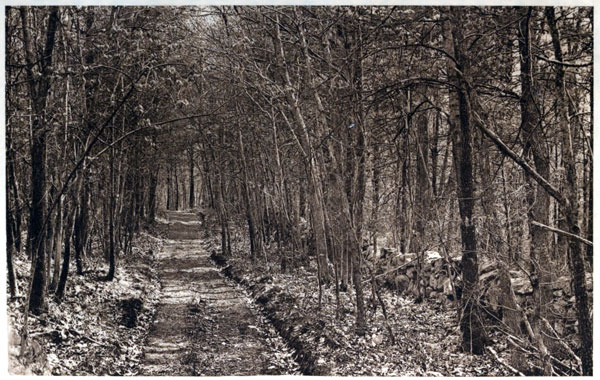
November Woods
Walden Pond has at last fallen a little. It has been so high over the stones—quite into the bushes—that walkers have been excluded from it.[73] There has been no accessible shore. All ponds have been high. The water stood higher than usual in the distant ponds which I visited and had never seen before. It has been a peculiar season. At Goose Pond, I notice that the birches of one year’s growth from the stumps standing in the water are all dead, apparently killed by the water, unless, like the pine, they die down after springing from the stump.
It is warm somewhere any day in the year. You will find some nook in the woods generally, at mid-forenoon of the most blustering day, where you may forget the cold. I used to resort to the northeast side of Walden, where the sun, reflected from the pine woods on the stony shore, made it the fireside of the pond. It is so much pleasanter and wholesomer to be warmed by the sun when you can, than by a fire.
I saw to-day a double reflection on the pond of the cars passing, one beneath the other, occasioned by a bright rippled streak on the surface of the water, from which a second reflection sprang.
One who would study lichens must go into a new country where the rocks have not been burned.
Therien says that the Canadians say marche-donc to their horses; and that the acid fruit must be spelled painbéna.[74] He says that the French acre or arpent is ten perches by ten, of eighteen feet each.
Nov. 9. It is a pleasant surprise to walk over a hill where an old wood has recently been cut off, and, on looking round, to see, instead of dense ranks of trees almost impermeable to light, distant well-known blue mountains in the horizon and perchance a white village over an expanded open country. I now take this in preference to all my old familiar walks. So a new prospect and walks can be created where we least expected it. The old men have seen other prospects from these hills than we do. There was the old Kettell place, now Watt’s, which I surveyed for him last winter and lotted off, where twenty-five years ago I played horse in the paths of a thick wood and roasted apples and potatoes in an old pigeon-place[75] and gathered fruit at the pie-apple tree. A week or two after I surveyed it, it now being rotten and going to waste, I walked there and was surprised to find the place and prospect which I have described.
I found many fresh violets (Viola pedata) to-day (November 9th) in the woods.
Saw a cat on the Great Fields, wilder than a rabbit, hunting artfully. I remember to have seen one once walking about the stony shore at Walden Pond. It is not often that they wander so far from the houses. I once, however, met with a cat with young kittens in the woods, quite wild.[76]
The leaves of the larch are now yellow and falling off. Just a month ago, I observed that the white pines were parti-colored, green and yellow, the needles of the previous year now falling. Now I do not observe any yellow ones, and I expect to find that it is only for a few weeks in the fall after the new leaves have done growing that there are any yellow and falling,—that there is a season when we may say the old pine leaves are now yellow, and again, they are fallen. The trees were not so tidy then; they are not so full now. They look best when contrasted with a field of snow.
A rusty sparrow or two only remains to people the drear spaces. It goes to roost without neighbors.
It is pleasant to observe any growth in a wood. There is the pitch pine field northeast of Beck Stow’s Swamp, where some years ago I went a-blackberrying and observed that the pitch pines were beginning to come in, and I have frequently noticed since how fairly they grew, dotting the plain as evenly as if dispersed by art. To-day I was aware that I walked in a pitch pine wood, which ere long, perchance, I may survey and lot off for a wood auction and see the choppers at their work. There is also the old pigeon-place field by the Deep Cut. I remember it as an open grassy field. It is now one of our most pleasant woodland paths. In the former place, near the edge of the old wood, the young pines line each side of the path like a palisade, they grow so densely. It never rains but it pours, and so I think when I see a young grove of pitch pines crowding each other to death in this wide world. These are destined for the locomotive’s maw. These branches, which it has taken so many years to mature, are regarded even by the woodman as “trash.”
Delicate, dry, feathery (perchance fescue) grasses growing out of a tuft, gracefully bending over the pathway. I do not know what they are, but they belong to the season.
The chickadees, if I stand long enough, hop nearer and nearer inquisitively, from pine bough to pine bough, till within four or five feet, occasionally lisping a note.
The pitcher-plant, though a little frost-bitten and often cut off by the mower, now stands full of water in the meadows. I never found one that had not an insect in it.
I sometimes see well-preserved walls running straight through the midst of high and old woods, built, of course, when the soil was cultivated many years ago, and am surprised to see slight stones still lying one upon another, as the builder placed them, while this huge oak has grown up from a chance acorn in the soil.
Though a man were known to have only one acquaintance in the world, yet there are so many men in the world, and they are so much alike, that when he spoke what might be construed personally, no one would know certainly whom he meant. Though there were but two on a desolate island, they would conduct toward each other in this respect as if each had intercourse with a thousand others.
I saw in Canada two or three persons wearing homespun gray greatcoats, with comical and conical hoods which fell back on their backs between the shoulders, like small bags ready to be turned up over the head when need was, though then a hat usurped that place. I saw that these must be what are called capots. They looked as if they would be convenient and proper enough as long as the coats were new and tidy, but as if they would soon come to look like rags and unsightly.[77]
Nov. 11. Gathered to-day the autumnal dandelion (?) and the common dandelion.
Some farmers’ wives use the white ashes of corn-cobs instead of pearlash.
I am attracted by a fence made of white pine roots. There is, or rather was, one (for it has been tipped into the gutter this year) on the road to Hubbard’s Bridge which I can remember for more than twenty years. It is almost as indestructible as a wall and certainly requires fewer repairs. It is light, white, and dry withal, and its fantastic forms are agreeable to my eye. One would not have believed that any trees had such snarled and gnarled roots. In some instances you have a coarse network of roots as they interlaced on the surface perhaps of a swamp, which, set on its edge, really looks like a fence, with its paling crossing at various angles, and root repeatedly growing into root,—a rare phenomenon above ground,—so as to leave open spaces, square and diamond-shaped and triangular, quite like a length of fence. It is remarkable how white and clean these roots are, and that no lichens, or very few, grow on them; so free from decay are they. The different branches of the roots continually grow into one another, so as to make grotesque figures, sometimes rude harps whose resonant strings of roots give a sort of musical sound when struck, such as the earth spirit might play on. Sometimes the roots are of a delicate wine-color here and there, an evening tint. No line of fence could be too long for me to study each individual stump. Rocks would have been covered with lichens by this time. Perhaps they are grown into one another that they may stand more firmly.
Now is the time for wild apples. I pluck them as a wild fruit native to this quarter of the earth, fruit of old trees that have been dying ever since I was a boy and are not yet dead. From the appearance of the tree you would expect nothing but lichens to drop from it, but underneath your faith is rewarded by finding the ground strewn with spirited fruit. Frequented only by the woodpecker, deserted now by the farmer, who has not faith enough to look under the boughs.[78] Food for walkers. Sometimes apples red inside, perfused with a beautiful blush, faery food, too beautiful to eat,—apple of the evening sky, of the Hesperides.[79]
This afternoon I heard a single cricket singing, chirruping, in a bank, the only one I have heard for a long time, like a squirrel or a little bird, clear and shrill,—as I fancied, like an evening robin, singing in this evening of the year. A very fine and poetical strain for such a little singer. I had never before heard the cricket so like a bird. It is a remarkable note. The earth-song.
That delicate, waving, feathery dry grass which I saw yesterday is to be remembered with the autumn. The dry grasses are not dead for me. A beautiful form has as much life at one season as another.
I notice that everywhere in the pastures minute young fragrant life-everlasting, with only four or five flat-lying leaves and thread-like roots, all together as big as a fourpence, spot the ground, like winter rye and grass which roots itself in the fall against another year. These little things have bespoken their places for the next season. They have a little pellet of cotton or down in their centres, ready for an early start in the spring.
The autumnal (?) dandelion is still bright.
I saw an old bone in the woods covered with lichens, which looked like the bone of an old settler, which yet some little animal had recently gnawed, and I plainly saw the marks of its teeth, so indefatigable is Nature to strip the flesh from bones and return it to dust again. No little rambling beast can go by some dry and ancient bone but he must turn aside and try his teeth upon it. An old bone is knocked about till it becomes dust; Nature has no mercy on it. It was quite too ancient to suggest disagreeable associations. It was like a piece of dry pine root. It survives like the memory of a man. With time all that was personal and offensive wears off. The tooth of envy may sometimes gnaw it and reduce it more rapidly, but it is much more a prey to forgetfulness. Lichens grow upon it, and at last, in what moment no man knows, it has completely wasted away and ceases to be a bone any longer.
The fields are covered now with the empty cups of the Trichostema dichotomum, all dry.
We had a remarkable sunset to-night. I was walking in the meadow, the source of Nut Meadow Brook.[80]
[Two pages missing.]
We walked in so pure and bright a light, so softly and serenely bright, I thought I had never bathed in such a golden flood, without a ripple or a murmur to it. The west side of every wood and rising ground gleamed like the boundary of Elysium.[81] An adventurous spirit turns the evening into morning. A little black brook in the midst of the marsh, just beginning to meander, winding slowly round a decaying stump,—an artery of the meadow.[82]
Some circumstantial evidence is very strong, as when you find a trout in the milk.
A people who would begin by burning the fences and let the forest stand! I saw the fences half consumed, their ends lost in the middle of the prairie, and some worldly miser with a surveyor looking after his bounds, while heaven had taken place around him, and he did not see the angels around, but was looking for an old post-hole in the midst of paradise. I looked again and saw him standing in the middle of a boggy Stygian fen, surrounded by devils, and he had found his bounds without a doubt, three little stones where a stake had been driven, and, looking nearer, I saw that the Prince of Darkness was his surveyor.[83]
Nov. 14. Saw to-day, while surveying in the Second Division woods, a singular round mound in a valley, made perhaps sixty or seventy years ago. Cyrus Stow thought it was a pigeon-bed, but I soon discovered the coal and that it was an old coal-pit. I once mistook one in the Maine woods for an Indian mound. The indestructible charcoal told the tale. I had noticed singular holes and trenches in the former wood, as if a fox had been dug out. The sun has probably been let in here many times, and this has been a cultivated field; and now it is clothed in a savage dress again. The wild, rank, luxuriant place is where mosses and lichens abound. We find no heroes’ cairns except those of heroic colliers, who once sweated here begrimed and dingy, who lodged here, tending their fires, who lay on a beetle here, perchance, to keep awake.
Nov. 15. I saw to-day a very perfect lichen on a rock in a meadow. It formed a perfect circle about fifteen inches in diameter though the rock was uneven, and was handsomely shaded by a darker stripe of older leaves, an inch or more wide, just within its circumference, like a rich lamp-mat. The recent growth on the outside, half an inch in width, was a sort of tea-green or bluish-green color.
The ivy berries are now sere and yellowish, or sand-colored, like the berries of the dogwood.
The farmers are now casting out their manure, and removing the muck-heap from the shore of ponds where it will be inaccessible in the winter; or are doing their fall plowing, which destroys many insects and mellows the soil. I also see some pulling their turnips, and even getting in corn which has been left out notwithstanding the crows. Those who have wood to sell, as the weather grows colder and people can better appreciate the value of fuel, lot off their woods and advertise a wood auction.
You can tell when a cat has seen a dog by the size of her tail.
Nov. 16. I found three good arrowheads to-day behind Dennis’s. The season for them began some time ago, as soon as the farmers had sown their winter rye, but the spring, after the melting of the snow, is still better.
I am accustomed to regard the smallest brook with as much interest for the time being as if it were the Orinoco or Mississippi. What is the difference, I would like to know, but mere size? And when a tributary rill empties in, it is like the confluence of famous rivers I have read of. When I cross one on a fence, I love to pause in mid-passage and look down into the water, and study its bottom, its little mystery. There is none so small but you may see a pickerel regarding you with a wary eye, or a pygmy trout glance from under the bank, or in spring, perchance, a sucker will have found its way far up its stream. You are sometimes astonished to see a pickerel far up some now shrunken rill, where it is a mere puddle by the roadside. I have stooped to drink at a clear spring no bigger than a bushel basket in a meadow, from which a rill was scarcely seen to dribble away, and seen lurking at its bottom two little pickerel not so big as my finger, sole monarchs of this their ocean, and who probably would never visit a larger water.
In literature it is only the wild that attracts us. Dullness is only another name for tameness. It is the untamed, uncivilized, free, and wild thinking in Hamlet, in the Iliad, and in all the scriptures and mythologies that delights us,—not learned in the schools, not refined and polished by art. A truly good book is something as wildly natural and primitive, mysterious and marvellous, ambrosial and fertile, as a fungus or a lichen.[84] Suppose the muskrat or beaver were to turn his views [sic] to literature, what fresh views of nature would he present! The fault of our books and other deeds is that they are too humane, I want something speaking in some measure to the condition of muskrats and skunk-cabbage as well as of men,—not merely to a pining and complaining coterie of philanthropists.
I discover again about these times that cranberries are good to eat in small quantities as you are crossing the meadows.
I hear deep amid the birches some row among the birds or the squirrels, where evidently some mystery is being developed to them. The jay is on the alert, mimicking every woodland note. What has happened? Who’s dead? The twitter retreats before you, and you are never let into the secret. Some tragedy surely is being enacted, but murder will out. How many little dramas are enacted in the depth of the woods at which man is not present!
When I am considering which way I will walk, my needle is slow to settle, my compass varies by a few degrees and does not always point due southwest; and there is good authority for these variations in the heavens. It pursues the straighter course for it at last, like the ball which has come out of a rifle, or the quoit that is twirled when cast. To-day it is some particular wood or meadow or deserted pasture in that direction that is my southwest.[85]
I love my friends very much, but I find that it is of no use to go to see them. I hate them commonly when I am near them. They belie themselves and deny me continually.
Somebody shut the cat’s tail in the door just now, and she made such a caterwaul as has driven two whole worlds out of my thoughts. I saw unspeakable things in the sky and looming in the horizon of my mind, and now they are all reduced to a cat’s tail. Vast films of thought floated through my brain, like clouds pregnant with rain enough to fertilize and restore a world, and now they are all dissipated.
There is a place whither I should walk to-day. Though oftenest I fail to find, when by accident I ramble into it, great is my delight. I have stood by my door sometimes half an hour, irresolute as to what course I should take.[86]
Apparently all but the evergreens and oaks have lost their leaves now. It is singular that the shrub oaks retain their leaves through the winter. Why do they?
The walnut trees spot the sky with black nuts. Only catkins are seen on the birches.
I saw the other day a dead limb which the wind or some other cause had broken nearly off, which had lost none of its leaves, though all the rest of the tree, which was flourishing, had shed them.
There seems to be in the fall a sort of attempt at a spring, a rejuvenescence, as if the winter were not expected by a part of nature. Violets, dandelions, and some other flowers blossom again, and mulleins and innumerable other plants begin again to spring and are only checked by the increasing cold. There is a slight uncertainty whether there will be any winter this year.
I was pleased to-day to hear a great noise and trampling in the woods produced by some cows which came running toward their homes, which apparently had been scared by something unusual, as their ancestors might have been by wolves. I have known sheep to be scared in the same [way] and a whole flock to run bleating to me for protection.
What shall we do with a man who is afraid of the woods, their solitude and darkness? What salvation is there for him? God is silent and mysterious.
Some of our richest days are those in which no sun shines outwardly, but so much the more a sun shines inwardly. I love nature, I love the landscape, because it is so sincere. It never cheats me. It never jests. It is cheerfully, musically earnest. I lie and relie [sic] on the earth.
Land where the wood has been cut off and is just beginning to come up again is called sprout land.
The sweet-scented life-everlasting has not lost its scent yet, but smells like the balm of the fields.
The partridge-berry leaves checker the ground on the side of moist hillsides in the woods. Are they not properly called checker-berries?
The era of wild apples will soon be over. I wander through old orchards of great extent, now all gone to decay, all of native fruit which for the most part went to the cider-mill. But since the temperance reform and the general introduction of grafted fruit, no wild apples, such as I see everywhere in deserted pastures, and where the woods have grown up among them, are set out. I fear that he who walks over these hills a century hence will not know the pleasure of knocking off wild apples. Ah, poor man! there are many pleasures which he will be debarred from! Notwithstanding the prevalence of the Baldwin and the Porter, I doubt if as extensive orchards are set out to-day in this town as there were a century ago, when these vast straggling cider-orchards were planted. Men stuck in a tree then by every wall-side and let it take its chance. I see nobody planting trees to-day in such out of the way places, along almost every road and lane and wall-side, and at the bottom of dells in the wood. Now that they have grafted trees and pay a price for them, they collect them into a plot by their houses and fence them in.[87]
My Journal should be the record of my love. I would write in it only of the things I love, my affection for any aspect of the world, what I love to think of. I have no more distinctness or pointedness in my yearnings than an expanding bud, which does indeed point to flower and fruit, to summer and autumn, but is aware of the warm sun and spring influence only. I feel ripe for something, yet do nothing, can’t discover what that thing is. I feel fertile merely. It is seedtime with me. I have lain fallow long enough.
Notwithstanding a sense of unworthiness which possesses me, not without reason, notwithstanding that I regard myself as a good deal of a scamp, yet for the most part the spirit of the universe is unaccountably kind to me, and I enjoy perhaps an unusual share of happiness. Yet I question sometimes if there is not some settlement to come.
Nov. 17. It is a strange age of the world this, when empires, kingdoms, and republics come a-begging to our doors and utter their complaints at our elbows. I cannot take up a newspaper but I find that some wretched government or other, hard pushed and on its last legs, is interceding with me, the reader, to vote for it,—more importunate than an Italian beggar. Why does it not keep its castle in silence, as I do? The poor President, what with preserving his popularity and doing his duty, does not know what to do. If you do not read the newspapers, you may be impeached for treason. The newspapers are the ruling power. What Congress does is an afterclap. Any other government is reduced to a few marines at Fort Independence. If a man neglects to read the Daily Times, government will go on its knees to him; this is the only treason in these days. The newspapers devote some of their columns specially to government and politics without charge, and this is all that saves it, but I never read those columns.[88]
I found this afternoon, in a field of winter rye, a snapping turtle’s egg, white and elliptical like a pebble, mistaking it for which I broke it. The little turtle was perfectly formed, even to the dorsal ridge, which was distinctly visible.
“Chesipooc Sinus” is on Wytfliet’s Map of 159-.
Even the Dutch were forward to claim the great river of Canada. In a map of New Belgium in Ogilby’s “America,” 1670, the St. Lawrence is also called “De Groote Rivier van Niew Nederlandt.”[89]
On this same map, east of Lake Champlain, called “Lacus Irocoisiensis” or in Dutch “Meer der Irocoisen,” is a chain of mountains answering to the Green Mountains of Vermont, and “Irocoisia,” or the country of the Iroquois, between the mountains and the lake.
Nov. 19. The first really cold day. I find, on breaking off a shrub oak leaf, a little life at the foot of the leafstalk, so that a part of the green comes off. It has not died quite down to the point of separation, as it will do, I suppose, before spring. Most of the oaks have lost their leaves except on the lower branches, as if they were less exposed and less mature there, and felt the changes of the seasons less. The leaves have either fallen or withered long since, yet I found this afternoon, cold as it is,—and there has been snow in the neighborhood,—some sprouts which had come up this year from the stump of a young black-looking oak, covered still with handsome fresh red and green leaves, very large and unwithered and unwilted. It was on the south side of Fair Haven in a warm angle, where the wood was cut last winter and the exposed edge of the still standing wood running north and south met the cliff at right angles and served for a fence to keep off the wind. There were one or two stumps here whose sprouts had fresh leaves which transported me back to October. Yet the surrounding shrub oak leaves were as dry and dead as usual. There were also some minute birches only a year old, their leaves still freshly yellow, and some young wild apple trees apparently still growing, their leaves as green and tender as in summer. The goldenrods, one or more species of the white and some yellow ones, were many of them still quite fresh, though elsewhere they are all whitish and dry. I saw one whose top rose above the edge of a rock, and so much of it was turned white and dry; but the lower part of its raceme was still yellow. Some of the white species seemed to have started again as if for another spring. They had sprung up freshly a foot or more, and were budded to blossom, fresh and green. And sometimes on the same stem were old and dry and white downy flowers, and fresh green blossom-buds not yet expanded. I saw there some pale blue asters still bright, and the mullein leaves still large and green, one green to its top. And I discovered that when I put my hand on the mullein leaves they felt decidedly warm, but the radical leaves of the goldenrods felt cold and clammy. There was also the columbine, its leaves still alive and green; and I was pleased to smell the pennyroyal which I had bruised, though this dried up long ago. Each season is thus drawn out and lingers in certain localities, as the birds and insects know very well. If you penetrate to some warm recess under a cliff in the woods, you will be astonished at the amount of summer life that still flourishes there. No doubt more of the summer’s life than we are aware thus slips by and outmanœuvres the winter, gliding from fence to fence. I have no doubt that a diligent search in proper places would discover many more of our summer flowers thus lingering till the snow came, than we suspect. It is as if the plant made no preparation for winter.
Now that the grass is withered and the leaves are withered or fallen, it begins to appear what is evergreen: the partridge[-berry] and checkerberry, and wintergreen leaves even, are more conspicuous.
The old leaves have been off the pines now for a month.
I once found a kernel of corn in the middle of a deep wood by Walden, tucked in behind a lichen on a pine, about as high as my head, either by a crow or a squirrel. It was a mile at least from any corn-field.
Several species plainly linger till the snow comes.
Nov. 20. It is a common saying among country people that if you eat much fried hasty pudding it will make your hair curl. My experience, which was considerable, did not confirm this assertion.
Horace Hosmer was picking out to-day half a bushel or more of a different and better kind of cranberry, as he thought, separating them from the rest. They are very dark red, shaded with lighter, harder and more oblong, somewhat like the fruit of the sweet-briar or a Canada red plum, though I have no common cranberry to compare with them. He says that they grow apart from the others. I must see him about it. It may prove to be one more of those instances in which the farmer detects a new species and makes use of the knowledge from year to year in his profession, while the botanist expressly devoted to such investigation has failed to observe it.
The farmer, in picking over many bushels of cranberries year after year, finds at length, or has forced upon his observation, a new species of that berry, and avails himself thereafter of his discovery for many years before the naturalist is aware of the fact.
Desor, who has been among the Indians at Lake Superior this summer, told me the other day that they had a particular name for each species of tree, as of the maple, but they had but one word for flowers; they did not distinguish the species of the last.
It is often the unscientific man who discovers the new species. It would be strange if it were not so. But we are accustomed properly to call that only a scientific discovery which knows the relative value of the thing discovered, uncovers a fact to mankind.
Nov. 21. For a month past the grass under the pines has been covered with a new carpet of pine leaves. It is remarkable that the old leaves turn and fall in so short a time.
Some of the densest and most impenetrable clumps of bushes I have seen, as well on account of the closeness of their branches as of their thorns, have been wild apples. Its [sic] branches as stiff as those of the black spruce on the tops of mountains.[90]
I saw a herd of a dozen cows and young steers and oxen on Conantum this afternoon, running about and frisking in unwieldy sport like huge rats. Any sportiveness in cattle is unexpected. They even played like kittens, in their way; shook their heads, raised their tails, and rushed up and down the hill.[91]
The witch-hazel blossom on Conantum has for the most part lost its ribbons now.
Some distant angle in the sun where a lofty and dense white pine wood, with mingled gray and green, meets a hill covered with shrub oaks, affects me singularly, reinspiring me with all the dreams of my youth. It is a place far away, yet actual and where we have been. I saw the sun falling on a distant white pine wood whose gray and moss-covered stems were visible amid the green, in an angle where this forest abutted on a hill covered with shrub oaks. It was like looking into dreamland. It is one of the avenues to my future. Certain coincidences like this are accompanied by a certain flash as of hazy lightning, flooding all the world suddenly with a tremulous serene light which it is difficult to see long at a time.
I saw Fair Haven Pond with its island, and meadow between the island and the shore, and a strip of perfectly still and smooth water in the lee of the island, and two hawks, fish hawks perhaps, sailing over it. I did not see how it could be improved. Yet I do not see what these things can be. I begin to see such an object when I cease to understand it and see that I did not realize or appreciate it before, but I get no further than this. How adapted these forms and colors to my eye! A meadow and an island! What are these things? Yet the hawks and the ducks keep so aloof! and Nature is so reserved! I am made to love the pond and the meadow, as the wind is made to ripple the water.[92]
As I looked on the Walden woods eastward across the pond, I saw suddenly a white cloud rising above their tops, now here, now there, marking the progress of the cars which were rolling toward Boston far below, behind many hills and woods.
October must be the month of ripe and tinted leaves. Throughout November they are almost entirely withered and sombre, the few that remain. In this month the sun is valued. When it shines warmer or brighter we are sure to observe it. There are not so many colors to attract the eye. We begin to remember the summer. We walk fast to keep warm. For a month past I have sat by a fire.
Every sunset inspires me with the desire to go to a West as distant and as fair as that into which the sun goes down.[93]
I get nothing to eat in my walks now but wild apples, sometimes some cranberries, and some walnuts. The squirrels have got the hazelnuts and chestnuts.
Nov. 23. To-day it has been finger-cold.[94] Unexpectedly I found ice by the side of the brooks this afternoon nearly an inch thick. Prudent people get in their barrels of apples to-day.[95] The difference of the temperature of various localities is greater than is supposed. If I was surprised to find ice on the sides of the brooks, I was much more surprised to find quite a pond in the woods, containing an acre or more, quite frozen over so that I walked across it. It was in a cold corner, where a pine wood excluded the sun. In the larger ponds and the river, of course, there is no ice yet. It is a shallow, weedy pond. I lay down on the ice and looked through at the bottom. The plants appeared to grow more uprightly than on the dry land, being sustained and protected by the water. Caddis-worms were everywhere crawling about in their handsome quiver-like sheaths or cases.
The wild apples, though they are more mellow and edible, have for some time lost their beauty, as well as the leaves, and now too they are beginning to freeze. The apple season is well-nigh over. Such, however, as are frozen while sound are not unpleasant to eat when the spring sun thaws them.[96]
I find it to be the height of wisdom not to endeavor to oversee myself and live a life of prudence and common sense, but to see over and above myself, entertain sublime conjectures, to make myself the thoroughfare of thrilling thoughts, live all that can be lived. The man who is dissatisfied with himself, what can he not do?
Nov. 24. Plucked a buttercup on Bear Hill to-day.
I have certain friends whom I visit occasionally, but I commonly part from them early with a certain bitter-sweet sentiment. That which we love is so mixed and entangled with that we hate in one another that we are more grieved and disappointed, aye, and estranged from one another, by meeting than by absence. Some men may be my acquaintances merely, but one whom I have been accustomed to regard, to idealize, to have dreams about as a friend, and mix up intimately with myself, can never degenerate into an acquaintance. I must know him on that higher ground or not know him at all. We do not confess and explain, because we would fain be so intimately related as to understand each other without speech. Our friend must be broad. His must be an atmosphere coextensive with the universe, in which we can expand and breathe. For the most part we are smothered and stifled by one another. I go and see my friend and try his atmosphere. If our atmospheres do not mingle, if we repel each other strongly, it is of no use to stay.
Nov. 25. I feel a little alarmed when it happens that I have walked a mile into the woods bodily, without getting there in spirit. I would fain forget all my morning’s occupation, my obligations to society. But sometimes it happens that I cannot easily shake off the village; the thought of some work, some surveying, will run in my head, and I am not where my body is, I am out of my senses. In my walks I would return to my senses like a bird or a beast. What business have I in the woods, if I am thinking of something out of the woods?[97]
This afternoon, late and cold as it is, has been a sort of Indian summer. Indeed, I think that we have summer days from time to time the winter through, and that it is often the snow on the ground makes the whole difference. This afternoon the air was indescribably clear and exhilarating, and though the thermometer would have shown it to be cold, I thought that there was a finer and purer warmth than in summer; a wholesome, intellectual warmth, in which the body was warmed by the mind’s contentment. The warmth was hardly sensuous, but rather the satisfaction of existence.
I found Fair Haven skimmed entirely over, though the stones which I threw down on it from the high bank on the east broke through. Yet the river was open. The landscape looked singularly clean and pure and dry, the air, like a pure glass, being laid over the picture, the trees so tidy, stripped of their leaves; the meadows and pastures, clothed with clean dry grass, looked as if they had been swept; ice on the water and winter in the air, but yet not a particle of snow on the ground. The woods, divested in great part of their leaves, are being ventilated. It is the season of perfect works, of hard, tough, ripe twigs, not of tender buds and leaves. The leaves have made their wood, and a myriad new withes stand up all around pointing to the sky, able to survive the cold. It is only the perennial that you see, the iron age of the year.
These expansions of the river skim over before the river itself takes on its icy fetters. What is the analogy?
I saw a muskrat come out of a hole in the ice. He is a man wilder than Ray or Melvin. While I am looking at him, I am thinking what he is thinking of me. He is a different sort of a man, that is all. He would dive when I went nearer, then reappear again, and had kept open a place five or six feet square so that it had not frozen, by swimming about in it. Then he would sit on the edge of the ice and busy himself about something, I could not see whether it was a clam or not. What a cold-blooded fellow! thoughts at a low temperature, sitting perfectly still so long on ice covered with water, mumbling a cold, wet clam in its shell. What safe, low, moderate thoughts it must have! It does not get on to stilts. The generations of muskrats do not fail. They are not preserved by the legislature of Massachusetts.
Boats are drawn up high which will not be launched again till spring.
There is a beautiful fine wild grass which grows in the path in sprout land, now dry, white, and waving, in light beds soft to the touch.
I experience such an interior comfort, far removed from the sense of cold, as if the thin atmosphere were rarefied by heat, were the medium of invisible flames, as if the whole landscape were one great hearthside, that where the shrub oak leaves rustle on the hillside, I seem to hear a crackling fire and see the pure flame, and I wonder that the dry leaves do not blaze into yellow flames.
I find but little change yet on the south side of the Cliffs; only the leaves of the wild apple are a little frostbitten on their edges and curled dry there; but some wild cherry leaves and blueberries are still fresh and tender green and red, as well as all the other leaves and plants which I noticed there the other day.
When I got up so high on the side of the Cliff the sun was setting like an Indian-summer sun. There was a purple tint in the horizon. It was warm on the face of the rocks, and I could have sat till the sun disappeared, to dream there. It was a mild sunset such as is to be attended to. Just as the sun shines into us warmly and serenely, our Creator breathes on us and re-creates us.
Nov. 26. An inch of snow on ground this morning,—our first.
Went to-night to see the Indians, who are still living in tents. Showed the horns of the moose, the black moose they call it, that goes in lowlands. Horns three or four feet wide. (The red moose they say is another kind; runs on mountains and has horns six feet wide.) Can move their horns. The broad, flat side portions of the horns are covered with hair, and are so soft when the creature is alive that you can run a knife through them.[98] They color the lower portions a darker color by rubbing them on alders, etc., to harden them. Make kee-nong-gun or pappoose cradle, of the broad part of the horn, putting a rim on it. Once scared, will run all day. A dog will hang to their lips and be carried along and swung against a tree and drop off. Always find two or three together. Can’t run on glare ice, but can run in snow four feet deep. The caribou can run on ice.[99] Sometimes spear them with a sharp pole, sometimes with a knife at the end of a pole. Signs, good or bad, from the turn of the horns. Their caribou-horns had been gnawed by mice in their wigwams. The moose-horns and others are not gnawed by mice while the creature is alive. Moose cover themselves with water, all but noses, to escape flies.[100] About as many now as fifty years ago.
Imitated the sounds of the moose, caribou, and deer with a birch-bark horn, which last they sometimes make very long. The moose can be heard eight or ten miles sometimes,—a loud sort of bellowing sound, clearer, more sonorous than the looing of cattle. The caribou’s, a sort of snort; the small deer, like a lamb.
Made their clothes of the young moose-skin. Cure the meat by smoking it; use no salt in curing it, but when they eat it.
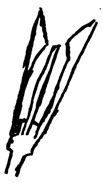
Their spear very serviceable. The inner, pointed part, of a hemlock knot; the side spring pieces, of hickory. Spear salmon, pickerel, trout, chub, etc.; also by birch-bark light at night, using the other end of spear as pole.
Their sled, jeborgon or jebongon (?), one foot wide, four or five long, of thin wood turned up in front; draw by a strong rope of basswood bark.
Canoe of moose-hide. One hide will hold three or four. Can be taken apart and put together very quickly. Can take out cross-bars and bring the sides together. A very convenient boat to carry and cross streams with. They say they did not make birch canoes till they had edge tools. The birches the lightest. They think our birches the same, only second growth.
Their kee-nong-gun, or cradle, has a hoop to prevent the child being hurt when it falls. Can’t eat dirt; can be hung up out of way of snakes.

Aboak-henjo [?], a birch-bark vessel for water. Can boil meat in it with hot stones; takes a long time. Also a vessel of birch bark, shaped like a pan. Both ornamented by scratching the bark, which is wrong side out. Very neatly made. Valued our kettles much.
Did not know use of eye in axe. Put a string through it and wore it round neck. Cut toes.
Did not like gun. Killed one moose; scared all the rest.
The squaw-heegun for cooking, a mere stick put through the game and stuck in the ground slanted over the fire, a spit. Can be eating one side while the other is doing.
The ar-tu-e-se, a stick, string, and bunch of leaves, which they toss and catch on the point of the stick. Make great use of it. Make the clouds go off the sun with it.
Snowshoes of two kinds; one of same shape at both ends so that the Mohawks could not tell which way they were going. (Put some rags in the heel-hole to make a toe-mark?)
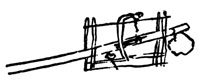
Side View
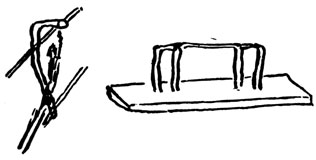
Log trap to catch many kinds of animals. Some for bears let the log fall six or seven feet. First there is a frame, then the little stick which the animal moves, presses down, as he goes through under the log; then the crooked stick is hung over the top of the frame, and holds up the log by a string; the weight of the log on this keeps the little stick up.

A drizzling and misty day this has been, melting the snow. The mist, divided into a thousand ghostly forms, was blowing across Walden. Mr. Emerson’s Cliff Hill, seen from the railroad through the mist, looked like a dark, heavy, frowning New Hampshire mountain. I do not understand fully why hills look so much larger at such a time, unless, being the most distant we see and in the horizon, we suppose them farther off and so magnify them. I think there can be no looming about it.
Nov. 28. Thursday. Cold drizzling and misty rains, which have melted the little snow. The farmers are beginning to pick up their dead wood. Within a day or two the walker finds gloves to be comfortable, and begins to think of an outside coat and of boots. Embarks in his boots for the winter voyage.
The Indian talked about “our folks” and “your folks,” “my grandfather” and “my grandfather’s cousin,” Samoset.
It is remarkable, but nevertheless true, as far as my observation goes, that women, to whom we commonly concede a somewhat finer and more sibylline nature, yield a more implicit obedience even to their animal instincts than men. The nature in them is stronger, the reason weaker. There are, for instance, many young and middle-aged men among my acquaintance—shoemakers, carpenters, farmers, and others—who have scruples about using animal food, but comparatively few girls or women. The latter, even the most refined, are the most intolerant of such reforms. I think that the reformer of the severest, as well as finest, class will find more sympathy in the intellect and philosophy of man than in the refinement and delicacy of woman. It is, perchance, a part of woman’s conformity and easy nature. Her savior must not be too strong, stern, and intellectual, but charitable above all things.
The thought of its greater independence and its closeness to nature diminishes the pain I feel when I see a more interesting child than usual destined to be brought up in a shanty. I see that for the present the child is happy and is not puny, and has all the wonders of nature for its toys. Have I not faith that its tenderness will in some way be cherished and protected, as the buds of the spring in the remotest and wildest wintry dell no less than in the garden plot and summer-house?
I am the little Irish boy That lives in the shanty. I am four years old to-day And shall soon be one and twenty. I shall grow up And be a great man, And shovel all day As hard as I can. Down in the Deep Cut, . . . . . Where the men lived Who made the railroad. For supper I have some potato And sometimes some bread, And then, if it’s cold, I go right to bed. I lie on some straw Under my father’s coat. At recess I play With little Billy Gray, And when school is done, Then home I run. And if I meet the cars, I get on the other track, And then I know whatever comes I needn’t look back. My mother does not cry, And my father does not scold, For I am a little Irish boy, And I’m four years old. Every day I go to school Along the railroad. It was so cold it made me cry The day that it snowed. And if my feet ache I do not mind the cold, For I am a little Irish boy, And I’m four years old.[101]
Nov. 29. Still misty, drizzling weather without snow or ice. The puffballs, with their open rays, checker the path-side in the woods, but they are not yet dry enough to make much dust. Damp weather in the fall seems to cause them to crack open, i. e. their outer skin. They look white like the shells of five-fingers on the shore.
The trees and shrubs look larger than usual when seen through the mist, perhaps because, though near, yet being in the visible horizon and there being nothing beyond to compare them with, we naturally magnify them, supposing them further off.
It is very still yet in the woods. There are no leaves to rustle, no crickets to chirp, and but few birds to sing.
The pines standing in the ocean of mist, seen from the Cliffs, are trees in every stage of transition from the actual to the imaginary. The near are more distinct, the distant more faint, till at last they are a mere shadowy cone in the distance. What, then, are these solid pines become? You can command only a circle of thirty or forty rods in diameter. As you advance, the trees gradually come out of the mist and take form before your eyes. You are reminded of your dreams. Life looks like a dream. You are prepared to see visions. And now, just before sundown, the night wind blows up more mist through the valley, thickening the veil which already hung over the trees, and the gloom of night gathers early and rapidly around. Birds lose their way.