V 1841 (ÆT. 23-24) (continued 2)
Reading edition
Man as he is, is not the subject of any art, strictly speaking. The naturalist pursues his study with love, but the moralist persecutes his with hate. In man is the material of a picture, with a design partly sketched, but Nature is such a picture drawn and colored. He is a studio, Nature a gallery. If men were not idealists, no sonnets to beautiful persons nor eulogies on worthy ones would ever be written. We wait for the preacher to express such love for his congregation as the botanist for his herbarium.
8. Man, however, detects something in the lingering ineradicable sympathy of Nature which seems to side with him against the stern decrees of the soul. Her essential friendliness is only the more apparent to his waywardness, for disease and sorrow are but a rupture with her. In proportion as he renounces his will, she repairs his hurts, and, if she burns, does oftener warm, if she freezes, oftener refreshes. This is the motherliness which the poet personifies, and the Sphinx, or wisely inquiring man, makes express a real concern for him. Nature shows us a stern kindness, and only we are unkind. She endures long with us, and though the severity of her law is unrelaxed, yet its evenness and impartiality look relenting, and almost sympathize with our fault.
9, 10, 11, 12, 13, 14. But to the poet there are no riddles. They are "pleasant songs" to him; his faith solves the enigmas which recurring wisdom does not fail to repeat. Poetry is the only solution time can offer. But the poet is soonest a pilgrim from his own faith. Our brave moments may still be distinguished from our wise. Though the problem is always solved for the soul, still does it remain to be solved by the intellect. Almost faith puts the question, for only in her light can it be answered. However true the answer, it does not prevent the question; for the best answer is but plausible, and man can only tell his relation to truth, but render no account of truth to herself.
9. Believe, and ask not, says the poet.
"Deep love lieth under These pictures of time; They fade in the light of Their meaning sublime."
Nothing is plain but love.
10, 11, 12, 13. Man comes short, because he seeks perfection. He adorns no world, while he is seeking to adorn a better. His best actions have no reference to their actual scenery. For when our actions become of that worth that they might confer a grace on Nature, they pass out of her into a higher arena, where they are still mean and awkward. So that the world beholds only the rear of great deeds, and mistakes them often for inconsistencies, not knowing with what higher they consist. Nature is beautiful as in repose, not promising a higher beauty to-morrow. Her actions are level to one another, and so are never unfit or inconsistent. Shame and remorse, which are so unsightly to her, have a prospective beauty and fitness which redeem them. We would have our lover to be nobler than we, and do not fear to sacrifice our love to his greater nobleness. Better the disagreement of noble lovers than the agreement of base ones. In friendship each will be nobler than the other, and so avoid the cheapness of a level and idle harmony. Love will have its chromatic strains,—discordant yearnings for higher chords,—as well as symphonies. Let us expect no finite satisfaction.
13. Who looks in the sun will see no light else; but also he will see no shadow. Our life revolves unceasingly, but the centre is ever the same, and the wise will regard only the seasons of the soul.
14. The poet concludes with the same trust he began with, and jeers at the blindness which could inquire. But our sphinx is so wise as to put no riddle that can be answered. It is a great presumption to answer conclusively a question which any sincerity has put. The wise answer no questions,—nor do they ask them. She silences his jeers with the conviction that she is the eye-beam of his eye. Our proper eye never quails before an answer. To rest in a reply, as a response of the oracle, that is error; but to suspect time's reply, because we would not degrade one of God's meanings to be intelligible to us, that is wisdom. We shall never arrive at his meaning, but it will ceaselessly arrive to us. The truth we seek with ardor and devotion will not reward us with a cheap acquisition. We run unhesitatingly in our career, not fearing to pass any goal of truth in our haste. We career toward her eternally. A truth rested in stands for all the vice of an age, and revolution comes kindly to restore health.
16. The cunning Sphinx, who had been hushed into stony silence and repose in us, arouses herself and detects a mystery in all things,—in infancy, the moon, fire, flowers, sea, mountain,—and,
(17) in the spirit of the old fable, declares proudly,—
"Who telleth one of my meanings Is master of all I am."
When some Œdipus has solved one of her enigmas, she will go dash her head against a rock.
You may find this as enigmatical as the Sphinx's riddle. Indeed, I doubt if she could solve it herself.
March 11. Thursday. Every man understands why a fool sings.
March 13. Saturday. There is a sort of homely truth and naturalness in some books, which is very rare to find, and yet looks quite cheap. There may be nothing lofty in the sentiment, or polished in the expression, but it is careless, countrified talk. The scholar rarely writes as well as the farmer talks. Homeliness is a great merit in a book; it is next to beauty and a high art. Some have this merit only. A few homely expressions redeem them. Rusticity is pastoral, but affectation merely civil. The scholar does not make his most familiar experience come gracefully to the aid of his expression, and hence, though he live in it, his books contain no tolerable pictures of the country and simple life. Very few men can speak of Nature with any truth. They confer no favor; they do not speak a good word for her. Most cry better than they speak. You can get more nature out of them by pinching than by addressing them. It is naturalness, and not simply good nature, that interests. I like better the surliness with which the woodchopper speaks of his woods, handling them as indifferently as his axe, than the mealy-mouthed enthusiasm of the lover of nature. Better that the primrose by the river's brim be a yellow primrose and nothing more, than the victim of his bouquet or herbarium, to shine with the flickering dull light of his imagination, and not the golden gleam of a star.
Aubrey relates of Thomas Fuller that his was "a very working head, in so much, that walking and meditating before dinner, he would eat up a penny loaf, not knowing that he did it. His natural memory was very great, to which he added the art of memory. He would repeat to you forwards and backwards all the signs from Ludgate to Charing-cross." These are very good and wholesome facts to know of a man, as copious as some modern volumes.
He also says of Mr. John Hales, that, "he loved Canarie" and was buried "under an altar monument of black marble ... with a too long epitaph;" of Edmund Halley, that he "at sixteen could make a dial, and then he said he thought himself a brave fellow;" of William Holder, who wrote a book upon his curing one Popham, who was deaf and dumb, "He was beholding to no author; did only consult with nature." For the most part an author but consults with all who have written before upon any subject, and his book is but the advice of so many. But a true book will never have been forestalled, but the topic itself will be new, and, by consulting with nature, it will consult not only with those who have gone before, but with those who may come after. There is always room and occasion enough for a true book on any subject, as there is room for more light the brightest day, and more rays will not interfere with the first.[227]
How alone must our life be lived! We dwell on the seashore, and none between us and the sea. Men are my merry companions, my fellow-pilgrims, who beguile the way but leave me at the first turn in the road, for none are travelling one road so far as myself.
Each one marches in the van. The weakest child is exposed to the fates henceforth as barely as its parents. Parents and relations but entertain the youth; they cannot stand between him and his destiny. This is the one bare side of every man. There is no fence; it is clear before him to the bounds of space.
What is fame to a living man? If he live aright, the sound of no man's voice will resound through the aisles of his secluded life. His life is a hallowed silence, a fane. The loudest sounds have to thank my little ear that they are heard.
March 15. When I have access to a man's barrel of sermons, which were written from week to week, as his life lapsed, though I now know him to live cheerfully and bravely enough, still I cannot conceive what interval there was for laughter and smiles in the midst of so much sadness. Almost in proportion to the sincerity and earnestness of the life will be the sadness of the record. When I reflect that twice a week for so many years he pondered and preached such a sermon, I think he must have been a splenetic and melancholy man, and wonder if his food digested well. It seems as if the fruit of virtue was never a careless happiness.
A great cheerfulness have all great wits possessed, almost a prophane levity to such as understood them not, but their religion had the broader basis in proportion as it was less prominent. The religion I love is very laic. The clergy are as diseased, and as much possessed with a devil, as the reformers. They make their topic as offensive as the politician, for our religion is as unpublic and incommunicable as our poetical vein, and to be approached with as much love and tenderness.
March 17. Wednesday. The stars go up and down before my only eye. Seasons come round to me alone. I cannot lean so hard on any arm as on a sunbeam. So solid men are not to my sincerity as is the shimmer of the fields.
March 19. Friday. No true and brave person will be content to live on such a footing with his fellow and himself as the laws of every household now require. The house is the very haunt and lair of our vice. I am impatient to withdraw myself from under its roof as an unclean spot. There is no circulation there; it is full of stagnant and mephitic vapors.
March 20. Even the wisest and best are apt to use their lives as the occasion to do something else in than to live greatly. But we should hang as fondly over this work as the finishing and embellishment of a poem.
It is a great relief when for a few moments in the day we can retire to our chamber and be completely true to ourselves. It leavens the rest of our hours. In that moment I will be nakedly as vicious as I am; this false life of mine shall have a being at length.
March 21. Sunday. To be associated with others by my friend's generosity when he bestows a gift is an additional favor to be grateful for.
March 27. Saturday. Magnanimity, though it look expensive for a short course, is always economy in the long run. Be generous in your poverty, if you would be rich. To make up a great action there are no subordinate mean ones. We can never afford to postpone a true life to-day to any future and anticipated nobleness. We think if by tight economy we can manage to arrive at independence, then indeed we will begin to be generous without stay. We sacrifice all nobleness to a little present meanness. If a man charges you eight hundred pay him eight hundred and fifty, and it will leave a clean edge to the sum. It will be like nature, overflowing and rounded like the bank of a river, not close and precise like a drain or ditch.
It is always a short step to peace—of mind.
Under this line there is or has been life; as, when I see the mole's raised gallery in the meadow, I know that he has passed underneath.
I must not lose any of my freedom by being a farmer and landholder. Most who enter on any profession are doomed men. The world might as well sing a dirge over them forthwith. The farmer's muscles are rigid. He can do one thing long, not many well. His pace seems determined henceforth; he never quickens it. A very rigid Nemesis is his fate. When the right wind blows or a star calls, I can leave this arable and grass ground, without making a will or settling my estate. I would buy a farm as freely as a silken streamer. Let me not think my front windows must face east henceforth because a particular hill slopes that way. My life must undulate still. I will not feel that my wings are clipped when once I have settled on ground which the law calls my own, but find new pinions grown to the old, and talaria to my feet beside.
March 30. Tuesday. I find my life growing slovenly when it does not exercise a constant supervision over itself. Its duds accumulate. Next to having lived a day well is a clear and calm overlooking of all our days.
FRIENDSHIP
Now we are partners in such legal trade, We'll look to the beginnings, not the ends, Nor to pay-day, knowing true wealth is made For current stock and not for dividends.
I am amused when I read how Ben Jonson engaged that the ridiculous masks with which the royal family and nobility were to be entertained should be "grounded upon antiquity and solid learning."[228]
April 1. ON THE SUN COMING OUT IN THE AFTERNOON
Methinks all things have travelled since you shined, But only Time, and clouds, Time's team, have moved; Again foul weather shall not change my mind, But in the shade I will believe what in the sun I loved.
In reading a work on agriculture, I skip the author's moral reflections, and the words "Providence" and "He" scattered along the page, to come at the profitable level of what he has to say. There is no science in men's religion; it does not teach me so much as the report of the committee on swine. My author shows he has dealt in corn and turnips and can worship God with the hoe and spade, but spare me his morality.[229]
April 3. Friends will not only live in harmony, but in melody.[230]
April 4. Sunday. The rattling of the tea-kettle below stairs reminds me of the cow-bells I used to hear when berrying in the Great Fields many years ago, sounding distant and deep amid the birches. That cheap piece of tinkling brass which the farmer hangs about his cow's neck has been more to me than the tons of metal which are swung in the belfry.
They who prepare my evening meal below Carelessly hit the kettle as they go, With tongs or shovel, And, ringing round and round, Out of this hovel It makes an Eastern temple by the sound. At first I thought a cow-bell, right at hand 'Mid birches, sounded o'er the open land, Where I plucked flowers Many years ago, Speeding midsummer hours With such secure delight they hardly seemed to flow.
April 5. This long series of desultory mornings does not tarnish the brightness of the prospective days. Surely faith is not dead. Wood, water, earth, air are essentially what they were; only society has degenerated. This lament for a golden age is only a lament for golden men.
I only ask a clean seat. I will build my lodge on the southern slope of some hill, and take there the life the gods send me. Will it not be employment enough to accept gratefully all that is yielded me between sun and sun?[231] Even the fox digs his own burrow. If my jacket and trousers, my boots and shoes, are fit to worship God in, they will do. Won't they, Deacon Spaulding?[232]
April 7. Wednesday. My life will wait for nobody, but is being matured still irresistibly while I go about the streets and chaffer with this man and that to secure it a living. It will cut its own channel, like the mountain stream, which by the longest ridges and by level prairies is not kept from the sea finally. So flows a man's life, and will reach the sea water, if not by an earthy channel, yet in dew and rain, overleaping all barriers, with rainbows to announce its victory. It can wind as cunningly and unerringly as water that seeks its level; and shall I complain if the gods make it meander? This staying to buy me a farm is as if the Mississippi should stop to chaffer with a clamshell.
What have I to do with plows? I cut another furrow than you see. Where the off ox treads, there is it not, it is farther off; where the nigh ox walks, it will not be, it is nigher still. If corn fails, my crop fails not. What of drought? What of rain? Is not my sand well clayed, my peat well sanded? Is it not underdrained and watered?[233]
My ground is high, But 'tis not dry, What you call dew Comes filtering through; Though in the sky, It still is nigh; Its soil is blue And virgin too.
If from your price ye will not swerve, Why, then I'll think the gods reserve A greater bargain there above, Out of their sup'rabundant love Have meantime better for me cared, And so will get my stock prepared, Plows of new pattern, hoes the same, Designed a different soil to tame, And sow my seed broadcast in air, Certain to reap my harvest there.
April 8. Friends are the ancient and honorable of the earth. The oldest men did not begin friendship. It is older than Hindostan and the Chinese Empire. How long has it been cultivated, and is still the staple article! It is a divine league struck forever. Warm, serene days only bring it out to the surface. There is a friendliness between the sun and the earth in pleasant weather; the gray content of the land is its color.
You can tell what another's suspicions are by what you feel forced to become. You will wear a new character, like a strange habit, in their presence.
April 9. Friday. It would not be hard for some quiet brave man to leap into the saddle to-day and eclipse Napoleon's career by a grander,—show men at length the meaning of war. One reproaches himself with supineness, that he too has sat quiet in his chamber, and not treated the world to the sound of the trumpet; that the indignation which has so long rankled in his breast does not take to horse and to the field. The bravest warrior will have to fight his battles in his dreams, and no earthly war note can arouse him. There are who would not run with Leonidas. Only the third-rate Napoleons and Alexanders does history tell of. The brave man does not mind the call of the trumpet nor hear the idle clashing of swords without, for the infinite din within. War is but a training, compared with the active service of his peace. Is he not at war? Does he not resist the ocean swell within him, and walk as gently as the summer's sea? Would you have him parade in uniform, and manœuvre men, whose equanimity is his uniform and who is himself manœuvred?
The times have no heart. The true reform can be undertaken any morning before unbarring our doors. It calls no convention. I can do two thirds the reform of the world myself. When two neighbors begin to eat corn bread, who before ate wheat, then the gods smile from ear to ear, for it is very pleasant to them. When an individual takes a sincere step, then all the gods attend, and his single deed is sweet.[234]
April 10. Saturday. I don't know but we should make life all too tame if we had our own way, and should miss these impulses in a happier time.
How much virtue there is in simply seeing! We may almost say that the hero has striven in vain for his pre-eminency, if the student oversees him. The woman who sits in the house and sees is a match for a stirring captain. Those still, piercing eyes, as faithfully exercised on their talent, will keep her even with Alexander or Shakespeare. They may go to Asia with parade, or to fairyland, but not beyond her ray. We are as much as we see. Faith is sight and knowledge. The hands only serve the eyes. The farthest blue streak in the horizon I can see, I may reach before many sunsets. What I saw alters not; in my night, when I wander, it is still steadfast as the star which the sailor steers by.
Whoever has had one thought quite lonely, and could contentedly digest that in solitude, knowing that none could accept it, may rise to the height of humanity, and overlook all living men as from a pinnacle.
Speech never made man master of men, but the eloquently refraining from it.
April 11. Sunday. A greater baldness my life seeks, as the crest of some bare hill, which towns and cities do not afford. I want a directer relation with the sun.
FRIENDSHIP'S STEADFASTNESS
True friendship is so firm a league That's maintenance falls into the even tenor Of our lives, and is no tie, But the continuance of our life's thread. If I would safely keep this new-got pelf, I have no care henceforth but watch myself, For lo! it goes untended from my sight, Waxes and wanes secure with the safe star of night. See with what liberal step it makes its way, As we could well afford to let it stray Throughout the universe, with the sun and moon, Which would dissolve allegiance as soon. Shall I concern myself for fickleness, And undertake to make my friends more sure, When the great gods out of sheer kindliness, Gave me this office for a sinecure?
Death cannot come too soon Where it can come at all, But always is too late Unless the fates it call.
April 15. Thursday. The gods are of no sect; they side with no man. When I imagine that Nature inclined rather to some few earnest and faithful souls, and specially existed for them, I go to see an obscure individual who lives under the hill, letting both gods and men alone, and find that strawberries and tomatoes grow for him too in his garden there, and the sun lodges kindly under his hillside, and am compelled to acknowledge the unbribable charity of the gods.
Any simple, unquestioned mode of life is alluring to men. The man who picks peas steadily for a living is more than respectable. He is to be envied by his neighbors.
April 16. I have been inspecting my neighbors' farms to-day and chaffering with the landholders, and I must confess I am startled to find everywhere the old system of things so grim and assured. Wherever I go the farms are run out, and there they lie, and the youth must buy old land and bring it to. Everywhere the relentless opponents of reform are a few old maids and bachelors, who sit round the kitchen fire, listening to the singing of the tea-kettle and munching cheese-rinds.[235]
April 18. Sunday. We need pine for no office for the sake of a certain culture, for all valuable experience lies in the way of a man's duty. My necessities of late have compelled me to study Nature as she is related to the farmer,—as she simply satisfies a want of the body. Some interests have got a footing on the earth which I have not made sufficient allowance for. That which built these barns and cleared the land thus had some valor.[236]
We take little steps, and venture small stakes, as if our actions were very fatal and irretrievable. There is no swing to our deeds. But our life is only a retired valley where we rest on our packs awhile. Between us and our end there is room for any delay. It is not a short and easy southern way, but we must go over snow-capped mountains to reach the sun.
April 20. You can't beat down your virtue; so much goodness it must have.
When a room is furnished, comfort is not furnished.
Great thoughts hallow any labor. To-day I earned seventy-five cents heaving manure out of a pen, and made a good bargain of it. If the ditcher muses the while how he may live uprightly, the ditching spade and turf knife may be engraved on the coat-of-arms of his posterity.
There are certain current expressions and blasphemous moods of viewing things, as when we say "he is doing a good business," more prophane than cursing and swearing. There is death and sin in such words. Let not the children hear them.
April 22. Thursday. There are two classes of authors: the one write the history of their times, the other their biography.
April 23. Friday. Any greatness is not to be mistaken. Who shall cavil at it? It stands once for all on a level with the heroes of history. It is not to be patronized. It goes alone.
When I hear music, I flutter, and am the scene of life, as a fleet of merchantmen when the wind rises.
April 24. Music is the sound of the circulation in nature's veins. It is the flux which melts nature. Men dance to it, glasses ring and vibrate, and the fields seem to undulate. The healthy ear always hears it, nearer or more remote.
It has been a cloudy, drizzling day, with occasional brightenings in the mist, when the trill of the tree sparrow seemed to be ushering in sunny hours.[237]
April 25. A momentous silence reigns always in the woods, and their meaning seems just ripening into expression. But alas! they make no haste. The rush sparrow,[238] Nature's minstrel of serene hours, sings of an immense leisure and duration.
When I hear a robin sing at sunset, I cannot help contrasting the equanimity of Nature with the bustle and impatience of man. We return from the lyceum and caucus with such stir and excitement, as if a crisis were at hand; but no natural scene or sound sympathizes with us, for Nature is always silent and unpretending as at the break of day. She but rubs her eyelids.
I am struck with the pleasing friendships and unanimities of nature in the woods, as when the moss on the trees takes the form of their leaves.
There is all of civilized life in the woods. Their wildest scenes have an air of domesticity and homeliness, and when the flicker's cackle is heard in the clearings, the musing hunter is reminded that civilization has imported nothing into them.[239] The ball-room is represented by the catkins of the alder at this season, which hang gracefully like a lady's ear-drops.
All the discoveries of science are equally true in their deepest recesses; nature there, too, obeys the same laws. Fair weather and foul concern the little red bug upon a pine stump; for him the wind goes round the right way and the sun breaks through the clouds.[240]
April 26. Monday. At R. W. E.'s.
The charm of the Indian to me is that he stands free and unconstrained in Nature, is her inhabitant and not her guest, and wears her easily and gracefully. But the civilized man has the habits of the house. His house is a prison, in which he finds himself oppressed and confined, not sheltered and protected. He walks as if he sustained the roof; he carries his arms as if the walls would fall in and crush him, and his feet remember the cellar beneath. His muscles are never relaxed. It is rare that he overcomes the house, and learns to sit at home in it, and roof and floor and walls support themselves, as the sky and trees and earth.
It is a great art to saunter.
April 27. It is only by a sort of voluntary blindness, and omitting to see, that we know ourselves, as when we see stars with the side of the eye. The nearest approach to discovering what we are is in dreams. It is as hard to see one's self as to look backwards without turning round. And foolish are they that look in glasses with that intent.
The porters have a hard time, but not so hard as he that carries his own shoulders. That beats the Smyrna Turks. Some men's broad shoulders are load enough. Even a light frame can stand under a great burden, if it does not have to support itself. Virtue is buoyant and elastic; it stands without effort and does not feel gravity; but sin plods and shuffles. Newton needed not to wait for an apple to fall to discover the attraction of gravitation; it was implied in the fall of man.
April 28. Wednesday. We falsely attribute to men a determined character; putting together all their yesterdays and averaging them, we presume we know them. Pity the man who has a character to support. It is worse than a large family. He is silent poor indeed. But in fact character is never explored, nor does it get developed in time, but eternity is its development, time its envelope. In view of this distinction, a sort of divine politeness and heavenly good breeding suggests itself, to address always the enveloped character of a man. I approach a great nature with infinite expectation and uncertainty, not knowing what I may meet. It lies as broad and unexplored before me as a scraggy hillside or pasture. I may hear a fox bark, or a partridge drum, or some bird new to these localities may fly up. It lies out there as old, and yet as new. The aspect of the woods varies every day, what with their growth and the changes of the seasons and the influence of the elements, so that the eye of the forester never twice rests upon the same prospect. Much more does a character show newly and variedly, if directly seen. It is the highest compliment to suppose that in the intervals of conversation your companion has expanded and grown. It may be a deference which he will not understand, but the nature which underlies him will understand it, and your influence will be shed as finely on him as the dust in the sun settles on our clothes. By such politeness we may educate one another to some purpose. So have I felt myself educated sometimes; I am expanded and enlarged.
April 29. Birds and quadrupeds pass freely through nature, without prop or stilt. But man very naturally carries a stick in his hand, seeking to ally himself by many points to nature, as a warrior stands by his horse's side with his hand on his mane. We walk the gracefuler for a cane, as the juggler uses a leaded pole to balance him when he dances on a slack wire.
Better a monosyllabic life than a ragged and muttered one; let its report be short and round like a rifle, so that it may hear its own echo in the surrounding silence.
April 30. Where shall we look for standard English but to the words of any man who has a depth of feeling in him? Not in any smooth and leisurely essay. From the gentlemanly windows of the country-seat no sincere eyes are directed upon nature, but from the peasant's horn windows a true glance and greeting occasionally. "For summer being ended, all things," said the Pilgrim, "stood in appearance with a weather-beaten face, and the whole country full of woods and thickets represented a wild and savage hue." Compare this with the agricultural report.
May 1. Saturday. Life in gardens and parlors is unpalatable to me. It wants rudeness and necessity to give it relish. I would at least strike my spade into the earth with as good will as the woodpecker his bill into a tree.[241]
WACHUSETT[242]
May 2.
Especial I remember thee, Wachusett, who like me Standest alone without society. Thy far blue eye, A remnant of the sky, Seen through the clearing or the gorge, Or from the windows of the forge, Doth leaven all it passes by. Nothing is true But stands 'tween me and you, Thou western pioneer, Who know'st not shame nor fear, By venturous spirit driven Under the eaves of heaven; And canst expand thee there, And breathe enough of air? Upholding heaven, holding down earth, Thy pastime from thy birth, Not steadied by the one, nor leaning on the other; May I approve myself thy worthy brother!
May 3. Monday. We are all pilots of the most intricate Bahama channels. Beauty may be the sky overhead, but Duty is the water underneath. When I see a man with serene countenance in the sunshine of summer, drinking in peace in the garden or parlor, it looks like a great inward leisure that he enjoys; but in reality he sails on no summer's sea, but this steady sailing comes of a heavy hand on the tiller. We do not attend to larks and bluebirds so leisurely but that conscience is as erect as the attitude of the listener. The man of principle gets never a holiday. Our true character silently underlies all our words and actions, as the granite underlies the other strata. Its steady pulse does not cease for any deed of ours, as the sap is still ascending in the stalk of the fairest flower.
May 6. Thursday. The fickle person is he that does not know what is true or right absolutely,—who has not an ancient wisdom for a lifetime, but a new prudence for every hour. We must sail by a sort of dead reckoning on this course of life, not speak any vessel nor spy any headland, but, in spite of all phenomena, come steadily to port at last. In general we must have a catholic and universal wisdom, wiser than any particular, and be prudent enough to defer to it always. We are literally wiser than we know. Men do not fail for want of knowledge, but for want of prudence to give wisdom the preference.[243] These low weathercocks on barns and fences show not which way the general and steady current of the wind sets,—which brings fair weather or foul,—but the vane on the steeple, high up in another stratum of atmosphere, tells that. What we need to know in any case is very simple.[244] I shall not mistake the direction of my life; if I but know the high land and the main,—on this side the Cordilleras, on that the Pacific,—I shall know how to run. If a ridge intervene, I have but to seek, or make, a gap to the sea.
May 9. Sunday. The pine stands in the woods like an Indian,—untamed, with a fantastic wildness about it, even in the clearings. If an Indian warrior were well painted, with pines in the background, he would seem to blend with the trees, and make a harmonious expression. The pitch pines are the ghosts of Philip and Massasoit. The white pine has the smoother features of the squaw.
The poet speaks only those thoughts that come unbidden, like the wind that stirs the trees, and men cannot help but listen. He is not listened to, but heard. The weathercock might as well dally with the wind as a man pretend to resist eloquence. The breath that inspires the poet has traversed a whole Campagna, and this new climate here indicates that other latitudes are chilled or heated.
Speak to men as to gods and you will not be insincere.
WESTWARD, HO!
The needles of the pine All to the west incline.[245]
THE ECHO OF THE SABBATH BELL HEARD IN THE WOODS[246]
Dong, sounds the brass in the east, As if for a civic feast, But I like that sound the best Out of the fluttering west. The steeple rings a knell, But the fairies' silvery bell Is the voice of that gentle folk, Or else the horizon that spoke. Its metal is not of brass, But air, and water, and glass, And under a cloud it is swung, And by the wind is rung, With a slim silver tongue. When the steeple tolls the noon, It soundeth not so soon, Yet it rings an earlier hour, And the sun has not reached its tower.
May 10. Monday. A good warning to the restless tourists of these days is contained in the last verses of Claudian's "Old Man of Verona."
"Erret, et extremos alter scrutetur Iberos. Plus habet hic vitae, plus habet ille viae."[247]
May 23. Sunday. Barn.—The distant woods are but the tassels of my eye.
Books are to be attended to as new sounds merely. Most would be put to a sore trial if the reader should assume the attitude of a listener. They are but a new note in the forest. To our lonely, sober thought the earth is a wild unexplored. Wildness as of the jay and muskrat reigns over the great part of nature. The oven-bird and plover are heard in the horizon. Here is a new book of heroes, come to me like the note of the chewink from over the fen, only over a deeper and wider fen. The pines are unrelenting sifters of thought; nothing petty leaks through them. Let me put my ear close, and hear the sough of this book, that I may know if any inspiration yet haunts it. There is always a later edition of every book than the printer wots of, no matter how recently it was published. All nature is a new impression every instant.
The aspects of the most simple object are as various as the aspects of the most compound. Observe the same sheet of water from different eminences. When I have travelled a few miles I do not recognize the profile of the hills of my native village.
May 27. Thursday. I sit in my boat on Walden, playing the flute this evening, and see the perch, which I seem to have charmed, hovering around me, and the moon travelling over the bottom, which is strewn with the wrecks of the forest, and feel that nothing but the wildest imagination can conceive of the manner of life we are living. Nature is a wizard. The Concord nights are stranger than the Arabian nights.
We not only want elbow-room, but eye-room in this gray air which shrouds all the fields. Sometimes my eyes see over the county road by daylight to the tops of yonder birches on the hill, as at others by moonlight.
Heaven lies above, because the air is deep.
In all my life hitherto I have left nothing behind.
May 31. Monday. That title, "The Laws of Menu[248] with the Gloss of Culluca," comes to me with such a volume of sound as if it had swept unobstructed over the plains of Hindostan; and when my eye rests on yonder birches, or the sun in the water, or the shadows of the trees, it seems to signify the laws of them all. They are the laws of you and me, a fragrance wafted down from those old times, and no more to be refuted than the wind.
When my imagination travels eastward and backward to those remote years of the gods, I seem to draw near to the habitation of the morning, and the dawn at length has a place. I remember the book as an hour before sunrise.
We are height and depth both, a calm sea at the foot of a promontory. Do we not overlook our own depths?
June 1. To have seen a man out of the East or West is sufficient to establish their reality and locality. I have seen a Mr. Wattles to-day, from Vermont, and now know where that is and that it is; a reformer, with two soldier's eyes and shoulders, who began to belabor the world at ten years, a ragged mountain boy, as fifer of a company, with set purpose to remould it from those first years.
The great person never wants an opportunity to be great, but makes occasion for all about him.
June 2. Wednesday. I am brought into the near neighborhood and am become a silent observer of the moon's paces to-night, by means of a glass, while the frogs are peeping all around me on the earth, and the sound of the accordion seems to come from some bright saloon yonder. I am sure the moon floats in a human atmosphere. It is but a distant scene of the world's drama. It is a wide theatre the gods have given us, and our actions must befit it. More sea and land, mountain and valley, here is,—a further West, a freshness and wildness in reserve when all the land shall be cleared.
I see three little lakes between the hills near its edge, reflecting the sun's rays. The light glimmers as on the water in a tumbler. So far off do the laws of reflection hold. I seem to see the ribs of the creature. This is the aspect of their day, its outside,—their heaven above their heads, towards which they breathe their prayers. So much is between me and them. It is noon there, perchance, and ships are at anchor in the havens or sailing on the seas, and there is a din in the streets, and in this light or that shade some leisurely soul contemplates.
But now dor-bugs fly over its disk and bring me back to earth and night.
June 7. Monday. The inhabitants of those Eastern plains seem to possess a natural and hereditary right to be conservative and magnify forms and traditions. "Immemorial custom is transcendent law," says Menu. That is, it was the custom of gods before men used it. The fault of our New England custom is that it is memorial. What is morality but immemorial custom? It is not manner but character, and the conservative conscience sustains it.[249]
We are accustomed to exaggerate the immobility and stagnation of those eras, as of the waters which levelled the steppes; but those slow revolving "years of the gods" were as rapid to all the needs of virtue as these bustling and hasty seasons. Man stands to revere, he kneels to pray. Methinks history will have to be tried by new tests to show what centuries were rapid and what slow. Corn grows in the night.[250] Will this bustling era detain the future reader longer? Will the earth seem to have conversed more with the heavens during these times? Who is writing better Vedas? How science and art spread and flourished, how trivial conveniences were multiplied, that which is the gossip of the world is not recorded in them; and if they are left out of our scripture, too, what will remain?
Since the Battle of Bunker Hill we think the world has not been at a standstill.
When I remember the treachery of memory and the manifold accidents to which tradition is liable, how soon the vista of the past closes behind,—as near as night's crescent to the setting day,—and the dazzling brightness of noon is reduced to the faint glimmer of the evening star, I feel as if it were by a rare indulgence of the fates that any traces of the past are left us,—that my ears which do not hear across the interval over which a crow caws should chance to hear this far-travelled sound. With how little coöperation of the societies, after all, is the past remembered!
I know of no book which comes to us with grander pretensions than the "Laws of Menu;" and this immense presumption is so impersonal and sincere that it is never offensive or ridiculous. Observe the modes in which modern literature is advertised, and then consider this Hindoo prospectus. Think what a reading public it addresses, what criticism it expects. What wonder if the times were not ripe for it?[251]
June 8. Having but one chair, I am obliged to receive my visitors standing, and, now I think of it, those old sages and heroes must always have met erectly.
July 10 to 12. This town, too, lies out under the sky, a port of entry and departure for souls to and from heaven.[252]
A slight sound at evening lifts me up by the ears, and makes life seem inexpressibly serene and grand. It may be in Uranus, or it may be in the shutter. It is the original sound of which all literature is but the echo. It makes all fear superfluous. Bravery comes from further than the sources of fear.
Aug. 1. Sunday. I never met a man who cast a free and healthy glance over life, but the best live in a sort of Sabbath light, a Jewish gloom. The best thought is not only without sombreness, but even without morality. The universe lies outspread in floods of white light to it. The moral aspect of nature is a jaundice reflected from man. To the innocent there are no cherubim nor angels. Occasionally we rise above the necessity of virtue into an unchangeable morning light, in which we have not to choose in a dilemma between right and wrong, but simply to live right on and breathe the circumambient air.[253] There is no name for this life unless it be the very vitality of vita. Silent is the preacher about this, and silent must ever be, for he who knows it will not preach.
Aug. 4. Wednesday. My pen is a lever which, in proportion as the near end stirs me further within, the further end reaches to a greater depth in the reader.
Nawshawtuct.—Far in the east I read Nature's Corn Law Rhymes. Here, in sight of Wachusett and these rivers and woods, my mind goes singing to itself of other themes than taxation. The rush sparrow sings still unintelligible, as from beyond a depth in me which I have not fathomed, where my future lies folded up. I hear several faint notes, quite outside me, which populate the waste.
This is such fresh and flowing weather, as if the waves of the morning had subsided over the day.
Aug. 6. If I am well, then I see well. The bulletins of health are twirled along my visual rays, like pasteboards on a kite string.
I cannot read a sentence in the book of the Hindoos without being elevated as upon the table-land of the Ghauts. It has such a rhythm as the winds of the desert, such a tide as the Ganges, and seems as superior to criticism as the Himmaleh Mounts. Even at this late hour, unworn by time, with a native and inherent dignity it wears the English dress as indifferently as the Sanscrit. The great tone of the book is of such fibre and such severe tension that no time nor accident can relax it.[254] The great thought is never found in a mean dress, but is of virtue to ennoble any language. Let it issue from the lips of the Wolofs, or from the forum of Rome, the nine Muses will seem to have been purveyors for it. Its education is always liberal; it has all the graces of oratory and of poetry. The lofty tone which is its indispensable breath is grace to the eye and music to the ear. It can endow a college.[255]
So supremely religious a book imposes with authority on the latest age. The very simplicity of style of the ancient lawgiver, implying all in the omission of all, proves an habitual elevation of thought, which the multiplied glosses of later days strive in vain to slope up to. The whole book by noble gestures and inclinations seems to render words unnecessary. The abbreviated sentence points to the thing for explanation. As the sublimest thought is most faithfully printed in the face, and needs the fewest interpreting words. The page nods toward the fact and is silent.
As I walk across the yard from the barn to the house through the fog, with a lamp in my hand, I am reminded of the Merrimack nights, and seem to see the sod between tent-ropes. The trees, seen dimly through the mist, suggest things which do not at all belong to the past, but are peculiar to my fresh New England life. It is as novel as green peas. The dew hangs everywhere upon the grass, and I breathe the rich, damp air in slices.
Aug. 7. Saturday. The impression which those sublime sentences made on me last night has awakened me before any cockcrowing. Their influence lingers around me like a fragrance, or as the fog hangs over the earth late into the day.
The very locusts and crickets of a summer day are but later or older glosses on the Dherma Sástra of the Hindoos, a continuation of the sacred code.[256]
Aug. 9. It is vain to try to write unless you feel strong in the knees.
Any book of great authority and genius seems to our imagination to permeate and pervade all space. Its spirit, like a more subtle ether, sweeps along with the prevailing winds of the country. Its influence conveys a new gloss to the meadows and the depths of the wood, and bathes the huckleberries on the hills, as sometimes a new influence in the sky washes in waves over the fields and seems to break on some invisible beach in the air. All things confirm it. It spends the mornings and the evenings.[257]
Everywhere the speech of Menu demands the widest apprehension and proceeds from the loftiest plateau of the soul. It is spoken unbendingly to its own level, and does not imply any contemporaneous speaker.
I read history as little critically as I consider the landscape, and am more interested in the atmospheric tints and various lights and shades which the intervening spaces create than in its groundwork and composition. It is the morning now turned evening and seen in the west,—the same sun, but a new light and atmosphere. Its beauty is like the sunset; not a fresco painting on a wall, flat and bounded, but atmospheric and roving, or free. But, in reality, history fluctuates as the face of the landscape from morning to evening. What is of moment in it is its hue and color. Time hides no treasures; we want not its then, but its now. We do not complain that the mountains in the horizon are blue and indistinct; they are the more like the heavens.
Of what moment are facts that can be lost,—which need to be commemorated? The monument of death will outlast the memory of the dead. The Pyramids do not tell the tale confided to them. The living fact commemorates itself. Why look in the dark for light? Look in the light rather. Strictly speaking, the Societies have not recovered one fact from oblivion, but they themselves are instead of the fact that is lost. The researcher is more memorable than the researched. The crowd stood admiring the mist and the dim outline of the trees seen through it, and when one of their number advanced to explore the phenomenon, with fresh admiration all eyes were turned on his dimly retreating figure. Critical acumen is exerted in vain to uncover the past; the past cannot be presented; we cannot know what we are not. But one veil hangs over past, present, and future, and it is the province of the historian to find out, not what was, but what is. Where a battle has been fought, you will find nothing but the bones of men and beasts; where a battle is being fought, there are hearts beating. We will sit on a mound and muse, and not try to make these skeletons stand on their legs again. Does Nature remember, think you, that they were men, or not rather that they are bones?
Ancient history has an air of antiquity. It should be more modern. It is written as if the spectator should be thinking of the back side of the picture on the wall, as if the author expected the dead would be his readers, and wished to detail to them their own experience. Men seem anxious to accomplish an orderly retreat through the centuries, earnestly rebuilding the works behind, as they are battered down by the incroachments of time; but while they loiter, they and their works both fall a prey to the enemy.
Biography is liable to the same objection; it should be autobiography. Let us not leave ourselves empty that, so vexing our bowels, we may go abroad and be somebody else to explain him. If I am not I, who will be? As if it were to dispense justice to all. But the time has not come for that.[258]
Aug. 12. We take pleasure in beholding the form of a mountain in the horizon, as if by retiring to this distance we had then first conquered it by our vision, and were made privy to the design of the architect; so when we behold the shadow of our earth on the moon's disk. When we climb a mountain and observe the lesser irregularities, we do not give credit to the comprehensive and general intelligence which shaped them; but when we see the outline in the horizon, we confess that the hand which moulded those opposite slopes, making one balance the other, worked round a deep centre, and was privy to the plan of the universe. The smallest of nature's works fits the farthest and widest view, as if it had been referred in its bearings to every point in space.[259] It harmonizes with the horizon line and the orbits of the planets.
Aug. 13. Friday. I have been in the swamp by Charles Miles's this afternoon, and found it so bosky and sylvan that Art would never have freedom or courage to imitate it. It can never match the luxury and superfluity of Nature. In Art all is seen; she cannot afford concealed wealth, and in consequence is niggardly; but Nature, even when she is scant and thin outwardly, contents us still by the assurance of a certain generosity at the roots. Surely no stinted hand has been at work here for these centuries to produce these particular tints this summer. The double spruce attracts me here, which I had hardly noticed in the gardens, and now I understand why men try to make them grow about their houses.[260]
Nature has her luxurious and florid style as well as Art. Having a pilgrim's cup to make, she gives to the whole—stem, bowl, handle, and nose—some fantastic shape, as if it were to be the car of a fabulous marine deity,—a Nereus or Triton. She is mythical and mystical always, and spends her whole genius upon the least work.[261]
Aug. 16. There is a double virtue in the sound that can wake an echo, as in the lowing of the cows this morning. Far out in the horizon that sound travels quite round the town, and invades each recess of the wood, advancing at a grand pace and with a sounding Eastern pomp.
Aug. 18. I sailed on the North River last night with my flute, and my music was a tinkling stream which meandered with the river, and fell from note to note as a brook from rock to rock. I did not hear the strains after they had issued from the flute, but before they were breathed into it, for the original strain precedes the sound by as much as the echo follows after, and the rest is the perquisite of the rocks and trees and beasts.[262] Unpremeditated music is the true gauge which measures the current of our thoughts, the very undertow of our life's stream.
Of all the duties of life it is hardest to be in earnest; it implies a good deal both before and behind. I sit here in the barn this flowing afternoon weather, while the school bell is ringing in the village, and find that all the things immediate to be done are very trivial. I could postpone them to hear this locust sing. The cockerels crow and the hens cluck in the yard as if time were dog-cheap. It seems something worth detaining time,—the laying of an egg. Cannot man do something to comfort the gods, and not let the world prove such a piddling concern? No doubt they would be glad to sell their shares at a large discount by this time. Eastern Railroad stock promises a better dividend.
The best poets, after all, exhibit only a tame and civil side of nature. They have not seen the west side of any mountain.
Day and night, mountain and wood, are visible from the wilderness as well as the village. They have their primeval aspects, sterner, savager than any poet has sung. It is only the white man's poetry. We want the Indian's report. Wordsworth is too tame for the Chippeway.[263]
The landscape contains a thousand dials which indicate the natural divisions of time; the shadows of a thousand styles point to the hour. The afternoon is now far advanced, and a fresh and leisurely wind is blowing on the river, causing long reaches of serene ripples. It has done its stent, and seems not to flow but lie at its length reflecting the light. The haze over the woods seems like the breath of all nature, rising from a myriad pores into the attenuated atmosphere.[264] It is sun smoke, the woof he has woven, his day's toil displayed.[265]
If I were awaked from a deep sleep, I should know which side the meridian the sun might be by the chirping of the crickets. Night has already insidiously set her foot in the valley in many places, where the shadows of the shrubs and fences begin to darken the landscape. There is a deeper shading in the colors of the afternoon landscape. Perhaps the forenoon is brighter than the afternoon, not only because of the greater transparency of the atmosphere then, but because we naturally look most into the west,—as we look forward into the day,—and so in the forenoon see the sunny side of things, but in the afternoon the shadow of every tree.
What a drama of light and shadow from morning to night! Soon as the sun is over the meridian, in deep ravines under the east side of the cliffs night forwardly plants her foot, and, as day retreats, steps into his trenches, till at length she sits in his citadel. For long time she skulks behind the needles of the pine, before she dares draw out her forces into the plain. Sun, moon, wind, and stars are the allies of one side or the other.[266]
How much will some officious men give to preserve an old book, of which perchance only a single [copy] exists, while a wise God is already giving, and will still give, infinitely more to get it destroyed!
Aug. 20. Friday. It seems as if no cock lived so far in the horizon but a faint vibration reached me here, spread the wider over earth as the more distant.
In the morning the crickets snore, in the afternoon they chirp, at midnight they dream.
Aug. 24. Let us wander where we will, the universe is built round about us, and we are central still. By reason of this, if we look into the heavens, they are concave, and if we were to look into a gulf as bottomless, it would be concave also. The sky is curved downward to the earth in the horizon, because I stand in the plain. I draw down its skirts. The stars so low there seem loth to go away from me, but by a circuitous path to be remembering and returning to me.[267]
Aug. 28. Saturday. A great poet will write for his peers alone, and indite no line to an inferior. He will remember only that he saw truth and beauty from his position, and calmly expect the time when a vision as broad shall overlook the same field as freely.[268]
Johnson can no more criticise Milton than the naked eye can criticise Herschel's map of the sun.
The art which only gilds the surface and demands merely a superficial polish, without reaching to the core, is but varnish and filigree. But the work of genius is rough-hewn from the first, because it anticipates the lapse of time and has an ingrained polish, which still appears when fragments are broken off, an essential quality of its substance. Its beauty is its strength. It breaks with a lustre, and splits in cubes and diamonds. Like the diamond, it has only to be cut to be polished, and its surface is a window to its interior splendors.
True verses are not counted on the poet's fingers, but on his heart-strings.
My life hath been the poem I would have writ, But I could not both live and live to utter it.[269]
In the Hindoo scripture the idea of man is quite illimitable and sublime. There is nowhere a loftier conception of his destiny. He is at length lost in Brahma himself, "the divine male." Indeed, the distinction of races in this life is only the commencement of a series of degrees which ends in Brahma.
The veneration in which the Vedas are held is itself a remarkable fact. Their code embraced the whole moral life of the Hindoo, and in such a case there is no other truth than sincerity. Truth is such by reference to the heart of man within, not to any standard without. There is no creed so false but faith can make it true.
In inquiring into the origin and genuineness of this scripture it is impossible to tell when the divine agency in its composition ceased, and the human began. "From fire, from air, and from the sun" was it "milked out."
There is no grander conception of creation anywhere. It is peaceful as a dream,[270] and so is the annihilation of the world. It is such a beginning and ending as the morning and evening, for they had learned that God's methods are not violent. It was such an awakening as might have been heralded by the faint dreaming chirp of the crickets before the dawn.
The very indistinctness of its theogony implies a sublime truth. It does not allow the reader to rest in any supreme first cause, but directly hints of a supremer still which created the last. The creator is still behind, increate.[271] The divinity is so fleeting that its attributes are never expressed.
Aug. 30. What is a day, if the day's work be not done? What are the divisions of time to them who have nothing to do? What is the present or the future to him who has no occasion for them, who does not create them by his industry?
It is now easy to apply to this ancient scripture such a catholic criticism as it will become the part of some future age to apply to the Christian,—wherein the design and idea which underlies it is considered, and not the narrow and partial fulfillment.
These verses are so eminently textual, that it seems as if those old sages had concentrated all their wisdom in little fascicles, of which future times were to be the commentary; as the light of this lower world is only the dissipated rays of the sun and stars.[272] They seem to have been uttered with a sober morning prescience, in the dawn of time.[273] There is a sort of holding back, or withdrawal of the full meaning, that the ages may follow after and explore the whole. The sentence opens unexpensively and almost unmeaningly, as the petals of a flower.[274]
To our nearsightedness this mere outward life seems a constituent part of us, and we do not realize that as our soul expands it will cast off the shell of routine and convention, which afterward will only be an object for the cabinets of the curious. But of this people the temples are now crumbled away, and we are introduced to the very hearth of Hindoo life and to the primeval conventicle where how to eat and to drink and to sleep were the questions to be decided.[275]
The simple life herein described confers on us a degree of freedom even in the perusal. We throw down our packs and go on our way unencumbered. Wants so easily and gracefully satisfied that they seem like a more refined pleasure and repleteness.[276]
Sept. 1. Wednesday. When I observe the effeminate taste of some of my contemporaries in this matter of poetry, and how hardly they bear with certain incongruities, I think if this age were consulted it would not choose granite to be the backbone of the world, but Bristol spar or Brazilian diamonds. But the verses which have consulted the refinements even of a golden age will be found weak and nerveless for an iron one. The poet is always such a Cincinnatus in literature as with republican simplicity to raise all to the chiefest honors of the state.
Each generation thinks to inhabit only a west end of the world, and have intercourse with a refined and civilized Nature, not conceiving of her broad equality and republicanism. They think her aristocratic and exclusive because their own estates are narrow. But the sun indifferently selects his rhymes, and with a liberal taste weaves into his verse the planet and the stubble.[277]
Let us know and conform only to the fashions of eternity.
The very austerity of these Hindoos is tempting to the devotional as a more refined and nobler luxury.[278] They seem to have indulged themselves with a certain moderation and temperance in the severities which their code requires, as divine exercises not to be excessively used as yet. One may discover the root of a Hindoo religion in his own private history, when, in the silent intervals of the day or the night, he does sometimes inflict on himself like austerities with a stern satisfaction.
The "Laws of Menu" are a manual of private devotion, so private and domestic and yet so public and universal a word as is not spoken in the parlor or pulpit in these days.[279] It is so impersonal that it exercises our sincerity more than any other. It goes with us into the yard and into the chamber, and is yet later spoken than the advice of our mother and sisters.[280]
Sept. 2. Thursday. There is but one obligation, and that is the obligation to obey the highest dictate. None can lay me under another which will supersede this. The gods have given me these years without any incumbrance; society has no mortgage on them. If any man assist me in the way of the world, let him derive satisfaction from the deed itself, for I think I never shall have dissolved my prior obligations to God. Kindness repaid is thereby annulled. I would let his deed lie as fair and generous as it was intended. The truly beneficent never relapses into a creditor; his great kindness is still extended to me and is never done. Of those noble deeds which have me for their object I am only the most fortunate spectator, and would rather be the abettor of their nobleness than stay their tide with the obstructions of impatient gratitude. As true as action and reaction are equal, that nobleness which was as wide as the universe will rebound not on him the individual, but on the world. If any have been kind to me, what more do they want? I cannot make them richer than they are. If they have not been kind, they cannot take from me the privilege which they have not improved. My obligations will be my lightest load, for that gratitude which is of kindred stuff in me, expanding every pore, will easily sustain the pressure. We walk the freest through the air we breathe.
The sublime sentences of Menu carry us back to a time when purification and sacrifice and self-devotion had a place in the faith of men, and were not as now a superstition. They contain a subtle and refined philosophy also, such as in these times is not accompanied with so lofty and pure a devotion.
I saw a green meadow in the midst of the woods to-day which looked as if Dame Nature had set her foot there, and it had bloomed in consequence. It was the print of her moccasin.
Sometimes my thought rustles in midsummer as if ripe for the fall.[281] I anticipate the russet hues and the dry scent of autumn, as the feverish man dreams of balm and sage.
I was informed to-day that no Hindoo tyranny presided at the framing of the world,—that I am a freeman of the universe, and not sentenced to any caste.[282]
When I write verses I serve my thoughts as I do tumblers; I rap them to see if they will ring.
Sept. 3. Friday. Next to Nature, it seems as if man's actions were the most natural, they so gently accord with her. The small seines of flax or hemp stretched across the shallow and transparent parts of the river are no more intrusion than the cobweb in the sun. It is very slight and refined outrage at most. I stay my boat in mid-current and look down in the running water to see the civil meshes of his nets, and wonder how the blustering people of the town could have done this elvish work. The twine looks like a new river-weed and is to the river like a beautiful memento of man, man's presence in nature discovered as silently and delicately as Robinson discovered that there [were] savages on his island by a footprint in the sand.[283]
Moonlight is the best restorer of antiquity. The houses in the village have a classical elegance as of the best days of Greece, and this half-finished church reminds me of the Parthenon, or whatever is most famous and excellent in art.[284] So serene it stands, reflecting the moon, and intercepting the stars with its rafters, as if it were refreshed by the dews of the night equally with me. By day Mr. Hosmer, but by night Vitruvius rather. If it were always to stand in this mild and sombre light it would be finished already. It is in progress by day but completed by night, and already its designer is an old master. The projecting rafter so carelessly left on the tower, holding its single way through the sky, is quite architectural, and in the unnecessary length of the joists and flooring of the staging around the walls there is an artistic superfluity and grace. In these fantastic lines described upon the sky there is no trifling or conceit. Indeed, the staging for the most part is the only genuine native architecture and deserves to stand longer than the building it surrounds. In this obscurity there are no fresh colors to offend, and the light and shade of evening adorn the new equally with the old.
Sept. 4. Saturday. I think I could write a poem to be called "Concord." For argument I should have the River, the Woods, the Ponds, the Hills, the Fields, the Swamps and Meadows, the Streets and Buildings, and the Villagers. Then Morning, Noon, and Evening, Spring, Summer, Autumn, and Winter, Night, Indian Summer, and the Mountains in the Horizon.
A book should be so true as to be intimate and familiar to all men, as the sun to their faces,—such a word as is occasionally uttered to a companion in the woods in summer, and both are silent.
As I pass along the streets of the village on the day of our annual fair, when the leaves strew the ground, I see how the trees keep just such a holiday all the year. The lively spirits of their sap mount higher than any plowboy's let loose that day. A walk in the autumn woods, when, with serene courage, they are preparing for their winter campaign, if you have an ear for the rustling of their camp or an eye for the glancing of their armor, is more inspiring than the Greek or Peninsular war.[285] Any grandeur may find society as great as itself in the forest.
Pond Hill.—I see yonder some men in a boat, which floats buoyantly amid the reflections of the trees, like a feather poised in mid-air, or a leaf wafted gently from its twig to the water without turning over. They seem very delicately to have availed themselves of the natural laws, and their floating there looks like a beautiful and successful experiment in philosophy. It reminds me how much more refined and noble the life of man might be made, how its whole economy might be as beautiful as a Tuscan villa,[286]—a new and more catholic art, the art of life, which should have its impassioned devotees and make the schools of Greece and Rome to be deserted.
Sept. 5. Saturday. Barn.
Greater is the depth of sadness Than is any height of gladness.
I cannot read much of the best poetry in prose or verse without feeling that it is a partial and exaggerated plaint, rarely a carol as free as Nature's. That content which the sun shines for between morning and evening is unsung. The Muse solaces herself; she is not delighted but consoled.[287] But there are times when we feel a vigor in our limbs, and our thoughts are like a flowing morning light, and the stream of our life without reflection shows long reaches of serene ripples. And if we were to sing at such an hour, there would be no catastrophe contemplated in our verse, no tragic element in it,[288] nor yet a comic. For the life of the gods is not in any sense dramatic, nor can be the subject of the drama; it is epic without beginning or end, an eternal interlude without plot,—not subordinate one part to another, but supreme as a whole, at once leaf and flower and fruit. At present the highest strain is Hebraic. The church bell is the tone of all religious thought, the most musical that men consent to sing. In the youth of poetry, men love to praise the lark and the morning, but they soon forsake the dews and skies for the nightingale and evening shades. Without instituting a wider comparison I might say that in Homer there is more of the innocence and serenity of youth than in the more modern and moral poets. The Iliad is not Sabbath but morning reading, and men cling to this old song, because they have still moments of unbaptized and uncommitted life which give them an appetite for more. There is no cant in him, as there is no religion. We read him with a rare sense of freedom and irresponsibleness, as though we trod on native ground, and were autochthones of the soil.[289]
Through the fogs of this distant vale we look back and upward to the source of song, whose crystal stream still ripples and gleams in the clear atmosphere of the mountain's side.
Some hours seem not to be occasion for anything, unless for great resolves to draw breath and repose in, so religiously do we postpone all action therein. We do not straight go about to execute our thrilling purpose, but shut our doors behind us, and saunter with prepared mind, as if the half were already done.[290]
Sometimes a day serves only to hold time together.[291]
Sept. 12. Sunday.
Where I have been There was none seen.
Sept. 14. No bravery is to be named with that which can face its own deeds.
In religion there is no society.
Do not dissect a man till he is dead.
Love does not analyze its object.
We do not know the number of muscles in a caterpillar dead; much less the faculties of a man living.
You must believe that I know before you can tell me.
To the highest communication I can make no reply; I lend only a silent ear.
Sept. 18. Saturday. Barn.—It is a great event, the hearing of a bell ring in one of the neighboring towns, particularly in the night. It excites in me an unusual hilarity, and I feel that I am in season wholly and enjoy a prime and leisure hour.
Sept. 20. Monday. Visited Sampson Wilder of Boston. His method of setting out peach trees is as follows:—
Dig a hole six feet square and two deep, and remove the earth; cover the bottom to the depth of six inches with lime and ashes in equal proportions, and upon this spread another layer of equal thickness, of horn parings, tips of horns, bones, and the like, then fill up with a compost of sod and strong animal manure, say four bushels of hog manure to a cartload of sod. Cover the tree—which should be budded at two years old—but slightly, and at the end of two years dig a trench round it three feet from the tree and six inches deep, and fill it with lime and ashes.
For grapes:—
Let your trench be twelve feet wide and four deep, cover the bottom with paving-stones six inches, then old bricks with mortar attached or loose six inches more, then beef-bones, horns, etc., six more (Captain Bobadil), then a compost similar to the preceding. Set your roots one foot from the north side, the trench running east and west, and bury eight feet of the vine crosswise the trench, not more than eight inches below the surface. Cut it down for three or four years, that root may accumulate, and then train it from the sun up an inclined plane.
Sept. 28. Tuesday. I anticipate the coming in of spring as a child does the approach of some pomp through a gate of the city.
Sept. 30.
Better wait Than be too late.[292]
Nov. 29. Cambridge.—One must fight his way, after a fashion, even in the most civil and polite society. The most truly kind and gracious have to be won by a sort of valor, for the seeds of suspicion seem to lurk in every spadeful of earth, as well as those of confidence. The president and librarian turn the cold shoulder to your application, though they are known for benevolent persons. They wonder if you can be anything but a thief, contemplating frauds on the library. It is the instinctive and salutary principle of self-defense; that which makes the cat show her talons when you take her by the paw.[293]
Certainly that valor which can open the hearts of men is superior to that which can only open the gates of cities.[294]
You must always let people see that they serve themselves more than you,—not by your ingratitude, but by sympathy and congratulation.
The twenty-first volume of Chalmers's English Poets contains Hoole's and Mickle's Translations. In the shape of a note to the Seventh Book of the Lusiad, Mickle has written a long "Inquiry into the Religious Tenets and Philosophy of the Bramins."
Nov. 30. Tuesday. Cambridge.—When looking over the dry and dusty volumes of the English poets, I cannot believe that those fresh and fair creations I had imagined are contained in them. English poetry from Gower down, collected into one alcove, and so from the library window compared with the commonest nature, seems very mean. Poetry cannot breathe in the scholar's atmosphere. The Aubreys and Hickeses, with all their learning, prophane it yet indirectly by their zeal. You need not envy his feelings who for the first time has cornered up poetry in an alcove. I can hardly be serious with myself when I remember that I have come to Cambridge after poetry; and while I am running over the catalogue and collating and selecting, I think if it would not be a shorter way to a complete volume to step at once into the field or wood, with a very low reverence to students and librarians. Milton did not foresee what company he was to fall into.[295] On running over the titles of these books, looking from time to time at their first pages or farther, I am oppressed by an inevitable sadness. One must have come into a library by an oriel window, as softly and undisturbed as the light which falls on the books through a stained window, and not by the librarian's door, else all his dreams will vanish. Can the Valhalla be warmed by steam and go by clock and bell?
Good poetry seems so simple and natural a thing that when we meet it we wonder that all men are not always poets. Poetry is nothing but healthy speech. Though the speech of the poet goes to the heart of things, yet he is that one especially who speaks civilly to Nature as a second person and in some sense is the patron of the world. Though more than any he stands in the midst of Nature, yet more than any he can stand aloof from her. The best lines, perhaps, only suggest to me that that man simply saw or heard or felt what seems the commonest fact in my experience.
One will know how to appreciate Chaucer best who has come down to him the natural way through the very meagre pastures of Saxon and ante-Chaucerian poetry. So human and wise he seems after such diet that we are as liable to misjudge him so as usually.[296]
The Saxon poetry extant seems of a more serious and philosophical cast than the very earliest that can be called English. It has more thought, but less music. It translates Boëthius, it paraphrases the Hebrew Bible, it solemnly sings of war, of life and death, and chronicles events. The earliest English poetry is tinctured with romance through the influence of the Normans, as the Saxon was not. The ballad and metrical romance belong to this period. Those old singers were for the most part imitators or translators.[297] Or will it not appear, when viewed at a sufficient distance, that our brave new poets are also secondary as they, and refer the eye that reads them and their poetry, too, back and backward without end?
Nothing is so attractive and unceasingly curious as character. There is no plant that needs such tender treatment, there is none that will endure so rough. It is the violet and the oak. It is the thing we mean, let us say what we will. We mean our own character, or we mean yours. It is divine and related to the heavens, as the earth is by the flashes of the Aurora. It has no acquaintance nor companion. It goes silent and unobserved longer than any planet in space, but when at length it does show itself, it seems like the flowering of all the world, and its before unseen orbit is lit up like the trail of a meteor. I hear no good news ever but some trait of a noble character. It reproaches me plaintively. I am mean in contrast, but again am thrilled and elevated that I can see my own meanness, and again still, that my own aspiration is realized in that other. You reach me, my friend, not by your kind or wise words to me here or there; but as you retreat, perhaps after years of vain familiarity, some gesture or unconscious action in the distance speaks to me with more emphasis than all those years. I am not concerned to know what eighth planet is wandering in space up there, or when Venus or Orion rises, but if, in any cot to east or west and set behind the woods, there is any planetary character illuminating the earth.
Packed in my mind lie all the clothes Which outward nature wears, For, as its hourly fashions change, It all things else repairs. My eyes look inward, not without, And I but hear myself, And this new wealth which I have got Is part of my own pelf. For while I look for change abroad, I can no difference find, Till some new ray of peace uncalled Lumines my inmost mind, As, when the sun streams through the wood, Upon a winter's morn, Where'er his silent beams may stray The murky night is gone. How could the patient pine have known The morning breeze would come, Or simple flowers anticipate The insect's noonday hum, Till that new light with morning cheer From far streamed through the aisles, And nimbly told the forest trees For many stretching miles?[298]
[Dec.] 12. Sunday. All music is only a sweet striving to express character. Now that lately I have heard of some traits in the character of a fair and earnest maiden whom I had only known superficially, but who has gone hence to make herself more known by distance, they sound like strains of a wild harp music. They make all persons and places who had thus forgotten her to seem late and behindhand. Every maiden conceals a fairer flower and more luscious fruit than any calyx in the field, and if she go with averted face, confiding in her own purity and high resolves, she will make the heavens retrospective, and all nature will humbly confess its queen.[299]
There is apology enough for all the deficiency and shortcoming in the world in the patient waiting of any bud of character to unfold itself.
Only character can command our reverent love. It is all mysteries in itself.
What is it gilds the trees and clouds And paints the heavens so gay, But yonder fast-abiding light With its unchanging ray? I've felt within my inmost soul Such cheerful morning news, In the horizon of my mind I've seen such morning hues, As in the twilight of the dawn, When the first birds awake, Is heard within some silent wood Where they the small twigs break; Or in the eastern skies is seen Before the sun appears, Foretelling of the summer heats Which far away he bears.
P. M. Walden.—I seem to discern the very form of the wind when, blowing over the hills, it falls in broad flakes upon the surface of the pond, this subtle element obeying the same law with the least subtle. As it falls it spreads itself like a mass of lead dropped upon an anvil. I cannot help being encouraged by this blithe activity in the elements in these degenerate days of men. Who hears the rippling of the rivers will not utterly despair of anything. The wind in the wood yonder sounds like an incessant waterfall, the water dashing and roaring among rocks.
[Dec.] 13. Monday. We constantly anticipate repose. Yet it surely can only be the repose that is in entire and healthy activity. It must be a repose without rust. What is leisure but opportunity for more complete and entire action? Our energies pine for exercise. That time we spend in our duties is so much leisure, so that there is no man but has sufficient of it.
I make my own time, I make my own terms. I cannot see how God or Nature can ever get the start of me.
This ancient Scotch poetry, at which its contemporaries so marvelled, sounds like the uncertain lisping of a child. When man's speech flows freest it but stutters and stammers. There is never a free and clear deliverance; but, read now when the illusion of smooth verse is destroyed by the antique spelling, the sense is seen to stammer and stumble all the plainer. To how few thoughts do all these sincere efforts give utterance! An hour's conversation with these men would have done more. I am astonished to find how meagre that diet is which has fed so many men. The music of sound, which is all-sufficient at first, is speedily lost, and then the fame of the poet must rest on the music of the sense. A great philosophical and moral poet would give permanence to the language by making the best sound convey the best sense.
[Dec.] 14. Tuesday. To hear the sunset described by the old Scotch poet Douglas, as I have seen it, repays me for many weary pages of antiquated Scotch. Nothing so restores and humanizes antiquity and makes it blithe as the discovery of some natural sympathy between it and the present. Why is it that there is something melancholy in antiquity? We forget that it had any other future than our present. As if it were not as near to the future as ourselves! No, thank heavens, these ranks of men to right and left, posterity and ancestry, are not to be thridded by any earnest mortal. The heavens stood over the heads of our ancestors as near as to us. Any living word in their books abolishes the difference of time. It need only be considered from the present standpoint.
[Dec.] 15. Wednesday. A mild summer sun shines over forest and lake. The earth looks as fair this morning as the Valhalla of the gods. Indeed our spirits never go beyond nature. In the woods there is an inexpressible happiness. Their mirth is but just repressed. In winter, when there is but one green leaf for many rods, what warm content is in them! They are not rude, but tender, even in the severest cold. Their nakedness is their defense. All their sounds and sights are elixir to my spirit. They possess a divine health. God is not more well. Every sound is inspiriting and fraught with the same mysterious assurance, from the creaking of the boughs in January to the soft sough of the wind in July.
How much of my well-being, think you, depends on the condition of my lungs and stomach,—such cheap pieces of Nature as they, which, indeed, she is every day reproducing with prodigality. Is the arrow indeed fatal which rankles in the breast of the bird on the bough, in whose eye all this fair landscape is reflected, and whose voice still echoes through the wood?
The trees have come down to the bank to see the river go by. This old, familiar river is renewed each instant; only the channel is the same.[300] The water which so calmly reflects the fleeting clouds and the primeval trees I have never seen before. It may have washed some distant shore, or framed a glacier or iceberg at the north, when I last stood here. Seen through a mild atmosphere, the works of the husbandman, his plowing and reaping, have a beauty to the beholder which the laborer never sees.[301]
I seem to see somewhat more of my own kith and kin in the lichens on the rocks than in any books. It does seem as if mine were a peculiarly wild nature, which so yearns toward all wildness. I know of no redeeming qualities in me but a sincere love for some things, and when I am reproved I have to fall back on to this ground.[302] This is my argument in reserve for all cases. My love is invulnerable. Meet me on that ground, and you will find me strong. When I am condemned, and condemn myself utterly, I think straightway, "But I rely on my love for some things." Therein I am whole and entire. Therein I am God-propped.
When I see the smoke curling up through the woods from some farmhouse invisible, it is more suggestive of the poetry of rural and domestic life than a nearer inspection can be. Up goes the smoke as quietly as the dew exhales in vapor from these pine leaves and oaks; as busy, disposing itself in circles and in wreaths, as the housewife on the hearth below. It is cotemporary with a piece of human biography, and waves as a feather in some man's cap. Under that rod of sky there is some plot a-brewing, some ingenuity has planted itself, and we shall see what it will do. It tattles of more things than the boiling of the pot. It is but one of man's breaths. All that is interesting in history or fiction is transpiring beneath that cloud. The subject of all life and death, of happiness and grief, goes thereunder.
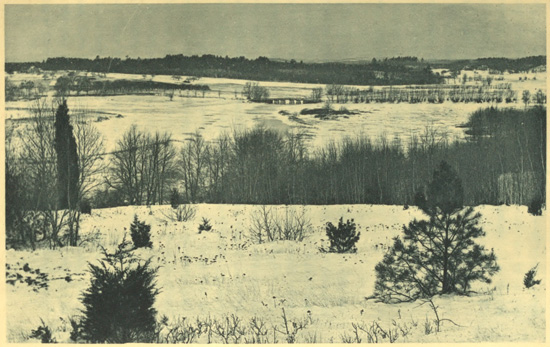
Winter Landscape from Fair Haven Hill
When the traveller in the forest, attaining to some eminence, descries a column of smoke in the distance, it is a very gentle hint to him of the presence of man. It seems as if it would establish friendly relations between them without more ado.[303]
[Dec.] 18. Saturday. Some men make their due impression upon their generation, because a petty occasion is enough to call forth all their energies; but are there not others who would rise to much higher levels, whom the world has never provoked to make the effort? I believe there are men now living who have never opened their mouths in a public assembly, in whom nevertheless there is such a well of eloquence that the appetite of any age could never exhaust it; who pine for an occasion worthy of them, and will pine till they are dead; who can admire, as well as the rest, at the flowing speech of the orator, but do yet miss the thunder and lightning and visible sympathy of the elements which would garnish their own utterance.
If in any strait I see a man fluttered and his ballast gone, then I lose all hope of him, he is undone; but if he reposes still, though he do nothing else worthy of him, if he is still a man in reserve, then is there everything to hope of him. The age may well go pine itself that it cannot put to use this gift of the gods. He lives on, still unconcerned, not needing to be used. The greatest occasion will be the slowest to come.
Sometimes a particular body of men do unconsciously assert that their will is fate, that the right is decided by their fiat without appeal, and when this is the case they can never be mistaken; as when one man is quite silenced by the thrilling eloquence of another, and submits to be neglected as to his fate, because such is not the willful vote of the assembly, but their instinctive decision.