Front matter (continued 2)
Reading edition
From birth to death the infringin' goes on, you can't take up a newspaper now but you see signs on't. In the good old times when a man had a child born to him to carry on his name and his propputy to future generations, he took the credit on't. How is it told on now? instead of puttin' it in as it used to be, and ort to be, "John Smith has got a son, John Smith Jr."—it is writ down now in this fool way:
"A son is born to John and Mary Smith." What's the use on't? John's name is enough any fool would know there wuz a female somewhere connected with the event in a womanly onobstrusive way, but why do they have to bring her name forward to set her up, and spile her, and mention all these little petickulars?
Why, how wuz it in Bible times, as I asked Samantha, sez I, "From the very first it wuz set down as it ort to be and a sample to foller, Noah begot Ham, and Ham begot Cush, and Cush begot Nimrod, and they kep' on begettin' and begettin', chapter after chapter, and no female's name connected with it in any way, shape or manner." Sez I, "Hain't that a solemn proof, Samantha, that females are inferior and wuzn't considered worth writin' about?" Sez I, "You nor no other Female Suffragist can squirm out of that."
Sez Samantha, "Men translated the Bible, but I can tell you," sez she, "that when Miss Ham, racked with agonizin' pain, went down to death's door for little Cush, whilst Mr. Ham wuz santerin' round Canean smart as a cricket, and probable flirtin' with some good lookin' four-mother, if Miss Ham had writ it up for the Daily Paper her name would been mentioned in the transaction."
That's jest the way it is, even Bible proof can't stop wimmen's clack and argyin'. Yes, jest as I said, infringin' follers a man from the cradle to the grave. For I'll be hanged if you don't see it writ nowdays, "James Brown, beloved husband of Sarah Brown." How bold, how forward! husband of! It seems as if it is enough to make his grampa, old Jotham Brown, turn over in his grave and try to git up, to stop such doin's. He lived in a time when females knowed their place and kep' in it. He had twenty-one children by his seven different wives, and every one on 'em wuz put in the paper and the old Fambly Bible credited to him; ketch him havin' any female's name mixed up with it, oh no! They couldn't infringe on him, not whilst he wuz alive, they couldn't. He worked his wives hard, and when one died off, he married another. He said as long as the Lord kep' takin' 'em, he should.
As I said no female couldn't git the better of him whilst he wuz alive, but they played a nasty mean trick on him after he wuz dead. His last wife wuz a high headed creeter, or would have been if he hadn't broke her in, and held her head down with such a tight rain. But owin' to his disagreein' with all his children and bloody relatives she got the propputy all in her hands, and after he died she got tall noble gravestuns for every one of his different wives, almost monuments, with a long verse of poetry on each one on 'em, and their names writ down in full.
"Mahala Eliza—Mehitable Jane—Amanda Mandana—Drusilly Charity—Priscilla Charlotte—Alzina Trypheena—Diantha Cordelia—all carved in big deep letters, and their names before they wuz married. These seven high stuns stood in a sort of a half circle with a little low stun in the center and on it printed in little letters wuz:
"Our Husband."
It looked dretful; but his children all hatin' him as they did they didn't interfere. But it wuz a mean trick and she couldn't have done it if he'd been alive, no indeed. But seein' he wuzn't there to rain her in and hold her down, she took the advantage on him as wimmen will if you give 'em the chance. Folks all thought she done it to come up with him for bein' so hard on his different wives, and keepin' 'em down so, and I presoom she did. I presoom she wuz a regular female infringer and suffrager.
Now in the marriage notices, instead of bein' put in the newspaper in the modest becomin' way it used to be, "John Smith's son married to Mary Brown," it has to be put in Mr. and Mrs. Smith's son or daughter is married. Where is the good horse sense on't? Everybody would know that young Smith had a mother somewhere in the background, but what's the use of bringin' her forward so and makin' on her? It is jest to infringe on men, that's what it is for.
And when Luke Dingman married Nancy Whittle she had the money to start a store bizness, but Luke bein' a man, his wuz the name that ort to been spoke on, and he went and got a handsome sign all painted "Luke Dingman's Store." And if you'll believe it Nancy made him git it painted all over agin "L. and N. Dingman's Store." What wuz the use of draggin' a female's initional into it? Jest to infringe on us men. But lots of men made fun on't and told Luke he'd ort to been man enough to stand his ground and kep' the first sign. They say it makes Luke real huffy, and he takes it out on Nancy, is dretful mean to her, but she's only got herself to blame, she hadn't ort to infringed on him.
And last week Samantha and I went to Philena Peedick's weddin'. And when the minister asked, "Who giveth this woman to this man?" the widder Peedick walked up bold as brass, and gin Philena away, she, a female woman! Never, as I told Uncle Sime, never did I see a plainer or more flagrant case of infringin' on men's rights. Why, Philena had a male uncle there, and ruther than see such things go on I would have gin her away myself.
But thank Heaven, there is one thing they hain't changed yet, females have got to knuckle down and be gin away to a man, in marriage, that's a little comfort. "Who giveth this woman!" They have got to hear that, much as it may gald 'em.
But as I told Uncle Sime, it would be jest like 'em to try to change that. And I told him the first we knew a female would snake a man up to the altar, and the minister would be made to say, Who giveth this man to this woman? and the woman who walked him up there would say, "I give him." And then she'll hand him over to the bride. Oh, my soul! have I ever got to see that day? Uncle Sime and I both said that we hoped and trusted that we would be dead and buried under our tombs before that humiliation come onto our sect.
Uncle Sime and I sympathize a lot together and talk of the good old times and forebode about the future. And one day when my sperit seemed crushed down and deprested more than common, and the future for us men looked dark and gloomy indeed, I sez to him:
"Simon, I see ahead on us the time when I shall be called Mr. Samantha Smith."
Uncle Sime, though very smart, hain't got my mind, sort o' forebodin' and prophetic, and much as he'd worried about wimmen's infringin', he hadn't foreboded to that extent, and he trembled like a popple leaf at them dretful words and sez:
"Oh, gracious heavens, Josiah! how can we men ever stand up under that!"
But I went on, turnin' the knife in the wownd, "Mr. Kittie Brown, Mr. Nellie Jones! What do you think of that, Simon?"
He groaned and sithed but didn't say nothin'; it seemed as if the very idee had fairly stunted him, and I kep' still and meditated and my mind roamed back to the humiliatin' time when I laid my onwillin' nose on the grindstun, or ruther it wuz laid on for me and held there, and I signed a piece of poetry I had writ "Samantha Allen's Husband."
It hain't no use to go into the petickulars and tell all about the means employed to git me under such mortifyin' subjugation. Vittles had sunthin' to do with it, and I hain't goin' to tell no furder. But never, never shall I forgit my meachin' and downtrod linement as I surveyed it in the glass when I wuz shavin' jest afterwards. Shavin' a beard! that very act riz up and asserted the supremacy of my sect and mocked the move I had made. Oh, the sufferin's of that occasion and my vain efforts to git out of it. But Samantha never sympathized with me a mite. She said, "You've seen me doin' the same thing for years and enjoyed it, and what is sass for the gander ort to be sass for the goose."
There is another proof of wimmen's infringin'; she turned that familiar old sayin' right round to carry her pint, and put the goose where the gander always had been, and ort to be. I tell you there hain't no length a female won't go to to carry the day and infringe on men's rights.
And you might as well git blood from a white turnip as to git any pity and sympathy from 'em for my downtrod sect. For when I mentioned to Samantha my turrible forebodin' about my sect havin' to take wimmen's names at the altar, and asked her if she could begin to realize what men's humiliated and despairin' feelin's would be at such a time, she up and sez:
"Do you realize what wimmen's feelin's are at the altar? She's had to stand it. No matter how romantic and beautiful her name wuz, Miss Victoria Angela Chesterfield has had to change it for Miss Ichabod Tubbs, or Miss Peleg Hogg.
"And," sez she, "if she has a big propputy and married a man so poor he had to borry his weddin' shirt, she had to hear him say, 'With all my worldly goods I thee endow,' when all them goods wuz a pile of debts she had to pay for him, but she had to stand it and couldn't snicker, for it wuzn't a snickerin' time.
"And a great able bodied business woman had to promise to obey a little snip of a boy, when they both knew she wuz lyin', with a priest hearin' the lie and givin' it his blessin'. My sect has had to stand considerable from yourn," sez Samantha.
No, I didn't git a mite of sympathy from her, and might have knowed it, and I'd better not said a word to her about my forebodin's.
But Uncle Simon Bentley always hears my prognostics with respectful sympathy, and he said after I come out of my meditations, and asked him agin how he would feel to take a woman's name, he sez:
"Thanks to a kind and protectin' Providence, I hain't married. But never! whilst I have the sperit of manhood in me would I, Simon Bentley, ever be called Miss Polly Brown. No, I would cover that alter with my goar, before I would submit to it." And to comfort me he sez, "Josiah, mebby it won't take place in our day."
But I sez, "Simon, I see it jest ahead on us if this infringin' can't be stopped, and I don't see no way to stop it."
But sez Simon in his comfortin' way, "Your book, Josiah, that great work, you forgit that. I believe it will work wonders for our poor strugglin' sect."
"No, Simon," sez I, "I don't forgit that great work for a moment of time; it is the anchor throwed out into the heavin' water of woman's revolt that is a risin' all round us. Sometimes I hope the anchor will touch the solid bottom of man's supremacy, and hold, and then I feel boyed up. But my feelin's ebbs and flows like the mighty ocean to which I have before fittin'ly compared my emotions. We both on us heave up, and heave down. To-day I am a heavin' down. Oh, how deprested and dubersome I do feel," but I went on in tremblin' axents, "I am bound to make this tremenjous effort, and if you and I, Uncle Sime, and the rest of our sect have got to lay down in the dust to be trod on by the feet of underlin's, whilst layin' there under them high heels, I will have the conscientiousness that I have did what I could for my downtrod sect."
My feelin's overcome me so here that I took out my bandanna and wiped my eyes, and Uncle Sime hisen. He looked as cast down as I did, as we both realized our danger from the turrible doin's round us, and instinctively we took holt of hands and sot there sympathizin' for quite a spell.
But anon Uncle Sime had to go home. He lives with his niece and she sez, "if she has to support him, he has got to be promp to his meals, or go without," so he hastened off.
And I summoned up the brave dantless sperit of manhood and walked upright through the kitchen (we'd been settin' on the back stoop). I trod with a firm bold step and braved Samantha's onsympathizin' demeanor as she stood fryin' nut cakes, and retired into the welcome seclusion of the corner sacred to my literary pursuits.
Mekanically I run my hands through the dish-pan heaped with Betsy's poetry. Oh, how sad, when a man has to turn to another female (and one he has always detested) for the sympathy and understandin' denied him on his own hearthstun. And though I despise Betsy Bobbett Slimpsey as a human bein' and a female, yet when torn and wownded from infringin' and cold remarks from my own pardner, I do draw a little mite of comfort from that granny iron dish-pan, and runnin' my hand through the poetry heaped up in it, and read how she looks up to my sect, and the becomin' and reverent views she takes on us, and me in petickular. And how it has always been the goal of her life and should be to every womanly female to be united by hook or by crook to one on us, it soothed me, it brought back the dear old days when man's supremacy wuz onquestioned and he wuzn't infringed on.
And I read how she despises and looks down on the encroachments of the inferior sect to which she belongs, and how she loathes the great tide of the Feminist movement that is risin' up all over the world, threatenin' to sweep us strong males away, as frothy water, if there is enough on't will uproot giant oaks.
I read over piece after piece to cam my sperit, hurt and wownded by infringin', and my pardner's onsympathizin' words, and I picked out the follerin' one as bein' comparitively worthy a place in my great work.
This poem, writ before her marriage, I consider the most touchin'ly pathetic one of all the enormous pile on 'em I had perused. What to a feelin' mind and tender heart is more pitiful than to see a patridge hidin' his head under a maple leaf, and thinkin' his hull body is hid from the hunter? What is more affectin' than to see how Betsy tried to hide her lifelong pursuit of man, and matrimony, under the cold word, duty?
"Unless she see her duty plain."
Oh, what a soul of meanin' there is hid under that word, unless. A keen eye, and a tender heart can read between the lines her real meanin', her dantless resolve, as plain as the hunter sees the plump body and gray tail feathers of the patridge. But I will not keep the reader longer from the sad but beautiful poem.
STANZAS ON DUTY
By Betsy Bobbett
Unless they do their duty see Oh who would spread their sail On matrimony's cruel sea And face its angry gale? Oh Betsy Bobbett I'll remain unless I see my duty plain. Shall horses calmly brook a halter Who over fenceless pastures stray? Shall females be dragged to the altar, And down their freedom lay? No, no, B. Bobbett I'll remain, unless I see my duty plain. Beware! beware, oh rabid lover Who pines for intellect and beauty, My heart is ice to all your overtures unless I see my duty, For Betsy Bobbett I'll remain unless I see my duty plain. Come not with keys of rank and splendor My heart's cold portals to unlock, 'Tis vain to search for feelin's tender Too late you'll find you've struck a rock; For Betsy Bobbett I'll remain unless I see my duty plain. 'Tis vain for you to pine and languish, I cannot soothe your bosom's pain, In vain are all your groans, your blandishments I warn you are in vain; For Betsy Bobbett I'll remain unless I see my duty plain. You needn't lay no underhanded Plots to ketch me, men desist Or in the dust you will be landed For to the last I will resist. For Betsy Bobbett I'll remain unless I see my duty plain.
VII
ABOUT WIMMEN'S FOOLISH LOVE FOR PETICKULARS
How folkses emotions will sometimes rise up entirely onexpected and onbeknown to them, and git the better on 'em. Of course we male Americans have always foreboded and felt dretful about a certain subject. But this mornin' it come over me like a black flood, the realizin' sense of the enormous labor that votin' would bring onto weak delicate females, and how impossible it wuz for their fraguile constitution and puny strength to stand up under it.
Why, how many many times we statesmen have said and preached and lectured that wimmen wuzn't much more nor less than angels, and ort to be treated as such. Tender delicate flowers, to be kep' from every chillin' breeze of life that tried to blow onto 'em.
Such talk has been one of the greatest comforts of us men, and has been very affectin' and effective with lots of females. As I say I've knowed it and held forth on it for years and years, ever since this loathsome doctrine of Wimmen's Rights become so prominent in Jonesville.
But as many different emotions as I've had about it, never wuz my feelin's so wrought up as upon this occasion I speak of. My steeled pen fairly trembled in my hands, shook by my devotion to Samantha, and my determination if possible to keep her beloved and delicate form from sinkin' down under the awful fateeg of votin', and havin' Rights. I wuz so excited and strung up by my feelin's, that I felt that I must warn her agin about it that very minute, and I hollered to her to come to me to once.
I spoze my voice wuz skairful, my feelin's wuz such, and she come a hurryin' in wipin' her hands on her apron, and sez she, "For the land's sake! what is the matter, Josiah? Have you got a crick?"
"No," sez I, "I've fell into fur deeper waters than any crick. It come over me like a overwhelmin' flood, the thought of the weakness of wimmen, and the arjous and tuckerin' job of votin', and how impossible it wuz for weak wimmen to not sink down under it, and I felt I had to warn you about it this very minute, and entreat you agin to shun it as you would a pizen serpent."
"Well," sez she, "you better forebode to yourself another time. I wuz jest rensin' out my last biler of clothes, and I've got to whitewash the summer kitchen, and paint the buttery floor, and scrape the paper off overhead in the settin' room, so's to paper it to-morrow. And I guess that whitewashin' and scrapin' off that paper with a case knife overhead is as hefty a job as liftin' up a paper ballot, to say nothin' of the biler full of clothes I'm liftin' on and off, and sweatin' over the wash-tub. And I'll thank you to keep your forebodin's and warnin's to yourself in the future, and not call me offen my work." And she went out and shet the door hard.
And that's all the thanks I got for my tender feelin's and overpowerin' desire to keep hardships from her. But I knowed she wuz expectin' company, and fixin' up and preparin' for 'em, so I overlooked it in her, and I presoom to say the thought of that company and the extra good meals we wuz sure to have, had a amelioratin' effect on me. But her hashness won't stop me nor other noble tender hearted males from worryin' about the turrible hardship and labor of votin', and tryin' our best to keep the gentle delicate females we are protectin' and guardin' from plungin' into it.
But I'm so sensitive and my feelin's so easy hurt, that it must have been a minute and a half before my mind settled down agin and I could hold my steeled pen in as firm a grip as heretofore, and resoom my powerful argumentative strain.
Another reason I've argued why wimmen should not vote wuz she would act so awkward in politics she would put in so many petickulars, wimmen's minds hain't stabled, they hain't got horse sense. And they don't nor won't appreciate that good old doctrine that has always been such a comfort to me and Uncle Sime and other statesmen, that what has been always will be, and to let well enough alone. No they have got to be tinkerin' and tryin' to make things better, and interfere, and talk and tell petickulars. Now if a merchant sells 'em cloth for their fambly, instead of buyin' and payin' for it and keepin' their mouth shet as a man would, they'll feel of it and pull it to and fro, fro and to. And if it hain't what he claims it is, if it is shoddy and poor, they'll talk and talk till he has to hustle round and buy good stuff, or they won't trade with him, takin' off his profits jest by petickulars.
And if a grocer lets his eatin' stuff lay round outdoors for the flies to roost on, do you spoze they'll buy that stuff? No, their minds not bein' bigger than them fly specks, they'll hound that man till they make him cover up that stuff or bring it into the house, and every one that has got horse sense knows it makes that man extra work, but what do they care? And if he tries to make a little more money by sellin' things that hain't jest what you might call hullsome—and of course every business man understands that he wants to make all the money he can—why, the woman that buys that stuff once, and thinks it hain't what she wants to feed her fambly on, she begins to tell petickulars; she'll call it rotten, and tell how long it has been in cold storage, she'll say "to lessen population and increase some millionaire's revenue." And she'll call his canned vegetables mouldy, and tell how his canned meat smells, and how it made her children sick, and how Eben Purdy's little girl died after eatin' it, and how it took off old Miss Lanfear.
All these little petickulars she has to dwell on with other wimmen till she gits 'em all rousted up and there will be a dozen talkin' at one time, sez I, and sez he, and sez she, and sez they. And they'll keep it up and jest boycote that man till he has to keep hullsome goods that cost him most as much agin, and of course cuts down his profits, but they don't think of that.
And how them wimmen found fault with the decision of the Supreme court, that pizen could be used to bleach flour, when they knew the Supreme court is composed of the very smartest men in the Nation. And they knowed them supreme men didn't approve of usin' enough pizen in it to kill the aged and infants.
But they had to argy and boast that if they wuz supreme wimmen, they wouldn't had a mite of pizen put into bread, jest as if grown folks can't stand a little pizen now and then. But you can see plain that they claim that wimmen can manage the home and food bizness better than men, and want to find fault with men and git the upper hands on 'em.
And it is jest so with milk. A fool ort to know that it makes a man as much agin work to fuss and clean off his cows and his stables every day, and keep his milk absolutely clean. But what do they care if a man breaks his back cleanin' his stables and washin' off his cows' tits. They'll talk and put in every little petickular about how many babies wuz killed by his bad milk, and how many folks got tomain from it, till they carry the day and git the milk they want. Another man made to toe the mark by petickulars.
And it is jest so with stuff throwed into the street—why, a man can't call his soul his own, and throw a old cabbage or rotten potato into the street without their interferin' with him, and makin' him clean up his primises and keep a covered garbage can.
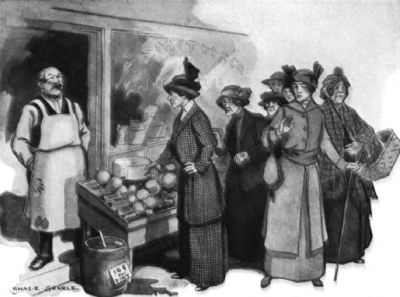
"Till she gets 'em all rousted up, and just boycote that man till he has to keep hullsome food"
Now jest imagine what that meddlin' interferin' sperit would be if carried into politics, if public officials wuz a prey to woman's petickulars. Now spozin' a man wuz nominated for some high office that hain't mebby jest exactly square. For as Uncle Sime sez, "What man is square in public life? No," he sez, "you'll find 'em every shape and size, except 4 by 4."
But wimmen can't accept that scientific statement, made by folks that know, that men are made in such a way that public life and politics wears and rubs on their square corners, and digs into and destroys their shape, so as Uncle Sime sez, "They can't help bein' crooked."
But wimmen's brains hain't strong enough, and their naters and consciences hain't elastic enough to comprehend such matters. They always have and always will pay more attention to them little petickulars of Right and Wrong than men have time to. As I've said before, they can't see big, they see little. They'll talk it over together how many million dollars is made by the White Slave trade every year, ketchin' sweet young girls, they'll say by the net of their love, by drink, by pizened needles, flattery, lies, treachery, takin' 'em from health, home and happiness, and throwin' 'em to the lions of Lust and Greed, into livin' deaths.
Oh, yes, they'll put in all the petickulars. And they'll ask how many millions wuz made by highway graft, tax-payers wadin' through mud, whilst high officials, contractors and public grabbers stuff the tax-payer's money in their pockets. And they'll bring up stories about all the other big corporations and money grabbers.
And how much blood money is made yearly by whiskey sellin'? That is the main fountain their petickulars gush from. Now if a smart hustlin' saloon keeper is nominated for some high office and wimmen could vote, what would be the consequence? Why, they would jest onloose them petickulars onto him and he would be washed completely away on 'em.
They wouldn't know any better than to peek and pry into his bizness, and run it down to the lowest notch. Jest as if a bizness that is good enough for the U.S. Govermunt isn't good enough for them. No, their naters bein' such, and they've got such itchin' ears, they'll pry round into every crook and turn of that man's bizness, and talk about it till they git the hull community riled up. The hull wimmen crew will pin on their white ribbings, and git their heads together, tellin' some story agin him, and the bizness he represents, and go into all the petickulars, sez I, and sez he, and sez she, and sez they.
"Le'me see," sez they, "when wuz it he got Hen Daggett so drunk that he went home and whipped his wife, and most killed her and her next baby wuz born a fool.
"And what time o' night wuz it, wuz it ten or twelve, that he got old Chawgo's boy crazy drunk and wantin' to git rid on him, histed him up on his motorcycle and started him for home, and he didn't go half a mile before he fell off and wuz killed.
"And what time of year wuz it, wuz it late in the spring or early in the summer, that them two Wizzel girls wuz took from his saloon drugged and unconscious, and not a hide or hair on 'em seen sence.
"And le'me see, wuz it on a Monday or a Tuesday, that them two men got into a drunken fight in his saloon and both on 'em got killed. No, it wuz on a Wednesday, for I remember I cut my bib apron wrong, I cut it ketrin ways, and jest as I wuz cuttin' it over, I hearn of that big railroad smash-up where two hundred got killed and maimed by a drunken engineer."
Them wimmen would bring up all them little petickulars agin that man, and his bizness lection day, jest to be mean, and to beat him. Every man and woman whiskey had destroyed, all the crime and agony and poverty it has caused, every fambly wrecked by it, every young man ruined, every young girl who went through the saloon into destruction, and the one hundred thousand deaths caused by it every year. They wouldn't know enough to keep their mouths shet at this time when it wuz so important to have 'em shet up; they'd jest clutter up the road to the pole with petickulars. And no matter how flourishin' a bizness that man wuz doin', and how much money he wuz makin', and how much he wuz willin' to pay for votes, helpin' the male community in this way, they'd carry the day agin him.
They can't seem to realize what a loss in propputy it is to the man they're a houndin'. And if you twit 'em of it they'll twit back and ask, What of the one billion, four hundred million dollars loss to the country every year, caused by strong drink, and ask you if you know that as many Americans are killed every year by it as has been killed in all the battles of the world since time begun. Havin' to ask all these little leadin' questions at jest that onconvenient time and take the advantage on him.
And then when they git him turned down and some favorite religious man elected in his place, oh, how their tongues would run agin, tellin' of all the good things he'd done and would do; agin it would be sez I, and sez he, and sez she, and sez they. Wimmen can't seem to learn to set still to home, and knit, no, they have got to meddle and interfere with men's bizness, as fur as they can, and woe be to us if they ever cut loose and run furder.
Why the Hullsale Liquor Dealers' Association will agree with every word I've said. They know what females are, and what they can do when they git their white ribbings on, and are banded together agin 'em, and they begin to tell petickulars. That's what makes 'em fight so agin Woman's Suffrage. They know where they and their bizness would be after a few years of wimmen's petickulars and votin', and they're willin' to pay well them that help 'em.
As I've intimidated before, to a smart hustlin' bizness man who looks out for his own interest, it is absolutely appallin' to see how Woman Suffragists stand in their own light. But in my talk about the shiftless ways of these wimmen, and their tetotle inability to see where their interests lays, I want to make a honorable exception of the modest retirin' She Auntys. Them wimmen, though females, have got some good horse sense; they know which side their bread is buttered and they lay out to keep it right side up. They know who helps butter that bread. They know it is better to ride round in palace cars to their lectures agin Female Suffrage, helped by them who hate that cause like pizen, than it is to walk afoot. And they know enough to grasp special priveliges, and enjoy 'em, and they lay out to help the ones that help them.
Liquor dealers have got oceans of horse sense, and oceans of money, and they let that money flow along where it will do the most good, into female channels if necessary. Anything to dam up the big waters of Reform from risin' up and washin' 'em away, and stop Woman Suffragists from ruinin' their bizness, and tellin' petickulars and votin'. And I'll ask this question of any man or woman with the brains of a angleworm or caterpillar—Hain't it easier to float along with the current, than to fight agin it and go in the other direction? Why a fool ort to know it is.
You won't ketch them She Auntys a peekin' round huntin' for every little petickular about what the Liquor Dealers' Association stands for, and talk and tattle about the effects of liquor sellin', no indeed. And I want to say and own up that when I find a spark of horse sense in a female, I'm willin' to own up to seein' that spark shinin' out agin the background of females' nateral ignorance and folly. We Jonesvillians reconize smartness and horse sense, and I want to encourage and happify them She Auntys by sayin', that the Creation Searchin' Society of Jonesville will never be found throwin' out no slurs agin them. Neither will I as a male man, and a celebrated author, ever be found mockin' and sneerin' at 'em.
Of course they are females, but considerin' the limited amount of brains that females have and their scurcity of horse sense, they have done and are doin' the best they can. The Creation Searchin' Society of Jonesville and the Liquor Dealers' Association stand up hand in hand, with me in the midst, and publicly reconize their humble helpfulness, and what more in the way of honor can any human female ask for?
I always despised petickulars, every male man duz. It's nateral when our minds are took up with big things, big thoughts, petickulars jar on us; we hain't got the time for 'em in our busy lives. But I believe few of my bretheren can say what I can, that petickulars come within one of bein' the death on 'em.
The way on't wuz Samantha wuz to Tirzah Ann's visitin' and wuz took bed sick there, and right while I wuz stark livin' alone, I wuz took down with voylent pains runnin' up and down my spinal collar, and hull body.
But the neighborin' wimmen, friends of Samantha, I will say done all they could for me, they flocked in and filled me up with milk porridge, chicken broth, etc., and sot up with me nights and waited on me, helped by their various husbands. And I should got along all right if it hadn't been for the endless swarm of petickulars they driv into my room.
Talk, talk, talk, and tellin' petickulars, some on 'em smaller than the end of a nat's toe nail.
And one day when I'd been made almost delerious by 'em, I made out to open the stand draw at the head of my bed and git out a pad and pencil, and writ the follerin' verses which come from the very bottom of my soul, Heaven knows!
OWED TO PETICKULARS
By Josiah Allen, Esq.
I've been bed-sick and very bad, And pains and chills and cramps I've had; And at Tirzah's Samantha come suddenly down With pleuresy pains from heel to crown, She couldn't git home with her plaguey crick— So they never let her know I wuz sick. But the neighbors turned out good and true And stood by me to help me through, They come alone, and they come in pairs, They come with mules, and they come with mares; And I felt the goodness that in 'em lay And treated 'em well both night and day, Till they brung in them petickulars. They come from fur, and they come from near, With new wild remedies strange and queer— My mouth wuz a open and burnin' road Down which the streams of their medicines flowed; Streams of worm-wood and oil of tar, And onions, and warnuts, and goose, and bar; But my mean wuz a christian's all the while— I sithed and swallered and tried to smile— Till they brung in them petickulars. They blistered my back, and they blistered my breast; They iled my nose, and they iled my chest, They gin me sweats of various sorts, Hemlock and whiskey and corn and oats— I drinked their gruel weaker'n a cat, I drinked their whey, didn't wink at that; I stood their faith cures, and their mind, I took 'em all and acted resigned— Till they brung in them petickulars. But they tried their cures to the very last, And I grew no better very fast; And I spoze they thought it would brighten my gloom, To bring some petickulars into my room. So they drove 'em in and they talked of flies— And of chicken's teeth, and muskeeter's eyes, And they talked of pins, and stalks of hay, And lettice seed, and there I lay— A victim of small petickulars. And one recounted a lengthy tale About the best way to drive a nail, And one old woman talked a hour On a pinch of salt and a spunful of flour; And Jane she boasted two hours the deed She did when she pizened a pusley weed, And there I'd sweat, and there I'd groan, And pull my gray locks onbeknown— A victim to small petickulars. And a female sot with anxious frown Disputin' herself right up and down— As to whether the hour wuz one or two, When their old white mare lost off its shoe— Sometimes 'twas two, and then 'twas one, And so through the hours that mare wuz run, And it trompled my brain till I cried, "Whoa! Do shue the old mair and let her go!" But under its heels I had to lay, And sweat, and rithe, and cuss the day— They driv in them petickulars. And they wondered if Jane had cloth enough For her calico apron with bib and ruff, And they mentally rent their robes and tore, For fear that sunthin' wuz wrong with the gore, Till I wished that gore wuz over it rolled, And on Martha's boots that had been new soled, And they almost mistrusted wuz too thin, By pretty nigh the wedth of a pin. And I vowed I could put their souls all in, And rattle 'em round in the head of a pin. And there I groaned, and turned, and lay, And sweat and sithed from day to day, A victim to small petickulars. Till one day I riz and cried with might, "Bring on a earthquake into my sight, Fetch me a cyclone good and strong, A hurrycain, pestilence, bring 'em along, Let me see 'em before I am dead; Let 'em roar and romp around my bed, But ketch 'em, kill 'em, drive 'em away, This very minute of this very day Every one of your dum petickulars. "Let me be killed out square and rough, By a good hard kick from a elephant's huff, Or let a volcano rise and bust This mortal frame, if bust it must. But I swan to man that I won't die By a kick from the off leg of a fly; And agin I swan, that I won't give in And go to my grave on the pint of a pin, Killed by your dum petickulars." My eyes wuz wild, my goery meen Skairt 'em almost to death, I ween The females all fled out of my sight, The two old women mad with fright, Jostled each other and fell over chairs; And all on 'em said "I wuz crazier'n bears." But I settled back on my peaceful bed And most mistrusted I wuz dead And had got through the gate to Beuler land, And I smiled some smiles, serene and bland, For I never had felt such peace before, As when I drove 'em out of the door, Every one of them dum petickulars.
VIII
I TALK ON WIMMEN'S EXTRAVAGANCE
It wuz a cam beautiful mornin'; old Mom Nater seemed agreeable and serene, goin' about her mornin's work of lightin' up and warmin' the world. And Samantha seemed as busy as old Nater herself, and as cam, as she went about her work of makin' the house comfortable and clean.
As I've mentioned prior and before this a better, cleaner housekeeper than Samantha Allen never trod on no shoe leather whatsoever, or went barefoot. Equinomical, industrious, and as a cook beyond any compare. If these words wuz the last I should ever write I'd die solemnly declarin' as a housekeeper and home maker Samantha Allen can't never be beat. Oh, if her principles about female suffragin', and the inferiority of her sect, and the superiority of my sect, wuz only equal to her housekeepin', what a treasure I would have in a earthen vessel (that is Bible; I don't really understand what it means, but I think it looks well for a deacon to patronize the Bible all he can conveniently, and bring into his literary work passages out on't).
I feelt meller and agreeable in my mind, as I sot there in my favorite corner almost immersed in the parfenalia of my perfession, two paper pads, a bottle of ink, a steeled pen, two lead pencils, a pen knife and the immense granny iron dish-pan containin' Betsy B.'s poetry.
And as I sot there with my steeled pen in my hand ready to begin work on my remarkable book, my mind become so impressed by the inestimable value it wuz goin' to be to the world and the male and female sect, that almost onbeknown to myself I uttered the words aloud that wuz seethin' through my large active brain.
Sez I, "Samantha, don't you believe this forthcomin' book of mine is goin' to be the greatest work of this age, or any age?"
She wuz pickin' the pin feathers offen a plump spring chicken for dinner, and she looked up at me over her specs in the cool deliberate way she has sometimes, and sez, "Josiah, a hen don't cackle till she lays her egg."
And then she resoomed her work agin, sayin' no more. Naterally my feelin's immediately hardened more hard than they had been, for I would ask any human bein' did not that one speech show what I've sot out to prove in my book, what wifflin' onstabled minds females have got, and how onfit for votin', onjinted, tottlin', wanderin' way off from the subject spoke on, flyin' down at one jump from literatoor onto poultry. For what connection, I ask, is there between the finest fruit in literature, and hens? Hens which are known to be the awkwardes and stupidest of any liven critters. What jinin' link is there between the most scathin' and convincin' arguments ever writ by mortal man, and eggs? Mute, onfeelin', onseein', eggs.
But I only gin a moment of my valuable time to contemplate this prominent phase of wimmen's folly. And bein' driv back as I have often been by a lack of congenial sympathy into my own interior (my mind), my inteleck seemed to flow freer than ever, and I devoted this propishous time to enlargin' on a important subject I had not had time to enlarge on before, and that wuz the well known extravagance of females and how fatally fatal that trait which is exclusively confined to her own sect would be if let loose on the political world. And so harrered up my mind got in contemplatin' that gigantic danger to my sect, and my country, that before I knowed it I wuz speakin' my thoughts and forebodin's aloud.
Sez I, "Another insurmountable objection agin female suffragin', another fearful danger facin' the country if females should have a free run in the political field, is their well known extravagance."
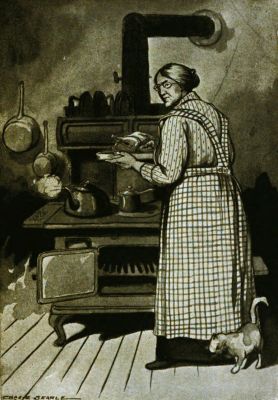
"Josiah," sez she, "a hen don't cackle till she lays her egg."
Sez I, "To a Female Researcher of the prudent, equinomical male sect, it is absolutely appallin' to witness the blind reckless extravagance of wimmen and their well known habits of follerin' each other's fashions blindly, like a flock of sheep jumpin' over the fence. If one woman gits a new dress the neighborin' wimmen have got to git one like it, or better, not a mite of independent sperit about 'em. Why can't they take pattern of us men who always wear jest what we please, and pay no attention to what any other male wears, pay no attention whatsumever to fashion or extravagance. In fact men would hardly know there wuz any such words as them, if it wuzn't for female doin's and the dictionary."
I knowed I had got Samantha in a corner then that she couldn't git out on and I waited with a dignified stately look on my linement to hear her say, "I gin up, Josiah; you're in the right on't." But did I hear her say this? Oh, no!
She lifted up the plump yeller skinned chicken in one hand, whilst she peered under its wings for a stray pin feather. And then she laid it down gently on the pages of the World that wuz spread for its benefit over the table, I spoze to keep her dress clean, and as she looked down on the smooth crisp folds of gingham she sez:
"Yes, lots of wimmen are extravagant. But as the fashion is now, Josiah, five or six yards will make a woman a dress, and have enough left to make her husband a vest, if he would wear anything so cheap. I've got enough left of this very dress, good green and white plaid gingham, costin' ten cents per yard to make you a good cool summer vest; it would wear like iron, and I stand ready to make it, and will you wear it, Josiah?"
She thought she had me in a corner then, but my mind works so quick I answered her almost instantaneously, "Id'no as a green and white plaid vest would be becomin' to my complexion, but I will wear it if the other bretheren will."
Sez she, "I thought you didn't care what any one else wore."
Is there any limit to a female's aggravatin'? I wouldn't dane a reply. But I took up Ayer's Albernack with a stern cold linement, and went to readin' the advertisements, and of course she didn't see the danger ahead on her, of irritatin' too fur a strong nater.
She kep' right on, "No doubt wimmen are sometimes extravagant, Josiah, no doubt they spend lots of money foolishly and worse than foolishly, but before we decide that it ort to deprive her of political rights, let us compare it with men's extravagance for a few minutes."
I felt above replyin' to her, but kep' my eye on the bottle of medicine, and the woman raised from the tomb by a smell of the cork, and she went on:
"Which party is it in a workman's home that usually wants to buy an automobile before the little home is paid for? Mebby in some rare cases the woman eggs the man on, but I believe that it is safe to say that in seven cases out of ten, it is not the housekeeper and house mother that is willin' to risk losin' the ruff that covers her baby's pretty head, and councils waitin' a while before takin' on the extravagance of the added expense. And which party is it, Josiah, that turns and twists every way to save money so her boy and girl can present a decent appearance before her mates? How many millions a year duz the horse races, yot races and polo games and other manly amusements amount to? How many billions a year duz the useless extravagance of tobacco cost? Of course you can substract sunthin' for some wimmen's foolish habit of cigarette smoking, but in the great total it would hardly count. And in how many poor homes duz a woman toil into the night hours to mend and make so that her family may look respectable, while her husband is spendin' his spare hours and spare change in the corner saloon?"
Sez I, lookin' up from the Albernack with a scathin' irony that must have scathed her, whether she owned up to it or not, "I thought it wuz about time for you to drag in that saloon bizness."
"Yes," sez she, "it is time. How many billion dollars a year is spent mostly by men, in the ruinous extravagance of strong drink, and how many billions more in payin' for the effects on't, loss of labor, jails, prisons, hospitals, police force, pauper burials, etc., etc., and I might string out them etc.'s, Josiah, clear from here to Grout Hozleton's and then not begin to git in the perfectly useless and ruinous extravagance of the liquor bizness. And I guess that take all the wimmen's extravagance, it will count up so small in comparison as to be lost sight on. And unlike the liquor bizness if a woman dresses extravagantly, which no doubt she often duz, the dressmakers and merchants and jewelers reaps a profit, if she gives extravagant fashionable parties, the grocer, the florist, the laboring class gits some benefit from it; it is not a danger to human life, like the heart breakin', soul destroyin' extravagance and danger to the hull community of the liquor traffic."
I felt above arguin' with her agin on this subject I had so often wasted my finest eloquence on. She knowed how I felt, and I wouldn't demean myself by repeatin' my crushin' arguments in that direction, for I knowed as well as I sot there that she wouldn't act crushed, no matter if she felt flat as a pan-cake. So I passed on to another faze of woman's extravagance.
Sez I, "It hain't enough for her to spend money like water on her bridge parties, and maskerades, and theatre and tango parties, but she has to rack what little brain she's got, tryin' to git up new follies that other wimmen hain't thought on; she has to have her dog parties, and monkey parties, when them animals come dressed like human bein's with human folks to wait on 'em. Thank Heaven! you can't say but what male men would look down with abhorrence on such fool doin's."
But Samantha sez, "Id'no, take a stag party sometimes—mebby in the beginin' them stags might be able to look down on the monkeys, but after high-balls and cock-tails and gallons of shampain has been consumed, Id'no whether them stags could look down on sober temperate monkeys, or the monkeys look down on them, though no doubt some of the stags behave and can see straight."
I scorned to notice this slur onto my sect, brung up I knowed to make me swurve from my subject, but it didn't make me swurve a inch. I went right on and brung up wimmen's extravagance in their houses.
Sez I, "Look at her gorgeous Brussels carpets, her draperies hangin' from elegant brass poles, her superb black walnut furniture, her glossy black hair-cloth sofias and easy chairs, a perfect riot of extravagance, Samantha. Who can blame a man from kickin' agin it, kickin'," sez I, "with the hull strength of a outraged nater and a number nine shue."
"No doubt," sez Samantha, "wimmen are sometimes extravagant in makin' their homes beautiful, but their families and admirin' friends benefit by it. And how duz her velvet carpets and Persian rugs, her rose-wood furniture, statuary, and costly pictures and silken draperies compare with men's outlay and extravagance in Public Buildings; for instance, the Capitol at Albany; wimmen have had nothing to do with that, and I guess her most extravagant doin's in her house will compare favorably with the millions men have spent in that house for years, and no sign of there ever bein' an end to it."
I knowed by the look on her linement that she meant to intimidate that there had been shiftlessnes and stealin' goin' on in that direction, and in other public works through the country, but I refused to notice the slur on my sect. That slur that females love to sling at us and which we'd better treat with silent contemp, jest as I did now, for no knowin' if we'd stoop to argy with 'em about it, what figgers and statistics they may bring up, to prove their slurs, so as I say I passed it over with silent disdain, but I sez in a safe general way, fur removed from probable figgers she would be apt to throw at me to prove her reckless insertions, I sez, puttin' a sad look onto my linement:
"Wimmen's extravagance makes the heart of man to ache and often drives him to a ontimely tomb, strivin' for fashionable display, strivin' for rights she don't need." And bein' anxious to change the subject at that juncter (I always think it is best to change the flow of my thought occasionally) I put on a sort of a solemn, fraid look on my linement, "Such talk as you wimmen talk is revolutionary, Samantha, and is liable to lead to war."
And then, if you'll believe it, so contrary and hard to conquer is females, she took advantage of that speech of mine to invay on the expenditure of war. She asked me then and there how many billions wuz spent every year by male men on the extravagance of man-made war, its preperation and consequences.
I told her coldly and with a irony as iron as our old cook stove, that as much as she expected of me, she couldn't expect me to figger up to a cent what war had cost the nation. Sez I, "With the barn chores on my hands, and my great work of destroyin' Woman's Suffrage do you expect me to keep track of every cent the nation has spent on war?"
"No," sez she, "one man couldn't reckon it up if he spent his hull lifetime at it, but jest the money spent on it yearly is two billion five hundred million. But," sez she, "it seems that the enormous extravagance of man in this direction and others don't unfit him for the franchise. And if you should spend a few years tryin' to reckon up the gigantic expenditure in money and misery, the horrors and extravagance of war and its effects, you might feel like talkin' less about wimmen's extravagance and how it makes her onfit to be a citizen of the country she's born into, and helps to support with her labor and taxes."
Oh, how aggravatin' a woman can be when she sets out to be. Much as I think of Samantha and the tendrils of my great heart are wropped completely round her, as big as she is round her waist—yet sometimes on occasions like this I almost wish I wuz a bacheldor, a fur off lonely man in some distant cave, or on some lonesome mountain peak, encumbered not by a female who thinks she has a right to argy with me and irritate me.
But these feelin's always come over me in the middle of the forenoon, or the middle of the afternoon. When it comes nigh meal time, my wild seethin' emotions gradually simmers down and as the appetizin' meals progress so duz my feelin's change and grow less dangerous; if they didn't I don't know what the effect would be to the world of females.
I spoze it is the way the overrulin' power has fixed it as a means of safety to females, for with my strong nater and massive inteleck, if it wuzn't for them three daily safety valves to let off the steam of my indignation at female doin's, and sayin's, Heaven only knows what would be the consequences. Things and folks would be tore to pieces for all that I knew and utterly destroyed. For how can you curb in a outraged and high sperited nature when it is fully rousted up, and aggravation has gone too fur? It is well that good vittles stand guard between me and them.
But as a man who loves peace and quiet, and despises female arguin' I wuz glad at this juncter to see the welcome form of Uncle Sime wendin' his way towards the barn. And I throwed down the Albernack with a hauty movement of my right hand, and strode off barnward with my head erect. And then we two valiant warriors in a noble cause held a meetin' of sweet sympathy and full understandin' in the horse barn.
IX
THE DANGER FROM WIMMEN'S EXAGGERATION
I told Samantha one day that another strong reason why wimmen hadn't ort to vote, and why they would be such a dangerous element in politics wuz that they prevaricated and exaggerated to such a alarmin' extent.
Sez I, "A woman can't tell a story straight to save her life—but has to put in so many exaggerations and stretch out facts so you couldn't reconize 'em when she gits 'em pulled out to the length she pulls 'em. They don't seem to have any idee of plain straightforward truthfulness such as my sect has. As long as they've seen men appearin' before 'em, tellin' the exact truth from day to day, and from year to year, they can't or won't foller his example.
"That trait of theirn," sez I, "is bad enough in the home and social circle, for there their men folks can head 'em off, and cover things up and make excuses for 'em, and tell the story straight. But if it wuz carried into public life where their men folks couldn't reach 'em, and quell 'em down, and ameliorate the effects on it, where would this nation be? It would be looked down on and shawed at by Foreign Powers as a nation of exaggerators and false witnessors, and it ort to be.
"Wimmen can't seem to learn to tell the truth and 'nothin' but the truth,' and that is the reason, Samantha," sez I, "that that clause wuz put in the law books; it wuz designed to try to skair female witnesses, and drive 'em into tellin' the truth. But it hain't done it."
I wuz gittin' real eloquent and riz up, for nothin' pleases a man more than to teach his wimmen folks great truths and enlighten 'em about laws. But Samantha had to bring me down from the hite I wuz on, in the aggravatin' way females have. And as it turned out I wuz kinder sorry I had dwelt on that trait of females that particular time, for she said in the irritatin' way wimmen have of bringin' up facts at times when there hain't no use of bringin' 'em up and when it is inconvenient for 'em to be brung.
Sez she, "I would talk about exaggeration in females, and men's love for exact truth, after what took place in this settin' room only last evenin'."
I didn't reply to her for there are times when silent disapproval is better than argument. I knowed what she meant, and I knowed she wanted to spile my argument, in the ornary way females have, so, as I say, I treated them words with silent contemp and went out to the barn. But I spoze I may as well tell you how it wuz, for if I don't she may tell it and make it out worse than it wuz. Condelick Henzy come over here last night after supper to borry my neck-yoke and Dr. Meezik from Zoar, where he used to live, went to see Condelick on bizness, and his wife told him he wuz here so he stopped here on his way home (I mistrust Condelick owes him though he didn't dun him before us).
They're both on 'em good natered easy-goin' men, and love to talk and tell stories. And I brung up a basin of good sick-no-furder apples, and they set and et apples and talked and talked. They both on 'em love to brag about what they've seen and hearn and naterally both on 'em want to tell the biggest story about it. Onfortinately Samantha wuz in the room to work on a new insane bed-quilt. And of course she has to find fault and cricketcise what they said and won't make allowances for high sperits.
Sez Dr. Meezik, "When I wuz a young man my folks lived on a farm that run along one side on a creek. And one day I wuz down on the creek lot hoein' corn and a bear come down on the ice from the big woods, and I rushed right out on the ice and killed that bear with my hoe."
Sez Condelick, "That's nothin' to what I did at about the same time. I lived on that same creek though furder south; it wuz dretful rich land. And I raised a cabbage there that wuz so big I hollered out the stem on't and made a boat of it, and used it to ferry me acrost that very stream of water."
"And it wuz jest about that time," sez Dr. Meezik, "le'me see, it wuz on my birthday about nine minutes past four o'clock in the afternoon, or it may have been nine and a half minutes past, I always want to be perfectly exact in my statements, but we will let it go at nine minutes.
"I wuz a great hunter in them days and fearless as a lion as you may know by my goin' out on the ice to meet that bear who had come to eat green corn, and killed him with my hoe handle.
"I had gone a little further north than I had ever gone before, and I come out to a big clearin' that I had never seen. I should say it wuz half a degree north of where we're settin' now, or it might have been half a pint further, a man can't be too exact and particular in telling such things, for some folks if they wanted to pick flaws and find fault might doubt his statement. But I didn't have my pocket compass with me and I wuz so surprised at what I see there that I don't know that I should thought to use it if I had had it.
"I must say that as many strange things as I've seen and heard I never wuz so surprised as I wuz at what I see there.
"Right there in that big clearin' there wuz a perfect army of tinkers makin' a immense brass kettle. There wuz jest one hundred of 'em, for I counted 'em over twice so's to be sure of gittin' the exact number. I am always so perfectly reliable in my statements, and am bound to git the smallest petickulars jest right. I spoze I got the habit partly from weighin' out my medicines so exact.
"And them tinkers wuz hammerin' away for all they wuz worth on that kettle, and you may judge of the size of it when I tell you them workmen wuz so fur apart they couldn't hear each other a hammerin'."
Even Condelick Henzy wuz took back and browbeat and sez mekanically, "What do you spoze they wuz goin' to do with the kettle?"
"Well," sez Dr. Meezik, "they didn't tell me, for I didn't want to act forward and ask, but I always spozed they wuz goin' to use it to bile your cabbage in."
Just at this epock of time Samantha gathered up her insane piece work and left the room. She didn't say nothin', but I knowed by the looks of her linement jest as well as I know now, that she'd throw that kettle and that cabbage in my face some time the most inconvenient for me, and you can see plain she's done it and now I hope she's satisfied.
As I said I went out to the barn and kinder fussed round cleanin' up some, and I never see Samantha agin till dinner time. I wuzn't afraid to go in and meet her and have her resoom her argument agin. No, I skorn the importation. I belong to a fearless sect, and am almost unacquainted with the word fear, though I know there is such a word in the Dictionary.
No, I had considerable putterin' round to do in the barn, and hen house, and so I stayed out there till I hearn the welcome sound of the dinner bell and smelt even from the barn door the agreable odors risin' from a first class dinner.
The smell and taste of the tender roast lamb and lushious vegetables softened my feelin's considerable, or would have if it hadn't been for the look on Samantha's face. It wuzn't a cross look nor a mean one, would that it wuz, for I could handle them looks better.
No, it wuz a kind of a superior look, as if she had conquored me in the argument about exaggeration and prevarication, and wuz gloatin' over the contrary temps that had occurred in the settin' room only the evenin' before, the little incident that broke down my excelent argument.
And of all the looks that mankind ever read on a woman's linement, the one a man can't stand is a superior look, a look that says as plain as words, "I like you and pity you, but I can't help lookin' down on you, Poor Thing!" That look from a inferior sect always aggravates a man so that he hain't skursly answerable for what he sez and duz.
And almost onbeknown to me I broke forth in a crushin' argument designed to crush her and change that look on her linement to one of humbleness becomin' to a female. Sez I, "Our sect has been the makin' of yourn, and it seems that when a female considers and thinks on all that men have done for wimmen and are willin' to do for 'em, they would have some feelin's of gratitude towards 'em, but they don't; they delight in argyin' with 'em and tryin' to git the better on 'em."
Instead of my smart reasonable words affectin' her favorably it seemed as if the look I despised deepened on her linement; not a sign did I see of meach, nor a sign of humble gratitude, and I wuz so irritated by it that I lanched right out in the crushin' argument that I had on my mind and that ort to bring female feathers droopin' down in the very dust.
Sez I, "Do you ever pause to think, Samantha, of the inestimable boon wimmen owe to men? Why," sez I, "if it hadn't been for a man, wimmen wouldn't had no souls to-day."
"How do you make that out?" sez Samantha, helpin' herself camly to some more dressin'.
"Why, it is a matter of history that way back in the centuries the preachers of that time had a meetin' to settle the question, and when they took a vote on't, the majority on 'em stood out on the popular side and cast their votes agin 'em, and vowed and declared that females hadn't no souls. And it wuz only by the vote of one single solitary man that it wuz carried in their favor and decided that they had souls.
"And I should think females would be so grateful to that noble man for what he done for 'em, for his bein' willin' to admit that they had souls, that they would honor the hull sect to which he belonged, and look up to 'em in humble and grateful gratitude, and never try to argy with 'em and aggravate 'em. For let me ask you, Samantha," sez I, in a solemn axent, "where would wimmen have been if that man had held out and jined in with the rest, and decided that wimmen hadn't got any soul? Where would they been then, and where would they be to-day?"
"Jest where they always wuz and are now," sez Samantha camly helpin' herself to a apple dumplin'. "It seems that it wuz men that started the question in the first place, and I spoze that if wimmen hadn't been so wore out and hampered by her hard work of takin' care of men, cookin', mendin', and cleanin' for 'em and bringin' up their children, etc., they might have had a jury of wimmen set on men to find out if they had souls. But I don't spoze they had a minute's time to spare from their hard work no more than I have, and I don't spoze it would make any difference either way. The main thing is whether men and wimmen have got souls to-day, and use them souls for the good of mankind, instead of lettin' 'em grow hard, or wither away in indifference to the woes and wants of the world, and the cause of Eternal Justice for every one, male and female."
That is jest the way with wimmen, they've got to talk and argy and try to have the last word. You can't seem to make 'em act meachin' and beholdin' to men anyway you can work it, and it seems to me I've tried every way there is from first to last.
But I wouldn't argy no more, I felt above it. I helped myself to my fourth apple dumplin' with a look of silent contemp on my linement, also I had the same look when I poured the lemon sass over it and took my third cup of coffee.
And my linement still showed to a clost observer the marks of a tried though hauty sperit, as I riz up from the table and retired with a high step to my sacred corner to resoom my literary efforts.
Sometimes pardners are real aggravatin' to each other and a trial to be borne with. And though I don't know what I'd do if I should ever lose Samantha, it don't seem as if I could ever eat another woman's vittles after livin' on the fat of the land as you may say for forty years.
Yet there are times when you set smartin' under wownds your pardner has gin your sperit and from arguments she no need to have brung up, and you see a widow man a passin' by, you have feelin's that can skursly be told on. You can see by the looks of his face and hands that he don't wash any oftener than he wants to, and never combs his hair and don't change his clothes till the Board of Health gits after him. And you know he never goes to meetin', and throws off girl blinders boldly, and stays out nights till as late as ten P.M. onquestioned and onscolded. And don't have to clean his shues when he goes in, and never curbs his appetite, but eats like a hog and enjoys himself.
Why, much as you love the dear pardner of your bosom, and prize the excelent food she cooks, and the clean comfortable home she makes for you—the air of freedom that seems to blow from that widow man (kinder stale air too) yet it fans your clean head and clean stiff shirt bosom like a breath from the Isle of Freedom.
And so after Samantha had hurt my feelin's and wownded my self respect by remindin' me of the incident mentioned, when if she had kep' still I should have come off victorious in my argument, I retired into the solitude of my corner in the settin' room where Betsy Bobbett's poetry lay heaped up in the dish-pan and I read with feelin' that I couldn't skursly describe the follerin' verses which I spoze Betsy writ after her husband had wownded her feelin's. And in readin' it I dedicate it silently to my brother men who have been aggravated by their pardners.
LONGIN'S OF THE SOLE
By Betsy Bobbett Slimpsey
Oh Gimlet! back again I float, With broken wings, a weary bard; I cannot write as once I wrote, I have to work so very hard; So hard my lot, so tossed about, My muse is fairly tuckered out. My muse aforesaid once hath flown, But now her back is broke, and breast; And yet she fain would crumple down; On Gimlet's pages she would rest, And sing plain words as there she's sot— Haply they'll rhyme, and haply not. I spake plain words in former days, No guile I showed, clear was my plan; My gole it matrimony was; My earthly aim it was a man. I gained my man, I won my gole; Alas! I feel not as I fole. Yes, ringing through my maiden thought This clear voice rose: "Oh come up higher." To speak plain truth with candor fraught, To married be was my desire— Now, sweeter still this lot doth seem, To be a widder is my theme. For toil hath claimed me for her own, In wedlock I have found no ease; I've cleaned and washed for neighbors round, And took my pay in beans and pease; In boiling sap no rest I took, Or husking corn in barn and stook. Or picking wool from house to house, White-washing, painting, papering, In stretching carpets, boiling souse; E'en picking hops it hath a sting, For spiders there assembled be, Mosquitoes, bugs and etc. I have to work oh! very hard; Old Toil I know your breadth and length; I'm tired to death, and in one word, I have to work beyend my strength. And mortal men are very tough To get along with, nasty, rough. Yes, tribulations doomed to her Who weds a man, without no doubt, In peace a man is singuler; His ways they are past findin' out, And oh! the wrath of mortal males— To paint their ire, earth's language fails. And thirteen children in our home Their buttons rent their clothes they burst, Much bread and such did they consume; Of children they did seem the worst. And Simon and I do disagree; He's prone to sin continualee. He horrors has, he oft doth kick, He prances, yells—he will not work. Sometimes I think he is too sick; Sometimes I think he tries to shirk; But 'tis hard for her in either case, Who B. Bobbett was in happier days. Happier? Away! such thoughts I spurn. I count it true from spring to fall, 'Tis better to be wed, and groan, Than never to be wed at all. I'd work my hands down to the bone Rather than rest a maiden lone. This truth I cannot, will not shirk, I feel it when I sorrow most: I'd rather break my back with work, And haggard look as any ghost,— Rather than lonely vigils keep, I'd wed and sigh and groan and weep. Yes, I can say though tears fall quick Can say, while briny tear-drops start, I'd rather wed a crooked stick, Than never wed no stick at all. Sooner than laughed at be, as of yore I'd ruther laugh myself no more. I'd ruther go half clad and starved, And mops and dish-cloths madly wave Than have the name, B. Bobbett, carved On head-stun rising o'er my grave. Proud thought! now, when that stun is risen 'Twill bear two names—my name and hisen. Methinks 'twould colder make the stun If but one name, the name of she, Should linger there alone—alone. How different when the name of he Does also deck the funeral urn; Two wedded names, his name and hurn. And sweeter yet, oh blessed lot! Oh state most dignified and blest! To be a widder calmly sot, And have both dignity and rest. Oh Simon, strangely sweet 'twould be To be a widder unto thee. The warfare past, the horrors done, With maiden's ease and pride of wife, The dignity of wedded one, The calm and peace of single life,— Oh, strangely sweet this lot doth seem; A female widder is my theme. I would not hurt a hair of he, Yet did he from earth's toil escape, I could most reconciléd be, Could sweetly mourn e'en without crape. Could say without a pang of pain That Simon's loss was Betsy's gain. I've told the plain tale of my woes, With no deceit or language vain, Have told whereon my hopes are rose, Have sung my mournful song of pain. And now I e'en will end my tale, I've sung my song, and wailed my wail.
X
THE MODERN WIMMEN CONDEMNED
The Vice President of the Creation Searchin' Society of Jonesville wuz here yesterday mornin', and as soon as he'd gone through the usual neighborly talk about the weather, the hens, his wife, and the neighbors, etc., he tipped back in his chair and pushed back his hat a little furder on his head. He never took off his hat in my sight; Samantha asked me once "if I spozed he took it off nights, or slep in it."
But I explained it to her as a kind man is always willin' to do if a female asks him properly for information.
Sez I, "I hearn him say once, Samantha, that the way he got in the habit of not takin' off his hat before wimmen wuz to impress 'em with the fact of male superiority, and to let 'em know that he wuzn't goin' to bow down before 'em and act meachin'. He wuz always a big feelin' feller and after he got to be such a high official in the C.S.S. he naterally is hautier actin'."
Well, almost to once he begun to Samantha about wimmen's votin', runnin' the idee down to the very lowest notch it could go on the masculine stillyards. You see my forthcomin' great work agin Wimmen Rights has excited the male Jonesvillians dretfully, and emboldened 'em, till they act as fierce and bold as lions when they're talkin' to females.
They realize that when that immortal work is lanched onto the waitin' world the cause of Woman's Suffrage will collapse like the bladders we used to blow up in childhood, jest as sharp and sudden and jest as windy. They know that them that uphold such uroneous beliefs won't be nothin' nor nobody then, and so they begin beforehand to act more hauty and uppish towards Suffragists, and browbeat 'em. And he poked fun at the cause and slurred at it, and sneered at it till I didn't know but Samantha would take lumbago from his remarks, but she didn't seem to.
She had got her mornin's work all did up slick, her gingham apron hung up behind the kitchen door, and she'd resoomed her white one trimmed with tattin'. And she sot knittin' on a pair of blue woosted socks for me, her linement as smooth and onrumpled as her hair, which wuz combed smooth round her forward. And she kep' on with her knittin', only once in a while she would look up at him over her specs in the queer way she has at times, but still kep' lookin' cam, and sayin' nothin'.
And her camness and her silence seemed to spur him on and make him bolder and more aggressiver. He thought she wuz afraid on him, but I knowed she wuzn't.
At last he flung out the remark to her that if wimmen could vote it would be the bad wimmen who would flock to the poles; Samantha wuz jest turnin' the heel in my sock and after she made the turn she said that that wuzn't so, and she brought up statisticks and throwed at him (still a knittin' and seamin' two and two) provin' that it is the educated conscientious wimmen who want to help the good men of the country to make the laws to try to make the world a safer place for their children, a better, cleaner place for every one, and she threw some statements at him from States that had Woman's Suffrage for years and years to prove her insertion, but the statisticks, the figgers and the proofs piled about him onheeded, for he had got hot and excited by this time and it seemed as if Samantha's very camness madded him, and her knittin', and her seamin' two and two, and her countin' "one—two," to herself once in a while.
And sez he agin in a overbearin' skairful voice, intended to intimidate females, "I tell you it is the bad wimmen who will rush to the poles, and I can prove what I say." Sez he, "The meaner anybody is the more and the oftener they want to vote; my father is one of the best of men and you can't hardly git him to stir his stumps 'lection day. And my wife's father is the meanest man in the country and he will vote from mornin' till night for either party and sell his vote where he can git the highest figger—(he don't live happy with his wife, and he went on) and so will her Uncle Josh sell his vote to anybody for a glass of whiskey, and most all the men on her side will sell their vote and make money by it. And I know more'n a dozen men right round here who do the same thing. I don't spoze you wimmen read much of any, but if you did you'd see how common graft and fraud is in politics, all the way from Jonesville to Washington. So you see," sez he, "I can prove right out what I said that it is the bad wimmen who would vote."
Samantha counted "two and two" to herself, and then said in a mild axent, "Why would a bad woman's vote be worse than a bad man's?" The Vice President see in a minute into what a deep hole his excitement and voylent desire to prove his argument had led him, and he acted sheepish as a sheep.
But anon he revived and ketched holt of the first argument he could lay his hand on, to prop up his side of the question. It wuz a argument he had read about, he didn't believe it himself, but ketched at it in his hurry.
Sez he, "We expect more from wimmen than we do from men; they're naterally better than men and we want to keep 'em so, keep 'em out of the dirt of public affairs."
Sez Samantha still a knittin' and still a lookin' cam, "You must use clean water to cleanse dirty things. I don't believe as you do. I think the good qualities of men and wimmen would heft jest about equal, and need equal treatment. But accordin' to your tell if men are so much worse than wimmen they need her help to clean up things."
Agin the Vice President see where his hasty talk and anxiety to prove his pint had led him. He wiggled round in his chair till I trembled for the legs on it, for he wuz still leanin' back in it too fur for safety. He kinder run his hand up under his hat and scratched his head, but didn't seem to root any new idees out of his hair, and he finally give up, settled his hat back more firmly on his head agin, let his chair down sudden and got up and sez:
"I come over this mornin' to borry Josiah's sheep shears."
And after he went out with 'em I asked Samantha, "What do you spoze the Vice President wanted of sheep shears this time of year?" And she sez:
"He looked sheepish enough to use 'em on himself."
Well, it wuz gittin' along towards noon, as I reminded Samantha, and she riz up and put her knittin' work on the mantelry piece, resoomed her gingham apron and went out into the kitchen and soon I hearn the welcome sounds so sweet to a man's ear whether literary or profane, that preperations wuz goin' on for a good square meal.
And as I sot there peaceful and happy in my mind who should come in but my dear and congenial friend, Uncle Sime Bentley. He had been on a visit to Illenoy. And after his first words of greetin' and his anxious inquiries as to how my great work wuz progressin' and gittin' along, he went on and gin me the petickulars about his journey.
He'd been on a visit to the city to see his nephew, Bill Bentley. Bill is well off and smart, and his father-in-law is rich and sent his only child, Bill's wife, to college; "jest like a fool," Uncle Sime said. "For what duz a female want with such a eddication." Sez he, "The three R's, Readin', Ritin' and Rithmetic are enough for her and would be for any woman if they worked and tended to things as my ma, Bill's grandma did.
"Up at four every mornin' summer and winter, milkin' five or six cows and then gittin' breakfast for her big fambly, hired men and all, and doin' every mite of the housework, and spinnin', weavin', makin' and mendin', and takin' sole care of her eight children, in sickness and health, and takin' care of her mother who had been as big a worker and stay-at-home as she wuz, and who wuz now melancholy crazy in a little room done off the woodshed.
"How ma did work," sez Uncle Sime in a reminescin' axent, "stiddy at it from mornin' till night, never stirrin' out of the house from year to year. Oh! if she could only have lived to set a sample for Bill's wife, and instruct her in a wife's duty.
"I told Bill so," sez Uncle Sime. "And if you please," sez he, "Bill resented it, and said, ketch him a killin' his wife with work hard enough for four wimmen, and not stirrin' out of the house from year to year, he thought too much of her; sez he, 'if I wanted a slave I'd buy one and pay cash for her.'
"He didn't seem to appreciate ma's doin's no more than nothin', though as I told him, There wuz a woman whose price wuz above rubies, so different from the slack forward wimmen of to-day. So retirin', so modest and womanly, willin' to work her fingers to the bone and not complain. Never puttin' forward her opinion about anything, always lookin' up to pa and knowin' he wuz always right. And if she ever did seem curious about anything outside her housework and fambly, pa would shet her up and bring her back to her duty pretty quick. Yes indeed! pa wuz the head of the house, and laid out to be. But Bill didn't seem to have no gumption and self respect at all, and wuz perfectly willin' to be on equal terms with his wife. And Bill told him she had a household allowance and a private bank account. Private bank account! I told Bill it wuz enough to make his grandma rise from her grave to see such bold onwomanly doin's.
"And Bill said 'it would be a good thing for her to rise, if she could stay up, for mebby she would take a little comfort and rest her mind and her bones a little, at this epock of time.'"
I sez, "I spoze, Simon, you didn't have nothin' fit to eat there and everything goin' to rack and ruin about the house."
"No," Uncle Sime said, "I must own up that things run pretty smooth, and Bill's wife sot a good table. They had a stout woman who helped about the work and takin' care of the children, leavin' Bill's wife free to go round with Bill to meetin's and clubs and a fishin' and motor ridin', and picknickin' with him and the kids."
"I spoze she wuz high headed and disagreable," sez I.
"No," sez Uncle Sime, "she wuz always good natered and dressed pretty, and why shouldn't she?" sez he bitterly, "havin' her own way and runnin' things to suit herself. And why shouldn't she dress pretty? Lanchin' out and buyin' everything she wanted. Not curbed down by Bill, nor askin' a man's advice at all about her clothes or housen stuff so fur as I could see."
Sez I, "Mebby Bill didn't like it so well as you thought, Simon; mebby he wuz chafin' inside on him."
"No, he wuzn't, he liked it, there's one of the pints I'm comin' at, how these modern wimmen will pull the wool over men's eyes, no matter how smart he is naterally. They did seem to have good times together, laughin' and talkin' together, settin' to the table a hour or so, a visitin' away as if they hadn't seen each other for a month. But merciful heavens! the subjects they talked on and discussed over! It seemed that she knew every crook and turn on subjects that Bill's grandma never had heard on by name. Hygeen, books, Street Cleanin', Hospital work, Charities, Political affairs from pole to pole and Scientific subjects—Radium, Electricity, Spiritualism, Woman's Suffrage, which they both believed in. There seemed to be no end to the subjects they talked about. So different from pa and ma's talk. They eat their meals in perfect and solemn silence most all the time, ma always waitin' on him. And if she did venter any remarks to him they usually didn't fly no higher than hen's eggs or neighborhood doin's. Do you spoze that pa would stood it havin' a wife that acted as if she knew as much as he did? Not much.
"But Bill's wife wuz right up to snuff as well informed as Bill wuz, and Bill didn't seem to know enough to be jealous and mad about a wife actin' as if she wuz on a equality with him. It made me ashamed to think a male relation on my own side should act so meachin'. And in one thing she even went ahead of Bill, owin' to the money men had spent on her. She sung like a bird, and evenin's Bill would lay back in his chair before the open fireplace and listen to her singin' and playin' them old songs and look at her as if he worshipped her. He didn't seem to want to stir out of the house evenin's unless she went too, lost all his ambition to go out and have a good man time, seemed perfectly happy where he wuz. And he used to be a great case to be out nights and act like a man amongst men.
"But," sez Uncle Sime, "I believe that one of the things that galded me most amongst all the galdin' things I see and hearn there, wuz Bill's wife's independence in money matters. Economic Independence! That wuz one of her fool idees. Oh, how often I thought of you, Josiah, and wished you wuz there to put down what I see and hearn in the beautiful language you know so well how to use."
My feelin's wuz touched and I sez solemnly, "Simon, I would loved to been there, and if I couldn't help you I could have sot and sympathized with you."
Sez Simon, "Never once durin' them six weeks I wuz there did I see her ask Bill for a cent, and how well I remember," sez Simon, "when if ma wanted the money for a pair of shues, or a gingham dress for herself, how she would have to coax pa and git him extra vittles and pompey him and beg for the money in such a womanly and becomin' way. And sometimes pa wuz real short with her and would deny her. Not but what he meant to git 'em in the end, for he wuz a noble man. But he held off, wantin' her to realize he wuz the head of the fambly, and to be looked up to."
Sez Simon, "Ma would have to manage every way for days and days to git them shues and that dress and when he did git any clothes for her pa picked 'em out himself, for ma had been brought up to think his taste wuz better'n hern."
Sez I, "Probable it wuz better, probable he got things that wore like iron."
"Yes, he did," sez Simon, "he did. He never cared so much for looks as he did the solid wear of anything." And for a few minutes Uncle Sime seemed lost in a silent contemplation of his pa's oncommon good qualities, and then he resoomed agin. "The news come right whilst I wuz there, about the leven hundred saloons closed durin' the few months since wimmen voted in that state. And Bill never resented it and even jined in with the idee that it wuz owin' to wimmen's votes largely that that and the other big temperance victories of late wuz accomplished. He didn't seem to have no more self respect than a snipe. And if you'll believe it, Josiah, Bill's wife made a public speech right whilst I wuz there, sunthin' about school matters she thought wuz wrong and ort to be set right."
"How did Bill like that, Simon?" sez I. "I guess that kinder opened his eyes."
"Like it!" sez Uncle Sime in a indignant axent. "Why, instead of actin' ashamed and resentin' it as a man of sperit would, he went with her and made a speech too, and they carried the day and beat the side they said wuz usin' the school to make money. And I hearn 'em with my own ears comin' in at ten P.M. laughin' and jokin' together like two kids. Makin' a speech before men! Oh, what would Bill's great-grandma thought on't? She'd say she had reason for her melancholy madness, and his grandma would say she wuz glad she wuz dead."
"Most probable that is so, Simon," sez I, sympathizin' with him. "As I've intimidated to you before, Simon, time and agin, this is a turrible epock of time us male men are a passin' through, jest like a see-saw gone crazy, wimmen up and stayin' up, and men down and held down. But wait till my great work agin Female Suffrage is lanched onto the world and then see what will happen, and jest as soon as I git a little ahead with my outdoor work I'm a goin' to lanch it. Then will come the upheaval and the crash, follered by peace and happiness. Men will resoom their heaven-born station as rulers and protectors of the weaker sect, and females will sink down agin into hern, lookin' up to man as their nateral gardeens and masters."