Front matter (continued 4)
Reading edition
Under the word "signalement" in the margin, the Consul also drew the following sketch of our hero, in order, as Mr. Jorrocks supposed, that the King of the Mouncheers might know him when he saw him:
"Age de 52 ans Taille d'un mètre 62 centimetres Perruque brun Front large Yeux gris-sanguin Nez moyen Barbe grisâtre Vizage ronde Teint rouge."
He then handed it over to Mr. Jorrocks for his signature, who, observing the words "Signature du Porteur" at the bottom, passed it on to the porter of the inn, until put right by the Consul, who, on receiving his fee, bowed him out with great politeness.
Great as had been the grocer's astonishment at the horses and carts that he had seen stirring about the streets, his amazement knew no bounds when the first Paris diligence came rolling into town with six horses, spreading over the streets as they swung about in all directions—covered with bells, sheep-skins, worsted balls, and foxes' brushes, driven by one solitary postilion on the off wheeler. "My vig," cried he, "here's Wombwell's wild-beast show! What the deuce are they doing in France? I've not heard of them since last Bartlemy-fair, when I took my brother Joe's children to see them feed. But stop—this is full of men! My eyes, so it is! It's what young Dutch Sam would call a male coach, because there are no females about it. Well, I declare, I am almost sorry I did not bring Mrs. J——. Wot would they think to see such a concern in Cheapside? Why, it holds half a township—a perfect willage on wheels. My eyes, wot a curiosity! Well, I never thought to live to see such a sight as this!—wish it was going our way that I might have a ride in it. Hope ours will be as big." Shortly after theirs did arrive, and Mr. Jorrocks was like a perfect child with delight. It was not a male coach, however, for in the different compartments were five or six ladies. "Oh, wot elegant creatures," cried he, eyeing them; "I could ride to Jerusalem with them without being tired; wot a thing it is to be a bachelor!"
The Conducteur—with the usual frogged, tagged, embroidered jacket, and fur-bound cap—having hoisted their luggage on high, the passengers who had turned out of their respective compartments to stretch their legs after their cramping from Calais, proceeded to resume their places. There were only two seats vacant in the interior, or, as Mr. Jorrocks called it, the "middle house," consequently the Yorkshireman and he crossed legs. The other four passengers had corner-seats, things much coveted by French travellers. On Mr. Stubbs's right sat an immense Englishman, enveloped in a dark blue camlet cloak, fastened with bronze lionhead clasps, a red neckcloth, and a shabby, napless, broad-brimmed, brown hat. His face was large, round, and red, without an atom of expression, and his little pig eyes twinkled over a sort of a mark that denoted where his nose should have been; in short, his head was more like a barber's wig block than anything else, and his outline would have formed a model of the dome of St. Paul's. On the Yorkshireman's left was a chattering young red-trousered dragoon, in a frock-coat and flat foraging cap with a flying tassel. Mr. Jorrocks was more fortunate than his friend, and rubbed sides with two women; one was English, either an upper nursery-maid or an under governess, but who might be safely trusted to travel by herself. She was dressed in a black beaver bonnet lined with scarlet silk, a nankeen pelisse with a blue ribbon, and pea-green boots, and she carried a sort of small fish-basket on her knee, with a "plain Christian's prayer book" on the top. The other was French, approaching to middle age, with a nice smart plump figure, good hazel-coloured eyes, a beautiful foot and ankle, and very well dressed. Indeed, her dress very materially reduced the appearance of her age, and she was what the milliners would call remarkably well "got up." Her bonnet was a pink satin, with a white blonde ruche surmounted by a rich blonde veil, with a white rose placed elegantly on one side, and her glossy auburn hair pressed down the sides of a milk-white forehead, in the Madonna style.—Her pelisse was of "violet-des-bois" figured silk, worn with a black velvet pelerine and a handsomely embroidered collar. Her boots were of a colour to match the pelisse; and a massive gold chain round her neck, and a solitary pearl ring on a middle finger, were all the jewellery she displayed. Mr. Jorrocks caught a glimpse of her foot and ankle as she mounted the steps to resume her place in the diligence, and pushing the Yorkshireman aside, he bundled in directly after her, and took up the place we have described.
The vehicle was soon in motion, and its ponderous roll enchanted the heart of the grocer. Independently of the novelty, he was in a humour to be pleased, and everything with him was couleur de rose. Not so the Yorkshireman's right-hand neighbour, who lounged in the corner, muffled up in his cloak, muttering and cursing at every jolt of the diligence, as it bumped across the gutters and jolted along the streets of Boulogne. At length having got off the pavement, after crushing along at a trot through the soft road that immediately succeeds, they reached the little hill near Mr. Gooseman's farm, and the horses gradually relaxed into a walk, when he burst forth with a tremendous oath, swearing that he had "travelled three hundred thousand miles, and never saw horses walk up such a bit of a bank before." He looked round the diligence in the expectation of someone joining him, but no one deigned a reply, so, with a growl and a jerk of his shoulders, he again threw himself into his corner. The dragoon and the French lady then began narrating the histories of their lives, as the French people always do, and Mr. Jorrocks and the Yorkshireman sat looking at each other. At length Mr. Jorrocks, pulling his dictionary and Madame de Genlis out of his pocket, observed, "I quite forgot to ask the guard at what time we dine—most important consideration, for I hold it unfair to takes one's stomach by surprise, and a man should have due notice, that he may tune his appetite accordingly. I have always thought, that there's as much dexterity required to bring an appetite to table in the full bloom of perfection, as there is in training an 'oss to run on a particular day.—Let me see," added he, turning over the pages of de Genlis—"it will be under the head of eating and drinking, I suppose.—Here it is—(opens and reads)—'I have a good appetite—I am hungry—I am werry hungry—I am almost starved'—that won't do—'I have eaten enough'—that won't do either—'To breakfast'—no.—But here it is, by Jingo—'Dialogue before dinner'—capital book for us travellers, this Mrs. de Genlis—(reads) 'Pray, take dinner with us to-day, I shall give you plain fare.'—That means rough and enough, I suppose," observed Mr. Jorrocks to the Yorkshireman.—"'What time do we dine to-day? French: A quelle heure dinons-nous aujourd'hui?—Italian: A che hora (ora) si prancey (pranza) oggi?'" "Ah, Monsieur, vous parlez Français à merveille," said the French lady, smiling with the greatest good nature upon him. "A marble!" said Mr. Jorrocks, "wot does that mean?" preparing to look it out in the dictionary. "Ah, Monsieur, I shall you explain—you speak French like a natif." "Indeed!" said Mr. Jorrocks, with a bow, "I feel werry proud of your praise; and your English is quite delightful.—By Jove," said he to the Yorkshireman, with a most self-satisfied grin, "you were right in what you told me about the gals calling me Monsieur.—I declare she's driven right home to my 'art—transfixed me at once, in fact."
"Must have another tumbler of wine before I can grapple with these chaps," said he, eyeing them, and looking into Madame de Genlis's book: "'Garsoon, donnez-moi un verre de vin,'" holding up the book and pointing to the sentence. He again set to and "went a good one" at both mutton and snipes, but on pulling up he appeared somewhat exhausted. He had not got through it all yet, however. Just as he was taking breath, a garçon entered with some custards and an enormous omelette soufflée, whose puffy brown sides bagged over the tin dish that contained it. "There's a tart!" cried Mr. Jorrocks; "Oh, my eyes, what a swell!—Well, I suppose I must have a shy at it.—'In for a penny in for a pound!' as we say at the Lord Mayor's feed. Know I shall be sick, but, however, here goes," sending his plate across the table to the garçon, who was going to help it. The first dive of the spoon undeceived him as he heard it sound at the bottom of the dish. "Oh lauk, what a go! All puff, by Jove!—a regular humbug—a balloon pudding, in short! I won't eat such stuff—give it to Mouncheer there," rejecting the offer of a piece. "I like the solids;—will trouble you for some of that cheese, sir, and don't let it taste of the knive. But what do they mean by setting the dessert on before the cloth is removed? And here comes tea and coffee—may as well have some, I suppose it will be all the same price. And what's this?" eyeing a lot of liqueur glasses full of eau de vie. "Chasse-café, Monsieur," said the garçon. "Chasse calf—chasse calf—what's that? Oh, I twig—what we call 'shove in the mouth' at the Free-and-Easy. Yes, certainly, give me a glass." "You shall take some dessert," said the Countess, handing him over some peaches and biscuits. "Well, I'll try my hand at it, if it will oblege your ladyship, but I really have had almost enough." "And some abricot," said she, helping him to a couple of fine juicy ones. "Oh, thank you, my lady, thank you, my lady, I'm nearly satisfied." "Vous ne mangez pas," said she, giving him half a plate of grapes. "Oh, my lady, you don't understand me—I can't eat any more—I am regularly high and dry—chock full—bursting, in fact." Here she handed him a plate of sponge-cakes mixed with bon-bons and macaroons, saying, "Vous êtes un pauvre mangeur—vous ne mangez rien, Monsieur." "Oh dear, she does not understand me, I see.—Indeed, my lady, I cannot eat any more.—Ge woudera, se ge could-era, mais ge can-ne-ra pas!" "Well, now, I've travelled three hundred thousand miles, and never heard such a bit of French as that before," said the fat man, chuckling.
IX. MR. JORROCKS IN PARIS
As the grey morning mist gradually dispersed, and daylight began to penetrate the cloud that dimmed the four squares of glass composing the windows of the diligence, the Yorkshireman, half-asleep and half-awake, took a mental survey of his fellow-travellers.—Before him sat his worthy friend, snoring away with his mouth open, and his head, which kept bobbing over on to the shoulder of the Countess, enveloped in the ample folds of a white cotton nightcap.—She, too, was asleep and, disarmed of all her daylight arts, dozed away in tranquil security. Her mouth also was open, exhibiting rather a moderate set of teeth, and her Madonna front having got a-twist, exposed a mixture of brown and iron-grey hairs at the parting place. Her bonnet swung from the roof of the diligence, and its place was supplied by a handsome lace cap, fastened under her chin by a broad-hemmed cambric handkerchief. Presently the sun rose, and a bright ray shooting into the Countess's corner, awoke her with a start, and after a hurried glance at the passengers, who appeared to be all asleep, she drew a small ivory-cased looking-glass from her bag, and proceeded to examine her features. Mr. Jorrocks awoke shortly after, and with an awful groan exclaimed that his backbone was fairly worn out with sitting. "Oh dear!" said he, "my behind aches as if I had been kicked all the way from Hockleyhole to Marylebone. Are we near Paris? for I'm sure I can't find seat any longer, indeed I can't. I'd rather ride two hundred miles in nine hours, like H'osbaldeston, than be shut up in this woiture another hour. It really is past bearing, and that's the long and short of the matter." This exclamation roused all the party, who began yawning and rubbing their eyes and looking at their watches. The windows also were lowered to take in fresh air, and on looking out they found themselves rolling along a sandy road, lined on each side with apple-trees, whose branches were "groaning" with fruit. They breakfasted at Beaumont, and had a regular spread of fish, beef-steak, mutton-chops, a large joint of hot roast veal, roast chickens, several yards of sour bread, grapes, peaches, pears, and plums, with vin ordinaire, and coffee au lait; but Mr. Jorrocks was off his feed, and stood all the time to ease his haunches.
Towards three in the afternoon they caught the first glimpse of the gilded dome of the Hospital of Invalids, which was a signal for all the party to brush up and make themselves agreeable. Even the three-hundred-thousand miler opened out, and began telling some wonderful anecdotes, while the Countess and Mr. Jorrocks carried on a fierce flirtation, or whatever else they pleased to call it. At last, after a deal of jargon, he broke off by appealing to the Yorkshireman to know what "inn" they should "put up at" in Paris. "I don't know, I'm sure," said he; "it depends a good deal upon how you mean to live. As you pay my shot it does not do for beggars to be choosers; but suppose we try Meurice's" "Oh no," replied Mr. Jorrocks, "her ladyship tells me it is werry expensive, for the English always pay through the nose if they go to English houses in Paris; and, as we talk French, we can put up at a French one, you know." "Well, then, we can try one of the French ones in the Rue de la Paix." "Rue de la Pay! no, by Jove, that won't do for me—the werry name is enough—no Rue de la Pay for me, at least if I have to pay the shot." "Well, then, you must get your friend there to tell you of some place, for I don't care twopence, as long as I have a bed, where it is." The Countess and he then laid their heads together again, and when the diligence stopped to change horses at St. Denis, Mr. Jorrocks asked the Yorkshireman to alight, and taking him aside, announced with great glee that her ladyship, finding they were strangers in the land, had most kindly invited them to stay with her, and that she had a most splendid house in the Rue des Mauvais-Garçons, ornamented with mirrors, musical clocks, and he didn't know what, and kept the best company in all France, marquesses, barons, viscounts, authors, etc. Before the Yorkshireman had time to reply, the conducteur came and hurried them back into the diligence, and closed the door with a bang, to be sure of having his passengers there while he and the postilion shuffled the cards and cut for a glass of eau-de-vie apiece.
The Countess, suspecting what they had been after, resumed the conversation as soon as Mr. Jorrocks was seated.—"You shall manger cinque fois every day," said she; "cinque fois," she repeated.—"Humph!" said Mr. Jorrocks to himself, "what can that mean?—cank four—four times five's twenty—eat twenty times a day—not possible!" "Oui, Monsieur, cinque fois," repeated the Countess, telling the number off on her fingers—"Café at nine of the matin, déjeuner à la fourchette at onze o'clock, diner at cinque heure, café at six hour, and souper at neuf hour." "Upon my word," replied Mr. Jorrocks, his eyes sparkling with pleasure, "your offer is werry inwiting. My lady," said he, bowing before her, "Je suis—I am much flattered." "And, Monsieur?" said she, looking at the Yorkshireman. He, too, assured her that he was very much flattered, and was beginning to excuse himself, when the Countess interrupted him somewhat abruptly by turning to Mr. Jorrocks and saying, "He sall be your son—n'est ce pas?" "No, my lady, I've no children," replied he, and the Countess's eyes in their turn underwent a momentary illumination.
The Parisian barrier was soon reached, and the man taken up to kick about the jaded travellers' luggage at the journey's end. While this operation was going on in the diligence yard, the Countess stuck close to Mr. Jorrocks, and having dispatched Agamemnon for a fiacre, bundled him in, luggage and all, and desiring her worthy domestic to mount the box, and direct the driver, she kissed her hand to the Yorkshireman, assuring him she would be most happy to see him, in proof of which, she drove away without telling him her number, or where the Rue des Mauvais-Garçons was.
Paris is a charming place after the heat of the summer has passed away, and the fine, clear, autumnal days arrive. Then is the time to see the Tuileries gardens to perfection, when the Parisians have returned from their châteaus, and emigrating English and those homeward bound halt to renovate on the road; then is the time that the gayest plants put forth their brightest hues, and drooping orange flowers scent the air which silvery fountains lend their aid to cool.
On a Sunday afternoon, such as we have described, our friend Mr. Stubbs (who since his arrival had been living very comfortably at the Hôtel d'Hollande, in expectation of Mr. Jorrocks paying his bill) indulged in six sous' worth of chairs—one to sit upon and one for each leg—and, John Bull-like, stretched himself out in the shade beneath the lofty trees, to view the gay groups who promenaded the alleys before him. First, there came a helmeted cuirassier, with his wife in blue satin, and a little boy in his hand in uniform, with a wooden sword, a perfect miniature of the father; then a group of short-petticoated, shuffling French women, each with an Italian greyhound in slips, followed by an awkward Englishman with a sister on each arm, all stepping out like grenadiers; then came a ribbon'd chevalier of the Legion of Honour, whose hat was oftener in his hand than on his head, followed by a nondescript looking militaire with fierce mustachios, in shining jack-boots, white leathers, and a sort of Italian military cloak, with one side thrown over the shoulder, to exhibit the wearer's leg, and the bright scabbard of a large sword, while on the hero's left arm hung a splendidly dressed woman. "What a figure!" said the Yorkshireman to himself, as they came before him, and he took another good stare.—"Yet stay—no, impossible!—Gracious Heaven! it can't be—and yet it is—by Jove, it's Jorrocks!"
"Why now, you old imbecile," cried he, jumping off his chairs and running up to him, "What are you after?" bursting into a loud laugh as he looked at Mr. Jorrocks's mustachios (a pair of great false ones). "Is there no piece of tomfoolery too great for you? What's come across you now? Where the deuce did you get these things?" taking hold of the curls at one side of his mustachios.
"How now?" roared Mr. Jorrocks with rage and astonishment. "How now! ye young scaramouch, vot do you mean by insulting a gentleman sportsman in broad daylight, in the presence of a lady of quality? By Jingo," added he, his eyes sparkling with rage, "if you are not off before I can say 'dumpling' I'll run you through the gizzard and give your miserable carcass to the dogs," suiting the action to the word, and groping under his cloak for the hilt of his sword.—A crowd collected, and the Yorkshireman perceiving symptoms of a scene, slunk out of the mêlée, and Mr. Jorrocks, after an indignant shake or two of his feathers and curl of his mustachios, pursued his course up the gardens.
This was the first time they had met since their arrival, which was above a week before; indeed, it was nine days, for the landlord of the house where the Yorkshireman lived had sent his "little bill" two days before this, it being an established rule of his house, and one which was conspicuously posted in all the rooms, that the bills were to be settled weekly; and Mr. Stubbs had that very morning observed that the hat of Monsieur l'Hote was not raised half so high from his head, nor his body inclined so much towards the ground as it was wont to be—a pretty significant hint that he wanted his cash.—Now the Yorkshireman, among his other accomplishments, had a turn for play, and unfortunately had been at the Salon the night before, when, after continuous run of ill-luck, he came away twelve francs below the amount of the hotel-keeper's bill, consequently a rumpus with Mr. Jorrocks could not have taken place at a more unfortunate moment. Thinking, however, a good night's rest or two might settle him down, and put all matters right, he let things alone until the Tuesday following, when again finding Monsieur's little "memoire" on one side of his coffeecup, and a framed copy of the "rules and regulations" of the house on the other, he felt constrained to take some decisive step towards its liquidation. Accordingly, having breakfasted, he combed his hair straight over his face, and putting on a very penitential look, called a cab, and desired the man to drive him to the Rue des Mauvais-Garçons.—After zigzagging, twisting, and turning about in various directions, they at last jingled to the end of a very narrow dirty-looking street, whose unswept pavement had not been cheered by a ray of sunshine since the houses were built. It was excessively narrow, and there were no flags on either side; but through the centre ran a dribbling stream, here and there obstructed by oyster-shells, or vegetable refuse, as the water had served as a plaything for children, or been stopped by servants for domestic purposes. The street being extremely old, of course the houses were very large, forming, as all houses do in Paris, little squares entered by folding doors, at one side of which, in a sort of lodge, lives the Porter—"Parlez au Portier"—who receives letters, parcels, and communications for the several occupiers, consisting sometimes of twenty or thirty different establishments in one house. From this functionary may be learned the names of the different tenants. Having dismissed his cab, the Yorkshireman entered the first gateway on his left, to take the chance of gaining some intelligence of the Countess. The Porter—a cobbler by trade—was hammering away, last on knee, at the sole of a shoe, and with a grin on his countenance, informed the Yorkshireman that the Countess lived next door but one. A thrill of fear came over him on finding himself so near the residence of his indignant friend, but it was of momentary duration, and he soon entered the courtyard of No. 3—where he was directed by an unshaved grisly-looking porter, to proceed "un troisième," and ring the bell at the door on the right-hand side. Obedient to his directions, the Yorkshireman proceeded to climb a wide but dirty stone staircase, with carved and gilded balusters, whose wall and steps had known no water for many years, and at length found himself on the landing opposite the very apartment which contained the redoubtable Jorrocks. Here he stood for a few seconds, breathing and cooling himself after his exertions, during which time he pictured to himself the worthy citizen immersed in papers deeply engaged in the preparation of his France in three volumes, and wished that the first five minutes of their interview were over. At length he mustered courage to grasp a greasy-looking red tassel, and give a gentle tinkle to the bell. The door was quickly opened by Agamemnon in dirty loose trousers and slippers, and without a coat. He recognised his fellow-traveller, and in answer to his inquiry if Monsieur Jorrocks was at home, grinned, and answered, "Oh oui, certainement, Monsieur le Colonel Jorrockes est ici," and motioned him to come in. The Yorkshireman entered the little ante-room—a sort of scullery, full of mops, pans, dirty shoes, dusters, candlesticks—and the first thing that caught his eye was Jorrocks's sword, which Agamemnon had been burnishing up with sandpaper and leather, lying on a table before the window. This was not very encouraging, but Agamemnon gave no time for reflection, and opening half a light salmon-coloured folding door directly opposite the one by which he entered, the Yorkshireman passed through, unannounced and unperceived by Mr. Jorrocks or the Countess, who were completely absorbed in a game of dominoes, sitting on opposite sides of a common deal table, whose rose-coloured silk cover was laid over the back of a chair. Jorrocks was sitting on a stool with his back to the door, and the Countess being very intent on the game, Mr. Stubbs had time for a hasty survey of the company and apartment before she looked up. It was about one o'clock, and of course she was still en déshabillé, with her nightcap on, a loose robe de chambre of flannel, and a flaming broad-striped red-and-black Scotch shawl thrown over her shoulders, and swan's-down-lined slippers on her feet. Mr. Jorrocks had his leather pantaloons on, with a rich blue and yellow brocade dressing-gown, and blue morocco slippers to match. His jack-boots, to which he had added a pair of regimental heel-spurs, were airing before a stove, which contained the dying embers of a small log. The room was low, and contained the usual allowance of red figured velvet-cushioned chairs, with brass nails; the window curtains were red-and-white on rings and gilded rods; a secretaire stood against one of the walls, and there was a large mirror above the marble mantelpiece, which supported a clock surmounted by a flying Cupid, and two vases of artificial flowers covered with glass, on one of which was placed an elegant bonnet of the newest and most approved fashion. The floor, of highly polished oak, was strewed about with playbills, slippers, curl-papers, boxes, cards, dice, ribbons, dirty handkerchiefs, etc.; and on one side of the deal table was a plate containing five well-picked mutton-chop bones, and hard by lay Mr. Jorrocks's mustachios and a dirty small tooth-comb.
Just as the Yorkshireman had got thus far in his survey, the Countess gave the finishing stroke to the game, and Mr. Jorrocks, jumping up in a rage, gave his leathers such a slap as sent a cloud of pipe-clay flying into his face. "Vous avez the devil's own luck"; exclaimed he, repeating the blow, when, to avoid the cloud, he turned short round, and encountered the Yorkshireman.
"How now?" roared he at the top of his voice, "who sent for you? Have you come here to insult me in my own house? I'll lay my soul to an 'oss-shoe, I'll be too many for ye! Where's my sword?"
"Now, my good Mr. Jorrocks," replied the Yorkshireman very mildly, "pray, don't put yourself into a passion—consider the lady, and don't let us have any unpleasantness in Madame la Duchesse Benvolio's house," making her a very low bow as he spoke, and laying his hand on his heart.
"D—n your displeasancies!" roared Jorrocks, "and that's swearing—a thing I've never done since my brother Joe fobbed me of my bottom piece of muffin. Out with you, I say! Out with ye! you're a nasty dirty blackguard; I'm done with you for ever. I detest the sight of you and hate ye afresh every time I see you!"
"Doucement, mon cher Colonel," interposed the Countess, "ve sall play anoder game, and you sall had von better chance," clapping him on the back as she spoke. "I von't!" bellowed Jorrocks. "Turn this chap out first. I'll do it myself. H'Agamemnon! H'Agamemnon! happortez my sword! bring my sword! tout suite, directly!"
"Police! Police! Police!" screamed the Countess out of the window; "Police! Police! Police!" bellowed Agamemnon from the next one; "Police! Police! Police!" re-echoed the grisly porter down below; and before they had time to reflect on what had passed, a sergeant's file of the National Guard had entered the hotel, mounted the stairs, and taken possession of the apartment. The sight of the soldiers with their bright bayonets, all fixed and gleaming as they were, cooled Mr. Jorrocks's courage in an instant, and, after standing a few seconds in petrified astonishment, he made a dart at his jack-boots and bolted out of the room. The Countess Benvolio then unlocked her secretaire, in which was a plated liqueur-stand with bottles and glasses, out of which she poured the sergeant three, and the privates two glasses each of pure eau-de-vie, after which Agamemnon showed them the top of the stairs.
In less than ten minutes all was quiet again, and the Yorkshireman was occupying Mr. Jorrocks's stool. The Countess then began putting things a little in order, adorned the deal table with the rose-coloured cover—before doing which she swept off Mr. Jorrocks's mustachios, and thrust a dirty white handkerchief and the small tooth-comb under the cushion of a chair—while Agamemnon carried away the plate with the bones. "Ah, le pauvre Colonel," said the Countess, eyeing the bones as they passed, "he sall be von grand homme to eat—him eat toujours—all day long—Oh, him mange beaucoup—beaucoup—beaucoup. He is von varé amiable man, bot he sall not be moch patience. I guess he sall be varé rich—n'est ce pas? have many guinea?—He say he keep beaucoup des chiens—many dogs for the hont—he sail be vot dey call rom customer (rum customer) in Angleterre, I think."
Thus she went rattling on, telling the Yorkshireman all sorts of stories about the pauvre Colonel, whom she seemed ready to change for a younger piece of goods with a more moderate appetite; and finding Mr. Stubbs more complaisant than he had been in the diligence, she concluded by proposing that he should accompany the Colonel and herself to a soirée-dansante that evening at a friend of hers, another Countess, in the "Rue des Bons-Enfants."
Being disengaged as usual, he at once assented, on condition that the Countess would effect a reconciliation between Mr. Jorrocks and himself, for which purpose she at once repaired to his room, and presently reappeared arm-in-arm with our late outrageously indignant hero. The Colonel had been occupying his time at the toilette, and was en grand costume—finely cleaned leathers, jack-boots and brass spurs, with a spick and span new blue military frock-coat, hooking and eyeing up to the chin, and all covered with braid, frogs, tags, and buttons.
"Dere be von beau garçon!" exclaimed the Countess, turning him round after having led him into the middle of the room—"dat habit does fit you like vax." "Yes," replied Mr. Jorrocks, raising his arms as though he were going to take flight, "but it is rather tight—partiklarly round the waist—shouldn't like to dine in it. What do you think of it?" turning round and addressing the Yorkshireman as if nothing had happened—"suppose you get one like it?" "Do," rejoined the Countess, "and some of the other things—vot you call them, Colonel?" "What—breeches?" "Yes, breeches—but the oder name—vot you call dem?" "Oh, leathers?" replied Mr. Jorrocks. "No, no, another name still." "I know no other. Pantaloons, perhaps, you mean?" "No, no, not pantaloons." "Not pantaloons?—then I know of nothing else. You don't mean these sacks of things, called trousers?" taking hold of the Yorkshireman's. "No, no, not trousers." "Then really, my lady, I don't know any other name." "Oh, yes, Colonel, you know the things I intend. Vot is it you call Davil in Angleterre?" "Oh, we have lots of names for him—Old Nick, for instance."—"Old Nick breeches," said the Countess thoughtfully; "no, dat sall not be it—vot else?" "Old Harry?" replied Mr. Jorrocks.—"Old Harry breeches," repeated the Countess in the hopes of catching the name by the ear—"no, nor dat either, encore anoder name, Colonel." "Old Scratch, then?" "Old Scratch breeches," re-echoed the Countess—"no, dat shall not do."—"Beelzebub?" rejoined Mr. Jorrocks. "Beelzebub breeches," repeated the Countess—"nor dat." "Satan, then?" said Mr. Jorrocks. "Oh oui!" responded the Countess with delight, "satan! black satan breeches—you shall von pair of black satan breeches, like the Colonel."
"And the Colonel will pay for them, I presume?" said the Yorkshireman, looking at Mr. Jorrocks.
"I carn't," said Mr. Jorrocks in an undertone; "I'm nearly cleaned out, and shall be in Short's Gardens before I know where I am, unless I hold better cards this evening than I've done yet. Somehow or other, these French are rather too sharp for me, and I've been down upon my luck ever since I came.—Lose every night, in fact, and then they are so werry anxious for me to have my rewenge, as they call it, that they make parties expressly for me every evening; but, instead of getting my rewenge, I only lose more and more money.—They seem to me always to turn up the king whenever they want him.—To-night we are going to a Countess's of werry great consequence, and, as you know écarté well, I'll back your play, and, perhaps, we may do something between us."
This being all arranged, Mr. Stubbs took his departure, and Mr. Jorrocks having girded on his sword, and the Countess having made her morning toilette, they proceed to their daily promenade in the Tuileries Gardens.
A little before nine that evening, the Yorkshireman again found himself toiling up the dirty staircase, and on reaching the third landing was received by Agamemnon in a roomy uniform of a chasseur—dark green and tarnished gold, with a cocked-hat and black feather, and a couteau de chasse, slung by a shining patent-leather belt over his shoulder. The opening of the inner door displayed the worthy Colonel sitting at his ease, with his toes on each side of the stove (for the evenings had begun to get cool), munching the last bit of crust of the fifth Périgord pie that the Countess had got him to buy.—He was extremely smart; thin black gauze-silk stockings, black satin breeches; well-washed, well-starched white waistcoat with a rolling collar, showing an amplitude of frill, a blue coat with yellow buttons and a velvet collar, while his pumps shone as bright as polished steel.
The Countess presently sidled into the room, all smirks and smiles as dressy ladies generally are when well "got up." Rouge and the milliner had effectually reduced her age from five and forty down to five and twenty. She wore a dress of the palest pink satin, with lilies of the valley in her hair, and an exquisitely wrought gold armlet, with a most Lilliputian watch in the centre.
Mr. Jorrocks having finished his pie-crust, and stuck on his mustachios, the Countess blew out her bougies, and the trio, preceeded by Agamemnon with a lanthorn in his hand, descended the stairs, whose greasy, muddy steps contrasted strangely with the rich delicacy of the Countess's beautifully slippered feet. Having handed them into the voiture, Agamemnon mounted up behind, and in less than ten minutes they rumbled into the spacious courtyard of the Countess de Jackson, in the Rue des Bons-Enfants, and drew up beneath a lofty arch at the foot of a long flight of dirty black-and-white marble stairs, about the centre of which was stationed a lacquey de place to show the company up to the hall. The Countess de Jackson (the wife of an English horse-dealer) lived in an entresol au troisième, but the hotel being of considerable dimensions, her apartment was much more spacious than the Countess Benvolio's. Indeed, the Countess de Jackson, being a marchande des modes, had occasion for greater accommodation, and she had five low rooms, whereof the centre one was circular, from which four others, consisting of an ante-room, a kitchen, a bedroom, and salle à manger, radiated.
Agamemnon having opened the door of the fiacre, the Countess Benvolio took the Yorkshireman's arm, and at once preceded to make the ascent, leaving the Colonel to settle the fare, observing as they mounted the stairs, that he was "von exceeding excellent man, but varé slow."
"Madame la Contesse Benvolio and Monsieur Stoops!" cried the lacquey de place as they reached the door of the low ante-room, where the Countess Benvolio deposited her shawl, and took a final look at herself in the glass. She again took the Yorkshireman's arm and entered the round ballroom, which, though low and out of all proportion, had an exceedingly gay appearance, from the judicious arrangement of the numerous lights, reflected in costly mirrors, and the simple elegance of the crimson drapery, festooned with flowers and evergreens against the gilded walls. Indeed, the hotel had been the residence of an ambassador before the first revolution, and this entresol had formed the private apartment of his Excellency. The door immediately opposite the one by which they entered, led into the Countess de Jackson's bedroom, which was also lighted up, with the best furniture exposed and her toilette-table set out with numberless scent bottles, vases, trinkets, and nick-nacks, while the salle à manger was converted into a card-room. Having been presented in due form to the hostess, the Yorkshireman and his new friend stood surveying the gay crowd of beautiful and well-dressed women, large frilled and well-whiskered men, all chatting, and bowing, and dancing, when a half-suppressed titter that ran through the room attracted their attention, and turning round, Mr. Jorrocks was seen poking his way through the crowd with a number of straws sticking to his feet, giving him the appearance of a feathered Mercury. The fact was, that Agamemnon had cleaned his shoes with the liquid varnish (french polish), and forgetting to dry it properly, the carrying away half the straw from the bottom of the fiacre was the consequence, and Mr. Jorrocks having paid the Jehu rather short, the latter had not cared to tell him about it.
The straws were, however, soon removed without interruption to the gaiety of the evening. Mr. Stubbs, of course, took an early opportunity of waltzing with the Countess Benvolio, who, as all French women are, was an admirable dancer, and Jorrocks stood by fingering and curling his mustachios, admiring her movements but apparently rather jealous of the Yorkshireman. "I wish," said he after the dance was over, "that you would sit down at écarté and let us try to win some of these mouncheers' tin, for I'm nearly cleaned out. Let us go into the cardroom, but first let us see if we can find anything in the way of nourishment, for I begin to be hungry. Garsoon," said he catching a servant with a trayful of eau sucrée glasses, "avez-vous kick-shaws to eat?" putting his finger in his mouth—"ge wouderay some refreshment." "Oh, oui," replied the garçon taking him to an open window overlooking the courtyard, and extending his hand in the air, "voilà, monsieur, de très bon rafraîchissement."
The ball proceeded with the utmost decorum, for though composed of shopkeepers and such like, there was nothing in their dress or manner to indicate anything but the best possible breeding. Jorrocks, indeed, fancied himself in the very élite of French society, and, but for a little incident, would have remained of that opinion. In an unlucky moment he took it into his head he could waltz, and surprised the Countess Benvolio by claiming her hand for the next dance. "It seems werry easy," said he to himself as he eyed the couples gliding round the room;—"at all ewents there's nothing like trying, 'for he who never makes an effort never risks a failure.'" The couples were soon formed and ranged for a fresh dance. Jorrocks took a conspicuous position in the centre of the room, buttoned his coat, and, as the music struck up, put his arm round the waist of his partner. The Countess, it seems, had some misgivings as to his prowess in the dancing line, and used all her strength to get him well off, but the majority of the dancers started before him. At length, however, he began to move, and went rolling away in something between a gallop and a waltz, effecting two turns, like a great cart-wheel, which brought him bang across the room, right into the track of another couple, who were swinging down at full speed, making a cannon with his head against both theirs, and ending by all four coming down upon the hard boards with a tremendous crash—the Countess Benvolio undermost, then the partner of the other Countess, then Jorrocks, and then the other Countess herself. Great was the commotion, and the music stopped; Jorrocks lost his wig, and split his Beelzebub breeches across the knees, while the other gentleman cracked his behind—and the Countess Benvolio and the other Countess were considerably damaged; particularly the other Countess, who lost four false teeth and broke an ear-ring. This, however, was not the worst, for as soon as they were all scraped together and set right again, the other Countess's partner attacked Jorrocks most furiously, calling him a sacré-nom de-Dieu'd bête of an Englishman, a mauvais sujet, a cochon, etc., then spitting on the floor—the greatest insult a Frenchman can offer—he vapoured about being one of the "grand nation," "that he was brave—the world knew it," and concluded by thrusting his card—"Monsieur Charles Adolphe Eugene, Confiturier, No. 15 bis, Rue Poupée"—into Jorrocks's face. It was now Jorrocks's turn to speak, so doubling his fists, and getting close to him, he held one to his nose, exclaiming, "D—n ye, sir, je suis—JORROCKS!—Je suis an Englishman! je vous lick within an inch of your life! —Je vous kick!—je vous mill!—je vous flabbergaster!" and concluded by giving him his card, "Monsieur le Colonel Jorrocks, No 3, Rue des Mauvais-Garçons."
A friend of the confectioner's interposed and got him away, and Mr. Stubbs persuaded Mr. Jorrocks to return into the cardroom, where they were speedily waited upon by the friend of the former, who announced that the Colonel must make an apology or fight, for he said, although Jorrocks was a "Colonel Anglais," still Monsieur Eugene was of the Legion of Honour, and, consequently, very brave and not to be insulted with impunity. All this the Yorkshireman interpreted to Mr. Jorrocks, who was most anxious to fight, and wished it was light that they might go to work immediately. Mr. Stubbs therefore told the confectioner's friend (who was also his foreman), that the Colonel would fight him with pistols at six o'clock in the Bois de Boulogne, but no sooner was the word "pistols" mentioned than the friend exclaimed, with a grimace and shrug of his shoulders, "Oh horror, no! Monsieur Adolphe is brave, but he will not touch pistols—they're not weapons of his country." Jorrocks then proposed to fight him with broad swords, but this the confectioner's foreman declined on behalf of his principal, and at last the Colonel suggested that they could not do better than fight it out with fists. Now, the confectioner was ten years younger than Jorrocks, tall, long-armed, and not over-burthened with flesh, and had, moreover, taken lessons of Harry Harmer, when that worthy had his school in Paris, so he thought the offer was a good one, and immediately closed with it. Jorrocks, too, had been a patron of the prize-ring, having studied under Bill Richmond, the man of colour, and was reported to have exhibited in early life (incog.) with a pugilist of some pretensions at the Fives-court, so, all things considered, fists seemed a very proper mode of settling the matter, and that being agreed upon, each party quitted the Countess de Jackson's—the confectioner putting forth all manner of high-flown ejaculations and prayers for success, as he groped about the ante-room for his hat, and descended the stairs. "Oh! God of war!" said he, throwing up his hands, "who guided the victorious army of this grand nation in Egypt, when, from the pyramids, forty centuries beheld our actions—oh, brilliant sun, who shone upon our armies at Jaffa, at Naples, Montebello, Marengo, Austerlitz, Jena, and Algiers, who blessed our endeavours, who knowest that we are brave—brave as a hundred lions—look down on Charles Adolphe Eugene, and enable him to massacre and immolate on the altar of his wrath, this sacré-nom de-Dieu'd beastly hog of an Englishman"—and thereupon he spit upon the flags with all the venom of a viper.
Jorrocks, too, indulged in a few figures of speech, as he poked his way home, though of a different description. "Now blister my kidneys," said he, slapping his thigh, "but I'll sarve him out! I'll baste him as Randall did ugly Borrock. I'll knock him about as Belcher did the Big Ilkey Pigg. I'll damage his mug as Turner did Scroggins's. I'll fib him till he's as black as Agamemnon—for I do feel as though I could fight a few."
PROCLAMATION!
I, John Jorrocks, of Great Coram Street, in the County of Middlesex, Member of the Surrey Hunt, in England, and Colonel of the Army when I'm in France, having been grossly insulted by Charles Adolphe Eugene of No. 15 bis, Rue Poupée, confectioner, this day repaired to Passy, with the intention of sarving him out with my fists; but, neither he nor any one for him having come to the scratch, I, John Jorrocks, do hereby proclaim the said Charles Adolphe Eugene to be a shabby fellow and no soldier, and totally unworthy the notice of a fox-hunter and a gentleman sportsman.
(Signed) JOHN JORROCKS.
(Countersigned) STUBBS.
This being completed, and the bill paid, they returned leisurely on foot to Paris, looking first at one object, then at another, so that the Countess Benvolio's dinner-hour was passed ere they reached the Tuileries Gardens, where after resting themselves until it began to get dusk, and their appetites returned, they repaired to the Café de Paris to destroy them again.—The lofty well-gilded salon was just lighted up, and the numberless lamps reflected in costly mirrors in almost every partition of the wall, aided by the graceful figures and elegant dresses of the ladies, interspersed among the sombre-coated gentry, with here and there the gay uniforms of the military, imparted a fairy air to the scene, which was not a little heightened by the contrast produced by Mr. Jorrocks's substantial figure, stumping through the centre with his hat on his head, his hands behind his back, and the dust of the day hanging about his Hessians.
"Garsoon," said he, hanging up his hat, and taking his place at a vacant table laid for two, "ge wouderai some wittles," and, accordingly, the spruce-jacketed, white-aproned garçon brought him the usual red-backed book with gilt edges, cut and lettered at the side, like the index to a ledger, and, as Mr. Jorrocks said, "containing reading enough for a month." "Quelle potage voulez vous, monsieur?" inquired the garçon at last, tired of waiting while he studied the carte and looked the words out in the dictionary. "Avez-vous any potted lobster?" "Non," said the garçon, "potage au vermicelle, au riz, a la Julienne, consommé, et potage aux choux." "Old shoe! who the devil do you think eats old shoes here? Have you any mock turtle or gravy soup?" "Non, monsieur," said the garçon with a shrug of the shoulders. "Then avez-vous any roast beef?" "Non, monsieur; nous avons boeuf au naturel—boeuf à la sauce piquante—boeuf aux cornichons—boeuf à la mode—boeuf aux choux—boeuf à la sauce tomate—bifteck aux pommes de terre." "Hold hard," said Jorrocks; "I've often heard that you can dress an egg a thousand ways, and I want to hear no more about it; bring me a beef-steak and pommes de terre for three." "Stop!" cried Mr. Stubbs, with dismay—"I see you don't understand ordering a dinner in France —let me teach you. Where's the carte?" "Here," said Mr. Jorrocks, "is 'the bill of lading,'" handing over the book.—"Garçon, apportez une douzaine des huîtres, un citron, et du beurre frais," said the Yorkshireman, and while they were discussing the propriety of eating them before or after the soup, a beautiful dish of little green oysters made their appearance, which were encored before the first supply was finished. "Now, Colonel," said the Yorkshireman, "take a bumper of Chablis," lifting a pint bottle out of the cooler. "It has had one plunge in the ice-pail and no more—see what a delicate rind it leaves on the glass!" eyeing it as he spoke. "Ay, but I'd rayther it should leave something in the mouth than on the side of the glass," replied Mr. Jorrocks; "I loves a good strong generous wine—military port, in fact—but here comes fish and soup—wot are they?" "Filet de sole au gratin, et potage au macaroni avec fromage de Parmesan. I'll take fish first, because the soup will keep hot longest." "So will I," said Mr. Jorrocks, "for I think you understand the thing—but they seem to give werry small penn'orths—it really looks like trifling with one's appetite—I likes the old joint—the cut-and-come-again system, such as we used to have at Sugden's in Cornhill—joint, wegitables, and cheese all for two shillings." "Don't talk of your joints here," rejoined the Yorkshireman—"I told you before, you don't understand the art of eating—the dexterity of the thing consists in titivating the appetite with delicate morsels so as to prolong the pleasure. A well-regulated French dinner lasts two hours, whereas you go off at score, and take the shine out of yourself before you turn the Tattenham Corner of your appetite. But come, take another glass of Chablis, for your voice is husky as though your throat was full of dust.—Will you eat some of this boulli-vert?" "No, not no bouleward for me thank ye." "Well, then, we will have the 'entrée de boeuf—beef with sauce tomate—and there is a côtelette de veau en papillotte;—which will you take?" "I'll trouble the beef, I think; I don't like that 'ere pantaloon cutlet much, the skin is so tough." "Oh, but you don't eat the paper, man; that is only put on to keep this nice layer of fat ham from melting; take some, if it is only that you may enjoy a glass of champagne after it. There is no meat like veal for paving the way for a glass of champagne." "Well, I don't care if I do, now you have explained how to eat it, for I've really been troubled with indigestion all day from eating one wholesale yesterday; but don't you stand potatoes—pommes de terre, as we say in France?" "Oh yes, fried, and à la maître d'hotel; here they come, smoking hot. Now, J—— for a glass of champagne—take it out of the pail—nay, man! not with both hands round the middle, unless you like it warm—by the neck, so," showing him how to do it and pouring him a glass of still champagne. "This won't do," said Jorrocks, holding it up to the candle; "garsoon! garsoon!—no good—no bon—no fizzay, no fizzay," giving the bottom of the bottle a slap with his hand to rouse it. "Oh, but this is still champagne," explained the Yorkshireman, "and far the best." "I don't think so," retorted Mr. Jorrocks, emptying the glass into his water-stand. "Well, then, have a bottle of the other," rejoined the Yorkshireman, ordering one. "And who's to pay for it?" inquired Mr. Jorrocks. "Oh, never mind that—care killed the cat—give a loose to pleasure for once, for it's a poor heart that never rejoices. Here it comes, and 'may you never know what it is to want,' as the beggar boys say.—Now, let's see you treat it like a philosopher—the wire is off, so you've nothing to do but cut the string, and press the cork on one side with your thumb.—Nay! you've cut both sides!" Fizz, pop, bang, and away went the cork close past the ear of an old deaf general, and bounded against the wall.—"Come, there's no mischief done, so pour out the wine.—Your good health, old boy, may you live for a thousand years, and I be there to count them! —Now, that's what I call good," observed the Yorkshireman, holding up his glass, "see how it dulls the glass, even to the rim—champagne isn't worth a copper unless it's iced—is it, Colonel?" "Vy, I don't know—carn't say I like it so werry cold; it makes my teeth chatter, and cools my courage as it gets below—champagne certainly gives one werry gentlemanly ideas, but for a continuance, I don't know but I should prefer mild hale." "You're right, old boy, it does give one very gentlemanly ideas, so take another glass, and you'll fancy yourself an emperor.—Your good health again." "The same to you, sir. And now wot do you call this chap?" "That is a quail, the other a snipe—which will you take?" "Vy, a bit of both, I think; and do you eat these chaps with them?" "Yes, nothing nicer—artichokes á la sauce blanche; you get the real eating part, you see, by having them sent up this way, instead of like haystacks, as they come in England, diving and burning your fingers amid an infinity of leaves." "They are werry pretty eating, I must confess; and this upper Binjamin of ham the birds are cooked in is delicious. I'll trouble you for another plateful." "That's right, Colonel, you are yourself again. I always thought you would come back into the right course; and now you are good for a glass of claret of light Hermitage. Come, buck up, and give a loose to pleasure for once." "For once, ay, that's what you always say; but your once comes so werry often." "Say no more.—Garçon! un demi-bouteille de St. Julien; and here, J——, is a dish upon which I will stake my credit as an experienced caterer—a Charlotte de pommes—upon my reputation it is a fine one, the crust is browned to a turn, and the rich apricot sweet-meat lies ensconced in the middle, like a sleeping babe in its cradle. If ever man deserved a peerage and a pension it is this cook." "It's werry delicious—order another." "Oh, your eyes are bigger than your stomach, Mr. J——. According to all mathematical calculations, this will more than suffice. Ay, I thought so—you are regularly at a stand-still. Take a glass of whatever you like. Good—I'll drink Chablis to your champagne. And now, that there may be no mistake as to our country, we will have some cheese—fromage de Roquefort, Gruyère, Neufchatel, or whatever you like—and a beaker of Burgundy after, and then remove the cloth, for I hate dabbling in dowlas after dinner is done." "Rum beggars these French," said Mr. Jorrocks to himself, laying down the newspaper, and taking a sip of Churchman's chocolate, as on the Sunday morning he sat with the Countess Benvolio, discussing rolls and butter, with Galignani's Messenger, for breakfast.
"Rum beggars, indeed," said he, resuming the paper, and reading the programme of the amusements for the day, commencing with the hour of Protestant service at the Ambassador's Chapel, followed on by Palace and Gallery of Pictures of the Palais Royal—Review with Military Music in the Place du Carousel—Horse-races in the Champs de Mars—Fête in the Park of St. Cloud—Combat d'Animaux, that is to say, dog-fighting and bull-baiting, at the Barrière du Combat, Tivoli, etc., etc., "It's not werry right, but I suppose at Rome we must do as Romans do," with which comfortable reflection Mr. Jorrocks proposed that the Countess and he should go to the races. Madame was not partial to animals of any description, but having got a new hat and feathers she consented to show them, on condition that they adjoined to the fête at St. Cloud in the evening.
Accordingly, about noon, the ostler's man of a neighbouring English livery-stable drew up a dark-coloured job cab, with a red-and-white striped calico lining, drawn by a venerable long-backed white horse, at the Countess's gateway in the Rue des Mauvais-Garçons, into which Mr. Jorrocks having handed her ladyship, and Agamemnon, who was attired in his chasseur uniform, having climbed up behind, the old horse, after two or three flourishes of his dirty white tail, as a sort of acknowledgment of the whip on his sides, got himself into motion, and proceeded on his way to the races. The Countess being resolved to cut a dash, had persuaded our hero to add a smart second-hand cocked-hat, with a flowing red-and-white feather, to the rest of his military attire; and the end of a scarlet handkerchief, peeping out at the breast of his embroidered frock-coat, gave him the appearance of wearing a decoration, and procured him the usual salute from the soldiers and veterans of the Hospital of Invalids, who were lounging about the ramparts and walks of the edifice. The Countess's costume was simple and elegant; a sky-blue satin pelisse with boots to match, and a white satin bonnet with white feathers, tipped with blue, and delicate primrose-coloured gloves. Of course the head of the cab was well thrown back to exhibit the elegant inmates to the world.
Great respect is paid to the military in France, as Mr. Jorrocks found by all the hack, cab, and fiacre drivers pulling up and making way for him to pass, as the old crocodile-backed white horse slowly dragged its long length to the gateway of the Champ de Mars. Here the guard, both horse and foot, saluted him, which he politely acknowledged, under direction of the Countess, by raising his chapeau bras, and a subaltern was dispatched by the officer in command to conduct him to the place appointed for the carriages to stand. But for this piece of attention Mr. Jorrocks would certainly have drawn up at the splendid building of the École Militaire, standing as it does like a grand stand in the centre of the gravelly dusty plain of the Champ de Mars. The officer, having speared his way through the crowd with the usual courtesy of a Frenchman, at length drew up the cab in a long line of anonymous vehicles under the rows of stunted elms by the stone-lined ditch, on the southern side of the plain when, turning his charger round, he saluted Mr. Jorrocks, and bumped off at a trot. Mr. Jorrocks then stuck the pig-driving whip into the socket, and throwing forward the apron, handed out the Countess, and installed Agamemnon in the cab.
A fine day and a crowd make the French people thoroughly happy, and on this afternoon the sun shone brightly and warmly on the land;—still there was no apparently settled purpose for the assembling of the multitude, who formed themselves in groups upon the plain, or lined the grass-burnt mounds at the sides, in most independent parties. The Champ de Mars forms a regular parallelogram of 2700 feet by 1320, and the course, which is of an oblong form, comprises a circuit of the whole, and is marked out with strong posts and ropes. Within the course, equestrians—or more properly speaking, "men on horseback"—are admitted under the surveillance of a regiment of cavalry, while infantry and cavalry are placed in all directions with drawn swords and fixed bayonets to preserve order. Being a gravelly sandy soil, in almost daily requisition for the exercise and training of troops, no symptoms of vegetation can be expected, and the course is as hard as the ride in Rotten Row or up to Kensington Gardens.
Foreigners accuse the English of claiming every good-looking horse, and every well-built carriage, met on the Continent, as their own, but we think that few would be ambitious of laying claim to the honour of supplying France with jockeys or racehorses. Mr. Jorrocks, indeed, indifferent as he is to the affairs of the turf, could not suppress his "conwiction" of the difference between the flibberty-gibberty appearance of the Frenchmen, and the quiet, easy, close-sitting jockeys of Newmarket. The former all legs and elbows, spurting and pushing to the front at starting, in tawdry, faded jackets, and nankeen shorts, just like the frowsy door-keepers of an Epsom gambling-booth; the latter in clean, neat-fitting leathers, well-cleaned boots, spick and span new jackets, feeling their horses' mouths, quietly in the rear, with their whip hands resting on their thighs. Then such riding! A hulking Norman with his knees up to his chin, and a long lean half-starved looking Frenchman sat astride like a pair of tongs, with a wet sponge applied to his knees before starting, followed by a runaway English stable lad, in white cords and drab gaiters, and half a dozen others equally singular, spurring and tearing round and round, throwing the gravel and sand into each other's faces, until the field was so separated as to render it difficult to say which was leading and which was tailing, for it is one of the rules of their races, that each heat must be run in a certain time, consequently, though all the horses may be distanced, the winner keeps working away. Then what an absence of interest and enthusiasm on the part of the spectators! Three-fourths of them did not know where the horses started, scarcely a man knew their names, and the few tenpenny bets that were made, were sported upon the colour of the jackets. A Frenchman has no notion of racing, and it is on record that after a heat in which the winning horse, after making a waiting race, ran in at the finish, a Parisian observed, that "although 'Annette' had won at the finish, he thought the greater honour was due to 'Hercule,' he having kept the lead the greater part of the distance." On someone explaining to him that the jockey on Annette had purposely made a waiting race, he was totally incredulous, asserting that he was sure the jockeys had too much amour-propre to remain in the rear at any part of the race, when they might be in front.
X. SPORTING IN FRANCE
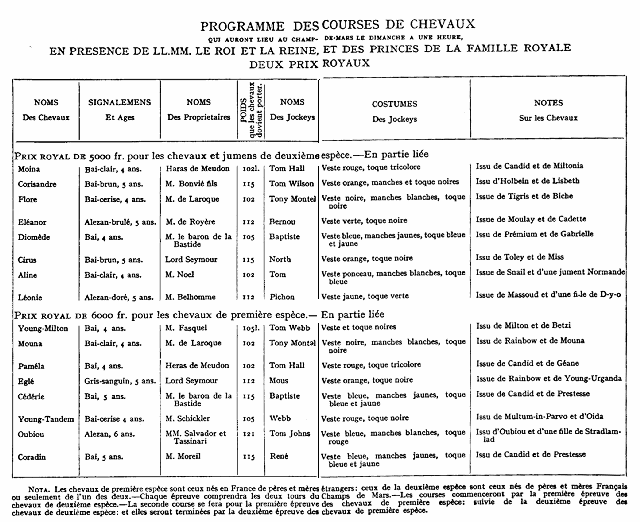
(View full size)
"Moderate sport," said Mr. Jorrocks to himself, curling his mustachios and jingling a handful of five-franc pieces in the pocket of his leathers—"moderate sport indeed," and therefore he turned his back to the course and walked the Countess off towards the cab.
From beneath a low tenth-rate-looking booth, called "The Cottage of Content," supported by poles placed on the stunted trees of the avenue, and exhibiting on a blue board, "John Jones, dealer in British beer," in gilt letters, there issued the sound of voices clamouring about odds, and weights and scales, and on looking in, a score of ragamuffin-looking grooms, imitation jockeys, and the usual hangers-on of the racehorses and livery-stables, were seen drinking beer, smoking, playing at cards, dice, and chuck-farthing. Before the well-patched canvas curtain that flapped before the entrance, a crowd had collected round one of the horses which was in the care of five or six fellows, one to hold him, another to whistle to him, a third to whisk the flies away with a horse's tail, a fourth to scrape him, a fifth to rinse his mouth out,—while the stud-groom, a tall, gaunt, hairy-looking fellow, in his shirt sleeves, with ear-rings, a blue apron and trousers (more like a gardener than a groom), walked round and round with mystified dignity, sacréing and muttering, "Ne parlez pas, ne parlez pas," as anyone approached who seemed likely to ask questions. Mr. Jorrocks, having well ascertained the importance of his hat and feather, pushed his way with the greatest coolness into the ring, just to cast his eye over the horse and see whether he was fit to go with the Surrey, and the stud-groom immediately took off his lavender-coloured foraging cap, and made two profound salaams, one to the Colonel, the other to the Countess. Mr. Jorrocks, all politeness, took off his chapeau, and no sooner was it in the air, than with a wild exclamation of surprise and delight, the groom screamed, "Oh, Monsieur Shorrock, mon ami, comment vous portez vous?" threw his arms round the Colonel's neck, and kissed him on each cheek.
"Hold!" roared the Colonel, half smothered in the embrace, and disengaging himself he drew back a few paces, putting his hand on the hilt of his sword, when in the training groom of Paris he recognised his friend the Baron of Newmarket. The abruptness of the incident disarmed Mr. Jorrocks of reflection, and being a man of impulse and warm affections, he at once forgave the novelty of the embrace, and most cordially joined hands with those of his friend. They then struck up a mixture of broken English and equally broken French, in mutual inquiries after each other's healths and movements, and presuming that Mr. Jorrocks was following up the sporting trade in Paris, the Baron most considerately gave him his best recommendations which horse to back, kindly betting with him himself, but, unfortunately, at each time assigning Mr. Jorrocks the losing horse. At length, being completely cleaned out, he declined any further transactions, and having got the Countess into the cab, was in the act of climbing in himself, when someone took him by the sword as he was hoisting himself up by the wooden apron, and drew him back to the ground. "Holloa, Stubbs, my boy!" cried he, "I'm werry 'appy to see ye," holding out his hand, and thereupon Mr. Stubbs took off his hat to the Countess. "Well now, the deuce be in these French," observed Mr. Jorrocks, confidentially, in an undertone as, resigning the reins to Agamemnon, he put his arm through the Yorkshireman's and drew out of hearing of the Countess behind the cab—"the deuce be in them. I say. There's that beggarly Baron as we met at Newmarket has just diddled me out of four Naps and a half, by getting me to back 'osses that he said were certain to win, and I really don't know how we are to make 'tongue and buckle' meet, as the coachmen say. Somehow or other they are far too sharp for me. Cards, dominoes, dice, backgammon, and racing, all one—they inwariably beat me, and I declare I haven't as much pewter as will coach me to Calais." The Yorkshireman, as may be supposed, was not in a condition of any great pecuniary assistance, but after a turn or two along the mound, he felt it would be a reproach on his country if he suffered his friend to be done by a Frenchman, and on consideration he thought of a trick that Monsieur would not be up to. Accordingly, desiring Mr. Jorrocks to take him to the Baron, and behave with great cordiality, and agree to the proposal he should make, they set off in search of that worthy, who, after some trouble, they discovered in the "Cottage of Content," entertaining John Jones and his comrades with an account of the manner in which he had fleeced Monsieur Shorrock. The Yorkshireman met him with the greatest delight, shook hands with him over and over again, and then began talking about racing, pigeon-shooting, and Newmarket, pretended to be full of money, and very anxious for the Baron's advice in laying it out. On hearing this, the Baron beckoned him to retire, and joining him in the avenue, walked him up and down, while he recommended his backing a horse that was notoriously amiss. The Yorkshireman consented, lost a Nap with great good humour, and banteringly told the Baron he thought he could beat the horse on foot. This led them to talk of foot-racing and at last the Yorkshireman offered to bet that Mr. Jorrocks would run fifty yards with him on his back, before the Baron would run a hundred. Upon this the Baron scratched his head and looked very knowing, pretended to make a calculation, when the Yorkshireman affected fear, and professed his readiness to withdraw the offer. The Baron then plucked up his courage, and after some haggling, the match was made for six Naps, the Yorkshireman reckoning the Baron might have ten francs in addition to what he had won of Mr. Jorrocks and himself. The money was then deposited in the hands of the Countess Benvolio, and away went the trio to the "Cottage of Content," to get men and ropes to measure and keep the ground. The English jockeys and lads, though ready enough to pigeon a countryman themselves, have no notion of assisting a foreigner to do so, unless they share in the spoil, and the Baron being a notorious screw, they all seemed heartily glad to find him in a trap. Out then they all sallied, amid cheers and shouts, while John Jones, with a yard-wand in his hand, proceeded to measure a hundred yards along the low side of the mound. This species of amusement being far more in accordance with the taste of the French than anything in which horses are concerned, an immense mob flocked to the scene, and the Baron having explained how it was, and being considered a safe man to follow, numerous offers were made to bet against the performance of the match. The Yorkshireman being a youth of discretion and accustomed to bet among strangers, got on five Naps more with different parties, who to "prevent accidents" submitted to deposit the money with the Countess, and all things being adjusted, and the course cleared by a picket of infantry, Mr. Jorrocks ungirded his sword, and depositing it with his frock-coat in the cab, walked up to the fifty yards he was to have for start. "Now, Colonel," said the Yorkshireman, backing him to the mound, so that he might leap on without shaking him, "put your best leg first, and it's a hollow thing; if you don't fall, you must win,"—and thereupon taking Mr. Jorrocks's cocked hat and feather from his head, he put it sideways on his own, so that he might not be recognised, and mounted his man. Mr. Jorrocks then took his place as directed by John Jones, and at a signal from him—the dropping of a blue cotton handkerchief—away they started amid the shouts, the clapping of hands, and applause of the spectators, who covered the mound and lined the course on either side. Mr. Jorrocks's action was not very capital, his jack-boots and leathers rather impeding his limbs, while the Baron had as little on him as decency would allow. The Yorkshireman feeling his man rather roll at the start, again cautioned him to take it easy, and after a dozen yards he got into a capital run, and though the lanky Baron came tearing along like an ill-fed greyhound, Mr. Jorrocks had full two yards to spare, and ran past the soldier, who stood with his cap on his bayonet as a winning-post, amid the applause of his backers, the yells of his opponents, and the general acclamation of the spectators.
The Countess, anticipating the victory of her hero, had dispatched Agamemnon early in the day for a chaplet of red-and-yellow immortelles, and having switched the old cab horse up to the winning-post, she gracefully descended, without showing more of her foot and ankle than was strictly correct, and decorated his brow with the wreath, as the Yorkshireman dismounted. Enthusiasm being always the order of the day in France, this act was greeted with the loudest acclamations, and, without giving him time to recover his wind, the populace bundled Mr. Jorrocks neck and shoulders into the cab, and seizing the old horse by the head, paraded him down the entire length of the Champ de Mars, Mr. Jorrocks bowing and kissing his hands to the assembled multitude, in return for the vivas! the clapping of hands, and the waving of ribbons and handkerchiefs that greeted him as he went.
Popularity is but a fickle goddess, and in no country more fickle than in France. Ere the procession reached the end of the dusty plain, the mob had tailed off very considerably, and as the leader of the old white horse pulled him round to return, a fresh commotion in the distance, caused by the apprehension of a couple of pickpockets, drew away the few followers that remained, and the recently applauded and belauded Mr. Jorrocks was left alone in his glory. He then pulled up, and taking the chaplet of immortelles from his brow, thrust it under the driving cushion of the cab, and proceeded to reinstate himself in his tight military frock, re-gird himself with his sword, and resume the cocked hat and feather.
Nothing was too good for Mr. Stubbs at that moment, and, had a pen and ink been ready, Mr. Jorrocks would have endorsed him a bill for any amount. Having completed his toilette he gave the Yorkshireman the vacant seat in the cab, flopped the old horse well about the ears with the pig-driving whip, and trotted briskly up the line he had recently passed in triumphal procession, and wormed his way among the crowd in search of the Countess. There was nothing, however, to be seen of her, and after driving about, and poking his way on foot into all the crowds he could find, bolting up to every lady in blue, he looked at his great double-cased gold repeater, and finding it was near three o'clock and recollecting the fête of St. Cloud, concluded her ladyship must have gone on, and Agamemnon being anxious to see it, of course was of the same opinion; so, again flopping the old horse about the ears, he cut away down the Champ de Mars, and by the direction of Agamemnon crossed the Seine by the Pont des Invalides, and gained the route to Versailles.
Here the genius of the people was apparent, for the road swarmed with voitures of every description, diligences, gondoles, co-cous, cabs, fiacres, omnibuses, dame-blanches, all rolling and rumbling along, occasionally interrupted by the lilting and tilting of a light English cab or tilbury, drawn by a thoroughbred, and driven by a dandy. The spirit of the old white horse even seemed roused as he got among the carriages and heard the tramping of hoofs and the jingling of bells round the necks of other horses, and he applied himself to the shafts with a vigour his enfeebled-looking frame appeared incapable of supplying. So they trotted on, and after a mile travelling at a foot's pace after they got into close line, they reached the porte Maillot, and resigning the cab to the discretion of Agamemnon, Mr. Jorrocks got himself brushed over by one of the gentry who ply in that profession at all public places, and tucking his sword under one arm, he thrust the other through Mr. Stubbs's, and, John-Bull-like, strutted up the long broad grass avenue, through the low part of the wood of St. Cloud, as if all he saw belonged to himself. The scene was splendid, and nature, art, and the weather appeared confederated for effect. On the lofty heights arose the stately place, looking down with placid grandeur on the full foliage of the venerable trees, over the beautiful gardens, the spouting fountains, the rushing cascades, and the gay and countless myriads that swarmed the avenues, while the circling river flowed calmly on, without a ripple on its surface, as if in ridicule of the sound of trumpets, the clang of cymbals, and the beat of drums, that rent the air around.
Along the broad avenue were ranged shows of every description—wild beasts, giants, jugglers, tumblers, mountebanks, and monsters, while in spots sheltered from the sun by lofty trees were dancing-places, swings, roundabouts, archery-butts, pistol-ranges, ball-kicking and head-thumping places, montagnes-Suisses, all the concomitants of fairs and fêtes—beating "Bartlemy Fair," as Mr. Jorrocks candidly confessed, "all to nothing."
The chance of meeting the Countess Benvolio in such a multitude was very remote indeed, but, to tell the truth, Mr. Jorrocks never once thought of her, until having eat a couple of cold fowls and drank a bottle of porter, at an English booth, he felt in his pocket for his purse, and remembered it was in her keeping. Mr. Stubbs, however, settled the account, and in high glee Mr. Jorrocks resumed his peregrinations, visiting first one show, then another, shooting with pea-guns, then dancing a quadrille, until he was brought up short before a splendid green-and-gold roundabout, whose magic circle contained two lions, two swans, two black horses, a tiger, and a giraffe. "Let's have a ride," said he, jumping on to one of the black horses and adjusting the stirrups to his length. The party was soon made up, and as the last comer crossed his tiger, the engine was propelled by the boys in the centre, and away they went at Derby pace. In six rounds Mr. Jorrocks lost his head, turned completely giddy, and bellowed out to them to stop. They took no heed—all the rest were used to it—and after divers yells and ineffectual efforts to dismount, he fell to the ground like a sack. The machine was in full work at the time, and swept round three or four times before they could stop it. At last Mr. Stubbs got to him, and a pitiable plight he was in. He had fallen on his head, broken his feather, crushed his chapeau bras, lost off his mustachios, was as pale as death, and very sick. Fortunately the accident happened near the gate leading to the town of St. Cloud, and thither, with the aid of two gendarmes, Mr. Stubbs conveyed the fallen hero, and having put him to bed at the Hôtel d'Angleterre, he sent for a "médecin," who of course shook his head, looked very wise, ordered him to drink warm water—a never-failing specific in France—and keep quiet. Finding he had an Englishman for a patient, the "médecin" dropped in every two hours, always concluding with the order "encore l'eau chaud." A good sleep did more for Mr. Jorrocks than the doctor, and when the "médecin" called in the morning, and repeated the injunction "encore l'eau chaud," he bellowed out, "Cuss your l'eau chaud, my stomach ain't a reserwoir! Give me some wittles!" The return of his appetite being a most favourable symptom, Mr. Stubbs discharged the doctor, and forthwith ordered a déjeuner à la fourchette, to which Mr. Jorrocks did pretty fair justice, though trifling in comparison with his usual performances. They then got into a Versailles diligence that stopped at the door, and rattling along at a merry pace, very soon reached Paris and the Rue des Mauvais-Garçons.
"Come up and see the Countess," said Mr. Jorrocks as they arrived at the bottom of the flight of dirty stairs, and, with his hands behind his back and his sword dragging at his heels, he poked upstairs, and opening the outer door entered the apartment. He passed through the small ante-room without observing his portmanteau and carpet-bag on the table, and there being no symptoms of the Countess in the next one, he walked forward into the bedroom beyond.
Before an English fire-place that Mr. Jorrocks himself had been at the expense of providing, snugly ensconced in the luxurious depths of a well-cushioned easy chair, sat a monstrous man with a green patch on his right eye, in slippers, loose hose, a dirty grey woollen dressing-gown, and black silk nightcap, puffing away at a long meerschaum pipe, with a figure of Bacchus on the bowl. At a sight so unexpected Mr. Jorrocks started back, but the smoker seemed quite unconcerned, and casting an unmeaning grey eye at the intruder, puffed a long-drawn respiration from his mouth.
"How now!" roared Mr. Jorrocks, boiling into a rage, which caused the monster to start upon his legs as though he were galvanised. "Vot brings you here?"
"Sprechen sie Deutsch?" responded the smoker, opening his eye a little wider, and taking the pipe from his mouth. "Speak English, you fool," bawled Mr. Jorrocks. "Sie sind sehr unverschämt" (you are very impudent), replied the Dutchman with a thump on the table. "I'll run you through the gizzard!" rejoined Mr. Jorrocks, half drawing his sword,—"skin you alive, in fact!" when in rushed the Countess and threw herself between them.
Now, Mynheer Van Rosembom, a burgomaster of Flushing, was an old friend of the Countess's, and an exceedingly good paying one, and having cast up that morning quite unexpectedly by the early diligence from Dunkirk, and the Countess being enraged at Mr. Jorrocks for not sharing the honours of his procession in the cab on the previous day, and believing, moreover, that his treasury was pretty well exhausted, thought she could not do better than instal Rosembom in his place, and retain the stakes she held for the Colonel's board and lodging.
This arrangement she kept to herself, simply giving Rosembom, who was not a much better Frenchman than Col. Jorrocks, to understand that the room would be ready for him shortly, and Agamemnon was ordered to bundle Mr. Jorrocks's clothes into his portmanteau and bag, and place them in readiness in the ante-room. Rosembom, fatigued with his journey, then retired to enjoy his pipe at his ease, while the Countess went to the Marche St. Honoré to buy some sour crout, roast beef, and prunes for his dinner.
"Turn this great slush-bucket out of my room!" cried Mr. Jorrocks, as the Countess rushed into his apartment. "Vot's he doing here?"
"Doucement, mon cher Colonel," said she, clapping him on the back, "he sall be my brodder." "Never such a thing!" roared Mr. Jorrocks, eyeing him as he spoke. "Never such a thing! no more than myself—out with him, I say, or I'll cut my stick—toute suite—directly!"
"Avec tout mon coeur!" replied the Countess, her choler rising as she spoke. "You're another," rejoined Mr. Jorrocks, judging by her manner that she called him something offensive—"Vous ête one mauvaise woman!" "Monsieur," said the Countess, her eyes flashing as she spoke, "vous êtes un polisson!—von rascal!—von dem villain!—un charlatan!—von nasty—bastely—ross bif!—dem dog!" and thereupon she curled her fingers and set her teeth on edge as though she would tear his very eyes out. Rosembom, though he didn't exactly see the merits of the matter, exchanged his pipe for the poker, so what with this, the sword, and the nails, things wore a very belligerent aspect.
Mr. Stubbs, as usual, interposed, and the Countess, still keeping up the semblance of her rage, ordered them to quit her apartment directly, or she would have recourse to her old friends the police. Mr. Stubbs was quite agreeable to go, but he hinted that she might as well hand over the stakes that had been entrusted to her keeping on the previous day, upon which she again indulged in a torrent of abuse, swore they were a couple of thieves, and that Mr. Jorrocks owed her far more than the amount for board and lodging. This made the Colonel stare, for on the supposition that he was a visitor, he had been firing away his money in all directions, playing at everything she proposed, buying her bonnets, Perigord pies, hiring remises, and committing every species of extravagance, and now to be charged for what he thought was pure friendship, disgusted him beyond expression.
The Countess speedily summoned the porter, the man of letters of the establishment, and with his aid drew Mr. Jorrocks out a bill, which he described as "reaching down each side of his body and round his waist," commencing with 2 francs for savon, and then proceeding in the daily routine of café, 1 franc; déjeuner à la fourchette, 5 francs; diner avec vin, 10 francs; tea, 1 franc; souper, 3 francs; bougies, 2 francs; appartement, 3 francs; running him up a bill of 700 francs; and when Mr. Stubbs remonstrated on the exorbitance of the charges, she replied, "It sall be, sare, as small monnaie as sail be consistent avec my dignified respectability, you to charge."
There seemed no help for the matter, so Mr. Stubbs paid the balance, while Mr. Jorrocks, shocked at the duplicity of the Countess, the impudence of Rosembom, and the emptiness of his own pockets, bolted away without saying a word.
That very night the Malle-Poste bore them from the capital, with two cold fowls, three-quarters of a yard of bread, and a bottle of porter, for Mr. Jorrocks on the journey, and ere another sun went down, the sandy suburbs of Calais saw them toiling towards her ramparts, and rumbling over the drawbridges and under the portcullis, that guard the entrance to her gloomy town. Calais! cold, cheerless, lifeless Calais! Whose soul has ever warmed as it approached thy town? but how many hearts have turned with sickening sorrow from the mirthless tinkling of thy bells!
"We'll not stay here long I guess," said Mr. Jorrocks as the diligence pulled up at the post-office, and the conducteur requested the passengers to descend. "That's optional," said a bystander, who was waiting for his letters, looking at Mr. Jorrocks with an air as much as to say, what a rum-looking fellow you are, and not without reason, for the Colonel was attired in a blue sailor's jacket, white leathers, and jack-boots, with the cocked hat and feather. The speaker was a middle-aged, middle-statured man, with a quick intelligent eye, dressed in a single-breasted green riding-coat, striped toilinette waistcoat, and drab trousers, with a whip in his hand. "Thank you for nothing!" replied Mr. Jorrocks, eyeing him in return, upon which the speaker turned to the clerk and asked if there were any letters for Monsieur Apperley or Nimrod. "NIMROD!" exclaimed Mr. Jorrocks, dropping on his knees as though he were shot. "Oh my vig what have I done? Oh dear! oh dear! what a dumbfounderer—flummoxed I declare!"
"Hold up! old 'un," said Nimrod in astonishment; "why, what's the matter now? You don't owe me anything I dare say!"
"Owe you anything! yes, I does," said Mr. Jorrocks, rising from the ground, "I owes you a debt of gratitude that I can never wipe off—you'll be in the day-book and ledger of my memory for ever and a year."
"Who are you?" inquired Nimrod, becoming more and more puzzled, as he contrasted his dialect with his dress.
"Who am I? Why, I'm Mister Jorrocks."
"Jorrocks, by Jove! Who'd have thought it! I declare I took you for a horse-marine. Give us your hand, old boy. I'm proud to make your acquaintance."
"Ditto to you, sir, twice repeated. I considers you the werry first man of the age!"—and thereupon they shook hands with uncommon warmth.
"You've been in Paris, I suppose," resumed Nimrod, after their respective digits were released; "were you much gratified with what you saw? What pleased you most—the Tuileries, Louvre, Garden of Plants, Père la Chaise, Notre Dame, or what?"
"Why now, to tell you the truth, singular as it may seem, I saw nothing but the Tuileries and Naughty Dame.—I may say a werry naughty dame, for she fleeced me uncommonly, scarcely leaving me a dump to carry me home."
"What, you've been among the ladies, have you? That's gay for a man at your time of life."
"Yes, I certainlie have been among the ladies,—countesses I may say—but, dash my vig, they are a rum set, and made me pay for their acquaintance. The Countess Benwolio certainlie is a bad 'un."
"Oh, the deuce!—did that old devil catch you?" inquired Nimrod.
"Vot, do you know her?"
"Know her! ay—everybody here knows her with her black boy. She's always on the road, and lives now by the flats she catches between Paris and the coast. She was an agent for Morison's Pills—but having a fractious Scotch lodger that she couldn't get out, she physicked him so dreadfully that he nearly died, and the police took her licence away. But you are hungry, Mr. Jorrocks, come to my house and spend the evening, and tell me all about your travels."
Mr. Stubbs objected to this proposition, having just learned that the London packet sailed in an hour, so the trio adjourned to Mr. Roberts's, Royal Hotel, where over some strong eau-de-vie they cemented their acquaintance, and Mr. Jorrocks, finding that Nimrod was to be in England the following week, insisted upon his naming a day for dining in Great Coram Street.
"Permits" to embark having been considerately granted "gratis" by the Government for a franc apiece, at the hour of ten our travellers stepped on board, and Mr. Jorrocks, having wrapped himself up in his martial cloak, laid down in the cabin and, like Ulysses in Ithaca, as Nimrod would say, "arrived in London Asleep."
XI. A RIDE TO BRIGHTON ON "THE AGE"
(In a very "Familiar Letter" to Nimrod)
DEAR NIMROD,
You have favoured myself, and the sporting world at large, with a werry rich high-flavoured account of the great Captain Barclay, and his extonishing coach, the "Defiance"; and being werry grateful to you for that and all other favours, past, present, and to come, I take up my grey goose quill to make it "obedient to my will," as Mr. Pope, the poet, says, in relating a werry gratifying ride I had on the celebrated "Brighton Age," along with Sir Wincent Cotton, Bart., and a few other swells. Being, as you knows, of rather an emigrating disposition, and objecting to make a nick-stick of my life by marking down each Christmas Day over roast-beef and plum pudding, cheek-by-jowl with Mrs. J—— at home, I said unto my lad Binjimin—and there's not a bigger rogue unhung—"Binjimin, be after looking out my Sunday clothes, and run down to the Regent Circus, and book me the box-seat of the 'Age,' for I'm blow'd if I'm not going to see the King at Brighton (or 'London-sur-Mary,' as James Green calls it), and tell the pig-eyed book-keeper it's for Mr. Jorrocks, and you'll be sure to get it."
Accordingly, next day, I put in my appearance at the Circus, dressed in my best blue Saxony coat, with metal buttons, yellow waistcoat, tights, and best Hessians, with a fine new castor on my head, and a carnation in my button-hole. Lots of chaps came dropping in to go, and every one wanted the box-seat. "Can I have the box-seat?" said one.—"No, sir; Mr. Jorrocks has it." "Is the box-seat engaged?" asked another.—"Yes, sir; Mr. Jorrocks has taken it." "Book me the box," said a third with great dignity.—"It's engaged already." "Who by?"—"Mr. Jorrocks"; and so they went on to the tune of near a dozen. Presently a rattling of pole chains was heard, and a cry was raised of "Here's Sir Wincent!" I looks out, and saw a werry neat, dark, chocolate-coloured coach, with narrow red-striped wheels, and a crest, either a heagle or a unicorn (I forgets which), on the door, and just the proprietors' names below the winder, and "The Age," in large gilt letters, below the gammon board, drawn by four blood-like, switch-tailed nags, in beautiful highly polished harness with brass furniture, without bearing reins—driven by a swellish-looking young chap, in a long-backed, rough, claret-coloured benjamin, with fancy-coloured tyes, and a bunch of flowers in his button-hole—no coachman or man of fashion, as you knows, being complete without the flower. There was nothing gammonacious about the turn-out; all werry neat and 'andsome, but as plain as plain could be; and there was not even a bit of Christmas at the 'orses' ears, which I observed all the other coaches had. Well, down came Sir Wincent, off went his hat, out came the way-bill, and off he ran into the office to see what they had for him. "Here, coachman," says a linen-draper's "elegant extract," waiting outside, "you've to deliver this (giving him a parcel) in the Marine Parade the instant you get to Brighton. It's Miss—— 's bustle, and she'll be waiting for it to put on to go out to dinner, so you musn't lose a moment, and you may charge what you like for your trouble." "Werry well," says Sir Wincent, laughing, "I'll take care of her bustle. Now, book-keeper, be awake. Three insides here, and six out. Pray, sir," touching his hat to me, "are you booked here? Oh! Mr. Jorrocks, I see. I begs your pardon. Jump up, then; be lively! what luggage have you?" "Two carpet-bags, with J. J., Great Coram Street, upon them." "There, then we'll put them in the front boot, and you'll have them under you. All right behind? Sit tight!" Hist! off we go by St. Mertain's Church into the Strand, to the booking-office there.
The streets were werry full, but Sir Wincent wormed his way among the coal-wagons, wans, busses, coaches, bottom-over-tops,—in wulgar French, "cow sur tate," as they calls the new patent busses—trucks, cabs, &c., in a marvellous workmanlike manner, which seemed the more masterly, inasmuch as the leaders, having their heads at liberty, poked them about in all directions, all a mode Francey, just as they do in Paris. At the Marsh gate we were stopped. A black job was going through on one side, and a haw-buck had drawn a great yellow one 'oss Gravesend cruelty wan into the other, and was fumbling for his coin.
"Now, Young Omnibus!" cried Sir Wincent, "don't be standing there all day." The man cut into his nag, but the brute was about beat. "There, don't 'it him so 'ard (hard)," said Sir Wincent, "or you may hurt him!"
When we got near the Helephant and Castle, Timothy Odgkinson, of Brixton Hill, a low, underselling grocer, got his measly errand cart, with his name and address in great staring white letters, just in advance of the leaders, and kept dodging across the road to get the sound ground, for the whole line was werry "woolley" as you calls it. "Come, Mister independent grocer! go faster if you can," cries Sir Wincent, "though I think you have bought your horse where you buy your tea, for he's werry sloe." A little bit farther on a chap was shoving away at a truck full of market-baskets. "Now, Slavey," said he, "keep out of my way!" At the Helephant and Castle, and, indeed, wherever he stopped, there were lots of gapers assembled to see the Baronet coachman, but Sir Wincent never minded them, but bustled about with his way-bill, and shoved in his parcels, fish-baskets, and oyster-barrels like a good 'un. We pulled up to grub at the Feathers at Merstham, and 'artily glad I was, for I was far on to famish, having ridden whole twenty-five miles in a cold, frosty air without morsel of wittles of any sort. When the Bart. pulled up, he said, "Now, ladies and gentlemen—twenty minutes allowed here, and let me adwise you to make the most of it." I took the 'int, and heat away like a regular bagman, who can always dispatch his ducks and green peas in ten minutes.
We started again, and about one hundred yards below the pike stood a lad with a pair of leaders to clap on, for the road, as I said before, was werry woolley. "Now, you see, Mr. Jorrocks," said Sir Wincent, "I do old Pikey by having my 'osses on this side. The old screw drew me for four shillings one day for my leaders, two each way, so, says I, 'My covey, if you don't draw it a little milder, I'll send my 'osses from the stable through my friend Sir William Jolliffe's fields to the other side of your shop,' and as he wouldn't, you see here they are, and he gets nothing."
The best of company, they say, must part, and Baronets "form no exception to the rule," as I once heard Dr. Birkbeck say. About a mile below the halfway 'ouse another coach hove in sight, and each pulling up, they proved to be as like each other as two beans, and beneath a mackintosh, like a tent cover, I twigged my friend Brackenbury's jolly phiz. "How are you, Jorrocks?" and "How are you, Brack?" flew across like billiard-balls, while Sir Wincent, handing me the ribbons, said, "Ladies and gentlemen, I wish you all a good morning and a pleasant ride," and Brack having done the same by his coach and passengers, the two heroes met on terry firmey, as we say in France, to exchange way-bills and directions about parcels. "Now," said Sir Wincent, "you'll find Miss——'s bustle under the front seat—send it off to the Marine Parade the instant you get in, for she wants it to make herself up to-night for a party." "By Jove, that's lucky," said Brackenbury, "for I'll be hanged if I haven't got old Lady——'s false dinner-set of ivories in my waistcoat pocket, which I should have forgot if you hadn't mentioned t'other things, and then the old lady would have lost her blow-out this Christmas. Here they are," handing out a small box, "and mind you leave them yourself, for they tell me they are costly, being all fixed in coral, with gold springs, and I don't know what—warranted to eat of themselves, they say." "She has lost her modesty with her teeth, it seems," said Sir Wincent. "Old women ought to be ashamed to be seen out of their graves after their grinders are gone. I'll pound it the old tabby carn't be under one hundred. But quick! who does that d——d parrot and the cock-a-too belong to that you've got stuck up there? and look, there's a canary and all! I'll be d——d if you don't bring me a coach loaded like Wombwell's menagerie every day! Well, be lively! 'Twill be all the same one hundred years hence.—All right? Sit tight! Good night!"