Chapter XX
Reading edition
“Longmoor,” Millport.
My dear Louise,—This day week will see me back. The portraits are finished. I huddled them all on to one canvas at last—all, at least, except papa. The children would not sit still without mamma, and mamma had a sort of unemployed, forcible idleness look about her without the children, so there they are. I won’t bore you by telling you any more about the pictures. I have told you about the people themselves, and if you don’t see their portraits in your mind’s eye it is owing to your slowness in the uptake.
My last experience in Millport has amused me as much as any. I had a whole day with Mrs. County, and I have not yet quite got back my power of moving naturally. Mrs. Merchant had to go last week to the other end of Cheddar to do some good work or other—sit on a Board or in a Chair, or something—and suggested that I should go with her for the run. Mrs. County, who, by the way, lives farther away than I thought, would give me luncheon, and had asked me to stay until the car picked me up again on its way home.
We motored miles and miles through something that certainly is not country, though neither is it town, sea, desert, or icefloe. Perhaps it is just arable land; I had not thought of that before. It looks like acres of brown paper, slightly wrinkled, and marked into irregular shapes by lines of the mixed rubbish that a bird makes its nest of. The dusty road runs alongside of these lines of dusty twigs and straw and rags, and every few minutes we passed a house built either of red brick or of that white mud that has had gravel thrown at it. Exasperating houses, planned often in imitation of a farmhouse with some cut about it, only, unfortunately, the builders have copied all the details and left out all the point. Any details they liked have been exaggerated, such as sloping roofs, odd levels, inconvenient entrances. These houses are the nurseries of Millport. Here the married sons and daughters live after they have left papa’s luxurious nest on the outskirts of his business, and before they have developed into full-blown county specimens, with a hunting stable and the supreme terror of all forms of discomfort, mental and physical.
In the eye of God I believe the last state of that man to be worse than the first, and that the middle state partakes of the vices and virtues of both. Papa is often self-made, but whether he has made himself bad or good, still he has done it in the way he likes, and often in fighting other people he develops a flair for sincerity like that of a pig for truffles. The young people in the nurseries, having papa’s enthusiasm for progress without his gouty rigidity, are sometimes a little priggish, but more often they are generous and amusing. They have a great many babies, and work hard and keep young a long time. Apollyon waits for them farther afield. If they escape his clutches they may come out top among the angels, but he manages to catch quite enough of them to keep him strong and active. When he catches them he imbues them with an almighty terror of the word “it.” They become “it’s” slave. Any trifle may involve them in the shame of not being quite “it” (in my mother’s time people called it “the thing”), and yet no one can tell them where “it” lurks; every one has to find out for himself. “In the sweat of thy brow shalt thou find ‘it,’” says Apollyon, and they never know a moment’s peace after that.
I was left for a few minutes alone in the drawing-room before Mrs. County came down. Her drawing-room is pretty, and smells delicious. No human being could work, or, I should think, live, in a room like that, but it is as pretty as a skilful conjuring trick. If one looked carefully at any detail of it, its charm was gone. I could imagine any number of cats feeling at home in it, because all its chairs are luxurious, and, apart from bodily luxury, a cat’s whole creed is negation and denial.
Presently the door opened and a lovely creature came in. The butler looked round the room and said: “Mrs. County will be down directly, ma’am.” She was just like Mrs. County, except that all her features turned a little down instead of a little up. Even her eyelids were nearly closed, whereas Mrs. County’s are nearly always turned up, with an appealing expression, as though she were about to join the angels but was too tired to make the first move.
I find it so difficult to observe by-laws, such as ignoring people unless one knows them. I should have chatted to this weary Wilhelmina if I had thought that there was a chance of her answering, but I had an instinct that she would partially raise one eyelid at me and pretend to be either a dying empress or a virtuous barmaid accosted in Piccadilly under a misapprehension. I therefore looked down my nose too, and said nothing.
Mrs. County, of course, introduced us when she came down. The other one’s name was really Mrs. Smith, and that in itself is disguise enough, so I need not invent one for her. She had a deep, rich voice, full of good food and the health which comes from taking plenty of exercise, and letting every one else do everything except what every one wants to do. That you make haste to do yourself, with carefully concealed greed.
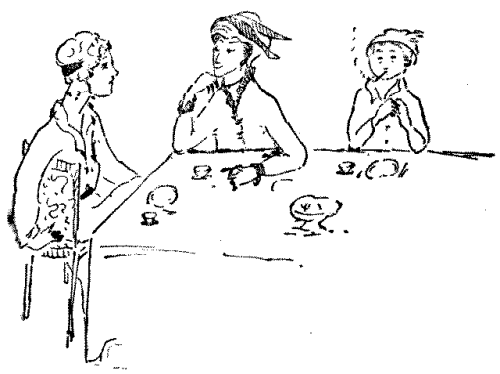
They were very entertaining. First they licked one another all over—“Darling, such a lovely hat! m’m—m’m. You do always manage to get hold of such wonderful things!” Then one or other got a little playful pat on the ear—“Yours, darling; he never was mine; nothing to do with me. I’m absolutely out of it.” Then a swift retreat—“Lola ought to be more careful, shouldn’t she? I mean, it’s too pitiful running after any one like that!”
We went in to lunch, and they purred together over the good food. Now and then they left for a moment their absorbing occupation of the preliminaries of battle while they took a detour round me. They had to do this for the sake of politeness, but they were both quite pleased to prolong their delights by a little diversion in between. Mrs. County brought Mrs. Merchant’s name in her mouth, and laid it before us as a morsel to worry. Being, more or less, in charge of it for the moment, I was able to slip it into my pocket and substitute a mixed variety of their Millport acquaintances. All of these they pretended to know in the slightest possible degree, they having now crossed the Rubicon between Millport and the County, and burned their sauce-boats (you know, don’t you, that this is the great ketchup country? You pass whole fields of it when you come through by train).
“Funny little place, Millport, isn’t it?” said Mrs. Smith. “I never could stand it when I was there. We’re having a party of natives next week; will you come, Rita, and help? I shan’t know what to do with them.”
“What sort of natives?” asked Mrs. County.
“Oh, you know the freaks Sam collects in Millport. He says we should not have any money if we weren’t civil to them.”
“It gives one such an insight into what the King and Queen must feel at Drawing-rooms, doesn’t it?” I suggested.
“I don’t quite see what you mean,” Mrs. Smith said, screwing up her eyes at me with elaborate attention. I explained that my cook’s sister was lady’s maid to one of the Queen’s ladies-in-waiting, and that she used to describe the fun that was often made, behind the scenes, of some of us middle-class people who go to the Drawing-rooms. Of course, they never suggested that the King and Queen made fun of their subjects—for, naturally, they wouldn’t; but some of those quite near the Throne did sometimes.
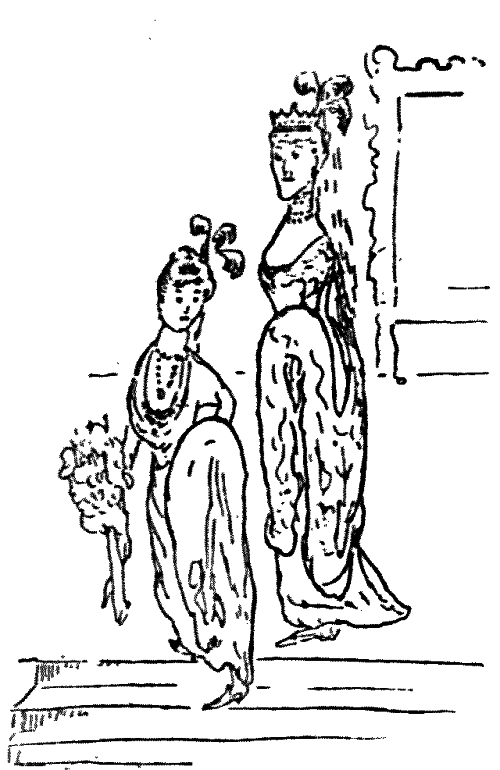
“You get all the best of the fun here,” I added, “because you see it from both points of view. Of course, the class below ours get it when they snub the tradespeople and then get snubbed by us; but the top dogs can only get one side of it all the time, until, perhaps, they go to heaven. Do you think that the Beasts who are described in the Book of Revelation will snub the ladies-in-waiting then?”
“I don’t know, I’m sure,” said Mrs. Smith coldly.
Mrs. County giggled, and, I thought, looked gratefully at me, as if I had been trying to score a point for her, which really hadn’t entered my mind. I was pursuing my own thoughts entirely. A great many people came over for tennis in the afternoon. Such a lot of cackling went on, but very languid cackling, like sick hens. At first it all seemed to consist of, “Now then, Hartley! Here, Lola! Where’s Bob? Teddy, have you got the balls? Will you take Emma? All right, take Lola then; it doesn’t matter which. Now then, Bob! Where’s Hartley? Lola, have you got the balls? Here, Teddy!” And then the same all mixed up again in a different way. But by and by, when they began to play, I became conscious again of the awful, cold shadow of fear that seems always upon them. Fear of losing some man’s allegiance. Fear of a husband discovering that a man’s allegiance is coveted. Fear of all their friends not knowing that there is any man’s allegiance for the husband to be prevented from discovering. Fear that there may be allegiance of greater social value which is being offered to some one else. Their life is like that fatiguing game called Demon Patience, where everybody tries to be the first to put the next card on six different heaps at once. I felt that Mrs. County and Mrs. Smith, and all the rest of them, were watching with the most practised rapidity of glance to see where a rival was going to plant a new dernier cri, whether in clothes, tricks of speech, paramours, or accomplishments of any kind. I longed to become a Yogi: to turn in my tongue, and sit motionless under a tree for a thousand hours and observe the slow processes of Nature.
When Mrs. Merchant came to fetch me I could have thrown myself into her arms. She is as simple as the day, and as dull as ditch-water (a clean ditch with clear water in it and rare ferns growing on the banks), and as pretty as a picture (a chromolithograph of an amiable and beautiful lady), and as wise as an owl which knows that the tree it lives in is hollow and prefers it that way, and as harmless as a dove whom I have been brutally making into pigeon-pie for your delight, but really that you may the better appreciate her full use and beauty. I should like to explain this to her if there were any chance of her ever coming across these letters; to tell her that we love
First when we see them roasted, biras we have passed Perhaps a hundred times nor cared to see.
We left Hartley and Emma and Lola and all of them hard at work, evaporating—metabolizing—rather than playing or doing anything else. Their existence seems to be continued by a succession of little explosions, when they leave off one habit and begin another. Some one, I suppose Mrs. County, had been rash enough to tell them that I belong to the professional classes. That set them off exploding like little bombs all round. “By Jove!” “You don’t say so!” “Dear me!” “Artists and those queer kind of beggars!” “Ever meet So-and-so? He painted my missis and we had the time of our lives,” etc.
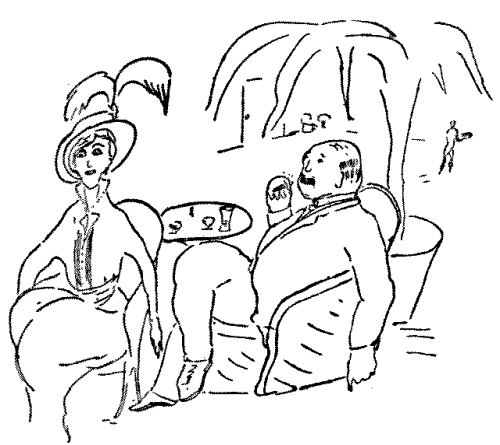
Have you ever, in a big hotel where an orchestra played after dinner, noticed the faces listening to the music? Sometimes in those orchestras there are men who can play. I have seen some of our brothers saying in their inner consciousness, and almost unknown to the part of their minds which they are using at the moment, “Queer beggars, by Jove! makin’ chunes and fiddlin’ away there. Curious sort of life it must be workin’ a stick up and down on a string made out of some por brute’s inside! wonderful how they manage to keep it up—La da, da de da, pretty little thing that. Tomkins is a deuced shrewd feller the way he handled that contract—” and their thoughts go wandering off again. So I have wandered off myself; but this pigeon-holing of people is a habit I have learned here for the first time. I never knew before how much you and I pigeon-holed merchants and their kind as miserly and uneducated persons, just as they pigeon-hole us as queer beggars with eccentric hair and polygamous habits. When we got home I explained all this to Mr. Merchant, and we spent an evening of vigorous discussion. He rolled me over, so to speak (I have got into the way of explaining all forms of hyperbole), and trampled on me.
“What you long-haired chaps don’t see—” he began.
“Now, if I am to stop calling you and your friends fat you must stop calling mine long-haired,” I interrupted.
“Very well,” he agreed, “but what you and your friends don’t see is that there must be different kinds of people to keep things going. You can’t have every one alike.”
“God forbid!” I said, “no one ever suggested it.”
“Now suppose one of your long-haired friends came into my office—”
“Yes,” I said, “or suppose one of your fat friends came into my studio—”
“Just so,” he replied. “Well, they’d both be fish out of water, wouldn’t they?”
“In a state of chaos,” I explained, “animals, birds, fishes and so on lived together, and such as could not agree ate each other in silence. Later in history they became civilized and masqueraded in one another’s skins, and we are led to hope that, by and by, the lion will lie down with the lamb, and the merchant and the cockatrice——”
The angry butler came in just then and Mrs. Merchant gave a slight cough and frowned at me, so we never finished our discussion. I shall be sorry to leave them.
Good-bye,
Yours ever,
Georgina.
PRINTED AT THE BALLANTYNE PRESS LONDON
A LIST OF THE LIBRARIES AND SERIES OF COPYRIGHT BOOKS PUBLISHED BY Duckworth & CO.
3 HENRIETTA STREET, COVENT GARDEN LONDON, W.C.
THE LIBRARY OF ART
Embracing Painting, Sculpture, Architecture, etc. Edited by Mrs S. Arthur Strong, LL.D. Extra cloth, with lettering and design in gold. Large cr. 8vo (7¾ in. by 5¾ in.), gilt top, headband. 5s. net a volume. Inland postage, 5d.
LIST OF VOLUMES
Donatello. By Lord Balcarres, M.P. With 58 plates.
Great Masters of Dutch and Flemish Painting. By Dr W. Bode. With 48 plates.
Rembrandt. By G. Baldwin Brown, of the University of Edinburgh. With 45 plates.
Antonio Pollaiuolo. By Maud Cruttwell. With 50 plates.
Verrocchio. By Maud Cruttwell. With 48 plates.
The Lives of the British Architects. By E. Beresford Chancellor. With 45 plates.
The School of Madrid. By A. de Beruete y Moret. With 48 plates.
William Blake. By Basil de Selincourt. With 40 plates.
Giotto. By Basil de Selincourt. With 44 plates.
French Painting in the Sixteenth Century. By L. Dimier. With 50 plates.
The School of Ferrara. By Edmund G. Gardner. With 50 plates.
Six Greek Sculptors. (Myron, Pheidias, Polykleitos, Skopas, Praxiteles, and Lysippos.) By Ernest Gardner. With 81 plates.
Titian. By Dr Georg Gronau. With 54 plates.
Constable. By M. Sturge Henderson. With 48 plates.
Pisanello. By G. F. Hill. With 50 plates.
Michael Angelo. By Sir Charles Holroyd. With 52 plates.
Mediæval Art. By W. R. Lethaby. With 66 plates and 120 drawings in the text.
The Scottish School of Painting. By William D. McKay, R.S.A. With 46 plates.
Christopher Wren. By Lena Milman. With upwards of 60 plates.
Correggio. By T. Sturge Moore. With 55 plates.
Albert Dürer. By T. Sturge Moore. With 4 copperplates and 50 half-tone engravings.
Sir William Beechey, R.A. By W. Roberts. With 49 plates.
The School of Seville. By N. Sentenach. With 50 plates.
Roman Sculpture from Augustus to Constantine. By Mrs S. Arthur Strong, LL.D., Editor of the Series. 2 vols. With 130 plates.
THE POPULAR LIBRARY OF ART
Pocket volumes of biographical and critical value on the great painters, with very many reproductions of the artists’ works. Each volume averages 200 pages, 16mo, with from 40 to 50 illustrations. To be had in different styles of binding: Boards gilt, 1s. net; green canvas, or red cloth, gilt, 2s. net; limp lambskin, red and green, 2s. 6d. net. Several titles can also be had in the popular Persian yapp binding, in box, 2s. 6d. net each.
LIST OF VOLUMES
Botticelli. By Julia Cartwright (Mrs Ady). Also in Persian yapp binding.
Raphael. By Julia Cartwright (Mrs Ady). Also in Persian yapp binding.
Frederick Walker. By Clementina Black.
Rembrandt. By Auguste Bréal.
Velazquez. By Auguste Bréal. Also in Persian yapp binding.
Gainsborough. By Arthur B. Chamberlain. Also in Persian yapp binding.
Cruikshank. By W. H. Chesson.
Blake. By G. K. Chesterton.
G. F. Watts. By G. K. Chesterton. Also in Persian yapp binding.
Albrecht Dürer. By Lina Eckenstein.
The English Water-Colour Painters. By A. J. Finberg. Also in Persian yapp binding.
Hogarth. By Edward Garnett.
Leonardo da Vinci. By Dr Georg Gronau. Also in Persian yapp binding.
Holbein. By Ford Madox Hueffer.
Rossetti. By Ford Madox Hueffer. Also in Persian yapp binding.
The Pre-Raphaelite Brotherhood. By Ford Madox Hueffer. Also in Persian yapp binding.
Perugino. By Edward Hutton.
Millet. By Romain Rolland. Also in Persian yapp binding.
Watteau. By Camilla Mauclair.
The French Impressionists. By Camille Mauclair. Also in Persian yapp binding.
Whistler. By Bernhard Sickert. Also in Persian yapp binding.
MASTERS OF PAINTING
With many illustrations in photogravure.
A series which gives in each volume a large number of examples reproduced in photogravure of the works of its subject. The first series of books on art issued at a popular price to use this beautiful method of reproduction.
The letterpress is the same as the volumes in the Popular Library of Art, but it is reset, the size of the volumes being 8¾ ins. by 5¾ ins. There are no less than 32 plates in each volume. Bound in cloth with gold on side, gold lettering on back: gilt top, picture wrapper, 3s. 6d. net a volume, postage 4d.
This is the first time that a number of photogravure illustrations have been given in a volume published at a popular price. The process having been very costly has been reserved for expensive volumes or restricted to perhaps a frontispiece in the case of books issued at a moderate price. A new departure in the art of printing has recently been made with the machining of photogravures; the wonderfully clear detail and beautifully soft effect of the photogravure reproductions being obtained as effectively as by the old method. It is this great advance in the printing of illustrations which makes it possible to produce this series.
The volumes are designed to give as much value as possible, and for the time being are the last word in popular book production.
It would be difficult to conceive of more concise, suggestive, and helpful volumes than these. All who read them will be aware of a sensible increase in their knowledge and appreciation of art and the world’s masterpieces.
The first six volumes are:
Raphael. By Julia Cartwright.
Botticelli. By Julia Cartwright.
G. F. Watts. By G. K. Chesterton.
Leonardo da Vinci. By Georg Gronau.
Holbein. By Ford Madox Hueffer.
Rossetti. By Ford Madox Hueffer.
THE CROWN LIBRARY
The books included in this series are standard copyright works, issued in similar style at a uniform price, and are eminently suited for the library. They are particularly acceptable as prize volumes for advanced students. Demy 8vo, size 9 in. by 5¾ in. Cloth gilt, gilt top. 5s. net. Postage 5d.
The Rubá’iyát of ’Umar Khayyám (Fitzgerald’s 2nd Edition). Edited, with an Introduction and Notes, by Edward Heron Allen.
Science and Religion in Contemporary Philosophy. By Emile Boutroux.
Wanderings in Arabia. By Charles M. Doughty. An abridged edition of “Travels in Arabia Deserta.” With portrait and map. In 2 vols.
The Intimate Life of Alexander Hamilton. By Allan McLane Hamilton. Illustrated.
Folk-Lore of the Holy Land: Moslem, Christian, and Jewish. By J. E. Hanauer. Edited by Marmaduke Pickthall.
Life and Evolution. By F. W. Headley, F.Z.S. With upwards of 100 illustrations. New and revised edition (1913).
The Note-Books of Leonardo da Vinci. Edited by Edward McCurdy. With 14 illustrations.
The Life and Letters of Leslie Stephen. By F. W. Maitland. With a photogravure portrait.
The Country Month by Month. By J. A. Owen and G. S. Boulger. With notes on Birds by Lord Lilford. With 20 black and white illustrations.
⁂ A new special edition of this book, with 12 illustrations in colour and 20 in black and white, is published. Price 6s. net.
Spinoza: His Life and Philosophy. By Sir Frederick Pollock.
The English Utilitarians. By Sir Leslie Stephen. 3 vols.
Vol. I. James Mill.
Vol. II. Jeremy Bentham.
Vol. III. John Stuart Mill.
Critical Studies. By S. Arthur Strong. With Memoir by Lord Balcarres, M.P. Illustrated.
Mediæval Sicily: Aspects of Life and Art in the Middle Ages. By Cecilia Waern. With very many illustrations.
MODERN PLAYS
Including the dramatic work of leading contemporary writers, such as Andreyef, Björnson, Galsworthy, Hauptmann, Ibsen, Maeterlinck, Eden Phillpotts, Strindberg, Sudermann, Tchekoff, and others.
In single volumes. Cloth, 2s. net; paper covers, 1s. 6d. net a volume; postage, 3d.
The Revolt and the Escape. By Villiers de L’Isle Adam. (Cloth binding only.)
Hernani. A Tragedy. By Frederick Brock. (Cloth binding only.)
Tristram and Iseult. A Drama. By J. Comyns Carr.
Passers-By. By C. Haddon Chambers.
The Likeness of the Night. By Mrs W. K. Clifford.
A Woman Alone. By Mrs W. K. Clifford.
The Silver Box. By John Galsworthy.
Joy. By John Galsworthy.
Strife. By John Galsworthy.
Justice. By John Galsworthy.
The Eldest Son. By John Galsworthy.
The Little Dream. By John Galsworthy. (Cloth, 1s. 6d. net; paper covers, 1s. net.)
The Fugitive. By John Galsworthy.
The Mob. By John Galsworthy.
The Pigeon. By John Galsworthy.
The Coming of Peace. By Gerhart Hauptmann. (Cloth binding only.)
Love’s Comedy. By Henrik Ibsen. (Cloth binding only.)
The Divine Gift. A Play. By Henry Arthur Jones. With an Introduction and a Portrait. (3s. 6d. net. Cloth binding only.)
The Widowing of Mrs Holroyd. A Drama. By D. H. Lawrence. With an Introduction. (Cloth only, 3s. 6d. net.)
Three Little Dramas. By Maurice Maeterlinck. (Cloth binding only.)
St Francis of Assisi. A Play in Five Acts. By J. A. Peladon. (Cloth only, 3s. 6d. net.)
Peter’s Chance. A Play. By Edith Lyttelton.
The Mother. A Play. By Eden Phillpotts.
The Shadow. A Play. By Eden Phillpotts.
The Secret Woman. A Drama. By Eden Phillpots.
Curtain Raisers. One Act Plays. By Eden Phillpots.
The Father. By August Strindberg. (Cloth binding only.)
Creditors. Pariah. Two Plays. By August Strindberg. (Cloth binding only.)
Miss Julia. The Stronger. Two Plays. By August Strindberg. (Cloth binding only.)
There are Crimes and Crimes. By August Strindberg. (Cloth binding only.)
Roses. Four One Act Plays. By Hermann Sudermann. (Cloth binding only.)
Morituri. Three One Act Plays. By Hermann Sudermann. (Cloth binding only.)
The Joy of Living. A Play. By Hermann Sudermann. (Cloth only, 4s. 6d. net.)
Five Little Plays. By Alfred Sutro.
The Two Virtues. A Play. By Alfred Sutro.
The Dawn (Les Aubes). By Emile Verhaeren. Translated by Arthur Symons. (Cloth binding only.)
The Princess of Hanover. By Margaret L. Woods. (Cloth binding only.)
Plays. By Leonid Andreyef. Translated from the Russian, with an Introduction by F. N. Scott and C. L. Meader. Cr. 8vo. cloth gilt. 6s.
Plays. (First Series.) By Björnstjerne Björnson. (The Gauntlet, Beyond our Power, The New System.) With an Introduction and Bibliography. In one vol. Cr. 8vo. 6s.
Plays. (Second Series.) By Björnstjerne Björnson. (Love and Geography, Beyond Human Might, Laboremus.) With an Introduction by Edwin Björkman. In one vol. Cr. 8vo. 6s.
Three Plays. By Mrs W. K. Clifford. (Hamilton’s Second Marriage, Thomas and the Princess, The Modern Way.) In one vol. Sq. cr. 8vo. 6s.
Plays (Volume One). By John Galsworthy. Three Plays (Joy, Strife, The Silver Box) in one vol. Sq. cr. 8vo. 6s.
Plays (Volume Two). By John Galsworthy. Three Plays (Justice, The Little Dream, The Eldest Son) in one vol. Sq. cr. 8vo. 6s.
Plays (Volume Three). By John Galsworthy. Three Plays (The Pigeon, The Fugitive, The Mob) in one vol. Sq. cr. 8vo. 6s.
Four Tragedies. By Allan Monkhouse. (The Hayling Family, The Stricklands, Resentment, Reaping the Whirlwind.) In one vol. Cr. 8vo. cloth gilt. 6s.
Plays. (First Series.) By August Strindberg. (The Dream Play, The Link, The Dance of Death, Part I.; The Dance of Death, Part II.) In one vol. Cr. 8vo. 6s.
Plays. (Second Series.) By August Strindberg. (Creditors, Pariah, There are Crimes and Crimes, Miss Julia, The Stronger.) In one vol. 6s.
Plays. (Third Series.) By August Strindberg. (Advent, Simoom, Swan White, Debit and Credit, The Spook Sonata, The Black Glove.) Cr. 8vo. 6s.
Plays. By Anton Tchekoff. (Uncle Vanya, Ivanoff, The Seagull, The Swan Song.) With an Introduction. Cr. 8vo. 6s.
THE READERS’ LIBRARY
A new series of Copyright Works of Individual Merit and Permanent Value—the work of Authors of Repute.
Library style. Cr. 8vo. Blue cloth gilt, round backs. 2s. 6d. net a volume; postage, 4d.
Avril. By Hilaire Belloc. Essays on the Poetry of the French Renaissance.
Esto Perpetua. By Hilaire Belloc. Algerian Studies and Impressions.
Men, Women, and Books: Res Judicatæ. By Augustine Birrell. Complete in one vol.
Obiter Dicta. By Augustine Birrell. First and Second Series in one volume.
Memoirs of a Surrey Labourer. By George Bourne.
The Bettesworth Book. By George Bourne.
Studies in Poetry. By Stopford A. Brooke, LL.D. Essays on Blake, Scott, Shelley, Keats, etc.
Four Poets. By Stopford A. Brooke, LL.D. Essays on Clough, Arnold, Rossetti, and Morris.
Comparative Studies in Nursery Rhymes. By Lina Eckenstein. Essays in a branch of Folk-lore.
Italian Poets since Dante. Critical Essays. By W. Everett.
Villa Rubein, and Other Stories. By John Galsworthy.
Faith, and other Sketches. By R. B. Cunninghame Graham.
Hope, and other Sketches. By R. B. Cunninghame Graham.
Progress, and other Sketches. By R. B. Cunninghame Graham.
Success, and other Sketches. By R. B. Cunninghame Grahame.
A Crystal Age: a Romance of the Future. By W. H. Hudson.
Green Mansions. A Romance of the Tropical Forest. By W. H. Hudson.
The Purple Land. By W. H. Hudson.
The Critical Attitude. By Ford Madox Hueffer.
The Heart of the Country. By Ford Madox Hueffer.
The Soul of London. By Ford Madox Hueffer.
The Spirit of the People. By Ford Madox Hueffer.
After London—Wild England. By Richard Jefferies.
Amaryllis at the Fair. By Richard Jefferies.
Bevis. The Story of a Boy. By Richard Jefferies.
The Hills and the Vale. Nature Essays. By Richard Jefferies.
The Greatest Life. An inquiry into the foundations of character. By Gerald Leighton, M.D.
St Augustine and his Age. An Interpretation. By Joseph McCabe.
Between the Acts. By H. W. Nevinson.
Essays in Freedom. By H. W. Nevinson.
Principle in Art: Religio Poetæ. By Coventry Patmore.
Parallel Paths. A Study in Biology, Ethics, and Art. By T. W. Rolleston.
The Strenuous Life, and other Essays. By Theodore Roosevelt.
English Literature and Society in the Eighteenth Century. By Sir Leslie Stephen.
Studies of a Biographer. First Series. Two Volumes. By Sir Leslie Stephen.
Studies of a Biographer. Second Series. Two Volumes. By Sir Leslie Stephen.
The Black Monk, and other Tales. By Anton Tchekoff.
Interludes. By Sir Geo. Trevelyan.
Essays on Dante. By Dr Carl Witte.
THE ROADMENDER SERIES.
The volumes in the series are works with the same tendency as Michael Fairless’s remarkable book, from which the series gets its name: books which express a deep feeling for Nature, and a mystical interpretation of life. Fcap. 8vo, with designed end papers. 2s. 6d. net.
Women of the Country. By Gertrude Bone.
The Sea Charm of Venice. By Stopford A. Brooke.
Magic Casements. By Arthur S. Cripps.
A Martyr’s Servant. By Arthur S. Cripps.
Thoughts of Leonardo da Vinci. Selected by Edward McCurdy.
The Roadmender. By Michael Fairless. Also in limp lambskin, 3s. 6d. Persian yapp, 4s. net. Velvet calf yapp, 5s. net. Illustrated Edition with Black and White Illustrations by W. G. Mein, cr. 8vo, 5s. net. Also Special Illustrated edition in colour from oil paintings by E. W. Waite, 7s. 6d. net. Edition de Luxe, 15s. net.
The Gathering of Brother Hilarius. By Michael Fairless. Also limp lambskin, 3s. 6d. net. Persian yapp, 4s. net. Velvet calf yapp, 5s. net.
Also a Special Illustrated Edition in Colour from Paintings by Elinor Fortescue Brickdale. 7s. 6d. net.
The Grey Brethren. By Michael Fairless. Also limp lambskin, 3s. 6d. net. Persian yapp, 4s. net. Velvet calf yapp, 5s. net.
A Special Illustrated Edition of the Children’s Stories, which appear in The Grey Brethren, is published under the title of “Stories Told to Children.” The Illustrations in Colour are from Drawings by Flora White.
Michael Fairless: Life and Writings. By W. Scott Palmer and A. M. Haggard. Also Persian yapp, 4s. net.
A Modern Mystic’s Way. By Wm. Scott Palmer.
From the Forest. By Wm. Scott Palmer.
Pilgrim Man. By Wm. Scott Palmer.
Winter and Spring. By Wm. Scott Palmer.
The Plea of Pan. By H. W. Nevinson, author of “Essays in Freedom,” “Between the Acts.”
Bedesman 4. By Mary J. H. Skrine.
Vagrom Men. By A. T. Story.
Light and Twilight. By Edward Thomas.
Rest and Unrest. By Edward Thomas.
Rose Acre Papers: Horæ Solitariæ. By Edward Thomas.
SOCIAL QUESTIONS SERIES.
Makers of Our Clothes. A Case for Trade Boards. By Miss Clementina Black and Lady Carl Meyer. Demy 8vo. 5s. net.
Sweated Industry and the Minimum Wage. By Clementina Black. With Preface by A. G. Gardiner. Cloth, crown 8vo. 2s. net.
Women in Industry: From Seven Points of View. With Introduction by D. J. Shackleton. Cloth, crown 8vo. 2s. net.
The Worker’s Handbook. By Gertrude M. Tuckwell. A handbook of legal and general information for the Clergy, for District Visitors, and all Social Workers. Cr. 8vo. 2s. net.
STORIES OF ANIMAL LIFE, Etc.
Illustrated by Charles Livingston Bull.
Uniform binding. Large crown 8vo. 6s.
Under the Roof of the Jungle. A Book of Animal Life in the Guiana Wilds. Written and illustrated by Charles Livingston Bull. With 60 full-page plates drawn from Life by the Author.
The Kindred of the Wild. A Book of Animal Life. By Charles G. D. Roberts, Professor of Literature, Toronto University, late Deputy-Keeper of Woods and Forests, Canada. With many illustrations by Charles Livingston Bull.
The Watchers of the Trails. A Book of Animal Life. By Charles G. D. Roberts. With 48 illustrations by Charles Livingston Bull.
The Story of Red Fox. A Biography. By Charles G. D. Roberts. Illustrated by Charles Livingston Bull.
The Haunters of the Silences. A Book of Wild Nature. By Charles G. D. Roberts. Illustrated by Charles Livingston Bull.
Plantation Stories. By Andrews Wilkinson. Illustrated by Charles Livingston Bull.
STUDIES IN THEOLOGY
A New Series of Handbooks, being aids to interpretation in Biblical Criticism for the use of the Clergy, Divinity Students, and Laymen. Cr. 8vo. 2s. 6d. net a volume.
The Environment of Early Christianity. By the Rev. Professor Samuel Angus, Professor of New Testament Historical Theology in St Andrew’s College, University of Sydney. Cr. 8vo. 2s. 6d. net.
Christianity and Ethics. By the Rev. Archibald B. D. Alexander, M.A., D.D., author of “A Short History of Philosophy,” “The Ethics of St Paul.”
The Christian Hope. A Study in the Doctrine of the Last Things. By W. Adams Brown, Ph.D., D.D., Professor of Theology in the Union College, New York.
Christianity and Social Questions. By the Rev. William Cunningham, D.D., F.B.A., Fellow of Trinity College, Cambridge, Hon. Fellow of Gonville and Caius College, Cambridge, Archdeacon of Ely, formerly Lecturer on Economic History to Harvard University.
A Handbook of Christian Apologetics. By the Rev. A. E. Garvie, M.A., Hon. D.D., Glasgow University, Principal of New College, Hampstead.
A Critical Introduction to the Old Testament. By the Rev. George Buchanan Gray, M.A., D.Litt., Professor of Hebrew and Old Testament Exegesis in Mansfield College, Oxford.
Gospel Origins. A Study in the Synoptic Problem. By the Rev. William West Holdsworth, M.A., Tutor in New Testament Language and Literature, Handsworth College; author of “The Christ of the Gospels,” “The Life of Faith,” etc.
Faith and its Psychology. By the Rev. William R. Inge, D.D., Dean of St Paul’s, Lady Margaret Professor of Divinity, Cambridge, and Bampton Lecturer, Oxford, 1899.
Christianity and Sin. By the Rev. Robert Mackintosh, M.A., D.D., Professor of Apologetics in Lancashire Independent College; Lecturer in the University of Manchester.
Protestant Thought before Kant. By A. C. McGiffert, Ph.D., D.D., of the Union Theological Seminary, New York.
The Theology of the Gospels. By the Rev. James Moffat, B.D., D.D., of the U.F. Church of Scotland, sometime Jowett Lecturer, London, author of “The Historical New Testament.”
A History of Christian Thought since Kant. By the Rev. Edward Caldwell Moore, D.D., Parkman Professor of Theology in the University of Harvard, U.S.A., author of “The New Testament in the Christian Church,” etc.
Revelation and Inspiration. By the Rev. James Orr, D.D., Professor of Apologetics in the Theological College of the United Free Church, Glasgow.
A Critical Introduction to the New Testament. By Arthur Samuel Peake, D.D., Professor of Biblical Exegesis and Dean of the Faculty of Theology, Victoria University, Manchester; sometime Fellow of Merton College, Oxford.
Philosophy and Religion. By the Rev. Hastings Rashdall, D.Litt. (Oxon.), D.C.L. (Durham), F.B.A., Fellow and Tutor of New College, Oxford.
The Religious Ideas of the Old Testament. By the Rev. H. Wheeler Robinson, M.A., Tutor in Rawdon College; sometime Senior Kennicott Scholar in Oxford University.
Text and Canon of the New Testament. By Alexander Souter, M.A., D. Litt., Professor of Humanity at Aberdeen University.
The Christian Doctrine of God. By W. R. Thomson, D.D.
Christian Thought to the Reformation. By Herbert B. Workman, M.A., D. Litt., Principal of the Westminster Training College.
THE WINDERMERE SERIES OF COLOUR BOOKS.
A New Series of Standard Books, well illustrated in colour, bound in cloth with picture wrapper in colour, designed end-papers. Illustrated by Milo Winter and by Hope Dunlop. Cover design by Charles Robinson. Royal 8vo. Cloth gilt. Picture wrappers in colour. 5s. net.
The Arabian Nights.
Robinson Crusoe.
Grimm’s Fairy Tales.
Gulliver’s Travels.
Hawthorne’s Wonder Book.
Tanglewood Tales.
The “Story Box” Series of Books for Children. Stories of Wonder and Fancy. With Illustrations in Full Colour and in Line. From 12 to 16 Illustrations in each Volume. Boards, with coloured cover inset, picture end-papers, attractive wrapper. Square cr. 8vo. 1s. net a volume.
The Buccaneers. By A. E. Bonsor.
The Fortunate Princeling. By A. D. Bright.
Wanted a King. By Maggie Browne.
The Enchanted Wood. By S. H. Hamer.
The Four Glass Balls. By S. H. Hamer.
Peter Pink Eye. By S. H. Hamer.
The Adventures of Spider & Co. By S. H. Hamer.
Gervas and the Magic Castle. By B. S. Harvey.
The Magic Dragon. By B. S. Harvey.
The Little Maid who Danced. By Helena Nyblom.
The Strange Little Girl. By B. Sidney Woolf.
Golden House. By B. Sidney Woolf.
Duckworth & Co.’s Shilling Net Series
The Brassbounder: A Tale of the Sea. By David W. Bone. Cloth. With picture jacket by E. F. Hodgson.
Wrack: A Tale of the Sea. By Maurice Drake. Cloth. With picture jacket by E. F. Hodgson.
Beyond The Rocks. By Elinor Glyn. Picture Paper Covers.
The Reason Why. By Elinor Glyn. Picture Paper Covers.
The Visits of Elizabeth. By Elinor Glyn. Picture Paper Covers.
Vicissitudes of Evangeline. By Elinor Glyn. Picture Paper Covers.
When the Hour Came. By Elinor Glyn. Picture Paper Covers.
Scottish Stories. By R. B. Cunninghame Graham. Cloth.
South American Sketches. By W. H. Hudson. Cloth.
Sahib Log: An Anglo-Indian Tale. By John Travers. Picture Paper Covers.
BOOKS ON APPROVAL
Messrs DUCKWORTH & CO.’s Publications may be obtained through any good bookseller. Anyone desiring to examine a volume should order it subject to approval. The bookseller can obtain it from the publishers on this condition.
The following Special Lists and Catalogues will be sent Post Free on request to any address:—
A LIST OF ANNOUNCEMENTS
A GENERAL CATALOGUE OF PUBLICATIONS
A COLOURED PROSPECTUS OF NEW ILLUSTRATED CHILDREN’S BOOKS
A DESCRIPTIVE LIST OF “THE READERS’ LIBRARY”
A DESCRIPTIVE LIST OF “MASTERS OF PAINTING,” “THE LIBRARY OF ART,” “THE POPULAR LIBRARY OF ART”
A DESCRIPTIVE LIST OF “THE CROWN LIBRARY”
A LIST OF THEOLOGICAL WORKS
A LIST OF MODERN PLAYS
DUCKWORTH & COMPANY
3 HENRIETTA STREET, COVENT GARDEN, LONDON