Front matter
Reading edition
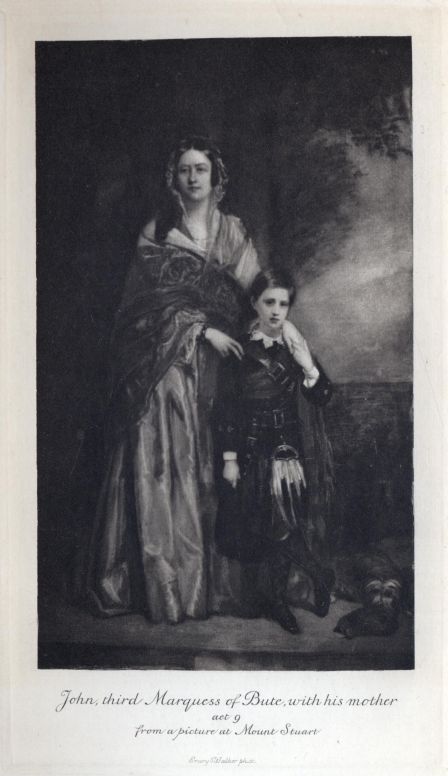
John, third Marquess of Bute, with his Mother aet 9 from a picture at Mount Stuart
JOHN PATRICK
THIRD MARQUESS OF BUTE, K.T.
(1847-1900)
A MEMOIR
BY
THE RIGHT REV. SIR DAVID HUNTER BLAIR
BT., O.S.B.
AUTHOR OF "A MEDLEY Of MEMORIES," ETC.
WITH PORTRAITS AND ILLUSTRATIONS
LONDON JOHN MURRAY, ALBEMARLE STREET, W. 1921
All rights reserved
TO THE MEMORY OF MY FRIEND
PREFACE
Just twenty years have passed away since the death, at the age of little more than fifty, of the subject of this memoir—a period of time not indeed inconsiderable, yet not so long as to render unreasonable the hope that others besides the members of his family (who have long desired that there should be some printed record of his life), and the sadly diminished numbers of his intimate friends, may be interested in learning something of the personality and the career of a man who may justly be regarded as one of the not least remarkable, if one of the least known, figures of the closing years of the nineteenth century.
Disraeli, when he published fifty years ago his most popular romance, thought fit to place on the title-page a motto from old Terence: "Nosse omnia haec salus est adulescentulis."[1] Was he really of opinion—it is difficult to credit it—that the welfare of the youth of his generation depended on their familiarising themselves with the wholly imaginary life-story of "Lothair"? the romantic, sentimental, and somewhat invertebrate youth who owed such fame as he achieved to the fact that he was popularly supposed to be modelled on the young Lord Bute—though never, in truth, did any hero of fiction bear less resemblance to his fancied prototype.
The present biographer ventures to think that the motto of Lothair might with greater propriety figure on the title-page of this volume. For there is at least one feature in the life of John third Marquess of Bute which teaches a salutary lesson and points an undoubted moral to a pleasure-loving generation, such a lesson and moral as it would be vain to look for in the puppet of Disraeli's Oriental fancy. If there is any characteristic which stands out in that life more saliently than another, it is surely the strong and compelling sense of duty—a sense, it is to be noticed, acquired rather than congenital, for Bute was by nature and constitution, as an acute observer early remarked,[2] inclined to indolence—which runs all through it like a silver thread. Other traits, and marked ones, he no doubt possessed—among them a penetrating sense of religion, a curious tenderness of heart, a singular tenacity of purpose, and a deep veneration for all that is good and beautiful in the natural and supernatural world; but these were for the most part below the surface, though the pages of this record are not without evidence of them all. But in the whole external conduct of his life it may be said that the desire of doing his duty was paramount with him—his duty to God and to man; his duty, above all, to the innumerable human beings whose happiness and welfare his great position and manifold responsibilities rendered to some extent dependent on him; and, finally, his duty in such public offices as he was called on to fill, and from which his diffidence of character and aversion from anything like personal display would have naturally inclined him to shrink. If the writer has succeeded in presenting in these pages something of this aspect of the life and character of his departed friend with anything like the vividness with which, at the end of twenty years, they still remain impressed on his own memory, he will be well content.
"The true life of a man," wrote John Henry Newman nearly sixty years ago,[3] "is in his letters"; and no apology is needed for the inclusion in this volume of some, at least, of the large number of Lord Bute's letters which have been placed at the disposal of his biographer, and for the use of which he takes this opportunity of thanking the several owners. Bute possessed in a high degree the essential qualities of a good letter-writer—a remarkable command of language, the power of clear and forcible expression, and (not least) a salutary sense of humour; and his voluminous correspondence, especially in connection with his literary work, was always and thoroughly characteristic of himself.
The writer desires, in conclusion, to express his gratitude not only for the loan of Lord Bute's letters, but for the kind help he has received from many quarters in the elucidation (especially) of details regarding his childhood and youth. In this connection his thanks are particularly due to the late Earl of Galloway and his sisters for their interesting reminiscences of Bute's boyhood at Galloway House; and also to the family of the late Mr. Charles Scott Murray for some particulars of his life during the critical years of his early manhood.
+ DAVID OSWALD HUNTER BLAIR, O.S.B. CHRISTMAS, 1920.
CONTENTS
CHAPTER PAGE I. EARLY LIFE. (1847-1861) . . . . . . . . . . . . . . . . 1 II. HARROW AND CHRIST CHURCH. (1862-1866) . . . . . . . . . 18 III. RELIGIOUS INQUIRIES--RECEPTION POSTPONED--COMING OF AGE. (1867, 1868) . . . . . . . . . . . . . . . 39 IV. DANESFIELD--RECEPTION INTO CATHOLIC CHURCH. (1867-1869) 60 V. THE WESTERN MAIL--ROME AND THE COUNCIL--RETURN TO SCOTLAND. (1869-1871) . . . . . . . . . . . . . 83 VI. MARRIAGE--HOME AND FAMILY LIFE--VISIT TO MAJORCA. (1871-1874) . . . . . . . . . . . . . . . 102 VII. LITERARY WORK--THE SCOTTISH REVIEW. (1875-1886) . . . . 117 VIII. LITERARY WORK--continued. (1886, 1887) . . . . . . . . 137 IX. FOREIGN TRAVEL--ST. JOHN'S LODGE--MAYOR OF CARDIFF. (1888-1891) . . . . . . . . . . . . . . . 156 X. FREEDOM OF GLASGOW--WELSH BENEFACTIONS--ST. ANDREWS. (1891-1894) . . . . . . . . . . . . . . . . . . . . 179 XI. NOTES AND ANECDOTES--ST. ANDREWS (2)--PROVOST OF ROTHESAY. (1894-1897) . . . . . . . . . . . . . 198 XII. ARCHITECTURAL WORK--PSYCHICAL RESEARCH--CONCLUSION. (1898-1900) . . . . . . . . . . . . . . . . . . . . 215 APPENDICES I. PRIZE POEM (HARROW SCHOOL) . . . . . . . . . . . . . . 231 II. HYMN ON ST. MAGNUS . . . . . . . . . . . . . . . . . . 236 III. HYMN: "OUR LADY OF THE SNOWS" . . . . . . . . . . . . . 238 IV. A PROVOST'S PRAYER . . . . . . . . . . . . . . . . . . 240 V. RECOLLECTIONS. BY SIR R. ROWAND ANDERSON . . . . . . . 241 VI. OBITUARY. BY F. W. H. MYERS . . . . . . . . . . . . . 245 VII. BIBLIOGRAPHY . . . . . . . . . . . . . . . . . . . . . 247 INDEX . . . . . . . . . . . . . . . . . . . . . . . . . 249
LIST OF ILLUSTRATIONS
JOHN, THIRD MARQUESS OF BUTE ÆT 9, WITH HIS MOTHER Frontispiece From a Painting by Mountstuart. Photo by F. C. Inglis, Edinburgh. FACING PAGE THE MARQUESS OF BUTE, ÆT 2 . . . . . . . . . . . . . . . . . . 6 From a Pencil Drawing by Ross at Cardiff Castle. This Drawing, executed for Lord Bute's great-grand-aunt (then aged 92), daughter of the third Earl, George III's Prime Minister, was left by her to her niece. Lady Ann Damson, whose great-niece, Mrs. Clark of Tal-y-Garn, gave it in 1906 to Augusta, wife of John, fourth Marquess of Bute. THE MARQUESS OF BUTE, ÆT 17 . . . . . . . . . . . . . . . . . 28 THE COMMUNION OF ST. MARGARET, QUEEN OF SCOTLAND . . . . . . . 48 CARDIFF CASTLE . . . . . . . . . . . . . . . . . . . . . . . . 56 CASTELL COCH, GLAMORGAN . . . . . . . . . . . . . . . . . . . 118 THE GREAT HALL, MOUNTSTUART . . . . . . . . . . . . . . . . . 134 Photo by Sweet, Rothesay. FALKLAND PALACE . . . . . . . . . . . . . . . . . . . . . . . 152 Photo by Valentine, Dundee. FACSIMILE LETTER FROM THE MARQUESS OF BUTE TO MISS SKENE . . . 174 THE MARQUESS OF BUTE AS MAYOR OF CARDIFF . . . . . . . . . . . 176 THE MARQUESS OF BUTE AS LORD RECTOR OF ST. ANDREWS UNIVERSITY. (1892-1897) . . . . . . . . . . . . . . . . . 202 Photo by Rodger, St. Andrews. PLUSCARDEN PRIORY . . . . . . . . . . . . . . . . . . . . . . 216