Volume 2 — CHAPTER XIX.
Reading edition
THOMAS HOOD AND LEECH.
The difficulty of gauging public taste in matters literary and artistic can be proved by numberless examples. How often does the manager of a theatre place in trembling anxiety a piece before his audience which afterwards runs for hundreds of nights! "Our Boys" has had a long life upon the stage; but so doubtful was everyone connected with its production of its living for one night even, that another play was held in readiness to take the place of the damned one. Books that have made reputations for their authors have been refused by publisher after publisher. Engravings run the same perilous course. Print-sellers, from long experience of public wants, should know what will satisfy them; but they seem to find the difficulty that befalls publishers and the managers of theatres.
Many years ago a very pretty servant-maid became a part of my household. I induced her to sit for me, having noticed the graceful way in which her various duties were performed; and I made a half-length figure of her carrying a silver salver, on which was a decanter, thinking that the contrast between the silver, glass, and a pretty gray dress would make an effective scheme of colour. The picture was beautifully engraved by Holl, and offered for publication by a friend, who bought it, to one of the most experienced print-sellers in London. To please my friend, to whom the print-seller was under great obligation, he bought the right of publication; but having no faith in its success, my pretty servant was passed on—at a sacrifice—to another print-seller, and she afterwards found great favour with the public, and was highly remunerative to her proprietor, under the name and title of "Sherry, sir?" This title was the "happy thought" of the print-seller, who, on my remonstrating with him for vulgarizing my picture, informed me that the title had been the sole cause of the success of the engraving.
A print was published many years ago of three chorister boys in surplice and cassock, who, with open mouths and upturned eyes, are supposed to be singing. In a moment of inspiration the artist, who, I believe, was also the engraver, christened his subject, "We praise Thee, O Lord!" and then offered it at most of the principal print-shops in London, where it was invariably refused. The artist published "We praise Thee," etc., himself, and, I was told, made more than two thousand pounds by it.
All this is introductory to the most astonishing example that could be conceived of the fallacy of what I may call expert opinion, on literary merit and public taste.
I am not sure of the precise date, but I think it was about 1848 or 1849 that Hood's "Song of the Shirt" appeared in Punch. There is, or was, a letter in existence from Hood to Mark Lemon, then editor of Punch, in which the writer tells his friend he has enclosed a poem that he may publish in Punch if he likes; but he "most likely won't like," and refuse it, as the publishers, one and all, to whom it has been offered, had done without hesitation. "In that case," said Hood, "tear it up, and put it in the waste-paper-basket; for I am sick of the sight of it." This was the "Song of the Shirt," one of the most powerful, touching, and pathetic poems in the English language.
My old friend, Willert Beale, whose recently-published "Light of Other Days" has charmed so many readers, sends me the following account of the introduction of the "Song of the Shirt" into Punch:
"Mark Lemon" (then editor of Punch) "was looking over the immense heap of Punch letters on his desk, when he opened one enclosing a poem, which the writer said had been rejected by three contemporaries, and if unavailable for Punch, he begged the editor, whom he knew but slightly, to consign the paper to his waste-basket, as he was sick of the sight of it. The poem was signed 'Tom Hood,' and entitled 'The Song of the Shirt,' now so famous among us all. Of a totally different character to anything that had previously appeared in the pages of Punch, most of the staff were dead set against the insertion of it; but Mark Lemon, whose quick appreciation of its merits made him unwilling to let so valuable a prize slip from his grasp, over-ruled all objections with quiet though firm determination, and brought it before the public through the medium of Punch. The insertion trebled the sale of the number. Mark Lemon was always very proud of this success, which was certainly attributable to his efforts.
"'Hood wants but one thing to make him famous,' he used to say, 'and that is death.'
"His words were verified, for in poverty and comparative obscurity died one of England's cleverest men."
In 1849 some very painful disclosures were made in the Metropolitan police-courts, when it appeared "that numbers of poor sempstresses were paid by the slop-sellers only three-halfpence for making a shirt, and in proportion for other articles of ready-made clothing." In all probability these disclosures suggested the "Song of the Shirt," as they assuredly did the charming designs by Leech, called "Pin-Money" and "Needle-Money." It seems to me almost an impertinence for a commentator on such admirable designs as these to point out the beauties so palpable to all who look at them. We sympathize with each of these classes of beings, for they are both the results of conditions that they have done nothing to create. It is certain that one of them is miserable, and it is by no means sure that the lovely girl's pin-money brings happiness with it.
There was everything in the shape of similarity of thought and feeling to have brought Leech and Hood into intimacy, but I doubt if they ever saw much of each other. Hood's comparatively premature death, preceded by much sickness and seclusion, took place while Leech was far from the position in public estimation that he afterwards reached. In proof of similarity of humour I give the following note from Hood to Dickens:
"17, Elm Tree Road, 1841, Saturday.
"Dear Dickens,
"As you are going to America, and have kindly offered to execute any little commission for me, pray, if it be not too much trouble, try to get me an autograph of Sandy Hook's. I have Theodore's.
"Yours very truly,
"Thos. Hood.
"My boy does not wait for an answer."
"Miss Kilmansegg and her Precious Leg: a Golden Legend," is perhaps one of the best, as it is certainly the longest, of Hood's poems, remarkable, indeed, for its puns and ingenious play upon words, its felicitous rhyming, and its underlying moral. Miss Kilmansegg was born with a golden spoon in her mouth, and her condition is shown in the charming drawing with which Leech illustrates the following lines:
"What wide reverses of fate are there! Whilst Margaret, charmed by the Bulbul rare, In a Garden of Gull reposes, Poor Peggy hawks nosegays from street to street, Till—think of that, who find life so sweet!— She hates the smell of roses!
"What wide reverses of Fate are there!"
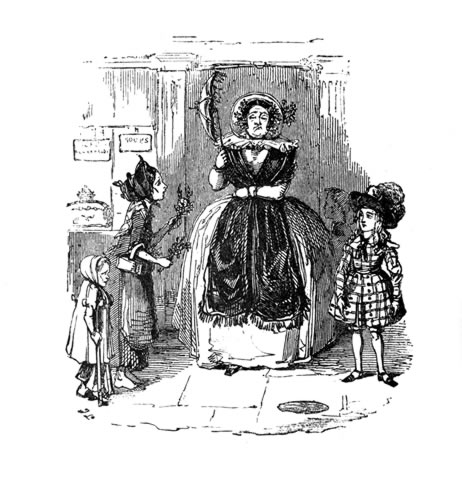
"Not so with the infant Kilmansegg— She was not born to steal or beg, Or gather cresses in ditches; To plait the straw, or bind the shoe, Or sit all day to hem and sew, As females must—and not a few!— To fill their insides with stitches."
The christening of the golden child was an affair so splendid as to tax the poet's invention for tropes and figures worthy of the occasion:
"Gold! and gold! and nothing but gold! The same auriferous shine behold Wherever the eye could settle! On the walls—the sideboard—the ceiling—sky—, On the gorgeous footmen standing by, In coats to delight a miner's eye With seams of precious metal. "Gold! and gold! and besides the gold, The very robe of the infant told A tale of wealth in every fold— It lapped her like a vapour! So fine! so thin! the mind at a loss, Could compare it to nothing except a cross Of cobweb with banknote paper."
Powerful as the poet's imagination shows in these glittering rhymes, it fails him in his endeavour to find a prefix in the form of a name worthy of accompanying Kilmansegg. He says:
"Then the babe was crossed and blessed amain, But instead of Kate, or Ann, or Jane, Which the humbler female endorses— Instead of one name, as some people prefix, Kilmansegg went at the tails of six, Like a carriage of state with its horses."
The names, therefore, are left to the imagination of the reader, who may learn, if he will, some particulars of the nameless Kilmansegg's childhood:
"Turn we to little Miss Kilmansegg, Cutting her first little toothy-peg With a fifty-guinea coral— A peg upon which About poor and rich Reflection might hang on a moral. "Born in wealth, and wealthily nursed, Capp'd, papp'd, napp'd, and lapp'd from the first On the knees of Prodigality, Her childhood was one eternal round Of the game of going on Tiddler's ground, Picking up gold in reality. * * * * *
"Gold! and gold! 'twas the burden still! To gain the heiress's early goodwill There was much corruption and bribery. The yearly cost of her golden toys Would have given half London's charity boys And charity girls the annual joys Of a holiday dinner at Highbury."
The kind of education permitted to this unfortunate heiress may be gathered from the following extracts:
"Long before her A B and C They had taught her by heart her £ s. d., And as how she was born a great heiress; And as sure as London was made of bricks My Lord would ask her the day to fix To ride in a fine gilt coach and six, Like her Worship the Lady Mayoress.
"The very metal of merit they told, And praised her for being as 'good as gold'! Till she grew as a peacock haughty; Of money they talked the whole day round, And weighed desert like grapes, by the pound, Till she had an idea from the very sound That people with naught were naughty. "Gold! still gold.... Gold ran in her thoughts and filled her brain, She was golden-headed, like Peter's cane, With which he walked behind her."
Miss Kilmansegg.
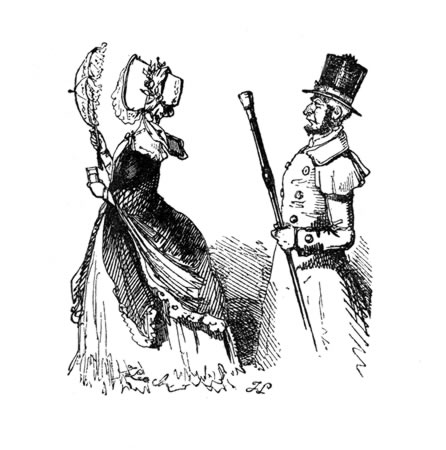
Leech's drawings which decorate "Miss Kilmansegg" display his appreciation of beauty and character, and are, in some examples, of great artistic excellence—notably in the portrait of the foreign gentleman who became the husband of the heiress. Some of them are, of course, deficient in the artistic qualities with which his long practice enabled him to enrich his latest work.
My space will not permit of my making many extracts from Hood's admirable work—only, indeed, so far as to explain Leech's drawings; but to those of my readers who make Miss Kilmansegg's acquaintance for the first time in these pages, I heartily recommend a perusal of the poem, and envy them the pleasure they will find in reading it.
Of course Miss Kilmansegg
"... learnt to sing and to dance, To sit on a horse although he should prance, And to speak a French not spoken in France Any more than at Babel's building."
The steed was a thoroughbred of great spirit—
"A regular thoroughbred Irish horse, And he ran away, as a matter of course, With a girl worth her weight in guineas."
I think it would be very difficult to find a description of any event in any book to equal Hood's account of the mad career of the Irish horse and its unfortunate rider:
"Away went the horse in the madness of fright, And away went the horsewoman mocking the sight; Was yonder blue flash a flash of blue light, Or only the flash of her habit? "Away she flies, and the groom behind"—
encountering all the perils of London streets, till the inevitable catastrophe takes place:
"On and on! still frightfully fast! Dover Street, Bond Street, all are past! But—yes—no—yes!—they're down at last! * * * * * There's a shriek and a sob And the dense dark mob Like a billow closes around them! 'She breathes!' 'She don't' 'She'll recover!' 'She won't.' 'She's stirring! she's living by Nemesis!' Gold, still gold, on counter and shelf, Golden dishes as plenty as delf, Miss Kilmansegg's coming again to herself On an opulent goldsmith's premises!"
The heiress recovers; but, alas! in her fall she broke her leg, and as "the limb was doomed it couldn't be saved." A substitute must be found. Of what, then, shall the "proxy limb" be made?
"She couldn't—she shouldn't—she wouldn't have wood! Nor a leg of cork, if she never stood; And she swore an oath, or something as good, The proxy limb should be golden!
So a leg was made in a comely mould Of gold—fine virgin, glittering gold— As solid as man could make it; Solid in foot, and calf, and shank, A prodigious sum of money it sank; In fact 'twas a Branch of the family Bank, And no easy matter to break it."
The golden leg became the talk of the town, kicking away all other attractions. The new novel, the new murder, even "wild Irish riots and rum-pusses," were neglected; in fact, "the leg was in everybody's mouth," and a grand fancy ball was given at the Kilmansegg mansion to celebrate the heiress's recovery, as well as to exhibit the golden leg. All the world and his wife worship at the golden shrine:
"In they go—in jackets, and cloaks, Plumes and bonnets, turbans and tokes, As if to a congress of nations: Greeks and Malays, with daggers and dirks, Spaniards and Jews, Chinese and Turks— Some like original foreign works, But mostly like bad translations. * * * * * But where—where—where? with one accord Cried Moses and Mufti, Jack and my Lord, Wang-Fong and Il Bondacani— When slow and heavy, and dead as a dump, They heard a foot begin to stump, Thump! lump! Lump! thump! Like the spectre in 'Don Giovanni!'
"And lo! the heiress, Miss Kilmansegg, With her splendid, brilliant, beautiful leg, In the garb of a Goddess olden— Like chaste Diana going to hunt With a golden spear—which of course was blunt, And a tunic looped up to a gem in front, To show the leg was golden."
The fancy ball was a great success, and at supper—which the poet describes in glowing language—the heiress's health was proposed:
"'Miss Kilmansegg, Full glasses I beg. Miss Kilmansegg and her Precious Leg!' And away went the bottle careering! Wine in bumpers! and shouts in peals! Till the clown didn't know his head from his heels, The Mussulman's eyes danced two-some reels, And the Quaker was hoarse with cheering!"
The party being over, and the last guest gone, Miss Kilmansegg went to bed and to dream:
"Miss Kilmansegg took off her leg And laid it down like a cribbage-peg, For the rout was done and the riot; The square was hushed, not a sound was heard The sky was gray, and no creature stirr'd Except one little precocious bird That chirped—and then was quiet. * * * * *
"And then on the bed her frame she cast, The time for repose had come at last; But long, long after the storm is past Rolls the turbid, turbulent billow."
She dreams:
"Gold! she saw at her golden foot The Peer whose tree has an olden root; The Proud, the Great, the Learned to boot, The handsome, the gay, and the witty— The man of Science—of Arms—of Art, The man who deals but at Pleasure's mart, And the man who deals in the City."
The poet now rhymes delightfully of the time—the perilous time—when a choice has to be made of a partner in life for the heiress. The dream was realized so far as regards the number of her suitors, for—
"to tell the rigid truth, Her favour was sought by Age and Youth, For the prey will find a prowler! She was followed, flattered, courted, address'd, Woo'd and coo'd and wheedl'd, and press'd By suitors from North, South, East, and West, Like that Heiress in song, 'Tibbie Fowler.'"
The embarras de choix resulted, as often happens, in the selection of the worst of the group:
"A foreign Count—who came incog. Not under a cloud, but under a fog, In a Calais packet's fore-cabin,
To charm some lady British-born, With his eyes as black as the fruit of the thorn, And his hooky nose, and his beard half shorn, Like a half-converted Rabbin. * * * * * "He was dressed like one of the glorious trade— At least, when Glory is off parade— With a stock, and a frock, well trimmed with braid, And frogs—that went a-wooing."
"The Foreign Count."
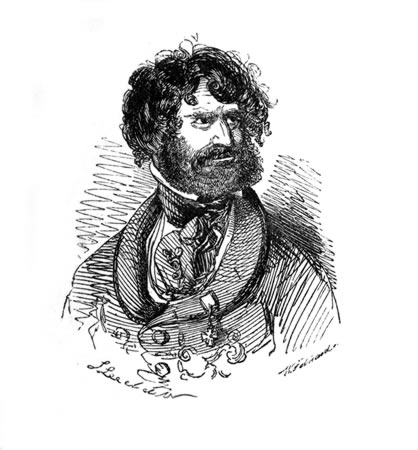
He could
"act the tender, and do the cruel; For amongst his other killing parts, He had broken a brace of female hearts, And murdered three men in a duel.
"Savage at heart, and false of tongue; Subtle with age, and smooth to the young, Like a snake in his coiling and curling, Such was the Count—to give him a niche— Who came to court that heiress rich, And knelt at her foot—one needn't say which— Besieging her Castle of Sterling."
In the whole range of Leech's art, no more subtle realization of character can be found than this wonderful drawing presents; in every touch, in every line, can be read the savage brutality of the man to whom the happiness of Hood's poor rich heroine is confided. How evident is "the trail of the serpent" over features not unhandsome! The love that could fail to be warned by such a face must be blind indeed. The poet's comments, and the contrast he shows between the lots of those who "marry for money" and those in whom simple and true love have been the guiding stars, are delightful. I add an example:
"But, oh! the love that gold must crown! Better, better, the love of the clown, Who admires his lass in her Sunday gown, As if all the fairies had dressed her! Whose brain to no crooked thought gives birth, Except that he never will part on earth With his truelove's crooked tester!
"Alas! for the love that's linked with gold, Better, better a thousand times told— More honest and happy and laudable, The downright loving of pretty Ciss, Who wipes her lips, though there's nothing amiss, And takes a kiss, and gives a kiss, In which her heart is audible."
The Count has been accepted; he has presented his betrothed
"With a miniature sketch of his hooky nose, And his dear dark eyes as black as sloes, And his beard and whiskers as black as those. The lady's consent he requited: And instead of the lock that lovers beg, The Count received from Miss Kilmansegg A model, in small, of her precious leg— And so the couple were plighted!"
But a short time probably elapsed between the betrothal and the marriage, which was solemnized, with golden splendour, of course, at St. James's Church. Thus the poet sings:
"'Twas morn—a most auspicious one! From the golden east, the golden sun Came forth his glorious race to run Through clouds of most splendid tinges; Clouds that had lately slept in shade, But now seemed made Of gold brocade, With magnificent gold fringes. * * * * *
"In short, 'twas the year's most golden day, By mortals called the first of May, When Miss Kilmansegg, Of the golden leg With a golden ring was married. * * * * * "And then to see the groom! the Count With Foreign Orders to such an amount, And whiskers so wild—nay, bestial; He seemed to have borrowed the shaggy hair, As well as the stars, of the Polar Bear, To make him look celestial!"
Of course the church was crowded inside and out,
"For next to that interesting job, The hanging of Jack, or Bill, or Bob, There's nothing that draws a London mob As the noosing of very rich people. * * * * *
"And then, great Jove! the struggle, the crush, The screams, the heaving, the awful rush, The swearing, the tearing, the fighting; The hats and bonnets, smashed like an egg, To catch a glimpse of the golden leg, Which between the steps and Miss Kilmansegg Was fully displayed in alighting. * * * * *
"But although a magnificent veil she wore, Such as never was seen before, In case of blushes, she blushed no more Than George the First on a guinea! * * * * *
"Bravely she shone—and shone the more, As she sailed through the crowd of squalid and poor, Thief, beggar, and tatterdemalion; Led by the Count, with his sloe-black eyes, Bright with triumph, and some surprise, Like Anson, in making sure of his prize, The famous Mexican galleon. * * * * *
"Six 'Handsome Fortunes,' all in white, Came to help the marriage rite, And rehearse their own hymeneals; And then the bright procession to close, They were followed by just as many beaux— Quite fine enough for ideals. "And how did the bride perform her part? Like any bride who is cold at heart, Mere snow with the ice's glitter; What but a life of winter for her? Bright but chilly, alive without stir, So splendidly comfortless, just like a fir When the frost is severe and bitter. "Yet wedlock's an awful thing! 'Tis something like that feat in the ring Which requires good nerve to do it, When one of a 'grand equestrian troop' Makes a jump at a gilded hoop, Not certain at all Of what may befall After his getting through it. "Such were the future of man and wife, Whose bale or bliss to the end of life A few short words were to settle: Wilt thou have this woman? I will—and then, Wilt thou have this man? I will, and Amen—— And those two were one flesh in the angels' ken, Except one leg—that was metal."
The Wedding—"Wilt thou have this Woman?"
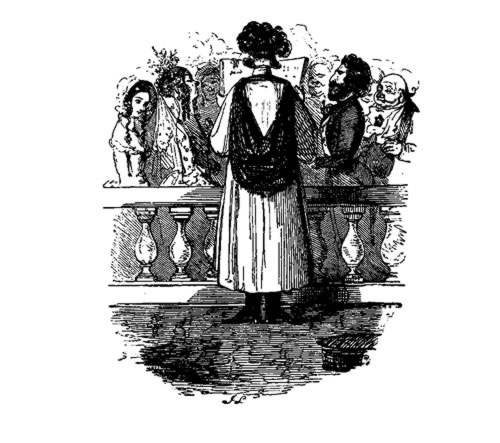
Here we have the Count in profile, only more agreeable because the view affords less of his villainous face.
I confess I am disappointed with Leech's rendering of Miss Kilmansegg. I cannot see why she should be deprived of a portion of the sympathy one always feels for "beauty in distress." Why should she be represented as the commonplace, red-nosed creature who plays the part of the bride in Leech's drawing? To be sure, the contrast she affords to the sweet little bridesmaid behind her heightens that young lady's attractions; but I cannot help thinking the heiress is hardly treated.
I pass over the wedding-breakfast, which was composed of everything in season, and of much that was out of it—
"For wealthy palates there be that scout What is in season for what is out, And prefer all precocious savour; For instance, early green peas, of the sort That costs some four or five guineas a quart, Where mint is the principal flavour."
The inevitable honeymoon follows—
"To the loving a bright and constant sphere That makes earth's commonest scenes appear All poetic, romantic, and tender; Hanging with jewels a cabbage-stump, And investing a common post or a pump, A currant-bush or a gooseberry clump, With a halo of dream-like splendour."
"Oh, happy, happy, thrice happy state, When such a bright planet governs the fate Of a pair of united lovers! Tis theirs, in spite of the serpent's hiss, To enjoy the pure primeval kiss, With as much of the old original bliss As mortality ever recovers."
"Love at the Board."
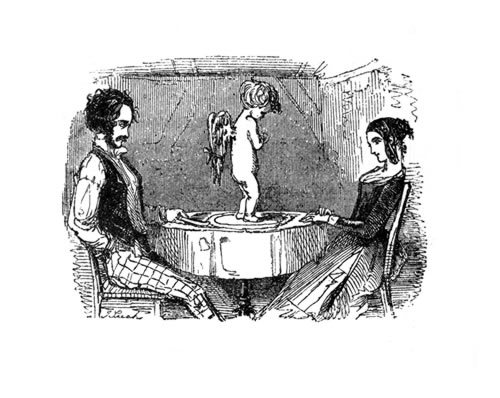
I hope my readers will agree with me, that amongst the pleasures we receive from this delightful poem, one of the greatest is the charming little sketch which it has suggested to Leech in these two happy lovers, completely wrapped up in each other, with love in the cottage, at the board, and all about them.
But the Kilmansegg moon!
"Now, the Kilmansegg moon, it must be told, Though instead of silver it tipped with gold, Shone rather wan, and distant, and cold; And before its days were thirty, Such gloomy clouds began to collect, With an ominous ring of ill-effect, As gave but too much cause to expect Such weather as seamen call dirty. "She hated lanes, she hated fields, She hated all that the country yields, And barely knew turnips from clover; She hated walking in any shape, And a country stile was an awkward scrape, Without the bribe of a mob to gape At the leg in clambering over. "Gold, still gold, her standard of old— All pastoral joys were tried by gold, Or by fancies golden and crural, Till ere she had passed one week unblest As her agricultural uncle's guest, Her mind was made up and fully imprest That felicity could not be rural."
And the Count?
"To the snow-white lambs at play, And all the scents and sights of May, And the birds that warbled their passion, His ears, and dark eyes, and decided nose, Were as deaf, and as blind, and as dull as those That overlook the Bouquet de Rose, The Huile Antique, And Parfum Unique, In a Barber's Temple of Fashion.
"And yet had that fault been his only one, The pair might have had few quarrels or none, For their tastes thus far were in common; But faults he had that a haughty bride With a golden leg could hardly abide— Faults that would even have roused the pride Of a far less metalsome woman. * * * * *
"He left her, in spite of her tender regards, And those loving murmurs described by bards, For the rattling of dice and the shuffling of cards And the poking of balls into pockets. "Moreover, he loved the deepest stake And the heaviest bets the players would make, And he drank—the reverse of sparely! And he used strange curses that made her fret; And when he played with herself at picquet, She found to her cost— For she always lost— That the Count did not count quite fairly. "And then came dark mistrust and doubt, Gathered by worming his secrets out, And slips in his conversation— Fears which all her peace destroyed, That his title was null, his coffers were void, And his French château was in Spain, or enjoyed The most airy of situations. "But still his heart—if he had such a part— She—only she—might possess his heart, And hold her affections in fetters. Alas! that hope, like a crazy ship, Was forced its anchor and cable to slip When, seduced by her fears, she took a dip In his private papers and letters— "Letters that told of dangerous leagues, And notes that hinted as many intrigues As the Count's in the 'Barber of Seville.' In short, such mysteries came to light That the Countess-bride, on the thirtieth night, Woke and started up in a fright, And kicked and screamed with all her might, And finally fainted away outright, For she dreamt she had married the Devil!"
In short, poor Miss Kilmansegg, or, rather, the "Golden Countess," was utterly wretched:
"Her cheek is pale, and her eye is dim, And downward cast, yet not at the limb Once the centre of all speculation; But downward drooping in comfort's dearth, As gloomy thoughts are drawn to the earth— Whence human sorrows derive their birth— By a moral gravitation. "How blessed the heart that has a friend A sympathizing ear to lend To troubles too great to smother! But friend or gossip she had none To hear the vile deeds the Count had done, How night after night he rambled; And how she learned by sad degrees That he drank and smoked, and, worse than these, That he 'swindled, intrigued, and gambled'! * * * * *
"He brought strange gentlemen home to dine That he said were in the Fancy Line,— And they fancied spirits instead of wine, And called her lap-dog 'Wenus.'"
He Brought Strange Gentlemen Home to Dine.
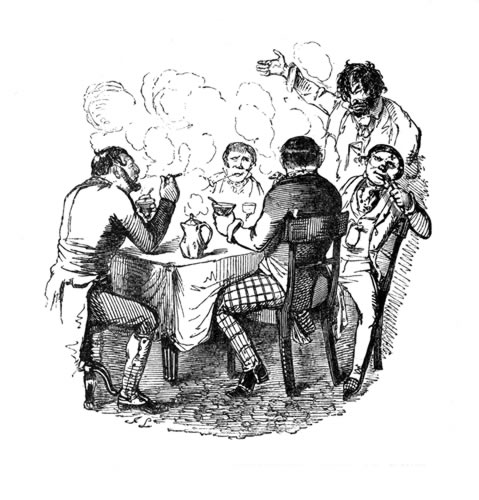
Leech has pretty well marked the profession of the "strange gentlemen" in this admirable drawing; their attitudes, the cut of their clothes, the character in their figures, to say nothing of the sticking-plaster on a face that could belong to no one but a "fighting man," sufficiently proclaim their habits. The figure of the Count is tragic in its intensity of drunken self-abandonment.
A leg of solid gold would, no doubt, if turned into cash, represent a large sum of money. It seems to have been the determination of the Countess, while still Miss Kilmansegg, to have reserved to herself all rights over the golden leg, for that auriferous limb was settled, as well as fixed upon herself, to be disposed of by will or otherwise, as she pleased. Says the poet:
"So the Countess, then Miss Kilmansegg, At her marriage refused to stir a peg Till her lawyers had fastened on her leg, As fast as the law could tie it."
Means which seem illimitable very speedily vanish when they fall into the hands of such people as the foreign Count. It was said of a famous roué of the last century that he "practised every vice except prodigality and hypocrisy—his insatiable avarice exempted him from the first, and his matchless impudence from the second." Our Count seems to have surpassed his prototype, whose "impudence" may not have been of the brutal character from which the poor Countess suffered; whilst a slight dash of avarice might have prevented the golden leg from being all that was left of her golden fortune.
The following lines eloquently describe the Count's state of mind after his orgies:
"And then how wildly he used to stare, And shake his fist at nothing, and swear, And pluck by the handful his shaggy hair, Till he looked like a study of Giant Despair For a new edition of Bunyan! "For dice will run the contrary way, As is well known to all who play, And cards will conspire as in treason."
At all events, cards, dice, and other expensive amusements had so reduced the Count that he had not a leg to stand upon, except his wife's golden one, and as that limb was in her own control, it was but a doubtful security. The Countess had made a will in which the leg was left to the Count, but life is uncertain—the Countess might outlive her husband; moreover, he was so placed that delay was not only dangerous, but inconvenient. The chronicler thus continues:
"Now, the precious leg while cash was flush, Or the Count's acceptance worth a rush, Had never excited dissension; But no sooner the stocks began to fall, Than, without any ossification at all, The limb became what people call A perfect bone of contention.
"For altered days made altered ways, And instead of the complimentary phrase So current before her bridal, The Countess heard, in language low, That her precious leg was precious slow, A good 'un to look at, but bad to go, And kept quite a sum lying idle. * * * * *
"But spite of hint, and threat, and scoff, The leg kept its situation; For legs are not to be taken off By a verbal amputation. "Firmly then—and more firmly yet— With scorn for scorn, and with threat for threat, The proud one confronted the cruel; And loud and bitter the quarrel arose, Fierce and merciless—one of those With spoken daggers, and looks like blows— In all but the bloodshed a duel. "Rash and wild, and wretched and wrong, Were the words that came from weak and strong, Till, maddened for desperate matters, Fierce as a tigress escaped from her den, She flew to her desk—'twas opened—and then, In the time it takes to try a pen, Or the clerk to utter his slow 'Amen,' Her will was in fifty tatters! "But the Count, instead of curses wild, Only nodded his head and smiled, As if at the spleen of an angry child; But the calm was deceitful and sinister! And a lull like the lull of the treacherous sea— For Hate in that moment had sworn to be The golden leg's sole legatee, And that very night to administer."
"The torn Will."
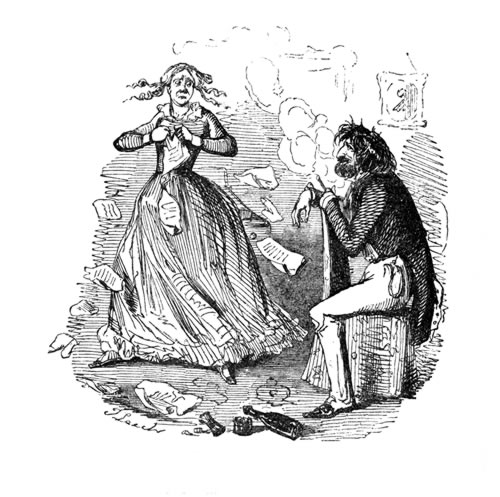
"That very night!"—one more night of golden dreaming, in the midst of which comes death; the deliverer from an existence which the worship of gold has made so pitiful:
"'Tis a stern and startling thing to think, How often mortality stands on the brink Of its grave without any misgiving: And yet in this slippery world of strife, In the stir of human bustle so rife, There are daily sounds to tell us that life Is dying, and Death is living! "But breath and bloom set doom at nought— How little the wretched Countess thought, When at night she unloosed her sandal, That the fates had woven her burial-cloth, And that Death, in the shape of a death's head moth, Was fluttering round her candle! "As she looked at her clock of ormolu, For the hours she had gone so wearily through At the end of a day of trial, How little she saw in the pride of prime The dart of Death in the hand of Time— That hand which moved the dial! "As she went with her taper up the stair, How little her swollen eye was aware That the shadow which followed was double! Or when she closed her chamber-door, It was shutting out, and for evermore, The world and its worldly trouble. "Little she dreamt as she laid aside Her jewels—after one glance of pride— They were solemn bequests to Vanity; Or when her robes she began to doff, That she stood so near to the putting off Of the flesh that clothes humanity.
"And when she quenched the taper's light, How little she thought, as the smoke took flight, That her day was done and merged in a night Of dreams and duration uncertain; Or along with her own That a hand of bone Was closing mortality's curtain! * * * * *
"Thus, even thus, the Countess slept, While death still nearer and nearer crept, Like the Thane who smote the sleeping; But her mind was busy with early joys, Her golden treasures and golden toys, That flashed a bright And golden light Under lids still red with weeping. "The golden guineas in silken purse, And the 'Golden Legends' she heard from her nurse, Of the Mayor in his gilded carriage— And London streets that were paved with gold, And the golden eggs that were laid of old— With each golden thing To the golden ring At her own auriferous marriage! "And still the golden light of the sun Through her golden dream appeared to run, Though the night that roared without was one To terrify seamen or gipsies— While the moon, as if in malicious mirth, Kept peeping down at the ruffled earth, As though she enjoyed the tempest's birth, In revenge of her old eclipses.
"But vainly, vainly the thunder fell, For the soul of the sleeper was under a spell, That time had lately embittered— The Count, as once at her foot he knelt— That foot which now he wanted to melt! But, hush! 'twas a stir at her pillow she felt, And some object before her glittered. "'Twas the golden leg! she knew its gleam! And up she started and tried to scream; But even in the moment she started, Down came the limb with a frightful smash, And, lost in the universal flash That her eyeballs made at so mortal a crash, The spark called vital departed. "Gold, still gold, hard, yellow, and cold, For gold she had lived, and died for gold— By a golden weapon, not oaken; In the morning they found her all alone— Stiff, and bloody, and cold as a stone— But her leg, the golden leg, was gone, And the 'golden bowl was broken.'
"Her Moral.
"Gold! gold! gold! gold! Bright and yellow, hard and cold, Molten, graven, hammered, and rolled; Heavy to get, and light to hold; Hoarded, bartered, bought, and sold, Stolen, borrowed, squandered, doled; Spurned by the young, but hugged by the old To the very verge of the churchyard mould; Price of many a crime untold; Gold! gold! gold! gold! Good or bad a thousandfold! How widely its agencies vary— To save, to ruin, to curse, to bless— As even its minted coins express, Now stamped with the image of good Queen Bess, And now of Bloody Mary!" "Bedtime." The admirable design—the "tailpiece" to the legend of "Miss Kilmansegg and her Golden Leg"—which Leech calls "Bedtime," is reproduced, not only for its excellence as a composition, but also in evidence of the readiness of the artist's imagination to adopt an idea that has been suggested by the poem, and of the skill with which that cunning hand has realized it. The little old miser has been "counting out his money" with the delight that "time cannot wither, nor custom stale." His shrunken shanks, thin face and hands, betray his age. Death cannot be far off; but no thought apart from the treasure can be spared for the inevitable visitor who surprises the miser at last in the midst of his golden worship. He is far from being tired; but he must go to bed, and sleep the sleep that knows no waking. His skeleton nurse has come for him; her bony hands encircle him. His shroud is on her arm; she cannot wait—no, not for him to handle once more those glittering coins, on which his eye sparkles, and his claw-like fingers make vain attempts to reach. CHAPTER XX. DR. JOHN BROWN AND LEECH. Whether that charming writer, Dr. John Brown, knew Leech in the flesh or not, I cannot say; but that he knew and fully appreciated him in spirit is evident enough in a paper published in a collection of essays entitled "Horæ Subsecivæ." I gather from the concluding passages of the Doctor's brilliant essay that it had been his intention to have written Leech's life, having collected much material for the purpose, but that "ill-health put a stop to this congenial labour." How admirably the labour would have been executed may be shown by the following extracts: "Leech," says Dr. Brown, "was singularly modest, both as a man and an artist. This came by nature, and was indicative of the harmony and sweetness of his essence; but doubtless the perpetual going to Nature, and drawing out of her fulness, kept him humble, as well as made him rich—made him (what every man of sense and power must be) conscious of his own strength. But before 'the great mother' he was simple and loving, attentive to her lessons as a child, for ever learning and doing." Again: "Of all our satirists, none have such a pervading sense and power of girlish, ripe, and womanly beauty as Leech.... There is a genuine domesticity about his scenes that could come only from a man who was much at his own fireside, and in the nursery when baby was washed. You see, he is himself pater familias, with no Bohemian trait or raffish turn. What he draws, he has seen; what he asks you to live in, and laugh at and with, he has laughed at and lived in. It is this wholesomeness and (to use the right word) this goodness that makes Leech more than a drawer of funny pictures, more even than a great artist. It makes him a teacher and an example of virtue in its widest sense, from that of manliness to the sweet devotion of a woman, and the loving open mouth and eyes of parvula on your knee." I find it difficult to believe that these remarks were written by one who had no personal knowledge of Leech; indeed, I should have thought the writer must have enjoyed an amount of intimacy with him. If Dr. Brown and Leech were strangers to each other, the writer's accurate estimate of the artist shows how exactly the drawings reflect the delightful nature of their producer, so familiar to his nearest friends. "What we owe to him," adds Dr. Brown, "of wholesome, hearty mirth and pleasure, and of something better than either—good as they are—purity, affection, pluck, humour, kindliness, good-humour, good-feeling, good-breeding, the love of Nature, of one another, of truth, the joys of children, the loveliness of our homely English fields, with their sunsets and village spires, their glimpses into the pure infinite beyond, the sea and all its fulness, its waves 'curling their monstrous heads and hanging them,' their crisping smiles on sunlit sands—all that variety of Nature and of man, which is only less infinite than its Maker! Something of this and of that mysterious quality called humour, that fragrance and flavour of the soul, which God has given us to cheer our lot, to help us to 'take heart and hope and steer right onward,' to have our joke, that lets us laugh and make game of ourselves when we have little else to laugh at or play with, of that which gives us when we will the silver lining of the cloud, and paints a rainbow on the darkened sky out of our own 'troublous tears'—something of all these has this great, simple-hearted, hard-working artist given to us and to our children as a joy and a possession for ever. Let us be grateful to him; let us give him our best honour, affection, and regard." Walking with Leech one day, we met an old gentleman, to whom I introduced my friend: early in the fifties it was. The old man, though well stricken in years, sported a dark and heavy moustache. "And so," said Leech, when, after a few commonplaces, we separated, "that is old Mr. Blank the portrait-painter, is it? What on earth induces him to wear purple moustachios?" Purple they were, certainly, and of rather a bright tinge. "Well," I replied, "he has dyed them, for they were white the other day." "In my opinion," said Leech, "only soldiers should be allowed moustachios." In my early days, that "hirsute appendage" created such a prejudice against the wearers as would not be credited in these beard-bearing times. There were places of business the doors of which were closed against the moustache. At a well-known bank complete shaving of moustache and beard is insisted upon to this day. The sufferings of our troops in the Crimea were sufficiently agonizing without the torment or even the possibility of the morning's shave; and it is to the Russian campaign we owe the "beard movement," which from that time to the present is so universal. Our officers returned from their battles covered with glory and hair, and so much improved by the latter—in the opinion of those whose approval was most valued—as to make a sacrifice of it out of the question. Little did Leech imagine when he made his sweeping objection to the moustache, what a factor he would find it in his future work. How many delightful sketches turn upon it! Who can forget those two little rival snobs—rivals in the love of some fair approver of beards—who have withdrawn themselves from society during the incubation of their moustachios, and who, having accidentally sought the same suburban retirement, meet face to face, stubbly beard to stubbly beard, at a corner of a lane? And that precocious young gentleman who asks his sisters if they approve of the removal of a moustache, the presence of which they had never been able to discover! Under the heading of "The Beard Movement," we have a British swell in a fainting state in the arms of a policeman; this serious condition having arisen from the sight of a postman with moustachios. In another drawing, policemen are marching to their posts of duty decorated by beards of such magnitude as to strike terror into the street boys, who scatter in all directions at the sight of them. In "Pictures of Life and Character" other examples of the alarm excited by the beard movement are given with the refined humour peculiar to Leech. I find I have to modify somewhat my conviction that Leech rarely adopted the subjects proposed to him for illustration; no doubt by far the largest number were the outcome of his own conception, or observation of incidents in his experience; but I have proof of several examples to the contrary. For instance, Mr. Holman Hunt says: "One Friday night I had sat down to much correspondence, intending before concluding to write of two or three amusing facts picked up that might suit him (Leech) for illustration. It had become very late, and I was clearing away my paper, when, with vexation, I remembered his letter had not been written. I seized the pen, and on a page I drew two horizontal lines quite dividing the space. In the top I put: 'Scene—Kitchen garden, country cottage. Dramatis Personæ: Factotum, master entering,' and then a line or two of dialogue. "The second subject I treated similarly, and the third also, which was not so promising. I enclosed this without a word to Leech, and posted it with my other letters about two in the morning. The following Wednesday the two subjects, admirably treated, were in Punch. When next I saw him he was eager with excuses for not having written. He added: 'The letter when it was opened at breakfast was most opportune, for I had to leave town by five, and I was bound to furnish two designs before going, and I had come down without having the wildest notion what to do. The subjects in your note were ready-made, and I was able to sketch them without a moment's waste of time." Mr. Hunt tells an anecdote of Kenny Meadows, the jovial Bohemian, whom, I hope, the reader of these pages may remember, that is so characteristic and amusing, and illustrative of his own nature and of that of Leech, that I insert it in this place. "Meadows was quite at the head of the Punch artists when Leech joined them, and was naturally delighted by the praise bestowed upon his drawings by 'this ruler amongst the illustrators of Punch.' He—Meadows—declared that a sight of Leech's illustrations had so disgusted him with his own work that he felt inclined to give up art altogether. 'Why,' said he, 'should I go on giving proof after proof of my incapacity when you leave me so far behind?' This modest effusion was uttered early in the evening, and before the setting in of the gin-and-water period, which was destined to effect a striking change in Meadows' estimate of himself, and of the recent addition to the pictorial staff. "Leech was a sincere admirer of Meadows' work, and of this he assured the self-condemning artist in no measured terms, instancing for special praise many of Kenny's designs brimming over with poetic conceits in the illustrations of Shakespeare. Meadows listened to Leech's compliments, and said it was 'deuced liberal' of him to say what he did. He then mixed himself a glass of gin and water, saying, 'Well, after all, it's wise to make the best of things, and be as jolly as one can under all circumstances.' "The two artists then fell into general conversation, and into—on the part of one of them—the imbibing of much gin and water. Under the influence of the latter, Meadows returned to the subject of his own works, and proceeded to show in what respect they surpassed those of others—even Leech's, which were worthless from the absence of 'poetry,' which ought to sanctify all art. "'Give me imagination or nothing, my dear boy!' he exclaimed. 'I don't want your commonplace facts done with a little trick of caricature, as it is called. Why don't you aim at something better, something higher? I would rather do nothing than the things you do, which, not only in design, but in execution, are unworthy of a true artist.'" All this was told to my friend by Leech himself, and, says Mr. Hunt, "Leech's shrug of the shoulders, expressive of bearing infinite disgrace, was the gesture of a comedian, but a hearty, good-natured laugh gave the real expression of the feeling left in his kind soul; there was not a jot of malice there against the severe judgment upon himself. The Scandinavian hero returning so sedate from victory that he might have been supposed to have suffered a defeat, or from disaster in the field, so composed that he might have been thought victorious, could not have surpassed Leech's manner in accepting both the praise and the censure of his elder rival." Another old friend of mine, Mr. Horsley, R.A., offers further proof of Leech's occasional acceptance of suggestions for his designs. In the course of a walk Mr. Horsley was accosted by one of those itinerant traders to whom the street is the shop, and solicited to buy a rope of onions. "Take the last rope, sir," says the man. My friend looks like a prosperous gentleman, to whom the offer might be made with a prospect of success, though the awkwardness of his appearance with the addition of a long rope of large onions in his hand would most likely prove a deterrent to the purchase. Mr. Horsley declined the offer, but it instantly occurred to him that such a proposal, if made to one of Leech's "swells," would be intensely comic, and he accordingly mentioned the incident to Leech, who smiled as usual and said nothing. A drawing, however, appeared immediately in Punch, but, strange to say, the incident is defrauded of much, if not all, its humour. The swell leaves nothing to be desired, except that he certainly should have been alone, and not, as according to Leech, accompanied by a lady, to whom the onions might have been useful. The absurdity surely consisted in the ludicrous position of a young gentleman who was subjected to an offer of which he would scarcely know the meaning, and much less likely to take advantage of it. My friend expressed his disappointment to Leech, who, with characteristic modesty, acknowledged his mistake. "I may mention another curious failure," says Mr. Horsley. "Leech came into my room one day roaring with laughter at a story he had just heard of two small boys who had been overheard discussing the age of a companion, and one said to the other, 'Well, I don't 'zactly know how old Charley is; but he must be very old, for he blows his own nose.' This is delightful as coming from the little chaps that Leech drew so perfectly; but, wonderful to relate, he represented the conversation as passing between a boy looking fourteen or fifteen and a girl in a riding-habit."
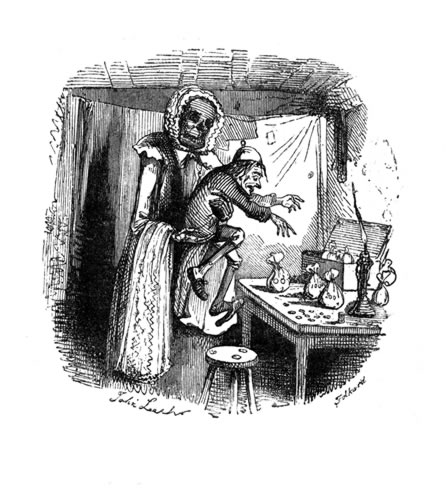
"He Blows His Nose."
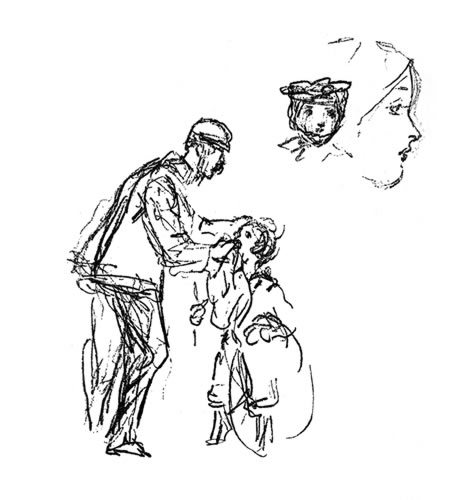
I subjoin the first idea of that which seems to be the incident told to Mr. Horsley, though it fails to illustrate the scene as described by Mr. Horsley, or the rendering of it afterwards adopted by Leech. The sketch, however, will show the rough manner in which all the thoughts so perfectly expressed on the wood-block were first sketched by the artist.