GRAND CAÑON OF THE COLORADO RIVER
Reading edition
While the Old World is better able than the New to satisfy the craving of the mind for art and history, no portion of our globe can equal the North American continent in certain forms of natural scenery which reach the acme of sublimity. Niagara, the Yosemite, the Yellowstone National Park, and the Grand Cañon of the Colorado in Arizona are the four great natural wonders of America. Niagara is Nature in the majesty of liquid motion, where, as the outlet of vast inland seas, a mighty river leaps in wild delirium into a gorge two hundred feet below, and boils and seethes tumultuously till its heart is set at rest and its fever cooled by the embrace of Lake Ontario. The Yosemite is Nature pictured, in a frame of granite precipices, as reclining on a carpet woven with a million flowers, above which rise huge trees three centuries old, which, nevertheless, to the spectator, gazing from the towering cliffs, appear like waving ferns. The Yellowstone Park is the arena of an amphitheatre in which fire and water, the two great forces which have made our planet what it is, still languidly contend where formerly they struggled desperately for supremacy. But the Grand Cañon of Arizona is Nature wounded unto death, and lying stiff and ghastly with a gash, two hundred miles in length and a mile in depth, in her bared breast, from which is flowing fast a stream of life-blood called the Colorado.
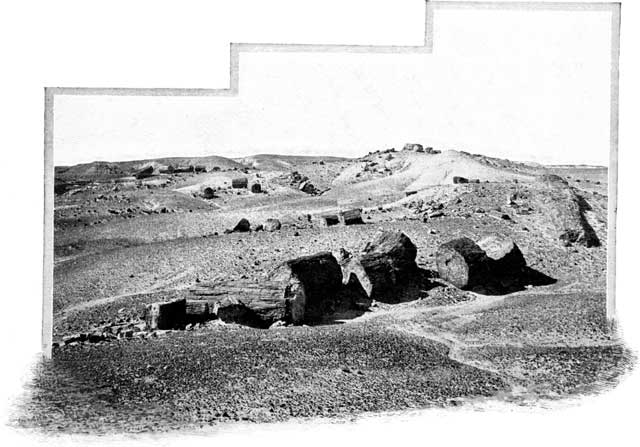
A PETRIFIED FOREST, ARIZONA.
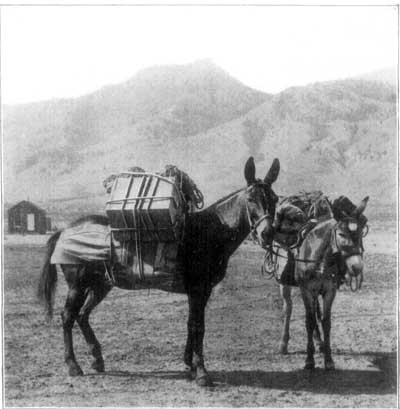
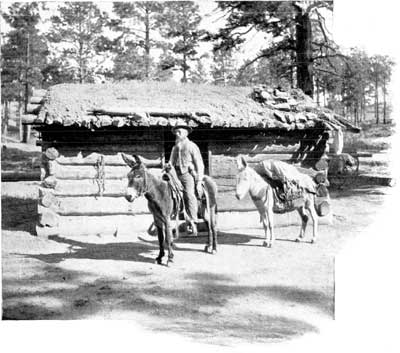
PACK-MULES OF THE DESERT.
EVIDENCES OF EROSION.
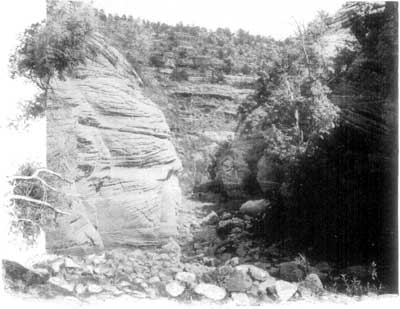
THE NAVAJO CHURCH.
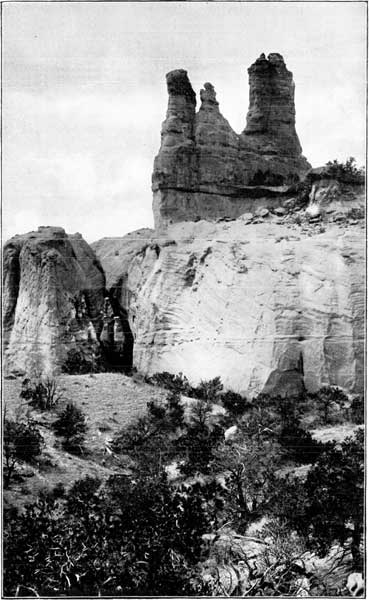
FANTASTIC FORMS.
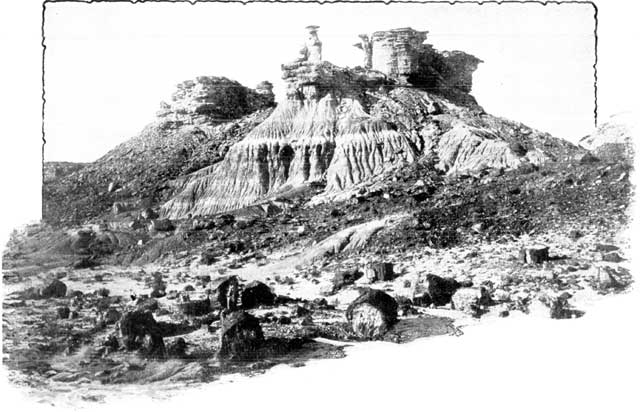
The section of country through which one travels to behold this last-named marvel is full of mystery and fascination. It is a land where rivers frequently run underground or cut their way through gorges of such depth that the bewildered tourist, peering over their precipitous cliffs, can hardly gain a glimpse of the streams flowing half a mile below; a land of colored landscapes such as elsewhere would be deemed impossible, with "painted deserts," red and yellow rocks, petrified forests, brown grass and purple grazing grounds; a land where from a sea of tawny sand, flecked here and there with bleached bones, like whitecaps on the ocean, one gazes upon mountains glistening with snow; and where at times the intervals are so brief between aridity and flood, that one might choose, like Alaric, a river-bed for his sepulchre, yet see a host like that of Pharaoh drowned in it before the dawn. In almost every other portion of the world Nature reveals her finished work; but here she partially discloses the secrets of her skill, and shows to us her modes of earth-building. Thus, the entire country is dotted with mesas, or table-lands of sandstone, furrowed and fashioned in a tremendous process of erosion, caused by the draining through this area of a prehistoric ocean, whose rushing, whirling, and receding waters molded the mountains, carved the cañons, and etched innumerable grotesque figures and fantastic forms. A feeling of solemnity steals over us, as we reflect upon the lapse of geologic time which such a record covers, unnumbered ages before man's advent on this planet; and these deep cañons and eroded valleys, whose present streams are only miniature representatives of those which formerly wrought havoc here, teach lessons of patience to the restless mortals who behold them; while some of the singular formations on the cliffs present perplexing problems which Nature, as it were in mocking humor, bids us solve.
A SPECIMEN OF NATURE'S HANDIWORK.
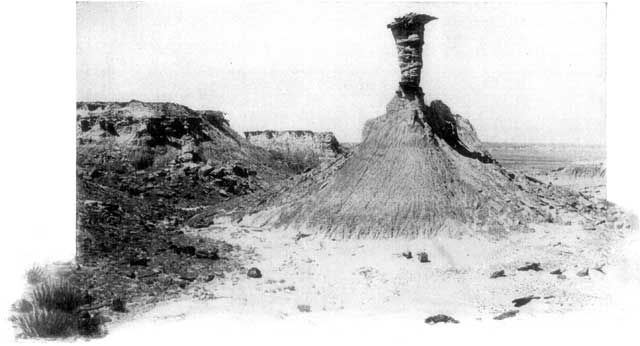
Was Nature ever really sportive? In the old days, when she produced her uncouth monsters of the deep, was she in manner, as in age, a child? Did she then play with her continents, and smile to see them struggle up from the sea only to sink again? Was it caprice that made her wrap her vast dominions in the icy bands of glaciers, or pour upon them lava torrents, and frequently convulse them with a mighty earthquake? If so, New Mexico and Arizona must have been her favorite playgrounds. At many points her rock formations look like whimsical imitations of man's handicraft, or specimens of the colossal vegetation of an earlier age. Some are gigantic, while others bear a ludicrous resemblance to misshapen dwarfs, suggesting, as they stand like pygmies round their mightier brethren, a group of mediaeval jesters in a court of kings. In the faint dusk of evening, as one flits by them in the moving train, their weird, uncanny forms appear to writhe in pain, and he is tempted to regard them as the material shapes of tortured souls.
A MESA.
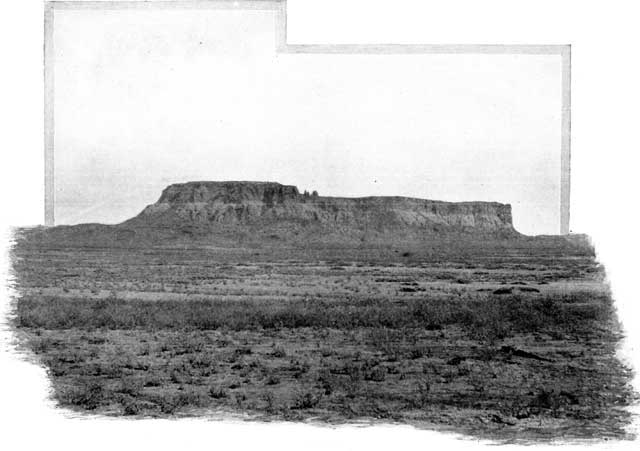
The mesas of New Mexico and Arizona are, usually, regular in outline, sometimes resembling in the distance cloud-banks on the edge of the horizon, but oftener suggesting mighty fortresses, or ramparts to resist invasion, like the wall of China. These are not only beautiful in form and color, but from the fact that they recall the works of man, we gaze at them with wonder, and find in them a fascinating interest. They prove that Nature needs some human association to appeal strongly to us, and how man's history of smiles and tears gives pathos, mystery, and romance to scenes which otherwise would be merely coldly beautiful or terribly sublime. It is for this reason, doubtless, that we are always endeavoring to personify Nature. We think of solitary trees as lonely, of storm-tossed waves as angry, and of a group of mountains as members of one family. Thus some of the Arizona mountains are called brothers. No doubt their birth was attended by the same throes of Mother Earth, and they possess certain family resemblances in their level summits, huge square shoulders, and the deep furrows in their rugged cheeks; while all of them evince the same disdain for decoration, scorning alike the soft rich robes of verdure and the rough storm-coats of the pines.
A GROUP OF MESAS.
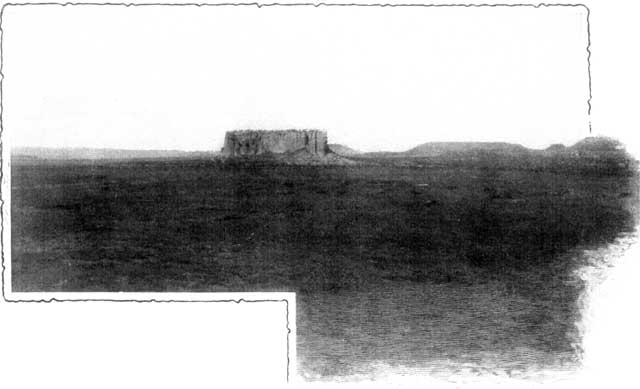
ON THE OLD SANTA FÉ TRAIL.
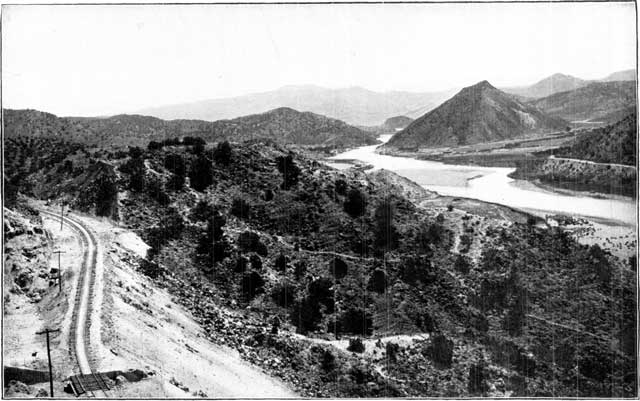
The idea of companionship in Nature is not wholly fanciful. Is not the fundamental law of the universe the attraction which one mass of matter has for another? Even the awful distances in interstellar space form no exception to this rule; for telescopic scrutiny reveals the fact that planets, suns, and systems move in harmony, on paths which indicate that they are all associated in the stupendous drama of the skies. The human interest connected with the mountains and the mesas of New Mexico and Arizona is not very great. No mediaeval mystery haunts these castles sculptured by the hand of Nature. No famous romancer has lighted on their cliffs the torch of his poetic fancy. No poet has yet peopled them with creatures of his imagination. We can, unfortunately, conjure up from their majestic background no more romantic picture than that of some Pueblo Indian wooing his dusky bride. Yet they are not without some reminiscences of heroism; for valiant men, a half century ago, following the westward moving star of empire, braved almost inconceivable hardships in their shadow, when, after four thousand years, American pioneers repeated the old, old story, begun upon the plains of Shinar, as the "Sons of the East" went westward in their quest of fortune. How few of us think of those unrecorded heroes now, as we cross this region in luxurious cars! To most of us the dead, whose bones once whitened many of these lonely plains, are nothing more than the last winter's snowdrifts melted by the sun; yet how effectively the Saxon has succeeded in his conquest of the continent we have continual evidence as we glide swiftly, from the Atlantic to the Pacific, through glowing grain fields, prosperous cities, and states that rival empires in size. Where formerly the Spanish conquerors, in their fruitless search for the reputed Seven Cities glittering with gold, endured privations and exhibited bravery which have hardly been surpassed in the entire history of the world; and where, too, as if it were but yesterday, the American Argonauts toiled painfully for months through tribes of hostile Indians, across desert wastes and over cloud-encompassed mountains, we find ourselves the inmates of a rolling palace, propelled by one of Nature's tireless forces, and feel at times in our swift flight as if we were the occupants of a cushioned cannon-ball of glass. Even the crossing of one of the many viaducts along our route is a reminder of how science has been summoned to assist the invader in his audacious enterprise of girdling a continent with steel.
AN ARIZONA CLOUD-EFFECT.
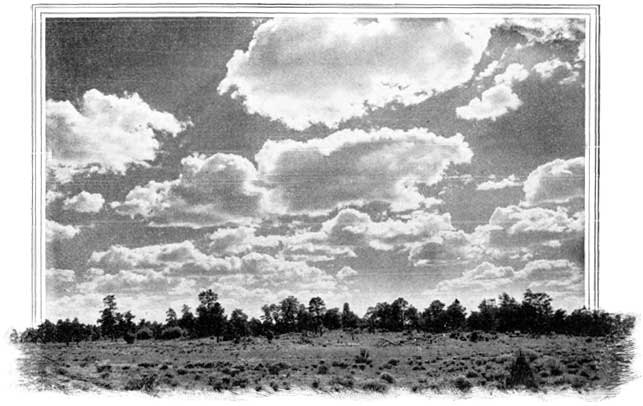
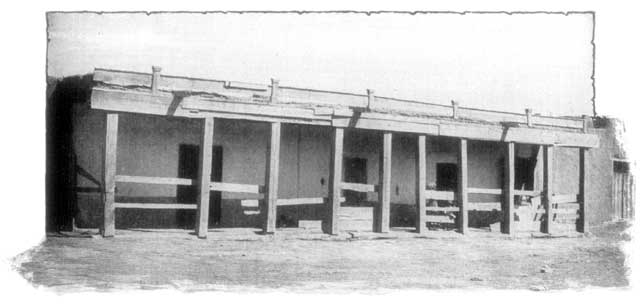
OLD HOME OF KIT CARSON, TAOS, N.M.
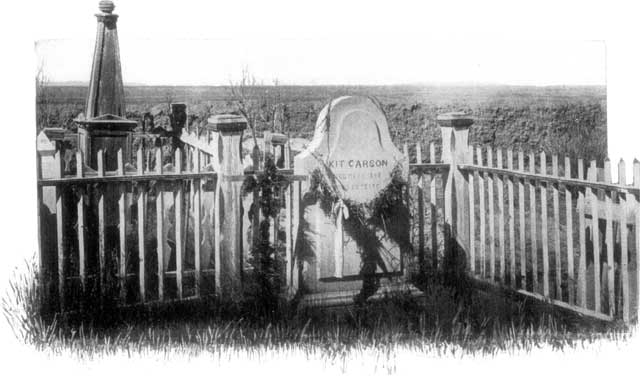
GRAVE OF KIT CARSON, TAOS, N.M.
THE BRIDGE OF CAÑON DIABLO.
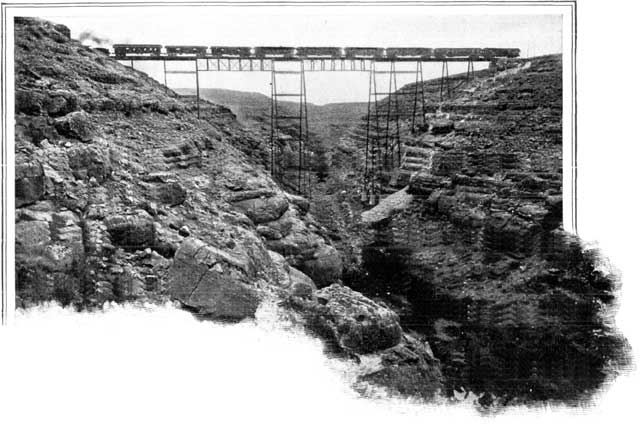
The art of bridge-building in some form or other is one of the earliest necessities of civilization. Even the apes in equatorial regions will link themselves together, and swing their living line across a stream to trees on the opposite bank, thus forming a connected path of bodies along which other monkeys pass in safety. Bridges of ropes or reeds are, also, made by the most primitive of men; while viaducts of stone rose gradually in perfection, from the rude blocks heaped up by savages to the magnificent structures fashioned by the Romans. But with the introduction of iron and steel into their composition, bridges are now constructed quickly, with consummate skill, and in a multitude of different forms assist in making possible the safe and rapid transit of our great Republic.
HOMES OF CLIFF DWELLERS.
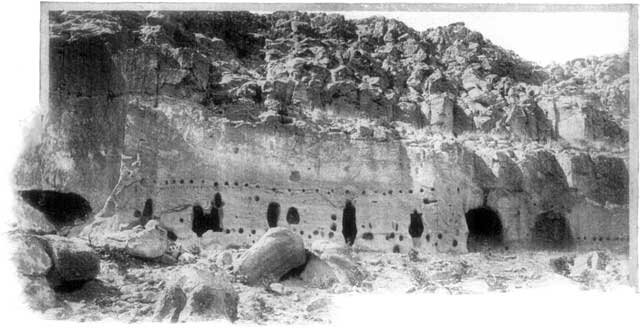
SKULLS OF CLIFF DWELLERS.
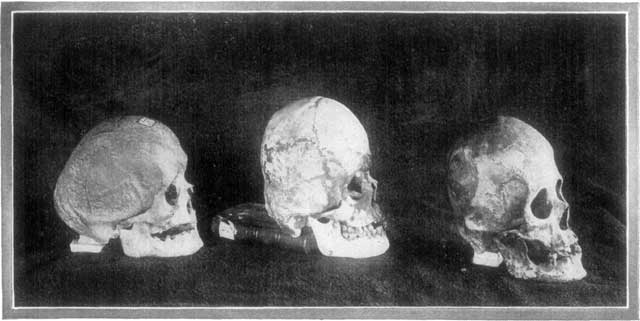
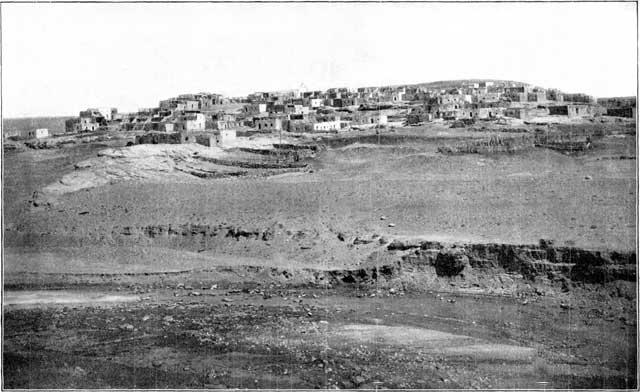
In addition to all the wonderful natural features of Arizona and New Mexico, the insight into ancient and modern Indian life which they afford is of extraordinary interest, particularly as aboriginal civilization, evidently, reached a higher level here than was attained by any of the tribes which roamed throughout the regions now known as the Middle and Eastern States. The natives of the arid regions of the great Southwest, though subdivided into numerous tribes, are usually known under the general title of Pueblos. The name itself, bestowed upon them by the Spaniards, is significant; since pueblo is the Spanish word for village, and this would seem to prove that the race thus designated three hundred and fifty years ago was not nomadic, but had been settled here for many years.
LAGUNA.
CLIFF PALACES.
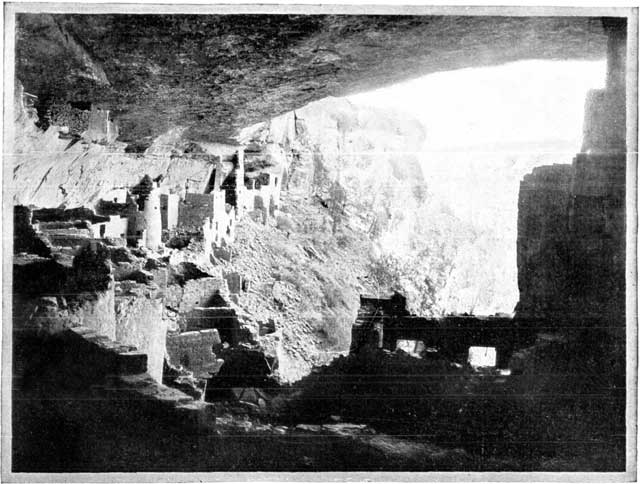
Antiquity and mystery impart a charm to these Pueblo Indians. They are foundlings of history. We see their immemorial settlements, and know that, centuries before Columbus landed on San Salvador, a number of advantageously situated places in the western portion of this continent served as the homes of powerful tribes, whose towns and villages formed the scenes of warfare and barbaric splendor. But of the men who built those villages we know comparatively nothing. Their origin is almost as trackless as the sand which hides so many of their relics in a tawny sepulchre. We may be certain, however, that the remnants who survive are the representatives of myriads who once made most of the American valleys palpitant with life, but over whom oblivion has swept like a huge tidal wave, leaving the scattered fragments of their history like peaks rising from a submerged world.
A TWO-STORY CLIFF PALACE.
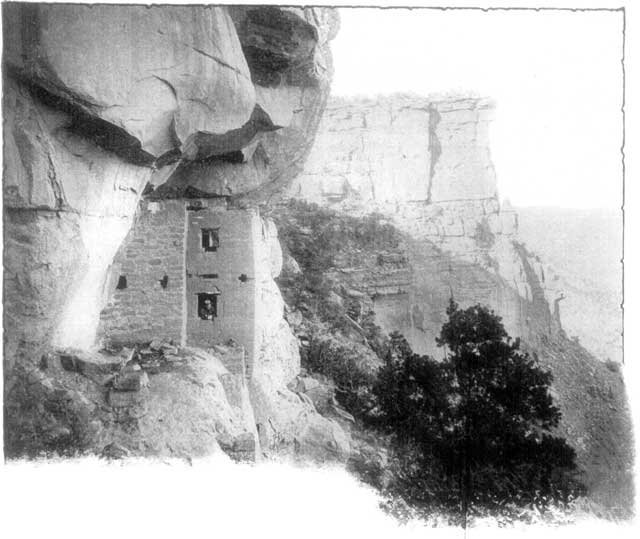
The best conclusions of scientists in regard to the geological periods of our planet consider that the Glacial Epoch began about two hundred and forty thousand, and ended about eighty thousand, years ago. Traces of the existence of men in North America during that glacial period have been found in abundance, and make it probable that a human population existed, toward the close of that era, all the way from the Atlantic Coast to the Upper Mississippi Valley. Where these men of the Ice Age originally came from is a matter of conjecture; but it seems probable that they migrated hither from the Old World, since it is certain that during the various elevations and depressions of the two continents, it was possible, several times, for men to go from Europe or from Asia into America without crossing any ocean, either by the northwestern corner of Alaska, which has been repeatedly joined to Siberia through the elevation of the shallow Bering Sea, or by the great Atlantic ridge which more than once has risen above the ocean between Great Britain and Greenland. Yet, though the first inhabitants of America, in all probability, came thus from the Old World at a very distant period of antiquity, it is believed by the best students of the subject that, until within the last few centuries, there had been no intercourse between America and either Europe or Asia, for at least twenty thousand years. Hence the Aborigines of this continent developed in the course of ages peculiarities which distinguish them from other races, and justify their being regarded as, practically, native to the soil.
AN EARLY PLACE OF SHELTER.
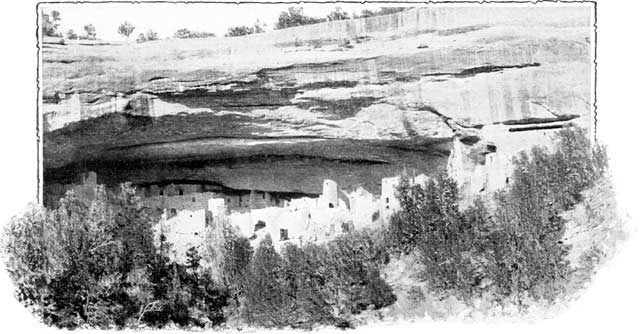
The Indians of New Mexico and Arizona were, probably, fugitives from more fertile lands, whence they had been expelled by the ancestors of the bloodthirsty and cruel Apaches. The country to which they came, and where they made a final stand against their predatory foes, was well adapted to defense. For hundreds of square miles the land is cleft with chasms, and dotted with peculiar, isolated table-lands hundreds of feet in height, with almost perfectly level surfaces and precipitous sides. The origin and formation of these mesas, due to erosion through unnumbered centuries, by water draining from an inland sea, has been already referred to, and it can be readily seen that they originally formed ideal residences for the peace-loving Pueblos, who either made their homes as Cliff Dwellers in the crevices of cañon walls, or took advantage of these lofty rocks, already shaped and fortified by Nature, and built on them their dwellings. These in themselves were no mean strongholds. Their thick walls, made of rock fragments cemented with adobe, constituted a natural fortress, against which weapons such as savages used before they acquired fire-arms could do little harm; and even these houses the Indians constructed like the cliffs themselves, lofty and perpendicular, tier above tier, and, save for ladders, almost as inaccessible as eagles' nests. Again, since these pueblos stood on table-lands, the approach to which could be easily defended, they were almost impregnable; while their isolation and elevation, in the treeless regions of New Mexico, enabled watchmen to discover the approach of an enemy at a considerable distance and to give warning for the women, children, and cattle roaming on the plain to be brought to a place of safety. The instinct of self-preservation and even the methods of defense are, after all, almost identical in every age and clime; and the motive which led the Indians to the summits of these mesas was, no doubt, the same that prompted the Athenians to make a citadel of their Acropolis, and mediaeval knights to build their castles on the isolated crags of Italy, or on the mountain peaks along the Rhine.
"CREVICES OF CAÑON WALLS."
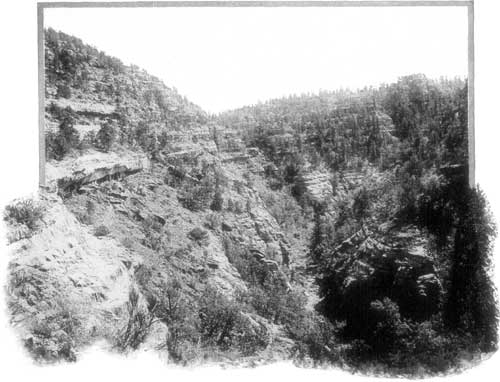
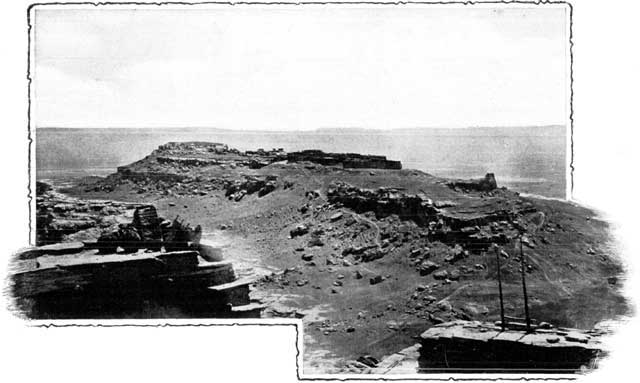
THE SUMMIT OF A MESA.
THE MESA ENCANTADA.
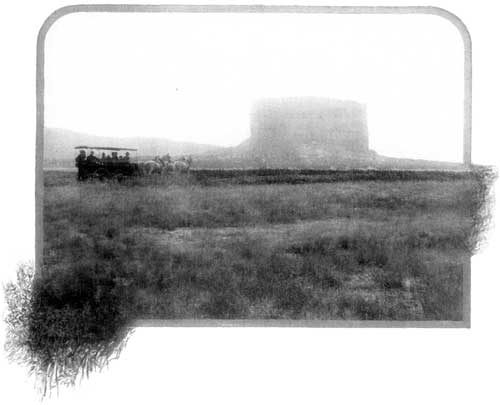
As times became more peaceful, the Pueblos located their villages upon the plains, and one of these, called Laguna, is now a station of the Santa Fé railway. But a mere glance at this, in passing, was far too brief and unsatisfactory for our purpose, aside from the fact that its proximity to the railroad had, naturally, robbed the settlement of much of its distinctive character. We therefore resolved to leave our train, and go directly into the interior, to visit a most interesting and typical pueblo, known as Ácoma. Arriving at the station nearest to it, early in the morning, we found a wagon and four horses waiting to receive us, and quickly started for our destination over a natural road across the almost level prairie. At the expiration of about two hours we saw before us, at a distance of three miles, a mesa of such perfect symmetry and brilliant pinkish color, that it called forth a unanimous expression of enthusiasm. Although the form of this "noblest single rock in America" changes as one beholds it from different points of view, the shape which it presented, as we approached it, was circular; and this, together with its uniform height and perpendicular walls, reminded me of the tomb of Cæcilia Metella on the Appian Way, magnified into majesty, as in a mirage. It was with added interest, therefore, that we learned that this was the Enchanted Mesa, about which there had been recently considerable scientific controversy. Enchanting, if not enchanted, it certainly appeared that morning, and, as we drew nearer, its imposing mass continued to suggest old Roman architecture, from Hadrian's Mausoleum by the Tiber to the huge circle of the Colosseum.
HOUSES AT LAGUNA.
THE MESA FROM THE EAST.
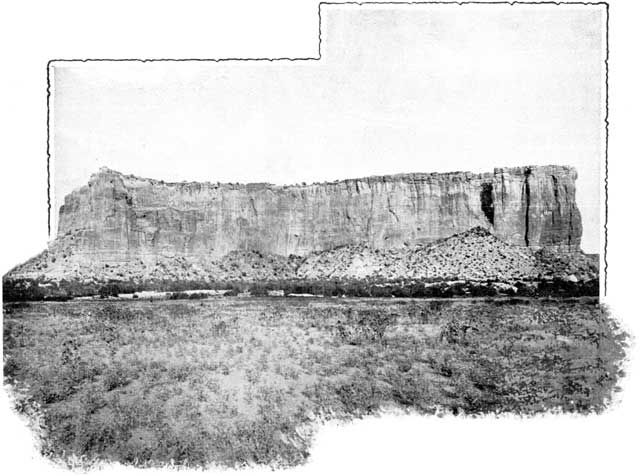
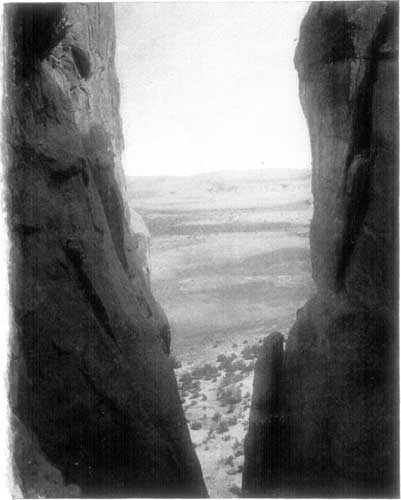
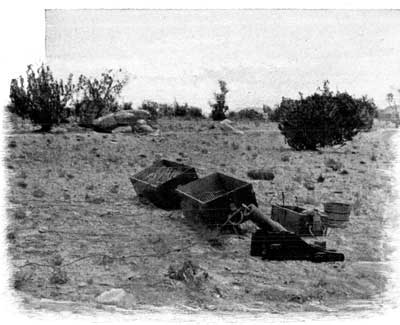
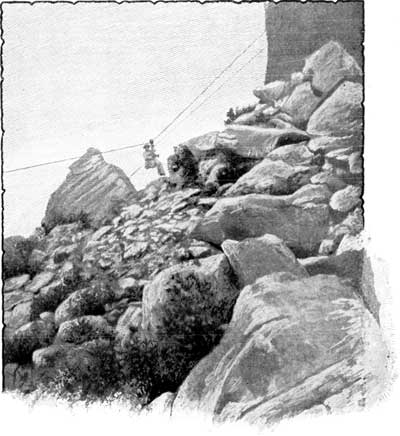
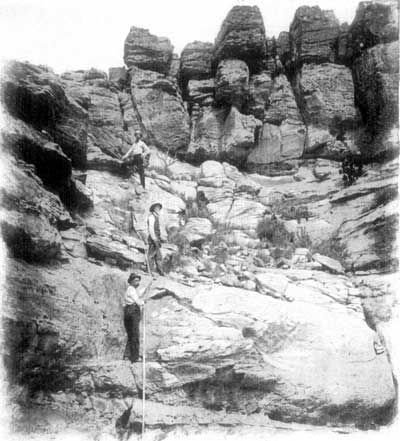
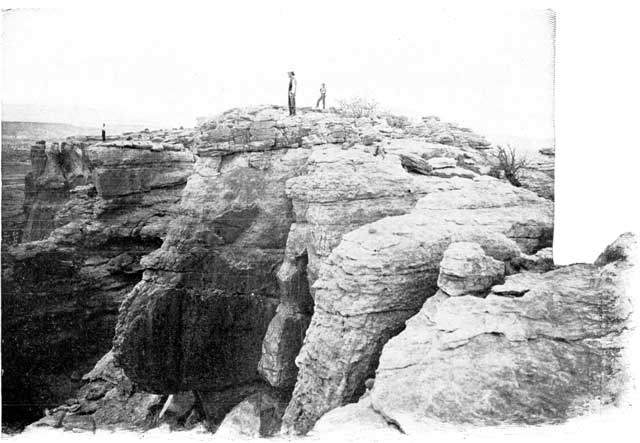
The Indian name of this remarkable cliff is Katzímo, and the title Haunted Mesa would be a more appropriate translation of the Spanish name, Mesa Encantada, than Enchanted; for the people of Ácoma believe its summit to be haunted by the spirits of their ancestors. A sinister tradition exists among them that one day, many centuries ago, when all the men of the village were at work upon the plain, a mass of rock, detached by the slow action of the elements, or else precipitated by an earthquake shock, fell into the narrow cleft by which alone an ascent or descent of the mesa was made, and rendered it impassable. The women and children, left thus on the summit of a cliff four hundred and thirty feet in height, and cut off from communication with their relatives and friends, who were unable to rejoin and rescue them, are said to have slowly perished by starvation, and their bones, pulverized in the course of centuries, are believed to have been, finally, blown or washed away. To test the truth of this tradition, at least so far as traces of a previous inhabitancy of the mesa could confirm it, Mr. Frederick W. Hodge, in 1895, made an attempt to reach the summit; but, though he climbed to within sixty feet of the top, he could on that occasion go no higher. He found, however, along the sides of the cliffs enormous masses of débris, washed down by the streams of water which, after a tempest, drain off from the summit in a thousand little cataracts. Not only did Mr. Hodge discover in this rubbish several fragments of Indian pottery, but he, also, observed certain holes in the cliff which seemed to him to have been cut there specially for hands and feet. These he believed to be traces of an ancient trail. Stimulated by the announcement of this discovery, Professor William Libbey, of Princeton College, in July, 1896, made the ascent of the Enchanted Mesa by means of a life line fired over the mound from a Lyle gun. Stout ropes having then been drawn over the cliffs and made secure, the adventurous aëronaut was actually hauled up to the summit in a boatswain's chair, as sailors are sometimes pulled ashore from a sinking ship. On his descent, however, he declared that he had found nothing to indicate that the crest had ever been inhabited, or even previously visited. Nothing daunted by this statement, a few weeks later Mr. Hodge again attempted the ascent in which he had failed the year before. This time he was successful, and scaled the cliff by means of an extension ladder and several hundred feet of rope. But very different were the conclusions reached by him as to the probable authenticity of the tradition; for after having been on the mesa only a short time, he found a piece of ancient pottery, and, during a search of twenty hours, not only were several more fragments of earthenware discovered, but also two stone ax-heads, an arrow-point of flint, and part of a shell bracelet. Moreover, a little monument of stone, arranged with evident design, was found on the edge of the cliff. Mr. Hodge and his party concluded, therefore, that beyond a doubt the Mesa Encantada had once been inhabited, and that the legend of the destruction of its last occupants may be true.
LOOKING THROUGH A CREVICE OF THE ENCHANTED MESA.
THE LYLE GUN AND ROPES.
MAN IN BOATSWAIN'S CHAIR.
THE HODGE PARTY.
INDIAN RELICS.
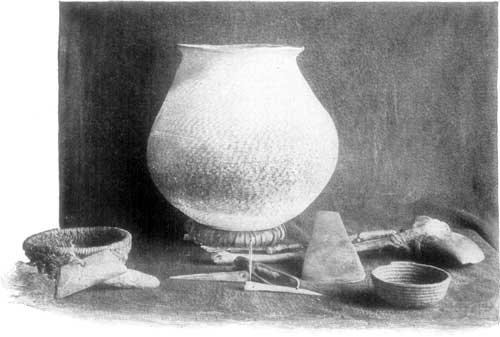
The discovery of pieces of pottery here does not of itself prove great advancement in the race that made them; for, curiously enough, the manufacture of rude pottery is one of the first steps taken by man from a savage to a semi-civilized state. The various races of mankind have usually reached this art soon after their discovery of fire. In fact, such an invention is almost inevitable. Thus, an early method of cooking food has always been to put it into a basket smeared with clay, which is supported over a fire. The clay served the double purpose of preventing liquids from escaping and protecting the basket from the flame. Now, even the dullest savage could not have failed to notice, after a time, that the clay became hardened by the fire, and in that state was sufficient for his purpose without the basket. Simple as it seems, the discovery of this fact marks an important epoch in the progress of every primitive race, and some authorities on ethnology distinguish the two great divisions of Savagery and Barbarism by placing in the lower grade those who have not arrived at the knowledge of making pottery.
THE TOP OF THE MESA ENCANTADA.
THE APPROACH TO ÁCOMA.
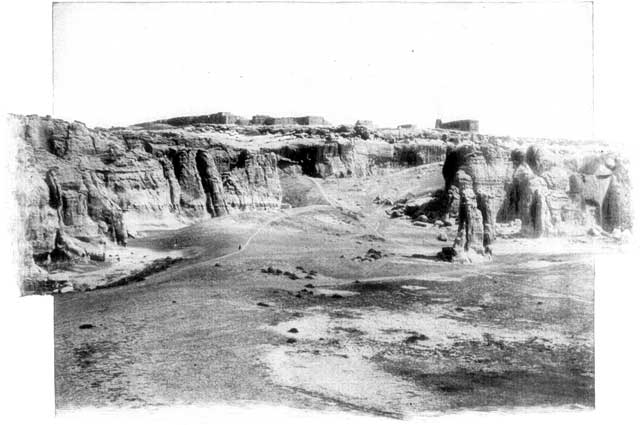
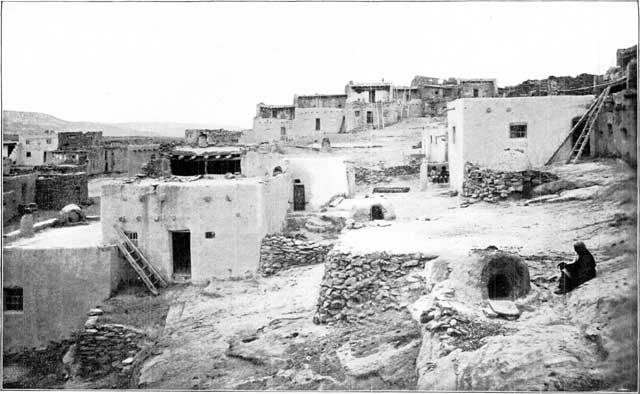
Soon after passing this haunted rock, and driving further over the mesa-dotted plain, we came in sight of the weird city of the sky called Ácoma. It occupies the summit of a table-land, the ascent to which is now a winding defile, flanked by frowning cliffs. Even this path, though readily ascended on horseback, is too precipitous and sandy for a wagon. Accordingly, as none of our party that day enjoyed the privilege of being an equestrian, we left our vehicle at the foot of the mesa, and completed the journey on foot. Some adventurous spirits, however, chose a short cut up the precipice along a natural fissure in the rocks, which, having been transformed with loose stones into a kind of ladder, was formerly, before these peaceful times, the only means of access to the summit. A steeper scramble would be hard to find. I must confess, however, that before taking either of these routes, we halted to enjoy a lunch for which the drive had given us the keenest appetite, and which we ate al fresco in the shadow of a cliff, surrounded by a dozen curious natives. Then, the imperious demands of hunger satisfied, we climbed three hundred and fifty feet above the surrounding plain, and stood in what is, with perhaps the exception of Zuñi, the oldest inhabited town in North America. Before us, on what seemed to be an island of the air, was a perfect specimen of the aboriginal civilization found here by the Spanish conqueror, Coronado, and his eager gold-seekers, in 1540. For now, as then, the members of the tribe reside together in one immense community building. It is rather droll to find among these natives of the desert the idea of the modern apartment house; but, in this place, as in all the settlements of the Pueblo Indians, communal dwellings were in existence long before the discovery of America, and the mesa of Ácoma was inhabited as it now is, when the Pilgrims landed upon Plymouth Rock.
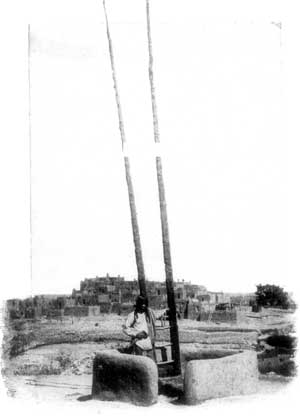
RAIN WATER BASIN, ÁCOMA.
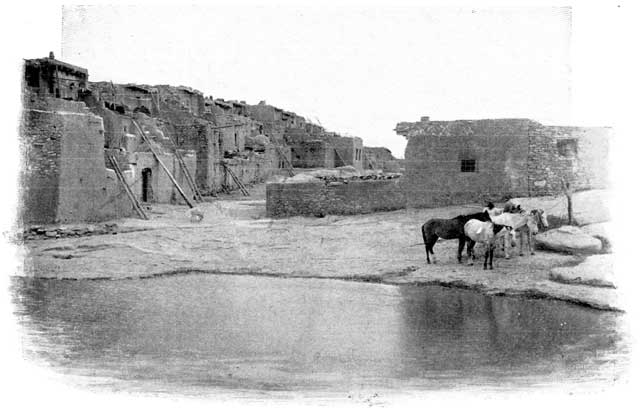
THE COURTYARD OF ÁCOMA.
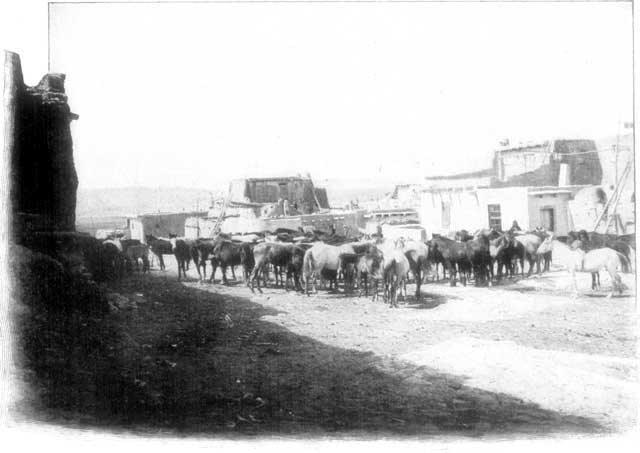
An Indian pueblo is really a honeycomb of adobe cells, built up in terraces. The outer walls, being the most exposed, are the highest, and from them toward the centre of the village, projecting stories descend in such a way that the balcony of one series of rooms forms a roof for the next below it. Finally, in the heart of the pueblo is an open area where horses are corralled. When the space on the summit of the mesa is sufficient, these apartment dwellings may be increased indefinitely by adding cells to the original mass, till it is six or seven stories high, and may contain one hundred, five hundred, or even a thousand persons, according to the size of the tribe. Formerly there were no doorways in the lowest stories; but in these peaceful days they are now introduced occasionally by Indian architects. Where they do not exist, the only means of entering the ground-floor rooms is by climbing a ladder from the courtyard to the first terrace, and thence descending by another ladder through a hole in the roof. The upper stories, being safer from attack, are more liberally supplied with doors and windows, the latter being sometimes glazed with plates of mica. At present, panes of glass are also used, though they were pointed out to us as special luxuries. At night, and in times of danger, the ladders in these pueblos used always to be drawn up after the last climbers had used them; since these industrious and sedentary Indians were ever liable to raids from their nomadic enemies, who coveted their stores of food and the few treasures they had gradually accumulated. This precaution on the part of the Pueblos again reminds us that human nature, in its primitive devices for self-protection, is everywhere very much the same. Thus, there is no connection between the Swiss Lake Dwellers and the Indians of New Mexico; yet as the latter, on retiring to their houses, draw up their ladders after them, so the old occupants of the villages built on piles in the Swiss lakes pulled after them at night the bridges which connected them with the land.
HOUSE OF A PUEBLO CHIEF.
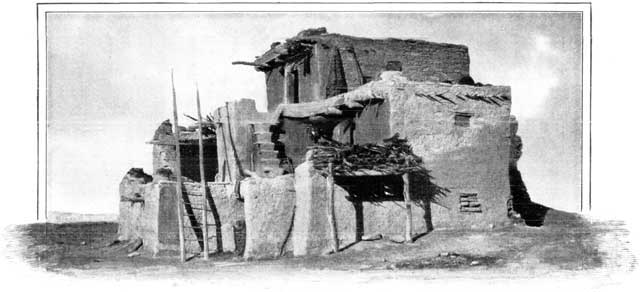
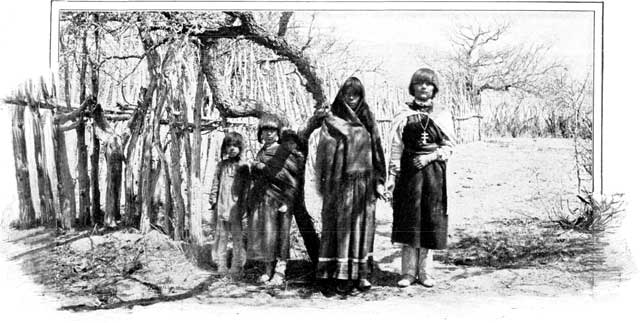
A GROUP OF PUEBLO INDIANS.
A PUEBLO TOWN.
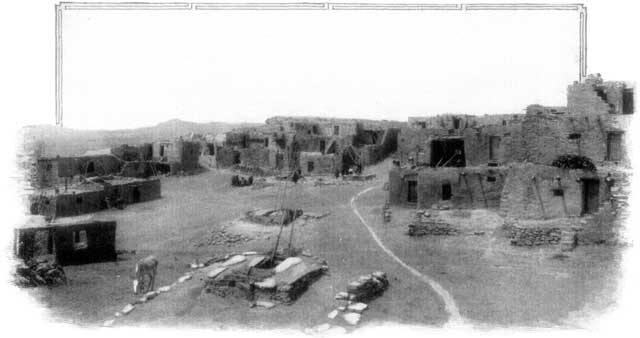
One can well imagine that the people of Ácoma do not spend many of their waking hours in their apartments. In this warm climate, with its superb air and almost rainless sky, every one lives as much as possible out of doors, and a true child of the sun always prefers the canopy of heaven to any other covering, and would rather eat on his doorstep and sleep on his flat roof, than to dine at a sumptuous table or recline on a comfortable bed. Nature seems to be peculiarly kind and indulgent to the people of warm climates. They need not only less clothing but less food, and it is only when we travel in the tropics that we realize on how little sustenance man can exist. A few dates, a cup of coffee, and a bit of bread appear to satisfy the appetites of most Aridians, whether they are Indians or Arabs. In the North, food, clothing, and fire are necessities of life; but to the people of the South the sun suffices for a furnace, fruits give sufficient nourishment, and clothing is a chance acquaintance. Yet life is full of compensation. Where Nature is too indulgent, her favorites grow shiftless; and the greatest amount of indoor luxury and comfort is always found where Nature seems so hostile that man is forced to fight with her for life.
CHARACTERISTIC PUEBLO HOUSES.
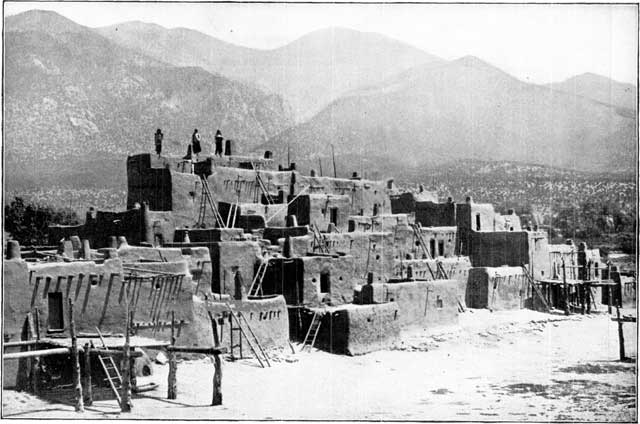
IN THE PUEBLO.
Most of the cells which we examined in the many-chambered honeycomb of Ácoma had very little furniture except a primitive table and a few stools, made out of blocks of wood or trunks of trees. Across one corner of each room was, usually, stretched a cord on which the articles of the family wardrobe had been thrown promiscuously. The ornaments visible were usually bows and arrows, rifles, Navajo blankets, and leather pouches, hung on wooden pegs. Of beds I could find none; for Indians sleep by preference on blankets, skins, or coarse-wool mattresses spread every night upon the floor. When we consider that the forty millions of Japan, even in their comparatively high degree of civilization, still sleep in much the same way, we realize how unnecessary bedsteads are to the majority of the human race. In a few rooms I discovered wooden statuettes of saints, one or two crucifixes, and some cheap prints, which were evidently regarded with great veneration. The floors, which were not of wood, but of smooth adobe nearly as hard as asphalt, were in every instance remarkably clean.
INTERIOR OF A PUEBLO APARTMENT.
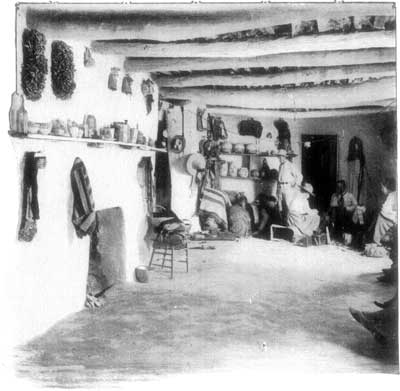
It is an interesting fact, in the domestic economy of the Indian life led in these aërial villages, that the woman is always the complete owner of her apartment and its contents; for it is the women of the tribe who build the dwellings. Accordingly, the position of a Pueblo woman is extraordinary; and should her husband ill-treat her, she has the right and power to evict him, and to send him back to his original home. On the other hand, the man is sole possessor of the live stock of the family and of the property in the field; but when the crops are housed, the wife is at once invested with an equal share in their ownership. Pueblo children, too, always trace their descent through the mother and take her clan name instead of the father's. I noticed that at Ácoma the children seemed to be obedient to their parents and respectful to age, as I have invariably found them to be in all partially civilized countries of the world; for, paradoxical as it may seem, it is only in highly civilized communities, where individualism is cultivated at the expense of strict discipline and parental control, that children become indifferent to their fathers and mothers, and insolent to their superiors in age and wisdom.
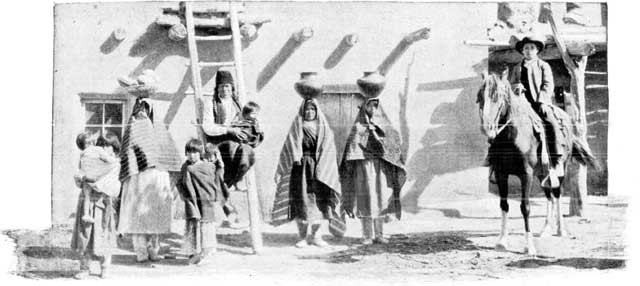
PUEBLO WATER-CARRIERS.
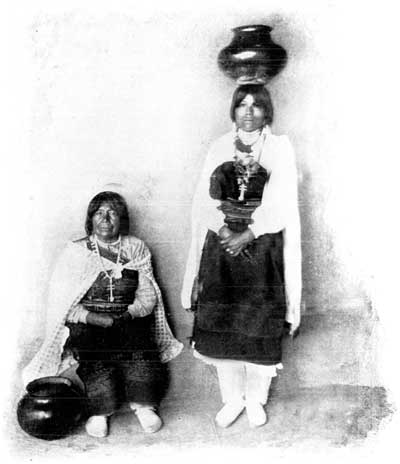
We lingered for some time upon this citadel of Ácoma, profoundly interested in the life and customs of a people that asks no aid of the United States, but is, to-day, as self-supporting as it has always been. The number of Pueblo Indians was never very large. It is probable that there were in all about thirty thousand of them at the time of the Spanish conquest, in 1540, and there are now about one-third that number scattered through more than twenty settlements. In an arid land where the greatest need is water, it is not strange that the dwellers on these rocky eyries should be called in the Indian dialect "Drinkers of the dew," for it would seem as if the dew must be their only beverage. But there are springs upon the neighboring plains whose precious liquid is brought up the steep trail daily on the heads of women, in three or five gallon jars, the carrying of which gives to the poise of the head and neck a native grace and elegance, as characteristic of Pueblo women as of the girls of Capri. Moreover, on the summit of the mesa there are, usually, hollows in the rock, partly natural, partly artificial, which serve as reservoirs to retain rain water and keep it fresh and cool.
AN ESTUFA.
Besides the communal apartment-house, every pueblo contains two characteristic edifices. One is as ancient as the tribe itself and thoroughly aboriginal, the other is comparatively modern and bears the imprint of the Spaniard; they are the estufa and the Roman Catholic church. The estufa has always played a prominent part in the history of these Indians. It is a semi-subterranean council hall, where matters of public business are discussed by the chiefs. The government of the Pueblos is practically the same as when the Spanish found them. Each village seems to be completely independent of its neighbors, and no member of one tribe is allowed to sell real estate to members of another, or to marry into another clan without permission from his own. Each settlement is governed by a council, the members of which, including its chief, are chosen annually. Heredity counts for nothing among them, and official positions are conferred only by popular vote. Even their war-chieftains are elected and are under the control of the council. All matters of public importance are discussed by this body in the estufa, the walls of which are usually whitewashed; but a more dismal place can hardly be imagined, not only from the dubious light which there prevails, but from the fact that it contains no furniture whatever, and no decoration. Sometimes a village will have several estufas, each being reserved for a separate clan of the tribe. In any case, whether many or few, they are used exclusively by men, women never being allowed to enter them except to bring food to their male relatives. As we approached the Ácoma estufa, it presented the appearance of a monstrous bean pot, from the opening of which a ladder rose to a height of twenty feet. This proved to be the only means of descending into an enclosure, to which we were politely but firmly denied admission. Peering into the aperture, however, and noting the warm, close air which came from it, I understood why the Spanish word estufa, or oven, was applied to these underground cells by their European discoverers; for neither light nor ventilation is obtainable except through the one opening, and in summer the temperature of the shallow cavern must be warm indeed.
ESTUFA AND SURROUNDINGS.
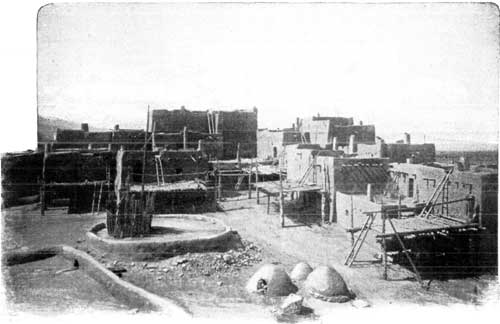
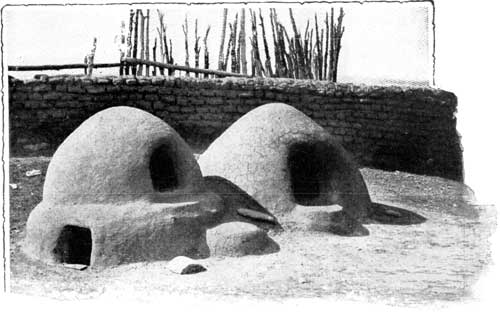
MEXICAN OVENS.
THE OLD CHURCH AT ÁCOMA.
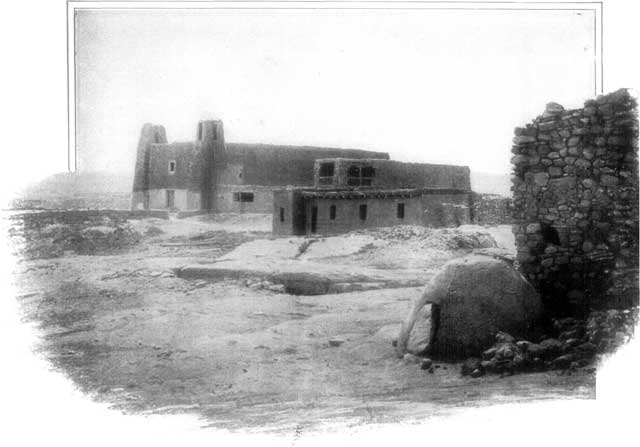
The only other notable structure in Ácoma is the Roman Catholic church, the walls of which are sixty feet in height and ten feet thick. One can realize the enormous amount of labor involved in its construction, when he reflects that every stone and every piece of timber used in building it had to be brought hither on the backs of Indians, over the plains, from a considerable distance, and up the desperately difficult and narrow trail. Even the graveyard, which occupies a space in front of the church, about two hundred feet square, is said to have required a labor of forty years, since the cemetery had to be enclosed with stone walls, forty feet deep at one edge and filled with earth brought in small basket-loads up the steep ascent from the plain below. The church itself is regarded by the Indians with the utmost reverence, although it must be said that their religion is still almost as much Pagan as Christian. Thus, while they respect the priests who come to minister to them, they also have a lurking reverence for the medicine man, who is known as the cacique. He is really the religious head of the community, a kind of augur and prophet, who consults the gods and communicates to the people the answers he claims to have received. This dignitary is exempt from all work of a manual kind, such as farming, digging irrigation-ditches, and even hunting, and receives compensation for his services in the form of a tract of land which the community cultivates for him with more care than is bestowed on any other portion of their territory, while his crops are the first harvested in the autumn. He also derives an income in the form of grain, buckskin, shells, or turquoises, from those who beg him to fast for them, and to intercede with the gods in case of sickness. On the other hand, the cacique must lodge and feed all the strangers who come to the village, as long as they stay, and he is, also, the surgeon and the nurse of the community.
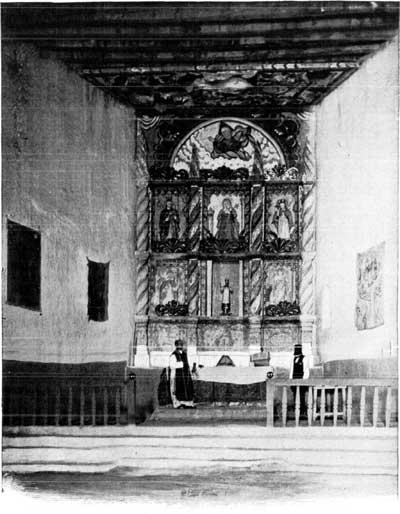
THE ALTAR.
DANCE IN THE PUEBLO.
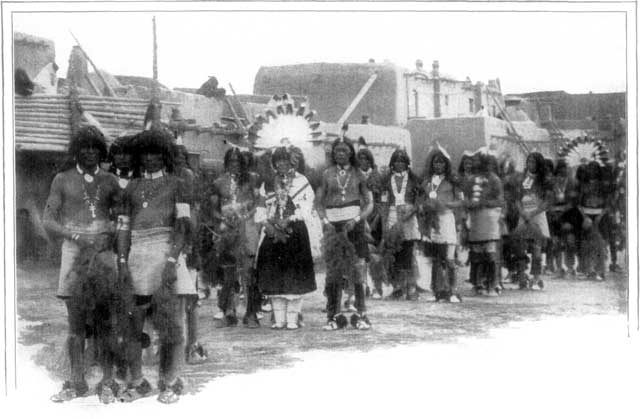
While, therefore, the Pueblos go to church and repeat prayers in accordance with Christian teaching, they also use the prayer-sticks of their ancestors, and still place great reliance on their dances, most of which are of a strictly religious character, and are not only dedicated to the sun, moon, rainbow, deer, elk, and sheep, but are usually performed for the specific purpose of obtaining rain. Formerly, too, when their lives were far less peaceful than they are to-day, the Pueblos indulged in war and scalp dances; but these are now falling into disuse. The most remarkable exhibition of dancing, still in vogue, is the repulsive Snake Dance of the Moquis of Arizona, which takes place every year alternately in four villages between the 10th and the 30th of August according to the phase of the moon. The origin of this extraordinary custom is not intelligible now even to the Indians themselves, but the object in performing it is to obtain rain, and the dance, itself, is the culmination of a religious ceremonial which continues for nine days and nights. During that time only those who have been initiated into the Sacred Fraternities of the tribe may enter the estufa, on the floor of which weird pictures have been made with colored sand.
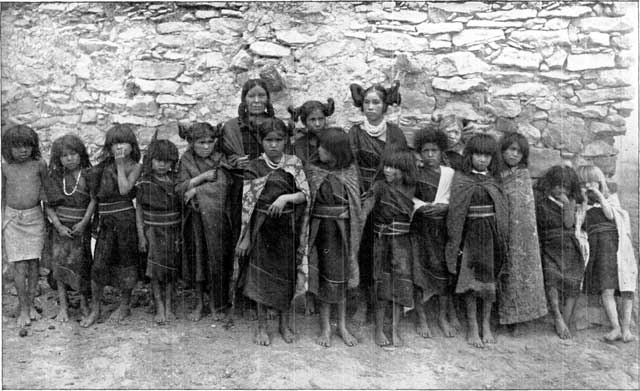
PUEBLO GIRLS.
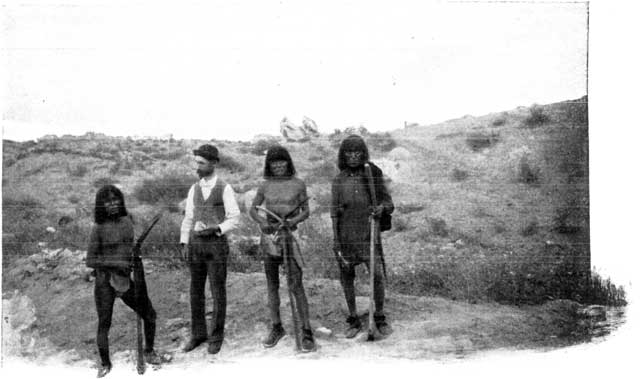
THREE SNAKE PRIESTS.
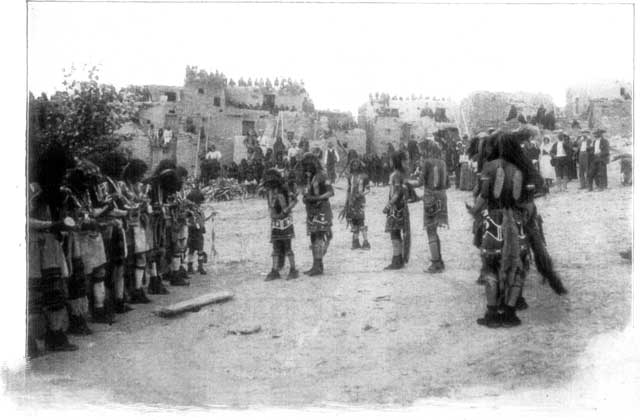
In the tribe of Moquis there are two fraternities known as the Antelopes and the Snakes, Each has from twenty to thirty members, some of whom are boys who serve as acolytes. When the open air ceremony of the Snake Dance begins, the members of these brotherhoods appear scantily clothed, with their faces painted red and white, and with tortoise-shell rattles tied to their legs. The Antelope fraternity first enters the square, preceded by a venerable priest carrying two bags filled with snakes. These serpents, which have been previously washed and covered with sacred meal, are deposited by the priest in a small leaf-embowered enclosure called the kisi. Around this the Antelopes now march, stamping with the right foot violently, to notify the spirits of their ancestors (presumably in the lower world) that the ceremony has begun. After making the circuit of the enclosure four times, they halt, and stand in line with their backs turned toward it. Then the Snake fraternity appears, headed by its priest, and performs the same ceremony. Then they too form a line, facing the Antelopes, and all of them, for about five minutes, wave their wands and chant some unintelligible words. Suddenly one Antelope and one Snake man rush to the kisi, and the priest who is presiding over the serpents presents them with a snake. The Snake man immediately places the wriggling reptile in his mouth, and holds it by the centre of its body between his teeth, as he marches around the little plaza, taking high steps. Meantime the, Antelope man accompanies him, stroking the snake continually with a wand tipped with feathers. Then all the members of the two fraternities follow in couples and do the same thing. Finally, each Snake man carries at least two snakes in his mouth and several in his hands; and even little boys, five years old, dressed like the adults, also hold snakes in their hands, fearlessly. Once in a while a snake is purposely dropped, and a man whose special duty it is to prevent its escape rushes after it and catches it up.
THE SNAKE DANCE.
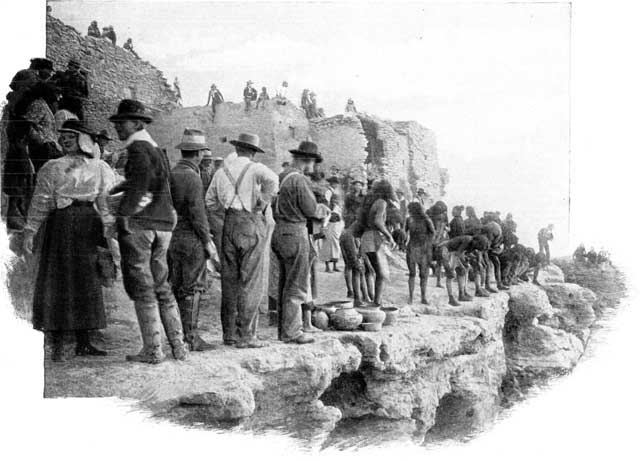
All the time that this hideous ceremony is going on, a weird chant is sung by the men and women of the tribe; and, at last, the chief priest draws on the ground a mystic circle with a line of sacred meal, and into this the men unload their snakes until the whole space becomes a writhing mass of serpents. Suddenly the members rush into this throng of squirming reptiles, most of which are rattlesnakes, and each, grabbing up a handful of them, runs at full speed down the mesa and sets them at liberty, to act as messengers to carry to the gods their prayers for rain. This ends the ceremony for the snakes, but not for the men; for after they have liberated the reptiles, the members of the brotherhoods return and bathe themselves in a kind of green decoction, called Frog-water. Then they drink a powerful emetic, and having lined up on the edge of the mesa, vomit in unison! This is to purge them from the evil effects of snake-handling; and lest it should not be sufficiently effectual, the dose is repeated. Then they sit down, and eat bread, given them by the women as a kind of communion or religious rite.
AFTER THE EMETIC.
CHIEF SNAKE PRIEST.
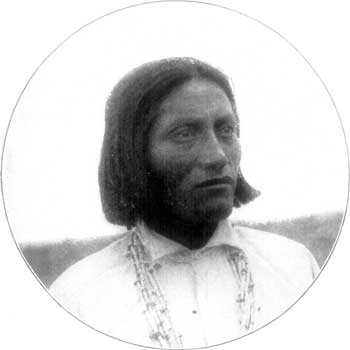
The seventy or eighty snakes used in this dance are treated from first to last with the utmost kindness and respect, especially the rattlesnakes, a dozen of which will frequently be squirming on the ground at once. It is noticeable that the Indians never pick up a rattlesnake when coiled, but always wait until it straightens itself out under the feather stroking, for it is claimed that the rattlesnake cannot strike uncoiled. At all events, when one is at its full length, the Indians not only catch it up fearlessly, but carry it with impunity in their mouths and hands. As might be supposed, however, the Moquis are said to possess an antidote against the poison of a rattlesnake, which, if a man is bitten, is given to him at once; and it is said that none of them ever dies from the effects of a snake-bite.
WHERE THE SNAKES ARE KEPT.
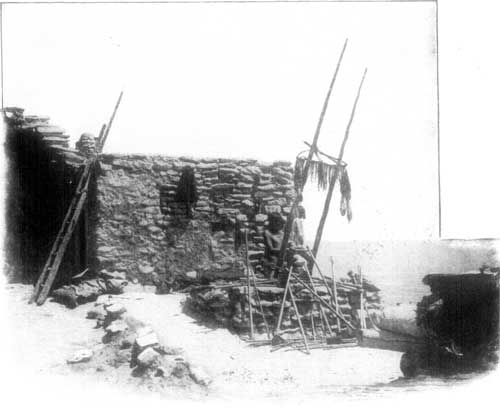
The religious element in all these ceremonies should not be lost sight of, for the life of the Pueblo Indians is permeated with religion, or superstition, to the minutest details. Thus, it is an interesting fact that vicarious atonement has been a custom among them from time immemorial, and their cacique is compelled to fast and do penance in many ways for the sins of his people. In some of the villages, also, certain men and women are chosen to expiate the wrongdoings of the tribe; and for more than a century there has been in New Mexico an order of Penitents, who torture themselves by beating their bodies with sharp cactus thorns, by carrying heavy crosses for great distances, and even by actual crucifixion. The severest of these cruel rites have, finally, been suppressed by the Roman Catholic church, but it encountered great difficulty in so doing, and the last crucifixion took place in 1891.
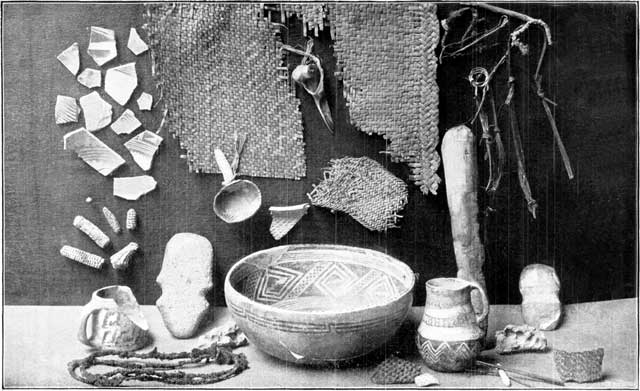
RELICS OF CLIFF DWELLERS.
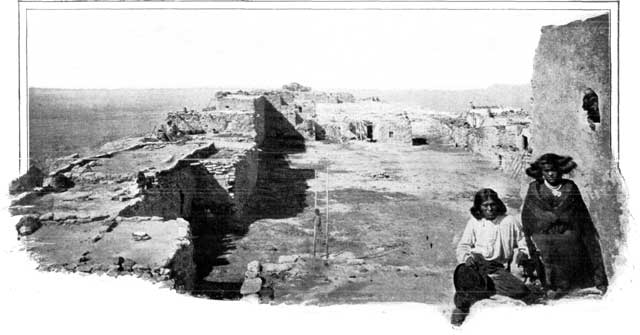
SUMMIT OF A MOQUI MESA.
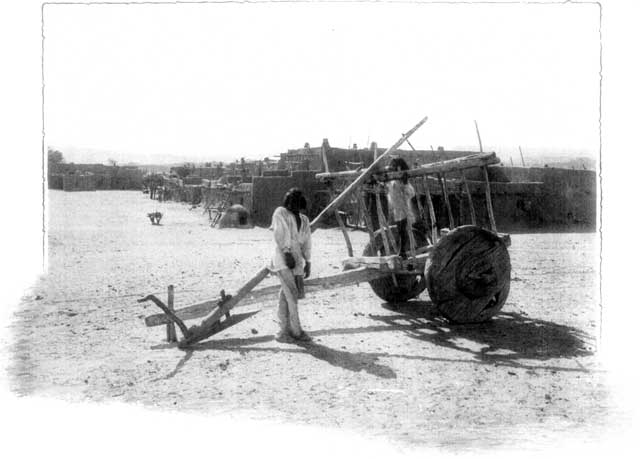
Such, then, are the Pueblos of New Mexico and Arizona; a race uniting aboriginal Pagan rites with Christian ceremonies: cherishing at the same time their idols and their churches; using to-day their rifles, and to-morrow their bows and arrows; pounding occasionally with a hammer, but preferably with a stone; and handling American money for certain purchases, while trading beads, shells, and turquoises for others. Sometimes we wonder that they have not made more progress during the centuries in which they have been associated with Europeans; but it is hard to realize the difficulties which they have encountered in trying to comprehend our civilization, and in grasping its improvements. Even the adoption of the antique Spanish plow, the clumsy two-wheeled cart, the heavy ax and the rude saw, which are still found among them, caused them to pass at one stride from the Stone to the Iron Age, which, but for the intervention of the Spaniards, they would not naturally have reached without centuries of patient plodding. Moreover, before the arrival of the Europeans, the Aborigines of America had never seen horses, cows, sheep, or dogs, and the turkey was the only domestic animal known to them. Hence, in ancient American society there was no such thing as a pastoral stage of development; and the absence of domestic animals from the western hemisphere is a very important reason why the progress of mankind in this part of the world was not more rapid. Still it is a remarkable fact that the most ancient race, of which we have any actual knowledge on this continent, is, also, the most peaceful, self-supporting, and industrious, subsisting principally on the sale of their curiously decorated pottery, and the products of their arid soil. We saw here a young man who had been educated in the Government School at Carlisle; but, like most of his race, after returning to his village he had reverted to the ways of his ancestors, disqualified by his birth and instincts of heredity from doing anything else successfully.
MOQUI CART AND PLOW.
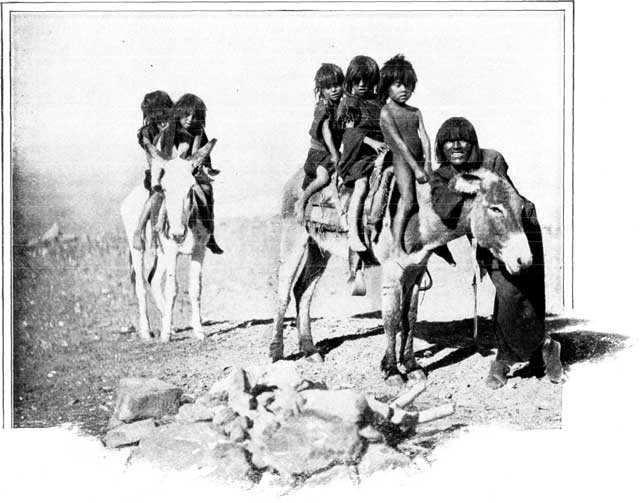
MOQUI CHILDREN.
It was late on the night succeeding our visit to Ácoma that we arrived at Flagstaff, and our entire party was asleep. Suddenly we were aroused by a prolonged shout and the discharge of half a dozen revolvers. Five minutes later there came a general fusillade of pistol shots, and near and distant cries were heard, in which our half-awakened faculties could distinguish only the words: "Hurry up!" "Call the crowd!" "Down the alley!" Then a gruff voice yelled just beneath my window: "Let her go," and instantly our locomotive gave a whistle so piercing and continuous that all the occupants of our car sprang from their couches, and met in a demoralized group of multicolored pajamas in the corridor. What was it? Had the train been held up? Were we attacked? No; both the whistle and the pistol shots were merely Flagstaff's mode of giving an alarm of fire. We hastily dressed and stepped out upon the platform. A block of buildings just opposite the station was on fire, and was evidently doomed; yet Flagstaff's citizens, whose forms, relieved against the lurid glow, looked like Comanche Indians in a war dance, fought the flames with stubborn fury. The sight of a successful conflagration always thrills me, partly with horror, partly with delight. Three hundred feet away, two buildings formed an ever-increasing pyramid of golden light. We could distinguish the thin streams of water thrown by two puny engines; but, in comparison with the great tongues of fire which they strove to conquer, they appeared like silver straws. Nothing could check the mad carousal of the sparks and flames, which danced, leaped, whirled, reversed, and intertwined, like demons waltzing with a company of witches on Walpurgis Night. A few adventurous men climbed to the roofs of the adjoining structures, and thence poured buckets of water on the angry holocaust; but, for all the good they thus accomplished, they might as well have spat upon the surging, writhing fire, which flashed up in their faces like exploding bombs, whenever portions of the buildings fell. Meantime huge clouds of dense smoke, scintillant with sparks, rolled heavenward from this miniature Vesuvius; the neighboring windows, as they caught the light, sparkled like monster jewels; two telegraph poles caught fire, and cut their slender forms and outstretched arms against the jet black sky, like gibbets made of gold. How fire and water serve us, when subdued as slaves; but, oh, how terribly they scourge us, if ever for a moment they can gain the mastery! Too interested to exchange a word, we watched the struggle and awaited the result. The fury of the fire seemed like the wild attack of Indians, inflamed with frenzy and fanaticism, sure to exhaust itself at last, but for the moment riotously triumphant. Gradually, however, through want of material on which to feed itself, the fiery demon drooped its shining crest, brandished its arms with lessening vigor, and seemed to writhe convulsively, as thrust after thrust from the silver spears of its assailants reached a vital spot. Finally, after hurling one last shower of firebrands, it sank back into darkness, and its hereditary enemy rushed in to drown each lingering spark of its reduced vitality.
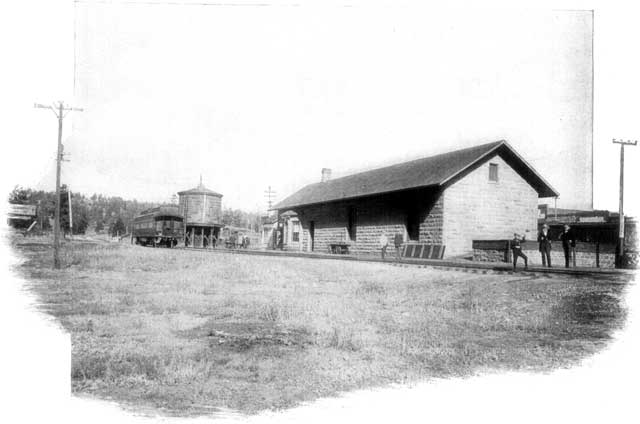
FLAGSTAFF STATION.
PACKING WOOD.
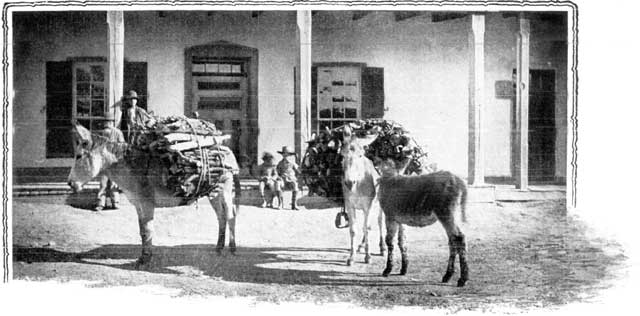
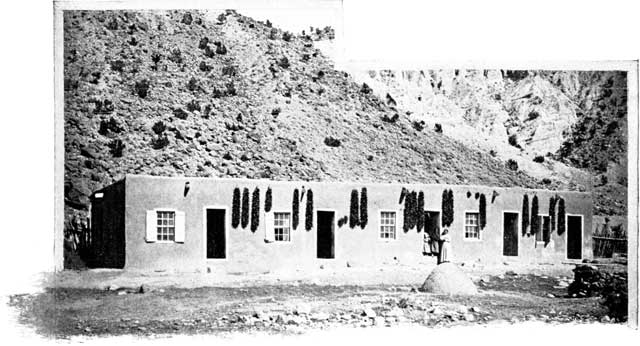
A MEXICAN HOME.
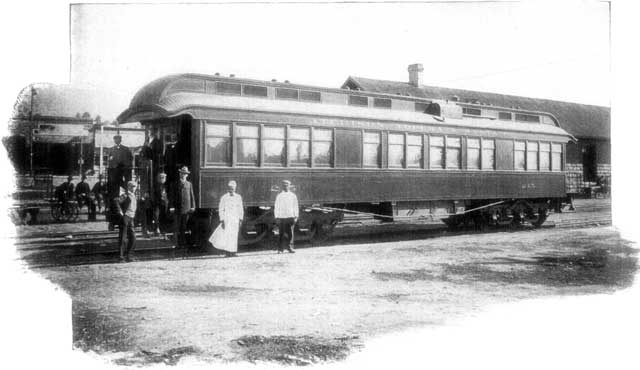
OUR CAR AT FLAGSTAFF.
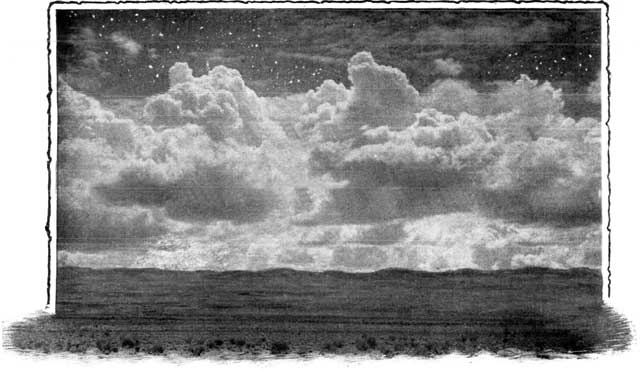
THE HEAVENS FROM THE OBSERVATORY, FLAGSTAFF.
TWILIGHT.
Upon a hill near Flagstaff stands an astronomical observatory from which distinguished students of the midnight skies search for the secrets of the moon and stars. Few better sites on earth could have been chosen for this purpose, since Arizona's atmosphere is so transparent that the extent of celestial scenery here disclosed is extraordinary. We visited the structure at the solemn hour that marks the hush between two days, when the last sound of one has died away, and before the first stir of the other thrills the morning air. Then, gazing through the lenses of its noble telescope, we welcomed the swift waves of light pulsating toward us from the shoreless ocean we call space. There is a mysterious beauty about the radiance of a star that far surpasses that of the moon. The latter glitters only with reflected light; but a star (that is to say a distant sun), when seen through a telescope, frequently scintillates with different colors like a diamond, and quivers like a thing of life. Moreover, the moon, forever waxing, waning, or presenting almost stupidly its great flat face, is continually changing; but the fixed star is always there. It fills the thoughtful soul with awe to look upon the starry heavens through such an instrument as that at Flagstaff. Space for the moment seems annihilated. We are apparently transported, as observers, from our tiny planet to the confines of our solar system, and, gazing thence still farther toward infinity, we watch with bated breath the birth, the progress, and the death of worlds. To one of the most distant objects in the depths of space, known as the Ring Nebula, the author addressed the following lines:
TO THE RING NEBULA. O, pallid spectre of the midnight skies! Whose phantom features in the dome of Night Elude the keenest gaze of wistful eyes Till amplest lenses aid the failing sight, On heaven's blue sea the farthest isle of fire. From thee, whose glories it would fain admire, Must vision, baffled, in despair retire! What art thou, ghostly visitant of flame? Wouldst thou 'neath closer scrutiny dissolve In myriad suns that constellations frame, Round which life-freighted satellites revolve, Like those unnumbered orbs which nightly creep In dim procession o'er the azure steep, As white-wing'd caravans the desert sweep? Or, art thou still an incandescent mass, Acquiring form as hostile forces urge, Through whose vast length a million lightnings pass As to and fro its fiery billows surge, Whose glowing atoms, whirled in ceaseless strife Where now chaotic anarchy is rife. Shall yet become the fair abodes of life? We know not; for the faint, exhausted rays Which hither on Light's wingèd coursers come From fires which ages since first lit their blaze, One instant gleam, then perish, spent and dumb! How strange the thought that, whatsoe'er we learn, Our tiny globe no answer can return, Since with but dull, reflected beams we burn! Yet this we know; yon ring of spectral light, Whose distance thrills the soul with solemn awe, Can ne'er escape in its majestic might The firm control of omnipresent law. This mote descending to its bounden place. Those suns whose radiance we can scarcely trace, Alike obey the Power pervading space.
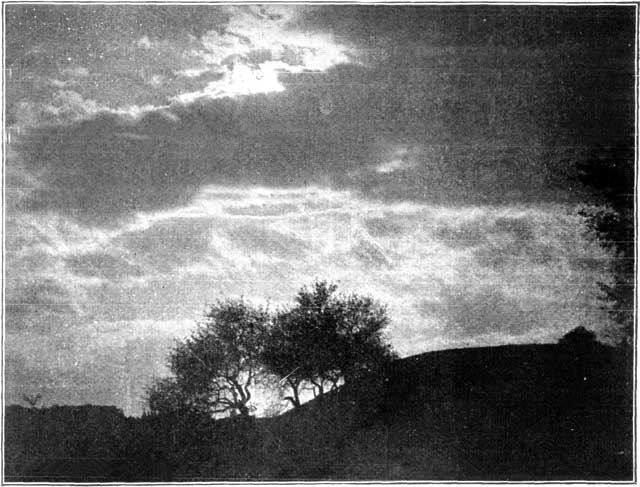
NIGHT.
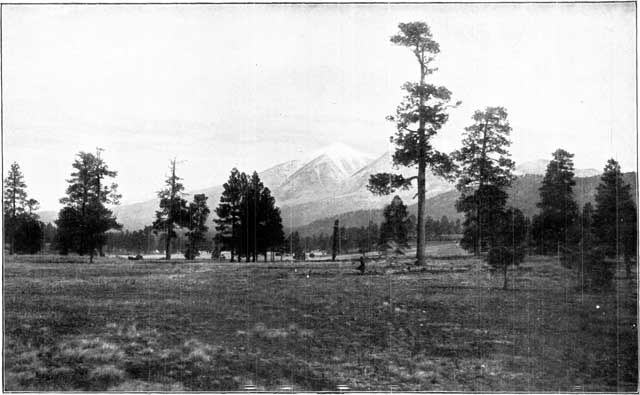
THE SAN FRANCISCO VOLCANOES.
STARTING FOR THE GRAND CAÑON.
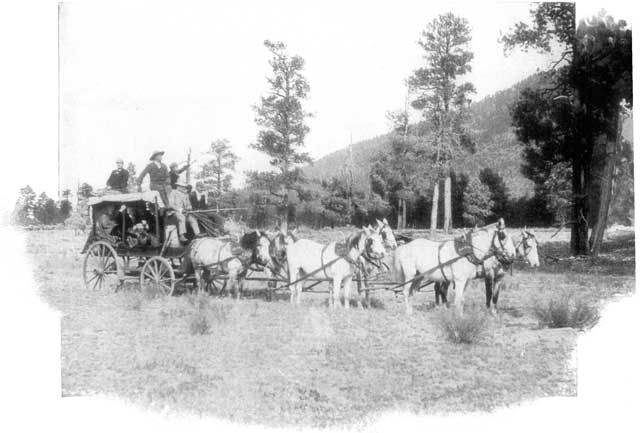
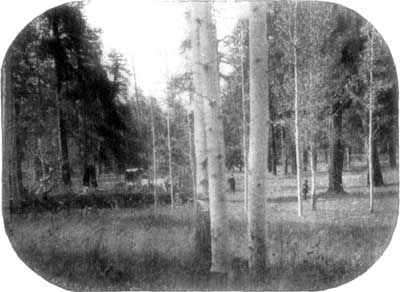
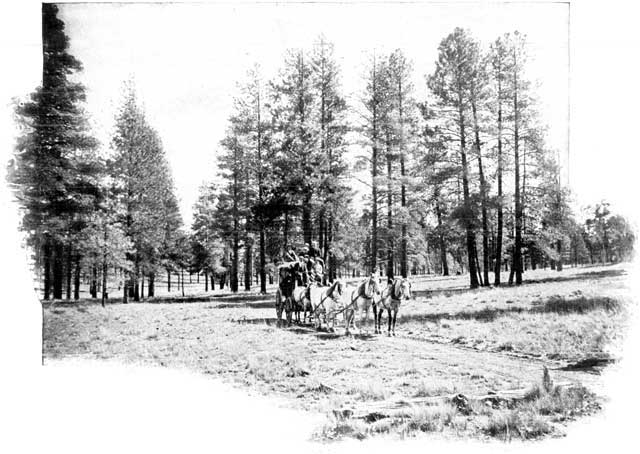
One glorious September morning, leaving our train at Flagstaff, we started in stage-coaches for a drive of sixty-five miles to the Grand Cañon. I had looked forward to this drive with some misgiving, dreading the heat of the sun, and the dust and sand which I had supposed we should encounter; but to my astonishment and delight it was a thoroughly enjoyable experience. It was only eleven hours in duration, and not only was most of the route level, but two-thirds of it lay through a section of beautifully rolling land, diversified with open glades and thousands upon thousands of tall pines and cedars entirely free from undergrowth. It is no exaggeration to say that we drove that day for miles at a time over a road carpeted with pine needles. The truth is, Arizona, though usually considered a treeless and rainless country, possesses some remarkable exceptions; and the region near Flagstaff not only abounds in stately pines, but is at certain seasons visited by rainstorms which keep it fresh and beautiful. During our stay at the Grand Cañon we had a shower every night; the atmosphere was marvelously pure, and aromatic with the odors of a million pines; and so exhilarating was exercise in the open air, that however arduous it might be, we never felt inconvenienced by fatigue, and mere existence gave us joy. Decidedly, then, it will not do to condemn the whole of Arizona because of the heat of its arid, southern plains; for the northern portion of the state is a plateau, with an elevation of from five thousand to seven thousand feet. Hence, as it is not latitude, so much as altitude, that gives us healthful, pleasing temperature, in parts of Arizona the climate is delightful during the entire year.
THE DRIVE THROUGH THE PINES.
THE SAN FRANCISCO MOUNTAIN.
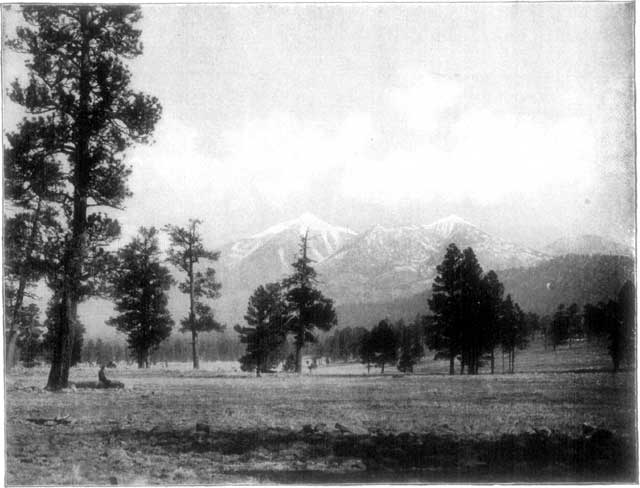
A portion of this stage-coach journey led us over the flank of the great San Francisco Mountain. The isolated position, striking similarity, and almost uniform altitude of its four peaks, rising nearly thirteen thousand feet above the sea, have long made them famous. Moreover, they are memorable for having cast a lurid light upon the development of this portion of our planet. Cold, calm, and harmless though they now appear, the time has been when they contained a molten mass which needed but a throb of Earth's uneasy heart to light the heavens with an angry glare, and cover the adjoining plains with floods of fire. Lava has often poured from their destructive cones, and can be traced thence over a distance of thirty miles; proving that they once served as vents for the volcanic force which the thin crust of earth was vainly striving to confine. But their activity is apparently ended. The voices with which they formerly shouted to one another in the joy of devastation have been silenced. Conquered at last, their fires smolder now beneath a barrier too firm to yield, and their huge forms appear like funeral monuments reared to the memory of the power buried at their base. Another fascinating sight upon this drive was that of the Painted Desert whose variously colored streaks of sand, succeeding one another to the rim of the horizon, made the vast area seem paved with bands of onyx, agate, and carnelian.
THE LUNCH STATION.
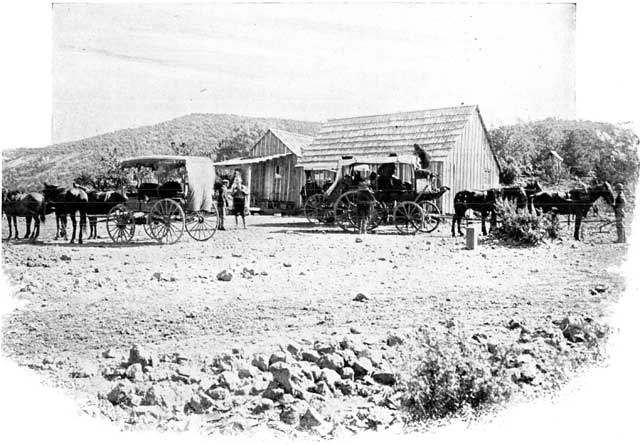
About the hour of noon we reached a lunch-station at which the stages, going to and from the Cañon, meet and pass. The structure itself is rather primitive; but a good meal is served to tourists at this wayside halting-place, and since our appetites had been sharpened by the long ride and tonic-giving air, it seemed to us the most delicious of repasts. The principal object of one of the members of our party, in making the journey described in these pages, was to determine the advisability of building a railroad from Flagstaff to the Cañon. Whether this will be done eventually is not, however, a matter of vital interest to travelers, since the country traversed can easily be made an almost ideal coaching-route; and with good stages, frequent relays of horses, and a well-appointed lunch-station, a journey thus accomplished would be preferable to a trip by rail.
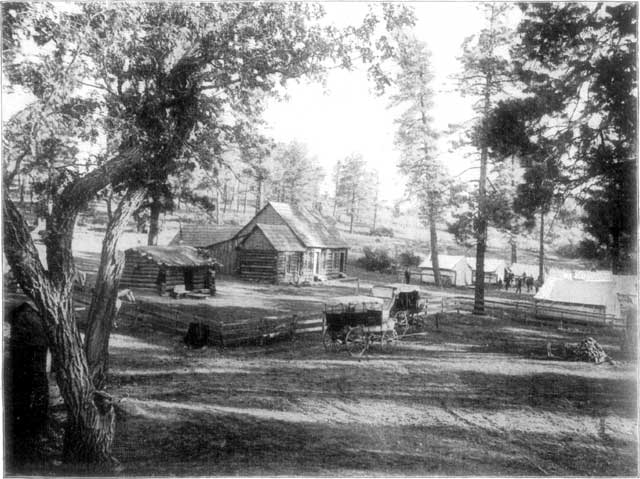
HANCE'S CAMP.
OUR TENT AT HANCE'S CAMP.
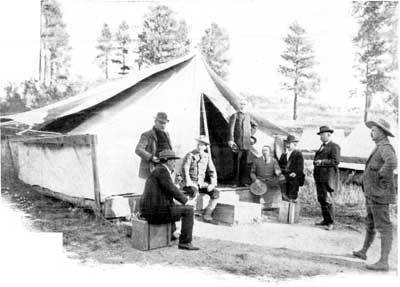
Night had already come when we arrived at our destination, known as Hance's Camp, near the border of the Cañon. As we drove up to it, the situation seemed enchanting in its peace and beauty; for it is located in a grove of noble pines, through which the moon that night looked down in full-orbed splendor, paving the turf with inlaid ebony and silver, and laying a mantle of white velvet on the tents in which we were to sleep. Hance's log cabin serves as a kitchen and dining-room for travelers, and a few guests can even find lodging there; but, until a hotel is built, the principal dormitories must be the tents, which are provided with wooden floors and furnished with tables, chairs, and comfortable beds. This kind of accommodation, however, although excellent for travelers in robust health, is not sufficiently luxurious to attract many tourists. The evident necessity of the place is a commodious, well-kept inn, situated a few hundred feet to the rear of Hance's Camp, on the very edge of the Cañon. If such a hotel, built on a spot commanding the incomparable view, were properly advertised and well-managed, I firmly believe that thousands of people would come here every year, on their way to or from the Pacific coast—not wishing or expecting it to be a place of fashion, but seeking it as a point where, close beside a park of pines, seven thousand feet above the level of the sea, one of the greatest marvels of the world can be enjoyed, in all the different phases it presents at morning, noon, and night, in sunshine, moonlight, and in storm.
OLD HANCE.
THE FIRST VIEW.
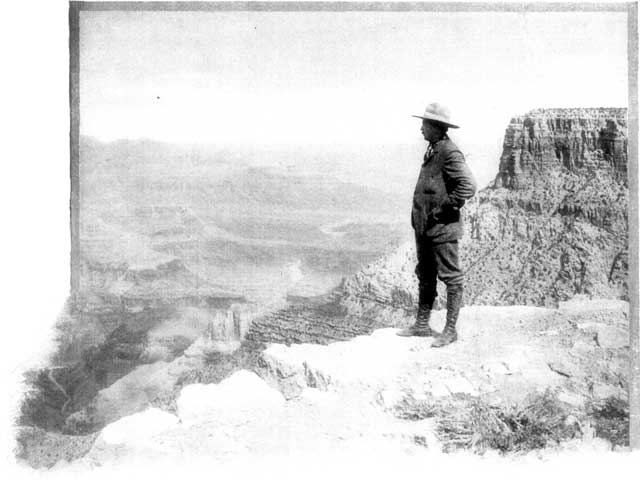
Early the next morning I eagerly climbed the little knoll at the foot of which our tents were located, for I well knew that from its summit I should see the Cañon. Many grand objects in the world are heralded by sound: the solemn music of Niagara, the roar of active geysers in the Yellowstone, the intermittent thunder of the sea upon a rocky coast, are all distinguishable at some distance; but over the Grand Cañon of the Colorado broods a solemn silence. No warning voice proclaims its close proximity; no partial view prepares us for its awful presence. We walk a few steps through the pine trees from the camp and suddenly find ourselves upon the Cañon's edge. Just before reaching it, I halted for a moment, as has always been my wont when approaching for the first time any natural or historic object that I have longed for years to look upon. Around me rose the stately pines; behind me was a simple stretch of rolling woodland; nothing betrayed the nearness of one of the greatest wonders of the world. Could it be possible that I was to be disappointed? At last I hurried through the intervening space, gave a quick look, and almost reeled. The globe itself seemed to have suddenly yawned asunder, leaving me trembling on the hither brink of two dissevered hemispheres. Vast as the bed of a vanished ocean, deep as Mount Washington, riven from its apex to its base, the grandest cañon on our planet lay glittering below me in the sunlight like a submerged continent, drowned by an ocean that had ebbed away. At my very feet, so near that I could have leaped at once into eternity, the earth was cleft to a depth of six thousand six hundred feet—not by a narrow gorge, like other cañons, but by an awful gulf within whose cavernous immensity the forests of the Adirondacks would appear like jackstraws, the Hudson Palisades would be an insignificant stratum, Niagara would be indiscernible, and cities could be tossed like pebbles.
THE EARTH-GULF OF ARIZONA.
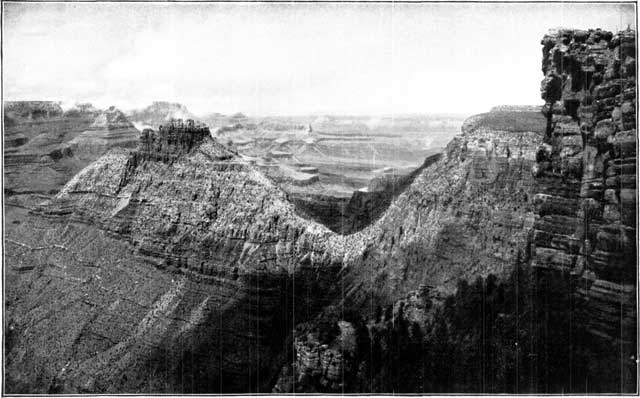
A PORTION OF THE GULF.
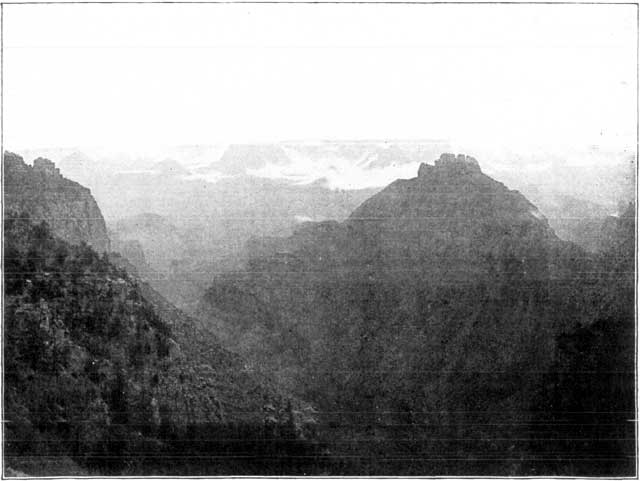
"A VAST, INCOMPARABLE VOID."
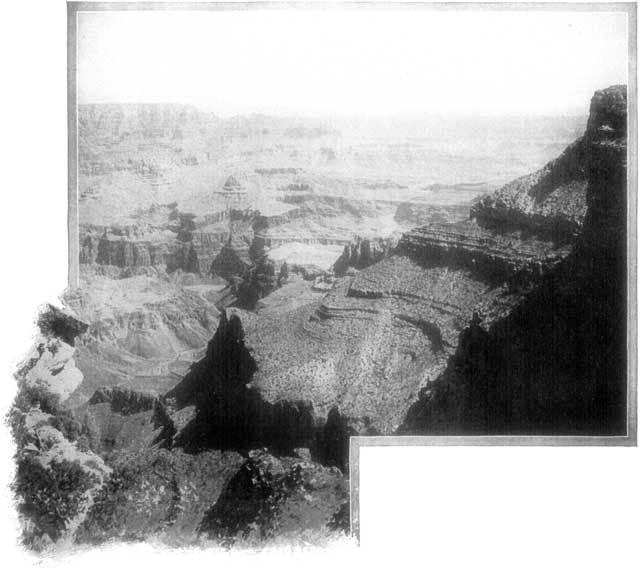
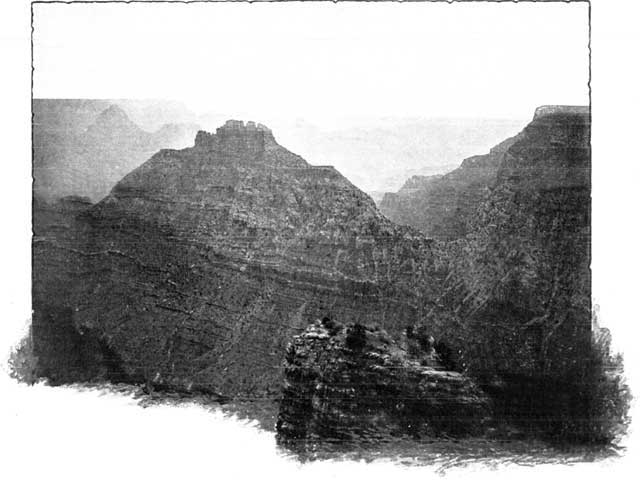
As brain grew steadier and vision clearer, I saw, directly opposite, the other side of the Cañon thirteen miles away. It was a mountain wall, a mile in height, extending to the right and left as far as the eye could reach; and since the cliff upon which I was standing was its counterpart, it seemed to me as if these parallel banks were once the shore-lines of a vanished sea. Between them lay a vast, incomparable void, two hundred miles in length, presenting an unbroken panorama to the east and west until the gaze could follow it no farther. Try to conceive what these dimensions mean by realizing that a strip of the State of Massachusetts, thirteen miles in width, and reaching from Boston to Albany, could be laid as a covering over this Cañon, from one end to the other; and that if the entire range of the White Mountains were flung into it, the monstrous pit would still remain comparatively empty! Even now it is by no means without contents; for, as I gazed with awe and wonder into its colossal area, I seemed to be looking down upon a colored relief-map of the mountain systems of the continent. It is not strictly one cañon, but a labyrinth of cañons, in many of which the whole Yosemite could be packed away and lost. Thus one of them, the Marble Cañon, is of itself more than three thousand feet deep and sixty-six miles long. In every direction I beheld below me a tangled skein of mountain ranges, thousands of feet in height, which the Grand Cañon's walls enclosed, as if it were a huge sarcophagus, holding the skeleton of an infant world. It is evident, therefore, that all the other cañons of our globe are, in comparison with this, what pygmies are to a giant, and that the name Grand Cañon, which is often used to designate some relatively insignificant ravine, should be in truth applied only to the stupendous earth-gulf of Arizona.
A SECTION OF THE LABYRINTH.
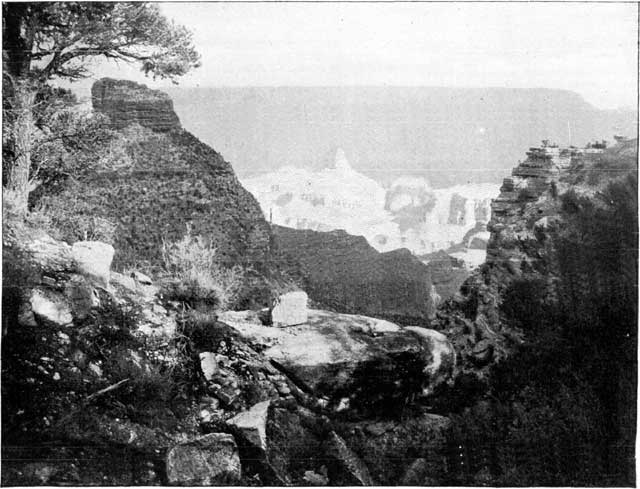
MOUNT AYER.
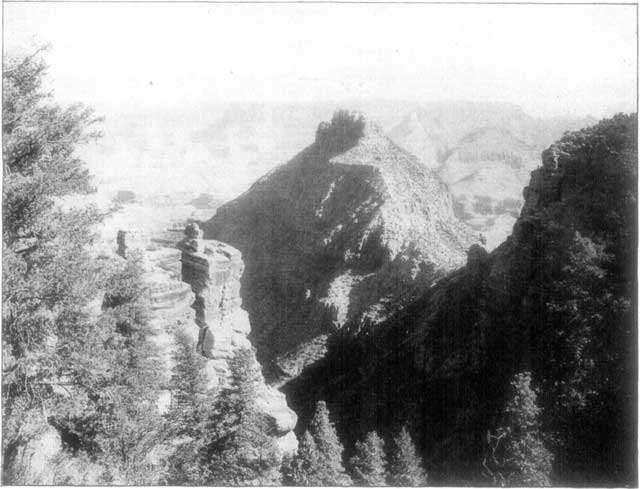
At length, I began to try to separate and identify some of these formations. Directly in the foreground, a savage looking mountain reared its splintered head from the abyss, and stood defiantly confronting me, six thousand feet above the Cañon's floor. Though practically inaccessible to the average tourist, this has been climbed, and is named Mount Ayer, after Mrs. Edward Ayer, the first woman who ever descended into the Cañon to the river's edge. Beyond this, other mountains rise from the gulf, many of which resemble the Step Pyramid at Sakhara, one of the oldest of the royal sepulchres beside the Nile. But so immeasurably vaster are the pyramids of this Cañon than any work of man, that had the tombs of the Pharaohs been placed beside them, I could not have discovered them without a field-glass. Some of these grand constructions stand alone, while others are in pairs; and many of them resemble Oriental temples, buttressed with terraces a mile or two in length, and approached by steps a hundred feet in height. Around these, too, are many smaller mountainous formations, crude and unfinished in appearance, like shrines commenced and then abandoned by the Cañon's Architect. Most of us are but children of a larger growth, and love to interpret Nature, as if she reared her mountains, painted her sunsets, cut her cañons, and poured forth her cataracts solely for our instruction and enjoyment. So, when we gaze on forms like these, shaped like gigantic temples, obelisks, and altars fashioned by man's hands, we try to see behind them something personal, and even name them after Hindu, Grecian, and Egyptian gods, as if those deities made them their abodes. Thus, one of these shrines was called by the artist, Thomas Moran, the Temple of Set; three others are dedicated respectively to Siva, Vishnu, and Vulcan; while on the apex of a mighty altar, still unnamed, a twisted rock-formation, several hundred feet in height, suggests a flame, eternally preserved by unseen hands, ascending to an unknown god.
SOME OF THE CAÑON TEMPLES.
SIVA'S TEMPLE.
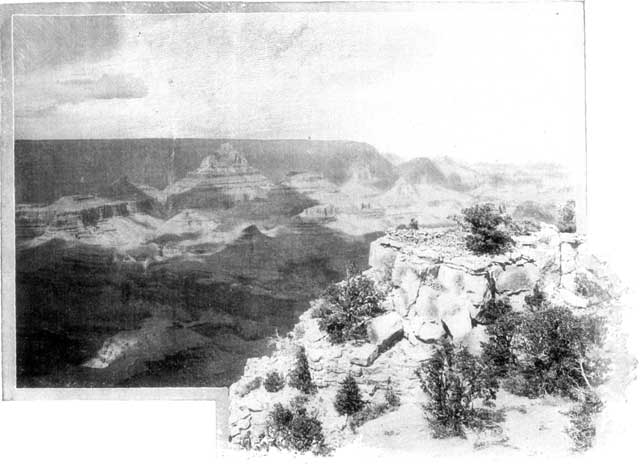
It is difficult to realize the magnitude of these objects, so deceptive are distances and dimensions in the transparent atmosphere of Arizona. Siva's Temple, for example, stands upon a platform four or five miles square, from which rise domes and pinnacles a thousand feet in height. Some of their summits call to mind immense sarcophagi of jasper or of porphyry, as if they were the burial-places of dead deities, and the Grand Cañon a Necropolis for pagan gods. Yet, though the greater part of the population of the world could be assembled here, one sees no worshipers, save an occasional devotee of Nature, standing on the Cañon's rim, lost in astonishment and hushed in awe. These temples were, however, never intended for a human priesthood. A man beside them is a pygmy. His voice here would be little more effective than the chirping of an insect. The God-appointed celebrant, in the cathedrals of this Cañon, must be Nature. Her voice alone can rouse the echoes of these mountains into deafening peals of thunder. Her metaphors are drawn from an experience of ages. Her prayers are silent, rapturous communings with the Infinite. Her hymns of praise are the glad songs of birds; her requiems are the meanings of the pines; her symphonies the solemn roaring of the winds. "Sermons in stone" abound at every turn; and if, as the poet has affirmed, "An undevout astronomer is mad," with still more truth can it be said that those are blind who in this wonderful environment look not "through Nature up to Nature's God." These wrecks of Tempest and of Time are finger-posts that point the thoughts of mortals to eternal heights; and we find cause for hope in the fact that, even in a place like this, Man is superior to Nature; for he interprets it, he finds in it the thoughts of God, and reads them after Him.
NEAR THE TEMPLE OF SET.
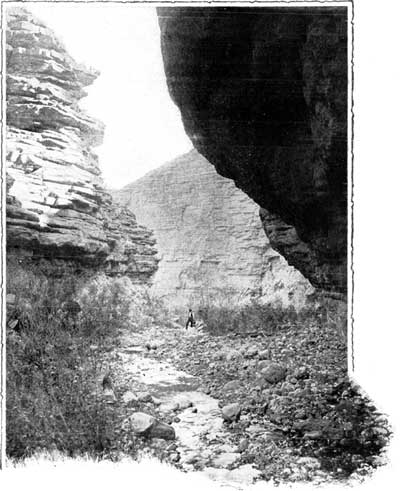
HANCE'S TRAIL, LOOKING UP.
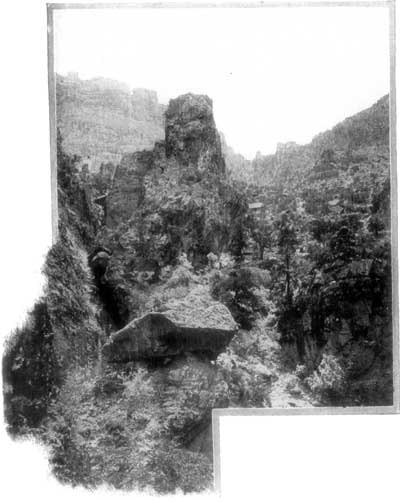
The coloring of the Grand Cañon is no less extraordinary than its forms. Nature has saved this chasm from being a terrific scene of desolation by glorifying all that it contains. Wall after wall, turret after turret, and mountain range after mountain range belted with tinted strata, succeed one another here like billows petrified in glowing colors. These hues are not as brilliant and astonishing in their variety as are the colors of the Yellowstone Cañon, but their subdued and sombre tones are perfectly suited to the awe-inspiring place which they adorn. The prominent tints are yellow, red, maroon, and a dull purple, as if the glory of unnumbered sunsets, fading from these rugged cliffs, had been in part imprisoned here. Yet, somehow, specimens of these colored rocks lose all their brilliancy and beauty when removed from their environment, like sea-shells from the beach; a verification of the sentiment so beautifully expressed in the lines of Emerson:
"I wiped away the weeds and foam, I fetched my sea-born treasures home; But the poor, unsightly, noisome things Had left their beauty on the shore, With the sun and the sand and the wild uproar."
MIST IN THE CAÑON.
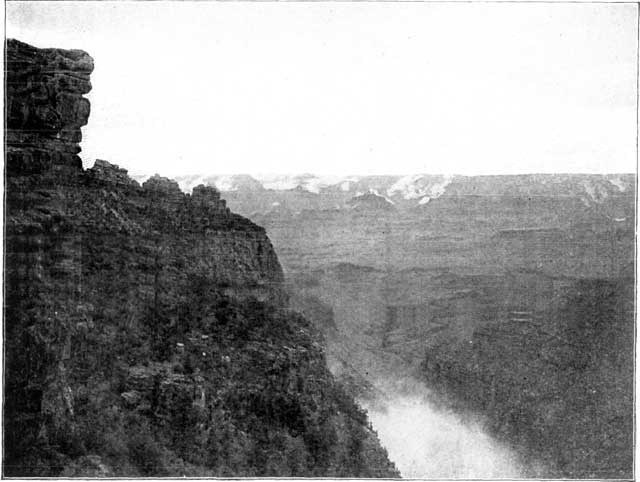
To stand upon the edge of this stupendous gorge, as it receives its earliest greeting from the god of day, is to enjoy in a moment compensation for long years of ordinary uneventful life. When I beheld the scene, a little before daybreak, a lake of soft, white clouds was floating round the summits of the Cañon mountains, hiding the huge crevasse beneath, as a light coverlet of snow conceals a chasm in an Alpine glacier. I looked with awe upon this misty curtain of the morn, for it appeared to me symbolic of the grander curtain of the past which shuts out from our view the awful struggles of the elements enacted here when the grand gulf was being formed. At length, however, as the light increased, this thin, diaphanous covering was mysteriously withdrawn, and when the sun's disk rose above the horizon, the huge facades of the temples which looked eastward grew immediately rosy with the dawn; westward, projecting cliffs sketched on the opposite sides of the ravines, in dark blue silhouettes, the evanescent forms of castles, battlements, and turrets from which some shreds of white mist waved like banners of capitulation; stupendous moats beneath them were still black with shadow; while clouds filled many of the minor cañons, like vapors rising from enormous cauldrons. Gradually, as the solar couriers forced a passage into the narrow gullies, and drove the remnant of night's army from its hiding-places, innumerable shades of purple, yellow, red, and brown appeared, varying according to the composition of the mountains, and the enormous void was gradually filled to the brim with a luminous haze, which one could fancy was the smoke of incense from its countless altars. A similar, and even more impressive, scene is visible here in the late afternoon, when all the western battlements in their turn grow resplendent, while the eastern walls submit to an eclipse; till, finally, a gray pall drops upon the lingering bloom of day, the pageant fades, the huge sarcophagi are mantled in their shrouds, the gorgeous colors which have blazed so sumptuously through the day grow pale and vanish, the altar fires turn to ashes, the mighty temples draw their veils and seem deserted by both gods and men, and the stupendous panorama awaits, beneath the canopy of night, the glory of another dawn.
A STUPENDOUS PANORAMA.
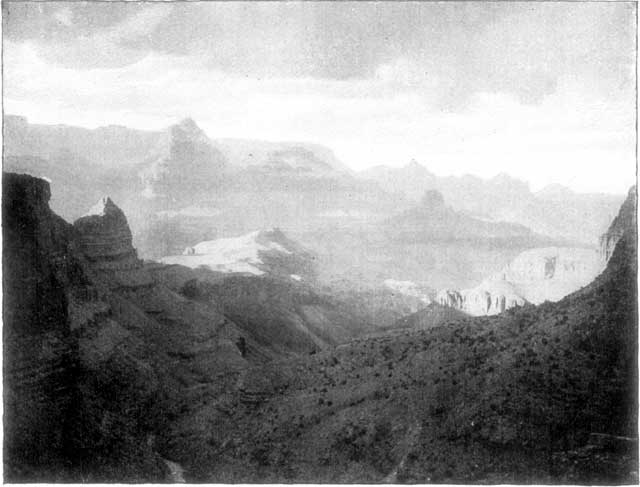
A TANGLED SKEIN OF CAÑONS.
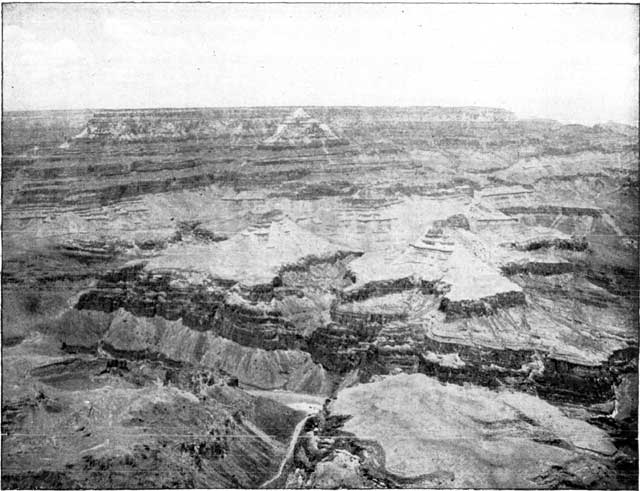
It was my memorable privilege to see, one afternoon, a thunder storm below me here. A monstrous cloud-wall, like a huge gray veil, came traveling up the Cañon, and we could watch the lightning strike the buttes and domes ten or twelve miles away, while the loud peals of thunder, broken by crags and multiplied by echoes, rolled toward us through the darkening gulf at steadily decreasing intervals. Sometimes two flashes at a time ran quivering through the air and launched their bolts upon the mountain shrines, as though their altars, having been erected for idolatrous worship, were doomed to be annihilated. Occasionally, through an opening in the clouds, the sun would suddenly light up the summit of a mountain, or flash a path of gold through a ravine; and I shall never forget the curious sensation of seeing far beneath me bright sunshine in one cañon and a violent storm in another. At last, a rainbow cast its radiant bridge across the entire space, and we beheld the tempest disappear like a troop of cavalry in a cloud of dust beneath that iridescent arch, beyond whose curving spectrum all the temples stood forth, still intact in their sublimity.
ON THE BRINK.
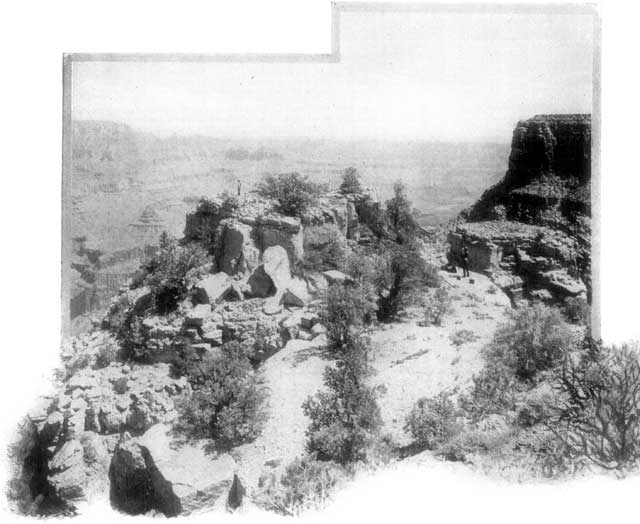
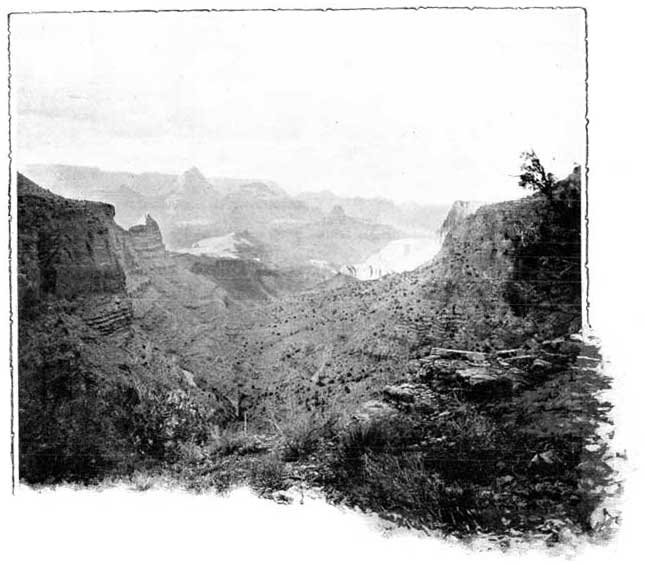
At certain points along the Cañon, promontories jut out into the abyss, like headlands which in former times projected into an ocean that has disappeared. Hence, riding along the brink, as one may do for miles, we looked repeatedly into many lateral fissures, from fifteen hundred to three thousand feet in depth. All these, however, like gigantic fingers, pointed downward to the centre of the Cañon, where, five miles away, and at a level more than six thousand feet below the brink on which we stood, extended a long, glittering trail. This, where the sunlight struck it, gleamed like an outstretched band of gold. It was the sinuous Colorado, yellow as the Tiber.
RIPLEY'S BUTTE.
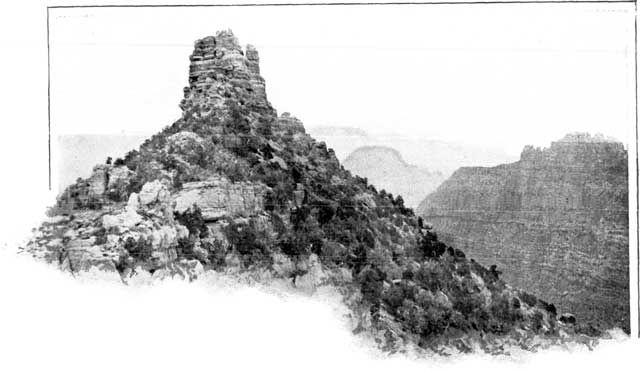
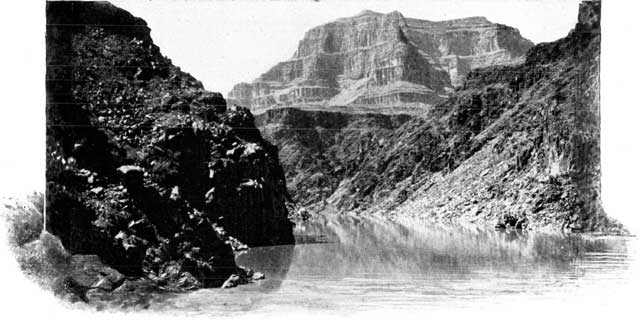
A BIT OF THE RIVER.
ON HANCE'S TRAIL.
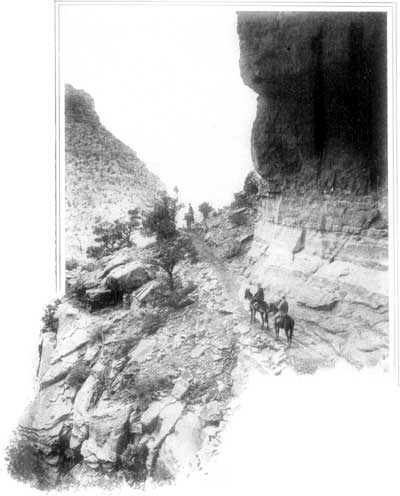
One day of our stay here was devoted to making the descent to this river. It is an undertaking compared with which the crossing of the Gemmi on a mule is child's play. Fortunately, however, the arduous trip is not absolutely necessary for an appreciation of the immensity and grandeur of the scenery. On the contrary, one gains a really better idea of these by riding along the brink, and looking down at various points on the sublime expanse. Nevertheless, a descent into the Cañon is essential for a proper estimate of its details, and one can never realize the enormity of certain cliffs and the extent of certain valleys, till he has crawled like a maimed insect at their base and looked thence upward to the narrowed sky. Yet such an investigation of the Cañon is, after all, merely like going down from a balloon into a great city to examine one of its myriad streets, since any gorge we may select for our descending path is but a tiny section of a labyrinth. That which is unique and incomparable here is the view from the brink; and when the promised hotel is built upon the border of the Cañon, visitors will be content to remain for days at their windows or on the piazzas, feasting their souls upon a scene always sublime and sometimes terrible.
A VISION OF SUBLIMITY.
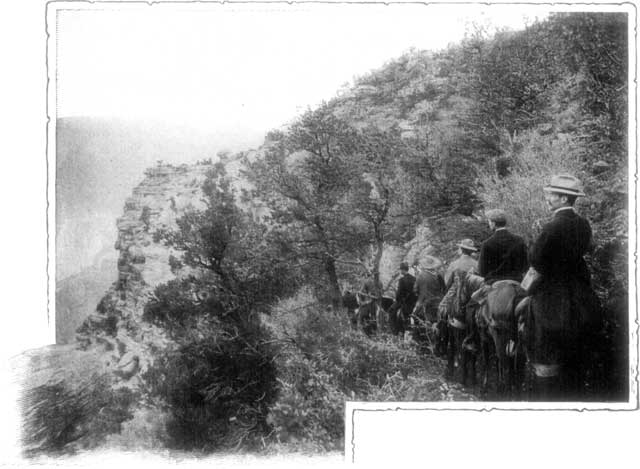
Nevertheless, desirous of exploring a specimen of these chasms (as we often select for minute examination a single painting out of an entire picture gallery) we made the descent to the Colorado by means of a crooked scratch upon a mountain side, which one might fancy had been blazed by a zigzag flash of lightning. As it requires four hours to wriggle down this path, and an equal amount of time to wriggle up, I spent the greater part of a day on what a comrade humorously styled the "quarter-deck of a mule." A square, legitimate seat in the saddle was usually impossible, so steep was the incline; and hence, when going down, I braced my feet and lay back on the haunches of the beast, and, in coming up, had to lean forward and clutch the pommel, to keep from sliding off, as a human avalanche, on the head of the next in line. In many places, however, riding was impossible, and we were compelled to scramble over the rocks on foot. The effect of hours of this exercise on muscles unaccustomed to such surprises may be imagined; yet, owing to the wonderfully restorative air of Arizona, the next day after this, the severest physical exertion I had ever known, I did not feel the slightest bad result, and was as fresh as ever. That there is an element of danger in this trip cannot be doubted. At times the little trail, on which two mules could not possibly have passed each other, skirts a precipice where the least misstep would hurl the traveler to destruction; and every turn of the zigzag path is so sharp that first the head and then the tail of the mule inevitably projects above the abyss, and wig-wags to the mule below. Moreover, though not a vestige of a parapet consoles the dizzy rider, in several places the animal simply puts its feet together and toboggans down the smooth face of a slanting rock, bringing up at the bottom with a jerk that makes the tourist see a large variety of constellations, and even causes his beast to belch forth an involuntary roar of disenchantment, or else to try to pulverize his immediate successor. In such a place as this Nature seems pitiless and cruel; and one is impressed with the reflection that a million lives might be crushed out in any section of this maze of gorges and not a feature of it would be changed. There is, however, a fascination in gambling with danger, when a desirable prize is to be gained. The stake we risk may be our lives, yet, when the chances are in our favor, we often love to match excitement against the possibility of death; and even at the end, when we are safe, a sigh sometimes escapes us, as when the curtain falls on an absorbing play.
STARTING DOWN THE TRAIL.
A YAWNING CHASM.
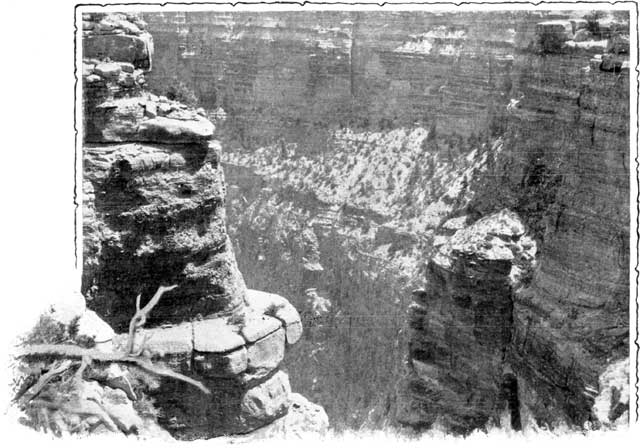
OBLIGED TO WALK.
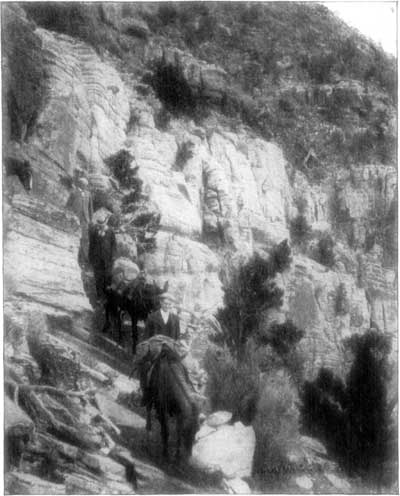
As we descended, it grew warmer, not only from the greater elevation of the sun at noon, but from the fact that in this sudden drop of six thousand feet we had passed through several zones of temperature. Snow, for example, may be covering the summits of the mountains in midwinter, while at the bottom of the Cañon are summer warmth and vernal flowers. When, after two or three hours of continuous descent, we looked back at our starting-point, it seemed incredible that we had ever stood upon the pinnacles that towered so far above us, and were apparently piercing the slowly moving clouds. The effect was that of looking up from the bottom of a gigantic well. Instinctively I asked myself if I should ever return to that distant upper world, and it gave me a memorable realization of my individual insignificance to stand in such a sunken solitude, and realize that the fissure I was exploring was only a single loop in a vast network of ravines, which, if extended in a straight line, would make a cañon seven hundred miles in length. It was with relief that we reached, at last, the terminus of the lateral ravine we had been following and at the very bottom of the Cañon rested on the bank of the Colorado. The river is a little freer here than elsewhere in its tortuous course, and for some hundred feet is less compressed by the grim granite cliffs which, usually, rise in smooth black walls hundreds of feet in almost vertical height, and for two hundred miles retain in their embrace the restless, foaming flood that has no other avenue of escape.
The navigation of this river by Major J.W. Powell, in 1869, was one of the most daring deeds of exploration ever achieved by man, and the thrilling story of his journey down the Colorado, for more than a thousand miles, and through the entire length of the Grand Cañon, is as exciting as the most sensational romance. Despite the remonstrances of friends and the warnings of friendly Indians, Major Powell, with a flotilla of four boats and nine men, started down the river, on May 24th, from Green River City, in Utah, and, on the 30th of August, had completed his stupendous task, with the loss of two boats and four men. Of the latter, one had deserted at an early date and escaped; but the remaining three, unwilling to brave any longer the terrors of the unknown Cañon, abandoned the expedition and tried to return through the desert, but were massacred by Indians. It is only when one stands beside a portion of this lonely river, and sees it shooting stealthily and swiftly from a rift in the Titanic cliffs and disappearing mysteriously between dark gates of granite, that he realizes what a heroic exploit the first navigation of this river was; for nothing had been known of its imprisoned course through this entanglement of chasms, or could be known, save by exploring it in boats, so difficult of access were, and are, the two or three points where it is possible for a human being to reach its perpendicular banks. Accordingly, when the valiant navigators sailed into these mysterious waters, they knew that there was almost every chance against the possibility of a boat's living in such a seething current, which is, at intervals, punctured with a multitude of tusk-like rocks, tortured into rapids, twisted into whirlpools, or broken by falls; while in the event of shipwreck they could hope for little save naked precipices to cling to for support. Moreover, after a heavy rain the Colorado often rises here fifty or sixty feet under the veritable cataracts of water which, for miles, stream directly down the perpendicular walls, and make of it a maddened torrent wilder than the rapids of Niagara. All honor, then, to Powell and his comrades who braved not alone the actual dangers thus described, but stood continually alert for unknown perils, which any bend in the swift, snake-like river might disclose, and which would make the gloomy groove through which they slipped a black-walled oubliette, or gate to Acheron.
A CABIN ON THE TRAIL.
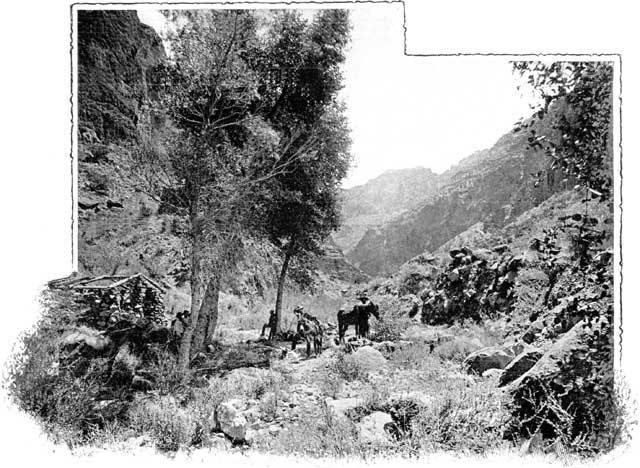
A HALT.
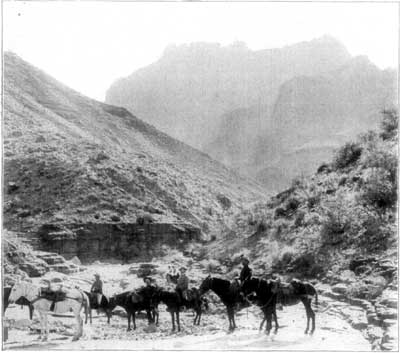
AT THE BOTTOM.
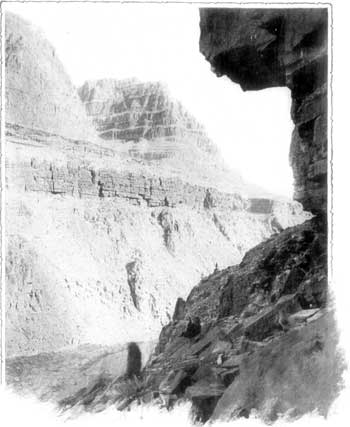
TAKING LUNCH NEAR THE RIVER.
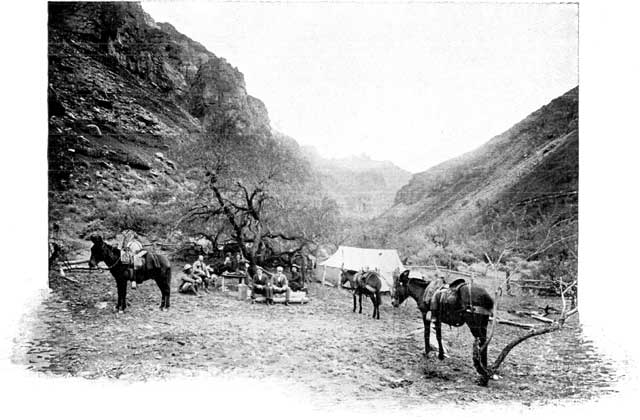
BESIDE THE COLORADO.
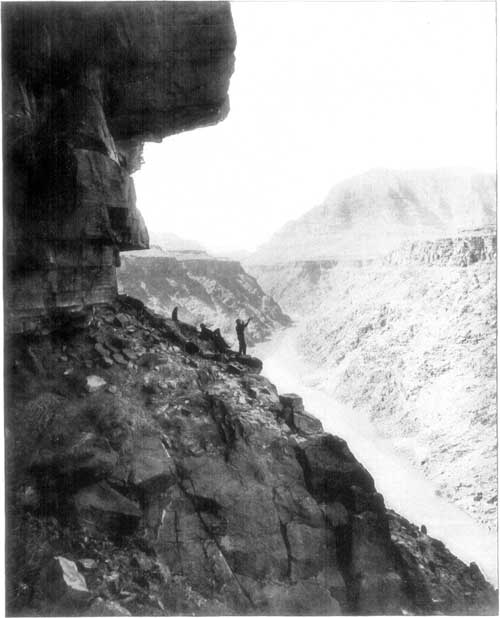
If any river in the world should be regarded with superstitious reverence, it is the Colorado, for it represents to us, albeit in a diminished form, the element that has produced the miracle of the Arizona Cañon,—water. Far back in the distant Eocene Epoch of our planet's history, the Colorado was the outlet of an inland sea which drained off toward the Pacific, as the country of northwestern Arizona rose; and the Grand Cañon illustrates, on a stupendous scale, the system of erosion which, in a lesser degree, has deeply furrowed the entire region. At first one likes to think of the excavation of this awful chasm as the result of some tremendous cataclysm of Nature; but, in reality, it has all been done by water, assisted, no doubt, by the subtler action of the winds and storms in the disintegration of the monster cliffs, which, as they slowly crumbled into dust, were carried downward by the rains, and, finally, were borne off by the omnivorous river to the sea.
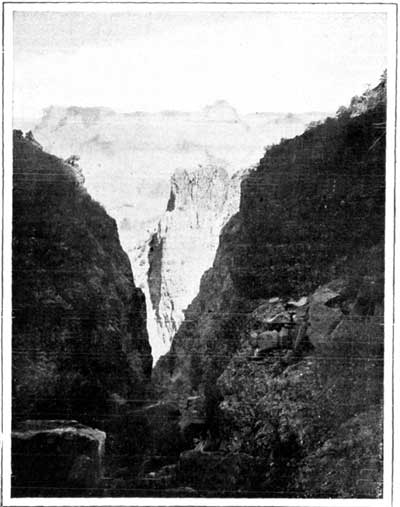
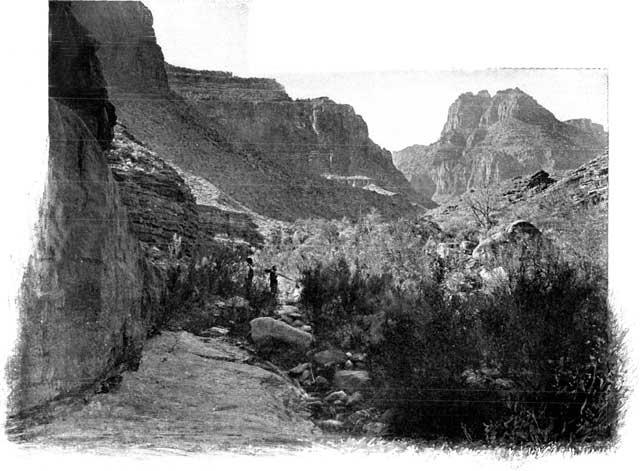
MONSTER CLIFFS, AND A NOTCH IN THE CAÑON WALL.
MILES OF INTRA-CAÑONS.
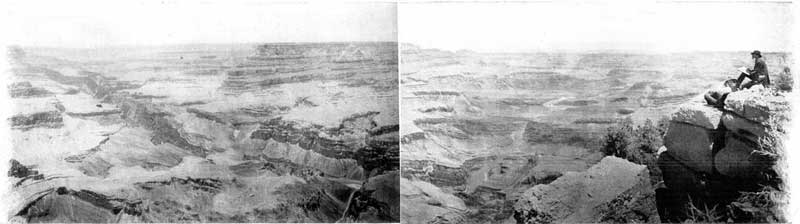
But though, at first, these agents do not seem as forceful and extraordinary as a single terrible catastrophe, the slow results thus gained are even more impressive. For what an appalling lapse of time must have been necessary to cut down and remove layers of sandstone, marble, and granite, thousands of feet in thickness; to carve the mighty shrines of Siva and of Vishnu, and to etch out these scores of interlacing cañons! To calculate it one must reckon a century for every turn of the hourglass. It is the story of a struggle maintained for ages between the solid and the fluid elements, in which at last the yielding water won a victory over adamant. It is an evidence, too, of Nature's patient methods; a triumph of the delicate over the strong, the liquid over the solid, the transitory over the enduring. At present, the softer material has been exhausted, and the rapacious river, shrunken in size, must satisfy itself by gnawing only the archaic granite which still curbs its course. Yet if this calculation overpowers us, what shall we say of the reflections awakened by the fact that all the limestone cliffs along the lofty edges of the Cañon are composed of fossils,—the skeletons of creatures that once lived here covered by an ocean, and that ten thousand feet of strata, which formerly towered above the present summits of the Cañon walls, have been eroded and swept downward to the sea! Hence, were the missing strata (all of which are found in regular sequence in the high plateaus of Utah) restored, this Cañon would be sixteen thousand feet in depth, and from its borders one could look down upon a mountain higher than Mont Blanc! To calculate the æons implied in the repeated elevations and subsidences which made this region what it is would be almost to comprehend eternity. In such a retrospect centuries crumble and disappear into the gulf of Time as pebbles into the Cañon of the Colorado.
On my last evening in the pine tree camp I left my tent and walked alone to the edge of the Grand Cañon. The night was white with the splendor of the moon. A shimmering lake of silvery vapor rolled its noiseless tide against the mountains, and laved the terraces of the Hindu shrines. The lunar radiance, falling into such profundity, was powerless to reveal the plexus of subordinate cañons, and even the temples glimmered through the upper air like wraiths of the huge forms which they reveal by day. Advancing cautiously to an isolated point upon the brink, I lay upon my face, and peered down into the spectral void. No voice of man, nor cry of bird, nor roar of beast resounded through those awful corridors of silence. Even thought had no existence in that sunken realm of chaos. I felt as if I were the sole survivor of the deluge. Only the melancholy murmur of the wind ascended from that sepulchre of centuries. It seemed the requiem for a vanished world.