"John Deane of Nottingham" (continued 6)
Reading edition
Mrs Deane and Jack heartily responded to this sentiment.
“You know Alethea, Jack? a pretty, sweet girl she is, I can assure you; though you saw so little of her, that you might not have discovered her good qualities,” continued the old gentleman.
Jack’s heart sank somewhat. He expected to hear his father give an account of the intended marriage of Alethea to Jasper. The old gentleman went on for some time enlarging on her beauty and accomplishments, and other attractive qualities.
“Your father means to say, Jack, that it has not been her fortune which has captivated your brother Jasper, for you must know that he has won her heart, and in the course of another week is to possess her hand. You have just come in time for the wedding. I am sure it will be a great pleasure to you to see Jasper made happy, as it adds greatly to our pleasure to have you back again amongst us.”
Poor Jack’s heart sank down to zero. His worst anticipations were thus realised. For some moments his head was in a whirl, and he knew not what to say. He speedily, however, recovered himself.
“I am thankful to hear of Jasper’s expected happiness,” he forced himself to say at last. He said it sincerely in one sense, for he loved his brother, and he felt that if Alethea was not to be his, he was glad that she should become Jasper’s wife.
The time passed so rapidly, that he was surprised when at length the riding-party returned just in time to get ready for dinner. His brother and sister were truly glad to see him. Alethea received him with some little embarrassment, not that she was conscious of having given him any encouragement; but she recollected how she had endeavoured to draw him into the Jacobite plot, and she fancied that she was the principal cause of separating him from his family and sending him away to sea. Polly and her intended husband, who was something in her own style, soon, by the racket they made, and the shouts of laughter in which they indulged, drove away any thing like sentiment, and set every body at their ease. Kind cousin Nat shortly made his appearance, and holding Jack at arm’s length, scanned him all over.
“I was not quite certain when I first saw you whether you were a buccaneer from the Spanish Main, or some other cavalier of fortune; but I now see that you are my own honest, good Jack, in spite of your somewhat ferocious appearance!” he exclaimed, shaking him by both hands. “You should get yourself, however, trimmed and docked, Jack, and you will be much more presentable in polite society.”
Jack had not come without a few curiosities and trinkets which had been collected on board the prizes, or taken on shore. He was thus able to bestow some acceptable presents upon the intended brides.
Again the old house in the market-place was the scene of festivity. Two couples were to pledge their faith to each other, and guests from far and near assembled to do honour to the occasion. Jack wrung Jasper’s hand.
“I wish you every happiness the world can give you!” he exclaimed, though as he spoke his voice trembled and the tears stood in his eyes.
Alethea looked more beautiful and attractive than she had ever done before, and Polly was more merry and full of life, not a bit abashed by the ceremony through which she then had to go. Jack performed his part well throughout the whole of it, and in the evening no one danced more lightly and merrily, or laughed louder than did he. At supper he sang some of his best sea-songs; and every one declared that Jack Deane was one of the finest young fellows who had appeared at Nottingham for many a long day.
Nottingham at that time could boast of some of the most agreeable society to be met out of London. It had been assigned as the residence of Marshall Tallard, the opponent of the great Duke of Marlborough at the battle of Blenheim, who was now a prisoner of war with a number of other gallant and polished French officers, who bore their captivity with resignation and cheerfulness, making themselves perfectly at home, and doing their best to amuse those among whom they lived.
Several curious traditions of their stay in the town still linger there. It was a French prisoner who first observed celery growing wild on the rock on which Nottingham Castle stands, Alainon Franchise, and having cultivated it successfully in his own little garden, he made that pleasant addition to English tables, from that time forth common every where throughout the kingdom. French rolls were also introduced from a receipt sent by the Marshall himself to a baker in Bridlesmith-gate.
It had been arranged that cousin Nat should reside with Jasper Deane, to whom he purposed giving up his practice when he should retire, which he expected to do in the course of a few years.
Jack was received in a friendly way wherever he went. The errors and wild pranks of the boy were entirely forgotten, when it was known that he had been fighting bravely for his king and country, and that he had by his own good conduct gained the rank he already held in the navy.
Jack, however, very soon got tired of leading an idle life. Routs and card-parties were not at all to his taste, and although Nottingham was not destitute of damsels possessed of a fair amount of beauty, he did not find himself attracted by any of them. He had speedily taught himself to think no more of Alethea, but in her stead another young and pretty form often rose up before him. He met with no one indeed, in his opinion, to be compared with sweet little Elizabeth Pearson, or rather, as he believed she should be called, Elise de Mertens. He made up his mind, therefore, to leave home at a short notice and hasten down to Portsmouth, where he saw in the columns of the Post-boy that a fleet was fitting out, under the brave Admiral Benbow, for the West Indies.
Chapter Twenty Eight.
Serves under Benbow in the West Indies.
It was early in March in the year 1702. As Jack Deane was approaching London, he heard a postman shouting, “Sad news! sad news!”
“What is it?” asked Jack.
“The king is dead!” was the answer. “Our good King William is no more!”
Jack, on making further inquiry, learned that the king had, on Saturday, 21st, gone out to hunt, as was his custom, near Hampton Court, when his horse fell, and he fractured his collar-bone. The injury was not considered serious, and he was conveyed to his palace at Kensington. Having been, however, in a very weak state, he did not rally, and it was evident to those around him that he was near his end. On the 8th of March one of the best and most sagacious of English monarchs breathed his last, holding the hand of the faithful Duke of Portland. His voice had gone ere that; but his reason and all his senses were entire to the last. He died with a clear and full presence of mind, and with a wonderful tranquillity.
On the accession of Queen Anne, the Jacobites remained quiet, under the belief that she would leave the crown to the son of James the Second, now known as the Chevalier Saint George. They were not aware of the sound Protestant principles of the great mass of Englishmen, and that any attempt to bring back a Romanist member of the hated House of Stuart, so often tried and found utterly unfit for ruling, would have produced another civil war. Those infatuated men, the Jacobites, did not conceal their joy at the death of the Protestant monarch. Banquets were held among them to celebrate the event, and some had the audacity and wickedness, it may be said, to toast the health of the horse which had thrown William. Another toast they drank was to the health of the little gentleman dressed in velvet, in other words, the mole that raised the hill over which Sorel (the king’s favourite horse) stumbled.
Jack Deane on hearing these things felt as if, had he been present, he should have been very much inclined to challenge those who showed this disrespect to a sovereign whom he had learned to honour and love.
The fleet had taken its departure some time before John Deane reached Portsmouth, but he found a fast frigate on the point of sailing to carry despatches to the admiral, the “Venus.” Admiral Benbow’s object in going out to the West Indies had been to detain the Spanish galleons. When war was declared on the accession of Queen Anne, a French admiral had also sailed from Brest for the same station, with fourteen sail of the line and sixteen frigates, to meet the galleons and convoy them to Cadiz. Although the brave Benbow’s squadron was far smaller than that of the French, he kept a sharp look-out for the enemy. He had performed many services in the West Indies to the merchants by capturing privateers and protecting their settlements from the attacks of the enemy.
Admiral Benbow’s ship was the “Breda,” of seventy guns, and her youngest lieutenant having died of fever, Jack Deane, greatly to his satisfaction, found himself appointed to that ship. Early in July, the admiral sailed from Jamaica, with seven sail of men-of-war, in the hope of joining Admiral Whitstone, who had been sent from England with a reinforcement to endeavour to intercept the French squadron which had sailed under Monsieur Du Casse. The admiral on the 10th of August, being off Donna Maria Bay, received advice that Du Casse had sailed for Carthagena and Portobello. He instantly went in quest of him, and in the evening of the 19th, discovered off Santa Martha ten sail of ships. On his nearer approach he found the greatest number of them to be French men-of-war. Four ships of from sixty to seventy guns, one great Dutch ship of about thirty or forty guns, and another full of soldiers, the rest being of a smaller size. They were steering along shore under their topsails. The admiral made a signal to form a line of battle ahead, and bore away under an easy sail, that those to leeward might the more readily get into their station. It was the admiral’s intention not to make the signal of battle but only of defiance, when he had got abreast of the enemy’s headmost ship. Before he reached his station, however, the “Falmouth,” which was in the rear, began to fire, as did also the “Windsor” and “Advance,” and soon after the Vice-Admiral was engaged; and now an act was performed which has rarely happened in the British Navy. After exchanging two or three broadsides, the “Windsor” and “Advance” luffed to windward out of gunshot, and left the admiral exposed to the fire of the two sternmost ships of the enemy, by whom he was very much galled. Neither did the ships in the rear come up to his assistance with the alacrity he expected. In spite of this, the brave Benbow continued to engage the enemy from four o’clock until night, and although the latter then ceased firing, yet he kept sight of them, intending to renew the action in the morning. On the following day at daybreak he found himself close to the enemy, with the “Ruby” only near enough to support him. Unintimidated by the misconduct of those who had so shamefully deserted him, he pursued the enemy, who were using every effort to escape. The “Ruby” in a short time was so dreadfully knocked about that he was obliged to order her to return to Port Royal. Two more days passed away, and still the brave old admiral kept up the pursuit. On the morning of the 24th, he got up with the sternmost ships of the French, and although receiving but little assistance from the rest of the squadron he brought them to close action. Round-shot, and chain-shot, and langrage came flying on board the “Breda,” the British seamen sending back much the same sort of missiles as those with which they were complimented. Volumes of smoke from the guns rolled out of the ports. Still undaunted, and excited by the example of their brave admiral, the British sailors fought on. At length a shot swept across the quarter-deck, on which the admiral was standing. He was seen to fall. His right leg was shattered by it. Immediately he was carried below. He urged the surgeons to dress the wound as rapidly as they could, and then being placed in his cradle, he directed himself to be brought once more on the deck. There, in spite of the agony he was suffering, he continued to give his orders. One of the last he issued was to direct the other captains to “keep the line and behave like men.” Great was his grief, vexation, and rage, when the recreant captains came on board and declared that enough had been done, and that it would be dangerous to follow the enemy. In vain the old admiral pleaded with them. They persisted that by so doing they would ensure the destruction of their ships and crews. Wounded and sick at heart he had at length to yield to them, and he issued the order for the squadron to return to Jamaica. Here the brave old admiral was carried on shore, and shortly afterwards died of the wound he had received. The captains who had refused to support him were tried by a court-martial, and two of them were carried home and shot on the decks of their ships, as soon as they arrived in an English port.
To return to John Deane. Soon after the “Breda” reached Port Royal, as she was likely to remain there for some time, and he was anxious for active employment, he got re-appointed to the “Venus,” which was sent to cruise for the protection of British commerce.
As soon as the frigate was clear of the island, a bright look-out was kept for the French privateers or any other of the enemy’s vessels. The frigate had been cruising for a week or more, and had already got some distance from Jamaica, having during the time captured several small vessels, some of which had been destroyed and others sent to Port Royal, when one forenoon a large ship was descried to leeward. All sail was crowded in chase, and as the frigate had the advantage of the wind, the stranger being almost becalmed, she soon came up with her.
As soon as the breeze reached the stranger, without hoisting her colours, she made all sail in an attempt to escape. Various opinions were offered as to her character. Some thought she was a Spanish galleon, though how she should have come thus far north was a question not easily answered. Others believed she was a large French merchantman, and some pronounced her to be a privateer. She was a fast craft, at all events, for as soon as she felt the breeze she slipped through the water at a rate which made it doubtful whether the “Venus” would come up with her. This made the English still more anxious for her capture, as, in the first place, if a merchantman, she was likely to have a rich cargo on board, and at all events she might be converted into a useful cruiser.
It was a general opinion in those days that the French vessels were faster sailers than the English, and certain it is that many of the best models of men-of-war were taken from the French. The Genoese, however, were reputed to be better ship-builders than either. A stern chase is a long chase always. The stranger persevered in her flight, in the hope that some accident might secure her escape. The English pursued in the hope that an accident to the chase might enable them to capture her.
The day wore on, and fears were entertained that the chase would escape during the darkness of the night. Every stitch of canvas which the frigate could carry was set on her, while the sails which could be reached were kept constantly wet, that no wind might pass through them. The crew cheered with glee when they found that their efforts were not without good effect, and that the frigate at last was overhauling the chase. At length she got near enough to fire a bow-chaser. The shot took effect, and cut away several of her braces. This allowed the sails to fly wildly in the air. In consequence, the frigate now came up more rapidly, and, as she did so, continued firing with good effect. The chase at length let fly all her sheets, and hauled down the French flag, which had just before been run up. As soon as the frigate hove to, Lieutenant Deane was ordered to board the prize with a boat’s crew. She proved to be a rich merchant vessel outward-bound to the French colonies on the Main, with a large and valuable assorted cargo, and was evidently a prize worth taking.
The captain of the “Venus” was ordered to send in his prizes, as he should take them, to Port Royal, but as long as he had sufficient men to fight his ship not to return himself. It was important, however, that so rich a prize should be carefully navigated, and he accordingly ordered his junior lieutenant—John Deane—to take charge of her with a crew of fifteen men, to carry her into Port Royal. Ten of her former crew volunteered to assist in navigating her, and they were allowed to remain, while the rest, with the captain and officers, were carried on board the “Venus.”
Jack now found himself for the first time in his life in command of a large ship. As may be supposed, he had not been asleep all the time he had been at sea, and he already possessed a very good knowledge of seamanship, as well as of navigation. He had no doubt, therefore, that he should be able safely to carry his prize to her destined port.
Two midshipmen were sent with him to act as lieutenants, and an old quarter-master to do the duty of boatswain. Jack was a great favourite among all with whom he had served, both with his superiors and with those beneath him. His two young midshipmen—Dick Lovatt and Ned Hawke—had become particularly-attached to him, while Will Burridge, the old quarter-master, would have gone through fire and water to serve him.
On one occasion, Burridge, whether he had had too much Jamaica rum on board or not it was difficult to say, managed to fall overboard into the harbour swarming with sharks. As the tide was running strong at the time, Burridge had already been swept some distance from the ship before he was perceived. Jack, regardless of the sharks, leaped overboard, and swimming towards the sinking seaman, kept him up, splashing about so as to make the monsters of the deep keep at a respectful distance till a boat arrived to take them both on board. Jack declared it was not a thing to be talked about, any body might have done the same, and therefore it was not mentioned at the time of its occurrence. It however raised Deane’s character among the crew, and made them all ready to volunteer in any expedition where he was to lead.
As soon as the damages which the prize had received were repaired, the frigate stood on her course, and Jack made sail for Port Royal. The prize was called the “Coquille,” and carried twelve guns, so that Jack hoped, should he be attacked by one of the enemy’s privateers, or any small man-of-war, he might make a good fight of it, and beat off his opponent if he could not take her.
The first day the weather was very fine; the wind then fell, and there was a dead calm. The sun struck down with intense heat on the deck of the vessel, making the very pitch in her seams bubble up. The crew began to feel the effects of the heat, and moved languidly about the decks, exhibiting a listlessness very different to their usual activity. Jack with one of his officers was sitting below at dinner, when Hawke, the other, who had the watch on deck, entered the cabin.
“I thought it as well to tell you, sir,” he said, “that I don’t quite like the way the Frenchmen are carrying on. I have observed them for some time past whispering together, and I cannot help thinking that they expect to find us napping, and to set on us and try to retake the vessel.”
“It’s as well to be prepared,” answered Jack. “Thank you for your forethought. But it will scarcely be right to put them in irons, unless we have evidence of their intention. I will tell Burridge, and hint to the men to be on the look-out, so that we shall be even with the Monsieurs if they make the attempt which you fancy they purpose.”
Burridge soon made his appearance in the cabin, hat in hand, and receiving his directions hurried back to speak to the English crew. Jack and his two young officers, having loaded their pistols and stuck them in their belts, and fastened on their swords, made their appearance also on deck. The Frenchmen seemed to be watching them; but if they had any sinister intentions, the preparations which Jack had made to oppose them compelled them for the moment to keep quiet.
Chapter Twenty Nine.
Hurricane—Captured by Pirates.
Jack had not had much experience with the West India climate; but he had heard enough of the signs preceding a hurricane to make him somewhat anxious about the state of the weather. Gradually a thick mist seemed to be overspreading the sky, while there was not a breath of wind sufficient to move a feather in the rigging.
“We shall have the wind down upon us presently,” he observed to Hawke. “We will clue up every thing, and strike the topgallant-masts. If the wind does not come it will be no great harm, as it will only give the Frenchmen something more to do; and if it does come, and we have all this gear aloft, it will be carried away to a certainty.”
The order was immediately issued, and the hands flew aloft to carry it out. Before, however, the canvas was all secured, a white line of foam was seen rushing towards the ship, extending on either side as far as the eye could reach. On it came, rising in height, while a loud roar burst on the ears of the crew.
“Down for your lives, men, down!” shouted Jack, as the ship, struck by the furious blast, heeled over.
Some obeyed the summons and slid down on deck in time; but others, who did not hear the order, remained aloft, many in their terror clinging to spars and shrouds, unable to move. Over heeled the stout ship. The masts like willow-wands bent, and then, snapping in two, were carried away to leeward. The lower yards dipped in the water, and most of those upon them were torn away from their grasp, while others were hurled to a distance from the ship. For a few minutes she lay helplessly on her beam-ends, then happily feeling the power of her helm, which was put up, the canvas at the same time being blown away, her head paid off, and righting herself she flew before the gale. In vain the poor wretches who had been hurled into the water shrieked for help. No human help could reach them! In a few minutes they were left far behind, while the ship, lately so trim and gallant, was hurried on, too likely to meet that destruction which overtook many other stout vessels at that time. More than half the English crew had been lost, and only one of the Frenchmen, so that their numbers were now more equal.
On flew the ship. The sea torn and thrown up by the force of the hurricane, loud-roaring billows foamed and hissed on either side, while darkness soon came on to add to the horrors of the scene.
Undaunted, Jack and his crew exerted themselves to clear away the wreck of the masts and spars. The fearful working of the ship, however, made it too probable that if not very strongly-built, she would spring a leak and go down. Every instant the seas grew higher and higher, and it was with difficulty that she could be kept before the wind. Her boats were washed away by the seas which broke on board, and though often she was in danger of being pooped by those which dashed against her stern, still she floated on.
When morning at length dawned, the hurricane began to abate. The wind ceased almost as rapidly as it had commenced; but the once stout ship, now almost a wreck, rolled heavily in the still tumbling seas. As yet little could be done to get her put to rights. She was still at a considerable distance from Jamaica, and with his diminished crew, Jack saw that it would take some time to rig jury-masts, and thus enable him to shape a proper course for Port Royal. As soon, however, as the sea went sufficiently down, and the ship became steadier, he ordered the crew to commence the work. His own men willingly obeyed; but the Frenchmen walked forward sullenly, declaring that there would be no use in exerting themselves, and positively refusing to work. While they were acting thus, Burridge brought him word that several had, by some means or other, got hold of fire-arms and hangers, and were evidently prepared for mischief.
“We must watch our opportunity, and try to disarm them,” observed John Deane. “Work they must, by some means or other, or else they must be put in irons.”
To do this, however, was no easy task, considering that there were as many Frenchmen as Englishmen, and the former were evidently desperate fellows. Hawke was fortunately able to speak French very well, and Jack directed him therefore to address the mutineers, and ask them again whether they would assist in putting the ship into order. A flat refusal was the answer, and thus the whole day was occupied. The following night was one of great anxiety, as it became necessary to keep a constant watch over the Frenchmen, lest they should suddenly attack the English and attempt to regain the ship. Jack did not allow himself a moment’s rest, but continued, with arms by his side, pacing the deck, while a constant watch was kept on the movements of the mutineers.
Dawn at length broke; and soon after the sun rose above the horizon its bright rays struck on the sails of a large vessel which was seen standing towards the “Coquille,” with a light breeze then blowing. Jack anxiously watched her through his glass, hoping, from the cut of her sails, that she might prove an English man-of-war. As she came on, he hoisted on the stump of the main-mast the English ensign reversed, the signal of distress. On the nearer approach of the stranger, however, Deane observed that the English flag was not hoisted in return, which would have been the case had she been a friend. If she had been at sea during the hurricane, she had escaped wonderfully well, for her masts and yards were as trim as if she had just come out of port. Her decks, too, seemed crowded with men. In a short time, running under the stern of the “Coquille,” she “hove to,” and a man with a speaking-trumpet hailed from her deck, demanding the name of the vessel, and where she was bound to.
“A prize to Her Majesty’s ship ‘Venus,’ and bound for Port Royal,” answered Jack.
“And very little chance you’ll have of getting there,” replied the man with the speaking-trumpet, “We will send a boat aboard you and see about the matter.”
In another minute two well-armed boats were lowered from the stranger, and soon came alongside the “Coquille.” Their crews jumped on board.
“You have been caught in the hurricane, I see,” said the man who seemed to act as the officer. “What is your cargo?”
Jack told him.
“Lucky for us, then, that you did not go down,” was the answer. “And now set to work and get the ship in order. You must understand that you are a prize to the ‘Black Hawk,’ belonging to a company of gentlemen adventurers. There’s no use grumbling: it’s the fortune of war. And now bear a hand and get your ship to rights as fast as you can. We will help you, and carry you safely into port, though not the port maybe you were bound for.”
Jack’s heart sank within him when he heard this. Resistance would be utterly useless. Even had the Frenchmen remained faithful, the pirates, for such he had little doubt they were, numbered ten to one of his own diminished crew. At first he and his young officers felt disposed to refuse to work, but Burridge, an experienced old seaman, strongly advised them to obey.
“There’s no use whatsomever, sir, to quarrel with these sort of gentry,” he observed. “They would as likely as not make a man walk the plank if they’re angry with him, and if we don’t try to please them they will probably send every one of us to be food for the sharks before another day passes over our heads.”
Jack saw the wisdom of this advice, so, putting the best face on the matter he could, he ordered his own people to commence the work he had been about to carry out when the pirate appeared. The Frenchmen were quickly made to change their tone, and the pirates, observing that they did not work with as good a will as the English, kept pricking them on, every now and then, with the points of their swords, amusing themselves greatly at the sight of the grimaces which were made in consequence of this treatment.
Poor Jack! this was the greatest trial he had ever gone through in his life. After having fully expected to enter Port Royal in triumph with a fine prize, thus to have it snatched from him by a band of rascally pirates! Still he did the best to keep up his spirits, hoping that some opportunity might occur to enable him ere long to make his escape.
“It cannot be helped,” observed Burridge, “and ‘what cannot be cured, must be endured,’ as my old woman used to say when she allowed the porridge to burn on the fire. It’s a long lane too, you know, sir, which has no turning, and though maybe these gentry will make us do a few things we shall not like, still, as long as they don’t cut our throats, we will manage some day or other to get clear of them.”
The pirates, to do them justice, were not idle themselves. A considerable number more now came on board to help get the ship into order, as it was very evident to them that she was a valuable prize. As soon as sail could be made on the ship, Jack and his officers were ordered to keep to their cabins, as he supposed, to prevent them ascertaining the direction which the ship was steering. This, so far, proved satisfactory, as it proved that the pirates had no immediate intention of taking their lives. Three days thus passed away, when from the perfectly smooth way in which the vessel glided on, Deane suspected that they were entering some harbour. The midshipmen were of the same opinion, and Hawke volunteered to try to reach the deck, to ascertain where they had got to. On going out, however, he found a sentry at the door, who ordered him back, telling him, that without the captain’s leave they would not be allowed to leave their cabin. In a short time longer, the sound of the anchor let go, and the perfect stillness of the ship, convinced Jack that he was right in his conjectures. Soon after this a person they had not before seen came to the cabin.
“Now, friends,” he said, “if you are wise men, you will enter with us and cut the service to which you have belonged. We don’t serve either king or queen, and have only ourselves to obey, while instead of handing over the profits of our labours to others we keep them for ourselves. We have a jovial life of it. No lack of adventure and excitement, and as much gold and silver as we can pick up, though, to be sure, we now and then have a little fighting for it, but that only adds to its value. What say you, lads? Will you join us?”
“Thank you for your polite offer,” answered Deane, “but we are well content with the service in which we’re engaged, and have no fancy for changing it. We, too, have plenty of fighting, and can generally scrape up as much gold as we want.”
“Enough is as good as a feast,” observed Burridge; “and I’ll tell you what, sir, with due respect to you, we would rather serve Queen Anne than King Mobb Sogg, or any other king in or out of Christendom; and though you gentlemen buccaneers are very fine fellows, we have no fancy just at present of becoming one of your number.”
“It would have been better for you if you had made up your minds to follow my advice,” answered the pirate officer; “I should have been able to set you at liberty at once and let you wander all over our island. As it is, you must be content to remain shut up on board, or maybe on shore, where we have a sort of prison which is sometimes useful.”
Jack and his companions were in no way ill-treated, except in being confined to the cabin, while an abundance of provisions were brought to them. From the noises they heard they judged that the cargo of the vessel was being taken out of her, and they hoped when that was done that some change or other might take place in their condition. They had no fancy to remain prisoners for ever, and they determined that if not released by their captors, they would endeavour if possible to escape by themselves. Burridge had been allowed to join them in the cabin. He told them he was afraid that the rest of the crew had joined the pirates, as they had all left the vessel shouting and singing, and apparently in very good-humour. He alone had refused to do so, in spite of the threats of punishment which the pirates uttered.
“I have sworn to fight for our country and for our new queen, and I intend to do so as long as there is life in me,” he observed.
In those days the bands of buccaneers which had made themselves a terror to the Spaniards had been dispersed. At the peace of Ryswick, finding that their occupation was gone, and that they would not long receive the support of the English government, many of them accepted offers of land in the plantations and became settlers. Those who were unwilling to lead a quiet life turned regular pirates, mostly hoisting black flags, with some hideous device, such as skulls and crossbones, and attacked all nations indiscriminately. Deane fully believed that he had fallen into the hands of characters of this sort, though he was surprised that they had hitherto treated him and his companions with so much leniency.
At length an officer visited them. He was a fierce-looking fellow, with his broad-brimmed hat and leather cocked on one side. A huge belt was slung across his shoulders, in which two or three brace of pistols were stuck. A hanger was by his side, with a silk coat covered with gold lace, while his face was adorned with a large moustache and a long black beard.
“Well, my hearties,” he exclaimed as he entered, “I hope you like being shut up here like dogs in a kennel! It’s a strange fancy if you do; to my mind, it would be better to have your freedom and enjoy yourselves on shore. What would you say, now, if I was to offer it you?”
“We should be obliged to you, master,” answered Jack; “for we should like to stretch our legs on shore amazingly.”
“Ah, that’s sensible!” answered the visitor; “but you must agree to my terms if you do.”
“That may alter the case,” said Jack. “Let us hear your terms though, and we may judge whether we can accept them.”
“Ah, they’re easy enough!” said their visitor. “All you have to do, is to swear to be faithful to our fraternity, and if you’re ordered to draw your sword and fight on our side, you will do it, even though our enemies should be your former friends.”
“This is only mockery!” exclaimed Jack. “If you tell us to draw our swords against our countrymen, we tell you at once, we would die rather than do so!”
“Then you must remain prisoners, and be treated as such,” answered their visitor. “However, as this craft will prove a fine cruiser, we are going to fit her out for sea, and if you don’t choose to go in her, you will have to come on shore.”
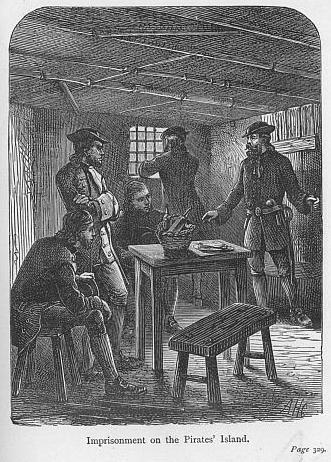
The pirate continued talking much in this way for some time, but without producing any effect upon his hearers. At last he got angry, and, slamming the door after him, went on deck. He soon returned, however, with a dozen men, whom he ordered to take charge of the four prisoners and to convey them on shore. They were accordingly marched up on deck, where for the first time Jack was enabled to examine the place into which the ship had been carried. It was a large lagoon, the entrance from the sea being so narrow that he could with difficulty make it out. Cocoanut and palm-trees thickly lined the shore, between which a few huts were seen, but no rising ground was visible, and Deane conjectured that they were on one of the quays which are to be found in the neighbourhood of Saint Domingo, and which had been the resort for many ages of pirates. The boat in which they were placed proceeded up the lagoon for some distance, when they were landed on one side of it, and surrounded by their guards and marched up away from the water. In a short time some huts of considerably larger dimensions than those they had already seen were reached, and one of them was pointed out as their future prison. It was close to the other houses, and was one of the largest in the village. Being ordered to go in, the door was closed behind them. It had, however, the advantage of a window, which, though strongly grated, gave them light and air, and enabled them to look out. It was, in other respects, a very undesirable residence, the furniture consisting of merely a couple of rough stools and a bench, with a rickety table.
“I am afraid, sir, we’ve fallen out of the frying-pan into the fire,” observed Burridge, as he surveyed the apartment. “On board we had our beds to sleep on, and decent furniture, but here we have nothing to boast of, of that sort, while I’m afraid it will be more than ever difficult for us to get away.”
It seemed but too likely that they were to be starved into compliance with the pirates’ wishes, for hour after hour passed away and no provisions were brought them. At length Burridge, who had been examining the place, expressed his belief that they might be able to work their way through the roof, and so get out.
“If they attempt to starve us, it’s a thing we must do,” he observed; “and it will be hard if we go foraging about the island and cannot find any food; and then if it’s impossible to get off, we must e’en before morning get back into our present prison, and maybe it will not be discovered that we have ever left it.”
The two midshipmen were delighted with this proposal, though Deane doubted somewhat that it would be carried out. Their only amusement was looking out of the window, which there was room for two of them to do at a time; but it was too small to allow more than that number to look out of it together. Now and then people were seen moving about, and passing at a distance from the prison; but no one came near enough for the prisoners to speak to them. Jack determined to do so if he could, however, that he might try to ascertain something more of the character of the people among whom they had fallen. He had been looking out for some time when he saw a person approaching, whom, by his dress and gay sash full of pistols, his hat with a feather, and the rich, jewelled hilt to his sword, he concluded was an officer. The man turned his face for an instant up to the window. Although his hair was somewhat grizzled and his beard bushy and long, partly concealing his face, the conviction flashed across Jack’s mind that he was no other than Master Pearson, as he called himself, with whom he had parted in the fens of Lincolnshire! The man turned away and passed on; but from his gait and manner, Deane felt still more convinced that he was not mistaken. Instantly a number of thoughts crowded into his mind. Was he there alone, or had he brought with him his wife and reputed daughter? Robber and outlaw as he might be in England, Deane still thought he was not debased enough to place them in so dangerous a position; and yet if they were not with him, where could he have left them? The one redeeming quality of the man was his devotion to his wife and the affection with which he seemed to regard the little Elizabeth.
Jack felt more than ever anxious that he might get out of prison that he might solve this question. Still, if it was Pearson, he had no wish to make himself known to him. He felt also a disinclination to mention the circumstances by which he had become acquainted with the man to his companions. He thought over and over again how he should act; but at the end of the time had arrived at no conclusion.
Chapter Thirty.
Imprisonment in the Pirates’ Island—The Lovers’ Meeting.
Notwithstanding the fears of the prisoners, the pirates seemed to have no intention of starving them, for in a short time a man came to the hut with an ample supply of cooked meat and a basket containing several bottles of wine.
“There, mates,” he said, “our captain sent you these things, and advises you to think over the matter our chief mate spoke to you about the other day. You will judge how we fare ourselves by the way we treat you.”
As there was food enough to last for some time they naturally expected they should not receive another visit during the day. As soon, therefore, as they had satisfied their hunger, Burridge continued his examination of the roof, and found, by removing the bamboo rafters, he could without difficulty force his way out through it. He proposed, therefore, as soon as it was dark, to get out and find his way down to the shore, as, in all probability, the island being but small, he could do so without difficulty. He thought then that if a boat or a small vessel could be found, they might all manage to get on board and make their escape without being discovered.
“You see,” he observed, “all is fish which comes to the nets of these gentlemen, and they will take small craft as well as large vessels. They are very likely to have captured a small schooner or sloop, and to have brought her into the harbour. They’re certain also, if they have done so, not to keep any strict watch over her, and if we ’bide our time we shall find a way of getting on board without interruption. I have heard of the doings of these gentry, and, depend upon it, some night they will be having a carouse when no one will be on the look-out.”
These remarks of the honest boatswain raised the spirits of his companions, and they determined, at all risks, to take advantage of the opportunity should it occur. The midshipmen proposed that the whole party should go together; but this Jack over-ruled, considering that should any body come to the hut and find it empty, search would be made for them, whereas by only one being absent, discovery was less likely. As soon, therefore, as it was dark Burridge made his way through the roof, and they heard him drop gently to the ground on the other side of the hut. He immediately afterwards came round to the window.
“All right, sir,” he said; “I saw the glimmer of the water when I was on the top of the hut, and I shall easily find my way to it. The pirates are carousing down by the huts on the shore, for I heard their voices singing and shouting, so I shall have a good chance of not being found out.”
Saying this Burridge glided away through the cocoanut grove by which the village was surrounded.
His companions waited anxiously for his return.
“If he is taken, I have a fancy they would not hesitate to send a pistol-bullet through his head,” said Hawke. “I wish that I could have gone with him, Mr Deane.”
“You would only have shared his fate, and so have gained nothing, and done him no good,” answered Jack. “Let us wait patiently: he has his wits about him, and he will take good care not to be caught.”
Two or three hours passed by and still Burridge did not make his appearance. His companions grew more and more anxious, both on his account and on their own. If he was taken their prospect of escape would be much lessened. In Jack’s mind also a new difficulty had arisen. Even supposing that the opportunity should occur of escaping, he could not bring himself to leave the island without ascertaining whether Dame Pearson and Elizabeth were residing on it. Before therefore he could go he must settle this point, one almost as difficult as that of escaping.
At length a voice was heard under the window.
“All right,” said Burridge, in a whisper; “I’ll tell you all about it as soon as I’m safe inside again.”
He soon made his way up to the top of the hut, and getting through the hole replaced the thatch and bamboo rafters before he jumped down to the ground.
“I was right,” he said, “and made my way down to the harbour. It is farther off though than I supposed; and I heard people moving about, so I had to be cautious; and more than all, they have two or three of those Spanish bloodhounds with them, and it’s a wonder the beasts did not find me out, and if they had come across my track they would have done so to a certainty. However I got down to the shore safe. I counted six or seven vessels in the harbour, besides two or three small ones, and several boats hauled up on the beach. So far as a craft is concerned, we have only to pick and choose. Then comes the difficulty of getting on board and finding our way out of the harbour. If we had been on deck when we came in we might have done that more easily, but to get out at night without knowing the passage will be a hard job indeed. However, it must be done by some means or other.”
It was agreed at last that they must wait for a moonlight night, when by sounding with a boat they might hope to get the vessel, in which they finally expected to make their escape, safe through the passage. It would also be necessary that the pirates should be indulging in a carouse and be off the watch, and that the wind should blow down the harbour. Every time the men who brought them their provisions came Jack sent a message to the captain, begging that they might be released, and allowed to wander at their will throughout the island. Several days had passed, however, and no answer had been returned.
Deane possessed an iron frame, but the anxiety which he endured began to tell greatly upon him, and for the first time in his life, he felt that he was becoming seriously ill. The thought occurred to him that it might be the yellow fever. Every day he grew worse and worse. His head ached, his limbs were full of pains, still he kept up his spirits as well as he could, and he and his companions continued to entertain hopes of escaping. One night Burridge returned from his usual expedition in high spirits. He had important information to give. While wandering along the shore he came suddenly upon a person seated on a rock, apparently watching the harbour as he had been. At first he felt very nervous about approaching the man, doubting who he could be. Still it struck him that it was not likely to be one of the pirates. He therefore cautiously approached him and, in a low voice, asked him who he was.
“You may suppose, sir,” said Burridge, “when he gave me the account my heart did leap with joy, when I found that he was an old shipmate—the pilot of a vessel I once sailed in! And what was more curious, he has been thinking of the same thing that we have, and hoping to make his escape in the same manner. He tells me that he has two companions on the island who are kept at work by the pirates as slaves; but that he has had an opportunity of speaking to them, and that they’re ready to help him make off with a vessel. If I had not known him, I should have been afraid of treachery; but he is a true man, and we need have no fear on that score. There will be moon enough for our purpose about five days hence, and I’ve arranged that we should all meet him at the spot where I found him at midnight at that time.”
This information raised Jack’s spirits, which had become very low in consequence of his illness. The effect, however, was only temporary, for the following day he became worse, and his companions began to fear that he would be taken from them. Their daily visitor, as it happened, remained in the hut longer than usual, and had thus an opportunity of observing how ill Deane looked. The midshipmen and Burridge also told him that they were afraid their officer would die if he had not some help.
“True enough, master,” said the man. “I will tell our captain, and perhaps he will do something for him. We have no objection to killing men in fair fight; but it is not our way to put them out of the world by clapping them into prisons, as they do in some countries.”
Saying this the man took his departure, promising to inform his captain of Deane’s state of health.
“Whatever happens to me,” said Deane to his companions, “you must endeavour to make your escape, according to the present arrangement. If you can find your way to Jamaica, you will be able to tell the authorities whereabouts this island is situated, and they will then probably send a man-of-war to bargain with the pirates for my release, or if they will not do that, to get me off by force.”
About an hour after their first visitor had left them, footsteps were heard approaching the door. It opened, and Jack, as he lifted his head from the bed of straw on which he lay in one corner, saw standing before him his old acquaintance—Pearson!
“They tell me you have fallen sick,” he said, “and want a doctor. Now I’m none myself, and there’s no one I can send here to cure you; but, as I don’t want you to suppose that we are entire barbarians, if you wish it, I will have you taken to my house, and there are some there who, maybe, will look after you and help cure you better than any doctor we can find in these parts.”
Under other circumstances, Deane would certainly have declined the offer, which would have made his escape impossible; but from the remarks made by the pirate captain, he could not help hoping that the persons he spoke of might prove to be Dame Pearson and Elizabeth. He felt, too, that even should he wish to attempt escaping, from his weakness he would be a great burden to his companions, while he would run the risk of losing his own life. He therefore replied that he was thankful for the offer made to him, and gladly accepted it. At this the captain summoned a couple of men who were waiting outside with a litter, and lifting Jack upon it, without allowing him much time to bid farewell to his companions, they carried him off. The midshipmen were greatly afraid that he would exact a promise from them not to attempt to escape. They were therefore greatly relieved when they saw him take his departure, leaving them at liberty to act as they thought best. They immediately consulted what should be done, and agreed, for his sake as well as their own, that they should endeavour to make their way to Port Royal as soon as possible, and despatch an expedition to destroy the nest of pirates.
Deane’s bearers carried him along through the cocoanut grove for some distance, when they came before a cottage far superior in appearance to any of those he had before passed. A garden in front bloomed with flowers, and a wide verandah afforded shade to the rooms within. Deane’s heart beat somewhat quicker than usual as he saw these and other signs of the presence of females.
“Here, dame, is a man who wants looking after. It will be to your and fair Bessy’s taste, and he will be grateful I doubt not. He was brought in here some time since on board a prize, and if it had not been for me, he and his companions would have been food for sharks by this time.”
Jack heard these words spoken as his bearers reached the door of the cottage. He had little difficulty in recognising the voice of Master Pearson, though perhaps had he not previously seen that individual he might not have done so. Pearson, for some reason or other, kept out of sight, and Deane found himself carried into a room and placed on a couch formed out of bamboos. The room was, however, in other respects richly furnished, with silk hangings, and gold and silver ornaments of all descriptions, quite out of character with the general appearance of the building.
“Dare, massa, you will do well,” said one of the negro bearers, with a good-natured expression of countenance. “Soon lily-white lady come look after you. I is ’Tello, you remember me, massa; I love Englishmen.”
Jack was not left long alone. Scarcely had the negroes taken their departure when he heard footsteps approaching the door. His heart beat quickly, for he fully expected to see Elizabeth Pearson, who he could not help persuading himself was an inhabitant of the island. Instead of Elizabeth, however, an old lady entered the room, followed by a black damsel. He turned his eyes towards the former, expecting to recognise the features of Dame Pearson. At first he could scarcely believe that a few years could have made so great an alteration in her, and he had to look twice before he was certain that she was the good dame who had treated him so kindly in the fens, sickness and anxiety having already worked a great change in her; yet Dame Pearson was the person who had just entered the room, of that he was sure.
“I was told that an English officer is ill, and requires aid,” she said. “I therefore desired that he might be brought here. I will feel your pulse, sir, that I may judge what remedies to apply.”
Jack was not surprised that she did not recognise him, and he thought it better not to make himself known to her at first. He felt however great disappointment at the non-appearance of Elizabeth; still, till he had told Dame Pearson who he was, he could not ask after her. From what the negro said, however, he still hoped that she might be in the house. The dame, after consulting with her attendant, retired again, saying that she would prepare such remedies as were most likely to benefit him. He thanked her, begging that they might be applied soon, for he felt so ill that, stout of heart as he was, he could not help at times believing that he should not recover.
“We will do our best for you, but the issue is in the hands of God,” answered the dame calmly. “However, in the meantime I will send my daughter that she may read to you from His Word. Thence you will obtain more comfort than man can bestow.”
Saying this she left the room. Jack’s eyes kept continually turned towards the door, and in another minute it opened, and a fair girl entered the room. She was taller, however, and of larger proportions than the little Elizabeth he had so often thought of. She carried a Bible in her hand, and taking a seat at a short distance from him, scarcely giving him more than a slight glance, opened the Book.
“You will undoubtedly draw comfort, as we have done, sir, from God’s blessed Word. I will therefore read to you from the Psalms of David, who was a man tried and afflicted.”
She commenced reading in a low, gentle voice. Jack could with difficulty refrain from making himself known, for he at once recognised that sweet voice which he had known so well. She read on for some short time, and then turned to passages in other parts of the Book which she thought calculated to bring comfort to one in sickness and distress.
Jack at length could restrain himself no longer.
“Elizabeth,” he exclaimed, “Elizabeth de Mertens! do you not know me?”
She flew to his side, and trembling took his hand which he stretched out towards her.
“Who are you?” she exclaimed. “Yes, yes, I know you, I know your voice! Jack Deane you are—yes, you must be! But oh, how did you come here? How do you know me, and that name by which you call me? I remember it well. It was my own name, though I had well-nigh forgotten it. Have you come to take me away from this dreadful place? and oh, from that dreadful man too?”
“Yes, indeed I am Jack Deane—and often have I thought of you, Elizabeth!” he answered; “and it was in consequence of the ring you gave me that I discovered your name. But sit down, and I will tell you by degrees what has occurred. If I was to give the history all at once, I have so many things to say that I should bewilder you. But I also want to learn about you—how you came here, and your adventures; for it seems strange that you have been brought out to this lonely island, to live among pirates and outlaws!”
“I am afraid you give them but their true name,” answered Elizabeth; “but let me hear about yourself, and those from whom you learnt my name.”
Jack could not speak without difficulty, but he managed, however, to give Elizabeth a brief account of himself, entering more particularly into the way in which he had discovered her parents. They were interrupted by the return of Dame Pearson and her black attendant.
“Hush!” said Elizabeth; “say nothing now: I will tell my mother when the girl is not present. I fear she is not to be trusted.”
The discovery Jack had made, instead of increasing his fever, had a beneficial effect, so it seemed, as it restored his spirits in a way that nothing else would have done. All his thoughts were now occupied in devising a scheme for carrying off Elizabeth from the island.
So completely had the fever deprived Jack of strength, that for several days he was unable to rise from his couch, although, thanks to the kind and constant attention he received, he was gradually recovering. He was especially anxious all this time to hear from his companions; but Dame Pearson could give him no information, nor could Elizabeth, although they believed that they still remained shut up in their prison.
Chapter Thirty One.
Dame Pearson’s History—Engagement between the Pirate and Queen’s Ship.
Pearson all this time had never appeared, though Elizabeth told Jack that he was still on the island. One day, however, he heard his voice raised to a high and angry pitch, very unlike the calm tone in which he used generally to speak.
“This is the sort of watch you fellows keep over your prisoners!” Pearson was exclaiming. “While you are in your drunken fits the whole island might be attacked and taken, and all our vessels cut out. You say you do not know when they got off? Then why did you not, the instant you made the discovery, put to sea in the first vessel you could get ready, and make chase after them? Go! hasten now, villains! they can scarcely be many leagues away, and are sure to be steering a course for Port Royal.”
Some grumbling remonstrances were heard in return to this address.
“Well, knaves, well, you shall sail in the sloop, and I’ll follow in the ship as soon as she can be got ready for sea,” exclaimed the pirate chief. “If you are afraid of being caught by a queen’s ship, we shall be in time to save you from hanging; why, and if not, you will only meet the fate which is certain to be yours one of these days!”
“And yours too, captain!” shouted one of the men. “Why do you bring that up before us?”
“Marry, indeed! because I have a fancy to please you. There’s this difference between us, however: you are afraid of it, and would do any sneaking thing to avoid the noose! I have no fear of that or any thing else, and so would not step out of my way to escape it. And now delay no longer, but be off with you all. I’ll be down at the harbour anon, and we’ll see how quickly we gentlemen rovers can get a ship ready for sea.”
From the conversation he had overheard, Jack thus knew that his friends had escaped. At the same time he dreaded the consequences of their being overtaken, well knowing from the temper of the pirate and his followers that, should they be captured, they would have but little chance of preserving their lives. He earnestly hoped, therefore, that they might escape safely to Port Royal. Two days after this he heard from Elizabeth that Pearson and his followers had left the island in their big ship.
“Now you may, without risk, tell my kind second-mother who you are. It will make her more ready, I doubt not, to plead for you with her husband, should such become necessary. If your friends escape him, he will probably return in a very bad humour, and be much disposed to wreak his vengeance on your head,” said Elizabeth.
Elizabeth, very naturally, took every opportunity of being with Jack alone, that she might hear more about her parents, of whom he had so much to tell, as also of his own adventures. The more he saw of her, the more he was struck by her natural refinement and intelligence, and the amount of information which she had been able to obtain. At length the secret was told to Dame Pearson. At first she would scarcely believe that Jack was the same youth she had formerly known, and she had to examine his countenance very narrowly before she would believe his and Elizabeth’s assertions. At length, however, she was convinced.
“I see no more reason to doubt,” she observed, “after all, that you should have changed from a drover to a naval officer, than that we, after living quiet lives as farmers in old England, should have become outcasts and wanderers on the earth.”
Jack had almost recovered even before Pearson left the island, but he did not wish to appear so, lest it should be the signal for his being dismissed from the cottage. Now, however, being able to leave the house, he rapidly regained his strength, and was able to walk about the island in company with Elizabeth. Those were happy days! He no longer concealed from himself that he had given her his heart, and he had good reason to suspect that he possessed hers in return. They took care in their walks to keep at a good distance from the huts; the permanent residents in the island consisting chiefly of old buccaneers and the wives and families of others away in the ships. These latter were, however, chiefly mulattoes or negresses, and it any of them caught sight of him and Elizabeth, they merely staved, taking him probably for one of the buccaneers. He passed his evenings in company with Dame Pearson and Elizabeth, reading and talking while they sat at their work. The poor lady was at first somewhat reserved, but as her confidence in Jack was established, she described to him her grief and sorrow when she discovered the course her husband purposed to pursue.
“On the discovery of the Jacobite plot, believing that he himself would be betrayed, he suddenly determined to quit England,” said the dame, continuing a narrative she had begun. “Going to a sea-port, he at first took out a licence as a privateer. That was bad enough, for his crew were bold and daring, and were constantly chasing or being chased; now and then fighting, but generally only attacking unarmed traders. Not knowing what to do with Elizabeth, and finding she was not averse to accompanying us, I had at first consented to bring her to sea, not at all aware of the life we were to lead.”
Although several prizes were thus taken, this slow mode of gaining wealth did not suit the captain or the majority of his men, and they therefore resolved to go out to the West Indies and to hoist the black flag. The plan had been kept from Dame Pearson and her daughter, but they heard of it, though they in vain urged Pearson to abandon the undertaking. He laughed at their scruples, and promised that in a few years they would make enough to enable them to retire to Virginia, or to some other plantation, and there settle down and enjoy the fruits of their enterprise.
“Why should not I do as well as Sir Henry Morgan, and fifty other fine fellows have done?” he exclaimed. “To be sure, some have lost their lives, but they were either drunkards or too audacious—but I am much too careful to be caught as they were.”
He only laughed at his wife when she pointed out to him the sinfulness of this proposed occupation, and at length told her that he had been a robber all his life, and that he had no intention of turning an honest man till he had made his fortune. This was the first intimation the poor woman had had of his career on shore, whatever might have been her suspicions on the subject. She was anxious on her own account, and still more unhappy on that of Elizabeth, when she found that nothing would turn her husband from his resolution. Still he had not lost all his former respect for her, and at length he consented to fix his abode on the island where Jack had found her. She had therefore only to wait patiently, hoping that he would soon put in execution the plan he had proposed, of finally settling down in one of the plantations. She had kept Elizabeth as much as possible in ignorance of Pearson’s character, but she had, however, at length found it out; and though looking at him with a feeling somewhat akin to horror, still she had determined not to desert, even should she have the opportunity, the kind woman who had adopted her and ever treated her as a daughter. Elizabeth herself, however, was not free from annoyances, for her youth and beauty had attracted the attention of several of the buccaneers, or, as they called themselves, “gentlemen of fortune,” and two or three of the officers, who looked upon their qualifications as superior to those of their companions, had made overtures to their chief for the hand of his supposed daughter. She, however, had rejected them with scorn, and Pearson still entertained so much respect and regard for her, that he had sworn that no man should have her against her will.
“Ah, Master Deane, you little know what quarrels have taken place about her!” said the dame, one day when Elizabeth was absent. “Three or four duels have been fought to my certain knowledge, and one young man among the gang was run through the body and killed, because he had sworn that no other than himself should be her husband. At last the captain had to declare that he would shoot the first man who killed another in any duel about her, and that, for a time, put a stop to the quarrels among them. I always thought myself that she was of gentle blood, from the account my husband gave me of the lady who placed her in his arms, and I am thankful therefore that she should not have been thrown away on any one beneath the rank of a gentleman, still more on any of these ruffian buccaneers, who, in spite of all their boasting, would very soon have broken her heart. The only wife fit for one of them, is a girl who is pleased with being covered with gold chains, and rings, and jewels, and cares nothing for her husband’s love. I know by experience how sad a thing it is for a wife to be mated to a man below her in rank, however kind and generous he may be. Such my husband has always been to me since he saved my life, but I was born and educated as a gentlewoman, and I have frequently had cause to feel a difference between us. Since my marriage I have never met with any of my family. They were all dispersed in the Civil Wars. Many of my brothers were probably killed fighting on the king’s side, and the youngest had set his heart on following the sea, which he probably did; but as our home was broken up, there was no place to which I could write to obtain tidings of them.”
Jack felt that he should be very sorry when the pleasant life he was now leading should come to an end. He spent his days in greater ease and idleness than he had enjoyed since he left home, most of the time sitting by the side of Elizabeth, or taking walks with her along the sea-shore or through the woods.
One day as he was sitting on a rock by the sea-side with Elizabeth, holding her hand in his, and talking of that happy future of which lovers delight to discourse, a white speck appeared in the horizon, which they well knew to be a sail. Gradually it increased in size. Higher and higher it rose, till the white canvas of a tall ship appeared above the long, unbroken line in the distance. The hull next came in sight, and the ship glided on rapidly towards the island. While the lovers were watching her, wondering what she could be, whether the pirate vessel or some stranger, another appeared in the same spot where she had first been seen. Gradually the sails of that one also rose upward, till the whole ship came in sight. Both of them were nearly before the wind, carrying as much canvas as they were able to bear. The first came rapidly on.
“She is bound in for the harbour,” observed Jack, “and from my recollection of the vessel which boarded us when I was made prisoner, I have no doubt that that is the same. If so, we must expect to have the pirate and his gang on shore again.”
“But what can that other vessel be?” asked Elizabeth, pointing towards the stranger.
Jack stood up to examine her, shading his eyes with his hand.
“She looks to me wonderfully like a man-of-war. It is possible that she may be in chase of the pirate. And see, here comes another vessel, her topsails are already above the horizon—and a third also! The pirates have brought a whole host of their enemies down upon them. The authorities in Jamaica have, I know, long been on the look-out to discover the head-quarters of the buccaneers. They have come for the purpose of attacking the island, and will not let a pirate escape if they can help it. Ah, see, there flies out the black flag! A daring fellow commands that vessel, and, depend upon it, he is resolved to fight it out to the last. The queen’s ship has hoisted her colours also. The object of the other is to disable her before her consorts can come up, and if he succeeds in that he hopes to get into the harbour, and there defend himself.”
The lock on which Deane and Elizabeth had taken their seat commanded not only a view of the sea, and of the entrance of the harbour, but also of a considerable part of the harbour itself. They could thus from their position watch all that was taking place.
The royal cruiser under all sail had stood in shore, to intercept the piratical vessel, which it was naturally supposed would make for the harbour, and it was important therefore to prevent her doing this. It was only, indeed, when the wind blew right in, that a vessel could enter under sail. On other occasions, it was necessary to warp or tow her in—an operation which could not be performed under the fire of an enemy. The pirate, finding that he could not get into the harbour unmolested, hauled up his courses, and boldly stood back towards the British ship, receiving her fire and returning it with interest.
Elizabeth gazed with lips apart and pale cheeks at the combatants, which now, surrounded by clouds of smoke, were rapidly exchanging broadsides.
“Oh, how dreadful!” she exclaimed. “It seems as if they must destroy each other. How many souls will thus be launched into eternity! How fearful, too, if the pirate gains the victory! for I have heard tales of the horrible way they treat those they conquer, when their blood is up in such a fight as this.”
“Little fear of that,” remarked Deane. “Our brave countrymen are not likely to give in to a set of mongrel outlaws as are these buccaneers. But mongrels as they are, they fight well, I acknowledge that! See, there goes the mast of one of the ships!”
“I can scarcely distinguish one from the other through the smoke,” said Elizabeth.
“It’s the frigate’s fore-mast, I fear,” exclaimed Deane. “She is attempting to board the pirate. But no! she has not succeeded, the other sheers off, and continues firing at a distance.”
As he spoke, the two vessels, which had for some short time been so close together as scarcely to be distinguished in the midst of the smoke, now separated, the pirate steering towards the land, while the frigate lay, with her fore-mast gone, and several spars shot away from the main-mast, while the rigging of the pirate seemed but little injured.
“How fearful!” exclaimed Elizabeth. “The pirates seem to have gained the victory.”
“Not at all,” answered Deane; “see, the red flag of England still flies triumphant, and probably, if we could see the decks of the two vessels, we should find that the pirate has been the greater sufferer. His object was to cripple his antagonist, and he has done so successfully, while the wish of the English captain has been to destroy the pirates.”
Although the pirate was so standing that only her after-guns could be brought to bear on the frigate, she continued firing with them, in return for a shot which the latter sent after her. She now stood directly in for the mouth of the harbour, and as she approached close to it her sails were quickly furled, and several boats went out to her, to assist in getting her in, while her own boats were lowered for the same purpose.
Chapter Thirty Two.
The Island Captured.
“The game is not over yet,” observed Deane, who with Elizabeth still stood on the rock watching the progress of the fight. “The crew of the frigate are busily employed in repairing damages. As soon as that is done, and the other two ships come up, depend upon it, they will attack the island, and, with the strong force the English will then have, the pirates will be utterly unable to resist them.”
“Alas! alas! I wish we could have escaped from the island before this had occurred! I tremble for the fate of my poor mother, for such I must still call her—and what will become of Master Pearson? for, as far as I can judge, he seems to be the head of the whole community.”
“For the kindness with which he has ever treated you, if he escapes with his life from the battle, I will use all my influence to protect him,” answered Deane. “At the same time, I think it likely he will fight to the last. He seems a man who would not yield, as long as a hope of success remains.”
“Let me go then and tell my poor mother of what has occurred, and prepare her for the worst,” exclaimed Elizabeth.
“Oh, no! stay here, let me entreat you!” he answered. “You will be safer on this rock, and I may possibly be able to make some signal to the boats as they come in, and thus you will escape the desperate struggle which is likely to take place when the crews land and attack the pirates. Or stay! if you can persuade Mistress Pearson to come here, she will be safer than in her own house. But you must not go alone: I will accompany you, and try and bring her back.”
To this plan Elizabeth willingly agreed, and she and Deane immediately hurried forward towards the village. The alarm of the poor lady was very great when she heard what was likely to occur, but she positively refused to quit the house.
“Go, go!” she replied to Elizabeth’s entreaties. “Leave me to my fate: Mr Deane will protect you better than I can, and you are not bound either to that unhappy man my husband or to me.”
Deane had now some difficulty in persuading Elizabeth to return with him, for she was unwilling to leave poor Mistress Pearson to the danger to which she would be exposed should the village be stormed, as it was too likely to be. At length, however, she yielded to her and Jack’s united entreaties, and returned to the rock with Deane. By the time they reached it, the other English vessels had almost come up with their crippled consort, and a considerable flotilla of boats was seen collecting round them. The pirates meantime, having warped their vessel into the harbour, had placed her across its mouth, so that her guns pointed directly down towards an enemy approaching in that direction. A considerable number of the people were also engaged on shore in throwing up breastworks at various points likely to be assailed. Guns were being brought down from the stores and from the other vessels up the harbour, and every effort was being made which desperate men could think of to defend the place. The English seemed to guess what the pirates were about by the rapidity of their movements, for not a moment was lost after the vessels had met, before the boats began to pull at a rapid rate towards the mouth of the harbour. There were twelve boats in all, carrying a considerable body of men. The ships at the same time stood in as close as they could venture, to cover the attack with their guns.
Between the rock on which Deane and Elizabeth stood, was a sandy bay, affording tolerably safe landing. This spot the pirates seemed to have overlooked, though the English were evidently aware of it, for while one party of boats pulled towards the mouth of the harbour, another, suddenly leaving the main body, made a dash towards the bay, for the purpose of landing before the pirates discovered it and were prepared to resist them. On came five boats at a rapid rate, the water foaming at their bows, as their crews urged them through it. Deane could with difficulty resist the temptation of hurrying forward to meet them, but he could not leave Elizabeth, nor could he place her in the danger to which she would be exposed had he carried her with him. As soon as the ships came close enough they opened their fire at the hastily thrown up forts at the harbour’s mouth, while the flotilla of boats dashed forward for the purpose of storming them before the enemy had recovered from the effects of the cannonading. The pirates, however, had been too long accustomed to desperate fighting of all sorts to be easily daunted, and the places of those who fell were quickly supplied by others who rushed forward to work their guns. Before, however, they could load and fire them, the boats’ crews, springing on shore, rushed forward and attacked them, hanger in hand, and quickly mastered the fort.
The pirate ship now opened her fire upon the boats advancing up the harbour. This told with great effect, and again and again they were struck, but still undaunted, they pulled on. Meantime the other boats had reached the bay, and their crews also quickly threw themselves on shore. The pirates did not perceive their intention till it was too late to prevent them, and now in steady order they were soon advancing up from the shore towards the fort, which was also greatly annoying the boats in their advance. Taken in the rear, its defenders were quickly cut down, and now the party of English blue-jackets rushed up towards the pirate ship, but some of her guns being directed at them and others at the boats, no great loss was sustained by either. So quickly indeed did the party advance, that very few shot took effect among them. At length they got close up to the ship and opened a hot fire of musketry upon her killing and wounding the men at her guns. The boats were thus able to advance with much less molestation than before, and getting alongside, their crews with loud shouts dashed on board. The pirates fought desperately, but nothing could resist the courage of the English. The outlaws were seen jumping overboard on either side, and many were shot while attempting to swim on shore. No quarter was asked for by them. They had seldom given it themselves. Still, however, they exhibited great courage and hardihood, fighting desperately to the last. Meantime a party of them who had remained on shore, manning several boats, put off to the rescue of their comrades. Thus before the English could prevent them, a considerable number had managed to escape from the ship, taking their way to a point up the harbour where they could land without being molested.
The men-of-war’s boats had been left with their boatkeepers in the bay. As soon as Deane saw that he could reach them without running the risk of encountering the pirates, he determined to place Elizabeth on board them.
“If we stay here, we shall very probably fall in with the buccaneers, who are likely to fly to this rock in the hope of defending themselves. Our way is now clear to the boats, and I will carry you there,” he said, taking Elizabeth’s arm.
“Whatever you think best I am ready to do,” she answered; and they hurried towards the bay.
Fortunately, the officer in charge of the boats belonged to Deane’s own ship, and recognising him, at once received Elizabeth on board.
“Now I have placed you in safety, I will go back and endeavour to protect our kind friend Mistress Pearson,” he said.
Elizabeth thanked him warmly, though she evidently at the same time dreaded losing sight of him. Deane well knew there was no time to be lost, for the sound of the firing and the shouts and cries of the combatants told him that they were approaching the village. He hurried back therefore, taking a sheltered way among the trees. He had just reached the house, when he saw a number of buccaneers rushing towards the village, with the intention, he judged, of attempting to defend themselves behind the walls of the buildings. He found Mistress Pearson standing pale with terror at the sound of the guns which had reached her ears, not knowing which party had been successful. Deane once more entreated her to fly.
“If you remain, you will too probably lose your life in the struggle,” he said.
Scarcely waiting for her answer, he had drawn her to the door, when he was seen by some of the pirates.
“Down with the villain! down with the traitor who has brought the enemy upon us!” they shouted.
They raised their muskets, but Mistress Pearson standing between them and Deane, prevented them from firing. Some of the fiercest were, however, rushing forward with the intention of cutting him down, when the cry arose, “The enemy are upon us! defend yourselves, lads!” and they had to face about to receive the charge of the British sailors, who dashed out from among the trees towards them. Several bullets whistled by Deane’s and the poor dame’s ears. The fighting was desperate. The pirates defended themselves, knowing that they should receive no quarter; but in spite of their bravery they were cut down on all sides. Deane had two or three times amid the clouds of smoke caught sight of Pearson, who was leading on the men, shouting to them to fight boldly. More seamen arriving, led on by a superior officer, the pirates at length began to retreat. As they reached the house of their chief, however, they made a stand, some threw themselves inside and began to fire through the windows, and others got behind the walls where they were sheltered from the fire of their enemies. Deane attempted to carry poor Dame Pearson to a place of shelter. Paralysed with fear, she could scarcely move. He found himself, therefore, surrounded by the combatants, and in great risk every instant of being shot.
The pirates here made a desperate stand; but the British seamen, again rushing on, cut down numbers with their hangers. Just then the house burst out into flames, and, surrounded by smoke, Deane could not be distinguished from the pirates who stood on the other side of him. Two or three seamen were on the point of cutting him down, when their officer interposed his sword.
“Hold, lads!” he shouted; “as I live, there is my friend John Deane, and protecting a lady too!”
This timely exclamation saved Deane’s life. He had no time, however, to exchange greetings with the officer, whom he recognised as the captain of his own ship, as the latter had to lead on his men in pursuit of the flying pirates. The good dame now entreated him to look for her husband; but he remembered that after the commencement of the fight he had nowhere seen him. What had become of him he could not tell, and all he could do was to assure her he had not seen him fall. Jack was anxious to convey her to the boats that she might be carried on board and placed in safety; but just as he was leaving the village Captain Davis returned, saying that all the pirates to be found had been killed or made prisoners.
“I am thankful, indeed, to hear it, Captain Davis,” said Deane. “And now I will ask you to assist me in conveying this lady on board.”
“Captain Davis!” exclaimed Mistress Pearson. “Let me see you, sir. That was my maiden name; and I had a brother who went to sea, from whom I have been parted for many long years. Can you be Richard Davis, the youngest son of Colonel Davis of Knowle Park?”
“Yes, indeed, I am, madame,” answered the Captain, coming up to her. “I was one of a numerous family, all of whom, to the best of my belief, have long since been dead.”
“One of them is still alive,” answered Mistress Pearson, “though a most unhappy woman. Do you not remember your sister Maria? Come, let me gaze on your countenance, for my heart tells me that in you I shall find one of my brothers. Yes, yes, I recognise your features! though I scarcely could expect you to know mine, so sadly changed as they must be.”
She had taken the captain’s hand, and gazed into his face as she spoke.
“No, I should not remember you,” he answered; “but yet I remember the voice of the kind sister who was always ready to suffer for the sake of her wild brothers. Yes, Maria, I know that you are my sister, and I am thankful that I have been the means of rescuing you from this place. How you came here you must tell me by and by. And now I would wish you to go at once on board the frigate, under the charge of Mr Deane, while we make a further search round the island for any fugitives who may have concealed themselves.”
Mistress Pearson trembled as her brother spoke these words.
“There is one for whom I would intercede,” she said. “Mr Deane will tell you about him. He has ever been a kind husband to me, and never till lately did I suspect his occupations. If he has escaped death, let me entreat you not to hunt him down, and I feel sure that he will turn to some nobler course, where he will redeem the crimes he has committed.”
Captain Davis very wisely made no answer to this appeal; but directed Deane, with a party of the seamen as a guard, to convey his new-found sister down to the boats, and to place her at once on board the frigate. He, meantime, having collected his men, commenced a further search for the pirates, some of whom, he was convinced, must have concealed themselves. The day was thus spent, though with no further success, and as night was coming on, a large party being placed on board the captured ships, the remainder returned in the boats to the vessels outside. The next day the search was continued; but no signs were discovered of the chief and other officers and men who were supposed to have escaped with him. The numerous prizes were carried out of the harbour, while all the huts, and storehouses, and other buildings were set on fire and destroyed, so that in a short time the whole island was reduced to that state of desolation in which the pirates had found it.
While the rest of the squadron returned to Jamaica, one vessel was left to cruise off the island, on the chance of Pearson and his followers, should they have been concealed on it, attempting to make their escape. When Jack arrived on board the “Venus,” he found the two young midshipmen, Hawke and Lovatt, and the old quarter-master Burridge, who welcomed him warmly. They told him that they had managed to make their escape exactly as they had proposed while the buccaneers were carousing; and had, fortunately, fallen in with the squadron which had been despatched on purpose to try and discover their haunts.
Chapter Thirty Three.
Sir George Hooke takes the Spanish Galleons in Vigo Bay.
Elizabeth’s joy at seeing Mistress Pearson was very great; and she did her utmost to comfort her in her affliction, aided by Captain Davis and Deane. As soon as they arrived at Port Royal, Captain Davis took a house for her on shore, where she and Elizabeth went to reside till a plan for their future proceedings could be arranged. Deane immediately wrote to Monsieur de Mertens, and told him of his recovery of his daughter, saying that she was still with her kind guardian, in whose company he hoped that he should, without delay, be able to escort her to England.
In those days the climate of the West Indies was as dangerous to Europeans as at the present, and ships seldom remained long on the station without losing many of their officers and men. The honest old Admiral Benbow was still alive, although rapidly sinking from the effects of his wounds and his annoyance at the conduct of his officers in the action with the French. Hearing of Jack’s conduct, he appointed him second lieutenant of the “Ruby,” in the place of an officer who had died. He was sorry to leave Captain Davis, especially as he expected now to have fewer opportunities of meeting Elizabeth. He had, however, the consolation to know that Captain Davis expected immediately to be sent home, and proposed taking his sister and Elizabeth with him. John Deane met with no adventures worth recording during his next cruise.
On the return of the “Ruby” to Port Royal, our hero found that the “Venus” had already sailed, and his ship was shortly afterwards also ordered home. On reaching England, he was immediately appointed to the “Lennox,” of seventy guns, commanded by his old friend Captain Jumper. She formed one of the squadron under Admiral Sir George Rooke just on the point of sailing for the coast of Spain. Being unable to obtain leave of absence, he wrote to Nottingham and Norwich; but before he received answers to his letters his ship put to sea. Sir George Rooke had his flag flying on board the “Royal Sovereign.”