Part 3 — PART III.
Reading edition
I travelled then west by Falkirk, by the foot of the great hills; and one night after I had got lodging in a farmer’s house, there happened a contest between the goodman and his mother, he being a young man unmarried, as I understood, and formerly their sowens had been too thin; so the goodman, being a sworn birly-man of that barony, came to survey the sowens before they went on the fire, and actually swore they were o’er thin; and she swore by her conscience they would be thick enough, if ill hands and ill een bade awa frae them. A sweet be here, mither, said he, do you think that I’m a witch? Witch here, or witch there, said the wife, swearing by her saul, and that was nae banning, she said, they’ll be gude substantial meat;—a what say you chapman? Indeed, goodwife, said I, sowens are but saft meat at the best, but, if you make them thick enough, and put a good lump of butter in them, they’ll do very well for a supper. I trow sae lad, said she, ye ha’e some sense: so the old woman put on the pot with her sowens, and went to milk the cows, leaving me to steer; the goodman, her son, as soon as she went out, took a great cogful of water, and put it into the pot amongst the sowens, and then went out of the house and left me alone: I considering what sort of a pish-the-bed supper I was to get if I staid there, thought it fit to set out, but takes up a pitcher of water, and fills up the pot until it was running over, and then takes up my pack, and comes about a mile farther that night, leaving the honest woman and her son to sup their watery witched sowens at their own pleasure.
The next little town I came to, and the very first house that I entered, the wife cried out, ‘Plague on your snout, sir, ye filthy blackguard chapman-like b——h it ye are, the last time ye came here ye gart our Sandy burn the gude bane kame it I gid a saxpence for in Fa’kirk, ay did ye, ay, sae did ye een, and said ye wad gie him a muckle clear button to do it.’ Me, said I, I never had ado with you a’ the days of my life, and do not say that Sandy is mine. A wae worth the body, am I saying ye had ado wi’ me, I wadna hae ado wi’ the like o’ you, nor I am sure wi’ them I never saw. But what about the button and the bane kame, goodwife? Sannock is na this the man? Ay is’t, cried the boy, gie me my button, for I burnt the kame, and she paid me for’t. Gae awa, sir, said I, your mother and you are but mocking me. It was either you or ane like you, or some other body. O goodwife, I mind who it is now; ’twas just ane like me, when ye see the tane ye see the tither; they ca’ him Jock Jimbither. A wae worth him, quoth the wife, if I dinna thrapple him for my gude bane kame. Now, said I, goodwife, be good, bridle your passion, and buy a bane kame and coloured napkin, I’ll gie you a whaukin’ penny-worth, will gar you sing in your bed, if I should sell you the tae half and gift you the tither, and gar you pay for every inch o’t sweetly or a’ be done. Hech, man, said she, ye’re a hearty fallow, and I hae need o’ a’ these things, but a bane kame I maun hae; for our Sannock’s head is a’ hotchen, and our John’s is little better, for an’ let them alane but ae eight days, they grow as grit as grossets. And here I sold a bane kame and a napkin, for she believed such a douse lad as I had no hand in making the boy burn the bone comb.
The next house I came into, there was a very little tailor sitting on a table, like a t—d on a trencher, with his legs plet over other, made me imagine he was a sucking three-footed tailor; first I sold him a thimble, and then he wanted needles which I showed him, one paper after another; he looked their eyes and trying their nibs in his sleeve, dropt the ones he thought proper on the ground between his feet, where he sat in a dark corner near the fire, thinking I did not perceive him. O said he them needles of yours are not good, man, I’ll not buy any of them. I do not think you need, said I, taking them out of his hand, and lights a candle that was standing near by; come, said I, sit about, you thieving dog, till I gather up my needles, then gathers up ten of them.
Come, said he, I’ll buy twa penny worth of them frae ye, I hae troubled you sae muckle; no, said I, you lousied dog, I’ll sell you none, if there’s any on the ground, seek them up and stap them in a beast’s a—se; but if ye were a man, I would burn you in the fire, though it be in your own house; but as you are a poor tailor, and neither a man nor a boy, I’ll do nothing but expose you for what you are. O dear honest chapman, cried his wife, ye maunna do that, and I’se gie you cheese and bread. No, no, you thieves, I’m for nothing but vengeance; no bribes for such. So as I was lifting up my pack, there was a pretty black cat which I spread my napkin over, took the four corners in my hand, carrying her as a bundle, until I came about the middle of the town, then provoking the dogs to an engagement with me, so that there came upon me four or five collies, then I threw the poor tailor’s cat in the midst of them, and a terrible battle ensued for some time, and baudrins had certainly died in the field, had I not interposed and got her off mortally wounded. The people who saw the battle alarmed the tailor, and he sallied out like a great champion, with his elwand in his hand. Go back, said I, you lousie dog, or I’ll tell about the needles; at which word he turned about. I travelled down the side of a water called Avon; and as I was coming past a mill-dam, there was a big clownish fellow lifting a pitcher of water out of the dam, so he dipt it full and set it down on the ground, staring at me he rumbled in himself out of sight o’er head and ears, and as soon as he got out, I said,—Yo ho, friend, did you get the fish? What an a fish, ye b——h? O, said I, I thought you had seen a fish, when you jumped in to make it jump out. What a d——l, sir, are you mocking me?—runs round his pitcher, and gives me a kick on the a—e, so that I fell designedly on his pitcher, and it tumbled down the bank and went in pieces: his master and another man looking and laughing at us, the poor fellow complained of me to him, but got no satisfaction.
The same evening as I was going towards the town of Linlithgow, I met an old crabbed fellow riding upon an old glaid mare, which he always was thrashing upon with his stick. Goode’en to you, goodman, said I, are you going to the bull wi’ your mare? What do you say sir? they gang to the bull wi’ a cow, you brute. O yes, goodman, you are right, said I; but what do they ca’ the he-beast that rides on the mare’s back? They ca’d a cusser, sir: a well then, goode’en to you, master cusser. He rides a little bit, then turns back in a rage, saying, I say, sir, your last words are waur than your first: he comes then to ride me down, but I struck his beast on the face, and in a short turn about it fell, yet, or I could get my pack to the ground, he cut me on the head at the first stroke; I then getting clear of the pack, played it away for some time, till by blows on the face, I made him bleed at both mouth and nose; then he cried out, Chapman, we are baith daft, for we’ll kill oursells and mak naething o’t; we had better ’gree: with all my heart, said I; and what will you buy? nothing but a pair of beard shears, said he, and give me them cheap; so I sold him a pair of B. shears, for three half-pence, and give him a needle, then parted good friends after the battle was over.
So I went to Linlithgow that night, where I met with Drouthy Tom, my sweet and dear companion, and here we held a most terrible encounter with the tippenny for twa nights and a day; and then we set out for Fife, on the hair order, by the way of Torryburn and Culross; and came up to a parcel of women washing by a water-side, I buys one of their hair: the time I was cutting it off, Tom fell a courting and kissing and clapping one of them, what happened I know not, but she cried out, Ye mislear’d filthy fallow, ye put your hand atween my feet. Daft jade, canna ye haud your tongue when it’s your ain shame that ye speak. Filthy body, the last chapman that kissed me had a horse pack, but he’ll hae naething in his Pack but auld breeks, hare skins, mauken skins, or ony trash that fills the bag and bears bouk, and yet he wad kiss and handle me! I was made for a better fallow.
FINIS.
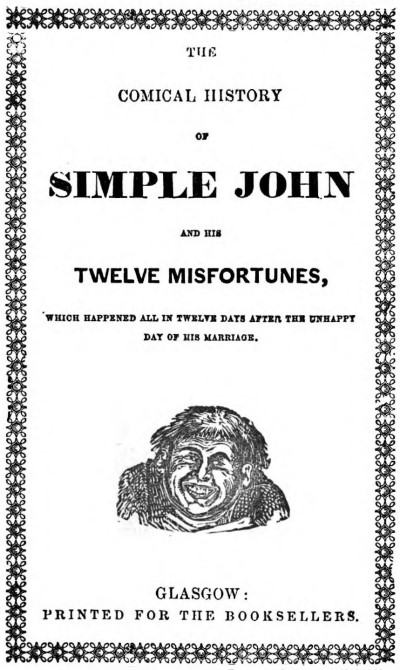
THE
COMICAL HISTORY
OF
SIMPLE JOHN
AND HIS
TWELVE MISFORTUNES,
WHICH HAPPENED ALL IN TWELVE DAYS AFTER THE UNHAPPY DAY OF HIS MARRIAGE.
GLASGOW:
PRINTED FOR THE BOOKSELLERS.