A NOBLE DEATH. (continued 2)
Reading edition
Mr. Grady, as the representative of what people are pleased to call the “New South,” but which is the “Old South” rehabilitated, was, in the providence of God, calculated to do for his country what Hill, Gordon and other brilliant lights of the old régime could never have compassed. As David, “the man of war,” was not permitted to build the temple, but that glory was reserved for Solomon, so Grady, the exponent of present principles, was permitted to gather the fragments and broken columns of the South’s ruined fortunes and begin the erection of a temple of prosperity so grand in proportion, so symmetrical in outline, as to attract, in its incomplete state, the admiration of the world.
In the extremity of our grief we are apt to magnify our loss, but this, indeed, seems irreparable, and we can take no comfort in the assurance of the philosopher who codified the experience of the past into the assurance that great ability is always found equal to the demand. On whom will Grady’s mantle fall? There really seems to be none worthy to wear what he so easily graced. And every Southern heart weighed down with a sense of its woe cannot but ask,
O death, why arm with cruelty thy power
To spare the idle weed yet lop the flower?
553
STILLED IS THE ELOQUENT TONGUE.
From the “Brunswick Times.”
Henry W. Grady is dead!
Hushed forever is the voice of the South’s most wonderful orator!
With the laurel upon his brow, with the plaudits of a nation ringing in his ears, with the love of his people freshly spoken, with a crown of glory about him, the matchless defender of the South has passed from earth, and beyond the silence of the stars his soul dwells in the companionship of the great who have gone before.
With his sorrow fresh upon the South, this death and loss following so closely upon that other in New Orleans but a few days ago, the heart is not in keeping with the brain, and not now can the pen dipped only in tears write.
Henry Grady had not reached the zenith of his fame, for the circle was widening for him and there were still brighter flowers for him to pluck, and in her hand Honor held out still richer prizes. But the mystery of death is upon him, and from his hand has dropped the forceful, graceful pen, and in silence and peace he sleeps for the grave.
With a superb intellect, with an eloquence rivalling the golden-tonged Chrysostom, with a love almost unapproached by any other for the South and her people, he stood peerless and matchless as his land’s defender and leader in all that made for her peace, prosperity and happiness.
But his sun has set. It matters not that in all brightness it went down; it matters not that he died full of honors; about that grave a people will gather with tears fast flowing and hearts crushed and bleeding. It is hard to give up one so grand of mind, so wonderful of tongue, so magnetic of personality, so richly endowed in all that equips the great leader.
554And such was Henry W. Grady.
Atlanta will mourn him, Georgia will weep for him, and the South will sorrow indeed.
Upon his bier the Times lays this tribute and stands reverent and uncovered by the grave of Georgia’s most brilliant son.
A SHINING CAREER.
From the “Macon Telegraph.”
Henry Grady is dead. This announcement carried sorrow all over Georgia yesterday, for there were few men in whom the people of this State felt so much interest or for whom they cherished such a warm affection as they did for this gifted and lovable man. He had not attained his thirty-ninth year when “God’s finger touched him” and closed his remarkable career, but his name was familiar from one limit of this Union to the other. Georgia had no more famous citizen, and perhaps there never was a man in this State in private station who was so widely known or so much admired. Mr. Grady never held a public office, and yet he was a recognized force in Georgia politics almost before he had reached the years of statutory manhood. He devoted his life to journalism, and in his chosen field achieved a national fame. He began his career as a boy editor in Rome, and at an age when most men are merely selecting their standards and shaping themselves for the real work of life, he became a prominent and influential figure, a leader of thought, and a promoter of public enterprises. Eighteen years ago he moved to Atlanta to pursue his profession in a broader field, and immediately made himself felt as a positive force in the community. The debt which Atlanta owes him is great indeed. No man did more to inspire the pride of community, to set on foot and carry to success great enterprises for the welfare and progress of the city, to rally its people to an enthusiastic unanimity on all 555questions affecting local prosperity than did Henry W. Grady. These public services would have endeared him to the people of his adopted city, but they were not so admirable as his private benefactions. He was first and foremost in many good works, the fame of which never went beyond the homes of the poor and unfortunate who were relieved by his ministrations. His hand was open always to the stricken and needy. He gave to the afflicted with a generosity which was oblivious to his own circumstances. Of his influence in promoting public enterprises there are enduring monuments. By his eloquence of tongue and pen he raised in less than two weeks $85,000 for the erection of the beautiful Young Men’s Christian Association building which now adorns one of the principal streets of Atlanta. He was the moving spirit in the building of the Chamber of Commerce and the enlargement of its membership until it reached proportions that made it a power not only in matters of business but in all the public concerns of the city. The Confederate Soldiers’ Home of Georgia is a monument to him, for he seized mere suggestions and made them the text of an appeal which stirred the hearts of the people of Georgia and evoked a long delayed tribute of gratitude to the broken veterans of the lost cause. The Cotton Exposition of 1880 and the Piedmont Expositions of 1887 and 1889, from which Atlanta reaped immense benefits, were largely due to his persistent labors.
While Mr. Grady became prominent in Atlanta, and justly esteemed by his fellow-citizens on account of works and triumphs like these, he rose into national prominence by reason of other evidences of his genius. His address to the New England Society in New York in December, 1886, was one of the most famous occasional speeches ever delivered in this country. The morning after its delivery he literally awoke to find himself famous throughout the country. Since that time he made various public addresses which commanded the attention of the United States and became subjects of common conversation among the people. His speech at the Dallas Exposition last year and his 556address to the legislatures of Georgia and South Carolina at the Augusta Exposition a few weeks later, were themes of the public press of the entire country. But the best and ablest public speech of his life was his last. It was that which he delivered two weeks ago at Boston in the performance of a mission which proved fatal to him. In this, as in all his famous public addresses, he seemed to strive with a passionate ardor and a most persuasive eloquence to bring the North and the South to a better understanding of each other, to foster the spirit of mutual respect and mutual forbearance, to inculcate the great idea that this is a re-united country and that the duty of every good citizen in its every section is to strive for its domestic peace, for its moral, social and material progress, and for its glory among the nations of the earth. He handled these great themes with a master hand and invested his exposition of them with a most fascinating eloquence. Few men in Georgia ever accomplished so much in so few years. Few men in Georgia were even the object of such affection at home and such admiration beyond the bounds of the State. The career which has been so suddenly cut off was shining with golden promise. The future seemed to be full of honors and there was everything surrounding the present that could make life sweet. But the end has come. The most eloquent tongue in Georgia has been smitten into everlasting silence in this world. A great, generous heart has been stilled.
A useful citizen, after a brief but busy and momentous life, which was productive of many enterprises of public importance and beneficent tendency, has folded his hands in the eternal rest. God’s peace be with him!
557
THE GREATEST CALAMITY.
From the “Augusta News.”
Can it be possible? Can it be that the brightest star in the galaxy of our great luminaries is blotted out and stricken from its orbit just as it was rising in full career to the zenith of usefulness, influence and splendor? Can it be that the most brilliant meteor which has flashed across our sky for a generation has fallen to earth literally burned to ashes by its own fiery contact with the grosser air and elements of the natural world? Can it be that the light has gone out of the most magnetic mind and the spirit gone from the most resistless personality in this sovereign State? Can it be that the South has lost the man who has been first and foremost in representing its real and progressive needs and issues, and who has done more for this section than all the young men of his day combined? Can it be that the kindly heart has ceased to beat which throbbed in love first for a devoted family, and next and always for his native State?
Even so, for while still the shadows of the night hung in mournful pall about his home and dawn lingered as if loth to look upon the lifeless form of one whom all his people loved, his spirit soared away to greet the dawning of an eternal day and the mortal part of Henry Woodfin Grady lay cold in death.
Dead, did we say? Was ever the coming of Death’s angel more untimely? So it seems to us, with our poor mortal vision, but there is an eye above, all-seeing; a Providence, all-timely; a Power, almighty; and to His will we bow this day. In His sight the stricken star is not blotted out but borne aloft to a brighter realm. In His providence the brilliant meteor of a day is not fallen, but simply shorn of all its dross and burnished in beauty and splendor for its flight through all the ages. In His power the spark which no longer animates the mortal man glows again in glory and sends a ray of loving light from Heaven 558to cheer and console the broken hearts on earth, and remind us that his influence and work are not lost, but will live and bear blessed fruit for generations yet to come.
Henry Grady has gone from earth ere yet the dew of youth has been drunk up by the midday sun of maturity, but in the brief span of life allotted to him what a world of work he has done, and what a name he made for himself! Not two-score years had passed over his head, and yet he had attained all the substantial success and honor which mortal man might wish. He was not only loved all over Georgia, but he was famous all over the country, and no public occasion of national import was deemed complete without his presence and his eloquent voice. He was a magician in his mastery of men, and the witchery of his voice was enchantment to any audience in any section. He was coming to be regarded as the representative of the whole South in the editor’s chair and on the rostrum, and it is truly said of him that he has done more for the material advancement of this section than any other man for the past fifteen years. His death is the greatest calamity which has befallen the South since the late war, and Israel may indeed mourn this day as for her first-born.
The name of Henry W. Grady will not be forgotten, for it will live in the affectionate regard of Georgians and grow greater in the good results which will follow his life-work. The fact that he literally died in the service of the South, as a result of cold contracted just after the impassioned delivery of his recent grand oration in Boston, will bind his name and memory nearer and dearer to Southern hearts; for to warrior or hero was never given a better time or a nobler way to die than to the man who gave his voice, his heart, his reputation and his life to healing the wounds of a fratricidal war, and to the harmonious building up of his own beloved South as the fairest and richest domain of our common country.
God bless his name and his memory, and be a strong and abiding support to his broken-hearted widow and household this day!
559
NO ORDINARY GRIEF.
From the “Columbus Ledger.”
A great loss has befallen the South in the death of Henry W. Grady, and deep sorrow rests upon the hearts of her people.
He was no ordinary man, and his death calls forth no ordinary grief. Brilliant in intellect, strong in his convictions, untiring in his efforts to promote the welfare of his country, genial, courteous, kind-hearted, ever ready to help the unfortunate, the loss of such a man cannot be estimated. When results were to be achieved, when encouragement was needed, his eloquent tongue, his ready pen, his helping hand were used with telling effect. His creed was to build up and not to tear down; to encourage and not to discourage; to help and not to hurt. His efforts were ever directed to the promotion of his State and the South, and no other man has accomplished so much for them as he. His last effort was for his country and his people, and the good which will result from his eloquent speech at Boston, will be a lasting monument. It would have been impossible for any man to have attained to Mr. Grady’s position without coming into contact with those who disagreed with him on many points, but even these acknowledged his greatness. To read of him was to admire him; to know him was to love him. In the midst of our sorrow let us thank God that He lends to earth such men.
A PLACE HARD TO FILL.
From the “Griffin News.”
Henry W. Grady died at his home in Atlanta late Sunday night of pneumonia, contracted during his recent trip North. His illness was very short and his untimely 560death is a shock not only to his many friends and admirers, but to the whole State in which he was so well known, and will be received with regret outside its borders. He was a beautiful writer and a brilliant orator, as well as a prominent factor in the development of Atlanta. He will be greatly missed in that city, and his place in the Constitution, of which he was easily the head, will be hard to fill. Peace to his ashes.
“JUST HUMAN.”
From the “Thomasville Enterprise.”
Thackeray, the greatest of English novelists, in the concluding words of Pendennis, says: “I have not painted a hero, only a man and a brother.” When Henry W. Grady made his first appearance before the public as a lecturer, his subject was the words that begin this article—“Just Human.” This was years ago, when he was only known to the world as a brilliant young journalist, and even then his fame for quick perception, incisive utterance and felicitous manner, was only begun. Later years added to that fame, and with each year, there seemed to come to him a wider range of ideas, and a bolder conception of the most effectual way to put those ideas into burning, glowing language.
After he had made his memorable speech before the New England Society in New York, each succeeding one only raised him higher in public esteem as a matchless, a magnetic orator, who could wield human hearts as he would. Through all these speeches, and in all that he ever wrote, there lingers, like a sweet incense, this thought, that he recognized that men were “Just Human,” and entitled to all that charity could offer in extenuation of their faults.
There is not a heart in all the world that has received one pang from aught that Henry Grady ever wrote or said; 561his utterances, whether from the rostrum or through the columns of his paper, always tended to make the world better, and his ambition seemed to be to smooth away the differences that annoy, and the bitternesses that gall. There is no man in all the country that can take up his work where he left it.
Where can we find the same impassioned eloquence that swayed, despite its force, as gently as the summer breezes that come across fields of ripe grain?
Where can we find the same acute feeling for the sorrows and sufferings of men and women, “Just Human,” the same sweet pleading for their extenuation or their amelioration?
When the epitaph over his grave comes to be written, no better rendering of the true greatness of the departed could be made than is contained in the suggestive name of his first lecture, “Just Human,” for the noble instinct that taught him to plead so eloquently for the failings of his fellow men, taught him to enter the Divine presence, asking for himself that mercy he had asked for others.
GEORGIA WEEPS.
From the “Union News.”
Hon. Henry W. Grady, of the Constitution, died at his home in Atlanta this morning at 3:40.
This cruel blow shivers every heart with agony, even as the thunderbolt of heaven rends the mighty monarch of the forest.
His death is a loss to Georgia. Every man feels it as a personal bereavement. He has done more for the material development of the State than any other one man in it. He was an enthusiast in the cause of education, an upholder of the church, an advocate of industrial training, a promoter of every enterprise calculated to benefit Georgia and 562her people. He was a friend to humanity, true to himself, to his country and to his God.
The most brilliant light in Southern journalism is veiled in darkness—a manly heart has ceased to beat; the tongue that has electrified thousands with magic eloquence is silent forever; the fingers that wielded the pen of genius and never traced a line in bitterness or malice, but was always uplifted in behalf of charity, love and good will, in behalf of progress, industry and enterprise, in behalf of the South and her institutions, his State and her people, are cold in death; the once warm hand of benevolence and fraternal greeting is chilled forever; a golden life is ended, but his works live after him, as a priceless heritage to his State, a boon to his people. The influence of his example pervades the State as a delightful aroma.
The dispensations of Providence are mysterious. It is strange fate, past all human understanding, why so excellent a spirit, a man of so much influence, should be cut down in the glory of his life, in the richest prime of his royal manhood.
Only a few days ago he stood in a blaze of glory in a Northern city and electrified thousands by his matchless oratory, in the presentation of a question that did the South great good and justice, and did much to soften the animosities of the North toward the South, and establish more fraternal relations between the two sections. But even while the plaudits of the admiring multitude were ringing in his ears, and the press of the country was singing his praises, the fatal hand of disease was laid upon him, and he was brought back to his own sunny and beloved Southland to die.
Mr. Grady was a popular idol. He was destined to reap the highest political honors in the State. His name was being prominently mentioned in connection with the Governorship and Senatorship of Georgia. Democratic leaders sought his favor. His influence was felt throughout the entire State. His support was an omen of success.
Ben Hill died, and his place has never been supplied in 563Georgia. Mr. Grady approached nearer to it than any other man. Now Mr. Grady is gone, and his duplicate cannot be found in the State. No man in recent years could so attract the eye and fasten the attention of the North. The death of no other Georgian at this time would have been so calamitous.
The star was rapidly hastening to the zenith of its brilliancy and greatest magnitude when suddenly it went out in darkness, but across the industrial and political firmament of the country it has left an effulgent track whose reflection illumines the world.
A GRAND MISSION.
From the “West Point Press.”
So much has been said about the lamented Grady that we may not be able to offer anything new. But as we feel that his untimely death is an irreparable loss we must offer our heartfelt tribute.
He was the most unselfish slave to friends, and to duty. As an editor he was brilliant and at all times as fearless as a Spartan; as an orator, age considered, he stood without a peer within the broad realm of his native land, and although but in the full vigor of manhood he has left upon record speeches that compare favorably with the master efforts of Calhoun and Webster. As a companion he was genial, jovial and untiring in his efforts to entertain; as a friend there was no bound to his fidelity.
If you would know the beauty and grandeur of Henry Grady’s character, go and learn it at the homes of poverty where he delighted to turn in the light, by his many offices of love and charity. If you would know the kindness of his generous heart go to those whom he has lifted from the vale of poverty and given encouragement to look up. Ask the army of newsboys for a chapter upon the life of Henry 564Grady and you will hear words to convince you that a philanthropist has been called hence. It seemed to us the other day while in Atlanta, as they said “Paper, sir,” that there was a sadness in the tone, and that a great sorrow was upon their hearts. Yes, those newsboys miss Henry Grady, for he was their friend and protector. Words of eulogy cannot restore those who cross the dark river; if they could there has been enough said to recall Henry Grady to the high position he honored by a life of unselfishness. His mission, only begun, was a grand one, and we trust his mantle may fall upon some one who will carry on his work.
THE SOUTH LOVED HIM.
From the “Darien Timber Gazette.”
Seldom has the nation’s heart been so saddened as by the news of Henry W. Grady’s death. Henry W. Grady, although comparatively young, has conquered this vast continent—east and west, north and south—and his many victories have been bloodless. He has truly demonstrated that the pen is mightier than the sword. An intellect exceptionally brilliant, an indomitable courage, a judgment keen, clear and cool, a character unspotted and unassailable—these are the weapons with which Henry W. Grady captured the nation.
The South loves him for his unflinching devotion to its interests; the North admires him for the conservatism which always characterized his political actions. The brilliancy of his intellect all admit. We venture to say that there lives not a man in the United States to-day whose death would be more sincerely or more universally mourned.
That a career so unusually promising should have been so suddenly cut off is sad indeed—sad especially for the South, whose claims he so ably advocated and so successfully furthured. The severing of the still more tender ties 565between wife and husband, mother and son, while in the youth of his glory, adds another gloomy chapter to the death of Southland’s most patriotic and brilliant son. Millions will bow their heads in grief with the loving wife and devoted mother.
We read and re-read the words of Henry W. Grady’s last speech with a strange fascination. They are like the last notes of the dying swan and will doubtless have much more weight under the sad circumstances. He has literally laid down his life that the colored man might enjoy his in peace and prosperity.
NO SADDER NEWS.
From the “Marietta Journal.”
No sadder news ever fell upon the ears of this people than the announcement that “Henry Grady is dead!” It staggered our people like a bolt of lightning from a clear sky.
His death took place at the family residence in Atlanta at 3:40 o’clock Monday morning, December 22. While on a visit to Boston, where he delivered the grandest speech of his life, he took cold, and being ill before he left home, he was prostrated on his return home, his sickness culminating in pneumonia and death. He was thirty-eight years old at the time of his death, and no private citizen at that age ever attained the renown that Grady had. As an orator and journalist he was without a peer; gifted above his fellows to sway men by his pen or his voice, he won the applause and admiration and love of his countrymen wherever he came in contact with them. His young life and genius had been devoted to deeds of kindness, peace, unity and charity. Selfishness did not enter his heart, that always beat in response to the woes and sufferings of his fellow men.
There was a charm and sparkle about his writings that 566never failed to captivate the senses, please and entertain. The South lost one of her brightest minds and stanchest champions in the death of Henry Grady. There is no man that can take his place in the rare gifts that so befittingly endowed him in the grand work in which he was engaged. His loss is an irreparable one. Sorrow and gloom pervade the hearts of our people over this sad event. We may not understand how one so superbly gifted, with capacities for the accomplishment of so much good in the world, is taken, and many who cumber the earth and are stumbling blocks, are left, but we know the hand of Providence is behind it all, and He is too wise to err, too good to be unkind.
Grand and noble Grady, we mourn your death; but we know a soul so radiant with love for humanity, is now at rest with the redeemed.
GEORGIA’S NOBLE SON.
From the “Madison Advertiser.”
In view of the innumerable, heartfelt and touching memorials to this gifted child of genius, anything that we might add would be as Hyperion to a Satyr. But moved by a feeling of profound grief at our’s and the Nation’s loss, we claim the privilege of giving, as humble members of the craft, expression to our high regard for the character of Georgia’s noble son, and mingle a tear with those of the entire country upon the grave of a great and good man.
In early life he manifested a ripeness and decision of purpose in selecting a calling for which he conceived he had an aptitude. Nor was his judgment erroneous, for, with rare genius, coupled with energy and untiring application, he soon found a place amongst the first journalists of the country. How, with his gifted pen, he convinced the judgment, moved the emotions and sympathies, inspired 567to lofty resolve and the cultivation of gentle kindness, none knew better than his constant readers.
Perhaps no character in Georgia, we may say in the South, was possessed of such varied, versatile talent. Profuse in rhetorical attainments, gifted in oratory, profound in thought, facile and versatile as a writer, an encyclopædia of statistics, he presented a combination amounting to an anomaly. Coming upon the stage of action at a period when the crown was torn from our Southland and she bent beneath the cross, when the gore of his patriot father, poured out on the fields of Virginia, was still red before his vision and calling as it were for vengeance, he remembered the vow of the greatest Captain of the age, taken at Appomattox, the injunction of our recently departed Chieftain, and set his noble brain, gifted pen and silver tongue to the herculean task of extinguishing the embers of sectional hate; to a recognition of the rights, and adjustment of the wrongs of his beloved South, and the rehabilitating of the great American nation, under the ægis of constitutional equality.
His strong and graceful effusions in the Atlanta Constitution had attracted universal attention, and put men everywhere to thinking. Blended with so much of genial kindness and courtesy, while abating nothing of truth or right, they won commendation, even from unwilling ears. Nor were they confined to one theme. Every work of industry, labor, love or charity found in him a potent advocate, convincing by his logic, and persuading by his gentle, finished rhetoric. As a journalist, among the craft and the world of readers, he was recognized as without a superior, scarcely with a peer.
But burning with a grand, great purpose, he felt with the inspiration of true greatness, that there was work for his tongue, as well as pen. With a penetrating judgment, he felt that the territory of those misguided and uninformed as to the condition and burdens of his beloved South must be invaded, and the ear of those who read but little or nothing of her grievances must be reached. Unexpectedly 568an opportunity was opened up for him, and he appeared before a cultivated audience in the great metropolis, New York.
To say that wonder, admiration and conviction was the result of his grand effort on that occasion, would be to put it mildly. Never, since the surrender, have any utterances, from any source, commanded, up to that time, so much attention and attracted so much careful and unprejudiced consideration of the situation of the South. From the position of an accomplished journalist, he bloomed out into a grand orator. His name and his grand effort was on every tongue, and every true Georgian thanked God that a David had arisen to battle her cause.
So profound was the impression made upon the Northern mind of the justice, truth and temperance of Mr. Grady’s position, that he was called to Boston, the cradle of Phillips, Garrison and all isms, to discuss the race question. Had his people been admonished of the consequences to him physically, they would have felt as did others in reference to the sweet singer of Israel—better ten thousand perish than he be endangered. Intent upon what he believed his great mission, he responded. What that grand effort was is fresh in the minds of all. Its influence upon this Nation, time alone will disclose.
Grand as was Mr. Grady as a writer, thinker and orator, his greatness culminated in the bigness of his heart. He might truthfully be called (as he styled the late Dawson) “the Golden-hearted man.” His pen, tongue, hand and purse were ever open to all the calls of distress or want, and every charitable movement found no more effective champion than in him. A striking recent incident is narrated of him illustrative of this his noble characteristic. Taking two tattered strangers into a store, he directed the proprietor to furnish each with a suit of clothes. The proprietor, his close personal friend, remonstrated with him for his prodigality, saying, “You are not able to so do.” He replied, “I know it, but are they not human beings?” Grand man. Surely he has won 569the crown bestowed upon the peacemaker and the cheerful giver. Mysterious are the ways of the Great Ruler. Little did his exulting friends think that he would be so soon summoned from the field of his glory and usefulness to the grave. Man proposes, God disposes, and Grady sleeps the long sleep, but “tho’ dead he yet speaketh.” Alone, aided by none save perhaps the gifted, battle-scarred, faithful Gordon, he gave up his life to enforcing the obligation of Lee, the injunctions of the lamented Davis. With a brave spirit and a heart of love, he would speak words of forgiveness to his wrong-doers, if any, while others less tolerant might say to them, “An eagle in his towering flight was hawked at by a mousing owl.” But with indorsement from such as Cleveland, Hill, Campbell and a host of others, he needs no apology from us. Peacefully he has crossed over the river, and under the perennial shade of the leal land he sits with Davis and Lee and receives their plaudits for his faithful, patriotic efforts.
THE DEATH OF HENRY GRADY.
From the “Hawkinsville Dispatch.”
Henry W. Grady died at his home in Atlanta, at 3:40 o’clock, on the morning of the 23d ult.
This announcement has already been flashed all over the United States, and has carried genuine sorrow throughout Georgia and many places beyond. The fame and the popularity of this brilliant young orator and writer were not confined to this State, but were almost co-extensive with the limits of the Union.
Mr. Grady was in Boston a week or two before his death to make an address, by invitation of the Merchants’ Club of that city. The address was on “The Negro Problem,” and it attracted attention throughout the United States. He was not well when he left Atlanta, and his departure 570was contrary to the advice of his physician. Immediately after the address, he went to New York, and while there he had to take his bed. He was compelled to decline all the honors tendered him, and hastened home. The citizens of Atlanta had arranged a complimentary reception for his return, but he was taken from the car into a carriage and carried to his home. He never left that home until he was carried out in his coffin.
His funeral took place on Wednesday of last week. It was probably the largest that has ever been seen in Atlanta, for Mr. Grady was nearer and dearer to the popular heart than any other man. The body was carried to the First Methodist church, where it lay in state several hours. Thousands of people passed through the church and took a last look at the face which was so familiar to all Atlanta. The church was profusely and beautifully decorated.
At two in the afternoon the funeral took place. There was no sermon, but the services consisted of prayers, reading selections from the Bible by several ministers, and songs. “Shall we gather at the river?” was sung as the favorite hymn of the deceased. At the close of the services, the remains were placed in a vault in Oakland Cemetery.
Henry Grady was a remarkable man. He was not quite thirty-nine years of age, had never held an official position, and yet his wonderful talent had won for him a national reputation. It is scarcely an exaggeration to say that, as an attractive writer and speaker, he had not an equal in the United States. Certainly he had no superior. He spoke as well as he wrote, and every utterance of his tongue or production of his pen was received with eagerness. There was an indescribable charm about what he said and wrote, that is possessed by no other person within our knowledge.
He began writing for the press when about eighteen, and at once made a reputation throughout the State. That reputation steadily grew until he could command an audience that would crowd any hall in the United States.
It is impossible to estimate the good he has done. At one time he would use his wonderful eloquence to urge the 571farmers of Georgia to seek prosperity by raising their own supplies. At another time, he would rally the people of Atlanta to help the poor of the city who were suffering from the severity of the winter weather. Then he would plead—and never in vain—for harmony among the distracted factions of his loved city, who were fighting each other in some municipal contest. Still again, he would incite his people to grand achievements in material prosperity; and who can measure the value which his influence has been to Atlanta in this particular alone? He often said to his people “Pin your eternal faith to these old red hills”; and he set the example.
But his work was not confined to the narrow limits of his city and State. He was in demand in other places, and wherever he went he captured the hearts of the people. His speeches and his writings were all philanthropic. All his efforts were for the betterment of his fellows. In the South he urged the moral and material advancement. In the North he plead, as no other man has plead, for justice to the South and for a proper recognition of the rights of our people. The South has had advocates as earnest, but never one as eloquent and effective.
In the prohibition contest in Atlanta two years ago, Mr. Grady threw his whole soul into the canvass for the exclusion of bar-rooms. With his matchless eloquence he depicted the evils of the liquor traffic and the blessedness of exemption from it. If reason had prevailed, his efforts would not have been in vain; but unfortunately the balance of power was held by the ignorant and the vicious—by those on whom eloquence and argument could have no effect; and he lost.
But his life-work is ended, except so far as the influence of good works lives after the worker dies. He has done much good for his State and for the entire country; and there is no man whose death would be more lamented by the people of Georgia.
572
A MEASURELESS SORROW.
From the “Lagrange Reporter.”
Atlanta buried yesterday her greatest citizen, and Georgia mourns the death of her most brilliant son. Not only Atlanta and Georgia bewail an irreparable loss, but the whole South joins in the lamentation, while beyond her boundaries the great North, so lately thrilled by his eloquence, stands with uncovered head at Grady’s tomb.
O measureless sorrow! A young man, with unequaled genius and great, loving heart, has been cut off in his golden promise. The South saw in him her spokesman—her representative to the world. The old and the new were happily blended in him. Revering the past, his face was turned to the rising day. As the stars went out, one by one, he greeted the dawn of a grander era, which he was largely instrumental in hastening. His work for Georgia, the South, the country, will abide. Time will only increase his fame.
A journalist without a peer, an orator unsurpassed, a statesman with grasp of thought to “know what Israel ought to do,” has fallen. Words are impotent to express the public grief.
God reigns. Let us bow to His will and trust Him for help. Our extremity is His opportunity. If leader is necessary to perfect the work, He will give us one qualified in all respects. Like Moses, the South’s young champion had sighted the promised land and pointed out its beauties and glories to his wondering people. Let us boldly pass over the Jordan that lies between.
Rest, noble knight. Dream of battle-fields no more—days of toil, nights of danger. Thy country will take care of thy fame.
573
GRADY’S DEATH.
From the “Oglethorpe Echo.”
Together with the sorrow of the thousands who loved Henry Grady that he should be taken from among them, comes the lament of the Nation that one so gifted and capable of so much good should be cut down just as he was fairly upon the threshold of his useful career. Viewing the surroundings from a human standpoint, it would seem that his end was indeed untimely and a calamity to the whole Nation.
Our own Colquitt and Gordon have won greatly the respect of the Northern people, but they nor any Southern man had as implicitly their confidence. Whatever Grady said or wrote, on no matter what subject, our friends across Mason and Dixon’s line accepted as utterly true and not to be questioned. They respected also his ability more than they did any other man of this section, and were more inclined to take his counsel and be governed by his advice and admonition.
This distinction Grady had honestly won, and by having it he was doing more than any ten men to obliterate sectional prejudices. His last great speech, delivered only a few days before his death, was on this line, and its good effects will be felt the country over, though he has been taken before he could see them. In that speech he disabused the minds of his hearers of many erroneous ideas of the relations of the races in the South. He did it by stating plainly and unhesitatingly facts and giving a true picture of the situation without varnish. He had the gift of doing this in such a way as to command the respect of both sides of whatever question he might be discussing. Just such speakers and just such speeches is what is now needed to bring the two sections together; to obliterate sectional prejudices; make the entire Nation one people in purpose and sentiment. But have we any more Gradys to make them? Perhaps 574so, but they are in the background and time must elapse before they can reach his place. We need them in the front and on the platform now. Grady was already there, and was doing perhaps, as no other man will ever do, what is urgently needed to make the Nation more harmonious, more peaceful and more prosperous; and while we must bow in humble submission to the will of the Higher Power which saw fit to end his career, we can but lament the evident loss the people of the South especially, and the whole Nation, sustains.
HE LOVED HIS COUNTRY.
From the “Cuthbert Liberal.”
In the death of Henry W. Grady, Georgia loses one of her most gifted sons. Though but a young man he had already acquired a name that will live as long as Americans love liberty or humanity loves charity. Though in point of years but just above the horizon of fame’s vast empyrean, his sun shone with the splendor and brilliancy usually reached at the zenith. As journalist, he was without a peer in his own loved Southland. As orator, none since the death of the gifted Prentiss had, at his age, won such renown. He loved Georgia, he loved the South, but his big heart and soul encompassed his whole country. As patriot, his widespread arms took in at one embrace the denizens upon the borders of the frozen lakes and the dwellers among the orange groves that girt the Mexic sea. He gave his life away in a masterful effort to revive peace and good will between sections estranged by passion and prejudice, and races made envious of each other by selfish intermeddling of those who would perpetuate strife to gratify their own greed. As neighbor and friend, those who knew him best loved him most. Wherever suffering or poverty pinched humanity, there his heart beat in sympathy and there his hand dispensed charity’s offerings 575without stint. Though we have differed with him in many things, the grave now holds all our differences and our tears blot out the bitterness of words or thoughts of the past. May the God in whom he trusted dispense grace, mercy and peace to the widow and orphans, whose grief and sorrow none but they can know.
A RESPLENDENT RECORD.
From the “Madison Madisonian.”
It is almost impossible to realize that Henry Grady is dead; that the eager, restless hands are stilled, and the great heart pulseless forevermore. The soul turned sick at the tidings, and a wave of anguish choked all utterance save lamentation alone. His people mourn his passing with one mighty voice, and like Rachel weeping in the wilderness, refuse to be comforted.
It seems a grief too heavy to be borne, and as lasting as the everlasting hills; but when time shall have laid its soothing hand upon our woe, there will succeed a sensation of exultance and exaltation, the natural consequence of a contemplation and appreciation of the briefness and brilliancy of his course, and the proportions and perfection of his handiwork.
To few men has it been given to live as Grady lived; to still less to die as Grady died, in the flush flood-tide of achievement, laying down sword and buckler, the victory won, and bowing farewell while yet the thunder-gust of plaudits shook the arena like a storm. He flamed like a meteor athwart the night and vanished in focal mid-zenith, leaving the illimitable void unstarred by an equal, whose rippling radiance, flashing in splendor from its myriad facets, might gladden our sublimated vision.
And what of good he accomplished, all his claim to renown, and the sole and simple cause of endearing him to 576mankind, rested upon one trait alone, one Christ-like attribute and actuating motive. He held but one creed and preached but one gospel—the gospel of love. “Little children, love one another,” said, now nearly a score of centuries since, the carpenter of Nazareth, and with this text—this first and greatest and most divine of all the commandments—for a wizard’s wand, our modern Merlin unlocked hearts and insured the hearty clasping of palms from one end to the other of this broad land.
What more resplendent record could man attain? What prouder fame be shouted down the ages?
His epitaph is written in the hearts of his people. His memory is enshrined in the love of a nation.
Let us leave him to repose.
DEDICATED TO HUMANITY.
From the “Sandersville Herald and Georgian.”
The usual joyous season of Christmas tide has been saddened by funeral dirges over the loss of Georgia’s gifted son. Since the death of the eloquent and lamented Ben Hill, the loss of no man has aroused deeper sorrow than Henry W. Grady. Greater demonstrations of grief with all the emblems of mourning were perhaps never before exhibited in Georgia. Memorial services were held not only in Atlanta, the city of his home, but throughout the State, voicing the great love of the people and their deep sense of the magnitude of his loss. More touching, beautiful eulogies and panegyrics have perhaps never been pronounced over the bier of any man.
The intensity of the admiration for Henry Grady grew out of the fact that his grand powers were all dedicated to the interests of humanity. His magic pen, that charmed while it instructed, that delighted while it moved, was laid under contribution to the good of his fellows. Eager for 577the development of his State and her resources, he traversed the lowlands of the South, and depicted her vast possibilities in the cultivation of fruits, melons, etc., that have added so much to her material wealth. Turning to the rock-ribbed mountains and hills of North Georgia he pointed out the vast treasures of iron ore, marble and coal, but waiting the hand of industry. In all sections he portrayed their resources, their fields for manufacturers, the importance and value of increased railroad transportation—in fact, leaving nothing undone that seemed to promise good and prosperity to his people.
The sunny heart which he always carried into his labors was his chief charm. The playful yet ardent spirit which he always had he seemed happily to be able to impart to others. Indeed, he seemed to be a gatherer of sunbeams, his blithe spirit seemed to sing,
Let us gather up the sunbeams
Lying all around our path,
Let us keep the wheat and roses,
Casting out the thorns and chaff.
The sweet, pacific tone of his mind gave him a wonderful influence over the masses. More than once when disturbing questions were agitating the city, and party and personal feeling ran high, has he by his conciliatory spirit and harmless pleasantry quelled the boisterous multitude. This spirit was ever fruitful of methods and concessions by which all could harmonize. It was the cropping out of these broad, liberal views in the fields of national patriotism that arrested the attention of other sections of the Union, and gave rise to calls for Grady to address the people at the meeting of the Historical Society in New York over two years ago. The eloquent utterances of the young orator, as he painted the Confederate soldier returning from the war, ragged, shoeless and penniless, fired the Northern heart with a sympathy for the South it had never known before.
From this time his fame as an orator was established, 578and he was at once ranked among the greatest living orators of the day.
Thoughtful men of the North, recognizing the race problem as one of the coming momentous issues of the future, were eager to hear the broad views and patriotic suggestions of this great pacificator. An invitation was there extended by the Merchants’ Association of Boston to address them at Faneuil Hall. The address seemed to call forth all his capacious powers, and is styled the crowning masterpiece of his life. As he graphically sketched the happy results of the sun shining upon a land with all differences harmonized, with all aspirations purified by the limpid fount of patriotism, he sketched a panorama of loveliness and beauty and promise that enraptured his hearers. And as the notes of the dying swan thrill with new melody, so the last utterances of the dying statesman will have now a new charm for those who loved him.
THE SOUTH LAMENTS.
From the “Middle Georgia Progress.”
One week ago yesterday morning woe folded her dark and gloomy pinions and settled over our fair and sunny Southland! He, who by his love for us, by his incessant labor for the advancement of our material progress, whose voice was raised to dispel the shadows of hate and prejudice, and bring the North and South into a closer union, whose heart was filled with charity, and whose hands were ever performing deeds of kindness, the eloquent and gifted Grady—the knightly and chivalrous leader of the peaceful hosts of the New South—was called to a brighter home in the skies, where all is peace and joy and supernal bliss. The whole South laments his death “and may his soul rest in peace” is the sentiment of every heart. His virtues are sung in sweetest song, and his worth proclaimed by lips 579tremulous with emotion. Young in years, but matured in wisdom, he grappled the great question that affected his people, and with matchless eloquence presented their cause on New England soil and told of their loyalty and love, still cherishing and remembering the traditions of the past. His death everywhere is recognized as a national calamity. Every public utterance and every public appearance, whether in New York, Boston, Texas or on his native soil, amid “the red old hills of Georgia,” has been greeted with applause and demonstrations of delight. Made fatherless in youth by the cruel ravage of war, he struck out with a stout heart and strong hands for success—how well he achieved it, the praises showered upon him from every quarter forcibly demonstrate the fact! Who has not felt the warmth of his sunny nature?—it glows in every stroke of his pen, and shines in all his eloquent utterances, and brightens his memory as his name and triumphs pass into history. Mr. Grady, by his pen and eloquence, has done more for the South than any other of her sons, and their love and appreciation is attested in their universal sorrow. His gifts were rare, his eloquence wonderful, and he bore in honor and peace the standard of his people, and they will ever keep his memory fresh and green.
HIS CAREER.
From the “Dalton Citizen.”
Only a few short weeks ago Hon. Henry W. Grady left his Atlanta home to electrify a critical audience in Boston, Mass., with one of his inimitable speeches. Through all the papers of the country the fame of this magnificent address went ringing, and ere the speech itself was printed, in full, the orator from whose lips it fell was stricken with a fatal disease on his return homeward. In little more than a week his life’s sands had run their course, and in the flush 580of a glorious and useful manhood Henry Grady lay dead, while his eulogies were on the lips of the whole nation. There has been much written by friends (he had no foes) in the newspaper world concerning this great loss; but it is all summed up in the words, “Henry Grady is dead!”
Somewhere, in an English poet’s writings, we find a pregnant little sentence: “I stood beside the grave of one who blazed the comet of a season.” The career of Henry Grady has been likened by several speakers and writers to a star burning brightly in the national and journalistic sky, but its light quenched in the darkness of death ere it reached its zenith. Fittest, it seems to us, is the simile quoted previously. A comet trailing its brilliant light across the darkening heavens, a spectacle focussing the gaze of millions of eyes, causing other stars to sink into insignificance by reason of its greater glow and grandeur.—Then, while the interest concerning its movements has reached its intensity, its gleaming light fades, and presently the sky is merely glittering again with the myriad stars, for the flash and the blaze of the comet have disappeared forever and it is invisible to mortal eyes. The question is, will another take its place, and when?—We think not soon. Even should an orator, whose eloquence might sway multitudes, rise to reign in the dead hero’s stead, it is more than probable that he would not combine with his oratory the wonderful statistical knowledge possessed by Mr. Grady, whose solid reasoning was only exceeded by the winsome touch, creeping in here and there, of the true artistic nature. He spoke in his last address of the South’s vast resources—of its “cotton whitening by night beneath the stars, and by day the wheat locking the sunshine in its bearded sheaf.” A practical argument at one turn and a beautifully rounded sentence at another.
These things made up the speeches that held so many in breathless attention, augmented by his magnetic personality. It would be well for our Southland could another as gifted shine forth in like splendor.
581
OUR FALLEN HERO.
From the “Hartwell Sun.”
We little thought in our last issue for the old year, when we penned a brief paragraph to the effect that Mr. Grady had returned from his brilliant triumph in Boston to his home in Atlanta sick with a cold, that in a few hours afterward his grand spirit should have winged its flight to the home beyond, and that upon the Christmas day, when the glad bells should ring out their joyous message of “Peace on earth—good will to men” in the great city so much of his own making, that instead they should toll the sad requiem of “Dust to dust,” and that every heart from the ragged newsboy to the chief magistrate should be bursting with anguish as the noble form of their idolized leader was consigned to the cold, silent grave.
The blow came so suddenly and was so totally unexpected, that it spread consternation—not only in his own beloved State and Southland—but over the entire country. Was there ever a man so universally loved with so brief a career! Was there ever a man so sincerely and widely mourned! Was there ever a man so grandly, so eloquently eulogized! Never have we seen anything like it—never have we heard of anything like it; nor do we believe there was ever a parallel.
But all the panegyrics by passionate lips uttered, nor all the burning words of eulogy by eloquent pens written, have yet expressed the tremendous weight of sorrow that oppresses the hearts of the people who loved him so well. This was indeed a time when strong men of mighty mind and fluent tongue felt the utter poverty of expression and the inadequacy of words.
It did appear as if he was just entering upon his glorious career,—as if his life’s work yet lay out before him. And yet what a glorious, what a grand work he had done! And may not his death have emphasized his glowing appeals for 582a broader charity; for an unquestioning confidence; for fraternal love and justice; for a re-united country. In our very heart we believe so. If not—God help our country!
We will not attempt to eulogize Henry Grady—to speak of his brilliant intellect; of his matchless eloquence; of his spotless character; of his great, warm, unselfish heart—that has already been done by those better fitted for the loving task; but the hot tears blind our eyes as we think of the handsome, boyish form of the peerless Grady lying cold in the remorseless embrace of death. Peace be to his precious ashes!—Eternal joy to his immortal spirit!
A DEATHLESS NAME.
From the “Gainesville Eagle.”
There was buried in Atlanta yesterday a young man that illustrated the possibilities of American youth.
There are two forces that combine to make great men—heredity and environment. The first had given Henry Grady magnificent natural endowment—a kingly and masterful mind. The second gave him opportunity, and he utilized it for all it was worth. Combined, they have given him a deathless name and fame that will make one of the brightest pages in the Southland’s history.
All over the land, men and women, who loved his sweetness of soul, grieve to-day over his untimely end. All over the South, men who expected much of his tongue and pen, mourn sincerely the loss of the brilliant mind which worshiped so loyally at Patriotism’s altar. How illy could he be spared. How inscrutable the ways of Providence! We can but bow and grieve.
But what an inspiration the history of his brief years! Poor and unknown a few years ago, he died in a halo of glory that had made his name a household word over a continent. His life was a psalm of praise. Like the birds, he sang because he must. Eloquence dwelt in his tongue 583like the perfume in the heart of the flowers; sweetness flowed from his pen as the honey comes from the mysterious alchemy of the bee—it was his nature.
This is not the time or place to analyze or measure his life-work. History and the future must render that verdict. Frankly, we are not of those who believe that his speeches—eloquent and grand as they were—will wipe out sectional feeling. The people who hate and fear the South are given over to believe a lie. It is their stock in trade; it is the life blood of their political partisanship, and though one rose from the dead, they would not believe. But he had done and was doing, and had he lived would have brought to a marvelous fruition something of far more practical value. He had made known to the world the marvelous resources of the South, and gotten the ear of capital and enterprise and brought, and was bringing, the enginery of its power to unlock the storehouses of an untold wealth. ’Tis here his grandest work was done. Call it selfish, if you will, but ’tis here our loss is greatest.
His brilliancy, dash and originality had made the great journal, of which he was the head, easily the foremost newspaper of the South. His eloquent tongue and matchless pen had made him par excellence the exemplar and apostle of this grand and growing section.
But the end has come. Only He who has smitten can know whether such another prophet shall rise in the wilderness to lead us forward to the glorious destiny which his prophetic eye foresaw, and to which his throbbing, loyal heart gave itself and died.
A GREAT SOUL.
From the “Baxley Banner.”
A great soul has passed away.
After a life brief but brilliant, he is lost to the country that loved and honored him, and which his lofty eloquence and pure patriotism have illustrated and adorned.
584As the lightning that comes out of the South, and flashes from horizon to horizon, so was his short life in its bright, swift passage, illuminating the earth.
In the death of Henry Grady, his city, his State, the South, the whole country has suffered a great loss. His voice was ever the ringing, stirring herald-tones that announced the promise of fairer days and a happier people. He was no low-browed, latter-day prophet of evil; but preached here and everywhere the new and bright evangel of hope. He was the voice of his city, heard ringing through Georgia and the Union; the voice of his State, heard clarion-like from ocean to ocean, and the golden-mouthed messenger from the South to the North, proclaiming a brotherhood of love that the shock of war had not destroyed. And thus his death will be mourned, not in Atlanta or in Georgia only, but wherever an American heart is, that heart will mourn his death.
Particularly is Mr. Grady’s death a loss to journalism. He stood the peer of any in the world, and was the greatest journalist in the South. His pen was as eloquent as his tongue, and from the closet as well as from the platform his words came with vivifying power, refreshing and inspiring.
Death struck him down from the lofty pinnacle of fame, to which his eloquence had so swiftly upborne him. A young man, he had already reached a height that would have dazzled a weaker soul, and he has fallen in the midst of his triumph, while yet the plaudits of tens of thousands from every part of this country rang fainter and fainter on his dying ear. It was something worth to have such heartfelt approbations sounding around him as he sunk to his last sleep. It was the crowning of a life well lived, and spent with lavish patriotism for his country’s weal.
He burned his life to the socket like a swift devouring flame. His energy was tremendous, and almost feverish in its eagerness to do something worth the doing. He returned to his city and his home with death upon him, stricken even in his great triumph. The glow of fever followed 585hard upon the glow of victory, and so, after a brief and burning life—a life crowded thick with triumphs, “God’s finger touched him and he slept”—the sleep He giveth to His beloved.
Of his private life all may speak. We know it well. It is familiar to us all as household words, though his charity and his kindness were without ostentation. He was generous without stint, and whether it was as the boy making up a fund to buy a poor schoolmate a handsome suit to graduate in, or as the man lending a helping hand to lift or guide the needy, self was forgotten in his kindness to others. In thousands of homes he will be
Named softly as the household name
Of one whom God has taken.
His city, his State, and his country will build for him a shaft, but his greatest monument will be in the hearts that mourn his death.
A great and loving soul has passed.
IN MEMORIAM.
From the “Henry County Times.”
The public heart, still quivering and aching from the shock occasioned by the death of its venerated and talented leader, Jefferson Davis, had its cup of woe and grief filled to overflowing by those words of doom—“Henry Grady is dead.” In the natural course of events, the first catastrophe was one that might have happened any time in the past ten years, as the great Confederate chief had long since passed the limit of three-score-and-ten, the average limit attached by Biblical authority to human life. Mr. Davis descended to his grave full of years and honors, and while he was universally and sincerely mourned in the South, still, it did not fall upon us with that electric suddenness 586which so shocked and agonized the Southern heart as when our young Demosthenes became a victim to the fell destroyer.
So universal is this sorrow, that a separate and personal bereavement could not have more completely shrouded in grief the public mind than did the announcement of his death. The advent of the dark angel into each and every household could not have more completely paralyzed the public mind than did the untimely taking off of this superbly gifted son of Georgia. Never since the angel of the Lord smote the first-born of Egyptian households for lack of mystic symbols on the door, has a people’s sorrow been so deep, so universal, and so sincere. Had the end of such a man come in the proper course of nature, heralded by such physical changes as indicate the approach of death, it might have been better borne, but would still have been an event of national misfortune that would have taxed to the uttermost the endurance of hearts already lacerated by freshly opened wounds. Had we been in the possession of such warnings as it was in the power of Omnipotence to have granted us, still the blow would have been unutterably painful and overpowering. But that he, who was conceded to be the intellectual peer of any in the nation; who was without a superior as an orator in the present generation; that he who was in an especial manner fitted to be the champion of the South in her appeal for justice at the bar of public opinion, both in Europe and America; that he, who was so richly endowed should suddenly and without warning, as it were, become the victim of death, and have all the bright and brilliant promise of a life whose sun had risen so gloriously, quenched in death and darkness, might well move a people to tears, and clothe a nation in sackcloth and ashes.
587
A PEOPLE MOURN.
From the “Warrenton Clipper.”
The people of the Southland are wrapped in grief and a nation mourns in sympathy. While all nature beams with beauteous smiles and December luxuriates in the balmy breezes of spring, he whom we had learned to love and to whom his people turned for hope and encouragement, lies wrapped in earth’s cold embrace. Henry W. Grady is dead. Early Monday morning his brave spirit forsook its earthly tenement and sought Him who had given it being. The electric words which flashed the sad news through the length and breadth of the country carried mourning into thousands of homes and millions of hearts. The friend of the people was dead, and one universal sense of sorrow pervaded the minds of all.
Mr. Grady had just returned from Boston, where he had delivered one of the grandest addresses of his life, before the Boston Merchants’ Association, upon the Southern question. The speech was thoroughly Southern in its character, and a grand defense of the course of his people in national politics and their dealings with the colored race. Exposure in the raw New England atmosphere caused him to contract a severe cold which rapidly grew worse. He was very ill when he returned to Atlanta and pneumonia in its worst form soon developed. He lay ill at his beautiful home in Atlanta for a few days only, gradually growing worse, until the end came Monday morning.
Though his dangerous situation was known, the probability of his death did not seem to occur to the people. That the youthful, magnetic, beloved Grady could die seemed impossible. When the blow had fallen its effect was to stun, and had we been told that it was a dream, a mistake, we would really have believed it and sought out some new evidence of his popularity. Dead! Is it possible! Before he had reached the prime of his manhood or 588the zenith of his fame! Did Death but waylay to seize him just as we were learning his worth? Of the many mysteries of life death is the greatest.
Nothing shows more the high estimation in which the man was held than the widespread sources from which came the words of sympathy and condolence; from field and fireside, from town and hamlet, from city street and mansion, from every source in which his noble words have found an echo, poured forth the gentle words of sympathy and sorrow. Statesmen and soldiers hastened to proffer their sympathy and great men of every rank condoled with the bereaved ones. Not a prominent Northern journal but devoted considerable space to his memory. Party and creed were alike forgotten. Not a whisper of depreciation was heard from any source.
There never died a man within the history of the State whose fame was so recent, who was so generally loved and admired in life and so universally regretted in death. On Christmas, the day of joy and peace, we laid our hero to rest. Not the less a hero because his were the victories of peace. No victor, fresh from the bloody field of battle, was ever more deserving of his laurel wreaths than he of the chaplets we can only lay upon his grave. The lips that pleaded so eloquently for peace and union are stilled in death, and the hand that penned so many beautiful words for the encouragement of his people moves no more. A sense of peculiar personal loss is upon us. The old men have lost a son, the young men a brother. Atlanta mourns her foremost citizen, the State a devoted son, the South an able defender and the Nation an honored citizen. Our matchless Grady is no more.
589
HENRY W. GRADY IS NO MORE.
From the “Valdosta Times.”
Henry W. Grady is dead. His great soul has passed from this mundane sphere. Truly “a silver tongue is hushed and a golden pen is broken.” Matchless orator, brilliant journalist, able statesman, patriotic citizen, noble man—shall we see your like again!
When Stonewall Jackson fell fighting for the land he loved, the Confederacy lost her great right arm, and never recovered from the blow. So, in these post-bellum days—in times of comparative peace—but under anomalous and trying conditions—the South loses her ablest leader, and at a time when his services seem most needed, and when he was doing that service so nobly and well. The death of Mr. Grady in ’89 compares only, in the Southern estimate, with the loss of Jackson in ’63. Viewed from the natural side of human wisdom, his death, in the words of the great Republican orator of New York, is a national calamity.
This young man, from obscurity and poverty, by the sheer force of his genius, sprang easily and early to a national celebrity which few dare hope for, and fewer still attain in the generations of men. He was both brilliant and practical, both gentle and wise. He would build a factory or a railroad, or found a great exposition, as easily as he would deliver a bright oration. He would counsel with statesmen with the same tact and ease that he would go gunning with the young men of the town. When he touched a man he made a friend.
The writer, who would pay this short and poor tribute, knew him for eighteen years. He has seen him from many points of view—mostly as an opponent in State politics, but always as a friend. In his office at work—at his private board—in the political caucus—on an angling or gunning expedition—his transcendent genius always shown with a rare and radiant light. To these who have known 590him well he has long been the man the world has recently found him to be—one of the greatest men of his time; to such his loss is felt as a personal bereavement. Each one, when his name is heard, will recall some word or deed to cherish as a fragrance from the tomb. Such memories will be treasured in the hearts of many, from Grover Cleveland to the saucy newsboys who cry the Constitution on the streets of Atlanta.
But to abler pens, and to those who have known him longer and better, the task is left to pronounce a fitting eulogy.
Of his life and his death, much space is ungrudgingly given elsewhere in this issue of the Times. Let the young men of the country read, and learn of him who has passed away at thirty-eight years of age and left the impress of his genius upon the greatest Nation of the earth.
“MAYBE HIS WORK IS FINISHED.”
From the “Dalton Argus.”
Henry Woodfin Grady died Monday morning, December 23, 1889, from bronchial and other troubles, irritated by his recent visit to Boston, where he made his last and greatest speech in behalf of the section and people he loved so well.
Since England lost her Wellington, and America her Lincoln, no greater calamity has moved a people to sympathetic tears than the death of Henry Grady. His life was the fulfillment of a noble man, and his grand impulses touched every phase of humanity. No man was ever better known to his country by an unbroken chain of rarer virtues, nobler purposes, and more powerful capacities. His work, in whatever field, was the impetuosity of patriotism. His successes stand as a mark of indomitable energy. Possessing an extraordinary faculty of grasping opportunities at 591the full flood tide, he illustrated the perfect patriot in forgetting self for common good, the genuine friend in bestowing his own advantages to others. Only he that worthily lives, in death enshrines himself in the hearts of his people, and not a wire in all the network of commercial arteries but that has given, in messages of love, cadences of a country’s sorrow. When poets and patriots are met at the bier by the hushed voices of the rabble, and commerce pauses to pay tribute, Heaven-blest must be the spirit that gives flight from earth. In all the walks of life Henry Grady has left remembrances that suggest homage to his worth.
But his name shall occupy a space in history, filling the brightest niche of an illustrious age, that his life shall stand out boldly in the perfect beauty of its accomplishment.
There is a touching coincidence in his death, following so closely after that of Jefferson Davis, that the funeral dirge of one almost blends into the decadence of the other, giving figure to an illustration as true as it is sublime.
Who can refute the suggestion that it was a wise decree of Providence, staying the relentless demands of Time that sectional prejudice might lose its forceful resentment, lending ear to the vigorous mind of Davis, through the very nobility of his after life; and giving communion of perfect sympathy through the pleading of Henry Grady, caught up as if from the living embers of the old, a fair type of that historic period, imbued with all the demands of the present, his patriotic ardor glowing with fire of eloquence, his dying speech giving tumult of enthusiasm in voice of advocacy, expounding reason indorsed by every Southern man?
No man better knew the temper of his people, or gave thought with riper philosophy to the issues which surround them; or was less fearless to speak the truth.
As a common country gave applause to the logic of the living, may we not trust in the prophecy of the mourning mother, that the work for which he gave his life, in unmurmuring sacrifice, is truly accomplished?
There is such pathos in the incident of this last grand 592effort to break the cordons of estrangement between the sections as may justify the hope.
The South, undemonstrative, unprejudiced, unyielding furthermore, pleads for no fairer basis.
HE NEVER OFFENDED.
From the “Washington Chronicle.”
He died peacefully at his home in Atlanta on Monday morning at forty minutes past three o’clock. As the news flashed over the wires it imparted a thrill of anguish to every Southern heart. For he was a great favorite at the South. And at the North he had cause to be proud of his reputation. It would be impossible to compare Mr. Grady with any man who has lived. His character was unique and so was his work. It is idle and senseless talk to conjecture what his future might have been if he had lived. His course is run and his life is finished, as completely finished as if he had lived an hundred years and died. What was that life? Grady was a big-hearted, whole-souled fellow, a man of the people, a statesman and a patriot. His intellectual attainments and all fitted him for the grand and brilliant position which he reached. True as steel to his native South, he was able to conciliate the North. A man of noble impulses, he never offended. In sober truth he was a great man, and accomplished a great work which will live after him and glorify his name.
Were a star quenched on high,
Forever would its light,
Still traveling downward from the sky,
Shine on our mortal sight.
So when a great man dies,
Ages beyond our ken,
The light he leaves behind him lies
Upon the paths of men.
593
THE SOUTH IN MOURNING.
From the “Elberton Star.”
Henry W. Grady, the peerless orator and true patriot, has been called to join the silent majority. This sad intelligence reached Elberton last Monday morning, by private telegram, and there was a gloom cast over the community unequaled in the history of the town. Henry Grady was loved and admired all over the South, but nowhere more dearly than in this section.
It seems hard that this brilliant young statesman should have been cut off just before he had gained the goal, just prior to when he would have written his name among that galaxy of eminent men who have gone before and made the world better for having lived in it. If Grady had lived he would have carried to a happy ultimatum the purpose he had just commenced in solving the vexatious race problem, and in doing this he would have had a place with the names of Jefferson, Washington, Clay, Calhoun, and Webster.
Grady was a great man. He was not only an orator of Hill-like ability, but he was a statesman. His writings and speeches for years were well able and well panoplied to grapple with and treat the most intricate and complicated questions in a masterly manner.
His recent speech in Boston, at which time he contracted the cold that terminated in his premature death, was particularly and singularly forcible. The press and people, both North and South, with one accord pronounced it one of the ablest papers of the nineteenth century, and with this great work begun, and the great architect thereof dead, it is difficult to conjecture who will or can come to the front and finish the grand and noble undertaking.
Grady’s first and greatest love was Atlanta. He was like an inexhaustible gold mine to that town, and the Gate City has sustained an irreparable loss. But Atlanta’s confines 594were too contracted for a heart and brain like his. He loved Georgia, almost like he loved his mother, and for Georgia’s weal, he would have sacrificed his all.
Georgia’s loss, the South’s loss, cannot be estimated.
At his bier we bow our heads in profound sorrow, and were it so that we could, we would cull the whitest flower in the whole world and place it on the grave of this the truest, noblest Georgian of them all.
STRICKEN AT ITS ZENITH.
From the “Greenesboro Herald and Journal.”
On the mild Christmas morning the heart of Georgia is bowed in sorrow over the death of her favorite son. It seems, indeed, a mockery that amidst the joys and festivities of the Christmas time, the dark shadow of the relentless foe of man should intrude his presence and take from our land one who was its brightest hope, its strongest support!
And yet it is true. Henry Grady is dead! The orator, the journalist, the poet by nature, the man of the people, is dead! We cannot realize it. So bright in his strong young manhood but one short week ago, now folded in the arms of death! A greater shock, a keener sorrow was never crushed upon a people!
This is not the time, in the shadow of the grave but in the brightness of his glory, to speak fully of him that is gone! Our pen fails, and all it can say is “Thou has stricken Thy people, O God! and in Thy wisdom Thou hast given us bitterness to drain! Let not our hearts rebel against Thee, our Lord and our God!”
The death which has come to Georgia to-day cannot be measured in its irreparable loss. A week ago the South was in mourning over the death of her great leader! But he belonged to the past, and while the sorrow fell deep, yet we realize that a life had ended which had filled its fullest 595mission. But in the death of Henry Grady the South has lost a leader of to-day—an active, earnest, true man, whose heart, bound up in the advancement of his people, was but laying brighter and fresher and truer plans for their prosperity. To every heart in the South the question comes “Who will lead us now? Who will defend our principles now that he is taken from us?” And out of the blackness of our desolation it seems that no star shines to guide us!
It is, perhaps, well that the last effort of Mr. Grady was in defense of our institutions and in support of the principles, motives and ambitions of his people. He died with the gathering halo of a people’s love clustering about him! He went to death with a defense of that people clinging to his lips and to his heart! In the zenith of his usefulness he was cut down! Why? God in His infinite wisdom knows best!
We can pay no tribute to the memory of Henry Grady greater than the love which weeps at his bier this morning. And yet the writer would lay, amidst the offerings which fall from the overflowing hearts of thousands to-day, a tiny tribute to his memory. He was our friend, wise and true and earnest in his counsels—pointing out that the true end of the journalist is the defense and advancement of his people. As a journalist, perhaps, has his greatest work been done, and upon the heart of every man of the pen he left an impression that his vocation is ennobled and is the grander that Henry Grady made it his love. And, in the shadow of death will come this consoling thought. That the press, which was his power, and which remains as the bulwark of the people, is the purer, and the better, and the stronger from the principles which Henry Grady inculcated in it. To carry out that work, which has fallen from his hands in death, should move the heart of every journalist, and when its fullest fruition has come, then will the crown upon the fame of Henry Grady shine the brighter!
Peace to the great man gathered to his reward! The future will crown his memory with the bright flowers which will come as the fruition of his hopes and of his life-work!
596
THE SOUTHLAND MOURNS.
From the “Griffin Morning Call.”
The brilliant young editor of the Atlanta Constitution entered into rest eternal and closed an earth-life remarkable for splendor at 3:40 o’clock yesterday morning. His brief career reflects not only glory upon his name, but also crowns with unique distinction the high profession of journalism. A noble representative of the grand old State of Georgia, the lustre of his life-work was reflected upon the commonwealth he served and to whose honor he consecrated the ripeness of his learning, his eloquence and his patriotism.
His harp hangs now mute upon the willows! No more shall the soul and intellect of the thoughtful North or South, in New York, New England, Texas or Georgia, be stirred to the depths by his impassioned words or impressed by his unanswerable logic. “The silver cord is loosed, the golden bowl is broken.” But the music his harp evoked is not dead and shall long linger a sweet song in many hearts, and his works do follow him.
He was born in Athens, Ga., in 1851, and though a man of well ripened powers, had not reached that prime when a strong man’s capacity for labor is most highly tested.
He was educated at the State University, and afterward pursued a post graduate course at the University of Virginia, where so many noble characters have been molded.
Here the orator and scholar grew and nature’s rare gifts were fused and refined in the crucible of mental discipline. The studies which specially attracted him and in which he excelled, were Greek, Anglo-Saxon, history and belles-letters. Thus, evidently a most copious vocabulary was created and the mind stored with fertile illustrations in the department of history and general literature. In the happy use of words, in graceful rhetoric he was not surpassed by any American of his day. Roscoe Conkling or Col. Ingersoll might be compared to him, but the former had not 597Grady’s tact, neither his full vocabulary, and never treated the difficult and delicate topics Grady handled. And Ingersoll, though having remarkable power of language and an accomplished rhetorician, had not the logical mind of the brilliant young Georgian, and tinges his best efforts with bitterness and cant.
Grady was natural, even-tempered, generous, warm-hearted. His end came after the greatest effort of his life. His Boston speech will do an inestimable benefit to the South at a time when, under President Harrison, the bitter and partisan spirit of the Republicans was leavening much of the thought of the North. Mr. Grady addressed Northern people from the home of Phillips and Sumner, and his words have rung from Boston to San Francisco. His great speech was susceptible to no criticism for taste, for loyalty to our convictions, for impressive oratory or convincing argument. His facts and his logic are as strong as his word painting.
His beautiful tribute to the land which “lies far South” is a literary gem not destined alone to stir the hearts at the time of its utterance. It will live for its poetry, its tender sentiment and its reality.
If our friends across Dixie’s mythical line are but moved to do justice to a long suffering people, and trust us for loyalty to settle our peculiar problems, Grady has not lived in vain and will be the great apostle of his age.
Lay him gently to rest then, Georgians, in this sweet Christmas time, while the bells are chiming the notes of his Savior’s birth, and cover his grave with holly, mistletoe, and ivy, until the Master comes in glorious majesty to judge the world, and earth and sea give up their dead.
599THE “CONSTITUTION”
AND ITS WORK
600
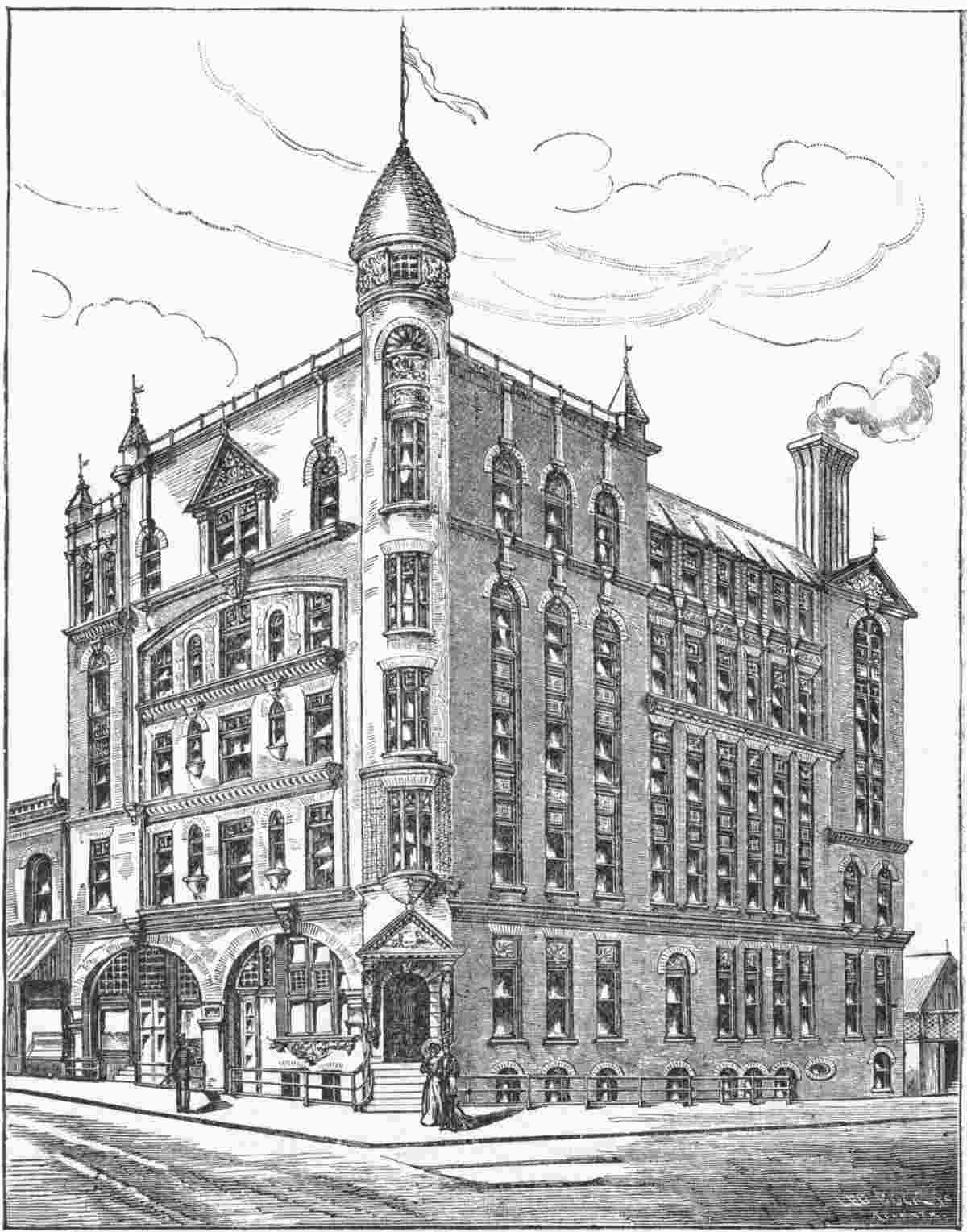
ATLANTA CONSTITUTION BUILDING.
601