Front matter
Reading edition
Transcriber's note: Unusual and inconsistent spelling is as printed.
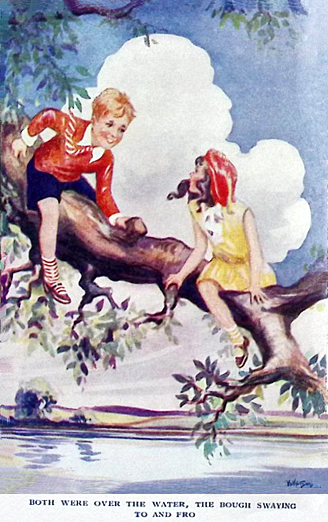
BOTH WERE OVER THE WATER, THE BOUGH SWAYING TO AND FRO
JOCK WITH MOUSIE
BY
AGNES GIBERNE
WITH ILLUSTRATIONS IN COLOUR AND LINE
BY
K. KITSON
LONDON
THE RELIGIOUS TRACT SOCIETY
MANCHESTER, TORONTO, MADRID, LISBON AND BUDAPEST
Made in Great Britain Printed by Purnell and Sons Paulton (Somerset) and London
CONTENTS
CHAPTER
I. IN THE FIRELIGHT
II. BIRTHDAY PRESENTS
III. JOCK HAS TO BE A MAN
IV. GOOD-BYE
V. A STRANGE NEW WORLD
VI. SOME PUZZLING THINGS
VII. A WHITE FAIRYLAND
VIII. THE MOORE FAMILY
IX. FORBIDDEN FRUIT
X. WAS IT WORTH WHILE?
XI. "WHERE, AND OH WHERE?"
XII. JOCK IN TROUBLE
XIII. MOUSIE'S CAPTAIN
XIV. HOW TO TAKE THINGS
XV. APRIL SUNSHINE
XVI. THE POND AGAIN
XVII. SO SLIPPERY
XVIII. WHAT WAS HE TO DO?
XIX. MOUSIE'S CONSCIENCE
XX. SUCH GOOD NEWS
XXI. MOUSIE'S MOODS
XXII. JOCK'S DELIGHT
XXIII. FRIENDS
ILLUSTRATIONS
Both were over the water, the bough swaying to and fro .. .. coloured frontispiece
"What's your name?" demanded a shrill little voice
She went rolling, rolling, falling, falling down the whole descent
JOCK WITH MOUSIE
I. IN THE FIRELIGHT
JOCK sat on a big square stool, nursing his right leg and earnestly staring into the dancing flames. Every moment they took fresh shapes, curtsying one to another, and winding about the lumps of coal. A green tip crept out from a cave of fiery red, and then a purple tongue shot itself forth. Jock wondered what made them do it.
Behind him lay a long narrow room, with pictures on the walls, dimly visible in the firelight. It was getting dusk, but blinds had not yet been drawn down. As the flames danced, they cast a long shadow of Jock on the floor, with its thick blue carpet, and Jock turned to watch it. He swayed from side to side to make the shadow sway.
How funny it was that some flames should be green and others red. And why did they keep always going up and up? And why should a lump of black coal catch fire and turn red and burn and burn away, only because it happened to be close to another lump already burning? These and other questions jumped into Jock's mind, and all but jumped out at his lips.
But he peered round again at his mother, lying on the sofa. She had lain there, with her eyes shut, ever since he came in. If only she would open her eyes, and would talk. He was bursting with new ideas, and during a whole quarter of an hour he had not spoken one single word. Such a time to wait!
Grown-up people were so funny—liking to sleep in the day-time. "He" never wanted to sleep, not even when bed-time came. His nights were too long and his days too short; for there was always such an immense amount of things to be done. He couldn't get through half of them.
At the end of the street, round a corner, was a school for small boys, where he went every day, partly for lessons, partly for games and walks with the other boys. So he had plenty of companionship and plenty of fun, and when he came home it was to the dearest of mothers. Jock was devoted to her.
Many months earlier she had been ill, and when her husband went to India with his regiment, she could not go with him. She had to stay in England with Jock, and he felt himself to be in charge of her. His father's last words had been—"Take care of your mother, old chap."
He really had tried hard, and through the weeks when she was ill, he had been wonderfully good and quiet for such a little fellow.
But she was well now, for she often said so, and he felt free to rush up and down stairs, and to leap about the room, and to shout and sing at the top of his voice. Except when, as just now, he found her lying down, and then often, though not always, he would think of his father's words, and would keep still.
This was Tuesday, and next day Jock would be eight years old. Last birthday his father was at home, and he well remembered all the fun and romping and laughter. Would it be quite the same this year? He thought not. He could hardly expect that Mummie would tear madly upstairs with him, three steps at a time, or would swing him down again like a sack of corn; or that she would gallop round and round the garden with Jock on her shoulders. No, that would not be possible.
He was a spare, slim boy, rather small in make, with curly chestnut hair and eager grey eyes. He glanced round again, and ventured—"Mummie—are you awake?"
She stood up in reply, and came to his side. Anybody might have guessed her to be his mother, for she, too, was slim in make, with curly chestnut hair and grey eyes.
"Did I wake you up, Mum? Oh, I'm glad you weren't asleep. I've got such heaps of things I want to say. Jane told me you wasn't to be disturbed—not on no account, she said. So I had my tea all alone, and then I painted and painted—ever so long, till I couldn't see. Mummie, shall we have lots of fun to-morrow?"
"Won't four boys to tea be enough?"
Jock nodded. "It'll be most awf'ly jolly. Only I do want to know what I'm going to have for my birthday presents. I mean—from you and Daddy. Couldn't you just tell me now?"
"I think not. Last year Dad said—No. And you will enjoy to-morrow the more for not knowing beforehand."
Jock was doubtful. "It's a whole night—a fearful long time to wait."
"You will be asleep most of the time."
"Shall I? Mummy—what is a salamander like?"
"A big lizard—black and yellow. Why?"
"Jane says salamanders can live in the fire. And I wonder if one of them could live in there—" he pointed to a little red cave amid glowing coals.
Mrs. Munro laughed. "I doubt if the salamander would enjoy it," she said.
II. BIRTHDAY PRESENTS
A VERY wide awake boy lay in bed, hoping each moment to hear the staircase clock strike six. He had been awake such an enormous time, and not once had the clock sounded, so he felt sure it must come directly.
Last year at six o'clock his father had come in from the next room, had picked up Jock bodily and had carried him off to his mother. And Jock had chattered happily till seven o'clock, when it had been decreed that the great business of presents might begin. But this year, being so much older, he was to jump up and go to her himself, only not until six. And Jock had promised.
So he waited and waited, and no sound came from beyond the closed door. Of course she was asleep.
He wondered and wondered what Mum's present would be. One thing he longed to possess, and that was—a real big man's pocket-book, like Dad's. But mother did not know this ardent desire of her little son. It meant so much and went so deep that he had not breathed it even to her. Perhaps he was afraid of being laughed at. Such a pocket-book could be of no possible use to a little fellow like him; none the less, he did want it, vehemently.
Then there was Dad, dear, kind, merry Dad, out in India. Most "certaintly" he would not have forgotten the birthday. And Grannie always sent something, and so did Aunt Judith—only from her it was commonly a book. And though Jock loved reading, there are books "and" books in the world. Aunt Judith's choice was not always the same that Jock's would have been.
"Dong—" came suddenly in a deep resounding tone. He lay still, and counted. "Dong—" that was two. "Dong—" that was three. "Dong—" four. "Dong—" five. One more—only one. It must "certaintly" be six.
But the one more "dong" failed to sound. He held his breath with listening, and soon he gave up hope. It was only five. Another whole long hour to wait. Jock kicked and squirmed and tossed to and fro in his disappointment, but nothing could alter the fact.
How to get through this terrifically long spell was the question. He had promised to stay in bed and to make no noise, but of course he couldn't lie there doing nothing.
First he tried counting. He counted up to a hundred, and then up to three hundred, and he was as wide awake as ever. Then he shut his eyes, and tried to see pictures and patterns, and still he was wide awake. Presently he started saying some of the multiplication-table backwards, which is no easy task, and even that failed to bring sleepiness.
Getting tired of figures he pranced about under the bed-clothes, and put his head where his feet were meant to be, while the said feet kicked about on the pillow.
This made a refreshing change, and he felt happy—till sudden fright seized him lest, under blankets and counterpane, he might fail to hear the clock. In a panic, he whirled himself right way round, and wondered if perhaps it had already struck. The time since five o'clock seemed enormously long; it almost "must" be past six now. This particular clock, unlike many big clocks, did not sound the quarters. Dire temptation arose to creep across the room, to open the door one tiny crack, and to whisper—"Mummie—are you awake?"
But what if it should be not quite six? And what of his promise?
He sighed like a grampus—if grampuses ever sigh—but he stayed in bed. And at last even that almost endless hour did come to an end. Again the deep-toned "Dong" sounded—six strokes. With one bound Jock was out of bed, racing across in the dark to the door, against which he banged.
"Gently, my boy—don't hurt yourself."
"Mummie—are you awake? May I come?" And in another instant he was cuddling down within her arms.
"God bless my own dear little son, and make him a good, true, brave man," she said softly. "Many, many happy returns, my darling."
"Mummie, it's been most awfully hard—waiting all that time. But I didn't disturb you, did I? Didn't you want my birthday to begin too?"
She held him fast and laughed a little. Had Jock been older, he might have heard in that soft laughter a note which told of tears not very far away.
"Must we wait till seven o'clock now?"
"Hadn't we better? You could see nothing yet. Daddy made us wait last year."
Jock agreed, and talked without a break till seven strokes boomed solemnly out. It was light enough now for him to see a small table close by, covered with packages.
"Are all those for 'me'? Oh, I say!"
Supremely happy, he drew the pile over on the bed, and set to work, not hurrying. With steady fingers he untied and opened one parcel after another, examining the contents of each with happy little murmurs, and sometimes a big "Oh!" of joy, glancing again and again at his mother for sympathy. She lay and watched him in silence.
Delight of delights—here was the very thing he most had wanted. A real big man's pocket-book, bound in Russia leather, with pockets and blank pages and pencil, all complete. How "did" Mummie guess? And what did it matter that he had not one single pocket into which it could go? He had his wish, and with a pocket-book of this size he felt himself already a man.
Then he found a grand box of soldiers, beautiful British-made soldiers in the uniform of the Guards. And a small railway-engine which, when wound up, would go by itself, drawing a string of little carriages. Both these were from his father.
A fine box of bricks had arrived from Grannie. Also, he found a puzzle from Jane, the housemaid, and a picture-book from the cook, and a knife from one of his school-fellows, and a bouncing india-rubber ball from another. And lastly, as expected, a book from Aunt Judith. Jock read the name aloud.
"'Fizzingcall Joggraphy.' What does 'Fizzingcall' mean?"
"'Physical Geography.' That means the part of geography which tells us about mountains and rivers and earthquakes. You will like to read about earthquakes."
"I don't like Joggraphy."
"Oh, I think you do—or you will some day. And it is so kind of Aunt Judith to send this. See—she has written inside the cover—'If Jock is not old enough yet to care for this interesting book, he will be glad to have it by-and-by.'"
Jock was quite content to wait for that doubtful future. He shoved the brown volume aside, and turned to the soldiers and the engine as much—oh, very much—more interesting. And he could hardly bear to have the big, lovely pocket-book for one moment out of his hands.
"You will have to write and thank Aunt Judith presently. She likes to hear quickly. No—I mustn't help you, darling. She always says she would rather have letters written entirely by yourself."
Jock looked serious, for spelling was not his strong point. Meanwhile his birthday had begun splendidly, and the rest of it, including a tea-party of school-fellows, proved a great success. Mrs. Munro seemed as full of fun as everybody.
And only one day later he did get his letter written to Aunt Judith:
"MY DEAR AUNT JUDITH, "Thank you awfuly for the book. I think praps Id better read it when Im older. I had lots of joly things, and we played games, and it was awfuly joly. Please thank Grannie awfuly for the briks, and Im going to write. I do like briks, and its awfuly joly having birthdays, and Mum sends her love. "Your afecshunit "JOCK."
III. JOCK HAS TO BE A MAN
"JOCK, dear, I want you here."
Jock was hard at work, running his new engine and carriages round the room, one evening a week later. It was dusk, and lights had been lighted.
"'PARIS,'" shouted an eager voice. Then—"Yes, Mum. D'rectly minute. Mayn't I just go on to Edinburgh?"
"Yes, just that, and then come here."
Jock's notions of "Joggraphy" were vague. His engine contrived somehow to touch at Australia on the way to Edinburgh, and then to land its (imaginary) passengers in Ireland. Having accomplished this feat, he ran to his mother.
"Mum, I do love my new pocket-book. It's most awfully nice. How did you know I wanted it?"
"Mothers guess things sometimes. Jock dear, I have something to say, and I want you to be brave about it. Something that we can't quite like—and yet—it has to be." Jock waited expectantly. "I am thinking—" she stopped for a moment—"I am thinking of going out to Dad."
"Out to India!" Jock opened his eyes. "Why—Mum—but that'll be awfully jolly, won't it?"
She held his hand, speaking with a little shake in her voice. "You see, dear, I always meant to go as soon as I should be well enough. And I am well now."
"Dad 'll think me grown a lot. I s'pose he wants you there most tremenjously. Don't you want to go, Mummie?"
"Very, very much—to be with dear Dad. But—"
"Shall we start d'rectly? What a lot of things we'll have to pack."
"'I' must start in about two weeks. But—Jock, my darling—I can't take you with me."
Jock stared up in her face. That she should go and leave him behind had never entered his thoughts as the barest possibility. A year earlier, if she could have travelled, she would have left him, but since she could not, nothing was said about the matter. He had always had his mother; he could not imagine living without her. He had known vaguely that some day he would have to go to school, but that had lain too far ahead to be considered.
"You see, dear, you have to be in England. You must be brought up like other English boys. You must learn to think as Englishmen think—to be able to do your duty by-and-by to our Country and our King. You have to learn how to be fair to others—how to take a beating—how to serve and how to obey."
"Couldn't you and Dad teach me all that?"
"I'm afraid not. And the climate of India is bad for English boys; and the life would be bad too—in many ways. There would be no proper games for you—no boys to play with. So many things would be harmful—things you can't understand."
"And will you be gone only a very little while? Will you come back—very soon?" A choky feeling came into Jock's throat, but he held it down. Dad often said that British boys didn't cry.
"We shall both come back—as soon as possible."
"Will it be—six weeks?"
Her lips were trembling. Jock gave one glance up. Then he put his curly head down on her knees, and fought his battle out in silence. Her hand crept round him.
"Have I got to stop here—all alone?" he presently asked.
"No, this house will be let to strangers. And you will be with dear, kind Grannie. You know how fond she is of you."
"Will Aunt Judith be there?"
"Yes. She will take such care of my Jock."
"I don't want her. I want—want—you."
Another break, and Jock spoke again. "Will Aunt Judith teach me my lessons?"
"You will have lessons from a kind clever man who lives near Grannie—Mr. Moore, the curate. He has boys of his own, and you will learn with them for the present."
"A man!" This was promotion. Jock sat up, interested. Till now he had had only women-teachers.
"And you will have no end of games with the boys. Think what it will mean—being in the country, with fields and woods and flowers and birds. So different from a town like this. And you will write to me every week, and I shall write every week to you."
Jock spoke in smothered tones—"I wish—I wish—you hadn't got to go."
"But Dad has to be there. So many of our best and bravest men are wanted in India. Some day perhaps you will be there too; only you have first to learn lots of things—things that can only be taught properly in England. And—yes, in Scotland too. England and Scotland are one. And you have to be a man now, my darling—because it is right for me to go, and for you to stay behind."
Jock murmured—"I'll—try." Then he ran out of the room; and his mother knew him too well to follow.
IV. GOOD-BYE
THE fortnight slipped away like lightning; and the end came suddenly, taking Jock by surprise. He had been so busy, one way and another, that he had not known how near the parting lay. And just at last, things so happened that he would have to take his journey with strangers, to Lethmere West, where Grannie lived. Mrs. Munro had meant to take him there herself, before joining her ship, but she was not well enough for the extra fatigue. And Aunt Judith, who was to have come for Jock, could not leave home, Grannie being poorly.
Jock did not care about that. He was glad that Aunt Judith would not be in the house during the last day.
"Mind, Master Jock," Jane said more than once, as she packed his boxes, "you've got to be a good boy, and don't you go and get upset and worry your mother." Jock did his best, but the world felt very queer, and everything seemed upside down.
When the last evening came, Mrs. Munro was again resting on the sofa, and Jock had his station at her side. They did not talk about the morrow, but about everyday things, as if nothing were about to happen. Jock fell into his favourite occupation of watching the fire.
"I wonder what makes the flames go up and up," he said suddenly. "They do jump about so. It's funny."
"I'm not learned enough to explain puzzles of that sort. Some day you must ask Daddy."
"Daddy knows everything, doesn't he?"
"Why—no. Nobody knows everything. But he knows a great deal more than you and I do. I wish I could answer all your questions, but you haven't a clever mother."
Jock was indignant. "You 'are' clever. You're most awfully clever," he declared. "I know you are."
"Oh no, I'm not, darling. Not half so clever as Aunt Judith, for instance. I think I'm only clever at loving."
Jock fondled her hand. "I wish I could know everything. I wish I could find out lots of new things."
"Perhaps you may some day—if you work hard at lessons, and do your very best, and keep your eyes open, so as to notice things that go on. Think what a chance you will have in the country, where it will all be so fresh and new to you. You were such a little fellow last time we went. You can't remember much." For more than two years Mrs. Munro had been unable, from one cause and another, to visit her old home.
"Mummie—shall I like those people—to-morrow?"
"Mr. and Mrs. Royle? I hope you will. It is so kind of them to take charge of you for the journey."
Then both were silent, till it was time for Jock to go upstairs.
But when he was in bed, she knelt beside him, and he nestled into her arms. And presently, very softly, she spoke words which he would not forget—words about his great and loving Father in heaven, and about the mighty Son of that Father, Who long ago had come from heaven to earth to die on the Cross for men, Who would be with Jock always—always ready to hear, always ready to forgive, always ready to help. Would Jock remember, and pray every day, evening and morning, to that wonderful unseen Friend?
Jock gave a huge answering squeeze; and then they were both silent—till somehow, he dropped off sound asleep.
And in early morning came the waking, followed by a hasty breakfast. Mrs. Munro had wanted much to take Jock herself to his station, and to see him off, but her own train left at almost the same time from another station, and the two could not be fitted in. So he had to go in charge of Jane.
He kept saying to himself—"I mustn't cry. I mustn't cry." And he did not—even when the last good-byes had been said, and he and Jane were off in their taxi.
V. A STRANGE NEW WORLD
THAT drive was one long bewilderment to Jock. He saw the people and the houses, but noticed nothing. Jane was sorry for him, and said a comforting word, but he could only reply—"Don't."
At the station she gave him over to a tall, elderly gentleman, and a thin angular lady, and Jock just submitted to be given over. He heard them talking to Jane, and did not know what they said.
"Mummie wasn't gone," he kept repeating to himself. "She wasn't—wasn't—gone." He would go back presently, and would find her at home—just as usual.
"Come, my boy—get in," a kind voice said, and Jock got in.
It was a first-class compartment, already half-full of rugs, bags, shawls and papers. Jane stepped in also, and settled him in a farther corner, putting by his side a basket of sandwiches and fruit. She stole one good-bye kiss from the boy, and Jock didn't mind even that. He was still saying to himself—"Mummie isn't—isn't—gone."
But he knew that she was gone. For the train was moving, and they were off. Jane was out of sight.
Jock felt himself in a new world—new and lonely. He sat like a little image, gazing out on the rushing landscape, seeing and hearing nothing that went on. By-and-by it dawned upon him that the elderly gentleman, Mr. Royle, was seated in the corner just opposite himself, and that the lady at the opposite end of the carriage seemed to be scolding her maid. Jock vaguely wondered what it could all be about.
And—after what felt like a very long interval—he found himself looking up into the face of the elderly man opposite. He met a pair of eyes gazing quietly into his own, such very blue eyes, and such kind ones.
Mr. Royle leant forward. "Feel cold, my boy?"
Jock said "No—" without thinking. He was cold, very cold all over, and shivering, but he had not found it out.
"Feel queer?" Jock nodded this time. "Want something to eat?" Jock shook his head.
"Ah, well—never mind. You'll soon be hungry—a little chap like you! If you were seventy years old, now, that would make a difference."
Jock could not help smiling.
"Had to say a lot of good-byes this morning?"
One good-bye, not a lot. At least, the lot did not count. But Jock could not say this.
Mr. Royle stood up, letting his wraps slide down on the floor.
His wife called out—"What are you doing?"
But he paid no attention. He took hold of Jock, and made him lie flat on the cushioned seat, covering him with a thick travelling-rug and putting under his head a rolled-up shawl for a pillow.
"That's better," the kind voice said. "Now—mind—you are to go to sleep. Don't think and fret. Things won't be half so bad as they seem just now. It will all come right in the end."
He patted the boy's head and went back to his seat.
Jock gave one grateful look, and shut his eyes. The train made such a roaring that at first he could attend to nothing else. But soon he grew used to it, and began to lose himself in half-dreams. The night had been a short one, and he had eaten very little breakfast. Sounds grew distant, and soon he was off. For two full hours he never stirred. Then he woke up slowly, wondering at first where he could be, till recollection dawned, and he sat up.
"Better?" Mr. Royle asked.
"I'm quite well," Jock said.
"That's right. Now will you have some sandwiches?"
And Jock found that he actually could enjoy them. The queer sick feelings were gone, and, though the great sense of loss was with him still, he could meet it now with more courage.
VI. SOME PUZZLING THINGS
THE journey to Lethmere West was long and tiresome. After luncheon, they had to get out and to wait for an hour at a station for their next train. Mr. Royle gave Jock some picture-papers, and presently Mrs. Royle came up, and began asking him questions. How old was he? Had he been often to see his Grannie? Didn't he like country better than town?
"You're going to live there now," she said.
Jock shook his head.
"Of course I mean while your parents are in India. They won't come back in a hurry." Mrs. Royle did not mean to be unkind. She just said what happened to slip into her head.
"Mother said she'd come back as soon as ever she could."
"Oh, that means nothing. It's what they always say. You can make up your mind to three or four years."
Jock fired up. "She won't. She won't. I know she won't. She—promised."
"Why, you're a regular little spitfire." The lady seemed amused.
"Come here, my boy," a quiet voice said from the other side of the waiting-room.
Jock obeyed, swelling and wrathful still, and Mr. Royle's hand came on his shoulder.
"Don't you mind what other people say. Remember—you can trust your mother. If she said she would come home as soon as she could, she will do it."
"But—but—but—" Jock could hardly get out the words, and he looked across at Mrs. Royle. "'She' says—"
"Never mind. Other people don't understand. You know what your mother said, and nothing else matters."
Jock leant against the shoulder of Mr. Royle's fur-lined coat, and felt a little comforted.
"And I'm going to tell you something else, my boy. Try to recollect it. The first few days will perhaps seem endless to you—each day like a whole week. But that won't last. After the first week, the days will move faster; and after the first month, they will begin to run; and after the first three months, they will gallop. See?"
"Will they?" It seemed to Jock like years already since the early morning.
"Take my word for it—they will. You will make no end of new friends; and you will have no end of fun."
"I'm going to have lessons at Mr. Moore's."
"Ah, yes—and you'll find boys there. A girl too—queer little fish!" This was murmured, and perhaps was not meant for Jock's ears. "You're not a mischievous boy, are you?—particularly."
Jock laughed. He wanted very much to ask why the girl should be called "a queer little fish," but he did not venture.
"Don't let her lead you into mischief, that's all. Keep a sane head of your own. You seem to me to be a sensible lad. Got any sisters?"
"No; it's only me."
"Ah—well—it's a mercy if they haven't managed to spoil you."
Mr. Royle went back to his paper, and Jock found himself with plenty to think about.
Slowly as time passed, the second train at length was due, and once more they were off. It had grown extremely cold, and, though very still, the air was piercing. Overhead in a clear sky some small crimson clouds lay near the horizon, and the telegraph posts went by much more deliberately than with the earlier train.
Three or four more stations, at each of which they stopped, and then "Lethmere East" appeared in big letters. This was the nearest station to Lethmere West, two miles distant. And when they drew up, there was Aunt Judith—trim and smart in figure, not tall but very upright, with dark hair and bright dark eyes, and a very wide awake manner.
"So—here you all are," she said briskly. "How kind of you both to undertake such a troublesome charge. I hope Jock has behaved properly. Oh, thanks, my mother is better. Well, Jock—how are you?"
She gave him a kiss, a rapid, bird-like peck on his cheek. Jock remembered those kisses of hers, and he wanted to rub it off, but didn't.
"Quite well?" she asked, but she did not wait for an answer. "We must be off—it is getting cold. A real, sharp frost."
"Too horribly cold," complained Mrs. Royle. "And such delays. I thought we should never arrive."
Outside the station they found the Royles' large motor-car waiting, and near it Aunt Judith's pony-carriage. Part of Jock's belongings were taken, and the rest would have to follow next day. Judith told him to jump in, and followed, taking the reins. Mr. Royle came close to shake hands with Jock.
"Good-bye," he said heartily. "Mind you come and see me some day soon, my boy. I shall look out for you. Come and tell me how you are getting on."
Aunt Judith opened her eyes rather widely. The car spun away at a fine pace, and the brown pony trotted calmly after. "Now, what made Mr. Royle say that?" questioned Aunt Judith. "I hope you didn't ask to go, Jock?"
"No, I didn't. 'Course I didn't, Aunt Judith. He was—awfully kind."
"I'm glad you didn't. Yes, he is a very kind man. And you've got through your journey all right. Are you warm?"
She pulled the rug up higher, and tucked it round him, and they went on at a steady jog-trot, from which not all Aunt Judith's efforts could rouse the pony. Evidently he was used to having his own way. She talked a great deal to him, and flicked her whip perpetually, and he shook his ears as if in response, but he chose his own pace.
When they drew near to Lethmere West it was nearly dark, and only dim glimpses of hedges and fields could be had, and then of a good-sized garden, and, lastly, of an open front door, lighted from within. Jock remembered the butler who stood there, a stout, middle-aged man. Aunt Judith bustled him in, and told him to stay by the fire in the morning-room, while she ran up to see her mother.
Then she came down to say that Mrs. Baynes was sound asleep, and that Jock should have his supper at once and go to bed. While he ate, she kept flitting in and out, talking most of the time. Then she called Emma, the housemaid, a rosy, good-tempered-looking girl, and told her to take Jock to his room, and to look after him. It was a pretty room on the first floor, with pink curtains and a pink coverlet, and Jock's things for the night were already unpacked.
"I can do everything for myself please," he said, when the maid lingered. "I'd rather, please."
"Well, don't be long, and I'll come back presently, and put out your light. You're tired, ain't you? Get to bed, quick—there's a good boy."
Jock was very tired, and very soon he was ready for bed—all except his prayers, which he put off till the last. Always, until to-day, his mother had come to him, for she had never left off that habit of infant days. Now for the first time, as he knelt by the little bed, he knew what it was to be "alone." He tried to keep back the tears which kept coming, and he tried to say his prayers as usual, but it was very hard. After two or three minutes, he crept into bed and hid his face under the clothes, and when Emma came back, she supposed him to be asleep. So she turned down the light and went away.
And desolation crept over Jock. It was like a big black cloud covering him. He was utterly alone. His mother was far away—out of reach.
But, mercifully, he was too tired to keep awake. And don't you think that, as he lay, one of God's dear angels stooped softly down to whisper comfort to the lonely child? Somehow a recollection came of his mother's words that last evening—only yesterday, but it seemed so long ago—and of the kind Heavenly Friend Who would always, always, be at his side. And with that thought, Jock dropped asleep, his cheeks still wet. Soon he was smiling.
For a lovely dream had come. He was back at home with Mummie, and her arms were round him, and she was saying with a gentle smile—"It wasn't so bad after all—was it, darling?"
VII. A WHITE FAIRYLAND
NO matter how dismal things may look overnight, long hours of sleep do make a difference, especially if one is only eight years old. Jock never once opened his eyes till broad daylight, and then he started suddenly wide awake. He sat up and took a good look round.
It was a very pretty little room. Somebody had been at pains to make it nice. In one corner stood a small table, with a little writing-desk on it, and a bookcase above, half-full of books, but with space for more books of his own. He gazed with eager eyes, taking in one thing after another.
Then he saw that the window-panes were covered with frost-pictures. There were trees in rows, and trees singly, and houses, and even people—all sketched by the busy fingers of Jack Frost. He had seen something of the kind before, but nothing equal to this. Jumping out of bed, he ran to the window.
And such a scene burst on him!
Below lay a small lawn covered by a thin white carpet, and in the centre of the lawn was a big tree, it, too, being dressed in white. From its topmost to its undermost twigs it was clothed in pure white. Jock supposed that a fall of snow had come in the night. But this was not snow, it was hoarfrost—such a thick hoarfrost that it lay along the bigger boughs three-quarters of an inch deep. And beyond the lawn were clumps of evergreen bushes, and each leaf of those bushes carried its own white trimming.
It was a fairyland scene, and Jock could not turn his eyes away. He had seen snow at home, pretty enough at first, when great flakes came floating down, even though they fell through a murky atmosphere. But he knew how black and grimy they soon became. Anything like this vision of purity he had never known.
When his toes complained of the cold floor, his first thought was that he could not possibly go back to bed. He must dress at once, and run out to see things for himself.
A brass clock on the mantelpiece spoke, and it said in very hurried tones—EIGHT. Jock was rather astonished, for at home he had always got up at seven. He did not know that Aunt Judith had ordered that he should not be aroused, but should sleep on. She might be a trifle short in manner and speech, but she had noted the boy's white face, and when Emma came to say how soundly he was sleeping, she said—"Let him rest till half-past eight. Have him ready by nine, and he shall breakfast with me."
A bath had been put ready, with plenty of cold water, to which he was used. He went in for a good splashing, and dressed with all possible speed, for he was eager to get out of doors. At home he had always been free to race in and out of the back-garden whenever he pleased, and it never entered his mind that perhaps here he ought to ask leave.
He met no one on the stairs or in the hall, and the front door stood invitingly open. Before him lay the front drive, with three or four elm-trees in the centre, and away to the right was a larger lawn. He walked down the drive, following its bend, and then turned sharply off to the right, racing across the big lawn towards a small pond which drew his attention.
All round the pond were heaped-up rocks, where, in summer, flowers grew abundantly. No flowers were to be seen now, but only leaves dressed in white, and the water at its edges was frozen hard. Jock stooped to examine it, and with his fingers broke off a piece of ice, nearly overbalancing himself as he did so, which might have meant a second cold bath.
He was so excited that he danced about on the slippery grass, quite forgetful of the fact that he had had no breakfast. It did not occur to him that people might be puzzled, if no one knew where he was gone. So he wandered round the pond, and on towards a wide grassy ditch, called a "haw-haw," dividing the garden from a field. The sun shone brightly, and millions of tiny ice-needles on grass and on leaves flashed forth gleams of light in response to the sun's kisses.
"Oh-h!" Jock said to himself in a wordless rapture. He stood still, and again murmured—"Oh—h!"
"What's your name?" demanded a shrill little voice.
Jock found himself facing a girl just beyond the haw-haw, standing on the slope of the field. He stared instead of answering. She was very slight, with long thin legs like sticks, and an extremely short frock, and tiny hands, ungloved. A cloth cap was stuck jauntily on one side of her head, while below it hung wisps of black hair. The face was small, with a pointed chin, and the black eyes roved everywhere, but came constantly back to Jock.
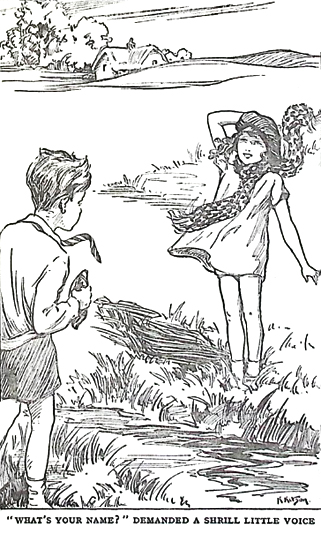
"WHAT'S YOUR NAME?" DEMANDED A SHRILL LITTLE VOICE
"I s'pose you're the new little boy," she remarked.
Jock felt insulted. "Little" indeed. Though not tall for his age, he was the bigger of the two.
"You've got red hair," she went on.
"It isn't red," protested Jock, but she ignored this.
"Mine's black. I wish it was nice and curly like yours. Stop—I'll come."
She retreated some paces, then took a run and cleared the ditch in fine style, landing close to her new acquaintance, at whom she looked with interest. "You haven't told me your name."
"I'm Jock Munro."
She nodded, and Jock asked in his turn, "What's yours?"
"I'm Mousie Moore. Dad called me 'Mousie' when I was a baby, 'cause I was such a wee thing, and they all do. I'm Phœbe really, and sometimes I'm called 'Fee.' And the boys are Tom and Hugh and Artie. And Bertha is our baby. How old are you?"
"I'm just eight."
"Is that all?"—in a superior tone. "Why, I'm nine and a quarter. Isn't it jolly your being here?"
Jock was silent. In the midst of it all he suddenly—remembered. A lump came into his throat.
The slim-legged maiden studied him closely.
"Never mind," she said consolingly. "'I'll' take care of you."
Jock felt his manliness at stake. To be taken up thus protectingly by a slip of a girl, smaller than himself, was rather too much.
Mousie came close, and, to his astonishment, imprinted a kind, though patronizing kiss on his cheek.
Jock promptly scoured it off.
"And we're going to see lots and lots of you," Mousie continued, undisturbed. "You're going to have lessons with the boys—only not to-day. And we'll do heaps and heaps of things together. I say—there's the gong. Hurry." She flung out her little claw-like hands. "Miss Baynes is most frightfully puncshal. Run—scamper—fly!—don't stop a moment."
And Jock obediently fled, though he rather resented being ordered about by so small a person, who wasn't even a boy.
VIII. THE MOORE FAMILY
THEIR house was just two cottages thrown into one, with a little garden round it. In front lay a small drawing-room and a smaller dining-room, and the schoolroom behind looked out on a bed of cabbages. On the walls hung various pictures of horses and dogs, and a square centre table rejoiced in an ink-bespattered table-cloth which had once been green.
Mr. Moore's work in this tiny village, even with the addition of some help given to the old Rector at Lethmere East, left him time for the education of his own children, and he often had one or two other boys to teach with them. Had he been a strong man—which he was not—he would not have undertaken so light a charge.
His one extra pupil of late had been Tom Moore, a nephew of his own, a delicate lad sent here because he was not robust enough for ordinary school-life. Tom looked older than his years, sitting at the table with hunched-up shoulders, and eyes glued to a book.
Opposite to him fidgeted Hugh, a merry-faced boy, about Jock's age. On a third side of the table a small, solid boy had perched himself in a high chair, from which he gazed complacently about with wide placid eyes; and the small girl on the rug was shaped after the same pattern, both being plump, broad, and happy. For Artie or Bertha to cry and be cross was an almost unknown event.
Into this scene, suddenly, burst Mousie.
"He's all right," she cried ecstatically. "He'll 'do.'" She had heard Captain Royle—only son of Jock's new travelling-friend—speak one day of a young fellow in precisely those words. The phrase had captured her fancy—the more so since Captain Royle was her hero—and she had at once adopted it for her own use. "Tom—do you hear?"
Tom looked vacantly up from his book.
"Tom—I say! Jock is all right. He's awfully nice. I like him ever so much. And he and me are going to be friends."
She counted on her fingers carefully. "There's you and Hugh. And there's Artie and Bertha. And now there's going to be Me and Jock."
Tom's eyes wandered back to the open page. "Well—why not? You're welcome."
"But there isn't any 'not.' It's settled. And he's awfully nice. What are you reading?"
"Spanish Armada."
"Oh dear—and Dad wants me to read that too. Tom—" and she put on her most coaxing face—"won't you tell me all about it? I'd like that ever so much better than reading to myself."
"Uncle wouldn't like it. He wants you to read."
Mousie sighed. She was not fond of hunting out history for herself, and much preferred to be saved the trouble. But Tom was a real lover of history, and he delighted in picturing to himself the brave deeds of Englishmen in days gone by. Mr. Moore found it no easy matter to get knowledge into the giddy heads of Mousie and Hugh, while he found real pleasure in teaching Tom, who was an unusually thoughtful and clever lad.
Mousie had her lessons with the boys, and even little Bertha was constantly in the schoolroom, playing with her toys and never giving any trouble.
The door opened, and in came Mr. Moore, with a hand on Jock's shoulder. A thin, fragile-looking man was the curate, with a big forehead and a cheery voice.
"Here, boys," he said. "Here's Jock."
Tom shuffled to his feet, while Hugh held genially out a grimy little paw, lately used for delving in the coal-scuttle after a lost pencil. Artie slowly scrambled to the ground, and came forward, beaming.
"Do you like nengines?" he asked, fixing round blue eyes on Jock. "When I'm a man—" and he smiled more broadly—"I'm going to be a nengine-driver."
"'I' mean to be a soldier, like my Dad," Jock promptly announced.
"I don't know what I'm going to be," meditated Hugh.
"An Ignoramus, my boy, with a very large capital I—if you don't get on faster than you've done lately," Mr. Moore remarked. "Jock beats you in height. Which is the older?"
Notes being compared, it was proved that Jock had the advantage by six months.
"But I'm taller than Mousie, Dad," protested Hugh.
"Mousie always was a shrimp. Now put your books away. The rest of this day is to be a holiday, in honour of Jock."
"Whoop," shouted Hugh.
"Keep within bounds, all of you, and keep out of mischief. You must teach Jock where he may go, and where he may not. Understand—boys?"
A general "Yes" answered.
"But Jock must come back to luncheon with me," Miss Baynes said. She had followed Mr. Moore and Jock into the schoolroom. "Jock, do you understand? You will be allowed to go about in the place—but you must keep within bounds. You must keep to rules. Do you understand? And—can I depend on you?"
"Yes, Aunt Judith."
Mousie danced wildly round the table. "Oh, loverly! A whole afternoon—and half a whole morning. Tom, do put away those horrid books and let's have fun."
Tom kept his seat, despite her pulling. "I've got to finish this," he said.
But Mousie gave him no peace, until she had her way.
IX. FORBIDDEN FRUIT
THE first two or three weeks of Jock's new life at Lethmere West went by smoothly. As Mr. Royle had foretold, the hours passed with increasing speed, and things became more and more full of interest. Aunt Judith, though not very fond of boys, was really kind, and Grannie was delightful.
She had grey hair, and Jock counted her tremendously old, though in point of fact she was hardly more than middle-aged. She loved to have her little grandson about the place, and Jock soon got into the way of running to her for sympathy, just as he had done with his mother. Jock was always thinking of that dear mother, and he longed to see her again. Still, he was a healthy, merry, high-spirited boy, and everybody was good to him, and it would not have been natural that he should have gone on being sad.
The greater part of each day he spent with the Moore children, and more especially he and Mousie were perpetually thrown together. She really made a charming little friend for him, for she was full of plans and ideas. Without being much of a reader, she had a knack of picking up notions, and of bringing them out in a new shape. Certainly she never was dull. Jock liked her, and was amused with her funny impulsive ways. And Mousie was genuinely fond of Jock, though still a trifle patronising. Perhaps each helped to rub down some of the other's rough edges. Most boys and girls have certain rough edges, you know, and it is a good thing that they should be smoothed down early.
The children lived a very free and happy life, allowed as they were to run all about in the village and in fields adjoining. They were under orders as to "bounds," which had to be observed, and beyond which they might not go without leave. By this time Jock pretty well knew which parts were and which were not "within bounds."
Or at least he ought to have known. But, like many boys of his age, he was forgetful, and often he trusted to the Moore children to remind him.
For quite a long time, or what Mousie counted to be long, she carefully avoided leading him into mischief. Indeed she was so extremely well-behaved through those early weeks that Miss Baynes was heard to say—"Really, Phœbe is very much improved."
But not long after Phœbe had a wilful fit. It came on quite suddenly, no one could have said why—least of all Mousie herself. She only felt as if she couldn't—"couldn't"—go on any longer being good, and as if she really must—"must"—make a change and do something out of the common.
In plain terms, Mousie wanted desperately to do what she knew she ought not, and she wanted somebody to do it with her.
It was a sunny soft day in February, just like spring. No one could dream of frost or snow on such a day. Trees were still leafless, and hedgerows were for the greater part still bare, but many small bushes had begun to show signs of stirring life, and some had the green of early leaves already visible.
Tom had chosen to spend this half-holiday indoors, dabbling with paints as he loved to do, and Hugh stuck to him faithfully. Mr. Moore was away for several hours, and Mrs. Moore, as usual, was busied with household concerns. So it came about, as a matter of course, that Jock and Mousie were together.
"I'm going to do something," she announced. "Something most awfully jolly."
"What is it?" Jock asked, always ready.
"You're not to know yet. You've just got to do what I tell you. It's to be a surprise. I'll settle everything, and you needn't bother. I'm lots older than you, and I've been here always, and you haven't. So of course I know. And you've only just got to promise you'll do faithfully what I tell you. Promise."
"What for? Why must I?"
"'Cause I want some fun. 'Cause I've got something 'loverly' to show you." Mousie danced on the tips of her tiny toes like an acrobat. "We've all been most awfully good lately, and I want some fun. Wouldn't you like some fun too? And won't you like to come somewhere that you haven't been? But you've got to promise—else I won't take you."
Jock suddenly felt that he did want the "fun," and that he wanted to go very much—quite desperately. And if he gave this promise, then of course he must keep it. He always kept his promises. So that would settle the matter entirely. He wouldn't need to bother any more about what they were doing, or where they were going. He would only have to follow Mousie's lead.
All this flashed quickly through Jock's mind. A gentle voice, far down, did try to murmur something. It tried to say that perhaps things were not altogether right, and perhaps he had better wait and ask to know more first. But Jock did not want to hear that little voice, so he smothered it in a hurry. He did so want the "fun."
"All right—I promise," he said.
"You'll come just where I like, and you'll do just what I tell you, and you won't ask me any questions."
"I promise," Jock said in a hurry, afraid that he might hear again that gentle voice.
"Come along then. I've got Artie—all ready."
Artie, being so small a boy, was not allowed to be taken anywhere and everywhere even "within bounds" by the older children, without leave.
"Have you asked?" Jock began, and Mousie shot at him a needle-like glance of reminder. He had bound himself to put no questions, and he stopped helplessly.
Phœbe led the way to a large field behind the house, and there they found Artie, complacently waiting.
"I told him we'd come. This way."
She flung herself lightly over a stile; she seemed all arms and legs. Jock was active enough, but he could not rival Mousie. She seemed to have no weight. Together they hauled Artie over by main force, for he had no spring in him. Then they went through another meadow, and two smaller fields, to a rough common. By this time, as Jock knew, they were well outside "bounds."
"But, I say, Mousie," he objected; and she treated him to another needle-like glance. He dropped into silence. What else was he to say? It was difficult. He had given his word. What could he do?
It was perfectly clear to Jock himself what he "wanted" to do. He wanted with all his heart to see what Phœbe had promised to show him—to have the "fun."
And he went on. They followed a path through a copse, reaching a gate which opened into a wood. Jock had not yet been through this wood. He was to go "some day," when primroses would be in bloom, but it was not open to the public, and even the Moore children were not supposed to enter it without permission. Jock tried hard to think that Mousie must of course have got leave to come.
On and on they rambled, too fast for Artie, who had begun to flag. But Mousie, bent on carrying out her plan, did not seem to notice him.
After pressing onward for a time, they reached an opening among the trees, a wide space, grass-grown, closely fringed with bushes and firs. On the farther side lay a large pond, and it, too, had trees around, drooping over as if to look at their own reflections in the still water below.
"There! That's what I wanted to show Jock," announced Mousie in a tone of triumph. "Isn't it just—just—'loverly'?"
It really was "loverly," to use the funny word which Mousie often brought out, when excited. The sun shone, lending sparkles to the grass, and gay tints to the leafless boughs, and radiance to the water. A great, solid oak-trunk had large sloping branches, one of which hung far out over the pond. Suddenly Mousie raced to this tree, scrambled up its rugged trunk, and took her position on the overhanging bough. Then she began to wriggle along it, her slim black legs dangling on either side.
Mousie screamed with a half-fearsome delight at finding herself no longer over dry land. "It's—it's—bee-autiful," she cried. "I can see right down below—things moving. Oh, I say. Fishes."
"Oh, I say," echoed Jock. "Mousie, I'm coming too. I must come too."
"And me too—me too, Fee," cried Artie.
X. WAS IT WORTH WHILE?
"NO, no, not Artie. Not for anything," shrieked Mousie. "Stay where you are, Artie. You're too small—ever so much too small. I don't believe Jock can do it either."
Jock not do what a girl could do! She could not have said anything more certain to bring him after her. "Of course I can," he shouted.
"Well, mind you take care. Stay where you are, Artie boy."
Artie obeyed, glad to rest his fat little legs, and Jock scrambled with some difficulty up the rough and sloping trunk. A few seconds more and he too sat astride the big low-curving bough. Then, following Mousie's lead, he wriggled along it, till they both were over the water, the bough swaying to and fro.
"Oh-h-h—" Jock breathed in a tone, half of rapture, half of uneasiness. "Oh—I say—Mousie—I say—"
"Hold tight. Isn't it fun? Let's make it swing more."
"Mousie—don't." Jock clutched the bough.
"Well—I won't. Dad said it was ever so deep just here. Yes, he brought us—one day. And he said—" Mousie's voice trailed into silence.
"Did he say you—wasn't to come?"
"Yes—'course he did." Mousie's tone was defiant. "And I wanted to come—most frightfully. So we're here. And I'm glad. I'm most awfully glad. It's such fun."
"You didn't ask if we might?"
"No, I didn't ask—nothing nor nobody. I knew they'd all say No. And I didn't want to have a No. I wanted to bring you, and I just—went and did it. So there!"
Jock was thinking soberly. "I say—hadn't we better go back?"
"What for? We've done it now. I don't mind—do you? It's just—lovely here." Something in the tone showed that Mousie was not quite happy. Stolen waters may be sweet, but they are apt to turn sour, and Phœbe, perhaps, had begun to taste the sourness.
Jock said no more, but he started to wriggle backward towards the edge of the pond, and he found this feat not so easy as the wriggling forward had been, especially when Phœbe began to follow him.
"Hold tight," she cried again. "Don't let go, whatever you do."
But her movements set the bough swinging again, and just as Jock reached the edge of the water, he overbalanced, and went down on the ground with a sharp thud, his right arm striking a projecting root.
Phœbe reached the same spot with all speed, slid down the tree, and ran to his side.
Jock was pulling himself up, with a rather white and bewildered look. "It—doesn't matter," he said.
"You aren't hurt, are you? What 'did' make you fall? Jock—you're not going to cry?"
Jock shook his head. "My arm hurts," he said.
"Pull off your coat, and let's see." The womanly side of Mousie came to the fore, and she knelt beside him, helping to bare his arm. An "Oh" of pity followed, at the sight of blood oozing from a red patch. "Oh, I'm so sorry. You poor, dear pet."
"It doesn't matter," repeated Jock manfully, though he winced at her touch.
"I'm sure it hurts frightfully." Mousie kissed the top of his head, and he endured this, since no one was at hand to see. "Never mind. I'll do it up, and it'll soon get all right. Here's my hanky—it's almost quite clean, and—I'll just dip it in the water. There—that's right." Deftly enough for so small a maiden, she folded the wet handkerchief round his arm, and tied the corners together.
"It doesn't hurt so much now, does it? I s'pose we'd better go home." Mousie gazed blankly round. "Why—where's Artie?"
Jock, too, stared about. No Artie was to be seen.
"Artie—Artie—" called Mousie in high shrill tones. "Ar-tie. We're going home. Come along, Artie!"
Jock joined in with the summons. But they called in vain. No answer came. The wood was very still. Artie had completely vanished.
XI. "WHERE, AND OH WHERE?"
THE two children stared hard, each at the other, blank dismay in both their faces.
"He can't have got far," Jock sensibly observed. "I shouldn't wonder if he thought he'd go home. And we'll find him there, all right."
"Oh no, no, we shan't. I know we shan't."
"Why not?"
"He couldn't. He doesn't know the way. He's lost, quite lost. And p'raps we'll never find him again," sobbed Mousie. "And it's all my fault—every bit my fault."
Jock thoughtfully offered his own pocket-handkerchief, which—like the one which encircled his arm—was "almost quite clean." She accepted the loan, but wept on. "I wouldn't cry if I was you," Jock suggested. "It's no good. He's got to be found."
"But we don't know where he is."
"He hasn't gone far. Why—he couldn't, in such a scrap of time. Where does this path go?"
"Oh, on and on in the wood. And it's a most awfully big wood—there's miles and miles. Dad said so. He said—anybody might get lost in it."
"Well, come along. I'm sure Artie hasn't run miles." Jock felt himself all at once the man in charge, able to take the lead. "Come."
Hand in hand they followed the path, skirting the pond, and then plunged deep among tall forest trees. As they went, they again and again raised the call of—"Artie!—Artie!"—but with no result. It seemed to them both that they had walked an immense distance, when Jock at length called a halt!
"I say—he's never come all this way. He couldn't. Let's go back, and see if he's at the pond, waiting for us."
Despondingly Mousie agreed, and they trudged back, to find themselves close to the pond much sooner than they expected. But no Artie appeared. The two stood, a forlorn little couple, wondering what on earth was to be done. What "could" have become of Artie?
Mousie's small face had grown white and peaked, and her eyes had black shades under them. She dropped down on the grass, murmuring hopelessly—"I'm so tired. I can't walk any more. And Artie is quite—quite—lost. And we'll never see him again. And by-and-by it'll be dark—and I'm so hungry—and Artie will starve. And we'll starve too. And we'll be like the Babes in the Wood. You won't mind, will you, Jock darling?"
"Jock darling" felt that he would mind it very much indeed. He was not at all disposed for such a dismal ending to their half-holiday.
"Nonsense, Mousie," he said. "Don't be such a silly. We've got to go home, and tell them, and then they'll come and find Artie."
"I can't. Oh, I couldn't—possibly. I never could do that. They'd be so angry."
"Well—and if they are—what then? If we can't find him, you've just got to tell, you know. And we've got to make haste."
Mousie shook a despairing head. She was crouching in a little heap on the ground, a picture of hopelessness, her small hands propping up her little pointed chin, as she gazed blankly around.
"I couldn't possibly tell," she wailed. "And you can't possibly go home and tell about me, Jock, because that would be so mean—wouldn't it? And you promised, too. I don't see how we can be like the Babes in the Wood—'cause there's no blackberries. D'you think the birds would really and truly come and cover us up? It would take such a lot of leaves."
Jock was about to say again—"Don't be such a goose—" when his eyes were caught by a tiny streak of scarlet, which certainly did not belong to grass or trees. It came through some thin underwood. And with a startled "I say!" Jock rushed thither. Mousie followed.
Behind a clump of bushes, reposing peacefully in a small hollow, they found a plump and round-faced little boy, sound asleep, nestling close to a big tree-root, which one fat arm embraced.
"Artie!" cried the enraptured Phœbe, and she went down by his side, hugging and kissing with her usual vehemence. "Oh, you darling—how could you? And never to hear all our shouting. Jock, isn't he funny? Wake up, wake up, Artie boy! Oh, you dear, silly old thing!"
Mousie went into fits of laughter as the sleeper slowly opened his eyes and sat up, drowsy and bewildered still. He looked vaguely round, and yawned.
"What did make you come here?" Mousie demanded.
Artie smiled his blandest. "I dunno. 'Cause I'd got a leg-ache."
"You'd no business to do it. You gave us such a fright—didn't he, Jock? And you mustn't have any more leg-ache. We've got to hurry home now, as fast as ever we can. And—mind, Artie—you needn't say anything to anybody about us coming here. Not unless you're asked outright."
"Needn't I?"
"Not unless you want to get Sis punished. You don't want that, do you?"
Artie smiled still more broadly.
"'Course I don't."
"Well, then, you can just say we've had lots of fun, playing about. That's quite perfectly true, and you needn't say any more. If we get back in time for tea, we shan't be asked, most likely. Everybody will only just think we've been in the fields."
Mousie, of course, knew she was doing wrongly. She knew she had no business to lead her little brother into deceit. But she resolutely turned her mind from this side of the question, as she pulled him up and they set off at a brisk pace homeward. Jock on one side and Mousie on the other side helped Artie's slower movements. Once Mousie, who kept silence most of the way, looked anxiously at Jock, and said—
"You won't tell?"
"No," came promptly.
"If you do, I shall get a black conduct-mark. And it will be my very first this year. And I've tried so awfully hard not to have one. I do want so awfully much to get Mr. Royle's prize in June. And I shouldn't have a chance—not one wee-est little scrap of a chance. I don't want the second-best prize. I want the best. Do—do—promise faithfully you won't tell. Please, dear, darling Jock."
"I've said I won't." Jock spoke gruffly, for he saw difficulties ahead. "All the same, you might have told me what you meant to do, not got me to go like this. It wasn't fair."
"Why, you wanted it every bit as much as me—you know you did."
"Yes, I daresay—after you'd made me want. I didn't before. And you never said one word about not getting leave—nor going out of bounds—not one word."
"You might have guessed," retorted Mousie, nose in air. "If I'd got leave, of course I wouldn't have had to make you promise. And—that wouldn't have been any fun—either."
Jock walked sturdily on in silence, and Mousie studied his looks with troubled eyes.
"I don't think you'd got any right—" he said at length.
"But you'll forgive me, Jock darling—won't you? And you'll belong to me—just the same—won't you?"
"I—dunno. I'll—see."
The corners of Mousie's mouth went down in dismal curves, but Jock would discuss the question no further.
By dint of racing the small boy out of breath and off his legs, they arrived in good time. The bell which summoned them to tea had not begun to sound when Mousie and Artie reached their back-garden, and Jock quitted them there, tearing at his best pace for home.
Aunt Judith had been away all the afternoon, and no one had missed him. No particular questions were asked as to what he had done, but Jock could not feel happy. He had never been used to hide things from his mother, and it did not seem right now. He was at a loss what to do.
XII. JOCK IN TROUBLE
NEXT morning Jock went as usual to the Moores' for his lessons, and came back as usual to early dinner. It was an unwontedly silent meal. Mrs. Baynes looked sad, and more than once Jock met Aunt Judith's eyes fixed steadily upon him, as if she were trying to make out his thoughts.
When the meal was over, he expected to have an hour in which to amuse himself. He was about to rush off, that he might join the other children, but Aunt Judith stopped him.
"Wait, Jock. I want a few words with you. Come with me."
She took him away from Grannie into the morning-room where she sat down, and made him stand just in front. Then she said slowly—"Jock—have you something to say to me?"
Jock looked at her in surprise. The next moment he began to understand.
"Have you anything to say—about yesterday afternoon?"
Jock's lips went tightly together.
"I think you have. Tell me—where did you go, and who was with you?"
A pause followed. Jock gazed steadily at her; and in his mind, he kept repeating—"I mustn't say anything. I mustn't say anything—" as if he were conning a lesson.
"Were you within bounds all the afternoon?"
"No," came at once. It was so natural to the boy to speak out.
"Where did you go? Jock, I insist on knowing. What made you disobey?"
"I—couldn't help it."
"Nonsense."
"I couldn't help it, Aunt Judith. I—had to go."
"Jock, you are telling me a lie."
Jock turned crimson. That made him angry as hardly anything else could have done. He was in the main a sweet-tempered boy, but he could lose his temper.
"I'm not. I'm not telling a lie," he cried vehemently. "I never do."
"I don't know what you may have done in the past. You are certainly now telling me a deliberate untruth. 'Had to go!' 'Couldn't help it!' A boy of your age. Of course you could help it."
Jock shook an indignant head. Words failed him.
"You gave me your promise that you would never go beyond bounds, and you said I might depend on your word."
"I didn't. I didn't," cried the boy.
"You did not—what?"
"I didn't promise for always. I thought you meant—just that first day. I didn't 'mean' to go beyond bounds—but—it wasn't a promise for always."
"That is another untruth," Aunt Judith said.
Jock was shaking with passionate resentment. "It isn't—it isn't," he cried. "I don't ever tell stories. Dad and Mummie know I don't. Dad always said—"
"That will do. I don't wish to hear any more. I happen to know that you went over the Common on the way to the wood. How much farther I cannot tell. And somebody was with you—no doubt one of the Moore children. I have no concern with what they do, but I do insist on obedience from you. Have you anything more now to tell me?"
Jock's lips were glued together, and his eyes had grown dark with passion.
Aunt Judith waited for a full minute. Then, she said—"I am very much disappointed in you. I took you for a truthful boy, and now you are telling me one falsehood after another. You will not go to Mr. Moore to-day. I shall explain that I am keeping you in. Go upstairs, and stay there—either till you choose to confess frankly all you have been doing, or else till night. I expect to hear where you went, and who was with you. If this were not the first time that I have found you out in direct disobedience, as well as in untruth, I would punish you more severely. As it is, you must spend the rest of the day in your room, unless you resolve to speak out. After that—I must consider."
Jock went without a word, his heart beating heavily. Never before in his life had his word been doubted. It had always been enough for him to say—"Yes, I did," or "No, I didn't,"—and he was at once believed. And now—now—to be accused of having told more than one bare-faced untruth, and of having deliberately broken his promise—he did not know how to bear it.
Sullenly, he sat down by the window in his pretty little room, feeling heart-sick and wretched. Not to be trusted! Not to be believed! Brought up as he had been to look on a promise as sacred, as never to be broken, this was the hardest thing that could have come to him, and perhaps not less hard because, deep down in his heart, Jock knew that he had brought it upon himself by his folly in letting Mousie lead him blindfold into mischief.
But even if he had not assured Mousie that he would not tell tales—could he have done otherwise? Could he have saved himself from blame by bringing disgrace on a girl? Dad would never have wished that. So in any case things must have gone wrong, because Aunt Judith would have asked questions which he could not answer. So argued Jock to himself, and he would not listen to a soft voice which asked—"But why did you go at all?"
And Grannie would believe what Aunt Judith told her. This was a real trouble, for the boy dearly loved his gentle Grannie. And they would write and tell Mummie—would tell her that her boy had broken his word.
The thought overwhelmed him. He did not know how to face it. Suddenly he recollected that to-morrow was the day for letters to be posted to India, and that they were always sent off the evening before. Aunt Judith would be writing that very afternoon. Jock himself had a letter in hand to his mother.
He would finish it now, this minute, and would post it himself. Before his mother went, she had given to him a supply of envelopes ready stamped and addressed, so there was no difficulty.
In a tearing hurry he got out his partly-written sheet, and sat down at the small writing-table. His pen scratched vehemently over the last page.
"Mummie dear, Ive got to tell you something. Aunt Judith is so horrid. She says Ive told a lie and I havent, I never do and Im so miseble I dont know how to bear it. I do do wish youd come home, darling Mummie, I do want you so awfully much, please, please, do come back to your own "JOCK."
Then he folded the sheet in haste and put it into one of the addressed envelopes, which he stuck fast. He seized his cap, and his hand was on the door-handle—when he stopped. He had been ordered to stay in this room all day.
But he couldn't—he couldn't—and he wouldn't. The letter had to go. If not, Mummie might believe Aunt Judith, and that would be too dreadful. And since Aunt Judith refused to believe what he said—what did things matter? He might just as well not try to be good. The letter anyhow had to go.
So he slipped out, shut the door behind him, and fled down the back-stairs, meeting no one by the way. Then out into the back-garden, and thence through a field, not to the village Post-office, where he could not fail to be noticed, but away to a small red Post-box, put up for the convenience of the Great House people, close to a gate leading into the grounds.
Pelting along at full speed, Jock was almost there, when, like a flash, another thought came.
He seemed all at once to be at home, and to hear Jane's voice saying, as so often she had said—"Now, Master Jock, do think of your mother, and don't you go and worry her. She's so easy tired, you know."
Would this letter of his "worry" her? Jock could not doubt that it would. She was so soon grieved and troubled by anything that made other people unhappy, more especially her own boy. And if it would—how could he send it off? And yet, if he did not send it, how could he endure to have Aunt Judith writing such things as she would say?
Jock went more and more slowly, till he reached the little red box. He stood still then, and stared hard at it.
Should he—or should he not—drop in the envelope? He took it out of his pocket, gazed at it, held it to the slit, almost let go—and again he heard Jane's warning words—"Don't you worry her!" And a little voice in his own heart joined in—"Don't—oh, don't."
"Oh, Mummie!" Jock gasped under his breath.
He thrust the letter into his pocket and burst through the gate, careless where he might be going, only with a wild longing to rush away from everything and everybody. He was out of bounds again, but he entirely lost sight of this fact, as he fled along a narrow path, on and on, till he reached an open space, surrounded by bushes, and having at its centre a fountain, from which a thin stream of water spouted gently upwards.
There Jock stood still, breathing hard. He was quite alone. Nobody would see or hear. So he flung himself flat on the grass and burst into a flood of tears. He had reached the depth of despair, and could see no light anywhere.
XIII. MOUSIE'S CAPTAIN
JOCK had no idea that he was not alone. He had been too full of his own thoughts to notice someone standing near the little post-box, almost behind him. And when he thrust the letter into his pocket and fled frantically into the Great House grounds, he did not dream that somebody followed after, arriving at the spot not three seconds later. Jock went fast, but his pursuer kept pace with him.
Then, as Jock lay sobbing helplessly on the ground, this same Somebody stood looking at him, and murmuring—"Poor little beggar."
A good cry once in a while does some people good—does even a boy good, if he feels sure that nobody sees. So Somebody waited patiently. But at length a kind hand came on Jock's shoulder, and a kind voice said—"Come, my boy—what is wrong? Perhaps we can put it right."
Jock pulled himself smartly to a sitting-posture—his breath coming brokenly still in half-sobs—and he looked up to meet a pair of the very kindest and brightest of blue eyes gazing down at him. He had a puzzled feeling that surely he had seen those eyes before, somewhere. The owner of the eyes seated himself on the piled-up rocks which surrounded the pretty fountain basin.
"What's the matter, old chap?" he asked in a frank, easy voice, almost as if he were a boy himself.
Jock caught his breath sharply.
"She—she—says—I've told a lie. And I haven't. I didn't. I don't. I never do."
The other was gravely studying Jock's reddened and tear-stained face. "No," he said, "I shouldn't think you were that sort of boy. I don't think you would tell a lie—knowingly. And I'm a pretty good judge, too."
Jock was a little comforted. "But she says I have," he repeated, deep resentment in the tone.
"Then I suppose she thinks so. Perhaps there is a mistake somewhere—and if so, the truth is bound to come out, sooner or later. I wouldn't mind too much. Tell me all about it. And if I can help—"
Jock looked doubtful.
"Too much of a stranger, am I? We don't know one another yet. But I should take you for an honest boy. Would you take me for an honest man?"
The two pairs of eyes, grey and blue, met in a long and questioning gaze. Neither went down before the other. Jock's face gradually lost some of its gloom, and a small dimple appeared in his cheek. How Jock's mother loved that dimple, and how Jock hated to be told of it, because somebody had once said in his hearing that it was—"pretty, but quite girlish."
"Suppose you tell me your name."
"I'm Jock Munro—and my Dad is a soldier."
"Why—so am I. And my name is Royle. I think you have seen my father."
Jock nodded. "Then—you're Mousie's Captain," he said promptly, and those blue eyes twinkled with fun.
"Really! I wasn't aware of her ownership. But Mousie and I are very good friends. Now, Jock, go ahead. What has it all been about?—And what have you been doing? There must be some cause for all this hullabaloo."
Jock considered gravely. "It was yesterday," he said at length. "And I can't tell you everything. I mustn't. I—went beyond bounds. And I—hadn't leave. And—I didn't ought to."
"No, certainly you ought not. A soldier's son—going out of bounds!"
Jock grew scarlet to the roots of his curly hair. "I—couldn't help it. I—had to."
"How was that? Were you dragged there by main force?"
"No. I'd promised. Somebody made me promise."
"Made you!"—in a curious tone.
"She—I mean, somebody—told me I was to."
"But no one could 'make' you promise against your will. Someone might try—might tease and plague and insist. That is not 'making.' You could always have said 'No.' Could you not?"
Jock hung his head. "I wonder whether, perhaps, you rather wanted to give that promise."
This brought a little nod.
"Ah, now we are getting to the root of the matter. You were asked to promise something which might mean wrong-doing—"
"But I didn't know that," interjected Jock.
"No? Had you found out that it certainly did not mean anything of the sort?"
"No," murmured Jock. "And I said—I said I would be sure not to ask no questions nor anything—and I'd just do exactly whatever she—I mean, somebody—wanted; and I'd go just wherever she—somebody—liked. And then—then I'd promised."
"And what next?"
"We went right out of bounds—ever so far." Jock's face kindled at the recollection. "I hadn't ever been there, you know. And we climbed a tree, and got along a big branch, right over the water. And then she—I mean, somebody—made me promise I wouldn't tell, 'cause it would get her punished."
"'Made' you again."
"I mean, she wanted it ever so. And of course I couldn't anyhow, could I?—it would have been telling tales. And then, when I said to Aunt Judith I couldn't help going out of bounds, she said it was a lie. She said I had told two lies. And—I hadn't! I—hadn't!"
The Captain's firm brown hand came kindly on Jock's shoulder.
"So many things you 'couldn't' do," he said slowly. "You couldn't help giving your first promise, and you couldn't break it; and you couldn't help going out of bounds, because you had promised. And you couldn't help giving a second promise, and you couldn't tell for fear of getting somebody else into trouble. One or two of those 'couldn'ts' were real, but not all of them."
"She needn't have said I'd gone and told lies. I hadn't."
"Not wilfully. But think a moment. When you told Aunt Judith that you 'couldn't help' going out of bounds—was that quite true?"
Jock looked up—indignant.
"Wait. Think a moment. Could you not have helped giving the first promise? You bound yourself—of your own free will. If you were bound, whose fault was it? Were you not to blame for what came after? Could you 'quite' truthfully say that you 'could not help it'?"
And Jock suddenly saw with clear eyes. There was no mistaking his distress. "And Dad said—Dad said—I'd never—never—" he whispered.
XIV. HOW TO TAKE THINGS
"JOCK, suppose you were an officer in the Army—" Jock looked up eagerly, for he meant to be, one day—"and suppose you were found fault with for something you could not help. You might get a real big rowing from your superior officer, when all the while you had not meant to do anything wrong. How would you take it? Would you fly into a rage?—Or would you say—'It wasn't me, sir, it was Smith?'—Or would you rush away and have a good cry?"
Jock laughed.
"Of course you would do nothing of the sort. You would just stand straight and still, and listen quietly, and then you would salute your officer and would bear the rowing without a word."
"'Would' I?"
"Undoubtedly. That is Army discipline. Don't you think that in this case, it is wiser for you just to take the consequences of what you have done—even though you did not mean to do wrongly?"
Jock nodded assent.
"That's right. Now—would you like to come and see my father? He expects you one day."
Jock sighed, for it sounded tempting. "I just oughtn't to be out at all," he murmured. "Aunt Judith said I was to stop in my room all day."
"Why didn't you?"
"I wanted to post my letter."
Which the Captain knew he had not posted, but he put no more questions. "I think you had better hurry back now, as fast as you can, and tell Aunt Judith why you came out. And then—take your punishment like a man."
"Will it be like that officer that got rowed?" Jock asked earnestly.
"It will. So—shake hands, and be off like lightning."
The warm grip of that strong hand put heart into the boy. He smiled and raced away, never slackening till close to Grannie's kitchen-garden. And there, unexpectedly, he banged straight into Mousie, seated alone and disconsolately on the ground.
Instantly Jock's mood changed, and dire resentment took possession of him. For at the bottom of all this trouble was Mousie. He stopped short—dead—and faced her, and Mousie gave him a pitiful little smile, and put her hand on his arm. Jock promptly shook it off.
"'Dear' Jock," the small maiden said wistfully.
"Oh, get out," retorted Jock. "You've had your way, and I've got to pay for it—that's all."
"Was Miss Baynes most awfully angry?"
Jock faced her with firmly shut lips.
"Was it all because of yesterday? I didn't mean to get you punished—truly I didn't."
"You've done it—anyhow."
"Jock—you didn't tell about me?"
"Shouldn't think you need ask that!"
"But you won't—you won't—will you?"
"There—get out. I've said I won't."
"Jock—you aren't angry with me?"
"Oh, get out," repeated Jock, with a move onward.
"I do love you so."
"Looks like it," uttered the aggrieved Jock.
"But I do—truly. And I won't ever do it again. And I'd tell—I would, Jock—if it wasn't just for that prize. Do you mind so very much, just this one time? I promise faithfully I'll never let you get blamed again—not for anything."
"I don't think 'your' promises are worth much."
"Oh, but they are. If only you'll forgive me this one time, and won't let out what I did—specially if you won't tell Captain Royle. 'Cause I know he wouldn't like me never any more."
"Oh, get along," was Jock's response, and he rushed away, refusing to see Mousie's face of entreaty.
This little scene had rubbed him all the wrong way, calling up his grievances and making more distasteful than before the idea of going to tell Aunt Judith. On first leaving Captain Royle, it had looked so easy, and now it was not easy at all. He remembered the things she had said to him, and he did not want to see her.
He went slowly through the back-garden, and reached the house. The passage within was empty, and nothing would be more easy than just to run up to his room, and perhaps then she would not need to know that he had left it at all. But—he remembered that he had to be a man, and he heard Aunt Judith's little cough in the morning-room. He opened the door.
"Jock—" she said.
"I've been out," he said in a hurry "And I know I oughtn't to. I wanted to post a letter to Mummy. And I didn't. And—I'm sorry."
"You ought to be. Go to your room at once."
Jock obeyed, and stood at his window, gazing out. Then he became aware that his arm was very stiff and painful. He had had so much to think about as to have paid it small attention thus far. So he pulled off his jacket, and unfastened the bandage which had slipped from its right place. Jock was regarding the bruised and discoloured patch with rueful eyes, when Aunt Judith came in.
"What have you done to yourself?" she asked.
"I—had a tumble."
"You must have the arm bathed. Give me that handkerchief."
Jock held it out, then snatched it back. He knew that in one corner were Mousie's initials, large and clear. It went hurriedly into his pocket.
"Give me that handkerchief, Jock."
"I—can't," Jock said desperately. "Please, Aunt Judith—I mustn't. It isn't mine."
Miss Baynes gave him one of her steady looks, and to his surprise she did not repeat the order. She went for some warm water and bathed the arm, tying it up afresh.
"That will soon be better, but you must take care not to knock it. Now mind, Jock—there must be no more of such doings—breaking rules, and refusing to answer questions, and worst of all, being untruthful. I am not going to say anything to your mother by this mail, because I do not want to give her pain without real need. But if anything of the kind happens again, she will have to know." Jock felt very glad that he had not posted his letter. "I thought you were a boy who could be trusted, and I am disappointed."
"Dad always said—" broke in Jock.
"Yes, your father did say so, and I am very sorry to find him mistaken." Jock swallowed something with difficulty. "I suppose you expect not to be punished, now you have told me. But—"
"No," Jock said resolutely.
Aunt Judith stood looking at him again.
"I might lock you in your room," she said slowly. "But this time I will not. You will spend the rest of the day there, and you will not come down this evening. To-morrow you will go to lessons as usual, but you will spend your play-hours in the garden, and not with the Moore children. I think, however, that your real punishment will be that for the present I cannot fully trust you."
Jock crimsoned, but she went on—
"I cannot be always sure that you are speaking the truth. I cannot feel certain that you will obey me when my back is turned. That is a sad state of things, and it makes me unhappy to have to say all this." Aunt Judith really did look unhappy. "But you have brought it on yourself. And it will rest now entirely with yourself to show me how soon you may be trusted."
She went out of the room, and Jock huddled in a corner of the window-seat feeling pretty well at an end of his courage. It was too horrid to be told that he could not be trusted. He felt as if he quite hated Aunt Judith and Mousie, and it did not comfort him even to think how Captain Royle had said that he must bear his punishment like a man. Jock was certain that no man could take this punishment nicely. No, not even an officer in His Majesty's Army.
Darkness was falling when the door-handle rattled gently, and Grannie slipped in, her soft silk gown swishing after a manner of its own.
"My poor little Jock!" was all she said.
And in a moment Jock was in her arms, clinging hard, with his face against her shoulder, yet still determined not to cry.
"Dear little Jock! My own little Jock," she whispered. "How did it come about, my pet?"
Jock's whole frame was heaving with the struggle to keep down his sobs, and he said nothing, only nestled more closely into that comforting clasp, and she fondled him lovingly.
"You won't do it again, will you? No, I know—I am sure you never meant to say what wasn't true; only there was some mistake, perhaps. But you won't again. And you will take care to keep within bounds, like a darling. And you won't worry poor Aunt Judith. Oh no, don't say that—" as Jock gulped out something about—"didn't care if she was worried." Mrs. Baynes stroked his hair. "You are such a kind little boy, I know you don't wish to worry anybody. And I am certain you won't disobey again. And then things will come right, and we shall all forget about to-day. And you will say your prayers presently, and ask to be forgiven—won't you? It wasn't all quite perfectly right, was it, my pet?"
Jock said "No—" But added—"'She' wasn't right neither. I think Aunt Judith ought to say 'her' prayers. She didn't ought to say I'd told a lie."
"It was very hard to bear, if you knew you had not—yes, of course, I see that. But things were just a little difficult, and you wouldn't explain—'couldn't'—was that it? And so she really did feel sure. But I do hope she may have made a mistake, and so things were not exactly as she thought. We all make mistakes sometimes, you know—you and I do, too. You must not go to bed feeling angry and bitter about her."
"P'raps I'd better stay up, Grannie," Jock quite seriously suggested.
"I don't think that would be a good plan. You would be so very tired. And it would be just as bad to sit up, feeling bitter and unforgiving, as to go to bed. The Bible tells us we are not to 'let the sun go down on our wrath'—even when it is a right kind of wrath. And the sun will soon be going down."
"I don't like Aunt Judith."
"But you have to like her, because she is Mummie's sister and my child. And because she wants so much to do what is best for our dear little Jock. Yes, she really does, Jock darling. So won't you try?" coaxed Grannie.
And how could Jock murmur anything but—"Yes"?
XV. APRIL SUNSHINE
IN the first week of April had come a spell of real summer weather, long before its time, of glorious sunshine and warmth. And the children in the schoolroom, waiting for Mr. Moore, did feel it rather hard to have to settle down again to lessons for the afternoon. Through the open window a chorus of birds' songs claimed attention. Yet, for a wonder, Mousie had brought out her slate and was frowning over rows of figures. For lessons lately had not gone too well, and she was growing anxious about the Conduct-prize.
Last summer and the summer before—in fact, ever since the Moores had come to live in Lethmere West—old Mr. Royle had offered to the children two or three prizes. The second and third were, as Mousie expressed it, "nothing particular," but the first was very particular, for any child who won it was allowed to choose what it should be. Mousie had clear notions as to what "she" would choose if this year she were the fortunate winner. She had set her heart on having a watch, a real little silver watch of her very own.
Mr. Moore, expected every moment, was rather late in making his appearance. Tom had opened a book, and Jock was stretching his limbs, and Hugh was idling close to the window. But Mousie, as already said, had her mind on "the prize."
The winning of it depended mainly on general conduct, though of course lesson-hours were included, and due attention to tasks is a part of "conduct." A black mark was given only in the case of serious wrong-doing, such as grave disobedience or deceit or deliberate untruth, and one black mark would shut off all possibility of the first prize. Tom had once won it and Hugh once, and Mousie's pride was awake. She had set her heart on success this year. It was a pity that she had not thought of the prize when her naughty fit was "on." But in such moods she seldom looked ahead or thought of anything except just the absorbing wish of the moment.
Jock knew himself to be included in the number of those who might get a prize, though, as he would only have tried for part of the year, he could hardly hope for the first. But since the "pond day" he had given up the idea. Though not told in so many words that he would have a black mark against his name, he felt no doubt on the question. Aunt Judith was sure to have told Mr. Royle all about him, he thought.